Friday, June 24, 2022


‘Wrong decision’: Germany to defy EU plan to ban petrol cars by 2035

Germany could defy the European Union’s effective ban on the sale of new petrol and diesel cars by 2035, in a move aimed at protecting hundreds of thousands of jobs in its world-leading car manufacturing sector.

Just days after Berlin announced it would fire up mothballed coal-fired power stations next northern winter as Russian cuts to gas exports threaten shortfalls, Finance Minister Christian Lindner said completely phasing out the combustion engine in Europe was “the wrong decision” because manufacturers elsewhere in the world, such as China, would fill the gap.

As part of the European Union’s plan to cut greenhouse emissions by 55 per cent by 2030 from 1990 levels, it has proposed a 100 per cent reduction in emissions from new cars by 2035, a mandate that would make it impossible to sell new petrol or diesel vehicles.

Lindner, a member of the business-friendly Free Democratic party within the coalition government, told a conference on Tuesday evening AEST: “Germany is not going to agree to a ban on combustion engines.”

Speaking at a conference hosted by Germany’s BDI industry association, Lindner said there would continue to be niche demand for combustion engines and the German government – where his party shares power with the Social Democrats and Greens - would not agree to the European legislation.

He said Germany would still be a leading market for electric vehicles.

Eighteen of the world’s 100 top automotive carmakers – including Audi, BMW, Mercedes-Benz and Volkswagen - are German. More than 4.6 million passenger cars and 283,567 commercial vehicles were manufactured by the country’s plants in 2019, before the coronavirus outbreak. The broader sector employs about 750,000 people.

Production of electric cars in Germany rose by 86 per cent in 2021, while combustion engines were down 23 per cent.

Several companies have already agreed to phase out combustion engines, with Volkswagen boss Ralf Brandstatter saying recently the shift to electrification was “irreversible”. Mercedes has already pledged to be all-electric by 2030, “where market conditions allow”.

The war in Ukraine and pressure to transition away from Russian gas has thrown the German economy into chaos, with the International Monetary Fund this week warnings its energy woes were a serious threat to Europe’s largest economy.

Adding to tensions within the German coalition, a spokesman for Environment Minister Steffi Lemke, from the Green alliance, said the government “fully supports the proposal by the Commission and the European Parliament to allow new passenger cars and light commercial vehicles only with zero-emission powertrains from 2035”.

The European Parliament signed off on the 2035 zero emissions mandate earlier this month. The European Council is due to make a final call at a meeting of EU climate and environment ministers on June 28.

The leader of Italy’s far-right Lega party, Matteo Salvini, referred to the decision at the time as “madness” calling it a “gift to China, a disaster for millions of Italians and Europeans”.

Italy is pushing to obtain an exception for carmakers like Ferrari, Bugatti and Lamborghini from the ban.

***********************************************

Biden Abuses Executive Authority to Pursue His Environmental Agenda

Plagued by inflation, a projected upcoming Republican wave in the midterm elections, and high gas prices, President Joe Biden is desperately seeking a win on clean energy.

To achieve that win, he has authorized the inappropriate use of the Defense Production Act— an egregious misuse of executive power.

Last Monday, Biden announced that he authorized use of the Defense Production Act to speed up the domestic production of clean energy technologies—like solar panels and heat pumps— for use in buildings.

The Defense Production Act gives the president a broad set of authorities to influence domestic industry in the interest of national defense. Since it was passed at the start of the Korean War, the act has served as a valuable federal statute to ensure that, when called upon, the domestic industrial base is capable of providing essential materials and goods needed for the national defense.

Over the years, Congress broadened “national defense” to include national emergencies, like pandemics, terrorist attacks, and natural disasters. Biden’s latest actions, however, strain the definition of national defense past the point of credulity. He has authorized the act to serve his political goals—in this case, a radical environmental agenda.

Last year, Biden’s $2.2 trillion Build Back Better bill, which included billions in clean energy programs, failed to pass in Congress. Sen. Joe Manchin, D-W.Va., who killed Biden’s landmark legislation, stated that part of his opposition to the bill was due to its climate and clean energy provisions, saying they “risk the reliability of our electric grid and increase our dependence on foreign supply chains.”

In this latest executive action, Biden has ignored Manchin’s objections and decided to pursue his agenda without the approval of Congress.

Biden’s misuse of Defense Production Act allocated funds is nothing new. For example, the Obama administration’s 2012 invocation of the Defense Production Act to advance the production of biofuel was packaged as providing energy security for America’s warfighters. However, it soon became clear that the flawed project had nothing to do with national defense, and everything to do with a radical and expensive (the Biofuel Production Project was allotted $230.5 million) environmental agenda.

Now, in a similar initiative, Biden has authorized the Department of Energy to use the Defense Production Act “to strengthen the resiliency of the nation’s supply chain” for solar, transformers and electric grid components, heat pumps, insulation, electrolyzers, fuel cells, and platinum group metals.

The administration has failed to justify how solar panels could meaningfully contribute to the national defense, even under an expanded definition of national defense.

According to Energy Secretary Jennifer Granholm, “For too long the nation’s clean energy supply chain has been over-reliant on foreign sources and adversarial nations.” Likewise, according to the deputy defense secretary, Kathleen Hicks, “reducing America’s dependence on gas and oil is critical to U.S. national security.”

OK—so the policy is go green by investing in domestic solar manufacturing and we will become more energy independent and less reliant on foreign adversaries.

So, does a transition from oil and gas to solar panels make us less reliant on foreign sources and adversarial nations, thereby strengthening our national security?

The answer is simple: No!

This is plainly obvious by the administration’s decision to, in tandem with the Defense Production Act authorization to stimulate solar panel manufacturing, potentially make it easier for solar companies in the U.S. to import cheaper Chinese-made solar parts from Southeast Asia.

Biden’s two-year halt on new solar tariffs will allow domestic project developers to continue using foreign-made equipment while U.S. manufacturing presumably ramps up using taxpayer funds through the Defense Production Act.

Americans benefit from being able to access the most competitive technologies to meet their energy needs. But the president’s supposed national security reasoning is just a red herring to manipulate energy markets to his preferred technology. According to his order, we will simply be shifting our foreign reliance on energy from global oil markets to Asian solar components, while ignoring that solar energy is not a perfect replacement for oil in meeting peoples’ energy needs.

Thus, on the false pretense that clean energy strengthens national security by decreasing our reliance on foreign sources and adversarial nations, the Biden administration misused its authority with the Defense Production Act, and the U.S. is still reliant on foreign sources and a new adversarial nation—China.

So, this is bad energy policy, terrible trade policy, and even worse defense policy given that we will now be more dependent on China, which Secretary of State Anthony Blinken just called the “most serious long-term threat” to the world order.

Biden’s misuse of the Defense Production Act is all the more frustrating in light of the real, urgent national security needs the act could be used to address.

U.S. munitions stocks are being depleted as Javelin and Stinger missiles are being sent to Ukraine, and industry says it will take years to manufacture enough to replenish those stocks. The Defense Production Act could force industry to prioritize those contracts and could provide funds to increase manufacturing capacity.

Instead, in choosing to pursue environmental pet projects, this administration is demonstrating a lack of seriousness about our national defense—at a time when the country cannot afford to be anything but serious.

***********************************************

Paper co-authored by UAH’s Dr. Christy on climate model warming bias is a top 10 download

A research paper finding a significant global warming bias in climate models that was co-authored by the interim vice president for research and economic development at the University of Alabama in Huntsville (UAH) has been cited by John Wiley & Sons Inc. as a top 10 download over the past 12 months in the American Geophysical Union (AGU) Earth and Space Science journal.

The paper was previously cited in 2021 as among the 10% most downloaded from the AGU journal in 2020.

“So, what drives the interest here is the incessant drumbeat of climate doom and gloom based on model forecasts, and the corresponding political reactions that create for us challenges like $100 per fill-up and attendant price increases – and some scarcity – for everything else,” says Dr. John Christy, who is also a distinguished professor of atmospheric science, Alabama’s state climatologist and the director of the Earth System Science Center (ESSC) at UAH, a part of the University of Alabama System. “When an issue hits people squarely in the pocketbook, it becomes important.”

“Pervasive Warming Bias in CMIP6 Tropospheric Layers” was co-authored by Dr. Ross McKitrick, an econometrician at the University of Guelph in Guelph, Ontario, Canada.

“With the ubiquitous and dramatic claims regarding the climate change issue all around us, it was a simple idea that Ross and I had: let’s test some of those claims that are based on models,” Dr. Christy says. “In particular was this simple scientific question: How well do the climate models on which these scary claims are based actually perform in the real world?”

The scientists examined and updated historical data focusing on 1979-2014 from the newest Coupled Model Intercomparison Project Version 6 (CMIP6) climate model and found that what previously were excessive warming rates modeled only in the tropical troposphere are now being excessively modeled globally. All of their model runs warmed faster than observations in the lower troposphere and mid-troposphere, both in the tropics and globally.

They found that the temperature of the bulk atmosphere, as measured by satellites, is an ideal characteristic to monitor for the detection of climate change. As part of an ongoing joint project between UAH, the National Oceanic and Atmospheric Administration (NOAA) and NASA, Dr. Christy with ESSC principal research scientist Dr. Roy Spencer publish a monthly Global Temperature Report that uses data gathered by advanced microwave sounding units on NOAA, NASA and European satellites to produce temperature readings for almost all regions of the Earth.

“We tested the ability of climate models to reproduce what the real world has already experienced using a variable – the bulk atmospheric temperature – that is a basic metric of the climate system,” Dr. Christy says. “All models heated up the atmosphere much faster on average than did Mother Nature over the past 40-plus years.”

He says that the models, which are simply theoretical hypotheses that need testing, failed a significant test of their ability to represent the way the real world works.

“This tells us we shouldn’t have much confidence in their forecasts, since they weren’t able to characterize the past 40 years correctly,” Dr. Christy says.

A separate test indicates that the disparity still exists, Dr. Christy says.

“We actually ran the test through 2021 a little later and achieved the same result.”

**********************************************

Australia: State picks fossil fuel over energy storage

Is there no such thing as an intelligent journalist left? OF COURSE nobody much is investing in energy storage. Either it is useful only for a few hours (batteries) or its costs are astronomical (pumped hydro). Coal, gas and nuclear are the only reliable power sources. All the rest is fantasy

The Queensland government has prioritised coal and gas-fired generation over energy storage

Twice as many taxpayer dollars will be spent on Queensland coal and gas-fired plants this year as they will on installing new renewable energy storage in the state.

Queensland already has the nation's highest wholesale electricity prices, which experts say is mostly due to its reliance on fossil fuel and lack of energy storage.

Household electricity bills will rise by 10 per cent, while power bills for businesses will soar 20 per cent from July.

Treasurer Cameron Dick will partly offset that by wiping $14.58 off household monthly bills for the next 12 months.

However, businesses won't get any support and will likely pass on their extra costs to consumers.

Over the long term, the state government will need to transition to renewable energy sooner if it wants to spare consumers further price pain.

Vast renewable generation projects are under construction, but the state needs about 6.5 gigawatts of energy storage as well.

Mr Dick promised $35 million in funding for a feasibility study on a 5-7GW pumped hydropower storage project in Tuesday's budget.

Another $13 million will be spent on finalising a study for a proposed 1GW pumped hydro project near Gympie.

However, the three public electricity generators will also spend $480 million with the majority of that propping up ageing coal and gas generation, rather than storage.

Stanwell Corporation, CS Energy and CleanCo will spend about $232.7 million on maintenance, upgrades and spare parts for coal and gas plants in 2022/23.

Stanwell will pour $21 million into the Meandu coal mine and CS Energy will invest $1.2 million on the Kogan Creek coal mine.

CleanCo - originally set up to be a renewable energy firm - will spend $13.6 million on the Kogan North Gas Field, which it jointly owns with Arrow Energy.

The big investment in fossil fuel generation comes with the government expecting to bank dividends from the generators in 2022/23, and for those to rise in 2023/24.

"This trend reflects earnings growth of these businesses, with the current wholesale market environment supporting returns in the next couple of years, and a return to more stable levels over the forward estimates," the budget said.

Meanwhile, the three generators will invest less than half the amount they spend on fossil fuel generation than they will on increasing renewable energy storage capacity.

About $122.5 million will be spent on two batteries at Chinchilla and on the Darling Downs, which will eventually be able to store about 500MW, in 2022/23.

Queensland will need about 14 times more storage than that to transition to renewable energy and phase out coal generation.

The three generators are also investing about $85.1 million in the Wambo and Karara wind farms, which will eventually generate 353MW of electricity.

In total, the state government will invest $281.8 million on renewable energy and $232.7 million on fossil fuel generation in 2022/23.

***************************************

My other blogs. Main ones below

http://dissectleft.blogspot.com (DISSECTING LEFTISM )

http://edwatch.blogspot.com (EDUCATION WATCH)

http://pcwatch.blogspot.com (POLITICAL CORRECTNESS WATCH)

http://australian-politics.blogspot.com (AUSTRALIAN POLITICS)

http://snorphty.blogspot.com/ (TONGUE-TIED)

*****************************************
Wednesday, June 22, 2022


Killing Jobs in the Name of Saving the Planet

During the State of the Union address to Congress this year, President Joe Biden delivered an astoundingly Orwellian endorsement of socialism, clothed as its anti-matter counterpart.

“I’m a capitalist, but capitalism without competition isn’t capitalism,” the president declared. “It’s exploitation, and it drives up prices. When corporations don’t have to compete, their profits go up, your prices go up, and small businesses and family farmers and ranchers go under.”

Besides dubiously blaming today’s 40-year-high inflation on corporate greed (greed that, presumably, was inexplicably dormant during decades of inflation that was a fraction of today’s), Biden’s remarks shamelessly suggest that his administration’s heavy imposition of new and revived regulations fosters competition when the real mission is to level unprecedented burdens and governmental control upon businesses of all sizes.

“I’m a capitalist” belongs alongside “War is peace. Freedom is slavery. Ignorance is strength.”

Promising to reduce average global temperatures by a degree or two is the most fashionable excuse in America today for the state battering companies, even though Russia and China have no intention of joining in the climate crusade at the expense of their expansionist objectives, and India and other developing nations aren’t going to abandon the ongoing industrialization their people yearn for in exchange for being congratulated by international bodies for going green.

Socialists who aren’t hiding their true identity propose basically a quick and merciful death for the private sector, like now-ousted British Labor Party leader Jeremy Corbyn arguing that wasteful “fragmentation” warrants re-nationalizing privatized railroads. Or Vermont Sen. Bernie Sanders proposing a 95 percent tax on companies that are more successful than he likes. But while Biden suggests he’s enabling enhanced competition, his Securities and Exchange Commission chairman, Gary Gensler, finds new forms of slow torture for this country’s employers. Gensler was heavily involved in writing one of the most onerous pieces of regulatory legislation ever—2002’s Sarbanes-Oxley Act, which costs Fortune 500 firms millions of dollars each annually on average, and has been a powerful disincentive to firms setting themselves up as publicly traded or retaining that status.

The SEC’s most prominent policy under Gensler is requiring issuers of stocks and bonds to assess and report the risks climate change poses to their investors. As Heritage Foundation senior fellow David Burton pointed out in a letter to Gensler, “Requiring all public companies to develop climate modeling expertise, the ability to make macroeconomic projections based on these models and then make firm-specific economic assessments based on these climate and economic models will be expensive, imposing costs that will amount to billions of dollars on issuers. These expenses would harm investors by reducing shareholder returns.”

Burton also points to the irony that discouraging companies from being or going public gives fat cats more wealth and the average Joe less because it “would deny to ordinary (unaccredited) investors the opportunity to invest in dynamic, high-growth, profitable companies until most of the money has already been made by affluent accredited investors” and “would further impede entrepreneurial access to public capital markets.”

According to former SEC chief economist James Overdahl, the “massive scope and prescriptive particularity” of the regulations, “centering around the inherent complexity in collecting required data and completing the calculations and analysis necessary to make the proposed disclosures” make it “difficult to recall any other instance in which the SEC has mandated disclosures where there are so many significant uncertainties, data limitations and practical difficulties in developing the required information.”

Obviously, lawsuits would become legion, as publicly traded firms are endlessly accused of failing to report climate impact to the full satisfaction of environmentalists. But companies not to be found on the stock exchange, who think themselves safe in their private status, will actually also be subject to heavy new costs, because public companies’ private partners and contractors will be required by the SEC to report their emissions, outside firms having to be turned to for certification.

In a media conference call on Thursday, U.S. Chamber Executive VP Tom Quaadman pointed out that according to the SEC itself, the climate disclosure rule in its current form “would be at least three times the implementation costs of Sarbanes-Oxley, which was the most expensive disclosure regime that we’ve gone through over the last generation,” requiring “almost 16 to 18 years to finalize all of the different Sarbanes-Oxley rules.”

Quaadman added that after “many, many meetings” with companies that are U.S. Chamber members, they told the Chamber of “implementation costs in the millions or tens of millions of dollars” for each firm—many times the SEC’s estimates.

*******************************************

MMT + ESG = Inflation

As Americans continue to suffer from intransigent—not transitory—inflation, many theories have been floated concerning the roots of the 8.6 percent inflationary rate that is absolutely devastating the lower- and middle-classes.

According to the Biden administration, blame for the worst rate of inflation in more than four decades lies with “Big Oil,” “Big Meat,” “Big Shipping,” and, of course, Vladimir Putin.

However, the American people are not buying Biden’s excuses for the runaway inflation they are enduring under his watch. In fact, most Americans pin the blame for out-of-control inflation on Biden and his misguided policies.

Fortunately, it seems as if the American people are quite a bit smarter than the Biden administration believes they are. Because when the rubber meets the road, there are two primary factors driving the awful inflation that is poisoning the U.S. economy.

Those factors are called modern monetary theory (MMT) and environmental, social, and governance (ESG) investing, which have both been fully embraced by the Biden administration.

In short, MMT posits that “a government can merge fiscal and monetary policy and simply print currency to pay for its expenditures indefinitely without economic costs or constraints,” according to the Federal Reserve Bank of Richmond.

In other words, MMT advocates, which include Treasury Secretary Janet Yellen, believe the U.S. government can print enormous sums of money to cover profligate government spending with no consequences. Apparently, these people do not grasp the basic economic concept that when the government spends and prints huge sums of money, the value of existing dollars plummets.

As Milton Friedmann famously put it, “Inflation is always and everywhere a monetary phenomenon in the sense that it is and can be produced only by a more rapid increase in the quantity of money than in output.”

In less than two years, Biden has gone all-in on MMT. From his $1.9 trillion American Rescue Plan to his $1.2 trillion “infrastructure” plan, Biden and the Democrat-controlled Congress have unleashed the federal spending spigot like never before. And, remember, Biden and Congress pleaded for another $5 trillion spending bonanza via the Build Back Better bill, which was thankfully stopped in its tracks by two brave Democratic senators.

Indeed, since taking office, the Biden administration has overseen the largest expansion in the U.S. money supply ever. In 18 months, the U.S. M2 money supply has grown by $6 trillion. To put into context, when Biden was inaugurated, the M2 money supply was $15.4 trillion. Today, it stands at $21.7 trillion.

Make no mistake, Biden’s MMT policies are promoting inflation based on the simple fact that printing trillions of dollars in a short span of time debases the currency, making each dollar less valuable.

While rampant money printing is arguably the primary force behind America’s roaring inflation, one should not overlook Biden’s war on U.S. energy production via his administration’s support of ESG investing.

In a nutshell, ESG investing is the epitome of crony capitalism because it empowers government and large financial institutions to collude in seeking preferred political and economic outcomes.

At the heart of ESG investing is the so-called “environmental” outcomes its overlords pursue, which conveniently rewards green energy projects while punishing fossil fuel producers by restricting access to capital.

In other words, ESG investing seeks to destroy the affordable and reliable fossil fuel industry through attrition warfare while flooding money into renewable energy sources that are more expensive and less reliable.

As Will Hares, an analyst at Bloomberg Intelligence, succinctly said, “Oil companies are finding it increasingly difficult to raise financing amid rising ESG and sustainability concerns, while banks are under pressure from their own investors to reduce or eliminate fossil-fuel financing.”

By arbitrarily reducing their access to capital, oil and gas companies are less able to engage in research and development, which means they produce less oil and gas. No wonder the United States is extracting less oil and gas than it did before the pandemic. And, no wonder the cost of energy, especially gasoline and diesel fuels, is skyrocketing at an absolutely dizzying rate.

Without a doubt, the rise in energy prices, due to ESG investing and Biden’s other anti-fossil fuel policies, is exacerbating inflationary measures and reducing Americans’ standard of living.

Fortunately, there is light at the end of the tunnel. Because our present bout of inflation is mostly due to MMT and ESG, we know it can be reversed.

Yes, it will not be easy and there will be more pain to come.

But, we have been in this boat before. In the late 1970s, the U.S. economy suffered through a similar inflationary period. Although the circumstances were not the same, similar principles were at play.

By the early 1980s, the inflationary dragon had been slayed via common sense economic policies of sound money, tax cuts, and regulatory reforms that spurred a two-decade economic boom.

We did it then. We can do it again. All we have to do is renounce those who are pushing the modern-day economic snake oil known as MMT and ESG investing.

**********************************************

Climate Czar John Kerry: 'We Absolutely Don't' Need Increased American Fossil Fuel Production

The panderer continues his pandering. It's all he knows

Talk about out of touch. President Joe Biden’s climate czar John Kerry openly rejected calls to increase American fossil fuel production last week, calling the arguments in favor of energy independence a “false narrative.”

The failed 2004 presidential candidate said Americans don’t need increased drilling and natural gas production as prices at the pump hit record highs.

Kerry was speaking at an event at the University of Southern California’s Center of Public Diplomacy on Friday, according to Fox News.

“Energy security worry is driving a lot of the thoughts now about, ‘Oh, we need more drilling. … We need to go back to coal.’

“No, we don’t. We absolutely don’t. And we have to prevent a false narrative from entering into this or, again, pun intended, we are cooked,” he said.

A lack of domestic energy production is the single largest factor in the exorbitant gas prices American commuters are paying under Biden.

Kerry’s claims contrast with the latest rhetoric from Biden himself. The president blasted energy companies for not refining enough crude oil in a Wednesday letter.

While Kerry wants to stop the flow of affordable energy to middle-class Americans, he’s not willing to rule out using such fuel himself.

In fact, Kerry’s energy usage is enough to dwarf anything that the average American could imagine.

As Biden’s special envoy for climate, Kerry flew in a private jet at least 16 times in 2021 alone. Some of his private jet trips included getaways to the luxury vacation venue of Martha’s Vineyard.

The former secretary of state has claimed that flying in a personal aircraft is the “only choice for somebody like me who is traveling the world to win this battle.”

Evidently, Kerry’s trip to Martha’s Vineyard was his version of Gettysburg in the war against climate change.

As always with the limousine liberals of Silicon Valley and the Hamptons, it’s the “other people” who are creating pollution and need to change their standard of living.

Somebody needs to “transition” this guy out of his private jet and onto a crowded and uncomfortable city bus.

***********************************************

How Australia's biggest state is spending $633MILLION on electric cars when fewer than one per cent of Aussies own one

Australia's most populated state is spending more than $630million on its electric car strategy even though just 0.6 per cent of Aussies own one, NSW budget figures reveal.

State Treasurer Matt Kean - known for climate change campaigning - announced on Tuesday that his government will spend an extra $38million on its electric car strategy, taking total investment to more than half a billion dollars.

The cash will be spent on rolling out more charging points in streets, apartment buildings and designated charging stations.

Australia lags the rest of the world when it comes to the take-up of electric vehicles, which account for less than one per cent of the million new cars sold every year. Across Australia, fully electric vehicles have a minuscule 0.6 per cent market share.

The NSW government wants to drive that figure to more than 50 per cent by 2030-31 under its Electric Vehicle Strategy.

Critics say the policies only help the rich because electric cars - which start at $44,000 - are too expensive for average income earners.

But supporters insist investment needs to be made now in preparation for when electric cars are cheaper and more popular.

Software billionaire and clean energy investor Mike Cannon-Brookes is among those who support electric car take-up.

Earlier this month he shared his surprise that the Moss Services Club in the southern highlands had a charging point.

'Kudos to the Moss Vale Services Club for having an @NRMA double EV charger in the car park,' he wrote.

'Charging my car while getting a schnitzel at the RSL with the kids felt like a new future for Australia… one that was nicely connected with our past.'

NSW Treasurer Matt Kean said rolling out more charges will 'allow more EV drivers to benefit from their cheaper running costs and a cleaner, quieter and more sustainable road network.'

He added: 'You'll never be far from a charger on our major highways, in regional destinations, apartment buildings and on kerbsides in metropolitan areas with limited off-street parking.'

The NSW government's strategy involves offering stamp duty exemptions for new and used electric vehicles worth up to $78,000.

Buyers are also spared paying up to $3,000 in charges that buyers of petrol and diesel cars still have to pay.

With a stamp duty exemption of $2,537.50 and that $3,000 rebate, they are getting back up to $5,540 from the taxpayers.

One Nation's NSW leader Mark Latham noted there was a a larger uptake for the subsidy in wealthier areas of Sydney's north shore and north-west.

'This shows how delusional NSW Treasurer Matt Kean has become in thinking he can save the planet with schemes like this,' he told Daily Mail Australia.

'Even from these early numbers, the inequity of the scheme is clear.

'This was always going to be a cross-subsidy from the poorer parts of NSW to the wealthier suburbs.'

As more people use electric cars, less fuel will be bought and governments will lose fuel duty revenue.

To make up for this the NSW government will introduce a road user charge of 2.5 cents per km (indexed to CPI) to electric cars from 1 July 2027 or when EVs make up 30 per cent of all new vehicle sales, whichever comes first.

***************************************

My other blogs. Main ones below

http://dissectleft.blogspot.com (DISSECTING LEFTISM )

http://edwatch.blogspot.com (EDUCATION WATCH)

http://pcwatch.blogspot.com (POLITICAL CORRECTNESS WATCH)

http://australian-politics.blogspot.com (AUSTRALIAN POLITICS)

http://snorphty.blogspot.com/ (TONGUE-TIED)

*****************************************

Tuesday, June 21, 2022


Why The Biden Admin Wants Censorship Of Renewable Energy Critics

The evil witch of climate politics

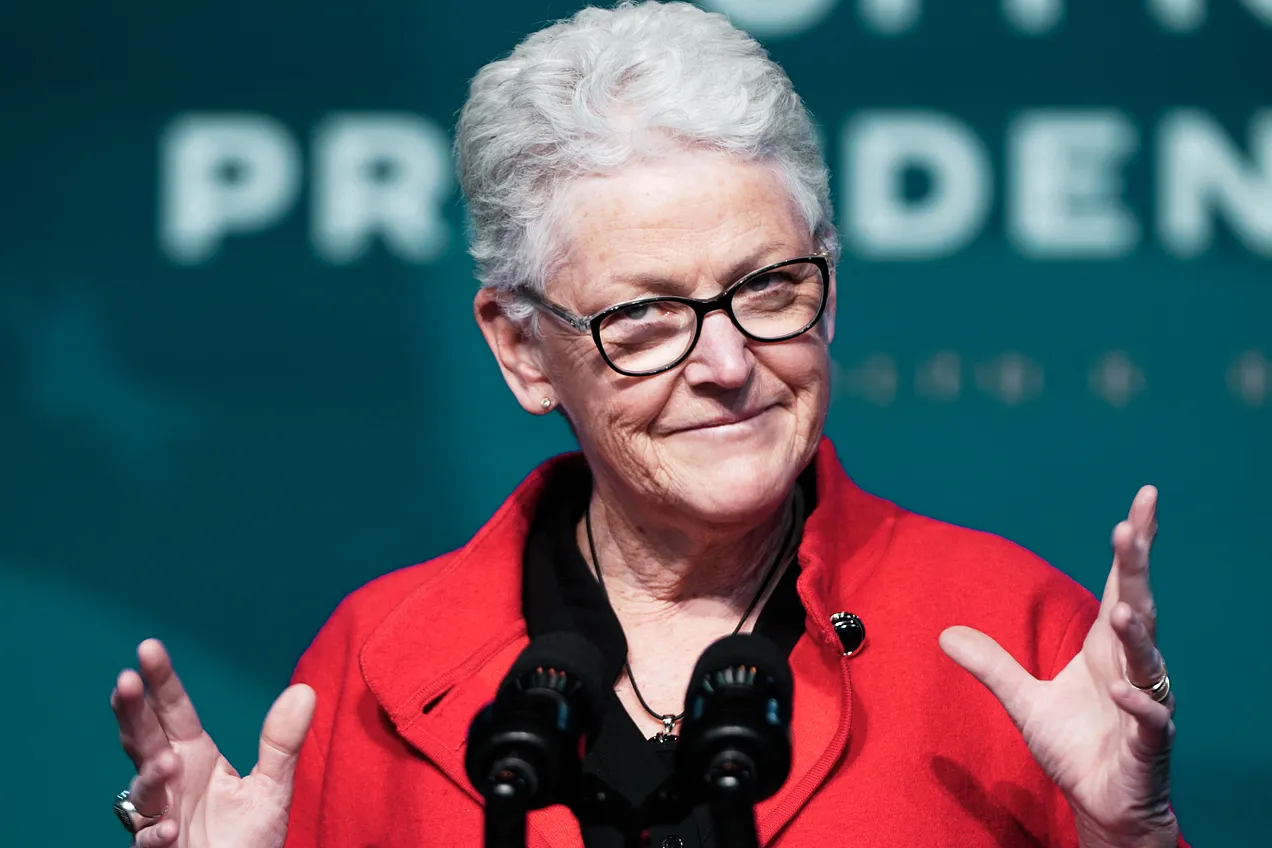
Biden Climate Advisor Gina McCarthy last week demanded that Facebook, Twitter and other social media companies crack down on those who are “seeding doubt about the costs associated with [green energy] and whether they work or not” in the name of public health.

In the face of widespread public outrage, the Biden Administration last month backed away from a proposal to create a disinformation board at the Department of Homeland Security.

But now it’s back with new demands to censor its critics, this time using a tactic that has worked in the recent past: by framing them as a threat to public health.

In a talk with Axios, Biden Administration Climate Advisor Gina McCarthy said, “The tech companies have to stop allowing specific individuals over and over again to spread disinformation.”

After an Axios reporter asked, “Isn't misinformation and disinfo around climate a threat to public health itself?” McCarthy responded, “Oh, absolutely… We are talking, really, about risks that no longer need to be tolerated to our communities.”

McCarthy pointed specifically to those who criticized the failure of weather-dependent renewables during the blackouts in Texas in February 2021. But many of those criticisms were factual. Over the last decade in Texas, investors sunk over $53 billion on weather-dependent energy sources, mostly wind turbines, which alongside frozen fossil fuel plants were largely unavailable during the cold snap in February. That was only partly because of the cold and mostly because of low wind speeds.

McCarthy claimed that the critics of renewables are funded by “dark money” fossil fuel companies, which she compared to Big Tobacco. She claimed the critics are being paid to “fool” the public about “the benefits of clean energy.” “We need the tech companies to really jump in,” she said, because criticizing renewables is “equally dangerous to denial because we have to move fast.”

But the main critics of renewables, including those used in Texas, do not receive funding from the fossil fuel industry. Those critics including Bjorn Lomborg, author of False Alarm, Steve Kooning, author of Unsettled, and me.

Moreover, McCarthy’s own interview with Axios was sponsored by 3M, a major supplier to the solar industry that has lobbied directly for climate and energy legislation that would benefit 3M.

There is no question that social media companies including Meta (Facebook and Instagram), Twitter, and Alphabet (Google and YouTube) are well within their legal right to censor inaccurate and harmful information. But over the last two years, Big Tech has repeatedly censored individuals for communicating accurate information, including on covid and climate change.

Start with covid. In 2020, Facebook and Youtube censored information accurately suggesting that covid may have been created in a lab. Twitter removed a tweet by a member of the White House’s coronavirus task force who questioned the efficacy of masks. And Facebook censored a claim in October by President Donald Trump that a covid vaccine was imminent, which it was.

Censorship continued in 2021 with the encouragement of the White House. In mid-2021, White House press secretary Jen Psaki said the Biden administration was identifying “problematic” covid posts for Facebook to censor. YouTube removed a video in which scientists from Harvard and Stanford expressed their opinion to Florida’s governor that children should not be required to wear masks. And Facebook censored former New York Times journalist John Tierney for accurately reporting on evidence of the harms to children from wearing masks.

There has been a similar pattern on climate change. In 2020, Facebook censored me for correctly pointing out that humans are not causing a sixth mass extinction and that weather-related disasters have become less deadly and less costly over time. Shortly after, Facebook censored John Stossel after he made a video that accurately pointed out that California’s high-intensity fires were mostly caused by poor government management, not climate change. And last year, Facebook censored Bjorn Lomborg for accurately reporting that the British medical journal Lancet found that warmer temperatures save lives.

Facebook and other social media companies give the people they have censored little in the way of an appeal process. After Stossel sued Facebook, its parent company, Meta, said in response to the lawsuit that Facebook’s “fact-checks” are just “opinion” and thus immune from defamation charges.

As such, notes The Wall Street Journal, “Merely pointing out technical limitations of lithium-ion batteries could be ‘disinformation,’” under the expansive censorship framework being proposed by McCarthy, Center for American Progress, and social media companies.

What, exactly, is going on? Given the widespread backlash to its proposed disinformation board, and the unfair censorship of accurate information, why is the Biden Administration once again seeking to censor its critics?

************************************************

If your power goes out this summer, blame President Joe Biden's energy policies

The president is beholden to climate extremists, and his administration is using every tool available to block American energy production. His administration is forcing American families through an energy transition that has no credible economic or technological path forward. It is a bitter pill to swallow.

President Joe Biden speaks during an interview with The Associated Press in the Oval Office on June 16, 2022.
Start the day smarter. Get all the news you need in your inbox each morning.

Struggling with the price of fuel

We are living with the painful results. Consumers are struggling with sky-high energy costs feeding 40-year high inflation. Americans are confronted with a new record-high gasoline price almost daily.

At these prices, the average family could pay about $4,800 this year for gasoline, a 70% increase over a year ago. That pain at the pump is about to get even worse. JPMorgan Chase & Co. forecasts gasoline prices will hit an average of $6.20 a gallon by summer’s end. That’s up from the Memorial Day average of about $4.60.

It is not just gasoline prices pummeling family budgets. The price of electricity is climbing rapidly. In March alone, the average residential price for electricity jumped 4.6% over February’s rate. This was much more than expected and suggests an unusually large annual increase.

Welcome to reality, Mr. President: Inflation has Americans worried

Although consumers pay more for electricity, the service they are getting is growing less reliable. A recent assessment by the North American Electric Reliability Corp. (NERC) reveals that more than half of the country is at an elevated risk or high risk of energy shortfalls this summer – shortfalls that could lead to blackouts and brownouts.

There are a number of reasons for NERC’s findings. Generator retirements, coal supply constraints, the intermittent nature of wind and solar energy, insufficient electric transmission, demand growth, cyber threats and weather events are all factors.

President Biden’s ill-conceived “incredible transition” is making the first four of these factors worse. The NERC official who led the assessment said at a news briefing that the “pace of our grid transformation is a bit out of sync” with the realities of the current grid.

The head of the California Public Utilities Commission made a similar observation, stating, “We know that reliability is going to be difficult in this time of transition.”

Indeed, it has gotten so bad in California that the officials are warning the state could lack adequate electricity generation to keep the lights on this summer. That has prompted Gov. Gavin Newsom to reconsider closing California’s last operating nuclear power plant.

Seeing the writing on the wall

As usual, the American people are a step ahead of the politicians. Power outages are much more than an inconvenience. They impose real costs that can add up to tens of billions of dollars each year. While the administration is calling on Americans to buy high-priced electric cars, they are buying backup generators instead. Consumers see the writing on the wall, and they are acting to keep their lights on.

At the same time as the president’s misguided transition is creating grid instability, his administration is pushing policies that put even greater strain on the electric grid. Take electric vehicles. One estimate suggests, for example, that the United States would have to generate an additional 25% more electricity if all U.S. cars were electric. The “electrification of everything” is not a solution to an unreliable grid. It’s a road to even higher electricity prices and more blackouts.

***********************************************

Germans to fire up old coal plants

Germany will restart coal-fired power plants and offer incentives for companies to curb natural gas consumption, marking a new step in the economic war ­between Europe and Russia.

Berlin unveiled the measures on Sunday after Russia cut gas supplies to Europe last week as it punched back against European sanctions and military support for Ukraine.

The steps, part of a broader strategy initiated after the invasion of Ukraine, aim to reduce gas consumption and divert gas deliveries to storage facilities to ensure that the country has enough reserves to get through the winter.

Russia’s gradual cutting of gas supplies has raised the spectre of a potential fuel shortage if ­Europe goes into winter with less-than-full stowages. It has also raised prices, putting additional pressure on economies that are already struggling with high inflation and rising borrowing costs and face the prospect of a recession.

Nord Stream, the main channel for Russian fuel to Europe, has reported a sharp drop in gas supplies.

Gazprom has blamed the shortfall on missing turbine parts that were stuck in Canada due to sanctions. European officials and analysts dismissed the explanation.

Germany imports about 35 per cent of its natural gas from Russia, down from 55 per cent before the war, and uses most of it for heating and manufacturing, according to German government estimates.

Last year, power generation using natural gas accounted for about 15 per cent of total public electricity in Germany, Economy Minister Robert Habeck said.

To accelerate the decline of gas in the power mix, Mr Habeck outlined a number of steps the government was taking to reduce reliance on gas and build up stores for the coming winter.

In a U-turn for a leader of the environmentalist Green Party, which has campaigned to reduce fossil-fuel use, Mr Habeck said the government would empower utility companies to extend the use of coal-fired power plants.

This would ensure that Germany has an alternative source of energy but would further delay the country’s efforts to slash carbon emissions.

“This is bitter,” Mr Habeck said of the need to rely on coal. “But in this situation, it is necessary to reduce gas consumption. Gas stores must be full by winter. That has the highest priority.”

Mr Habeck said the measure expires on March 31, 2024, by which time the government hoped to have created a sustainable alternative to Russian gas.

***************************************************

Renewable or reliable? Energy cannot be both

Australia’s new ALP government has gigantic green energy plans to be funded by electricity consumers and taxpayers.

They promise (with a straight face) that Australia’s electricity will be 82 per cent renewable by 2030.

They predict a 43 per cent reduction in emissions and being ‘on track for Net Zero by 2050’.

They threaten to litter the landscape with 400 community batteries, 85 solar banks, and a $20B expansion of the electricity grid.

This gigantic ‘green’ electricity plan will need at least 150 million Chinese solar panels covering outback kingdoms of land, plus thousands of bird-slicing metal-hungry wind turbines, plus never-ending roads and powerlines – not friendly to grass or trees and with no room for native birds, bees, bats or marsupials – not green at all.

The ALP has also revived the hoary plan to run an extension cord to Tasmania.

Naturally, some greedy green Tasmanians want to keep all that wind, solar, and hydro energy for themselves. Others dream of sending Northern Territory sunshine up a long cable from Darwin to Singapore.

With enthusiastic support from the new Parliament full of Climatists, Net Zeros, Teals, and Greens (but very few engineers) we can expect a disorderly rush to plaster a mess of electrical machinery and appliances all over the face of Australia.

They will also promote more demand for electricity for electric cars, many seeking overnight charging (despite having zero solar power and intermittent wind power at night). So we will need giant fire-prone batteries to recharge small fire-prone batteries.

When there is no sun on a single solar panel for 12 hours, no one notices; when all wind turbines sit idle for days under a slow-moving winter high, no one cares; but when one aging under-maintained coal plant falters, we notice; when three coal generators fail, we have a power crisis.

Yet we have green millionaires urging quicker closure of our few remaining 24/7 coal-powered generators.

The ALP/Green/Teal plan will clutter the countryside with solar panels, wind turbines, transmission lines, access roads (some bitumen), giant batteries, and fire-prone National Parks.

Eastern Australia recently had several very windy days, which caused many blackouts as trees and powerlines were blown down. Imagine the outages and repair costs after a cyclone slices thru this continent-wide spider-web of fragile power lines connecting millions of wind/solar generators, fire-prone batteries, and diverse markets. Picture the green energy network after the next big flood or bushfire.

Europeans can pretend to run a modern society with intermittent energy from windmills and sunbeams because they can call on reliable energy from French nuclear, Scandinavian hydro, Polish and German coal, Iceland geothermal, North Sea natural gas, and (sometimes) Russian gas, oil, and coal.

Australia has no extension cord to neighbours with reliable energy – we are on our own.

We can have Renewable Energy, or Reliable Energy, but not both.

***************************************

My other blogs. Main ones below

http://dissectleft.blogspot.com (DISSECTING LEFTISM )

http://edwatch.blogspot.com (EDUCATION WATCH)

http://pcwatch.blogspot.com (POLITICAL CORRECTNESS WATCH)

http://australian-politics.blogspot.com (AUSTRALIAN POLITICS)

http://snorphty.blogspot.com/ (TONGUE-TIED)

*****************************************

Monday, June 20, 2022


Lockdowns for hot weather now

Region in France bans outdoor gatherings

Officials in France banned people from attending concerts, outdoor gatherings, and events due to safety concerns over a heatwave.

“Everyone now faces a health risk,” official Fabienne Buccio told France Bleu radio, after announcing the regional restrictions around Bordeaux.

Outdoor events – including, ironically, annual ‘Resistance’ celebrations – are banned until the officials declare the heatwave is over. They’re even restricting some indoor events that don’t have air conditioning.

However, private weddings are still allowed.

Temperatures reportedly hit 40 degrees Celsius on Thursday, and the heatwave is expected to peak on Saturday.

Nonetheless, rather than let people take responsibility for themselves – to hydrate or stay home – French officials are comfortable deciding for them.

Indeed, democratic governments seem comfortable stripping citizens’ freedoms for safety as of late. From COVID lockdowns to climate.

Recently, The Counter Signal reported that climate change lockdowns were likely on the horizon.

For example, unelected IGOs recently advised the British government to outright ban driving on Sundays to curb rising gas prices and address an energy crisis.

The advisement came from the International Energy Agency (IEA) as part of a 10-point plan, central to which is achieving net-zero carbon emissions by 2050.

And this isn’t as conspiratorial as it might sound.

For example, while speaking on behalf of the World Health Organization (WHO), International Council of Nurses CEO Howard Catton claimed that climate change is the “grandmother of all health threats,” suggesting that the WHO may get involved with climate change-related health risks, like heatwaves, in the future.

Moreover, Nicole Schwab, the daughter of World Economic Forum founder Klaus Schwab) recently said she wants governments to take advantage of COVID infrastructure and policies to fight climate change.

*************************************************

Why Corporate Environmental, Social, and Governance Enforcement Is Self-Reinforcing Scam

When the left tries to impose its policy visions on others, often the only winning move is not to play its game.

But when it comes to “ESG,” bureaucrats and billionaires have figured out how to force the rest of us to play along.

ESG, which stands for environmental, social, and governance, is a nebulous phrase that means, in effect, that a company is guided not merely by the goal of serving the public through offering goods and services its customers need, but by left-wing social causes, too.

Investment firms that are guided by ESG will, for example, refuse to invest in or do business with the fossil fuel sector even if doing so would benefit their shareholders or investors. Other ESG-guided entities push for left-wing priorities, such as “civil rights audits”—code for more focus on racial equity—even if that isn’t good for the bottom line.

Some companies will voluntarily adopt ESG in their corporate guidelines and disclosures. Others remain committed to serving the public through offering goods and services at a fair price and aren’t interested in virtue signaling.

But to woke activists and government officials, opting out of ESG is not an option. So, they force noncompliant businesses to conform to ESG by artificially creating real costs for not doing so.

They do this through litigation. They will sue companies—often with dubious or plainly meritless cases—just to create litigation risk and costs. Even if the claims are meritless, businesses face real costs measured in lawyers’ fees, litigation costs, and the risk—however small—of a monetary judgment.

As companies plan, they must consider such costs.

Activists in and out of government deliberately create these costs to make it less attractive for companies to refuse to adopt ESG priorities.

Take the case of Oracle, which was sued by investors because the company allegedly “breached its fiduciary duty by failing to have meaningful diversity on its board and workforce.” The case involved Oracle’s supposed misrepresentation of its diversity measures in public statements.

Although the case was dismissed, it cost Oracle a lot of time, effort, and money to defend against it. And that was just one case. Other companies are hit with similar lawsuits all the time.

The Oracle case illustrates a pattern in ESG litigation. Shareholders use corporate statements—in this case, that Oracle was “actively seeking women and minority candidates” for the board—and then sue the companies under the theory that the company’s failure to realize liberal policy goals renders the statements false.

Activist shareholders create a lot of these ESG litigation costs, but the federal government has even more power to do so, and it uses it.

Recently proposed Securities and Exchange Commission disclosure rules for investors who take ESG into account are a good example. The more companies are forced to issue disclosure statements paying tribute to woke pieties, the more ammunition activist shareholders will have to sue them. And the more disclosure statements companies are forced to make, the more likely it is that the SEC will also sue them for failing to live up to its increasingly liberal expectations.

Consider, too, the SEC’s 2022 examination priorities. According to those, when ESG-motivated investment funds vote their shares in the companies they invest in, the SEC will monitor whether those votes “align with their ESG-related disclosures.”

Given how vague those disclosures often are, that gives the SEC a lot of leeway to interpret them according to left-wing policy goals.

The SEC recently extracted a fine from Bank of New York Mellon after deciding that the bank made “misleading claims” about how it uses ESG criteria to pick stocks.

The fine was small for the bank—$1.5 million—but it likely followed a time-consuming and expensive internal investigation and blackened the bank’s name among investors.

Going forward, the bank will try to avoid reincurring those costs, but that will be hard if the SEC is interpreting and enforcing vague terms. The best move for regulated entities is to recite all the right liberal pieties and play as hard left as possible in the hope that the SEC will think of them as an ideological ally instead of a target.

In 2020, litigation cost companies $22.8 billion, which is comparable to Iceland’s entire gross domestic product. Businesses naturally, and quite rightly, try to minimize those costs. In the ESG space, the only way to do that is to further commit to and pursue ESG priorities.

Some companies, however, are just doomed. These are businesses such as fossil fuel companies that are simply never going to be popular with the activist left no matter how fervently the former endorse left-wing cultural values.

ESG activists in and out of government have not only sued those companies with dubious claims to drive up their costs, they have also tried to cut off their capital.

Trillions of dollars invested in publicly traded companies (which include fossil fuel companies such as BP, Chevron, and Shell) come from pension funds. The trustees of those funds have fiduciary obligations that require them to invest with the goal of maximizing returns for the millions of middle- and lower-income Americans who depend on them for retirement.

They generally cannot pursue “collateral” ESG priorities. That means that they cannot avoid oil companies just because they don’t like them.

They can, however, pursue a “risk-adjusted return” form of ESG investing, where they avoid companies that face litigation risk because that risk might lower the return on investment.

See where this is going?

Activist shareholders, state and local governments, and federal regulators all manufacture litigation risk to impose costs on companies that don’t align with the ESG agenda.

Investment funds can use this litigation risk—no matter how frivolous—as justification to cut off capital from disfavored companies.

Democrats in Congress, too, are trying to help the ESG racket. The House of Representatives last June passed H.R. 1187, which would have required that public companies disclose information about ESG “performance metrics” and would allow the SEC to define that term.

The creation of ESG performance metrics would mean that these often-frivolous lawsuits would be more viable because the companies’ statements would be concrete rather than vague and aspirational, as Oracle’s was.

What we’ve seen is a cycle of left-wing activism that has effectively turned the major players in the country’s economy toward liberal priorities. Many companies play along because they share those values. But even companies that aim to maximize value are now playing along because they have no choice.

Activist litigants, state attorneys general, and bureaucrats are driving up the costs of not playing woke ball.

Things are likely to get worse before they get better because this reinforcing cycle is getting more sophisticated. Additionally, the federal regulatory apparatus will be in woke hands for at least two more years, and they will make the most of that time.

Congress and the courts ought to make clear that the SEC has no authority to enforce these sorts of vague rules.

State regulators ought to make sure that pension funds in their state aren’t violating their fiduciary duties by playing the ESG game. And for states that don’t already require their pension funds to maximize investor returns, they ought to pass model legislation doing that as quickly as possible.

When it’s no longer possible to refuse to play the left’s game, it’s time for powers bigger than woke corporations to shut the game down.

***************************************************

ExxonMobil Fires Back at Biden After Letter Warning Use of Emergency Powers

The Exxon Mobil Corportation fired back at President Joe Biden’s letter calling on U.S. energy producers to bring “near-term solutions” to address rising gas prices and decades-high inflation.

“In the short term, the U.S. government could enact measures often used in emergencies following hurricanes or other supply disruptions—such as waivers of Jones Act provisions and some fuel specifications to increase supplies,” the oil giant said in a news release Wednesday.

And in the longer term, the federal government “can promote investment through clear and consistent policy that supports U.S. resource development, such as regular and predictable lease sales, as well as streamlined regulatory approval and support for infrastructure such as pipelines,” according to ExxonMobil.

Notably, Biden signed an executive order in early 2021 that suspended construction of the Keystone XL pipeline, which would have brought oil from Alberta, Canada, to the interior United States. The move was criticized by oil industry officials, Canadian Prime Minister Justin Trudeau, and Republicans.

In recent days, the president has increasingly blamed oil companies for allegedly gouging consumers as gas prices remain elevated at $5 per gallon. Gas prices nationwide are averaging roughly $5 a gallon, an economic burden for many Americans and a political threat for Biden’s fellow Democrats going into the midterm elections.

“The crunch that families are facing deserves immediate action,” Biden wrote in a letter this week to seven oil refiners, including Exxon. “Your companies need to work with my Administration to bring forward concrete, near-term solutions that address the crisis.”

In the letter, Biden suggested that he might use emergency powers, adding that his “administration is prepared to use all reasonable and appropriate Federal Government tools and emergency authorities to increase refinery capacity and output in the near term, and to ensure that every region of this country is appropriately supplied.”

But the American Petroleum Institute, which represents the industry, said in a statement that capacity has been diminished as the Biden administration has sought to move away from fossil fuels as part of its climate agenda. Meanwhile, several prominent White House officials continue to tout electric vehicles as a means to escape the current high gas prices despite the average cost of a new EV being about $56,000.

“While we appreciate the opportunity to open increased dialogue with the White House, the administration’s misguided policy agenda shifting away from domestic oil and natural gas has compounded inflationary pressures and added headwinds to companies’ daily efforts to meet growing energy needs while reducing emissions,” American Petroleum Institute CEO Mike Sommers said in a statement.

***********************************************

The Dark Ages for Australian energy

When the sun finally sets on the West, the English-speaking peoples will find out that they are as fragile and expendable as the starving third-world children used by aid organisation to pick pockets.

Modernity is held together by cheap energy, not the rainbow-padding nonsense of progressive politics that does little but catch fire on the frayed wires of civilisation, much like Rudd’s notorious pink batts.

Yesterday, millions of Australian homes on the east coast were told to switch off non-essential appliances after blackouts began and extended short-falls loomed. Energy suppliers cautioned the affluent Teal-heartland of Sydney’s Northern Beaches that they were at risk of losing power as temperatures plunged. Suggestions such as ‘consider how many rooms need to be heated’ were made, presumably targeted to the mansion-dwelling community who voted to put ‘Climate Change’ above energy security.

Green-tinged Queensland suffered a similar problem, with the situation so concerning that the Australian Energy Market Operator (AEMO) put in place a $300-per-megawatt-hour price cap.

As a result, everyone is turning to gas suppliers in a panic, demanding that gas companies ‘find gas’ and offer it at ‘low prices’ – or else? This would be after the government went out of its way to deny the gas industry in favour of their preferred ‘renewables’ mates. The gas industry is unsurprisingly reluctant to help out, considering they require $500-per-megawatt-hour to profit.

As a side note, the climatecouncil.org.au insists, ‘Output of oil and gas in developed nations needs to be cut by 74 per cent by 2030, with a complete phase-out by 2034.’ That is going to be tricky with renewables leaning on gas to cover the giant voids in output. Basically, if you’re still breathing, somewhat warm, and well-fed – you’re probably a burden to the climate goal.

Back in the real world, if governments and energy suppliers are begging people to turn off their toasters, it’s a good thing the Australian population ignored Labor’s demands to switch to electric vehicles or we’d be waking up to streets littered with expensive, useless cars.

The price cap has created its own problem, with the Australian Energy Regulator issuing a letter to power generators instructing them to ‘bid capacity into the market’ regardless of the cap as blackouts threaten across the country. The existence of price caps causes energy providers to withhold supply to protect revenue – which is why socialist-style intervention on market prices rarely works. The government gives ‘stuff away for free’ but businesses can’t do that or there will be nothing for tomorrow.

According to an article in The Australian, AER chair Clare Savage had this to say:

‘Recently the AER has observed that following the application of administered pricing in the NEM, generators are withdrawing available capacity from the market. This behaviour may be motivated by generators seeking to avoid the administered pricing compensation process in favour of the AEMO directions compensation process. As you know, market participants must not, by any act or omission, whether intentionally or recklessly, cause or significantly contribute to the circumstances causing a direction to be issued, without reasonable cause.’

New Energy Minister Chris Bowen has done a lot of theatrical waving of his hands, pretending that there’s ‘nothing to see here’ as the country faces an energy crisis.

‘The operator tells them there is no need to be concerned about blackouts in the immediate future,’ Bowen said, giving a speech that should never have to be made in a responsible, first-world nation. ‘Nobody should turn off any power usage that they need, that they are using for their comfort or their safety. Nobody should do that.’

When the energy grid was truly competitive, Australia had reliable, cheap, and plentiful energy. The interference of government has had disastrous consequences, with public money being tossed at ‘renewables’ to make them look more ‘profitable’ when in reality, they are propped up by taxes. Productive energy sources have been punished by severe restrictions on access, expansion, and investment. Banks have gone so far as to consider denying loans in the fossil fuel sector to keep green-themed shareholders happy.

The same people who did their best to demonise and dismantle the fossil fuel grid are now complaining about the shutdown of coal-fired plants. Well kids, this is a glimpse of the future promised by Labor, the Greens, Teals, and Liberal moderates.

There is a solution to both ‘climate woes’ and energy security in the form of nuclear energy – a technology for which Australia is uniquely placed to benefit. Labor has given a definitive ‘no’ on nuclear, almost certainly because they felt their green investment portfolio shudder in terror. The introduction of nuclear to the Australian grid erases the need for solar, wind, and battery storage – destroying profits for the ‘green economy’.

At the same time as federal Labor has been out – quite literally – begging coal-fired plants to increase their operation to stave off disaster, Western Australia Labor Premier Mark McGowan has promised to close all state-owned coal-fired plants by 2030 and gift renewables barons $4 billion in public money. He complains that the ‘glut of excess power’ produced by them is costing money – so one is left to wonder why McGowan’s idea of saving $3 billion over ten years involves spending $4 billion.

‘We’re standing at a point where to continue business as usual would lead to around $3 billion of losses by the end of the decade. Those losses either have to be covered by taxpayers or would lead to dramatically higher power bills for West Australians – while still continuing to emit higher levels of carbon emissions. Either way, it’s simply not sustainable in the long term.’

Why not just close the power stations and let the renewables sector expand on its own? Or is it not profitable without a drip attacked to the state coffers…?

No, don’t bother looking for the Liberal Party. It was former-Liberal Leader Zak Kirkup’s idea in the first place. The great news is that Western Australia doesn’t have an extension cord long enough to cross the desert, so McGowan will have nowhere to hide when it all goes horribly wrong.

All this is taking place while bored billionaires purchase coal-fired power stations for fun and shut them down unnecessarily.

The result of closing power plants is a sudden and drastic reliance on gas – of which there isn’t an infinite amount to go around. Shortages are being flagged, even if resources are expanded. Gas was meant to prop renewables up for decades, but the determination for ‘climate action right-now’ is resulting in the ridiculous culling of gas reserves which will, in turn, limit the lifespan of the renewables industry.

This is all complete madness when a few strategically placed nuclear plants could permanently solve the energy crisis with next-to-no emissions. For those who say, ‘oh nuclear is expensive!’ weren’t they telling us that ‘no expense is too much to save the world from extinction?’ We’re not told the total green price tag, but subsidies for renewables alone were set at $11.6 billion in 2021.

The answer is sitting in front of Australia, but governments, the energy industry, and mining companies have no interest in pursuing nuclear until they have dug up and sold every last dollar from other resources that are set to be devalued when the ‘Nuclear Age’ arrives.

Energy supply doesn’t care much for virtue-signalling politics or the ambitions of career politicians. It is a world of engineering absolutes, brick walls, and fail points. Reliable, stable power is essential to sustain the lives of millions of people where even short-lived blackouts pose a serious threat.

Hippy colonies can get away with a few cold nights or a failed market garden by collapsing around a campfire for a bit of weed-induced ‘Kumbaya’ followed by a sneaky trip to the local shops. When the same thing happens to a city, panic takes hold. Investors pull out. Businesses close. The elderly freeze to death.

Covid was not an emergency. Sustained blackouts and a ruined power grid is an emergency.

Any government that chooses to play politics with energy is reckless to the point of criminal. Finally (and just for fun) what happens if Australia finally gets its 100 per cent magnificent wind and solar grid backed up by battery power during the night when there’s no wind?

Uh, blackouts…

***************************************

My other blogs. Main ones below

http://dissectleft.blogspot.com (DISSECTING LEFTISM )

http://edwatch.blogspot.com (EDUCATION WATCH)

http://pcwatch.blogspot.com (POLITICAL CORRECTNESS WATCH)

http://australian-politics.blogspot.com (AUSTRALIAN POLITICS)

http://snorphty.blogspot.com/ (TONGUE-TIED)

*****************************************

Sunday, June 19, 2022


MSNBC Warns 'Less Than a Decade' To Save the Planet

There have been many such prophecies. All have failed

Against the backdrop of extreme weather across the country, Chris Jansing welcomed Penn State University’s Michael Mann to declare that “we have less than a decade” to save the planet.

image from https://i.imgur.com/aPcWMDW.png

Jansing teed Mann up quoting President Biden and wondering, “So, let me ask you specifically about what the president just said, that ‘the science tells us the window for action is rapidly narrowing.’ How rapidly and how narrow is it?”

Repeating Biden’s words, Mann went full Doomsday prophet, “Rapid and narrow. We have less than a decade now to bring carbon emissions down globally by 50% if we are to remain on a path that keeps warming below that, sort of, catastrophic one-and-a-half degree Celsius, three degree Fahrenheit warming of the planet where the things that we’re starting to see now become much worse and we get extremes that we haven't seen before and so that’s not someplace we want—we want-- to go.”

For Mann, there is still some good news, “We want to prevent the problem from getting worse and that means decarbonizing our economy rapidly. That means we need legislation and there’s still an opportunity to pass climate legislation this term in Congress, if we can, you know, get a few stragglers to get behind some—some--, you know, basic policies that would incentivize renewable energy that would begin to defund infrastructure for fossil fuels.”

People paying over $5 per gallon might have something to say about that, but Mann didn’t care, “These are things we need to do now. We can't wait, because we have to get on that path immediately if we are to prevent the worst impacts of climate change.”

Starting to bring the segment to a close, Jansing hoped recent disasters could spur change, “We've only got 30 seconds, but I have to ask you, do you think that because of the economic impact, not to mention lives lost because of the extreme weather conditions, governments that have been slow to act, members of Congress who have been slow to act, might actually take more action?”

Mann replied that was his hope and used gun control as his analogy, “Well, let's hope so. We never thought that we would see any possibility of any sort of common sense gun legislation, and we're seeing that now because there's a demand on the part of the people, because people are crying out and demanding their policy makers to do something. We need to see the same thing with climate. We need to demand that our policymakers act now before it is too late.”

Just once it would be nice if a host could ask Mann or his associates about some of the past prophecies that have failed to come true, but that would require some criticism of Mann, which he does not take well.

*******************************************

Moment furious Italian motorists drag Extinction Rebellion protesters away to let traffic pass after activists staged a sit-in blockade of one of Rome's busiest roads

How come Italians are the only ones with any guts?

This is the moment Extinction Rebellion activists were forcibly removed by furious Italian motorists after they blocked a busy motorway in Rome on Thursday.

Demonstrating over environmental issues, the protesters sat in a row across Rome's Raccordo - the city's main ring-road and one of its busiest - holding banners.

A video shot from the side of the two-lane road showed the demonstrators using road-block protest tactics also used in Britain, causing a huge traffic jam to snake back as far as the eye could see, with no police officers or vehicles in sight.

In response, irate Italian motorists at the front of the queue jumped out of their vehicles to take action - dragging the protesters across the tarmac and dumping them on to the side of the road.

One man ripped an orange banner from the hands of the Extinction Rebellion activists and threw it over the side of the motorway barrier. A woman, dressed in a summer dress while still carrying her handbag, tore a second sign from their grasp.

After removing the banners, a second man joined the first in forcibly dragging the protesters by their arms across the tarmac to the side of the road, making enough of a gap for several vehicles to get through and past the demonstration.

However, as the first man was dragging the remaining protesters off the road, the activists he had first removed saw an opportunity and ran back into the middle of the road, and in front of the on-coming traffic - only to sit down again with their banner.

With the traffic again being blocked, the man grabbed one of the female protesters by the hair and dragged her again to the side of the road. This did not deter her, however, as she quickly shuffled back in front of the traffic.

According to Italian publication Corriere Dello Sport, the young protesters were part of an Extinction Rebellion off-shoot group called the 'Last Generation' campaign.

The group is calling for the end of all fossil fuel extraction projects, and is demanding that Italy does not restart its coal plants - and instead develop more wind and solar energy sources.

Britain has been grappling with similar protests in recent years, with Extinction Rebellion also wreaking havoc on public transport. Another group - Insulate Britain - have used the same road-block tactics as the activists in Italy.

Legal action has been taken against the protesters, and injunctions have been taken out to deter activists with potential prison sentences.

The video showed the first man - wearing sunglasses, shorts and a T-Shirt - shouting in the face of the female activist who had sat back down in the middle of the road.

This time, he picked her up and threw her to the side of the road. In the meantime, the second man was able to make a gap in the activists long enough for more cars and trucks to drive through and away from the scene.

By the end of the video, however, the protesters are shown persisting with their efforts, blocking at least half of the road - again with their orange banner.

Corriere Dello Sport reported that the protest was eventually broke up with the arrival of local police, the Carabinieri (federal police) and the Digos (special forces) - with the protesters being taken into custody.

***********************************************

UK Car industry in shock and fuel prices climb as government scraps all grants for electric vehicles

Motoring groups have criticised the government’s decision to scrap subsidies for newly purchased electric vehicles (EVs), fearing it could dissuade buyers from entering the market.

In a shocking blow the car industry, the Department for Transport (DfT) has revealed that £1,500 grants for purchases of new electric cars that cost under £32,000 have been ditched.

The DfT argued the “success” of the Plug-in Car Grant means the Government will now “refocus” the funding to encourage users of other vehicles to make the switch to EVs.

Existing applications for the grant “will continue to be honoured”, the DfT added.

Transport minister Trudy Harrison said: “Government funding must always be invested where it has the highest impact if that success story is to continue.”

“Having successfully kickstarted the electric car market, we now want to use Plug-in Grants to match that success across other vehicle types, from taxis to delivery vans and everything in between, to help make the switch to zero emission travel cheaper and easier.”

She argued the Government continues to invest record amounts in the transition to EVs – with £2.5bn injected since 2020 – and that Downing Street has set the most ambitious phase-out dates for new diesel and petrol sales of any major country.

Downing Street has targeted 2030 for the phasing out of new petrol and diesel car sales in the UK.

However, motoring groups have suggested this target will be difficult to achieve without the support of grants;

The AA has slammed the decision, warning that many motorists being forced to wait for a new EV due to global supply constraints will lose out.

Its president Edmund King said the grants were “essential for many drivers making the switch from petrol and diesel.”

He said: “The plug has been pulled at the wrong time on this important grant before many users, still waiting for delayed EVs due to global shortages, have made the change. Drivers, and indeed many fleets, planning to make the switch to EV, may now back out until they can find more cash.”

Rival motoring group RAC also questioned the move, raising concerns lack of financial support for aspiring EV owners could stifle the UK’s green ambitions.

Head of policy Nicholas Lyes said: “The UK’s adoption of electric cars is so far impressive but in order to make them accessible to everyone, we need prices to fall – having more on the road is one important way of making this happen, so we’re disappointed the Government has chosen to end the grant at this point. If costs remain too high, the ambition of getting most people into electric cars will be stifled.”

Sales of fully electric new cars have risen from fewer than 1,000 in 2011 to nearly 100,000 in the first five months of 2022/

This suggests EVs are finally breaking into the mainstream, with sales outstripping diesel vehicles last year.

Petrol prices reach new heights as CMA reviews retail markets
The scrapping of EV grants comes amid skyrocketing forecourt prices, with petrol prices climbing to new highs in Tuesday’s trading.

The average price of a litre of petrol at UK forecourts reached a new record of 185.4p yesterday -an increase of 6.9p in just a week.

This follows a 10p hike in petrol prices in May.

Concerns over prices at the pumps has led to the Competition and Markets Authority launching a review of the retail market, with Business Secretary Kwasi Kwarteng raising concerns that the five pence fuel duty cuts are not being passed on to consumers.

Tom Hatton, head of product management at analytics group Kalibrate told City A.M. petrol retailers are not engaging in wholesale profiteering despite record forecourt prices,

Instead, he suggested fuel vendors were ramping up prices for consumers in line with higher wholesale costs more quickly than they did in the past, with retailers more cautious amid soaring oil prices and geopolitical volatility.

He argued: “We have not seen cumulative rises like this for years and years.”

*****************************************************

Australia: NSW will need Narrabri gas mine says minister in Leftist Federal government

Pleasing realism

Resources Minister Madeleine King has warned of a bigger energy crisis in future years if new gas fields like the Narrabri project in northern NSW do not go ahead, declaring that critics of the project should accept the need for gas as part of the transition from coal to renewable energy.

Warning of gas shortfalls that could hurt industry and households, the new federal minister said Narrabri should proceed if it met environmental safeguards and all the gas should flow to the domestic market.

Santos wants to produce the first gas from the controversial project in 2026 and says it could sell the gas “two or three times over” on the domestic market because demand is so strong, but the company must gain state and federal approvals for gas production and a pipeline to Sydney.

The gas field is opposed by the Australian Conservation Foundation, Greenpeace, the Climate Council, the Gomeroi traditional owners and others, while Greens leader Adam Bandt wants federal Labor to halt all new gas and coal projects.

King said she hoped the project would go ahead but understood it had to pass further regulatory checks, including challenges under native title legislation.

“If Narrabri meets all the environmental standards, and by all accounts it does, then it makes sense for it to go ahead,” King said in her first interview with the Herald and The Age since taking office.

“It is an important gas reserve that will help the population of NSW address a future power crisis. It avoids a crisis, is what it does, because it means more gas closer to your systems.”

While the NSW government has backed the Santos plan in principle, the project is subject to independent environmental approvals while the government also examines a separate plan to build an import terminal in Port Kembla to supply gas that has been shipped from Western Australia.

King emphasised that she wanted to “decarbonise” the economy by shifting to renewables but had to deal with household and industry demand “and accept some of the realities of our current energy mix”.

She said demand for gas would fall over time and she wanted Australia to reach net zero emissions by 2050 with Labor policies to shift to renewables and invest in the electricity grid, but she said gas was part of the transition because it would replace dirtier emissions from coal-fired power.

“I understand people’s concerns about there being a lack of determination around meeting net zero emissions and a lack of an energy plan and that has been because of the climate wars in this country in the last 10 or 15 years,” she said.

“I have a lot of sympathy for it and I’m as angry as anyone about the inaction that has allowed the current crisis to be upon us.

“But everyone needs to understand, especially I think in some of the southern states, that right now when you flick on your light switch or have your dishwasher running or turn on your telly, for the most part, that moves a turbine in a coal-fired generator ... you’re using more coal, which is high in emissions.

“While the government is now bringing in an energy plan which will get working on renewables, and that’s our very determined ambition, gas is the transition fuel that is able to bring down emissions in the short term.

“So it’s not a perfect answer. We’d all love to switch straight from coal to renewables. But it’s simply not possible,” she said.

“So I guess for the good people of NSW, they need to consider what they really want. And I imagine they still want to be able to turn on their television and keep their fridge running.

“What is the current means to be able to do it and be on a downward trajectory with emissions? Well, it’s via gas on the way to a proper, solid, reliable transmission system that allows renewables and the storage of renewables to operate into the long term.

“We’ve got a long way to go, actually, because of the lack of investment over the last 10 or 15 years and you can’t switch on investment like we switch on lights.

“And for those people that will get angry at me for what I’ve said, I just want to let them know that I want to clean and decarbonised world as well. And that’s what we’re working towards. It might not be on the same timeline as others. But we are all going through the same goal.”

Santos has promised in the past that all the gas from Narrabri would serve the domestic market if the project gained approval, making this part of its formal submission to the Independent Planning Commission.

“Santos has committed to providing all this gas to the domestic market and agreed to accept a condition to this effect on any petroleum production lease granted for the project under the Petroleum (Onshore) Act 1991,” the company wrote.

Santos chief executive Kevin Gallagher confirmed the pledge in an interview on Sky News on June 8.

***************************************

My other blogs. Main ones below

http://dissectleft.blogspot.com (DISSECTING LEFTISM )

http://edwatch.blogspot.com (EDUCATION WATCH)

http://pcwatch.blogspot.com (POLITICAL CORRECTNESS WATCH)

http://australian-politics.blogspot.com (AUSTRALIAN POLITICS)

http://snorphty.blogspot.com/ (TONGUE-TIED)

*****************************************

Friday, June 17, 2022


How millions of lives can be saved if the US acts now on climate

Utter rubbish. Warming would SAVE lives. Winter is the time of dying, not summer

The rapidly shrinking window of opportunity for the US to pass significant climate legislation will have mortal, as well as political, stakes. Millions of lives around the world will be saved, or lost, depending on whether America manages to propel itself towards a future without planet-heating emissions.

For the first time, researchers have calculated exactly how many people the US could save by acting on the climate crisis. A total of 7.4 million lives around the world will be saved over this century if the US manages to cut its emissions to net zero by 2050, according to the analysis.

The financial savings would be enormous, too, with a net zero America able to save the world $3.7tn in costs to adapt to the rising heat. As the world’s second largest polluter of greenhouse gases, the US and its political vagaries will in large part decide how many people in faraway countries will be subjected to deadly heat, as well as endure punishing storms, floods, drought and other consequences of the climate emergency.

“Each additional ton of carbon has these global impacts – there is a tangible difference in terms of death rates,” said Hannah Hess, associate director at the research group Rhodium, which is part of the Climate Impact Lab consortium that conducted the study. “There’s a sense of frustration over the lack of progress at the national level on climate but every action at state or local level makes a difference in terms of lives.”

The lab’s new “lives saved calculator” uses a model of historical death records and localized temperature projections to come up with an estimate for the number of lives saved if emissions are eliminated. The analysis just looks at lives at risk from extreme heat, meaning the true climate toll would be higher due to other growing threats such as flooding and strong storms.

Just 10 US states could save 3.7 million lives worldwide by cutting their emissions to net zero, largely due to their high consumption of fossil fuels. Texas alone could save 1.1 million lives. But even action in less populous states would have a benefit: Idaho is capable of saving about 68,000 lives, Kansas could save 126,000 lives and Hawaii could save about 16,000 lives.

Hess said that rising heat this century will cause an uneven distribution of deaths around the world, mainly focused on areas such as north and west Africa, as well as south Asia. India and Pakistan recently endured a brutal heatwave of temperatures reaching 122F (50C) in some places, which killed several hundred people and was made 30 times more likely by the climate crisis.

“People have different abilities to adapt depending on the resources they have to protect themselves from extreme heat,” said Hess. “The hottest places don’t all face equally elevated risk of death; it’s closely tied to economic growth. Within the US there are impacts in places like southern California and Texas, but the US is really eclipsed by poorer regions of the world when it comes to these sort of deaths.”

************************************************

Climate change may NOT kill polar bears: Scientists discover a population THRIVING in the ice-free sea as the animals adapt to rising temperatures

While polar bears are often used as the poster child for climate change, a new study has cast doubt on whether rising temperatures will really kill off the animals.

Researchers from the University of Washington have discovered a new population of polar bears thriving in the ice-free sea in Southeast Greenland.

The population is genetically distinct and uniquely adapted to the ice-free environment – and could help to shed light on the future of the species amid rising temperatures.

'Polar bears are threatened by sea ice loss due to climate change,' said Dr Kristin Laidre, who led the study.

'This new population gives us some insight into how the species might persist into the future.

'But I don't think glacier habitat is going to support huge numbers of polar bears. There's just not enough of it. We still expect to see large declines in polar bears across the Arctic under climate change.'

The population has access to sea ice for four months of the year – from February to late May.

During the other eight months, the polar bears hunt seals from chunks of freshwater ice breaking off the Greenland Ice Sheet.

'The marine-terminating glaciers in Southeast Greenland are a fairly unique environment,' said co-author Twila Moon.

'These types of glaciers do exist in other places in the Arctic, but the combination of the fjord shapes, the high production of glacier ice and the very big reservoir of ice that is available from the Greenland Ice Sheet is what currently provides a steady supply of glacier ice.'

Based on historical records and Indigenous knowledge, the researchers knew there were some bears in Southeast Greenland.

However, until now, the region hasn't been studied in detail because of its unpredictable weather, jagged mountains, and heavy snowfall.

'We wanted to survey this region because we didn't know much about the polar bears in Southeast Greenland, but we never expected to find a new subpopulation living there,' Dr Laidre said.

'We just didn't know how special they were.'

In the study, the team combined 36 years of movement, genetic and demographic data to assess the population for the first time.

Their results showed that this group is comprised of a few hundred bears and is genetically distinct from any of the 19 previously known polar bear populations.

'They are the most genetically isolated population of polar bears anywhere on the planet,' said co-author Professor Beth Shapiro.

'We know that this population has been living separately from other polar bear populations for at least several hundred years, and that their population size throughout this time has remained small.'

Body measurements suggest that the adult females are smaller than other regions, and have fewer cubs, which may reflect the challenge of finding mates in the complex environment, according to the team.

Satellite tracking of adult females within the population shows that the bears are homebodies – unlike most other polar bears, who travel far over sea ice to hunt.

This group walks on ice inside protected fjords, or scramble over mountains to reach neighbouring fjords over the Greenland Ice Sheet, according to the team.

Of the 27 bears tracked, half accidentally floated an average of 120 miles south on small ice floes caught in the East Greenland coastal current, before hopping off and walking home on land.

'In a sense, these bears provide a glimpse into how Greenland's bears may fare under future climate scenarios,' Dr Laidre said.

'The sea ice conditions in Southeast Greenland today resemble what's predicted for Northeast Greenland by late this century.'

The population has access to sea ice for four months of the year – from February to late May.

During the other eight months, the polar bears hunt seals from chunks of freshwater ice breaking off the Greenland Ice Sheet.

**********************************************

The Revenge Of The ‘Fossil Fuels’

Energy prices across the board — from thermal coal and natural gas to diesel and gasoline — have surged over the past year and have only been accentuated by the financial sanctions on Russia after its invasion of Ukraine.

On Monday, Goldman Sachs published a report that revised its oil price outlook higher (again), raising its peak summer price forecast for Brent crude from $125/barrel to $140/barrel. But it is not only crude oil prices that are likely to remain stronger for longer.

Countries around the world are struggling with energy shortages and price spikes as energy security and affordability are propelled to the policy centre-stage after Russian tanks rolled into Ukraine.

Yet it would be myopic to view surging energy prices merely as a result of the Russian invasion.

The recent price spikes in fuels are a cumulative result of government policies in the West that have focused obsessively with the speculative, model-based forecasts of the climate impacts of carbon emissions.

The climate industrial complex has vilified ‘fossil fuels’ over the past few decades in the name of a presumed impending climate apocalypse. It starved the oil, gas and coal sectors of capital investments and diverted trillions of dollars of public funds to subsidize wind, solar and electric vehicle industries.

What Stranded Resources?

Mark Carney, the “rock star” ex-central banker, is a member of the Foundation Board of the World Economic Forum and became the UN Special Envoy on Climate Action and Finance in 2019.

He was appointed finance advisor for the UK presidency of the COP26 United Nations Climate Change conference in Glasgow held in November. Mr. Carney spent the last few years persuading the world’s financial institutions that ‘fossil fuels’ – accounting for over 80 per cent of global primary energy supply – are “stranded assets” on a one-way trajectory to zero value as the world races to “net zero (carbon emissions) by 2050”.

Mr. Carney isn’t the only illustrious professional on the “fossil-fuels-are-stranded-resources” bandwagon.

A short list would include U.S. Treasury Secretary Janet Yellen, BlackRock BLK -2.4% chief executive Larry Fink and Fatih Birol, the Executive Director of the International Energy Agency.

They assert an “existential threat” of ‘climate change’ caused by the combustion of ‘fossil fuels’. These leaders in finance and public policy circles are joined in the popular media by climate Jeremiahs such as Al Gore, Bill McKibben and Prince Charles who have used their bully pulpits to encourage divestment from fossil fuel companies.

One year ago, ExxonMobil gained much media attention as it was forced to concede three board seats to climate activist investor Engine No. 1 in the industry’s biggest and most closely watched corporate contest.

Critics of the company’s business strategy railed against the company’s “lack of attention” to alarmist climate concerns. The company had fallen out of favour of the “Woke Inc.” Wall Street hedge funds and was ditched from the Dow Jones index in 2020.

And now, the company is the darling of Wall Street as it spews cash for shareholders. According to analyst Stephen Richardson cited by a Bloomberg piece on ExxonMobil’s remarkable turnaround in its stock price, “every conceivable headwind has become a tailwind” given the “structural deficit” in crude oil markets.

The Green Pain Is “Worth It”

But the revenge of the ‘fossil fuels’ is hardly restricted to ExxonMobil’s resurgent stock value. It is no small irony that a vast swath of the U.S. — from the Great Lakes to the West Coast, covering some two-thirds of the world’s richest country — is at risk of blackouts this summer according to the North American Electric Reliability Corporation (NERC).

As expected, progressive commentators and NERC itself blame this on predicted extreme heat and drought. Yet the US has had extreme weather before.

After decades of shutting down reliable (i.e. dispatchable power 24/7) coal and nuclear generating plants and replacing them with erratic, weather-dependent solar and wind power, the US national grid is now destabilized and vulnerable to surges in demand and supply.

Last year’s near-catastrophic blackouts in Texas after a sudden cold snap is illustrative. As one editorial of a major national newspaper put it after NERC’s warning: “Summer is around the corner, and we suggest you prepare by buying an emergency generator, if you can find one in stock… Welcome to the ‘green energy transition’.”

Europe and the UK, global leaders in the “energy transition” efforts, also face potential blackouts as aggressive retirements of nuclear, coal and gas-fuelled plants have been replaced by unreliable renewables over the past two decades.

A shortage of gas this winter could leave six million homes in the UK without power, the UK government recently warned.

True to “the revenge of fossil fuels” theme, the government has asked coal power stations it had previously ordered to close down to remain open.

As if putting salt into an open wound, the IEA’s executive director Fatih Birol warned that Europe could be forced to start rationing energy this winter especially if the winter is cold and China’s economy rebounds.

This is the same person who announced the astonishing Net Zero “roadmap” — published by the IEA with much fanfare in May 2021 — which called for the global cessation of all new investments in ‘fossil fuels’.

*************************************************

Australia: Green lunacy

He mentions storage but shows no awareness of its monstrous cost if it were to replace much generating

Chris Bowen has furiously dismissed suggestions that prolonging coal-fired power is the solution to Australia's energy crisis

The Energy Minister Minister fired-up in a press conference when he was challenged by a journalist about the unreliability of renewable energy.

One of the reasons given for the National Electricity Market suspension on Wednesday was a lack of wind and solar power.

The journalist asked: 'Isn't part of the supply problem the fact that you cannot direct wind into the market?

'The only thing you can do is to keep the coal-fired generators going to their end of life and to fix the ones that you have got now and include them in the capacity market, isn't that the short-term fix?'

Minister Bowen said the solution is to rapidly invest in renewable energy and storage - not more unreliable coal power.

'The problem is there is not enough investment in renewable energy. There hasn't been enough investment in storage,' he said.

'Yes, you can say the wind doesn't always blow and the sun doesn't always shine. The rain doesn't always fall either but we can store the water and we can store renewable energy if we have the investment.

'That investment has been lacking for the last decade. That is the problem.'

Mr Bowen said the current crisis has 'largely' been caused by unexpected outages at coal-fired power stations which are nearing the end of their lifespans.

Opposition leader Peter Dutton cautioned Labor against moving into renewables too quickly, risking further power shortages down the track.

'Labor is rushing toward a new system when it's not at a sensible pace,' he told 2GB.

'They went into the election promising electricity bills would be cheaper and that is not going to happen.'

Last night hospitals were ordered to reduce electricity use and millions of people urged not to use basic appliances.

The potential for mass blackouts has increased with about 1800MW of coal-fired power not operating in Queensland and 1200MW of capacity offline in the states of NSW, Victoria, South Australia and Tasmania.

The Tomago aluminium smelter in NSW, the country's biggest electricity user, was also forced to cut production to reduce the chance of a blackout.

NSW Treasurer Matt Kean on Wednesday evening begged residents not to run dishwashers until late at night, and Sydney hospital staff were ordered to conserve power in all non-clinical settings.

'This is the result of two-and-a-half decades of policy failures by all sides of politics,' Victorian state Liberal MP Tim Smith said on Wednesday night. 'Like a third world country, we are rationing power in the two first weeks of winter.'

Former Victorian Liberal Party President Michael Kroger said Australia had become 'an international laughing stock' over the crisis.

'We've got more uranium, oil, gas, gold, diamonds, whatever. We are the most energy rich country on the globe,' he told Sky News on Wednesday night. 'We're exploding with natural resources, yet we have an energy crisis. What a farce.'

***************************************

My other blogs. Main ones below

http://dissectleft.blogspot.com (DISSECTING LEFTISM )

http://edwatch.blogspot.com (EDUCATION WATCH)

http://pcwatch.blogspot.com (POLITICAL CORRECTNESS WATCH)

http://australian-politics.blogspot.com (AUSTRALIAN POLITICS)

http://snorphty.blogspot.com/ (TONGUE-TIED)

*****************************************