Wednesday, August 25, 2021


Climate crisis made severe rains behind Europe’s 2021 floods ‘up to nine times’ more likely

This is just modelling. There is no actual evidence for the claim

The extreme rainfall that triggered devastating and deadly flooding across western Europe last month was made between 1.2 and nine times more likely by the climate crisis, a rapid analysis finds.

Severe downpours similar to those suffered in countries including Germany, Belgium and Switzerland last month are now 3 to 19 per cent heavier because of human-driven global heating, the research says.

Previous rainfall records were smashed in parts of Germany and Belgium last month, causing rivers to burst their banks and unleash deadly waters.

The unprecedented flooding killed at least 220 people in Germany and Belgium, and caused £4.9bn (€5.5bn) worth of damage in Germany alone.

“Climate change is hitting us everywhere now,” Dr Maarten van Aalst, one of the research authors and director of the international Red Cross Red Crescent Climate Centre, told a press briefing.

“I hope it’s a wake-up call to not just people that have been affected, but people elsewhere [too].

“We are facing more extreme events of many kinds, and the only thing we can do is to close the tap of increasing greenhouse gas emissions ... and to prepare for the more extreme climate that we live in.”

Similar rainfall events are currently expected to occur around once every 400 years for any given region in western Europe, the analysis says.

“Even with climate change, this was a very rare event,” said Dr van Aalst.

“But this is just one event in one place that is happening every 400 years. If you look around the world, we’re going to be seeing many of those things that only happen once every 400 years.”

****************************************

Have you been greenwashed? The dirty secret behind 'clean' energy deals

Power supplier Outfox The Market's website is plastered with eco-friendly claims. 'You don't have to choose between the planet and your pocket,' reads the marketing copy, adorned with a cartoon image of wind turbines on a green field. 'Do the right thing. Go green, go clean.'

Like many other cheap energy brands, the supplier is capitalising on a growing appetite for clean, renewable electricity.

Yet closer inspection of the small print shows these green tariffs are no more environmentally friendly than ordinary energy deals.

The supplier may purport to offer '100 per cent clean wind electricity', but the only thing it needs to make such a claim are certificates that cost as little as £1.45 per customer.

To state that a tariff is green, suppliers have to prove they have generated the renewable electricity themselves, bought it from a plant, or purchased a Renewable Energy Guarantees of Origin (Rego) certificate.

The vast majority — including Outfox The Market — choose the last of these options, as it is typically the cheapest and easiest.

Each certificate guarantees that a supplier will match its customer's electricity usage by investing a similar amount in green energy produced by a renewable generator.

But suppliers continue to source energy from the wholesale market — the National Grid — which uses fossil fuels, all the while claiming to be '100 per cent renewable'.

Firms are not obliged to reveal how much of their 'green' energy comes from the purchase of these certificates, or how much is bought directly from renewable sources.

So customers can think the energy they use is purely green, when it is actually generated from a combination of gas, solar, wind, hydroelectric, biomass and nuclear sources.

Regos — issued by the energy watchdog Ofgem — have come under increasing scrutiny, and earlier this month ministers pledged to clamp down on 'greenwashing' firms that exaggerate their eco-friendly credentials.

Concerns about greenwashing were highlighted this year in a major report by the consultancy Baringa. Report author Vlad Parail says: 'People might switch to a green tariff, then feel they can relax about their carbon footprint. In reality, when they buy from a firm backed by Regos, the direct impact a customer has on the environment is very small.'

Energy firm Utilita estimates that three in five customers would take action against their supplier if they had been misled.

Saving the planet doesn't come cheap

Two years ago, Aimee Higgins started reading more about climate change and wanted a more eco-friendly lifestyle.

A big part of that, the 39-year-old says, was having a greener energy supplier, even though it didn’t come cheap.

She was used to paying £50 a month for her three-bedroom home, which she occupies alone.

But now she pays £80 a month for a genuinely green tariff — a rise of more than 50 per cent.

Aimee, co-founder of a non-profit environmental organisation called Every One of Us, insists it is worth it.

She says: ‘I realise I am in a privileged position to be able to pay more for energy that is genuinely green.

‘Our green energy infrastructure is still growing and as it improves, prices will come down for everyone, provided people like me start investing in it now.’

Aimee is a customer of Good Energy, which has a gold accreditation under Uswitch’s Green Tariff system.

Some 58 per cent say they would want to be compensated for the premiums they paid for so-called green energy — meaning firms could be left repaying £144 a year to customers as a result of misleading '100 per cent renewable energy' claims.

Analysis by Money Mail found that of the 20 cheapest energy tariffs currently available on Uswitch, 14 hold a 'bronze' score for green credentials. The remaining six are not even accredited.

To achieve a 'bronze', a brand can rely solely on Regos certificates. If more than 42.9 pc of its electricity is bought direct from a renewable generator, it gains 'silver' status.

************************************************

A hybrid light aircraft

Good for "short hops"

At first glance it did not look very different from the other light aircraft dotted around Exeter airport’s runway, a chunky extra compartment bolted to the bottom of the fuselage the only hint that there was more to it than met the eye.

But the plane took off a little more steeply than might have been expected and as it circled the airport before heading towards the moors of Devon and the coast of Cornwall, it was noticeably quieter than the norm.

This was the maiden test flight in England of the Electric EEL, a hybrid electric plane, the like of which may soon be coming to airfields across the world.

“I’m impressed,” said Chris Davey, deputy airfield operations duty manager, as he watched the plane sail away into the blue sky. “Its climb rate was good and it’s a lot quieter than a conventional plane. I guess it’s the future.”

Thirty-six minutes later, the plane touched down 80 miles away at Cornwall Airport Newquay. It didn’t go as fast as some of the jet planes he has flown and nowhere near as high as the spacecraft he has worked on but test pilot Elliot Seguin, a relaxed Californian who flies with the figure of a guitar player on top of the instrument control panel, was clearly enjoying himself. “Oh boy, I like this plane,” he said.

Electric EEL is an adapted six-seat Cessna. There is a conventional combustion engine in the back of the plane that drives the rear propeller. But that chunky compartment holds six batteries – originally built for motorcycles – that power the front propeller. The replacement of one conventional engine with the batteries makes the plane lighter – hence the steeper climb – but also, the makers argue, quieter, cheaper, greener.

Seguin said it flew very much like a conventional Cessna. “That means we can really focus on the electrical systems. We’ve got Teslas on the road, cellphones in our pockets that show this battery stuff is here. We’ve got to see if we can put batteries in an airframe and make it work.”

The plane was tested in California and Hawaii before being shipped from the Port of Long Beach to the UK. Seguin tested it in Orkney before flying down to Exeter for a champagne launch in front of two UK government ministers, aviation minister Robert Courts and the business and energy minister Lord Callanan.

It is very much a work in progress. The batteries are only used to help get the plane airborne. “We could get half an hour of juice out of them but the batteries wouldn’t be happy with that,” said Seguin.

The plane has been built by California company Ampaire, which believes hybrid, and eventually, completely electric planes may, in the not too distant future, be used for short hops – for example from Exeter to the Isles of Scilly.

Susan Ying, Ampaire’s senior vice-president said she believed that as well as being good for the environment, hybrid planes will cut the cost of flying. She said the cost of the hop from Exeter to Newquay in Electric EEL was 30% cheaper than in a conventional light aircraft. “And batteries are coming down in price all the time,” she said.

************************************

UK: Council accused of taking ‘rewilding’ too far as weeds take root in Brighton sidewalks

A Green-led council has been accused of taking rewilding too far by allowing so many weeds to flourish that they have become a health hazard, with some residents requiring hospital treatment after tripping up on overgrown pavements.

Brighton and Hove council, which has been under Green party control since last year, has banned toxic weedkillers that include chemicals such as glyphosate after a petition from residents.

But it is now struggling to control the resulting “growth spurt” in pavement weeds – a problem made worse by pandemic staff shortages.

The issue threatens to pit the city’s younger generation, who largely back rewilding, against older suburban residents who favour tidiness and safety.

Alistair McNair, a Conservative councillor for Patcham on the northern edge of Brighton, said: “Of all the complaints I get, weeds are among the top three issues. In some streets weeds are 2ft high.”

He said that some people had complained of nasty falls after tripping on weeds. “I have been told by a few residents that they or their relatives have fallen over and some have been hospitalised,” he said. “For a lot of residents it’s a really important issue.”

He added: “Weeds on pavements is not rewilding and it’s not attracting insects, it is breaking up pavements and a lot of people are infirm and really unhappy about it.”

McNair backed the ban on glyphosate, but urged the council to find other ways to remove weeds. He said: “Residents have told me there are cheaper ways of doing it – people have said salt water kills weeds – and you can use non-glyphosate weed killers.”

A fellow Conservative councillor, Robert Nemeth, told the Sunday Times: “It’s all very well for trendy city-dwellers to say: ‘Let’s rewild our pavements’ … They probably haven’t got any friends who are elderly or disabled.”

But the council’s Green party leader, Phélim Mac Cafferty, defended the policy as a way of increasing biodiversity. He said: “Native wildflower species such as dandelion, red clover and hogweed are incredible for supporting the most pollinating insects. This in turn supports a wider thriving ecology.”

He said that all political parties backed a call to ban pesticides when it was first implemented by the previous Labour-led council in 2019.

He added: “It was made clear to councillors that this ban on glyphosate would lead to more weeds on paved areas. But many residents have also welcomed the weeds as habitats for insects and bees and complain when the city council removes them.”

Mac Cafferty said extra staff were deployed to manually remove weeds, but he accepted that this strategy had been hit by Covid staff shortages and a summer “growth spurt”.

He added: “We understand the need to make sure pavements are passable and safe. So we are now seeking contractors who can help speed up the weed removal programme. We remain resolute in tackling the climate and ecological emergency and the ceasing of pesticide use is one way we can do this. ”

McNair said: “This was an issue before Covid. Many of the streets in my ward are occupied by elderly residents. And they believe that removing weeds is a core responsibility of the council and it is not being done.”

He added: “The Greens mainly represent the centre of town where you don’t have as many verges and green spaces. There might be an elementary lack of understanding about different needs of residents across the city. The ward I represent is older but there are a lot of young families here too. I get complaints from people with wheelchairs and pushchairs.

“I have raised the issue in council and I was told by one councillor that residents like the weeds. Some councillors think this is part of rewilding, whatever that means.”

***************************************

My other blogs. Main ones below

http://dissectleft.blogspot.com (DISSECTING LEFTISM )

http://edwatch.blogspot.com (EDUCATION WATCH)

http://pcwatch.blogspot.com (POLITICAL CORRECTNESS WATCH)

http://australian-politics.blogspot.com (AUSTRALIAN POLITICS)

*****************************************
Monday, August 23, 2021


Antarctica's 'Doomsday Glacier' is being melted by Earth's internal heat as well as climate change, study finds

Wow! This is progress. I have been rattling on for years about the role of subsurface volcanic heat in Antarctic melting but this is the first time I have seen it in the Greenie literature. The claim that global warming is "also" involved is mere assertion without proof

Antarctica's 'Doomsday Glacier' is not only losing ice rapidly from climate change, but it's getting a double whammy from the heat of the Earth itself, a new study suggests.

The Thwaites Glacier — which has been called the 'Doomsday Glacier' due to its impact on sea level rise — is being hit with heat from the Earth's crust, as it is only 10 to 15 miles deep below West Antarctica, compared to around 25 miles in East Antarctica.

This results in an a 'geothermal heat flow of up to 150 milliwatts per square meter,' the study's lead author, Dr Ricarda Dziadek, said in a statement.

According to the BBC, the Thwaites glacier contributes roughly four percent to annual sea-level rise and is now believed to be losing 80 billion tons of ice per year.

Since 1980, it has lost at least 600 billion tons of ice, according to a 2017 analysis done by the New York Times, using data from NASA JPL.

Some of the accelerated sea ice loss can be attributed to hidden rivers under the glacier, according to Live Science, but most of it is related to climate change and rising temperatures.

The researchers looked at geomagnetic field datasets of West Antarctica to create new geothermal heat flow maps.

These showcase how important the second, but just as important, factor is on the glacier and its subsequent ice loss, even if the exact impact is presently unclear.

'The temperature on the underside of the glacier is dependent on a number of factors – for example whether the ground consists of compact, solid rock, or of meters of water-saturated sediment,' explained co-author and AWI geophysicist Dr Karsten Gohl.

'Water conducts the rising heat very efficiently. But it can also transport heat energy away before it can reach the bottom of the glacier.'

In 2020, researchers obtained the first-ever footage of the underside of the glacier, showing turbulent warm waters under the ice sheet that are causing an 'unstoppable retreat.'

The temperature of Earth's crust can vary depending upon location, but it can range between 200C (392F) to 400C (752F) near the Moho, according to National Geographic.

The team found that the heat flow from the Earth's crust is imperative to look at when thinking about its future.

'Large amounts of geothermal heat can, for example, lead to the bottom of the glacier bed no longer freezing completely or to a constant film of water forming on its surface,' Gohl added.

'Both of which would result in the ice masses sliding more easily over the ground. If, in addition, the braking effect of the ice shelf is lost, as can currently be observed in West Antarctica, the glaciers' flow could accelerate considerably due to the increased geothermal heat.'

The enormous basin contains more than six feet of additional potential sea level rise and a significant melting could result in the Thwaites Glacier living up to its 'doomsday' name.

The research was published Thursday in the journal Communications Earth & Environment.

****************************************

Solar panels are NOT environmentally friendly

Huge resources are used to produce and install them

Let us explore this claim that solar is clean and will save the earth, starting with … well … the framing. The bauxite ore to make aluminum or the manufactured aluminum itself, if comes from, say, China, has to get here vis cargo ships that can consume as much as 63,000 gallons of marine diesel fuel per day to get here at 20-25 miles per hour. Do the math. LNG powered ships, of course, can reduce the impact, but…

And, who produces this aluminum?

First on this list of aluminum-producing countries is China. The world’s leading producer was once again responsible for more than half of global aluminum output in 2020. It put out 37 million MT, and also consumed a considerable amount of the metal.

It’s not just the shipping that creates the impacts, either, or the fact that our enemies tend to be our solar aluminum suppliers. Chemicals, electricity, oil and gas, as well as coal, are all used in the production of aluminum, as this story indicates:

The other major ingredient used in the smelting operation is carbon. Carbon electrodes transmit the electric current through the electrolyte. During the smelting operation, some of the carbon is consumed as it combines with oxygen to form carbon dioxide. In fact, about half a pound (0.2 kg) of carbon is used for every pound (2.2 kg) of aluminum produced. Some of the carbon used in aluminum smelting is a byproduct of oil refining; additional carbon is obtained from coal.

Because aluminum smelting involves passing an electric current through a molten electrolyte, it requires large amounts of electrical energy. On average, production of 2 lb (1 kg) of aluminum requires 15 kilowatt-hours (kWh) of energy. The cost of electricity represents about one-third of the cost of smelting aluminum.

Summation: Green energy companies are misleading us when they say going solar will save the planet. They could not produce solar without coal, oil, or other fossil fuels used in the production of the materials used in framing those ugly land destroying solar energy facilities.

******************************************

It’s the end of the world as we know it – again

HENRY ERGAS

The end of the world, it seems, is here to stay. No doubt, today’s climate scientists, armed with computer models that spit out mountains of projections, are a far cry from the doomsaying prophets of old.

But it is not hard to discern a continuity between the heat, fires and cyclones the Intergovernmental Panel on Climate Change announced earlier this week and the flames, floods and famines that have framed one of mankind’s most ancient fantasies.

Long before the many accounts of the last days of humanity were committed to writing, tribal lays had recorded disasters that would presage the demise of life on earth. The Indian version, which figures in the Mahabharata and the Puranas, expected the “Fire of the Cosmic Conflagration” to bring on the universe’s dissolution. And similar to it were the Ragnarok myth of the Scandinavians and the German Gotterdammerung – that fearful time, foretold in the Voluspa, in which mankind would be overrun by “Malice and foulness, Ere the World ends, Ere the Doom fall”.

The Greeks refined those prefigurations into the myth of the eternal return, with its perpetual cycle of destruction and renewal. But it was undoubtedly the Christian vision of the end of days that left the most enduring imprint on the Western mind.

Best captured in the notion of the adventus – that which comes towards us – the end time, in that vision, already exists and its realisation, when it transforms itself into the present, would be merely the ultimate moment of revelation. Always already given and known by God, the apocalypse – or “lifting of the veil” – was viewed as a fate humanity might fear or desire but that was not of its doing.

Deeply marking Europe’s collective imaginary for century after century, that conception of the end time underwent dramatic change in the period that stretched from the Enlightenment through to the late 19th century. As living standards began to rise, expectations of progress and of personal and social improvement, which until then had stayed stubbornly beyond reach, acquired unprecedented immediacy. At the same time, however, new horrors emerged out of the chaos of the Napoleonic wars and from the “dark satanic mills” that drove a huddling underclass into urban infernos.

It was therefore no coincidence that just as the Enlightenment’s central, formative doctrine – that the constant augmentation of knowledge would serve as an inextinguishable engine of progress – gained ground, a radically new version of the apocalypse appeared, with Jean-Baptiste Cousin de Grainville’s Last Days of Humanity heralding its arrival.

A defrocked priest so despairing of the future that he drowned himself in the Somme canal at Amiens on February 1, 1805, Cousin de Grainville shocked his readers by asserting that the world would end in accordance with the laws of nature, not by a word from God. The end would, in other words, come naturally and without any help from divine intervention or human ingenuity – but no less painfully for that.

Absorbed into the maelstrom of romanticism, by the 1830s Cousin de Grainville’s vision of nature turning upon man had spawned a dystopian “counterdream” to the Enlightenment’s dream of perpetual improvement.

Suddenly, Europe’s leading painters, anticipating Bertolt Brecht’s prediction that someday nothing would remain of the world’s great cities except the wind that blows through them, began depicting London, Paris and Berlin as colossal, burnt-out ruins, hulking in an uninhabitable landscape of charred stumps and blackened carcasses.

Yet that secularised version of the apocalypse, in which the end days, rather than revealing the divine will, revealed the innermost secrets of nature’s laws, itself proved transient. As scientific advance accelerated, and the late 19th-century arms race with it, the newly developed genre of science fiction portrayed in spine-chilling terms Europe’s terrible readiness for mutual destruction and its thirst for what Yeats was to call the “blood-dimmed tide”.

Fascinated by the prospect of a final, purging, fire that would consume self-destructive mankind, those premonitory fantasies culminated in HG Wells’s The World Set Free, written in 1913, which grimly foresaw “the unquestionable crimson conflagrations of the atomic bombs”.

With even Wells’s terrifying images understating the dissolution of civilised norms and human hopes that was to come, the 20th century both renewed and redefined the end time. There had been, in the romantic vision of the apocalypse, an element of nature taking its revenge on reckless humanity; now, in the final step of secularising what remained a quintessentially theological concept, responsibility for the life-ending cataclysm was laid squarely at man’s door.

Clad in the trappings of science, these versions of the end time cast it as a catastrophe under human control. If mankind averted the disaster, humanity would be saved; if not, it would trigger an apocalypse that, in marked contrast to earlier conceptions, no longer foreshadowed a new beginning. Shorn of the Christian promise of redemption, humanity, should it fail to act decisive­ly, would, this time, have neither new life nor any second chances.

Hence the dramatic urgency that permeated the mass campaigns for the renunciation of war in the 1920s, for unilateral nuclear disarmament in the ’60s and for drastic environmental action in the decades after that.

And hence too each of those movements’ obsession with inexorable “tipping points” that, although invariably pushed back as previously announced deadlines arrived, were always portrayed as fast approaching.

Poised on the eve of its own extinction, humanity seemed, in these fully secularised visions of mankind’s demise, even more forlorn than it was when the end days reflected the wrath of primeval gods.

It may be that the apocalypse’s persistence over the millennia reflects an evolutionary function: perhaps natural selection, harnessing the individual fear of death to the goal of humanity’s survival, has endowed us with a collective hypochondria that keeps societies on their toes. And it may also be that our visions of the end have become more grounded in reality and better constrained by analytical disciplines than were their predecessors.

But if history has a lesson, it is that the apocalyptic mindset has repeatedly unleashed forces every bit as dangerous as the fates it foretold. Impatient for action, disdainful of debate, extreme fears, like extreme hopes, have always been the implacable enemies of reasoned judgment and of democratic deliberation. Releasing ancient instincts, those fears can readily fuel fanaticism, intolerance and distrust; and they are made all the more dangerous by their interaction with the myriad other factors tearing the social fabric. As the pandemic and climate change once again set those instincts aflame, it would be ironic if our fear of an ending finally proved to be the end of us.

***************************************

The Big Battery Myth: Why Battery Storage Can’t Save Intermittent Wind & Solar

You have probably heard about “big batteries” that are expected to keep the lights on as we negotiate the green energy transition from conventional power to renewable energy. For example a 600MW battery has been suggested to partially replace the Liddell coal-fired power station when it is phased out in 2023.

As the green energy transition proceeds the intermittent input from wind and solar will have to be “firmed” (backed up) by “dispatchable” power – that is power that is available on demand – from some combination of gas turbines, battery storage and pumped hydro reservoirs.

Batteries are prominent in planning at present and this calls for close attention to the feasibility and the cost of battery storage. A previous note estimated the cost of battery storage for a single wind farm.

The critical issue is the capacity of batteries. As explained in the note, the capacity of batteries is so small compared with the demand of the grid that it is not helpful to think of “big” batteries as grid-scale storage to provide dispatchable power.

The Hornsdale battery holds 194MWh, that is one fifth of a GigawattHour (GWh). Compare with the amount of power that flows through the NEM in the course of the day. The “depth” of the stream of power varies from 18GW (18,000MW) to 37GW (37,000MW) at the peak of demand during summer heatwaves. The figure below shows how the demand rises from the low point in the small hours of the morning to meet the demand at breakfast time, then settles during the day to rise again to the daily peak at dinnertime. The peak of demand lately did not exceed 30GW and so the calculations underestimate the amount required at the peak of demand near 37GW. It is not necessary to be more precise to make the point about the relative amount of power in “big” batteries compared with the grid.

Allowing an average flow of 25000MW for the 24 hour day, the total amount of power required is 600,000MWh, that is 3000 Hornsdale units.

The Capacity of Big Batteries

We are informed by AEMO that the energy transition is inevitable. “This system is now experiencing the biggest and fastest transformational change in the world.”

At least 15GW of coal power is expected to close by 2040, to be replaced by some 36GW of wind and solar power.

The intermittent input from wind and solar will have to be “firmed” (backed up) by “dispatchable” power from some combination of gas generation, storage in batteries and storage in pumped hydro reservoirs.

A Wood Mackenzie survey found that Australian companies have plans to build 9.2GWh (gigawatt-hours) of battery storage but only 4% of these projects have started construction. In other words hardly any battery storage is operating or under construction at present.

One of the planned functions of big batteries is to provide almost instantaneous inputs to counter sudden falls in the supply of wind or solar power that were signalled in this note on fluctuations in the wind supply.

The other function that is (hopefully) planned is to provide substantial amounts of power to cover periods of high demand (dinnertime) and periods when there is little or no wind and solar power (windless nights.) This proposal is not realistic due to the limited capacity of “big batteries’ compared with the amount of power required in the grid.

Consider the amount of power stored in the Hornsdale Power Reserve, the official name of the Elon Musk Big Battery installed at the Hornsdale wind farm in 2017. It was billed as the biggest battery storage unit in the world at the time and it occupied a hectare with a cost of $90 million for 129 MWh of power. In 2020 the second phase added 65MWh at a cost of $71 million. That is $1.1 million per MWh compared with $700,000 per MWh for the first phase. This is surprising, assuming that most of the infrastructure supporting the battery (land, cabling etc) that was purchased and constructed during Phase 1 is common to Phase 2. That should reduce the cost especially as we are assured that the price of storage is “plummeting.”

Big battery capacities are often reported in MW and not MWh. The difference is critical because the MW figure indicates the depth of the flow or the size of the pipe if you want to think about it like that and the figure for MWh indicates the quantity or the amount of power that flows through the “pipe.”

There are reports of two-hour, four-hour and even eight-hour batteries and we need to know the depth of flow in MW in addition to the period of the flow in hours to know precisely how much storage capacity can be delivered.

To be clear about the limited capacity of big batteries, compare the 194MWh of power stored in the Hornsdale Power Reserve with the amount of power consumed in the state of South Australia. The depth of the stream of power in the grid varies over the range of 1000MW to 2,500MW depending on the time of day and the season. Allowing 1,500MW for the purpose of estimation, that translates into a daily flow of 36,000MWh. That is equivalent to the capacity of 185 Hornsdale batteries.

With the cost in the vicinity of $200 million per unit, that amount of battery storage is clearly out of the question even when the number of units is reduced to take account of solar power during the day. Many more would be required to allow for wind droughts that exceed 24 hours, as occurred in June 2020.

***************************************

My other blogs. Main ones below

http://dissectleft.blogspot.com (DISSECTING LEFTISM )

http://edwatch.blogspot.com (EDUCATION WATCH)

http://pcwatch.blogspot.com (POLITICAL CORRECTNESS WATCH)

http://australian-politics.blogspot.com (AUSTRALIAN POLITICS)

*****************************************

Sunday, August 22, 2021


California surrenders to "fossil fuels"

"Temporary"?

Natural gas is a hydrocarbon, a "fossil fuel"

Richard Lindzen writes:

I think that most of these people realize that there is nothing that the US and Europe can do that will have a discernible impact on climate regardless of what one believes about climate. Under the circumstances, the rational policy would be to do everything possible to increase the wealth of their societies in order to maximize resilience to whatever nature might do for whatever reason. There must be some reason why societies are choosing to do the opposite. Perhaps Fresno thinks that rationality might be preferable – at least in the short run. Maybe they feel that Covid has burdened people about as much as they can tolerate.


California plans to build five temporary natural gas plants to prevent blackouts and one of those plants will be in Fresno County, according to a local lawmaker.

The Department of Water Resources will install five natural gas plant generators at three powerplants in the state, according to the office of Jim Patterson, R-Fresno.

A total of $171.5 million has already been allocated for the implementation, according to the California Department of Finance.

Patterson confirmed news of the plants during a press conference Friday. His office later told The Bee that one of the generators will be installed at Midway Peaking Plant near Mendota in Fresno County.

His office confirmed plants would also be sited in Yuba City in Sutter County and Roseville in Placer County. Two generators will be at Calpine Greenleaf 1 located near Yuba City, Patterson’s office told The Bee late Friday. Two more will be installed at the Roseville Energy Park located near Roseville.

He said the gas-fueled generating plants will consist of a total capacity of 150 megawatts, with 30 megawatts for each unit.

Patterson said his “hunch” is that the state’s use of the plants won’t be temporary, noting that they will be licensed for five years.

The decision to install the five plants has been a result of flawed policies by decision-makers, he said.

“California has been forced to do this because we now have growing demand on a grid that has flattening supplies and that has caused these Flex Alerts,” he said. “Our grid is destabilized because of political decisions.”

From 2009 to 2019, there were two Flex Alerts per year, he said. So far this year alone, he said, the state has had about six Flex Alerts. With high temperatures this year, Californians have been urged to conserve electricity during certain hours.

“Now, as a result of the policies that are coming out of the state Capitol, we are increasingly seeing a grid that is close to being unbalanced,” he said.

Alisha Gallon, a spokeswoman for Patterson’s office, said the office only became aware of the plans through a reporter.

“There have been no official announcements to my knowledge,” she told The Bee. “We have no statement from the Governor or DWR (Department of Water Resources).”

The Department of Water Resources was in the process of procuring, installing and operating the five 30-megawatt generators at the three powerplants, according to an Aug. 10 letter from the California Department of Finance.

“Based on preliminary reporting, Finance has determined that funding for these critical activities must be secured immediately to allow the Department to secure these additional resources for expedited deployment,” the letter reads. “Accordingly, the Director of Finance is allocating $171.5 million from the Disaster Response-Emergency Operations Account.”

The Department of Finance, in the letter, says it has reviewed the information and agrees with the “estimates and need to make an initial allocation to address these immediate needs.”

It’s unclear whether the $171.5 million is just for the initial allocation or the total amount needed.

The Department of Water Resources will began its work related to the generators within 120 days from Gov. Gavin Newsom’s July 30 “state of emergency to safeguard the state’s energy system this summer,” according to the letter.

“Now we see the order that these natural gas plants are going to pop up — and one of them in my area here in the Fresno area,” Patterson told reporters.

He said California has been gambling that it can supply the fifth-largest economy in the world with electricity, primarily from wind and solar energy, which are not available at all times.

***************************************

No, CBS News, Global Warming Did Not Create Taliban Victory

CBS News published an article today claiming global warming was a major factory in the Taliban overrunning Afghanistan and creating murderous chaos throughout the country, rather than political ineptitude. CBS News argues that global warming created horrible weather conditions that decimated crop production during the past 30 years in the country, and the Taliban fed off the misery experienced by Afghan farmers. The objective truth is entirely the opposite.

According to the CBS News article, titled “How climate change helped strengthen the Taliban,” “Rural Afghanistan has been rocked by climate change. The past three decades have brought floods and drought that have destroyed crops and left people hungry. And the Taliban — likely without knowing climate change was the cause — has taken advantage of that pain.”

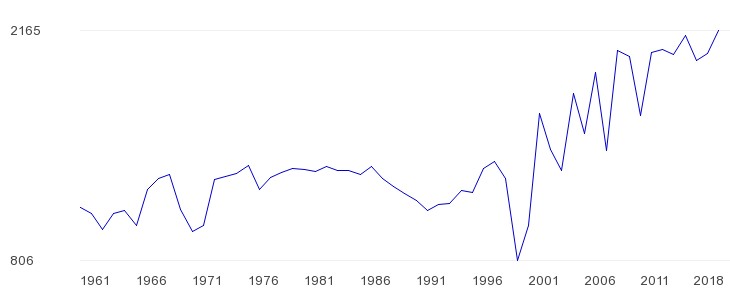
The United Nations Food and Agriculture Organization (UN FAO) keeps meticulous crop production data for nations throughout the world, including Afghanistan. In the graph below, the information website The Global Economy presents the UN FAO data on cereal crop yields (corn, wheat, and rice) in Afghanistan, with the left axis showing kilograms per hectare:

Afghanistan crop production, by year

image from https://climaterealism.com/wp-content/uploads/2021/08/crops-Afghan-1.jpg

CBS News claims that climate change in Afghanistan during “the last three decades … have destroyed crops and left people hungry.” As you can see, however, Afghanistan has fully doubled its crop yields during the past three decades. Also, Afghan farmers have set new production records on a regular basis, especially during the past few years.

It may be convenient for CBS News to divert attention from the current deadly debacle in Afghanistan by blaming it on climate change. The objective truth, however, is that Afghan crop production has tremendously benefited from a modestly warming world. If global warming has had any impact on Afghan farmer sentiment throughout the country, it has clearly been to make farmers happier, more prosperous, and less vulnerable to the Taliban.

************************************

Biden’s Ill-Conceived Executive Order on Electric Vehicles

President Joe Biden issued an executive order Aug. 5 calling for half of all new vehicles sold in the U.S. to be zero-emission vehicles by 2030.

A president can’t exactly force Americans to buy an electric vehicle, and Biden largely meant his executive order as a messaging tool to fuel enthusiasm for his climate agenda. But it threatens to ignore customers along the way.

Electric and alternative fuel vehicles arrived on the scene in the past two decades, yet only accounted for 2% of car sales in 2019 despite generous federal and state subsidies. So far, electric vehicles and other alternative fuel vehicles have generally been the lifestyle choice of well-off Americans and urbanites.

Studies from the Congressional Research Service and the University of California at Berkeley show the vast majority of tax credits for buying an electric vehicle have gone to corporations and to Americans in top income brackets.

Buying an electric vehicle is a perfectly acceptable choice, but we shouldn’t pretend that electric vehicles, such as they are now, are the “all-American vehicle.”

Nor should we pretend that they don’t come with trade-offs. All transportation options require compromises, because there’s no perfect vehicle or energy resource. For example, if more Americans are driving electric vehicles in the next decade, as Biden wants, when and where you recharge them matters.

High electricity demand equals high stress on grid infrastructure, as Californians and Texans have found out with rolling blackouts and calls to reduce consumption.

Another electric vehicle trade-off is the manufacturing of (and eventually disposal of) batteries. A typical electric vehicle needs six times the mineral inputs as manufacturing a conventional car, according to the International Energy Agency. The vast majority of those minerals are mined in China, with its far more lax labor and environmental protections.

Trade-offs are also exactly why the relationship between customers and businesses is so important. As companies strive to understand the diverse needs, priorities, and preferences of customers, they must innovate to get ahead.

Customers benefit from robust competition and innovation, whether that’s between traditional vehicles, electric vehicles, alternative fuel vehicles, or the “next thing” in transportation that hasn’t even been imagined yet.

EPA Along for the Ride

As mentioned earlier, the president can’t make you buy an electric vehicle. But he can make it very difficult for car companies to manufacture and sell alternatives.

The same day Biden issued his executive order on electric vehicles, the Environmental Protection Agency proposed new regulations for greenhouse gas emissions from passenger cars and trucks.

Acting under the Clean Air Act, the EPA is proposing to require model year 2023 cars to average 55 miles per gallon and trucks 38 miles per gallon. That’s about a 10% increase from model year 2022. The standards would tighten almost 5% annually to 2026, topping out at an average of 63 miles per gallon for cars and 44 miles per gallon for trucks.

In short, the standards would make it that much harder to build and sell a traditional gasoline-fueled car or pickup truck in the U.S. Effectively, they serve to box out the competition for electric vehicles.

The standards, if finalized, would almost certainly raise costs for customers, as previous standards under the Obama administration did.

There’s also a sordid and complicated backstory behind how those numbers were arrived at, the long and short of it being caballing between the state of California, big business, and the EPA, which does not bode well for either customers or representative democracy.

Even so, environmental activists are now saying that’s still not enough.

The Bigger Climate Picture

The president’s executive order and the EPA’s proposed car regulations are all in service of Biden’s commitment as part of the Paris Agreement to halve U.S. greenhouse gas emissions by 2030 in an effort to reduce global warming. But that isn’t even good climate policy.

There’s a temptation in the U.S. to take a myopic approach to climate policy; that is, to not consider domestic policy in the global context of climate change.

Two-thirds of all carbon dioxide emissions come from emerging and developing nations. China emits twice as much as America. Even John Kerry, the president’s special climate envoy, has said on several occasions that industrialized nations could eliminate all greenhouse gases and it would have no impact on global temperatures by the end of the century.

Biden’s electric vehicle aspirations and the EPA’s aggressive proposed vehicle emissions standards ignore those realities. And they make Americans poorer (death by a thousand regulatory cuts), which harms their ability to be resilient and adapt to change or adversity, from wherever it comes.

It also forgets a reality Americans should be very proud of. Over the past 40 years, air pollution has declined more than 70%, even as more Americans are driving more miles than ever before.

Air quality in the U.S. is among the best in the world. We have a lot to celebrate.

The federal government should not be the locus of supply and demand for cars. That kind of centralized control isn’t good for customers—who, as we noted, have diverse needs, priorities, and preferences—and it narrows the scope of innovation to government-preferred ends.

But that’s not how Biden and many of his allies see things, and it’s time Congress took back the wheel.

**********************************************

Biden Admits Green New Deal Is a Dream

Last week, the U.N. Intergovernmental Panel on Climate Change ordered a “code red,” releasing a “landmark” report warning that global warming was an existential threat to humanity, “unequivocally” blaming humans for the problem, and demanding rapid action to cut greenhouse gas emissions.

“What the IPCC told us is what President [Joe] Biden has believed all along,” White House press secretary Jen Psaki noted last Tuesday. “Climate change is an urgent threat that requires bold action.”

The very next day, the Biden administration released a statement imploring the OPEC cartel to increase production of oil to help lower worldwide gas prices. “Higher gasoline costs,” the White House said, “if left unchecked, risk harming the ongoing global recovery.” The White House wants OPEC to go above the 400,000-barrels-per-day increase it already promised to implement, which doesn’t seem to jibe with the notion that we are on the precipice of the apocalypse.

As an economic matter, of course, the request makes total sense: By pressuring exporters to pump more oil, a fungible commodity, we lower costs worldwide.

Even though technology continues to create efficiencies that lower emissions, modernity relies heavily on affordable and reliable energy. Economies would collapse without it. And for emerging nations, affordable fossil fuel remains a prerequisite for lifting billions of people out of poverty.

As a political matter, it might seem odd, to say the least, that President Joe Biden is imploring foreign nations to increase supply. Firstly, such a position runs contrary to virtually every “green” plan in existence—almost all of which intentionally, through mandates or bans or taxes or contrived “markets,” exist to make fossil fuels more expensive and reduce use.

Clean energy advocates, including the president, argue that, in the aggregate, going green would be an economic plus. But if slightly higher prices threaten the world’s economic health, what would complete weaning from fossil fuels do to the economy? Biden has promised a “100% clean energy economy” with “net-zero emissions” in only a few decades. Without some technological miracle, this is a fantastical, not to mention suicidal, goal.

The reality is that Biden couldn’t go a year in office without pleading with oilocracies to hike production. In his defense, one assumes, people will point out that COVID-19 presents a historically unique situation. As far as the economics of recovery go, not really. In fact, this manmade downturn should be easier to mend than most. And this is certainly not the last recession or downturn or pandemic or world event that is going to affect the energy market.

Though it’s probably an unpopular position, I’d be content importing cheap oil, or allowing others to flood the market, while saving our own supply for a time when new drilling becomes more economically feasible. But the hypocrisy of all this is that Biden works to restrict energy trade only in North America.

Earlier this year, the president rescinded oil and gas lease sales from most of the nation’s massive state-owned lands and waters, citing climate change as the reason. He then shut down the Keystone XL pipeline, revoking a permit that was needed to build a 1,200-mile project that would have carried around 830,000 barrels per day of Alberta oil sands crude into the United States—probably more than enough to avoid begging OPEC for oil—again citing climate change as the reason.

At the same time, Biden lifted United States sanctions that would have blocked completion of the Nord Stream 2 natural gas pipeline that will transport fuel from Russia to Germany, which, like us, is a signee of the Paris Agreement.

Most European nations aren’t abiding by that agreement (well, without the help of an economy-paralyzing pandemic). Which is a reminder that to merely keep pace with the IPCC recommendations on carbon emissions, Americans, who use around 20 million barrels of petroleum every day, would be compelled to induce a pandemic-level shutdown of the economy every year for 30 years.

Americans, despite what they tell pollsters about climate change, demand affordable gas. You might recall that, despite his best efforts to undermine U.S. energy production, former President Barack Obama took credit for the domestic oil and gas boom. “That was me, people,” he told a crowd in 2018. Political pressure is also why the White House made sure its OPEC statement on gas prices was for public consumption, rather than simply making those requests of OPEC through diplomatic channels.

The Green New Deal, whatever iteration of the plan you care to support, is unfeasible. Biden’s request is just another reminder.

***************************************

My other blogs. Main ones below

http://dissectleft.blogspot.com (DISSECTING LEFTISM )

http://edwatch.blogspot.com (EDUCATION WATCH)

http://pcwatch.blogspot.com (POLITICAL CORRECTNESS WATCH)

http://australian-politics.blogspot.com (AUSTRALIAN POLITICS)

*****************************************

Friday, August 20, 2021


UN Climate Report Reveals the Crisis Is About Truth, Not Climate

The United Nations’ latest climate change report sparked predictable hyperventilating. You’ve seen the headlines crying, “Code Red for Humanity” and clamoring about “extreme” and “unprecedented” warming likely to be “irreversible”—accompanied by fear-mongering images of raging wildfires and flooded towns.

Fortunately, the true state of our climate is far from disastrous. In fact, both climate science and thousands of years of human history show this is the best time yet to be alive. The U.N. is continually moving the goalposts when its apocalyptic predictions fail to come true.

The problem with climate science today isn’t so much the science as shoddy reporting that over-simplifies and over-dramatizes—and a toxic political climate (pun intended) that forbids deviation from the politically correct narrative.

The computer models used by the U.N. and every other climate-focused entity around the world are statistical projections, not precise calculations. The specific models cited in the latest U.N. report are designed to offer a broad range of possible outcomes and formulated using highly suspect and outdated criteria. Yet the report focuses heavily on the model scenarios known to be extremely unlikely—garnering over 40 percent of mentions and almost 100 percent of media coverage.

These same models show that even totally eliminating fossil fuel consumption would have a microscopic influence on global temperatures—less than two-tenths of a degree Celsius even if the full Green New Deal was enacted immediately.

In reality, we know remarkably little about the effect of human activity on the climate. What the vast majority of us know about climate change we get from the news, and it sure seems like natural disasters such as floods, wildfires, and the recent heat waves in the Pacific Northwest are getting more common. But perception does not equal reality.

Global weather data shows hurricane activity and frequency have not increased over the long term. News articles fueling climate anxiety usually cite spurious graphs that start the timeline in the 1980s. But the world didn’t begin in the 1980s, and there have been several periods in history that saw the same, or worse, hurricane activity as we’re experiencing now.

Similarly, although you wouldn’t know it from the news, wildfires and floods are on the decline, and recent heat waves in the Pacific Northwest are small potatoes compared to the 180- and 240-year megadroughts the planet experienced between 800 and 1400 A.D.

The even better news? You and I are 99 percent less likely to die in a severe weather event than our great grandparents. In 1920, global climate-related disasters killed almost 500,000 people every year. Today, even though the world’s population has quadrupled, fewer than 20,000 die from climate-related disaster. In fact, cold-related deaths are over 40 times more common than heat-related deaths in the United States and Canada.

If we’re becoming more resilient to disasters that are happening less often, what’s the crisis? It’s not a climate crisis, but a crisis of truth.

The climate activists who demand “follow the science” appear remarkably uninterested in the nuances and uncertainties of the research they believe supports their ideology.

Science has never been about marching in lockstep with the mainstream. Its purpose has always been curiosity, testing new ideas, and striving to understand more about how the world works—even, and especially, if it proves a previous theory wrong. Even schoolchildren know to shake their heads in disdain at the politicians who persecuted Galileo for having the audacity to publish his theory about the solar system. Yet the same abuse of science is occurring every day as the left exploits misunderstandings of climate research (deliberately or not) to push a political agenda.

While activists march against fossil fuels and let their children believe their future has no hope amid rising seas and dying rainforests, they’ve turned a blind eye to the fact that humanity is better off now than it ever has been. Extreme poverty is at its lowest rate in recorded history, and people are living longer, healthier, freer, and more comfortable lives than ever before. Climate change or no climate change, the future is bright if we only look past the hysteria and seek to truly understand the world around us.

As former Obama-era undersecretary for science Steve Koonin explains in his book “Unsettled,” climate reporting is like a game of telephone. The U.N.’s Sixth Assessment Report is a 3,949-page PDF. It’s easy to understand why reporters on deadline fail to meticulously comb through the entire document or the catalog of research it cites. They simply don’t have time to dig past the simplistic talking points, so they select the most shocking and click-inducing claims without delving into the methodology or scientific uncertainties. It’s understandable, but it’s also a disservice to the public. Something needs to change.

Instead of fixating on our climate, which is likely to remain mild and manageable as our resilience continues to improve, we should focus on sharing the affordable, reliable energy resources our nation is blessed with to fight poverty, improve environmental quality, and spread prosperity around the world.

***********************************************

Fox news on the latest climate panic

Good coverage of skeptical scientists

In the first release of a three-part report, the Intergovernmental Panel on Climate Change (IPCC) warned this week of the consequences of a rapidly warming world spurred largely by human-influenced climate change.

"The alarm bells are deafening, and the evidence is irrefutable: greenhouse‑gas emissions from fossil-fuel burning and deforestation are choking our planet and putting billions of people at immediate risk," United Nations General Secretary Antonio Guterres said. "Global heating is affecting every region on Earth, with many of the changes becoming irreversible."

But, not everyone agrees with Guterres and the panel’s nearly 4,000-page Sixth Assessment Report.

"The IPCC is an excellent source for climate science, but we tend to focus very selectively on the worst news, often overstating the effects of climate change on extreme weather events. Often adaptation is ignored, although it can alleviate much or sometimes almost all of climate damages," Bjorn Lomborg, president of the Copenhagen Consensus and visiting fellow at Stanford University's Hoover institution, said in an emailed statement to Fox News on Wednesday.

"Although climate change in total has negative impacts, we rarely hear about the positive impacts, such as a profound global greening of the planet, equivalent to two more continents of green, each the size of Australia."

Lomborg wrote in a New York Post article on Monday urging readings not to buy alarmism and "scare stories on climate impacts," and that the U.N. has "a long history of claiming catastrophe is right around the corner," writing about problems related to "one-sided" and negative thinking on climate change. Lomborg said that while climate change is a "real problem that we should fix smartly," it won’t be as catastrophic as some present it to be and that humans’ adaptive capacities are not properly being taken into account.

The IPCC report is compiled by more than 200 of the world’s leading climate scientists from 66 countries, including research from thousands of papers. The last one was released in 2013.

It says global temperatures have reached their highest level in more than 100,000 years, rising by 1.1 degrees Celsius since the 19th century, with almost all warming since pre-industrial times caused by the release of heat-trapping gases like carbon dioxide and methane.

As temperatures rise, the scientists note that ice melt and sea level rise have been accelerating, with extreme weather events like rainfall and drought also expected to worsen and become more frequent as further warming is "locked in."

The 2015 Paris climate accord target of limiting global warming to an increase of 2 degrees Celsius by the year 2100 – ideally, an increase of no more than 1.5 degrees Celsius – is practically unattainable according to five scenarios in which scientists all concluded that the world would see an increase of 1.5 degrees Celsius in the 2030s. Three of the scenarios saw temperatures rise by 2 degrees Celsius.

"The whole notion is just built on this assumption that warming is bad to start with," former Trump/Pence EPA Transition Team member and JunkScience.com founder Steve Milloy told Fox News on Wednesday, calling the report’s extreme weather claims "very unlikely."

"This new report, number one, there’s nothing new in it. There’s no new science, the alarm is just, you know, it’s more ‘code red’ than it was five, six years ago – the last time they came out with one of these things," the IPCC was "backing off their most extreme projections because none of that – obviously – is going to happen."

Speaking with Fox News the same day, Competitive Enterprise Institute Center for Energy and Environment senior fellow and ICPP reviewer Patrick J. Michaels said he believes the report and its conclusions were "mired in the atmosphere of unreality."

"The U.N. has been pushing the climate story since 1988 – that’s a long time ago – when it established the Intergovernmental Panel on Climate Change. And, that panel was established specifically to provide what they call the basis for a possible treaty on climate. Any committee that is assigned such a specific assignment will do exactly as it was told. And, therefore, the composition of the [IPCC] – the authors – are selectively chosen because they know the results they are going to get," he said.

"The real reason this report is so extreme is that the previous reports have not elicited the actions that its proponents wanted," Michaels noted. "And, in fact, people are becoming increasingly tired of stories about the end of the world."

Michaels, a past president of the American Association of State Climatologists and program chair for the Committee on Applied Climatology of the American Meteorological Society, took issue with the report’s Coupled Model Intercomparison Project (CMIP6) modeling.

Michaels, who says he is not a climate change skeptic, said if the report had used best practice models instead the issue would have "fallen apart."

That said, the report states that CMIP6 modeling includes "new and better representation of physical, chemical and biological processes, as well as higher resolution, compared to climate models considered in previous IPCC assessment reports."

David Legates, a professor of climatology at the University of Delaware and a policy expert at the Heartland Institute, took issue with what he says is the political nature of the report.

"So, it’s a panel of government officials who have been selected by the various governments. And, of course, they all have axes to grind," the former Trump-era National Oceanic and Atmospheric Administration (NOAA) senior official said.

"So, [there are] certain things they want to say. [There are] certain things they want to guarantee. Many of these nations want to make sure that carbon dioxide is an evil gas because ‘if we can tax it we can make sure that we can get our cut of the money that they’re taking away from other people.' And so, they have a vested interest in not the science – whatever that may be – but in stating that carbon dioxide is sort of an evil gas and therefore has to be regulated and has to be controlled."

For those looking to find a glimmer of hope in the new IPCC report, researchers found that majorly catastrophic disasters or "tipping points" were of "low likelihood," including ice sheet collapses and the abrupt slowdown of ocean currents.

The report suggested that warming could be reversed through "negative emissions" – extracting more carbon dioxide from the atmosphere than is added – though the term "fossil fuels" is not included in the summary or a Monday press release.

Man-made CO2 removal "leading to net negative emissions" would lower CO2 in the atmosphere, a 42-page summary of the report for policymakers said. And even if this were achieved and sustained, increases in temperature would be reversed but other climate changes would continue in the "current direction for decades to millennia."

However, the panel doesn’t explain how this could be achieved and many scientists remain skeptical of its plausibility.

Michael Shellenberger, the author of "Apocalypse Never" and founder and president of Environmental Progress, told Fox News that most of the important trends regarding climate change are currently headed in the right direction."

"Climate change is real. It’s caused by human emissions – at least a significant amount of it is. And, we should try to do something about it because – all else being equal – it’s better for temperatures to not change. But, of course, not all else is equal," he said.

"Climate change is being caused by human emissions, which are caused by humans trying to improve lives for themselves and their children. Not just through fossil fuel use but also through land-use change," he continued. "And so, you’re always looking to balance the benefits of energy consumption with the downsides. But, the trends are mostly going in the right direction."

Shellenberger said the IPCC report’s "scary" scenarios were inaccurate because there is "no possibility" that they could occur due to the usage of natural gas over coal across the world.

The environmental journalist said that while the IPCC science is "mostly fine," he highlighted that there are "some games that get played" in the panel’s reports, including "a bunch of scenarios that basically everybody acknowledges [are] not going to happen because we’re not going to increase coal use sixfold."

The report’s claim that the world is seeing more extreme weather is misleading, Shellenberger says, because it leads people to think that disasters are getting worse.

Droughts can be worsened by warmer temperatures but are explained by natural variability and high-intensity fires can be avoided by better forest management, he argued – though allowing that climate scientists can point to longer fire seasons over larger geographic areas.

Nevertheless, he said human beings are more resilient to extreme weather events and carbon emissions would go down globally over the coming decade.

"The takeaway is that climate change is not what people think it is. It is significantly outweighed by things like droughts, which are still determined by natural variables and by economic development and preparedness, and we’re just so much better prepared," he told Fox News.

"We’re more resilient to changing temperatures than we’ve ever been and it’s just not the end of the world."

*********************************************

Economists and the environment

What does the average economist know about environmental science? Probably no more than any other reasonably educated person.

Yet economists have three talents that are sorely missing from most discussions of environmental policy—particularly policies related to climate change. They understand (1) the scientific method, (2) cost-benefit analysis and (3) how costs and benefits affecting different generations can be evaluated over time.

Here is how these skills matter.

* The Scientific Method. During the Trump administration it became common for critics to accuse the president of being anti-science. In fact, New York Times columnist Paul Krugman accused the entire Republican Party of being anti-science.

Yet the Times routinely tells readers that wildfires in California, flooding in Europe, and worldwide deaths from heat are caused by climate change. Writing in the Wall Street Journal, Bjorn Lomborg notes that:

- “In 2021 the burned area to date is the fourth-lowest of the past 11 years. The area that burned in 2020 was only 11% of the area that burned in the early 1900s. Contrary to climate clichés, annual global burned area has declined since 1900 and continues to fall.”

- “A new study of more than 10,000 rivers around the world shows that most rivers now flood less.”

- “According to another study, climate change annually causes almost 120,000 additional heat deaths but avoids nearly 300,000 cold deaths.”

Here are some more conclusions of real science. Heat waves across the United States today are no more common than they were in 1900. The sea level is rising no faster today than it was 90 years ago. The latest Intergovernmental Panel on Climate Change report says that the most likely warming over the remainder of the century (1.5) is likely to have minimal economic impact.

* Cost-Benefit Analysis. Why do we care if there is global warming? For the same reason we would care if there were global cooling. The key question in both cases would be: are the costs of climate change greater than the benefits?

Writing in the Wall Street Journal in 2015, Matt Ridley noted that actual warming has been below almost all the predictions of the climate models. Ridley doesn’t deny that there has been some warming or even that humans have contributed to it.

Yet, looking forward, he says moderate warming (up to 3.5°C over the next century) can be beneficial for the world on net. For example, carbon dioxide causes crops and wild ecosystems to grow greener and become more drought-resistant.

If there is a case for doing something about climate change, what should we do? On this, economists are virtually unanimous—regardless of their other political views. The best solution is a carbon tax. If the revenue from such a tax were refunded, say by a cut in income or payroll taxes, total private sector income and assets would be unchanged. But everyone would have an economic incentive to reduce carbon emissions.

With a U.S. carbon tax, 331 million people would have an incentive to reduce their use of carbon. With a worldwide carbon tax, up to 8 billion people would have that incentive. Families would reorganize their lives to make the cost of the change as painless as possible. And that is something no government mandate could ever do.

Unfortunately, almost every political figure who wants some sort of government action is opposed to a carbon tax. Instead, they prefer command and control and subsidies—using the power of government to reduce carbon use in ways that are invisible to people who fill their gas tanks at the pump.

Economists estimate that these solutions would have a social cost six times as high as the carbon tax, under the best of circumstances. Once lobbyists got their hands on the process, the social cost could be many times that amount. The costs would be paid by the consumers of virtually every product. Instead of incentives to reduce their use of carbon, people would have an incentive to reduce their consumption of everything else.

To be fair, the U.S. public right now is unwilling to pay higher gasoline taxes to avert global warming. (Carbon taxes poll worse than defunding the police.) But that just means the advocates of carbon reduction haven’t made a persuasive case. The case would be more believable, however, if writers like Paul Krugman quit trying to deceive people into believing that carbon mitigation is a free lunch.

* Intergenerational Equity. In the standard scenario, we are told we should sacrifice today so that our grandchildren (say, 100 years from now) will have a better life. Why would we want to do that? A hundred years from now people will have a much higher income and standard of living than we have today. Why would we want to take from the poor and give to the rich?

Economists can’t answer that question. But they can tell us what the trade-offs are.

Boston University economist Laurence Kotlikoff and his colleagues have taken a midstream estimate of predicted warming and Yale economist William Nordhaus’s estimate of the economic effects of warming over time. They used those predictions to estimate the economic impact of warming and its mitigation on different generations. Kotlikoff then used the model to construct a mitigation plan that makes every generation better off.

In the Kotlikoff model, long-term warming is harmful. So, his suggested carbon tax of $70 a ton (about 70 cents per gallon of gasoline) makes future generations better off. Kotlikoff would not only refund the carbon tax in the form of other tax cuts; he would cut additional taxes as well—in effect borrowing from future taxpayers. The upshot: every generation comes out ahead.

If we heard more from economists like Kotlikoff and his colleagues, and less from people who tell us to go buy a Tesla, public discussion about climate change would be far more rational.

**********************************************

Australia: ’Seven-year witch hunt’: Linc Energy case sensationally dropped

The Crown has dropped its case against four former Linc Energy directors accused of serious environmental breaches.

The Crown has sensationally dropped its case against four former Linc Energy directors accused of serious breaches of the Environmental Protection Act.

Director of Public Prosecutions Carl Heaton QC wrote to the four defendants saying he was no longer satisfied there was “sufficient prospects of convictions”. He instructed Ralph Devlin QC to enter a nolle prosequi “at the earliest opportunity”.

Former Linc chief Peter Bond said the marathon case was a waste of $50m of taxpayers’ money. He said it was a witch hunt from the start and called for a commission of inquiry.

Mr Bond said compensation should be paid to farmers whose land values fell and whose incomes suffered when they were prohibited from certain farming activities after an emergency was declared in March 2015.

“I’m still in shock,” Mr Bond said in an exclusive interview.

“This has gone on for seven years. I said from day one it was a witch hunt. It has cost me a lot and I’m still trying to get over it.”

Linc Energy’s activities were publicly criticised by then environment minister Steven Miles, who said pollution from the firm’s underground coal gasification plant at Hopeland, 300km west of Brisbane, was potentially the biggest environmental disaster in Queensland history.

Linc Energy’s fall from grace was spectacular because premier Peter Beattie declared the project one of state significance in 2007, hailing it as a Smart State “clean-coal technology”. The process involved igniting coal underground and drawing off the gas through a series of wells. Linc told investors it also wanted to produce gas-to-liquid fuels, including diesel and aviation fuel.

Director Stephen Dumble said he was glad it was over.

“I’m relieved, but I can’t say I’m happy about it,” he said.

“I’ve had my life destroyed by it.”

Grazier Toby Trebilco, who lives next door to Linc’s plant, said he wept when he heard the decision. He describes it as “the disaster that never was” and wants a public apology from Mr Miles, who he believes was manipulated by green activists.

“They got it all wrong and gave our district a bad name,” he said. “We have suffered a great injustice.”

Mr Trebilco was critical of reports on the ABC on March 16, 2015, suggesting groundwater was contaminated and hundreds of thousands of tonnes of soil would have to be removed.

Grazier Max Thompson said 150 landholders had suffered. “It’s hard to put a figure on it, but the talk of an environmental disaster has had a negative impact on land prices.”

The initial underground gasification trials were bankrolled by state-owned power station operator CS Energy, not Linc.

Linc purchased the facility and was given a licence by the Mines Department to escalate the underground tests.

District Court judge Leanne Clare SC she had difficulty understanding the case brought by the Crown.

The summary of the essential facts presented by the DPP was gobbledygook, she told the court.

Judge Clare struck out the particulars presented by Mr Devlin.

A spokesman for Environment Minister Meaghan Scanlon said the government would consider its options.

***************************************

My other blogs. Main ones below

http://dissectleft.blogspot.com (DISSECTING LEFTISM )

http://edwatch.blogspot.com (EDUCATION WATCH)

http://pcwatch.blogspot.com (POLITICAL CORRECTNESS WATCH)

http://australian-politics.blogspot.com (AUSTRALIAN POLITICS)

*****************************************

Wednesday, August 18, 2021


Code Red Climate Hype: The United Nations Is A Propaganda Machine

Last week, the head of the United Nations described its latest climate report as a “Code Red for Humanity.” The UN’s Secretary-General Antonio Guterres told us billions of people are “at immediate risk.”

But that isn’t the case. In the words of natural disaster expert Roger Pielke Jr: “Not only is this wrong, but it is also irresponsible. Nowhere does the IPCC report say that billions of people are at immediate risk.”

Pielke is the truth-teller. Guterres is the spin doctor. Please, check for yourself. Download last week’s 42-page Summary for Policymakers issued by the Intergovernmental Panel on Climate Change (IPCC) here. Now conduct your own search.

Does the term ‘code red’ appear in that document? No, it does not.

Does the word billion? Nope.

Is there any mention of any ‘immediate risk’? Immediate doesn’t appear in those 42 pages, either.

The UN is a hype machine. Since the early 1970s, its officials have repeatedly threatened us with an environmental holocaust.

Remember UN climate guru Christiana Figueres advising the BBC eleven years ago that if 2010’s climate talks failed “it will be tragic, it will be a holocaust“?

Every time a climate report is released, the UN recycles the same message. Crisis. Catastrophe. Disaster. Emergency. No time to lose. Fear, fire, alarm. Followed by a long list of demands.

Guterres’ press release uses the word must eight times. As in: we “must act decisively.” Countries “must phase out” coal plants. “COVID-19 recovery spending must be aligned” with climate goals.

Pardon me, but the UN has no right to tell any of us what we must do. UN officials aren’t elected by the public. They’re bureaucrats. Careerists who hop from one UN post to another.

Even more to the point: they are a specially protected class. Their diplomatic immunity renders them untouchable — wholly unaccountable for their actions.

UN personnel have no skin in the game. They pay no price when they mess up. The UN was supposed to help rebuild Haiti after the devastating 2010 earthquake. It failed miserably.

Then it made matters worse. UN peacekeepers introduced cholera to that already-traumatized nation. As 10,000 cholera deaths followed, the UN spent years denying responsibility.

We the people have no mechanism by which to unseat UN officials – even when their incompetence kills people. We have no way of turfing them from office – even when they promote harmful public policy.

One day humans may achieve fulfilling lives without the aid of fossil fuels. But that day is not yet here. Much of the world is still struggling to feed itself, to access clean drinking water and medical services.

Those basics depend on affordable, reliable energy – the kind that fossil fuels provide.

Yet the head of the UN insists this latest climate report “must sound a death knell for coal and fossil fuels… There must be no new coal plants built after 2021…end all new fossil fuel exploration and production…”

It’s important to understand who this man is. When Guterres served as prime minister of Portugal between 1995-2002, he led that country’s Socialist Party. For more than ten years, he also served as president and vice-president of the Socialist International.

It’s time we ended our absurd naivety about the UN. This is a hotbed of undemocratic, unaccountable far-left activism. Its reports are best ignored.

***********************************************

Water shortage solved? Newly created membrane removes 99.9% of salt from seawater and make it drinkable within MINUTES

Scientists have created a new technology they say can remove nearly all of the salt from seawater, potentially solving one of the world's largest health problems.

Researchers from the Korea Institute of Civil Engineering and Building Technology (KICT) created a new membrane, known as coaxial electrospun nanofiber membrane.

The membrane not only removes 99.9 percent of salt from seawater, but it lasts up to a month, whereas previously solutions only lasted for about 50 hours before they need to be replaced.

The membrane was able to operate without wetting and fouling issues due to its low sliding angle, as well as its thermal conductivity properties.

However, it does have drawbacks, notably temperature polarization and a decrease in water vapor flux because of how it conducts heat.

The World Health Organization suggests good quality drinking water should have a total dissolved solid (TDS) of less than 600 parts per million (ppm).

Although previous technologies operated for less than 50 hours, they did have a high water vapor flux performance.

'The co-axial electrospun nanofiber membrane have strong potential for the treatment of seawater solutions without suffering from wetting issues and may be the appropriate membrane for pilot-scale and real-scale membrane distillation applications,' the study's lead author, Dr Yunchul Woo, said in a statement.

The potential solution is enormous, given that roughly 785 million people do not have access to clean drinking water, according to 2019 data from the World Health Organization.

Additionally, roughly 2 billion people across the globe use a drinking water source that is contaminated with feces, the WHO added.

Contaminated water can cause significant disease, such as diarrheas, cholera, dysentery, typhoid, and polio.

The WHO explained that by 2025, 'half of the world's population will live in water-stressed areas.'

The membrane was created by alternative nano-technology, also known as electrospinning, to help prevent the membrane from getting too wet, as well as its long-term stability.

The nanofibers in the membranes allow for a higher surface roughness and the ability to repel water, also known as hydrophobicity.

Other solutions have struggled with membrane wetting, which is why they have to be replaced so often and up until this point, that filtration system had not been feasible for long-term operations.

This technology created by the KICT researchers starts with poly(vinylidene fluoride-co-hexafluoropropylene) as the core, mixed with silica aerogel and a low concentration of polymer as the sheath, which allows the team to get the hyper-repellent membrane surface.

The study was published in April in Journal of Membrane Science.

Previous attempts to turn seawater into drinking water have included using a metal-organic framework to desalinate it, using sunlight as power.

Other attempts have included using the temperature differences between surface and deep sea water to make sea water drinkable; and using graphene to create a membrane to filter the sea water into drinking water.

*******************************************

Statement CLINTEL: New IPCC report provides little objective basis for policymaking

CLINTEL has carried out a preliminary review of the IPCC Summary for Policymakers (SPM) of the AR6 WGI report (on the Physical Science) issued today. It appears that the SPM is, as in previous reports, prone to data exaggeration and so provides little objective basis for policymaking.

Surprisingly, climate scientists from IPCC-circles only last week admitted that their new AR6 generation of climate models are ‘overheated’ and therefore too alarmist. The admission also raises questions on the reliability of temperature forecasts of the IPCC previous generation of models in the 2014 AR5 report, which used an extremely high RCP8.5 emissions scenario, often inappropriately touted as a business-as-usual case and used to promote extreme climate action.

Independent observations had already indicated that CMIP5-models were too sensitive to greenhouse gas increases, probably by a factor of two. The combination of too high climate sensitivity and too high emissions projections resulted in implausibly high temperature forecasts. As the new generation models appear to run even warmer, they make the equivalent scenarios in AR6 erroneously high. IPCC-scientists themselves are beginning to doubt whether their models can be trusted as a policy instrument. “It’s become clear over the last year or so that we can’t avoid this admission”, Gavin Schmidt – director of NASA’s Goddard Institute for Space Studies – told the renowned journal Science. Schmidt also said: “You end up with numbers for even the near-term that are insanely scary – and wrong.”

The new scenarios of up to 5°C temperature rise from 1850 by 2100 are not consistent with observed current warming of about 0.15°C per decade, implying a further rise of only 1.2°C by 2100.

The SPM graphic of global temperatures over the last 2000 years inspires little confidence in that it fails to note the Roman and Medieval Warming Periods (with temperatures similar to or higher than now) nor the Little Ice Age (with the coldest temperatures over those two millennia).

Global mean sea level projections to 2100 appear similarly exaggerated. Tide gauge data since 1900 indicates a rise of 2.1mm per year, while 27 years of satellite data indicates 3.3mm per year. Taking the higher figure implies only 25cm further rise by 2100.

The generalized SPM claims of increased frequency and intensity of extreme weather events appear inconsistent with previous IPCC reports. The basis for these claims, particularly for increased droughts, will be further assessed in our analysis of the full WGI report. Many current independent observations actually indicate greater incidence of extreme weather events in the past.

CLINTEL has consistently argued that, while the climate is changing, partly due to anthropogenic influences, there is no climate crisis, and that climate policy should be based on prudent cost-effective adaptation rather than unaffordable ineffective mitigation. The new SPM provides little objective evidence to change those strongly-held convictions.

Email from:

Guus Berkhout, President of CLINTEL (https://clintel.org),

Jim O’Brien, Irish CLINTEL ambassador, Chair of the ICSF (www.ICSF.ie).

******************************************

Red Wall Tory revolt over Boris's green drive: Northern MPs blast PM's climate plans over cost to poorest Britons

Boris Johnson is facing a revolt among Tory MPs in former 'red wall' seats in the north of England over the eye-watering cost of his environmental drive.

Conservatives elected in 2019 in working class areas that had been Labour for generations lashed out in a private WhatsApp group last night over fears their constituents will be left out of pocket.

Mr Johnson has outlined his plans to make the UK 'net zero' in terms of emissions by 2050, including banning petrol and diesel car sales within a decade.

He also plans to outlaw gas boilers in homes and have them replaced with costly green alternatives.

The Prime Minister yesterday argued that acting now was cheaper than delaying the change.

But the MPs, many of whom have been in the Commons for just two years, vented their fury over the cost and the lack of reciprocal efforts from major polluters, in messages revealed by the Sun.

Brendan Clarke-Smith, who represents Bassetlaw in Nottinghamshire, said: 'It's a hard sell asking people to make sacrifices when the rest of the world, China/Russia etc, are carrying on as usual.'

And Ashfield's ex-miner MP Lee Anderson added: 'This will not go down well in Red Wall seats at all.'

Brendan Clarke-Smith, who represents Bassetlaw in Nottinghamshire, said: 'It's a hard sell asking people to make sacrifices when the rest of the world, China/Russia etc, are carrying on as usual.' And Ashfield's ex-miner MP Lee Anderson added: 'This will not go down well in Red Wall seats at all.'

Ministers are also said to be considering watering down plans to ban the installation of gas boilers in 2035. They are due to be barred from new homes in just four years' time with all other houses following suit a decade later.

But the Times today suggests that the move could be made an 'ambition', over the cost of green replacements that can reach £12,000.

The Prime Minister used a social video video this week to back his targets - including making the UK 'net zero' in terms of emissions by 2050.

Critics have warned that that target could cost £1.4trillion and a senior minister admitted yesterday that families will bear some of the cost.

It came after a new UN climate report painted a bleak picture of the future without immediate action.

In the video, Mr Johnson said: 'It's far cheaper and more effective to act now to avoid incalculable (environmental) damage in the future, and economic (damage) as well.

'Here in the UK we have proved we can do it, we have halved emissions in the last three decades, even though our country has grown much richer.'

It comes as a new poll shows the vast majority of Britons bellieve that climate change and the threat it poses is real.

YouGov found that almost three-quarters (73 per cent) believes that the impact of environmental damage is not being exaggerated.

Over half (55 per cent) said they were frightened, including 15 per cent who admitted to being 'very' frightened'.

***************************************

My other blogs. Main ones below

http://dissectleft.blogspot.com (DISSECTING LEFTISM )

http://edwatch.blogspot.com (EDUCATION WATCH)

http://pcwatch.blogspot.com (POLITICAL CORRECTNESS WATCH)

http://australian-politics.blogspot.com (AUSTRALIAN POLITICS)

*****************************************

Wednesday, August 11, 2021


Critique from Germany of the latest climate "report"

Prof. Fritz Vahrenholt

The IPCC’s 6th Assessment Report on Climate (AR6) was published yesterday, August 9, 2021. Fritz Vahrenholt has summarized the most important things on Roland Tichys Einblick.

“Climate models (CMIP6) have failed across the board”

One notices in the report that it’s primarily politically and less scientifically anchored. How can it be the uncertainty range of CO2 climate sensitivity (i.e. the climate effectiveness of CO2) has been drastically narrowed down when the latest climate models (CMIP6) have failed across the board?

Reruns of an old myth

Curious: one of the chapter authors (Mauritsen) himself has for years represented a value well below the new range of 2.5-4.0°C per doubling of CO2. As in the 2001 AR3 report, the IPCC again is pushing a hockey stick in the summary for politicians. Allegedly, the climate of the past has hardly changed.

PAGES2K controversy

‘Die Welt’ conducted an interview with paleoclimatologist Ulf Büntgen, who explained how there had been a scandal in the PAGES2k group responsible for the new hockey stick. Many members left the group because they did not agree with the approach. Exactly as our Klimaschau had already speculated in 2020.

IPCC on this ice

Also peculiar: The IPCC states that this time it would use less the climate models for its forecasts (because they failed, but you don’t say that so openly), but instead the known climate past. And just that (“the son of the hockey stick”) is as wrong as the model results.

The IPCC is on very thin ice with this. It assumes rock solid that 100% of the warming since 1850 is man-made. All natural climate factors, which must have worked in former times (because the pre-industrial climate changed also significantly) must have been switched off today by “magic hand”. How does that work?

Flawed extreme weather models

Equally curious is that the report now sees a man-made component in extreme weather quite definitely. That’s pretty crazy, because most extreme weather has no trend at all over the last 150 years. And the models of Friederike Otto and colleagues regularly fail in the task of mapping extreme weather trends over the last pre-industrial millennia. These flawed models are then used to make the “attribution” i.e. assignment of man vs. nature. It’s like driving without a license.

Using “unlikely RCP 8.5 emissions scenario” a “serious mistake”

The AR6 treats the unlikely RCP 8.5 emissions scenario as if it were a plausible possibility. A serious mistake that misinforms politicians and other non-specialists. Now the air is getting thin for the IPCC because the AR6 has nothing to do with an open-ended, neutral summary of the state of knowledge. Only the ONE side of the scientific opinion spectrum is included.

Critical side excluded

Critics were not allowed to write in from the beginning. They were allowed to unload their frustration as reviewers and write down their criticism. However, they ended up directly in the wastepaper basket. The review editors were elected by the same political body as the authors, the IPCC board. And the board is elected by the governments, especially the green-influenced environment ministries of the countries.

“Scientific foundation as weak as ever”

After all the dust from this week’s AR6 report settles, things will likely, quickly become quiet about this new report. Because those involved know what they have hid from the public, where it gets dicey. True to the motto “The show must go on”, the AR6 was put on the stage with lots of hype although the scientific foundation was as weak as ever.

Stained scientists

The authors involved will be professionally rewarded by their governments. From the point of view of scientific ethics, however, a stain now sticks to them. For one may assume that the broad outlines of AR6 were already determined BEFORE they were written. The wide range of CO2 climate sensitivity had long been a thorn in everyone’s side. For 30 years the range existed, without progress. Now one has simply reduced the span by force, without technical basis. A true magic trick, but its illusion will be gone shortly thereafter.

Luke-warmers have the science on their side

Because research continues. The researchers who favor a value below 2.5°C/2xCO2 have strong scientific arguments that they will use in the coming years. For the IPCC, however, there will then be no turning back. A hopeless situation.

https://notrickszone.com/2021/08/10/ipcc-enters-into-thin-air-german-scientists-ipcc-in-a-hopeless-situation-stained-scientists/


******************************************

Another critique

THOMAS GALLATIN 

UN Climate Report Not as Alarming as Alarmists Claim

Chicken Little-ism splashed across the front pages of Leftmedia outlets following the latest climate report dispensed by the UN’s Intergovernmental Panel on Climate Change (IPCC). Agence France-Presse’s alarmist title read, “Climate Report Must Be ‘Death Knell’ For Fossil Fuels: UN Chief.” The Washington Post ran the doom-and-gloom opinion headline, “The U.N.‘s dire climate report confirms: We’re out of time.” And the Associated Press’s headline was “'Code red’: UN scientists warn of worsening of global warming.”

The end is nigh, but maybe not as nigh as one would think after digging into the actual IPCC report. In fact, what the report essentially boils down to is the assertion that, according to those oh-so-accurate computer models (wink, wink), global temperatures, by “best estimate,” can be expected to rise by 1.5 degrees Celsius by 2040 and by 2.1 to 3.5 degrees by the year 2100. In other words, 19 years from now the globe may be a little warmer and 79 years from now a tad bit warmer still.

Computer models are only as good as the information fed to them. Neither computers nor the leftist climate scientists inputting information are trustworthy prophets.

That the globe has been warming is not seriously disputed by anyone. The sticking point remains the blame — that the primary cause of this warming can be primarily attributed to human activity. That’s especially true in light of the ecofascists’ demands for drastic measures to avoid catastrophe. Scientists readily admit that even if these radical free-market-economy-destroying measures were implemented immediately, there is no certainty that they would have any significant impact on the climate’s current trajectory.

Meanwhile, what the Leftmedia is pushing with its climate alarmism is not really concern for the climate. Rather, it’s an excuse to demand an end to governmental systems that prize Liberty and individual freedom. It’s a call for massive top-down governmental control over the lives of individuals. In short, a demand for a global authoritarian state to govern every aspect of people’s lives, all in the name of saving the planet.

In the end, the IPCC’s report is more of the same climate projections that climate alarmists take as “science” gospel, but in reality never pan out even remotely as dire as predicted. It’s good to learn from the physical world and to engage in it responsibly. “Conserve” is the root word of conservative, and we ought to have that plan for the environment. However, it’s also important to engage in this study with a spirit of humbleness, knowing that there is far more humanity doesn’t know than that which is known. It is pure hubris to claim the science on climate change is “settled.” And it is downright malevolent to assert that those objecting to drastic actions that would destroy the free market and individual liberty in the name of saving the planet are opposed to science and human flourishing.

For eons, adaptation has worked for plants, animals, and humans. We would be wise to follow suit.

https://patriotpost.us/articles/81845-un-climate-report-not-as-alarming-as-alarmists-claim-2021-08-10