Sunday, December 25, 2016


The good ol' Green/Left double standard again

Dr. Susan Crockford (email: scrock@uvic.ca) has written a well-informed and approachable book about polar bears.  She has no time for the usual Warmist scare about the bears being "endangered".

The book has only just been released but the Warmists are already on the case.  A review by someone called "Eli" on Amazon reads:

"Caveat emptor: the author's vague self-description as "a professional zoologist who has studied polar bear ecology and evolution for more than 20 years" appears intended to mask the facts that her PhD and professional work are in the field of canine archaeology, and that she has no formal training or expertise in polar bear science. Up to you to decide whether she's the best source of information for you and your kids on polar bear facts and myths."

I would love to know who Eli is.  I want to ask him whether tobacco-grower Al Gore's speeches about global warming should be disregarded because Al's qualifications are in divinity and social science


The Hockey Stick Collapses: 50 New (2016) Scientific Papers Affirm Today's Warming Isn't Global, Unprecedented, Or Remarkable

Two fundamental tenets of the anthropogenic global warming narrative are (1) the globe is warming (i.e., it's not just regional warming), and (2) the warming that has occurred since 1950 can be characterized as remarkable, unnatural, and largely unprecedented.  In other words, today's climate is substantially and alarmingly different than what has occurred in the past..because the human impact has been profound.

Well, maybe.  Scientists are increasingly finding that the two fundamental points cited above may not be supported by the evidence.

In 2016, an examination of the peer-reviewed scientific literature has uncovered dozens of paleoclimate reconstructions that reveal modern "global" warming has not actually been global in scale after all, as there are a large number of regions on the globe where it has been cooling for decades.   Even if it was warming on a global scale, the paleoclimate evidence strongly suggests that the modern warm climate is neither unusual or profoundly different than it has been in the past.  In fact, today's regional warmth isn't even close to approaching the Earth's maximum temperatures achieved earlier in the Holocene, or as recently as 1,000 years ago (the Medieval Warm Period), when anthropogenic CO2 emissions could not have exerted a climate impact.

In fact, there is a growing body of evidence that the warming in recent decades is not even unprecedented within the context of the last 80 years.   That's because the amplitude of the 1930s and 1940s warm period matched or exceeded that of the warmth in the late 20th and early 21st centuries in many regions of the world.  Furthermore, between the warmth of the 1930s and '40s and the warmth of the 1990s to present, there was a very widely publicized cooling period (late 1950s to early 1970s) that was heavily discussed in the peer-reviewed scientific literature.

Today's instrumental datasets curiously do not reflect this 20th century warming-cooling-warming oscillatory shape, however, as doing so would not lend support to the modeled understanding that climate is shaped by anthropogenic CO2 emissions, which have increased linearly, not cyclically.  In fact, not only has the high amplitude of the 1930s and 1940s warmth been "adjusted" down or depressed in global-scale representations of instrumental temperatures by NASA or the MetOffice, the substantial cooling (-0.5øC in the Northern Hemisphere, including -1.5øC cooling in the Arctic region) that occurred in the 1960s and 1970s has all but disappeared from today's temperature graphs.

Scientists, meanwhile, keep on publishing their results.  And their results don't lend support to the narrative that the globe has been synchronously warming, or warming in linear fashion and in concert with the rise in anthropogenic CO2 emissions.  Indeed, in many regions of the world, decadal-scale cooling has occurred since the mid-20th century.

Listed below are a collection of 50 peer-reviewed scientific papers published within the last year (2016) undermining the "consensus" position that modern warming patterns are global in extent and synchronization, and that today's warmth is both unusual and unprecedented.  The first section (1) identifies the regions of the world where there has been no net warming in recent decades.  The second section (2) puts modern climate into its much larger Holocene context, revealing just how insignificant and unremarkable this current (regional) warming trend has been relative to history.

More HERE  (See the original for links)


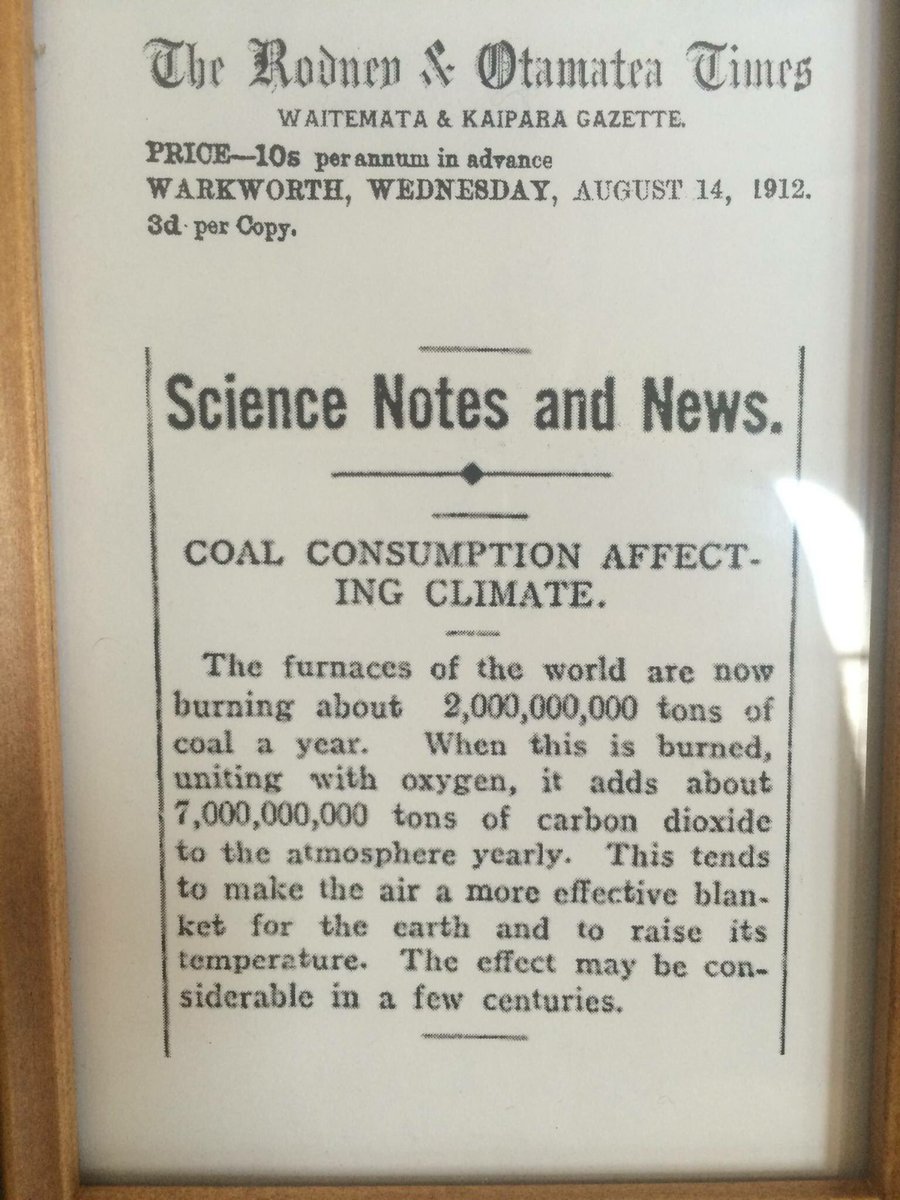
News from 1912: plus ça change, plus c'est la même chose


Time to Get Rid of the EPA? Scott Pruitt May Be Just the Guy to Do It

Trump's nominee for the EPA Administrator could - and should - abolish the agency

Several commentators have characterized the selection of Oklahoma attorney general Scott Pruitt to become the next EPA Administrator as a sharp stick in the eye to the agency and its employees. They're right - and seldom has any herd of federal bureaucrats been more deserving of it. For decades, in administrations Democratic and Republican alike, the EPA has been relentlessly ideological, politicized, corrupt, and incompetent.

When I joined the Food and Drug Administration in 1979, I was essentially apolitical and knew next to nothing about federal regulation. I was a science nerd who had spent the previous 16 years in college, graduate school, medical school, and postdoctoral training. It didn't take long until I learned about the jungle of government bureaucracies, and one of the harshest lessons concerned the perfidy and incompetence of one of the FDA's siblings, the EPA.

I found the EPA to be relentlessly anti-science, anti-technology, and anti-industry. The only thing it seemed to be for was the Europeans' innovation-busting "precautionary principle," the view that until a product or activity has been definitively proven safe, it should be banned or at least smothered with regulation. In fact, during international discussions and negotiations over the harmonization of biotechnology regulations in which I participated, the EPA often seemed allied with the European Union and committed to working against U.S. interests.

To my astonishment, I found that there were entire groups within the EPA whose function it was to lie to the Office of Management and Budget and to Congress about the rationale for and impacts of their proposed regulations. And over the years, I discovered that there is a kind of underground railway by which the most incompetent, disaffected, and anti-industry employees from other regulatory agencies find their way to the EPA, creating a miasma of dysfunctional governance.

During the two decades since I left government service, I've continued to watch the EPA's shenanigans with a mixture of awe and vexation. Policy by policy and decision by decision, the EPA has decimated the nation's competitiveness, ability to innovate, and capacity to create wealth. Its policies and decisions have single-handedly killed off entire once-promising sectors of biotechnology, including bioremediation (the use of microorganisms to clean up toxic wastes, including oil spills) and microorganisms that when sprayed on plants could prevent frost damage.

The EPA's expansive and ever-expanding regulations impose huge costs on American businesses and, ultimately, on consumers. An analysis by the Competitive Enterprise Institute estimated that the annual cost of compliance with EPA regulations alone is more than a third of a trillion dollars. Ideology is one thing, but corruption and abuse are quite another. A scheme was exposed some years ago that would have diverted EPA "research" funds to pay outside public-relations consultants. This payola scheme is similar to the agency's longstanding practice of buying influence by doling out hundreds of millions of dollars each year to certain favored nonprofit organizations - money that, according to the inspector general and Government Accountability Office, is dispersed with no public notice, competition, or accountability. The GAO investigators documented systematic malfeasance by regulators, including: 1) making grants to grantees who were unable to fulfill the terms of the grants; 2) favoring an exclusive clique of grantees without opening the grants to competition; 3) funding "environmental" grants for activities that lack any apparent environmental benefit; and 4) failing to ensure that grantees performed the objectives identified in the grants.

I saw firsthand evidence of this while I was an official at the FDA. For some reason I was favored with periodic reports of the research funded by the EPA. The overwhelming majority of it was shoddy, irrelevant, and unpublishable - but the grants bought the goodwill of researchers who would rubber-stamp unscientific EPA policies while serving on advisory committees.

The EPA is the prototype of agencies that spend more and more money to address smaller and smaller risks. In one analysis by the Office of Management and Budget, of the 30 least cost-effective regulations throughout the government, the EPA had imposed no fewer than 17 of them. For example, the agency's restrictions on the disposal of land that contains certain types of wastes prevent 0.59 cancer cases per year and avoid $20 million in property damage, at an annual cost of $194 million to $219 million.

The EPA is the prototype of agencies that spend more and more money to address smaller and smaller risks.

Superfund (officially, the Comprehensive Environmental Response, Compensation and Liability Act) is one of the EPA's greatest travesties. An ongoing program intended to clean up and reduce the risk of toxic-waste sites, it was originally conceived as a short-term project - $1.6 billion over five years, to clean up some 400 sites (by law, at least one per state and, not coincidentally, about one per congressional district). But it has grown into one of the nation's largest public-works projects: more than $30 billion spent on about 1,300 sites.

How could cleaning up toxic-waste sites not be a good thing? Well, various studies have attempted to evaluate the impacts of Superfund's massive and costly cleanups, but the results are equivocal. Putting that another way, after the expenditure of tens of billions of dollars, no beneficial results have been demonstrable. On the other hand, some Superfund projects have definitely caused harm. University of California-Davis economics professor J. Paul Leigh has analyzed the occupational hazards of environmental cleanup projects and concluded that the risk of fatality to the average cleanup worker - a dump-truck driver involved in a collision, or a laborer run over by a bulldozer, for example - is considerably larger than the cancer risks to individual residents that might result from exposure to untreated sites. EPA official Carl Mazza admitted that the agency is aware that Superfund policies often conflict with risk analysis, but "political considerations" prevent rational, data-driven decision-making.

Another example of flawed decision-making at the EPA is the imposition of overly stringent ambient-air standards under the Clean Air Act. Clean air is desirable, of course, but an EPA rule finalized in February 2012 that created new emissions standards for coal-fired and oil-fired electric utilities was ill-conceived. According to an analysis by Diane Katz and James Gattuso of the Heritage Foundation:

The benefits are highly questionable, with the vast majority being unrelated to the emissions targeted by the regulation. The costs, however, are certain: an estimated $9.6 billion annually. The regulations will produce a significant loss of electricity generating capacity, which [will] undermine energy reliability and raise energy costs across the entire economy.

Stung repeatedly by the responses to such benefit-cost calculations, the EPA has begun more often to manipulate the benefit side by invoking so-called non-use benefits of regulations, such as "the value one places on knowing that an aquatic ecosystem is healthy" or "secondary and tertiary ecosystem impacts." The problem with such supposed benefits is that estimating them is highly prone to wishful thinking (read: plucking numbers from the air). For example, regulators might "calculate" that a significant improvement in water quality in the Mississippi River could be a source of benefit to people throughout the nation, not just to those who use the river or who live near it, because it is nationally symbolic.

An EPA subterfuge that has received attention from Senator David Vitter (R., La.) and other Republicans on the Environment and Public Works Committee is the "sue and settle" maneuver that the EPA uses to advance its radical environmental agenda by substituting a judicial mechanism for the customary interface of legislation and agency rulemaking. The way this works is that extremist environmental groups (some of which receive government grants) sue the federal government on the grounds that agencies are failing to meet their regulatory obligations, and then, behind closed doors, the activists and Obama-administration officials work together to concoct a settlement agreement that furthers activists' (and regulators') radical goals.

Since it was created in 1970, the EPA has been a rogue agency - ideological, poorly managed, and out of touch with sound science and common sense. It is emblematic of what Wall Street Journal columnist Bill McGurn condemned as the "soft despotism" of the "unelected and increasingly assertive class that populates our federal bureaucracies and substitutes rule by regulation for the rule of law."

The nation's experiment with a free-standing environmental agency has failed. The EPA's few essential functions should be relegated to less scientifically and ethically challenged agencies and departments. (It was, after all, created during the Nixon administration by cobbling together elements of various departments, including HHS, Interior, and Agriculture.)

Scott Pruitt may be the guy who could make that happen.

SOURCE


How the Clean Power Plan Hurts States Represented by Democratic Senators

One of President Barack Obama's most controversial regulations is getting a lot of attention after President-elect Donald Trump nominated Oklahoma Attorney General Scott Pruitt to serve as administrator of the Environmental Protection Agency (EPA). The Clean Power Plan (CPP), under the purported authority of the Clean Air Act, requires states to develop plans to reduce emissions by 32 percent below 2005 levels. If a state fails to adopt a plan, the EPA creates one for it. The rule will supposedly avert 0.015øF by 2100 of future temperature increases.

In February, the Supreme Court stayed the rule until the U.S. District Court of Appeals for the D.C. Circuit, which sat en banc in September for oral arguments, rules in the case, West Virginia v. EPA. Twenty-seven states are part of the lawsuit against the EPA, which argues that CPP is unconstitutional because states are not given the opportunity not to participate in the implementation of the rule.

States and supporters of the lawsuit note that CPP will have an extraordinarily negative impact on the coal industry, on which their economies rely for jobs and energy. According to an analysis by NERA Economic Consulting, the energy sector will spend between $41 billion and $73 billion annually to comply with CPP, making it the most expensive rule ever promulgated. Under the authority of the Congressional Review Act, Congress passed S.J. Res. 24, though without veto-proof majorities in the House and Senate, to reject CPP. President Obama vetoed the resolution.

Pruitt's strong opposition to CPP has been frequently mentioned in coverage of his nomination to serve as head of the EPA. In July 2015, he filed his own lawsuit against the EPA over the rule, though it was later consolidated into West Virginia. "The EPA does not possess the authority under the Clean Air Act to accomplish what it proposes in the unlawful Clean Power Plan. The EPA is ignoring the authority granted by Congress to states to regulate power plant emissions at their source," Pruitt said when he filed the lawsuit. "The Clean Power Plan is an unlawful attempt to expand federal bureaucrats' authority over states' energy economies in order to shutter coal-fired power plants and eventually other sources of fossil-fuel generated electricity. This would substantially threaten energy affordability and reliability for consumers, industry and energy producers in Oklahoma."

"Oklahomans care about issues of air quality and our state policy makers are best-suited and specifically granted the authority by federal law to regulate these issues. We are filing this lawsuit in order to ensure decisions on power generation and how to achieve emissions reductions are made at the local level rather than at the federal level," he added.

Pruitt believes that the EPA has claimed too much authority from Congress, running roughshod over the constitutional separation of powers and the states' ability to decide what is best for their citizens and economies. What is good for New York, for example, may not be good for Oklahoma. Indeed, Oklahoma would not be the only state negative impacted by CPP.

A November 2015 analysis from NERA Economic Consulting warns that consumers and businesses in the lower 48 states will see energy price increases, potentially as large as $39 billion annually. A Democratic senator in a state expected to see a double-digit energy price increase may have a tough time explaining to voters why he either voted against the resolution of disapproval that would have put a stake in the heart of CPP or why he did not vote support Pruitt, who will seek to roll back the rule, in a confirmation vote.

Take Sen. Sherrod Brown (D-Ohio). His state is expected to see an average energy price increase of 15 percent because of CPP. Yet, he voted to keep the regulations in place in November 2015 when S.J. Res. 24 came to the floor. As did Sens. Jon Tester (D-Mont.) and Claire McCaskill (D-Mo.), whose constituents will see a 24 percent increase in energy prices. Sen. Bob Casey (D-Pa.) also voted to keep CPP in place, and his constituents will see a 17 percent average increase.

While Sens. Joe Manchin (D-W.V.) and Heidi Heitkamp (D-N.D.) voted to disapprove of the regulations, which will cause their states to see price increases of 33 percent and 43 percent, are sitting on the fence, at least thus far, on whether they will vote to confirm Pruitt. Manchin recently stopped short of saying he would vote to confirm the Oklahoma attorney general. Heitkamp expressed "serious concerns" about Pruitt's opposition to ethanol.

Tester, who voted to keep CPP in place, was hyperbolic in his reaction to Pruitt's nomination, saying that he "is very concerned about Mr. Pruitt's history of not protecting clean air and clean water." McCaskill, another CPP supporter, said she was "reserving judgment" on Pruitt. Trump won Montana and Missouri by 20 points and 9 points. Sen. Joe Donnelly (D-Ind.), whose state Trump won by 20 points, has been quiet about Pruitt.

Democrats from states Trump won and who support CPP, and either voted to uphold the rule in November 2015 or oppose Pruitt's confirmation, face another awkward reality because their position puts them at odds with some influential labor unions. International Brotherhood of Electrical Workers (IBEW), which represents 750,000 members, joined the lawsuit against the EPA over CPP. "The EPA is creating energy policy and they have neither the expertise nor the legal authority to do it. We worked with the EPA for years to address greenhouse gas emissions with a plan that is both effective and legal," IBEW President Lonnie Stephenson said when the union joined the lawsuit. "Unfortunately, we don't believe this regulation is either."

The United Mine Workers of America, which represents 80,000 members, also joined the lawsuit against CPP. "Our initial analysis indicates there will be a loss of 75,000 direct coal generation jobs in the United States by 2020. Those are jobs primarily in coal mines, power plants and railroads. By 2035, those job losses will more than -double to 152,000," UMWA President Cecil Roberts said about the damage the rule will do to the economy. "When a U.S. government economic multiplier used to calculate the impact of job losses is applied to the entire economy, we estimate the total impact will be about 485,000 permanent jobs lost."

Raymond Ventrone -- who represents more than 2,000 members of International Brotherhood of Boilermakers in Ohio, West Virginia, and Western Pennsylvania -- has blast the Obama administration's anti-coal agenda, writing in the Pittsburgh Post-Gazette, "My members learned the hard way that the EPA's goal isn't clean air; it's eliminating coal and our way of life."

"We can have clean air and keep coal as a vital part of our economy, but we can't do it if the EPA and its allies are allowed to continue waging a devastating war against our jobs," he added.

While these labor unions may not have taken a position on Pruitt's nomination, they know that the EPA's Clean Power Plan will hurt their members. Democratic senators who are considering voting against or are on the fence about Pruitt's nomination are sending the wrong message to their constituents at home. This rule will lead to higher compliance costs, energy price increases, and lost jobs. There is not a need for a debate over this. The Senate should confirm Pruitt when he comes to the floor for a vote.

SOURCE


Australia: Rebel Greens faction to fight police, capitalism

This is not exactly new.  Rhiannon was a Trot long before she was a Green.  And she's not the only Trot who went Green when they saw  a chance of more influence there.  Why they have come out openly now is a bit of a mystery, though.  Frustrated at achieving so little, I guess.

A newly formed hard-left faction within the Greens has publicly stated it does not believe in the rule of law or the legitimacy of the Australian state and says it will work to “bring about the end of capitalism”.

Formed around federal NSW senator Lee Rhiannon and NSW upper house MP David Shoebridge, the “Left Renewal” faction has published a statement of principles that is at odds with its own party and contradicts the Greens’ national policies in several key areas.

In forming the faction, Left Renewal said the Greens were failing those with liberal ­beliefs.

“Positions of power and influence within the party are falling to those with liberal politics, who manipulate party processes and abuse their resources to take and solidify their control,” the new faction’s Facebook page says.

The group opposes market-based mechanisms, such as a carbon tax or an emissions trading scheme, as methods to address climate change, and will have a binding caucus in which members will be forced to follow the ­majority view expressed within the faction.

Candidates supported by the hard Left have lost in recent state preselections in NSW, prompting the unified group looking to wrest power from what it sees as a right-wing body.

In a statement of principles, the group describes itself as ­“advocates for peace” and rejects the authority of the police.

“A rejection of class antagonism, and capitalism, also depends on a rejection of the state’s legitimacy and the right of it, and its apparatuses, to impose oppression upon the working class,” it says.

“We further rejected state- mediated oppression in all of its forms, and recognise that violent apparatuses like the police do not share an interest with the working class.”

Former Greens leader Bob Brown previously has called for Senator Rhiannon to bow out of politics to make room for ­“renewal”.

SOURCE

***************************************

For more postings from me, see  DISSECTING LEFTISM, TONGUE-TIED, EDUCATION WATCH INTERNATIONAL, POLITICAL CORRECTNESS WATCH, FOOD & HEALTH SKEPTIC and AUSTRALIAN POLITICS. Home Pages are   here or   here or   here.  Email me (John Ray) here.  

Preserving the graphics:  Most graphics on this site are hotlinked from elsewhere.  But hotlinked graphics sometimes have only a short life -- as little as a week in some cases.  After that they no longer come up.  From January 2011 on, therefore, I have posted a monthly copy of everything on this blog to a separate site where I can host text and graphics together -- which should make the graphics available even if they are no longer coming up on this site.  See  here or here

*****************************************


Friday, December 23, 2016


Liberals rage as Trump eyes killing UN green scheme

Liberals are seething after President-Elect Donald Trump’s transition team asked a simple question.  How much taxpayer money are we spending on international “global warming” programs?  The answer will have you seething, too.

Though the United States Senate never ratified the United Nations’ Paris climate treaty, the Obama administration has been following its dictates and funneling billions of taxpayer dollars into the required U.N. programs. But no one knows exactly how much taxpayer money is being shipped overseas.

So members of Trump’s transition team did what any fiscally responsible citizen would do.  They asked.

“As part of a list of questions posed last week to the department’s Bureau of Oceans and International Environmental and Scientific Affairs, according to multiple people familiar with the matter, the Trump landing team asked, ‘How much does the Department of State contribute annually to international environmental organizations in which the department participates?,’” The Washington Post reports.

And liberals are freaking out. Why?  The dirty secret of “clean” energy is it requires hundreds of billions of tax dollars.

“According to a 2013 Congressional Research Service report, federal spending on climate change initiatives between fiscal year 2008 and 2013 totaled roughly $77 billion. Two-thirds of those funds went to developing carbon-free technology and deploying those advances, and most of that work was undertaken by the Energy Department rather than State,” the Post reports.

Under the terms of the U.N. climate treaty, the U.S. would pay $3 billion over four years. The payments started a year ago, when the State Department shipped the U.N. $500 million, taken out of a program to stop the spread of the Zika virus.

The Obama administration and liberal media then attacked Republicans over the sudden lack of funds to fight Zika.

Trump has told supporters he will cut off such payments to the U.N.  “(Trump’s) campaign released a policy statement (Nov. 1) suggesting that he would ‘cancel all wasteful climate change spending,’ which would include the elimination of all of the federal government’s international and domestic climate programs as well as a rollback in regulations aimed at cutting carbon emissions,” the Post reports.

“The campaign estimated that these moves would save $100 billion over eight years,” the Post reports.

Trump wants to spend that money on U.S.-based environmental programs, telling supporters he will “use that money to support America’s vital environmental infrastructure and natural resources.”

SOURCE


British High Court Green Lights Fracking

Back in May, a local council awarded the UK's first fracking permit since 2011, but greens concerned about the controversial drilling practice challenged that decision in court. Today, that challenge was dismissed, giving a green light for Britain to finally start plumbing its estimated 1.3 quadrillion cubic feet of shale gas. Reuters reports:

Britain's High Court ruled on Tuesday that a fracking permit awarded by a local council to developer Third Energy was legal, after it was challenged by environmental campaigners, opening the way to shale gas extraction in the UK.

Substantial amounts of shale gas are estimated to be trapped in underground rocks and the British government wants to exploit it to help offset declining North Sea oil and gas output, create some 64,000 jobs and help economic growth.

The contested permit in Yorkshire, in the north of England, was the first approval for shale gas fracking since a moratorium was lifted in 2012. "The substantive claim for judicial review is dismissed," Justice Lang said in her written verdict on the case, ruling that the permit remains valid.

The UK's experience with shale has been a long and tortured one. Public support has ebbed and flowed, and despite strong top-down support for fracking, local opposition (of the NIMBY variety) has stymied all comers over the past five years. It's possible that companies will finally begin to start tapping the UK's considerable reserves of shale gas, but don't expect the protests to stop.

NIMBY opposition has been much stronger in the UK than here in the U.S. for two reasons. First, the population density of the parts of America that contain our most productive shale formations is relatively low (see these maps for proof). Having fewer stakeholders to appease makes it demonstrably easier to negotiate with local communities.

But there's another key to America's shale success: mineral rights. Landowners here in the U.S. also own what's underneath their properties, and are therefore compensated directly by companies seeking to tap shale oil and gas reserves. In the UK, the government owns those resources, which removes the financial incentive for property owners to welcome fracking operations into their communities.

The British government has worked to ameliorate this, setting up a slush fund to pay out to these communities, but this tacked-on mechanism is neither as simple or straightforward as America's system of mineral rights.

Britain's shale experience has been halting, characterized by fits and starts, but this latest court approval could be the regulatory nudge that our allies across the pond need to start their own shale boom.

SOURCE


Obama rushes out 11th-hour regulations targeting beleaguered coal industry

At the eleventh hour, the Obama administration on Monday rolled out regulations to crack down on coal mining across the country, a parting shot against the beleaguered industry as the president leaves office.

The regulations, designed to protect America's streams and waterways from pollution produced during mining operations, will add significant costs to coal mining companies, many of which are struggling to operate.

The Interior Department estimates that it will cost the coal industry about $81 million each year to comply with the rule. The agency stressed that figure is just 0.1 percent of the coal industry's "aggregate annual revenues."

"We traveled the country, visited many mines and met with many of the people who work and live in coal country to make sure we wrote the best rule possible - one that is both economically achievable and protective," said Janice Schneider, the Interior Department's assistant secretary for land and minerals management.

But critics, including leaders in the energy sector and Republicans on Capitol Hill, have said the proposal will be much more expensive and surely will lead to even more layoffs in the industry, which has been losing jobs each year during the Obama administration.

Top Republican lawmakers, including House Speaker Paul D. Ryan, said Monday that they intend to work with the incoming Trump administration and scrap the rule early next year.

"The Obama administration is fighting its war on coal to the bitter end. This one rule could have crushing consequences for coal miners, their families and many communities," Mr. Ryan said in a statement. "If we are going to get America back on track, job-crushing regulations like this must stop. Our unified Republican government will act to provide coal country with relief."

The Interior Department's Stream Protection Rule will go into effect 30 days after its official release and publication in the Federal Register, meaning it likely will be implemented Jan. 19, one day before Mr. Trump takes office.

Congressional Republicans will have the power to reverse the rules with a simple majority vote.

Under the Congressional Review Act, enacted in the 1990s, Congress can reverse regulations proposed within the previous 60 legislative days. That means any regulations put forth since June 13 could be reversed with a majority vote, according to the Congressional Research Service.

In addition to the Stream Protection Rule, federal rules limiting fracking on public lands and other environmental regulations also will be in Republican crosshairs in January.

Republicans seem to have at least a few allies across the aisle. Some coal-state Democrats also bashed the Interior Department's latest proposal, arguing that it's duplicative and essentially useless. Sen. Joe Manchin III, West Virginia Democrat, said he will work with Republicans to pass a bill to, at the very least, weaken the proposal.

"While we all must carefully review this 1,648 page final rule, I want to reiterate that the proposed rule was very alarming in its scope and potential impacts. I believe that the manner in which this rule making was executed was flawed and lacked transparency, and I will pursue legislation to ensure it does not harm our coal mining communities and economies," he said in a statement.

The broad rules require coal companies "to avoid mining practices that permanently pollute streams, destroy drinking water sources, increase flood risk and threaten forests."

More important, companies will be required to test and monitor the conditions of all streams that could be affected by their mining "before, during and after their operations," the Interior Department said. The testing is meant to provide baseline data that would help government agencies determine whether any pollution was caused by coal mining.

"The responsible rule released today represents a modern and balanced approach to meeting the nation's energy needs," Interior Secretary Sally Jewell said. "Regulations need to keep pace with modern mining practices, so we worked closely with many stakeholders to craft a plan that protects water quality, supports economic opportunities, safeguards our environment and makes coalfield communities more resilient for a diversified economic future."

Coal industry leaders said the administration clearly is trying to deal another blow to the coal industry on its way out the door.

"The decision to promulgate this duplicative rule at this stage is postelection midnight regulation and therefore obstructionism at its worst," said Hal Quinn, president and CEO of the National Mining Association.

SOURCE


Obsolete Climate Science on CO2

The incoming Trump administration has promised dramatic transformations on many vital domestic issues. The best gauge of this development is the fierce level of opposition his policies have generated from Democratic stalwarts. One representative screed is a New York Times Op-Ed by Professors Michael Greenstone and Cass Sunstein, who lecture the incoming president on climate change: “Donald Trump Should Know: This is What Climate Change Costs Us.”

Greenstone and Sunstein have a large stake in the game: During their years in the first Obama administration, they convened an interagency working group (IWG) drawn from various federal agencies that determined that the social cost of carbon (SCC)—or the marginal cost of the release of a ton of carbon into the atmosphere—should be estimated at about $36 per ton (as of 2015). Choose that number and there is much justification for taking major policy steps to curb the emission of carbon dioxide. Greenstone and Sunstein hoped that the working group process would draw on the “latest research in science and economics,” and establish the claimed costs by “accounting for the destruction of property from storms and floods, declining agricultural and labor productivity, elevated mortality rates and more.”

Their effort should be dismissed as a rousing failure, and as an affront to the scientific method that they purport to adopt in their studies. The first error is one of approach. The worst way to get a full exchange of views on the complex matter of global warming is to pack the IWG entirely with members from the Obama administration, all surely preselected in part because they share the president’s exaggerated concerns with the problem of global warming. The only way to get a full and accurate picture of the situation is to listen to dissenters on global warming as well as advocates, which was never done. After all, who should listen to a “denier”?

This dismissive attitude is fatal to independent inquiry. No matter how many times the president claims the science is rock-solid, the wealth of recent evidence gives rise to a very different picture that undercuts the inordinate pessimism about climate change that was in vogue about 10 years ago. The group convened in the Obama administration never examined, let alone refuted, the accumulation of evidence on the other side. Indeed, virtually all of its reports are remarkable for the refusal to address any of the data at all. Instead, the common theme is to refer to models developed by others as the solid foundation for the group’s own work, without questioning a word of what those models say.

The second major mistake in the government studies is the way in which they frame the social costs of carbon. As all champions of cost/benefit analysis understand, it is a mistake to look at costs in isolation from benefits, or benefits apart from costs. Yet that appears to be the approach taken in these reports. In dealing with various objections to its reports, the IWG noted in its July 2015 response that “some commenters felt that the SCC estimates should include the value to society of the goods and services whose production is associated with CO2 emissions.” Their evasive response has to be quoted in full to be believed: "Rigorous evaluation of benefits and costs is a core tenet of the rulemaking process. The IWG agrees that these are important issues that may be relevant to assessing the impacts of policies that reduce CO2 emissions. However, these issues are not relevant to the SCC itself. The SCC is an estimate of the net economic damages resulting from CO2 emissions, and therefore is used to estimate the benefit of reducing those emissions."

In essence, the benefits from present or future CO2 emissions are not part of the story. Yet a truly neutral account of the problem must be prepared to come to the conclusion that increased levels of CO2 emissions could be, as the Carbon Dioxide Coalition has argued, a net benefit to society when a more comprehensive investigation is made. The entire process of expanding EPA regulations and other Obama administration actions feeds off this incorrect base assumption. The most striking admission of the folly of the entire EPA project comes from EPA Chief Gina McCarthy, who has stated that she would regard a decrease of one one-hundredth of a degree as enormously beneficial, notwithstanding its major cost, because its symbolism would “trigger global action.” No cost/benefit analysis would justify wasted expenditures solely on symbolic grounds. After all, human progress on global warming will only suffer if other nations follow our false siren on CO2 emissions, while ignoring the huge pollution that envelops major population centers like Delhi and Beijing.

Unfortunately, support for regulating CO2 emissions relies unduly on a Regulatory Impact Analysis that is worth no more than the faulty assumptions built into the model. These include the EPA’s hugely complicated Clean Power Plan, temporarily enjoined by the United States Supreme Court, that relies once again on the flawed social costs of carbon estimates.

The weakness of the EPA approach is shown by the data that Greenstone and Sunstein cite to support the contention that global warming has reached dangerous levels. They refer, for example, to a Geophysical Research Letter of 2014 that notes the retreat of ice in the West Antarctic between 1992 and 2011. But that one finding has to be set in context, as is done in the 2016 State of the Climate Report  prepared by the Committee for a Constructive Tomorrow (CFACT) and sent to the U.N. Climate Conference in Morocco. This more complete account notes that the mass gain in East Antarctica has been at 200 billion tons per year on average, compared to the 65 billion tons, which was offset by substantial gains in ice in West Antarctica, generating a net gain of roughly 82 billion tons per year in Antarctic ice between 2003 and 2008. The upshot: “The good news is that Antarctica is not currently contributing to sea level rise, but is taking 0.23 millimeters per year away.” Overall, the temperature over the Antarctic has been constant for the past 35 years.

No analysis that looks at the minuses can afford to ignore the larger pluses and maintain its credibility. Indeed, for what it is worth, the CFACT report notes that the ice mass in the Arctic is now about 22 percent greater than it was at its low point in 2012. This fact helps explain why there has been no recent change in the rise of sea levels, and certainly none that can be attributed to the relatively modest level of temperature increases in the past 100 years. Recent trends suggest the rate of increase in ocean levels has been decelerating over the last 18 years, during which time there has been a substantial increase in carbon dioxide levels. Yet the 102 different models used by the Intergovernmental Panel on Climate Change (IPCC) are all high in their estimates, by roughly four-fold. As documented in the 2016 CFACT report, there has been substantially no change in overall global temperature over the past 18 years, and the record highs reported are by tiny fractions of degrees that are smaller than the margin of measurement error. Yet the government’s methodology is to look at the models and ignore the data.

Just that was done by the now anachronistic 2009 EPA Endangerment Findings for Greenhouse Gases, which reported on the overall shrinkage of Arctic ice and claimed that the “elevated CO2 levels” were expected to result “in small beneficial effect[s] on crop yields.” The good news on this point seems to be that the increase in CO2 has led to about a 14 percent increase in green vegetation on earth over the past 30 years, as Matt Ridley reported in a 2016 lecture. It is the best of all possible CO2 worlds if the level of arable land increases with minor temperature changes and there are no appreciable changes in ocean levels. Put these numbers together and a revision of the SCC must be made, as it now appears that the net costs of carbon are negative. Further, the revised projections have only strengthened the lower estimates of global warming from elevated CO2 levels.

This basic conclusion is reinforced by other data, easily accessible, that addresses other concerns raised in the Greenstone and Sunstein article. For starters, there has been no recent increase in the level of storms and floods, or the damage that is said to result from them. To the contrary, the trend line has been unambiguously favorable, as the number of extreme events like floods and storms has declined steadily over the past 100 years. Indeed, the last major event in the United States was Hurricane Katrina in 2005, followed by eleven years of relative tranquility in the United States and around the world. This point is critical because one of the constant claims on global climate change is that the system-wide instability has increased these extreme events, even if overall temperature levels have remained constant.

The overall picture with respect to the SCC, then, is the exact opposite of that described by Greenstone and Sunstein, and that change in direction has a serious effect on the success of various legal challenges. Greenstone and Sunstein note that a legal decision in 2008 held that ignoring the SCC makes an administrative rule “arbitrary and capricious” and thus requires its reformulation by the applicable agency. They also reference another 2016 decision that upheld an administrative decision of the Department of Energy that explicitly took into account the SCC. But these judicial decisions have a surreal aura about them. The key statute for these cases was the Energy Policy and Conservation Act of 1975 (EPCA), which was passed in the aftermath of the 1973 Mideast Oil Embargo that followed in the wake of the 1973 Yom Kippur War. The EPCA’s chief finding was that “the fundamental reality is that this nation has entered a new era in which energy resources previously abundant will remain in short supply, retarding our economic growth and necessitating an alteration in our life’s habits and expectations.”

It was on the strength of this 41-year-old statute that the Court in 2008 required the National Highway Traffic Safety Administration to reissue its rules for the average fuel economy standards for light trucks because they failed to take into account the SCC. The ruling is wholly anachronistic today because the revolution in energy technology has obviated the entire factual premise on which the so-called CAFE (corporate average fuel economy) rules rest. Given fracking, energy is abundant. Thus, the SCC has to be reevaluated in light of evidence collected outside the EPA, and summarized above, none of which was taken into account when working within the closed universe of the current set of environmental and energy laws. At this time, it appears that virtually all the EPA rules rest on outdated science.

Greenstone and Sunstein are not alone in their refusal to deal with evidence that undermines their claims. But if the SCC looks to be negative, the Trump administration should act to eliminate the current endangerment finding for carbon dioxide, and dismantle the regulatory apparatus that rests upon its highly questionable estimation of the positive value of SCC. The sorry truth is that the EPA and the regulatory process in the Obama administration show no respect for the scientific method they claim to rely on.

SOURCE


Forced "Greenhouse" emission reductions entrench high electricity prices in Australia

Significant economic conse­quences are foreshadowed by several ­reports into the electricity industry that were presented to this month’s meeting of ­federal, state and territory energy ministers. Two of those reports addressed issues stemming from Australia’s ratification of the Paris Agreement on climate change.

One of these, The Future ­Security of the National Electricity Market, was from a group chaired by Chief Scientist Alan Finkel. The other, The Integration of Energy and Emissions Reduction Policy, was prepared by the Australian Energy Market Commission.

The key feature of the Paris Agreement was the pledge by Australia and other developed countries to reduce their greenhouse gas emissions by 26 per cent to 28 per cent by 2030.

Developing countries, which account for a growing 65 per cent of global emissions, have no effective restraints.

Australia ratified the Paris Agreement on the day after Donald Trump’s election victory. The president-elect has pledged to walk away from the agreement, an outcome that would transform it from largely ineffective to totally ­ineffective.

Malcolm Turnbull, however, wishes to push ahead in forcing emission reductions.

But his plans hit a road bump with the release of the draft report from the Finkel committee, which recommended controls over ­future emissions by using a form of carbon tax. When, under media questioning, Energy Minister Josh Frydenberg ­acknowledged this, a backbench revolt required Turnbull to ­remove it as a ­policy option.

The same form of carbon tax was canvassed by the AEMC as a means to achieving the planned reduction in greenhouse gas emissions. The AEMC costed the measure at $55.4 billion. If, instead, the emission reductions were to be achieved by using a variation of the renewable energy target, these costs would increase to $66.6bn.

Either way, especially in view of the US position, the emission reduction policy is up there in profligacy with two other government spending follies: the National Broadband Network and the submarines.

More immediate energy-­related issues concern the ambitions of Victoria and Queensland to follow South Australia down the renewable path.

Electricity from renewable ­energy costs three times as much to produce as electricity from coal and gas. For this year, the AEMC estimates the cost of existing federal and state renewable energy programs for the average household’s electricity bills at $191 in Queensland (7 per cent of the bill), $109 in NSW, $91 in Victoria and $155 in South Australia.

But these are only the direct costs. The indirect costs, in ­addition to renewable energy’s ­innate unreliability, are greater.

In the first place, this is because electricity market rules mean wind and solar will always run when they are able to do so. This forces other suppliers into stop-start operations, which coal and gas baseload power stations cannot easily accommodate. Those stations are being forced to close and each such closure ramps up the wholesale electricity price.

The AEMC estimates that next year the closure of Hazelwood in Victoria will cause a cost increase of $200 for each household in the state, with lesser cost increases in other jurisdictions.

Second, wind generators ­require increased network spending. The electricity market operator has put a $2.2bn cost on new transmission lines to link Victoria’s proposed wind generators to the grid. This stems from the wind generators wanting to locate in areas where there is weak transmission capacity.

Originally the national electricity market rules required new generators to pay for any addi­tional transmission costs their ­location entailed.

But those sensible rules have gone by the board, hence the costs will be charged to consumers. They amount to about $50 a household a year (and much more than that for businesses).

Third, the AEMC has foreshadowed additional costs, which it is unable to quantify, because of a new back-up power fund to provide system stability to cover wind and solar power’s intrinsic ­inability to offer the same flexibility as the fossil-fuel generators they displace.

Compounding these problems are the measures introduced in NSW and Victoria (and prospectively under a future South Australian Liberal government) to ban or restrict the search for gas.

Households and industry are paying a high price for political meddling reacting to vociferous environmentalists’ pressures and the patronage of renewable ­energy businesses.

Australia has gone much further than any other country with green energy cost impositions.

At the turn of the century, competition reform and privatisations had brought us the world’s cheapest electricity. This has been undone. American and French consumers now pay little more than half our average price and even Japanese households, in a country with negligible domestic energy resources, have electricity cheaper than Australians.

Australia’s low prices were also the attraction for energy-intensive industries, and the news foreshadowing the departure of the Portland Alcoa smelter makes that facility the latest casualty of the nation’s politically induced loss of industry competitiveness.

Sadly, none of the reports before ministers offers a ­return to the low prices households once enjoyed.

SOURCE

***************************************

For more postings from me, see  DISSECTING LEFTISM, TONGUE-TIED, EDUCATION WATCH INTERNATIONAL, POLITICAL CORRECTNESS WATCH, FOOD & HEALTH SKEPTIC and AUSTRALIAN POLITICS. Home Pages are   here or   here or   here.  Email me (John Ray) here.  

Preserving the graphics:  Most graphics on this site are hotlinked from elsewhere.  But hotlinked graphics sometimes have only a short life -- as little as a week in some cases.  After that they no longer come up.  From January 2011 on, therefore, I have posted a monthly copy of everything on this blog to a separate site where I can host text and graphics together -- which should make the graphics available even if they are no longer coming up on this site.  See  here or here

*****************************************


Thursday, December 22, 2016


Earth's temperatures have always bounced up and down

Temperature reconstructions for the last 10,000 years based on a wide range of proxy data are reported below.  They show that it has in the past been both warmer and cooler than it is today.  Present temperatures are nothing unusual in Earth's history.  Nothing manmade is needed to explain the current temperature averages.  And note that this data concerns the Arctic, the favourite area of the Warmists


Holocene climate change in Arctic Canada and Greenland

Jason P. Briner et al.

Abstract

This synthesis paper summarizes published proxy climate evidence showing the spatial and temporal pattern of climate change through the Holocene in Arctic Canada and Greenland. Our synthesis includes 47 records from a recently published database of highly resolved Holocene paleoclimate time series from the Arctic (Sundqvist et al., 2014). We analyze the temperature histories represented by the database and compare them with paleoclimate and environmental information from 54 additional published records, mostly from datasets that did not fit the selection criteria for the Arctic Holocene database. Combined, we review evidence from a variety of proxy archives including glaciers (ice cores and glacial geomorphology), lake sediments, peat sequences, and coastal and deep-marine sediments. The temperature-sensitive records indicate more consistent and earlier Holocene warmth in the north and east, and a more diffuse and later Holocene thermal maximum in the south and west. Principal components analysis reveals two dominant Holocene trends, one with early Holocene warmth followed by cooling in the middle Holocene, the other with a broader period of warmth in the middle Holocene followed by cooling in the late Holocene. The temperature decrease from the warmest to the coolest portions of the Holocene is 3.0 ± 1.0 °C on average (n = 11 sites). The Greenland Ice Sheet retracted to its minimum extent between 5 and 3 ka, consistent with many sites from around Greenland depicting a switch from warm to cool conditions around that time. The spatial pattern of temperature change through the Holocene was likely driven by the decrease in northern latitude summer insolation through the Holocene, the varied influence of waning ice sheets in the early Holocene, and the variable influx of Atlantic Water into the study region.

Quaternary Science Reviews. Volume 147, 1 September 2016, Pages 340–364


Congress: Obama Admin Fired Top Scientist to Advance Climate Change Plans

Investigation claims Obama admin retaliated against scientists, politicized DoE

A new congressional investigation has determined that the Obama administration fired a top scientist and intimidated staff at the Department of Energy in order to further its climate change agenda, according to a new report that alleges the administration ordered top officials to obstruct Congress in order to forward this agenda.

Rep. Lamar Smith (R., Texas), chair of the House Committee on Science, Space, and Technology, released a wide-ranging report on Tuesday that shows how senior Obama administration officials retaliated against a leading scientist and plotted ways to block a congressional inquiry surrounding key research into the impact of radiation.

A top DoE scientist who liaised with Congress on the matter was fired by the Obama administration for being too forthright with lawmakers, according to the report, which provides an in-depth look at the White House’s efforts to ensure senior staffers toe the administration’s line.

The report also provides evidence that the Obama administration worked to kill legislation in order to ensure that it could receive full funding for its own hotly contested climate change agenda.

The report additionally discovered efforts by the Obama administration to censor the information given to Congress, interfering with the body’s ability to perform critical oversight work.

“Instead of providing the type of scientific information needed by Congress to legislate effectively, senior departmental officials sought to hide information, lobbied against legislation, and retaliated against a scientist for being forthcoming,” Smith said in a statement. “In this staff report based on lengthy record before the committee, much has been revealed about how senior level agency officials under the Obama administration retaliated against a scientist who did not follow the party line.”

“Moving forward, the department needs to overhaul its management practices to ensure that Congress is provided the information it requires to legislate and that federal employees and scientists who provide that information do so without fear of retribution,” Smith said.

The report goes into Congress’ efforts to regulate the Low Dose Radiation Research Program, or LDRRP, which sought to test the impact of radiation on human beings. The program, started in the 1990s, was meant to support research into waste cleanup and the impact of nuclear weapons.

In mid-2014, lawmakers introduced legislation, the Low Dose Radiation Act of 2014, to help regulate the program and minimize harmful side effects.

During an October 2014 briefing with senior DoE staff on the matter, lawmakers heard testimony from Dr. Noelle Metting, the radiation research program’s manager.

Less than a month later, lawmakers discovered that Obama administration officials had “removed Dr. Metting from federal service for allegedly providing too much information in response to questions posed by” Congress during the briefing, the report states.

Congressional investigators later determined that the administration’s “actions to remove Dr. Metting were, in part, retaliation against Dr. Metting because she refused to conform to the predetermined remarks and talking points designed by Management to undermine the advancement of” the 2014 radiation act.

Emails unearthed during the investigation “show a sequence of events leading to a premeditated scheme by senior DoE employees ‘to squash the prospects of Senate support'” for the radiation act, a move that lawmakers claim was meant to help advance President Obama’s own climate change goals.

“The committee has learned that one of DoE’s stated purposes for Dr. Metting’s removal from federal service was her failure to confine the discussion at the briefing to pre-approved talking points,” according to the report. “The committee has also established that DoE management … failed to exercise even a minimal standard of care to avoid chilling other agency scientists as a result of the retaliation against Dr. Metting for her refusal to censor information from Congress.”

The investigation concluded that “DoE placed its own priorities to further the president’s Climate Action Plan before its constitutional obligations to be candid with Congress,” the report states. “The DoE’s actions constitute a reckless and calculated attack on the legislative process itself, which undermines the power of Congress to legislate. The committee further concludes that DoE’s disregard for separation of powers is not limited to a small group of employees, but rather is an institutional problem that must be corrected by overhauling its management practices with respect to its relationship with the Congress.”

These moves by the administration were part of an effort to secure full funding for the president’s climate change agenda, the report claims.

“Instead of working to understand the value of the LDRRP for emergency situations, DoE Management engaged in a campaign to terminate research programs that could divert funds from the president’s Climate Action Plan,” the report states.

Congress is recommending a full overhaul of the DoE’s management structure in order to ensure this type of situation does not occur again.

SOURCE


It’s climate regulations that threaten us

H. Sterling Burnett

Here are some climate actions President Trump could take to Make America Great Again

In President-Elect Donald Trump’s Contract with the American Voter, a “100-day action plan to Make America Great Again,” Mr. Trump outlines several measures he says he will undertake to create jobs and spur economic growth.

While much of his proposed agenda will help to improve the economy while also leaving reasonable environmental protections in place, I believe there are two additional environment-related policy changes that he could take to jump-start the economy.

In a September 21, 2015, appearance on Hugh Hewitt’s radio show, Mr. Trump said, “I’m not a believer in man-made global warming. I mean, Obama thinks it’s the number-one problem in the world today. I think it’s very low on the list.… We have much bigger problems.”

If these comments accurately reflect Trump’s views, a first important step he could take to undo the damage done by the Obama administration’s vainglorious attempt to control climate and weather would be to reverse the Environmental Protection Agency’s (EPA) determination that carbon dioxide (CO2) is a pollutant endangering public and environmental health.

This “endangerment finding” came about in response to EPA following a narrow 5-4 Supreme Court decision in the 2007 case Massachusetts v. EPA. In that case, a majority of the justices ruled that, if EPA determines carbon-dioxide emissions are causing global warming – and global warming may reasonably be expected to endanger public health or welfare – then EPA has the authority to regulate carbon dioxide as a pollutant.

In fact, the justices ruled, EPA would be required to regulate carbon dioxide under such a finding, unless it can provide a reasonable basis for not choosing to regulate this vitally important, plant-fertilizing gas.

Relying on unsubstantiated projections produced by the U.N. Intergovernmental Panel on Climate Change, EPA did determine that CO2 emissions from cars and industry do threaten human welfare. That led directly to the agency’s decision to limit those emissions.

For instance, the endangerment finding was the basis for ratcheting up automobile fuel-economy standards to 54.5 mpg by 2025. That could soon mean consumers no longer have the right or ability to choose the vehicles they drive – based on safety, passenger or cargo considerations, for example – by either forcing all but the smallest cars off the roads or, at the very least, making larger cars and trucks too expensive for all but the relatively wealthy to drive.

Additionally, the endangerment finding serves as the foundation for various Obama administration regulations requiring utilities, oil and gas producers, and other entities to cut their greenhouse gas emissions. If these draconian rules are not overturned by the Trump Administration, Americans will pay much more for energy and their energy supplies will be less reliable.

Mr. Trump cannot undo the endangerment finding with the stroke of a pen. To reverse it, he must instead charge EPA to demonstrate, through independent, validated research, that carbon-dioxide emissions are “toxic” (which they are not at any levels that might occur in Earth’s atmosphere) – or that global warming is causing measurable amounts of sea-level rise, increased hurricane numbers or intensity, the spread of diseases, or other harms directly attributable to carbon-dioxide emissions in the United States.

If EPA cannot directly link such problems to U.S. carbon-dioxide emissions – and it can’t – or cannot show such problems can be dramatically reduced by cutting U.S. carbon dioxide emissions – and again it can’t – then EPA should withdraw the endangerment finding.

Withdrawing the endangerment finding would end the legal justification for a range of burdensome climate regulations. In the process, it would also end radical environmental activists’ ability to use courts to impose climate policies on an unwilling public whose elected representatives have repeatedly rejected climate policies.

Second, President-Elect Trump also recognizes that, to fully reverse Barack Obama’s harmful climate policies, the United States must withdraw from international climate agreements that drive and justify many domestic climate actions – and must stop diverting billions of dollars of taxpayer money from important domestic and defense concerns to U.N. climate programs.

In his Contract with the American Voter, Mr. Trump pledges to “cancel billions in payments to U.N. climate change programs, and use the money to fix America’s water and environmental infrastructure.”

Trump can accomplish this unilaterally by halting the Obama administration’s illegal shift of State Department funds – funds that Congress directed would be used in other diplomatic programs, such as combating virulent diseases – to the United Nations’ Green Climate Fund.

The easiest way for President Trump to end the United States’ participation in all international climate agreements would be for him, on day one, to remove America’s signature from the U.N. Framework Convention on Climate Change (UNFCCC), signed by President George H.W. Bush in 1992.

Article 25 of the UNFCCC allows any state party to that convention to withdraw upon giving one year’s notice, without incurring any further obligation

In fact, withdrawing from the UNFCCC would cancel United States obligations to all other U.N.-brokered climate agreements subsequent to it, including the Paris “agreement” that President Obama signed, because all subsequent agreements were built upon UNFCCC.

Our nation is not threatened by manmade climate change. It is threatened by regulations implemented in the name of protecting us from dangerous manmade climate and weather.

These two actions would be a great first step toward “putting America first” during President Trump’s first 100 days in office.

Via email


A Chance for Congress to Kill Some Cronyism

President-elect Donald Trump ran in part against the business-as-usual cronyism that has for decades been rampant in Washington, D.C. His pledge to “Drain the Swamp” resoundingly resonated – and helped propel him to the presidency.

Congress has been a chronic, consistent swamp filler. Now, headed into the Trump presidency, Congress has an opportunity to reverse course and start draining. They absolutely should avail themselves.

The prospective cronyism in question revolves around the West Lake Landfill in Bridgetown, Missouri (located near Saint Louis’ Lambert Airport). A limestone quarry in the 1930s, it during World War II and into the 1960s became a dumping ground for, amongst other things, processed uranium.

Thankfully, a 2015 Environmental Protection Agency (EPA) study concluded that the site actually poses no health risk. Nevertheless, the Agency had in 1990 declared West Lake a Superfund site designated for cleanup – so a cleanup we will have.

But this is government – and government moves…s l o w l y. The EPA didn’t get around to hiring anyone to do the work until…2015. At which point the speed of the private sector would have kicked in. The cleanup company retained would have had the gig finished by the end of this year. One year – and done. No fuss – no more muss.

Great news, right? Well, not for the Teamsters Union. The Teamsters haven’t unionized the landfill cleanup company – so they had no hand in the job. So they began methodically working to kill the cleanup. Because they are, first and foremost, environmentalists concerned about the Earth. I kid. They want the deal cancelled – and redone involving them.

But the Teamsters alone leading the charge isn’t so pretty a messaging face. Like everyone else on the Left, the Teamsters love touchy-feely front groups. These gaggles are the smiley-face masks over the Left’s snarling visage.

For the radical environmentalists opposed to the Dakota Access Pipeline – it’s the Standing Rock Sioux Indian tribe. For the Teamsters, on Westlake – it’s Just Moms Saint Louis: “(F)ounded…in 2013 ‘to educate the community about the potential hazards and health risks surrounding the West Lake Landfill.’ The group has hosted town hall meetings, amassed 18,000 members to its Facebook page, lobbied members of Congress and been described as ‘a surprisingly powerful force.’”

Their “surprisingly powerful” lobbying is a little less surprising – when you remember they are backed by and teamed with the Teamsters: “The Teamsters Union mentions Just Mom STL in numerous press releases and other communications materials on its website.  Moreover, the Teamsters Union has hosted press conferences and educational events with Just Moms STL.”

Remember, Just Moms StL claims to just and only want the Westlake landfill cleaned up. They were founded in 2013 – when they had a prospectively legitimate gripe. But they succeeded – the EPA in 2015 got off its duff and hired a company to do the job. Which would by now be totally finished – were it not for Just Moms StL (and their Teamsters teammates) continuing to agitate.

Which means this isn’t about a landfill cleanup. It’s about the Teamsters cleaning up – at our exorbitant expense.

Which leads us to Washington D.C. – and yet another raft of Congressional cronyism: “In February 2016…the Senate passed a bill to transfer the clean up (from the EPA) to the Army Corps of Engineers. (Missouri) Democrat Senator Claire McCaskill introduced the legislation.”

Get that? A Missouri Democrat – gumming up the works to assist the Teamsters in getting a government gig in Missouri. And lest we forget: “About 20 percent of Teamsters workers are employed by the federal government.” I’m sure that stat has nothing to do with anything here.

If the Army Corps of Engineers takes over, we’ll undoubtedly be subjected to years of additional delay and hundreds of millions of dollars of additional waste.

All to clean up a site that isn’t hurting anyone. And which would already be cleaned up and forgotten – had Just Moms StL taken for an answer the “Yes” they claimed all along to have wanted.

But the Army Corps of Engineers will likely absurdly overpay the Teamsters to do the job – and that’s all that really matters in Crony Town.

The ridiculous McCaskill Senate-passed bill – now sits in the House: “(W)here supporters with ties to big labor unions are pushing to get it passed without scrutiny.”

The bill should proceed – absolutely nowhere. It should suffer death by Congressional inattentiveness. It’s pointless – it’s wasteful – it’s cronyism. It’s everything pre-Trump Washington was.

It’s time to put that past behind us.

SOURCE


Obama Said to Use 1953 Law to Restrict Offshore Oil Drilling

President Barack Obama is preparing to block the sale of new offshore drilling rights in most of the U.S. Arctic and parts of the Atlantic, a move that could indefinitely restrict oil production there, according to people familiar with the decision.

Obama will invoke a provision in a 1953 law that gives him wide latitude to withdraw U.S. waters from future oil and gas leasing, said the people who spoke on condition of anonymity because the decision had not been announced. Until now the law has been used mostly to permanently preserve coral reefs, walrus feeding grounds and marine sanctuaries.

Related actions by Canada, including a possible five-year pause on some activity in its share of the Beaufort Sea north of Canada’s Northwest Territories, will be announced at the same time as the U.S. action, the people said.

"If the reports are right, then this is a gift to the public and to our kids that will rank with any in the history of American conservation," said Niel Lawrence, Alaska director of the Natural Resources Defense Council.

Coming in the waning days of his administration, Obama’s move -- set to be announced Tuesday -- responds to a clamor from environmental activists who have looked for a way to lock in protections before President-elect Donald Trump takes office.

Environmentalists said the action would further bolster Obama’s legacy as the president who has done more than any other to combat climate change, because it would illustrate he believes the warming Earth can’t afford the oil and gas locked under the Arctic and Atlantic waters targeted for protection.

“If President Obama acts to permanently protect important areas of the Atlantic Ocean from offshore drilling, he will be making a good decision -- a smart business decision -- based on science and facts," said Jacqueline Savitz, a senior vice president with the conservation group Oceana. "This decision would help to protect existing lucrative coastal tourism and fishing businesses from offshore drilling, which promises smaller, short-lived returns and threatens coastal livelihoods."

Spokesmen for the White House and the Canadian prime minister’s office declined to comment.

Using the so-called 12(a) provision of Outer Continental Shelf Lands Act to keep drilling out of big chunks of the nation’s territorial oceans is sure to draw a legal challenge, and there is scant legal precedent on the matter. Trump may rescind Obama’s order, but the statute doesn’t include a provision for reversal and that action may take years to work its way through court.

"I see no evidence that Congress ever intended for these withdrawals to be reversible; courts should respect that," Lawrence said.

The Republican-led Congress could advance legislation to undo the ocean withdrawals and eliminate the underlying provision empowering Obama’s move.

‘Short-sighted’

Although oil companies have struggled to tap resources at the top of the globe, industry leaders say they will be needed to meet the world’s energy needs. The industry’s top trade group, the American Petroleum Institute, cast the idea of permanently withdrawing offshore waters as detrimental to national security.

"Blocking offshore exploration would weaken our national security, destroy good-paying jobs and could make energy less affordable for consumers," said Erik Milito, an upstream director for the group. "Fortunately, there is no such thing as a permanent ban, and we look forward to working with the new administration on fulfilling the will of American voters on energy production."

Lucas Frances, spokesperson for the oil industry-supported Arctic Energy Center, said company bidding in recent sales of Alaska and federal territory -- including $870,000 for state waters hugging the coastline -- illustrate there is continued interest in exploring the area.

“The administration has always justified a ban on Arctic development because of an alleged lack of local support or industry interest," Frances said, adding that polling of Native Alaskans shows that is unfounded.

“If reports are true, it is hard to avoid the conclusion that the Obama administration is playing politics with the future of Alaska,” Francis said.

Obama’s withdrawals would block the sale of new oil and gas leases in portions of the U.S. Atlantic and most of the Chukchi and Beaufort seas north of Alaska. They are not expected to affect drilling or production under existing leases, including 42 parcels that Royal Dutch Shell Plc, Hilcorp Energy Co., Eni Spa, Repsol Sa and other companies own in the Beaufort, according to a government registry last updated in June.

The action also doesn’t affect waters under state jurisdiction, including part of the Beaufort Sea where a Texas company recently trumpeted a potential 6 billion barrel discovery.

Obama had already ruled out selling new leases in the Arctic, Atlantic and Pacific from 2017 to 2022. This is different: It would explicitly put certain areas off limits for oil exploration and production.

SOURCE

***************************************

For more postings from me, see  DISSECTING LEFTISM, TONGUE-TIED, EDUCATION WATCH INTERNATIONAL, POLITICAL CORRECTNESS WATCH, FOOD & HEALTH SKEPTIC and AUSTRALIAN POLITICS. Home Pages are   here or   here or   here.  Email me (John Ray) here.  

Preserving the graphics:  Most graphics on this site are hotlinked from elsewhere.  But hotlinked graphics sometimes have only a short life -- as little as a week in some cases.  After that they no longer come up.  From January 2011 on, therefore, I have posted a monthly copy of everything on this blog to a separate site where I can host text and graphics together -- which should make the graphics available even if they are no longer coming up on this site.  See  here or here

*****************************************


Wednesday, December 21, 2016


More wildfires ahead for Tasmania's wilderness as globe warms (?)

Warmists seem determined to turn physics on its head.  The report below is based on global warming causing lower rainfall.  I quote from the underlying bureaucratic report:  "The major impacts projected to occur from climate change are related to increases in vegetation and soil dryness and flammability".

But it's basic that warmer water evaporates more vigorously.  That's why your kettle gives off steam. And that evaporated water comes down soon after as rain.  So warmer oceans should bring MORE rain, not less. Soils should be WETTER, not dryer!  Science flies out the window with Warmists.  Warmism is a cult, not science

Would it have made any difference if this bureaucratic report had undergone peer review?  Probably not


Tasmania's globally recognised and protected wilderness faces a growing threat of bushfire.

That's the worrying revelation of a new report looking at the impact of climate change on the 1.6 million-hectare Tasmanian Wilderness World Heritage Area.

"This report concludes that the risks of bushfire to the TWWHA will increase in coming years under the influence of climate change," author Tony Press wrote in the document published on Tuesday for the state government.

With less than a month until the mid-January anniversary of devastating fires which ravaged about 19,800 hectares of unique and aged temperate rainforest, Dr Press and a team of experts have made a number of recommendations.

"It is likely that climatic conditions like those in 2016 will re-occur, and other aspects of fire risk will also increase," he said.

"It is therefore important to take the lessons learned from the 2016 bushfires, and the climate projections referred to in this report, to prepare for a future where fire management in the TWWHA is expected to be more challenging.

"The increase in bushfire risk has already started, and changes to management are needed now and well into the future."

Across January and February Tasmania recorded thousands of lightning strikes which started multiple fires in dry conditions, with 145 known blazes affecting almost 127,000 hectares.

It took more than 6,500 local, interstate and overseas professional and volunteer firefighters and up to 40 aircraft, as part of a coordinated effort costing an estimated $52 million.

It also sparked a senate inquiry.

"Increased spring and summer dryness, lower rainfall, higher temperatures and increased occurrence of lightning fires, combined, pose a major challenge to fire management in the TWWHA and the long-term protection of its natural and cultural values," the report said.

Eighteen recommendations include improvements or a review of prevention, preparedness, response and recovery methods.

The state government said changes have already been made ahead of the 2016-17 bushfire season.

"It's important to understand that fires within the TWWHA have happened before and the January event was not an isolated occurrence," a ministerial statement read.

SOURCE


Britain to mine coal again

In northeastern England, a battle is raging between grass roots campaigners and a company intent on digging a new open cast mine as world coal prices soar.

A year after Britain closed its last deep coal mine and pledged to phase out coal-fired power generation, the economics of mining have been transformed.

Coal prices have risen by well over 100 per cent this year to $US100 a tonne. Some mining stocks have risen even more, spurred by US President-elect Donald Trump's pledges to revive coal and pull out of the Paris Agreement on climate change.

Some wonder how long the coal price surge will last, but in Northumberland, the Banks Group is pressing ahead with plans for a new mine despite opposition from local environmentalists.

Northumberland County Council agreed that Banks could extract three million tonnes of coal by cutting an open cast mine near Druridge Bay, a scenic windswept arc of white sand and grassy dunes on the North Sea coast.

The government has "called in" the application, meaning there will be a public enquiry in 2017.

Jeannie Kielty, who works on community relations for Banks, says open cast is part of the social fabric of the northeast, an area with a long history of coal mining.

"The benefits that come from these sites can't be over-stated," she says. "We are frustrated with the call-in because it delays us, but we still believe we can work the site."

On the other side of the argument is the Save Druridge Bay campaign, led by a hard core of eight campaigners. It also has high-profile support from television personality and comedian and keen bird watcher Bill Oddie.

"Suddenly someone wants to turn the clock back in some really perverse way," Oddie said at a campaigning beach party in May. "It's sacrilege."

Banks has overcome opposition in the past, appealing successfully against a ban on developing another site in the area at Shotton.

Situated on the Blagdon Estate owned by Matt Ridley, a peer and Conservative politician who has said climate change has done more good than harm, Shotton has been mined by Banks since 2008.

Banks says all the coal at Shotton and Highthorn, the site of the proposed mine, can be extracted by the government's 2025 deadline for phasing out coal-fired power generation.

But the company plans to expand. In September, Banks announced it was exporting coal to Spain and has begun canvassing opinion on a project to extract 800,000 tonnes of coal at Dewley Hill near Newcastle.

British planning rules and the government's drive to close coal-fired power stations do allow coal mining in some circumstances.

The phase-out plans apply only to so-called unabated coal, meaning a company that has the technology to reduce emissions can carry on generating power with coal.

Exceptions can also be made if there is a risk that supplies will be disrupted, a danger heightened by Britain's vote to leave the European Union. That makes the country more reliant on its own resources and less sure it can tap into the European power grid.

Big banks say they have stopped funding coal in Britain, although they may consider projects in some emerging economies.

For shareholders, it made financial sense to get out of the industry a year ago, when mining stocks and coal prices were collapsing. Now the mining sector offers attractive yields at a time when interest rates are at record lows.

Shares in Glencore, the world's biggest shipper of seaborne coal, have risen more than 200 per cent since January.

Fossil Free, which campaigns against fossil fuels, says the shift towards a low carbon economy is irreversible. But while 580 international investment institutions pledged to abandon coal in 2015, the group does not know how many have kept their promise.

Northumberland County Council planning officer Frances Wilkinson, who prepared the report recommending approval for Highthorn, faced a different question.

She found the decision very difficult as the environmental impact and the benefits were "finely balanced".

She was guided, she said, by a clause in planning regulations that permission should not be given for coal mining unless the proposal is environmentally acceptable or can be made so, or "it provides national, local or community benefits which clearly outweigh the likely impacts".

Banks says Highthorn will employ 100 people and generate GBP48 million pounds ($A81 million) in related contracts and other benefits to the community.

In 2015, Banks made an operating profit of GBP18 million pounds, down from GBP27 million pounds the previous year because of a fall in coal prices.

It says its break-even coal price is a commercial secret but it can make a profit even when prices are low. The group also includes a renewables arm and a property division.

SOURCE


Is This the End of Obama’s EPA Legacy?

President-elect Donald Trump’s decision to pick Oklahoma Attorney General Scott Pruitt to lead the Environmental Protection Agency indicates that Trump intends to dismantle President Barack Obama’s environmental legacy.

Writers at the Environmental Defense Fund have criticized Pruitt for his ties to fossil fuel interests, implying that placing him in EPA’s top spot would be like putting a fox in charge of the hen house. Nevertheless, Trump is motivated by the belief that EPA needs to “refocus.”

As Obama was running for the White House eight years ago, he said that his environmental plan would make electricity rates “skyrocket.” During his time as president, the EPA has loosed a series of regulations that not only lay the groundwork for higher electricity prices but that have cost tens of thousands of people their livelihoods.

Last month, a District Court judge reprimanded EPA for failing to comply with a requirement in the Clean Air Act mandating that it estimate the number of jobs lost as a result of environmental regulations. Over the last few years, EPA Administrator Gina McCarthy responded to requests for such job-loss estimates by stating that those calculations were not done because they are of “limited utility.”

To whom, one might ask? EPA’s bureaucrats, obviously.

It’s unfortunate that the EPA thinks the livelihoods of thousands of people who may be adversely affected by regulation are not worth studying. This is sloppy policymaking that indicates the EPA is more concerned with pursuing a political agenda than with crafting sound policy.

During Obama’s tenure, the EPA has grown bold in manipulating the legal process in order to achieve political goals. The Mercury and Air Toxics Standards (MATS) rule, for example, was sold as a public health safeguard that would cut mercury and acid gas emissions. But the pleasant-sounding rule will cost power plants almost $10 billion per year (a cost passed to electricity consumers), promising benefits of just $4 million to $6 million per year.

In order to justify the high cost of MATS to the public, EPA channeled the ghosts of Enron past and used some creative accounting by including the co-benefits resulting from the reduction of substances that are not covered under the hazardous-air-pollutants program.

More concerning than EPA’s dubious accounting practices, however, is its flippant attitude toward the legal framework within which it must operate. Before the Supreme Court even decided on the appropriateness of MATS, Administrator McCarthy stated that the ruling of the Supreme Court wouldn’t matter because the litigation process had taken so long that most of the power plants were either in compliance already or would be soon.

This means that EPA has the ability to do sloppy work, exploit the legal process, and still get its way, regardless of whether the rule is appropriate and necessary. The British novelist C.S. Lewis wrote of people who behave in such a manner; he called them “moral busybodies ... (who) will torment us without end for they do so with the approval of their own conscience.”

Cheap and abundant energy is the bedrock of our economy and is necessary to maintain our high standard of living. Regulation affecting our energy supply should be appropriate, necessary, and crafted with great care. It should not be done without honest reflection about those who will be harmed in order to achieve the desired result.

Let’s hope that Trump’s pick to head his administration’s EPA is able to refocus and restrain the agency’s overreaches because all Americans are affected by the decisions made by a small group of bureaucrats in Washington.

SOURCE


Let’s Make American Energy Great Again

For the past eight years, President Barack Obama and his allies in Congress have feverishly worked to centralize energy regulatory power in Washington, empowering federal bureaucrats to micromanage how energy producers operate their facilities and run their businesses.

The fundamental problem with centralized regulatory authority is the tendency of Washington bureaucrats to be ignorant of—and often indifferent to—the interests of the people who live in the communities that are affected by their rules.

This isn’t a knock on the men and women who work in the federal bureaucracy, most of whom are well-educated and well-intentioned. But there’s no doubt that a regulator in Washington, D.C., knows less about a coal mine in Sevier County, Utah, than a regulator in Salt Lake City.

But starting in January 2017, we can begin to move all that decision-making power closer to the people.

The incoming Congress and new administration give us the best opportunity in recent memory to put Washington—especially federal energy policy—back on the side of hardworking Americans.

This will require a dual-track approach that simultaneously reins in our hyperactive federal bureaucracy and takes positive steps to return regulatory authority to the states.

We can—and should—start the process of repealing the most harmful and costly federal regulations right away. For President-elect Donald Trump, this means undoing many of his predecessor’s executive orders, like the moratorium on coal leasing.

And on Capitol Hill, we can get to work immediately after the new Congress is sworn in, by using the Congressional Review Act to rescind the laundry list of regulations the Obama administration issued in the past several months.

Much of this can be accomplished in the first 100 days of the new administration. But we must also advance long-term, structural solutions that decentralize regulatory authority out of the federal bureaucracy.

This should begin with a much-needed and fundamental attitude adjustment within administrative agencies (which is one reason I’m extremely encouraged by the nomination of Scott Pruitt to head the Environmental Protection Agency), so that Washington’s regulators remember that their job is to work with—not condescend to—the states.

Finally, Congress should work to pass, and get signed into law, legislation that empowers states to resume their rightful role in regulating the energy producers within their borders.

For federal lands states, like Utah, I believe the only fair and sustainable solution is a full transfer of all noncontroversial federal land back to the state governments.

But this is a long-term goal, and in the meantime, we can develop solutions that encourage co-management of public lands and that prevent federal rules from pre-empting or overriding effective regulations implemented by state agencies.

Advancing public policies that support and strengthen the revival of energy production in our country is important for all Americans, but especially for our fellow citizens involved in producing, refining, and transporting our nation’s energy resources—jobs like construction workers, rig and drill operators, and miners—where upwards of 90 percent of workers don’t have, or need, a college degree.

If we want our economy to produce the jobs and wage growth it has in the past, the energy sector is perhaps the best area for the incoming administration to start.

SOURCE


Fact Checking The Claim Of 97% Consensus On Anthropogenic Climate Change

A very cautious approach

The claim that there is a 97% consensus among scientists that humans are the cause of global warming is widely made in climate change literature and by political figures. It has been heavily publicized, often in the form of pie charts, as illustrated by this figure from the Consensus Project.

The 97% figure has been disputed and vigorously defended, with emotional arguments and counterarguments published in a number of papers. Although the degree of consensus is only one of several arguments for anthropogenic climate change – the statements of professional societies and evidence presented in reports from the Intergovernmental Panel on Climate Change are others – there is data to suggest that support is lower. In this post, I attempt to determine whether the 97% consensus is fact or fiction.

The 97% number was popularized by two articles, the first by Naomi Oreskes, now Professor of Science History and Affiliated Professor of Earth and Planetary Sciences at Harvard University, and the second by a group of authors led by John Cook, the Climate Communication Fellow for the Global Change Institute at The University of Queensland. Both papers were based on analyses of earlier publications. Other analyses and surveys arrive at different, often lower, numbers depending in part on how support for the concept was defined and on the population surveyed.

This public discussion was started by Oreskes’ brief 2004 article, which included an analysis of 928 papers containing the keywords “global climate change.” The article says “none of the papers disagreed with the consensus position” of anthropogenic global warming. Although this article makes no claim to a specific number, it is routinely described as indicating 100% agreement and used as support for the 97% figure.

In a 2007 book chapter, Oreskes infers that the lack of expressed dissent “demonstrates that any remaining professional dissent is now exceedingly minor.” The chapter revealed that there were about 235 papers in the 2004 article, or 25%, that endorsed the position. An additional 50% were interpreted to have implicitly endorsed, primarily on the basis that they discussed evaluation of impacts. Authors addressing impacts might believe that the Earth is warming without believing it is anthropogenic. In the article, Oreskes said some authors she counted "might believe that current climate change is natural." It is impossible to tell from this analysis how many actually believed it. On that basis, I find that this study does not support the 97% number.

The most influential and most debated article was the 2013 paper by Cook, et al., which popularized the 97% figure. The authors used methodology similar to Oreskes but based their analysis on abstracts rather than full content. I do not intend to reopen the debate over this paper. Instead, let’s consider it along with some of the numerous other surveys available.

Reviews of published surveys were published in 2016 by Cook and his collaborators and by Richard S. J. Tol, Professor of Economics at the University of Sussex. The 2016 Cook paper, which reviews 14 published analyses and includes among its authors Oreskes and several authors of the papers shown in the chart below, concludes that the scientific consensus “is robust, with a range of 90%–100% depending on the exact question, timing and sampling methodology.” The chart shows the post-2000 opinions summarized in Table 1 of the paper. Dates given are those of the survey, not the publication date. I’ve added a 2016 survey of meteorologists from George Mason University and omitted the Oreskes article.

The classification of publishing and non-publishing is that used by Cook and his collaborators. These categories are intended to be measures of how active the scientists in the sample analyzed have been in writing peer-reviewed articles on climate change. Because of different methodology, that information is not available in all of the surveys. The categorization should be considered an approximation. The chart shows that over half the surveys in the publishing category and all the surveys in the non-publishing category are below 97%.

Cook is careful to describe his 2013 study results as being based on “climate experts.” Political figures and the popular press are not so careful. President Obama and Secretary of State John Kerry have repeatedly characterized it as 97% of scientists. Kerry has gone so far as to say that “97 percent of peer-reviewed climate studies confirm that climate change is happening and that human activity is largely responsible.” This is patently wrong, since the Cook study and others showed that the majority of papers take no position. One does not expect nuance in political speeches, and the authors of scientific papers cannot be held responsible for the statements of politicians and the media.

Given these results, it is clear that support among scientists for human-caused climate change is below 97%. Most studies including specialties other than climatologists find support in the range of 80% to 90%. The 97% consensus of scientists, when used without limitation to climate scientists, is false.

In the strict sense, the 97% consensus is false, even when limited to climate scientists. The 2016 Cook review found the consensus to be “shared by 90%–100% of publishing climate scientists.” One survey found it to be 84%. Continuing to claim 97% support is deceptive. I find the 97% consensus of climate scientists to be overstated.

An important consideration in this discussion is that we are attempting to define a single number to represent a range of opinions which have many nuances. To begin with, as Oreskes says, “often it is challenging to determine exactly what the authors of the paper[s] do think about global climate change.” In addition, published surveys vary in methodology. They do not ask the same questions in the same format, are collected by different sampling methods, and are rated by different individuals who may have biases. These issues are much discussed in the literature on climate change, including in the articles discussed here.

The range of opinions and the many factors affecting belief in anthropogenic climate change cannot be covered here. The variety of opinion can be illustrated by one graph from the 2013 repeat of the Bray and von Storch survey showing the degree of belief that recent or future climate change is due to or will be caused by human activity. A value of 1 indicates not convinced and a value of 7 is very much convinced. The top three values add to 81%, roughly in the range of several other surveys.

Even though belief is clearly below 97%, support over 80% is strong consensus. Would a lower level of consensus convince anyone concerned about anthropogenic global warming to abandon their views and advocate unrestricted burning of fossil fuels? I think not. Even the 2016 Cook paper says “From a broader perspective, it doesn’t matter if the consensus number is 90% or 100%.”

Despite the difficulty in defining a precise number and the opinion that the exact number is not important, 97% continues to be widely publicized and defended. One might ask why 97% is important. Perhaps it’s because 97% has marketing value. It sounds precise and says that only 3% disagree. By implication, that small number who disagree must be out of the mainstream: cranks, chronic naysayers, or shills of the fossil fuel industry. They are frequently described as a “tiny minority.” It’s not as easy to discount dissenters if the number is 10 or 15 percent.

The conclusions of the IPCC are the other most often cited support for anthropogenic climate change. These conclusions are consensus results of a committee with thousands of contributors. Although this is often viewed as a monolithic conclusion, the nature of committee processes makes it virtually certain that there are varying degrees of agreement, similar to what was shown in the Bray and von Storch survey. The Union of Concerned Scientists says of the IPCC process “it would be clearly unrealistic to aim for unanimous agreement on every aspect of the report.” Perhaps this is a subject for another day.

SOURCE

***************************************

For more postings from me, see  DISSECTING LEFTISM, TONGUE-TIED, EDUCATION WATCH INTERNATIONAL, POLITICAL CORRECTNESS WATCH, FOOD & HEALTH SKEPTIC and AUSTRALIAN POLITICS. Home Pages are   here or   here or   here.  Email me (John Ray) here.  

Preserving the graphics:  Most graphics on this site are hotlinked from elsewhere.  But hotlinked graphics sometimes have only a short life -- as little as a week in some cases.  After that they no longer come up.  From January 2011 on, therefore, I have posted a monthly copy of everything on this blog to a separate site where I can host text and graphics together -- which should make the graphics available even if they are no longer coming up on this site.  See  here or here

*****************************************