Sunday, December 24, 2006

COSTING WIND POWER

There is an interesting site here that uses publicly available data to calculate the cost of getting electricity from wind power rather than from King Coal etc. It turns out to be about as intelligent a policy as sacrificing your children to a false God. And the calculations do not even include the fact that every wind station built has to have a coal station built to back it up when the wind is not blowing -- thus roughly doubling the capital cost of delivering a given amount of electricity. It's about as rational as Devil worship.


CO2, SCOTUS and alarmism


The U.S. Supreme Court is currently addressing a question of crucial importance to the U.S. economy: Is carbon dioxide, from fossil-fuel burning for energy production a "pollutant" that requires regulation? The petitioners, led by the Commonwealth of Massachusetts, demand regulation-interpreting the Clean Air Act differently than the respondent, the U.S. Environmental Protection Agency. CO2 is non-toxic and naturally present in the atmosphere-but also a greenhouse (GH) gas and therefore a potential cause of anthropogenic global warming (AGW).

The oral arguments and scientific amicus curiae briefs, pro and con, never addressed the basic issue: Is CO2 the principal cause of current warming? The plaintiff's amici included two Nobelists in chemistry-although this tactic may backfire when law clerks discover that the two have little demonstrated competence in disciplines relevant to the issue.

Absence of good science is evident in the arcane legal dispute about "standing." To buttress his claim that anthropogenic global warming would injure Massachusetts, its assistant attorney general, James Milkey, invoked sea-level rise and loss of coastal lands, relying on a previous affidavit but suggesting the court not inquire into its merits. Indeed, his opponent, Deputy Solicitor General Gregory Garre, did not challenge him. Yet Mr. Milkey's argument is seriously flawed.

All available data show that global sea levels have risen 400 feet since the peak of the most recent ice age 18,000 years ago. In recent millennia, the rate has been 18 cm (7 inches) per century-and there is good argument for this rate to continue until the next ice age. Tidal gauges around the world show no acceleration during the 20th century but only a steady rise-in spite of strong global warming before 1940.

How can this be? Evidently, the rise expected from melting glaciers and a warmer, expanding ocean is largely offset by loss of water from increased ocean evaporation and consequently more ice accumulation on the Antarctic continent. Hence, a short-lived warm period (lasting decades or even centuries) would not accelerate the ongoing sea-level rise of 18 cm per century. In other words, no harm to Massachusetts from anthropogenic global warming.

This idea, discussed in my book "Hot Talk, Cold Science," seems to be penetrating to more climate scientists. For example, in 1990, the U.N.-Intergovernmental Panel on Climate Change (IPCC) estimated a "best-value" rise of 66 cm by the year 2100; in 1996, the U.N. panel reported 49 cm (with a range of 13-94 cm); in 2001, the U.N. panel gave 9-88 cm, while the 2007 report estimates a more reasonable range of 14-43 cm. By contrast, the affidavit Mr. Milkey relies on gives 58-and as much as 130 cm. Incidentally, James Hansen, an amicus for the petitioners, claims up to 600 cm by 2100. Evidently, Mr. Hansen-and Al Gore, who listens to him-are climate contrarians.

It is strange that both briefs ignore the only relevant evidence, published in May 2006 by the federal Climate Change Science Program (CCSP). Instead, the petitioners give undue weight to a hurriedly assembled National Academy report of June 2001. They are 90 percent sure that current warming is anthropogenic but don't explain why. By contrast, the federal climate-change program report shows quite clearly that greenhouse models cannot explain the observed patterns of warming. (See esp. Fig. 5.4G here) This disparity leads to the inescapable conclusion that most of the warming is of non-greenhouse origin and therefore part of a natural climate cycle. In other words, models exaggerate the effects of CO2, and even drastic efforts to control emissions are unlikely to affect global climate.

In fact, there is good reason to consider rising CO2 levels a blessing-a thesis supported by published economic studies. Agronomists agree that, as the essential plant food, more CO2 would enhance growth of crops and forests. Longer growing seasons and fewer frosts would benefit agriculture. Further, ocean warming inevitably increases evaporation and therefore precipitation, raising global supplies of fresh water. In addition, most warming would occur mainly at night in winter at high latitudes. Such warming may delay or even cancel the next ice age, expected to follow the present warm interglacial period.

Thus, the drive to regulate CO2-and effectively control energy-appears to be based on ideology rather than science or any real concern about climate. Quoting Lenin: "The establishment of socialism in capitalist nations requires only targeting their supply of energy."

Source


AGAINST THE TIDE OF CHIC CLIMATE GLOOM

A comment from New Zealand, once known as "Godzone" (God's own country) -- and it has improved since then!

Here's a bit of Christmas cheer. Planet Earth is not, contrary to Nicholas Stern, Al Gore and acolytes, ending in a boil-up. According to a book about to be published in Europe later this month, the world is richer, healthier and environmentally better off than ever before. According to the latest Spectator - which hails the book's author Indur Goklany as an "acclaimed American economist" who served as the US delegate to the United Nations' intergovernmental panel on climate change - The Improving State of the World will provoke "intense controversy".

In this country it will be dismissed as rubbish, especially by those on the extreme left, for whom global warming is a fantastic opportunity to attack wealth and happiness. Climate change is suddenly everyone's New Best Friend, including - Gawd help us - the National Party. Global warming is the new threat we must "battle", according to the Labour Government. Oh, that must mean all those other battles are over - the war on terror, Asian bird flu, Sars, not to mention racism and oppression against minorities.

But back to Goklany's statistics, for which we can be grateful. The world's poor, he reckons, now enjoy the most dramatic rise in their standard of living. And, telling us something many of us already know, as countries have abandoned communism, state control and/or poverty, they have become more environmentally clean and their people more healthy. Here's some statistics: in poor countries, the daily intake of calories per person has increased by 38 per cent since the 1960s to an average of 2666 calories per day, and those countries' populations have increased by 83 per cent in the same period.

There was a 75 per cent decrease in global food prices (in real terms) in the second half of the 20th century, attributable largely to improved agricultural productivity and free trade. In prosperous countries, the price of essential foodstuffs like flour, bacon and potatoes has dropped by a massive 82 to 92 per cent in the past century, and Goklany notes that similar trends are now evident in developing countries.

In the late 1970s, the number of people subsisting on the equivalent of $1 a day was 16 per cent of the world's population; today it's down to 6 per cent. Now only one fifth of the world lives in absolute poverty. Which, of course, is no comfort to those hundreds of millions in places like North Korea and sub-Saharan Africa, starving to death as I write. And while we should not simply shrug our shoulders and pretend these dreadful situations don't exist, it doesn't mean we should be so depressingly despondent and pessimistic.

This book, from the previews I have seen, should be required reading for every New Zealand politician over their Christmas break, as they compete to be the most environmentally sanctimonious, and scramble for votes in the process. You may choose not to believe it, but in 2006 the demand for oil from rich countries actually declined, despite the fact their economies continued to grow.

Climate change, Goklany argues, "might exacerbate existing problems, such as malaria, coastal flooding and habitat loss" but this doesn't justify the "heavy-handed interventionism" advocated in Sir Nicholas Stern's report which trips so easily from the lips of New Zealand MPs at National Radio's microphones. What they fail to mention is that Stern is head of the British Labour Government's Economic Service and was commissioned by Gordon Brown to write his report on climate change. When the report was released, recommending the setting of carbon emissions targets and a credit purchase system for businesses which exceed them, Brown was reportedly furious.

Goklany argues that it may be cheaper to adapt to higher temperatures than try to stop them. New Zealand has just suffered the ideal winter for politicians who want to make us all poorer so they can save the planet. Slips, floods, icebergs - we've seen it all. But was it fair to blame global warming? The icebergs took seven years to reach the Dunedin coast. Old farming codgers remember worse flooding, even in summer. I, for one, was known in our district as the flood baby. Born in February 1953, central Hawke's Bay roads were washed out by rain so a tractor, using a dog chain, towed my mother's car up and over steep farmland to get her to the maternity hospital in time for my birth.

And speaking of babies, Goklany's book says infant mortality is now down to 57 per 1000, vastly improved since the days before industrialisation when at least 200 out of every 1000 children died within 12 months of birth. But will this make us happy? Absolutely not. It's chic, right now, to be uber-environmentalist. Green is the new black. And black is New Zealand's national colour.

The New Zealand Herald


Australia: Greenie water hysteria

Greenies are great at turning a problem into a panic

From the country that brought you KD Lang and little else comes water warrior Maude Barlow. The celebrated thinker is legendary in her native Canada for transforming water shortages into the apocalypse. She's in Australia this week, claiming that Sydney will be reduced to having only drinking water within three to five years. "I want to say to people in Australia you have a limited amount of time before you're going to have to evacuate your country. I mean that," she said.

Well, just because you mean something Maude, it doesn't necessarily make it so. The Sydney Catchment Authority concedes the water shortage is dire, but encourages Australians not to abandon their homes and make tracks for Port Moresby just yet. Official forecasts predict that current supplies would last 4 1/2 years on current usage - and if existing rainfall patterns continued.

Before Maude starts charging like an Alberta steer, this does not mean Sydney will run out of water in 2010. If it doesn't rain between now and then we may have to put the cottage garden on hold, but it's hardly cause for national evacuation. The Sydney Catchment Authority's latest figures - gathered last Thursday -- have the Sydney, Blue Mountains and Illawarra dam systems at 37.1 per cent capacity. That is an historic low, but the authorities insist alternatives like desalination and recycling are still being viewed as a last resort. The SCA has done some calculations on what it would take to restore the dams to 100 per cent capacity. About 70mm of rain every day for five days across the system's 1600sq m catchment area would do the trick, but it's unlikely. The last time the dams were full to the brim was not between the wars, as you might have presumed from Maude's hysterics. It was in 1998.

Now, Maude is undoubtedly an authority on water, but in the face of these raw statistics she's coming off sounding a little shrill. Maude reckons Sydney is on a par with Beijing and Mexico City to be the first major city in the world to run dry. She covers such predictions in her book Blue Gold: The Fight to Stop the Corporate Theft of The World's Water, a copy of which should be in every Christmas stocking. "Blue gold" once referred to office Cabcharges, but that's a different kind of corporate theft.

Source

***************************************

Many people would like to be kind to others so Leftists exploit that with their nonsense about equality. Most people want a clean, green environment so Greenies exploit that by inventing all sorts of far-fetched threats to the environment. But for both, the real motive is generally to promote themselves as wiser and better than everyone else, truth regardless.

Global warming has taken the place of Communism as an absurdity that "liberals" will defend to the death regardless of the evidence showing its folly. Evidence never has mattered to real Leftists


Comments? Email me here. My Home Pages are here or here or here. For times when blogger.com is playing up, there are mirrors of this site here and here.

*****************************************

Saturday, December 23, 2006

GREENLAND AND THE LYING GREENIE EVANGELISTS AT "SCIENCE" MAGAZINE

In introducing Chen et al.'s new study, Science magazine (where it was published) says "satellite measurements of gravity variations show that the Greenland Ice Sheet now is disappearing at the rate of about 240 cubic kilometers per year," stating as factual what is really only suggested by the authors' analysis, and that only tenuously. But why take our word for it? Simply consider what the three researchers themselves have to say about the subject.

Forming the basis for the ice sheet mass balance assessment of Chen et al. were data returned from the Gravity Recovery and Climate Experiment (GRACE) satellite mission, which was launched in March of 2002 and has since been providing measurements of earth's gravity field at roughly monthly intervals. These data, however, which covered the period April 2002 to November 2005 in the Chen et al. study, had to be significantly "massaged" before they were usable.

First came what the scientists call the "GRACE dealiasing process," which was designed to remove atmospheric and oceanic contributions from the gravity signals and that requires an entire User Handbook to describe its particulars. Then came corrections for post-glacial rebound or PGR, which is the rebounding of earth's crust and mantle from the depressing effects of the crushing weights of past glacial ice loads. With respect to the complexities of this procedure, Chen et al. state that "because PGR effects are present within the same geographical regions as current deglaciation, a PGR model [our italics] is required to separate the effects."

Expanding on this complication and its potential resolution, the three University of Texas at Austin scientists note that "different PGR models may show large discrepancies in modeling the Greenland surface deformation effect," but because "average PGR effects over all of Greenland are estimated [again by models] to be small," they neglect them altogether, not only over the bulk of Greenland, but also over vast regions of the ocean surrounding Greenland.

A third problem is the limited spatial resolution of GRACE gravity fields, which shortcoming the researchers attempt to overcome by using "numerical simulations [our italics] to assign [our italics] mass changes to regions suggested by remote sensing or other observations." But in spite of this dubious attempt at improvement, they still find that the "limited spatial resolution of GRACE estimates causes a large portion of variance to be spread into the surrounding oceans, even though the actual source location is likely on the continent."

A fourth nagging problem, in the words of the researchers, is that "PGR effects from nearby regions such as Hudson Bay may contribute to variations over Greenland." In fact, they admit that "many [our italics] error sources may affect our GRACE estimates, which include the remaining GRACE measurement error (after spatial smoothing), uncertainty in the background geophysical models used in GRACE, and unquantified [our italics] other leakage effects." And for even more errors associated with GRACE assessments of ice sheet mass balance, see our review of the study of Velicogna and Wahr (2006).

So just how questionable might the GRACE results possibly be? In a comparative study of the ice sheet mass balance over Svalbard, Chen et al. note that the technique they employ yields a mass wastage of about 75 km3/year, but that absolute gravity measurements indicate a melting rate of about 50 km3/year, and that surface deformation data suggest an ice loss rate of about 25 km3/year. If one or the other of these results is correct, the GRACE approach employed by Chen et al. could be anywhere from 50% to 200% too high.

Even more telling is Chen et al.'s open acknowledgement that "another study (Zwally et al., 2005) based on 10 years of radar altimetry data during the period 1992 to 2002 suggests a small mass gain [our italics] for Greenland," which is even opposite in sign to their estimate. In light of these many observations, all of which come from Chen et al.'s own paper, we find no need to say anything more. Most rational people should be able to draw their own conclusions about the matter.

Source


New England greenhouse con game

Eight states have joined together to try to pressure Kansas regulators to block a three-unit, 2,100 MW coal-fired power plant planned by Sunflower Electric Power Corp. at its Holcomb station. The attorneys general of California, Connecticut, Delaware, Maine, New York, Rhode Island, Vermont, and Wisconsin wrote the Kansas Department of Health and Environment asking the regulators to require Sunflower to develop the project with integrated gasification combined cycle technology. R.I. Attorney General Patrick C. Lynch told Providence Business News, "This is, plain and simple, an issue directly related to global warming. Rhode island is on the front lines in combating this real and increasingly dangerous threat to the sustainability of our plant."

Sunflower is a rural electric generation and transmission cooperative serving distribution co-ops in eastern Kansas. With a straight face, Lynch announced that he is again asking R.I. Gov. Donald Carcieri to reconsider his decision to pull out of the Regional Greenhouse Gas Initiative, a cap-and-trade program. But neither Massachusetts nor Rhode Island are participating.

In a related irony, Maine-based advocacy group Environment Northeast released a report this week that finds that carbon dioxide emissions in New England and eastern Canada have increased since 2001, despite a joint pledge by New England governors and eastern Canada premiers five years ago to reduce CO2 emissions 10% below 1990 levels by 2020. The report projects carbon dioxide emissions in the region will be 50% above 1990 levels by 2020. One of the purposes of the report is to put pressure on incoming Democratic Gov.-elect Deval Patrick, who will be inaugurated Jan. 4., to join the regional greenhouse initiative.

Source


Climate ideology control

America's vital traditions of free speech, association and debate are under assault. Al Gore bristles at anyone who raises inconvenient truths about climate alarmism. Greenpeace calls us "climate criminals." Grist magazine wants "Nuremberg-style war crimes trials" for climate disaster skeptics, probably followed by hangings, since burning at the stake would release greenhouse gases.

Climate catastrophist Ross Gelbspan told a Washington, D.C., audience: "Not only do journalists not have a responsibility to report what skeptical scientists have to say about global warming. They have a responsibility not to report what those scientists say."

Sen. Barbara Boxer, California Democrat, shamefully treated physician-scientist-author Michael Crichton like a child molester during a congressional hearing, for suggesting climate change theories be reviewed by double-blind studies and evidentiary standards akin to what the Food and Drug Administration uses for new medicine. And Sens. Olympia Snowe of Maine and Jay Rockefeller of West Virginia have issued a "gag order" against ExxonMobil. "Its message: Start toeing the senators' line on climate change, or else," said the Wall Street Journal.

Earth-centered-universe dogmas have been replaced by a far more intolerant Church of Gaia catechism of cataclysm. We have entered an era of climate McCarthyism and eco-Inquisitions, whose goal appears to be slashing energy use and economic growth, by making activists, politicians and bureaucrats the final arbiters of every energy and economic decision.

Yes, Earth's climate is changing -- again, though far less than it has repeatedly throughout our planet's history. Yes, people influence our weather and climate -- to some degree. But few scientists have joined astronomer James Hansen in saying humans have replaced the sun and other natural forces as the primary cause, Climate Armageddon is nigh and drastic action must be taken immediately.

Cataclysm theorists point to computer models. But models are not evidence. Neither are headlines, hype or Hollywood special effects -- nor incessant claims that every storm, drought, heat wave or cold snap is due to fossil fuels. Moreover, even perfect compliance with the Kyoto Protocol would do virtually nothing to stop hypothetical human-induced climate change. And the true costs of Draconian emission controls would be astronomical.

Carbon taxes, carbon caps and greenhouse gas targets and timetables would send energy prices even higher, raise the cost of every consumer product and service, reduce profits, impair productivity, stifle innovation -- and drive jobs overseas, to countries where energy is still available and priced lower. Simply put, no juice -- no jobs.

In the coming decade, say energy analysts, Colorado alone will need 5,000 megawatts of new electrical generation; Texas, more than 25,000; the United States, hundreds of thousands. Most will have to come from fossil fuels. Will policymakers enable or prevent us from meeting these needs? If 13,000 wind turbines (on 105,000 California acres) are needed to generate the annual electrical output of one 500-megawatt gas-fired power plant, how many turbines on how many once-scenic acres will it take to produce 50,000 megawatts? How many birds and bats will they kill?

If we emphasize intermittent, unreliable wind and solar, will brownouts and outages become routine for offices, factories, schools and operating rooms? If utilities have to sequester CO2 at $40-50 a ton, will they follow Britain's lead, and tell parents who can no longer afford to heat their homes adequately they can just send their children to bed with hats, mittens, sox -- and bags of rice warmed in microwaves? What will bureaucrats tell families of elderly folks who die in summer heat waves, because they can't afford air conditioning -- or AC has been banned as "polluting and unnecessary"?

To reduce electricity demand, will alarmists tell kids they can't have computers or Sony PlayStations? Will they try to ban plasma televisions, which use 5 times more electricity than conventional TVs? How much will California really preserve our environment by locating new power plants in Montana, Idaho, Utah and the Dakotas -- and sending the electricity to Los Angeles via 2,000-mile-long transmission lines -- so legislators can claim to have reduced carbon emissions within the Golden State?

How many Third World families will die from lung and intestinal diseases, because agitators, politicians and bureaucrats continue to pressure banks and companies not to build power plants in poor countries? Will Senate Inquisitors -- and fearmongering green organizations -- now run their offices solely on wind and solar power?

These are just a few of the inconvenient questions and truths that alarmists want muzzled. Raising them -- through open, robust, civil debate -- is the essence of social responsibility, good citizenship and sound science. Even at the risk of being browbeaten by congressional neo-McCarthyites, we must speak out, to prevent enactment of economically and ethically ruinous state and federal laws.

We do not face a looming climate chaos. We have time to respond rationally and responsibly, evaluate competing claims, demand real science and evidence, devise sensible laws and policies, and develop new energy generation technologies that will meet growing U.S. and global demand for abundant, reliable, affordable electricity -- while gradually improving efficiency, reducing pollution, and protecting the health and economic vitality of families, companies and communities. Our energy generation and pollution control technologies changed dramatically between 1900 and 2000. We can do it again -- if we have faith in our creative genius, technological innovation, and ability to engage in robust but civil debate over complex energy, climate, economic and environmental issues.

Source


Antarctica: Inconvenient elephant seals

The scare du jour on global warming is a massive inundation of our coast caused by rapid loss of ice from Antarctica. It's a core point in Al Gore's science fiction movie, and it continues to be thumped by doomsayers around the world, in the echo chamber of the alarmist media. It's also a bunch of hooey. If you could take the boredom, you could have read hundreds of news stories on this since An Inconvenient Truth debuted on May 25. But you'll find very little mention of a paper that appeared a mere six weeks later, in the Proceedings of the National Academy of Science, which should have stopped the whole show cold. The work is by Brenda Hall from the University of Maine and several co-authors.

First, Gore's science fiction. Due to the warming of the surrounding ocean, big ice-shelves begin to crack off and float away. Because that ice is floating, it doesn't raise sea level a bit. But then the ice cracks all the way back to where it is grounded on the ocean floor. That stuff isn't floating and the ocean rises dramatically, some twenty feet in a hundred years. Much of Manhattan, the movie suggests, is under water, along with just about every other coastal city.

Now, the truth. The notion that this is going to happen soon has just been fatally harpooned by giant Elephant Seals (Mirounga leonine). They generally hang out a long distance form Antarctica. Most of their breeding rookeries are a good 2,000 miles away on islands in the open ocean, where they feed. Most of the Antarctic coast is hemmed by huge ice shelves that prevent them from finding food.

But that wasn't always the case. According to Hall's paper, a large area of the Antarctic coast was ice-free between 1,100 and 2,300 years ago. Elephant seals established multiple rookeries on the continent. Temperatures had to be much warmer than they are today, for at least 1,200 years, and yet there was no disintegration of the large ice shelves. Hall et al. then noted another similar period, almost twice as long, from 4,000 to 6,000 years ago.

The warm millennium ended as the world's temperature descended from what scientists call the "Medieval Warm Period" into the "Little Ice Age." Antarctica has yet to fully recover from this last period, as temperatures averaged across the continent actually showed a net cooling in the last three decades.

Hall studied ancient Antarctic beaches, which could only contain relics of large numbers of elephant seals if there were open water. Others have examined extinct penguin rookeries and found that those happily footed birds tended to be absent when the seals were present. That's because penguins feed along the edges of sea-ice, so if there isn't any, there aren't any birds.

Of course this also means, even as temperatures warm to degrees seen for more than half of the last six millennia, that penguins will be displaced from their current rookeries. The horror of natural climate variability! Cute little penguins driven from their homes by cruel Mother Nature!!

Hall et al. give a quantitative perspective on today's climate. Current thinking is that the Antarctic ice shelves become susceptible to rapid breakup when the January (Summer) temperature averages about -1.5 degrees Celsius But the seals only thrive, according to the paper, "when the mean January temperature exceeds 0 [degrees] C, usually by considerable margins." So Hall and her colleagues conclude that "January temperatures...surpassed the -1.5 [degrees] C threshold during two long periods at ~1,000-2,300 and 4,000-6,000 years b.p. [before present]."

George Denton, one of Hall's University of Maine colleagues and coauthors, summed it up in the school's U Maine Today Magazine: "Through her discovery of elephant seal remains over a widespread area where they do not exist today, she [Hall] shows evidence not only that a warming occurred, but that the Ross Ice Shelf survived that event. It's important because it speaks to the staying capacity of the ice shelf in the face of global warming."

Stories about an imminent collapse of Antarctic ice shelves can go back to the science fiction shelves, where they belonged all along. For that matter, so can this whole apocalyptic myth. If Antarctic ice remained stable for thousands of years with temperatures considerably warmer than they are today, how in the world are we going to provoke a catastrophe? Among other things, we will still have to be powering our society on fossil fuels in the year 4,100.

Source

***************************************

Many people would like to be kind to others so Leftists exploit that with their nonsense about equality. Most people want a clean, green environment so Greenies exploit that by inventing all sorts of far-fetched threats to the environment. But for both, the real motive is generally to promote themselves as wiser and better than everyone else, truth regardless.

Global warming has taken the place of Communism as an absurdity that "liberals" will defend to the death regardless of the evidence showing its folly. Evidence never has mattered to real Leftists


Comments? Email me here. My Home Pages are here or here or here. For times when blogger.com is playing up, there are mirrors of this site here and here.

*****************************************

Friday, December 22, 2006

Asbestos fears are justified, say government theorists

The naturally-occurring asbestos has been there throughout the California area concerned ever since the area was settled so we should be seeing lots of asbestos-related disease in the area by now. How strange that there has not been a single report of that! A most interesting natural experiment in showing how asbestos problems have been vastly over-hyped

The U.S. Geological Survey on Tuesday confirmed a federal environmental agency's findings of a particularly dangerous kind of asbestos on playgrounds in El Dorado Hills. USGS experts in mineral identification reached the conclusion after closely examining the playgrounds' study samples of tiny particles that the mining industry asserted were not asbestos.

The investigation found that most of those particles did not conform to the traditional commercial definition of asbestos, as the National Stone, Sand & Gravel Association had argued. The microscopic bits of minerals nonetheless were within scientists' widely accepted range of sizes, shapes and chemical compositions counted as "asbestos" for health studies, USGS scientists said. "We don't equate the commercial definition of asbestos with toxicity," said Gregory Meeker, a mineralogist with the USGS Denver office who led the investigation. "It has not been health based. It's been for the guy who wants to mine a deposit and make a profit at it."

U.S. Environmental Protection Agency officials who conducted the October 2004 study of El Dorado Hills' Community Park and nearby schoolyards said the Geological Survey's findings affirmed its pioneering exposure studies of naturally occurring asbestos in El Dorado Hills and elsewhere in the country. "The survey's study refutes assertions made by the R.J. Lee report and supports our findings and conclusions," said Dan Meer, who supervised the playgrounds' sampling by the EPA's San Francisco regional office.

Spokesman for the industry lobby could not be reached for comment late Tuesday. But the consultant who conducted the review of the EPA sampling had maintained that the environmental agency did not follow proper standards for identifying asbestos particles in air samples. "It is too bad that they chose to ignore a very detailed analysis that we had provided to EPA and USGS," Rich Lee, president of R.J. Lee Group of Pittsburgh, said in July. The EPA study found that children and adults in El Dorado Hills can significantly raise their exposure to breathable asbestos particles simply from the dust kicked up riding a bicycle or playing basketball on outdoor courts.

The main public health concern related to such exposures is mesothelioma, an inoperable and almost always fatal cancer of the membranes lining the chest and other body cavities, asbestos health experts say. Short exposure -- months, not years -- can be enough to instigate the disease, though it typically takes 30 or more years to take hold.

The EPA strapped personal air monitors on agency technicians who mimicked children's activities at the park and on sports fields at Silva Valley Elementary, Jackson Elementary and Rolling Hills Middle schools.

About 1,000 of the El Dorado Hills' 31,000 residents packed the Community Park's gymnasium to learn more from federal scientists. Findings prompted the Community Services District to blacktop the New York Creek trail running through the park and increase irrigation on sports fields to cut dust. The schools also adopted dust controls. At the same, the superintendent of El Dorado County schools was widely circulating copies of the Stone, Sand & Gravel Association's critique discrediting the EPA study. Superintendent Vicki Barber stopped short of endorsing the industry view. But she said it reinforced doubts that she and other local officials harbored over the reliability of EPA asbestos testing. Barber declined to comment Tuesday, saying she had not yet read the full USGS report.

County Supervisor Helen Baumann, who represents El Dorado Hills, called the Geological Survey's study a "a fair analysis" and left her confident that the county is "doing everything we need to do to protect public health." The USGS, the scientific arm of the Interior Department, launched the $100,000 investigation at the request of the EPA, which wanted an independent examination of the industry critique. Last April, the USGS team collected dozens of samples of rock, soil and settled dust in the areas where the environmental agency had conducted its asbestos exposure assessment. USGS mineralogists also analyzed samples the EPA had collected using a number of sophisticated tests to determine the chemistry, mineral composition and form of the asbestos structures detected. The USGS investigators said asbestos health experts, not the mining industry or mineralogists, need to take the lead in redefining asbestos from a health perspective. "Ultimately, it is the health community that must determine what particle types are significant with respect to asbestos-related diseases," the report said

Source


FORGET KYOTO - U.S. DEMOCRATS PREPARE EUROPE FOR A HARD LANDING

Washington is likely to stay out of the U.N. Kyoto Protocol for curbing greenhouse gases beyond 2012 even with a shift in power to Democrats from Republicans, a former top U.S. trade and economics official said. Stuart Eizenstat, lead negotiator for former U.S. President Bill Clinton on the Kyoto Protocol for curbing greenhouse gas emissions, said changes were afoot at state and business level but the mere mention of Kyoto was a red rag and would remain so. "In the United States there is growing interest and growing concern but no chance of joining Kyoto," he told Reuters by telephone. "The word is radioactive."

Clinton, a Democrat, did not present Kyoto to the Republican dominated Senate in 1998 knowing it would be defeated. Clinton's Republican successor President Bush turned his back on the treaty -- the only legally binding global accord on climate change -- arguing that it would be economic suicide to sign up to Kyoto while allowing major developing nations like China and India to be exempt. Kyoto obliges 35 developed nations to cut greenhouse gases by at least 5 percent below 1990 levels by 2008-12. Governments are now wrangling over how to extend the protocol beyond 2012.

Bush is entering the last two years of his administration, but is not expected to change course on the environment. Mid-term elections last month gave Democrats control of Congress by a tiny margin, reawakening speculation of a shift toward accepting Kyoto-style caps. But for Eizenstat, a former U.S. deputy treasury secretary and under secretary of commerce for international trade, the numbers simply do not add up because it needs a two-thirds majority to get laws through -- and that looks unlikely given most Republicans' ideological hatred of Kyoto. "With the changeover in Congress we really do have the potential for greater interest but not really legislation. It hasn't changed the dynamic," he added.

And that is despite the introduction in California by Republican governor Arnold Schwarzenegger of tough climate laws, and a carbon emissions trading deal between seven other states. "California has a formal Kyoto-type emissions law. It is very important to see what they do on emissions trading," Eizenstat said. "The whole history of environmental laws is that they start in California and head east."

There is a chance the Senate might agree a less strict goal. It has voted down calls to set mandatory caps on emissions at 2000 levels -- an easier target than Kyoto. But backers of that bill say they will try again in 2007. However, a law passed in 1997 barred the U.S. from making international commitments on carbon emission cuts unless developing countries did likewise -- and that, according to Eizenstat, cuts across party lines. "It would be very difficult to get the U.S. into some sort of Kyoto commitment without China," he said. "Unless China undergoes a metamorphosis you would have real difficulty."

Talks to extend Kyoto have made little headway -- due partly to U.S. meddling and partly to uncertainty over the intentions of China, which builds one coal-fired power plant a week. Most scientists agree that temperatures will rise by between two and six degrees Celsius this century due mainly to carbon emissions from burning fossil fuels for power and transport, putting millions of lives at risk from floods and famines. Former World Bank chief economist Nicholas Stern said in October that urgent action on global warming was vital, and that delay would multiply the cost 20 times.

Eizenstat said one possibility was that the United States would at some stage be forced by the spreading patchwork of business and state actions to bring in federal emissions laws. But the key would be extending that to the international level, and the hatred of Kyoto made that less than likely.

Reuters, 19 December 2006


THE WORLD IS RICHER AND HEALTHIER

For billions of people around the world, these are the best of times to be alive. From Beijing to Bratislava, more of us are living longer, healthier and more comfortable lives than at any time in history; fewer of us are suffering from poverty, hunger or illiteracy. Pestilence, famine, death and even war, the Four Horsemen of the Apocalypse, are in retreat, thanks to the liberating forces of capitalism and technology.

If you believe that such apparently outlandish claims cannot possibly be true, think again. In a book which will trigger intense controversy when it is published later this month, the acclaimed American economist Indur Goklany, former US delegate to the United Nations' intergovernmental panel on climate change, demonstrates that on every objective measure of the human condition - be it life expectancy, food availability, access to clean water, infant mortality, literacy rates or child labour - well-being and quality of life are improving around the world.

A remarkable compendium of inform-ation at odds with the present fashionable pessimism, Goklany's The Improving State of the World, published by the Cato Institute, reveals that, contrary to popular belief, it is the poorest who are enjoying the most dramatic rise in living standards. Refuting a central premise of the modern green movement, it also demonstrates that as countries become richer, they also become cleaner, healthier and more environmentally conscious.

Needless to say, Goklany has already been accused of naive Panglossianism by the doom and gloom merchants, to whom all must always be for the worst in the worst of all possible worlds. This is deeply unfair to Goklany: like the rest of us, he is concerned at the shameful deprivation, disease and misery that continue to affect hundreds of millions of people in sub-Saharan Africa, North Korea and all the rest of the world's horror spots. But he argues convincingly that to recognise their horrific plight should not prevent us from also acknowledging our progress in liberating even larger numbers of people from extreme poverty.

We should be especially proud of the fact that humanity has never been better fed: the daily food intake in poor countries has increased by 38 per cent since the 1960s to 2,666 calories per person per day on average. The population of those countries has soared by 83 per cent during that time, so this is a stupendous achievement which puts the final nail in the coffin of Malthusianism.

Together with a 75 per cent decline in global food prices in real terms in the second half of the 20th century, caused by improved agricultural productivity and freer trade, fewer people than ever before are going hungry. The rate of chronic undernourishment in poor countries has halved to 17 per cent, compared with a little over a third 45 years ago. In wealthy countries, the cost of essential foods has collapsed, with the price of flour, bacon and potatoes relative to incomes dropping by between 82 and 92 per cent over the past century; similar trends are now visible in developing countries too.

There is still a long way to go; but never before in human history have so many people been liberated from extreme poverty so quickly. The number of people subsisting on $1 a day has declined from 16 per cent of the world population in the late 1970s to 6 per cent today, while those living on $2 a day dropped from 39 per cent to 18 per cent. In 1820, 84 per cent of the world's population lived in absolute poverty; today this is down to about a fifth.

Famine and declining life expectancy are problems now limited to the small number of countries unfortunate enough to continue to suffer from horrendous misgovernment by kleptocratic elites or which persist in rejecting capitalism and globalisation. There is only one way to ensure that the most deprived in the poorest countries are fed and clothed: their governments must embrace the market economy, strong property rights, sound money, free trade and technological progress. That is the only road to higher economic growth; and increased wealth is the prerequisite to better living standards.

To see how far we have come, consider that anyone born in Britain during the Middle Ages would have been exceptionally lucky to live to see their 30th birthday. The average person could expect to live only to the age of 22, before succumbing to disease, injury or famine. By 1800, thanks to the Industrial Revolution, life expectancy in Britain had climbed to 36 years, then the highest ever seen but less than the life expectancy enjoyed today in even the most war-torn and deprived countries. By the 1950s the average Briton could expect to live to the age of 69; today this has increased to almost 78 years.

Life expectancy in poorer countries has improved even faster. In China it has surged from 41 years in the 1950s to 71 years today; in India it is up from 39 years to 63 years, almost doubling the average lifespan of 2 billion people. In 1900 average life expectancy around the world was a mere 31 years; today it is 67 years and rising.

Just as remarkably, the gap between poor and rich countries has been shrinking fast. By the early 1950s a child born in a wealthy country such as Britain could expect to live 25 years longer than a child born in a poor country such as Algeria; today accidents of birth matter far less. The gap has closed to 12.2 years, thanks to diffusion and transfer of public health practices and medical advances pioneered in the West.

We are not only living longer; we are also living healthier lives, in poor as well as in rich countries. Disability rates in the leading developed countries have declined strikingly and the onset of chronic diseases has been significantly delayed during the course of the past century - by nine years for heart disease (despite increased obesity), by 11 years for respiratory disease (despite smoking) and by nearly eight years for cancer.

All of these and other improvements to well-being have come despite a hundredfold increase in the use of man-made chemicals, demolishing the oft-repeated but obstinately incorrect claim that pollution, urbanisation and modernity have made life more dangerous. In truth, before industrialisation, at least 200 out of every 1,000 children died before reaching their first birthday. Infant mortality globally is now down to 57 per 1,000, thanks to huge strides made in nutrition, hygiene and medical care in the developing world.

Children are not only much more likely to survive infancy; they are also far more likely to spend their childhood in school. Child labour, while still all too prevalent, has been in steady decline for years. In 1960 a quarter of all children aged ten to 14 were in work, a share which has fallen to a tenth today. Partly as a result, the global illiteracy rate has declined from 46 per cent in 1970 to about 18 per cent today.

There are many other ways in which life has improved across the developing world. Compared with 20 years ago, people are generally more free to choose their rulers and express their views; more likely to live under the rule of law and less likely to be deprived of their life, liberty or property through the whim of a ruler. Social and professional mobility is less circumscribed by accidents of birth and location. Fewer people are toiling 18 hours a day in mines; more are working in offices and able to afford holidays.

When Charles Dickens depicted the industrial town as hell on earth in The Old Curiosity Shop, he was chronicling the dark phase of economic development which some parts of China and India are undergoing today. But the forces that eventually lifted Britain from that Stygian gloom had already been set in motion, as they have in emerging economies today. Remarkably, there is mounting evidence that as countries become richer, they eventually also become greener, cleaner and healthier.

Increased productivity and better technology have allowed us to conserve energy resources, cut emissions of noxious substances such as lead and sulphur dioxide, provide cleaner drinking water and ensure better quality air. London's great smog of December 1952, which killed 4,000 people, is now a mere historical footnote, as is the Great Stink of 1858, when the Thames was so filthy and polluted that Parliament had to be evacuated.

The widespread view that Western societies are squandering natural resources on an unprecedented scale doesn't stand up to scrutiny. A ton of coal produces 12 times more electricity in modern power stations than a century ago. Energy intensity in the rich countries has been falling by 1.3 per cent a year for the past century and a half. This year the demand for oil from rich countries will actually fall, despite buoyant economic growth. Because one acre of agricultural land produces so much more food today than it did even a decade ago, Western countries have been able to cut back on the amount of space devoted to agriculture. Forests are growing again, replacing fields.

To the doom merchants, however, none of this really matters. Emissions of carbon dioxide and other greenhouse gases are on the rise globally which, they claim, will trigger devastating global warming and a catastrophic relapse in living standards. But Goklany begs to differ. Climate change might exacerbate existing problems, such as malaria, coastal flooding and habitat loss, he acknowledges, but this doesn't justify the heavy-handed interventionism called for in Sir Nicholas Stern's recent report.

In fact, equally rigorous modelling using different assumptions suggests that, for the next 80 years at least, the benefits of faster economic growth in further improving quality of life across the developing world will outweigh any cost of global warming. Some reductions in carbon emissions may eventually be needed, Goklany says, but in most cases it would be cheaper to adapt to higher temperatures than to try to stop them.

Our best bet, therefore, is to allow technology, trade and the global economy to continue growing unimpeded. Such is Goklany's plea: if the present rate of improvement continues, he argues, we could soon be living in a world where 'hunger and malnutrition have been virtually banished; where malaria, TB, Aids and other infectious and parasitic diseases are distant memories; and where humanity meets its needs while ceding land and water back to the rest of nature ... even in sub-Saharan Africa infant mortality could be as low as it is today in the United States, and life expectancies as high'.

Hope has become a commodity in short supply in the West. Even though more progress will always be required, our victories over famine and extreme poverty during the past two centuries are civilisation's greatest achievement. It is time we took a well-deserved break from worrying about terrorism, rising crime, social dislocation and all our other problems to celebrate what we have actually got right.

The Spectator, December 2006

For more on Goklanys' new book see details on the CATO website here


Beware the ecosexual

I'm not sure whether to blame it on the Stern report on climate change or Al Gore's An Inconvenient Truth, but being green has never been more fashionable nor annoying. The competitiveness by some to be an eco-warrior is so out of control that it now extends to the world of dating and the birth of the "ecosexual". Good looks, a sense of humour, education and high income count for zilch these days if you don't eat organic, wear organic and recycle. To get lucky, you have to think globally and act locally in your day-to-day living.

But while being ecosmart may "turn on" the ecosexual, don't presume that slipping between the allergy-free sheets with one will mean happy ever after with loads of children. Oh no, because if you truly live by the Three Rs (reduce, reuse and recycle) you should also belong to the Voluntary Human Extinction Movement, a group of people dedicated to phasing out the human race in the interest of the health of the Earth. I kid you not. They exist and their slogan is "May We Live Long and Die Out" (apologies for not knowing the Latin translation). To think I have been congratulating myself for separating my rubbish.

The movement's American founder Les Knight, who had a vasectomy in the 1970s when he was 25, believes humans are inherently dangerous to the planet and inevitably create an unsustainable situation. "As long as there's one breeding couple, we're in danger of being right back here again," he says. How's that for logic?

But while VHEM and its members may be the extreme fallout of global warming, there are plenty of ecofriendly people bordering on the obsessive. As one friend recently lamented after a blind date from hell: "Give me a man who loves a beer and a steak any day." She went out (once) with Mr Blind Date after mutual friends sold him as Mr Long-Term. But her summary of him the morning after was very different to the guy they had talked up the week before. His first mistake was mentioning his ex-wife within the first five minutes - then referring to her about another 10 times over the course of the evening: Always a turn-off. His second was the revelation he was a non-drinking vegan. Carnivores, it seems, are a dying breed. But the third cross against his name, and which seemed to be the clincher, was the fact he lived in a cave for a year after his divorce - something about getting back to nature.

Meanwhile, a colleague told me last week of a friend who broke up with her boyfriend when she discovered he didn't recycle his newspapers. She felt she couldn't continue to see a man who didn't realise we all have a responsibility to the environment. Another has a mate who was dumped by a farmer because of the drought. How can you compete with an act of God, she asked. A raindance perhaps? In hindsight the stresses of "the drought" may have been a furphy, given it's now worse than ever and the farmer has found himself a Russian "friend" he met over the internet.

The true ecosexual is a frightening evolving breed who mainly resides in the city and not surprisingly uses the internet to meet like-minded "sexy-conservationists". In the US, there are sites for vegans wanting more than just to exchange tofu recipes such as Earth Wise Singles, which promises to help "green-living and environmentally responsible adults" meet their "soulmate". There's also Green Passions, which is particularly popular on the West Coast, where it seems being green is an obsessive trend like aerobics was in the '80s.

It also doesn't take long to come across horror testimonials from people who claim to have been led up the organic garden path by fake ecosexuals. San Francisco designer Rachel Pearson, 33, who owns a successful line of children's clothing made from organic cotton writes: "For a while I was happily dating a film producer from Los Angeles who I thought was definitely on my eco-wavelength. But one morning we went out for breakfast and he ordered an all-meat meal and doused his coffee with several packets of Equal. "I was dumbstruck. I think I ate my entire meal in silence. Pork plus NutraSweet? That was definitely our last date."

Another, a stockbroker-turned-acupuncturist, revealed his dark secret of dating a woman who once admitted to eating half a chocolate cake for dinner. "Not exactly a mindful way to eat," he wrote, before warning others "that's a red-flag". While it's good to know that there are people out there doing their bit to try and stop the melting polar ice-caps, it's disheartening to discover that perhaps love can't conquer all. That if you eat meat, or occasionally wear nylon, or buy takeaway in plastic disposable containers, you are destined for a loveless life. I do however, take solace in the fact that groups such as the Voluntary Human Extinction Movement really are a dying breed

Source

***************************************

Many people would like to be kind to others so Leftists exploit that with their nonsense about equality. Most people want a clean, green environment so Greenies exploit that by inventing all sorts of far-fetched threats to the environment. But for both, the real motive is generally to promote themselves as wiser and better than everyone else, truth regardless.

Global warming has taken the place of Communism as an absurdity that "liberals" will defend to the death regardless of the evidence showing its folly. Evidence never has mattered to real Leftists


Comments? Email me here. My Home Pages are here or here or here. For times when blogger.com is playing up, there are mirrors of this site here and here.

*****************************************
Thursday, December 21, 2006

UNUSUALLY WARM NORTHERN WINTER

And Brisbane, Australia, where I live, is having an unusually cool summer. So what does it all prove? Precisely nothing

Traditional scenes of pristine snow and ice have given way to rain and muddy grass from Reykjavik to Moscow as unseasonably warm weather puts a damper on festivities. Russians normally revel in the bitter harshness of their winters, but the warmest December since 1879, when records began, has left Muscovites despairing about a lack of snow to see in the new year. Staff at the Yakhroma Park resort, 30 miles north of Moscow, have turned to artificial snow machines to try to open at least one ski run in what should be the peak season. Natalia Silinskaya, the park’s commercial director, said that attendance was down 70 per cent on last year. Skiing has been possible on only two weekends so far this winter....

Moscow experienced a record winter high last Friday of 9.3C (48.8F), far above the average of -5C. The city received a light dusting of snow yesterday for the first time this month, but it was not expected to stay on the ground for long. Temperatures are predicted to rise above freezing again before the weekend. This winter is in stark contrast to last year, when temperatures in the capital plunged to -40C in the coldest winter since 1940. In St Petersburg, where the temperature set a new record of 10.7C last week, organisers of an ice sculpture festival had to create a refrigerated enclosure to prevent the artwork melting.

Source

Update: And it's unusually cool elsewhere in Australia too. How amazing that weather is changeable!

Update 2: A reader writes: "Well, it might be warm in Northern Europe but it’s f*cking cold here in NorCal. We seem to be experiencing early cold weather with lots of snow predicted for the Sierras and Snow in WA, OR, and even in Vancouver (where we are heading for Christmas)."


Do economists agree on climate change? Yes

What long-term impact is global climate change likely to have on the economy? To answer this question (and a slew of others), I polled Ph.D. economists, randomly selected from the ranks of the American Economic Association.

Like almost everyone else, economists must, essentially, take on faith predictions and calculations by scientists about the impact of greenhouse gases on the environment. They realize that such predictions are based on complicated models and tentative scenarios, informed by self-interest. But they have been trained to understand what makes the economy hum and to think through how people will respond to changing conditions of all kinds.

Specifically, I asked this challenging question: "In comparison to a world in which greenhouse gas (GHG) levels were stable, rising levels of greenhouse gases by the end of the twenty-first century will cause GDP per capita in the U.S. to be a) more than 10 percent lower, b) about 5 to 10 percent lower, c) about 1 to 5 percent lower, d) less than 1 percent lower or higher, e) about 1 to 5 percent higher, or f) more than 5 percent higher." (Remember that GDP or gross domestic product equals the value of all final goods and services produced in the economy or equivalently the level of aggregate income.)

A couple of these choices may seem odd to the lay person, since few media accounts hold out the prospect that any global warming and other climate changes induced by rising greenhouse gas levels could be beneficial to our standard of living. However, some economists credit this possibility - pointing to the fertilization effect of higher carbon dioxide levels on plant growth and the amenity value of warmer weather, for example.

The results show that most economists are not alarmed by the likelihood of continued carbon dioxide emissions. The Great Depression of 1929 to 1933 caused inflation-adjusted GDP to fall a numbing 27%. Few economists think that rising GHGs will have anywhere near this impact - only one in eight predict that GDP will fall by more than 10 percent. Almost twice as many believe that rising greenhouse gas levels will cause the economy to grow. The most popular response is that rising greenhouse gas levels will have virtually no impact on income per person (less than 1 percent lower or higher). The vast majority (73.2%) predict that the impact will be less than 5 percent one way or the other. (Here are the complete responses: a) more than 10 percent lower = 12.5%; b) about 5 to 10 percent lower = 7.1%; c) about 1 to 5 percent lower = 21.4%; d) less than 1 percent lower or higher = 35.7%; e) about 1 to 5 percent higher = 16.1%; f) more than 5 percent higher = 7.1%.)

Assuming that "more than 10" = 15, "more than 5" = 10, and taking the midpoint of the other intervals, this averages to -1.86%. Since the end of World War II, inflation-adjusted GDP has risen by about 2 percent per year on average. Thus, the collective wisdom of these economists is that greenhouse gas emissions will shave about one year of economic growth off the economy over the next century.

Why do economists generally conclude that the economic impact of climate change is likely to be small, not large? The growing literature on this topic suggests that most parts of the economy are not very vulnerable to climate change. Just as importantly, parts of the economy that might be negatively impacted are pretty flexible and adaptable to change. If climate does change, crops can be modified, different crops can be planted and crops can be planted in different places, for example. If sea levels rise, we have the ability and resources to build protective structures or, in a worse case scenario, simply move to higher ground.

Thus, while potential climate changes might be devastating to parts of the environment, most economists don't think that it will affect our economic standard of living much, one way or the other. The bottom line is that recent history has shown economists that the primary cause of economic growth is technological improvement. Climate change cannot staunch the global torrent of new discoveries, processes and products. Human ingenuity is the ultimate resource and - as far as most economists are concerned - rising greenhouse gas levels cannot imperil this.

Source


RESISTING GREENIE PROPAGANDA IN THE SCHOOLS INVITES ATTACK


Out from under their hoodies they came, awkward Eagle Rock High School intellects eager to weigh in on a controversy that has been oozing like an oil slick across the online environment: Al Gore - self-promoting propagandist or lonesome crusader for planet Earth? More precisely, the question being yakked out on education and political websites nationwide goes more like this: Was the National Science Teachers Assn. behaving as immorally as one Hollywood activist claims when it rejected an offer of 50,000 free DVDs of "An Inconvenient Truth," the former vice president's global warning alarum?

Listen to Laurie David - a producer of the Gore documentary, environmentalist and wife of "Seinfeld" co-creator Larry David - and it's easy to believe that the 57,000-member science teachers association turned down her generous offer because it had already sold its soul to the pro-greenhouse gas forces of Big Oil. It's also easy to suspect that writing on this subject means I've been suckered into providing publicity for the recently released DVD or Gore's undeclared but inevitable presidential run. But what the heck. The question of whether science instruction can be kept pure is just too interesting not to poke at.

The brouhaha began with an e-mail from Paramount Pictures to the science teachers group. It asked if the organization would distribute donated DVDs to its members. In the ensuing exchange, forwarded around by the Natural Resources Defense Council - for which Laurie David serves as a trustee - the teachers explained: "There is strong consensus that we should pass on this." The group's members, the e-mail explained, might perceive the distribution as a political endorsement and it could open the door for all sorts of other distributions.

What really set David off, though, was the association's concern that handing out the DVD would place "unnecessary risk upon the capital campaign, especially [with] certain targeted supporters." Could free-spending oil companies be among those "targeted supporters?" David publicly wondered. In a Washington Post op-ed piece, she noted that whenever she screened the film, admiring viewers clamored that "every student in every school in the United States needed to see this movie." So how could a teachers' group turn down her generous offer while scooping up millions of dollars of oil company dough - including $6 million from Exxon Mobil since 1996? "These companies have spent years misinforming the public about global warming . lying to the public about global warming!" David railed in a phone conversation that singed my right ear. If Big Oil really had students' best interests in mind, they could build playgrounds, she said, rather than trying to spin curriculum. "They're trying to infiltrate the schools."

Bill Aldridge, who served 16 years as executive director of the science teachers association, has followed the controversy and is appalled at his former organization's decision. "They don't want to offend oil companies and American Petroleum Institute," he said.

Linda Froschauer, president of the group, confirms that it has accepted money from corporations, including those in the oil business. Much of that Exxon Mobil money went to distributing the national science standards materials published by the uncontroversial National Academy of Sciences, and Shell sponsors a speaker at the group's annual conference. It's all in the open and does not affect the message, she says.

Froschauer, an eighth-grade science teacher, gives the Gore movie a wobbly thumbs up. "A great deal of the science was very good," she says - although she would fail students for turning in projects with graphs that present information without the full context, as some in the documentary do, she added. The "supporters" her group doesn't want to offend, she says, are all those who would bridle at the way "Inconvenient Truth" presents its information or at any hint that science teaching is being politicized.

The problem is that educators need money and taxpayers aren't going to be endlessly generous. Last week, for example, Los Angeles City Hall announced that Verizon had kicked in $1 million for after-school programs. Will that money influence what's taught? Probably not. But the purity of any teaching or scholarship can be subtly or overtly twisted by an underwriter's preoccupation with profit or ideology.

To which many teachers I talked to say: "So?" Kurt Holland, a science teacher at Santa Monica Alternative School and member of the science teacher's group, independently ordered five copies of the DVD without knowing about the flap. Hearing about it doesn't bother him. "I see controversy," he says, "as a complete and total learning opportunity."

Across town, those Eagle Rock ninth-graders possess more healthy skepticism than many adults. They'd read the book "An Inconvenient Truth" for an English class. They were eager to opinionate. Danny Leventon: "I didn't like the parts where Al Gore talked about his family and himself. I didn't really care about his family." Camilla Manciati: "It had a lot of pictures, and the pictures affected me emotionally. When they talked about the family, it made you realize this man cares about family and the environment." Gerry Zhang: "I'm in the Academic Decathlon, and we're studying climate change. The decathlon coaches challenged what Al Gore says.. They say scientists are very careful about predicting what will happen." Jake Goranson: "I felt the book was often misleading in the language that Al Gore used. He used loaded language instead of giving us straight facts." Moises Escamilla: "I liked it. They gave you helpful tips to avoid global warming. You know, the 'Three Rs' - reduce, reuse, recycle."

That about nails it. The book is a remarkable echo of the film, and the inconvenient truth about the film is that it's peculiar, as much a hagiographic biopic as a science documentary. I watched the closing credits with almost as much concern for Gore's ego as for those sweltering polar bears. That said, "An Inconvenient Truth" is also a powerful, emotion-engaging primer on the potentially devastating impact of global warming.

David says Paramount is going to give the DVDs to teachers without the association's help. If I were a science teacher, I'd jump at the offer. I'd use the DVD to spur discussion of science in all its sometimes-tainted complexity. I'd talk to students about corporate shortsightedness, conflicts of interest and disinformation campaigns. I'd tell them about zealotry and the temptation to propagandize. I'd remind them that scientific inquiry requires testing and proof. I'd trust them to sort out the truth. [If it is given to them]

Source


BRITISH WINDFARM ENDANGERS THE ENVIRONMENT

A wind farm in the Thames Estuary was approved by the Government yesterday despite a warning from the shipping industry that it would significantly increase the risk of massive pollution in the event of a collision. It will be located 12 miles off the coast between Margate in East Kent and Clacton in Essex and consist of 341 turbines spread over 90 square miles, making it the world's largest offshore wind farm.

The Chamber of Shipping said that the decision had been rushed through by the Department of Trade and Industry without proper consideration of the risks to mariners. More than 100 ships a day would pass close to the wind farm. The chamber said that the wind farm would be too close to shipping lanes, leaving little margin for error. It said the turbines would interfere with radar, preventing ships from spotting smaller boats. "With visual and radar detection of vessels impaired, the risk of collision is increased, and should such a collision involve a chemical or oil tanker, the repercussions would be immediate and far-reaching.

"The decision ignores expert advice on the safety of those using the estuary [and] disregards the Maritime and Coastguard Agency's guidance as to the minimum distance which should separate shipping lanes from wind farm sites. It is hard to understand why an environmentally minded project has been pushed forward with little consideration given to its potential to cause an irreversibly damaging environmental disaster."

A spokesman for the DTI said that the approval contained a condition that required more work to be done on navigational safety.

Source


WHAT GREEN ACTIVISTS DON'T WANT YOU TO KNOW

A letter to the editor of the WSJ by Senator James Inhofe, (R., Okla.), Chairman of the United States Senate Environment and Public Works Committee

I write to applaud your Dec. 4 editorial "Global Warming Gag Order." I also read with interest the responses from your readers ("Senators' 'Chill Out' Letter to Exxon Creates a Heated Reaction," Letters to the Editor, Dec. 13). As chairman of the Senate Committee on Environment and Public Works for the past four years, I have held several hearings examining the fears of manmade catastrophic global warming, and I have spoken publicly on this issue more than any other senator.

Those who wish to quell opposing viewpoints on manmade global warming do so because of a number of inconvenient facts about both the science of climate change and the economic harm their proposed "solutions" would cause the American people. What the activists and special interest groups don't want you to know is that 60 scientists wrote an open letter to Canadian Prime Minister Harper this year stating, "If, back in the mid-1990s, we knew what we know today about climate, Kyoto would almost certainly not exist, because we would have concluded it was not necessary."

They don't want you to know that Claude Allegre, a leading French scientist who is a member of both the U.S. and French National Academies of Sciences, recently defected from the alarmist camp, and now says the cause of global warming is "unknown." They don't want you to know that the U.N.'s Intergovernmental Panel on Climate Change is expected to revise downward significantly its estimate of man's contribution to global warming in its upcoming Fourth Assessment Report or that another U.N. report recently found that emissions from cows were more damaging to the planet than C02 from cars.

And they certainly don't want you to know that their favored solution, the Kyoto Protocol -- often referred to by supporters as merely a "first step" -- would cost the average American family more than $2,700 a year while having no measurable impact on global temperature.

Despite enjoying a huge advantage in funding over skeptics, liberal special interests groups have had almost no impact in convincing policymakers to pass economically destructive climate legislation in the U.S. Now it appears those same alarmists are panicking and adopting a new agenda: to silence those who disagree with their views. I find it troubling that two of my colleagues in the Senate would join the campaign to shut down the ongoing debate on the science of global warming.

Source

***************************************

Many people would like to be kind to others so Leftists exploit that with their nonsense about equality. Most people want a clean, green environment so Greenies exploit that by inventing all sorts of far-fetched threats to the environment. But for both, the real motive is generally to promote themselves as wiser and better than everyone else, truth regardless.

Global warming has taken the place of Communism as an absurdity that "liberals" will defend to the death regardless of the evidence showing its folly. Evidence never has mattered to real Leftists


Comments? Email me here. My Home Pages are here or here or here. For times when blogger.com is playing up, there are mirrors of this site here and here.

*****************************************

Wednesday, December 20, 2006

Has the new ice age begun?

Post below lifted from Lubos Motl

According to the most recent data from the World Meteorological Organization (WMO), the year 2006 is set to be
  • colder than 2005
  • colder than 2004
  • colder than 2003
  • colder than 2002
  • ... and, most obviously, ...
  • colder than 1998,

despite the new El Nino that has been warming the Earth again for a couple of months at the end of 2006 and that will probably continue in 2007. Yes, right now it seems that 2006 will become the coldest year among the most recent five years, and it will belong to the colder half of the years in the last decade.

The number of hurricanes in 2006 was below the long-term average. The total number of Atlantic tropical storms was the second lowest number during the last 12 years, after 1997.

Using the WMO terminology, 2006 is set to become the "sixth warmest year" after 1998, 2005, 2002, 2003, and 2004: see WMO's top five. Nevertheless, when a naive and innocent girl would read most of the newspapers, she would most likely start to think that we live in an era of a spectacular global warming. In reality, we live in an era of a spectacularly inexpensive propaganda produced by unusually blinded zealots.

And that's the memo.


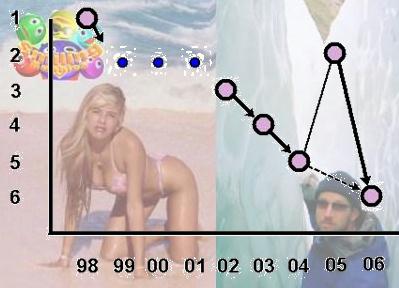
Figure 1: Global cooling. This graph, depicting 6 warmest years since 1998 according to their rank, shows how Al Gore and other people with comparable moral and scientific standards would be presenting the recent temperature records if cooling became more convenient for their goals than warming.

Note that various tricks that are popular with some politicians and journalists-activists are used although not as intensely as in the media. The beginning of the graph is appropriately chosen. Some years that would lead to undesirable conclusions are removed. The decreasing links are emphasized and scientifically interpreted while the increasing links are suppressed and painted as scientifically irrelevant episodes.

Some particular years, in this case 2005, are drawn as exceptions from the underlying trend if it can help the case. In fact, I forgot:


They would also add pictures that would make it clear that the past climate is what it should be while the future is a disaster: yes, the guy is stuck in between two glaciers and all of us will be. ;-)

They would also extrapolate the graphs in some catastrophic way up to 2050 and beyond and shoot a cynical movie about all these threats. A campaign showing that the CEOs of the companies producing heating devices - together with the nasty owners of the ski resorts - are vampires who are ready to sacrifice the planet to increase their profits would follow. Steve Jobs is a vampire, too: he is selling millions of white iPods that increase the reflectivity of the Earth, via the mirror effect, and bring us closer to the new ice age.

Media would inform you that they want to hide that a new ice age is imminent. We would be constantly reading about 25,000 Britons who froze to death during the 2005-2006 winter. Scary hurricanes would be described as a consequence of global cooling and heat waves would either become unimportant weather events or consequences of the global cooling.

The world would be different in details but the general picture would be isomorphic.

The Improving State of the World

Indur Goklany, a former EPA official, has collected 450 pages of data showing that the world is cleaner, happier, and healthier than ever before. The new book is recommended by various famous people such as Nobel prize winners and Chicago economists but not only them.

Goklany shows amazing numbers how the economic growth and technological progress has improved nutrition the in the third world, how it has made the environment cleaner - the countries that have abandoned communism are an important example. The food prices in real terms dropped by 75 percent in the last 50 years. The life expectancy has grown tremendously and the infant mortality has decreased four-fold. Also, it is cheaper to adapt to different temperature than to try to stop its change by introducing heavy-handed interventionism.

One of the things that the book disproves is the hypothesis that the economic growth leads to an increasing damage of the environment.


Irradiation back on the table

Food-related illnesses renew calls for a known safe process -- but one that freaks out the Greens

Two high-profile E. coli outbreaks this year have some in the food business wondering -- once again -- if it's time to go nuclear. For decades, many food safety experts have argued that irradiation -- zapping food with high-energy rays to kill microorganisms -- could avert hundreds of deaths and perhaps millions of illnesses each year. But for just as long, federal regulators and food retailers have been leery of bringing the technology to market.

Despite exhaustive reviews by federal scientists and endorsements by public health and medical groups around the world, irradiation by its very name conjures up images that are anything but wholesome: nuclear fallout, for one. That imagery, combined with some lingering uncertainties about irradiation's effects on food, has helped grass-roots activists make a potent case against it.

The U.S. Food and Drug Administration has approved irradiation as a disinfectant for a limited range of foods, including spices and ground beef. But a food industry petition to greatly expand that approval to include many ready-to-eat products -- fresh bagged greens, for instance -- has been awaiting review by the agency for more than seven years. Now, with both government officials and the produce industry feeling pressure to respond to the recent outbreaks, irradiation is again up for debate.

Jeff Barach, vice president of the Food Products Association, the trade group that brought the 1999 irradiation petition, said he had for months been unable to get an audience with FDA officials -- until September's outbreak of E. coli in Salinas Valley spinach. "We all of a sudden got a meeting" with the head of the department that is evaluating the petition, Barach said. He said that he offered to limit the scope of the request to fewer products -- to focus only on fresh packaged vegetables, lunch meats, and a few other items -- in exchange for a quicker decision from the agency. "I think we've made some good progress," he said. An FDA spokesman said the agency can't comment on the petition's status.

Members of California's fresh greens industry recently have been discussing irradiation -- among other strategies -- in their ongoing negotiations on food safety standards, according to Trevor Suslow, a specialist in perishable produce at the University of California, Davis, who has been present at some of the sessions. One appeal of irradiation to the produce industry has to do with the difficulty of pinpointing the source of contamination following a foodborne illness outbreak. By the time someone gets sick, there is a good chance the offending bacteria have died off. So, farmers and food processors -- and federal investigators -- can't tell where safeguards failed. Irradiation introduces the prospect of a final "kill step," for fresh produce, an additional layer of protection if other precautions fail.

The high-energy rays can penetrate packaging, making it possible to do a final disinfection after, say, spinach leaves have been washed and sealed in a bag. The technology can also kill pathogens nestled where disinfectants like chlorine don't always reach: in a crevice in a leaf of spinach, for instance. Recent studies have shown that the technology will reduce populations of common foodborne disease pathogens by at least 99.9 percent without hurting the quality of most fresh produce, according to Brendan Niemira, a lead scientist at the U.S. Department of Agriculture's Food Safety Intervention Technologies lab in Pennsylvania.

Irradiation disinfects food by damaging the DNA of microorganisms, rendering them unable to reproduce. The most common irradiation machines employ the high-energy gamma rays produced by radioactive cobalt. Newer alternatives use X-ray and electron acceleration techniques that do not require radioactive material. Units suitable for mass food processing cost between $4 million and $8 million, according to executives at two U.S. food irradiation firms. Irradiation was first identified as a food disinfectant in the 1920s. It does not make food radioactive, and its safety is supported by the results of nearly all studies of the technology performed over the past 50 years.

Still, were the irradiation of ready-to-eat produce to be approved, it would likely be the target of fierce campaigning by some public-advocacy groups. "I would characterize our view on irradiation as calling for a moratorium," said Andrew Kimbrell, executive director of the Center for Food Safety in Washington, D.C. In 1999, when the USDA was considering whether to allow irradiation and genetic engineering in certified organic foods, Kimbrell's group helped build strong opposition that included 300,000 public comments. The agency decided to keep both technologies out of the production of organic foods. Kimbrell says that research results don't provide proof of the safety of irradiation. He also argues that its widespread use would lead the food industry to be sloppy in other areas.

Michael Pollan, an influential writer on food and agriculture, raises another objection: If a costly food safety technology like irradiation becomes a standard step in food processing, small producers are likely be hurt more than large ones who are in a better position to absorb major expenses. That's particularly galling, Pollan says, since the national-scale outbreaks of foodborne illness that tend to prompt the use of such technologies are usually linked to big operations.

The average grocery shopper doesn't have much of an opinion one way or the other about irradiation, said Christine Bruhn, a cooperative extension specialist at UC Davis who has studied consumer attitudes toward the technology for more than 20 years. About 15 percent know about the technology and support it, while 10 percent express strong opposition, she said. While the recent E. coli episodes have again prompted discussion of wider use of irradiation, a major change isn't likely unless the produce industry's troubles continue, she said. "I suspect it's going to take a few more outbreaks," she said.

Source


THE PEISER MANIFESTO: SOME EXCERPTS

Benny Peiser gives his personal view of global warming -- and says that the politicians have painted themselves into a corner with their panic rhetoric

Peiser believes the lack of a practical short-term solution means that policymakers should be trying to tone down the current climate change discourse and prepare citizens for the long haul. "You have to say, 'Okay, these are the challenges, these are the issues, we won't be able to do it in the short-term but in the long-term we might'." Currently, however, the discourse in the UK is heading in precisely the opposite direction. Earlier this month Mike Hulme, director of the Tyndall Centre for Climate Change Research, criticised politicians, environmental groups and the media for talking about the potential impacts of climate change in catastrophic terms (LTT 16 Nov). Peiser has been making this point for some time and sees a strong cultural dimension to the alarmist discourse. "The emergence of environmental apocalypticism is perhaps the most significant ideological development in the western world since the demise of Marxism," he says.

He acknowledges that his technological approach is at odds with the more alarmist predictions. "If I were to counsel people to take this more long-term perspective they would say 'You underestimate the severity of the problem and that we're facing Armageddon now'," he says. "I personally think this kind of hype is unhelpful. This is not the first time in history that a population has been stirred up, become very emotional to the point of near hysteria over an issue. It's very, very poisonous for a rational policy-making process when emotions are so high and people stop pondering and weighing different options. Whenever the end is nigh, the solutions are worse than the malady."

Trapped by rhetoric

Peiser says the catastrophic emphasis in climate change discourse has been stoked by all three of Britain's main political parties because each is desperate to capture the 'green' vote. "The Conservatives are now greener than the Greens," he laughs. "From a policy perspective it is a situation where you can only lose because any government, whether it is Labour or the Conservatives, will be faced with the reality that their policies don't match the rhetoric," he says. "Tony Blair has made climate change top of the agenda but actually hasn't done anything to bring down emissions." "Where does that leave policy-makers?" asks Peiser. "It leaves them looking very exposed. But that's the price you pay for exaggerating a risk that you actually cannot address." Politicians, he says, "have cornered themselves". "They have dug themselves into such a hole that there is no way out. There is currently no way out of this hole for any British party."

Peiser says the tensions between the rhetoric and the reality are now becoming apparent. He cites the pressure that the Government is facing from over 400 MPs and Friends of the Earth to include annual carbon dioxide reduction targets in the Climate Change Bill. "If you want to sacrifice the British economy then please include annual targets in the legislation," he says." But politicians should be very honest about that and say, 'You want to save the planet? Okay, but don't come and complain about unemployment, rising energy prices and industries simply relocating to other parts of the world where they are taking a different approach'."

"[Chancellor] Gordon Brown knows that it is impossible to realise annual targets," says Peiser. "But once you actually hype up the problem of climate change and then say, 'Hold on, we cannot reduce CO2 year-on-year,' you look very bad. You look like someone who doesn't take the problem seriously. So that is the problem for any policy-maker: you exaggerate the threat and then you don't follow it up because you can't. You will be found out as a hypocrite. And that's what this Government looks like."

Runways and roads

Transport policy will give the Government particular problems, Peiser believes. "The Government will find itself in an increasingly difficult situation to legitimise spending money on any road improvements and any airport expansions," he says." Unless you actually do what the green campaigners say and make flying a luxury for the rich you will have an increase in air flights. The same is true for traffic on the roads. So the Government is faced with a conundrum."

Surprisingly, Peiser actually praises environmental commentator George Monbiot who, following the Stern Review, called for the road and airport expansion programmes to be scrapped, and even out-of-town shopping centres to be closed in the longer term (LTT 2 Nov). "George Monbiot is spot on as far as I'm concerned," says Peiser. "He's the only person who is actually consistent. He says 'Listen to the science, we've got ten years to solve this problem, otherwise it's too late. That means the complete halt of road expansion, airport expansion, a reduction of road traffic - make it more expensive, tax left, right and centre'." Peiser, of course, disputes the foundation of Monbiot's argument. "I question the disaster scenarios. That's why I say I have no problems with expanding a few airports because I don't think they're going to cause our civilisation to collapse."....

Perhaps nowhere are the tensions between the climate change and economic agendas more apparent than in the media. The Guardian and Independent newspapers have been among the most prominent in reporting and commenting on the threats that climate change could present, with both giving extensive coverage to the more alarming predictions. Yet, at the same time, both papers carry reader travel offers to far-away destinations and adverts for cars, cheap flights and energy-intensive consumer products.

"The problem with the Guardian and the Independent is that if they took the climate change threat seriously, they would stop advertising all the trappings of the 'good life'," says Peiser. "They would stop all ads for cars and all ads for holidays. If we really are facing disaster and collapse, why are they then profiting from all the companies and all the industries they blame for this?"

"In reality, the newspapers contribute to the problem perhaps just as much as the car industry, oil industry or any other, because they are promoting the lifestyles. They are the ones who are promoting and encouraging people to go on holiday and to fly and to use flashy cars - that's the ads they place for their readers." "They're claiming the 'End is nigh' but 'Look at this flashy car', 'Look at this cheap flight to Spain'. What signals are they sending out?"

Peiser says the contradictions simply illustrate our reliance on fossil fuels. "Without advertising the Guardian and Independent wouldn't survive. The problem for any person and any institution is that you can't actually drop out [of the carbon economy]."...

Chancellor Gordon Brown is expected to announce tax increases on motoring and air travel in next week's pre-Budget statement and is likely to cite concern about climate change as a key justification for doing so. But Peiser believes that, though the public is undoubtedly concerned about climate change, many people will not be prepared to accept the pain associated with the measures to tackle the problem.

He points to the "field day" that the tabloid newspapers had with the leaked memo from environment secretary David Miliband urging the Chancellor to make motoring and air travel more expensive (LTT 2 Nov). "The Daily Mirror had a comment column saying: 'Thank God there are still scientists who think this whole climate change thing is nonsense'," he says.

"So would you believe it, if policy goes against people's own interest then they start asking questions. As long as it's free everyone wants to be seen to be green and everyone is green. But once people start to feel the pain, they will start wondering, 'Hold on, is that actually right?'" Similarly, Peiser believes the idea of personal carbon rationing (championed by commentators such as Mayer Hillman and George Monbiot, and even floated by Miliband) is politically impractical. "Let's go back to rationing and see how long the Government survives," says Peiser. "Good luck to them. It's political suicide even to attempt it unless other countries are doing the same thing. People in Britain would realise that their living standards are going down while other countries' living standards are going up."

More here


New Australian Leftist leader ignores the Greens

Kevin Rudd has infuriated green groups by shutting them out of a key national environment debate, the formation of Labor's Tasmanian forest policy, and pledging strong support for the island state's forest industry. In one of his biggest policy moves since assuming the Labor leadership, Mr Rudd has rejected the party's previous position on Tasmanian forests and backed existing deals between the Howard Government and the pro-logging Lennon Government. Stopping in Tasmania on his national "listening" tour, Mr Rudd declared that former Labor leader Mark Latham had got it wrong with his pledge on forestry conservation before the 2004 election - which was blamed for Labor losing two seats. In rejecting the Latham policy, Mr Rudd confirmed that there was no place for the conservation movement in shaping Labor's new policy on Tasmania's forests.

Green groups reacted angrily, with the Wilderness Society saying Mr Rudd had paved the way for a sell-out on forests. Mr Rudd also came under fire from Australian Greens Leader Bob Brown and conservationists for not taking new Labor environment spokesman Peter Garrett with him on his trip to Tasmania.

But the local forest industry warmly welcomed Mr Rudd's pledge to support the existing Regional Forests Agreement and Community Forests Agreement, negotiated between the state and the Howard Government. Mr Rudd's statement on forests came days after he pledged to push for relaxation of Labor's restrictive policy on uranium mining - a move that has put him at odds with Mr Garrett.

On Tasmanian forests, Mr Rudd said Labor's guiding principle was that it wanted to see a long-term sustainable industry, based on three pillars:

* Close consultation with the State Government, unions and forest industries.
* No overall loss of jobs.
* Consultation with the State Government over conservation and protection of old growth forest areas.

Mr Rudd said he was in Tasmania to listen carefully to local communities, but confirmed that he had spoken to no-one in the forest industry on his visit. He said he would talk to the conservation movement from time to time. "But when it comes to the architecture of our forests policy here in Tasmania, it is as I've described before, based on those three principles and two sets of agreements which we support." Labor's loss of two seats in Tasmania at the last election, Bass and Braddon, was attributed to Mr Latham's $800 million package that would have secured [locked up] nearly all remaining contested old growth areas.

Industry and unions instead backed the more modest Howard conservation package in what was widely portrayed as a poll-eve political coup by the Prime Minister. Mr Rudd followed his predecessor, Kim Beazley, in distancing himself from the Latham policy. "Labor got it wrong. Part of the reason it got it wrong was that it didn't listen to the local community," he said.

His statement yesterday was welcomed by the Forest Industries Association of Tasmania. "We support and endorse the approach that Kevin Rudd has outlined," said executive director Terry Edwards.

The conservation movement, which has fought for more than 20 years for the protection of the state's old growth forests, came out swinging. "The policy Kevin Rudd is set to adopt is the one endorsed by the Lennon Labor Government which is destroying our forests," said the Wilderness Society's campaigns manager, Geoff Law. "It is desperately ironic that it comes almost 20 years to the day after Peter Garrett came to the Lemonthyme forest in Tasmania, and stood beside Bob Brown and said these forests must be saved."

The Australian Conservation Foundation said it was surprised that Mr Rudd was closing doors during a "listening" tour. "I think he should be certainly talking to the wide range of environmental stakeholders to get a full picture of issues as complex as these," said Matt Ruchel, Manager of Land and Water for the ACF.

Mr Rudd deflected questions about Mr Garrett, the former rock star and ACF head who now holds the Climate Change and Environment portfolio on Labor's front bench. In 2004, Mr Garrett described the Tasmanian timber industry as logging gone mad and carnage in the forests. Mr Rudd said that he was now leader of the party, and Mr Garrett had a job to do on climate change. Mr Rudd was speaking on a visit to bushfire-ravaged areas of Tasmania's east coast, where he said he had seen no indication of any gaps in the federal response to the fires. The main east coast fire has burned more than 20 homes and 25,000 hectares of land.

Source

***************************************

Many people would like to be kind to others so Leftists exploit that with their nonsense about equality. Most people want a clean, green environment so Greenies exploit that by inventing all sorts of far-fetched threats to the environment. But for both, the real motive is generally to promote themselves as wiser and better than everyone else, truth regardless.

Global warming has taken the place of Communism as an absurdity that "liberals" will defend to the death regardless of the evidence showing its folly. Evidence never has mattered to real Leftists


Comments? Email me here. My Home Pages are here or here or here. For times when blogger.com is playing up, there are mirrors of this site here and here.

*****************************************