Sunday, December 04, 2011

Should someone who writes on the ethics of science know some science?

Prof Donald Brown appears not to. He is an ethics "expert" who writes below in the most scathing terms about climate skeptics -- but he is a very poor moral philosopher as well as demonstrating no knowledge of science.

Moral philosophers discuss at great length what the basis of their ethical position is. They ask, for instance how notions of right and wrong originate and what they are based on. Comrade Brown does nothing like that. His very first sentence is a mere assertion and a highly dubious one at that. He assumes what he has to prove. He says: "Because climate change is an ethical problem....".

Had I been writing on the topic, I would have said "Because climate change is a non-existent problem..." -- and the evidence for my statement is pretty obvious, as even Warmist scientists admit that the tiny amount of warming seen in the late 20th century has ceased, and ceased around 12 years ago.

So does Comrade Brown take any account of that scientific fact? Not in the least. He mentions a few scientific claims in his article but gives references for none of them, let alone looking at the factual basis for them. The essential basis he gives for his position is that various science bodies have pronounced in favour of global warming. But that is neither a scientific nor a philosophical approach to truth. It is a bureaucratic approach to knowledge and before Galileo that approach would have yielded the "truth" that the sun revolved around the earth. Anybody who knows about intellectual fashions would regard a bureaucratic warrant of truth as worthless. The best face one can put on his assertions is that he is a dupe. I reproduce an excerpt from his hate-speech below


Climate change must be understood at its core as an ethical problem because; (a) it is a problem caused by some people in one part of the world that are hurting poor people who are often far away and poor, (b) the harms to these victims are potentially catastrophic, and (c) the victims can't protect themselves by petitioning their governments- they must hope that those causing the problem will see that their ethical duties to the victims requires them to drastically lower their greenhouse gas emissions.

However, I will in a minute review the tactics of the climate change disinformation campaign. We think you will agree that these are not acceptable ways of acting skeptically but malicious, morally unacceptable disinformation

To understand the full moral depravity of the climate change disinformation campaign, one must know something about the state of climate science. There is a "consensus" view on climate science that has been articulated by the Intergovernmental Panel on Climate Change, the IPCC. This consensus is not a consensus on all scientific issues entalied by climate change; it is a consensus about the fact that the planet is warming, that this warming is largely human caused, and that under business-as-usual we are headed to potentially catastrophic impacts for humans and the natural resources on which life depends. Furthermore, these harms are likely to be most harshly experienced by many of the Earth's poorest people.

Every Academy of Science has issued reports supporting the consensus view including four reports by the US Academy of Science. Well over 100 scientific organizations with expertise in climate science have also issued reports or statements in support of the consensus view. At least 97% of all scientists that actually do research in climate science support the consensus view according to two recent surveys in respectable scientific journals.

There are six recent books that have investigated the disinformation campaign on climate change science. (See references below) What follows is an ethical analysis of the disinformation campaign based upon the findings in these books.

The disinformation campaign began in the 1980s when some of the same scientists and organizations that fought government regulation of tobacco began to apply the tactics honed in their war on the regulation of tobacco to climate change. For almost 25 years this campaign has been waged to undermine public support for regulation of greenhouse gases.

The organizations trying to undermine public support on climate policies by exaggerating scientific uncertainty have expanded over the last few decades to include think tanks, front groups, astroturf groups (that is groups pretending to be bottom-up citizen responses), PR firm led campaigns financed by fossil fuel interests and free-market fundamentalists philanthropic funding organizations. Much of the funding support for these efforts has come from some fossil fuel interests.

The tactics deployed by this campaign are now all well documented including in the six books mentioned above. These tactics have included:

A. Lying. Some of the claims made by some of those engaged in the disinformation campaign have been outright lies about such things as the claim that the entire scientific basis for human-induced climate change is a hoax or that there is no evidence of human causation of climate change Given that every Academy of Science in the world has issued reports in support of the consensus view, it is a clear lie that the basis for human-induced warming is a hoax and that such claim is preposterous. This is far from reasonable skepticism but a lie.

SOURCE


Another "adjustment" to the data

Sea-level expert Nils Axel Morner writes:

The IPCC’s Fourth Assessment claimed that “there is strong evidence” of sea level rising over the last few decades. It goes as far as to claim: “Satellite observations available since the early 1990s provide more accurate sea level data... This decade-long satellite altimetry data set shows that since 1993, sea level has been rising at a rate of around 3mm yr–1, significantly higher than the average during the previous half century.”

Almost every word of this is untrue. Satellite altimetry is a wonderful and vital new technique that offers the reconstruction of sea level changes all over the ocean surface. But it has been hijacked and distorted by the IPCC for political ends.

In 2003 the satellite altimetry record was mysteriously tilted upwards to imply a sudden sea level rise rate of 2.3mm per year. When I criticised this dishonest adjustment at a global warming conference in Moscow, a British member of the IPCC delegation admitted in public the reason for this new calibration: “We had to do so, otherwise there would be no trend.”

This is a scandal that should be called Sealevelgate.

SOURCE


A referee's report on a paper by Hulme of the UEA

Mike Hulme is a professor of Climate Change in the School of Environmental Sciences at the University of East Anglia (UEA). In October 2000 he founded the Tyndall Centre for Climate Change Research. So he is a big star among Warmist scientists. The review (apparently by Keith Briffa) of one of his papers is therefore revealing. The review could scarcely be more scathing, ripping apart Hulme's analytical methods and accusing him of "massaging" the data. That is the character of a man upon whom Warmist place much reliance.

The review has come to light courtesy of email 977 in the Claimategate II release


Review of "1000 years of rainfall variability in the Sahel: an evaluation of a long-term climate model simulation against observational data", by N. Brooks and M. Hulme.

This paper deals with a clearly defined topic, but has several shortcomings that make it unacceptable for publication. These are

1) inadequacy of the model for studying the Sahel,

2) poor validation of the model, and

3) arbitrary and unjustified statistical analyses. I am also uncomfortable with their interpretation of results. Finally, and this is a minor issue, I think better literature could be cited. When several papers were available for citation about a certain point, the choice was generally a minor paper, with the most important papers being omitted. There is a tendency to cite "soft science" literature in places where more technical literature is appropriate.

1. Model and Model Validation: A validation attempt was made via comparison of statistics such as the mean, season cycle, and time spectra. However, in doing so the authors compared statistics for this century with those for a 1000-year model run. There is no reason to assume that these periods are statistically comparable. Indeed, the results suggest they are not.

However, some aspects of the climate can be considered fairly stable, such as the summer rainy season. The model produces less than 50% of its rainfall in July, July, August, compared to about 80% in the "real world".

It also shows many years in which rainfall approaches zero in the rainy season. The proper validation approach would have been to compare a 20th century simulation with the observed statistics. Further, it is important to show that the model can capture the mean spatial pattern and the real temporal variability of the observed data. This was not done.

2. The model results are extensively "massaged", using what appear to be arbitrarily chosen filters of 9 years, 25 years, 45 years, 96 years and 101 years. This is compared with unfiltered observational data. What is the justification of these particular filters, how do they affect the results. Is it appropriate to do statistical analyses, such as spectra, on the filtered series?

3. As a result of all of this statistical manipulation, it is difficult to follow what the authors do. It is even more difficult to judge their results and its statistical significance. This is particular problematic when a major results is correlations for thousands of grid points (Fig. 8.).

If this work were to be revised, much more attention would have to be paid to the statistical approach and to validating the results. At the moment I have no confidence in any of the conclusions draw from this simulation.

SOURCE


A very shaky hockeystick

The "hockeystick" picture of past temperatures was based on "reconstructions" of temperature from proxy data such as tree-rings. But tree rings are a very poor index of temperature and the excerpt from a Cimategate II email shows that the Warmist scientists knew that. Tom Wigley is writing to Michael Mann:

"A word of warning. I would be careful about using other, independent paleo reconstruction work as supporting the MBH reconstructions. I am attaching my version of a comparison of the bulk of these other reconstructions. Although these all show the hockey stick shape, the differences between them prior to 1850 make me very nervous. If I were on the greenhouse deniers' side, I would be inclined to focus on the wide range of paleo results and the differences between them as an argument for dismissing them all."

SOURCE


The Age Of Superstition And Ignorance

If you pave over rural lands, you get floods. When rain falls on impermeable ground, it runs off into rivers. One hundred twenty-one experts in New Jersey were too dense to figure this out, and instead blame their recent floods on CO2.
Some New Jersey communities are already suffering from the changes. While no single storm can be attributed to the changing climate, the two largest recorded floods on the Raritan River are Hurricane Floyd in 1999 and Hurricane Irene this year, said Anthony Broccoli, a director of Rutgers’ Climate and Environmental Change Initiative.

“From 1902 to 2001, there were 18 recorded flood events of the Delaware River at Trenton,” Broccoli said. “From 2002 through this year so far, there have been nine.”

There has been no increase in heavy rain events near Trenton. Irene barely made the top twenty. Hightstown is the closest USHCN station to Trenton.


We truly live in an age of superstition and scientific ignorance.

SOURCE (See the original for links)


Absolute Certainty Is Not Scientific

Global warming alarmists betray their cause when they declare that it is irresponsible to question them.

By DANIEL B. BOTKIN (Botkin is president of the Center for the Study of the Environment and professor emeritus at the University of California, Santa Barbara)

One of the changes among scientists in this century is the increasing number who believe that one can have complete and certain knowledge. For example, Michael J. Mumma, a NASA senior scientist who has led teams searching for evidence of life on Mars, was quoted in the New York Times as saying, "Based on evidence, what we do have is, unequivocally, the conditions for the emergence of life were present on Mars—period, end of story."

This belief in absolute certainty is fundamentally what has bothered me about the scientific debate over global warming in the 21st century, and I am hoping it will not characterize the discussions at the United Nations Climate Change Conference in Durban, South Africa, currently under way.

Reading Mr. Mumma's statement, I thought immediately of physicist Niels Bohr, a Nobel laureate, who said, "Anyone who is not shocked by quantum theory has not understood it." To which Richard Feynman, another famous physicist and Nobel laureate, quipped, "Nobody understands quantum mechanics."

I felt nostalgic for those times when even the greatest scientific minds admitted limits to what they knew. And when they recognized well that the key to the scientific method is that it is a way of knowing in which you can never completely prove that something is absolutely true. Instead, the important idea about the method is that any statement, to be scientific, must be open to disproof, and a way of knowing how to disprove it exists.

Therefore, "Period, end of story" is something a scientist can say—but it isn't science.

I was one of many scientists on several panels in the 1970s who reviewed the results from the Viking Landers on Mars, the ones that were supposed to conduct experiments that would help determine whether there was or wasn't life on that planet. I don't remember anybody on those panels talking in terms of absolute certainty. Instead, the discussions were about what the evidence did and did not suggest, and what might be disprovable from them and from future landers.

I was also one of a small number of scientists—mainly ecologists, climatologists and meteorologists—who in the 1970s became concerned about the possibility of a human-induced global warming, based on then-new measurements. It seemed to be an important scientific problem, both as part of the beginning of a new science of global ecology and as a potentially major practical problem that nations would have to deal with. It did not seem to be something that should or would rise above standard science and become something that one had to choose sides in. But that's what has happened.

Some scientists make "period, end of story" claims that human-induced global warming definitely, absolutely either is or isn't happening. For me, the extreme limit of this attitude was expressed by economist Paul Krugman, also a Nobel laureate, who wrote in his New York Times column in June, "Betraying the Planet" that "as I watched the deniers make their arguments, I couldn't help thinking that I was watching a form of treason—treason against the planet." What had begun as a true scientific question with possibly major practical implications had become accepted as an infallible belief (or if you're on the other side, an infallible disbelief), and any further questions were met, Joe-McCarthy style, "with me or agin me."

Not only is it poor science to claim absolute truth, but it also leads to the kind of destructive and distrustful debate we've had in last decade about global warming. The history of science and technology suggests that such absolutism on both sides of a scientific debate doesn't often lead to practical solutions.

It is helpful to go back to the work of the Wright brothers, whose invention of a true heavier-than-air flying machine was one kind of precursor to the Mars Landers. They basically invented aeronautical science and engineering, developed methods to test their hypotheses, and carefully worked their way through a combination of theory and experimentation. The plane that flew at Kill Devil Hill, a North Carolina dune, did not come out of true believers or absolute assertions, but out of good science and technological development.

Let us hope that discussions about global warming can be more like the debates between those two brothers than between those who absolutely, completely agree with Paul Krugman and those who absolutely, completely disagree with him. How about a little agnosticism in our scientific assertions—and even, as with Richard Feynman, a little sense of humor so that we can laugh at our errors and move on? We should all remember that Feynman also said, "If you think that science is certain—well that's just an error on your part."

SOURCE

***************************************

For more postings from me, see DISSECTING LEFTISM, TONGUE-TIED, EDUCATION WATCH INTERNATIONAL, POLITICAL CORRECTNESS WATCH, FOOD & HEALTH SKEPTIC, GUN WATCH, AUSTRALIAN POLITICS, IMMIGRATION WATCH INTERNATIONAL and EYE ON BRITAIN. My Home Pages are here or here or here. Email me (John Ray) here. For readers in China or for times when blogger.com is playing up, there are mirrors of this site here and here

*****************************************

Saturday, December 03, 2011

Durban Due Diligence

Kelvin Kemm

From my vantage point here in South Africa, I could hardly miss the major build-up to the COP-17 United Nations world environment and climate conference, which is being held November 28 to December 9 in Durban, where I went to school and university.

For weeks international news broadcasts spoke of “the road to Durban,” and people of all ranks made daily comments concerning issues to be addressed at COP-17. Conference organisers announced that bottled water would be limited, or even prohibited, because making, shipping and disposing of plastic bottles was not environmentally sound – and in any event Durban tap water is so good that anyone can safely drink water out of any tap, whether in a hotel room, restaurant or back yard garden hose. I agree with both points; Durban municipal water is excellent everywhere.

Other images also drifted through my mind, such as those of legendary scientist and philosopher Galileo, who dared to announce that it was not the sun that orbited the earth, but the planets, including the earth, which orbited the sun. The ruling establishment of the day jumped on Galileo, threatening him with dire consequences if he did not toe the politically correct line and recant his claims. He did so to avoid burning at the stake but was placed under house arrest anyway, to ensure that he did not spread his views, and his book was banned.

Many years later, during the French Revolution, baying mobs in Paris streets were ready to chop the heads off anyone perceived not to be part of the New World Order. Even scientist Antoine Lavoisier, the discoverer of oxygen and hydrogen, was one of many unfortunate people who lost their heads to French guillotines.

Today, I fear we are experiencing similar, though less lethal, sentiments on topics of so-called global warming, global climate change, global climate disruption and weather “weirding.” In far too many instances, any person who dares to challenge official dogma is branded a “denier” and treated as an enemy of society. This is not merely sad; it is dangerous to all mankind.

Chanting climate change advocacy groups want non-compliant businesses and industries found guilty of crimes against the planet, so that condemned industrialists can be hunted down and punished. This is destructive of reasoned scientific debate, affordable energy and modern civilization.

The asserted evidence that anthropogenic carbon dioxide is totally to blame for any observed climate changes is at best scientifically very shaky. There are far too many holes in the theory for it to pass the conventional rigour that should be applied to any scientific debate.

The evidence shows serious deviations between CO2 claims, computer models and computer-generated forecasts and scenarios, on the one hand – and actual observations and measurements of temperature and weather, on the other hand. Historical and archaeological evidence (of major climate and weather changes and extremes) likewise do not support claims that allegedly stable climate conditions have suddenly been thrown into disarray by human greenhouse gas emissions.

Atmospheric carbon dioxide concentrations and observed temperature changes over the past century simply do not correlate nearly as well as necessary for proper scientific analysis. Similarly, historical evidence clearly demonstrates that there was a Medieval Warm Period (MWP) of great health, wealth and prosperity, during which temperatures were warmer than today’s, but with no anthropogenic carbon dioxide in the equation.

Archaeology and history also show that successful Viking settlements died out in Greenland after the MWP, as a significant 500-year-long period of global cooling set in. The coldest point of this Little Ice Age was the well-documented Maunder Minimum, when ice fairs were held on London’s frozen Thames River. Contemporary paintings of these frozen festivals still exist today.

Similar long-term periods, such as the Roman Warming, have likewise been documented, as have lengthy periods of droughts and floods in various ancient societies – to say nothing of major ice ages and interglacial periods that affected much of Europe and North and South America. Previous significant climatic changes are hardly rare events. However, for obvious reasons, the global warming advocacy faction does not want to discuss these historical periods.

Moreover, over the past decade, significant new scientific evidence has suggested that observed global warming can probably be explained largely or entirely by changes in solar activity and thus cosmic ray incidence on earth, consequent changes in cloud cover and atmospheric water vapour levels, periodic shifts in oceanic temperatures and currents, and other natural phenomena.

Why, then, do we witness repeated attempts to demonize and bury any hint that solar activity is a principal cause of observed global warming? Why do climate change alarmists seek to suppress evidence that the Earth has not warmed and may even have cooled slightly since 1998? Why do so many Climategate 1.0 and 2.0 emails reflect much more private uncertainty among alarmist climate scientists than they have been willing to admit publicly?

These actions are much too close to the Galileo and French Revolution affairs for comfort.

Even worse, misguided government and corporate policies and actions worldwide – in response to the false science and high pressure tactics – will be highly detrimental to mankind, especially poor families that will be trapped in perpetual poverty, disease, malnutrition and premature death.

We can only hope that future generations will not group the Galileo, French Revolution and climate change eras as similar Dark Ages, when “establishment” zealots and easily inflamed crowds suppressed science and analytical truth.

Let us hope, instead, that at least some world leaders will have the courage to stand up at COP-17 and demand the kind of scientific rigour that brought so much enlightenment and progress over the centuries. Proper due diligence in Durban requires nothing less.

Only then will poverty be eradicated, and health and environmental conditions improve, for billions of people all over our planet.

SOURCE


Quarter of British homes 'face fuel poverty': Green taxes add to burden for struggling families

One in four households will struggle to keep warm this winter because of costlier gas and electricity and the impact of green taxes, figures out today show. More than five million households in England alone are living in fuel poverty as incomes stagnate and energy bills soar.

Fuel poverty is where a family spends more than 10 per cent of its income on energy.

Ministers are under increasing pressure to abandon green energy targets amid warnings that fuel surcharges will put the lives of the most vulnerable at risk as they struggle to pay bills.

The Government faces calls to tear up or delay plans to force through a £200billion shift to wind turbines, wave power and new nuclear power stations.

Previous official projections had forecast that 4.1million households would be in fuel poverty this year, but calculations following rises in energy prices over the summer have shown that a million more will be hit.

The figures provided to Consumer Focus are based on actual bills after the rises.

William Baker, of the statutory consumer body, said: ‘With over five million households currently in fuel poverty, it is difficult to see how the Government is going to eradicate fuel poverty by 2016, as required by the Warm Homes and Conservation Act 2000.

‘We therefore urge the Government to use the proceeds from new carbon taxes to provide vital funds to support a national energy efficiency programme.’

All six of the big energy suppliers pushed up their prices with the biggest, British Gas, putting up its gas and electricity prices by 18 per cent and 16 per cent.

The government-appointed Fuel Poverty Advisory Group last night urged ministers to act. Chairman Derek Lickorish said that the average family’s dual fuel bill has doubled since 2003 and is now more than £1,300.

‘The Government needs to reflect on what’s happening to ordinary people. It has not been taking this seriously enough,’ he said.

The figures show the severity of the problems in parts of the country with more than 40 per cent of households in Wales in fuel poverty. The North East and West Midlands have fuel poverty levels of more than 30 per cent. Around 2.5million people are now in debt to their energy supplier, with the average gas bill arrears now £320.

A Government-commissioned study earlier this year warned that more than 2,700 people are dying each year in England and Wales because they cannot afford to keep their homes warm.

The study by social policy expert Professor John Hills, of the London School of Economics, concluded that green taxes on household power bills have a disproportionate impact on poorer homes.

Energy companies meanwhile are under pressure to cut prices following significant falls in the wholesale cost of fuel.

Unusually warm weather and the lack of demand from industrial customers as the economy falters have created a glut of cheap power. The fall in wholesale prices kicked in at the end of August – exactly the time that price rises began.

Experts at independent industry analysts ICIS Heren said: ‘UK energy markets are in freefall as the eurozone teeters on the brink of recession.

‘UK wholesale energy prices plummeted to 12-month lows this week, finally cancelling out increases earlier in the year that caused energy companies to raise household prices.’

SOURCE


Global warming alarmism cooling

Another frantic effort to redistribute wealth from developed nations to developing nations is under way, this time in Durban, South Africa. The excuse is the same old, tiresome claim that socialism writ large is necessary to save the planet from global warming.

Fewer people are fooled every year the United Nations brings together representatives of about 190 nations hoping to profit from the shakedown. Just as claims of climate doom are wearing thin, so are arguments for separating you from your money.
Article Tab: In this image made available by Greenpeace, activists dressed as trees protest the deforestation of the Amazon jungle in Brazil in Durban, South Africa, Nov. 29, the second day of the two-week U.N. climate conference attended by 192 parties seeking agreement on future action to curb climate change.

We like the way contrarian climate scientist S. Fred Singer describes the confab: "10,000 or so Durban attendees – official delegates, U.N. and government officials, journalists, NGO types and other hangers-on – will have a grand old time: two weeks of feasting, partying, living it up in luxury hotels, and greeting old friends at this 17th reunion – all at someone else's expense."

"At someone else's expense" could be the theme of the global warming movement.

Americans should be pleased that the conference no sooner began than the U.S. was blamed for not taxing and regulating greenhouse gases enough, and for not writing enough compensatory checks to countries less fortunate. In the view of those overseas who want your money, America still hasn't sacrificed enough, despite onerous regulations and punitive taxes imposed domestically, including the horrific California Global Warming Solutions Act.

The United States and other developed nations are realizing that reducing their own productivity – a byproduct of reducing greenhouse gas emissions – isn't smart in hard times. It's good to see common sense prevail.

On the eve of this conference to extend the Draconian Kyoto Protocol greenhouse gas-limiting treaty, someone leaked thousands of emails revealing the duplicity, flawed science and conspiratorial inclination of the clique of climate scientists, who have claimed global warming threatens the planet.

A similar leak occurred on the eve of the 2009 global warming conference in Copenhagen, which ended in frustration for climate alarmists and nothing binding for the rest of us. The emails' peek behind the scenes called into question the motives of climate alarmists, the reliability of the science behind their scary stories and pointed up the conspiratorial nature of the clique.

It also hasn't hurt that the public increasingly is aware climate alarmists' catastrophic claims aren't panning out. Sea levels declined in 2010, rather than drowning island nations as claimed. The melting of Mount Kilimanjaro's snow cap was proven unrelated to global warming, contrary to claims. There are fewer, not more, devastating hurricanes. Temperatures at best have remained level for nearly 15 years, despite historic increases in CO2 emissions, which warming theorists insist should drive them higher.

And now, as nations ride out a rough economy, they are becoming more reluctant to cut their own economic throats and throw money at unproductive uses.

SOURCE


EPA fuel efficiency standards are an unnecessary cost to taxpayers, automakers and drivers

Once again the Environmental Protection Agency (EPA) is stepping on the toes of, well, everyone who owns, manufacturers or sells a vehicle.

The EPA’s most recent announcement is all vehicles must meet an average of 54.5 miles per gallon by 2025—a doubling of today’s average of about 27 mpg, according to the Wall Street Journal.

The ironic part of this mandate is if you asked anyone who drives they will likely confirm that they would love to see an increase of fuel economy in their vehicle. Better fuel economy means fewer trips to the gas station and more money in your pocket, who doesn’t want that?

But, alas, the free enterprise system is once again interrupted by the edict of a rogue government agency.

The problem with this EPA decree is it jumps ahead of the free market economy. Instead of letting consumer demand be the driving force behind better gas mileage in vehicles automakers will now be forced to pay an EPA-estimated $157 billion to comply with the rule. But automakers aren’t the only ones who will suffer, this mandate will likely raise the price of vehicles by an average of $3,100—not something Americans want.

More HERE


Don't let Big Green stymie boom in energy jobs

Imagine that you never went to college and you have virtually no experience punching the time clock, thanks to the ongoing depression in blue-collar jobs in American manufacturing. Not to worry, though, because there are places in America where men who are willing to put in long hours doing hard work can earn $100,000 or more. There are downsides, like being out in the middle of nowhere and coping with shortages of housing and other amenities such as sleep, but the rewards can be immense for the hardy. And, since this is the oil and gas industry, true stories of ambitious men going from rough-necking to millionaires are anything but unprecedented.

We refer, of course, to the booming Bakken oil fields in America's high plains, where little towns like Williston, Dickinson and Minot have seen populations and economic growth explode in recent years. There are billions of barrels of oil in the Bakken formation that underlies North Dakota, Montana and Canada's Saskatchewan region. Bakken oil was previously inaccessible, but, thanks to new technologies like hydraulic fracturing and horizontal drilling, it has become eminently reachable.

Here's how CNN Money describes the boom: "Many of the highest-paying jobs are at oil companies, where workers make an average salary of about $100,000, often with little-to-no experience or need for a college degree ... But it's not just the oil companies that are hiring. The oil boom has brought such a big influx of people that every single industry -- from hospitality to retail -- has been hit with overwhelming demand as a result." Unemployment is all but nonexistent in these boom towns.

Similar, if somewhat less spectacular, success stories are playing out in Pennsylvania, Ohio and West Virginia where those same new technologies have produced an explosion of natural gas production from the Marcellus Shale formation. As the New York Times' David Brooks wrote earlier this month: "Already shale gas has produced more than half a million new jobs, not only in traditional areas like Texas but also in economically wounded places like western Pennsylvania and, soon, Ohio. If current trends continue, there are hundreds of thousands of new jobs to come." Even old-line industries like steel are benefitting, with the Cleveland Plain-Dealer recently reporting that Republic Steel is investing $85 million to create 450 new jobs at a plant it was shutting down just three years ago. The plant will make steel pipe needed for the Marcellus gas wells.

Thanks to the new technologies, additional vast untapped energy resources in Texas, Alaska and off-shore could make America energy independent in the 21st century, allowing U.S. policymakers to tell Orgazniation for Petroleum Exporting Countries nations to go pound sand. But Big Green environmentalists - and their political allies in the White House and Congress -- are determined to keep the country from enjoying this boom. As Brooks noted in the Times, "not-in-my-backyard activists are organizing to prevent exploration. Environmentalists and their publicists wax apocalyptic." So a key issue in 2012 will be whether Americans want continued high unemployment and economic stagnation, or new jobs and growth. We're betting on the Bakken boom.

SOURCE


Suppression of climate debate is a disaster for science

Margaret Wente, in Canada

Environment Minister Peter Kent has done us all a favour by stating the obvious: Canada has no intention of signing on to a new Kyoto deal. So long as, the world’s biggest emitters want nothing to do with it, we’d be crazy if we did. Mr. Kent also refuses to be guilted out by climate reparations, a loony and unworkable scheme to extort hundreds of billions of dollars from rich countries and send it all to countries such as China. Such candour from Ottawa is a refreshing change from the usual hypocrisy, which began the moment Jean Chrétien committed Canada to the first Kyoto Protocol back in 1998.

Yet even though a global climate deal is now a fantasy, the rhetoric remains as overheated as ever. Without a deal, we’re told, the seas will rise, the glaciers will melt, the hurricanes will blow, the forest fires will rage and the four Horsemen of the Apocalypse will do their awful work.

Or maybe not. As Roger Pielke Jr., one of the saner voices on the climate scene, points out, the hurricanes have failed to blow since Hurricane Wilma hit the Gulf Coast back in 2005. Despite the dire predictions of the experts, the U.S. has now experienced its longest period free of major hurricanes since 1906.

It’s possible to accept the underlying science of global warming, as Mr. Pielke does, while also maintaining that substantial uncertainties still exist. Why wouldn’t they? Climate science is relatively new, and it’s also insanely complicated. No one knows with any certainty the exact impact of carbon dioxide emissions, what long-term climate trends will be or the effect of other factors, such as the sun.

But don’t take it from me. Take it from the climate scientists themselves.

By no coincidence, a new cache of hacked e-mails from leading climate scientists hit the Internet last week, just in time for the lead-up to the United Nations climate conference in Durban, South Africa. The e-mails are not recent – they are a new instalment in the so-called Climategate affair, which broke two years ago. They deal with a small area of global-warming studies that addresses the question: How do we know the Earth is warmer now than it was 1,000 years ago? The evidence is not straightforward, because it relies on proxy data such as tree rings.

Although Climategate has been widely dismissed as nothing more than the usual academic sniping, it is much more than that. In some of the e-mails, scientists propose ways to massage the data to make it look better. They try to figure out how to get dissident scientists fired. Others are unhappy because they believe important information has been simplified, suppressed or misrepresented for public consumption.

“There have been a number of dishonest presentations of model results by individual authors and by IPCC [the UN’s Intergovernmental Panel on Climate Change],” one scientist complained, also arguing that calculating the climate’s sensitivity to increased levels of carbon dioxide “cannot even be done using present-day data.” Another wrote, “I also think the science is being manipulated to put a political spin on it which for all our sakes might not be too clever in the long run.” Or, as another doubter put it, “What if climate change appears to be just mainly a multi-decadal natural fluctuation? They’ll kill us probably…”

There’s nothing wrong with uncertainty in science. What’s wrong is denying it exists. “They were attacking skeptics for questioning the science, but in private, they were questioning it themselves,” Ross McKitrick, an economics professor at the University of Guelph who is a leading climate-science critic, told me. He thinks the entire IPCC process needs to be rebuilt from scratch.

Governments around the world have spent billions on policies to counteract the impact of global warming. They have done so because policy-makers, politicians and the public have been told that the science is built on bedrock. But some of that bedrock turns out to be sand.

Instead of distancing themselves from the shenanigans, the broader climate-science community has treated the central figures in Climategate like persecuted heroes. That is a terrible mistake, because it erodes the credibility of the entire field. The suppression of legitimate debate is a catastrophe for climate science. It’s also a catastrophe for science, period.

SOURCE

***************************************

For more postings from me, see DISSECTING LEFTISM, TONGUE-TIED, EDUCATION WATCH INTERNATIONAL, POLITICAL CORRECTNESS WATCH, FOOD & HEALTH SKEPTIC, GUN WATCH, AUSTRALIAN POLITICS, IMMIGRATION WATCH INTERNATIONAL and EYE ON BRITAIN. My Home Pages are here or here or here. Email me (John Ray) here. For readers in China or for times when blogger.com is playing up, there are mirrors of this site here and here

*****************************************

Friday, December 02, 2011

Wind power truly in the realm of mysticism

Wind power paranoia has bypassed science logic and is well and truly in the realm of mysticism

Let me state categorically that, as a physicist, I am in favour of wind power that is genuinely economically viable. The problem is that large-scale wind power fed into a national grid is just not viable – either economically or practically – from an engineering stand point.

The dream of some enthusiasts that there is some major technological leap just waiting in the wings that will make wind power viable is extremely unlikely to take place. The total energy in any wind stream is measurable, and there is no known quantum leap waiting for a solution that could produce considerably more wind energy than at present.

The extreme language and wild claims concerning the potential glories of wind power are becoming more and more exotic and are rapidly being blown further away from reality by the wind of reason. We really need a wind of change to blow now to bring debate back to sound logical discourse on the real strengths and weaknesses of wind power.

I have been reading documents on wind energy from a variety of sources and one sees a spectrum of highly optimistic statements, such as the one here in South Africa from the wind lobby, which says it is striving for 20% of national demand to be met by wind power by 2025. Okay, there is nothing wrong in an optimistic dream.

However, in referring to the intro- duction of more wind power, the statement goes on to say: “It will involve close interaction between the private and public sectors to ensure technical parameters and electricity grid designs are appropriate to facilitate it.”

What this statement actually says is: there are severe technical problems in integrating a highly variable energy source into the grid and somebody will have to overcome these problems that we know exist, but we do not want to mention them.

A spokesperson of the South African Wind Energy Association was quoted in the media as saying: “Contrary to what most believe, a 30 000 MW wind energy plant would have an average daily minimum power output of 7 000 MW and would displace 6 000 MW of conventional coal or nuclear power baseload.”

This statement is significant for a few reasons. Firstly, it is irresponsible fantasy. Secondly, it does admit that a ‘plant’ of 30 000 MW does not produce 30 000 MW but only an ‘average’ of 7 000 MW. Take careful note of the word ‘average’. This word means that, in practice, the ‘plant’ could produce any output from zero to 30 000 MW, depending on if and when the wind blows. On ‘average’, they say, one should get 7 000 MW ‘daily’.

But what does that mean? How can one use the terms ‘average’ and ‘daily’ together. Think about it. The most common error committed unknowingly by the media, and knowingly by the wind proponents, is that a quoted figure for installed capacity for wind power is not the amount you get. Wind power systems are fundamentally designed to produce about 25% of their installed capacity, so one designs to get about 7 000 MW out of 30 000 MW of installed capacity. Frequently, the operating wind systems do not even deliver the designed 25% – at times half of this or less. In contrast, with nuclear power, one would get more than 25 000 MW out of an installed capacity of 30 000 MW and one would get it all the time, not only ‘on average’ when the wind blows.

Further, to refer to ‘a plant’ of 30 000 MW as if such a huge capacity would be built in one ‘plant’ is just crazy. Actually, it is irresponsible to use such language.

A capacity figure of 30 000 MW would be arrived at by adding together many wind farms which would be placed very far apart. So, the wind patterns would be very different. The so-called ‘average’ wind output of 7 000 MW could actually appear anywhere over a very wide area, hundreds or, perhaps, thousands of kilometres apart. This is the type of situation that gives rise to technical problems in the grid. You cannot just push significant pulses of electricity into the grid at widely divergent places at widely differing times – depending on when and where the wind blows. Something will blow (pun intended).

To say that this claimed 7 000 MW would replace 6 000 MW of nuclear or coal power is just foolish.
I recently received a comprehensive wind power report from the UK. This report contains the real results of UK wind power facilities. It is very revealing. For example, it quotes, in detail, the significant number of days during the past year when the entire system produced essentially no output at all. What this tells one is that the entire installed wind capacity needs a backup consisting of some really reliable source like coal or nuclear.

What then is the point of large-scale wind power if one needs a second source in reserve? I am not aware of any place in the world where the installation of large-scale wind energy has actually resulted in the decommissioning of other significant power sources.

It is time that the fantasy of producing large-scale economic wind energy reliably was put aside and a sensible realism emerged. Such a realism would examine deploying existing wind technology in isolated standalone systems, which are genuinely economic and which use the intermittent nature of the wind as a strength, and do not hide this inherent weakness with smoke and mirrors. There are thousands of places on the planet that really need such standalone energy systems.

SOURCE


British Met Office Climate Forecasts: Always Wrong But Never In Doubt

When it comes to testing a climate model, the future is more important than the past. You can take your model and adjust its various parameters to fit observations already made, but the crucial test is how well that model matches the future. This involves making a prediction, but, as they say, prediction is difficult, especially about the future.

The important thing about a prediction is that once made you don’t modify it or start making excuses. It is prediction though that sets a model apart from mere curve fitting and tells you if your model is in touch with reality and is not just matching wriggles on graphs. The problem with computer models of the climate is that ideally several decades are needed to see if they are any good. This is tricky to fit into an academic life and frustrating for all concerned, but there are other ways.

Shorter-term predictions will contain more noise but if the model captures accurately the putatively increasing man-made warming signal in the data it should be possible to say something statistically about its presence. In the past few years the Met Office has been doing exactly that. What they have also been displaying is a public lack of self-evaluation, and hoping we have short memories.

In 2007 it became obvious that annual global temperatures were not increasing in the past few year, and a few people said so in public what scientists were talking about in private hoping it wouldn’t get out.

With A Vengeance

In August of 2007 the UK Met Office released a study that predicted that global warming will set in with a vengeance after 2009, after they implicitly acknowledged the temporary warming standstill, with at least half of the five following years expected to be hotter than 1998, which was then, and is still the warmest year on record.

The Guardian said:

British scientists are predicting a succession of record-breaking high temperatures in the most detailed forecast of global warming's impact on weather around the world.
Powerful computer simulations used to create the world's first global warming forecast suggests temperature rises will stall in the next two years, before rising sharply at the end of the decade.
From 2010, they warn, every year has at least a 50% chance of exceeding the record year of 1998 when average global temperatures reached 14.54C.

Reporters were told that in order to make such a prediction, researchers at the Met Office had made a computer model that takes into account such natural phenomena as the El Nino pattern in the Pacific Ocean, and other fluctuations in ocean circulation and heat content.

The Telegraph said:

This is the prediction of the first computer model of the global climate designed to make forecasts over a timescale of around a decade, developed by scientists at the Met Office.
"This is a very valuable step forward," Science magazine was told by meteorologist Rowan Sutton of the University of Reading. "It's precisely on the decadal time scale and on regional scales that natural variability and anthropogenic (man made) effects have comparable magnitudes."

The climate model was described in Science. It states, “…at least half of the years after 2009 predicted to exceed the warmest year currently on record.”

How well did this computer model do by its own test?

We are now two years into their five year prediction, and as yet none of them has been anywhere near the temperature of 1998. This means that, if the prediction is correct, then all three of the subsequent years, including 2014, must be hotter than 1998. Looking at the data I don’t think this is likely to happen.

In the event of the prediction’s failure it would be disingenuous to say: oh well, there were more La Nina cooling events than we thought, but that the model is sound. Such events were incorporated into the model. Strictly speaking if it fails its self-appointed test then the model is unsound, it has failed its crucial test at the least with its specific input parameters.

The problem is however that the Met Office keeps moving the goalposts.

After the 2007 prediction, and with the addition of only one annual more temperature datapoint (that for 2008 which was statistically identical to the previous years since 2001), in 2009 Prof Phil Jones of the University of East Anglia wrote in an email:

Tim, Chris, I hope you’re not right about the lack of warming lasting till about 2020. I'd rather hoped to see the earlier Met Office press release with Doug's paper that said something like - half the years to 2014 would exceed the warmest year currently on record, 1998!

Then at the end of 2009 the Met Office admitted that 2009 was not a record breaker and was in fact near the “lower end of expectations.”

The problem was, of course, the cooling effect of a La Nina, which even though incorporated into the models, had compensated for the underlying warming. As Phil Jones put it, the presence of La Nina during the last year partially masked this underlying rate.

Phenomena such as El Nino and La Nina have a significant influence on global surface temperature, said Dr. Chris Folland of the Met Office Hadley Centre. Further warming to record levels is likely once a moderate El Nino develops. The transition from a La Nina effect to an El Nino one is expected late next year.

Of course, even in the presence of no warming seen in the past decade a strong El Nino might boost temperatures to a record level, even though that would say more about the El Nino’s starting point and not the underlying decadal temperature increase. Such crucial scientific specifics were however lost, at least in public. So the hopes were high that 2010 would be a record year.

Climate could warm to record levels in 2010, the Met Office said:

The latest forecast from our climate scientists, shows the global temperature is forecast to be almost 0.6 °C above the 1961-90 long-term average. This means that it is more likely than not that 2010 will be the warmest year in the instrumental record, beating the previous record year which was 1998.

It wasn’t. The forecast was a spectacular failure.

Despite a strong El Nino it had a temperature anomaly of 0.470 (with respect to 1961 – 90 average) making it the third warmest year though when the errors are looked at it is in undistinguished member of the post-2001 standstill.

In another rewriting of history Prof Phil Jones said that due to natural variability we do not expect to see each year warmer than the last, but the long-term trend is clear.

The problem is that no year has been warmer than the last!

So, forever hopeful, onto 2011. If the model is correct it must surely be the warmest, after all if the model is right a new warmest year ever must be along any year soon.

The Met Office said that for 2011 they were expecting another very warm year, with a global anomaly forecast of +0.44C above the 1961-1990 average. That would make 2011 the equal 6th warmest year on record.

It isn’t. Whilst we wait for the November and December data 2011 has a temperature anomaly of 0.356 and is the 11th warmest year. Again the Met Office forecast was way off.

Remember the 2007 prediction (half of the post 2009 years would be warmer than 1998). Curiously, at the beginning of 2011 the Met Office revised their prediction and said they expect that 'half the years between 2010 and 2015 to be hotter than the hottest year on record'.

The goalposts have moved! 2009 – 2014 has become 2010 – 2015. The cardinal rule in making predictions is not to fudge them, and be honest about the results before making a new prediction with a revised timescale.

If the Met Office climate model is correct then there should be more than 50% of the years 2010 – 2015 exceeding the 1998 record. In the Times of 29 Nov 2011 Peter Stott of the Met Office changed the goalposts again, saying that they stood by their previous prediction that half the years in this decade would be warmer globally than 1998, the warmest year to date.

None of the Met Office forecasts have been correct. The global annual average temperature has to increase soon or else the goalposts will have to be moved again. At what stage does one admit the predictions were wrong?

The latest news is that a second cooling La Nina is brewing in the later part of 2011 and may extend into 2012. Given that, I wonder what the predictions for 2012 will be?


SOURCE


Era of energy subsidies is over

American consumers, not Congress, should choose best power sources

Bill Clinton famously said, “The era of big government is over.” Well, it didn’t work out that way. But something truly remarkable is happening in our national conversation about energy subsidies: outrage, mounting opposition and, we hope, a swift end. This would be great news for taxpayers and consumers.

Subsidy folly has been bipartisan and commonplace. For the past three decades, both parties have intervened in the energy industry. In 1978, a Democrat-controlled Congress and President Carter created an investment tax credit for solar, wind and other renewable energy sources. In 1992, a Democrat-controlled Congress and Republican President George H.W. Bush passed the production tax credit for electricity produced from wind and biomass. Then in 2005, a Republican-controlled Congress and President George W. Bush passed the Energy Policy Act of 2005, which included massive tax subsidies for seemingly every energy source under the sun, including alternative vehicles, advanced nuclear power and, of course, solar power. The latter legislation created the infamous Department of Energy loan-guarantee programs that produced the ongoing Solyndra scandal.

After three decades, what have we learned?

* Energy subsidies distort the free market by funneling billions in taxpayer dollars to politically favored energy sources and technologies, preventing market prices from signaling the optimal source for particular energy uses.

* Subsidizing energy sectors drains the federal treasury and forces the consumption of higher-cost energy sources.

* Politically allocated capital typically flows to politically connected companies or to large companies that could develop innovative technologies on their own dime. The $535 million Solyndra scandal has reinforced all of these lessons and helped shine a light on the energy-subsidy debate, exposing those who maintain government is the solution to our energy needs.

The good news is that with the support of the American people, politicians now are speaking the truth. At a recent Republican presidential forum, the candidates were in near-unanimous agreement that it is time to end the federal government’s role and allow the free market to bring our nation the next great energy source. Texas Gov. Rick Perry said, “I do not think it is the federal government’s business to be picking winners and losers, frankly, in any of our energy sources.” Rep. Michele Bachmann had similar remarks: “I want to see a [level] federal playing field. We’ve seen what a disaster it is when the federal government picks winners and losers.” In his economic plan, former Massachusetts Gov. Mitt Romney said government “should not be in the business of steering investment toward particular politically favored approaches.” This is progress. Just four years ago, almost every candidate in Iowa was afraid to say that subsidizing politically favored energy technologies had been an enormous policy failure.

Given the shift in the debate, the time to end subsidies is now. This month we introduced the Energy Freedom and Economic Prosperity Act, H.R. 3308, which has garnered support from such conservative organizations as Americans for Prosperity, Americans for Tax Reform, Club for Growth, Council for Citizens Against Government Waste, Freedom Action, Heritage Action for America, National Taxpayers Union and Taxpayers for Common Sense. H.R. 3308 would eliminate all energy tax credits, each of which is nothing more than a taxpayer handout to politically favored industries or companies. From solar to wind, from geothermal to biomass and from ethanol to hydrogen, they all must go. It is equal opportunity - not one single solitary tax credit would survive this bill. The proposal then would use the savings realized from the repeal of these tax credits to lower the corporate tax rate. This is a perfect model for tax reform - close out politically allocated tax favors and loopholes and lower taxes on every business that competes in America.

While we are gaining broad public support to end these energy tax credits, the takers of government largesse seldom go quietly. The pro-subsidy lobby pushes to extend its giveaway from Uncle Sam, seeking to extend the production-tax-credit subsidies for wind, biomass and geothermal energy every four years. This is the umpteenth-and-never-final request for “just four more years.” But a few more years will just lead to a few more years after that. Even before we introduced the legislation that for the first time would provide zero tax credits to any energy source, the American Wind Energy Association howled that Rep. Mike Pompeo “seems to misunderstand how a key federal tax incentive has built a thriving American wind manufacturing sector and tens of thousands of American jobs.” Well, we both understand perfectly - handouts are hard to give up.

After three decades, the tide on energy subsidies has turned. Our nation has squandered hundreds of billions of dollars with these tax credits and has little to show for it. We hold no ill will to any of these energy sources that receive tax credits - some or all of them may well become the next great American energy technologies. But having dozens of energy handouts leads companies to spend resources lobbying Washington rather than tinkering in their garages and labs. Indeed, we are counting on one of these alternatives to succeed. We just know that we have no idea, nor do any of our peers in Congress, which one consumers ultimately will demand. The winner must be determined the old-fashioned way: through hard work, innovation, American moxie and superior skills engaged in competition.

Let’s put a different twist on the old saying “not invented here” by acknowledging that energy technology never has been invented here - on the Potomac - and do away with energy subsidies once and for all.

SOURCE


Long-term sea-level rise negligible

This week's Spectator cover star Nils-Axel Mörner brings some good news to a world otherwise mired in misery: sea levels are not rising dangerously – and haven't been for at least 300 years. To many readers this may come as a surprise. After all, are not rising sea levels – caused, we are given to understand, by melting glaciers and shrinking polar ice – one of the main planks of the IPCC's argument that we need to act now to 'combat climate change'?

But where the IPCC's sea level figures are based on computer 'projections', questionable measurements and arbitrary adjustments, Mörner's are based on extensive field observations. His most recent trip to Goa in India last month – just like his previous expeditions to Bangladesh and the Maldives – has only served to confirm his long-held view that reports of the world's imminent inundation have been greatly exaggerated for ends that have more to do with political activism than science.

Mörner's views have not endeared him to environmental campaigners or the IPCC establishment. A few years ago, when I mentioned his name in a public debate with George Monbiot, I vividly remember an audible hissing from sections of the audience as if I'd invoked the equivalent of Lord Voldemort.

The problem for Mörner's detractors is that, eccentric and outspoken Danish count though he no doubt is, he also happens to be the world's pre-eminent expert on sea levels. Besides being responsible for dozens of peer-reviewed papers on the subject, he was also chairman of INQUA Commission on Sea Level Changes and Coastal Evolution. This means that his findings can not easily be dismissed as those of a raving 'climate change denier'.

I have heard Mörner speak many times and his position is not nearly as controversial as it is sometimes made out to be by his detractors. His view is simple: 'If sea levels really are rising and islands like Tuvalu and the Maldives are in imminent danger of drowning, where is the physical evidence to support it?' So far there is none. It is those who claim otherwise who are the true 'deniers'.

SOURCE


Reports of Australian long-term sea-level data being suppressed by Left-appointed bureaucrats

The constant Warmist attempts to block public access to basic data tells its own story. What have they got to hide? Below is one answer

SENIOR bureaucrats in the state government's environment department have routinely stopped publishing scientific papers which challenge the federal government's claims of sea level rises threatening Australia's coastline, a former senior public servant said yesterday.

Doug Lord helped prepare six scientific papers which examined 120 years of tidal data from a gauge at Fort Denison in Sydney Harbour. The tide data revealed sea levels were rising at a rate of about 1mm a year or less - and the rise was not accelerating but was constant.

"The tidal data we found would mean sea levels would rise by about 100mm by the end of the century," Mr Lord said yesterday. "However the (federal) government benchmark which drives their climate change policy is that sea levels are expected to rise by 900mm by the end of the century and the rate of rise is accelerating."

Mr Lord, who has 35 years experience in coastal engineering, said senior bureaucrats within the then Department of Environment Climate Change and Water had rejected or stopped publication of five papers between late 2009 and September this year.

"This was very thorough research, peer reviewed and getting the highest ranking from various people, and one of the papers got a nine out of 10 for the quality of the work," he said.

"You have to ask yourself why they were rejected, considering they had been peer reviewed, and the Fort Denison tide data is among the longest continuous data of its type available in the world. "There's never been a sensible explanation of why they have stopped these papers."

Mr Lord left government work in 2010 but continued to co-author the tidal data papers with experts still working for the state government.

The latest incident came in September when organisers of the Coasts and Ports 2011 Conference in Perth accepted one of the studies, only to have senior OEH bureaucrats tell them it had to be withdrawn. "They were able to do this because my co-author of this study, and the co-authors of the other rejected studies done after I left government work, still work for the government," Mr Lord said.

"As far as I am aware the minister has not been made aware by her department that this has been happening."

SOURCE


Federally Funded Arctic Stupidity

Federal report: Arctic much worse since 2006

By SETH BORENSTEIN | AP – 5 hrs ago

WASHINGTON (AP) — Federal officials say the Arctic region has changed dramatically in the past five years — for the worse.
It’s melting at a near record pace, and it’s darkening and absorbing too much of the sun’s heat.

Right. NSIDC reported in their last Arctic Sea Ice News that autumn freeze up was 40% faster than normal. It is pitch black in the Arctic, and ice extent is essentially identical to 1996.

The Arctic acts as Earth’s refrigerator, cooling the planet. What’s happening, scientists said, is like someone pushing the fridge’s thermostat much too high.

DMI reports that temperatures near the pole have been close to the long term mean for the past seven months.

“It’s not cooling as well as it used to,” Richter-Menge said.
The dramatic changes are from both man-made global warming and recent localized weather shifts, which were on top of the longer term warming trend, scientists said.

Right. Walt Meier at NSIDC says that it was warmer in Greenland 70 years ago.

The report, written by 121 scientists from around the world, said statistics point to a shift in the Arctic health in 2006. That was right before 2007, when a mix of weather conditions and changing climate led to a record loss of sea ice, from which the region has never recovered. This summer’s sea ice melt was the second worst on record, a tad behind 2007.

In other words, the trend since 2007 is upwards.

“We’ve got a new normal,” said co-author Don Perovich, a geophysicist at the Army Corps of Engineers Cold Research and Engineering Lab. “Whether it’s a tipping point and we’ll never recover, who’s to say?”

We do have a new normal. Climate scientists constantly making completely unsupportable claims while climate conferences are happening in exotic resorts. These people are hoping to keep the money flowing in and will say anything to maintain their lifestyle.

The report highlighted statistics to show an Arctic undergoing change:
—A NASA satellite found that 430 billion metric tons of ice melted in Greenland from 2010 to 2011, and the melting is accelerating. Since 2000, Greenland’s 39 widest glaciers shrunk by nearly 530 square miles, about the equivalent of 22 Manhattans.

http://news.yahoo.com/

Satellites are pieces of metal. They don’t find anything. People on the other hand often misinterpret data collected from equipment on satellites. Sea level has dropped dramatically since the start of 2010. This tells us that the net balance of ice is probably positive, not negative. It also tells us that the people making these claims are probably incompetent.

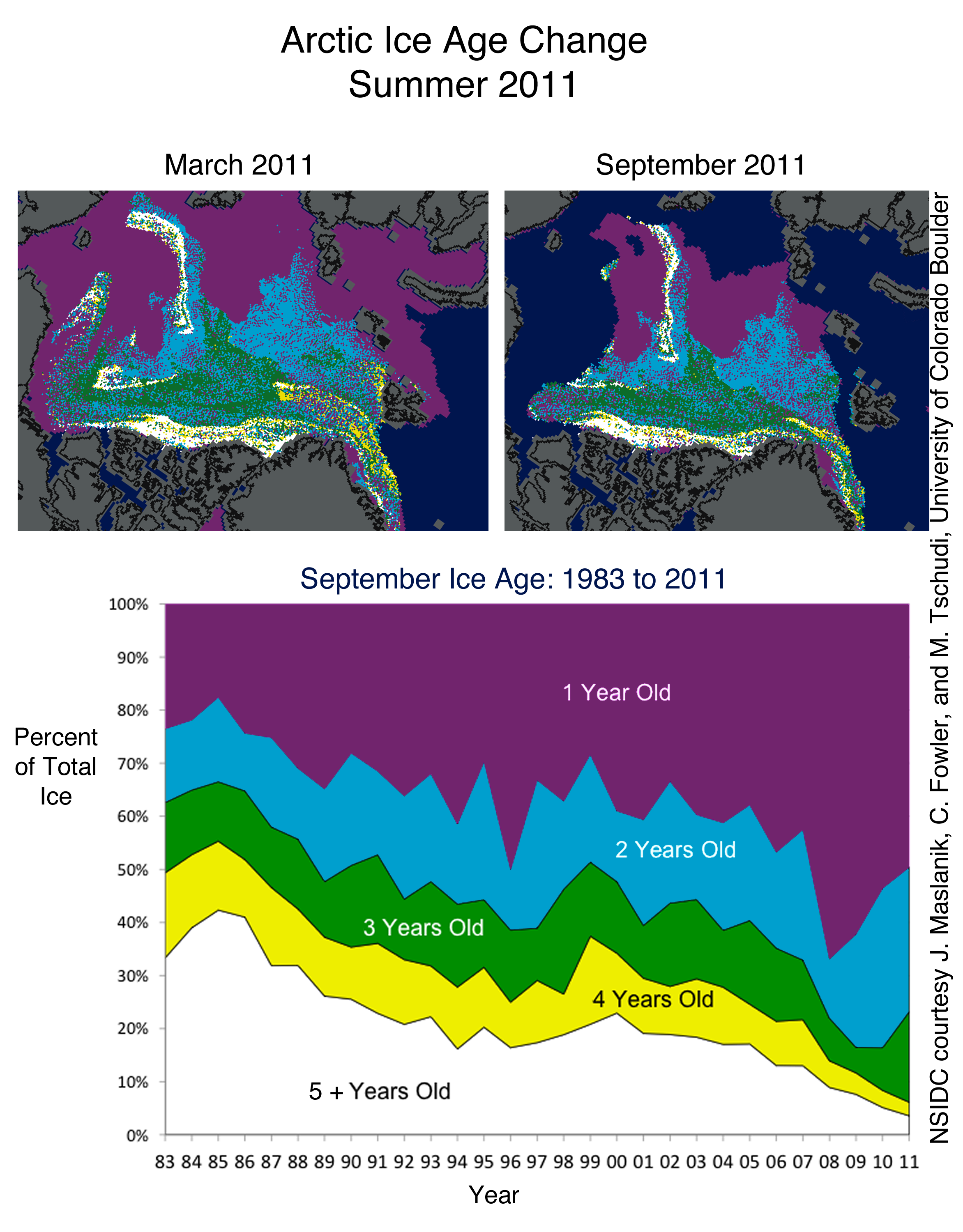
Multi-year ice [particularly 2-year ice] has increased by almost 50% over the last three years. The ice is recovering, but they choose to ignore it.

Federally Funded Arctic Stupidity

http://nsidc.org/images/arcticseaicenews/20111004_Figure6.png


SOURCE


Disagreement with Warmism merits firing

Climategate II -- Email 3946:

I responded to [Chris Landsea's] earlier message in a fairly low key fashion. I think he has behaved irresponsibly and ought to be fired by NOAA for not have an open enough mind to even consider that climate change might be affecting hurricanes. I am quickly becoming outraged by this and I hope it backfires on him!!!!

Kevin [Trenberth]

SOURCE

***************************************

For more postings from me, see DISSECTING LEFTISM, TONGUE-TIED, EDUCATION WATCH INTERNATIONAL, POLITICAL CORRECTNESS WATCH, FOOD & HEALTH SKEPTIC, GUN WATCH, AUSTRALIAN POLITICS, IMMIGRATION WATCH INTERNATIONAL and EYE ON BRITAIN. My Home Pages are here or here or here. Email me (John Ray) here. For readers in China or for times when blogger.com is playing up, there are mirrors of this site here and here

*****************************************

Thursday, December 01, 2011

David Attenborough is accused of climate change sensationalism by Lord Lawson

Lord Lawson has accused David Attenborough of sensationalism and alarmism over the environment. The former Tory chancellor, who is a climate change sceptic, said the broadcaster’s claims about global warming were sheer speculation.

In the final episode of his natural history series Frozen Planet, which is broadcast next Wednesday, Sir David is expected to suggest the Arctic could be free of ice by 2020.

In a piece written for Radio Times, Lord Lawson said: ‘Sir David Attenborough is one of our finest journalists and a great expert on animal life. Unfortunately, however, when it comes to global warming, he seems to prefer sensation to objectivity.

‘Had he wished to be objective, he would have pointed out that, while satellite observations confirm that the extent of Arctic sea ice has been declining over the past 30 years, those satellite observations show that overall, Antarctic sea ice has been expanding over the same period.’

Sir David – in the same edition of Radio Times – said that ‘data from satellites collected over the last 40 years show a drop of 30 per cent in the area of the Arctic sea ice at the end of each summer’. He added that the ice was ‘almost half as thick as it was in the 1980s’ and that animals such as polar bears were in jeopardy.

Sir David wrote that the loss of sea ice in the north affected the whole planet because it acted as ‘a huge reflector, bouncing 85 per cent of the sun’s heat back into space’. He warned of devastating effects in coastal areas as sea levels rose.

Lord Lawson has claimed that the polar bear population was rising and that while there had been a ‘modest increase’ in the mean world temperature in the final quarter of the 20th century, the Met Office had confirmed there had been no further global warming.

The former Conservative minister said: ‘Two things are clear. First, that Sir David’s alarmism is sheer speculation. Second, that if there is a resumption of warming, the only rational course is to adapt to it, rather than to try (happily a lost cause) to persuade the world to impoverish itself by moving from relatively cheap carbon-based energy to much more expensive non-carbon energy.’

It has already been revealed that the BBC is offering Frozen Planet to broadcasters in other countries without the controversial climate change episode.

According to the International Union for the Conservation of Nature, most populations of polar bears are declining.

Sir David has been vocal about his concerns over climate change for many years and in 2006 he warned that the issue was the biggest challenge facing the world. He has said: ‘If we do care about our grandchildren then we have to do something.’

SOURCE


An Alternative Agenda For The Durban Environmental summit

Global leaders are set to meet in Durban, South Africa, from Nov. 28 to Dec. 9, in an attempt to figure out how to continue their fight against "climate change" when the first Kyoto Protocol commitment period ends in 2012. Since I'm currently sitting here in the dark with the heat off, perhaps they'd grant me the temporary moral authority to offer a few suggestions for their agenda.

-- Don't waste any time fiddling with the planet's thermostat. So the big achievement of the previous summit in Cancun was agreeing that the Earth's temperature must not be permitted to increase by 2 degrees Celsius? Look, I've been in European gyms with air conditioning that can't even be controlled within the space of a few thousand square feet, despite regular intervention by head-scratching specialists. Usually the excuse is that the "ceiling is too high." Well, guess what? The Earth's ceiling is really, really high. Give it up already and move on to something you can realistically control.

-- Nuclear energy is the future. Nuclear energy: good. Nuclear bomb: bad. It's that simple. Now can we move on to a less silly debate? Oh, you say you're worried about a nuclear energy facility going all Chernobyl on you? While you're at it, why don't you also avoid getting your hair cut for fear the hairdresser will stab you in the eye with the scissors while trimming your bangs? The odds are about the same for both. Great Britain has already found out what happens when nuclear is replaced by much dirtier coal: The prices go up and no one is any happier. Speaking of which ...

-- Imposing green alternatives almost always results in dirtier ones. When I go to the supermarket and am told the plastic bags cost money, it isn't ever going to force me to carry around loose groceries. I'll always pay the extra money and tolerate the cashier's dirty looks in exchange for the Earth-murdering plastic bags, which I will then recycle as garbage bags at home before throwing them in the trash, where they will hopefully be recycled by a seagull who will recoup them from the landfill and use them in a nest or maybe even as a stylish necklace that would make Charles Darwin proud. When enviro-fascists succeed in removing those bags from stores and I'm expected to carry loose groceries, I will then rely on grocery delivery -- meaning a gas-guzzling truck will deliver my groceries and someone will carry them to my door in bags or boxes.

Likewise, what do people do when heating their home gets too expensive? They throw wood on the fire. And that's pollution we can actually see --- not just "faith-based" pollution.

-- Oil is the future. At least it's your future and that of your kids. Beyond that, come on -- do you really care anyway? It won't be running out anytime soon, so how about embracing it so we don't lose an economic advantage to those who already accept this fact?

-- Excessive tree-hugging is suffocating the foliage. Plants need carbon dioxide to live and produce oxygen. Humans need oxygen and need to eat plants. One of the biggest issues facing humanity now and increasingly in the future is food security, particularly in Africa and the Arab world, where we're already seeing uprisings. Why would anyone want to risk further stoking food shortages and political instability in the interest of stopping an abstraction like "climate change"? Let's get our priorities straight.

-- Innovation can't be forced; it needs to emerge organically. Benjamin Franklin and Albert Einstein weren't successful as inventors because some world governing body held a gun to their heads -- or to their wallets. Encourage "green" invention by promoting scientific education and critical thinking rather than indulging the ongoing epidemic of ensconcing kids in liberal arts programs to educate them far beyond their intelligence. A focus on technological education will lead to the emergence of "green alternatives" that don't need tons of government cash to get an inch off the ground.

SOURCE


China decries Canada's "bad example" in climate talks

China profits greatly from Greenie nonsense -- providing the toys that Greenies think they need -- like solar panels

Canada's failure to deny reports that it is about to ditch the Kyoto Protocol is "setting a bad example" to other developed nations as global climate change talks enter their third day, China's official news agency said on Wednesday.

Canadian Environment Minister Peter Kent said on Monday that Kyoto was "the past," but he would not confirm media reports that Ottawa was planning to formally withdraw from the treaty, one of the main topics of global climate talks now under way in Durban, South Africa.

Canada says it backs a new global deal to cut emissions of greenhouse gases, but insists it has to cover all nations, including China and India, which are not bound by Kyoto's current targets.

The commentary published by Xinhua news agency accused Canada of undermining global efforts against climate change and damaging its own reputation in pursuit of short-term interests.

"While delegations from every country attend the Durban climate conference to discuss a second commitment period for the Kyoto Protocol, one can imagine the damage done by this 'rumor'," Xinhua said.

"Some are angry and some are depressed, but whatever the expression made by each delegation, they are united in their criticism of Canada."

The commentary said Canada's failure to meet its Kyoto Protocol targets had encouraged it to write off the protocol and thereby "smash a pot to pieces just because it is cracked."

The Kyoto Protocol obliged signatory countries from the developed world to make mandatory cuts in their total greenhouse gas emissions by 2012, when the first commitment period ends.

Canada was obliged to slash CO2 by 6 percent compared to 1990, but by 2009, the total was still 17 percent higher.

Canada was also likely to be using the rumors to try to secure a favorable breakthrough during the Durban talks, Xinhua said, and "as soon as the negotiations do not meet its expectations, it will allow the rumors to become reality."

If Canada pulls out of Kyoto, it will join the United States on the sidelines of a treaty originally designed to force rich nations with far higher historical levels of greenhouse gas emissions to take on most of the burden when it comes to handling climate change.

Developing nations like China and India were not under any obligation to make binding CO2 cuts under the treaty, and also received funding for clean projects through Kyoto's Clean Development Mechanism.

Russia and Japan have refused to support an extension of Kyoto beyond 2012, saying that the treaty is meaningless if the biggest emitters -- China and the United States -- do not sign up for binding cuts.

SOURCE


Energy Innovations in Louisiana Could Guide Policy Changes in the Northeast

Manufacturing jobs are coming back to Louisiana thanks to innovations in the energy industry that pressure groups in the northeast are attempting to block. The substantial deposits of natural gas that are now available could create about 35,000 jobs in the state as key industries mobilize to exploit these resources, according to the American Chemical Council (ACC).

Shale gas “provides the opportunity for what will be a renaissance in chemical manufacturing in the United States, and Louisiana is uniquely positioned to capitalize on that,” ACC President and CEO Cal Dooley, has been quoted as saying. “The $5.4 billion investment in expanded ethylene production capacity in Louisiana will generate a total of $10.9 billion in additional chemical industry output, bringing the state’s industry revenues to $56.9 billion and maintaining it as the country’s second-largest chemical-producing state.”

Natural gas supplies that were previously beyond human reach can now be extracted from layers of shale rock located deep below earth’s surface. This has industry officials excited, but environmental pressure groups are in a state of panic. Additional natural gas production works against their policy schemes built around the idea of forcing the federal government to restrict fossil production. The idea here is to force the public onto alternative or renewable energy sources.

In the more industrialized areas of the country that are reliant on cheap, affordable energy, the “fracking” revolution has meet up with little resistance. The story is much different in the liberal northeast where the political class is succumbing to pressure groups.

In June, the New Jersey state legislature voted 32-1 in the Senate and 56-11 in the Assembly to impose a ban on hydraulic fracturing. In response, Gov. Chris Christie agreed to a one-year moratorium on the process. Meanwhile, New York’s department of environmental conservation appears poised to implement a regulatory scheme that will ban, restrict and manage various forms of fracking in that state. Anti-drilling activists are also stepping up efforts in Pennsylvania, according to a report from the Commonwealth Foundation.

The green movement is upset because a geological formation known as the Marcellus Shale, which cuts across New York, Pennsylvania, Ohio and West Virginia, is open to new development, thanks to “fracking.” Even worse, from their point of view, a group of Penn State economists have concluded that development of the Marcellus Shale has helped to alleviate the current recession.

The Center for Healthy Environments and Communities (CHEC) at the University of Pittsburgh Graduate School of Public Health (GSPH) has launched a projected called Fractracker.org that was made possible with an endowment from the Heinz Foundation. The site includes an anti-drilling blog.

The future is there for new manufacturing, and new job creation in the northeast. But it’s clear that business groups and average citizens have a much tougher fight on their hands given how potent and well-funded the environmental groups are in their part of the country.

SOURCE


The Great Global Warming Fizzle

The climate religion fades in spasms of anger and twitches of boredom

How do religions die? Generally they don't, which probably explains why there's so little literature on the subject. Zoroastrianism, for instance, lost many of its sacred texts when Alexander sacked Persepolis in 330 B.C., and most Zoroastrians converted to Islam over 1,000 years ago. Yet today old Zoroaster still counts as many as 210,000 followers, including 11,000 in the U.S. Christopher Hitchens might say you can't kill what wasn't there to begin with.

Still, Zeus and Apollo are no longer with us, and neither are Odin and Thor. Among the secular gods, Marx is mostly dead and Freud is totally so. Something did away with them, and it's worth asking what.

Consider the case of global warming, another system of doomsaying prophecy and faith in things unseen.

As with religion, it is presided over by a caste of spectacularly unattractive people pretending to an obscure form of knowledge that promises to make the seas retreat and the winds abate. As with religion, it comes with an elaborate list of virtues, vices and indulgences. As with religion, its claims are often non-falsifiable, hence the convenience of the term "climate change" when thermometers don't oblige the expected trend lines. As with religion, it is harsh toward skeptics, heretics and other "deniers." And as with religion, it is susceptible to the earthly temptations of money, power, politics, arrogance and deceit.

This week, the conclave of global warming's cardinals are meeting in Durban, South Africa, for their 17th conference in as many years. The idea is to come up with a successor to the Kyoto Protocol, which is set to expire next year, and to require rich countries to pony up $100 billion a year to help poor countries cope with the alleged effects of climate change. This is said to be essential because in 2017 global warming becomes "catastrophic and irreversible," according to a recent report by the International Energy Agency.

Yet a funny thing happened on the way to the climate apocalypse. Namely, the financial apocalypse.

The U.S., Russia, Japan, Canada and the EU have all but confirmed they won't be signing on to a new Kyoto. The Chinese and Indians won't make a move unless the West does. The notion that rich (or formerly rich) countries are going to ship $100 billion every year to the Micronesias of the world is risible, especially after they've spent it all on Greece.

Cap and trade is a dead letter in the U.S. Even Europe is having second thoughts about carbon-reduction targets that are decimating the continent's heavy industries and cost an estimated $67 billion a year. "Green" technologies have all proved expensive, environmentally hazardous and wildly unpopular duds.

All this has been enough to put the Durban political agenda on hold for the time being. But religions don't die, and often thrive, when put to the political sidelines. A religion, when not physically extinguished, only dies when it loses faith in itself.

That's where the Climategate emails come in. First released on the eve of the Copenhagen climate summit two years ago and recently updated by a fresh batch, the "hide the decline" emails were an endless source of fun and lurid fascination for those of us who had never been convinced by the global-warming thesis in the first place.

But the real reason they mattered is that they introduced a note of caution into an enterprise whose motivating appeal resided in its increasingly frantic forecasts of catastrophe. Papers were withdrawn; source material re-examined. The Himalayan glaciers, it turned out, weren't going to melt in 30 years. Nobody can say for sure how high the seas are likely to rise—if much at all. Greenland isn't turning green. Florida isn't going anywhere.

The reply global warming alarmists have made to these dislosures is that they did nothing to change the underlying science, and only improved it in particulars. So what to make of the U.N.'s latest supposedly authoritative report on extreme weather events, which is tinged with admissions of doubt and uncertainty? Oddly, the report has left climate activists stuttering with rage at what they call its "watered down" predictions. If nothing else, they understand that any belief system, particularly ones as young as global warming, cannot easily survive more than a few ounces of self-doubt.

Meanwhile, the world marches on. On Sunday, 2,232 days will have elapsed since a category 3 hurricane made landfall in the U.S., the longest period in more than a century that the U.S. has been spared a devastating storm. Great religions are wise enough to avoid marking down the exact date when the world comes to an end. Not so for the foolish religions. Expect Mayan cosmology to take a hit to its reputation when the world doesn't end on Dec. 21, 2012. Expect likewise when global warming turns out to be neither catastrophic nor irreversible come 2017.

And there is this: Religions are sustained in the long run by the consolations of their teachings and the charisma of their leaders. With global warming, we have a religion whose leaders are prone to spasms of anger and whose followers are beginning to twitch with boredom. Perhaps that's another way religions die.

SOURCE


Malcolm Gladwell, tipping points and Climategate

How a marketing buzzword changed the world

By Andrew Orlowski

Best-selling author Malcolm Gladwell had a powerful impact on the way climate change was marketed to the public, without even knowing it. Gladwell's marketing book, published in 2000, embedded the phrase "tipping point" into the public's imagination, and this in turn was used to raise the urgency of climate change.

It seems ridiculous today, with climate sensitivity models being tuned downwards, natural variability recognised as increasingly important, and climate institutions talking about a period of long-term cooling. Much of the urgency went out of the window after countries failed to agree on a successor to the Kyoto agreement at Copenhagen in 2009, and the costs and taxes of "low carbon" strategies are political poison.

But back in the mid-noughties, it was very different. The idea that the climate was reaching a "tipping point", and that global temperature would runaway uncontrollably, was rife. It created a sense of urgency that helped pass legislation such as the UK's Climate Change Act in 2008.

This story emerges from the FOIA2011 archive – the so-called Climategate 2.0 emails released last week. Although it hasn't had the immediate and dramatic impact of the first leak two years ago, the breadth of social networks uncovered in these emails will keep historians busy for years – and whets the appetite for the 95 per cent of UEA emails still under wraps.

The idea of climatic tipping points is fascinating for several reasons.

The question of whether ecosystems are inherently stable – or unstable – preoccupied biologists for much of the last century – and was the subject of Adam Curtis's film The Use and Abuse of Vegetational Concepts, in a BBC series for which I was assistant producer, and which Curtis summarised here. Fashions change, and so do myths. Arthur Tansley, who invented the word "ecosystem", believed in "the great universal law of equilibrium", and this was pursued for decades. Today, the idea that ecosystems are delicate and unstable instead dominates.

The idea also divides scientists. Geologists, for example, point to evidence of long-term cycles, and stress continuity and predictability. For example, we roughly know how long interglacial periods last – we're in one now, which is due to end fairly soon. And the idea also divides us. If you are of the view that mankind is a disturbance to a natural order, you're much more likely to believe in runaway effects. If you're of the view that nature is here to be tamed for our benefit – an idea born out of the Enlightenment – you're more likely not to panic.

In 2000, New Yorker journalist Malcolm Gladwell published a mish-mash of ideas that nevertheless spawned a buzzword. Gladwell found a common metaphor that could describe – but importantly, not quite convincingly explain – things as different as the spread of diseases, social behaviour (crime waves) and best-selling products. The phrase "tipping point" was everywhere.

Both Gladwell and Tansley were really making grand, metaphorical generalisations. Gladwell borrowed his idea from epidemiology, Tansley from the idea of the human brain as an electrical circuit. Both became universal "theories of everything".

Into our story comes the magnificent Hans Joachim "John" Schellnhuber CBE, a German physicist and social networker, whose stratospherically high opinion of himself is not, it seems, shared by the climate scientists at the University of East Anglia. Today Schellnhuber is climate change advisor to the president of the EU Commission, and boasts of regular chats with Chancellor Merkel. He was a climate advisor to Tony Blair.

By the late 1990s Schellnhuber was a powerful and influential figure. Having founded the Potsdam climate research institute he was able to influence the establishment of a UK equivalent, the Tyndall Centre, and UEA was bidding to host it.

On his blog, Andrew Montford relates the tale of how Schellnhuber helped hand the Tyndall award to UEA, then took a post as its research director. This was a full-time job, but Schellnhuber concurrently held a full-time job at Potsdam – leading to incredulity from his new colleagues at UEA. "Even a very competent person could not possibly hold down two responsible, full-time jobs like this," writes former CRU director Tom Wigley, in amazement.

Schellnhuber had become fascinated by complex systems and non-linearity, particularly the work coming out of the New Age-y Santa Fe Institute. (He formally joined the Institute last year.) This was deeply influential. What he saw terrified him: a world out of control. Let this hagiographic profile of Schellnhuber pick up the tale.

"After many successful, and some failed, attempts to explain climate change to political leaders and CEOs, Schellnhuber has a good sense of what works and what does not. As the lead author of the chapter on 'large-scale discontinuities' in the third report produced by the IPCC, he used the phrase 'tipping point', which has wide currency in the business world," we learn.

“In a conversation with a BBC journalist, I said ‘these are, more or less, tipping points’ [in climate change]. He immediately understood," Schellnhuber told his profiler.

Schellnhuber capitalised on this with a paper, Tipping Elements in the Earth's Climate System co-authored with several others. Despite its speculative nature – "subsystems indicated could exhibit threshold-type behavior in response to anthropogenic climate forcing", we learn. It has been cited over 500 times.

The death of the planet has been greatly exaggerated

Amongst the subsystems discussed are the Arctic sea ice, which could take 10 years to disappear, the collapse of the Gulf Stream (10 years), and the greening of the Sahara Desert (10 years). None look likely today, with global temperatures fairly static (or falling slightly – depending on how you fit the curve) for 15 years.

It was a deeply pessimistic point of view. But Schellnhuber welcomed the climate apocalypse, because he saw human beings as the planet's enemy – and the planet must come before human life.

“In a very cynical way, it’s a triumph for science because at last we have stabilised something – namely the estimates for the carrying capacity of the planet, namely below 1 billion people,” Schellnhuber told a conference in March 2009. Such a neo-Malthusian vision could only be turned into reality with unprecedented coercion and repression.

Earlier I referred to two competing views of the relationship between man and nature: the enlightenment view of optimism, of taming nature (and looking after it responsibly), and man as a destroyer. Schellnhuber's pessimism belong firmly in the latter school, and that's the view that's dominated policy-making for 40 years. There's a problem, in that it isn't one shared that's by the public; few parents or grandparents pray for their offspring to be worse off, or more less free.

There is little doubting Schellnhuber's success both as a social networker and an influencer. At the height of the climate panic a few years ago, the sense of urgency became all encompassing, and convinced politicians and the media that these were extraordinary times, requiring extraordinary measures.

He was able to do so because of the media's familiarity with a book aimed at the marketing business – and some sweeping generalisations. The irony of the story is that by over-dramatising the climate change debate, Schellnhuber may have had the exact opposite that he intended.

SOURCE

***************************************

For more postings from me, see DISSECTING LEFTISM, TONGUE-TIED, EDUCATION WATCH INTERNATIONAL, POLITICAL CORRECTNESS WATCH, FOOD & HEALTH SKEPTIC, GUN WATCH, AUSTRALIAN POLITICS, IMMIGRATION WATCH INTERNATIONAL and EYE ON BRITAIN. My Home Pages are here or here or here. Email me (John Ray) here. For readers in China or for times when blogger.com is playing up, there are mirrors of this site here and here

*****************************************