Wednesday, September 08, 2021


Climate change could DOUBLE the frequency of extreme regional summer droughts in Europe by 2099

What utter rubbish! Warming oceans would bring MORE rain and snow, not less. Elementary physics

Climate change could result in the number of 'extreme summer droughts' in Europe doubling by 2099, a report has warned.

The climate crisis has already had a number of drastic global impacts, including an increase in the number of droughts, 'causing considerable social, economic, and environmental costs', according to the researchers from the Ludwig-Maximilians-Universität München (LMU) in Germany.

The World Health Organization (WHO) says droughts are the most serious hazard to crops and livestock in every part of the world, affecting 55 million people every year.

To determine future risk, researchers used archive data on rainfall levels throughout Europe, the British Isles and Scandanavia with future climate prediction models.

Their analysis suggests that all areas will see some increase in the number of summer droughts, but in France, the Alps, the Mediterranean and the Iberian Peninsula the number could double.

What is a meteorological drought?

Drought is a complex climate phenomenon covering a wide range of definitions and conditions.

Their impacts are economically, socially, and environmentally complex, and a universal definition that covers all consequences does not exist.

Droughts are instead classified by their impact: meteorological, hydrological, agricultural, or socio-economic.

Meteorological droughts are a predecessor of other drought types.

They have no clear start and end, unlike hurricanes, for example, which can easily be seen as they develop.

Drought is the absence of water, a creeping phenomenon that slowly sneaks up and impacts many sectors of the economy, and operates on many different time scales.

Meteorological drought happens when dry weather patterns dominate an area and can begin and end rapidly.

In contrast, hydrological drought takes much longer to develop and recover.

In their study, the researchers analysed the 'percent of normal index' (PINI), designed to give a percentage of rain in any given period.

They then compared that figure to the prediction of rainfall in a single climate model for eight regions of Europe over the next 80 years.

Each region they studied had a different climate, covering the British Isles, Scandinavia, mid-Europe, the Alps, Eastern Europe, France, the Mediterranean and the Iberian Peninsula.

In the long-term future, from 2080 to 2099, Europe will see an increase in frequency and intensity of summer droughts, but a drop in winter droughts, according to the research.

There will be greater differences between winter and summer rainfall levels as well, increasing during winter and decreasing over the summer months.

For mid-Europe there's a sharp rise in the likelihood of an extreme drought - up by about a quarter of current levels.

In Eastern Europe and the Alps, severe and extreme droughts have higher probabilities in the future, going from a 20 to 40 per cent increase.

France has one of the higher levels, with a 60 per cent increase in frequency of extreme droughts, while in the Mediterranean, the chance of extreme droughts in the future is around 80 per cent for the summer months.

Meanwhile, in the Iberian Peninsula, the chance of extreme droughts is the highest of all regions, reaching 96 per cent in July and 88 per cent in August.

In these two regions, however, the absolute rainfall values in July and August are already low, meaning that comparatively small absolute changes can lead to high percentages of the PNI, which is a relative measure.

Destructive events including storms, flooding and drought are causing seven times more damage than in the 1970s, but they're killing far fewer people, according to the UN's World Meteorological Organisation (WMO).

In the 1970s and 1980s, these events killed an average of about 170 people a day worldwide, but in the 2010s that dropped to about 40 per day.

The WMO's report looks at more than 11,000 weather disasters between 1970 and 2019, based on data from the Centre for Research on the Epidemiology of Disasters.

A disaster related to a weather, climate or water hazard occurred every day on average over the past 50 years – killing 115 people and causing $202 million (£146 million) in losses daily, it found.

In total, just over 2 million deaths and $3.64 trillion (£2.64 trillion) in losses were attributed to such catastrophes.

The report follows Hurricane Ida and drought-worsened wildfires in the US, as well as catastrophic floods in mainland Europe this summer.

Researching the future occurrence of droughts is crucial for adequate climate crisis mitigation, according to the study, published in Frontiers in Water.

'Summer droughts are a highly relevant topic in Europe,' said author Magdalena Mittermeier, who shares the first authorship with Andrea Böhnisch.

'We find a clear trend towards more, longer and more intense summer droughts, in terms of a precipitation deficit, towards the end of the century under a high-emission carbon scenario (RCP8.5).'

This is the emission scenario currently most likely under global average emission levels, although governments hope to change this with new climate measures.

The impacts of droughts are economically, socially, and environmentally complex, and a universal definition that covers all consequences does not exist.

Instead, droughts are classified by their impact as meteorological, hydrological, agricultural, or socio-economic.

Meteorological droughts are a potential predecessor of other drought types and are therefore important to research, and are the type covered by this study.

Regional differences between drought events are high, and there is an urgent need to identify geographical hot spots for future drought events, the team added.

'Our study shows that unabated climate change will worsen the risk of hot-spot droughts drastically,' said Mittermeier.

'But also, in some regions where droughts currently play a minor role, the future drought risk is expected to get serious. We show that the Alps should be considered an additional future hot-spot.'

She said these extreme future events can be avoided by climate mitigation, including those agreed to under the UN Paris Agreement.

'These three key features of: first, increasing drought occurrence in summer; second, wetter conditions in winter as well as; and third, interannual variations due to the natural variability of the climate system are visualised in what we call "drying stripes".

'These allow an overview of our results at first glance. The drying stripes show the percentage of precipitation for every month and year summarised over our ensemble compared to the long-term mean in a counterfactual world with pre-industrial greenhouse gas concentrations.

'With this, they show the projected summer drying trend throughout the 21st century compared to a world without climate change.'

The findings have been published in the journal Frontiers in water.

******************************************

Britain starts coal plant after gas prices surge

Britain has fired up two coal units at one of its power plants to help keep up with energy supply demands.

National Grid ESO asked Électricité de France to heat up the units at its West Burton A power station in Lincolnshire following an increase in gas prices.

While the British government hopes to phase out coal-generated power by 2024, the alternative energy the country uses is either providing insufficient power or becoming too expensive, the Daily Telegraph reports.

Wind power produces energy for Britain but at a varying rate. Monday morning's power report showed wind power produced 474 megawatts, much less than the 14,286 megawatts that wind power produced on May 21.

Gas prices have also led to a return to coal as the price for gas has now jumped to £219.46 ($303) per megawatt-hour on Monday morning, according to Bloomberg. The result has forced Britain to return to using coal in order to keep up with its energy demands.

*************************************

Australian superannuation juggernaut says it will not divest its substantial oil and gas holdings to meet newly detailed climate targets, as it announced plans to phase out thermal coal investments by the end of the decade

IFM, which is owned by 23 industry superannuation funds, is one of the world’s biggest infrastructure investors and owns substantial oil and gas pipelines in the US. The company announced plans to achieve net zero emissions in its $74 billion infrastructure portfolio, including by fully exiting thermal coal by 2030.

IFM’s global head of infrastructure Kyle Mangini said there is “relatively little debate” on the outlook for thermal coal – an energy source that governments around the world are rejecting in the quest to reduce carbon emissions and transition to renewable energy sources.

“We acknowledge that it is part of the energy mix today but it will be phased out of the energy mix over time, and from that perspective, it’s not a sound long-term investment,” Mr Mangini said. “We put the blanket exclusion on coal really because of the view it’s not viable and that needs to be addressed sooner rather than later.”

Major investment firms have set net zero emissions targets in recent years and are now using either divestment - selling out of carbon-heavy assets- or engagement - remaining invested to advocate for change - to achieve these goals.

IFM’s remaining exposure to thermal coal is limited to the Polish district heating business bought in 2006. But the fund manager owns other carbon-heavy assets including North American oil and gas infrastructure projects Colonial Pipeline and Buckeye Partners. Chief executive David Neal said there were no plans to sell these assets to meet decarbonisation targets.

“We’re really focused on transition rather than divestment,” Mr Neal said. “So what can we do to help the assets in the oil and gas sector at the right time and in the right way transition to support the new cleaner economy? There is a lot of opportunity to do just that.”

“Divestment might get the emissions down in our portfolio but it does absolutely nothing for the planet’s emissions and it certainly does not help the global economy. This is about being a responsible investor.”

IFM’s interim targets include reducing scope one and two emissions (direct emissions and emissions from electricity use) across infrastructure assets by 40 per cent by 2040. This will be achieved, for example, by encouraging its airports and ports to install solar panels or diversify operations to include clean energy projects.

Reducing scope 3 emissions is not part of IFM’s climate plan, which includes indirect emissions like those from airplanes using IFM’s airports or gas passing through IFM’s pipelines. Mr Neal said these were “incredibly important” to understanding long-term risks but were outside IFM’s “direct influence and control”.

“The more people are concerned about the emissions that come from flying, the less airports get used. Those sorts of things,” he said. “There’s a difference here between what we’re worried about and what risks we’re managing.”

The International Energy Agency in May released a report claiming there could be no new oil and gas projects if the world was to achieve net zero emissions by 2050. Mr Neal said retaining its oil and gas assets would “in many cases but not exclusively” rely on the development of new technologies or carbon offsets.

Mr Mangini added the oil and gas sector would play a “really important stabilising role” for the adoption of renewable energy until “storage capability is built into the system more broadly”.

“The fact you can generate [energy] now with a renewable source that is less expensive than fossil fuels means you don’t require government subsidies in many cases is a huge development. Now you have investment being led by the market instead of being led by the government,” he said. “There has been tremendous progress, there is so much RND [research and development] I feel very optimistic we will see a lot more progress.”

Nationals MP George Christensen last week accused the major banks of “caving” to international investor pressure when making decisions to phase out exposure to thermal coal. Mr Neal also rejected any “pressure” from investors and said decarbonisation was rather a collaborative approach to managing investment risk.

“I think we are all on this same journey. Our investors are working through how is their long-term risk being managed? How are the opportunities from this massive energy transition that’s going to occur over the next couple of decades, how are those opportunities being embraced?

“There’s no doubt those engagements are much more intense than they used to be. There’s huge momentum across the investment world in understanding how climate risk can be managed.”

IFM will soon release interim decarbonisation targets for the remainder of its $174 billion portfolio including listed equities, private equity and debt.

******************************************

Australian State bans single-use plastics

Queensland has banned single-use plastic straws, stirrers, cutlery and plates, as well as containers and cups made from expanded polystyrene.

Initially announced in March, businesses had until September 1 to stop using items listed under the first stage of the state government ban.

The plan received huge support from the community during consultations, with 94 per cent of 20,000 respondents supporting the proposal.

The related legislation also makes provision for more single-use items to be banned through regulation in the future.

Environment Minister Meaghan Scanlon confirmed earlier this year more restrictions are likely in the future.

“There’s been a lot of commentary around things like coffee cups, a range of other plastics, so we’ll be making sure that we’re consulting widely around what the next phase of those products is,” she said in March.

“Queensland really is ahead when it comes to the rest of the country on single-use plastics, but we want to make sure that we’re continuing to progress with this.”

***************************************

My other blogs. Main ones below

http://dissectleft.blogspot.com (DISSECTING LEFTISM )

http://edwatch.blogspot.com (EDUCATION WATCH)

http://pcwatch.blogspot.com (POLITICAL CORRECTNESS WATCH)

http://australian-politics.blogspot.com (AUSTRALIAN POLITICS)

http://snorphty.blogspot.com/ (TONGUE-TIED)

*****************************************
Tuesday, September 07, 2021


Climate change is causing ‘catastrophic harm to health’ and action to tackle it cannot be put off because of Covid, medical journals warn

This is nonsense on stilts. Warm weather is good for you. Winter is the season of dying. And the claims about disasters also range between exaggerated and false. For instance, the claim that agriculture is suffering is the reverse of the truth. Almost every year grain crops are in glut

'Health is already being harmed by global temperature increases and the destruction of the natural world,' read an editorial published in more than 220 leading journals ahead of the Cop26 climate summit in November.

Since the pre-industrial era, temperatures have risen around 1.1 degrees Celsius (34 degrees Fahrenheit).

The editorial, written by the editors-in-chief of over a dozen journals including the Lancet, the East African Medical Journal, Brazil's Revista de Saude Publica and the International Nursing Review, said this had caused a plethora of health problems.

'In the past 20 years, heat-related mortality among people older than 65 years has increased by more than 50 percent,' it read.

'Higher temperatures have brought increased dehydration and renal function loss, dermatological malignancies, tropical infections, adverse mental health outcomes, pregnancy complications, allergies, and cardiovascular and pulmonary morbidity and mortality.'

It also pointed to the decline in agricultural production, 'hampering efforts to reduce undernutrition.'

These effects, which hit those most vulnerable like minorities, children and poorer communities hardest, are just the beginning, it warned.

As things stand, global warming could reach +1.5C on pre-industrial levels around 2030, according to the UN's Intergovernmental Panel on Climate Change.

And that, along with the continued loss of biodiversity, 'risk catastrophic harm to health that will be impossible to reverse,' the editorial warned.

'Despite the world's necessary preoccupation with Covid-19, we cannot wait for the pandemic to pass to rapidly reduce emissions.'

In a statement ahead of the publication of the editorial, World Health Organization chief Tedros Adhanom Ghebreyesus said: 'The risks posed by climate change could dwarf those of any single disease.'

'The Covid-19 pandemic will end, but there is no vaccine for the climate crisis.

'Every action taken to limit emissions and warming brings us closer to a healthier and safer future.'

The editorial pointed out that many governments met the threat of Covid-19 with 'unprecedented funding' and called for 'a similar emergency response' to the environmental crisis, highlighting the benefits.

'Better air quality alone would realise health benefits that easily offset the global costs of emissions reductions,' it read.

The authors also said 'governments must make fundamental changes to how our societies and economies are organised and how we live.'

***********************************

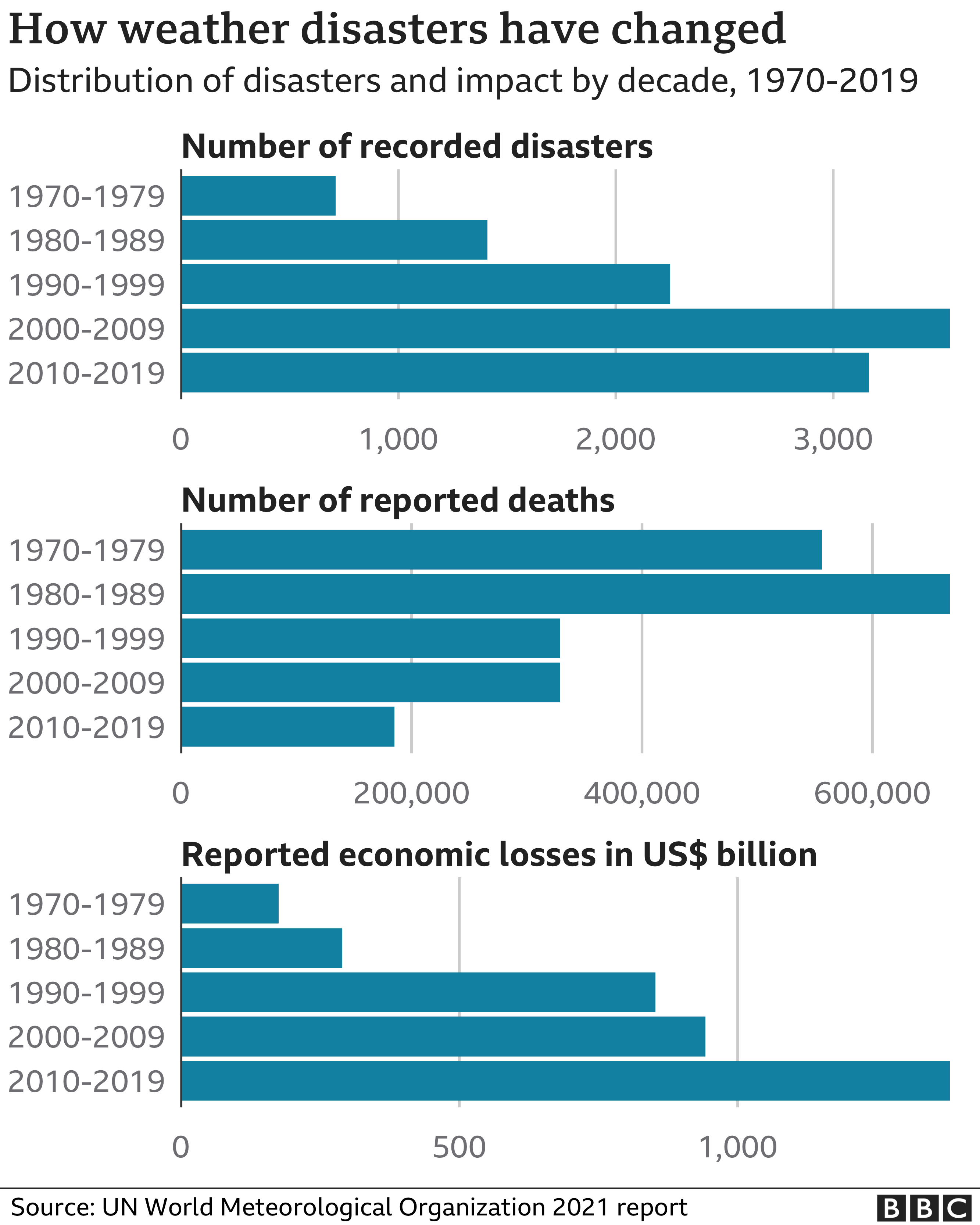
“Big increase in weather disasters over the past five decades”- Claim BBC

This is another fairy tale to scare the kids which comes around once a year without fail:

The number of weather-related disasters to hit the world has increased five-fold over the past 50 years, says the World Meteorological Organization.

However, the number of deaths because of the greater number of storms, floods and droughts has fallen sharply.

Scientists say that climate change, more extreme weather and better reporting are behind the rise in these extreme events.

image from https://ichef.bbci.co.uk/news/976/cpsprodpb/3601/production/_120352831_optimised-disasters-nc.png

In fact, according to the BBC’s own chart, the number of disasters has declined in the last decade, hardly supporting their story.

But why do disasters seem much more common now than in the 1970s, when even the IPCC says there is no evidence that weather is getting more extreme? Simple- better reporting systems mean that we record weather events now that would have been missed in the past.

We have, of course, been down this road before! The WMO data comes from Centre for Research on the Epidemiology of Disasters (CRED) database EM-DAT. CRED, who only began publishing data in 1998, themselves warned in 2004 that earlier data was incomplete:


Despite this warning, false claims that weather disasters are on the increase keep being made. Last year, it was the UN, and the before it was the left wing IPPR. And as surely as night follows day, their claims are faithfully trumpeted by the BBC and the rest of the gullible media.

****************************************

Governor Walz Surrenders to Environmental Jihadists

Spirits must have been high as the Governor of Minnesota took the long drive from St. Paul to Alexandria. The weather was perfect, clear cool skies. A glorious day for a picnic on the banks of a picturesque Minnesota lake. It’s fair to assume that the staff expected a warm welcome at the Democrat gathering.

What they got was a taste of just how radicalized their party has actually become.

The Governor was beaming as he took the podium, prepared to rally the loyal troops. Minutes later he was driven from the stage. Mr. Walz was confronted by a squadron of Leftists, convinced that what they had to say was far more important than anything he had to contribute.

So they shouted him down.

Most of the state’s media missed the episode. Fortunately, Alpha News shared the story along with a video which you can see here.

Regardless of your view of this Governor or his policies, it was a shameful display of disrespect, not just of him but of the Office of Governor. The encounter illustrated several things that warrant consideration.

First, the Democrat Party much like Afghanistan, has become a collection of angry tribes. The Left seems to take a clue from the Taliban, there is no room for tolerance or even debate. Anyone who disagrees must be destroyed. The Governor’s sin was that he finally bowed to the facts and agreed to allow the rebuild of an aging pipeline. Now he is a “Climate Denier” in their eyes. He must be run out of town. And that’s just what they did.

The Governor received no slack from these environmental jihadists for recently announcing (foolishly) that Minnesota would follow California’s lead and require half of all vehicles sold in the state be electric within nine years. These “protesters” are perpetually angry. That’s why we should call them the angry Left. They will never be happy, no matter how many times we capitulate.

This is especially so when it comes to “saving the planet.” If you’ve never been taught the golden rule, the Ten Commandments let alone the concept of Minnesota Nice in school, it affects your behavior. You apparently believe you can be as rude and crude as you like. There are no legal or eternal consequences. If your mother is the Earth and that’s all there is, you must do everything to save her. That includes spreading disinformation and half truths about anyone who questions your science. In their world, ends justify the means.

And nothing is ever enough. Even if we all moved back into caves, they would demand meatless Monday’s and fireless Friday’s.

Shouting down a Governor, who has supported their looney agenda 95% of the time, wasn’t just a good idea and morally acceptable. In their eyes it was absolutely essential. With the militant Left it’s my way or the highway. Sadly, the Governor chose the highway.

Throughout history bullies have understood the power of intimidation. Watching the video of the encounter one is struck by the reaction of the others in attendance. Presumably they were there because they wanted to hear and see their Governor. Yet none of the more than 200 people did much of anything to make the jihadists sit down and behave.

Once the Governor and his security detail decided to surrender, they did so in haste. It looked a little like Biden’s withdrawal from Afghanistan. The retreat came quickly with little forethought or planning. Loyalists you’re on your own, we’re outa here! They piled him into that big SUV (carbon be damned) and back to St. Paul they raced.

The worst thing about the whole ugly incident is that the radical environmentalists achieved their objective. The Governor’s unwillingness to stand his ground and make them behave like human beings will only wet their appetite. Expect more confrontations down the road.

There can be no Minnesota Nice when you’re dealing with bullies who behave like jihadists. Surrender buys peace at a heavy price. Putting on your big boy pants and staring them down is the only answer.

***************************************

Australian Government hits back over coal phase-out call

The federal government has hit back at a senior United Nations official's call for Australia to accept coal's days are numbered.

Selwin Hart, the UN's assistant secretary-general and special adviser on climate action, told the ANU's Crawford Leadership Forum the phasing out of coal is a prerequisite of limiting global warming to 1.5C.

"If the world does not rapidly phase out coal, climate change will wreak havoc right across the Australian economy: from agriculture to tourism, and right across the services sector," he said.

But he said coal workers and their communities were entitled to a "just transition" to new jobs.

Resources Minister Keith Pitt said coal would remain a significant contributor to the Australian economy well beyond 2030.

"The future of this crucial industry will be decided by the Australian government, not a foreign body that wants to shut it down costing thousands of jobs and billions of export dollars for our economy," Mr Pitt said on Monday.

He noted in the three months to July, coal exports soared to $12.5 billion - a 26 per cent increase on the previous quarter.

But while it was Australia's second largest export, the nation accounted for six per cent of the world's total annual production behind China, India and Indonesia.

"Coal will continue to generate billions of dollars in royalties and taxes for state and federal governments, and directly employ over 50,000 Australians."

Labor leader Anthony Albanese said the market was leading the energy industry away from coal-fired power toward cheaper renewables.

"This is an opportunity for Australia," he said.

Mr Hart said the region was looking to Australia for leadership, especially on the target of net zero emissions by 2050.

Prime Minister Scott Morrison has said it is the government's "preference" to get to net zero by mid-century, but has not formally committed to it.

"National governments responsible for 73 per cent of global emissions have now committed to net zero by mid-century, and we urge Australia to join them as a matter of urgency," Mr Hart said.

All countries have been encouraged by the UN to submit enhanced "nationally determined contributions" - or NDCs - before COP26 climate summit in Glasgow in November.

Mr Albanese said he was committed to net zero emissions by 2050 as it was "good for jobs, good for lowering prices, as well as being good for lowering emissions and good for the environment".

A spokewoman for Emissions Reduction Minister Angus Taylor said Australia had a strong 2030 target and a clear plan to meet and beat it.

British high commissioner Victoria Treadell said a higher level of ambition for the 2030 and 2050 targets was needed from all countries.

"We are very much hoping we will see that new level of ambition and I know it is something your prime minister is looking at, working hard to try to find a position in time for Glasgow," she told Sky News.

**************************************

My other blogs. Main ones below

http://dissectleft.blogspot.com (DISSECTING LEFTISM )

http://edwatch.blogspot.com (EDUCATION WATCH)

http://pcwatch.blogspot.com (POLITICAL CORRECTNESS WATCH)

http://australian-politics.blogspot.com (AUSTRALIAN POLITICS)

http://snorphty.blogspot.com/ (TONGUE-TIED)

*****************************************

Monday, September 06, 2021


Fire and Floods, And Not Ready To Tackle Them

This NYT article is totally shallow. Recent disasters are catalogued and declared to be abnormal but no attempt is made to SHOW that they are abnormal. Why? Because they are not, and a statistical presentation would show that. Weather disasters have always been with us and always will

In Louisiana and Mississippi, nearly one million people lack electricity and drinking water after a hurricane obliterated power lines. In California, wildfire menaces Lake Tahoe, forcing tens of thousands to flee. In Tennessee, flash floods killed at least 20; hundreds more perished in a heat wave in the Northwest. And in New York City, 7 inches of rain fell in just hours Wednesday, drowning people in their basements.

Disasters cascading across the country this summer have exposed a harsh reality: The United States is not ready for the extreme weather that is now becoming frequent as a result of a warming planet.

“These events tell us we’re not prepared,” said Alice Hill, who oversaw planning for climate risks on the National Security Council during the Obama administration. “We have built our cities, our communities, to a climate that no longer exists.”

In remarks Thursday, President Biden acknowledged the challenge ahead.

“And to the country, the past few days of Hurricane Ida and the wildfires in the West and the unprecedented flash floods in New York and New Jersey is yet another reminder that these extreme storms and the climate crisis are here,” said Mr. Biden, who noted that a $1 trillion infrastructure bill pending in Congress includes some money to gird communities against disasters. “We need to do — be better prepared. We need to act.”

*************************************

Personal carbon allowances revisited

This is straight totalitarianism, reminiscent of Soviet Russia You will be restricted from doing things that you would normally do by a "carbon" straitjacket. Reminiscent of wartime rationing

Abstract

Here we discuss how personal carbon allowances (PCAs) could play a role in achieving ambitious climate mitigation targets. We argue that recent advances in AI for sustainable development, together with the need for a low-carbon recovery from the COVID-19 crisis, open a new window of opportunity for PCAs. Furthermore, we present design principles based on the Sustainable Development Goals for the future adoption of PCAs. We conclude that PCAs could be trialled in selected climate-conscious technologically advanced countries, mindful of potential issues around integration into the current policy mix, privacy concerns and distributional impacts.

***********************************

Climate groups sue after Biden administration revives Trump-era drilling leases

The Biden administration, faced with a court order to resume federal oil and gas leasing, has resurrected a Trump-era plan to offer millions of acres in the Gulf of Mexico that environmentalists describe as the largest offshore sale in U.S. history.

The Interior Department said Tuesday that it would publish a notice this month offering 80.8 million acres in the Gulf. The department is revising the Trump administration‘s 79.7-million-acre plan, which was canceled shortly after President Biden took office as part of his “pause” on new oil and gas activity on federal lands and waters.

A coalition of climate organizations promptly sued in federal court to block the sale. The lawsuit said the order relied on “arbitrary environmental analyses” and cited the disconnect with Mr. Biden’s ambitious climate change agenda.

“President Biden’s administration has recognized that climate change presents immense harms and that bold, immediate actions are needed to achieve emission reductions and curb the climate emergency facing the globe,” said the lawsuit, filed by Earthjustice. “Despite this, the Biden administration’s Interior Department is holding Lease Sale 257.”

The Bureau of Ocean Energy Management estimated that the sale would result in the production of up to 1.12 billion barrels of oil and 4.4 trillion cubic feet of natural gas over a period of at least 50 years. The lawsuit said the production would “magnify greenhouse emissions worldwide.”

“The sale will offer over 80 million acres of public waters to the oil and gas industry, making it the largest offshore lease sale in U.S. history,” the complaint said.

The administration is moving forward with a sale it nixed just seven months ago to comply with U.S. District Court Judge Terry Doughty’s June order halting the leasing freeze pending the outcome of a lawsuit filed by 13 states.

The Justice Department told the court last week that it would submit the Record of Decision for the lease sale by the end of August and publish the sale notice in September.

**************************************

The Myth of Climate Refugees

Thousands of illegal immigrants are streaming across to the United States’ southern border every day under President Joe Biden.

In response, climate alarmists are following former Chicago Mayor and President Obama’s Chief of Staff Rahm Emanuel’s shameful advice to “never let a crisis go to waste” by repeating the false claim that many of the immigrants are “climate refugees.” Meaning they are being forced to flee their homelands by disasters caused by anthropogenic global warming.

Research shows this claim is false. Millions of people flee their homelands each year. But the causes are what they have always been: war, political persecution, crime, and poverty. Refugees now, as they always have, are leaving their countries in pursuit of a better life for their children and themselves. Not because of climate change.

A recent International Policy Digest (IPD) article titled “It’s Time to Recognize Climate Refugees” falsely claims “refugees are … fleeing climate change.”

“In the face of warmer temperatures, reduced precipitation, and blighted crops—struggling farmers from Guatemala and El Salvador are giving up and fleeing to the U.S. border,” says IPD.

“Climate change will submerge American communities like Isle de Jean Charles, Louisiana, and entire countries like the Maldives.”

Narrative Belies Food Facts

The problem is the narrative doesn’t fit the facts. Guatemala’s top agricultural products are coffee and sugar cane.

Since 1988, when James Hansen famously declared, in a carefully staged Senate hearing, that humans were definitely causing dangerous global warming, data from the United Nations Food and Agriculture Organization (FAO) show Guatemala’s coffee production has set new records in nine separate years. Coffee production increased by more than 34 percent from 1998 to 2018. Guatemala’s sugar production has boomed even more over the past 33 years of modest warming, setting new records for production 19 times since 1998 and increasing by more than 284 percent.

FAO data for El Salvador is equally positive. Rather than crops failing amidst modest warming, farmers are doing better. Corn and sugar cane are two of El Salvador’s most important agricultural products. Since 1988, El Salvador’s corn harvest has set new records six times. Despite yearly ups and downs typical of crop production anywhere, El Salvador’s corn production has not fallen below its 1998 production levels since 2003, and corn production has grown 46 percent.

El Salvador’s sugar cane production has increased 162 percent since 1998, setting new records for production in 11 separate years.

FAO data show that what’s true for El Salvador and Guatemala is true for the world as a whole, with global crop yields, especially for the world’s most important cereal crops—corn, rice, and wheat—setting new records almost every year. The truth is almost all nations asserted to be shedding climate refugees due to crop failures, have been benefiting from steadily increasing crop yields over the past decades.

Freedom Not Climate Change

For instance, climate alarmists disgustingly asserted in the past that warming-induced crop failure was a reason for the Syrian civil war and the mass exodus of Syrian refugees. Syria is part of an arid, desert region of the world where, for thousands of years, droughts have been the norm, not the exception. In fact, the entire region experienced the same drought as Syria, yet war did not break out in Iran, Israel, Jordan, or Saudi Arabia.

The battle for freedom against continued tyranny, not food shortages, was responsible for the “Arab Spring” revolutions in Syria and other countries around the same time. Indeed, FAO data show Syrian crop production grew by approximately 50 percent since 1995, and the Arab Spring democracy uprisings in Syria and elsewhere, occurred in 2011, a year in which Syria produced its eighth highest crop yields in history.

Island Populations Growing

The claim that rising seas due to climate change are creating refugees from American coastal cities and small island nations is equally false. Demographic data show population, property values, and development continues to increase each year along America’s coasts.

And, multiple studies conducted over the past two decades confirm, the majority of islands predicted to shed climate refugees due to sea-level rise are growing, not shrinking, as are their populations and related infrastructure.

For example, one recent peer-reviewed study found eight out of Tuvalu’s nine coral atolls have grown in size during recent decades, and 3/4ths of Tuvalu’s 101 reef islands have similarly grown in size. Also, Tuvalu is experiencing net immigration rather than net emigration. There are 20 percent more people living in Tuvalu now than 30 years ago. Tuvalu’s population has doubled since 1970.

Also, whereas 30 years ago, the Canberra Times claimed all 1,196 islands that comprise the Maldives could be completely underwater by now. Not only are all 1,196 islands still there, but the Maldives population has doubled during the past 20 years. People are flocking to the Maldives islands, not fleeing them.

The constant attempt to link illegal immigration to climate change is part and parcel of what one author referred to as “the endless, fruitless search for climate refugees.” Climate refugees, if they exist at all, are few and far between, and provide no justification for authoritarian policies to fight climate change or open border immigration.

***************************************

My other blogs. Main ones below

http://dissectleft.blogspot.com (DISSECTING LEFTISM )

http://edwatch.blogspot.com (EDUCATION WATCH)

http://pcwatch.blogspot.com (POLITICAL CORRECTNESS WATCH)

http://australian-politics.blogspot.com (AUSTRALIAN POLITICS)

http://snorphty.blogspot.com/ (TONGUE-TIED)

*****************************************
Sunday, September 05, 2021


Climate change deniers are as slippery as those who justified the slave trade

Nick Cohen is a moderate Leftist but he has fallen for the egotistical fallacy that what goes on in his own head goes on in most other people's. He declares skeptical arguments disproven without looking at the shallowness of the "disproofs". He is just gullible. Calling climate skeptics "cranks" just reveals him as a bigot. What he writes is a smear, not an argument

No one seems as defeated as the global warming “deniers” who dominated rightwing thinking a decade ago. Like late 18th-century opponents of abolishing the slave trade, Lord Lawson and the claque of Conservative cranks who filled the comment pages of the Tory press are remembered today as dangerous fools – assuming they are remembered at all.

The billions of dollars spent by the fossil fuel industry on propaganda and its acceptance by know-nothing elements on the right caused incalculable damage. They might have followed Margaret Thatcher, who warned in 1989 of C02 admissions leading to climate change “more fundamental and more widespread than anything we have known”. The desire of business to protect profits and the vanity of politicians and pundits, who saw themselves as dissidents fighting the consensus rather than fanatics enabling destruction, helped to waste two decades of valuable time.

Every argument they advanced has been disproved, as much by the experience of everyday life as science. Journalists are advised: “If someone says it is raining and another person says it’s dry, it’s not your job to quote them both. Your job is to look out the window and find out which is true.” The world only had to look at the weather outside to know who was trying to fool it.

To pick from the dozens of examples in Richard Black’s history of the conspiracy theory (Denied: The Rise and Fall of Climate Contrarianism) , global warming is not a “swindle”, as a Channel 4 documentary informed its viewers in 2007. Glaciers and ice sheets are shrinking and the seas are becoming more acidic. If there was swindling, it was at Channel 4, as Ofcom suggested when it found the station guilty of several breaches of the broadcasting rules. It is not “erroneous” to assume that humanity is driving the climate catastrophe, as the Spectator assured its readers as late as 2017. The pace of man-made climate change is faster than anything in the Earth’s history and all attempts to invent other explanations have failed.

Viscount Ridley, who presided over the collapse of Northern Rock, and now dismisses the collapse of the planet in the pages of the Times, said climate change was doing “more good than harm”. We should adapt to a warmer Earth and celebrate the reduction in deaths from the winter cold. But the seas and icecaps cannot adapt, nor can cities threatened with flooding and countries facing desertification. The lights did not go out as we switched to renewable energy, as so many pundits said they would. And energy bills have fallen rather than risen, despite the assertions of the noble Lawson to the contrary. Rightwing denialism appears buried so deep in the dustbin of history it can never be recycled.

And yet there is nervousness among the impressively large number of Conservative politicians who are serious about pushing for net zero. They are pleading with their colleagues to understand the advantages to consumers and businesses that a determined remaking of the economy would bring. The Conservative Environmental Network is already in a fight with a small group of rightwing MPs, who claim “the poorest will pay the highest price for net-zero fantasies” (even though no measure is more likely to reduce fuel poverty than a government home-insulation drive). That battle will only intensify.

I put “denier” in quotes at the top of this piece because the enemies of science (and of us all) are endlessly malleable shapeshifters. Once they can no longer deny the existence of man-made global warming, they shift and keet on shifting so no one can ever pin them down. In this, they mirror the defenders of slavery 230 years ago, who created the modern world’s first corporate PR campaign and provided an example for all who have followed.

The comparison isn’t harsh. One day, the attack on climate science will be seen as shocking as the defence of human bondage. Indeed, that day should have long passed. They are overwhelmingly old men or, in the case of Lawson, a very old man. They grew up in a 20th century where the carbon economy was natural: the way the world was and would always be. Slavery was equally natural to the plantation owners and slave traders of Georgian Britain. It had always existed, everywhere on Earth.

The 18th century had its Viscount Ridleys who opined that slavery did more good than harm. In 1789, during the hearings for the first abolition bill in history, one witness told parliament that Africans wanted to be enslaved and “nine out of 10 rejoice at falling into our hands”. The pro-slavery lobby was as well funded as the fossil-fuel lobby, and as relentless. The Telegraph comment pages did not exist in 1789 so it commissioned The Benevolent Planters by one Thomas Bellamy to appear at the Theatre Royal in London’s West End. The play told the story of Oran and Selima, lovers who are separated in Africa. Their capture by slavers is a blessing. Far from being oppressors, kind slave owners bring the couple together in the West Indies and allow them to live productive lives together.

William Wilberforce was assailed by claims that if Britain abolished slavery, “our manufactures will droop in consequence, our land-tax will be raised, our marine destroyed, while France, our natural enemy and rival, will strengthen herself by our weakness”. Today, Nick Timothy, the man who destroyed Theresa May’s premiership, tells Telegraph readers the British will be forced into penury by “net-zero zealots” while other countries “break their promises” and profit from our naivety.

In the 18th and 21st centuries, as soon as one fake position was exposed, another took its place. The arguments change. The intent remains the same.

It remains an open question as to whether Boris Johnson secretly shares a denialist intent. Conservative environmentalists look on him with approval as he prepares to host the Cop26 climate change conference in November. He says all the right things, but the investment and political will needed to electrify transport, reduce meat eating and refit the housing stock are nowhere to be seen. Denialism is a shapeshifter. Its latest form may be a bombastic prime minister who promises the Earth but does next to nothing to protect it.

***************************************

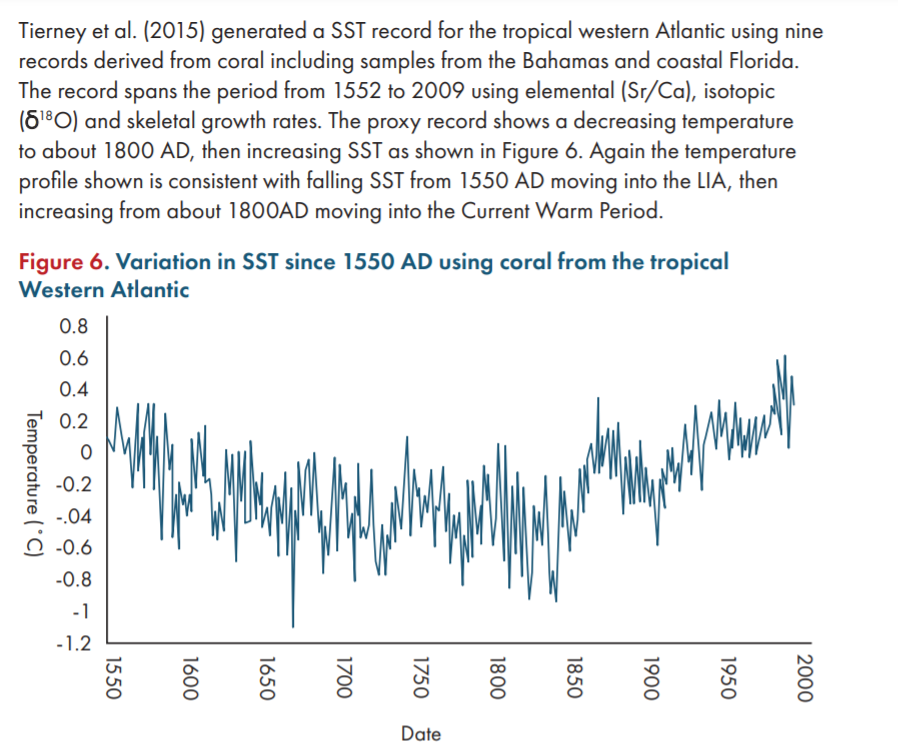
WHAT CORALS CAN TELL US ABOUT CLIMATE CHANGE

There is a long research article under the heading above that would not be appropriate to reproduce here. I did however like one of their graphs. I reproduce it below. You will note that the temperature was the same in 1550 and 1950. Not much global warming there!


The lesson is that the temperature goes up and down in random ways

****************************************

How to fight microplastic pollution with magnets

Microplastics are fragments smaller than five millimetres and either come directly from the products we use or are created as larger plastic objects break down in the environment. They are ubiquitous – they have been found at the bottom of the world's deepest ocean trench and lodged in Arctic sea ice.

Microplastics are found in our clothes, cosmetics and cleaning products. One load of laundry can release an average of 700,000 microplastic fibres. Less than a millimetre in length, these fibres make their way into rivers and oceans, where they are eaten by fish and even corals. Because of their tiny size, microplastics are able to pass through filtration systems, making it very difficult to avoid them.

One 2018 study, plastic contamination can also be found in bottled water, with 93% of 259 bottled water samples the scientists examined containing microplastics.

According to recent research, we constantly inhale and ingest microplastics during our daily lives. One study in 2019 by researchers at the University of Newcastle found that globally people ingest an average of 5g of plastic every week – the equivalent of a credit card. The impact that this diet of microplastics has on our health, however, is still poorly understood.

Chemicals used in plastic have, however, been linked to a range of health problems including cancer, heart disease and poor foetal development. Studies have found that human exposure to microplastics could cause oxidative stress, inflammation and respiratory problems.

It was on his local beach that Ferreira came up with a solution that could extract microplastics from water. "I found some oil spill residue with loads of plastic attached to it," he says. "I realised that oil could be used to attract plastic."

Ferreira mixed vegetable oil with iron oxide powder to create a magnetic liquid, also known as ferrofluid. He then blended in microplastics from a wide range of everyday items, including plastic bottles, paint and car tyres, and water from the washing machine.

After the microplastics attached themselves to the ferrofluid, Ferreira used a magnet to remove the solution and leave behind only water.

Following 5,000 tests, Ferreira's method was 87% effective at extracting microplastics from water.

Ferreira is currently in the process of designing a device which uses the magnetic extraction method to capture microplastics as water flows past it. The device will be small enough to fit inside waterpipes to continuously extract plastic fragments as water flows through them. He has also been working on a system that could be fitted to ships so they can extract plastics on the oceans.

After receiving funding from the Footprint Coalition, which was founded by actor Robert Downey Jr, Ferreira started scaling up the technology so it could be used at wastewater treatment facilities and prevent microplastics from escaping into the ocean.

He is currently working with US company Stress Engineering to fine-tune his invention and design a device out of stainless steel, glass or recycled plastic. "We're trying to make something where we are not creating more plastic pollution," he says.

The technology is "very quick, cheap and low energy," he says, adding that it can easily be integrated into existing facilities and is able to handle normal flow rates of water.

*******************************

Pennsylvania Lawmakers Move to Block Newly Cleared Climate Regulations

No sooner did a Pennsylvania state commission narrowly approve new climate regulations this week than state lawmakers advanced a resolution to prevent those rules from taking effect.

The five-member Independent Regulatory Review Commission voted 3-2 on Wednesday to approve “cap and trade” regulations to limit carbon dioxide emissions, endorsed by Pennsylvania Gov. Tom Wolf, a Democrat, in an executive order in October 2019.

Republicans on the House Environmental Resources and Energy Committee voted Thursday to approve a concurrent resolution to spike the regulations. They were joined by state Rep. Pam Snyder, a Democrat, whose district includes Greene, Fayette, and Washington counties.

The regulations would enable Pennsylvania to become part of the Regional Greenhouse Gas Initiative, a multistate agreement to address climate change that includes 11 New England and mid-Atlantic states.

Government regulators in participating states compel electric utilities to purchase carbon allowances at quarterly auctions whenever the power companies surpass the cap on carbon dioxide emissions established by RGGI, as the pact is known.

During the Wednesday meeting, Commissioner John Soroko made a motion to disapprove of the regulations, which failed 3-2. Commissioner Murray Ufberg then made a motion to approve the regulations, which passed 3-2.

The Pennsylvania General Assembly created the Independent Regulatory Review Commission in 1982 to determine whether state agencies have the statutory authority to adopt regulations and whether regulations are consistent with state lawmakers’ intent.

*************************************

My other blogs. Main ones below

http://dissectleft.blogspot.com (DISSECTING LEFTISM )

http://edwatch.blogspot.com (EDUCATION WATCH)

http://pcwatch.blogspot.com (POLITICAL CORRECTNESS WATCH)

http://australian-politics.blogspot.com (AUSTRALIAN POLITICS)

http://snorphty.blogspot.com/ (TONGUE-TIED)

*****************************************

Friday, September 03, 2021


Ozone recovery is offsetting Southern Hemisphere climate change trends in summer

Cooler summers in Australia despite high CO2 levels!

If the latest climate report from the Intergovernmental Panel on Climate Change (IPCC) made anything clear, it was that much more needs to be done to reverse the impacts of climate change.

But buried in the 1,000-page document of mostly alarming reading there was one positive gem.

Our action in reducing ozone depletion is, in the short term, offsetting some of the impacts greenhouse gases are having on summer rainfall systems in the Southern Hemisphere.

What does that mean?

It's all to do with a major climate driver known as the Southern Annular Mode (SAM), a belt of strong westerly winds linked to rainfall in the Southern Hemisphere.

The SAM's position — either moving further north or south — can influence which latitudes see the impacts of storm systems and cold fronts, and can also have an influence on temperature.

Without ozone depletion and greenhouse gas emissions, its position over the southern ocean has a natural variability both north and south.

But with those things occurring, the SAM has been trending further south toward Antarctica, research has shown.

With the SAM further south, storm tracks also shift south, away from Australia — changing which areas recieve rainfall.

Australian Antarctic Division principle research scientist Andrew Klekociuk said in the last 20 years however, ozone recovery has been turning that trend around during the summer months, pushing back on the influence of greenhouse gases.

"[Ozone recovery] is starting to relax the change that we’ve seen [in the SAM]," Dr Kelkociuk said.

"For a period now, we have this tug-of-war between ozone recovery and the effects of greenhouse gas increases."

The weakening of the pole-ward trend during the summer months was referenced in the latest IPCC report, released last month.

It's an element of the report climate science professor Julie Arblaster, from Monash University, described as a "really good news story".

"We, as humans, are doing a big chemistry experiment on our planet at the moment and anything we can do to reduce our impact on the climate system has to be of benefit," she said.

"Bringing the [rainfall and storm systems] back equator-ward would certainly help return some of the rainfall patterns to their normal location."

What could this mean for rainfall?

The position of the SAM has different rainfall outcomes for different parts of the Southern Hemisphere and Australia.

Some regions, including eastern Australia, actually experience wetter conditions in summer when the wind-belt is further towards Antarctica.

That means for eastern Australia, a reversal of that trend could mean less rainfall during the summer months, according to Professor Arblaster.

Regions like western Tasmania and New Zealand, however, could see rainfall increase.

But Professor Arblaster said it was hard to say exactly what the pushback means for Australian summer rainfall, because the SAM was not the only factor influencing the weather.

"Different regions have influences from many things and not just the SAM trend," she said.

"For example, the El Nino Southern Oscillation.

"So there is a strong understanding of how the ozone hole has affected the SAM, but how much influence ozone depletion has had on Australian rainfall trends is still a question."

Impact to temperatures

When it comes to temperatures, Professor Arblaster said there was evidence international efforts to limit ozone depletion had also gone a long way in "avoiding" larger temperature rises across the globe.

"The ozone-depleting substances are really strong greenhouse gasses," she said.

"So if we had continued emitting CFCs, then a study by Goyal and co-authors found that would have led to an additional warming of 0.5 and 1 degree up to now in some regions, and additional warming after."

Short-term buffer only

Both the IPCC report, Professor Arblaster and Dr Klekociuk made one thing clear.

The buffer that ozone recovery was providing to the pole-ward shift of the SAM would not last if greenhouse gas emissions were not reduced.

"If we don’t reduce emissions soon, the greenhouse gases will overwhelm any impact from ozone recovery by the end of the 21st Century," Professor Arblaster said.

The Antarctic ozone hole has recently started to show signs of recovering since The Montreal Protocol was signed in the late 1980's — an international agreement to phase out the use of ozone-depleting substances such as chlorofluorocarbons (CFCs).

It is currently on track to have recovered by the mid to late 21st Century.

********************************************

Climate change: Arctic WARMING linked to COLDER winters

But Warmists can explain anything away

A new study shows that increases in extreme winter weather in parts of the US are linked to accelerated warming of the Arctic.

The scientists found that heating in the region ultimately disturbed the circular pattern of winds known as the polar vortex.

This allowed colder winter weather to flow down to the US, notably in the Texas cold wave in February.

The authors say that warming will see more cold winters in some locations.

Over the past four decades, satellite records have shown how increasing global temperatures have had a profound effect on the Arctic.

Warming in the region is far more pronounced than in the rest of the world, and has caused a rapid shrinkage of summer sea ice.

Scientists have long been concerned about the implications of this amplification of global change for the rest of the planet.

This new study indicates that the warming in the Arctic is having a significant impact on winter weather in both North America and East Asia.

The researchers detail a complex meteorological chain that connects this warmer region to a rotating pattern of cold air known as the polar vortex.

The authors show that the melting of ice in the Barents and Kara seas leads to increased snowfall over Siberia and a transfer of excess energy that impacts the swirling winds in the stratosphere above the North Pole.

The heat ultimately causes a stretching of the vortex which then enables extremely cold weather to flow down to the US.

There has been an increase in these stretching events since satellite observations began in 1979.

The scientists believe this vortex stretching process led to the deadly Texas cold wave in February this year.

"We're arguing that melting sea ice across Northwest Eurasia, coupled with increased snowfall across Siberia is leading to a strengthening of the temperature difference from west to east across the Eurasian continent," explained lead author Dr Judah Cohen, who's a professor at the Massachusetts Institute of Technology (MIT) and a director of Atmospheric and Environmental Research, a weather risk management company.

"We know when that temperature difference increases, that leads to more disruptions of the polar vortex. And when it's weakened, that leads to more extreme winter weather such as the Texas cold wave last February."

The researchers say that their findings are based on both observations and modelling and they show a physical link between climate change in the Arctic, the stretching of the polar vortex and the impacts on ground.

The authors believe their work could improve predictions about the onset of extreme cold winter events.

"One of the benefits of this study is that if you recognise these precursors and you know the conditions that are favourable for triggering such event, then you get to extend your forecast lead time," said Dr Cohen.

"In Texas, people could have certainly prepared better with better warnings, some people froze to death in their homes and perhaps they could have gone to seek shelter."

Looking at the bigger picture, the research team believes that their findings will help people understand that global warming is complex and perhaps dispel the idea that colder winters mean climate change isn't happening.

"There has been a long-standing apparent contradiction between the warmer temperatures globally, however, an apparent increase in cold extremes for the United States and in northern Eurasia. And this study helps to resolve this contradiction," said fellow author, Prof Chaim Garfinkel from the Hebrew University of Jerusalem.

"In the past, these cold extremes over the US and Russia have been used to justify not reducing carbon, but there's no longer any excuse to not start reducing emissions right away."

********************************************

Those pesky clouds

That clouds would warm the earth was an integral part ofthe original global warming theory

Best estimates for global temperature increases due to a doubling of atmospheric CO2 since the start of the industrial era are between +1.5C and +4.5C. A major reason for this huge range of uncertainty is how clouds will perform in a warmed world, with some modelers saying clouds will help cool the planet, while the majority say clouds will further warm it.

Clouds add immense uncertainty to climate models because they contain so many variables (including altitude, size, turbulence, amount of ice crystals, quantity and particle chemistry), and also because they don’t fit neatly inside the global grid cell system that modelers use to estimate warming.

A new study used a machine learning model to bypass previous cloud modeling problems. The researchers concluded that a doubling of atmospheric CO2 will most likely lead to a 3.2C (5.76F) global temperature increase, almost exactly in the middle of the range estimated by the majority of current U.N. Intergovernmental Panel on Climate Change models.

Researchers within and outside the study agree more data and research is needed to confirm or alter these results.
Most of us think of them as puffy and picturesque, but for climate modelers, clouds are a major thorn in the side, and are the hard question. Scientists do know clouds wield an outsize influence on climate: Reducing Earth’s cloud cover by just 5% would have the same planet-wide warming effect as all the CO2 released into the atmosphere since the start of the industrial age.

The big problem, however, is that as the earth warms, the effect of clouds changes too, and after decades of research and debate scientists can’t agree exactly how. Most think clouds will warm the earth overall, others think they could cool it, and no one is sure by how much either way.

Not knowing how these potentially huge cloud influences will unfold makes predicting climate change very difficult. The best estimate of temperature increase due to a doubling of atmospheric CO2 lies anywhere between +1.5C (2.7F) and +4.5C (8.1F), according to the U.N. Intergovernmental Panel on Climate Change (IPCC). Most of that gigantic uncertainty owes to the difficulty of modeling clouds.

Cumulonimbus cloud over Warsaw, Poland. Image by Kamil Nowacki.
Now that uncertainty range may have been narrowed down to a sliver, based on the findings of a new study by researchers at Imperial College, London. The team took a novel approach, sidestepping finicky cloud modeling schemes altogether, and turning to machine learning to predict climate “cloud feedback” instead.

Climate models work by slicing the world up into a three-dimensional grid and assigning values such as humidity, temperature, air pressure and a host of other descriptors within each entire cell. But clouds are wispy, ephemeral and driven by microscopic processes. “You can’t model the physics of clouds themselves,” says Paulo Ceppi, co-author of the new study. “If you think about a cloud, if you really wanted to simulate a cloud, you would need to simulate every individual droplet and ice crystal.”

Climate models divide the world into a vast three-dimensional grid with many individual cells — with each cell sometimes as much as 100 kilometers across. Average values for various factors in each cell are calculated, including humidity, temperature and air pressure. Clouds are difficult to model because their shape, size and composition are not easily fitted into, described and averaged within large cells. This diagram shows how individual clouds (top illustration) at various altitudes and which occupy only a portion of each cell, are averaged (bottom illustration) to show either the simple presence or absence of clouds filling an entire cells. Image produced by Studio Canek.
Clouds are also typically much smaller than the size of a single grid cell (with each cell usually covering 100km2, or 62 sq. mi.), making it hard to know where they fit into the model. And that is a huge problem, because where clouds are determines whether they cool or warm the earth.

Lower level clouds tend to reflect sunlight back out into space, having a cooling effect; higher level clouds can act as a blanket, trapping heat and warming the earth. At higher latitudes, where there is less sunlight to reflect, that blanketing effect currently dominates, all other factors being equal. Scientists think that clouds presently cool the earth more than they warm, but if low-level clouds decline or move further northward as global warming escalates, that could change.

High altitude cirrus clouds allow most of the sun’s shortwave radiation to pass through to the earth’s surface. Because they are cold, they trap much of the longwave radiation re-emitted upwards by the earth. Image by hehaden found on Flickr.

Puffy white stratocumulus clouds reflect most of the sun’s shortwave radiation back out into space, cooling the earth. Image courtesy of ISS Crew Earth Observations, Wikimedia Commons.
Traditionally, the cloud modeling problem has been addressed through “parameterization,” algorithms that predict the probability or percentage of cloudiness in a grid cell.

Initially, these algorithms were crude, sometimes just a binary choice between cloudy and not-cloudy depending on a cell’s relative humidity. Today’s algorithms are dense, knotty blocks of Fortran code, accounting for altitude, size, turbulence, amount of ice crystals, quantity and even chemistry of particles in the air.

Despite this added detail, or perhaps because of it, different parameterization schemes give wildly different results. Understanding why, says Ceppi, is difficult. Cloud models “are so complicated, and they have grown [more so] over generations of coders. People know what’s in there, but as soon as the model isn’t super simple, it becomes quite hard to describe what’s happening.”

Each cell “becomes a complex system, just like the real world,” says Peer Nowack, co-author of the new study.

Ceppi and Nowack took a different, simpler approach. Instead of trying to simulate the real world in ever finer detail, they looked at it from the top down. Reasoning that cloudiness at any given point statistically correlates to just a handful of key climate factors, chief among them surface temperature, they used a machine learning model to scan 20 years of climate data (from March 2000 to September 2019) — augmented by modeled estimates to fill in any gaps and seeking a formula that best defines the relationship of cloud changes to warming.

This wasn’t the first attempt to apply statistical analysis to clouds, but previous studies had focused only on certain types of clouds, or regions of the earth. The new study, by contrast, analyzed the entire planet, at every altitude. Moreover, instead of analyzing each point in isolation, the research team correlated the cloudiness at each point to a large area surrounding it, allowing the researchers to account for spatial patterns in cloud-forming factors.

Once the formulas had been derived, predictions could be made as to what might happen to clouds as global temperatures rise. The researchers then compared the predictions against the climate models used by the IPCC in drafting its assessment reports. Their results showed that the majority of climate modelers have it about right: global warming will result in a decline in low-level clouds and a rise in the altitude of high level clouds, implying a positive cloud feedback, meaning clouds will add to warming over time.

The results, says Ceppi, were “bang on” with the average effect seen in models.

“We find robust evidence that clouds amplify warming. Our results don’t shift the central [temperature increase] estimate one way or another… It’s not that things are worse than we previously thought. It’s that we’re more confident that it will be what we thought it would be [according to our current models].”

The researchers conclude that a doubling of atmospheric CO2 will most likely lead to a 3.2C (5.76F) global temperature increase, almost exactly in the middle of the IPCC’s estimate range. A temperature increase of less than 2C (3.6F) — the maximum increase to avoid climate disaster — has only a 0.5% probability, say the researchers.

“It’s an interesting study,” says Annica Ekman, a climate modeler at Stockholm University who was not involved in the research. She sees an important innovation in the use of spatial correlation. “That’s clever. I think we need that. I think this could be why previous parameterizations, when it was parameterizations… did not work so well, for low-level clouds, because they might not have had this large-scale influence in them.”

But machine learning is only as good as the data it is trained on, and is insufficient to make such a definitive conclusion in this case, says Kevin Trenberth, a Distinguished Scholar at the U.S. National Center for Atmospheric Research. “The data used [in the new study] are not real data, but come from models and are known to contain flaws,” he wrote in an email. Trenberth points out that the period under study was dominated by an unusually strong El Niño. “They would need another 50 years of data in order to sample a dozen El Nino events,” and confirm their results.

The study researchers maintain that they did account for data anomalies in their own uncertainty estimates, but admit more data would have been preferable.

Ceppi, however, anticipates a deeper concern. “The one limitation of our approach… would be if all the [cloud] models [used by the new study] happen to be wrong. And things are so non-linear, in a way that is not captured by any of the models. Then we fail.” But that will happen, he says, only at the highest levels of global warming.

“Then we’re talking about tipping points,” says Nowack. Then we’ve got bigger problems.

********************************

Setting fire to the politics of global warming

There is a burning question at the centre of the latest Intergovernmental Panel on Climate Change report, the sixth assessment report into global warming (AR6). Is this a scientific document or a political one? The answer is that, by necessity, it is a bit of both.

Not too much should be read into the timing of the release of the report ahead of the Glasgow conference scheduled for November. This is because the Glasgow meeting was due to be held last year, before the report’s originally scheduled release in March.

Nonetheless, the report provides a rallying point for pressure groups, including the UN, to encourage world leaders to do more to reduce their nations’ greenhouse gas emissions.

From a scientific perspective, AR6 does not draw any startling new conclusions. Rather, scientists at the frontline of studying climate change are more convinced than ever that rising levels of carbon dioxide in the atmosphere have a direct relationship to rising surface temperatures averaged across the world. The science community is more willing to accept that natural variation can produce periods of negligible warming or even cooling.

The new learnings involve the use of climate models to provide a link between extreme weather events and a warming world. This remains a relatively new science and the results do not always have a high degree of confidence.

There is a robust defence of climate models overall but an admission that some newer models produce outcomes that cannot be accepted on their own.

Where the AR6 report becomes political is the extent to which it allows itself to become a vehicle for breathless prophecies of a looming Hadean future. This should not be surprising given that experts at the IPCC billed the report as “a code red for humanity”. In more sober tones, the report says warming since the start of the industrial revolution has been 1.07C and the best estimate of warming if greenhouse gases are allowed to double in the atmosphere is 3C.

It says the Paris Agreement’s more aspirational target to limit future warming to 1.5C will likely be exceeded on an annual basis in a little over a decade. Without action the actual Paris Agreement threshold of 2C will be breached in coming decades. But there is still a chance to meet even the lower target if the world can agree to decarbonise to net-zero emissions by 2050.

Unfortunately, the report has left itself open to the same criticisms that have dogged other recent appraisals of climate science. By necessity, the report includes a wide range of possible scenarios. Each scenario is based on a different trajectory for future greenhouse gas emissions. They range from sharp decreases in emissions to business as usual and a high-emissions scenario, RCP8.5.

The IPCC says, in general, no likelihood is attached to the scenarios assessed. But it does say the likelihood of high-emissions scenarios such as RCP8.5 is considered to be low. It is the high-emissions scenarios that have the greatest potential for bigger storms and tipping point extremes. Analysis shows the high-emissions scenarios that the IPCC says have a low probability dominate the report, with 41.5 per cent of all scenario mentions.

The scenarios judged most likely under current trends get less than half of this amount.

Many people no doubt will argue that even the best case scenarios can result in bad outcomes for the planet and that highlighting the negatives is necessary to get reluctant politicians to act. And they are probably right because as things stand it will take a minor miracle to break the logjam in global climate change politics that has frustrated progress throughout the IPCC’s existence and threatens to derail Boris Johnson’s Glasgow dream.

The issue is how to treat the developed and developing world differently but fairly and still cut total emissions. Scott Morrison touched on it on Tuesday when he said we could not ignore the fact the developing world accounted for two-thirds of global emissions and those emissions were rising.

The difficult part is that advanced economies have developed over a long time, principally on the basis of fossil fuel industries. And, as Morrison says, “It’s a very fair argument that the developing world makes, which says ‘why should our economic futures be denied when advanced economies around the world have been able to go forward on that basis of their energy economies over a long period of time?’ ”

This is the issue that has stalled global progress on limiting greenhouse gas emissions, which continue to grow as increases from developing economies swamp cuts from the developed world.

Out of total annual global emissions from fossil fuels of 36.4 billion tonnes, China emits 10.2 billion tonnes. The US is the next biggest emitter with 5.4 billion tonnes, then the EU with 2.9 billion, India 2.6 billion, Russia 2.4 billion and Japan 1.3 billion.

The developed world is proposing deep cuts to emissions but at the same time outsourcing industrial production of the things needed to make the transition to China, including the greenhouse gas emissions involved.

India forcefully has let it be known that it will continue to prioritise industrial development and poverty alleviation over curbing greenhouse gas emissions and is calling for a per capita measure.

Johnson has had high hopes of making the Glasgow summit the point at which the world turned its back on coal. But India and China refused even to attend a meeting called to discuss it.

The glue that is supposed to bring the sides together is money, with the transfer of funds from the developed to the developing world. But with coffers drained from tackling the Covid-19 pandemic the developed world is less well placed to deliver.

The situation is made more dire by growing pushback against governments in the EU and Britain, which are doing the most to make the change to net zero. Britain’s Committee on Climate Change, the agency charged with advising that a transition to net zero could be made at limited cost, has been ordered to produce its costings. It now says the spreadsheets of calculations have been deleted and overwritten.

In a statement on Monday, Johnson said we know what must be done to limit global warming. That is, “consign coal to history and shift to clean energy sources, protect nature and provide climate finance for countries on the front line”. Easier said than done.

***************************************

My other blogs. Main ones below

http://dissectleft.blogspot.com (DISSECTING LEFTISM )

http://edwatch.blogspot.com (EDUCATION WATCH)

http://pcwatch.blogspot.com (POLITICAL CORRECTNESS WATCH)

http://australian-politics.blogspot.com (AUSTRALIAN POLITICS)

http://snorphty.blogspot.com/ (TONGUE-TIED)

*****************************************

Thursday, September 02, 2021


Nearly 500 Extinction Rebellion Climactivists Arrested In London Protests

During the first week of protests in London from the radical climate change alarmist group Extinction Rebellion (XR), nearly 500 activists have been arrested by the Metropolitan Police.

In the first eight days of the two-week-long “Impossible Rebellion” protests in the British capital, 469 green radicals have been arrested for various offenses, according to the Met.

On Tuesday, approximately 200 Extinction Rebellion activists gathered on London Bridge, ten of whom locked themselves to a bus that they had brought along to the protest, shutting down traffic for hours.

In an exclusive Breitbart London video, XR activists were seen blocking off a major intersection of Central London last Monday.

The climate change activists constructed a giant four-meter table in the middle of the road in Covent Garden, with activists chaining themselves to the structure.

While police initially took a hands-off approach through most of the day, 52 activists were eventually arrested in the evening and the structure was eventually dismantled the following morning.

Smaller protests have continued through the rest of the week, including pouring fake blood throughout the City of London to symbolize Britain’s banking hub’s connections to the historical slave trade and allegedly man-made climate change.

On Tuesday of last week, activists attempted to block off traffic in Cambridge Circus, using lock-on devices to tie each other together as well as to street furniture.

A Met Police spokesman said per the Evening Standard: “Removing these lock-on devices is not impossible, but it takes time. In addition to the caravan blocking Tower Bridge and the blue van blocking the approach on Mansell Street, protesters also lay down on the junction to Tower Bridge.

“We have the tools to remove these lock-ons. We see many comments and questions asking why this work can’t be quicker and use more direct tactics.”

“While we understand the public’s frustration, we must consider the safety of everyone involved – including our officers. This work is painstaking but we work as quick as we can.”

Some social media users celebrated police for acting fast to prevent another makeshift structure from being constructed on the road on Monday.

While XR has developed fast-moving tactics where unmarked vehicles are used to rapidly deploy protests and objects to block traffic, police were witnessed by bystanders to move in quickly to prevent the structure from being completed, all in a matter of seconds.

**************************************

The Woman Who Kicked The Hornet’s Nest—Then Blamed It On Global Warming

Google News today is promoting an article in which a klutz in Washington state stumbled into a hornets’ nest, got stung, and then blamed global warming.

In reality, hornets have always existed in Washington state, and a person stumbling into a hornets’ nest and getting stung has absolutely no connection with global warming.

The website Crosscut published an article today titled, “Covering climate change means watching the Washington you love fade away.” Google News is promoting the article at the top of its search results for “climate change.”

The article begins with the author recounting how she recently stumbled into a hornets’ nest and got stung.

The author claimed she had never been stung by a hornet before in Washington state, and immediately blamed climate change for the hornets existing there and stinging her.

However, as shown in the image below – presented by Wikipedia – bald-faced hornets are quite widespread and are more prolific in cooler areas to the north of Washington.

Given this fact, it is quite dubious that global warming made the hornet nest any more likely to exist when the author clumsily stumbled into it.

Taking her global warming speculation and scapegoating still further, the author claimed global warming is making the West Nile virus more likely in Washington.

However, the Washington State Department of Health reports there has been only one case of West Nile virus in Washington this year.

This follows just two cases in 2020 and five cases in 2019. If there is any trend of West Nile virus in Washington state, it is a trend of declining cases.

Nationally, U.S. Centers for Disease Control data show no worsening trend in West Nile virus cases, either. The most annual cases were reported nearly 20 years ago, in 2003.

Blaming global warming for all manner of unpleasant things has become a knee-jerk habit among many people.

Blaming global warming for a klutz stumbling into a hornets’ nest and getting stung is now one of those examples. In reality, this example illustrates how anti-science such global warming claims are.

*****************************************

The Problem Of Life-Expired Wind And Solar Waste

The millions of solar panels headed for landfill are a veritable toxic cocktail of gallium arsenide, tellurium, silver, crystalline silicon, lead, cadmium, and heavy earth material.

Then there’s the landfill legacy being created by wind turbine blades, with the First World cynically using the Third World as its dumping ground: ‘Green’ Energy’s Poisonous Legacy: Millions of Toxic Turbine Blades Destined for African Landfills

Thousands of 45-70m blades (weighing between 10 to 25 tonnes) are being ground up and mixed with concrete and used in the bases of other turbines erected later or simply dumped in landfills. Which should worry locals: the plastics in the blades are toxic, and contain Bisphenol A, which is so dangerous to health that the European Union and Canada have banned it.

In the US, Instead of fronting up to pay the bill to dump them, hundreds of them are being stacked up across the Midwest in the hope that no one will notice.

While the purportedly “inevitable transition” to an all wind and sun powered future might be exuberant wishful thinking, the present steady progression of wind turbine blades and solar panels toward landfills will soon become a march of epic proportions. The only thing inevitable about wind and solar is mountains of toxic rubbish heading for a landfill near you.

Renewables: Oh, The Waste!

The Biden administration is ignoring the problem of waste and pollution in its pursuit of renewable energy, writes the Institute of Energy Research (IER).

“Electric vehicle batteries, solar panels, and wind turbines result in a massive amount of waste and pollution. China is responsible for half of the total electric vehicles in the world—a number that is growing rapidly. About half of its retired batteries are not disposed of in an environmentally sound way, causing significant waste and pollution problems . . . .”

IER cites an article in the Epoch Times (a newspaper that focuses on problems caused by the Chinese Communist Party). It quotes Jiang Tianming, a Hong Kong financial analyst, who criticizes Chinese policies that promote electrical vehicles. “These policies resulted in a fast-growing industry, However, if the retired batteries cannot be recycled effectively and environmentally friendly, the statement that new energy cars are ‘clean’ and ‘environmentally friendly’ is undoubtedly a false proposition.”

IER also discusses waste caused by solar panels and wind turbines.

On solar panels:

“Solar panels are mostly made of glass, which has low value as a recycled material, but they also have small amounts of silicon, silver, and copper as well as heavy metals (cadmium, lead, etc.) that some governments classify as hazardous waste. Hazardous waste can only be transported at designated times and via select routes. Because solar panels are delicate and bulky, specialized labor is required to detach and remove them to avoid their shattering and polluting local areas.”

On wind turbines:

“Wind turbine blades are made of a tough but pliable mix of resin and fiberglass—similar to what spaceship parts are made from. Decommissioned blades are difficult and expensive to transport. They can be anywhere from 100 to 300 feet long and must be cut up on-site before getting trucked away on specialized equipment to a landfill that may not have the capacity for the blades. Landfills that do have the capacity may not have equipment large enough to crush them.“

*********************************************

China To Build 43 New Coal-Fired Power Plants

China is planning to build 43 new coal-fired power plants and 18 new blast furnaces — equivalent to adding about 1.5 percent to its current annual emissions — according to a new report.

The new projects were announced in the first half of this year despite the world’s largest polluter pledging to bring its emissions to a peak before 2030, and to make the country carbon neutral by 2060.

The news shows that at least some in China are prioritizing economic growth over emissions reductions — although some analysts say they are still optimistic that China will reach its climate targets. “There is this desire in the Chinese political and economic system to keep on building, to continue the infrastructure fever,” says Li Shuo, a senior global policy adviser for Greenpeace in Beijing.

The report on China’s new coal plants was written by the Helsinki-based research organization the Centre for Research on Energy and Clean Air (CREA) and the U.S. group Global Energy Monitor (GEM) and released on Aug. 13. It came just days after the U.N.’s Intergovernmental Panel on Climate Change (IPCC) published an alarming report that concluded human-caused climate change is an “unequivocal” reality. U.N. Secretary General Antonio Guterres called the IPCC report a “code red for humanity.”

China is leading the world in new coal power plants, building more than three times as much new coal power capacity as all other countries in the world combined in 2020. It isn’t alone in its reliance on coal, however. China and four other countries, India, Indonesia, Japan and Vietnam, account for more than 80 percent of the coal power stations planned across the world, according to a June report by the think-tank Carbon Tracker.

But it’s not all bad news. China has pledged to reduce its energy intensity — measured by comparing total energy consumed to GDP — and its carbon intensity — the carbon-dioxide produced per dollar of GDP — by 2025. Chinese President Xi Jinping said in April the country will also reduce coal use beginning in 2026.

Despite the development of coal power plants, China is a renewable energy leader, accounting for about 50% of the world’s growth in renewable energy capacity in 2020

The gullible greens still try to convince themselves that China really is going to cut emissions eventually. They cling on to the pledge of reducing energy and carbon intensity, but they really ought to realise that this is a meaningless promise, as all maturing economies do this as they expand into consumer goods and services. This does not mean though that energy consumption will actually decline, simply that the economy will grow faster than energy use does.

Then there is the nonsense about China being the world’s leader in renewable energy. Naturally, given the size of their economy, everything thing they do is big. But the sad reality is that wind and solar power still only contributed a paltry 4 percent of China’s energy last year.

As for Xi’s “promises”, we might recall that Senile Joe actually believed the Taliban.

The report reckons that these new coal plants and blast furnaces will add 150 million tonnes to China’s CO2 emissions. This is roughly half the UK’s total emissions.

***************************************

My other blogs. Main ones below

http://dissectleft.blogspot.com (DISSECTING LEFTISM )

http://edwatch.blogspot.com (EDUCATION WATCH)

http://pcwatch.blogspot.com (POLITICAL CORRECTNESS WATCH)

http://australian-politics.blogspot.com (AUSTRALIAN POLITICS)

http://snorphty.blogspot.com/ (TONGUE-TIED)

*****************************************

Wednesday, September 01, 2021


Today’s Madagascar Drought Entirely Normal, 2000 Years Of Data Show…Link To Climate Change “Not Correct”

Madagascar’s current drought is perfectly within normal range. Droughts were even worse in the past, 2000 years of precipitation reconstruction data show…

Not surprisingly, there been lots of climate doomsday talk about the drought and hunger situation in Madagascar, all coming from the usual suspects. The media like the climate sensationalization to attract clicks and activists like to exploit it to pound their fund-raising drums.

Recently Die kalte Sonne here looked at the situation in one of its climate videos and finds that blaming manmade climate change for the misery in Madagascar doesn’t hold any water.

Citing scientific data from a 2021 publication issued by Europe’s Copernicus global observation project, there has indeed been a drought in Madagascar. But how does it compare in a historical context?

Well within range of natural variability

Here we clearly see it’s been similarly dry earlier over the past century on multiple occasions, particularly in the early 20th century. Natural variability plays a major role in Madagascar precipitation.

Die kalte Sonne, who have deep expertise on Africa’s past climate, then present a study by Scroxton et al (2017) with precipitation reconstruction going back 2000 years for Madagascar, and 800 years for Oman:

Once again the data show that today’s precipitation levels in the two aforementioned regions remain well within the natural range and contradict the alarmist claims made by the panic-mongering UN, media and activists.

Die kalte Sonne summarizes: “The kneejerk linking of this year’s drought in Madagascar to climate change is thus scientifically not correct.”

********************************************

Even the slight warming we have had so far has been beneficial

Tom Eisenhauer remembers driving through Manitoba, a province in central Canada, more than a decade ago. Surrounding his car were fields of cold-weather crops, such as wheat, peas and canola (rape). Dense staples such as maize (corn) and soya, which are more profitable, were few and far between. The view is very different now. More than 5,300 square kilometres have been sown with soya and around 1,500 with maize.

Mr Eisenhauer’s company, Bonnefield Financial, hopes to benefit from the ways that climate change is changing Canadian agriculture. The company buys fields and leases them to farmers, both in Manitoba and elsewhere in the country. It is betting that a warmer climate will steadily increase how much its assets are worth, by enabling farmers in the places where it is investing to grow more valuable crops than they have traditionally selected. It is far from the only business making such wagers. Climate change could make a cornucopia out of land that was once frigid and unproductive.

******************************************

Climate change could spark major shifts in British produce in the coming decades as the country attempts to avoid a “catastrophic” environmental fallout, experts have said.

This is just speculation

At the end of July, the U.K.’s Royal Meteorological Society published its State of the U.K. Climate 2020 report, with the authors noting that last year was England’s third warmest year since records began in 1884.

Meanwhile, the U.K. Met Office predicts that the country is set for warmer and wetter winters, hotter and drier summers and “more frequent and intense weather extremes” because of climate change.

Michael Christie, professor of environmental and ecological economics at Aberystwyth Business School in Wales, told CNBC in a phone call that unless drastic measures were taken in the U.K. and internationally, temperature rises would have “more and more catastrophic effects.”

“And those effects will be irreversible,” he added, noting that certain industries were at greater risk.

“For agriculture, for example, there will be risks in terms of potential impact on what crops can grow,” he said. “There are also issues in terms of livestock and methane emissions, so farmers might not be able to have [as much] livestock in the future. But there are maybe some benefits in that warmer temperatures in the U.K. might actually lead to increased yields.”

*****************************************

Hysteria over climate change report unhelpful for addressing the issue

The International Panel on Climate Change released its sixth assessment report this month. While there are reasons to be concerned with what’s in the report, the national media is breathlessly reporting the IPCC’s findings absent important context.

For example, the Washington Post reported, “If the headlines don’t already feel rather apocalyptic, they are about to get worse.”

The Post article is likely making an accurate prediction. Headlines are notoriously sensational and it would be no surprise if that gets worse. But that has nothing to do with what’s happening with global warming.

Multiple articles have screamed about increases in heat-related deaths, which made for some scary headlines during this inferno of a summer. What you won’t hear about is that the IPCC report also found “the frequency and intensity of cold extremes have decreased.”

A recent study in the journal, The Lancet, found that about 500,000 people die from heat every year, whereas cold kills about 4.5 million. Global warming, on the whole, may be decreasing deaths from temperature extremes. Also important to note, according to the International Disaster Database, deaths from all climate-related natural disasters are at historic lows.

The Guardian newspaper characterized the IPCC report as judging the human race to be full of carbon-spewing sinners who are “guilty as hell” of committing “climate crimes of humanity.” There’s absolutely no such language anywhere in the report.

The IPCC’s latest report blames about 1.1 degrees Celsius of global surface temperature increases on CO2 emissions. The report expresses a high degree of confidence that the increase in temperatures is faster in the past 50 years than the planet has seen at any period in the previous 2,000 years.

Global warming is real, and it’s a problem. Nothing in the report disputes this, and it’s confirmed with more certainty than ever. However, contrary to alarmists’ claims, nothing in the report suggests the world is coming to an end.

The report lays out five different scenarios for the future, which it calls “shared socioeconomic pathways.” These involve assumptions about economic and population growth, as well as how much CO2 we’ll put into the atmosphere over the next century.

Much of the reporting in the national media focuses on two scenarios that show temperatures rising 3.5 to 4.5 degrees by 2101. Warming of that level would be a gargantuan problem, but it’s important to understand these two scenarios — which the IPCC refers to as “business as usual” models — are also the most implausible of the five.

Zeke Hausfather, director of climate and energy at the Breakthrough Institute, and Glen P. Peters, research director at the Center for International Climate Research, argued in an article in Nature that these “business as usual” scenarios should be labeled unlikely, worst-case scenarios. The authors warn that overstating the likelihood of extreme climate impacts makes mitigation seem harder than it actually is, which undermines our ability to address the problem effectively.

These scenarios are implausible because they assume an increase in CO2 emissions that doesn’t reflect current trends. For example, this pathway in the latest IPCC report predicts the human race in 100 years will be burning five times more coal than we are today. We saw coal production peak eight years ago, and these worse-case scenarios are based on older trends.

Environmental researchers Roger Pielke Jr., Matthew Burgess and Justin Ritchie analyzed the IPCC’s emission scenarios and found that 71% of the most plausible scenarios estimate warming between 2 and 3 degrees Celsius by 2100. The median was 2.2 degrees.

In July, Pielke and Ritchie wrote in Issues in Science and Technology of a trend in climate science to use distorted scenarios, which they argue undermines properly informed policymaking. It leads to the kind of thinking seen in the highly misguided Green New Deal, which aims to force everyone to rely on weather-dependent energy sources, such as wind and solar, almost entirely for their energy. As any farmer will tell you, weather is not something you want to place bets on. When your energy depends on the weather, you can expect to be without it when you need it the most. Ultimately, such an approach to addressing climate change will necessitate enormous sacrifices.

Consider proposals by a team of European researchers led by University of Leeds sustainability researcher Jefim Vogel. In order to limit global warming to 1.5 degrees Celsius — 0.4 more degrees above the current level — the researchers estimate that Americans will have to use 90% less energy and families of four will have to live in houses no larger than 640 square feet.

Each person would have an allotment of no more than 7,500 kilowatt-hours of electricity per year, which is about the same amount the average citizen of Bolivia uses. Currently, the average American consumption is about 80,000 kilowatt hours annually, and no developed country has energy use rates close to what the authors propose.

Surprisingly, these findings don’t lead them to reconsider if limiting energy consumption is a feasible solution to climate change. Spurred on by the need to avoid a climate apocalypse, the authors argue that we need a “more fundamental transformation of the political-economic regime” to achieve these goals.

When policymakers are informed primarily by unrealistic worst-case scenarios, to the exclusion of any data that challenges them, you end up with panicked, unworkable, unrealistic and financially infeasible proposals. They’re really good at generating debates and political stalemates, but terrible at solving problems. This kind of unmitigated alarm has far more influence over policy making than those who believe climate change is a hoax, which is simply not true, and so it’s really the alarmists who are preventing us from finding real solutions to the problem.

***************************************

My other blogs. Main ones below

http://dissectleft.blogspot.com (DISSECTING LEFTISM )

http://edwatch.blogspot.com (EDUCATION WATCH)

http://pcwatch.blogspot.com (POLITICAL CORRECTNESS WATCH)

http://australian-politics.blogspot.com (AUSTRALIAN POLITICS)

http://snorphty.blogspot.com/ (TONGUE-TIED)

*****************************************