Friday, March 04, 2016


Total and utter crooks

Pesky CO2 stasis

Despite its utter triviality, the 2015 temperature rise produced by NOAA of 13 hundredths of one degree has been hailed with gladsome hearts by Warmists. Their enthusiasm has however been tempered by the well-known fact that 2015 hosted an El Nino event, a natural climate oscillation that is known to produce a rise in termperatures.  So it is perfectly clear that the 2015 temperature is no proof of anthropogenic warming.  Warmists don't like having their toys taken off them, however, so Jim Hansen and others have dismissed the El Nino contribution as slight.

So how great or small was it?  They do not say.  They offer no calibration or adjustment.  The adjustment kings don't do that adjustment! Yet an adjustment as good as any other they use would be to take the spike observed for the previous El Nino and simply subtract it from the 2015 temperature.  Not hard!  Warmists often found fault with skeptics who did not correct for the effects of the 1998 El Nino so it is quite a travesty that they are not  making any corrections for the current El Nino.

But something that needs no inferences at all is the CO2 record. If the temperature rise was anthropogenic, global warming theory tells us that CO2 was responsible.  It tells us that the temperature spike should have been preceded by a spike in CO2 levels in the atmosphere.  So did that happen?  Was there an unusual rise in CO2 levels during 2015?

For information about CO2 levels I like to turn to the Cape Grim figures, as it is much better located than Mauna Loa, which is near an active volcano.  So I first looked to Cape Grim, in Northern Tasmania.  And the last 4 months they had up showed exactly the opposite of the Warmist story. The levels were drastically plateaued.  They showed variations only in the decimal points of CO2 ppm.

I was rather pleased with that finding but I was vexed that CSIRO had still not put up the figures from December 2015 or January 2016.  February 2016 would have been nice too but I could cut them some slack on that one.  And WHY were they so behind with their posting?  Were the more recent figures even more devastating?

So I turned to Mauna Loa.  And my first look at the Mauna Loa site was an instant laugh.  They showed that the difference between January 2015 and January 2016 was only 2.56 ppm.  But I still wanted the monthly data and I was pleased to see that they do have the whole of 2015 plus January 2016 up.

And the picture was crystal clear. The 2015 figures as a whole just oscillated.  It was up and down around the 400ppm mark for the whole of the year.  Threre was nothing to explain the 2015 temperature change. It's only the January 2016 figure that edged up a bit.

So even that headline figure that gave me an immediate laugh did not represent 2015.  They got a CO2 rise only by courtesy of January 2016.  They must be steaming with frustration.  I always go back as far as I can into the source data when I think something is fishy and did I find stinking fish this time!

How steaming were they? The following footnote on their site probably covers it:  "The last year of data are still preliminary, pending recalibrations of reference gases and other quality control checks. The Mauna Loa data are being obtained at an altitude of 3400 m in the northern subtropics, and may not be the same as the globally averaged CO2 concentration at the surface".  They don't like their own data.

So the 2015 temperature rise was WHOLLY due to El Nino or some other natural effect.  What a come-down!  Once again we see the Green/Left need lies and deceptions to support their narratives.


Be Prepared For Latest UAH Satellite Global Temperature Data

At last El Nino has shown up in the satellite data.  Warmists will say it was due to CO2 but since the 2015 temperature rise was WHOLLY due to El Nino and natural influences (see above), we must expect the same for this rise too.  We don't have the CO2 figures for February yet but January showed only a tiny rise.

The media will be spreading catastrophic global warming news from the latest satellite temperature data from March 1, 2016.

The University of Alabama at Huntsville (UAH) posted its latest satellite global temperature data that spans until the end of February 2016.  This is a data set from 1979 until present when satellite temperature measurements were first made.  The data follows:


Latest Global Average Tropospheric Temperatures

Due to the super El Nino weather system along the Equator on the Western side of South America, this February was the hottest global temperature measured over the history of satellite temperature measurements from 1979.

The ocean temperature of the El Nino for December 2015 surpassed the highest temperature for the 1998 super El Nino.  Ocean cooling started January 2016.  What is in store for the rest of 2016 remains to be seen.

As seen for the 1998 El Nino, rapid cooling took place after the peak temperature early 1998.  This was caused by the El Nino turning into the ocean cooling La Nina.  Possibly the same temperature drop may take place in the future for 2016.  This remains to be seen.

The satellite temperature data shows a temperature rise since 1979 of 0.12 degree C. per decade; or 1.2 degrees per century which places the earth's warming below the recommended limit on global warming of the 2015 Paris Climate Accord.

Data over thousands of years have shown approximate 500-year cycles of planet warming and cooling.  We are currently in the Current Warming Period which commenced approximately 1850.  This was preceded by the Little Ice Age from approximately 1350 to 1850.  Thus continued global warming should be anticipated until after the start of the 22 century.

Email from James H Rust, professor of nuclear engineering and policy advisor The Heartland Institute


This food shortage BS never stops

Greenies have been making false prophecies of food shortages for years now.  Even Hitler did it. And I have often rebutted them. In brief: The world's internationally-traded food problem has for a long time been glut;  Warming would open up new agricultural land in Canada and Russia; Warming should cause more evaporation from the oceans, thus giving MORE rainfall, not less.  A prediction of flood might make some sense but a prediction of water shortage makes no sense at all

The modelling crap below is a laugh a minute. If global warming DID exist, it would be INCREASING food-crop yields. Plants gobble up CO2. It is their basic food. And a warmer world would be a wetter one -- again giving plants a boost. The increased level of CO2 now in the atmosphere has already benefited plant growth, with the greening of the Sahel the most vivid example of that

Aside from Greenie folly and basic biology, however, there is China. China was a food-importer under Mao and any Greenie wisehead would see that as inevitable given that an area about the same as the contiguous United States has to feed 1.3 billion people with primitive technology. Poop is their main fertilizer.

But under capitalism China feeds the world. It is a huge exporter of food and exports to most countries on the globe. For instance: "By value, China is the world's No.1 exporter of fruits and vegetables, and a major exporter of other food products ranging from apple juice to garlic and sausage casings. Its agricultural exports to the US surged to $US2.26 billion last year". And that quote was from 2007!

And have another look at Russia.  How many people know how big Siberia is?  It is roughly 5 milllion sq. miles, compared to about 3 milion sq. miles for the continental USA.  It's BIG.  So if warming opened up Southern Siberia to agriculture, the potential for new food production would be enormous.

Politics and economics are the main constraints on the food supply, nothing else. Capitalism is its friend. Greenies are its enemy


The academic journal article is: "Global and regional health effects of future food production under climate change: a modelling study", continuing a long tradition of British medical journals involving themselves in politics


At least half a million people will die in the year 2050 as a result of the impact climate change will have on food production, according to experts.

The stark forecast is expected to occur because of changes in diet and bodyweight from reduced crop productivity.

Most of these additional deaths will be in China, India, and other low-income countries in the Pacific and Asia, but the effects on food availability will also reach into richer countries.

Writing in The Lancet, Dr Marco Springmann from the Oxford Martin Programme on the Future of Food at University of Oxford claimed climate change could cut improvements in food availability by about a third by 2050.

This would lead to around 3.2 per cent less food being available for the average person.

In particular, this will include reductions in fruit, vegetables, and red meat amounting to about 99kcal fewer calories per person per day.

These changes in food availability will also increase non-communicable conditions such as heart disease, stroke, and cancer, said Dr Springmann.

It's not all bad news, however.

The reduction in food availability is being predicted to cut obesity-related deaths by 260,000, but even this is slightly less than the 266,000 extra deaths predicted as a result of people being underweight.

Springmann and colleagues used an agricultural economic model with data on emission predictions and possible climate responses to evaluate the effects on global food production, trade, and consumption for 2050.

SOURCE  


Good old Graham Readfearn from Brisbane is doing damage control

The recent Fyfe et al. paper which repeatedly referred to a "warming slowdown" in recent years was curious in its non-use of numbers.  The authors said that there was a slowdown but not by how much.  By slowdown they meant that the rate of warming was notably reduced but it did not vanish altogether.  Curiously for a scientific paper (and I have read it right through) they made no attempt at quantifying exactly how much warming went on during the "slowdown".  They said there was some but not how much.  Instead they waffled about all the natural events which could have caused the slowdown.  So the paper was just a reluctant admission that the numbers ran contrary to global warming theory.

Graham Readfearn below has picked up that ball and run with it.  He is basically just re-running the paper in a form suitable for a non-technical audience.  It's all just a big apology for failed  prophecy.  That they can't put a number on how much warming there was in recent years is really rather amusing and a big step backwards for them


Did global warming really slow down for a decade or so in the 2000s and does it really matter if it did?

New analysis written by a group of well regarded climate scientists appeared in a journal a couple of weeks ago, arguing that global warming did slowdown.

Those first two sentences are about as straightforward as this post gets. So I suggest that you either get out now while you can or you buckle in.

That’s because for us to understand this issue properly, we need more context than you could shake a contextual stick at, we need to have a bit of respect for the scientific process and we also need to embrace some nuance – three things the public conversation on climate change isn’t particularly known for.

We also need to ask the authors of the analysis some questions, which I’ve done (don’t you dare just scroll).

First, the analysis appeared in the journal Nature Climate Change and it basically argued that between 2001 and 2014, the rate of global warming slowed down a bit.

This is where we need our first injection of nuance. When we say “global warming” what we’re actually talking about here are the air temperatures which, as one of the authors told me, is a relatively “fickle” measure of climate change.

The amount of heat going into the oceans, the rate of sea level rise and the increasing heat extremes are more reliable or more relevant measures.

The authors, led by Dr John Fyfe, of the University of Victoria in British Columbia, wrote that some climate models over this period also tended to overestimate the rate of warming at the surface.

The authors say this “slowdown” was caused by a combination of natural ocean cycles, volcanoes going off, less energy coming from the sun and changes in the amounts of tiny particles in the atmosphere, mainly from industrial pollution.

Now, climate science denialists have welcomed the paper as a great big serving of “I told you so” with smug sauce and an overbearing garnish of self-satisfied rodomontade.

British climate science denier James Delingpole also delivered a pudding of chilled vexatious abuse with lumpy custard (Delingpole attacked “pause deniers” on the back of a paper that expressly says ‘we do not believe that warming has ceased’).

So as is the norm, many of those commentators have either not read the paper, have misinterpreted the paper, have cherry-picked the bits of the paper that they like, ignored context or failed to ask the authors the most simple follow-up questions.

What’s more, the analysis is extremely unlikely to be the final word on the matter in the peer reviewed literature. Criticism of the statistical methods and choices used in the paper has already begun to surface, and you can be confident there will be more to come.

Two previous papers in particular have argued that statistically and practically, the slowdown didn’t happen.

In the journal Science in June 2015, Thomas Karl and colleagues from the US government’s National Oceanographic and Atmospheric Administration argued the slowdown was an “illusion”.

Once biases in the data were corrected, mainly concerning ocean temperature readings taken by ships, the slowdown disappeared, the paper said

Research published in the journal Scientific Reports and led by the University of Bristol’s Stephan Lewandowsky also argued any so-called “hiatus” did not exist in the context of longer-term trends (17 years or more). Both these papers are discussed in the latest analysis.

So the most obvious question for the authors of this latest analysis is, what does this actually mean for long-term projections of climate change, especially if we keep loading the atmosphere with greenhouse gas emissions from burning fossil fuels?

Dr John Fyfe, of the University of Victoria in British Columbia, told me:

    Climate models did not generally simulate the slowdown because the slowdown was mainly due to random internal variability. As for policy makers, they should be aware that once the recent phase of internal variability flips – which we think is about now – global surface temperatures will rapidly rise.

    It would be very wrong to interpret our paper as suggesting that global warming has stopped. Our findings show that the rate of human-caused warming over the early-2000s was about the same as before.

    However, over the early 2000s human-caused warming was masked by a cooling influence from internal variability combined with cooling from a sequence of small volcanic eruptions.

In an interview with me last year another of the authors, Prof Michael Mann, described the period of an alleged slowdown as the “faux pause”, saying that “global warming hasn’t stopped, even though you still hear those contrarian talking points.”

Mann told me he had not changed his mind and the distinction between global warming stopping or experiencing a temporary slowdown was “critical”.

    Moreover, the slowdown is now very likely over. It was at most a temporary respite, and as we have argued in our other recent work there is a good chance we will now see the flipside.

    Internal variability will begin to work against us, and lead to even faster warming in the decade ahead. The Faux Pause may have led to False Complacency, when it comes to climate change

All this talk of a “slowdown” period, remember, overlaps a period when we saw 14 of the 16 hottest years on record all happening since 2000.

Prof Matt England, of the University of New South Wales climate change research centre, another co-author on the analysis, told me:

    The last thing we want out there is confusion in the community about what this all means. None of this calls into question the rate of global warming.

    People need to understand that long-term projections are not affected in any way by decadal variability.

    This is a very important point. This is only the global average surface temperature and it’s only one measure of the climate system – and it’s a very fickle measure.

    What I mean by that is that it bounces around from year to year. People don’t wake up and say ‘oh gee, that global average air temperature that’s gone up by point zero one of degree from last year has really affected my life’.

    They are instead affected by extreme temperature change, sea level rise and all those other metrics that really matter to society. There’s an over-emphasis on the surface air temperature.

    In the earlier 20th century there has been no slowdown at all in the instances of extremes. We are really exposed to these events and they have been on the rise.

    Global warming in terms of the net energy in the system has continued unabated. It’s important to point out to people that there was no pause at all in global warming when you measure it as the world’s climate system. If you look at ocean heat content, that’s gone up almost monotonically.

    So really this slowdown has been a real distraction for action on climate change. But the mere fact that there are scientists looking at the record is a normal scientific debate.

    We are still sucking energy into system that goes into melting ice and sea level rise and that’s why it’s a false pause.

SOURCE  


After Admitting He Has No Evidence about Dimock and fracking, Tony Ingraffea Hides and Runs

By Phelim McAleer

Professor Tony Ingraffea has never been shy about speaking to the press about fracking. He has been in both Gasland documentaries, given hundreds of press interviews, and spoke at rallies with anti-fracking celebrities Mark Ruffalo, Sean Lennon, and Yoko Ono.

But over the past few days, his advocacy has come back to haunt him and left him literally hiding and running away when it comes to answering difficult questions.

It has been a rough few days for Professor Ingraffea, the anti-fracking movement’s favorite scientist. Finally, he was under oath and had to tell the truth. When he didn't, he had to face his lies being exposed. He was giving evidence in the Dimock Water Trial where the Hubert and Ely families from Pennsylvania are accusing Cabot Oil and Gas of polluting their water during fracking.

Under skillful cross-examination, Professor Ingraffea was forced to admit that he's an anti-fracking and anti-fossil fuel "advocate." He denied being an activist, but his face fell when lawyers for Cabot asked to show the jury photographs of him speaking in front of anti-fracking signs and participating in an Artists Against Fracking press conference alongside Ruffalo, Lennon, and Ono.

Even the lawyer for the families, Leslie Lewis, blurted out in open court that she "wasn't thrilled" that the photos existed.

But the hits to Professor Ingraffea's credibility kept coming. He admitted that his theory contradicted the plaintiffs’ own timeline. Under Ingraffea's theory, the "contamination" could only have started in late 2008/early 2009 because that was when the gas drilling started; however, the plaintiffs have stated repeatedly that their water allegedly deteriorated in the summer of 2008 before the drilling Ingraffea has been blaming for the past 8 years.

Then Ingraffea shockingly admitted that after eight years of claims and multi-million dollar lawsuits, he had no proof that Cabot had contaminated any water in Dimock.

So yesterday, after he finished giving evidence, he was outside the courthouse. I decided to ask Professor Ingraffea some difficult questions. Suddenly the professor, possibly for the first time since he became a prominent anti-fracking activist advocate, didn’t want to talk to the press. In fact, he wanted to hide--behind a woman's coat.

I wanted to know if, after admitting under oath that he had no evidence to back up his claims that Dimock's water was contaminated, he would now take the opportunity to apologize to the people of Dimock. He didn't. He ran away.

It's sad that people such as Professor Ingraffea can make so many damaging claims, scaring people, telling them their water is poisoned, and all these years later admit in a court that he never had any evidence to back up his scaremongering.

SOURCE  


Green Industry Drowning in Economy Awash With Cheap Oil

For an industry with its own problems, the oil industry sure is eating the green industry for lunch. For a little over a year now, the price of oil has skimmed at a low $30 a barrel, making everything from gasoline to plastic manufacturing cheaper than it has in a while. The development of fracking brought this about. It was a development the government nor the investors of Tesla anticipated. Government poured subsidy after subsidy into solar energy, ethanol, etc., in preparation of the day when the price of oil would climb higher than an oil geyser. But that day won’t come for a while, and Tesla is left with an electric car that only makes economic sense to drive if a barrel of oil goes for $350 a barrel, according to an editorial by Investor’s Business Daily.

If the United States was a completely free market, it would quickly correct itself. But because the government wanted to incubate the fledgling green energy industries, Americans are left on the hook, both as taxpayers and consumers. Investor’s Business Daily’s editorial board writes, “The Institute for Energy Research points out that electricity costs have been rising about 3% per year, even as the prices of coal and natural gas (which provide about 70% of our electricity) have been falling. The reason for the discrepancy is that electricity production from wind and solar power are two to three times more expensive.”

Meanwhile the recycling industry, which sorts plastics, papers and aluminum cans and sells the products back to manufacturers, also finds itself struggling in a commodities market where it’s cheaper to use pure products in manufacturing than reuse a city’s waste. The oil industry has steadily lost jobs in 2015, but it has also opened up the possibility that we will have enough oil to last decades, even centuries — and regulators are left behind.

SOURCE  

***************************************

For more postings from me, see  DISSECTING LEFTISM, TONGUE-TIED, EDUCATION WATCH INTERNATIONAL, POLITICAL CORRECTNESS WATCH, FOOD & HEALTH SKEPTIC and AUSTRALIAN POLITICS. Home Pages are   here or   here or   here.  Email me (John Ray) here.  

Preserving the graphics:  Most graphics on this site are hotlinked from elsewhere.  But hotlinked graphics sometimes have only a short life -- as little as a week in some cases.  After that they no longer come up.  From January 2011 on, therefore, I have posted a monthly copy of everything on this blog to a separate site where I can host text and graphics together -- which should make the graphics available even if they are no longer coming up on this site.  See  here or here

*****************************************

Thursday, March 03, 2016


MIT fossil fuel protesters settle in for long haul

This is just a self-righteousness display entered into to get praise from their equally ignorant peers.  It's a sort of party.  There is of course no way that getting their demands met would affect climate.  What it would affect is the funding of their college.  The price of coal sttocks on the stockmarket is way down so MIT would get only pennies if they sold up.  If they hang on to their stocks, however, they will at least get some dividends.  And energy companies could well be miffed enough to cease coming to MIT with research grants for projects that interest them.  So MIT is resisting a sell-off for good budgetary reasons. But the Green/Left like to impoverish anyone they can so it all fits.  Students who attack their own college should have their enrollment cancelled

They have become a familiar sight lining the wide hallway outside the stately second-floor offices of MIT president L. Rafael Reif.

For the past 116 days, students, professors, and alumni who are pressing the college to shed fossil fuels from its investment holdings have been calmly occupying this slick, hard stretch of the Infinite Corridor.

By all accounts, it is a very MIT protest. Students coordinate shifts with a shared spreadsheet; they bring textbooks and doctoral theses; and a computer program reminds them to stand and stretch every 30 minutes.

Oh, and they don’t plan to give up.

For 116 days, students, professors, and alumni have been holding a sit-in to press MIT to shed fossil fuels from its investment holdings.

“When we do something at MIT, we do it thoroughly,” said Nina Lytton, a 1984 graduate of the MIT Sloan School of Management who comes every day and passes the time knitting. She has finished 62 furry Hawaiian leis so far.

Organizers believe this is the longest-running divestment sit-in for a college, breaking Swarthmore College students’ 32-day record several months ago. That Pennsylvania protest was one of the many divestment campaigns that erupted across the world last year, including at Harvard University.

The group organizing the protest at the Massachusetts Institute of Technology, Fossil Free MIT, has asked that the school divest its endowment from coal and tar sands and make the campus carbon neutral by 2040. It is also pressing for the institute to create an ethics advisory council to combat “disinformation” about climate change.

The school in October released its five-year plan to confront climate change, which did not include divestment. Reif said maintaining the institute’s ties with oil and energy companies, who fund research at MIT, is a more effective way to tackle the problem.

Fossil Free MIT members began meeting with administrators just a few days after the sit-in began Oct. 22 and think they might be close to an agreement for more action by the college.

Until then, they’re enjoying camaraderie and the quiet exhilaration that has come from making a stir.

By now, administrators and secretaries know them well.

“Hey Karla,” one student said Friday as Karla Casey, Reif’s executive assistant, passed by. Casey waved back and smiled. One day, an administrator brought them scones.

Across from the door Casey carefully shut behind her, graduate student Michael DeMarco sat on a yoga mat as yellow pieces of paper, dotted with equations, escaped his stack of legal pads.

“You sort of wish that you didn’t need to be here,” said DeMarco, who studies physics. He brought along a computer, two textbooks, and a binder.

Usually, DeMarco sits the night shift, from 6 p.m. to 10 p.m. In the evening, employees are relaxed, he said.They ask how his day was, he asks what they’re doing with their kids that weekend. It’s all genuine, but it’s also part of the strategy.

“We develop the more mundane relationships that are crucial for bridging the gaps,” DeMarco said.

The administration did not respond to a request for comment about the negotiations.

SOURCE


OBL believed in global warming

Worried about "harmful gases"

Osama bin Laden wrote a letter calling on the American people to help President Barack Obama fight 'catastrophic' climate change and 'save humanity', newly released documents show.

The letter was among materials that were seized in the May 2, 2011, U.S. raid on bin Laden's hideout in Pakistan that killed the al Qaeda chief and which were released on Tuesday by the Obama administration.

The undated, unsigned letter 'to the American people,' which U.S. intelligence officials attributed to bin Laden, appeared to have been written shortly after Obama began his first term in 2009, based on the letter's references to events.

Bin Laden's preoccupation with climate change also emerged as a theme in the first tranche of documents from the raid that was declassified in May 2015, as well as in an audio recording released via the al Jazeera network in January 2010.

In the rambling letter made public Tuesday, bin Laden blamed the 2007-8 U.S. financial crisis on corporate control of capital and corporate lobbyists, and the U.S.-led wars in Iraq and Afghanistan.

He called on Americans to launch 'a great revolution for freedom' to liberate the U.S. president from those influences.

That would enable Obama to make 'a rational decision to save humanity from the harmful gases that threaten its destiny,' bin Laden continued.

In a separate letter, bin Laden urged a close aide to launch a media campaign for the 10th anniversary of the September 11, 2001, attacks that included a call for cutting greenhouse gas emissions.

SOURCE  


Mr. President, you owe America an apology. We did drill our way to $2 gas

“We can’t just drill our way to lower gas prices,” President Obama told an audience four years ago at the University of Miami.

Like this year, it was an election year and Obama was running for re-election. Later in his speech, he added: “anybody who tells you that we can drill our way out of this problem doesn’t know what they’re talking about, or just isn’t telling you the truth.” He scoffed at the Republicans for believing that drilling would result in $2 gasoline — remember this was when prices at the pump, in many places, spiked to more than $4 a gallon: “You can bet that since it is an election year, they’re already dusting off their three-point plans for $2 gas. I’ll save you the suspense: Step one is drill, step two is drill, step three is drill.”

Well, Mr. President, you owe America, and the Republicans, an apology. Your snarky comments were wrong. The Republican’s supposed three-point plan, which you mocked, was correct.

I don’t expect our presidents to be energy experts, but they should be advised by the brightest minds in the business. Obviously, Obama surrounds himself with ideologues.

Today, on the four-year anniversary of another of Obama’s inaccurate predictions, we have drilled our way to $2 gas — despite the fact that he has supported the anti-fossil-fuel movement’s efforts to impede and block oil production. In fact, due to American ingenuity and initiative that successfully combined horizontal drilling and hydraulic fracturing, we are producing so much it has resulted in a global glut of oil and a national average gasoline price of $1.70. According to AAA, the cost per gallon has been below $2 for 25 days.

In his message in Miami, he bragged: “under my administration, America is producing more oil today than at any time in the last eight years.” Yes, that is true. But it is not because of Obama’s support. A Congressional Research Service report released last year found that since fiscal year 2010 oil production on federal lands is down by 10 percent, while it up 89 percent on state and private lands. Obama aligns himself with those who want to “keep it in the ground” — who count his “no” decision on the Keystone pipeline as their biggest victory to date.

Funny, in the 2012 speech he said: “Over the last three years, my administration has approved dozens of new pipelines, including from Canada.” That was then.

He then launched into his requisite rhetoric on renewables: “The United States consumes more than a fifth of the world’s oil. But we only have 2 percent of the world’s oil reserves. That means we can’t just rely on fossil fuels from the last century. … Because of investments we’ve made, the use of clean renewable energy in this country has nearly doubled. … As long as I’m President, I will not walk away from the promise of clean energy. I will not cede the wind or solar or battery industry to China.”

Wait! Wind and solar do not reduce our need for foreign oil. Wind turbines and solar panels do produce electricity — albeit ineffectively, inefficiently and uneconomically. But we do not have an electricity shortage. We do not import electricity. We do not make electricity from oil. Automobiles run on gasoline made from oil — for which the president’s new budget includes a $10 a barrel tax that translates to about 24 cents per gallon.

Four years ago, in Miami, he said: “…high gas prices are like a tax” straight out everyone’s paycheck. Yet today, he wants to increase the nearly $.45 a gallon we currently pay in taxes to $.69.

Obama’s false “We can’t just drill our way to lower gas prices” prediction was made during an election year. During this election year, is a good time to be reminded that, without government “investment,” we did drill our way to lower gas prices. At the same time, taxpayer-supported renewable projects continue to go bankrupt and be shuttered — taking with them our money and the jobs they promised to create.

Yes, Mr. President, you owe America an apology.

SOURCE  


What the Defeat of a Wind Energy Project Means for Harry Reid’s Hometown

Grassroots conservationists and property rights activists in Nevada stand poised to secure an unprecedented legal victory over government-backed wind energy proponents that could reverberate across state lines.

If they prevail, they will have handed a rare defeat to the U.S. Senate’s top Democrat, Harry Reid, in his hometown.

A federal District Court judge ruled against the development of an 87-turbine, 200-megawatt wind farm in tiny Searchlight, Nev., and the company behind the project joined with the U.S. Interior Department to file an appeal.

The case, which now sits before the U.S. 9th Circuit Court of Appeals, could stretch out for at least another year.

Even so, the Searchlight Wind Energy Project, as it is officially known, appears to be stalled permanently.

If the court decision in October had gone the other way, it would have provided the federal government with the legal “right of way” to press ahead with installing wind turbines that would cut across almost 19,000 acres of public lands.

“For at least the time being, the District Court ruling means that people in Searchlight can continue to enjoy the spectacular mountain views they presently have, and can avoid the dust storms that follow when large areas of the desert are stripped of vegetation,” Judy Bundorf, one of the town residents who filed suit against the project, says.

Searchlight, a former gold mining center in Clark County, is perhaps best known today as the birthplace of Reid, now Senate minority leader and one of the Democrats’ leading national advocates of green energy.

Searchlight is part of the southern tip of Nevada, about 58 miles south of Las Vegas.

Bundorf and others filed suit to halt the Searchlight Wind Energy Project in an effort to preserve the bucolic desert regions in and around their community.

Bundorf’s home in the town of under 600 residents is about a mile from where wind turbines as tall as 428 feet were to be located. But the court ruling is a much bigger victory, she says in an interview with The Daily Signal.

Americans across the country, Bundorf says, confront “well-connected special interests and their allies in government” such as Reid, who favor “inefficient and expensive renewable energy plans” that “degrade and burden the environment.”

The fact that District Judge Miranda Du decisively vacated the Interior Department’s March 2013 “record of decision” on the Searchlight wind project while also rejecting Interior’s environmental impact and biological conclusions could set a legal precedent for future renewable energy initiatives, Bundorf and other plaintiffs suggest.

In her ruling, Du concluded that the Bureau of Land Management and U.S. Fish and Wildlife Services, both divisions of the Interior Department, produced a flawed analysis of the likely impact of the wind turbines on wildlife such as golden eagles, desert tortoises, and bats.

Du found “analytical gaps” in the Final Environmental Impact Statement and Biological Opinion that she said the agencies must rectify.

“One issue that was never addressed was the potential for people getting valley fever, or coccidioidomycosis,” Bundorf tells The Daily Signal. “This is a fungal infection that is not uncommon when the desert crust is destroyed by grading. The spores are carried by the wind, and the infection can be fatal to elderly people or people with compromised immune systems.”

Bundorf, who is married but has no children, cites the “thousands of boaters, fishermen, hikers, and campers” who visit the area, particularly those who travel in and around Cottonwood Cove on Lake Mohave, just 14 miles east of Searchlight.

The turbines were set to be erected on both sides of the road for much of the distance to the lake, she says. In addition, a large electrical substation would have to be built adjacent to the entrance to Lake Mead National Recreation Area and, along the road, an operations and maintenance building with laydown yard for storing heavy equipment.

“People come to the desert to enjoy the solitude, not to drive through a heavy industrial zone to get to their destination,” Bundorf says.

Reid, the Searchlight native who had been a vocal supporter of the wind energy project, has gone silent on it since the October court ruling.

SOURCE  


Be Like the Beaver - BUILD MORE DAMS

Viv Forbes

Water is essential for all life, and happily it is abundant on our blue watery planet.

However, salty oceans cover 70% of Earth’s surface and contain 97% of Earth’s water. Salt water is great for ocean dwellers but not directly useful for most life on land. Another 2% of Earth’s water is tied up in ice caps, glaciers and permanent snow, leaving just 1% as land-based fresh water.

To sustain life on land, we need to conserve and make good use of this rare and elusive resource.

Luckily, our sun is a powerful nuclear-powered desalinisation plant. Every day, solar energy evaporates huge quantities of fresh water from the oceans. After a stop-off in the atmosphere, most of this water vapour is soon returned to earth as dew, rain, hail and snow – this is the great water cycle. Unfortunately about 70% of this precipitation falls directly back into the oceans and some is captured in frozen wastelands.

Much of the water that falls on land is collected in gullies, creeks and rivers and driven relentlessly by gravity back to the sea by the shortest possible route. Allowing this loss to happen is poor water management. The oceans are not short of water.

Some animals and plants have evolved techniques to maximise conservation of precious fresh water.

Some Australian frogs, on finding their water holes evaporating, will inflate their stomachs with water then bury themselves in a moist mud-walled cocoon to wait for the drought to break. Water buffalo and wild pigs make mud wallows to retain water in their private mud-baths, camels carry their own water supply and beavers build lots of dams.

Some plants have also evolved water saving techniques – bottle trees and desert cacti are filled with water, thirsty humans can even get a drink from the roots and trunks of some eucalypts and many plants produce drought/fire resistant seeds.

Every such natural water conservation or drought-proofing behaviour brings benefits for all surrounding plants and animals.

People have long recognised the importance of conserving fresh water – early settlers built their homes near the best waterholes on the creek and every homestead and shed had its corrugated iron tanks. Graziers built dams and weirs to retain surface water for stock (and fence-crashing wildlife), used contour ripping and good pasture management to retain moisture in soils, and drilled bores to get underground water. And sensible rules have evolved to protect the water rights of down-stream residents.

Rainfall is often a boom and bust affair. Much fresh water is delivered to the land surface suddenly in cyclones, storms and rain depressions. But “The Wet” is always followed by “The Dry”, and droughts and floods are normal climatic events. People who fail to store some of the flood must put up with the drought.

Greens should learn from the beavers. Strings of dams can moderate flood risk, as well as creating drought sanctuaries and secure water for graziers, towns, irrigators and wildlife. Modern cities could not survive without large water storages for drinking water, sanitation, gardens and factories.

Fresh water is also necessary to produce fresh food. We can have fresh milk, butter, cheese, meat, vegetables, nuts and fruit; or we can irrigate the oceans and import fresh food from more sensible countries. And without fresh water and fresh food, there will be no local food processing.

Those infected with the green religion believe we should waste our fresh water by allowing it all to return as quickly as possible to the salty seas. They fight to protect beaver dams and natural lakes, but persistently oppose human dams and lakes. Some even want existing dams destroyed, while wasting billions on energy-hungry desalination and sewerage re-treated plants, pumps and pipelines.

They also want to prohibit man’s production of two drought-defying atmospheric gases, both released by the burning of hydrocarbons – carbon dioxide which makes plants more drought tolerant, and water vapour which feeds the clouds and the rain.

Green water policies are un-sustainable, even suicidal.

Humans must copy the beavers and “Build more Dams”. And help the biosphere by burning more hydrocarbons.

SOURCE  


Australia: Great Barrier Reef suffers 'tragic' coral bleaching event

This is utter rubbish.  Bleaching events are poorly understood but one thing we know is that they are NOT a response to warmer water.  Corals are at their most prolific in Torres strait, the part of Australia nearest to the equator, and hence the warmest East coast waters.  And in any case even NOAA's "adjusted" figures showed only 13 hundredths of one degree global  temperature rise in 2015

Fears of a mass coral bleaching event on the Great Barrier Reef have prompted federal authorities to issue an urgent warning on the natural wonder, which is *under threat from climate change*.
The Great Barrier Reef Marine Park Authority on Tuesday said patchy bleaching had been detected on multiple reefs in mainly shallow areas, and weather forecasts of upcoming hot conditions posed a dangerous threat over the next few weeks.

In a statement, the authority said the conditions had triggered "level one incident response" involving more in-water field surveys and monitoring by authorities and researchers.

Climate action advocacy group 350.org said the bleaching was "tragic" and the Turnbull government should block what would be Australia's largest coal mine, by Indian mining giant Adani, and commit to halting new fossil fuel projects nationally.

The authority said the bleaching had occurred in mainly shallow areas where corals are often exposed to high levels of sunlight.
Chairman Russell Reichelt said February and March were the highest risk periods for mass coral bleaching on the reef because of hot, dry El Nino conditions and high sea surface temperatures, adding "the next few weeks will be critical".

"Bleaching is a clear signal that living corals are under physiological stress. If that stress is bad enough for long enough, the corals can die. Corals generally have a temperature limit, and the bleaching indicates they're outside of their comfort zone," Dr Reichelt said.

"At this stage, there appears to be low rates of coral mortality restricted to a small number of reefs, and most of the corals affected by bleaching are those that are particularly vulnerable to this type of event such as plate and branching corals."

The authority says the most common cause of coral bleaching is sustained heat stress, which is occurring more frequently as the climate changes.

Dr Reichelt said the Bureau of Meteorology and the United States' National Oceanic and Atmospheric Administration had forecast a high probability of heat stress that would cause further bleaching.

While sea surface temperatures were fluctuating across the 345,000 square kilometre marine park, in some areas they had reached 2.5 degrees above the summer average, which was exacerbated by lack of cloud cover, he said.

"What happens now will be entirely dependent on local weather conditions. If we're fortunate enough to receive plenty of cloud cover, which will effectively provide shade, it will go a long way to reducing heat absorption by the ocean and alleviating thermal stress on corals," he said.

Dr Reichelt said the bleaching event was less severe than that which has occurred across the Pacific during the current global bleaching event. The authority says past bleaching events show coral reefs can recover if thermal stress does not last for prolonged periods.

If mass bleaching does occur, the authority would study its extent and impacts, alongside coral reef scientists from the Australian Institute of Marine Science, James Cook University, the University of Queensland and the CSIRO.

Blair Palese, chief executive of 350.org said the "tragic coral bleaching" showed coal and gas were "warming the planet and destroying the places we love most".

The authority says bleaching occurs when stress causes corals to expel tiny marine algae called zooxanthellae, which live inside their tissue and provide corals with much of their food and colour.
Without zooxanthellae, the coral tissue appears transparent, revealing the coral's bright white skeleton.

SOURCE

***************************************

For more postings from me, see  DISSECTING LEFTISM, TONGUE-TIED, EDUCATION WATCH INTERNATIONAL, POLITICAL CORRECTNESS WATCH, FOOD & HEALTH SKEPTIC and AUSTRALIAN POLITICS. Home Pages are   here or   here or   here.  Email me (John Ray) here.  

Preserving the graphics:  Most graphics on this site are hotlinked from elsewhere.  But hotlinked graphics sometimes have only a short life -- as little as a week in some cases.  After that they no longer come up.  From January 2011 on, therefore, I have posted a monthly copy of everything on this blog to a separate site where I can host text and graphics together -- which should make the graphics available even if they are no longer coming up on this site.  See  here or here

*****************************************
Wednesday, March 02, 2016


The climate crew, alienating potential allies and worshipping false idols

Featuring the brainless DiCaprio

So last night was the Oscars and, as expected, Leo DiCaprio won the best actor award and, as expected, he took time during his acceptance speech to discuss climate change. Now Canadians are aware of how knowledgeable Leo is on weather-related topic following his laughable outburst last year when he informed the world that a run-of-the-mill winter Chinook was something that had never happened before. Last night was no exception when he exclaimed “our production needed to move to the southern tip of this planet just to be able to find snow.”

 For folks not familiar with Alberta weather, a Chinook is a warm wind that can roll in from the west and change the temperature by up to 30 degrees Celsius in four hours. Winter Chinooks are common with written records of them going back as far as 1877.

Now anyone familiar with the climate statistics for southern Alberta  (let’s use Calgary as an example) will notice a trend in Alberta weather. Alberta winters tend to be pretty darn cold and can be pretty darn dry. In particular, come late January and into February the precipitation goes way down. So if it is late January and you have just had a Chinook run through that melted your snow, you may go for several weeks until a storm system comes through to give you new snow. It is still cold as hell, but there simply isn’t any precipitation. Thus, when a “dramatic” event melted the snow that late January, it probably made a lot of sense to head somewhere else since apparently the production company was unwilling to wait until the late season snows of March and April returned the conditions to a white backdrop suitable for filming.

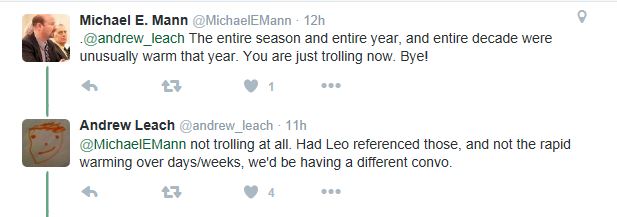
Now Albertans understand this and so when Dr. Michael Mann posted a comment about the Oscars:


One of the few people not blocked by Dr. Mann, a gentleman by the name of Dr. Andrew Leach, had the temerity to point out that Mr. DiCaprio was mistaken and that the weather after that year’s Chinook was actually quite cold.

Needless to say Dr. Mann decided to Mannsplain  Dr. Leach and then insult him


and then, not surprisingly, he decided to block Dr. Leach.

When it was pointed out to Dr. Mann who he had blocked Dr. Mann, the person who had just called the man a “troll”, subsequently complained that Dr. Leach was often “irritating/rude on social media”.

Pot meet kettle.

Now many folks have been blocked by Dr. Mann, (myself included) , that is not a big deal. What is a big deal is that Dr. Mann managed to alienate a potential ally. You see, Dr. Leach isn’t just another anonymous commenter on Twitter, Dr. Leach was the Chair of the Province of Alberta’s Climate Change Advisory Panel.

Dr. Leach and his panel produced the Climate Leadership Report (caution large .pdf file) that served as the basis for the Alberta Climate Leadership Plan. Dr. Leach and his panel spent three months of their lives travelling the province doing the consultation necessary to build up the technical support and political and social goodwill necessary to enact the policy.

Besides Premier Notley, Dr. Leach is likely the most important reason Alberta is creating a program to put a price on carbon to fight climate change. Can you imagine a more important ally if you are trying to build a consensus for a change in climate policy across North America than the man who helped convince Alberta that it needed to control its carbon emissions?

Turning Dr. Leach into your friend should be a no-brainer for climate activists and a couple polite words is all it would have taken to smooth the waters. Instead, out comes the insults and then the block and another potential ally is stomped. Gotta love the climate crew, they pull out their shotguns at the drop of a hat; proceed to point them directly at their own feet; and then let go with both barrels.

Going back to Leo for a moment, I really don’t understand why so many in the climate change community lionize the man? Here is a man whose opulent lifestyle, love of private jets  and carbon profligacy should get him scorned by these same activists. Instead he says the right things every now and again and he is cast as their champion?

This morning I had a fascinating exchange with Vox writer David Roberts on the topic. Mr. Roberts is a solid writer who, along with Brad Plumer, have written some of the smartest, data-driven pieces on climate change to appear in the mainstream media but on the topic of Leo he has a huge blind-spot and this morning he was taking on all comers:


As you can see, the basis for his support of Mr. DiCaprio appears to be that as long as he says the right things in interviews and speeches, then everything he does in his private life should be ignored. I, of course, disagree because unlike most of us Leo flaunts his “private life” for all to see and what we have seen shows his behaviour to be at odds with his words. Our exchange was brief with Mr. Roberts ending with a drive-by insult and then he was off.

What was more interesting was watching Mr. Roberts explaining to climate change activists in Alberta why they should ignore both what Mr. DiCaprio has said and done because only a handful of people would notice the error.

The funny thing is this was all derived from a CBC article on the topic.

I’m not sure how familiar Mr. Roberts is with Canadian politics but when you are a progressive and you lose the CBC you have lost whatever battle you were trying to fight. Moreover, as Mr. Turner was trying to explain, Alberta activists tend to care when Leo spews his ignorance on one topic because it has a way of tainting his arguments on every other topic. How can anyone take seriously an activist who, a year after being corrected on the topic of Chinooks, is still making the same ridiculous statements? For activists in Alberta Leo is simply poisoning the well and will make their lives immeasurably harder.

I don’t want to go on too long tonight, but I simply wanted to ask the activists out there a simple question:

Why are you making it so hard on yourselves?

Outside of your progressive enclaves there are a lot of people who still need to be convinced about the importance of action and you are not making it easier. How hard would it have been for Dr. Mann to simply have been be civil to an esteemed colleague? A colleague with a lot more green cred than Dr. Mann himself in much of Canada.

Regarding Mr. DiCaprio, why are so many activists lionizing a man who’s carbon footprint really does make him a one-percenter in the field? Sure he has said some nice things but his actions don’t appear to back up his words. There are so many really deserving people out there to carry the flag and instead you rely on celebrities and celebrity-scientists? That is probably why in a recent major study only 44% of Canadians believed that humans were the primary cause of climate change?  You guys have had 25 years doing this and you can’t even convince half of Canadians that humans as the primary cause of climate change? Why do you never learn from your mistakes because, as the polls clearly indicate, your opponents certainly do.

SOURCE


Some cold facts on global warming

Climate change alarmists ignore data that contradict their agenda

Yesterday it was still February, but the high temperature hit 64 degrees here in Washington, with snow drifts still melting from last month’s massive East Coast blizzard. So what are we to make of the weather and the climate change controversy? Is it getting warmer or colder?

It’s not even a question worth asking, as far as the analysts at NASA are concerned. Before the blizzard hit, they had already announced that 2015 was the hottest year on record. Not that this is anything new for most Americans. We hear dire global warming proclamations on a near-daily basis, and it’s always just been the hottest day, week, month or year — no matter what the weather’s like outside.

Yet, as climate expert David Kreutzer recently pointed out, NASA is fairly selective about which information you’re supposed to believe. The agency’s own satellite data shows that while last year was indeed warm, it wasn’t as warm as 2010 or 1998.

But wait, some may say. You can chalk up this discrepancy to the difference between what the satellite data says and what the surface temperatures are (which NASA gathers from thousands of sites worldwide, with a few “adjustments” thrown in). But it doesn’t matter. Neither data set supports the wild predictions being bandied about by global warming alarmists.

Search all the data for evidence of the accelerated warming projected by the Intergovernmental Panel on Climate Change and you come up empty-handed. Sometimes temperatures go up, but not always. There’s no constant warming. Indeed, the data show a significant moderation of the warming trend. At times it appears to have leveled off or even cooled a bit.

Should we be surprised? Not really. When you throw in variables such as measurement errors, as well as El Nino and La Nina, it makes sense that the average temperature for some years will be higher even if the overall trend is flat.

“Will the trend stay flat? Probably not,” Mr. Kreutzer writes. “The Earth has been recovering from the Little Ice Age for a couple of centuries and recovering from a real ice age for thousands of years. So there is a reasonable chance that we will revert to an overall warming trend, but there is no guarantee. Who knows? We might even be headed into another ice age (as was predicted in the 1970s).”

None of this is to say that human-caused carbon-dioxide emissions haven’t contributed to some warming. They likely have. But the bottom line is that, one way or the other, there’s no reason to believe that the sky is falling. Or, to be more exact, that the earth beneath it is warming up to levels that should frighten us.

No data points to catastrophic warming, hysterical predications aside. And, it should be noted, the National Oceanic and Atmospheric Administration and the Intergovernmental Panel on Climate Change show that there have been no upward trends in hurricanes, tornadoes, floods or droughts.

Small wonder then, that liberal groups who are vested in global warming alarmism often ignore data that contradict their agenda. They tell us repeatedly that the debate is over, as if there is an expiration date on free speech. Unfortunately, too many in the media comply. Some outlets, such as the Los Angeles Times, won’t even accept letters to the editor that question the gospel of man-made climate change.

Hence we get very selective reporting. “For example, the national media hyped NASA’s finding that 2014 was the hottest year on record,” writes Republican Rep. Lamar Smith of Texas. “Ignored was the footnote that revealed that NASA was only 38 percent certain this was accurate. Less than fifty-fifty. Americans would have been better served by a coin toss.”

There’s a lot of hot air circulating, all right. Fortunately, it’s more political than scientific. Leonardo DiCaprio may have been taken in, but the rest of us can ignore the overheated rhetoric.

SOURCE


Climate activists threaten to shut down world's major coal sites

Reclaim the Power says it will use direct action at a dozen international sites in May, including the UK’s largest opencast coal mine in south Wales

The dozen international sites facing civil disobedience from the Break Free 2016 campaign span the globe from the US to Australia and South Africa to Indonesia.

The Ffos-y-fran opencast mine, near Merthyr Tydfil in Wales, is about halfway through extracting 11m tonnes of coal. Ellie Groves, from the Reclaim the Power network, said: “The only way we can stop catastrophic climate change is taking action to keep fossil fuels in the ground.”

“The local community have battled Ffos-­y-­fran for nearly a decade and now face the threat of a new mine next door at Nant Llesg,” said Groves. “Enough is enough. We need a ban on opencast coal mining across Wales, and the rest of the UK.”

Coal is the most polluting fossil fuel and scientists estimate that 80% of current reserves must remain in the ground in order to avoid dangerous climate change. The UK government intends to phase out coal burning by 2025 but the International Energy Agency still forecasts growth in the global demand for coal.

A statement from Reclaim the Power said: “Hundreds are expected to set up camp nearby and take part in a mass action to close the mine. The action will take place a few days before the Welsh assembly elections on May 5.”

The Reclaim the Power network has held annual camps since 2013 and has conducted a series of direct actions, including blockading a World Coal Association conference and a fracking company. Ffos-y-fran supplies the Aberthaw power station, whose illegally high levels of pollution have led the EU to take the UK to court. Miller Argent, the company running Ffos-y-fran, and the local Labour MP Gerald Jones both declined to comment on the planned protests.

Campaign group 350.org, which had led the fossil fuel divestment movement, is helping to coordinate the international actions. “We’re mobilising to shut down the world’s most dangerous fossil fuel projects and support the most ambitious climate solutions,” says the Break Free 2016 website.

“We want to ensure there continues to be momentum to keep fossil fuels in the ground and to confront fossil fuel companies,” said Will Bates, global campaigns director for 350.org.

Bates emphasised that, while involving civil disobedience, the protests would be peaceful. “Our actions must reflect the scale and urgency of this crisis,” says the website. The protests are likely to emulate a protest in Germany in August 2015 which shut down the large Garzweiler opencast coal mine for a day.

“We need to be disrupting business as usual if governments will not put in place the policies that will get the job done,” said Bates. “It is what is necessary. We think it is in everybody’s best interest.”

SOURCE


IS GLOBAL WARMING MAKING IT SNOW?

In the early days of global warming hysteria, the alarmists understandably warned that warmer temperatures would cause, among other things, less snow. Jim Steele reminds us:

"[Kevin] Trenberth’s 1999 paper framing the effects of global warming on extreme precipitation declared, “With higher average temperatures in winter expected, more precipitation is likely to fall in the form of rain rather than snow, which will increase both soil moisture and run off, as noted by the IPCC (1996) and found in many models.” The 2001 IPCC 3rd Assessment repeated those expectations stating, “Northern Hemisphere snow cover, permafrost, and sea-ice extent are projected to decrease further.” Soon climate scientists like Dr. Viner proffered alarming scenarios that “children would no longer know what snow was”. Similarly in 2008 politicians like RFK Jr. warned DC children would be deprived of the fun of sledding due to global warming."

It all sounded plausible, but nature refused to cooperate:

"But our climate naturally oscillates and by early February of 2010 Snowmageddon was blanketing the USA’s eastern seaboard with record snows, making global warming predictions the butt of many jokes. The heavy snows didn’t disprove CO2 had caused any warming, but it definitely highlighted failed predictions."

If the alarmists were scientists, they would acknowledge that a theory that generates false predictions is wrong. But they aren’t doing science, they are doing politics. So they retrospectively revised their predictions. Any port in a storm:

"In 2011 Chris Mooney writing for the DeSmog blog noted heavy snowfall had become a “communications nightmare” for global warming theory and urged, “We need to move the public to a place where drawing a warming-snowstorm connection isn’t so challenging”.

Good luck with that.

"Kevin Trenberth was already on point. Just two weeks after the 2010 Snowmageddon, Trenberth appeared in a NPR interview flip-flopping to a new climate change framework in which a “Warming Planet Can Mean More Snow”. Now he argued, “The fact that the oceans are warmer now than they were, say, 30 years ago means there’s about on average 4 percent more water vapor lurking around over the oceans than there was, say, in the 1970s”. Thus “you can get dumped on with more snow partly as a consequence of global warming,” A year later the Union of Concerned Scientists held a press conference asserting global warming was no longer causing less snow, but causing heavier snow. And now, every year as heavy snowstorms approach, Trenberth and his well-groomed media outlets bombard the public, urging them not to be misled by their senses, but trust that cold and snowy days have worsened due to global warming"

The alarmists’ new, improved global warming theory was that warmer temperatures caused the atmosphere to be able to hold more moisture. Therefore the total precipitable water vapor increases with CO2, and–presto!–more water vapor means more snow. All earlier predictions were conveniently forgotten.

There are several problems with this theory, including the fact that total precipitable water vapor has not increased in parallel with atmospheric CO2:


It is true that warmer temperatures allow the air to hold more water, so the lack of any significant increase in TPW implies that the Earth hasn’t been warming as required by the alarmists’ theories. Needless to say, this isn’t the conclusion they draw. But as we all know, consistency is not their strong point. Trenberth is famous for writing privately to his political allies: “The fact is that we can’t account for the lack of warming at the moment and it is a travesty that we can’t.”

The point of this amusing story is that for the alarmists, almost everything is negotiable. More snow? Less snow? No problem! No matter what happens, they tweak their models and pretend that they saw it coming all along. There is only one constant, one fixed star amid the models’ constant fluidity: the need for government control over the world’s economies. This is why governments pay billions to the climate alarmists, and are utterly indifferent to their laughable record of failed predictions. Climate alarmism has nothing to do with science.

SOURCE


Again:  Warming may bring cooling!

The British Met office is having it both ways

Our atmospheric scientists are predicting a dramatic change in high altitude winds 50km above the ground and the imminent occurrence of an event known as a sudden stratospheric warming (SSW) in early March.

Professor Adam Scaife, Head of Monthly to Decadal Prediction explains: “Sudden stratospheric warming events occur high up in the atmosphere and involve a complete reversal of the high altitude polar jet stream – they can even affect weather at the surface, and for the UK a sudden stratospheric warming increases the risk of wintry weather.”

The phenomenon begins with a wave-like disturbance which travels up into the high-altitude jet stream. Scaife said: “This disturbance can grow to a point where it turns over and breaks, just like a wave on a beach.”

Normally the jet stream flows from west to east with some north and south oscillation, but the force from this high altitude disturbance pushes against the jet stream until the winds actually reverse and flow from east to west instead. Air then falls into the Arctic and is compressed so that it starts to warm: the temperature can rise by as much as 50C in just a few days.

Professor Scaife added: “This reversal of high altitude winds can also burrow down into the lower stratosphere. Once it is within reach of weather systems in the lower atmosphere the Atlantic jet stream often weakens and moves south. This allows cold air from the east into northern Europe and the UK.”

Sudden stratospheric warming events occur on average every couple of years and our long-range forecasts have consistently suggested an increased risk of sudden stratospheric warming towards the end of this winter. The last big event was in early 2013 and was followed by a cold end to winter. Although the impact of the current event is unlikely to be as severe, it increases the risk of cold north easterlies and wintry weather for the UK over the next few weeks.

SOURCE


7 Reasons the Dimock Water Case Is Looking Very, Very Shaky as the Trial Enters Its Second Week

The Ely and Hubert families in Dimock, Pennsylvania are suing Cabot Oil & Gas alleging they have polluted their water. In various court filings and in countless documentaries and comments to journalists, the Ely family have claimed fracking/drilling has destroyed their life, damaged their health, and caused their children to be ill--serious allegations. They attracted international publicity with anti-fracking activists describing Dimock as the “ground zero” of fracking pollution. But after eight years of allegations and one week of the trial, here are seven reasons the the case looks very, very shaky.

1. Testing the Truth
The plaintiffs’ case was collapsing long before they entered the court in Scranton. Their original complaint contained alarming allegations that Cabot and fracking caused neurological, gastrointestinal, and dermatological damage to the plaintiffs and their children. They also claimed that a blood study showed results consistent with toxic exposure to..heavy metals. But in the run up to the hearing, they failed to produce ANY evidence to back up these claims. No doctor’s report, no blood test, nothing. The evidence was so lacking that the judge prevented them from even raising the possibility in the court that their health was affected.

2. Legal Eagle
The plaintiffs’ lawyer is truly awful. Leslie Lewis is so bad that it’s possible that she’s looking for a sympathy verdict from the jury. She is disorganized, doesn't seem to understand the science, and constantly tries to put words in witnesses’ mouths when she doesn't get the answer she wants. She also has the habit of blurting out statements that damage her clients’ case. It was Ms. Lewis who early in the case memorably and unnecessarily told the jury that the central allegation of anti-fracking activists across the planet had no scientific basis. There was absolutely no evidence that fracking fluids had ever contaminated Dimock's water. “We don't have proof of that. This is not about fracking fluid appearing in the water. Hydraulic fracturing materials, we don't have proof of that,” she told the jury.
But don't take my word for it. Ms. Lewis hasn't impressed the judge, either. Judge Martin Carlson criticized her, stating that her attempts to introduce an enormous amount of “evidence” at the last minute was “extraordinary, unprecedented, unexplained and [a] profoundly troubling development.”

3. McMansion
And her clients aren’t much better. It's difficult to know if the Ely family are bad parents or bad liars or both. Despite claiming that they and their children were suffering from a raft of medical conditions after being poisoned by fracking fluids and other chemicals, the Elys never, ever took their children to a doctor to discuss the illnesses--not once. And the Elys are not unsophisticated people who would not have had access to medical experts. Monica Ely is a dentist who would have friends and colleagues who could help her access the best tests and best experts available. But they didn't even bother having their children tested--despite the fact that the Elys kept telling their children and the world's media that they had been poisoned. In fact, the Elys were so unconcerned with the state of their water on the property that after they claimed it was poisoned they went ahead and built a $1 million mansion on the property.

4. Superhuman
Scott Ely was a shifty and very unimpressive witness. But perhaps the lowest moment was when he tried to fix a problematic timeline (that he set up) but fatally undermined his credibility. Scott had told three different people--a doctor, a hydrologist, and in a handwritten statement to his own lawyer--that the water problems started in August 2008. However, his lawyer has also told the court that they all accept drilling did not start on nearby gas wells until late September/October 2008. So on the witness stand, Scott suddenly remembered--eight years after the case started--that in June/July 2008 he remembered a massive gas leak at a gas well that he was claiming must have affected his water.

“I pulled up on that location. The location was shut down. Gas was spewing out of ground....It stunk like crazy everybody was evacuated from the location....You can see the gas up around the rig,” he told the jury. Except that he was then forced to admit that natural gas is invisible and odorless. So the jury will have to believe Scott Ely has superhuman powers, or they will have to assume that he is a dishonest witness.

5. Mother of the Year
 Monica Ely has been shown to be an extremely dodgy witness also. Apart from neglecting to bring her children to the doctor--even though she thought they had been poisoned by fracking--Ms Ely also portrayed herself as someone who tried to shield her children from the politicking and contentious debate around fracking. She testified that she tried “not to involve our kids with this.” Then the Cabot lawyers pointed out and produced photos (see above) that showed far from sheltering her children Ms Ely had in fact “brought them to press conferences, rallies with people like [actor] Mark Ruffalo, taken them to the Tribeca Film festival,” and had allowed them to be featured in the highly contentious documentary Gasland. Monica Ely: no time to take her children to the doctor even though she thought they were poisoned but plenty of time to take them to rallies with actors and activists.  
                                                                         
6. Expert Witness
The the plaintiffs’ expert witnesses are pretty awful also. Hydrologist Paul Rudin gave evidence on Friday where, after posing as a neutral scientist, admitted that he had “come into this case with a bias against non-renewable energy exploration.” That’s right. The first expert witness the plaintiffs were able to produce admitted he was biased against fossil fuels and fossil fuel companies. Science at its purest, obviously.

7. Outsourcing
And Paul Rudin’s methodology is unorthodox to say the least. Despite wanting to find out if Scott Ely's property was affected by gas drilling, he did no tests on the property, but instead went to a quarry 2,700 ft away and concluded that was sufficient examination of the property's geology. And in breach of every acceptable international standard, he allowed Scott Ely to collect the water supplies that he analyzed with no checks or attempts to ensure that the water was collected properly.

SOURCE

***************************************

For more postings from me, see  DISSECTING LEFTISM, TONGUE-TIED, EDUCATION WATCH INTERNATIONAL, POLITICAL CORRECTNESS WATCH, FOOD & HEALTH SKEPTIC and AUSTRALIAN POLITICS. Home Pages are   here or   here or   here.  Email me (John Ray) here.  

Preserving the graphics:  Most graphics on this site are hotlinked from elsewhere.  But hotlinked graphics sometimes have only a short life -- as little as a week in some cases.  After that they no longer come up.  From January 2011 on, therefore, I have posted a monthly copy of everything on this blog to a separate site where I can host text and graphics together -- which should make the graphics available even if they are no longer coming up on this site.  See  here or here

*****************************************


Tuesday, March 01, 2016


More harm done by the Green/Left

Tens of thousands of people are dying every year because repeated warnings about the dangers of diesel cars and wood-burning for heating were ignored by successive governments trying to make Britain ‘greener’, The Mail on Sunday can reveal.

Ironically, the policies have only made our air dirtier. They are accused of triggering a ‘public health disaster’, with the huge shift to diesel vehicles to try to cut greenhouse gas emissions denounced as a ‘con’.

Last week, a devastating official report said the drive for diesel and wood-burning are directly responsible for needlessly high incidences of a shocking list of conditions including diabetes, autism, lung cancer, cardiovascular disease, learning difficulties, asthma, low birth weight and kidney disease.

Professor Jonathan Grigg, vice chair of the report by the Royal College of Physicians and the Royal College of Paediatrics and Child Health, told this newspaper that the move to diesel vehicles in the mistaken belief this would cut greenhouse gas emissions is having catastrophic consequences.

The two worst types of pollution that diesel engines produce are nitrogen dioxide (NO2) and tiny particles less than 2.5 microns in diameter – called ‘PM 2.5’ particulates – that lodge deep in the lungs and can even cross into the bloodstream.

Prof Grigg said NO2 and the particulates are produced by a range of sources, which together are reducing the average life expectancy of every man, woman and child by a shocking eight months and causing 40,000 to 50,000 early deaths each year. He said a substantial amount of that pollution is caused by diesel and wood. Official figures show that diesel cars and vans alone are currently responsible for about two-thirds of roadside pollution.

‘This is a public health disaster,’ said Grigg, who is professor of paediatric respiratory and environmental medicine at Queen Mary University in London. ‘The tragedy is that people have bought diesel cars thinking they are protecting the environment, whereas toxic emissions from diesel engines are causing death and disease. It is understandable that buyers now feel they were conned.’

Former Chancellor Gordon Brown cut vehicle excise duty for fuel-efficient diesels in his 2000 budget. Since then the proportion of cars sold that are diesel has surged from 14 per cent to more than 50 per cent, with 14 million now on the road.

Last week Labour MP Geraint Davies launched a Bill to give the Environment Agency powers to curb diesel use in periods when the risk is highest, saying that successive governments, Labour included, had ‘ignored the warnings’ because of their ‘over-focus’ on cutting carbon dioxide (CO2) in the air.

He added: ‘Using diesel to combat climate change is no better – indeed, it is arguably worse – than petrol, but we are passively smoking diesel emissions that are costing £20 billion and 40,000 lives a year. Taxation levels on diesel and petrol are on a par and do not reflect the cost to the environment and to health.’

Meanwhile almost £400 million has been paid in subsidies to homes and businesses which install ‘biomass’ wood-burning boilers under the Government’s 2012 ‘renewable heat incentive’. These also emit large quantities of PM 2.5 pollution. Experts say wood smoke is already costing between 1,000 and 3,000 lives a year.

Prof Grigg said: ‘The idea that wood smoke pollution is somehow less toxic than fossil fuel is simply not tenable. The warnings were always there. But the narrative was, “We have to reduce CO2 in order to meet our targets – and here are ways we can do it”.

As a result, the warnings were overwhelmed.’

Those warnings started as early as 1986, when lung expert Dr Robin Russell-Jones, who successfully campaigned to remove toxic lead from petrol, gave evidence to a House of Lords select committee that diesel pollution was linked with asthma, cardiovascular disease and lung cancer.

Three years later, Margaret Thatcher’s Government was starting to become concerned about global warming. For the first time it considered creating cash incentives for drivers to switch to diesel cars, on the grounds that because they travelled more miles per gallon, their CO2 emissions would be lower.

Dr Russell-Jones wrote to Sir John Fairclough, her chief scientific advisor, saying he had ‘read with amazement that the government is thinking of introducing a tax break in favour of diesel fuel on the grounds that it is environmentally friendly.’ This might be true so far as global warming was concerned, he wrote, ‘but from every other point of view it is a disaster.’

Diesel was ten times more carcinogenic than petrol, he added: ‘I only hope it is not too late to prevent this lunatic proposal.’

As Dr Russell-Jones pointed out yesterday, Mrs Thatcher had been a scientist: ‘You could get through to her: perhaps that’s why the idea – then – was dropped.’

The dangers were hammered home at the end of 1993 in a major report for the Department of the Environment by an expert panel, the Quality of Urban Air Review Group.

The report said that other policies, such as the ban on coal burning introduced by the Clean Air Act, had been slowly reducing PM pollution. If the proportion of diesels on the road stayed the same, then by 2005 the level of disease-causing particulates in the atmosphere would halve. But if the proportion of diesels rose to 50 per cent then there would be no reduction. Now the proportion of diesels is 50 per cent, that is exactly what has happened.

The 1993 report laid out the consequences in stark terms: ‘Diesel emissions are a potential health hazard. They contain compounds known to be carcinogenic and may cause impairment of respiratory functions. There is evidence that an increase in mortality and morbidity may be associated with an increased concentration of particulates in urban air.’

The 1993 report’s lead author, Prof Roy Harrison of Birmingham University, revealed yesterday that in the closing years of John Major’s government in 1996 and 1997, he sat on another committee that advised Whitehall on diesels and the environment.

He said: ‘We recommended that because of the health issues around diesel, instead of giving it tax breaks, duty on diesel fuel should be increased relative to petrol. The Government responded by saying it would be better to do this through vehicle duty. So when I discovered that its successor had done the reverse by effectively cutting duty for diesels, I was very concerned.’

The New Labour government decided to do that in the wake of a 1998 EU directive, which compelled Britain to cut CO2 emissions from vehicles by 25 per cent by 2020.

The warnings continued. In 2002, the American Cancer Society issued a major study suggesting diesels were so carcinogenic that, in the UK, they could be expected to cause 4,000 cases of lung cancer a year.

Britain’s Medical Research Council had planned to say that diesels caused a third of all lung cancers, but, according to reports at the time, toned down its warning to say only that diesels were a ‘relatively minor’ cause compared to smoking.

In 2007 came yet another major report. The Air Quality Expert Group showed that the aim of cutting carbon emissions by boosting diesels wasn’t working.

It said any gains were insignificant as diesel engines tended to bigger, refining diesel led to high emissions, and the other toxic substances pumped out from diesels’ exhaust pipes enhanced the fuel’s greenhouse effect.

The new Royal Colleges’ report supports this, saying that Japanese petrol technology has reduced carbon far more effectively.

Yet still the damage continued. In 2009, the Labour Government set out plans for what was to become the Renewable Heat Incentive subsidy for wood burning boilers.

Amazingly, in a parliamentary answer, Energy Minister Jim Fitzpatrick revealed that the Government’s own assessment showed this would cost lives – between 240,000 and 1.75 million ‘person years’ would be lost each year by 2020. Prof Harrison said yesterday that recent studies suggest that wood smoke in the atmosphere is costing up to 3,000 lives a year.

Working out exactly how many of the needless deaths due to pollution are the direct result of policies designed to curb carbon dioxide is difficult, but it is clear that their contribution is substantial.

Meanwhile, the new report’s conclusions are devastating: the air quality crisis is a ‘major public health problem deserving of multiple measures to drive down exposure in as many ways as possible… when our patients are exposed to such a clear and avoidable cause of death and disability, it is our duty as doctors to speak out’.

SOURCE


Warren Buffett on climate change

The American investor also dismissed the possibility climate change could prove a large risk to the Berkshire Hathaway portfolio. Berkshire is one of the world's biggest property insurers and insurers against catastrophic risks but given insurance policies are written for one year and repriced upwards to reflect growing risks, climate change may actually increase the firm's profitability.

"Worries might, in fact, be warranted if we wrote ten- or twenty-year policies at fixed prices," says Mr Buffett, who points out climate change has not produced more frequent weather-related events covered by insurance.

"As a citizen, you may understandably find climate change keeping you up nights," writes Mr buffett. "As a homeowner in a low-lying area, you may wish to consider moving. But when you are thinking only as a shareholder of a major insurer, climate change should not be on your list of worries."

That said, the firm has poured $US16 billion into renewables in recent years, and according to Mr Buffett, the company's electricity portfolio now consists of 7 per cent wind and 6 per cent solar.

SOURCE


Mosquitoes must be protected

One of the greatest fictions ever perpetrated on the American people is that liberals care about helping the poor. Indeed, they seem determined to advance policies that limit opportunities created by economic expansion and growth. The latest example of this can be seen in retail giant Ikea's decision to cancel plans for a 366,500-square foot store outside of Cleveland, due to environmental impact concerns. The store has no plans to pursue other locations in the Cleveland area.

After investing more than a year of effort in preparing for the store, Ikea chose to withdraw due to an anticipated rejection from the U.S. Army Corps of Engineers, charged with stewardship over the proposed building site, which includes 15 acres of wetlands. The Clean Water Act severely limits the private sector's ability to develop such land, as Ikea is finding out to its cost.

In the midst of one of the weakest economic recoveries in U.S. history, environmental concerns about the well-being of a patch of swamp (a perfectly good word the left has abandoned in favor of the banal euphemism "wetlands.") should take a backseat to the economic development created by hugely successful companies like Ikea.

Cleveland's economy remains fragile, its crime rate high; any efforts to grow the local economy should be met with open arms, not obstructed by government bureaucrats more concerned with protecting the habitats of potentially-deadly mosquitos than with helping actual human beings. It pains me personally to see these lost jobs.  I may not live in Cleveland, but I still have Browns seasons tickets and love my hometown.

Meanwhile, Ikea employs more the 120,000 workers worldwide and stands as one of retail's greatest success stories, contributing more than $33 billion to the U.S. economy. The chain is not only good for workers, but for consumers as well, offering affordable furnishing options that otherwise may not exist. In fact, while inflation is making many consumer goods more expensive each year, Ikea has a history of lowering its prices by 2 to 3 percent annually on account of its increased efficiency.

This may seem like a small issue — after all, it's only one store — but it reflects the deeper problem of the restrictive regulatory climate gripping the whole country. In recent years, environmental regulators have attempted to seize greater and greater control over private property, the most egregious example being the expansive Waters of the United States rule that would give the Environmental Protection Agency jurisdiction over small ponds, gullies, ditches, and streams on privately held land. Last year, the Supreme Court temporarily blocked the rule, but that could easily change, especially given the recent passing of Justice Scalia and the ensuing vacancy. Such environmental overreach would add to the already $2 trillion cost of federal regulations nationwide.

Human civilization has flourished due to millennia of people mixing their labor with the land and building things; agriculture, manufacturing, research facilities, yes, even the humble retailer, raising the standard of living for consumers everywhere. Without these things, the amount of progress we have made as a species in terms of wealth, longevity, and knowledge would have been impossible.

Progressive squeamishness over mankind continuing to do as we have always done, build, helps no one, least of all the citizens of Cleveland. If we're truly interested in helping people succeed, instead of training them to depend on handouts, we have to get government out of the way and start building things again.

Next year, Ikea plans to open a store in Columbus, Ohio. When Clevelanders see the benefits of economic development enjoyed by that city, they will no doubt regret the missed opportunity to improve their own community. Swamps may be pretty, but they don't employ people, don't grow the economy, and are notoriously unreliable sources for flat-pack furniture.

SOURCE  


Abolish the EPA and leave environmental protection to the States

Amid prolonged bickering with his rivals, Donald Trump outlined a fairly radical proposal during Thursday’s Republican debate: to scrap the US Environmental Protection Agency.

Typically there was little policy detail. But it was clear that the EPA – and its $8bn budget – would be on the chopping block should the Republican frontrunner become president.

“Environmental protection – we waste all of this money,” he said. “We’re going to bring that back to the states. We are going to cut many of the agencies, we will balance our budget and we will be dynamic again.”

The promise was an echo of recent statements from Trump on the EPA. He has said there is “tremendous cutting” to be done because the EPA “aren’t doing their job, they are making it impossible for our country to compete”.

He has also accused the EPA of “going around causing damage as opposed to saving damage”, leading to “a tremendous amounts of money, tremendous fraud, tremendous abuse”.

Trump’s plan to dissolve the EPA and hand environmental protection duties to the states goes further than his main rivals for the GOP nomination, but anti-EPA sentiment appears to run deep in both Ted Cruz and Marco Rubio.

Cruz has called the EPA a “radical” agency that has imposed “illegal” limits on greenhouse gases from power plants. “I think states should press back using every tool they have available,” the Texas senator has said. “We’ve got to rein in a lawless executive that is abusing its power.”

Rubio has said the EPA’s plan to curb emissions would have a “devastating impact” on jobs; he has also vowed to scale back the Clean Water Act.

“Regulations in this country are out of control, especially the Employment Prevention Agency, the EPA,” Rubio said in January.

Trump would appear to have some support for abolishing the EPA within Congress – Iowa Republican senator Joni Ernst, for example, has said the regulator should be scrapped because “the state knows best how to protect resources”.

Scrapping the EPA, however, would cause an unravelling of basic protections of air and water. Environmental law experts argue it would also be difficult to achieve anyway.

The agency, formed in 1970 under Richard Nixon, is empowered to administer federal standards under the Clean Water Act and the Clean Air Act. It has also been responsible for controlling or banning chemicals such as the pesticide DDT.

Robert Percival, director of the environmental law program at the University of Maryland, said ditching the EPA was a “ridiculous idea”.

“It reflects a lack of understanding over the US legal system, you’d have to fundamentally repeal or change all our environmental laws,” he said.

Trump is demagoguing. It plays to the far-right base but it would have enormous consequences for people’s health

Robert Percival, University of Maryland

“The EPA sets national standards and then the states come up with a plan on how to implement them. One reason this is done is to avoid a race to the bottom, so that states don’t relax regulations over air or water to attract industry.

“California could do a decent job maybe because it has such a large environmental agency but smaller states wouldn’t be able to perform those functions.

“Trump is demagoguing. It plays to the far-right base but it would have enormous consequences for people’s health.”

Supporters of the EPA point to evidence that the agency has helped save a huge amount of money, as well as prevented many deaths. A 2012 study estimated that the Clean Air Act alone has saved $22tn in healthcare costs during its lifetime.

“The EPA pays for itself and our environmental laws have been enormously successful,” said Percival.

“We don’t have the environmental problems China does, with its smogs and its polluted drinking water. China doesn’t have a centralized regulator like theEPA, with 15,000 employees to enforce national standards. We’d be setting ourselves up for an environmental disaster.”

EPA “overreach” has been a long-held bugbear of some Republicans, some of whom believe the toxic water crisis in Flint, Michigan, is evidence that the agency is failing.

Congressional hearings into Flint are being used to put pressure on Gina McCarthy, the EPA’s administrator. But the idea of shutting down the entire agency may be a step too far for some Republicans.

SOURCE  


No traction for climate change

Tom Steyer’s priorities are at odds with America

Billionaire climate activist Tom Steyer has spent millions of dollars trying to make climate change a major issue on the 2016 campaign trail. But neither the candidates nor the voters seem to notice.

After one of the Democratic presidential debates, Mr. Steyer issued a statement lamenting that the focus on climate change was “far too brief.” Following a Republican debate, he expressed outrage that “not a single Republican presidential candidate took this threat seriously,” to which he added, “And that’s why not a single one of these candidates is qualified to get anywhere near the Oval Office.”

To be fair, Mr. Steyer does appear to hold sway over the Democratic presidential candidates. Both Hillary Clinton and Bernie Sanders have, at Mr. Steyer’s insistence, pledged to achieve at least 50 percent “clean” energy by 2030. Mr. Steyer, who has yet to throw his support behind a candidate, appears to be dangling his wealth and endorsement over the Democratic candidates to cajole them to do even more.

Just days before the New Hampshire primary, Mrs. Clinton was asked if she would support banning the extraction of natural gas, oil, and coal on public lands. “Yeah, that’s a done deal,” was her reply. Clarifying her position to another activist, she said, “No future extraction. I agree with that.” Similarly, Mr. Sanders has co-sponsored legislation in the Senate that would block the development of these resources on federal lands. According to a recent study commissioned by the Institute for Energy Research, of which I am president, these “keep it in the ground” proposals would forgo millions of jobs, trillions of dollars in higher wages, and $20.7 trillion in economic activity.

Fortunately, on the whole, Mr. Steyer’s campaign to restrict affordable and reliable energy isn’t getting many converts. Mr. Steyer spent $73.7 million of his own money in a failed effort to make climate change a major issue in the 2014 elections. He wasted millions of dollars on ads that often didn’t even address climate change and whose truthfulness was disputed by fact-checking organizations like Poltifact and Factcheck.org. After his nearly yearlong campaign, climate change actually dropped as a priority among voters, ending up near the bottom of their list of concerns.

Mr. Steyer shouldn’t be entirely surprised if presidential hopefuls aren’t jumping through his hoops with enthusiasm. In a recent Gallup poll of the most important problems facing the United States, climate change was not even listed. The broader “Environment/Pollution” was in 18th place as a concern of just 2 percent of the respondents. The political reality is that candidates must attract the mainstream electorate, who prioritize the economy, jobs and poverty — issues that are in direct conflict with Mr. Steyer’s goals.

Mr. Steyer’s own state of California is ripe with examples of his agenda clashing with the people’s needs. Due in part to regulations that require non-hydroelectric renewables to represent 33 percent of the state’s electricity supply by 2020, residential electricity bills are nearly 40 percent higher than the national average and the ninth highest in the nation. Nevertheless, last year, Mr. Steyer testified in favor of legislation that would have bumped the current 33 percent renewables target up to 50 percent by 2030.

Mr. Steyer also supports California’s cap-and-trade program, which could raise gasoline prices by anywhere from 16 cents to 76 cents per gallon. Meanwhile, he’s pushing a ballot measure that would impose a 10 percent tax on oil extraction. This tax would, of course, raise gasoline prices for the state’s motorists, who already pay a 59 cents per gallon gas tax — one of the nation’s highest and about 11 cents more than the national average. Even without new taxes, California already has some of the highest gasoline prices in the country.

Higher energy costs have created a serious problem in California. According to a report by the Manhattan Institute, one million California households live in energy poverty, which is defined as a household in which 10 percent or more of the residents’ income is spent on household energy costs (excluding gasoline and other transportation-related costs). Higher energy costs leave these families with less money to spend on other necessities like groceries or proper healthcare.

Candidates seeking the presidential nomination — particularly in the Democratic camp — can’t square their rhetoric with their policies. They claim to help the poor, but they support energy policies that will make it harder for low-income families to make ends meet. Meanwhile, poll after poll shows Americans are more concerned about growing the economy and creating jobs than sacrificing their economic futures at the altar of Tom Steyer’s climate agenda.

SOURCE  


Australia: Green/Left waste followed by Green/Left self-indulgence

Centuries from now future citizens will pick through the remnants of 21st century Australia. Some discoveries may puzzle them.

Why, for example, did Australians spend so much time and money building facilities for the purpose of turning salt water into fresh water?

Presumably these future folk will know that Australia didn’t actually need these devices at the time, given our usual abundant rainfall. So what was the use of all those desalination plants? Were they merely experimental? Did they have another, more practical application?

Or, like Stonehenge or Egypt’s pyramids, were they quasi-religious or spiritual monuments to some form of mystical deity?

The last answer will be close enough. Australia’s desalination plants were built in panic following warnings from former Climate Commission chief Tim Flannery that we were in danger of running out of water. “In Adelaide, Sydney and Brisbane, water supplies are so low they need desalinated water urgently, possibly in as little as 18 months,” Flannery claimed in 2007.

A couple of years ago, at the 2014 Mudgee Readers’ Festival, Flannery recalled those warnings. “Here in eastern Australia we’ve got much more variable rainfall, and I remember being asked about this at times, even by the government. I said, ‘what you should do is build a desalination plant; that’s really your last resort. Build it as an insurance policy’.

“Instead, treasury departments across eastern Australia said, ‘That’s a waste of money’.”

If only.

Desalination plants were constructed in Sydney, Melbourne, Adelaide, the Gold Coast and a couple in Perth, at a total cost of around $12 billion. Most of that money was completely squandered, because — just like Flannery’s government-funded Climate Council — half of our nation’s desal plants have since been shut down, or at least reduced to standby status. Perth’s are still supplying water, and so is Adelaide’s, although it doesn’t need to following dam-filling rains. As of last month, the plant is running at just 10 per cent of capacity — at a cost of $1 million per day.

Sydney’s desal plant hasn’t spat out a drop since it was put on standby in 2012, only two years after it was opened. It is presently costing more than half a million dollars per day just to sit there like the world’s fattest disability pensioner while Sydney’s dams remain at more than 90 per cent of their capacity. The Gold Coast’s desal plant opened in 2009 and closed in 2010.

Thanks for all that, Professor Flannery. Undaunted by the outcome of his ridiculously expensive water worries, the great global warming hysteric has lately moved on to another field. He’s swapped desal for diesel — thousands of litres of the stuff.

Recently the Climate Council — a privatised, donation-funded version of the old Climate Commission, still with Flannery at the helm — invited concerned Australians to join the professor on a cash-raising cruise along Western Australia’s Kimberley Coast. “As part of this adventure, you will join renowned scientist and former Australian of the Year, Professor Tim Flannery — the Climate Council’s Chief Councillor — on the adventure of a lifetime,” the Council promises.

“Over eight days you’ll sail the breathtaking Kimberley coast in the award-winning charter vessel, Kimberley Quest, on an expedition of archaeological discovery. Best of all, by taking part in this expedition, you’ll be stepping up to help provide Australians with a vital source of correct and informed information on climate change.”

There’s no better information than informed information. As part of their climate crusade, Flannery’s ecotourists will also be supplied with a “courtesy vehicle to/from your Broome accommodation”, a “light aircraft from Broome to Mitchell Plateau” and a “return helicopter flight from Mitchell Plateau to Hunter River”, which is what you’d expect for a total cost north of $7500.
Lap of luxury and a fuel bill to boot with a scenic flight returning to the Kimberley Quest. Picture: Supplied

All of that fossil fuel incineration doesn’t exactly sit well with Flannery’s climate change message, however. And then there’s the vessel he and his mates will travel aboard. The Kimberley Quest II, to give the ship its full name, is “equipped with a helipad, spa, [and] large en-suited cabins” that “feature private ensuites, individual air-conditioning, viewing windows, mini-refrigerators and are serviced daily by your hostess.”

This sucker’s carbon footprint must be sensational. All of those airconditioners, spas and fridges don’t run on wind chimes, so the Kimberley Quest II is fitted with no fewer than four diesel-burning engines — two massive 450 horsepower Caterpillar 3406Es for propulsion and a couple of smaller Cat generators to keep the champagne chilled as you discuss the terrible threat of global warming. Get them all cranking at once and the diesel consumption rate might be around 320 litres per hour, which is why this floating Gaia-eater needs a total fuel capacity of 36,000 litres.

To put that fuel capacity into perspective, 36,000 litres of diesel is enough to run a poor African village’s electricity generator for nearly five years. The fastest Audi at last year’s Le Mans 24 hour race made it all the way to the podium after using less than 1500 litres of diesel during the entire event.

Still, I suppose Flannery’s diesel drainage is all worth it. You can never put a price on the “correct and informed information on climate change.” Unless that price is more than $7500 per customer, not including return flights to Broome, personal expenditures for laundry and tipping, compulsory travel insurance and meals not outlined in the itinerary

SOURCE

***************************************

For more postings from me, see  DISSECTING LEFTISM, TONGUE-TIED, EDUCATION WATCH INTERNATIONAL, POLITICAL CORRECTNESS WATCH, FOOD & HEALTH SKEPTIC and AUSTRALIAN POLITICS. Home Pages are   here or   here or   here.  Email me (John Ray) here.  

Preserving the graphics:  Most graphics on this site are hotlinked from elsewhere.  But hotlinked graphics sometimes have only a short life -- as little as a week in some cases.  After that they no longer come up.  From January 2011 on, therefore, I have posted a monthly copy of everything on this blog to a separate site where I can host text and graphics together -- which should make the graphics available even if they are no longer coming up on this site.  See  here or here

*****************************************