Wednesday, September 09, 2015


More on the latest scare from NASA

Scientists from Australia's CSIRO have backed it. As a result, Geologist Geoff Derrick emailed  Dr Rintoul, a so-called scientist from CSIRO -- as below:

To Dr Steve Rintoul:

Dear Steve

The CSIRO was once a respected science organisation.

By putting your name to these rancid projections from NASA on Antarctic and Greenland ice and sea levels (see below) , you have as much scientific credibility as Obama, which is close to zero.

I hope Steyn's book is now in your library.  What is contained therein should be motivation enough to examine the integrity of the alarmist world you frequent, which clearly dances to the tune of pseudoscience and unwarranted projections and scaremongering.

I wish it were otherwise. If you disagree with the NASA rubbish, then you should say so.

Does not the following statement from the NASA item concern you as a supposed scientist?  Is it ignorance, bad expression, or a healthy combination of both??

"The (OMG) project will examine the role of ocean currents and ocean temperatures in melting Greenland's ice from below. . "

The last time I looked, the ice sheet of Greenland is largely contained in a massive crustal depression, with NO contact with any ocean along it's substrate.  In the case of your Antarctic scaremongering , you should also check out the high crustal heat flow  adjacent to the West Antarctic peninsula - that has more effect than any amount of carbon dioxide in our atmosphere.

NASA and the CSIRO obviously accept as gospel what is written in this article, such as breathless commentary that the Antarctica is "losing 118 gigatons of ice per annum over the past decade".  This equates to about 130 km3 pa, so given that there are 26 million km3 of ice around Antarctica, we could expect it to be ice free in about 200,000 years.  Be still my beating heart.


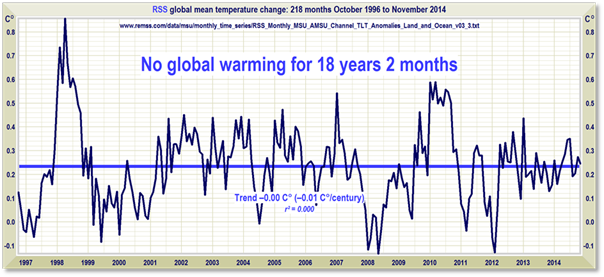
Note that the graph is calibrated in tenths of a degree and also note the clear flattening from 2000 on

Via email


IPCC is run by smallish old-boys network

That's what the article below tells us.  It also suggests that the result may be blinkered findings

Patterns of authorship in the IPCC Working Group III report

Esteve Corbera et al.

Abstract

The Intergovernmental Panel on Climate Change (IPCC) has completed its Fifth Assessment Report (AR5). Here, we explore the social scientific networks informing Working Group III (WGIII) assessment of mitigation for the AR5. Identifying authors’ institutional pathways, we highlight the persistence and extent of North–South inequalities in the authorship of the report, revealing the dominance of US and UK institutions as training sites for WGIII authors. Examining patterns of co-authorship between WGIII authors, we identify the unevenness in co-authoring relations, with a small number of authors co-writing regularly and indicative of an epistemic community’s influence over the IPCC’s definition of mitigation. These co-authoring networks follow regional patterns, with significant EU–BRICS collaboration and authors from the US relatively insular. From a disciplinary perspective, economists, engineers, physicists and natural scientists remain central to the process, with insignificant participation of scholars from the humanities. The shared training and career paths made apparent through our analysis suggest that the idea that broader geographic participation may lead to a wider range of viewpoints and cultural understandings of climate change mitigation may not be as sound as previously thought.

SOURCE


Wake up Obama, climate change has been happening forever

By Betsy McCaughey

President Obama hiked to Exit Glacier in Alaska last week, with photographers in tow, to send the world a message: The glacier is melting.

Obama blames it on the increasing use of fossil fuels such as coal, oil and natural gas, which he wants to restrict not only in the United States but worldwide. The photo-op was designed to build support for an international climate agreement he’s pushing hard to sell, so far with little success.

Trouble is, the president needs to get his facts straight. Exit Glacier has been shrinking for 200 years — since 1815 — long before widespread industrialization and automobiles. As the president ended his trip, he sounded the alarm again: “This state’s climate is changing before our eyes.”

News flash, Mr. President: Alaska has been buffeted by cyclical swings in climate for thousands of years. That’s true for the rest of the world, too. There was a 300-year-long Medieval heat wave, followed by a Little Ice Age that began around 1300, and then the 300-year warming period we’re in now.

The Anchorage Daily Times ran a front-page story in 1922 recording the “unheard-of temperatures” in the Arctic and glaciers disappearing. “The Arctic Ocean is warming up and icebergs are growing scarcer.”

Oblivious to the history of constant climate change, Obama pointed to Exit Glacier and said: “We want to make sure our grandkids can see this.”

He may get his wish, but it won’t be because of anything he’s doing. The current warming trend appears to be over, speculates Roger Cohen, a fellow of the American Physical Society. The Alaska

Climate Research Center reports almost no evidence of warming trends in Alaska since 1977.

Many scientists are predicting the onset of two or three centuries of cooler weather — which would mean bigger glaciers. That’s despite the world’s growing use of fossil fuels. No matter what humans do, temperature trends go up, and then down; glaciers expand and then recede; sea levels rise and then fall, explains Will Happer, professor emeritus of physics at Princeton.

That doesn’t mean pollution controls are futile. We all want to breathe clean air. But don’t blame climate change on humans. There are bigger forces at work here.

Scientists disagree about what these forces are, and are researching better ways of accurately measuring temperature trends via satellite. Amid all this controversy and uncertainty about global climate change, Obama blindly insists that his theory of global warming “is beyond dispute” and attacks his critics as “deniers.”

Sounding more like an Old Testament doomsayer than a president, Obama warned in his Alaska speech that unless carbon fuels are restricted, “we will condemn our children to a planet beyond their capacity to repair: Submerged countries. Abandoned cities. Fields no longer growing.” Sounds scary, but he’s on thin ice backing up those predictions.

Despite Obama’s professed concern for the people of Alaska affected by climate change, his visit was more about theatrics than helping locals. Alaska’s Sen. Lisa Murkowski (R) lambasted

Obama’s job-killing new restrictions on oil and gas drilling in the Arctic. Obama says the region’s “very fragile,” but Murkowski is more worried that the economy is fragile. “It’s clear this administration does not care about us and sees us as nothing but a territory,” she said.

It’s a demonstration of Obama’s appalling lack of priorities. The president told his Alaska audience that “few things will disrupt our lives as profoundly as climate change.” Really, Mr. President? How about the epidemic of cop shootings in the United States, or the drowned toddlers washing up on Mediterranean shores as families flee the Middle East, or ISIS beheading thousands of Christians?

Obama says that with climate change, more than any other issue, “there is such a thing as being too late.” Tell that to a cop’s widow or the father who watched his family drown.

SOURCE


Obama’s deceitful, unsustainable energy decrees

Wind and solar reap taxpayer loot, while hydrocarbon energy, industries and jobs get pummeled

Paul Driessen

“That’s not the American way. That’s not progress. That’s not innovation. That’s rent-seeking and trying to protect old ways of doing business, and standing in the way of the future.”

That wasn’t the Wall Street Journal lambasting the mandate- and subsidy-dependent renewable energy consortium. It was President Obama demonizing critics of his plans to replace carbon-based energy with wind, solar and biofuels, stymie the hydraulic fracturing revolution that’s given the United States another century of oil and gas – and “fundamentally transform” and downsize the US and global economies.

The president thinks this legacy will offset the Iran, Iraq, Islamic State and other policy debacles he will bequeath to his successors. His presidential library exhibits won’t likely mention those foreign policy fiascoes or the ways his energy policies mostly benefit the richest 1% of Americans, especially political cronies and campaign contributors – while crippling the economy and pummeling millions of families and businesses that depend on reliable, affordable oil, gas and coal energy for their income and welfare.

Mr. Obama and his regulators have already imposed enormous financial, labor, ozone, water, climate, power generation and other burdens on our economy – mostly with trifling benefits that exist only in computer models, White House press releases, and rosy reports from advocacy groups that receive billions of dollars from his Environmental Protection Agency, Department of Energy and other agencies. On August 24, he announced another billion-dollar program to force America to produce 20% of its electricity from renewable sources by 2030: mostly wind and solar, plus a little more geothermal and biomass.

Those sources now provide less than 8% of all electricity, so this is a monumental increase. If the president wants to take credit for any alleged benefits, he must also accept blame for the abysmal failures.

One of the biggest is Solyndra, the solar company that got $535 million in taxpayer-guaranteed loans just before it went belly-up. A four-year investigation found that Solyndra falsified its financials, sales outlook and other business dealings and omitted material facts. However, the Department of Energy failed in its due diligence obligations and apparently buckled under White House pressure to approve the financing.

Par for the course, though, the Justice Department will not seek criminal indictments of any Solyndra officials, nor penalize any DOE apparatchiks for their willing incompetence. After all, a principal investor in the company (George Kaiser) was a major donor to Obama campaigns.

Of course, dozens of other companies also dined at the federal trough, before going under and costing us taxpayers many billions of dollars. But the administration wants more money and mandates – and more rules that destroy conventional energy competitors – to drive his climate and “transformation” agendas.

Meanwhile, he ignores the one truly and steadily innovative business that has generated real energy, jobs, wealth and tax revenues during his presidency – and largely kept the tepid Obama economy afloat: fracking. In fact, his bureaucrats are working to ban the technology on federal lands and regulate it into a marginal role elsewhere, even as the industry reduces its water use, keeps gasoline prices low, finds ways to produce oil at $45 per barrel, and proves its practices do not contaminate drinking water.

The president also ignores inconvenient facts about his “clean, eco-friendly” renewable energy utopia. For example, wind and solar facilities require vast land acreage and are increasingly moving into sensitive wildlife habitats, threatening protected and endangered birds, bats and other species.

The proposed 550-mile Atlantic Coast natural gas pipeline from West Virginia shale gas fields across Virginia to southern North Carolina would impact about 4,600 acres (12% of the District of Columbia), and nearly all that land would be restored to croplands or grassy habitats as soon as the pipe is laid. The fuel is destined mostly for existing gas-fired electrical generating units on a few hundred total acres. If all that gas were used to generate electricity, it would produce 190,500 megawatt-hours of electricity per day.

In stark contrast, generating the same electricity with wind would require 46,000 400-foot turbines on some 475,000 acres of land – plus thousands of acres of towering transmission lines to urban centers hundreds of miles away. They would be permanent and highly visible eyesores and wildlife killers, crossing deforested mountain ridges and scenic areas, and generating electricity maybe 20% of the time. Building them would require millions of tons of concrete, iron, copper, rare earth metals from China’s ruined Baotou region, and petroleum for the monstrous bird- and bat-chopping turbine blades.

Energy analyst Robert Bryce says meeting the Obama EPA’s Clean Power Plan emission goals would require blanketing 34 million acres (an area larger than New York State) with wind turbines.

A 2013 study estimates that US wind turbines already kill some 573,000 birds a year – 83,000 of them bald and golden eagles and other raptors. Far better data from Europe, however, suggests that the annual US death toll is closer to 13 million birds and bats. And our wildlife agencies exempt wind companies from endangered species and other environmental laws. More turbines will multiply the carnage.

Moreover, we would still need the gas-fired units, operating inefficiently on standby spinning reserve status and going to full power dozens of times daily, whenever the wind stops blowing. Ditto for solar.

Using solar panels to generate 190,500 MWH per day would require 1.7 million acres of land – akin to blanketing Delaware and Rhode Island with habitat-destroying panels – plus long transmission lines and gas-fired units.  Los Angeles recently refused to buy power from a much smaller 2,557-acre solar project proposed for the Mojave Desert, because of impacts on desert tortoises and bighorn sheep.

President Obama never mentions any of this – or the fact that greater natural gas use is reducing carbon dioxide emissions, which he claims have replaced the sun and other powerful natural forces in driving climate change. This April, US CO2 emissions fell to their lowest level for any month in 27 years. But now that he’s sent coal marching toward history’s ash heap, natural gas is next on his target list.

To top it off, all the billions of dollars, crony corporatism, campaign cash for helpful politicians, feed-in tariffs and Renewable Fuel Standards (mandates and diktats) – and all the habitat and wildlife impacts – will raise the wind, solar, geothermal and biomass share of the nation’s energy mix from 8% today to only 10% in 2040, to supply our growing population, Energy Information Administration analysts project.

Since 2006, US households received over $18 billion just in federal income tax credits for weatherizing homes, installing solar panels, buying hybrid and electric vehicles, and other “clean energy” investments. But the bottom 60% of families received only 10% of this loot; the top 10% got 60% of the total and 90% of the subsidies and tax credits for ultra-expensive electric vehicles, like the $132,000 Tesla Model S. Worse, that $18 billion could have drilled wells to provide safe drinking water for five billion people!

The United States depends on energy-rich fossil fuels, plus nuclear and hydroelectric power – not pie-in-the-sky ideas or smoke-and-mirrors solutions to imaginary climate catastrophes. So does the rest of the world. We cannot afford pseudo-environmental ideologies, climate fabrications and dictatorial decrees.

Germany’s Energiewende (mandated energy transformation) program also seeks to replace coal and nuclear energy with wind, solar and biofuels. It has made German electricity prices (including $31.5 billion in hidden annual subsidies) nearly ten times higher than in US states that still rely on coal for power generation. The program has already killed countless jobs and threatens to send still more energy-intensive companies overseas – to countries that justifiably refuse to slash their hydrocarbon use, CO2 emissions or economic growth in the name of controlling Earth’s eternally changing climate.

Every winter, German, British and other European policies literally kill thousands of poor and elderly people who can no longer afford to heat their homes properly. Where is that vaunted liberal compassion?

Why would the United States want to proceed lemming-like down a similarly delusional energy pathway to economic ruin and the needless deaths of birds, bats and our most vulnerable citizens? Other than reelecting Mr. Obama, what did we do to deserve this? And how can we undo the damage?

Via email


The Resilience of an American Pika Metapopulation to Global Warming

By CRAIG D. IDSO

The American pika (Ochotona princeps) is an insanely cute critter often found in above-timberline rock fields in the western U.S.


Because they often live near mountain peaks, there’s been concern that global warming could push them over the top, to extinction. Writing in the Journal of Mammalogy, Smith and Nagy (2015) state that American pikas (Ochotona princeps) “have been characterized as an indicator species for the effects of global warming on animal populations,” citing the works of Smith et al. (2004), Beever and Wilkening (2011) and Ray et al. (2012). Indeed, as they continue, “a consideration of the effects of climate, primarily recent warming trends due to climate change, has dominated much of the recent literature on American pikas and their persistence.” Hoping to provide some additional insight on the subject, the two Arizona State University researchers set out to investigate the resilience of a pika metapopulation residing near Bodie, California, USA, that was exposed to several decades of natural warming.

The investigation, which Smith and Nagy characterized as “the longest study of any pika species,” focused on the Bodie metapopulation for two primary reasons. First, it is “situated at the warmest locality of any longitudinal study of the American pika.” As such, its area of habitat is comparatively warm and fully capable of inducing warm temperature stress. Second, the population has been well-studied, having been censused (for patch occupancy data) several times since the early 1970s. Given these two characteristics of the Bodie metapopulation (location and well-studied) the two researchers were able to test for a relationship between pika extinctions/recolonizations and chronic/acute temperature warming. So what did their analysis reveal?

With respect to chronic temperature warming, Smith and Nagy report that despite a relatively high rate of patch (islands of pika-suitable habitat) turnover across the study location, there was “a near balance” of pika patch extinctions and recolonizations during the past four decades of intense data collection (see figure below). Furthermore, a series of statistical analyses that were performed on the patch turnover and historic temperature data revealed there was “no evidence that warming temperatures have directly and negatively affected pika persistence at Bodie.” In fact, the only significant correlation they found among these two parameters occurred between mean maximum August temperature and the number of pika recolonizations the following year, which correlation was positive, indicating that higher August temperatures lead to a greater rate of pika recolonization the next year, a result which the authors describe as “in the opposite direction of the expectation that climate stress inhibits recolonizations.”

With respect to acute temperature warming, defined as the number of hot summer days exceeding a temperature threshold of 25°C or 28°C, Smith and Nagy write that “neither warm chronic nor acute temperatures increased the frequency of extinctions of populations on patches, and relatively cooler chronic or acute temperatures did not lead to an increase in the frequency of recolonization events.”

Taken together, the above findings demonstrate that the Bodie metapopulation of American pikas is “resilient at the individual (Smith, 1974) and population scales” to both chronic and acute temperature warming, and has “been so for at least 60 years.” And, as an “indicator species” for the effects of global warming on animal populations, the future for American pikas and other animal species looks bright!

SOURCE


The Fall of Mann: "A Disgrace to the Profession": The World's Scientists on Michael E Mann, his Hockey Stick and their Damage to Science

by Mark Steyn


Number One on the Climatology Hit Parade - Michael E Mann's book, Dreary Predictions, is down to Number 20.

We're a few days away from the official launch of my new book, and it's already doing quite nicely at Amazon in print and Kindle - and not too shabby north of the border, too. And it's Number One on the Climatology Hit Parade. Keep an eye on our right-hand sidebar for news of any media appearances by yours truly when the book is officially released next week.

"A Disgrace to the Profession" is about the most famous science graph of the 21st century and its inventor - Michael E Mann, the Big Climate enforcer and self-conferred Nobel Laureate who decided to sue me three years ago. Usually in these situations, the defendant is supposed to fall silent for the half-decade or more it takes the dysfunctional court system to get around to hearing the case. But I decided to go a different route. I liked this line on the book from Laura Rosen Cohen in a post called "Fighting Back Works":

"It's probably the longest, funniest, most savvily organized and meticulous "screw you" in the history of Western literature. It's probably a new genre. I don't know of any precedent for a literary vehicle of this kind.

Instead of waiting for the opportunity to flush more of his hard-earned money down the toilet, waiting for the sclerotic US justice system and Michael Mann to crush him into pulp, using their process as punishment, Steyn has gone on the offensive.

And it's a delightfully offensive book."

But it's not just me being "delightfully offensive", but a gazillion scientists - as the Prussian notes, in a piece called "Fall of Mann":

"I've been following the Mann / Steyn war pretty much since it began. The most recent twist is that Steyn, proving that Mann should really have listened to me when he had the chance, has put out a new book, "A Disgrace To The Profession": The World's Scientists – in their own words – on Michael E. Mann.

I'm eagerly awaiting my copy. The book – which consists of comments by various leading climate scientists on what they think of Mann and his ludicrous stick – dovetails nicely with my own intellectual path on this subject.

I first got into the subject of Mann and the Stick when it was being loudly trumpeted that Mann's hockey stick had been proved by National Academy of Sciences. Looking at what the Academy actually reported, this turned out to be misleading. The Academy cleared Mann of deliberate falsification, but concluded the stick was a pretty shaky piece of science. Mann seemed to agree.

Then came the beginning of the Steyn lawsuit. I was torn. On the one hand, I have a lot of respect for Steyn; on the other hand, I hated – still hate – seeing accusations of scientific dishonesty made lightly. I was also utterly unimpressed by Mann lying about his Nobel prize.

Then I found out about his habit of bullying other researchers, and generally being a megalomaniacal windbag, and was serially dishonest about, e.g., whether he'd been exonerated by different groups. Even so, I was not willing to accuse Mann of scientific dishonesty.

Then I found out what some other scientists were saying..."

Do read the rest of what the Prussian has to say. Meanwhile, reader Kelly Haughton writes:

"Thank you for doing the public service of fighting back against the Mann lawsuit. It appears to me that you are doing a great job.

I view your new book as a way of starting the trial for the lawsuit before the judge is willing to go forward. I love the idea of doing that since Mann is primarily trying to silence you while the suit is tied up. I am assuming you will be entering this book in evidence when the trial begins. Ultimately, the book proves you believed what you wrote in the original blogpost and have good reasons to believe all of the points made.

So if Mann really believes in his suit, he should sue to prevent the publishing of your new book. If he does not sue about the new book, it will weaken his original suit.

It makes me wonder what, if any, reaction to the publishing of your book, Mann's lawyers will recommend. Not sure there is a good one.

If Mann were to sue to prevent the publishing of the new book, the whole freedom of speech argument becomes even stronger.

If they do nothing, they will need to plan a defense against the material in the book. That is quite a bit of work that they were not planning on doing. Not to mention it would be difficult.

They will probably continue to delay and delay. And hope you go away.

Assuming they go for delay, I hope you have enough material for Volume 2."

Oh, I wouldn't worry about that. I like the idea of the book as "a way of starting the trial ...before the judge is willing to go forward". But we may be looking at four or five volumes before His Honor starts catching up. As for Mann's lawyers, I wouldn't presume to speculate on what they would recommend. The two main ones are rather agreeable in person, which is more than I can say for their client on the one occasion he deigned to show his face in court.

SOURCE

***************************************

For more postings from me, see  DISSECTING LEFTISM, TONGUE-TIED, EDUCATION WATCH INTERNATIONAL, POLITICAL CORRECTNESS WATCH, FOOD & HEALTH SKEPTIC and AUSTRALIAN POLITICS. Home Pages are   here or   here or   here.  Email me (John Ray) here.  

Preserving the graphics:  Most graphics on this site are hotlinked from elsewhere.  But hotlinked graphics sometimes have only a short life -- as little as a week in some cases.  After that they no longer come up.  From January 2011 on, therefore, I have posted a monthly copy of everything on this blog to a separate site where I can host text and graphics together -- which should make the graphics available even if they are no longer coming up on this site.  See  here or here

*****************************************


Tuesday, September 08, 2015


NASA says sea levels will rise by a metre over the next century

And what is the basis of that prophecy?  It's not an academic journal article.  It's just a press release, which is here.  And the whole scare is based on one alleged fact: "Seas around the world have risen an average of nearly 3 inches since 1992".

One writer has looked carefully at the data concerned and concludes:

"There is nothing abnormal about sea level rising by 3 inches over a 23-yr period.  Nor is a 3 mm/yr sea level rise over a multi-decade period unusual.  There is simply no anomaly requiring an explanation.  The claim that the 3 inches if sea level rise from 1992-2015 is inline with 3 feet of sea level rise in the 21st century is patently false and demonstrably disprovable.  The accurate statement that sea level is rising faster now than it was 50 years ago is cherry-picking of the highest order."


EXPERTS fear an ice sheet the size of Queensland is melting so quickly it will cause massive storm surges capable of decimating Australia’s coastal cities within the next century.

Satellite images recently captured by NASA show large sections of Greenland and Antarctica are vanishing at a much faster rate than previously thought.

Because of this scientists now believe sea levels will rise by a metre over the next 100 to 200 years. And this is not good. Dr Steve Rintoul from the CSIRO told news.com.au if the NASA predictions prove true Australia could expect more devastating flash floods similar to the one suffered by Brisbane four years ago.  [The Brisbane floods were due to negligent use of Brisbane's big flood-control dam (Wivenhoe).  They were not a "flash flood"]

He said as the average sea level rose, so did the risk of destructive storm surges. “What that means is that the frequency and severity of coastal flooding increases and those floods are more serious as the average sea level rises,” he said. “Most Australians live along the coast, and this is where we are going to feel the impact of sea levels rises.

“There is also about 150 million people that live within one metre of present day sea level, and so if sea levels rise by one metre, those people will be displaced. Many of our major cities around the world are close to sea level and also much of our industry and infrastructure is also close to the coast.

The implications of rising sea levels are quite serious because a one metre rise would cause serious disruption not just to people on low level islands but to infrastructure and the economy in countries that have a coastline.” ... blah blah blah

SOURCE


A Prayer For The Earth: Answering The Pope’s Call. A One Act Mini-Play

Statistician Briggs is being naughty

Father: “In the name of the Father, Son, and Holy Ghost.”

Penitent: “Bless me father, I have sinned. It’s been about six months since my last confession.”

Father: “Go on…”

Penitent: “I visited a prostitute twice. I gave her counterfeit money the second visit. I took drugs maybe three, four times. I haven’t gone to mass since my last confession. I didn’t make my kids go, either. But that’s because my ex took them after we divorced. Um…last time I was at mass, I dropped the wafer thing, which I know is not supposed to happen. Uh…”

Father: “Anything else?”

Penitent: “Well, I was in a hurry last week, so…”

Father: “There is no shame here, my son. You must confess all.”

Penitent: “I was late for work, so I didn’t recycle. I threw a pop can in the regular trash. And…well, I knew it was wrong. I hid the can under some coffee grounds so the EPA police wouldn’t see it. That’s it, that’s everything.”

Father: “That’s it?”

Penitent: “Yes.”

Father: “This is very bad.”

Penitent: “I know.”

Father: “Failing to recycle hurts the Earth, you know.”

Penitent: “Yeah.”

Father: “And that can was also money. The deposit. You threw away money, money that could have helped The Poor™.”

Penitent: “I figured one of those bums or illegals might fish it out. They’re always going through the trash.”

Father: “No person is illegal, my son.”

Penitent: “Even those who break the law? No—I’m kidding. I’m joking. Nervous tension. You know how it is.”

Father: “Our bishop said we must be on ‘environmental alert‘. That we must examine our lifestyles with respect to the Earth. We need to meditate on how Brother Sky and Sister Moon feed and nurture us. The bishop said we need to ‘have a greater awareness of environmental and ecological issues’. He wants us to moderate our lifestyles. That’s it. That’s key. I’ve thought a lot about that and I feel we need to put the Earth first and foremost in our lifestyles. With every action, we need to ask, ‘Is this good or bad for the Earth?'”

Penitent: “It was just one can, and—”

Father: “That’s how it starts! A can is tossed into the wrong bin might seem like a small crime, but it’s a gateway. It opens the door. It starts you on a dark path. Today it’s a can, tomorrow you use a large wattage light bulb when you could have got by with one half as bright. And once you do that, what’s to stop you switching on the air conditioning? Next thing you know you’re leaving the car on idle at red lights, forgetting, even, that you have a carbon footprint. You mustn’t forget that your behavior influences others. If everybody threw cans away, the planet itself could face global warming! We could see a temperature rise of nearly a quarter of a degree by the century’s end. And then where would we be?”

Penitent: “I know. I am sorry.”

Father: “Yes, I can sense that you are. It’s well that you came in, and today of all days. It proves the Earth is watching out for you. Today, in case you have forgotten, is the day the Holy Father set aside to pray for the Earth. To pray for the ‘Care of Creation’. The Pope wants us to ask God’s forgiveness ‘for sins committed against the world in which we live.’ Your blithe can was one of these sins. ”

Penitent: “I see that.”

Father: “Pope Francis said we are experiencing an ‘ecological crisis’. He said, ‘living our vocation to be protectors of God’s handiwork is essential to a life of virtue; it is not an optional or a secondary aspect of our Christian experience.’ No more cans in the trash!”

Penitent: “Yes. I mean, no, father. Never again.”

Father: “Very well. I can feel that you are contrite. The Pope wants us to ‘reaffirm [our] personal vocation to be stewards of creation.’ So for your penance I want you to meditate on what the Earth means to you. And re-read the EPA’s Steps to an Environmentally Pure Life. Make that your prayer for Creation.”

Penitent: “I will.”

Father: “I absolve your from your environmental sins. Go in peace and sin no more.”

Penitent: “Thank you, father.”

SOURCE


Cooling coming?

New study Shows Climate Dominance By The 200-Year Solar Cycle …Cooling coming in the 21st Century!

Abstract

A large number of investigations of paleoclimate have noted the influence of a 200 year oscillation which has been related to the De Vries/Suess cycle of solar activity. As such studies were concerned mostly with local climate, we  have used extensive northern hemispheric proxy data sets of Büntgen and of Christiansen/Ljungqvist together with a southern hemispheric tree-ring set, all with 1 year time resolution, to analyze the climate influence of the solar cycle. As there is increasing interest in temperature rise rates, as opposed to present absolute  temperatures, we have analyzed temperature differences over 100 years to shed light on climate dynamics of at least the last 2500 years. Fourier- and Wavelet transforms as well as nonlinear optimization to sine functions show the dominance of the 200 year cycle. The sine wave character of the climate oscillations permits an approximate prediction of the near future climate.”

I can't see how they can use data from only 100 years to examine a 200 year cycle but maybe I am missing something.  If they are right we have just passed the peak of the cycle and are in for declining temperatures from now on

SOURCE


UK: Anti-fracking protesters to be labelled 'extremists' by police thanks to Government terror strategy

And the attention-seekers are squealing

Anti-fracking protesters could be viewed as potential extremists under the government’s new counter-terrorism strategy, police have told teachers.

The bizarre advice was offered during a training session as part of the Prevent strategy, which aims to stop youngsters being brainwashed by Islamic extremists.

The group of 100 teachers were told that people campaigning against fracking in their local area could be regarded as having extreme views.

They were also warned that environmental activists and anti-capitalists could be deemed a threat, with the Green MP Caroline Lucas given as an example.

Dylan Murphy, a history teacher present at the training day, said: ‘The thing that set alarm bells ringing in my head was when he started talking about environmental activists. ‘I thought, “Are you equating anti-fracking protests and environmental protesters with neo-Nazis and terrorists?”’

Yesterday, critics voiced concerns that officers appeared to be widening the remit of counterterrorism strategies in schools to include protest groups.

Amanda Brown, assistant general secretary of the NUT teaching union, said: ‘I’m quite alarmed that a police officer, who people would trust and think is offering the right advice, would say that it might be considered as extremism that someone is expressing their right, in a democracy, to express a view.’ [Demonstrators do more than express a view]

The training session was delivered to teachers from several different schools in Holmfirth, West Yorkshire, the Times Educational Supplement reported.

One teacher said the officer referred to the behaviour of Ms Lucas – who was arrested for her part in blocking a road at an anti-fracking demonstration in 2013 – as an example of extremism.

A source at West Yorkshire Police confirmed that the officer at the session had referred to the MP as an example but did not intend to suggest that she was a violent extremist.

The source also confirmed that the attending teachers, drawn from across the Kirklees district, were warned about anti-capitalist and environmental extremists, as well as far-Right and al-Qaeda-inspired extremism.

Ms Lucas said she is ‘shocked’ and is planning to write to the police to complain.

‘Equating peaceful political demonstrations with violent extremism is both offensive and deeply misguided,’ the MP said. ‘It’s this kind of thinking that has led police in this country to waste vast amounts of taxpayers’ money in infiltrating environmental groups.’

Under controversial new guidelines, teachers are required to monitor their pupils and flag up any concerns they may have about radicalisation.

The latest version of the Prevent strategy was published in 2011 and lists international terrorism as well as terrorism connected with Northern Ireland and the extreme Right, as threats.

No mention is made of environmental or anti-capitalist groups.

The government has defined extremism in its Prevent strategy as: ‘Vocal or active opposition to fundamental British values, including democracy, the rule of law, individual liberty, and mutual respect and tolerance of different faiths and beliefs.’

Russ Foster, assistant chief commissioner at West Yorkshire Police, said: ‘The police acknowledge the right of people to protest in a lawful manner. However, should an individual seek to use violence in furtherance of their view, then Prevent would seek to engage with them.’

SOURCE


Of Photo-Ops, Glaciers, and Climate Change

Last week, President Barack Obama traveled to Alaska to opine on the perils of climate change. The backdrop for his rumination was the Exit Glacier, which has retreated 187 feet in the past year (and 1.25 miles in the last 200 years). “This is as good of a signpost of what we’re dealing with when it comes to climate change as just about anything,” he said.

Obama isn’t the first politician to use a retreating glacier as a backdrop both to opine on the perils of warming and to advocate for active government intervention in the economy to mitigate the supposed effects of climate change.

Back in 2007, Nancy Pelosi, majority leader in the U.S. House of Representatives and a bipartisan group of representatives, traveled to Greenland for a day, in theory to learn about global warming and observe Sermeq Kujalleq (Jakobshavn Glacier), “the world’s fastest glacier” near Ilulissat. It has become a mandatory stop of the global warming tour. As this Greenlandic tourist website proclaims:

Climate change becomes more of a hot topic each day. The Ilulissat Icefjord, and the Greenland Ice Cap that produces it, are increasingly in the spotlight. We Greenlanders are thankful for the growing interest in an issue that we live with and adapt to constantly, but even more so, we are proud to be at the center of important research with global implications. Visiting the Ilulissat Icefjord is not only about seeing a large calving glacier or melting icebergs before it’s too late. It is a unique opportunity to be active in the climate change conversation here at ‘ground zero’ and to let your experiences in Greenland inspire your life back home.

I visited Ilulissat shortly after Pelosi and spent several days there due to a strike by Air Greenland. Wandering the town after spending several hours exploring the glacier on foot, by air, and by boat, it was hard to conclude that Pelosi did not spend too much time studying global warming. She was in town for a day, and almost every store in town had a thank you note from the Majority Leader from her time shopping. And while the speed of Sermeq Kujalleq is impressive and might be worrying if representative of all glaciers, Pelosi, and crew neglected to mention is that the adjacent Sermeq Avannarleq (“The dead glacier”) is remarkably stable.

Back to President Obama. The Exit Glacier may be in retreat, but other Alaskan glaciers are growing. What Obama did essentially was cherry-pick to force conclusions that the evidence would not necessarily support (much like he did to justify the Iran deal). And that assumes that climate change and global warming would actually be as bad for the economy and humanity as some of the doomsayers preach. After all, as I’ve argued over at the American Enterprise Institute, between 1900 and 2000, the average global temperatures rose 0.65 Celsius. During the same period, global average life expectancy pretty much doubled to over 60 years old. Average global per capita income increased almost ten-fold over the same period from $680 to $6,500. If rate of warming is the concern, the end of the “little ice age” between the 14th and 19th century should have brought a retraction in global health and economy, but it didn’t. Likewise, height of Islamic civilization coincided with the “medieval warm period.”

A few months ago, I was talking to a Navy meteorologist about her job. She had done her training at Pennsylvania State, one of the best programs for meteorology. She was explaining how difficult it was: she needed to study the same hard science and advanced mathematics as other scientists, but while physicists, biologists, chemists, and others can strictly control laboratory conditions to isolate variables, meteorologists and climatologists cannot. That makes predictions—and often the science itself—far more difficult. While evidence suggests some anthropogenic impact on warming, politicians and scientists emphasizing the human aspect are undercut by the repeated failure of their models to predict warming trends, even if such failures might simply be the result of the extraordinary complexity of the atmosphere.

With the Iran deal apparently done (if the Iranians themselves don’t throw a wrench into it), both President Obama and Secretary of State John Kerry have suggested they will focus their remaining efforts on tackling climate change. Let’s hope that Obama and Kerry will be prepared for a more serious debate and will have the self-confidence and mastery of the facts to argue rather than mudsling or engage in vacuous photo-ops on the taxpayer dime.

SOURCE


Global warming or natural variability?

A new paper attributes spring floods in Texas and Oklahoma to manmade global warming. Still, critics say it could also be an issue of natural variability.

It's long been said that human-driven emissions of greenhouse gases into the atmosphere make the earth warmer. As temperature increases, so does the amount of moisture in the atmosphere. In times of rain, that results in more water coming down. Meanwhile, some scientists believe that human-caused warming of the oceans adds to El Niño cycles, something that also affects the atmosphere. A new paper published in Geophysical Research Letters ties these things together as a cause of May 2015 floods in Texas and Oklahoma.

Chip Knappenberger is a former research coordinator at the Virginia State Climatology Office and is now serving as assistant director of the center for the study of science at the Cato Institute. He says it's possible the authors of the paper are misidentifying things.

Knappenberger: "Well, it is easy, I think, to fool yourselves into thinking you're finding a global-warming signal in the realm of natural variability, because natural variability is a tricky thing,” he says.

“It takes all sorts of forms and timescales, and if you're not fully aware of all that, you can find something that looks like what you think anthropogenic global warming signals look like somewhere in that noise of natural variability. It seems to me, looking over this study, that there is a possibility - a pretty strong possibility - that is what's going on here."

This is not the only research tying manmade global warming to natural disasters. Knappenberger doubts this will be the last that will be heard about such findings.

"They're never going to see otherwise because there is this notion that anthropogenic global warming has this sort of magical quality,” he tells OneNewsNow. “No matter what you're looking for, you can typically blame it on global warming. From droughts to floods to blizzards to record heat to tornadoes, it's a contrast of opposites, but you can always come back to Aha! Anthropogenic global warming is the cause of that.

"So, when you get down to it, it has a very magical quality that way, and things with magical qualities tend to run with how you think science should be. If you can explain everything with one theory, it's probably not likely what's going on."

Even so, atmospheric scientists point to man's burning of fossil fuels as the principle driver of global warming or climate change.

"Putting more greenhouse gases in the atmosphere through human activity does have an effect on the overall atmosphere and weather systems,” Knappenberger acknowledges. “But whether you can identify that effect and whether that effect rises above the natural noise to become significant in a way that we should worry about it is where the argument lies.

"I'm here to say that natural variability still plays a large role especially on local and regional spatial scales, more so than [does] global warming."

SOURCE

***************************************

For more postings from me, see  DISSECTING LEFTISM, TONGUE-TIED, EDUCATION WATCH INTERNATIONAL, POLITICAL CORRECTNESS WATCH, FOOD & HEALTH SKEPTIC and AUSTRALIAN POLITICS. Home Pages are   here or   here or   here.  Email me (John Ray) here.  

Preserving the graphics:  Most graphics on this site are hotlinked from elsewhere.  But hotlinked graphics sometimes have only a short life -- as little as a week in some cases.  After that they no longer come up.  From January 2011 on, therefore, I have posted a monthly copy of everything on this blog to a separate site where I can host text and graphics together -- which should make the graphics available even if they are no longer coming up on this site.  See  here or here

*****************************************

Monday, September 07, 2015


British Met Office boss slams Greenie for exaggerating warming

It's not a sudden onrush of honesty.  He just doesn't want warming predictions to be falsified too soon.  He could well still be alive in 15 years time and he doesn't want to be laughed at

One of Britain’s top climate scientists has launched a blistering attack on actress Emma Thompson and the BBC, accusing them of ‘scaremongering’ over the speed of global warming – and risking a worsening of the refugee crisis.

Richard Betts, head of climate impacts research at the Met Office and a professor at Exeter University, launched his attack on Twitter about an interview Ms Thompson gave to Newsnight presenter Emily Maitlis last Wednesday.

He followed it up with a longer critique – an extract of which this newspaper publishes today – on the website of HELIX, a prestigious EU-wide climate research programme which he also directs.

The actress, a Greenpeace activist who that morning had taken part in a protest against Shell’s plans to drill for oil in the Arctic, warned that if the drilling went ahead, the world would be a staggering 4C hotter by 2030.

She said: ‘If they take out of the Earth all the oil they want to take out, if you look at the science, our temperature will rise 4 degrees Celsius by 2030, and that’s not sustainable.’

Ms Maitlis did not challenge her.

In his first tweet, Prof Betts asked: ‘Who briefed Emma Thompson? Clearly not someone who actually knows about climate science.’

He added: ‘Has it occurred to scaremongers like Emma Thompson that exaggerating climate change could drive more migration unnecessarily? Irresponsible.’

Other scientists were equally critical. Dr Ed Hawkins, at Reading University, told this newspaper: ‘Climate change poses substantial risks to humans and ecosystems, but what Emma Thompson said about the timescales of predicted warming was inaccurate.’

In his blog post, Prof Betts points out that the authoritative UN Intergovernmental Panel on Climate Change gives a ‘wide range of estimates of the speed of future warming’ – but none of them is anywhere near 4C by 2030.

He adds that under the highest scenario for future emissions, ‘the earliest time of reaching 4C above pre-industrial was around 2070, and the latest sometime after 2100’.

Ms Thompson hit back yesterday, saying: ‘I’d like to say to him [Richard Betts]: Are you insane, have you been to the Arctic, have you seen the state of the glaciers? I’ve talked to the experts... this is not scaremongering.’

A BBC spokeswoman said: ‘In a longer interview Emily would have pressed Thompson to justify her assertion.’ She refused to say whether the BBC would be correcting Ms Thompson’s statement.

Comment by Professor Richard Betts, Met Office head of climate impacts research:

In a recent BBC Newsnight item, the actress Emma Thompson spoke passionately and in no uncertain terms about 4C warming by the year 2030, and stated that ‘in a few years… whole swathes of the Earth will become uninhabitable’. These statements do not reflect what the science actually says.

Some might argue that the focus should be on worst-case catastrophic scenarios, leaving no room for doubt, in order to promote urgency in emissions cuts.

It’s certainly easy to see why this might be tempting, as global emissions have continued to rise despite clear indications that unchecked climate change poses large risks.

This seems to be the case in Emma Thompson’s recent BBC Newsnight item. Does this matter? What’s the harm in a bit of exaggeration if it’s in a good cause? To my mind, there are three reasons why it’s a problem.

Firstly, making wild predictions that don’t come true obviously harms your credibility. It’s the old ‘boy who cried wolf’ story – he made up the story of the wolf, so when it eventually did come, nobody believed him. There was a wolf, but only later on.

When the world has not become a barren wasteland within a few years, it will be easy for critics to say that the whole climate change problem has been exaggerated.

It has not been exaggerated – at least not by mainstream science – but that will be easily overlooked when harking back to these claims.

Secondly, if people come to believe that catastrophic impacts are only round the corner, this could lead to wrong decisions made in panic.

A lot is being done to make us more resilient to the climate change we’ve already set in motion – new flood defences, plans for reservoirs and water supplies, and so on. But these are expensive, and doing these too early could cost billions. And if people are scared into moving away from their homelands because they think it will be uninhabitable, this would only add to the existing refugee crisis, for no good reason.

Finally, even if the world does make major emissions cuts very soon, this will take time to filter through into tangible effects on global warming. There is already more warming in the pipeline which is unavoidable. Therefore anything projected for the next few years is already unavoidable.

If ‘whole swathes’ really will become uninhabitable ‘in a few years’, then there is absolutely nothing we can do about it, however urgently we cut emissions.

Whether Shell drills for Arctic oil or not, the changes for the next few years are already locked in. Emma Thompson’s apocalyptic vision is therefore one of despair, not something that can credibly be avoided through action, however drastic.

Fortunately, while Ms Thompson’s concerns are valid in the longer term, her timing isn’t supported by the science.

Higher levels of climate change and the associated risks are further off than she fears, and hence could still be avoided.

Whether we choose to attempt to do this or to try instead to live with the risks is a choice the world needs to make. There are no easy options, and such a choice is hugely important. It needs to be properly informed by sound science, communicated responsibly to the world.

SOURCE


Pesky Greenland: When all else fails, blame the sun

Warmists normally pooh-pooh the influence of the sun.  But Greenland is very important to Warmists.  It's one of the few bits of the Arctic that is not sea ice -- so it's the only bit that could raise sea-levels if its ice melted.  But it doesn't always melt when it "should".  So we see a lot of "post hoc" explanations below.  Such explanations are in principle of little value.  Good science is predictive.  You can explain anything after the event

The sun’s activity could be affecting a key ocean circulation mechanism that plays an important role in regulating Greenland’s climate, according to a new study. The phenomenon could be partially responsible for cool temperatures the island experienced in the late 20th century and potentially lead to increased melting of the Greenland ice sheet in the coming decades, the new research suggests.

Scientists have sought to understand why Greenland cooled during the 1970s through the early 1990s while most of the Northern Hemisphere experienced rising temperatures as a result of greenhouse warming.

The new study suggests high solar activity starting in the 1950s and continuing through the 1980s played a role in slowing down ocean circulation between the South Atlantic and the North Atlantic oceans. Combined with an influx of fresh water from melting glaciers, this slow-down halted warm water and air from reaching Greenland and cooled the island while temperatures rose across the rest of the Northern Hemisphere, according to the new study accepted for publication in Geophysical Research Letters, a journal of the American Geophysical Union.

The new research also suggests weak solar activity, like the sun is currently experiencing, could slowly fire up the ocean circulation mechanism, increasing the amount of warm water and air flowing to Greenland.

Starting around 2025, temperatures in Greenland could increase more than anticipated and the island’s ice sheet could melt faster than projected, according to Takuro Kobashi, a climate scientist with the Department of Climate and Environmental Physics at the University of Bern in Switzerland and lead author of the new study.

This unexpected ice loss would compound projected sea-level rise expected to occur as a result of climate change, Kobashi said. The melting Greenland ice sheet accounted for one-third of the 3.2 millimeters (0.13 inches) rise in global sea level every year from 1992 to 2011.

“We need to really consider how solar activity will change in the future,” said Kobashi. “If solar activity becomes really low, as scientists expect, the Greenland ice sheet will melt faster than we expected from the climate model with just greenhouse gas [warming].”

The new study compared past solar activity with historical temperature records to figure out if the cooling Greenland experienced during the late 20th century was part of a long-term pattern.

The team used ice cores drilled from the Greenland ice sheet to reconstruct snow temperatures for the past 2,100 years. A relatively new technique, which measures argon and nitrogen gases trapped in the ice, allowed the scientists to measure small changes in temperature at 10- to 20-year increments.

The ice cores showed that for the past 2,000 years changes in Greenland temperatures have generally followed any temperature shifts occurring in the Northern Hemisphere. The new research found that the change in Greenland temperatures vacillated up and down around the average change in Northern Hemisphere temperatures over time. The vacillations coincided with changes in the sun’s energy output that occurred over multiple decades, according to the new study.

When the sun’s energy output increased, there was a bigger drop in Greenland’s temperature compared to the change in average temperature across the Northern Hemisphere. When the sun’s energy output decreased, there was a larger increase in Greenland’s temperature compared to the change in average temperature that occurred across the Northern Hemisphere.

Climate models showed that changes in solar activity could prompt shifts in ocean and air circulation in the North Atlantic that affect Greenland’s climate, according to the new study.

Water circulation in the Atlantic follows a steady pattern of movement, called the Atlantic Meridional Overturning Circulation (AMOC). Warm water flows from the South Atlantic toward the North Atlantic, transferring heat toward Greenland. As the water cools, it sinks to the ocean floor and travels south toward the tropics, completing the circular pattern.

During a period of high solar activity, more energy from the sun reaches Earth and is transferred to tropical waters. When this warmer-than-usual water reaches the North Atlantic, it is not dense enough to sink. With nowhere to go, the water causes a traffic jam and the water circulation pattern slows down.

Changes in solar activity can also alter the atmospheric circulation pattern over the Atlantic, which in turn affects ocean circulation, but how this process works is still unknown, said Kobashi.

In the late 20th century, there also was a compounding problem. Large amounts of freshwater gushed into the North Atlantic as climate change caused increased melting of glaciers, icebergs, and the Greenland ice sheet. Freshwater, being more buoyant than salt water, entered the intersection where cool water drops to the ocean floor and travels south to the tropics. Climate models showed that the water in the intersection became less salty and less likely to sink. Models also showed that additional freshwater came from an increase in rainfall, according to the new study.

The traffic jam worsened and the water circulation pattern that transfers heat from the South Atlantic to the North Atlantic slowed. This slow-down caused the air above Greenland to cool and temperatures there to drop, according to the new study.

Because the oceans take a long time to heat up or cool down, the temperature changes in Greenland lagged 10 to 40 years behind the high solar activity, showing up from the 1970s through the early 1990s, according to the new study.

The new study suggests low solar activity could have the opposite effect and lead to warmer temperatures in Greenland in another decade. When there is less solar energy reaching the Earth, water reaching Greenland easily sinks and returns to the tropics along the ocean floor. The water circulation pattern speeds up, quickly funneling heat toward Greenland and warming the island.

The new study makes a good case that the solar maximum in the 1950s through the 1980s may have played a role in the cooling Greenland saw in the late 20th century, said Michael Mann, a climate  scientist with the Department of Meteorology at Penn State University in University Park, Pennsylvania, who was not involved in the new study.

Another recent study by Mann and his colleagues proposed that trapped greenhouse gases from fossil fuel burning caused warming across the Northern Hemisphere and triggered an increase in ice melt. This led to the slowdown in ocean circulation and a cooler Greenland.

Both studies suggest buoyant meltwater from melting glaciers would have interrupted the sinking of the AMOC and its return to the tropics along the bottom of the ocean. But the new research suggests solar activity is the main driver behind the changes to the ocean circulation pattern.

“I’m open-minded that the real answer is more complicated, and it may be a combination of the two hypotheses,” said Mann. “This article paves the way for a more in-depth look at what is going on. The challenge now will be teasing apart the two effects and trying to assess the relative importance of both of them.”

Kobashi contends that solar activity explains the change in ocean circulation and Greenland warming since 1995, which he says cannot be explained by increasing greenhouse gases alone.

Abstract

The abrupt Northern Hemispheric (NH) warming at the end of the 20th century has been attributed to an enhanced greenhouse effect. Yet, Greenland and surrounding subpolar North Atlantic remained anomalously cold in 1970s- early 1990s. Here, we reconstructed robust Greenland temperature records (NGRIP and GISP2) over the past 2100 years using argon and nitrogen isotopes in air trapped within ice cores, and show that this cold anomaly was part of a recursive pattern of antiphase Greenland temperature responses to solar variability with a possible multidecadal lag. We hypothesize that high solar activity during the modern solar maximum (ca. 1950s-1980s) resulted in a cooling over Greenland and surrounding subpolar North Atlantic through the slow-down of Atlantic Meridional Overturning Circulation (AMOC) with atmospheric feedback processes.

Reference:  Modern solar maximum forced late 20th century Greenland cooling by T. Kobashi, J. E. Box, B. M. Vinther, K. Goto-Azuma, T. Blunier, J. W. C. White, T. Nakaegawa and C. S. Andresen published in Geophysical Research Letters DOI: 10.1002/2015GL064764

SOURCE


Some more adhocery: Guardian Says They Could Have Predicted The Hiatus Which They Also Say Never Happened

Steve Goddard is the clipping collector.  They are very damning

BxGep7FIgAAe2Ag


ScreenHunter_10319 Sep. 05 08.10

SOURCE


Scientists Discover There are 2.64 Trillion More Trees on Earth, Washington Post Whines About Deforestation

They often put out tree counts.  This shows how much faith we should put in such counts. Apparently there are too many salmon in the Pacific Ocean now as well.  Europe was down to less than 10% forest cover 200 years ago, now it is over 30% due to a combination of developing silviculture (tree farming) and substituting coal for wood as fuel in smelters and glassworks

Leave it to the Washington Post to spoil good news with climate alarmism.

Science and environment reporter Chris Mooney reported that a new study of trees concluded the world’s tree population was 7.6 times greater than previously estimated. The researchers calculate that there are more than 3 trillion trees on the planet, 2.64 trillion more than they’d thought there were.

To the average person that sounds like great news. However, Mooney and the scientists he consulted claimed this is not good news.

Mooney quoted Thomas Crowther, one of the study’s authors, who said, “We can now say that there’s less trees than at any point in human civilization.” Crowther is a postdoctoral researcher at the Yale School of Forestry and Environmental Studies.

The rest of the Post story and the scientists it quoted complained about the threat of climate change and deforestation. Mooney quoted one of the 38 co-authors of the study, but turned to three other individuals not involved in the research to provide commentary about it.

One of them, conservation biologist at the United Nations Foundation Thomas Lovejoy who is also a supporter of climate alarmist Al Gore -- speculated that the study, “does not say there’s more forest. It just says there’s more trees in the forest.” Lovejoy also suggested that the existence of an additional 2.64 trillion trees does not change the the current understanding of deforestation rates throughout the world.

The study was originally inspired by a request from Plant for the Planet, a youth organization which “leads the United Nations Environment Programme’s ‘Billion Tree Campaign.’” Plant for the Planet asked Crowther to provide a baseline number of trees so they would know how many more to plant in order to reach their one billion goal.

SOURCE


Unsettled science

Aerosols from Moderate Volcanos Now Blamed for Global Warming Hiatus

While looking for quotes on an upcoming post about Ocean Heat Content, I ran across the press release for a new paper (in press) by Neely et al, which blames the recent slowdown in global warming on smaller more moderate volcanos.

Many readers will recall the October 2011 article by Paul Voosen titled "Provoked scientists try to explain lag in global warming".  The article presented the different responses from a number of climate scientists, including John Barnes, Kevin Trenberth, Susan Solomon, Jean-Paul Vernier, Ben Santer, John Daniel, Judith Lean, James Hansen, Martin Wild, and Graeme Stephens, to the question, “Why, despite steadily accumulating greenhouse gases, did the rise of the planet’s temperature stall for the past decade?”  The different replies led Roger Pielke, Sr. to note at the end of his post "Candid Comments from Climate Scientists":

"These extracts from the Greenwire article illustrate why the climate system is not yet well understood. The science is NOT solved"

Judith Curry provided running commentary in her post "Candid Comments from Global Warming Scientists".  If you haven’t read it, it’s a worthwhile read.

Neely et al  2013  (in press) blames moderate volcanos. According to a press release from the University of Colorado Boulder:

"A team led by the University of Colorado Boulder looking for clues about why Earth did not warm as much as scientists expected between 2000 and 2010 now thinks the culprits are hiding in plain sight — dozens of volcanoes spewing sulfur dioxide.

The study results essentially exonerate Asia, including India and China, two countries that are estimated to have increased their industrial sulfur dioxide emissions by about 60 percent from 2000 to 2010 through coal burning, said lead study author Ryan Neely, who led the research as part of his CU-Boulder doctoral thesis. Small amounts of sulfur dioxide emissions from Earth’s surface eventually rise 12 to 20 miles into the stratospheric aerosol layer of the atmosphere, where chemical reactions create sulfuric acid and water particles that reflect sunlight back to space, cooling the planet."

The paper (in press) is Neely et al (2013) Recent anthropogenic increases in SO2 from Asia have minimal impact on stratospheric aerosol.

The abstract reads:

"Observations suggest that the optical depth of the stratospheric aerosol layer between 20 and 30 km has increased 4–10% per year since 2000, which is significant for Earth’s climate. Contributions to this increase both from moderate volcanic eruptions and from enhanced coal burning in Asia have been suggested. Current observations are insufficient to attribute the contribution of the different sources. Here we use a global climate model coupled to an aerosol microphysical model to partition the contribution of each. We employ model runs that include the increases in anthropogenic sulfur dioxide (SO2) over Asia and the moderate volcanic explosive injections of SO2 observed from 2000 to 2010. Comparison of the model results to observations reveals that moderate volcanic eruptions, rather than anthropogenic influences, are the primary source of the observed increases in stratospheric aerosol."

Bottom line: There’s still no consensus from climate scientists about the cause of the slowdown in the warming rate of global surface temperatures.

And of course, the sea surface temperature and ocean heat content reveal another reason: there hadn’t been a strong El Niño to release monumental volumes of warm water from below the surface of the tropical Pacific and shift up the sea surface temperatures of the Atlantic, Indian and West Pacific Oceans.  Refer to my essay “The Manmade Global Warming Challenge” and my ebook Who Turned on the Heat?

SOURCE


Australian senators Keep Hammering the Great Wind Power Fraud

Following almost 6 months of solid graft, 8 hearings in 4 States and the ACT, dozens of witnesses and almost 500 submissions, the Senate Inquiry into the great wind power fraud delivered its ‘doorstop’ final report, which runs to some 350 pages – available here: Senate Report

The first 200 pages are filled with facts, clarity, common sense and compassion; the balance, labelled “Labor’s dissenting report”, was written by the wind industry’s parasites and spruikers – including the Clean Energy Council (these days a front for Infigen aka Babcock & Brown); theAustralian Wind Alliance; and Leigh Ewbank from the Enemies of the Earth.

Predictably, Labor’s dissenting report is filled with fantasy, fallacy and fiction – pumping up the ‘wonders’ of wind; completely ignoring the cost of the single greatest subsidy rort in the history of the Commonwealth; and treating the wind industry’s hundreds of unnecessary victims – of incessant turbine generated low-frequency noise and infrasound – with the kind of malice, usually reserved for sworn and bitter foreign enemies.

And the wind industry’s stooge on the Inquiry, Anne Urquhart – is still out their fighting a faltering, rearguard action – long after the battle for wind power supremacy was lost – a bit like the tales of ragged, 80 year old Japanese soldiers that kept fighting the Imperial War, until they were dragged out of the jungle and into the 21st Century. Nevermind the facts, when delusion will do!

Among those Senators on the Committee – who pulled no punches in getting the truth out – were Liberal Senator from WA, Chris Back and STT Champion, Liberal Democratic Party Senator, David Leyonhjelm from NSW.

While the wind industry and its parasites have been praying to the Wind-Gods that the whole thing might just ‘blow over’, those Senators on the Inquiry – not in thrall of Infigen, Vestas & Co – are still in there fighting for a fair-go for rural communities, across the Country; and power consumers, everywhere.

Always pleased to disappoint the beleaguered and dwindling band of wind worshippers in this country, STT is delighted that Chris Back and David Leyonhjelm show no sign of letting up.

SOURCE

***************************************

For more postings from me, see  DISSECTING LEFTISM, TONGUE-TIED, EDUCATION WATCH INTERNATIONAL, POLITICAL CORRECTNESS WATCH, FOOD & HEALTH SKEPTIC and AUSTRALIAN POLITICS. Home Pages are   here or   here or   here.  Email me (John Ray) here.  

Preserving the graphics:  Most graphics on this site are hotlinked from elsewhere.  But hotlinked graphics sometimes have only a short life -- as little as a week in some cases.  After that they no longer come up.  From January 2011 on, therefore, I have posted a monthly copy of everything on this blog to a separate site where I can host text and graphics together -- which should make the graphics available even if they are no longer coming up on this site.  See  here or here

*****************************************
Sunday, September 06, 2015


Why the Earth Is Heating So Fast: On the Dangerous Difference Between Science and Political Science

Bill McKibben doesn't seem to read his own headline.  He presents NO evidence below that "the Earth Is Heating So Fast".  Mainly because it isn't.  The satellites do not lie.


All he mentions is a speculative paper by committed Warmists in a Warmist publication which says (unsurprisingly) that we should stop mining "fossil" fuels.  What Jesus said of Satan is true of Bill McKibben: "There is no truth in him" (John 8:44)


President Obama is visiting Alaska this week — a territory changing as rapidly as any on earth thanks to global warming. He’s talking constantly about the danger that climate change poses to the planet (a welcome development given that he managed to go through virtually the entire 2012 election without even mentioning it). And everything he’s saying is right: we are a nation, and a planet, beset by fire, flood, drought. It’s the hottest year in earth’s recorded history. July was the hottest month ever measured on planet earth. [Not according to the more comprehensive satellite measurements]

But of course the alarm he’s sounding is muffled by the fact that earlier this year he gave Shell Oil a permit to go drill in the Arctic, potentially opening up a giant new pool of oil. [So???] ....

Earlier this year, before Obama made his decision to let Shell go a’drilling, a team of scientists published a key paper in one of the planet’s most rigorous [rigorously in favor of global warming] scientific journals, Nature. After extensive calculation of the atmosphere’s carbon concentration, these scientists listed the deposits of coal, oil and gas we had to leave alone if we wanted to keep climate change from going past the 2 degree Celsius red line set by the planet’s nations, a target solemnly agreed to by…President Obama at the climate talks in Copenhagen in 2009. Here’s what those scientists said: “development of resources in the Arctic and any increase in unconventional oil production are incommensurate with efforts to limit average global warming to 2 °C.”

In this case, the scientists are serving as proxies for physics. They’re not expressing an opinion; they’re reporting on the world’s actual limits. It’s as if physics is saying, “I’m unhappy with this situation.” Or…not unhappy.

Now, presidents can’t do everything physics demands on climate change. For one thing, Republicans get in the way. And for another we obviously can’t shut down all use of fossil fuels overnight, though in terms of climate change that would be smart. All we can do is move as quickly as possible towards a renewable future. Which is precisely why we shouldn’t even consider opening up a vast new pool of oil, one that we won’t even be able to tap for 10 or 20 years. When you’re in a hole the first rule is stop digging — and yet we’ve just given Shell a giant shovel.

The point is, we’ve got to stop pretending. The idea that you’re doing the right thing when you meet in the middle is, in this case, a dangerous delusion. It’s as if King Solomon had really wanted to cut the baby in half; some things simply can’t be split down the middle.

SOURCE


America should not be in debt

How America’s abundance can be harnessed to stop our debt spiral

By Rick Manning

off limitsElectricity is the lifeblood of industry.

Inexpensive, reliable electricity is an essential element that business leaders consider when choosing where to locate a job-creating factory, and this is one of the United States’ natural competitive advantages.

America is blessed with abundant natural resources, including natural gas reserves that have caused President Obama to call our nation the “Saudi Arabia” of natural gas. We have a new abundance of oil with the potential of massive amounts of recoverable oil reserves, along with at least one field that would dwarf Texas and North Dakota combined when the technology is developed to release it. Our nation has 28 percent of all the recoverable coal in the world, enough to meet our needs for 261 years.

As virtually everyone knows, this potential economic boon is a direct result of the ingenuity of people in the oil and gas industry who have developed innovative ways to safely release shale oil and natural gas to the surface and those who have created safer ways to extract coal from the earth. And it is these creators who Obama’s environmental team are desperately trying to regulate out of existence through manufactured concerns about methane, coal-fired power plants and other global warming schemes.

But this is not a piece about the environmental regulations, but rather one about the economic peril facing our nation should Obama’s agenda prevail.

Here is the economic reality our nation faces: America has a national debt of approximately $18.6 trillion. The last time the national debt was paid down by any amount was 1957, fifty-eight years ago. Even in the so-called balanced budget years in the 1990s, the national debt went up, putting the lie to one more Clinton legacy.

But why does the national debt matter at all, and what impact might it have on America’s economic future?

The way to understand the national debt is to think of it as a credit card balance in your household — a balance that you are constantly adding to, and the payments you make only cover the interest payments. Eventually, even those interest payments swamp your ability to pay them if the principal becomes too large.

That is where the United States is headed unless something drastic happens.

The Office of Management and Budget projects that America will add approximately $3 trillion more to the national debt if we stay the course and don’t go on a spending spree. In these projections they estimate that total interest payments, including those owed to Social Security and Medicare, on the debt will double from last year’s 2014 payments to just under $800 billion in 2020. These assumptions are based upon a return to normal interest rates. Should the market demand higher rates of return on U.S. debt, the problem gets even worse.

These same estimates have revenues increasing from $3 trillion to $4.3 trillion from 2014 to 2020 with our nation’s economic growth holding steady between 2.3 and 3.1 percent, while spending increases over the same period by slightly less than $1.5 trillion.

Why is all this important?

Because it demonstrates that the current economic path is unsustainable, and only two solutions present themselves: spend less money and/or increase revenues.

On the spending side, it is unlikely that Congress and the President will have the political will to substantially cut, much less stop, the growth of the majority of spending, which rests in the entitlement side of the equation and is on autopilot.

While not giving up that fight, the best way to win it is to lower the demand for government services like Medicaid, welfare and unemployment insurance by changing the economic landscape in our nation by ratcheting up GDP growth dramatically.

And this brings us back to inexpensive electricity, and the high-paying domestic jobs that are created as a consequence.

Should the Obama administration have their way on the strangling environmental regulations that are projected by the U.S. government to increase electricity costs by 16 percent over the next two decades – as well as threaten the availability of stable electricity supplies – we will have squandered any opportunity to grow out of the debt death spiral in which our economy finds itself.

If Obama’s job-killing climate agenda is stopped, creating increased revenue flows without the need for new taxes, our nation will still need to tackle the spending side of the equation to balance the budget and lower our national debt to GDP levels to healthy levels. However, if we fail to defeat Obama’s environmental agenda, it becomes almost impossible to reverse the vicious economic cycle of debt that has ensnared us.

Obviously, there are a myriad of other factors like currency, trade rules, and labor costs which factor into the economic growth equation, but America’s natural resource abundance is our worldwide competitive advantage. Eliminating that advantage through environmental rules deliberately designed to drive up energy costs can only be classified as suicidal.

Congress can take the first step in thwarting Obama’s environmental strangling of America’s economic growth by defunding the enforcement of his anti-coal burning utility regulation and methane regulations this month, allowing the next President to decide if our nation should be fundamentally transformed into dust left on the ash heap of history.

SOURCE


Dumbcluck Pushes Solar Power--In Arctic Town That Sees Little Sun in Winter

President Obama promoted solar energy to residents of Kotzebue, an Alaskan town located 26 miles north of the Arctic Circle that gets less than six hours of sunlight for 34 days in early December through early January.

“I know you guys have started putting up solar panels and wind turbines around Kotzebue. And because energy costs are pretty severe up here, for remote Alaskan communities, one of the biggest problems is high energy costs,” the president said in a speech he delivered during a three-day tour of the state in which he stressed the dangers of climate change.

“One of the reasons I came up here is to really focus on what is probably the biggest challenge our planet faces. If there’s one thing that threatens opportunity and prosperity for everybody, wherever we live, it’s the threat of a changing climate,” said Obama, the first president to venture north of the Arctic Circle.

“We are the number-one producer of oil and gas. But we’re transitioning away from energy that creates the carbon that’s warming the planet and threatening our health and our environment, and we’re going all in on clean, renewable energy sources like wind and solar. And Alaska has the natural resources to be a global leader in this effort,” the president said.

“So we’re going to deploy more new clean-energy projects on Native lands, and that’s going to reduce dependence on fossil fuels, promote new jobs and new growth in your communities,” he added.

Kotzebue – a town of about 3,000 residents that bills itself as the “Gateway to the Arctic” – is one of 15 major communities in Alaska’s Far North Region that are located north of the Arctic Circle, according to TravelAlaska.com, the state’s official tourism agency.

The Arctic Circle is the boundary for the “midnight sun”, a phenomenon caused by the tilt in the Earth’s axis in which the sun does not set in the summer or conversely rise in the winter.

On December 22, the winter solstice, the sun rises in Kotzebue at 10:12 am and sets at 3:42 pm – for a total of just five and a half hours of sunlight.  During the 34 days between December 3rd and January 6th, Kotzebue’s days are less than six hours long.

In Barrow, the northernmost town in Alaska which is located 330 miles north of the Arctic Circle, there are 67 winter days in which the sun does not shine at all, according to Alaska.org.

SOURCE


Levin on Obama’s Climate Agenda: It's Not About The Environment, But Destroying the American Lifestyle

Nationally syndicated radio show host Mark Levin argued on Tuesday that the real purpose behind President Obama’s climate agenda is destroying the American lifestyle, not saving the environment.

“This isn’t about the environment,” said Levin. “He’s a Degrowther. This is about destroying the American lifestyle, and at the heart of the American lifestyle is the American energy system.”

Here is a transcript of what Mark Levin had to say:

    “Let me do this again, let me do this again. Obama despises capitalism. He’s a Marxist. He’s an Alinskyite. That’s a fact. He’s buddies with Ayers. He’s buddies with Wright. So, he despises free markets. Notice the word ‘free.’ He despises them. He’s a control freak as most egomaniacs are. He wishes to reshuffle society, to socially engineer it. He’s stuck in what was once a constitutional system as he tries to break free from it time and time again, as he usurps it. This isn’t about the environment. He’s a Degrowther. This is about destroying the American lifestyle, and at the heart of the American lifestyle is the American energy system -- fossil fuels.

    “Quote, from page 111 out of the degrowth movement in Europe, which Obama is fully aware of because he’s part of it: ‘Sustainable degrowth is a downscaling of production and consumption that increases human well-being and enhances ecological conditions and equity on the planet.’ Mr. Producer let us post this chapter again on my social sites. It’s free.

    ‘It calls for a future where societies live ...’ -- I’m quoting from them -- ‘where societies live within their ecological means, with open, localized economies and resources more equally distributed, through new forms of democratic institutions. It’s an essential economic strategy to pursue in overdeveloped countries like the United States for the well-being of the planet of underdeveloped populations, and yes, even of the sick, stressed, overweight consumer populations in overdeveloped countries.’

    “This is why I emphasized Kerry emphasizing global, global, global.

    “This is international redistribution of rights. And what these Marxists leftists believe is, we have too much. We have too much material; we have too much wealth; we have too much energy. It’s not about reducing carbon pollution. It’s about reducing your lifestyle, your well-being.”

SOURCE


Sea Level Analyst: “Not Possible To Torture Coastal Tide-Gauge Data Into Yielding A Sea-Level Rise Anywhere Near 3.3 mm/yr”!

By David A. Burton

Many may not be aware of this, but satellite altimeters are incapable of measuring sea-level at the coasts, among other significant problems.

Coastal tide gauges, on the other hand, measure sea-level at this important location – which is where it really matters. Tide gauge measurements of sea-level are far more reliable than satellite altimetry, and of much longer duration. The longest tide-gauge records of sea-level measurements are nearly ten times as long as the combined satellite measurement record, and twenty times as long as any single satellite measurement record.

No sign of any acceleration

NOAA has done linear regression analysis on sea-level measurements (relative sea-level) from 225 long term tide gauges around the world, which have data spanning at least 50 years. (Note: the literature indicates that at least 50-60 years of data are required to determine a robust long term sea-level trend from a tide gauge record.) There’s no sign of any acceleration (increase in rate) in most of those tide-gauge records.

More than 85% of stations show less rise than 3.3 mm/year

The rate of measured sea-level rise (SLR) varies from -17.59 mm/yr at Skagway, Alaska, to +9.39 mm/yr at Kushiro, Japan. 197 of 225 stations (87.6%) have recorded less than 3.3 mm/yr sea-level rise. At 47 of 225 stations (20.9%) sea level is falling, rather than rising. Just 28 of 225 stations (12.4%) have recorded more than 3.3 mm/yr sea-level rise.

The average SLR at those 225 gauges is +0.90 mm/yr. The median is +1.41 mm/yr.

That appears to be slightly less than the true global average, because a disproportionate number of those 225 stations are northern hemisphere stations affected by post glacial rebound (i.e., the land is rising faster). On the other hand quite a few long-term tide gauges which are substantially affected by subsidence (i.e., the land is sinking), often due to extraction of water, oil, or natural gas, or due to the location having been elevated with fill dirt which is compacting (Ex.: Galveston).

I downloaded the two sea-level measurement spreadsheet files (U.S. and global) from NOAA’s page, and combined them into a single Excel spreadsheet. For ease of sorting I changed the U.S. station ID numbers by adding an “A-” prefix. I also added “average” and “median” lines at the end of the spreadsheet.

The average of all 375 NOAA-analyzed stations is 1.28 mm/yr, and the median is 1.71 mm/yr:

NOAA says that the average is 1.7-1.8 mm/yr. Some of the difference between the calculated average and NOAA’s figure for MSL rise may be due to the addition of model-derived GIA adjustments to the measured rates when calculating the average to account for post glacial rebound (PGR). My guess is that they’re using Prof. Richard Peltier’s figures. Unfortunately, those figures are only very loosely correlated with what is actually happening at the tide-gauge locations.

Prof. Peltier also estimates that melt-water load from the melting of the great ice sheets (~10k years ago) is causing the ocean floors to sink by enough to cause a 0.3 mm/yr fall in sea-level, absent other factors. That number (0.3 mm/yr) is usually added to calculated “global average” sea-level rise rates, inflating the reported average, even though the resulting sum is not truly sea-level, and is not useful for projecting sea-level for coastal planning. It’s an attempt to calculate what the rate of sea-level rise would be were it not for the hypothesized sinking of the ocean floor.

50-60 years of data needed to establish trend

Unfortunately, many of the tide station records in NOAA’s expanded list of 375 are too short to be appropriate for measuring sea-level trends. The literature indicates that at least 50-60 years of data are needed to establish a robust sea-level trend from a tide station record. But the shortest record in NOAA’s list is Apra Harbor, Guam, with just 21 years of data. The text at the top of NOAA’s page says, “Trends with the widest confidence intervals are based on only 30-40 years of data.” But that is incorrect. I suspect they wrote it before they added the gauges with very short records.

So I also made a version of this spreadsheet in which stations with records shorter than 50 years are omitted.

Considering only tide stations with records of at least 50 years, the average and median rates of MSL rise (of the 225 remaining stations) are 0.90 mm/yr and 1.41 mm/yr, respectively:

I also tried limiting it to stations with records of at least 60 years, with very similar results: average 0.77 mm/yr, and median 1.37 mm/yr.

The average (0.90 mm/yr) is probably unrealistically low, due to the disproportionate number of stations in northern Europe which see low or negative rates of measured sea-level rise due to post glacial rebound. The fact that the average is less than the median also suggests that there are a disproportionate number of low-end outliers.

I also tried another approach, in which I excluded the most extreme latitudes. I started with just the “50+ year” stations, and included only stations within a latitude range of 45 (i.e., I excluded stations above 45 north or below 45 south). The resulting average and median for 137 stations were 2.22 mm/y and 2.02 mm/yr, respectively:

That approach largely solves the problem of low-side bias introduced by stations which are affected by PGR (which lowers the calculated average), but it doesn’t solve the problem of high-side bias introduced by stations affected by subsidence (which raises the calculated average). So the average (2.22 mm/yr) is probably unrealistically high. The fact that the average is greater than the median also suggests that there are a disproportionate number of high-end outliers.

So I tried another approach, this time explicitly eliminating “outliers.” I started with just the “50+ year” stations, but excluded the 40 stations with the lowest rate of sea-level rise (including most of those experiencing falling sea-level), and the 30 stations with the highest rate of sea-level rise (including most of those experiencing severe land subsidence, like Galveston, which is built on sinking fill dirt).

The resulting average and median rates of sea-level rise (calculated from 155 stations) are both 1.48 mm/yr:

That figure, 1.48 mm/yr, is the current best estimate of globally averaged coastal sea-level rise. At first glance excluding more low outliers than high outliers might seem to bias the result to the high end. But I think it is justifiable because of the disproportionate number of northern European and North American stations at locations where the land is rising due to post glacial rebound. The fact that the median and average are equal suggests that there aren’t disproportionate numbers of either high or low outliers.

I also tried excluding the low and high 35 stations, and the result was an average MSL rise of 1.36 mm/yr, and median 1.41 mm/yr, which suggests that it includes more low outliers than high outliers.

Note that 1.48 mm/yr is less than six inches per century. Also if you add Peltier’s +0.3 mm/yr GIA to that calculated 1.48 mm/yr global average rate of MSL rise, the sum is within NOAA’s 1.7-1.8 mm/yr range.

It is not possible to torture the tide-gauge data into yielding a globally averaged rate of relative sea-level rise anywhere near 3.3 mm/yr.”

SOURCE  (See the original for links)


Australian conservative Think-Tank praised for role in carbon tax demise

THE Institute of Public Affairs is in the running to win an international prize for its role in repealing the carbon tax.

THE right-wing think tank is a finalist for the $US100,000 ($A142,000) Templeton Freedom Award, granted by American non-profit organisation The Atlas Network.

A glowing description of the IPA's campaign strategy against the carbon tax, which was passed under the Gillard government in 2011 and repealed by the Abbott government in 2014, is detailed on The Atlas Network website.

The report lauds the IPA's influence in the Australian media landscape.

"Starting from the day the tax was announced, the IPA took an active role in the mainstream media to counter the misinformation that advocates of the carbon tax were peddling," the report reads.

"The IPA's research and analysis of the economics underpinning the case for the carbon tax appeared in print media outlets 209 times between Jan 1, 2010, and July 31, 2014.

"IPA research scholars also featured on radio and television stations around Australia, with 363 radio appearances between 2008 and 2013 and 261 television appearances in the same time frame."

The report praises the effectiveness of then IPA policy director Tim Wilson's efforts in representing a "contrarian perspective".

IPA deputy executive director James Paterson is quoted in the report saying revenue raised by the carbon tax was used to "grow the welfare state, subsidise politically favoured industries and engage in economy-wide welfare distribution".

The report concludes: "The carbon tax repeal has signalled that Australia is more open for business by eliminating costly compliance measures that served as a significant financial and time burden on Australian businesses and provided a significant barrier to entry for the energy market, especially for potential large investors."

The IPA will find out if it has won the prize at a New York event in November.

SOURCE

***************************************

For more postings from me, see  DISSECTING LEFTISM, TONGUE-TIED, EDUCATION WATCH INTERNATIONAL, POLITICAL CORRECTNESS WATCH, FOOD & HEALTH SKEPTIC and AUSTRALIAN POLITICS. Home Pages are   here or   here or   here.  Email me (John Ray) here.  

Preserving the graphics:  Most graphics on this site are hotlinked from elsewhere.  But hotlinked graphics sometimes have only a short life -- as little as a week in some cases.  After that they no longer come up.  From January 2011 on, therefore, I have posted a monthly copy of everything on this blog to a separate site where I can host text and graphics together -- which should make the graphics available even if they are no longer coming up on this site.  See  here or here

*****************************************