Tuesday, April 14, 2015


New Video from Prof. Murry Salby

He was fired from his university job for pointing out holes in the global warming story


It's a bit technical but very thorough.  Another comment below:

Highly informative, if scientifically complex, answers to the question why why and by how much the atmospheric  CO2 (carbon dioxide) budget is increasing were contained in a lecture just given in London by Professor Murry Salby. The lecture has been very well captured on video, illustrated by comprehensive (and comprehensible) charts and graphs, and posted to YouTube. It runs to 1 hr 40 minutes, and is worthy every second of it. (We are hoping to be able to post in the near future, a layman-friendly summary of Professor Salby's findings that very little of the atmospheric CO2 budget can be blamed on human activity).

The Salby story here


The Obama climate monarchy

Using the EPA, CEQ and other federal agencies to fundamentally transform America

Paul Driessen

ISIS terrorists continue to butcher people while hacking into a French television network. Iran’s quest for nuclear weapons remains on track. In a nation of 320 million people, American businesses hired only 126,000 workers in March, amid a pathetic 62% labor participation rate. Wages and incomes are stagnant.

And yet President Obama remains fixated on one obsession: dangerous manmade climate change. He blames it for everything from global temperatures that have been stable for 18 years, to hurricanes that have not made US landfall for nearly 9.5 years, and even asthma and allergies. He is determined to use it to impose energy, environmental and economic policies that will “fundamentally transform” our nation.

He launched his war on coal with a promise that companies trying to build new coal-fired power plants would go bankrupt; implemented policies that caused oil and gas production to plunge 6% on federal lands, even as it rose 60% on state and private lands; proclaimed that he will compel the United States to slash its carbon dioxide emissions 28% below 2005 levels by 2025, and 80% by 2050; and wants electricity prices to “necessarily skyrocket.” His Environmental Protection Agency has led the charge.

EPA has targeted power plants that emit barely 3% of all mercury in US air and water, saying this will prevent IQ losses of an undetectable “0.00209 points.” On top of its recent “Clean Power Plan,” EPA is taking over what used to be state roles, demanding that states meet CO2-reduction mandates by reorganizing the “production, distribution and use of electricity.” The agency justifies this latest power grab through a tortured 1,200-page reinterpretation of a 290-word section of the Clean Air Act.

The injuries, abuses and usurpations have become too numerous to count, and involve nearly every federal agency – as the President seeks to make the states and Executive and Judicial Branches irrelevant in his new monarchical “do as I tell you, because I say so, or else” system of government.

Now even the Council on Environmental Quality (CEQ) is getting involved, by dramatically retooling the 1970 National Environmental Policy Act. NEPA requires that federal agencies consider the impacts of their significant decision-making actions on “the quality of the human environment,” anytime they issue permits for projects, provide government funding or conduct the projects themselves.

The law has avoided many needless impacts but has also enabled activists to delay or block projects they oppose on ideological grounds. The new White House/CEQ “guidelines” were issued on Christmas Eve 2014, to minimize public awareness and response. They require that federal agencies henceforth consider potential impacts on climate change, whenever they provide permits, approvals or funding for any federal, state or private sector projects, on the assumption that such projects will always affect Earth’s climate.

Problems with the new diktats are far too numerous for a single article, but several demand discussion.

First, CEQ uses US carbon dioxide emissions as proxy for climate change. This assumes CO2 is now the dominant factor in climate and weather events, and all the powerful natural forces that ruled in past centuries, millennia and eons are irrelevant. It presumes any increases in US “greenhouse gases” correlate directly with national and global climate and weather events, and any changes will be harmful. It also considers emissions from China and other countries to be irrelevant to any agency calculations.

Second, CEQ employs the same “social cost of carbon” analyses that other agencies are using to justify appliance, vehicle and other efficiency and emission standards. This SCC assessment will now examine alleged international harm up to 300 years in the future, from single project emissions in the United States, despite it being impossible to demonstrate any proximate relationship between asserted global climate changes and any US project emissions (which are generally minuscule globally).

Moreover, the entire SCC analysis is based on arbitrary, fabricated, exaggerated and manipulated costs, with no benefits assigned or acknowledged for using hydrocarbons to improve, safeguard and save countless lives – or for the role that rising atmospheric carbon dioxide plays in improving crop and other plant growth, thereby feeding more people, greening our planet and bolstering wildlife habitats.

Third, the expensive, time-consuming, useless, impossible exercise is made even more absurd by CEQ’s proposed requirement that agencies somehow calculate the adverse global climatic impacts of any federally approved project that could emit up to 25,000 metric tons of carbon dioxide or its equivalents per year. A single shopping mall, hospital or stretch of busy highway could meet this threshold – triggering endless “paralysis by analysis,” environmentalist litigation, delays and cost overruns.

Fourth, CEQ also wants agencies to somehow evaluate “upstream” and “downstream” emissions. In cases reviewing highway or hospital projects, this would entail examining emissions associated with mining, processing, shipping and using cement, steel, other building materials and heavy equipment before and during construction – and then assessing emissions associated with people and goods that might conceivably be transported to or from the facility or along the highway following construction.

CEQ likewise wants project proponents to offset these alleged impacts with equally spurious mitigation projects, which will themselves by subjected to still more analyses, contention, litigation and delays.

Fifth, the proposed CEQ guidelines would supposedly evaluate any and all adverse impacts allegedly caused by climate changes supposedly resulting from fossil fuel use and CO2 emissions. But they do not require federal agencies to assess harms resulting from projects delayed or blocked because of the new climate directives. Thus agencies would endlessly ponder rising seas and more frequent and/or severe hurricanes, tornadoes, floods and droughts that they might attribute to particular projects.

However, they would not consider the many ways people would be made less safe by an analytical process that results in more serious injuries and deaths, when highway improvements, better levees and other flood protections, modern hospitals and other important facilities are delayed or never built.

Nor has CEQ factored in the roles of ideologically motivated anti-development bureaucrats in the federal agencies – or the ways Big Green campaigns and lawsuits are sponsored by wealthy far-left foundations, Russian money laundered through a Bermuda law firm, and even grants from the government agencies.

Sixth, in many cases, the CEQ rules could actually be counterproductive even to the Administration’s purported energy and environmental goals. Its war on coal is intended to replace coal mines and power plants with “more climate-friendly” natural gas. However, CEQ’s new guidelines for methane and carbon dioxide could delay or prevent leasing, drilling, fracking, production, pipelining and export of new gas. That would hardly seem a desirable outcome – unless the real purpose is to keep fossil fuels in the ground, increase energy prices, compel a faster transition to unreliable wind and solar power, cause more brownouts and blackouts, destroy jobs, reduce living standards, and keep more people dependent on government welfare and thus likely to vote Democrat.

NEPA is supposed to improve the overall “quality of the human environment,” and thus human health and welfare. That means all its components, not merely those the President and his Executive Branch agencies want to focus on, as they seek to use climate change to justify shutting down as much fossil fuel use as possible, in an economy that is still 82% dependent on hydrocarbons.

The CEQ and White House violate the letter, spirit and intent of NEPA when they abuse it to protect us from exaggerated or imaginary climate risks decades from now – by hobbling job creation, families, human health and welfare, and environmental quality tomorrow. That their actions will impact poor, minorities and working classes most of all makes the CEQ proposal even more pernicious.

When will our Congress, courts and state legislatures step up to the plate, do their jobs, and rein in this long Train of Abuses and Usurpations?

Via email.


Science and power

A fascinating speech by New Zealand chemist Nicola Gaston on the subject of scientists relationship to the public reveals someone who is thinking deeply about the trials and tribulations of public funded scientists and the role that power plays. I don't think she is quite there, but this certainly represents a step forward.

Gaston notes firstly that politicians have power over scientists in a way that often prevents the latter from speaking freely, but then moves on to consider the power that scientists have over the public:

"[T]he use of expertise — or rather, the misuse of academic status as a proxy for expertise on a particular question of public interest, is an exercise of power. The exercise of such power is at its most blatant when it happens along the lines of ‘trust me, I’m a scientist’ and at its most useful when the scientist involved is willing to explain the science. But there is always a power dynamic in any form of science communication, and understanding that has to be a prerequisite to doing it well.
Of course this is precisely the dynamic that the Manns and the Maslins and their "supporters in higher places" have been seeking to exploit since the very beginning."

The use of science as a battering ram to achieve political ends is a worrying development, but not really one than Gaston's talk touches on. This is a pity because she expresses concern about scientists receiving unwelcome attention from politicians:

"Climate scientists have previously been subject to interference from the right of the political spectrum (e.g. the Attorney General of Virginia’s 2010 investigation of the research behind the Hockey Stick, under the Virginia Fraud Against Taxpayers Act); it is a relatively recent development that now sees democratic senators digging into the funding of scientists who have published work critical of some work on climate change, among them, Roger Pielke himself."

Such tactics, she says, "hollow out the reasonable middle ground". But the problem is that if political action is going to be demanded on the basis of scientific findings then the standards of openness that science has previously accepted are no longer going to be adequate. If public policy measures are going to be demanded then the public have a right to have these demands examined in forensic detail. The argument that FOI should not apply to scientists' data and correspondence in the way it applies to other civil servants is, to put it bluntly, risible. Does anyone seriously expect Republican and Conservative politicians to roll over and accept that science demands the widespread adoption of socialism without being able to examine or question the alleged evidence? Are we really arguing that science should become a way of sidestepping the democratic process and that scientists should not be accountable to the public that pays their salaries?

Make no mistake, that is what the scientivists want.

SOURCE


UK: Scrap the Climate Change Act

Researcher and writer Ben Pile says the CCA is the worst example of how politicians have distanced government from democracy

It might be easy to imagine that scepticism towards claims that we face catastrophic climate change would be the main reason anybody could object to the Climate Change Act 2008 (CCA). But that would be a mistake.

The CCA was passed in the House of Commons by an overwhelming majority. Just five MPs voted against its second reading. Eager to appear as planet-savers, MPs were united by a cross-party consensus in which the various parties endeavoured to outbid each other in the scale of mandatory emissions reductions they demanded.

This absurd game of politics-by-numbers concluded with the Liberal Democrats promising to abolish the petrol engine and nuclear power, and to make the UK carbon neutral by 2050. The days of cheap energy were over, they proudly declared. One reason for objecting to the CCA, then, is that it epitomises the worst excesses of consensus politics: utter indifference to and divorce from the needs of everyday life.

The CCA mandated the creation of an expert panel to decide what the UK’s carbon emissions should be – the Committee on Climate Change. But, like most quangos, its bureaucrats were more interested in their own political ambitions than the public’s needs. Bemoaning the lack of popular support for climate policies, one CCC member, Professor Julia King, remarked that ‘we have a very selfish population’, and that enforcing ‘behaviour change’ should be a major part of the government’s strategy.

Rather than finding technological solutions to climate change, King and others wanted to engineer obedience. The second reason for objecting to the CCC is that it allows technocrats to serve themselves, and legitimises their high-minded hostility to the public.

But the main reason to object to the CCA is that it reflects the growing tendency to hide from criticism behind the comforting certainty of scientific objectivity. The CCA has been an expensive failure, but its critics were dismissed as climate-change deniers. The real objective of the CCA was not to save mankind from the weather, but to save an exhausted political establishment from the public, and from democracy.

SOURCE


Gavin Following In Jimmy’s Footsteps

James Hansen is famous for lying to the press, and his protege Gavin Schmidt is following in his footsteps.
“Long-term trends in Antarctic temperature are perhaps slightly rising over the continent as a whole, but are quite variable,” Schmidt told Live Science in an email

‘Freak Weather Event’ Sets Antarctic Heat Records
This is the exact opposite of what he published in a peer-reviewed paper in 2004.
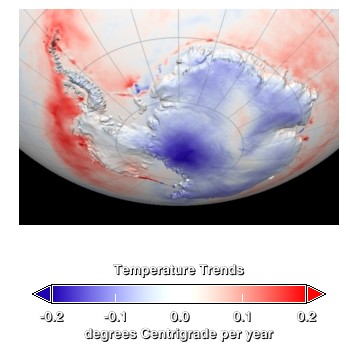
ScreenHunter_07 Nov. 04 15.52

SVS Animation 3188 – Antarctic Heating and Cooling Trends
Shindell and Schmidt 2004

Shindell, D.T., and G.A. Schmidt 2004. Southern Hemisphere climate response to ozone changes and greenhouse gas increases. Geophys. Res. Lett. 31, L18209, doi:10.1029/2004GL020724.
While most of the Earth warmed rapidly during recent decades, surface temperatures decreased significantly over most of Antarctica.

Pubs.GISS: Abstract of Shindell and Schmidt 2004
Perhaps Antarctica has warmed since 2004, reversing the trend he reported in 2004? Gavin’s own data shows that hasn’t happened.
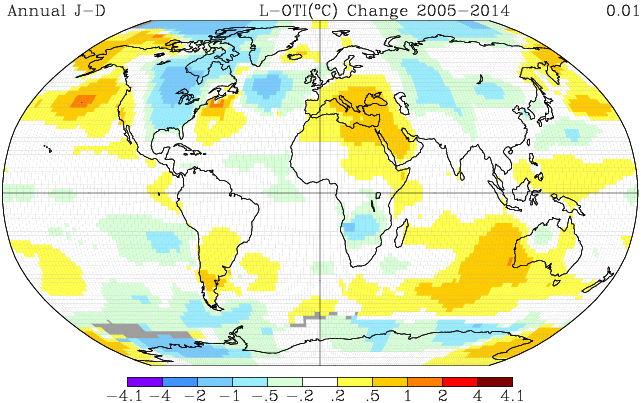
nmaps


Data.GISS: GISS Surface Temperature Analysis
Satellites show that southernmost latitudes have been cooling for 35 years.
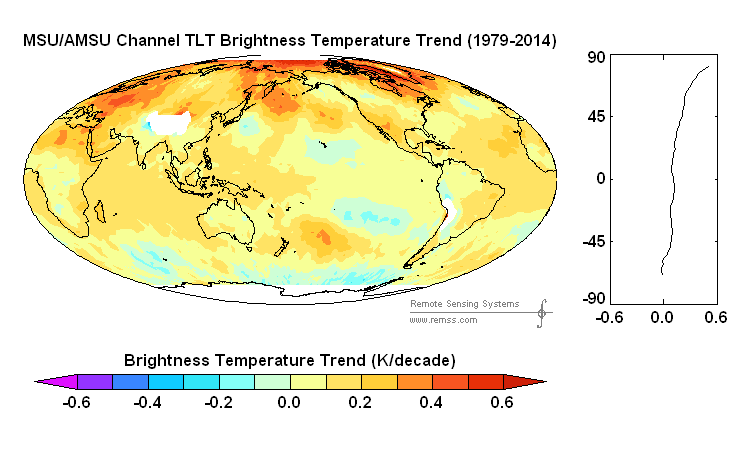
MSU_AMSU_Channel_tlt_Trend_Map_v03_3_1979_2014.730_450 (2)


RSS / MSU Data Images / Monthly
So why did Gavin tell the press that Antarctica is warming?

SOURCE


Put the acid on Great Barrier Reef doomsayers

By Patrick Moore (A co-founder and former leader of Greenpeace)

There is nothing more symbolic of the natural beauty of Australia than the Great Barrier Reef.

This makes it a powerful emotional tool to strike fear into the hearts of citizens. The “ocean acidification” hypothesis, that corals and shellfish will die due to higher levels of carbon dioxide dissolved in the sea, is often used to stoke those fears.

Here’s why I don’t believe there is a shred of evidence to support these claims.

When the slight global warming that occurred between 1970 and 2000 came to a virtual standstill, the doomsayers adopted ­“climate change”, which apparently means all extreme weather events are caused by human emissions of CO2.

Cold, hot, wet, dry, wind, snow and large hailstones are attributed to humanity’s profligate use of fossil fuels. But the pause in global warming kept on and became embarrassing around 2005.

Something dire was needed to prop up the climate disruption narrative. “Ocean acidification” was invented to provide yet another apocalyptic scenario, only this one required no warming or severe weather, just more CO2 in the atmosphere.

The story goes that as CO2 ­increases in the atmosphere the oceans will absorb more of it and this will cause them to become acidic — well, not exactly, but at least to become less basic. This in turn is predicted to dissolve the coral reefs and kill the oysters, clams, mussels and algae that have calcareous shells. It was named “global warming’s evil twin”.

Seawater in the open ocean is typically at a pH of 8.0-8.5 on a scale of 0-14, where 0 is the most acidic, 14 is most basic and 7 is ­neutral. Ocean acidification from increased CO2 is predicted to make the ocean less basic, perhaps to pH 7.5 under so-called worst-case projections.

How do I know that increased CO2 will not kill the coral reefs and shellfish? Let me count the ways.

* First, contrary to popular ­belief, at 400 parts per million (0.04 per cent), CO2 is lower now in the atmosphere than it has been during most of the 550 million years since modern life forms emerged during the Cambrian ­period. CO2 was about 10 times higher then than it is today.

Corals and shellfish evolved early and have obviously managed to survive through eras of much higher CO2 than present levels. This alone should negate the “predictions” of species extinction from CO2 levels nowhere near the historical maximum.

* Second, due to its high concentration of basic elements such as calcium and magnesium, sea­water has a powerful buffering ­capacity to prevent large swings in pH due to the addition of CO2.

This self-correcting capacity of seawater will ensure the pH will remain well within levels conducive to calcification, the process whereby shells and coral structures are formed. Marine shells are largely made of calcium carb­onate, the carbon of which is ­derived from the CO2 dissolved in the seawater.

* Third, and most interesting, there are freshwater species of clams and mussels that manage to produce calcareous shells at pH 4-5, well into the acidic range. They are able to do this because a mucous layer on their shell allows them to control the pH near the surface and to make calcification possible beneath the mucous layer.

The “ocean acidification” story depends only on a chemical hypo­thesis whereas biological factors can overcome this and create conditions that allow calcification to continue. This is corroborated by the historical record of millions of years of success in much higher CO2 environments.

* Fourth, ocean acidification proponents invariably argue that increased CO2 will also cause the oceans to warm due to a warming climate. Yet they conveniently ­ignore the fact that when water warms the gases dissolved in it tend to “outgas”.

It’s the same phenomenon that happens in a glass of cold water taken from the fridge and placed on a counter at room temperature. The bubbles that form on the ­inside of the glass as it warms are the gases that were dissolved in the colder water. So in theory a warmer sea will have less CO2 dissolved in it than a cooler one.

* Finally, it is a fact that people who have saltwater aquariums sometimes add CO2 to the water in order to increase coral growth and to increase plant growth. The truth is CO2 is the most important food for all life on Earth, including marine life. It is the main food for photosynthetic plankton (algae), which in turn is the food for the entire food chain in the sea.

For some reason, the proponents of catastrophic global warming ignore this fact. They talk of “carbon pollution” as if CO2 is a poison. If there were no CO2 in the global atmosphere there would be no life on this planet. Surely, that should be enough to permit questioning the certainty of those who demonise this essential molecule.

Many climate activists are telling us ocean acidification is decimating coral reefs and shellfish. Have they read the story of ­remote Scott Reef off Western Australia? The ARC Centre of ­Excellence for Coral Reef Studies reports that in a brief 15 years this huge reef recovered completely from massive bleaching in 1998. Reefs go through cycles of death and recovery like all ecosystems.

We are told CO2 is too high and we will suffer for it. Nothing could be further from the truth.

We should celebrate CO2 as the giver of life it is.

SOURCE

***************************************

For more postings from me, see  DISSECTING LEFTISM, TONGUE-TIED, EDUCATION WATCH INTERNATIONAL, POLITICAL CORRECTNESS WATCH, FOOD & HEALTH SKEPTIC and AUSTRALIAN POLITICS. Home Pages are   here or   here or   here.  Email me (John Ray) here.  

Preserving the graphics:  Most graphics on this site are hotlinked from elsewhere.  But hotlinked graphics sometimes have only a short life -- as little as a week in some cases.  After that they no longer come up.  From January 2011 on, therefore, I have posted a monthly copy of everything on this blog to a separate site where I can host text and graphics together -- which should make the graphics available even if they are no longer coming up on this site.  See  here or here

*****************************************


Monday, April 13, 2015


Microbes eating melting Artic soil will add 'substantial amounts' of carbon to the atmosphere, researchers warn

A good thing, then, that temperatures seem to be insensitive to CO2 levels

Frozen Arctic and sub-Arctic soil that thaws from global warming will add substantial amounts of carbon to the atmosphere in the form of greenhouse gases, accelerating climate change the rest of the century, but it won't come in a sudden burst, researchers say in a new paper.

A review by government and academic experts concludes that harmful carbon dioxide and methane generated by microbes digesting thawed plant and animal material will instead enter the atmosphere gradually.

But it's a carbon source that shouldn't be ignored, said Dave McGuire, a senior researcher at the U.S. Geological Survey and a professor of ecology at the University of Alaska Fairbanks.

In the last 30 years, permafrost in Alaska, Russia and other Arctic regions has warmed nearly 11 degrees, climbing from an average temperature just under 18 degrees to just over 28 degrees Fahrenheit, according to research cited.  [Which shows that we are looking at local processes, not global ones -- as the global warming over that period was minute]

Researchers wanted to find out how much carbon is contained in permafrost, how fast it's likely to be released and in what form it will be released.

'The estimates that we came up in this synthesis suggest that throughout the rest of this century, it could be on the order of the magnitude of what tropical deforestation currently affects the global carbon cycle,' McGuire said.

McGuire is co-lead author and one of 17 researchers who worked on a research paper with these conclusions that appeared this week in the journal Nature.

The paper is an outcome of the Permafrost Carbon Network, a group of more than 200 scientists from 88 research institutions in 17 countries who for four years have studied changes in the Arctic.

'People have been sort of proposing that there's a potential for a 'permafrost bomb,' ' McGuire said, a surge that could quickly cause trillions in economic damage to roads, buildings, runways and other infrastructure built on frozen ground.

'Our research indicates that's not likely,' he said. A gradual and prolonged release will give Arctic communities time to adapt.

Many unknowns remain, he said.

An increase in forest fires could result in faster permafrost thaw.  On the other hand, longer growing seasons could mean more vegetation and more absorption of carbon that could counter output from thawing permafrost, he said.

SOURCE


Study: Protecting tropical reefs need not be a zero-sum game

A new study suggests that less draconian restrictions could still put many troubled reefs on the road to recovery. This could reduce friction between conservationists and those who depend on the reefs for their livelihood

Large patches of ocean that countries have declared out of bounds for fishing have become gold standards for maintaining or rebuilding the health of tropical reefs and other key ocean habitats.

A new study suggests that less draconian restrictions could put many troubled reefs on the road to recovery. A mix of approaches – from curbs on the type of fishing gear used and clearly defined fishing rights to restrictions on the species of fish caught – also can lead to healthier, more resilient reef communities, the study suggests.

The recovery probably would take longer under such management practices than it would under a flat ban on fishing, the researchers acknowledge. And the long-term effects of ocean acidification and global warming remain wild cards.
Recommended: Climate change: Is your opinion informed by science? Take our quiz!

But the scientists say that more flexible management practices could reduce friction between conservationists and the millions of people, particularly those living in developing countries, who depend on the reefs for their livelihood. The hope is that management plans tailored to local needs will be less likely to force a Hobson's choice between long-term conservation goals and immediate livelihoods.

"Conservation is not just about walling off areas and denying access, it’s about finding effective solutions that preserve the integrity of the ecosystem," notes Aaron MacNeil, a marine ecologist at the Australian Institute of Marine Science in Townsville, Queensland, and the lead author of the study, which is set to appear in Thursday's issue of the journal Nature.

Conservation groups have done a lot of heavy lifting in making the case for marine-protected areas and in showing that they can work, he writes in an e-mail.

But, he adds, "fisheries closures are not for everyone, and if they are established in places where people are poor or disinclined to comply with regulations, then they just become ‘paper parks.’ "

The new study, involving researchers from Australia, Canada, Britain, and the United States, provides a unique perspective on tropical-reef conservation that can help inform regulations that are more likely to get buy-in from local people than an outright ban, he adds.

Based on fisheries data from 832 reefs in 64 locations around the world, the study suggests a global base line from which to gauge success. It shows how fish biomass at the reefs stacks up against the base line. It estimates the time needed for a fully protected reef to return to normal. And it suggests how quickly fish biomass can bounce back if measures other than fishing bans are used.

Few question that the world's tropical-reef ecosystems – the ocean analogue to tropical rain forests and their biodiversity – are in trouble and that for now, fishing remains the dominant threat to reef ecosystems.

On average, an unfished reef system supports about 1,000 kilograms (1.1 tons) of fish per hectare (two acres), found the team, which adopted that as their base line.

A healthy reef system typically hosts at least 90 percent of that base line, the study shows. With the right mix of species, a reef system can still maintain its full range ecosystem functions with about 500 kilograms of fish per hectare.

But of the 832 reefs in the study, 83 percent had fish densities below 500 kilograms per hectare. One-third of the reefs fell below 250 kilograms per hectare. Reefs around Guam and Papua New Guinea were in the worst shape, with only 10 percent of the fish-density base line – a level at which the reef system has all but collapsed.

The team's analysis found that for reefs where fishing was permitted or under some restrictions, on average it would take 39 years for fish density to recover to the 90 percent level. The worst reefs could take up to 60 years to recover.

Meanwhile, previous studies have suggested that marine-protected areas, which have been set up during the past 20 years, also take decades to bring fish populations back to the base line.

One key finding in the new study: Fish that graze on algae – vital to preventing algae from smothering a reef – don't need to be present at "pristine reef" levels to fulfill their roles as reef cleaners. They tend to reach their ideal biomass well before the overall fish density on a reef reaches the 500 kilogram mark. That may help explain a reef system's ability to maintain its functions with only half the fish density of an unfished reef.

In general, reefs with some form of fishing restrictions sported fish biomass levels averaging 27 percent higher than those of fished reefs. Where those restrictions involved nets hurled from beaches or the catch of algae grazers, the density of grazers in general increased to about 80 percent of the levels needed to keep algae in check.

For Nicholas Dulvy, a marine biologist at Simon Fraser University in British Columbia whose conservation research focuses on sharks and rays, any surprise from the study comes less in its results than in the effort it makes to evaluate, at least in broad terms, more-traditional conservation approaches, rather than focus on marine-protected areas alone.

Over the past decade, he says, many marine scientists and conservations groups "have given up on fisheries management and instead focused on locking down the ocean into marine protected areas," he writes in an e-mail.

Yet even for marine-protected areas, accommodations are being made for some level of fishing, notes Deborah Brosnan, an independent marine biologist who works closely with governments in developing conservation and natural-hazard resilience plans.

Last summer, researchers at the University of Queensland in Australia published an analysis of several approaches to setting up marine-protected areas in an attempt to strike a balance between long-term conservation demands and those of local residents for immediate income from fishing. Depending on local circumstances, the approaches involved gradually increasing the size of a reserve, increasing the number of species protected, or adjusting the number of months a year that the reserve would be closed to fishing.

The latest study provides additional information that managers could use immediately, notes Dr. Brosnan.

"In communicating with fishermen, being able to provide an explanation with biomass numbers will be critical to explaining the level of degradation and the goals of recovery in a language that they can understand," she writes in an e-mail. This kind of communication "also will be important to help avoid a situation where the recovery of some fish triggers overfishing."

She currently is advising an agency that is having a hard time explaining to fishing interests why tighter reef-fishing restrictions are needed. The issue is raising "real tensions," she writes. The kind of information the new study provides "gives a rationale, a basis, and a way to have a dialogue instead of a conflict."

SOURCE


Our global whorehouse

Did you know that the small minority of climate change deniers among us, me included, are Hell bent on turning our planet into a global whorehouse?

That’s right. Unless we climate change deniers are silenced once and for all, and mankind is forced to drastically reduce his carbon footprint, the detrimental effects of human caused global warming will soon overwhelm the entire earth and drive our women into prostitution.

Thankfully, a California congresswoman is introducing legislation to save our women from a life of ill repute. Democrat, Barbara Lee, seeks to force our government to address all “policies and programs in the United States that are globally related to climate change” through the lens of gender.

This courageous congresswoman understands that “Recognizing the disparate impact of climate change on women and the efforts of women globally to address climate change,” is necessary to stop the long term and catastrophic weather changes that will result in drought and destructive weather events such as flooding, which will lead to food shortages, joblessness and disease, along with economic and political crisis on a regional scale.

Global warming if allowed to continue unchecked will cause women to become whores because “women will disproportionately face harmful impacts from climate change, particularly in poor and developing nations where women regularly assume increased responsibility for growing the family's food and collecting water, fuel, and other resources,” she explains. Consequently, they will be the most desperate and vulnerable, forced into situations, “such as sex work, transactional sex, and early marriage.”

The impending climate change environmental crises will force women to migrate, often into refugee camps or other vulnerable circumstances, where they will have to scrounge for food and resources for their families. Therefore government should begin to focus on poor women, as well as empower women to develop strategies to prepare for these eventualities.

If we don’t act quickly and decisively to muzzle the climate change deniers, save our women, and prevent the terrible disaster, global warming will surely turn our beautiful planet into... our global whorehouse.

SOURCE


Greenie disruption behind California's water shortages


Call it potty policy. This week, California took aim at the porcelain throne, mandating that all toilets — along with urinals and faucets — sold in the state after Jan. 1, 2016, conserve water. It’s part of a frantic effort to do anything to manage the state’s severe drought without actually doing what’s needed to manage the state’s severe drought.

While it’s true that California is in the fourth year of below-average precipitation, and that January and March of this year have been particularly dry, neither of these things is fully to blame for the intensity of the drought’s impact. Instead, the culprit is bad government policy and a three-inch fish.

Despite population growth, California has not completed a major water infrastructure project in nearly 50 years. Indeed, Democrats, including Governor Jerry Brown, have opposed state and federal water projects since the 1970s. And while California voters have authorized $22 billion in water bonds since 2000, most of the money has gone to environmental projects and not to safeguarding and improving water supply.

Then there’s the Delta smelt. The little swimmers, whose most appreciated contribution to society arguably comes in conjunction with the word “fried,” have become so revered by ecofascists that they’re willing to imperil the entire state to save them. Delta smelt are native to the Sacramento-San Joaquin River Delta in northern California, and a federal rule from the 1970s limits diversion of water from this northern delta to the San Joaquin Valley and southern California — all for the sake of the smelt.

The ridiculousness becomes apparent when you consider that in the past two years more than 2.6 million acre-feet of water were let out into the San Francisco Bay because there was not enough capacity north of the delta to store the water, and the “save the smelt” policies wouldn’t allow the water to be sent to reservoirs south of the delta. So instead, the water was wasted.

Indeed, as The Wall Street Journal notes, “During normal [rainfall] years, the state should replenish reservoirs. However, environmental regulations require that about 4.4 million acre-feet of water — enough to sustain 4.4 million families and irrigate one million acres of farmland — be diverted to ecological purposes.”

And the problem is nothing new. A year ago, California, populated by thriving smelt, was in a similar situation. At that time, the Ninth Circuit Court of Appeals sided with the smelt and against diverting much-needed water south. The Metropolitan Water District of Southern California took the issue to the Supreme Court, which earlier this year turned down the appeal, effectively raising a glass to smelt and a finger to California farmers and residents.

The water shortage has become so severe that the Sierra Nevada snowpack, which houses about one-third of California’s water reserve, is at a paltry 5% of its normal average. Given smelt priority and the mismanagement of billions intended for water improvement projects, Governor Brown has now instituted the first mandatory water restrictions in the state’s history, requiring cities and towns to cut usage by 25%, with possible fines of up to $10,000 per day for those localities that fail to meet the mandate.

While conserving water will help, it will hardly solve a problem decades in the making. For this, a good lesson is needed in prioritizing humans over fish. Now, please pass the tartar sauce.

SOURCE


No one is talking about Britain's utterly mad energy policy

All the major parties are signed up to the policy set in train by Ed Miliband’s Climate Change Act. They don't know what they are doing

By Christopher Booker

One reason why this election campaign seems so trivial and unreal is the number of important national issues that will scarcely be mentioned. Several of these I shall cover in the weeks ahead. But high on the list is our reckless and dangerous national energy policy. Last week, scarcely noticed south of the border, came the news of the premature closure of Britain’s second largest power station. The giant Longannet plant in Fife, with its 2,400-megawatt capacity, can still supply two thirds of all Scotland’s average electricity needs.

The reasons given for Longannet’s closure early next year were partly the crippling cost of the Government’s “carbon” taxes and the additional £40 million it is being charged for connection to the grid. But the immediate trigger for the decision was Longannet’s failure to win a contract to supply back-up for Scotland’s ever-rising number of wind farms at times when there is insufficient wind.

Even Scotland’s energy minister, Fergus Ewing, called the closure of Longannet “a national scandal”, laying the blame squarely on “Westminster” – which is curious considering that his government’s policy is that by 2020 Scotland should produce 100 per cent of its electricity from “renewables”. (In other words, that it should be able to rely on unsubsidised back-up from fossil fuel plants in England when there is too little wind, while selling heavily subsidised wind power back to England when there is too much.)

But Longannet’s real crime is that the 4.5 million tons of coal it burns each year make it the biggest CO2 emitter in Scotland. Which is also, of course, why we will hear nothing about Britain’s energy future in this election: because all the major parties are signed up to the policy set in train by Ed Miliband’s Climate Change Act committing us to reduce our “carbon” emissions by 80 per cent within 35 years.

Nuclear power plants make energy that is four times as expensive as that from coal

The policy on which they are all agreed, set out in the Coalition’s “2050 Pathways for tackling climate change”, centres on three main steps, each more bizarre than the last. Step one is that we should “decarbonise” our economy, not just by closing down the coal and gas-fired power stations that supply more than 70 per cent of our electricity, but by chucking out all those gas appliances 90 per cent of us use for cooking and heating.

Step two is that we should double our production of electricity, which we would then use, not just for cooking and heating but also for virtually all our transport (electric cars, trains etc). Step three is that all this electricity should be generated from “zero carbon” sources, mainly from thousands more wind turbines and a fleet of new nuclear power stations.

The only problem is that none of this insane make-believe can possibly come about. When the wind doesn’t blow, the only power to keep our lights on, our homes heated and our electric cars running would be that from those supposed new nuclear power stations.

At the present rate, with only one new nuclear power plant dubiously in view by 2024, producing electricity four times as expensive as that from coal, not even tens of thousands of diesel generators could produce enough back-up power to keep our computer-dependent economy functioning at all. (Last Tuesday evening, wind was producing less than 1 per cent of the power we were using).

But not a word of this will we hear in the election campaign: partly because all our main political parties have signed up to it, but even more because virtually none of our politicians have the slightest clue what it is they are signed up to.

SOURCE


Australia: The renewable energy bomb is set to explode

David Leyonhjelm

You know you have a dog of a policy when the government, opposition and various minor parties agree it should be reformed, but the Greens and their cheer squad think it’s great.

That policy is the Renewable Energy Target. What seemed like a good idea – to encourage renewable energy – is now a mess of rising energy costs and a distorted electricity market.

Renewable electricity generators have received $9 billion in industry subsidies over the 15-year life of the RET, in addition to the price they receive for the electricity they produce. Without change, a further $22 billion will be paid by 2030. In the words of the Warburton Review, the RET is “a cross-subsidy that transfers wealth from electricity consumers and other participants in the electricity market to renewable energy companies”.

The renewable energy legislation was designed to ensure renewable energy makes up 20 per cent of the energy market by 2020. Electricity retailers must purchase Renewable Energy Certificates – from power companies that generate renewable energy – for at least 20 per cent of the power they sell. Each certificate (representing 1 megawatt-hour (MWh) of electricity) currently trades for around $40, which retailers then add to your electricity bill.

However, the legislation also contains a hard target for renewable energy of 45,000 gigawatt-hours (GWh), which at the time was assumed would equate to 20 per cent of the market. Due to falling consumption, this is now expected to be closer to 30 per cent. The problem is – leaving aside small-scale solar (ie rooftop panels on houses), which is allocated 4000 GWh of the target – we currently generate just 16,000 GWh of large-scale renewable energy towards satisfying the target.

Put another way, in 15 years we have incorporated 16,000 GWh of new renewable energy into the RET, leaving just five years to generate another 25,000 GWh to meet the large-scale target of 41,000 GWh. Nobody believes this is possible.

If retailers cannot purchase enough certificates, the legislation requires that a penalty charge of $65/MWh be imposed. With retail margins added, this will nearly triple the cost of the scheme to electricity retailers, who will pass it on to consumers. Electricity prices will skyrocket.

Everyone with knowledge of the electricity market knows this is a political time bomb about to go off, most likely within 18 months when interim targets are not met. Electricity retailers have for some time been refusing to enter new long-term agreements to purchase power (and Renewable Energy Certificates) because they know the scheme will implode due to bill shock and political pain. The public will not stand for increases in electricity prices of up to 20 per cent.

With this problem looming and negotiations between the government and opposition stalled, late last year I developed a detailed reform package for the RET. Since most opposition to reform is based on cuts to the 41,000 GWh large-scale target, my plan is to maintain this but to recognise established hydro-generation in the calculations – essentially Snowy Hydro and Hydro Tasmania – which together produce about 15,000 GWh. There would also be no cap on small-scale solar generation, which is expected to grow to 13,000 GWh.

My proposal would ensure the renewable target is achieved, with no penalty charges kicking in.

There would be strings attached for existing hydro-generators, though. To be allowed to produce valuable Renewable Energy Certificates they would have to commit to upgrading their existing generators, thereby introducing around 3000 GWh of new renewable generation into the grid.

The only losers would be the major wind-energy generators, which are eagerly waiting to build dozens of new wind farms in an effort to meet the target and get on the subsidy gravy train. Against that, many people are hoping these are never built, among them those who suffer adverse health effects from the inaudible infrasound they generate, plus those (like me) who hate to see our majestic eagles and hawks splattered all over the countryside.

The importance of reasonably priced electricity cannot be overstated. My plan will reinforce Australia’s commitment to renewable energy while solving the RET problem before the time bomb goes off.

SOURCE

***************************************

For more postings from me, see  DISSECTING LEFTISM, TONGUE-TIED, EDUCATION WATCH INTERNATIONAL, POLITICAL CORRECTNESS WATCH, FOOD & HEALTH SKEPTIC and AUSTRALIAN POLITICS. Home Pages are   here or   here or   here.  Email me (John Ray) here.  

Preserving the graphics:  Most graphics on this site are hotlinked from elsewhere.  But hotlinked graphics sometimes have only a short life -- as little as a week in some cases.  After that they no longer come up.  From January 2011 on, therefore, I have posted a monthly copy of everything on this blog to a separate site where I can host text and graphics together -- which should make the graphics available even if they are no longer coming up on this site.  See  here or here

*****************************************


Sunday, April 12, 2015


It's always CO2 that is the guilty party

There are many volcanic gases, the chief of which is that famous greenhouse gas, water vapor, but there are many others, including the very reactive H2S and SO2.  But you would never realize that from the story below unless you read carefully. The influence of H2S and SO2 is mentioned but it is CO2 that is given headline treatment.  In fact, if you read carefully, SO2 was probably the main problem

The Great Dying, which struck the Earth 252 million years ago, wiped out more than 96 per cent of the world's creatures.

And while extreme volcanic eruptions are commonly blamed for triggering the event, research has found the majority of species on the planet were ultimately killed when the oceans became more acidic.

In particular, they claim the volcanic eruptions released huge amounts of carbon dioxide which were absorbed into the oceans and changed their chemical compositions.

The Great Dying, which struck the Earth 252 million years ago, wiped out more than 96% of the world's creatures. And while extreme volcanic eruptions are commonly blamed for triggering the event, research has found the majority of species on the planet were ultimately killed when the oceans became more acidic +4
The Great Dying, which struck the Earth 252 million years ago, wiped out more than 96% of the world's creatures. And while extreme volcanic eruptions are commonly blamed for triggering the event, research has found the majority of species on the planet were ultimately killed when the oceans became more acidic

The study, led by the University of Edinburgh, is the first to show that highly acidic oceans were to blame.

And the researchers said that the amount of carbon added to the atmosphere to trigger the mass extinction was 'probably greater than today's fossil fuel reserves'.

The Great Dying, also known as the Permian-Triassic Boundary extinction, took place over a 60,000-year period, and acidification of the oceans lasted for around 10,000 years.

These extreme temperatures already threatened many land and marine species, but this was made worse when large volcanic eruptions began to take place.

Huge volumes of viscous basalt lava covered an area roughly seven times the size of France, explained the Natural History Museum, and sulphur dioxide from these eruptions caused vinegar-like acid rain to cover the Earth.

The Great Dying, also known as the Permian-Triassic Boundary extinction, took place 252 million years ago.

At this time, a single supercontinent called Pangaea covered the Earth. This huge landmass created extremely hot and dry conditions, and by the Late Permian, temperatures were at an all time high.

These extreme temperatures already threatened many land and marine species, but this was made worse when large volcanic eruptions began to take place.

Huge volumes of viscous basalt lava covered an area roughly seven times the size of France, explained the Natural History Museum, and sulphur dioxide from these eruptions caused vinegar-like acid rain to cover the Earth.

As carbon dioxide was released into the atmosphere, global temperatures soared and this caused oceans to get hotter.

This also caused a lack of oxygen in the world's waters, killing off marine life and destroying food chains.

But it was the acidification of the oceans that was the driving force behind the deadliest phase of the extinction, which dealt a final blow to an already unstable ecosystem, the Scottish researchers said.

Researchers believe this acidification lasted for around 10,000 years.

As carbon dioxide was released into the atmosphere, global temperatures soared and this caused oceans to get hotter.

This also caused a lack of oxygen in the world's waters, killing off marine life and destroying food chains.

But it was the acidification of the oceans that was the driving force behind the deadliest phase of the extinction, which dealt a final blow to an already unstable ecosystem, the Scottish researchers said.

Oceans can absorb some carbon dioxide, but the large volume released - at such a fast rate - changed their chemistry.

To make these conclusions, a team led by Dr Matthew Clarkson and Professor Rachel Wood analysed rocks in the United Arab Emirates - which were on the ocean floor at the time - to develop a climate model to work out what drove the extinction.

Models of ocean chemistry show that anoxia and euxinia - the presence of hydrogen sulphide - would have been closely associated with high levels of carbon dioxide, which suggests a combination of gases acted as a killing mechanism.

The rocks preserve a detailed record of changing oceanic conditions at the time.

'Scientists have long suspected that an ocean acidification event occurred during the greatest mass extinction of all time, but direct evidence has been lacking until now,' said Dr Clarkson from the University of Edinburgh's school of geosciences.

'This is a worrying finding, considering that we can already see an increase in ocean acidity today that is the result of human carbon emissions.'

The study is published in the journal Science and was carried out in collaboration with the University of Bremen, University of Exeter and the Universities of Graz, Leeds, and Cambridge.

And the findings are now helping scientists understand the threat posed to marine life by modern-day ocean acidification.

Dr Clarkson's research follows similar analysis in Italy earlier this year by geologists from Imperial College London (ICL).

They discovered evidence of vinegar-like acid rain caused by the sulphur dioxide in 250 million-year-old rocks from Italy's Vigo Meano region.

'For the first time, we can say that soils from this time had an acidity similar to that of vinegar,' Mark Sephton from ICL said.

The Vigo Meano rocks contained vanillin - the substance that gives vanilla its distinct taste and flavour - and this was a surprise because vanillin is typically broken down by bacteria.

In an attempt to explain how vanillin could exist in the rocks for so long, the researchers turned to the dairy industry, which sometimes uses vanilla in milk.

Acidifying the milk protects vanillin as the low pH deactivates the enzymes that would break it down. The same can be said for vanillin in ancient rock.

'Our data fits the idea that acid rain caused the microbes to cease functioning,' said Henk Visscher, a palaeoecologist at Utrecht University in the Netherlands.

The findings follow a similar study in 2013 by US scientists who simulated the Great Dying.

The MIT researchers found that sulphur emissions from massive volcano eruptions were significant enough to create extremely acidic rain, which would have affected plant growth.

They believe such acidity may have been sufficient to disfigure plants and stunt their growth, contributing to their ultimate extinction.


After the eruptions ended, the researchers found believe pH levels in rain bounced back, becoming less acidic within one year.

SOURCE


Obama’s stealth climate treaty

Global trade agreements like the Trans-Pacific Partnership can be used to “reduce greenhouse gas emissions” around the world. So said Chairman of the White House Council of Economic Advisers Jason Furman in an April 8 speech to the Brookings Institution in favor of the Pacific trade deal.

Furman was referencing the 2015 Economic Report of the President, outlining the supposed environmental protection benefits of trade deals such as the Trans-Pacific Partnership. According to the report, “Trade agreements can raise environmental standards in countries that otherwise would not be motivated to raise standards on their own.”

The report also states “strong, enforceable environmental provisions pursued as part of our bilateral and regional trade agreements can help raise environmental standards in our trading partners…”

To put the icing on the cake, the U.S. Trade Representative website on the trade deal explicitly states, “Through the Trans-Pacific Partnership, the United States is negotiating for robust environment standards and commitments from member countries.”

As the Trans-Pacific Partnership is negotiated, that certainly sounds like bad news for American coal producers, particularly those in Senate Majority Leader Mitch McConnell’s (R-Ky.) home state of Kentucky. The coal industry’s export interests could be adversely harmed if it turns out the trade agreement is really a stealth climate treaty.

And Senate Republicans may be prepared to put the trade agreement to an up or down vote — before they even read it.

That’s right. Next week, the Senate will be introducing so-called “fast track” trade promotion authority legislation to allow the trade agreement to come to the floor on an expedited basis without even the opportunity to amend it — after President Barack Obama is done negotiating it.

They’re not even going to review the agreement before they sacrifice the supermajority requirement to adopt it.

Who ever heard of the Senate invoking cloture on legislation members have not even had the chance to read yet? Let alone something with such broad negative ramifications against U.S. energy exporters?

Yet, that is precisely what McConnell and Senate Republicans are proposing to do with the Trans-Pacific Partnership.

Now perhaps it is unreasonable to expect that Malaysia might adopt our minimum wage, or Australia to restrict coal electricity consumption the way the Environmental Protection Agency has here. But why leave it to chance?

This is no free trade deal.

Instead, this could be a stealth treaty for Obama to regulate the global economy, and in particular, to put the coal industry out of business — once and for all. Why would McConnell agree to an expedited process for an agreement that might regulate the climate before it has even been finalized?

SOURCE


Reporters Ignore Climate Change Skeptics

The views of researchers skeptical of the theory humans are causing potentially catastrophic climate change have become scarce in news stories covering the topic.

A recent study by George Mason University researchers published in the trade magazine Journalism found contrarian views on the subject are no longer welcome in many of the nation’s newspapers. The authors of “Covering Global Warming in Dubious Times: Environmental Reporters in the New Media Ecosystem,” interviewed nearly a dozen journalists who regularly report on climate change, formerly known as global warming.

Skeptics ‘Generally Irrelevant’

The George Mason study quotes one reporter as saying, “there is pretty much understanding across the board in the United States media now that this is real, this is true, it’s happening, [and] we’re responsible. That debate is over. [Thus] in this day and age, including climate denialists (sic) in a story about climate change is generally irrelevant.”

News editors encourage reporters to deny there is an ongoing debate over humanity’s role on climate change, the study found. Journalists (who requested anonymity in the study) reported, “this practice of ignoring skeptics was largely supported by their managers and editors. In fact, one reporter’s news organization had recently developed an explicit editorial policy discouraging reporters from quoting climate change deniers in environment and science coverage.”

L.A. Times Confirms Bias

A Los Angeles Times commentary (October 8, 2013) confirms the study’s findings. Paul Thornton, the Times letter’s editor explained the paper’s decision not to print letters to the editor questioning the theory of human-induced global warming. Thornton acknowledged he is “no expert when it comes to our planet’s complex climate processes.” Instead, Thornton stated he relies on the UN’s Intergovernmental Panel on Climate Change (IPCC), which he described as “a body made up of the world’s top climate scientists.” According to Thornton the IPCC, had recently concluded “it was 95% percent certain that we fossil-fuel-burning humans are driving global warming. The debate right now is not whether this evidence exists (clearly, it does) but what this evidence means for us.”

Thornton’s commentary concluded, "Simply put,I do my best to keep letters of error off the letters page; when one does run, a correction is published. Saying ‘there is no sign humans have caused climate change’ is not stating an opinion, it’s asserting a factual inaccuracy.”

‘Witch Hunt’

Jay Lehr, science director at The Heartland Institute, publisher of Environment & Climate News, identifies something more ominous at work. “There is an old saying in law schools everywhere,” Lehr said. “'If you have the facts on your side, pound the facts. If you have the law on your side, pound the law. If you have neither on your side, pound the table.’ What is going on now is a witch hunt, proving there are no longer any supportable facts that indicate mankind has any significant role in determining climate. All that remains is to vilify those in opposition.”

SOURCE


Obama Pushes to Train Veterans for Solar Power

As if abuses of veterans by the VA weren't enough!

President Barack Obama on Friday unveiled an expansion of U.S. government efforts to train military veterans for jobs in the solar power industry during a visit to Utah.

The administration announced a new goal of training 75,000 people to enter the solar work force by 2020. That is an increase from a goal announced last year of training 50,000 workers by the same deadline. Many of those workers would be veterans, administration officials said.

The Department of Defense plans to have "Solar Ready Vets" programs at 10 bases across the country to train military members who are returning to civilian life for solar jobs.

"It's going to train transitioning military personnel for careers in this growing industry," Obama said of the program during remarks at Hill Air Force Base in Utah, standing near a set of solar panel installations.

Officials declined to provide a figure for what the programs would cost.

SOURCE


Canada Passed on U.S.-Mexico Climate Announcement

Canada declined a U.S. invitation last week to jointly announce climate policy cooperation with Mexico, with Ottawa saying it has not yet finalized its own domestic strategy, sources from both countries familiar with the discussions said on Thursday.

On March 24, three days before the United States and Mexico announced they would partner on a high-level bilateral clean energy and climate policy task force, U.S. officials approached Canadian counterparts asking them to join the effort, three sources said.

One source said that while Canadian officials said they were supportive of North American harmonization of climate policy they were not yet prepared to join the continental partners.

Shane Buckingham, spokesman for Canadian Environment Minister Leona Aglukkaq, declined to comment on the invitation but said Ottawa is preparing to submit its climate plan to the United Nations "in the weeks ahead" after it gets feedback from the provinces about their own emissions-cutting policies.

"Given the importance of this submission, Canada wants to ensure it has the most complete picture of provincial and territorial plans possible before submitting," Buckingham told Reuters.

Mexico on March 27 said it would cap its greenhouse gas emissions by 2026, becoming the first emerging economy to submit its climate plan ahead of a key U.N. summit in Paris from Nov. 30 to Dec. 11.

The United States on Tuesday formally submitted its own climate plan, which commits the country to reduce greenhouse gas emissions up to 28 percent by 2025 below 2005 levels.

Buckingham said the United States and Canada already align regulatory initiatives, including harmonizing vehicle standards, reducing sulfur in gasoline and phasing down HFCs.

He said Canada also works jointly with the United States and Mexico through the Commission for Environmental Cooperation.

In December, Canadian Prime Minister Stephen Harper said in a televised interview with the CBC that his government preferred a continental response to climate change rather than imposing a unilateral price on carbon on Canada's oil sector, its fastest growing source of greenhouse gas emissions.

Harper's conservative government opposes carbon pricing policies, which have support from opposition parties.

The environment critic for the opposition New Democratic Party in the Canadian Parliament said climate policy was not a priority for the Harper government.

"They're hoping to form some kind of Axis of Denial with the next Republican (U.S.) government and they're utterly disengaged on the climate file," said Megan Leslie, deputy leader of the NDP.

SOURCE


Heartland Institute Not in ‘Tactical Retreat’ from Climate Realism

By Joseph Bast, President, The Heartland Institute

Washington Post column by Dana Milbank read too much into a four-month-old op-ed

Washington Post Columnist Dana Milbank wrote in his April 6 column that The Heartland Institute was making “a tactical retreat” away from the fight against global warming alarmism. I wish he had called me first, I would have told him: Nothing could be further from the truth.

In the coming months we will distribute more than a quarter-million books and reports on climate change and host the Tenth International Conference on Climate Change on June 11-12 in Washington, DC. The man-made global warming paradigm is crumbling, public support is vanishing, and except for a few last hold-outs at the Washington Post and New York Times, the whole world knows it. Human activity is not causing a climate crisis.

To invent his story, Milbank took out of context two passages from a December 24, 2014 opinion piece at Human Events by Justin Haskins, an editor for The Heartland Institute. I would have phrased it a bit differently, but I don’t disagree with the points Haskins made.

The Heartland Institute is a think tank, not a church. We don’t all sing from the same hymnal. I encourage debate and tolerate dissent, that’s how I learn new things and how my staff gets better. We agree on the important stuff: that individual liberty must expand, markets must be free, and government ought to be limited.

SOURCE

***************************************

For more postings from me, see  DISSECTING LEFTISM, TONGUE-TIED, EDUCATION WATCH INTERNATIONAL, POLITICAL CORRECTNESS WATCH, FOOD & HEALTH SKEPTIC and AUSTRALIAN POLITICS. Home Pages are   here or   here or   here.  Email me (John Ray) here.  

Preserving the graphics:  Most graphics on this site are hotlinked from elsewhere.  But hotlinked graphics sometimes have only a short life -- as little as a week in some cases.  After that they no longer come up.  From January 2011 on, therefore, I have posted a monthly copy of everything on this blog to a separate site where I can host text and graphics together -- which should make the graphics available even if they are no longer coming up on this site.  See  here or here

*****************************************


Friday, April 10, 2015


Anaesthetic is WARMING the planet: Gases used to knock out patients during surgery are contributing to climate change (?)

We're used to being nagged about gas concentrations in parts per million but now we are being nagged about gas concentrations in parts per trillion!  We didn't even get to stop on parts per billion. And the idea that the anaesthetic gases are much "stronger" in their effect than CO2 ignores completely that the magnitude of CO2 effects is very unsettled (The "climate sensitivity" debate).  There is reason to believe that the effect of CO2 is real but negligible.  The same may be true of the anaesthetic gases.  Theories take you only so far and can be too simplistic.  Certainly in the last 18 years the theoretical effect of the trace gases has not accorded with reality


Anaesthetic gases used to send patients to sleep during surgery are accumulating in the Earth's atmosphere where they are contributing to climate change.

Scientists say they have detected the gases used in anaesthetic as far afield as Antarctica and concentrations have been rising globally in the past decade.

The gases - desflurane, isoflurane and sevoflurane - are potent greenhouse gases that have 2,500 times the impact on global warming compared to carbon dioxide.

Dr Martin Vollmer, who led the study at the Swiss Federal Laboratories for Material Science and Technology in Dubendorf, Switzerland, said the anaesthetic gases were capable of storing far more energy from the sun than carbon dioxide.

He said: 'On a kilogram-per-kilogram basis, it's so much more potent.  'Modern halogenated inhalation anesthetics undergo little metabolisation during clinical application and evaporate almost completely to the atmosphere.'

The researchers, whose work is published in the journal Geophysical Research Letters, found that concentrations of desflurane reached 0.30 parts per trillion in 2014.

Isoflurane, sevoflurane and halothane have reached 0.097, 0.13 and 0.0092 parts per trillion in the atmosphere respectively.

By comparison, carbon dioxide gas currently makes up 400 parts per million in the atmosphere.

However, one kilogram (2.2lbs) of desflurane produces the same greenhouse effect as 2,500 kg (5,512lbs) of carbon dioxide.

The researchers estimate that anaesthetic gas emissions currently combine to produce the equivalent effect in the atmosphere of 3.1 million tonnes of carbon dioxide.

The research team did not examine the impact of nitrous oxide, another major component of anaesthetic, as it is released by many other sources.

The researchers have been taking air samples from remote sites around the Northern Hemisphere since 2000 while they have also obtained air samples in the North Pacific and the South Shetland Islands in Antarctic.

The team also used two hourly measurements at a high altitude observatory at Jungfraujoch, Switzerland since 2013 to track anaesthetic gases.  They then used computer modelling to produce global estimates for the concentrations of these gases.

However, Edmond Eger, an anaethesiologist at the University of California San Francisco, said: 'What the report fails to note is that a major factor determining the environmental effect is the manner in which the anesthetics are used.

'Many anesthetists deliver sevoflurane or isoflurane in a two - three liters per minute flow but deliver desflurane in a lower flow - 0.5 to one liter per minute. 'Some believe that desflurane has clinical advantages that argue for its continued use.'

SOURCE


Busted: Obama’s claim that global warming caused daughter’s one-time asthma attack

Here’s what actually happened.

President Obama claimed today that global warming was to blame for a one-time asthma attack that happened to his daughter Malia when she was in pre-school.

Except that, according to Michelle Obama, the attack occurred while they were at the circus — a venue teaming with peanuts.

And wouldn’t you know it, Malia has a peanut allergy.

Blame global warming? That’s nuts!

SOURCE


Freeman Dyson says the  Earth is actually growing greener

Eminent physicist Freeman Dyson is very elderly but still alive and alert.  He celebrates the increased levels of CO2 in the air in a recent interview

Freeman says models do a good job of helping us understand climate but they do a very poor job of predicting it.

Dyson says, “as measured from space, the whole earth is growing greener as a result of carbon dioxide, so it’s increasing agricultural yields, it’s increasing the forests and it’s increasing growth in the biological world and that’s more important and more certain than the effects on climate.”

He acknowledges that human activity has an effect on climate but claims it is much less than is claimed. He stresses the non-climate benefits of carbon are overwhelmingly favourable.

SOURCE (Video at link)


The sun and the wind are free, but converting them to RELIABLE electricity is expensive, if not impossible

By Marita Noon

In an effort to get America off of fossil fuels, “free” solar and wind energy is often touted as the solution. However, in reality, the so-called free energy has high costs and does little to minimize fossil-fuel use or cut greenhouse gases.

Because solar and wind energy are not available 24/7 — also frequently referenced as not “dispatchable” — incorporating them into the electricity portfolio requires back-up power to be available on demand. When the sun doesn’t shine or the wind doesn’t blow, we still expect to have heating or air conditioning, cook our dinners, charge our phones, and use our computers.

To do this, requires fossil fuels—typically natural gas “peaking plants,” but depending on what is available, it may be a coal-fueled power plant that is forced to operate inefficiently, releasing more CO2 than it would if allowed to operate as intended.

Think of it this way: If you want to cook a hamburger, and you have a charcoal grill, you go outside about 30 minutes before you plan to cook. You mound up the charcoal, sprinkle it with lighter fluid, and toss on a match. When the coals are white on the edges, you know they are ready. You put your burger on the grill and cook it for five to eight minutes. Once you remove the burger, the coals are still hot for hours. Ultimately, they burn down to ashes and are cold enough that you can throw them into your plastic trash can, or into the forest. To restart it later in the same day is not efficient.

By comparison, if you are going to cook that same hamburger over natural gas or propane, you go out five minutes before you plan to grill to heat up the elements. You cook your burger, and you turn it off. No coals, no cool down needed.

Power plants function in a similar fashion.

A coal-fueled power plant cannot easily be turned on and off. It works most efficiently — i.e. cleanly — when it burns continuously. Like the grill, you can add more coal throughout the process to keep the temperature up, which creates the steam that generates electricity.

But with a natural-gas-fueled power plant, you can easily turn it on and off. So when the wind suddenly stops blowing — with no warning, the gas plant can quickly ramp up to generate the needed power.

As Germany, with the highest implementation of renewable energy of any country, found out, to maintain grid stability, it needs coal- and natural-gas-fueled power plants. As a result of its policies that favor renewables, such as solar and wind, Germany has had to subsidize its fossil fueled power plants to keep them open.

So, by adding solar and wind power to the energy mix, we actually increase costs by paying for redundant power supplies—which ultimately, through rate increases, hurts the less fortunate who also have to cover the costs of the renewables.

In the cold weather of Albuquerque’s winter, I received a call from an “unemployed single mother living in an 800 square-foot apartment.” When I answered the phone, she dumped on me. She was angry. Her life circumstances meant she didn’t turn on her heat because she couldn’t afford it. After stating her position, she ranted at me, “I just opened up my utility bill. I see that I am paying $1.63 a month for renewable energy.” She continued: “I don’t give a f#*! about renewable energy! Why do I have to pay for it?”

I tried to steer her attention away from the utility company and toward the legislature that nearly a decade ago passed the Renewable Portfolio Standard, which requires increasing amounts of more expensive renewable energy. As a result, her rates went up, and she had no say in the matter — except that she may have voted for the legislators who approved the policy.

Recently, in Florida, the state NAACP chapter had an op-ed published that, essentially, said the same thing: renewable energy for some people, costs those who can least afford it.

It is not that renewable energy is bad. I have friends who live off the grid. They are cattle ranchers, who live in New Mexico’s Gila Forest. Were it not for their solar panels, they’d have no lights, no computers, no direct contact with the rest of the world. For them, solar panels on the roof — with a back-up system of car batteries — are their salvation. At a cost that worked for them, they were able to purchase used solar panels that someone else had discarded. They are grateful for their solar panels, but they have little option — and they know that; they accept it.

Without thinking of what works well in each situation, government has tried to apply a one-size-fits-all solution. Based on a phony narrative of energy shortages and global warming, err, climate change, renewables have been sold as the panacea. While they may be the right choice in a few cases, such as my cattle ranching friends, or even in the oil fields — which are one of the single biggest industrial users of solar power, many individual locales may be better served by coal, or natural gas, even nuclear, than by renewable power. But the mandates, or the EPA, have not taken that into consideration.

In New Mexico, there are two coal-fueled power plants situated virtually at the mouth of the coal mine. The coal is extracted and sent straight to the power plants that generate most of New Mexico’s power and provide enough excess to sell to neighboring Arizona and California. But, EPA regulations require that these plants, now, with years of useful service left, be shut down. Some of the units will be converted to natural gas — something the region also has in abundance. However, the natural gas has pipelines that can take it to the world markets; it is not stranded in the San Juan Basin.

In contrast, the coal cannot conveniently leave the area — there is no rail to transport it. Looking at the specifics of the basin, it makes sense to continue to generate electricity from coal and allow the natural gas to benefit markets (perhaps even our allies) without other resources — but the EPA and its environmental advocates will hear nothing of it. Their ideology drives the policy whether it makes economic, or practical, sense or not.

Just try to bring truth or logic into the discussion, and the crusaders will treat you as they have Indiana’s Governor Mike Pence.

Last month, I released a white paper: Solar power in the U.S. Using real-life data and news reports, we present the harsh realities of today’s solar market—which has reacted, not with facts, but by smearing me and the supposed funding of the organizations I lead. Apparently, when you have emotion and messaging on your side, you do not need to be impeded by facts — such as the sun and the wind are free, but converting them to electricity is expensive; converting them to reliable, albeit expensive, electricity is virtually impossible. Ah, but they never let the truth stand in the way of their feel-good story.

SOURCE


Using the Global Warming Hoax to Destroy America

By Alan Caruba

When President Obama announced on March 31 that he intends to ensure that the U.S. will slash its “greenhouse gas emissions” 26% below 2005 emissions levels by 2025 in order to keep pledges made to fulfill the U.N. Framework Convention on Climate Change, he failed to mention that such levels would be comparable to what they were in our Civil War era, 150 years ago.

He also failed to mention that the U.S. has made no such pledges as regards the 1992 “Kyoto Treaty” which was resoundingly rejected by the U.S. Senate when then Vice President Al Gore brought it back from the U.N. conference.

There is no need, globally or nationally, to reduce such emissions. It would be a crime against humanity, especially for the millions that would be denied electrical power or would see its cost rise exponentially. “The President has no credible evidence to back up his claims,” said H. Sterling Burnett, a Research Fellow with the free market think tank, The Heartland Institute. “Obama’s climate actions are likely to cause far more harm to people, especially the poor, than any purported threats from global warming.”

“Global warming” and “climate change” are attributed to the use of fossil fuels to manufacture and transport ourselves and our goods, and to create electrical energy, despite the fact that the Earth, its oceans and land areas naturally generate such gases.

There are, for example, more than 1500 potentially active volcanoes and countless others under the oceans. They produce billions of tons of carbon dioxide (CO2) and other gases that are identified as “greenhouse gas emissions.” The human contribution pales in comparison to natural sources such as the warming ocean surface which releases CO2.

Even so, CO2 constitutes a mere 0.04% of the atmosphere. There is no evidence CO2 plays any role in the Earth’s global temperature.

Do these “greenhouse gas emissions” trap heat? Apparently not because the Earth has been in a natural cooling cycle for the past eighteen years breaking and making records for snow and ice. In the 1970s scientists were predicting a new Ice Age. Ten years later they were predicting “global warming.”

Why then is the President intent on slashing “greenhouse gas emissions” when (1) the Earth is not a greenhouse and (2) doing so would harm our economy for decades to come?

The answer lies in his promise to “fundamentally transform” a nation that does not need transformation except for the reduction of the size and scope of the federal government. Its economic system is the best in the world. Its military is the strongest. Its agriculture feeds Americans and is exported to other nations.

As David Rothbard, the president and co-founder of the Committee for a Constructive Tomorrow (CFACT), a free market think tank, noted in the wake of Obama’s announcement, “The President will have to bypass the law-making process and use executive orders and regulations” to achieve his goal of slashing emissions. “To do so requires tortured readings of the Clean Air Act and other current laws.”

Significantly, “the President offers no suitable replacement for the lost generating capacity beyond pointing toward wind and solar which is not up to the task.” When Obama took office, coal-fired plants provided 50% of U.S. electricity. It is now down to 40% and headed lower if Obama has his way.

Rothbard warns that “Global warming campaigners see this presidency and the Paris U.N. Summit as the best chance they are likely to see to take control of American energy. The ramifications are disastrous for American freedom and prosperity.”

This brings us to the what John L. Casey, founder of the Space and Science Research Corporation, (SSRC), an independent scientific research organization in Orlando, says about the forthcoming November 30 to December 15 U.N. climate conference in Paris which he describes as “doomed” and that’s the good news.

Its announced goal of imposing global limits on greenhouse gas emissions will not be mandatory and “President Obama has effectively gutted any meaningful agreement among the major industrialized nations, by having granted to the planet’s largest CO2 producer, China, free license to build as many coal power plants as they wish, and emit as many gigatons of greenhouse gases as they wish until 2030.”

This is, in fact, a global trend as many developing nations such as India do the same thing. Nor will they suddenly shut down electricity production fifteen years from now.

This huge, international farce formerly known as the U.N. Framework Convention on Climate Change, began as an international treaty created in 1992. The U.S. Senate refused to ratify the Kyoto Treaty, but pledges to reduce greenhouse gases were made by 33 out of 195 countries, called their “Intended National Determined Contribution” are the main feature at the forthcoming Paris conference.

For all the media attention the President will try to generate for this idiocy, Ken Haapala, president of the Science and Environmental Policy Project, says “It is unlikely that the current Senate would approve a binding agreement.”  Haapala notes that lawmakers that include the Senate Majority Leader, Mitch McConnell (R-KY), Sen. James Inhofe (R-OK)m and Rep. Lamar Smith (R-TX), “have all insisted that the international agreement the U.N. is working on is a treaty and cannot be enforced without Senate approval.”

Sen. McConnell warned, “Considering that two-thirds of the U.S. Federal government hasn’t even signed off on the Clean Power Plan and 13 states have already pledged to fight it, our international partners should proceed with caution before entering into a binding, unattainable deal.”

While most Americans have concluded that “global warming” or “climate change” are low on their list of fears President Obama has elevated this hoax to the top of his agenda for his last two years in office, along with the deal that would give Iran the opportunity to build a nuclear arsenal of weapons.

He doesn’t want to “transform” America. He wants to destroy it.

SOURCE


The whales are OK

From the IWC

It is well known that overexploitation by the whaling industry led to serious declines in many of the world’s populations of whales, although thankfully no species was brought to extinction and many are now in the process of recovering, although not all.

One reason for this is the improved management of whaling that began in the mid-1970s, when management by population or stock was introduced. This led to the development of the present highly precautionary scientific ‘management procedure’ approaches developed by the IWC’s Scientific Committee for commercial and aboriginal subsistence whaling in order to ensure that past mistakes will not be repeated.

What is status?

Normally when considering ‘status’, one is interested in (a) where a population is now compared to where it was originally and (b) where it is going in the future. In other words one does not only need information on present abundance but also on trends in abundance. The importance of long-term monitoring cannot be over-emphasised and further details of monitoring and how we can achieve it for cetaceans can be found here.

Concurrent with improved management procedures, our ability to estimate the number of whales directly, using a range of techniques, has greatly improved (see summary on pages 166-171 in this paper). Below, we provide a general (and necessarily simplified) overview of the status of large whales by species and ocean basin.

For some species/stocks there is sufficient information to assess the present abundance against unexploited population size. For others we have good estimates of present population size but not of past abundance, or of abundance estimates for only part of their range or, in a few cases, no estimates of present abundance.

Estimating the number of whales in an area is not an exact science and, of course, estimates come with confidence intervals that reflect uncertainty. For the purposes of this very general overview, we have used what in common parlance is called the ‘best’ estimate by broad geographical areas. It is important to note that any scientific work associated with management and conservation must use rigorous abundance estimates and take fully into account any uncertainty surrounding abundance estimates and population structure.

Threats

Knowledge of status is important in terms of evaluating threats to populations, assigning priorities to mitigating those threats and evaluating the success of those mitigation measures. Threats to cetaceans can be said to incorporate two broad categories. The first are those that result in death in the short-term such as direct hunting (e.g. whaling) and accidental/incidental mortality (e.g. by catches in fishing gear, ship strikes). At the level of the individual animal, this is of course always a problem; however, when considering conservation at the population level, this is not necessarily so (depending on the conservation objective chosen), provided that the level of mortality is sustainable.

The other category of threats is more difficult to identify and especially quantify – those that can be said to affect the ‘overall fitness’ of the population with respect to reproductive success and/or survivorship and that are generally related to environmental degradation. These include such factors as chemical pollution, noise pollution, overexploitation of prey, disturbance, climate change, etc.

At the level of the individual animal these may not always appear to be a problem (for example a female whose reproductive ability has been impaired may seem perfectly healthy), but at the population level they may represent a serious threat. These environmental factors can affect populations of all species; indeed the most vulnerable populations to such threats may be those for which direct exploitation would not be allowed.

Species or population

Although often people request information on status at the species level, biologically it is more sensible to consider status at the population level (although determining stock structure, particularly for populations where the breeding grounds are unknown, is difficult). A perfect example of why this is the case is the gray whale; there is one healthy population (and thus the species is not endangered) but also one critically endangered population that therefore requires immediate conservation action (see below).

In fact only two species of large whales can be considered in danger of extinction, the North Pacific right whale and the North Atlantic right whale, both of which were severely depleted by pre-20th century whaling.

SOURCE

Also note that all right whales are very similar and that the Southern right whale (E. australis) is not considered to be endangered

***************************************

For more postings from me, see  DISSECTING LEFTISM, TONGUE-TIED, EDUCATION WATCH INTERNATIONAL, POLITICAL CORRECTNESS WATCH, FOOD & HEALTH SKEPTIC and AUSTRALIAN POLITICS. Home Pages are   here or   here or   here.  Email me (John Ray) here.  

Preserving the graphics:  Most graphics on this site are hotlinked from elsewhere.  But hotlinked graphics sometimes have only a short life -- as little as a week in some cases.  After that they no longer come up.  From January 2011 on, therefore, I have posted a monthly copy of everything on this blog to a separate site where I can host text and graphics together -- which should make the graphics available even if they are no longer coming up on this site.  See  here or here

*****************************************