Thursday, April 09, 2015


We will not be moved, says American Physical Society leadership

A lot of their members are not happy with the APS endorsing Warmism so it remains to be seen what the next meeting of the society will produce.  Will the proposed new statement get a majority in favour?

Frequently Asked Questions

Q: Why is APS revising its climate change statement?
A: The American Physical Society formally reviews its statements every five years. The APS Panel on Public Affairs (POPA) formed a subcommittee in fall 2013 to review its 2007 Climate Change Statement and 2010 Climate Change Commentary. After reviewing the statement, commentary and recent scientific reports, POPA developed a single, concise statement on Earth's Changing Climate.

Q: Who wrote the statement?
A: The entire APS Panel on Public Affairs (POPA) membership was engaged in drafting the statement. The panel's membership as well as the Charge to POPA and resource documents can be found on the APS Climate Change Statement review website.

Q: What was the process to revise the statement?
A: A detailed description of the process is included in APS News and posted on the APS Climate Change Statement review website. Briefly, the APS Panel on Public Affairs (POPA) adhered to the process outlined in the APS Board & Council Joint Oversight Policies & Procedures, starting with a standard review of the 2007 APS Climate Change Statement and 2010 Climate Change Commentary. Then, a POPA subcommittee convened a workshop to inform itself on aspects of the Intergovernmental Panel on Climate Change (IPCC) consensus view of the physical basis of climate science. That was followed by the drafting of a single, concise statement that was reviewed by POPA and the APS Council. The APS Board unanimously voted to send it to the membership for comment on Feb. 21, 2015.

Q: How does this draft statement compare to the 2007 statement and 2010 commentary?
A: In this draft statement on Earth's Changing Climate, APS "reiterates" its 2007 statement in stating that: the climate is changing, humans are contributing to climate change, and rising concentrations of greenhouse gases pose the risk of significant disruption around the globe. While there remain scientific challenges to our ability to observe, interpret and project climate change, APS continues to support actions - as it did in the 2007 statement - that reduce greenhouse gases and increase the resilience of society to climate change. A primary change is that the draft is succinct and does not require an associated commentary.

Received via email


Statistician Briggs replies to Ronald Bailey

Following up on the article behind my leading post yesterday

I have already changed my mind about global warming. I was initially a believer that bad times were on their way. Why? Well, I was young, fresh to the field. I knew how smart my betters were; I knew how wonderfully complex their models could be; I saw the increasing success in weather forecasting and the improvements in short-term (out to a year or so) climate predictions.

The temperatures, back then, were on their way up, too, in accord with what some climatologists were predicting. I never made the mistake, like Bailey, to count the same piece of evidence more than once. Rising temperatures were consist with the theory that increasing CO2 caused increasing temperatures. But a melting glacier is a consequence of that heating, it is not additional proof of the theory. What an elementary mistake to think it was! Likewise, nothing that was a consequence of increased temperatures counts as additional evidence of why the increased happened.

That I saw people making these mistakes, in a big, enthusiastic way, was what started my path back to Truth. How many papers announced "This evil will befall us once the temperature increases past the point of no return"? Thousands; more; they continue in a steady stream. And all of them were taken as evidence that the CO2-theory was right.

That being impossible, and stupid, I began seriously looking into the problem.

That's when I noticed climate model forecasts had no skill. Before, I merely took it for granted they had. The predictions models made were not as good as saying "next year will look like last year", i.e. persistence. The models were poor globally, and even worse locally. The temperatures, for some two decades now, are not going in the direction the models promised.

This can only mean that the models were (are) broken. Why? Well, the theory which underlies them must be busted. Where? Who knows? It could be many things, or just one big thing. It's not my job to find out, either. Though I and some pals of mine have some guesses.

Your car doesn't start. You can then authoritatively state, "My car is busted." It would be asinine and unscientific to say, "Even though my car doesn't start, it really does work and really is taking me places." Yet that is what supporters of the current models are saying. The models don't work but proponents still claim they're still taking us to the future. This is a form of politically correct lunacy.

But therein lies my answer to the question. I would change my mind and believe the models had a good, and not a dismal, handle on reality if they were to start making good predictions. About the future.

I had to add that, what seemed unnecessary, "About the future" because of the unfortunate habit of some modelers to claim their models make good "forecasts"--of the past. Yes, they do this. It's called "hindcasting" or "backcasting". It's a way of testing model fit with observed data. It can be useful to discover wild or egregious flaws in models, but no matter how well a model hindcasts, it's no guarantee it will make good future-casts.

Future-casts, i.e. predictions, are the only test. There is none other. And models have so far failed that test.

But if they were to pass that test, and pass it consistently, then I'd have to believe the models were on to something, and that the theories which drive the models are likely true.

SOURCE


Viscount Monckton replies to Bailey

Lord Monckton has done a most comprehensive reply to Bailey that does not yet seem to be online anywhere.  It is very graphics-intensive so I do not have the time to get it ready for publication here but I do reproduce below some excerpts

our emissions of CO2 and its atmospheric concentration are rising, but anthropogenic CO2 represents only 3% of the total free CO2 in the Earth-atmosphere system. But in logic – it cannot be repeated often enough – mere correlation does not necessary imply causation.

Professor Murry Salby, late of Macquarie University, Australia, has established that it is the time-integral of temperature changes that causes changes in CO2 concentration, leaving little or no room for any detectable anthropogenic contribution. He is not alone in his findings. If he is right, there is no need to posit any role for CO2 or other anthropogenic influences. On that analysis, climate sensitivity  may well be zero.

Cross-correlations by Professor Salby between CO2 change and temperature change. He has found by detailed inspection that the observed record shows CO2 concentration change lagging temperature change by about 8-10 months, approximately the lag that would be expected on the basis of an atmospheric residence time of about 5 years. It is a settled principle of logic that that which occurs second cannot have caused that which occurred first.

Will greenhouse-gas emissions cause much warming?

 No - and, on the evidence to date, certainly not as much as the IPCC predicted.


Near-term projections of warming at a rate equivalent to 2.8 [1.9, 4.2] K/century, made with "substantial confidence" in IPCC (1990), for the 303 months January 1990 to March 2015 (orange region and red trend line), vs. observed anomalies (dark blue) and trend (bright blue) at less than 1.4 K/century equivalent, taken as the mean of the RSS and UAH satellite monthly mean lower-troposphere temperature anomalies.

Do temperature feedbacks amplify direct CO2 warming?

No. Measurements suggest feedbacks are negative, attenuating direct CO2 warming.


Furthermore, the range of mean global surface temperature change over the past 810,000 years was just 3.5 degrees C either side of the long-run average - about the same as the range of temperatures permitted by an ordinary household thermostat. It is difficult to alter the Earth's temperature, because the atmosphere is sandwiched between two vast heat-sinks: the oceans below and outer space above.

Via email


Has The Guardian “Rolling Stoned” Christy & Spencer?

The super-confident Warmist, Dana Nuccitelli, of The Guardian is good at "proving" his points by quoting what his fellow Warmists say but his repertoire is not limited to that.  He also does personal attacks. He has recently done a hit piece on two skeptical scientists.  His screed is mostly "ad hominem" so hardly worth replying to but one of those targeted, Roy Spencer, has replied as follows:

That tireless ecological zealot over at The Guardian, Dana Nuccitelli, took the opportunity of our 25th anniversary of satellite-based global temperature monitoring to rip us a new one.

Comparing John Christy and me to "scientists who disputed the links between smoking and cancer", Dana once again demonstrates his dedication to the highest standards of journalism.

Well done, Grauniad.

I prefer to compare us to Barry Marshall and Robin Warren, who rejected the scientific consensus that peptic ulcers were due to too much stress or spicy food.  While they eventually received the Nobel Prize after years of ridicule and scorn from the medical research community, we have no illusions that we will ever be credited for our long-standing position that global warming fears have been overblown.  I’m sure the UN’s IPCC will find a way to take credit for that, and get another Peace Prize for it.

(I wonder if Marshall and Warren were being paid off by the spicy food lobby?)

The "97% of all climate scientists agree" meme that Dana bitterly clings to has been thoroughly discredited…. as if scientific consensus on something so poorly understood as climate change (or stomach ulcers 15 years ago?) really means anything, anyway.

To prove that Dana should probably avoid trying to interpret simple graphs, let's examine this chart he so likes, which allegedly shows that our (UAH) global temperature dataset has been continually adjusted for errors over the years, resulting in an increasing warming trend:
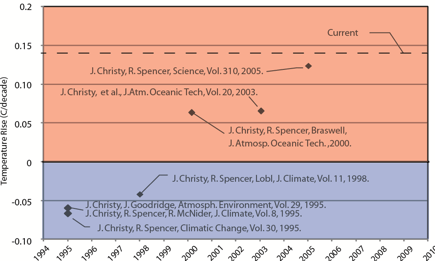
Danas-excellent-chart

Now, setting aside the fact that (1) we actually do adjust for obvious, demonstrable errors as soon as they have been found (unlike the IPCC climate modelers who continue to promote demonstrably wrong models), and (2) RSS gets about the same (relatively benign) warming trend as we do, let's examine some other popular temperature datasets in the same manner as the above graph:
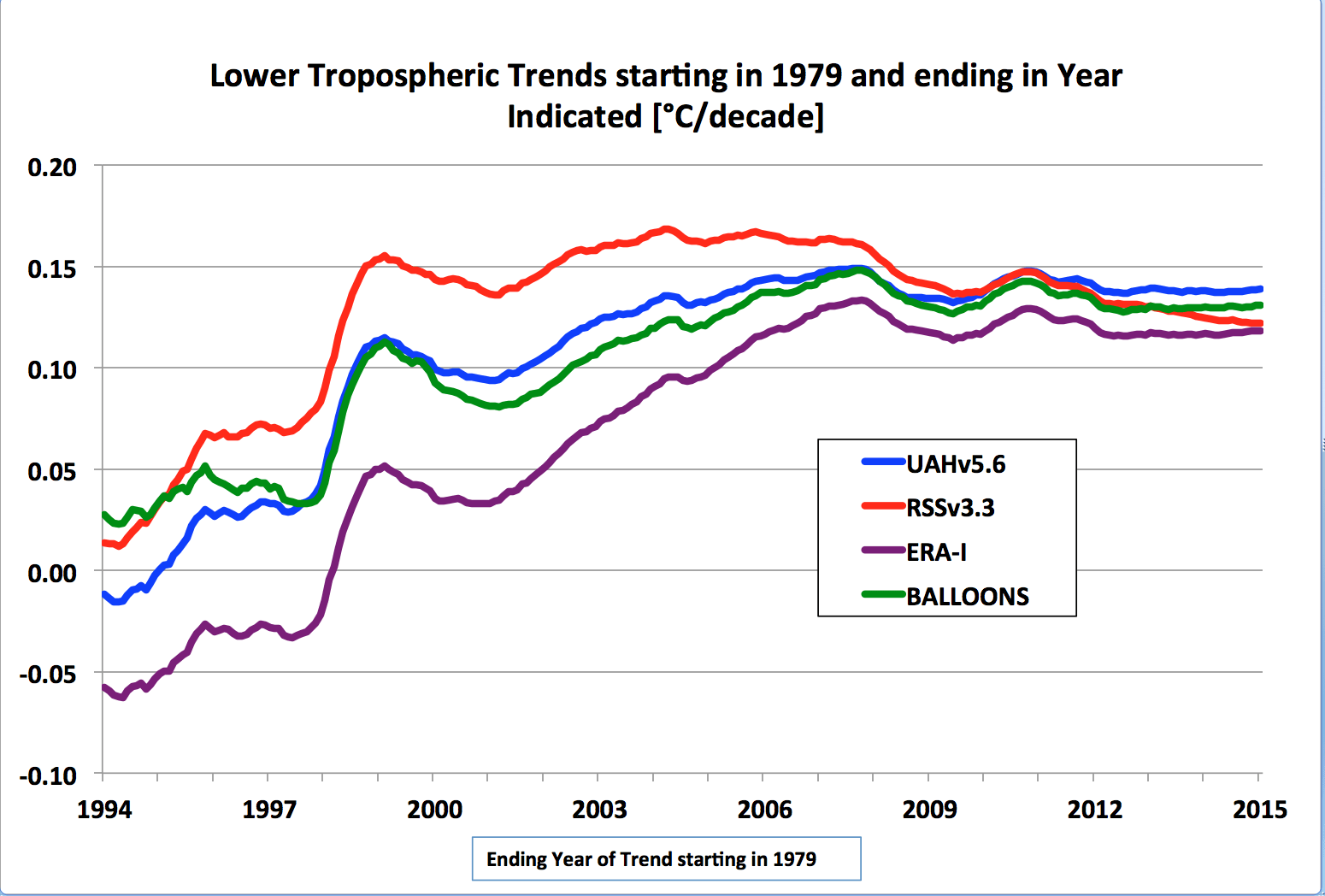
Accum_Trend

Looks a lot like Dana's plot, doesn't it?   Do you want to know why?  Is it really because all those other temperature dataset providers were also busily correcting mistakes in their data, too?  No, it's largely because as the years go by, the global temperature trend changes, silly.

About the only thing Dana got reasonably correct is his article's tag line, "John Christy and Roy Spencer are pro-fossil fuel and anti-scientific consensus."

You're damn right we are.   But not because we are paid to say it, which we aren't.  (What are you paid to say for The Guardian, Dana?)

We are pro-fossil fuel because there are no large scale replacements available, wind and solar are too expensive, and you can’t just cut fossil fuel use without causing immense human suffering.  Yes, I’ve talked to some of the top economists about it.

And indeed we are “anti-scientific consensus” because the consensus (which mostly just follows the average of the IPCC climate models) has been demonstrated to be wrong.

Finally, if Dana objects to me tiring of being called a "global warming denier" (with the obvious Holocaust connotations) for the last seven eight years and fighting back, read this and then tell me where I am wrong.

SOURCE


Research known to be fraudulent gets published

The report below concerns the medical literature but if it happens there it surely happens everywhere

Research Misconduct Identified by the US Food and Drug Administration

Out of Sight, Out of Mind, Out of the Peer-Reviewed Literature

By Charles Seife

ABSTRACT

Importance:  Every year, the US Food and Drug Administration (FDA) inspects several hundred clinical sites performing biomedical research on human participants and occasionally finds evidence of substantial departures from good clinical practice and research misconduct. However, the FDA has no systematic method of communicating these findings to the scientific community, leaving open the possibility that research misconduct detected by a government agency goes unremarked in the peer-reviewed literature.

Objectives:  To identify published clinical trials in which an FDA inspection found significant evidence of objectionable conditions or practices, to describe violations, and to determine whether the violations are mentioned in the peer-reviewed literature.

Design and Setting:  Cross-sectional analysis of publicly available documents, dated from January 1, 1998, to September 30, 2013, describing FDA inspections of clinical trial sites in which significant evidence of objectionable conditions or practices was found.

Main Outcomes and Measures:  For each inspection document that could be linked to a specific published clinical trial, the main measure was a yes/no determination of whether there was mention in the peer-reviewed literature of problems the FDA had identified.

Results:  Fifty-seven published clinical trials were identified for which an FDA inspection of a trial site had found significant evidence of 1 or more of the following problems: falsification or submission of false information, 22 trials (39%); problems with adverse events reporting, 14 trials (25%); protocol violations, 42 trials (74%); inadequate or inaccurate recordkeeping, 35 trials (61%); failure to protect the safety of patients and/or issues with oversight or informed consent, 30 trials (53%); and violations not otherwise categorized, 20 trials (35%). Only 3 of the 78 publications (4%) that resulted from trials in which the FDA found significant violations mentioned the objectionable conditions or practices found during the inspection. No corrections, retractions, expressions of concern, or other comments acknowledging the key issues identified by the inspection were subsequently published.

Conclusions and Relevance:  When the FDA finds significant departures from good clinical practice, those findings are seldom reflected in the peer-reviewed literature, even when there is evidence of data fabrication or other forms of research misconduct.

SOURCE


The trouble with Google defining "truth"

It thinks we're only entitled to seeing Google's "facts," especially on climate change

Ron Arnold

With its $385 billion share value, Google, Inc. has bumped ExxonMobil to become America's No. 2 ranked company in market capitalization.

That may not be a good thing. A February article in New Scientist announced, Google wants to rank websites based on facts, not links, and writer Hal Hodson said, "The internet is stuffed with garbage. Google has devised a fix - rank websites according to their truthfulness."

Not surprisingly, the idea of changing page rank from popularity to "truthfulness," based on a Google-made "knowledge vault," did not go down well.

Fox News reported, "Google's plan to rank websites is raising censorship concerns." Douglass Kennedy opened with, "They say you're entitled to your own opinions, but you are not entitled to your own facts. It's a concept not everyone is comfortable with."

They're saying we're only entitled to Google's "facts," which completely short-circuits how slippery "facts" can be and naively equates facts with truth. Ask any lawyer about truth.

Today's climate wars consist of arguments between highly qualified scientists about facts that some sincerely believe are true, and some sincerely believe are false, each for solid reasons. It should be an honest debate among equals, but it's degenerated into a power play by alarmists to kill debate to drive favored public policies that are pushed by certain politicians and their social and political base.

Google's truth plan is not so simple. Facts are statements about existence. Statements about existence can be true or false. Existence itself - your kitchen sink or the climate or whatever - can't be true or false; it just exists. Say anything you want about existence, and it won't change a thing. It still just exists. Existence doesn't give a damn what you think about it. Facts are statements about existence, and statements are always arguable.

But get everyone to believe Google Facts, and you can enforce political policies worth trillions of dollars to climate profiteers - and impose punitive, economy-strangling, job-killing regulations on millions of families.

You can see where this is going.

Imagine: Big Google the Universal Truthsayer. That's as scary as "Mr. Dark" in Ray Bradbury's 1962 novel Something Wicked This Way Comes, only worse. It's the perfect machine to kill all dissent and wither the Internet into a wasteland of groupthink, susceptible to disinformation campaigns from any power center from the CIA, to the rich bosses of Google, Inc. to Google's political friends and allies.

What about those rich bosses? Google's two co-founders, Larry Page and Sergey Brin, created a corporate foundation in 2005. The Google Foundation has 2013 assets of $72,412,693, gave grants of $7.9 million, and added $29.4 million from corporate profits.

Three of Google's top-ten recipients are key climate alarmists: the World Wildlife Fund ($5 million); Energy Foundation ($2.6 million); and rabidly anti-fracking Natural Resources Defense Council ($2.5 million).

NRDC is particularly influential because it also received $3.01 million in taxpayer-financed Environmental Protection Agency grants since 2009 and has 50 employees on 40 federal advisory committees: NRDC has 33 employees on 21 EPA committees, and more in six other agencies.

The big gun in Google philanthropy is Executive Chairman Eric Schmidt, whose Schmidt Family Foundation ($312 million, 2013 assets) is a major armory for groups that attack skeptics of dangerous manmade climate change. The Schmidt Foundation has given $67,147,849 in 295 grants to 180 recipients since it was endowed in 2007.    

Top Schmidt money went to Climate Central ($8.15 million), a group of activist climate scientists bolstered by $1,387,372 in EPA grants since 2009.

Schmidt also gave $3.25 million to the Energy Foundation, which was almost superfluous, since EF is practically the Mother Ship of green grants, with $1,157,046,016 given via 28,705 grants to 11,866 recipients since 1999.

Among the shadier grants in the Schmidt portfolio are anti-fracking, anti-fossil-fuel grants totaling $1.19 million to the Sustainable Markets Foundation, a shell corporation that gives no recorded grants, but funnels money to climate and anti-fracking organizations such as Bill McKibben's 350.org, so that the donors are not traceable.

Schmidt supported the far-left Tides Foundation empire with $975,000 for an anti-consumer film, "The Story of Stuff." It gave the Sierra Club $500,000 for anti-natural gas activism, the Center for Investigative Reporting $985,000 for an anti-coal film, and so forth. Schmidt's list goes on for pages.

With all the massive resources of wealth and power alarmists have, we must ask: Why do they give so much to destroy the climate debate and the debaters? What are they afraid of?

Perhaps they have staked so much money and reputation on manmade climate catastrophe claims that they are terrified by the prospect that inconvenient evidence, data, debate and scientists could destroy their carefully constructed climate house of cards.

Or perhaps it's what Eric Schmidt said at January's World Economic Forum in Davos, Switzerland, when he was asked for his prediction on the future of the web. "I will answer very simply that the Internet will disappear."

How? The mature technology will be wearable, give us interactive homes and cars, and simply fade into the background - to become something that we all have, that most of us don't really know (or care) very much about, as long as it can do whatever we want.

That's the view from the pinnacle of wealth and power. On the ground, the joke is on Google.

Michael Humphrey, Forbes contributor and instructor at Colorado State University, sees younger people abandoning the public forum in favor of one-to-one connectivity. He says they don't trust the Internet.

Why? Millennials say the Internet is cheapening language, it is stunting curiosity (because answers come so easily), we are never bored so we lose creativity, it steals innocence too quickly, it makes us impulsive with our buying and talking, it is creating narcissists, it creates filter bubbles that limit discovery, it hurts local businesses, it is filled with false evidence, it desensitizes us to tragedy, it makes us lonely.

They want the real world.

Via email

***************************************

For more postings from me, see  DISSECTING LEFTISM, TONGUE-TIED, EDUCATION WATCH INTERNATIONAL, POLITICAL CORRECTNESS WATCH, FOOD & HEALTH SKEPTIC and AUSTRALIAN POLITICS. Home Pages are   here or   here or   here.  Email me (John Ray) here.  

Preserving the graphics:  Most graphics on this site are hotlinked from elsewhere.  But hotlinked graphics sometimes have only a short life -- as little as a week in some cases.  After that they no longer come up.  From January 2011 on, therefore, I have posted a monthly copy of everything on this blog to a separate site where I can host text and graphics together -- which should make the graphics available even if they are no longer coming up on this site.  See  here or here

*****************************************

Wednesday, April 08, 2015


What Evidence Would Persuade You That Man-Made Climate Change Is Real?

Ronald Bailey below has decided to move to the side of the Gods after having been a skeptic.  So his arguments for his new belief are interesting.  What he says is that warming is still going on even though we cannot detect it.  Some small changes are happening that would happen if there were warming so that is enough to convince him.

The story that heat suddenly started to hide in the deep ocean 18 years ago is just a desperate guess propped up by shaky statistics that ignores the nature of heated molecules -- which is to rise. Even frantic Warmist Stefan Rahmstorf doesn't accept that story.  He is an oceanographer and that background  makes it clear to him how implausible the ocean story is.

Bailey seems unaware that the small changes concerning him have mostly occurred over quite a short timescale, a scale too short to be sure that there is any reliable trend.  Starting your measurements of Arctic ice from 1979, for instance, is a very short time span for estimating a trend, considering the slow and erratic pace of climate events.  And in the last few years the trend seems to have  reversed anyway

More importantly, he does not even address the problem posed by the very small scale of temperature change over the last 100  years or so.  Why is a temperature rise of less than one degree Celsius a problem?  Nobody noticed it when it was happening so why would anybody notice a continuation of that trend?  The Warmist answer is a prophecy of Armageddon. And in that we DO have a regularity of nature:  Prophecies of Armageddon always fail.

Warmists prophesy that the warming trend will not continue on its gentle way.  It will suddenly accelerate due to feedbacks.  But the principal feedback proposed (clouds) is highly speculative and on the best evidence wrong.  Take that feedback away and all the rest of Warmism could be true and yet give no grounds for concern.  The whole scare depends on feedbacks that probably won't happen and which have certainly not so far been observed

Furthermore, the focus on CO2 is tendentious.  There are many influences on climate so even if there were warming going on how would we know that CO2 was the guilty party?  Correlation is not causation, as Bailey himself admits. Global warming theory perfectly easily allows that the warming effect of CO2 will be too minute to detect.

I could go on but will close with a  comment by James Taylor of the Heartland Institute -- received via email:

"Ron Bailey presented and then debated a straw man. Few people argue against the notion “that man-made climate change is real.” The pertinent issues for skeptics regard context, pace, and consequences – and to a certain extent the relative importance of anthropogenic vs. natural forcings. Bailey habitually creates and then debates weak global warming straw men, which leads me to believe Bailey either lacks the intelligence to discern what is being debated or is deliberately misrepresenting what key issues are in dispute regarding the global warming debate".


In 2005, I changed my mind about climate change: I concluded that the balance of the scientific evidence showed that man-made global warming could likely pose a significant problem for humanity by the end of this century. My new assessment did not please a number of my friends, some of whom made their disappointment clear.

At the 2007 annual gala dinner of the Competitive Enterprise Institute, a D.C.-based free-market think tank, the master of ceremonies was former National Review editor John O'Sullivan. To entertain the crowd, O'Sullivan put together a counterfeit tale in which I ostensibly had given a lecture on environmental trends pointing out that most were positive. After my talk, O'Sullivan told the audience, a young woman supposedly approached me to express her displeasure with regard to my change of mind on climate change.

Continuing his fable, O'Sullivan recounted to the hundreds of diners that I had tried to explain why my views had shifted. Eventually realizing that the young woman was having none of it, I then purportedly asked her if it wasn't enough that we two actually agreed on most environmental policy issues. The young woman paused for a moment, said O'Sullivan, and then retorted, "I suppose that Pontius Pilate made some good decisions, too." Being compared, even in jest, to the Roman governor who consented to the crucifixion of Jesus is, to say the least, somewhat disconcerting.

Welcome to the most politicized science of our time.

So what evidence would convince you that man-made climate change is possibly real? Keep in mind that despite what progressive dimwits like Naomi Klein might assert, the scientific evidence does not mandate any particular program.

What about higher temperatures? Obviously, in order for there to be any man-made global warming, temperatures must be going up. Are they? Yes.

Concentrations of greenhouse gases in the atmosphere have increased from 280 parts per million in the late 18th century to around 400 ppm today. And the trend in average global surface temperatures has been increasing since the late 19th century. As I've reported before, all of the global temperature datasets, both the instrumental and satellite, find that the atmosphere has warmed since the 1950s.

By how much? Summed over the past 35 years—that is, since the advent of satellite monitoring—temperatures have increased by at most 0.56 C° (1 F°) and at least by 0.455 C° (0.8 F°). In general, the instrumental records suggest that surface temperatures have warmed on average by about +0.9 C° (1.6 F°) since the 1950s.

Let's look at the near-term trends. The average rate of increase since 1979 varies among the temperature datasets from a high of +0.16 C° to a low of +0.13 C° per decade. The rate of surface temperature increase dramatically slowed after 1998 to rate of around +0.05 C° per decade. Of course, correlation does not imply causation, but how sure can you be that the rise in the atmospheric concentration of greenhouse gases just happens to coincide with an entirely natural increase in average temperatures? Conversely, how sure can you be that a natural decline in average temperatures is not temporarily countering a trend toward to higher temperatures caused by accumulating greenhouse gases? Explanations based on natural variability work both ways. I will address the recent “hiatus” in temperature trends below.

What about converging daytime and nighttime temperatures?

Climatologists predicted that man-made warming would produce a decrease in the differences between low nighttime temperatures and high daytime temperatures. And indeed, a decrease between day and night temperatures has been occurring in the United States, China, Spain, and other regions. This phenomenon is global, although more recently daytime and nighttime temperatures have been increasing at about the same rate. Along with the observed increases in average temperature, heat waves have become more common since the 1950s.

What about earlier spring and later fall seasons?

Many studies find that the onset of spring is occurring earlier than it did decades ago. A 2015 study reports that the advent of spring in the Northern Hemisphere occurs about 4 days earlier than in 1980. A 2006 European study found that spring is arriving about 3 days earlier, and a 2014 study reported that the growing season in the Northern Hemisphere is expanding.

Part of the reason that spring is advancing is that the extent of snow cover in March and April in the Northern Hemisphere has been falling. As a 2011 study in the journal Cryosphere reports, "The rate of decrease in March and April Northern Hemisphere (NH) Snow Cover Extent (SCE) over the 1970–2010 period is ~0.8 million km2 per decade corresponding to a 7% and 11% decrease in NH March and April SCE respectively from pre-1970 values." The decline in snow cover is broadly in line with climate model predictions.

What about disappearing glaciers and Arctic sea ice?

The Arctic-wide melt season has lengthened at a rate of 5 days per decade from 1979 to 2013, according to a 2014 study in Geophysical Research Letters. A 2014 review article looks at what satellite data are telling us about recent climate trends in the Arctic. Temperatures are rising at 0.6°C per decade, about 4 times the global average. Sea ice extent has been falling at 3.8 percent per decade, and spring snow cover is dropping by 2.1 percent per decade. The Greenland ice sheet has been losing mass at a rate of 34 gigatons per year, though that has increased sevenfold since 2002 to an estimated 215 gigatons per year.

Ice is not melting only in the Arctic. Most of the world's 130,000 mountain glaciers are also disappearing.

The growing extent of sea ice in the Antarctic over the past decades is a climate change conundrum. On the face of it, more sea ice would indicate cooling rather than warming. Researchers are still trying to figure out what is going on. One idea is that warmer waters are melting the bases of freshwater Antarctic ice shelves. The fresh water then cools the sea surface thus promoting the freezing of more sea ice. When climate researchers don't understand what is going on they often attribute the empirical trends to "internal variability."

What about stronger rainstorms?

As temperatures increase by 1 degree Celsius, global average water vapor in the atmosphere is estimated to increase by around 7 percent. It is difficult to determine the average global humidity. But a 2005 study parsing satellite data finds that the atmosphere did moisten, as predicted, between 1982 and 2004. A 2014 study confirmed the finding and suggests that the increase is mostly the result of man-made warming.

Increased atmospheric humidity suggests that precipitation should also increase. The data show that this is happening. A 2013 study that analyzed data from nearly 9,000 weather stations from around the globe found increases in annual maximum daily precipitation at nearly two-thirds of the stations since 1900. (Climate change does not appear to be exacerbating hurricanes, tornadoes, or droughts.)

What about warming oceans?

Does the recent 17-year hiatus in rising global temperatures cut strongly against the notion of man-made global warming? The pause certainly was not predicted by the computer climate models. As the researchers at the private consultancy Remote Sensing Systems have noted, "The troposphere has not [their emphasis] warmed as fast as almost all climate models predict." University of Alabama in Huntsville climatologist John Christy compared 102 climate model predictions with actual temperature data and found that "their response to CO2 on average is 2 to 5 times greater than reality." Pretty damning.

Other researchers have reluctantly come to acknowledge that there has been a slowdown in surface temperatures. But while surface temperatures may be on pause, they are convinced that "global heating" is not. Lots of researchers have been reporting that for the past couple of decades, 90 percent of the extra heat from greenhouse warming has been sequestered in the oceans. In February, Nature Climate Change asserted that planetary warming continues "unabated," with most of the excess heat being absorbed by the top 2,000 meters of the oceans. Just how and where the heat gets buried in the oceans remains controversial.

Last year an intriguing study in Science suggested that natural variability in the North Atlantic can keep transporting heat downward into the deep ocean for periods lasting 20 to 35 years. Those researchers propose that "the latter part of the 20th century saw rapid global warming as more heat stayed near the surface. In the 21st century, surface warming slowed as more heat moved into deeper oceans."

How about some falsifiable predictions?

Another February 2015 article in Nature Climate Change makes the bold prediction that the current hiatus will likely last only until the end of this decade. Around 2020, the authors suggest, the oceans will start to release the stored heat and surface temperatures will begin to rise rapidly. An even more alarming (alarmist?) article in the April 2015 Nature Climate Change asserts that the rate global average temperature increases will rise to 0.25°C per decade by 2020, "an average greater than the peak rates of change during the previous one to two millennia."

The future course of man-made warming depends on climate sensitivity, conventionally measured as how high average temperature would eventually increase if atmospheric carbon dioxide were doubled. In recent years, there has have a lot of back and forth between researchers trying to refine their estimates of climate sensitivity. At the low end, some researchers think that temperatures would increase a comparatively trivial 1.5 degrees Celsius; on the high end, some worry it could go as high as high 6 degrees Celsius. The uncertainty over this variable is largely why I think that future warming could become a signficant problem. In a 2014 article in Geophysical Research Letters, a group of researchers calculated that it would take another 20 years of temperature observations for us to be confident that climate sensitivity is on the low end and more than 50 years of data to confirm the high end of the projections. How lucky do you feel?

In his magisterial 1960 essay "Why I Am Not A Conservative," economist Friedrich Hayek observed:

"Personally, I find that the most objectionable feature of the conservative attitude is its propensity to reject well-substantiated new knowledge because it dislikes some of the consequences which seem to follow from it—or, to put it bluntly, its obscurantism. I will not deny that scientists as much as others are given to fads and fashions and that we have much reason to be cautious in accepting the conclusions that they draw from their latest theories. But the reasons for our reluctance must be rational and must be kept separate from our regret that the new theories upset our cherished beliefs."

It might be that it is just so happens that natural climate variability has boosted global temperatures and the trends discussed above are occurring coincidentally at the same time the concentrations of carbon dioxide are 30 percent above their highest levels in the past 800,000 years. Correlation does not imply causation. The data cited (and uncited) do not prove beyond a reasonable doubt that man-made climate change is real. However, in my best judgment the preponderance of the evidence suggests that the greenhouse gases produced by humanity are warming the climate and that it could be a significant issue later in this century. In the foregoing I have aimed to cite data, not model outputs. I have long been a critic of computer climate models.

To restate: The existence of man-made warming does not mandate any particular policies. So back to the headline question: If generally rising temperatures, decreasing diurnal temperature differences, melting glacial and sea ice, smaller snow extent, stronger rainstorms, and warming oceans are not enough to persuade you that man-made climate is occurring, what evidence would be?

SOURCE


Joe Bastardi: Is There Anything in the Global Warming Debate That Would Convince Me I'm Wrong?

    There is a constant process I go through, from a forecast for tomorrow, to when I train with weights. Unless challenged, you do not improve. So the challenge is listed in the title above. I must always seek the right answer. It’s not getting soft, it’s simply using this methodology to either confirm or deny my idea.

So, is there anything in the global warming debate that would convince me I’m wrong?

As a matter of fact, yes.

1.) The PDO, which is tracking nicely with the 1950s, turned cold early- and mid-‘50s, warmed late (as it is now) and then turned cold again. The AMO, which is in its warm endgame now, turned cold, but temperatures did not fall. However, since 2007 and the flip of the PDO, there has been a slight decrease in global temperatures based on NCEP CFSR data.


That’s one factor.

2.) Another is the top of the stratosphere, which has been cooling since the late 1970s. But since the Pacific flipped, it’s warming! That to me says there was an expansion in levels below it (warming). Now, the question becomes: Is this warming driven by the cycles of the ocean – which I believe – that reverses as it cools, leading to stratospheric warming? (We may be starting to see that now and the result would be stronger cold invasions over the continent.) Or is it truly because of the increase in human-caused greenhouse gases? (There’s nothing we can do about nature, though one may argue fossil fuel CO2 is entirely natural, since it comes front plant and animal life anyway.)

From 1979-2008, it cooled over the Arctic region.


But over the last several winters, it is reversing and warming.


3.) I am watching the Southern Hemisphere, because ice expansion in an area surrounded by water seems to be a perfect counter-balance.


Notice how total global sea ice, again since the decadal shift in the Pacific around 2007, has returned more or less to normal!


4.) Finally, I am waiting for someone, somewhere, to quantify the global water vapor, which I believe is the true measure of the climate system. Over the tropics, where the trapping hot spots are supposed to occur, water vapor varies directly with the ups and downs of the tropical oceans. Understanding that, and the relationship to global cloudiness, would be huge.

Example: The 400 mb mixing ratios anomalies over the tropical Pacific in the warm cycle of the Pacific 1978-2007:


Since the PDO flip, it has dried out, and this is in direct opposition to the trapping hot spot theory over the tropical oceans.


Objective satellite-era-based measurements in conjunction with oceanic cycles would be a much better way of measuring where the climate is going. Obviously, a sustained increase in water vapor, by far the most prominent greenhouse gas, would be indicative of a change that is meaningful. The bulk of the “warming” has been where it’s dry and cold. In the long-running record highs, it’s not getting hotter. Additionally, the current hysteria that everything is the worst ever is a function of several non-scientific, highly subjective variables. Chief among them is the fact that we can observe almost everything now, and people are not acquainted with what has happened before in detail. If we want to continue to follow along with global temperatures, then it’s a simple test: Watch what they do over the next 15-20 years as the oceans cool.

These are things I look at that can lead me to say, Joe, you are wrong.

For me, this debate is far from settled. And it’s the atmosphere that should settle it, not agendas.

Now, I ask people who don’t see things my way: Is there anything that can challenge your position on this? If not, then your position is dogma, very different from what is needed to strive for the correct idea on this matter.

SOURCE


Nutty Muslim Professor: “The Patriarchy is Killing our Planet,” US to Blame for Rape in Middle East

Dr. Nafeez Ahmed, who has taught at University of Sussex’s School of Global Studies and and Brunel University, has written an article in which he claims that “global warming,” among other crises, are “gendered,” and men are at fault.

The piece, titled “Patriarchy is killing our planet – women alone can save her,” appeared in “The Ecologist.”

Dr. Ahmed specifically pins the world’s problems specifically on men; not specific men, but men as a whole. The way to solve it is by destroying the patriarchy.

He explains, “The global epidemic of violence against women and their systematic exclusion from the power structures that rule us are integral to man’s violent exploitation of Earth and her resources.”

Detailing the problems that face the earth, Dr. Ahmed writes, “The global crises we face today are legion, but their disparate nature is illusory.” In reality, they all have the same source: men.

Ahmed writes, “In all these cases, we see that our relentless plunder of our own planetary life-support systems, correlates with our unnerving tendency to divide, exclude and ‘Otherize’, often in ways that are so insidious we find it difficult, even painful, to acknowledge these processes.” He concludes, “But to this day, one of the most ever-present yet still unacknowledged processes is patriarchy.”

He then explains the different things that men have caused. He writes, “Climate change is gendered…Poverty is gendered… Food and water is gendered… Violence is gendered.”

To “the patriarchy,” Dr. Ahmed writes, “rape is good for business.” He even blames the rape of women in Middle East countries on “Western” arms dealers and “Western intervention”. In “Iraq, Afghanistan, and Palestine, to less developed regions like Africa,” the rape of women is, in part, the United States’ fault, he writes.

Ahmed then attacks capitalism, writing, “Contemporary global capitalism might be making some people richer, but it is making more people poorer and unhappier, in a context of accelerating uncertainty and conflict. And by the end of this century at least, we face the prospect, according to the consensus of our best scientific minds, of a largely uninhabitable planet if we continue business-as-usual.”

In the end, “misogyny is an integral function of planetary destruction,” Ahmed concludes. “If we want to save the planet, patriarchy must die. That means recognizing and taking responsibility for the fact that patriarchy is integral to the structures of power we take for granted, across East and West.”

SOURCE


Australian study finds Earth is greener than 10 years ago: Total amount of vegetation found to have increased significantly over past decade

Carbon is good for you

For years we have been told mankind is destroying the planet, felling trees and systematically ripping up forests.  So it may be a surprise to some that Earth is actually greener today than it was a decade ago.

In an authoritative new study, scientists have calculated that the total vegetation on the planet increased substantially between 2003 and 2012.

While tropical jungles are still disappearing – felled for timber and to make way for cattle pasture – tree growth elsewhere has outstripped the loss.

The unexpected findings show that the area of ground covered by plants has increased in Russia, China, Australia and Africa, leading to a net gain in vegetation cover.

Some of this is due to deliberate conservation, such as a huge tree-planting campaign by the Chinese. Elsewhere high rainfalls have resulted in faster growth of shrubs and grasses on the plains of Africa, northern Australia and South America. And the abandonment of large agricultural areas following the collapse of the Soviet Union led to forests reclaiming farmland.

But whatever the cause, the increase in vegetation is indisputably significant.

The Australian team, whose results are published in the journal Nature Climate Change, found the ‘greening effect’ has been so substantial that the world’s trees and plants are storing 4billion more tonnes of carbon than they were a decade before.

Carbon dioxide in the air is sucked up by plants’ leaves and converted through photosynthesis into the food they need to grow, locking the carbon in their wood. The 4billion tonne increase in plant carbon storage is the equivalent of 7 per cent of the 60billion tonnes of carbon dioxide emitted through industry and transport over the same period.

The surprising results – gathered by scientists who analysed 20 years of satellite data – comes after decades of warnings about environmental catastrophe caused by deforestation.

The scientists studied radio waves naturally emitted by the Earth’s surface to calculate the amount of vegetation covering the land. Using satellites, they were able to calculate the way forest patterns had changed over 20 years, which they say is a more accurate way of measuring deforestation than simply surveying land use.

Study author Professor Albert van Dijk, of the Australian National University, said: ‘Previous analyses of vegetation biomass focused on forest cover change. With our approach we found unexpectedly large vegetation increases in the savannas of southern Africa and northern Australia.’

Lead author Dr Yi Liu, of the University of New South Wales, warned that the gains may be easily lost as weather patterns shift with climate change.

He said: ‘Savannas and shrublands are vulnerable to rainfall – one year can be very wet, and more carbon will be fixed in plants, but the next year can be very dry, and then we will lose the carbon fixed in previous years.’ He added that huge vegetation loss is still occurring on the edge of the Amazon forests and in the Indonesian provinces of Sumatra and Kalimantan.

And while the increase in grasslands and pine forests is a rare glimmer of hope for conservationists, it only goes some way to mitigating the ongoing loss of tropical rainforest, which supports more species than any other ecosystem on Earth.

SOURCE


Will Rachel Carson Be the First Woman on the $20 Bill?

Isn't this racist?  Her unfounded attacks on DDT have led to millions of African deaths

There’s a movement afoot to put a woman on the $20 bill and retire the slavery-supporting, Trail-of-Tears-blazing President Andrew Jackson from his long-held post.

Among the top 15 nominees is marine biologist Rachel Carson. In 1962, Carson authored Silent Spring, a seminal book for the environmental movement that warned of the degradation of natural systems if pesticide use continued unchecked. Drawing from many scientific studies, she described how DDT enters the food chain by accumulating in the fatty tissues of animals (humans, too). Today DDT is classified internationally as a probable carcinogen that persists in the environment for long periods.

Silent Spring was a bestseller, in part because, as the President’s Science Advisory Committee under John F. Kennedy acknowledged when it examined and later defended Carson’s findings, the American public had previously been unawares that pesticides were toxic.

The scientific community also largely backed Carson up, but chemical companies and some government scientists went on the attack. Carson’s gender was regularly used as a means to undermine her work; she was called “hysterical,” a “nun of nature,” and a “sentimental woman who loved cats.”

During the several years it took to finish Silent Spring, Carson learned she had breast cancer—a diagnosis she kept secret for fear that the chemical industry would use it to discredit her. She died in 1964. Carson didn’t live to see the formation of the U.S. Environmental Protection Agency six years later or the 1972 ban of the sale of DDT within the U.S.—two events she helped bring about.

SOURCE


Nobody needs to be paid to be climate skeptics -- because Warmist "Science" Is so Bad

Members of the Scientific Council of the Global Warming Policy Foundation (GWPF) recently criticized the Royal Society’s positions on climate.

Their clear, authoritative scientific objections to the Royal Society’s positions reveal the weak scientific foundation on which the great climate fervor has been based. The public must either become conversant enough to grasp this or step back and get out of the way of those who have. Scientists don’t need to be paid to oppose the ideas of climate orthodoxy, because those ideas are just so damn bad.

To the Bitter End

Accusing scientists of venal motives when they raise questions about climate has come to be what passes for scientific debate. Unlike the GWPF critique, this is not science at all. Al Gore recently renewed calls for climate deniers (as they are pejoratively called by the dogmatists) to be punished. This follows brazen political-style attacks on scientists because of their views on climate. In particular there has been an aggressive assault questioning our ethics, morality, competence, and even sanity. It has been amazingly coordinated, coming simultaneously from a number of fronts: activists, Congress, Hollywood, and even some psychologists.

This entire assault could not be more anti-scientific. The protagonists are political interlopers in science who do not understand or respect the nature of scientific truths and how they are discovered, let alone how they are justified. One of the greatest lessons from the history of science is that humans don’t only get things wrong, but they stubbornly hang on to the stupidest of ideas to the bitter end. I do not absolve myself from this; it is my legacy as much as yours.

The Followers of Eris

What the dogmatists understand well is eristic argument, after Eris the Greek goddess of discord and chaos. Eristic tactics come to us from the ancient Greek sophists. Eristic methods manifest themselves today in the works of Saul Alinsky. As the goddess’s qualities suggest, they are inherently divisive. The objective is victory, not truth. This is foreign to the training and personalities of most scientists. I, like other scientists, go into debates with a collegial attitude, tolerant of contrary thinking, no matter how wrong it may seem. Freely doubt the ideas; respect the people. When confronted with eristic tactics though, which are often absurd, aggressive, and deeply irrational, we are left gobsmacked. Like any other humans, scientists can speak the language of political nonsense, but they speak it badly. Their famous political naivety makes them easy prey for any political operative. And so we loose against eristic tactics, even when we know they are coming.

The followers of Eris see opposition in terms of a struggle for power, while scientists see opposition as a means for testing thinking. For scientists, opposition is a feature not a bug. Authorities can proudly convince themselves to be absurdly wrong, until some brave souls stand up to them. Sometimes there is a heavy price.

An easily comprehensible example would be the case of the physician Ignaz Semmelweis. He proposed that patients would be helped if you thoroughly washed your hands between patients. The consensus among experts of his day was that he was wrong. He was driven out and ended his days in a psychiatric hospital. This phenomenon is not the exception, but the rule. In countless cases ranging from obscure technical issues, known only by experts, to grand insights like continental drift, this story, or something like it, has been played out again and again in history.

It does not mean that experts are always even mostly wrong. It only means that when humanity does take a step ahead, that step naturally concerns something that prideful experts didn’t know before. Over the generations, this lesson has been gradually absorbed into the scientific world. The heretics and crackpots might just be right, and so there is an awareness (even if grudging) that tolerance of what seems wrong is essential—the scientific version of free speech. It is probably no accident that scientific advances tend to be made in the freest environments. Scientists must ask critical questions of each other about their works to move us all ahead. It’s their job. Opposition is necessary, but only opposition with a presumption of good will, where all agree that the objective is truth, not crushing your enemies.

The Field That Never Was

Climate, as the scientific field we know today, is very young. It was cobbled together from pieces of a number of established fields and elevated into the limelight only very recently as science goes. It was particularly vulnerable to antirational inroads because there was no core body of scientific knowledge, like say physics or chemistry have. Before the great climate fervor, the term “climate science” was virtually unheard of. Instead, climatology was a tranquil, narrow, and descriptive area, with little funding and few practitioners. Today’s version, climate science, is driven as much by trumped up public fears as traditional scientific objectives. I have heard many times that what we scientists should work on “depends on what policymakers want.”

The fields and methodologies of climate science are a disjointed collection that few have anything approaching a universal command of, let alone a universal command from which to form a knowledgable consensus. Is climate research the gathering and description of data? Is it statistical time series analysis? Is it meteorology extended by supercomputers? Is it molecular spectroscopy? Is it oceanography, glaciology, geology, thermodynamics, physics, orbital mechanics, computer science, survey research, economics, biology, dynamical systems theory, solar physics, or much more? It is easy to say “all of the above,” but specialists in these subfields often wonder privately what the other specialties are actually there for. For example, “do we really need complex models when greenhouses are so simple?” Or, “We modelers can help paleontologists more than they can help us.” There are many such examples.

The shared vision of this collection of fields, as they stand, has simply not been academic for the most part. Its identity is inextricably bound to the climate fervor itself, which is created and fanned by politicians and media through relentless promotion, torrents of funding, and the punishing of nonconforming scientists. It is unclear what defines climate science as a whole academically, let alone what climate is in and of itself. No, we don’t even have a coherent, physically based, definition for climate, let alone climate change. That is not because we can’t recognize change, but we do not know what parts of the endless, ongoing ubiquitous change actually count. This is as deep a problem as there is in modern science. All we have are ad hoc definitions guarded from scientific criticism by ignorant followers of Eris. Those followers call this settled science.

Hollow Victories

The dogmatists and followers of Eris have destroyed the collegial atmosphere among scientists, and they push for scientists on the wrong side of their dogma to be treated as enemies of the state, as we have all recently witnessed. Science, as a whole, has been damaged by them. Because of them, climate science remains frozen and deeply flawed with no way to grow up, despite avalanches of funding thrown at it. Money is not enough. Academic freedom sometimes seems like a gratuitous anachronism, but climate science is the very thing it was made for. Fortunately, some academic organizations, such as the American Meteorological Society and the University of Delaware, have taken a principled position on this. But others seem to have wilted. Modern universities and academic institutions are not as independent as we would like to believe. They live on grants and government funding.

Eristic methods have proven most effective politically. But the political victories of those employing them are hollow. They cannot ultimately defeat the scientists opposed to their dogma because those scientists have never been playing a political game, no matter how much dogmatists rant and flail otherwise. They easily push us out of political and popular discourse, but Nature is the final judge. On that, they are way over their heads. No eristically-charged hyper-politics can ever trump Nature. If it is not already obvious to you that the dogmatists have egg on their faces because of this, hold on, Nature has more coming. Eventually stonewalling with, “What egg on my face?” will only leave the wider public laughing at them even more than they already are.

There is no justification for acting like vicious badgers toward scientists. The response of some GWPF scientists to the climate orthodoxy shows that scientists do not need to be paid to have reason to question the climate orthodoxy. Its positions are scientifically very weak, not strong, and it is the dogmatists that are responsible for that weakness. If they want to employ the credibility of science to support their agendas, they must learn to treat scientists holding contrary views in a credible manner. Such scientists have an important and respected role to play in advancing science. Dogmatists, of course, don’t easily change, so this stalemate may well continue until intelligent laymen have had enough and push them off the stage. Meanwhile, we are still here, and we are not going anywhere.

SOURCE

***************************************

For more postings from me, see  DISSECTING LEFTISM, TONGUE-TIED, EDUCATION WATCH INTERNATIONAL, POLITICAL CORRECTNESS WATCH, FOOD & HEALTH SKEPTIC and AUSTRALIAN POLITICS. Home Pages are   here or   here or   here.  Email me (John Ray) here.  

Preserving the graphics:  Most graphics on this site are hotlinked from elsewhere.  But hotlinked graphics sometimes have only a short life -- as little as a week in some cases.  After that they no longer come up.  From January 2011 on, therefore, I have posted a monthly copy of everything on this blog to a separate site where I can host text and graphics together -- which should make the graphics available even if they are no longer coming up on this site.  See  here or here

*****************************************


Tuesday, April 07, 2015


Warmists discover some real feedbacks

The feedback from increasing cloud that is central to their theory is very dubious.  The best evidence is that clouds cause cooling, not warming.  But there are various real climate feedbacks and they seem finally to have discovered some -- and put their "spin" on the discovery.  I reproduce underneath the article below some comments by Profs. Robert Giegengack and Don Easterbrook

Scientists agree that an increase in atmospheric greenhouse gases causes the Earth’s temperature to rise, but they’ve also noticed that relationship seems to swing both ways: warmer temperatures also seem to correspond with an increase in greenhouse gases. But drawing conclusions about the nature of the relationship is tricky, because though scientists have seen a correlation, they haven’t been able to show causation.

Now, scientists believe they’ve untangled the relationship. In a paper published Monday in Nature Climate Change, researchers from the University of Exeter claim to have found direct evidence that as global temperatures rise, so does the atmospheric concentration of greenhouse gases, creating a positive feedback that in turn warms the Earth even more — basically, global warming creates more global warming.

“We discovered that not only does thickening the blanket of heat-trapping gases around our planet cause it to get warmer, but also, crucially, when it gets warmer this increases thickens the blanket of heat-trapping gases,” Tim Lenton, the paper’s author, told ThinkProgress, “so we have a process called a ‘positive feedback’ that amplifies changes in the Earth’s temperature.”

This isn’t the first time this relationship has been suggested. Scientists have previously used data from Antarctic ice cores to show that historic temperature rises were accompanied by spikes in global carbon dioxide levels, but other studies cast doubt on that timing, showing a lag of some thousand years.

While several models suggest a correlation between warming temperatures and an increase in greenhouse gas, Lenton’s team is the first to prove the relationship using direct evidence, taken from ice cores nearly one million years old.

The team — comprised of scientists from the University of Exeter, the Scripps Institution of Oceanography, and Wageningen University in the Netherlands — analyzed Antarctic ice core data from the end of ice age cycles 400,000 and 800,000 years ago. That ancient ice is important, because it offers an extremely large amount of historical global temperature and greenhouse gas concentration data, which the scientists were able to analyze to figure out how the two interact.

Combining historical data about temperature and greenhouse gas composition, the scientists used a mathematical approach known as Takens’ theorem to look at the relationship between the two. The approach, Lenton explained, is based on the idea that if one variable causes even a small change in the other, the more information you have about the first variable. The more information you have about the first variable, the better you should be able to predict the change in the second. Eventually the variables will converge, giving researchers an idea of how strong the first is in predicting change in the second.

“We find that if A and B are temperature and CO2 (or temperature and methane) we get strong reciprocal causality,” Lenton said, proving that warmer temperatures cause an increase in atmospheric greenhouse gases.

The findings provide even more support to the overwhelming evidence that humans are causing global warming by pumping greenhouse gases into the atmosphere. The surprise, Lenton explained, is that the findings also show that increasing temperature eventually increases greenhouse gases.

“It implies that we should expect the ‘Earth system’ to respond to anthropogenic global warming by amplifying it with the release of additional greenhouse gases,” Lenton said.

Though the study looks at historical data, Lenton acknowledges that current implications can’t be overlooked. “The Earth is a complex system containing many feedbacks, and they are strong enough to swing the planet between the depths of an ice age and a warm ‘interglacial’,” Lenton said.

The Earth is currently warming at a much faster rate than previous warming events, roughly ten times faster than ice-age-recovery warming, according to NASA. In 2013, atmospheric greenhouse gas hit a record high, and scientists warned that the Earth’s ability to store and mediate gas, through plants and oceans, might been approaching its saturation point.

We’re already seeing unexpected changes in the climate: the West Antarctic ice shelves, for instance, is melting at a much faster rate than scientists predicted. “As we meddle with the climate system now, driving it to hotter temperatures, we should expect the Earth to reply by amplifying the changes we are causing,” Lenton said.

SOURCE

Comment on the above by Prof. Robert Giegengack

"We" have known for a long time that the change in insolation  represented by Milankovic variation is not adequate to bring about the change in temperature documented by the O-isotopes in the Antarctic ice cores.

From the time that the first ice-core data were published (~1980), students of climate change have acknowledged that, despite strong evidence that Milankovic cyclicity controls the timing of the glacial/non-glacial oscillation, the magnitude of temperature change recorded in the ice cores exceeds what could be expected from the Milankovic variations. Thus, positive feed-back processes have been invoked from day one. Those include:

1. albedo feedback: when it gets colder, glaciers advance at high  latitudes/altitudes, and more incoming insolation is reflected to space by ice-covered surfaces; when it gets warmer, glaciers shrink, and exposed soil and open water absorb more insolation.

2. When the atmosphere is warmer, it holds more H2O vapor, the most effective greenhouse gas; as temperature falls, the capacity of the atmosphere to hold H2O as vapor declines

3. higher temperatures drive CO2 and other gases out of solution in sea water. When sea-water temperature declines, solubility of CO2 in sea water rises.

4. higher temperatures favor respiration of soil micro-organisms over photosynthetic drawdown of CO2; when temperatures fall, activity of soil micro-organisms is reduced, and photosynthetic drawdown of CO2 gets ahead.

5. higher temperatures thaw permafrost, releasing CH4 to the atmosphere. CH4 is also a greenhouse gas, but it quickly oxidizes to CO2 and H2O. We don't know the extent to which higher temperatures might release CH4 from methane hydrates on the continental shelves.

There may be other positive feedback processes, not yet identified.

This is not "news". The feedback processes were described in detail in the 1980s. They have operated in every glacial/non-glacial cycle represented in the Antarctic ice cores.

Prof. Don Easterbrook adds:

Ice cores leave little doubt that climatic warming ALWAYS precedes  increases in atm CO2 and studies of shorter term (months/yrs) increases in CO2 following warming confirm the cause and effect of warming ----> increased atm CO2.

It is very clear from ice cores that ice ages are brought to a close abruptly by warming that precedes increased CO2 so CO2 is not involved in the warming. The weakness in this paper is that there is no evidence that CO2 causes more than insignificant warming.


Perverse climate “morality”

Current climate policies mean energy deprivation, poverty, disease and death for billions

Paul Driessen

You’ve got to admit, liberal are masters at describing every initiative they launch as “the moral thing to do.” Their campaign for draconian energy regulations and a new global warming treaty is no exception. Protecting people, wildlife and ecosystems from climate catastrophes is the greatest moral cause of our time, alarmist scientists, activists, politicians, bureaucrats, clerics and journalists insist. Rubbish.

It has nothing to do with morality. It’s all about money, power and control. It narrowly defines “morality” to ignore the incredible benefits that fossil fuels and electricity bring to people everywhere – while dismissing the enormous harm their policies will wreak on families and ecological values that they profess to care so much about. And it makes no mention of the fact that they will rarely, if ever, be held accountable for their falsehoods and fraudulent science, or the damage and deaths they cause.

On March 31, President Obama promised to slash America’s carbon dioxide emissions 28% below 2005 emission levels by 2025 and 80% by 2050, taking us back to Civil War era emission levels, 150 years ago. He wants U.S. taxpayers to contribute our “fair share” to a new UN $100-billion-per-year UN slush fund to help poor countries adapt to and mitigate rising seas, storms and other climate change disasters that our plant-fertilizing CO2 emissions allegedly cause. He instructed his federal agencies to implement a host of new rules prior to the December 2015 United Nations climate conference in Paris.

Mr. Obama’s EPA will use “Clean Power Plan” and other regulations to shutter more coal-fired generating plants, issue new methane rules for landfills and natural gas production, funnel countless millions of dollars to activist and propaganda groups, and use sue and settle lawsuits to impose even tighter restrictions. FEMA will require that states use CO2-based computer models to determine how manmade climate change threatens communities, if they want disaster preparedness funding.

The Council on Environmental Quality will require that all applicants for federal project permits fully evaluate greenhouse gas emissions and potential impacts on climate change, to the satisfaction of bureaucrats and litigious Big Green pressure groups. The Department of Energy will issue new efficiency standards that double the cost of pickup trucks and appliances, and spend more taxpayer billions on wind, solar and biofuel loans and subsidies. The Interior Department will close more federal lands to drilling, and exempt more wind and solar projects from endangered species and other environmental laws.

The Overseas Private Investment Corporation and World Bank will refuse to lend money for coal-fired power plants, and even most gas-fueled generators and hydroelectric facilities, in developing countries.

These actions will have disastrous consequences. According to the Heritage Foundation, NERA economic consultants and other experts, EPA’s actions alone will cost hundreds of thousands of jobs and a $100-billion loss in gross domestic product. By 2030, America’s electricity output will drop by nearly 10% even as we add 54 million people to our population. Brownouts and blackouts will occur regularly, and we will be told to get used to using expensive electricity when it’s available, instead of when we need it.

Poor, minority and blue-collar families will have to find thousands of dollars a year for soaring electricity, vehicle and appliance costs. Small businesses will have to find tens of thousands of dollars to keep the heat and lights on. Factories, malls, school districts, hospitals and cities will have to pay millions more.

Millions of middle class workers will get laid off – in coal mines, power plants, factories, shops and other businesses. Entire families and communities will be impoverished. Bread winners lucky enough to find work will be forced to work multiple jobs, commute longer distances, and suffer severe sleep deprivation.

Families will have to cope with more stress, depression, drug and alcohol abuse, spousal and child abuse. Nutrition and medical care will suffer. More people will have strokes and heart attacks. More will die. But the White House, EPA and other federal agencies studiously ignore these impacts. The only moral issue they want to talk about is alleged impacts from exaggerated and fabricated manmade climate change.

Two-thirds of Florida’s endangered manatees survive cold winters by huddling in warm waters that flow from coal-fired power plants. EPA’s plant closures could cause hundreds of them to die, while millions of birds and bats will be slaughtered every year by proliferating wind turbines.

Meanwhile, thousands of elderly people perish every winter from hypothermia, because they can no longer afford to heat their home properly, due to soaring electricity costs under Britain’s climate policies.

In poor countries, millions already die every year from lung and intestinal diseases, because of polluted air from open cooking fires, filthy water, spoiled food, substandard hospitals and squalid living conditions – because billions still do no have access to electricity. Imagine your life following hurricanes or other natural disasters that make electricity and safe water unavailable for a week or month. Then picture living that way for decades on end. White House, World Bank and OPIC policies will save people from “climate disasters” decades from now by killing them tomorrow. This they pass off as morality.

In the years since EPA Administrator William Ruckelshaus banned DDT in 1972, tens of millions of Africans and Asians died from malaria. Now his daughter is promoting similarly deadly policies, as lead author for the National Climate Assessment, which hypes every exaggerated and imaginary climate scare imaginable. Other Big Green and Climate Crisis radicals oppose GMO crops and chemical fertilizers, and insist that starving, energy deprived families limit their living standards to what is dictated by climate activists and supported by wind, solar and biofuels. The death tolls continue to mount.

African Development Bank’s president Donald Kaberuka says poor nations will no longer tolerate these hypocritical, lethal policies. His bank will continue loaning money for coal-fired generating units. But in a perverse irony, the absence of World Bank and OPIC money means those projects will not have sufficient funding to install modern, readily available pollution controls. So millions of families will finally have electricity and won’t be sickened by wood and dung fires, but new pollutants will needlessly afflict them.

Japan is also financing coal-fired power plants in Japan, India and Bangladesh – often using Green Climate Fund money! It points out that these high-efficiency units burn coal with less pollution and fewer carbon dioxide emissions than older plants – and stresses the importance of helping impoverished countries get reliable, affordable electricity to create jobs, improve living standards and save lives.

China, India, Germany, Poland and other countries are also building coal-fueled power plants at a steady clip. And Russia says it will “comply” with any new treaty primarily by emphasizing CO2 reductions due to absorption by forests. At this rate, the United States will soon be the only nation that strangles its economy and imperils people’s health and welfare in the name of stopping climate change.

But the Obama Administration is imposing its authoritarian policies anyway – and justifying them by falsifying temperature data and ignoring the reality that: (1) rising carbon dioxide levels are improving crop and tree growth; (2) temperature, hurricane, sea ice and other trends contradict climate models and manmade disaster hysteria; and (3) any human influences on the climate are drowned out by the sun, deep ocean circulation patterns and other powerful natural forces. No wonder alarmists won’t debate skeptics.

Earth’s climate and weather will continue changing, because the forces driving them are always in flux. We simply have to adjust to them. But Obama prefers the Lewis Carroll approach to climate and morality.

“When I use a word, it means just what I choose it to mean – neither more nor less,” Humpty Dumpty told Alice, “The question is, whether you can make words mean so many different things,” Alice replied. No, Humpty responded. “The question is, who is to be master, that’s all.”

We the People must not let Obama & Co. be our master. Congress can and should refuse to ratify any climate treaty. It can and should defund these totalitarian initiatives. The next president can and should review and revoke every one. States can and should challenge them in court and refuse to knuckle under.

Via email


Global cooling on the way?

Russian climatologists tend to think that the evidence points to an oncoming global cooling event.  Below is the abstract from a recent peer-reviewed paper from Russia

CURRENT LONG-TERM NEGATIVE AVERAGE ANNUAL ENERGY BALANCE OF THE EARTH LEADS TO THE NEW LITTLE ICE AGE

by Habibullo ABDUSSAMATOV

Pulkovo observatory of the RAS, Saint Petersburg, Russia

The average annual decreasing rate of the total solar irradiance (TSI) is increasing from the 22-nd to the 23-rd and 24-th cycles, because the Sun since the 1990 is in the phase decline of quasi-bicentennial variation. The portion of the solar energy absorbed by the Earth is decreasing. Decrease in the portion of TSI absorbed by the Earth since 1990 remains uncompensated by the Earth's radiation into space at the previous high level over a time interval determined by the thermal inertia of the Ocean. A long-term negative deviation of the Earth’s average annual energy balance from the equilibrium state is dictating corresponding variations in it’s the energy state. As a result, the Earth will have a negative average annual energy balance also in the future. This will lead to the beginning of the decreasing in the Earth's temperature and of the epoch of the Little Ice Age after the maximum phase of the 24-th solar cycle approximately since the end of 2014. The influence of the consecutive chain of the secondary feedback effects (the increase in the Bond albedo and the decrease in the concentration of greenhouse gases in the atmosphere due to cooling) will lead to an additional reduction of the absorbed solar energy and reduce the greenhouse effect. The start of the TSI’s Grand Minimum is anticipated in the solar cycle 27±1 in 2043±11 and the beginning of the phase of deep cooling of the 19th Little Ice Age for the past 7,500 years around 2060±11.

Thermal Science, 19, 2015


British National Trust boss vows to go to war on global warming


She should stick to hats

The National Trust was last night warned not to meddle in politics after it vowed to step up attempts to tackle climate change.

Critics said the charity risked damaging its popularity by getting mired in a debate that bitterly divides politicians, economists and the public.

The backlash came after director-general Dame Helen Ghosh yesterday set out how the organisation would actively campaign to slow the pace of global warming. She insisted its charitable status should not stop it taking a stance.

The former senior civil servant said: ‘Like any other charity we cannot be political with a capital ‘P’, but that doesn't stop us from campaigning on issues that strike at the heart of what our charitable purpose asks us to do.

‘All the practical evidence we have at the trust shows that the biggest challenge we are now facing concerns the threat to biodiversity and wildlife.’

The organisation – which describes itself as Europe’s biggest conservation charity – has already launched its ten-year strategy in which it said climate change ‘poses the single biggest threat’ to the places it looks after.

It pledged to meet half its energy needs with green sources such as wind, solar and hydropower by 2020.

But Dame Helen went further yesterday, telling The Sunday Telegraph she was especially concerned about the effects of climate change on the Trust’s 775 miles of coastline – saying parts of it were ‘falling off into the sea’. [Coastal erosion has been going on for over a century in Eastern England]

Insects such as silverfish, which are found in warm and damp areas including under carpets in many Trust properties, are no longer being killed off by ‘crisp, cold winters’.  [Really??]

Dame Helen, who joined the Trust two years ago, said: ‘The protection of our natural environment and historic places over the past 100 years has been core to the work of the Trust but it has never been just about looking after our own places.

‘The natural environment is in poor health, compromised by decades of unsustainable management and under pressure from climate change.

‘Wildlife has declined, over-worked soils are washing out to sea; villages and towns are flooded.’ But Peter Bone, Conservative MP for Wellingborough, last night said the subject was better left to Parliament.

‘It seems to me very surprising that the National Trust has taken this stance – it is entering a political debate with very strongly held views on both sides,’ he said.  ‘I would not have thought that is the role of a charity like the National Trust.  ‘I would suggest that the subject would be better left to politicians to debate the issue.’

Benny Peiser, director of the Global Warming Policy Forum – a think-tank which is sceptical of the extent of climate change – added: ‘The National Trust risks alienating a lot of its members over this issue.

‘Why have they come out now after 20 years of debate about climate change? It is a very popular organisation and I fear that this step will cause lots of trouble with its membership.

‘This is a token gesture that will not change anything in terms of policy.’

SOURCE


The $15 Billion Failure to Store Nuclear Waste

By Alan Caruba

“The American people have spent 30 years and $15 billion to determine whether Yucca Mountain would be a safe repository for our nation’s civilian and defense-related nuclear waste.” That’s a quote of Sen. Jim Inhofe (R-OK) reported in the April issue of The Heartland Institute’s Environment & Climate News.

Compare that with the one year and 45 days it took to build the Empire State Building or the five years it took to build the Hoover Dam in the depths of the Great Depression. In the first half of the last century, Americans knew how to get things done, but the rise of environmentalism in the latter half, starting around the 1970s, has increased the cost and time of any construction anywhere in the U.S. In the case of Yucca Mountain it has raised issues about nuclear waste that is currently stored is less secure conditions.

As reported by CNS News in January, “The Nuclear Regulatory Commission (NRC) has released the final two volumes of a five-volume safety report that concludes that Nevada’s Yucca Mountain meets all of its technical and safety requirements for the disposal of highly radioactive nuclear waste.” Five volumes!

So why the delay?  The NRC says the Department of Energy “‘has not met certain land and water rights requirements’ and that other environmental and regulatory hurdles remain.”


A Wall Street Journal editorial on March 30 asserted that It is not about environmental and regulatory hurdles. It is about a deal that Nevada Senator Harry Reid, the former Senate Majority Leader, cut with President Obama to keep Yucca Mountain from ever opening for use. In return, Reid blocked nearly all amendments to legislation to shield Obama from having to veto bills. He virtually nullified the Senate as a functioning element of our government.

“Since there is no permanent disposal facility, spent fuel from the nation’s nuclear reactors—‘enough to fill a football field 17 meters deep’ according to a 2012 Government Accountability Office report—is currently being stored at dozens of above-ground sites. The GAO expects the amount of radioactive waste to double to 140,000 by 2055 when all of the currently operating nuclear reactors are retired.”

The United States where the development of nuclear fission and its use to generate electrical energy occurred is now well behind other nations that have built nuclear facilities and are adding new ones. As Donn Dear, an energy expert with Power For USA, points out “there are only four new nuclear power plants under construction, all by Toshiba-Westinghouse LLC. One other plant, Watts Bar 2, whose construction was held up for several years, is being completed by TVA.”

Meanwhile, as Dear notes, “South Korea is building four nuclear reactors in the United Arab Emirates. The Russian company, Rosatom, is building power plants in Turkey, Belarus, Vietnam, and elsewhere. The China National Nuclear Corporation is scheduled to build over twenty nuclear power plants.”

These represent jobs and orders for equipment that are not occurring in the United States, along with the failure to utilize nuclear energy to provide the growing need for electricity here. The same environmental organizations opposing construction here are the same ones supporting the Environmental Protection Agency’s attack on coal-fired electrical plants. The irony is, of course, that nuclear plants do not produce carbon dioxide emissions that the Greens blame for the non-existent “global warming”, not called “climate change.”

A cynical and false propaganda campaign has been waged against nuclear energy in the U.S., mostly notably with the Hollywood film, “The China Syndrome” about a reactor meltdown. If you want to worry about radiation, worry about the Sun. It is a major source. Three incidents, Three Mile Island in 1979 and Chernobyl in 1986, added to the fears, but no one was harmed by the Three Mile Island event and Chernobyl was an avoidable accident.

More recent was the March 11, 2011 shutdown of the Fukushima reactor in Japan as the result of an earthquake and subsequent tsunami. Three of its cores melted in the first three days, but there have been no deaths or radiation sickness attributed to this event. That’s the part you’re not told about.


In the end, all it takes is one ignorant President to set progress back for decades. In this case it was President Jimmy Carter for not allowing reprocessing of nuclear waste, a standard practice in France where only one-fifth of spent fuel requires storage. In the 1980s there were three U.S. corporations leading the way on the introduction and use of nuclear energy to produce electrical power; General Electric, Westinghouse Electric, and Babcock & Wilcox. Today only Babcock-Wilcox continues as a fully owned American company.

Thanks to President Obama, we have lost another six years on the Yucca Mountain project. That fits with his refusal to permit the Keystone XL pipeline. No energy project that might actually benefit America will ever see his signature.

Some are arguing that America is a nation in decline and they can surely point to the near destruction of our nuclear energy industry as one example. That decline can begin to end in 2017 with the inauguration of a new President.

SOURCE


Climate 'sceptic' Bjorn Lomborg's Australian influence grows as he joins University of WA

One of the world's best-known climate contrarians, Bjorn Lomborg, will establish a base in Perth as his influence in Australia grows.

The controversial Dane has struck a four-year deal with the University of Western Australia to run a policy research centre in its business school, which will focus on the nation's future prosperity.

Dr Lomborg said he planned to spend a "significant amount of time" in Australia following his appointment this month as one of the Abbott government's advisers on foreign aid.

That appointment was criticised sharply by the Labor opposition and environmental activists, who questioned why someone who played down the effects of global warming should be advising on Pacific Island nations, which are particularly vulnerable to climate change.

Dr Lomborg acknowledged on Wednesday his work had divided audiences but said he would continue to offer "rational advice on the best way to prioritise public spending".

"Australian politics seems very dichotomous, which is not a good thing if you want people to look ahead and find common solutions," he said.

"But this is not a right or a left-wing project. We'll inevitably annoy people who support some left-wing pet ideas as well as those who hold onto some right-wing ideas."

Dr Lomborg is best known for his books The Skeptical Environmentalist and its follow-up volume Cool it, which were criticised by climate scientists for underplaying the rate of global warming.

More recently, the Copenhagen Consensus Centre he founded has studied international development issues. His trademark approach is to use cost-benefit analyses to tell governments which projects produce the most social value per dollar spent.

His latest work, The Smartest Targets for the World, says, for example, that establishing free trade, ending overfishing or fossil fuel subsidies, or eliminating malaria, tuberculosis or child malnutrition represent "phenomonal" value for money. However, encouraging sustainable tourism or reducing child marriages or drug abuse are relatively wasteful uses of aid funds.

Dr Lomborg said his Perth-based Australia Concensus Centre would allow him to apply his economic modelling "to a rich country for the first time".

He said that, as with most Western nations, policy discussions in Australia tended to focus on the few years of the election cycle.

"We're going to look at long-term issues and their consequences: pension reform, infrastructure spending, what we should do with the environment, schooling, immigration and so on. Hopefully, our research will create helpful information for policymarkers.

"But, in the end, economists are not who'll decide what happens in Australia or the world: we're just putting the prices of the different options on the menu."

The university's vice-chancellor, Professor Paul Johnson, said Dr Lomborg's centre "will become the go-to place for useful economic research to inform the national and international debate".

SOURCE

***************************************

For more postings from me, see  DISSECTING LEFTISM, TONGUE-TIED, EDUCATION WATCH INTERNATIONAL, POLITICAL CORRECTNESS WATCH, FOOD & HEALTH SKEPTIC and AUSTRALIAN POLITICS. Home Pages are   here or   here or   here.  Email me (John Ray) here.  

Preserving the graphics:  Most graphics on this site are hotlinked from elsewhere.  But hotlinked graphics sometimes have only a short life -- as little as a week in some cases.  After that they no longer come up.  From January 2011 on, therefore, I have posted a monthly copy of everything on this blog to a separate site where I can host text and graphics together -- which should make the graphics available even if they are no longer coming up on this site.  See  here or here

*****************************************