Greenie nonsense killed people in big Australian fires
A Greenie council has blood on its hands
RESIDENTS in one of the areas devastated on Black Saturday were not allowed to clear highly flammable, noxious tea tree on their land because it was classified as native vegetation by the local council, the royal commission into the bushfire disaster has been told. Peter Wiltshire, who suffered serious burns and damaged airways trying unsuccessfully to save his home at St Andrews on February 7, said yesterday the tea tree, known as burgan, was "extremely flammable and lets off gases in heat". Wildfire from burning burgan on a neighbouring property created enough radiant heat to cause a horsefloat at one end of his house to instantaneously burst into flame.
But the local Nillumbik Shire Council stopped landowners clearing burgan without applying for permission, Mr Wiltshire said. "They call it native vegetation and we are not allowed to clear it without a permit. It is probably the most noxious and flammable material. It really is a pest and dangerous."
Mr Wiltshire, who is chairman of the St Andrews Country Fire Authority brigade, said a massive fireball that engulfed his house and caused window glass to melt was fuelled by "black gas" above tree-top level. He suffered serious burns to his face and both arms, had damaged airways from inhaling heated air and smoke and spent 24 hours in an induced coma in hospital after escaping with his wife and daughter from their blazing home.
Twelve of the 173 people who died on Black Saturday were killed in St Andrews.
Tasmanian Fire Service fire management planning officer Mark Chladil told the hearing that Victoria's decision to allow people to automatically rebuild on the sites of their former homes using only the new national bushfire building code was "somewhat risky". Sites needed to be fully assessed for bushfire threat using the full gamut of planning issues, said Mr Chladil, who is also a member of the Australasian Fire and Emergency Service Authorities Council. "To be blunt, rebuilding at the moment would be somewhat risky in each of these places without considering the range of siting, water supply, access, vegetation management options as well as building options," he said. "There are going to be sites where it will be seen as foolhardy to have rushed in and rebuilt in the same place without addressing these issues." The social welfare benefits of allowing survivors to rebuild as quickly as possible could be better met by providing each family with an individual building assessor to advise them on rebuilding, Mr Chladil said.
Earlier, the inquiry was told that an essential handbook vital in ensuring the effectiveness of the new national building standard would not be available until at least the end of the year. Barry Eadie, the head of the Standards Australia committee that developed the new bushfire building standard hastily introduced after February 7, said the new code would not save houses without the companion handbook, which gave crucial advice about such things as planning, water supply, access and maintenance of landscaping and vegetation. [It's common sense among the bureaucrats that is needed, not more unreadable official bumf]
SOURCE
U.S. CHAMBER OF COMMERCE SEEKS PUBLIC HEARING ON EPA’S CO2 ENDAGERMENT FINDING
The nation's largest business lobby wants to put the science of global warming on trial
The U.S. Chamber of Commerce, trying to ward off potentially sweeping federal emissions regulations, is pushing the Environmental Protection Agency to hold a rare public hearing on the scientific evidence for man-made climate change. Chamber officials say it would be "the Scopes monkey trial of the 21st century" -- complete with witnesses, cross-examinations and a judge who would rule, essentially, on whether humans are warming the planet to dangerous effect. "It would be evolution versus creationism," said William Kovacs, the chamber's senior vice president for environment, technology and regulatory affairs. "It would be the science of climate change on trial."
The goal of the chamber, which represents 3 million large and small businesses, is to fend off potential emissions regulations by undercutting the scientific consensus over climate change. If the EPA denies the request, as expected, the chamber plans to take the fight to federal court.
The EPA is having none of it, calling a hearing a "waste of time" and saying that a threatened lawsuit by the chamber would be "frivolous." EPA spokesman Brendan Gilfillan said the agency based its proposed finding that global warming is a danger to public health "on the soundest peer-reviewed science available, which overwhelmingly indicates that climate change presents a threat to human health and welfare."
Environmentalists say the chamber's strategy is an attempt to sow political discord by challenging settled science -- and note that in the famed 1925 Scopes trial, which pitted lawyers Clarence Darrow and William Jennings Bryan in a courtroom battle over a Tennessee science teacher accused of teaching evolution illegally, the scientists won in the end. The chamber proposal "brings to mind for me the Salem witch trials, based on myth," said Brenda Ekwurzel, a climate scientist for the environmental group Union of Concerned Scientists. "In this case, it would be ignoring decades of publicly accessible evidence."
In the coming weeks, the EPA is set to formally declare that the heat-trapping gases scientists blame for climate change endanger human health, and are thus subject to regulation under the Clean Air Act. The so-called endangerment finding will be a cornerstone of the Obama administration's plan to set strict new emissions standards on cars and trucks.
The proposed finding has drawn more than 300,000 public comments. Many of them question scientists' projections that rising temperatures will lead to increased mortality rates, harmful pollution and extreme weather events such as hurricanes. In light of those comments, the chamber will tell the EPA in a filing today that a trial-style public hearing, which is allowed under the law but nearly unprecedented on this scale, is the only way to "make a fully informed, transparent decision with scientific integrity based on the actual record of the science."
Most climate scientists agree that greenhouse gas emissions, caused by the burning of fossil fuels and other human activities, are warming the planet. Using computer models and historical temperature data, those scientists predict the warming will accelerate unless greenhouse gas emissions are dramatically reduced. "The need for urgent action to address climate change is now indisputable," said a recent letter to world leaders by the heads of the top science agencies in 13 of the world's largest countries, including the head of the U.S. National Academy of Sciences.
The EPA’s endangerment finding for greenhouse gases, as proposed in April, warned that warmer temperatures would lead to "the increased likelihood of more frequent and intense heat waves, more wildfires, degraded air quality, more heavy downpours and flooding, increased drought, greater sea level rise, more intense storms, harm to water resources, harm to agriculture, and harm to wildlife and ecosystems."
Critics of the finding say it's far from certain that warming will cause any harm at all. The Chamber of Commerce cites studies that predict higher temperatures will reduce mortality rates in the United States.
SOURCE
Ludicrous EU war on airlines
The European Union has taken a stand against large global airlines by publishing a list of nearly 4,000 companies that must reduce their impact on the atmosphere or face a European airport ban.
A new EU target, adopted this year, requires that airline emissions in Europe drop by three percent by 2012, and five percent by 2013. In order to meet the target, airlines named on the new list published on Saturday in the Official Journal of the European Union must reduce their emissions or face penalties.
The list includes transportation giants such as Lufthansa, Alitalia, Quantas, KLM, Emirates, US Airways and United as well as manufacturers Airbus and Dassault, hundreds of private business jet operators, the US Navy and the air forces of Israel and Russia. Aircraft emissions currently represent three percent of Europe's CO2 output.
The EU adopted its new policy in January despite coming under fierce pressure from the majority of International Civil Aviation Organization (ICAO) member countries and companies belonging to the International Air Transport Association (IATA).
A new European law is to come into force on Jan. 1, 2012, under which all airlines - both European and non-European - operating within Europe would have to limit CO2 emissions or face being barred from European airports.
SOURCE
CAN WARM ICE CREAM SAVE THE PLANET?
Warm ice cream is the holy grail for scientists at Unilever, owner of the Magnum and Ben & Jerry’s brands, which is developing a “low-carbon” product to be sold at room temperature and frozen at home.
Unilever hopes that a product sold at room temperature will help to reduce greenhouse gas emissions. Ice cream is one of the company’s more energy-intensive products because of the need to keep it frozen during transport and storage.
The company, the world’s largest producer of ice cream, sells €5 billion (£4.3 billion) a year worldwide of brands that also include Wall’s, Cornetto, Feast, Viennetta and Solero. The UK ice cream market is worth £789 million a year, it says.
A spokesman for Unilever said that warm, or so-called ambient, ice cream was a “very interesting idea” but one that posed tough challenges that its scientists were trying to solve. “The key question which has yet to be fully answered is: how do you ensure that, when the ambient ice cream is frozen at home it will have the right microstructure to produce a fantastic consumer experience?”
The research programme is being undertaken in Unilever’s own laboratories with help from academics at Cambridge University. Gavin Neath, Unilever’s senior vice-president for sustainability, said: “We have to look at a really radical solution.”
More HERE
Another blow for the British Met office
But the Met office thinks it can predict what will be happening in 2050!
British holidaymakers are not the only people upset that Met Office predictions of a barbecue summer have proved woefully inaccurate. Tesco is so fed up with the unreliability of forecasters that it has set up its own six-strong “supermarket weather team” to help plan more accurately which types of food it will need to stock.
The UK’s biggest retailer has pulled together a dedicated team of data experts who collate weather forecasts from a wide range of sources that are then analysed using unique software. The computer program includes detailed regional weather reports for the whole of the UK going back five years and, crucially, what each Tesco store sold as a result of that weather. A rise of 10C, for example, led to a 300% uplift in sales of barbecue meat and a 50% increase in sales of lettuce.
A spokesman for Tesco said: “In recent years, the unpredictability of the British summer — not to mention the unreliability of British weather forecasters — has caused a massive headache for those in the retail food business deciding exactly which foods to put out on shelves. “The present summer is a perfect example, with the weather changing almost daily and shoppers wanting barbecue and salad foods one day and winter food the next.”
Tesco said the system has already predicted temperature drops during July that led to a big increase in demand for soup and hot puddings. The company believes that as well as boosting profits, its weather system will also help to cut food waste.
SOURCE
Birdwatching 'not environmentally friendly'
Once again, there's no such thing as a happy Greenie. They basically disapprove of EVERYBODY
An academic study suggests competitions to spot as many species of bird in a day, along with thousands of enthusiasts visiting a garden when a rare bird is spotted, means a heavy use of transport. Many twitchers will travel hundreds, potentially thousands, of miles just to see a bird, according to Professor Spencer Schaffner, who admits being a birdwatcher himself.
Prof Schaffner's research on "Environmental Sport" also found that many sites where new breeding grounds are being set up are often former landfill or other sites which still leak pollution. As they have been covered with grass to make a park or wildlife area, many of the environmental hazards are still present but being ignored, particularly by birdwatchers, he said.
Prof Schaffner, from the University of Illinois, said he had noticed a big increase in competitive events for the twitchers. It often involves having to spot as many different kinds of bird in a set period and can involve driving hundreds of miles a day to find another breed to tick off the list. There are even some who spend their whole lives, full time, trying to spot every one of the 10,000 breeds in the world but only a handful have got as far as 8,000. More than 5,000 people travelled to Kent recently to see a Golden-winged warbler which had been blown off course to land in Britain.
Writing in the Journal of Sport and Social Issues, Prof Schaffner said: "Birding is... an ostensibly green category of sport relying on both environmental protection and degradation. "Competitive birders log many hours in their cars. Some even fully to spot a single species of bird. "We tend to think getting out there in the outdoors and doing things that I'm calling environmental sport is part of saving the planet. "It's considered part of being green and caring about nature. But a lot of the environments we do that in are altered, manufactured, human-modified places. "And a lot of the stuff we do isn't necessarily in the best interest of those ideas of conservation."
Former landfill sites converted into 'natural areas' still pose "significant dangers to the environment" because of toxic chemicals just beneath the surface, he said. Twitchers ignore the problems because the bird species seem to be thriving although many may simply be moving through the area as part of a migration path, said the professor.
SOURCE
***************************************
For more postings from me, see DISSECTING LEFTISM, TONGUE-TIED, EDUCATION WATCH INTERNATIONAL, POLITICAL CORRECTNESS WATCH, FOOD & HEALTH SKEPTIC, GUN WATCH, SOCIALIZED MEDICINE, AUSTRALIAN POLITICS, IMMIGRATION WATCH INTERNATIONAL and EYE ON BRITAIN. My Home Pages are here or here or here. Email me (John Ray) here. For readers in China or for times when blogger.com is playing up, there is a mirror of this site here.
*****************************************
Tuesday, August 25, 2009
ANTHROPOGENIC GLOBAL COOLING?
An email from Norm Kalmanovitch [kalhnd@shaw.ca]
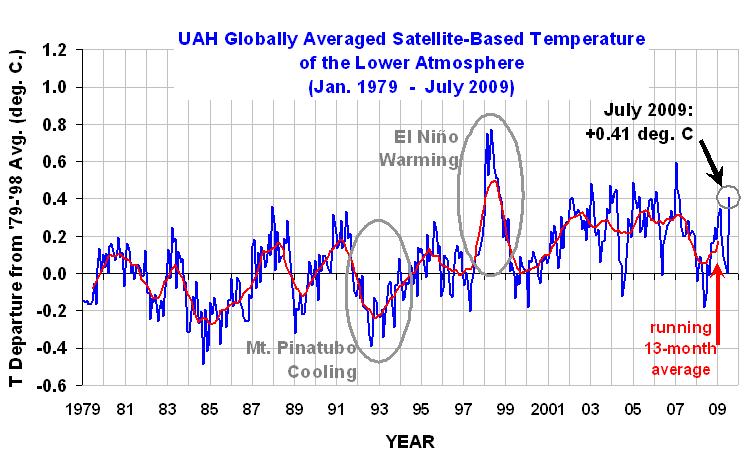
There is a very good case to be made for anthropogenic global cooling from CO2 emissions. The beginning of rapid increases in global CO2 emissions started in 1945 with the rapid increase in post war industrialization that has seen CO2 emissions rise from under 4gt/year in 1945, to over 31.5gt/year today. This increase in CO2 emissions over the past 63 years has resulted in over 40 years of global cooling. The only time that there was a decrease in emissions was from 1979 to 1982 when the world was warming.
This forms a positive correlation of sufficient statistical significance to make a reasonable case for this relationship to be valid. Although correlation is not causation, there is nothing in the current science literature database that demonstrates any contrary evidence so based solely on "peer reviewed" science literature (as is the case for AGW), this hypothesis could be taken as valid.
The original paper on this topic by Svante Arrhenius in 1896 can be shown to be in error because at the time quantum physics had not yet revealed the physical process of interaction between the Earth's radiative energy and atmospheric CO2.
The only part of the Earth's thermal radiative spectrum that is affected by CO2 is the 14.77micron band, but Arrhenius, unaware of this fact used measurements limited to only 9.7microns and therefore was not actually measuring the effect from CO2. He also used an experimental source for thermal radiation that was at 100°C, and the radiative spectrum from this source includes the 4.2micron wavelength band of CO2 that is not part of the Earth's radiative spectrum, so he was not measuring the actual effect from the thermal radiation from the Earth.
In 1970 the Nimbus 4 satellite measured the Earth's radiative spectrum showing that the spectral band affected by CO2 had a deep notch in it centred on 14.77microns. This deep notch demonstrated that well over 90% of the possible effect had already been achieved from just the 325ppmv atmospheric concentration of CO2, so further changes in concentration would have only minor effects, and increases in CO2 concentration could neither be responsible for either global warming or global cooling of any significant degree.
While CO2 concentration increases can be demonstrated to have little further effect on global temperatures, this has no bearing on CO2 emissions because there is no correlation between CO2 emissions and CO2 concentration, and CO2 emissions may alter the global temperature by processes other than changes to the greenhouse effect. It is easily demonstrated that there is no correlation between CO2 emissions and atmospheric CO2 concentration. Over the three years from 1979 to 1982 when CO2 emissions were decreasing due to the rapid increase in the price of oil that drastically reduced consumption, there was no change in the rate of increase in atmospheric concentration of CO2 proving that humans were not the primary source for the increase in concentration.
The science literature data base is filled with articles about global warming and CO2, but none of these articles actually relate CO2 emissions to global warming, and just falsely assume that emissions and concentration are interchangeable. All of the articles are based on projections from climate models, which also make this false assumption about emissions and concentration, and these models have yet to demonstrate a result that matches physical observation. This is because models use a contrived CO2 forcing parameter that was clearly not designed on any physical basis either experimental or empirical. In fact there is nothing in all the global warming literature, even the articles about polar bears and melting ice, that can refute the anthropogenic global cooling hypothesis.
Even though there is nothing in the literature data base that can refute the hypothesis of anthropogenic global cooling, the hypothesis can be clearly shown to be false by strict adherence to science protocol and the scientific method. There is clear observational evidence that the Earth warmed from 1975 to 1998 as emissions increased, so even though the world cooled for more years than it warmed with increasing CO2 emissions, these 23 years provide observations contrary to the hypothesis that can't be explained by the hypothesis, and therefore the hypothesis must be abandoned.
Another hypothesis that explains the current global cooling is based on solar cycles and their effect on solar output and changes to the Earth's albedo from cloud cover. The driving mechanism for this is not fully understood, but to date there is absolutely no contrary evidence to the overall hypothesis. There is in fact clear supportive evidence including observational evidence from a project called Earth Shine which measures the Earth's albedo by its reflection on the moon. The albedo measurements show reducing albedo concurrent with global warming, changing to increasing albedo concurrent with global cooling in 1998. (Figure 2 page 21). See here (PDF).
This is the way science is supposed to work, and while it is a simple matter to falsify the Anthropogenic Global Cooling hypothesis, it should be far easier to falsify the Anthropogenic Global Warming theory, because everything stated in the theory is contrary not only to observation, but contrary to established physical principles and physical laws as well. The fact that AGW still exists as a valid hypothesis seven years after the Earth started to cool in spite of the continued rapid increase in global CO2 emissions, is testament to how easy it is to misinform the public with well executed propaganda and media control.
Another comment on "OCEANS WARMEST ON RECORD"
An email from James H. Rust [jrust@bellsouth.net]
In the August 21, 2009 issue of The Atlanta Journal-Constitution, on page A9 appeared an article "Oceans warmest on record" by Associated Press writer Seth Borenstein.
The article stated the July 2009 average ocean temperature was 62.6 degrees as reported by the National Climate Data Center and the hottest since record-keeping began in 1880. The article contained statements by Canadian climate scientist Andrew Weaver of the University of Victoria in British Columbia. He stated that breaking ocean temperature records were more ominous than breaking land temperature records because water takes longer to heat up and cool. Weaver said, "This is another yet really important indicator of the change that's occurring."
Consulting the internet showed that Mr. Borenstein and Prof. Weaver have long been advocates that catastrophic events will occur due to carbon dioxide being added to the atmosphere from burning fossil fuels. One of the sites mentioned that a democratic society should have a well-informed public. This I agree with. However, that statement was followed with the public should not be informed about science disagreeing with carbon dioxide have significant effects on climate because that is misleading the public. So much for open debate in a democracy.
Further examining the data from the National Climate Data Center showed the 62.6 degrees was a global surface sea temperature which was 1.06 degrees warmer than the twentieth century average of 61.5 degrees. For the twentieth century, about half the time temperatures were increasing and the other half of the time temperatures were decreasing. If one compared the July 2009 sea surface temperature with the average for the last twenty five years of the twentieth century, the new record temperature would have been a few tenths of a degree higher.
We are presently in a period with an active El Nino in the central Pacific Ocean which should raise global surface sea temperatures. Surface sea temperatures should be a far cry from global ocean temperatures because of stratification of temperatures. Those who swim in the ocean can be quite comfortable on the surface and have cold feet six feet below. Warming from the sun only penetrates a few feet into water.
For several years we have been told that climate cooling is taking place because of reduced sunspot activity. In addition, I have read that ARGOS buoys planted throughout the oceans have indicated stable ocean temperatures or a slight decrease in temperature. This data has only existed since 2003. This information seems to contradict the findings reported by the Associated Press.
AFRICAN LEADERS DEMAND $70 BN P.A. FROM WEST FOR CLIMATE COMPENSATION
How are the Warmist politicians going to wriggle out of this one?
The leaders of 10 African countries are gathering in Ethiopia to try to agree a common position on climate change. The summit comes ahead of crucial UN talks in Copenhagen in December. Under the auspices of the African Union, the meeting will underline the chief African demand for compensation for damages caused by global warming. The move to agree a common negotiating platform for Africa is a recognition of the failure of the continent to make its voice heard to date.
One of the documents prepared for the meeting talks about the "dismal co-ordination" of the African negotiation process. So far, delegations from individual countries have had limited success in making the case that Africa needs special help as it has the lowest emissions of carbon dioxide on the planet, but is set to suffer the worst impacts.
In an attempt to change this, the African Union is bringing together the leaders of 10 countries under the chairmanship of Libya's Muammar Gaddafi. The objective is to agree a set of key ideas on the way forward on climate for Africa so that the continent can be represented by one delegation at the global negotiations in Copenhagen in December.
Proposals for discussion include the suggestion that developed countries should cut their emissions by at least 40% by 2020, and that the richer nations should provide funds of $67bn (£40bn) a year to help the least well off cope with the impacts of rising temperatures.
The reality of the UN climate negotiations is that the US, China, India and the European Union have the greatest sway. The African leaders will be hoping that speaking with one voice at Copenhagen will significantly enhance their negotiating position.
SOURCE
TREE COVER FAR BIGGER THAN EXPECTED ON FARMS: STUDY
Almost half of the world's farmland has at least 10 percent tree cover, according to a study on Monday indicating that farmers are far less destructive to carbon-storing forests than previously believed. "The area revealed in this study is twice the size of the Amazon, and shows that farmers are protecting and planting trees spontaneously," Dennis Garrity, Director General of the World Agroforestry Center in Nairobi, said in a statement.
The Centre's report, based on satellite images and the first to estimate tree cover on the world's farms, showed tree canopies exceeded 10 percent on farmland of 10 million square kms (3.9 million sq miles) -- 46 percent of all agricultural land and an area the size of Canada or China.
By one yardstick used by the U.N.'s Food and Agricultural Organization, a "forest" is an area in which tree canopies cover at least 10 percent of an area. The definition excludes, however, farmland or urban areas.
The report said that farmers keep or plant trees for uses such as production of fruit, nuts, medicines, fuel, building materials, gums or resins. Trees also provide shade for crops, work as windbreaks, boundary markers or to help avert erosion. And trees are often hardier than crops or livestock so can be a backup for farmers on marginal land in hard times.
Previous estimates of the area of farmland used in agroforestry had ranged up to only about 3 million sq kms. Farms are often portrayed as enemies of forests -- homes to a wide diversity of animals and plants. Forests are also giant stores of heat-trapping carbon dioxide, the main greenhouse gas. "We're pleasantly surprised -- it quantifies an under-appreciated resource," Tony Simons, deputy director general of the World Agroforestry Center, told Reuters.
More HERE
The environmental dark ages
To hear some environmentalists speak you would think that we are currently in the environmental dark ages. The ever expanding economy (current hiccup exempted) means that we are using up ever more resources, spewing out ever more pollution and generally leading the way to Hell in a handcart.
That they say this when the air and the waters are cleaner than they have been for many centuries, when resources, judged by their price, are cheaper and thus more abundant than ever, causes no little amusement.
However, it is their next step which is so dangerous. We must localise all production, not eat food from outside our own region: depending upon who you talk to it might be from outside your own garden, town, county or bioregion but international trade is certainly very naughty indeed. In fact, we shouldn't be getting anything at all from other countries, let alone the other side of the world.
Localism in government is to be admired, localism in production and consumption rather less so.
A new book on the end of the Roman Empire points to this as the defining economic mark of that age:
Not for nothing do we decribe that time as The Dark Ages. Last time around it came about because of the collapse (for whatever reasons) of a political power. Let's not inflict it upon ourselves in the name of environmentalism, eh?
SOURCE
Bring on global warming: Diabetes 'most likely to occur among children in winter'
Warmists are always claiming that warming is bad for your health despite all evidence to the contrary. Below is just one example of such contrary evidence
Children under 15 are more likely to develop diabetes in winter, a large international study suggests. Analysis of data of 31,000 children from 105 diabetes centres in 53 countries found a correlation between the season and the onset of Type 1 diabetes. Of the 42 centres that exhibited this seasonal trend, 28 centres had peaks of diagnosis in winter and 33 had troughs in summer. This winter trend was more prevalent in boys as well as in both sexes from the older age groups (5 to 14 years old).
The study, published in the journal Diabetic Medicine, also found that diabetes centres further away from the equator were more likely to have greater numbers of new cases in winter.
A total of 23,000 children in Britain have been diagnosed with Type 1 diabetes, the fourth-highest incidence in Europe, but the exact causes of the condition are unclear.
In contrast to Type 2 diabetes, which is associated with obesity and more likely to develop in middle age, the Type 1 form typically arises in childhood and requires lifelong supplements of insulin. The condition develops when the insulin-producing cells in the pancreas have been destroyed. It is not known for sure why these cells have been damaged but the most likely cause is an abnormal reaction of the body to the cells. This may be triggered by a viral or other infection.
Elena Moltchanova, who led the study at the National Institute for Health and Welfare, Helsinki, said: “Numerous reasons have been suggested for the apparent seasonality of the onset of Type 1 diabetes. “These include a seasonal variation in people’s levels of blood glucose and insulin, seasonal viral infections, the fact that young people tend to eat more and do less physical activity during winter months and, similarly, that summer holidays provide a rest from school stress and more opportunity to play outdoors.”
Victoria King, research manager at the charity Diabetes UK said that previous studies had shown conflicting results, “but this larger study shows a stronger correlation which is interesting, especially as we still don’t know exactly why Type 1 diabetes develops. “Investigating why we might be seeing this pattern could tell us more about what may be triggering the development of Type 1 diabetes”, she added. “Despite this, the study looked at correlations over a relatively short period of time and not all centres that took part in the study showed the correlation between seasonality and diagnosis of Type 1 diabetes so more data are needed before more definite conclusions can be drawn.”
SOURCE
***************************************
For more postings from me, see DISSECTING LEFTISM, TONGUE-TIED, EDUCATION WATCH INTERNATIONAL, POLITICAL CORRECTNESS WATCH, FOOD & HEALTH SKEPTIC, GUN WATCH, SOCIALIZED MEDICINE, AUSTRALIAN POLITICS, IMMIGRATION WATCH INTERNATIONAL and EYE ON BRITAIN. My Home Pages are here or here or here. Email me (John Ray) here. For readers in China or for times when blogger.com is playing up, there is a mirror of this site here.
*****************************************
An email from Norm Kalmanovitch [kalhnd@shaw.ca]
There is a very good case to be made for anthropogenic global cooling from CO2 emissions. The beginning of rapid increases in global CO2 emissions started in 1945 with the rapid increase in post war industrialization that has seen CO2 emissions rise from under 4gt/year in 1945, to over 31.5gt/year today. This increase in CO2 emissions over the past 63 years has resulted in over 40 years of global cooling. The only time that there was a decrease in emissions was from 1979 to 1982 when the world was warming.
This forms a positive correlation of sufficient statistical significance to make a reasonable case for this relationship to be valid. Although correlation is not causation, there is nothing in the current science literature database that demonstrates any contrary evidence so based solely on "peer reviewed" science literature (as is the case for AGW), this hypothesis could be taken as valid.
The original paper on this topic by Svante Arrhenius in 1896 can be shown to be in error because at the time quantum physics had not yet revealed the physical process of interaction between the Earth's radiative energy and atmospheric CO2.
The only part of the Earth's thermal radiative spectrum that is affected by CO2 is the 14.77micron band, but Arrhenius, unaware of this fact used measurements limited to only 9.7microns and therefore was not actually measuring the effect from CO2. He also used an experimental source for thermal radiation that was at 100°C, and the radiative spectrum from this source includes the 4.2micron wavelength band of CO2 that is not part of the Earth's radiative spectrum, so he was not measuring the actual effect from the thermal radiation from the Earth.
In 1970 the Nimbus 4 satellite measured the Earth's radiative spectrum showing that the spectral band affected by CO2 had a deep notch in it centred on 14.77microns. This deep notch demonstrated that well over 90% of the possible effect had already been achieved from just the 325ppmv atmospheric concentration of CO2, so further changes in concentration would have only minor effects, and increases in CO2 concentration could neither be responsible for either global warming or global cooling of any significant degree.
While CO2 concentration increases can be demonstrated to have little further effect on global temperatures, this has no bearing on CO2 emissions because there is no correlation between CO2 emissions and CO2 concentration, and CO2 emissions may alter the global temperature by processes other than changes to the greenhouse effect. It is easily demonstrated that there is no correlation between CO2 emissions and atmospheric CO2 concentration. Over the three years from 1979 to 1982 when CO2 emissions were decreasing due to the rapid increase in the price of oil that drastically reduced consumption, there was no change in the rate of increase in atmospheric concentration of CO2 proving that humans were not the primary source for the increase in concentration.
The science literature data base is filled with articles about global warming and CO2, but none of these articles actually relate CO2 emissions to global warming, and just falsely assume that emissions and concentration are interchangeable. All of the articles are based on projections from climate models, which also make this false assumption about emissions and concentration, and these models have yet to demonstrate a result that matches physical observation. This is because models use a contrived CO2 forcing parameter that was clearly not designed on any physical basis either experimental or empirical. In fact there is nothing in all the global warming literature, even the articles about polar bears and melting ice, that can refute the anthropogenic global cooling hypothesis.
Even though there is nothing in the literature data base that can refute the hypothesis of anthropogenic global cooling, the hypothesis can be clearly shown to be false by strict adherence to science protocol and the scientific method. There is clear observational evidence that the Earth warmed from 1975 to 1998 as emissions increased, so even though the world cooled for more years than it warmed with increasing CO2 emissions, these 23 years provide observations contrary to the hypothesis that can't be explained by the hypothesis, and therefore the hypothesis must be abandoned.
Another hypothesis that explains the current global cooling is based on solar cycles and their effect on solar output and changes to the Earth's albedo from cloud cover. The driving mechanism for this is not fully understood, but to date there is absolutely no contrary evidence to the overall hypothesis. There is in fact clear supportive evidence including observational evidence from a project called Earth Shine which measures the Earth's albedo by its reflection on the moon. The albedo measurements show reducing albedo concurrent with global warming, changing to increasing albedo concurrent with global cooling in 1998. (Figure 2 page 21). See here (PDF).
This is the way science is supposed to work, and while it is a simple matter to falsify the Anthropogenic Global Cooling hypothesis, it should be far easier to falsify the Anthropogenic Global Warming theory, because everything stated in the theory is contrary not only to observation, but contrary to established physical principles and physical laws as well. The fact that AGW still exists as a valid hypothesis seven years after the Earth started to cool in spite of the continued rapid increase in global CO2 emissions, is testament to how easy it is to misinform the public with well executed propaganda and media control.
Another comment on "OCEANS WARMEST ON RECORD"
An email from James H. Rust [jrust@bellsouth.net]
In the August 21, 2009 issue of The Atlanta Journal-Constitution, on page A9 appeared an article "Oceans warmest on record" by Associated Press writer Seth Borenstein.
The article stated the July 2009 average ocean temperature was 62.6 degrees as reported by the National Climate Data Center and the hottest since record-keeping began in 1880. The article contained statements by Canadian climate scientist Andrew Weaver of the University of Victoria in British Columbia. He stated that breaking ocean temperature records were more ominous than breaking land temperature records because water takes longer to heat up and cool. Weaver said, "This is another yet really important indicator of the change that's occurring."
Consulting the internet showed that Mr. Borenstein and Prof. Weaver have long been advocates that catastrophic events will occur due to carbon dioxide being added to the atmosphere from burning fossil fuels. One of the sites mentioned that a democratic society should have a well-informed public. This I agree with. However, that statement was followed with the public should not be informed about science disagreeing with carbon dioxide have significant effects on climate because that is misleading the public. So much for open debate in a democracy.
Further examining the data from the National Climate Data Center showed the 62.6 degrees was a global surface sea temperature which was 1.06 degrees warmer than the twentieth century average of 61.5 degrees. For the twentieth century, about half the time temperatures were increasing and the other half of the time temperatures were decreasing. If one compared the July 2009 sea surface temperature with the average for the last twenty five years of the twentieth century, the new record temperature would have been a few tenths of a degree higher.
We are presently in a period with an active El Nino in the central Pacific Ocean which should raise global surface sea temperatures. Surface sea temperatures should be a far cry from global ocean temperatures because of stratification of temperatures. Those who swim in the ocean can be quite comfortable on the surface and have cold feet six feet below. Warming from the sun only penetrates a few feet into water.
For several years we have been told that climate cooling is taking place because of reduced sunspot activity. In addition, I have read that ARGOS buoys planted throughout the oceans have indicated stable ocean temperatures or a slight decrease in temperature. This data has only existed since 2003. This information seems to contradict the findings reported by the Associated Press.
AFRICAN LEADERS DEMAND $70 BN P.A. FROM WEST FOR CLIMATE COMPENSATION
How are the Warmist politicians going to wriggle out of this one?
The leaders of 10 African countries are gathering in Ethiopia to try to agree a common position on climate change. The summit comes ahead of crucial UN talks in Copenhagen in December. Under the auspices of the African Union, the meeting will underline the chief African demand for compensation for damages caused by global warming. The move to agree a common negotiating platform for Africa is a recognition of the failure of the continent to make its voice heard to date.
One of the documents prepared for the meeting talks about the "dismal co-ordination" of the African negotiation process. So far, delegations from individual countries have had limited success in making the case that Africa needs special help as it has the lowest emissions of carbon dioxide on the planet, but is set to suffer the worst impacts.
In an attempt to change this, the African Union is bringing together the leaders of 10 countries under the chairmanship of Libya's Muammar Gaddafi. The objective is to agree a set of key ideas on the way forward on climate for Africa so that the continent can be represented by one delegation at the global negotiations in Copenhagen in December.
Proposals for discussion include the suggestion that developed countries should cut their emissions by at least 40% by 2020, and that the richer nations should provide funds of $67bn (£40bn) a year to help the least well off cope with the impacts of rising temperatures.
The reality of the UN climate negotiations is that the US, China, India and the European Union have the greatest sway. The African leaders will be hoping that speaking with one voice at Copenhagen will significantly enhance their negotiating position.
SOURCE
TREE COVER FAR BIGGER THAN EXPECTED ON FARMS: STUDY
Almost half of the world's farmland has at least 10 percent tree cover, according to a study on Monday indicating that farmers are far less destructive to carbon-storing forests than previously believed. "The area revealed in this study is twice the size of the Amazon, and shows that farmers are protecting and planting trees spontaneously," Dennis Garrity, Director General of the World Agroforestry Center in Nairobi, said in a statement.
The Centre's report, based on satellite images and the first to estimate tree cover on the world's farms, showed tree canopies exceeded 10 percent on farmland of 10 million square kms (3.9 million sq miles) -- 46 percent of all agricultural land and an area the size of Canada or China.
By one yardstick used by the U.N.'s Food and Agricultural Organization, a "forest" is an area in which tree canopies cover at least 10 percent of an area. The definition excludes, however, farmland or urban areas.
The report said that farmers keep or plant trees for uses such as production of fruit, nuts, medicines, fuel, building materials, gums or resins. Trees also provide shade for crops, work as windbreaks, boundary markers or to help avert erosion. And trees are often hardier than crops or livestock so can be a backup for farmers on marginal land in hard times.
Previous estimates of the area of farmland used in agroforestry had ranged up to only about 3 million sq kms. Farms are often portrayed as enemies of forests -- homes to a wide diversity of animals and plants. Forests are also giant stores of heat-trapping carbon dioxide, the main greenhouse gas. "We're pleasantly surprised -- it quantifies an under-appreciated resource," Tony Simons, deputy director general of the World Agroforestry Center, told Reuters.
More HERE
The environmental dark ages
To hear some environmentalists speak you would think that we are currently in the environmental dark ages. The ever expanding economy (current hiccup exempted) means that we are using up ever more resources, spewing out ever more pollution and generally leading the way to Hell in a handcart.
That they say this when the air and the waters are cleaner than they have been for many centuries, when resources, judged by their price, are cheaper and thus more abundant than ever, causes no little amusement.
However, it is their next step which is so dangerous. We must localise all production, not eat food from outside our own region: depending upon who you talk to it might be from outside your own garden, town, county or bioregion but international trade is certainly very naughty indeed. In fact, we shouldn't be getting anything at all from other countries, let alone the other side of the world.
Localism in government is to be admired, localism in production and consumption rather less so.
A new book on the end of the Roman Empire points to this as the defining economic mark of that age:
An emphasis on "localization" as the fundamental change following the fall of the Roman Empire, and numerous micro-studies of exactly how that localization occurred. Cities shrank, trade networks dried up, etc.
Not for nothing do we decribe that time as The Dark Ages. Last time around it came about because of the collapse (for whatever reasons) of a political power. Let's not inflict it upon ourselves in the name of environmentalism, eh?
SOURCE
Bring on global warming: Diabetes 'most likely to occur among children in winter'
Warmists are always claiming that warming is bad for your health despite all evidence to the contrary. Below is just one example of such contrary evidence
Children under 15 are more likely to develop diabetes in winter, a large international study suggests. Analysis of data of 31,000 children from 105 diabetes centres in 53 countries found a correlation between the season and the onset of Type 1 diabetes. Of the 42 centres that exhibited this seasonal trend, 28 centres had peaks of diagnosis in winter and 33 had troughs in summer. This winter trend was more prevalent in boys as well as in both sexes from the older age groups (5 to 14 years old).
The study, published in the journal Diabetic Medicine, also found that diabetes centres further away from the equator were more likely to have greater numbers of new cases in winter.
A total of 23,000 children in Britain have been diagnosed with Type 1 diabetes, the fourth-highest incidence in Europe, but the exact causes of the condition are unclear.
In contrast to Type 2 diabetes, which is associated with obesity and more likely to develop in middle age, the Type 1 form typically arises in childhood and requires lifelong supplements of insulin. The condition develops when the insulin-producing cells in the pancreas have been destroyed. It is not known for sure why these cells have been damaged but the most likely cause is an abnormal reaction of the body to the cells. This may be triggered by a viral or other infection.
Elena Moltchanova, who led the study at the National Institute for Health and Welfare, Helsinki, said: “Numerous reasons have been suggested for the apparent seasonality of the onset of Type 1 diabetes. “These include a seasonal variation in people’s levels of blood glucose and insulin, seasonal viral infections, the fact that young people tend to eat more and do less physical activity during winter months and, similarly, that summer holidays provide a rest from school stress and more opportunity to play outdoors.”
Victoria King, research manager at the charity Diabetes UK said that previous studies had shown conflicting results, “but this larger study shows a stronger correlation which is interesting, especially as we still don’t know exactly why Type 1 diabetes develops. “Investigating why we might be seeing this pattern could tell us more about what may be triggering the development of Type 1 diabetes”, she added. “Despite this, the study looked at correlations over a relatively short period of time and not all centres that took part in the study showed the correlation between seasonality and diagnosis of Type 1 diabetes so more data are needed before more definite conclusions can be drawn.”
SOURCE
***************************************
For more postings from me, see DISSECTING LEFTISM, TONGUE-TIED, EDUCATION WATCH INTERNATIONAL, POLITICAL CORRECTNESS WATCH, FOOD & HEALTH SKEPTIC, GUN WATCH, SOCIALIZED MEDICINE, AUSTRALIAN POLITICS, IMMIGRATION WATCH INTERNATIONAL and EYE ON BRITAIN. My Home Pages are here or here or here. Email me (John Ray) here. For readers in China or for times when blogger.com is playing up, there is a mirror of this site here.
*****************************************
Monday, August 24, 2009
Britain backpedalling?
Carbon targets may be too tough, says former deputy PM
Targets to cut carbon dioxide emissions may have to be watered down to get a deal at the critical Copenhagen climate summit, the former deputy prime minister John Prescott warns today.
Prescott, who brokered the Kyoto deal on climate change a decade ago and is heavily involved in the current negotiations, risked the wrath of green campaigners by saying it was time for a "plan B" if agreement could not be reached between the main parties.
That could involve accepting a longer timetable for cuts in carbon emissions that are supposed to be achieved by 2020 and then by 2050, he suggested, arguing that it was more important to get a deal "on the principles" of how high-carbon lifestyles are tackled worldwide.
"I am saying you had better start preparing in your minds for plan B as well as plan A," he said. "A lot of people fear that if you moved away from those targets you would get the NGOs screaming and shouting, 'you have sold out', but I had to ignore them to get the deal at Kyoto."
He explained that if it were not possible to "dot the i's and cross the t's" of targets, then the summit could agree to flesh out the details later so long as the principles of a deal to shift towards low-carbon lifestyles were clear. He insisted that common ground could be found despite resistance to targets among developing countries, but there could be "conflict" over the timetable, adding: "We might not be able to get it by 2020 or by 2050 but [we should] agree the principles."
Prescott, who remains an envoy on climate change for the Council of Europe, has been shuttling between Washington and China talking to key players in the negotiations. This week he will launch a new website, newearthdeal.org, designed to promote the idea of a fairer settlement on climate change for developing countries and to encourage the public to lobby politicians. He will follow it up with a tour of schools in the autumn.
He supports the idea of targets based on emissions per head, rather than per government – which would be easier for highly populous but relatively underdeveloped countries such as China and India to meet, but tougher on the US – arguing that "social justice" needs to be built into the deal.
Prescott, who has become an unlikely star of the blogosphere, hopes to use his mastery of social media to galvanise public support for a global warming deal. He has already used Facebook to build a campaign to curb bankers' bonuses and last week used Twitter to torment the Conservatives over MEP Daniel Hannan's outbursts against the NHS.
Asked what he was doing personally to reduce his carbon emissions, he said he was considering solar panels for his roof and a home wind turbine.
SOURCE
Tony Blair: Vagueness is the solution
I think this qualfies as a classic example of a good old British "fudge"
World leaders must not get bogged down in 'precise percentages' when they negotiate a successor the Kyoto climate change treaty in Copenhagen, Tony Blair has said. Speaking in Beijing on Thursday, Mr Blair said leaders should trust in new technologies to put the world on a path to a greener future.
The former British prime minister called for a "realistic and practical" deal to be struck at the UN Summit in Copenhagen this December that would unleash the potential of green technology to solve the problem of global warming. "We need to get an agreement that sets the world on a new path of sustainable consumption without getting obsessed with precise percentages," he said.
Mr Blair, who is working with the non-profit Climate Group to push for an agreement in December, welcomed recent reports that China is considering setting targets that will see its carbon emissions peak in 2030. However he predicted the key to success in keeping climate change below the UN's benchmark 2C would come down to as yet unforeseen developments in greener cars, buildings and power-stations. "It is impossible to predict now what might happen in 10 or 20 years time," he added, [Wisdom is dawning!] "the important thing is that we reach an agreement that allows China and India, the US and EU to come to a common position - though with varying obligations. "If we reach an agreement that sets the world on this new sustainable path then I think that we can see emissions peak more quickly than many people think."
Mr Blair added that China was now leading the way in some areas of green technology and investment and urged leaders of the developed and developing worlds to get away from a "binary approach" to climate change. "We must get away from seeing climate change as an East versus West issue. There are huge business opportunities in green technology whether you are in London or California, China or India."
Preliminary rounds of negotiations have shown that developing and developed world nations are still a long way apart when it comes to the "precise percentages" on cutting emissions.
China and India continue to call for a 40pc reduction in greenhouse gasses below 1990 levels by 2020 from the developed world, while European and US negotiations say 13 to 17 per cent is the best they can offer.
Acknowledging that negotiations would be tough - and get tougher as the December deal for a deadline approached - Mr Blair said that there had nonetheless been a significant change in attitudes towards climate change since his term in office. "I expect China will come out with its position, America will come out with its position and so on ...[but] the agenda for [Copenhagen], I think, is on a completely different level of credibility than previous negotiations."
SOURCE
Something’s Fishy With Global Ocean Temperature Measurements
by Roy W. Spencer, Ph. D.
In my previous blog posting I showed the satellite-based global-average monthly sea surface temperature (SST) variations since mid-2002, which was when the NASA Aqua satellite was launched carrying the Advanced Microwave Scanning Radiometer for EOS (AMSR-E). The AMSR-E instrument (which I serve as the U.S. Science Team Leader for) provides nearly all-weather SST measurements.
The plot I showed yesterday agreed with the NOAA announcement that July 2009 was unusually warm…NOAA claims it was even a new record for July based upon their 100+ year record of global SSTs.
But I didn’t know just HOW warm, since our satellite data extend back to only 2002. So, I decided to download the NOAA/NCDC SST data from their website — which do NOT include the AMSR-E measurements — to do a more quantitative comparison.
From the NOAA data, I computed monthly anomalies in exactly the same manner I computed them with the AMSR-E data, that is, relative to the June 2002 through July 2009 period of record. The results (shown below) were so surprising, I had to go to my office this Saturday morning to make sure I didn’t make a mistake in my processing of the AMSR-E data.
As can be seen, the satellite-based temperatures have been steadily rising relative to the conventional SST measurements, with a total linear increase of 0.15 deg C over the 7 year period of record versus the conventional SST measurements.
If the satellite data are correct, then this means that the July 2009 SSTs reached a considerably higher record temperature than NOAA has claimed. The discrepancy is huge in terms of climate measurements; the trend in the difference between the two datasets shown in the above figure is the same size as the anthropogenic global warming signal expected by the IPCC.
I have no idea what is going on here. Frank Wentz and Chelle Gentemann at Remote Sensing Systems have been very careful about tracking the accuracy of the AMSR-E SST retrievals with millions of buoy measurements. I checked their daily statistics they post at their website and I don’t see anything like what is shown in the above figure.
Is it possible that the NCDC SST temperature dataset has been understating recent warming? I don’t know…I’m mystified. Maybe Frank, Chelle, Phil Jones, or some enterprising blogger out there can figure this one out.
More HERE (See the original for links, graphics etc.)
The Big Global Warming Debate
Editorial by S. Fred Singer
Don’t get taken in by stories of penguins and polar bears, hurricanes and heat waves, floods and famines. There is really only one key question: Is the cause of current climate changes primarily natural or is it human- caused? In particular, is there really any appreciable Anthropogenic Global Warming (AGW)? Aside from its scientific importance, the question has great significance for policy. If climate change is natural, if there is no appreciable AGW, then there is little we can do about it.
We’d better just adapt -- as humans have been doing for many millennia.
Climate is always changing warming or cooling on many time scales. So the overall warming of the 20th century could well be natural. On the other hand, the growing level of human activity, esp. generation of energy by fossil-fuel burning, has increased levels of atmospheric greenhouse (GH) gases, esp. carbon dioxide (CO2). So an anthropogenic cause is also plausible. How to decide? That’s the essence of the climate debate.
The opposing positions are clear-cut but difficult to reconcile. The UN-sponsored IPCC (Inter-governmental Panel on Climate Change) claims it’s mostly anthropogenic. The independent NIPCC (Non-governmental International Panel on Climate Change) says climate change is mostly natural, as it always has been.
The IPCC appeals to a scientific consensus (wrong!), to recent climate change as being unusual (not so!), to ice shrinking and glaciers melting (tells nothing about the cause!), to a positive correlation between increases in CO2 and temperature (frequently negative!), and to agreement between observations and climate models. But the NIPCC claims that observations disagree with GH models; therefore models have not been validated and cannot be relied on to predict future climate. This disagreement is where current debate focuses -- as it should.
If the NIPCC is correct and climate change is mostly natural, then this means that carbon dioxide contributes insignificantly to Global Warming and is therefore not a 'pollutant.' This fact has not yet been widely recognized, and irrational GW fears continue to distort energy policies and foreign policy. All efforts to curtail CO2 emissions, whether global, federal, or at the state level, are pointless -- and in any case, ineffective and very costly.
However, there are still two interesting scientific questions calling for a solution:
· Why do observations and models disagree? Why do GH models call for substantial warming trends, while the data do not and even show cooling, as since 1998?
· And if GH gases are really ineffective, as NIPCC claims, what exactly is causing climate to change on a time scale of decades and centuries?
But if the IPCC is correct, and some adjustment of observations and models could bring them into agreement, then there are still two further hurdles before one can justify any drastic policies of mitigation, aside from common-sense energy conservation.
· Is a warmer climate really worse than the present one? Economic analysis and historic evidence both indicate that, on the whole, a warmer climate is beneficial--and so are higher levels of atmospheric CO2 that feed agricultural crops and forests.
· Can practical and economically acceptable mitigation schemes really have much effect on climate or even on atmospheric GH gas levels?
These are the issues that politicians need to debate before rushing ahead with ill-considered legislation. Maybe the best policy is to abstain and do nothing. Remember the maxim of physicians: Above all, do no harm!
SEPP Editorial #26-2009 (8/22/09)
ASK NOT IF THE SCIENCE OF GLOBAL WARMING IS TRUE ...
BOOK REVIEW of "Why We Disagree About Climate Change by Mike Hulme. Review by Joe Bast
More than a few people will be tempted to buy this book based on the promise, implicit in its title, that it examines the ideas and motives of both sides in the global warming debate. But that is not what this book is about. It is the musings of a British socialist about how to use global warming claims as a means of persuading “the masses” to give up their economic liberties.
That the author, Mike Hulme, is a scientist who helped write the influential reports of the Intergovernmental Panel on Climate Change (IPCC) and many other government agencies makes this book even more disturbing.
Narrow-Minded Outlook
Hulme frankly admits his perspective is colored by his politics—“democratic socialist”—and it soon becomes apparent that the only disagreements about climate change he’s aware of are those occurring between the left (people who think like him) and the far left, people he describes as “eco-anarchists,” “eco-socialists,” and “eco-authoritarians.”
Opposition from centrists, conservatives, libertarians, and non-ideological scientists who dispute his alarmist spin on the complicated data of global warming merit hardly any mention.
Warming Gospel in Doubt
The notion that science can be determined by government agencies proclaiming to speak on behalf of entire scientific communities might be passively accepted in Old Europe, but it is jarring for an American reader. Opinion polls show two-thirds of us do not believe global warming is manmade, and more than 30,000 American scientists (including more than 9,000 with Ph.D.s) have signed a petition saying there is no convincing scientific evidence that human activity will cause catastrophic global warming.
A group of scientists called the Nongovernmental International Panel on Climate Change (NIPCC) has produced an 880-page rebuttal of the latest IPCC report containing more than 4,000 references to peer-reviewed science. I edited that work.
There is a debate taking place about global warming in America, and it is not the one described by Hulme as being between those who favor “cap and trade” and those who favor even more radical changes in political, social, and economic behavior. Rather, it is about how much of the warming of the late twentieth century was natural and how much was manmade, whether the consequences of that warming were on balance positive or negative, and whether anything should be or could be done to prevent or delay future warming. This debate—the real public policy debate—is entirely missing from Hulme’s book.
Ideological Agenda
Convinced that the scientific debate is over and he won, Hulme devotes most of his attention to finding ways to overcome “barriers other than lack of scientific knowledge to changing the status of climate change in the minds of citizens—psychological, emotional, and behavioural barriers.” He attempts to explain the public’s failure to respond to his calls for action in terms of popular theories of irrational group behavior, such as anchoring, fear of change, and so on. He lacks the power of introspection that would have led him to understand the fountains of his own irrational beliefs.
The real purpose of this book isn’t revealed until far into it. “The idea of climate change,” Hulme writes at page 326, “should be seen as an intellectual resource around which our collective and personal identities and projects can form and take shape. We need to ask not what we can do for climate change, but to ask what climate change can do for us.”
According to Hulme, climate change can do a lot: “Because the idea of climate change is so plastic, it can be deployed across many of our human projects and can serve many of our psychological, ethical, and spiritual needs.”
In other words, socialists like Hulme can frame the global warming issue to achieve unrelated goals such as sustainable development, income redistribution, population control, social justice, and many other items on the liberal/socialist wish list.
Knowingly Telling Lies
Like the notorious Stephen Schneider, who once said, “We have to offer up scary scenarios, make simplified, dramatic statements, and make little mention of any doubts one might have. ... Each of us has to decide what the right balance is between being effective and being honest,” Hulme writes, “We will continue to create and tell new stories about climate change and mobilise them in support of our projects.”
These “myths,” he writes, “transcend the scientific categories of ‘true’ and ‘false’.” He suggests that his fellow global warming alarmists promote four myths, which he labels Lamenting Eden, Presaging Apocalypse, Constructing Babel, and Celebrating Jubilee.
It is troubling to read a prominent scientist who has so clearly lost sight of his cardinal duty—to be skeptical of all theories and always open to new data. It is particularly troubling when this scientist endorses lying to advance his personal political agenda.
Read this book if you want insight into the mind of a scientist who has surrendered all moral authority to speak truthfully about global warming. Avoid it if you are looking for a book that explains why we disagree about climate change.
SOURCE
Major Australian conservative political party totally rejects any Warmist laws
The rural and regional-based National party invariably forms part of a coalition with the Centre-Right "Liberal" party in government but tends in general to be farther Right. There are however many global-warming skeptics in the Liberal party too
Before we go north of the Tweed, however, let's duck down to Canberra where at the historic Hyatt Hotel, the Nationals yesterday wound up their peak federal council meeting.
And very successful it was too. In the words of the party's federal director Brad Henderson, in his report to conference: "A new treatment of our logo, new website, in our annual report and with a new visual identity our contemporary new look tells Australians that we are changing."
What that "changing" meant became clear as the weekend progressed. In danger of dying a demographic death the Nationals have decided to rededicate themselves to their base.
Again in Henderson's words: "The nub of the changes that we are making is about more assertively advocating the interests of regional Australia."
The trouble is that in doing so they will henceforth not only be seeking to differentiate themselves from Labor but from the Liberals and Turnbull too.
Henderson in his report was clear about this. This new course, he said, "will require protection from bad or clumsy policy because regional Australia has the most to lose from policies like Labor's emissions trading scheme."
The possessive noun "Labor's" as applied to the emissions trading scheme is cursory, of course. What the Nationals really mean is that they are opposed to any ETS: a position the Nationals Senate leader Barnaby Joyce made clear yesterday morning when interviewed on the Nine Network.
Asked by Laurie Oakes whether the Nationals at the conference had decided they wouldn't vote for an emissions trading system under any circumstances, Joyce replied: "That is correct."
Translated, that is a one-finger salute to Turnbull. In other words, no matter what amendments or concessions he manages to negotiate with the Rudd government before the ETS comes back before the Senate in November, the Nationals won't be having a bar of it.
And what's more, said Joyce, making policy not so much on the run as at a gallop, if the Coalition does win government at the next election they'll be dismantling whatever ETS is in place anyway.
More HERE
***************************************
For more postings from me, see DISSECTING LEFTISM, TONGUE-TIED, EDUCATION WATCH INTERNATIONAL, POLITICAL CORRECTNESS WATCH, FOOD & HEALTH SKEPTIC, GUN WATCH, SOCIALIZED MEDICINE, AUSTRALIAN POLITICS, IMMIGRATION WATCH INTERNATIONAL and EYE ON BRITAIN. My Home Pages are here or here or here. Email me (John Ray) here. For readers in China or for times when blogger.com is playing up, there is a mirror of this site here.
*****************************************
Carbon targets may be too tough, says former deputy PM
Targets to cut carbon dioxide emissions may have to be watered down to get a deal at the critical Copenhagen climate summit, the former deputy prime minister John Prescott warns today.
Prescott, who brokered the Kyoto deal on climate change a decade ago and is heavily involved in the current negotiations, risked the wrath of green campaigners by saying it was time for a "plan B" if agreement could not be reached between the main parties.
That could involve accepting a longer timetable for cuts in carbon emissions that are supposed to be achieved by 2020 and then by 2050, he suggested, arguing that it was more important to get a deal "on the principles" of how high-carbon lifestyles are tackled worldwide.
"I am saying you had better start preparing in your minds for plan B as well as plan A," he said. "A lot of people fear that if you moved away from those targets you would get the NGOs screaming and shouting, 'you have sold out', but I had to ignore them to get the deal at Kyoto."
He explained that if it were not possible to "dot the i's and cross the t's" of targets, then the summit could agree to flesh out the details later so long as the principles of a deal to shift towards low-carbon lifestyles were clear. He insisted that common ground could be found despite resistance to targets among developing countries, but there could be "conflict" over the timetable, adding: "We might not be able to get it by 2020 or by 2050 but [we should] agree the principles."
Prescott, who remains an envoy on climate change for the Council of Europe, has been shuttling between Washington and China talking to key players in the negotiations. This week he will launch a new website, newearthdeal.org, designed to promote the idea of a fairer settlement on climate change for developing countries and to encourage the public to lobby politicians. He will follow it up with a tour of schools in the autumn.
He supports the idea of targets based on emissions per head, rather than per government – which would be easier for highly populous but relatively underdeveloped countries such as China and India to meet, but tougher on the US – arguing that "social justice" needs to be built into the deal.
Prescott, who has become an unlikely star of the blogosphere, hopes to use his mastery of social media to galvanise public support for a global warming deal. He has already used Facebook to build a campaign to curb bankers' bonuses and last week used Twitter to torment the Conservatives over MEP Daniel Hannan's outbursts against the NHS.
Asked what he was doing personally to reduce his carbon emissions, he said he was considering solar panels for his roof and a home wind turbine.
SOURCE
Tony Blair: Vagueness is the solution
I think this qualfies as a classic example of a good old British "fudge"
World leaders must not get bogged down in 'precise percentages' when they negotiate a successor the Kyoto climate change treaty in Copenhagen, Tony Blair has said. Speaking in Beijing on Thursday, Mr Blair said leaders should trust in new technologies to put the world on a path to a greener future.
The former British prime minister called for a "realistic and practical" deal to be struck at the UN Summit in Copenhagen this December that would unleash the potential of green technology to solve the problem of global warming. "We need to get an agreement that sets the world on a new path of sustainable consumption without getting obsessed with precise percentages," he said.
Mr Blair, who is working with the non-profit Climate Group to push for an agreement in December, welcomed recent reports that China is considering setting targets that will see its carbon emissions peak in 2030. However he predicted the key to success in keeping climate change below the UN's benchmark 2C would come down to as yet unforeseen developments in greener cars, buildings and power-stations. "It is impossible to predict now what might happen in 10 or 20 years time," he added, [Wisdom is dawning!] "the important thing is that we reach an agreement that allows China and India, the US and EU to come to a common position - though with varying obligations. "If we reach an agreement that sets the world on this new sustainable path then I think that we can see emissions peak more quickly than many people think."
Mr Blair added that China was now leading the way in some areas of green technology and investment and urged leaders of the developed and developing worlds to get away from a "binary approach" to climate change. "We must get away from seeing climate change as an East versus West issue. There are huge business opportunities in green technology whether you are in London or California, China or India."
Preliminary rounds of negotiations have shown that developing and developed world nations are still a long way apart when it comes to the "precise percentages" on cutting emissions.
China and India continue to call for a 40pc reduction in greenhouse gasses below 1990 levels by 2020 from the developed world, while European and US negotiations say 13 to 17 per cent is the best they can offer.
Acknowledging that negotiations would be tough - and get tougher as the December deal for a deadline approached - Mr Blair said that there had nonetheless been a significant change in attitudes towards climate change since his term in office. "I expect China will come out with its position, America will come out with its position and so on ...[but] the agenda for [Copenhagen], I think, is on a completely different level of credibility than previous negotiations."
SOURCE
Something’s Fishy With Global Ocean Temperature Measurements
by Roy W. Spencer, Ph. D.
In my previous blog posting I showed the satellite-based global-average monthly sea surface temperature (SST) variations since mid-2002, which was when the NASA Aqua satellite was launched carrying the Advanced Microwave Scanning Radiometer for EOS (AMSR-E). The AMSR-E instrument (which I serve as the U.S. Science Team Leader for) provides nearly all-weather SST measurements.
The plot I showed yesterday agreed with the NOAA announcement that July 2009 was unusually warm…NOAA claims it was even a new record for July based upon their 100+ year record of global SSTs.
But I didn’t know just HOW warm, since our satellite data extend back to only 2002. So, I decided to download the NOAA/NCDC SST data from their website — which do NOT include the AMSR-E measurements — to do a more quantitative comparison.
From the NOAA data, I computed monthly anomalies in exactly the same manner I computed them with the AMSR-E data, that is, relative to the June 2002 through July 2009 period of record. The results (shown below) were so surprising, I had to go to my office this Saturday morning to make sure I didn’t make a mistake in my processing of the AMSR-E data.
As can be seen, the satellite-based temperatures have been steadily rising relative to the conventional SST measurements, with a total linear increase of 0.15 deg C over the 7 year period of record versus the conventional SST measurements.
If the satellite data are correct, then this means that the July 2009 SSTs reached a considerably higher record temperature than NOAA has claimed. The discrepancy is huge in terms of climate measurements; the trend in the difference between the two datasets shown in the above figure is the same size as the anthropogenic global warming signal expected by the IPCC.
I have no idea what is going on here. Frank Wentz and Chelle Gentemann at Remote Sensing Systems have been very careful about tracking the accuracy of the AMSR-E SST retrievals with millions of buoy measurements. I checked their daily statistics they post at their website and I don’t see anything like what is shown in the above figure.
Is it possible that the NCDC SST temperature dataset has been understating recent warming? I don’t know…I’m mystified. Maybe Frank, Chelle, Phil Jones, or some enterprising blogger out there can figure this one out.
More HERE (See the original for links, graphics etc.)
The Big Global Warming Debate
Editorial by S. Fred Singer
Don’t get taken in by stories of penguins and polar bears, hurricanes and heat waves, floods and famines. There is really only one key question: Is the cause of current climate changes primarily natural or is it human- caused? In particular, is there really any appreciable Anthropogenic Global Warming (AGW)? Aside from its scientific importance, the question has great significance for policy. If climate change is natural, if there is no appreciable AGW, then there is little we can do about it.
We’d better just adapt -- as humans have been doing for many millennia.
Climate is always changing warming or cooling on many time scales. So the overall warming of the 20th century could well be natural. On the other hand, the growing level of human activity, esp. generation of energy by fossil-fuel burning, has increased levels of atmospheric greenhouse (GH) gases, esp. carbon dioxide (CO2). So an anthropogenic cause is also plausible. How to decide? That’s the essence of the climate debate.
The opposing positions are clear-cut but difficult to reconcile. The UN-sponsored IPCC (Inter-governmental Panel on Climate Change) claims it’s mostly anthropogenic. The independent NIPCC (Non-governmental International Panel on Climate Change) says climate change is mostly natural, as it always has been.
The IPCC appeals to a scientific consensus (wrong!), to recent climate change as being unusual (not so!), to ice shrinking and glaciers melting (tells nothing about the cause!), to a positive correlation between increases in CO2 and temperature (frequently negative!), and to agreement between observations and climate models. But the NIPCC claims that observations disagree with GH models; therefore models have not been validated and cannot be relied on to predict future climate. This disagreement is where current debate focuses -- as it should.
If the NIPCC is correct and climate change is mostly natural, then this means that carbon dioxide contributes insignificantly to Global Warming and is therefore not a 'pollutant.' This fact has not yet been widely recognized, and irrational GW fears continue to distort energy policies and foreign policy. All efforts to curtail CO2 emissions, whether global, federal, or at the state level, are pointless -- and in any case, ineffective and very costly.
However, there are still two interesting scientific questions calling for a solution:
· Why do observations and models disagree? Why do GH models call for substantial warming trends, while the data do not and even show cooling, as since 1998?
· And if GH gases are really ineffective, as NIPCC claims, what exactly is causing climate to change on a time scale of decades and centuries?
But if the IPCC is correct, and some adjustment of observations and models could bring them into agreement, then there are still two further hurdles before one can justify any drastic policies of mitigation, aside from common-sense energy conservation.
· Is a warmer climate really worse than the present one? Economic analysis and historic evidence both indicate that, on the whole, a warmer climate is beneficial--and so are higher levels of atmospheric CO2 that feed agricultural crops and forests.
· Can practical and economically acceptable mitigation schemes really have much effect on climate or even on atmospheric GH gas levels?
These are the issues that politicians need to debate before rushing ahead with ill-considered legislation. Maybe the best policy is to abstain and do nothing. Remember the maxim of physicians: Above all, do no harm!
SEPP Editorial #26-2009 (8/22/09)
ASK NOT IF THE SCIENCE OF GLOBAL WARMING IS TRUE ...
BOOK REVIEW of "Why We Disagree About Climate Change by Mike Hulme. Review by Joe Bast
More than a few people will be tempted to buy this book based on the promise, implicit in its title, that it examines the ideas and motives of both sides in the global warming debate. But that is not what this book is about. It is the musings of a British socialist about how to use global warming claims as a means of persuading “the masses” to give up their economic liberties.
That the author, Mike Hulme, is a scientist who helped write the influential reports of the Intergovernmental Panel on Climate Change (IPCC) and many other government agencies makes this book even more disturbing.
Narrow-Minded Outlook
Hulme frankly admits his perspective is colored by his politics—“democratic socialist”—and it soon becomes apparent that the only disagreements about climate change he’s aware of are those occurring between the left (people who think like him) and the far left, people he describes as “eco-anarchists,” “eco-socialists,” and “eco-authoritarians.”
Opposition from centrists, conservatives, libertarians, and non-ideological scientists who dispute his alarmist spin on the complicated data of global warming merit hardly any mention.
Warming Gospel in Doubt
The notion that science can be determined by government agencies proclaiming to speak on behalf of entire scientific communities might be passively accepted in Old Europe, but it is jarring for an American reader. Opinion polls show two-thirds of us do not believe global warming is manmade, and more than 30,000 American scientists (including more than 9,000 with Ph.D.s) have signed a petition saying there is no convincing scientific evidence that human activity will cause catastrophic global warming.
A group of scientists called the Nongovernmental International Panel on Climate Change (NIPCC) has produced an 880-page rebuttal of the latest IPCC report containing more than 4,000 references to peer-reviewed science. I edited that work.
There is a debate taking place about global warming in America, and it is not the one described by Hulme as being between those who favor “cap and trade” and those who favor even more radical changes in political, social, and economic behavior. Rather, it is about how much of the warming of the late twentieth century was natural and how much was manmade, whether the consequences of that warming were on balance positive or negative, and whether anything should be or could be done to prevent or delay future warming. This debate—the real public policy debate—is entirely missing from Hulme’s book.
Ideological Agenda
Convinced that the scientific debate is over and he won, Hulme devotes most of his attention to finding ways to overcome “barriers other than lack of scientific knowledge to changing the status of climate change in the minds of citizens—psychological, emotional, and behavioural barriers.” He attempts to explain the public’s failure to respond to his calls for action in terms of popular theories of irrational group behavior, such as anchoring, fear of change, and so on. He lacks the power of introspection that would have led him to understand the fountains of his own irrational beliefs.
The real purpose of this book isn’t revealed until far into it. “The idea of climate change,” Hulme writes at page 326, “should be seen as an intellectual resource around which our collective and personal identities and projects can form and take shape. We need to ask not what we can do for climate change, but to ask what climate change can do for us.”
According to Hulme, climate change can do a lot: “Because the idea of climate change is so plastic, it can be deployed across many of our human projects and can serve many of our psychological, ethical, and spiritual needs.”
In other words, socialists like Hulme can frame the global warming issue to achieve unrelated goals such as sustainable development, income redistribution, population control, social justice, and many other items on the liberal/socialist wish list.
Knowingly Telling Lies
Like the notorious Stephen Schneider, who once said, “We have to offer up scary scenarios, make simplified, dramatic statements, and make little mention of any doubts one might have. ... Each of us has to decide what the right balance is between being effective and being honest,” Hulme writes, “We will continue to create and tell new stories about climate change and mobilise them in support of our projects.”
These “myths,” he writes, “transcend the scientific categories of ‘true’ and ‘false’.” He suggests that his fellow global warming alarmists promote four myths, which he labels Lamenting Eden, Presaging Apocalypse, Constructing Babel, and Celebrating Jubilee.
It is troubling to read a prominent scientist who has so clearly lost sight of his cardinal duty—to be skeptical of all theories and always open to new data. It is particularly troubling when this scientist endorses lying to advance his personal political agenda.
Read this book if you want insight into the mind of a scientist who has surrendered all moral authority to speak truthfully about global warming. Avoid it if you are looking for a book that explains why we disagree about climate change.
SOURCE
Major Australian conservative political party totally rejects any Warmist laws
The rural and regional-based National party invariably forms part of a coalition with the Centre-Right "Liberal" party in government but tends in general to be farther Right. There are however many global-warming skeptics in the Liberal party too
Before we go north of the Tweed, however, let's duck down to Canberra where at the historic Hyatt Hotel, the Nationals yesterday wound up their peak federal council meeting.
And very successful it was too. In the words of the party's federal director Brad Henderson, in his report to conference: "A new treatment of our logo, new website, in our annual report and with a new visual identity our contemporary new look tells Australians that we are changing."
What that "changing" meant became clear as the weekend progressed. In danger of dying a demographic death the Nationals have decided to rededicate themselves to their base.
Again in Henderson's words: "The nub of the changes that we are making is about more assertively advocating the interests of regional Australia."
The trouble is that in doing so they will henceforth not only be seeking to differentiate themselves from Labor but from the Liberals and Turnbull too.
Henderson in his report was clear about this. This new course, he said, "will require protection from bad or clumsy policy because regional Australia has the most to lose from policies like Labor's emissions trading scheme."
The possessive noun "Labor's" as applied to the emissions trading scheme is cursory, of course. What the Nationals really mean is that they are opposed to any ETS: a position the Nationals Senate leader Barnaby Joyce made clear yesterday morning when interviewed on the Nine Network.
Asked by Laurie Oakes whether the Nationals at the conference had decided they wouldn't vote for an emissions trading system under any circumstances, Joyce replied: "That is correct."
Translated, that is a one-finger salute to Turnbull. In other words, no matter what amendments or concessions he manages to negotiate with the Rudd government before the ETS comes back before the Senate in November, the Nationals won't be having a bar of it.
And what's more, said Joyce, making policy not so much on the run as at a gallop, if the Coalition does win government at the next election they'll be dismantling whatever ETS is in place anyway.
More HERE
***************************************
For more postings from me, see DISSECTING LEFTISM, TONGUE-TIED, EDUCATION WATCH INTERNATIONAL, POLITICAL CORRECTNESS WATCH, FOOD & HEALTH SKEPTIC, GUN WATCH, SOCIALIZED MEDICINE, AUSTRALIAN POLITICS, IMMIGRATION WATCH INTERNATIONAL and EYE ON BRITAIN. My Home Pages are here or here or here. Email me (John Ray) here. For readers in China or for times when blogger.com is playing up, there is a mirror of this site here.
*****************************************
Sunday, August 23, 2009
COMMON SENSE ABOUT MELTING ICE FEARS
An email from Riley Still [rileystill@mindspring.com]
The gigantic Pine Island Glacier is apparently "melting" faster than it did before. By my sophisticated mathematical computations, the PIG drainage area contains significantly less than one percent (1%) of the ice in Antarctica. According to Wikipedia, the PIG's AREA is 10% of the West Antarctica Ice Sheet (WAIS) which has 10% of the ice in Antarctica. The PIG is not nearly as thick as the ice sheet on East Antarctica.
According to the BBC article: "the new data points to a lifespan for the vast ice stream of only another 100 years." [...] "One of the authors, Professor Andrew Shepherd of Leeds University, said that the melting from the centre of the glacier would add about 3cm to global sea level."
Three cm in 100 years! Hardly noticeable in one year much less 100.
Meanwhile, with the exception of the Wilkins Ice Shelf, also relatively small, and other smaller WAIS glaciers, overall ice mass in Antarctica is holding steady.
Hijackers of the "Arctic Sea" ship now in Russian hands claim to be conservationists
Below is a VERY rough translation from the original Finnish. The Arctic Sea is a Finnish ship
Arctic Sea: The men suspected of hijacking the ship belong to environmental groups, maintains a Russian news channel in a Vesti-TV interview. According to them, they were not violent. The crew in turn maintain the opposite. One of the detainees said in Cape Verde, in an interview that they did not use violence or the threat of the gun to anyone.
"So you claim to be environmentalists. What organization you represent," the interviewer asked. "I do not know if it was a private office", arrested in reply.
"We only wanted protection from the storm. We entered the ship on July 25. Then we were left on board, but for some reason, the captain refused to refuel our boat"
Interviewed were of the man that they had not been involved in arms and relationships with the crew were "good" and "friendly". Instead, the crew gives a different version of it. In the same news story crew members showed their hands and feet on which are traces of handcuffs and ropes. "Look, here is the overall dimension of plastic tracks. They tied us in, one crew member said to the TV camera.
More HERE
IPCC IN TROUBLE: GLOBAL FOREST DESTRUCTION SEEN OVERESTIMATED
The amount of carbon emissions caused by world forest destruction is likely far less than the 20 percent figure being widely used before global climate talks in December, said the head of the Brazilian institute that measures Amazon deforestation. Gilberto Camara, the director of Brazil's respected National Institute for Space Research, said the 20 percent tally was based on poor science but that rich countries had no interest in questioning it because the number put more pressure on developing countries to stem greenhouse gases.
"I'm not in favor of conspiracy theories," Camara told Reuters in a telephone interview on Friday. "But I should only state that the two people who like these figures are developed nations, who would like to overstress the contribution of developing nations to global carbon, and of course environmentalists."
A lower estimate for carbon emissions from deforestation would have an impact on the Copenhagen talks, where preserving forests is a top item on the agenda. The summit will negotiate a follow-up to the Kyoto climate change treaty that could introduce forest credit trade to cut developing nation deforestation.
Camara, who stressed that he thought Brazil's deforestation rates remain too high, said recent calculations by his institute using detailed satellite data showed clearing of the world's biggest forest accounted for about 2.5 percent of annual global carbon emissions.
Given that the Amazon accounts for about a quarter of deforestation globally, a figure of about 10 percent for total emissions caused by forest destruction is likely to be more accurate, Camara said. The 20 percent figure used by the Intergovernmental Panel on Climate Change was based on calculations from sampling of forests by the United Nations Food and Agriculture Organization (FAO), he said. The FAO method came up with an average annual figure of 31,000 sq km (12,000 sq miles) deforested in the Amazon from 2000-2005. But Brazil's method of using satellite images to measure deforestation "pixel by pixel" was far more accurate and showed a figure of 21,500 sq km for the period, Camara said.
More HERE
FORGET GLOBAL WARMING: OBAMA ADMINISTATION APPROVES CANADIAN OIL SAND PIPELINE
The United States approved Enbridge Inc's $3.3 billion Alberta Clipper pipeline project on Thursday, granting the project, which will deliver Canadian oil to U.S. refineries, a presidential permit, and raising the ire of some environmental groups.
The U.S. State Department said that allowing construction of the 450,000 barrel per day line serves U.S. interests by adding secure oil supplies from outside the OPEC nations at a time when political tensions in some producing regions threaten to interfere with oil shipments.
"The department found that the addition of crude oil pipeline capacity between Canada and the United States will advance a number of strategic interests of the United States," it said in a statement. The department also said construction of the line would create jobs for U.S. workers in what it called a difficult economic period.
More HERE
CONSENSUS THAWS ON GLOBAL WARMING
What's the climate change scare really about? Not what the alarmists want the public to think. Just ask the retiring head of Greenpeace. In an unguarded moment, he might spill the secret again.
During an Aug. 5 interview with the BBC, Gerd Leipold, outgoing executive director of Greenpeace, admitted that his organization emotionalizes issues to influence the public. At the time, he was admitting his group had made an error in its July 15 news release that claimed "we are looking at ice-free summers in the Arctic as early as 2030." "I don't think (the Greenland ice sheet) will be melting by 2030," he said. "That may have been a mistake."
Or maybe it was one of those examples that Greenpeace embellished to stir fear in the public? If so, it wouldn't be an isolated case. Others have admitted they're willing to bend the truth in order to draw attention to the cause.
Twenty years ago, Stanford University environmentalist Stephen Schneider told Discover magazine that it's perfectly fine "to offer up scary scenarios, make simplified, dramatic statements and make little mention of any doubts we might have. . . . Each of us has to decide what the right balance is between being effective and being honest."
Al Gore noted the power of propaganda when he once told Grist, a magazine for environmentalists, that "it is appropriate to have an overrepresentation of factual presentations on how dangerous it is, as a predicate for opening up the audience."
So why all the distortions about global warming? To save the planet, to save us from ourselves? No. To choke economies in developed nations, particularly the U.S. "We will definitely have to move to a different concept of growth," Leipold told the BBC's Stephen Sackur in the same interview in which he acknowledged Greenpeace's mistake. "The lifestyle of the rich in the world is not a sustainable model."
This same thinking is found in the minds of so many of the global warming alarmists. They say they can make the trouble go away if they can just force the U.S. and other developed nations to cut their levels of consumption.
When all the pretense about science is stripped away, it becomes clear that the global warming scare is not about the planet, but about establishing egalitarianism across the world. It's about making everyone more equal by slowing growth in rich nations rather than increasing growth in poor and developing countries.
The mind-set can be found in campaigns such as Climate Justice, which "is not only the right tool for climate stabilization," says Jin-woo Lee, a policy analyst for the Energy & Climate Policy Institute for Just Transition, but also "the underlying principle for global equity."
Greenpeace's Leipold said he believes the world is finally beginning to take global warming seriously. But that seems wildly optimistic. The movement looks to be losing momentum. Already 20,000 overnight hotel stays that had been reserved for the December United Nations climate summit in Copenhagen have been cancelled. Either a lot of people are losing interest — or they're thinking it will just be too cold.
SOURCE
Cut the carbon later on
Like the junior Pielke, Bjorn Lomborg (below) does not challenge the Warmists head-on. He just tries to get them to think logically about their own aims and assumptions. He might do some good but all signs are that the Warmist religion is not responsive to facts or logic. They just trust their High Priests implicitly
At its heart, much of the debate over climate change deals with just one divisive and vexing question: How big should cuts in carbon emissions be? This narrow focus makes the debate unconstructive. Everybody wants to prevent global warming and the real question is: How can we do that best?
We should be open to other ways to stop warming, such as cutting carbon emissions in the future instead of now or focusing on reducing emissions of other greenhouse gases. Global warming will create significant problems, so carbon reductions offer significant benefits.
Cutting carbon emissions, however, requires a reduction in the basic energy use that underpins modern society, so it also will mean significant costs.
Prominent climate economist Richard Tol, of Hamburg University in Germany, has analysed the benefits and costs of cutting carbon now v cutting it in the future. Cutting early will cost $US17.8 trillion ($21.6 trillion), whereas cutting later will cost just $US2trillion. Nonetheless, the reduction in CO2 concentration -- and hence temperature -- in 2100 will be greater from the future reductions. Cutting emissions now is much more expensive, because there are few, expensive, alternatives to fossil fuels. Our money simply doesn't buy as much as it will when green energy sources are more cost-efficient.
Tol strikingly shows that grand promises of drastic, immediate carbon cuts -- reminiscent of the call for 80 per cent reductions by mid-century that some politicians and lobbyists make -- are an incredibly expensive way of doing very little good. All the academic models show that, even if possible, limiting the increase in global temperature to 2 degrees C, as promised by the European Union and the G8, would cost a phenomenal 12.9 per cent of gross domestic product by the end of the century. This would be the equivalent of imposing a cost of more than $US4000 on each inhabitant every year, by the end of the century. Yet the damage avoided would likely amount to only $US700 for each inhabitant.
The real cost of ambitious, early and large carbon-cutting programs would be a reduction in growth -- particularly damaging to the world's poor -- to the tune of about $US40 trillion a year. The costs also would come much sooner than the benefits and persist much longer. For every dollar the world spends on this grand plan, the avoided climate damage would be worth only US2c.
It would be smarter to act cautiously by implementing a low carbon tax of about US50c a ton -- about US0.5c a gallon of gas or E0.1c a litre of petrol -- and increase it gradually through the century. This would not cut carbon emissions spectacularly, but neither would it be a spectacular waste of public funds. Each dollar would avoid $US1.51 of global warming damages, a respectable outcome.
Taxing fossil fuels to reduce carbon emissions is a sensible part of the solution to climate change, but it is not the only or best way to prevent warming. There are other ways to cut carbon from the atmosphere. One of these is protecting forests, since deforestation accounts for 17per cent of emissions. If we are serious about grand promises to keep global temperature rises below 2 degrees C, we obviously need to find ways of making this cheaper. Brent Sohngen, of Ohio State University in the US, points out that forests could be important: including forestry in the control of greenhouse gases could somewhat reduce costs.
Moreover, although politicians focus nearly exclusively on cutting carbon emissions, CO2 is not the only gas causing warming. The second biggest culprit is methane. Cutting methane is cheaper than cutting carbon and, because methane is a much shorter-lived gas than CO2, we can prevent some of the worst short-term warming through its mitigation. Agricultural production accounts for half of anthropogenic methane, but waste-water systems, landfills and coalmining also create the gas.
Claudia Kemfert, of the German Institute for Economic Research, argues that spending $US14 billion to $US30bn to reduce methane would create benefits -- from the reduction in warming -- between 1.4 and three times higher.
We could also put a bigger focus on reducing black carbon, considered responsible for as much as 40 per cent of present net warming and one-third of Arctic melting. Black carbon is essentially the soot produced by diesel emissions and -- in developing countries -- by the burning of organic matter to cook food and stay warm. It can be eliminated with cleaner fuels and new cooking technologies.
Doing so would yield other benefits as well. Sooty pollution from indoor fires claims several million lives each year, so reducing black carbon would be a life-saver. A team of economists led by David Montgomery estimates that spending $US359million could realistically slash 19per cent of black carbon emissions. This would have a significant cooling effect on the planet and would save 200,000 lives from pollution.
The net annual benefits would run into several billion dollars, which equates to $US3.60 worth of avoided climate damage for each dollar spent.
Costs and benefits matter. The best solution to climate change achieves the most good for the lowest cost. With this as our starting point, it is clear that a narrow focus on short-term carbon emission cuts is flawed. The most pertinent question of all is: Why don't we choose a solution to global warming that will actually work?
SOURCE
The AP's lying Seth Borenstein again
I mentioned this matter yesterday but did not mention that it was yet again a misleading article from Seth Borenstein that was mainly responsible for giving erections to many Warmists. Below therefore is part of a comment on Borenstein's assertions
The Seth Borenstein AP article about the recent high sea surface temperature is misleading. There is a significant difference between what Seth Borenstein reported and what NOAA stated in the July “State of the Climate”.
Borenstein does not clarify that it is a record for the month of July, where NOAA does. NOAA writes, “The global ocean surface temperature for July 2009 was the warmest on record, 0.59°C (1.06°F) above the 20th century average of 16.4°C (61.5°F). This broke the previous July record set in 1998.” Refer to Figure 1, which is a graph of SST for July from 1982 to 2009 (NOAA’s ERSST.v3b version).
Borenstein readers are told that July 2009 Sea Surface Temperatures (SSTs) were the highest since records began, but that is false. Figure 2 illustrates monthly SSTs from November 1981 to July 2009. I’ve added a red horizontal line to show the July 2009 value.

Whether or not July SSTs represented a record is also dependent on the SST dataset. NOAA’s satellite-based Optimally Interpolated (OI,v2) dataset presents a different picture. That dataset clearly shows that July 1998, Figure 3, had a higher SST. See Figure 3
And looking at the monthly OI.v2 data since November 1981, Figure 4, there are numerous months with higher SSTs.

More HERE
***************************************
For more postings from me, see DISSECTING LEFTISM, TONGUE-TIED, EDUCATION WATCH INTERNATIONAL, POLITICAL CORRECTNESS WATCH, FOOD & HEALTH SKEPTIC, GUN WATCH, SOCIALIZED MEDICINE, AUSTRALIAN POLITICS, IMMIGRATION WATCH INTERNATIONAL and EYE ON BRITAIN. My Home Pages are here or here or here. Email me (John Ray) here. For readers in China or for times when blogger.com is playing up, there is a mirror of this site here.
*****************************************
An email from Riley Still [rileystill@mindspring.com]
The gigantic Pine Island Glacier is apparently "melting" faster than it did before. By my sophisticated mathematical computations, the PIG drainage area contains significantly less than one percent (1%) of the ice in Antarctica. According to Wikipedia, the PIG's AREA is 10% of the West Antarctica Ice Sheet (WAIS) which has 10% of the ice in Antarctica. The PIG is not nearly as thick as the ice sheet on East Antarctica.
According to the BBC article: "the new data points to a lifespan for the vast ice stream of only another 100 years." [...] "One of the authors, Professor Andrew Shepherd of Leeds University, said that the melting from the centre of the glacier would add about 3cm to global sea level."
Three cm in 100 years! Hardly noticeable in one year much less 100.
Meanwhile, with the exception of the Wilkins Ice Shelf, also relatively small, and other smaller WAIS glaciers, overall ice mass in Antarctica is holding steady.
Hijackers of the "Arctic Sea" ship now in Russian hands claim to be conservationists
Below is a VERY rough translation from the original Finnish. The Arctic Sea is a Finnish ship
Arctic Sea: The men suspected of hijacking the ship belong to environmental groups, maintains a Russian news channel in a Vesti-TV interview. According to them, they were not violent. The crew in turn maintain the opposite. One of the detainees said in Cape Verde, in an interview that they did not use violence or the threat of the gun to anyone.
"So you claim to be environmentalists. What organization you represent," the interviewer asked. "I do not know if it was a private office", arrested in reply.
"We only wanted protection from the storm. We entered the ship on July 25. Then we were left on board, but for some reason, the captain refused to refuel our boat"
Interviewed were of the man that they had not been involved in arms and relationships with the crew were "good" and "friendly". Instead, the crew gives a different version of it. In the same news story crew members showed their hands and feet on which are traces of handcuffs and ropes. "Look, here is the overall dimension of plastic tracks. They tied us in, one crew member said to the TV camera.
More HERE
IPCC IN TROUBLE: GLOBAL FOREST DESTRUCTION SEEN OVERESTIMATED
The amount of carbon emissions caused by world forest destruction is likely far less than the 20 percent figure being widely used before global climate talks in December, said the head of the Brazilian institute that measures Amazon deforestation. Gilberto Camara, the director of Brazil's respected National Institute for Space Research, said the 20 percent tally was based on poor science but that rich countries had no interest in questioning it because the number put more pressure on developing countries to stem greenhouse gases.
"I'm not in favor of conspiracy theories," Camara told Reuters in a telephone interview on Friday. "But I should only state that the two people who like these figures are developed nations, who would like to overstress the contribution of developing nations to global carbon, and of course environmentalists."
A lower estimate for carbon emissions from deforestation would have an impact on the Copenhagen talks, where preserving forests is a top item on the agenda. The summit will negotiate a follow-up to the Kyoto climate change treaty that could introduce forest credit trade to cut developing nation deforestation.
Camara, who stressed that he thought Brazil's deforestation rates remain too high, said recent calculations by his institute using detailed satellite data showed clearing of the world's biggest forest accounted for about 2.5 percent of annual global carbon emissions.
Given that the Amazon accounts for about a quarter of deforestation globally, a figure of about 10 percent for total emissions caused by forest destruction is likely to be more accurate, Camara said. The 20 percent figure used by the Intergovernmental Panel on Climate Change was based on calculations from sampling of forests by the United Nations Food and Agriculture Organization (FAO), he said. The FAO method came up with an average annual figure of 31,000 sq km (12,000 sq miles) deforested in the Amazon from 2000-2005. But Brazil's method of using satellite images to measure deforestation "pixel by pixel" was far more accurate and showed a figure of 21,500 sq km for the period, Camara said.
More HERE
FORGET GLOBAL WARMING: OBAMA ADMINISTATION APPROVES CANADIAN OIL SAND PIPELINE
The United States approved Enbridge Inc's $3.3 billion Alberta Clipper pipeline project on Thursday, granting the project, which will deliver Canadian oil to U.S. refineries, a presidential permit, and raising the ire of some environmental groups.
The U.S. State Department said that allowing construction of the 450,000 barrel per day line serves U.S. interests by adding secure oil supplies from outside the OPEC nations at a time when political tensions in some producing regions threaten to interfere with oil shipments.
"The department found that the addition of crude oil pipeline capacity between Canada and the United States will advance a number of strategic interests of the United States," it said in a statement. The department also said construction of the line would create jobs for U.S. workers in what it called a difficult economic period.
More HERE
CONSENSUS THAWS ON GLOBAL WARMING
What's the climate change scare really about? Not what the alarmists want the public to think. Just ask the retiring head of Greenpeace. In an unguarded moment, he might spill the secret again.
During an Aug. 5 interview with the BBC, Gerd Leipold, outgoing executive director of Greenpeace, admitted that his organization emotionalizes issues to influence the public. At the time, he was admitting his group had made an error in its July 15 news release that claimed "we are looking at ice-free summers in the Arctic as early as 2030." "I don't think (the Greenland ice sheet) will be melting by 2030," he said. "That may have been a mistake."
Or maybe it was one of those examples that Greenpeace embellished to stir fear in the public? If so, it wouldn't be an isolated case. Others have admitted they're willing to bend the truth in order to draw attention to the cause.
Twenty years ago, Stanford University environmentalist Stephen Schneider told Discover magazine that it's perfectly fine "to offer up scary scenarios, make simplified, dramatic statements and make little mention of any doubts we might have. . . . Each of us has to decide what the right balance is between being effective and being honest."
Al Gore noted the power of propaganda when he once told Grist, a magazine for environmentalists, that "it is appropriate to have an overrepresentation of factual presentations on how dangerous it is, as a predicate for opening up the audience."
So why all the distortions about global warming? To save the planet, to save us from ourselves? No. To choke economies in developed nations, particularly the U.S. "We will definitely have to move to a different concept of growth," Leipold told the BBC's Stephen Sackur in the same interview in which he acknowledged Greenpeace's mistake. "The lifestyle of the rich in the world is not a sustainable model."
This same thinking is found in the minds of so many of the global warming alarmists. They say they can make the trouble go away if they can just force the U.S. and other developed nations to cut their levels of consumption.
When all the pretense about science is stripped away, it becomes clear that the global warming scare is not about the planet, but about establishing egalitarianism across the world. It's about making everyone more equal by slowing growth in rich nations rather than increasing growth in poor and developing countries.
The mind-set can be found in campaigns such as Climate Justice, which "is not only the right tool for climate stabilization," says Jin-woo Lee, a policy analyst for the Energy & Climate Policy Institute for Just Transition, but also "the underlying principle for global equity."
Greenpeace's Leipold said he believes the world is finally beginning to take global warming seriously. But that seems wildly optimistic. The movement looks to be losing momentum. Already 20,000 overnight hotel stays that had been reserved for the December United Nations climate summit in Copenhagen have been cancelled. Either a lot of people are losing interest — or they're thinking it will just be too cold.
SOURCE
Cut the carbon later on
Like the junior Pielke, Bjorn Lomborg (below) does not challenge the Warmists head-on. He just tries to get them to think logically about their own aims and assumptions. He might do some good but all signs are that the Warmist religion is not responsive to facts or logic. They just trust their High Priests implicitly
At its heart, much of the debate over climate change deals with just one divisive and vexing question: How big should cuts in carbon emissions be? This narrow focus makes the debate unconstructive. Everybody wants to prevent global warming and the real question is: How can we do that best?
We should be open to other ways to stop warming, such as cutting carbon emissions in the future instead of now or focusing on reducing emissions of other greenhouse gases. Global warming will create significant problems, so carbon reductions offer significant benefits.
Cutting carbon emissions, however, requires a reduction in the basic energy use that underpins modern society, so it also will mean significant costs.
Prominent climate economist Richard Tol, of Hamburg University in Germany, has analysed the benefits and costs of cutting carbon now v cutting it in the future. Cutting early will cost $US17.8 trillion ($21.6 trillion), whereas cutting later will cost just $US2trillion. Nonetheless, the reduction in CO2 concentration -- and hence temperature -- in 2100 will be greater from the future reductions. Cutting emissions now is much more expensive, because there are few, expensive, alternatives to fossil fuels. Our money simply doesn't buy as much as it will when green energy sources are more cost-efficient.
Tol strikingly shows that grand promises of drastic, immediate carbon cuts -- reminiscent of the call for 80 per cent reductions by mid-century that some politicians and lobbyists make -- are an incredibly expensive way of doing very little good. All the academic models show that, even if possible, limiting the increase in global temperature to 2 degrees C, as promised by the European Union and the G8, would cost a phenomenal 12.9 per cent of gross domestic product by the end of the century. This would be the equivalent of imposing a cost of more than $US4000 on each inhabitant every year, by the end of the century. Yet the damage avoided would likely amount to only $US700 for each inhabitant.
The real cost of ambitious, early and large carbon-cutting programs would be a reduction in growth -- particularly damaging to the world's poor -- to the tune of about $US40 trillion a year. The costs also would come much sooner than the benefits and persist much longer. For every dollar the world spends on this grand plan, the avoided climate damage would be worth only US2c.
It would be smarter to act cautiously by implementing a low carbon tax of about US50c a ton -- about US0.5c a gallon of gas or E0.1c a litre of petrol -- and increase it gradually through the century. This would not cut carbon emissions spectacularly, but neither would it be a spectacular waste of public funds. Each dollar would avoid $US1.51 of global warming damages, a respectable outcome.
Taxing fossil fuels to reduce carbon emissions is a sensible part of the solution to climate change, but it is not the only or best way to prevent warming. There are other ways to cut carbon from the atmosphere. One of these is protecting forests, since deforestation accounts for 17per cent of emissions. If we are serious about grand promises to keep global temperature rises below 2 degrees C, we obviously need to find ways of making this cheaper. Brent Sohngen, of Ohio State University in the US, points out that forests could be important: including forestry in the control of greenhouse gases could somewhat reduce costs.
Moreover, although politicians focus nearly exclusively on cutting carbon emissions, CO2 is not the only gas causing warming. The second biggest culprit is methane. Cutting methane is cheaper than cutting carbon and, because methane is a much shorter-lived gas than CO2, we can prevent some of the worst short-term warming through its mitigation. Agricultural production accounts for half of anthropogenic methane, but waste-water systems, landfills and coalmining also create the gas.
Claudia Kemfert, of the German Institute for Economic Research, argues that spending $US14 billion to $US30bn to reduce methane would create benefits -- from the reduction in warming -- between 1.4 and three times higher.
We could also put a bigger focus on reducing black carbon, considered responsible for as much as 40 per cent of present net warming and one-third of Arctic melting. Black carbon is essentially the soot produced by diesel emissions and -- in developing countries -- by the burning of organic matter to cook food and stay warm. It can be eliminated with cleaner fuels and new cooking technologies.
Doing so would yield other benefits as well. Sooty pollution from indoor fires claims several million lives each year, so reducing black carbon would be a life-saver. A team of economists led by David Montgomery estimates that spending $US359million could realistically slash 19per cent of black carbon emissions. This would have a significant cooling effect on the planet and would save 200,000 lives from pollution.
The net annual benefits would run into several billion dollars, which equates to $US3.60 worth of avoided climate damage for each dollar spent.
Costs and benefits matter. The best solution to climate change achieves the most good for the lowest cost. With this as our starting point, it is clear that a narrow focus on short-term carbon emission cuts is flawed. The most pertinent question of all is: Why don't we choose a solution to global warming that will actually work?
SOURCE
The AP's lying Seth Borenstein again
I mentioned this matter yesterday but did not mention that it was yet again a misleading article from Seth Borenstein that was mainly responsible for giving erections to many Warmists. Below therefore is part of a comment on Borenstein's assertions
The Seth Borenstein AP article about the recent high sea surface temperature is misleading. There is a significant difference between what Seth Borenstein reported and what NOAA stated in the July “State of the Climate”.
Borenstein does not clarify that it is a record for the month of July, where NOAA does. NOAA writes, “The global ocean surface temperature for July 2009 was the warmest on record, 0.59°C (1.06°F) above the 20th century average of 16.4°C (61.5°F). This broke the previous July record set in 1998.” Refer to Figure 1, which is a graph of SST for July from 1982 to 2009 (NOAA’s ERSST.v3b version).
Borenstein readers are told that July 2009 Sea Surface Temperatures (SSTs) were the highest since records began, but that is false. Figure 2 illustrates monthly SSTs from November 1981 to July 2009. I’ve added a red horizontal line to show the July 2009 value.
Whether or not July SSTs represented a record is also dependent on the SST dataset. NOAA’s satellite-based Optimally Interpolated (OI,v2) dataset presents a different picture. That dataset clearly shows that July 1998, Figure 3, had a higher SST. See Figure 3
And looking at the monthly OI.v2 data since November 1981, Figure 4, there are numerous months with higher SSTs.
More HERE
***************************************
For more postings from me, see DISSECTING LEFTISM, TONGUE-TIED, EDUCATION WATCH INTERNATIONAL, POLITICAL CORRECTNESS WATCH, FOOD & HEALTH SKEPTIC, GUN WATCH, SOCIALIZED MEDICINE, AUSTRALIAN POLITICS, IMMIGRATION WATCH INTERNATIONAL and EYE ON BRITAIN. My Home Pages are here or here or here. Email me (John Ray) here. For readers in China or for times when blogger.com is playing up, there is a mirror of this site here.
*****************************************
Saturday, August 22, 2009
Record July 2009 Sea Surface Temperatures? The View from Space
Warmists have been having orgasms over a recent report that the world average sea surface temperature reached a record high in July. A bit more data, however reveals it as just a normal oscillation -- as Roy Spencer shows below (Excerpt). Does the big low at the end of 2007 also mean global cooling or do both figures tell us nothing about permanent trends? You figure
Since NOAA has announced that their data show July 2009 global-average sea surface temperatures (SSTs) reaching a record high for the month of July, I thought I would take a look at what the combined AMSR-E & TMI instruments on NASA’s Aqua and TRMM satellites (respectively) had to say. I thought it might at least provide an independent sanity check since NOAA does not include these satellite data in their operational product.
The SSTs from AMSR-E are geographically the most complete record of global SSTs available since the instrument is a microwave radiometer and can measure the surface through most cloud conditions. AMSR-E (launched on Aqua in May 2002) provides truly global coverage, while the TMI (which was launched on TRMM in late 1997) does not, so the combined SST product produced by Frank Wentz’s Remote Sensing Systems provides complete global coverage only since the launch of Aqua (mid-2002). Through a cooperative project between RSS, NASA, and UAH, The digital data are available from the same (NASA Discover) website that our daily tropospheric temperatures are displayed, but for the SSTs you have to read the daily binary files and compute the anomalies yourself. I use FORTRAN for this, since it’s the only programming language I know.
As can be seen in the following plot of running 11 day average anomalies, July 2009 was indeed the warmest month during the relatively short Aqua satellite period of record, with the peak anomaly occurring about July 18.

The large and frequent swings in global average temperature are real, and result from changes in the rate at which water evaporates from the ocean surface. These variations are primarily driven by tropical Intraseasonal Oscillations, which change tropical-average surface winds by about 2 knots from lowest wind conditions to highest wind conditions.
As can be seen, the SSTs started to fall fast during the last week of July. If you are wondering what I think they will do in the coming months, well, that’s easy…I have no clue.

(Bigger image of the above here)
More HERE (See the original for links)
‘Save the planet’ sounds a lovely idea but . . .
. . . if we try to deal with climate change by turning our backs on economic growth, the poor will pay the heaviest price
By Oliver Kamm, writing from Britain
I took part in a Radio 3 discussion recently about the new age of austerity. A poet on the programme argued for the simple virtues. The recession, he said, would give consumers in rich societies an opportunity to rediscover thrift and conservation. The future of the planet depended on a curb to materialism and acquisitiveness.
That message is today’s green orthodoxy, and its advocates have a reassuring air of humanitarian concern. But it is a reactionary notion. To the student of economic history, it recalls nothing so much as the pocket sermons of the original do-nothing Republican, President Herbert Hoover. As the global economy succumbed to the Great Depression, Hoover looked on the bright side of financial panic. “It will purge the rottenness out of the system,” he declared. “High costs of living and high living will come down. People will work harder, live a more moral life.”
Anti-materialism has perennial appeal, and there is a fringe of the modern green movement that specialises in smug jeremiad. “This time around,” writes a founder of Greenpeace International, “we’re not going to recover from global recession by consuming more resources and energy. Growth cannot solve the problems created by growth.”
Shome mishtake, shurely? A recession is, by definition, consecutive quarters of negative growth. Personal consumption is the biggest component of national income. If we consume more, then recovery will come. The question that less strident environmentalists raise is whether the use of resources can be made sustainable, so that present and future human needs are met while the environment is preserved. That sounds a moderate aim but it’s full of problems.
Green campaigners are rightly concerned with environmental degradation. There is copious evidence of global warming due to man-made emissions of carbon dioxide and other gases that trap heat. The pace of glacial retreat and a rise in sea levels confirm it. The journalists and politicians who take issue with the science are no more credible than the ones (sometimes the same people) who dispute Darwin. Climate change poses not only environmental hazards. The desperately poor state of Bangladesh faces twin threats of catastrophic flooding and Islamist militancy. Amid the devastation of low-lying areas and a mass flight to higher ground, malevolent extremism might thrive.
For all that, environmentalism is a flawed idea. Its weakness is not that it lacks justice, but that it lacks a sense of priorities. How do you rank global warming relative to women’s rights in Afghanistan or the prevention of genocide in Darfur? “Save the planet” is an exhortation, not a policy, and it doesn’t get you far. In particular, it gives no guidance on how to weigh present needs, such as eradicating poverty in the developing world, against future constraints on natural resources. In short, it does not deal with trade-offs. That is a big omission.
If the planet faced catastrophe on the scale envisaged by the theorists of the “limits to growth”, then all public policy ought indeed to be subordinated to preventing it. But not even greens, beyond a few dystopian survivalists, argue that case. They instead invoke the Precautionary Principle (the capital letters are important, apparently).
Oddly, this has no fixed definition but is cited widely and vaguely by organisations such as Unesco as a strategy for guarding against serious, and especially irreversible, damage to natural resources. The problem, as Dick Taverne, the Liberal Democrat peer, has pointed out, is that because the Precautionary Principle “operates asymmetrically and emphasises possible harm, not benefit, it is bound to tilt the balance against innovation”. And if there is one resource that is almost infinitely renewable, it is human inventiveness.
It is not fanciful to expect substitutes for fossil fuels to be developed, to the benefit of the environment. It has happened continually. The alternative to environmentalist prescriptions is not the Pollyanna Principle. It is a recognition that our knowledge of the effects of climate change is limited, and that solutions do occur as innovation substitutes new products for old. If we elevate environmental concerns above all other goals, as a matter of policy, then there will be costs. Greens should be open that the biggest costs will almost inevitably be borne by the poorest people.
As the international economy recovers, policymakers will seek to stimulate domestic demand in the rapidly industrialising nations of China and India. Making people richer in previously poor nations is a good thing. But it will increase pollution and carbon emissions.
The relationship between living standards and pollution is complex. Some economists believe the relationship is like an inverted U-curve, in which pollution increases as per capita incomes in a developing country increase, but then declines once a certain standard of living is reached. It makes intuitive sense that people value the environment more when they have enough to eat and various material wants are satisfied.
If this is right, then the most effective long-term route to preserving the environment will be to encourage growth in the developing world. Insisting on unrealistic pollution targets now will work against that goal. But in any event, there is a short-run trade-off between environmental standards and an increase in economic welfare in the developing world.
It is far from obvious that the environment takes precedence. And there are ominous protectionist currents in green campaigns. The former Vice-President Al Gore has argued that “weak and ineffectual enforcement of pollution control measures should also be included in the definition of unfair trading practices”.
No, it shouldn’t. Integration into the global trading system benefits poor countries. They can specialise in what they produce, become more productive and thereby get richer.
That is also the long-term route to a cleaner environment. Closed economies in the developing world do not benefit from the advanced clean technologies used by multinational companies. China under Mao was an extreme case of a self-sufficient economy that emphasised local production and it was an environmental disaster. A blast furnace in every village produced unusable steel and toxic fumes. Growth and open trade are the route to a better quality of life. It is a surpassing irony that today’s green evangelists won’t recognise it.
SOURCE
The Real Climate Agenda
So, if the orthodox climate science is wrong, what's the real motivation for action - the real agenda? First, allow me to present a brief metaphorical context for framing the answer.
On a dark December night 36 years ago, a Lockheed 1011 jumbo jet crashed into the Florida Everglades, killing over 100 people. During the final approach to Miami, the crew noticed that one green light had failed to illuminate -- a light that indicates whether or not the nose landing gear has extended successfully. The pilots discontinued the approach, set the aircraft into a circling holding pattern over the pitch-black Everglades, and turned their attention toward investigating the problem. They became so preoccupied with their search that they failed to realize the plane was gradually descending closer and closer toward the dark swamp below. By the time someone noticed what was happening, it was too late to avoid the disaster.
Put in our current context, the unlit bulb created a diversionary scare, a false warning of certain disaster and death, while the real threat was the plane's downward spiral into a dark swamp of no return. Environmentalism generally and catastrophic man-made global warming specifically is a falsified diversionary scare distracting us from the fall of our Republic into the dark, stinking swamp of statism.
The Earth's climate system, like the Lockheed 1011's landing system, is functioning normally -- as it has always functioned. But our deadly green deception is no accident. It is here by design, with purpose: it is here to cause us to discontinue America's approach -- our children and generations of children's approach -- to the destination of American exceptionalism and the liberty purchased with the blood of patriots.
Americanism, our birthright, the only true hope of this planet's peoples, is being deliberately attacked from without and from within by determined, often wealthy, statists. We no longer have representative government, but are ruled by an alien ideology. Understand that the federal government is not us, it is them. And we can count on them always being them. That is, to be the embodiment of Lord Acton's axiom that power corrupts and absolute power corrupts absolutely.
And where will this corruption of power lead if unchecked? More and more today, under the guise of fabricated "planetary population and environmental crises," men give sanction to the state's bursting the limits of its proper function -- with the clear and present danger of its becoming a planet-embracing Leviathan, driven by a malevolent culture of Malthusian-based eugenics. This mind-set propounds at every point of policy wealth destruction and redistribution for "social justice," and population control and reduction for "environmental sustainability."
Too dark to be believable?
Consider that President Obama's top science adviser, climate Czar, John Holdren, is a long-time globalist who has endorsed and advocated for "surrender of sovereignty" to "a comprehensive Planetary Regime" that would control the entire world's resources, direct global redistribution of wealth, oversee the "de-development" of the West, control a World Army and taxation regime, and enforce world population limits. He has castigated the United States as "the meanest of wealthy countries," written a justification for compulsory abortion and sterilization of American women, advocated drastically lowering the U.S. standard of living, and left the door open to trying global warming "deniers" for crimes against humanity.
This is the business the UN's IPCC is about. This is the eventual end-game of cap-and-trade policy. If it passes the Senate this coming September, and is signed into law, we will have passed the event horizon: the America we inherited will implode.
For the first time since America's incarnation, it will then be the official, codified policy of the federal government that the present generation must have its liberty and prosperity diminished without limits; and for the next generation, the American Dream will become criminalized. All in the name of a non-existent climate crisis.
War is upon us whether we will it or not. It is time to become angry. It is time to engage. As President Reagan said of winning the Cold War: "If not now, when? If not us, who?"
SOURCE
Privatize ANWR
Last year at this time, as gas prices rose and the economy tanked, the hot button issue was energy. The Left believed that humans were overindulging and the only action to take was to reduce the nation’s “carbon footprint.” While the Right believed that America should only increase production of domestic oil.
For the average American, recycling and drilling a little more probably seems like a good idea. Those ideas are very different than allowing the government to mandate recycling and subsidize drilling. This, of course, causes two major problems. The first solution restricts American’s freedoms while the second continues the spending of an already fiscally troubled nation.
But, what if there was a third option that could simultaneously get the efficient amount of energy out of America while preserving the environment? Well, there is. It is called: implementing private property rights. Private property rights allow individuals to decide what type of grass to grow after they purchase a home. And it can be applied to many of the energy problems the world faces today.
Take the Arctic National Wildlife Refuge (ANWR) owned by the government and the source of constant debate for drilling versus conservation. If private individuals were allowed to own the land, instead of the government, then society would get the most efficient balance of energy production versus conservation.
This is because private ownership of property allocates resources more efficiently due to people’s willingness to pay through a market price system. For example, when Adam goes to the bar he sees a beer for five dollars. The bar is expressing that at any value below five dollars they would rather keep the beer. When Adam exchanges his money for this beer, he is expressing that he values the beer at five dollars (if not more).
If this simple economic exchange were put to work in ANWR, the environmentalists and the corporations would bid for the ownership of the land. If the environmentalists value the land as a place of sanctuary more than new entrepreneurs value the oil, then environmentalists would get the property.
The environmentalists may say that they cannot possibly compete with corporations that earn profits. But the alternative is to allow greedy politicians to decide what group they can get the most votes and campaign money from, using the force of law to impose their will.
The truth is that environmentalists can compete, though they may not be able to prevent all possible efficient economic activity on the land. They would, however, be able to monitor every activity on their land while funding their causes.
Economists Emily Schaeffer and Walter Block find the example of the Audubon Society, which owns and operates the Rainey Wildlife Sanctuary. This 26,000-acre sanctuary located in Louisiana has been pumping millions of dollars worth of natural gas, while keeping the land beautiful.
The reason that the land remains beautiful is due to private ownership. The society monitors the practices of the extraction of natural gas and benefits from the profits. Implementing this solution would bring Americans the most efficient balance between energy and conservation, since those who own the property will take the most care of it and find the best uses for it.
SOURCE
WA: Seattle voters reject bag tax
Seattle voters firmly rejected Referendum 1, which would have made Seattle the first city in the nation to go after both plastic and paper shopping bags. The defeat — 58 percent to 42 percent, with more than half of the expected votes counted — means an ordinance passed by the Seattle City Council last year will not take effect. Had Referendum 1 passed, grocers, convenience marts and drugstores would have charged shoppers 20 cents for each bag they were provided at checkout counters.
Supporters of the charge pinned the loss on a heavily funded opponent that outspent them 15-to-1, but they said the campaign had laid the grass-roots foundation for future efforts. "Big money can come in and run deceptive scare campaigns, but in the end, people who care will defeat the people who scare," said Green Bag Campaign spokesman Brady Montz.
Most of the anti-fee campaign's $1.4 million came from the Virginia-based American Chemistry Council. Seattle Ethics and Elections Commission staff said that group's $500,000 contribution in mid-July was the largest for a local ballot measure in recent history. "I think the results confirm what the coalition has said from the beginning, that it was a costly and unnecessary tax," said Adam Parmer, spokesman for the Coalition to Stop the Seattle Bag Tax. "I think you saw Seattle voters saying that this was not the right approach to protecting our environment."
The city hoped the 20-cent charge would encourage Seattle consumers to stop using throwaway shopping bags and instead take their purchases home in recycled bags or reusable totes, reducing waste. Stores with annual revenues of less than $1 million would have kept the 20 cents to cover their costs, while those grossing more would have kept 25 percent and passed the rest on to the city for recycling, environmental education and reusable bags for low-income consumers. The City Council ordinance was to take effect this year, but opposition forces quickly collected enough signatures to put the issue before voters.
Opponents regularly labeled the charge a tax rather than a fee and called it unnecessary and misguided. They said it would backfire — that as throwaway bags were phased out, people who now reuse them at home in various ways would start buying sturdier plastic bags that are even worse for the environment.
SOURCE
Australia: Another Greenie scare evaporates
Would you believe the evils of dredging a deeper shipping channel into Melbourne?
THEY just won't give up. "Time will tell," moaned a Blue Wedges Coalition spokesman this week. Sure, Port Phillip Bay isn't rotten with the mutant fish the eco-alarmists predicted. Sure, swimmers don't emerge from the waters glowing fiendishly from the "radioactive" waste that Green Wedges was sure would come, making "a trip to the beach a risky outing". Eels aren't flopping weakly on the beaches, poisoned to their gasping gills by "high levels of toxins" or "toxic algae blooms". Nor do the seas roaring through the unplugged Heads now cause "flooding in low-lying areas" or lap the steps of Parliament House.
But think Blue Wedges activists, who cost us millions through their scares, could finally admit they were wrong? Could they admit that the dredging of the bay's shipping lanes, now finished at last, has not caused the devastation they so wildly predicted, with the uncritical support of The Age? Not a bit of it. Being green means never having to say you're sorry -- sorry for being a reckless scaremonger whose two court actions and endless claims of doom helped cost taxpayers another $120 million in legal costs and extra green-proofing of a project that's so vital for the state's trade, now that container ships are much bigger.
Instead, as the giant Queen of the Netherlands dredger departs this week, a good job finished, there was Blue Wedges yet again, warning of monsters. "Time will tell," its spokesman said. Already, he claimed, we'd "lost a generation of anchovies". Indeed, on the Blue Wedges website remains its warning from April: that with these anchovies gone, the penguin colony at Phillip Island could "crash" in autumn.
Well, autumn has gone, but the penguins haven't, which suggests the fishiest thing about Blue Wedges' latest scare isn't the anchovies. Sure enough, the Office of the Environmental Monitor says this claim of "missing" anchovies seems based on no more than a sampling error. Ho hum.
You may say, let it go. Blue Wedges has lost, the rest of the state has won. We have our deeper shipping lanes, and leave the activists to think they at least ensured no fish need fear for it's future. But no. How many scares have we now seen not come to pass? Count 'em -- the scares about nuclear winter, acid rain, giant famines, DDT, the Y2K bug, SARS, avian flu and this swine flu that Australia's chief medical officer warned could kill 20,000 of us this season alone. Now we're told that if we don't turn off the lights we face a warming hell few humans can hope to survive. Seriously.
Enough with the panic merchants. Hold them to account before they slip free to fight another alarmist cause. Blue Wedges was wrong, and was always going to be wrong. The Age was wrong, and was always going to be wrong. Scraping a deeper trench in a giant bay was never going to end all marine life as we know it.
Not that The Age will admit it. For instance, it still hasn't informed readers that its claim that the dredging had caused dead fish to wash up at Newport was false. Just as it won't admit the planet it keeps claiming is warming has spent the past eight years cooling. "Time will tell," comes that moan again. Actually, buster, time has told. And it's told against you.
SOURCE
***************************************
For more postings from me, see DISSECTING LEFTISM, TONGUE-TIED, EDUCATION WATCH INTERNATIONAL, POLITICAL CORRECTNESS WATCH, FOOD & HEALTH SKEPTIC, GUN WATCH, SOCIALIZED MEDICINE, AUSTRALIAN POLITICS, IMMIGRATION WATCH INTERNATIONAL and EYE ON BRITAIN. My Home Pages are here or here or here. Email me (John Ray) here. For readers in China or for times when blogger.com is playing up, there is a mirror of this site here.
*****************************************
Warmists have been having orgasms over a recent report that the world average sea surface temperature reached a record high in July. A bit more data, however reveals it as just a normal oscillation -- as Roy Spencer shows below (Excerpt). Does the big low at the end of 2007 also mean global cooling or do both figures tell us nothing about permanent trends? You figure
Since NOAA has announced that their data show July 2009 global-average sea surface temperatures (SSTs) reaching a record high for the month of July, I thought I would take a look at what the combined AMSR-E & TMI instruments on NASA’s Aqua and TRMM satellites (respectively) had to say. I thought it might at least provide an independent sanity check since NOAA does not include these satellite data in their operational product.
The SSTs from AMSR-E are geographically the most complete record of global SSTs available since the instrument is a microwave radiometer and can measure the surface through most cloud conditions. AMSR-E (launched on Aqua in May 2002) provides truly global coverage, while the TMI (which was launched on TRMM in late 1997) does not, so the combined SST product produced by Frank Wentz’s Remote Sensing Systems provides complete global coverage only since the launch of Aqua (mid-2002). Through a cooperative project between RSS, NASA, and UAH, The digital data are available from the same (NASA Discover) website that our daily tropospheric temperatures are displayed, but for the SSTs you have to read the daily binary files and compute the anomalies yourself. I use FORTRAN for this, since it’s the only programming language I know.
As can be seen in the following plot of running 11 day average anomalies, July 2009 was indeed the warmest month during the relatively short Aqua satellite period of record, with the peak anomaly occurring about July 18.
The large and frequent swings in global average temperature are real, and result from changes in the rate at which water evaporates from the ocean surface. These variations are primarily driven by tropical Intraseasonal Oscillations, which change tropical-average surface winds by about 2 knots from lowest wind conditions to highest wind conditions.
As can be seen, the SSTs started to fall fast during the last week of July. If you are wondering what I think they will do in the coming months, well, that’s easy…I have no clue.
(Bigger image of the above here)
More HERE (See the original for links)
‘Save the planet’ sounds a lovely idea but . . .
. . . if we try to deal with climate change by turning our backs on economic growth, the poor will pay the heaviest price
By Oliver Kamm, writing from Britain
I took part in a Radio 3 discussion recently about the new age of austerity. A poet on the programme argued for the simple virtues. The recession, he said, would give consumers in rich societies an opportunity to rediscover thrift and conservation. The future of the planet depended on a curb to materialism and acquisitiveness.
That message is today’s green orthodoxy, and its advocates have a reassuring air of humanitarian concern. But it is a reactionary notion. To the student of economic history, it recalls nothing so much as the pocket sermons of the original do-nothing Republican, President Herbert Hoover. As the global economy succumbed to the Great Depression, Hoover looked on the bright side of financial panic. “It will purge the rottenness out of the system,” he declared. “High costs of living and high living will come down. People will work harder, live a more moral life.”
Anti-materialism has perennial appeal, and there is a fringe of the modern green movement that specialises in smug jeremiad. “This time around,” writes a founder of Greenpeace International, “we’re not going to recover from global recession by consuming more resources and energy. Growth cannot solve the problems created by growth.”
Shome mishtake, shurely? A recession is, by definition, consecutive quarters of negative growth. Personal consumption is the biggest component of national income. If we consume more, then recovery will come. The question that less strident environmentalists raise is whether the use of resources can be made sustainable, so that present and future human needs are met while the environment is preserved. That sounds a moderate aim but it’s full of problems.
Green campaigners are rightly concerned with environmental degradation. There is copious evidence of global warming due to man-made emissions of carbon dioxide and other gases that trap heat. The pace of glacial retreat and a rise in sea levels confirm it. The journalists and politicians who take issue with the science are no more credible than the ones (sometimes the same people) who dispute Darwin. Climate change poses not only environmental hazards. The desperately poor state of Bangladesh faces twin threats of catastrophic flooding and Islamist militancy. Amid the devastation of low-lying areas and a mass flight to higher ground, malevolent extremism might thrive.
For all that, environmentalism is a flawed idea. Its weakness is not that it lacks justice, but that it lacks a sense of priorities. How do you rank global warming relative to women’s rights in Afghanistan or the prevention of genocide in Darfur? “Save the planet” is an exhortation, not a policy, and it doesn’t get you far. In particular, it gives no guidance on how to weigh present needs, such as eradicating poverty in the developing world, against future constraints on natural resources. In short, it does not deal with trade-offs. That is a big omission.
If the planet faced catastrophe on the scale envisaged by the theorists of the “limits to growth”, then all public policy ought indeed to be subordinated to preventing it. But not even greens, beyond a few dystopian survivalists, argue that case. They instead invoke the Precautionary Principle (the capital letters are important, apparently).
Oddly, this has no fixed definition but is cited widely and vaguely by organisations such as Unesco as a strategy for guarding against serious, and especially irreversible, damage to natural resources. The problem, as Dick Taverne, the Liberal Democrat peer, has pointed out, is that because the Precautionary Principle “operates asymmetrically and emphasises possible harm, not benefit, it is bound to tilt the balance against innovation”. And if there is one resource that is almost infinitely renewable, it is human inventiveness.
It is not fanciful to expect substitutes for fossil fuels to be developed, to the benefit of the environment. It has happened continually. The alternative to environmentalist prescriptions is not the Pollyanna Principle. It is a recognition that our knowledge of the effects of climate change is limited, and that solutions do occur as innovation substitutes new products for old. If we elevate environmental concerns above all other goals, as a matter of policy, then there will be costs. Greens should be open that the biggest costs will almost inevitably be borne by the poorest people.
As the international economy recovers, policymakers will seek to stimulate domestic demand in the rapidly industrialising nations of China and India. Making people richer in previously poor nations is a good thing. But it will increase pollution and carbon emissions.
The relationship between living standards and pollution is complex. Some economists believe the relationship is like an inverted U-curve, in which pollution increases as per capita incomes in a developing country increase, but then declines once a certain standard of living is reached. It makes intuitive sense that people value the environment more when they have enough to eat and various material wants are satisfied.
If this is right, then the most effective long-term route to preserving the environment will be to encourage growth in the developing world. Insisting on unrealistic pollution targets now will work against that goal. But in any event, there is a short-run trade-off between environmental standards and an increase in economic welfare in the developing world.
It is far from obvious that the environment takes precedence. And there are ominous protectionist currents in green campaigns. The former Vice-President Al Gore has argued that “weak and ineffectual enforcement of pollution control measures should also be included in the definition of unfair trading practices”.
No, it shouldn’t. Integration into the global trading system benefits poor countries. They can specialise in what they produce, become more productive and thereby get richer.
That is also the long-term route to a cleaner environment. Closed economies in the developing world do not benefit from the advanced clean technologies used by multinational companies. China under Mao was an extreme case of a self-sufficient economy that emphasised local production and it was an environmental disaster. A blast furnace in every village produced unusable steel and toxic fumes. Growth and open trade are the route to a better quality of life. It is a surpassing irony that today’s green evangelists won’t recognise it.
SOURCE
The Real Climate Agenda
So, if the orthodox climate science is wrong, what's the real motivation for action - the real agenda? First, allow me to present a brief metaphorical context for framing the answer.
On a dark December night 36 years ago, a Lockheed 1011 jumbo jet crashed into the Florida Everglades, killing over 100 people. During the final approach to Miami, the crew noticed that one green light had failed to illuminate -- a light that indicates whether or not the nose landing gear has extended successfully. The pilots discontinued the approach, set the aircraft into a circling holding pattern over the pitch-black Everglades, and turned their attention toward investigating the problem. They became so preoccupied with their search that they failed to realize the plane was gradually descending closer and closer toward the dark swamp below. By the time someone noticed what was happening, it was too late to avoid the disaster.
Put in our current context, the unlit bulb created a diversionary scare, a false warning of certain disaster and death, while the real threat was the plane's downward spiral into a dark swamp of no return. Environmentalism generally and catastrophic man-made global warming specifically is a falsified diversionary scare distracting us from the fall of our Republic into the dark, stinking swamp of statism.
The Earth's climate system, like the Lockheed 1011's landing system, is functioning normally -- as it has always functioned. But our deadly green deception is no accident. It is here by design, with purpose: it is here to cause us to discontinue America's approach -- our children and generations of children's approach -- to the destination of American exceptionalism and the liberty purchased with the blood of patriots.
Americanism, our birthright, the only true hope of this planet's peoples, is being deliberately attacked from without and from within by determined, often wealthy, statists. We no longer have representative government, but are ruled by an alien ideology. Understand that the federal government is not us, it is them. And we can count on them always being them. That is, to be the embodiment of Lord Acton's axiom that power corrupts and absolute power corrupts absolutely.
And where will this corruption of power lead if unchecked? More and more today, under the guise of fabricated "planetary population and environmental crises," men give sanction to the state's bursting the limits of its proper function -- with the clear and present danger of its becoming a planet-embracing Leviathan, driven by a malevolent culture of Malthusian-based eugenics. This mind-set propounds at every point of policy wealth destruction and redistribution for "social justice," and population control and reduction for "environmental sustainability."
Too dark to be believable?
Consider that President Obama's top science adviser, climate Czar, John Holdren, is a long-time globalist who has endorsed and advocated for "surrender of sovereignty" to "a comprehensive Planetary Regime" that would control the entire world's resources, direct global redistribution of wealth, oversee the "de-development" of the West, control a World Army and taxation regime, and enforce world population limits. He has castigated the United States as "the meanest of wealthy countries," written a justification for compulsory abortion and sterilization of American women, advocated drastically lowering the U.S. standard of living, and left the door open to trying global warming "deniers" for crimes against humanity.
This is the business the UN's IPCC is about. This is the eventual end-game of cap-and-trade policy. If it passes the Senate this coming September, and is signed into law, we will have passed the event horizon: the America we inherited will implode.
For the first time since America's incarnation, it will then be the official, codified policy of the federal government that the present generation must have its liberty and prosperity diminished without limits; and for the next generation, the American Dream will become criminalized. All in the name of a non-existent climate crisis.
War is upon us whether we will it or not. It is time to become angry. It is time to engage. As President Reagan said of winning the Cold War: "If not now, when? If not us, who?"
SOURCE
Privatize ANWR
Last year at this time, as gas prices rose and the economy tanked, the hot button issue was energy. The Left believed that humans were overindulging and the only action to take was to reduce the nation’s “carbon footprint.” While the Right believed that America should only increase production of domestic oil.
For the average American, recycling and drilling a little more probably seems like a good idea. Those ideas are very different than allowing the government to mandate recycling and subsidize drilling. This, of course, causes two major problems. The first solution restricts American’s freedoms while the second continues the spending of an already fiscally troubled nation.
But, what if there was a third option that could simultaneously get the efficient amount of energy out of America while preserving the environment? Well, there is. It is called: implementing private property rights. Private property rights allow individuals to decide what type of grass to grow after they purchase a home. And it can be applied to many of the energy problems the world faces today.
Take the Arctic National Wildlife Refuge (ANWR) owned by the government and the source of constant debate for drilling versus conservation. If private individuals were allowed to own the land, instead of the government, then society would get the most efficient balance of energy production versus conservation.
This is because private ownership of property allocates resources more efficiently due to people’s willingness to pay through a market price system. For example, when Adam goes to the bar he sees a beer for five dollars. The bar is expressing that at any value below five dollars they would rather keep the beer. When Adam exchanges his money for this beer, he is expressing that he values the beer at five dollars (if not more).
If this simple economic exchange were put to work in ANWR, the environmentalists and the corporations would bid for the ownership of the land. If the environmentalists value the land as a place of sanctuary more than new entrepreneurs value the oil, then environmentalists would get the property.
The environmentalists may say that they cannot possibly compete with corporations that earn profits. But the alternative is to allow greedy politicians to decide what group they can get the most votes and campaign money from, using the force of law to impose their will.
The truth is that environmentalists can compete, though they may not be able to prevent all possible efficient economic activity on the land. They would, however, be able to monitor every activity on their land while funding their causes.
Economists Emily Schaeffer and Walter Block find the example of the Audubon Society, which owns and operates the Rainey Wildlife Sanctuary. This 26,000-acre sanctuary located in Louisiana has been pumping millions of dollars worth of natural gas, while keeping the land beautiful.
The reason that the land remains beautiful is due to private ownership. The society monitors the practices of the extraction of natural gas and benefits from the profits. Implementing this solution would bring Americans the most efficient balance between energy and conservation, since those who own the property will take the most care of it and find the best uses for it.
SOURCE
WA: Seattle voters reject bag tax
Seattle voters firmly rejected Referendum 1, which would have made Seattle the first city in the nation to go after both plastic and paper shopping bags. The defeat — 58 percent to 42 percent, with more than half of the expected votes counted — means an ordinance passed by the Seattle City Council last year will not take effect. Had Referendum 1 passed, grocers, convenience marts and drugstores would have charged shoppers 20 cents for each bag they were provided at checkout counters.
Supporters of the charge pinned the loss on a heavily funded opponent that outspent them 15-to-1, but they said the campaign had laid the grass-roots foundation for future efforts. "Big money can come in and run deceptive scare campaigns, but in the end, people who care will defeat the people who scare," said Green Bag Campaign spokesman Brady Montz.
Most of the anti-fee campaign's $1.4 million came from the Virginia-based American Chemistry Council. Seattle Ethics and Elections Commission staff said that group's $500,000 contribution in mid-July was the largest for a local ballot measure in recent history. "I think the results confirm what the coalition has said from the beginning, that it was a costly and unnecessary tax," said Adam Parmer, spokesman for the Coalition to Stop the Seattle Bag Tax. "I think you saw Seattle voters saying that this was not the right approach to protecting our environment."
The city hoped the 20-cent charge would encourage Seattle consumers to stop using throwaway shopping bags and instead take their purchases home in recycled bags or reusable totes, reducing waste. Stores with annual revenues of less than $1 million would have kept the 20 cents to cover their costs, while those grossing more would have kept 25 percent and passed the rest on to the city for recycling, environmental education and reusable bags for low-income consumers. The City Council ordinance was to take effect this year, but opposition forces quickly collected enough signatures to put the issue before voters.
Opponents regularly labeled the charge a tax rather than a fee and called it unnecessary and misguided. They said it would backfire — that as throwaway bags were phased out, people who now reuse them at home in various ways would start buying sturdier plastic bags that are even worse for the environment.
SOURCE
Australia: Another Greenie scare evaporates
Would you believe the evils of dredging a deeper shipping channel into Melbourne?
THEY just won't give up. "Time will tell," moaned a Blue Wedges Coalition spokesman this week. Sure, Port Phillip Bay isn't rotten with the mutant fish the eco-alarmists predicted. Sure, swimmers don't emerge from the waters glowing fiendishly from the "radioactive" waste that Green Wedges was sure would come, making "a trip to the beach a risky outing". Eels aren't flopping weakly on the beaches, poisoned to their gasping gills by "high levels of toxins" or "toxic algae blooms". Nor do the seas roaring through the unplugged Heads now cause "flooding in low-lying areas" or lap the steps of Parliament House.
But think Blue Wedges activists, who cost us millions through their scares, could finally admit they were wrong? Could they admit that the dredging of the bay's shipping lanes, now finished at last, has not caused the devastation they so wildly predicted, with the uncritical support of The Age? Not a bit of it. Being green means never having to say you're sorry -- sorry for being a reckless scaremonger whose two court actions and endless claims of doom helped cost taxpayers another $120 million in legal costs and extra green-proofing of a project that's so vital for the state's trade, now that container ships are much bigger.
Instead, as the giant Queen of the Netherlands dredger departs this week, a good job finished, there was Blue Wedges yet again, warning of monsters. "Time will tell," its spokesman said. Already, he claimed, we'd "lost a generation of anchovies". Indeed, on the Blue Wedges website remains its warning from April: that with these anchovies gone, the penguin colony at Phillip Island could "crash" in autumn.
Well, autumn has gone, but the penguins haven't, which suggests the fishiest thing about Blue Wedges' latest scare isn't the anchovies. Sure enough, the Office of the Environmental Monitor says this claim of "missing" anchovies seems based on no more than a sampling error. Ho hum.
You may say, let it go. Blue Wedges has lost, the rest of the state has won. We have our deeper shipping lanes, and leave the activists to think they at least ensured no fish need fear for it's future. But no. How many scares have we now seen not come to pass? Count 'em -- the scares about nuclear winter, acid rain, giant famines, DDT, the Y2K bug, SARS, avian flu and this swine flu that Australia's chief medical officer warned could kill 20,000 of us this season alone. Now we're told that if we don't turn off the lights we face a warming hell few humans can hope to survive. Seriously.
Enough with the panic merchants. Hold them to account before they slip free to fight another alarmist cause. Blue Wedges was wrong, and was always going to be wrong. The Age was wrong, and was always going to be wrong. Scraping a deeper trench in a giant bay was never going to end all marine life as we know it.
Not that The Age will admit it. For instance, it still hasn't informed readers that its claim that the dredging had caused dead fish to wash up at Newport was false. Just as it won't admit the planet it keeps claiming is warming has spent the past eight years cooling. "Time will tell," comes that moan again. Actually, buster, time has told. And it's told against you.
SOURCE
***************************************
For more postings from me, see DISSECTING LEFTISM, TONGUE-TIED, EDUCATION WATCH INTERNATIONAL, POLITICAL CORRECTNESS WATCH, FOOD & HEALTH SKEPTIC, GUN WATCH, SOCIALIZED MEDICINE, AUSTRALIAN POLITICS, IMMIGRATION WATCH INTERNATIONAL and EYE ON BRITAIN. My Home Pages are here or here or here. Email me (John Ray) here. For readers in China or for times when blogger.com is playing up, there is a mirror of this site here.
*****************************************
Subscribe to:
Posts (Atom)


 Jim Hansen and his twin