
AT LAST PEOPLE ARE BEGINNING TO LOOK AT THE COSTS OF GLOBAL WARMING POLICIES
"Bringing global warming to an end would cost almost half global GDP - EUR13,000bn - at least, one London analyst has calculated. Charles Dumas of Lombard Street Research says this is many times the cost of dealing with the damaging effects of global warming.
Scientists say the world will continue to heat up for the next 50 years, based on the amount of carbon already in the atmosphere.
Mr Dumas says that actually halting global warming would mean going well beyond even the provisions of the Kyoto Treaty. Global oil consumption would have to be cut by large amounts, and quickly. On the "extremely conservative" assumption that such cuts in oil usage knock 0.5pc off global growth, the cumulative loss over five years would be $16.5 trillion, even if growth resumed its previous trend after the five years.
"It follows from any cost-benefit analysis that nobody is going to do anything serious about global warming," he says. "The cost of any serious measures would be orders of magnitude greater than whatever is needed by way of defences against a 15-foot rise in sea levels and freak weather insurance. "In reality, no-one seriously proposes a cure for global warming, because adequate measures would cause economic catastrophe and probably world war. We are going to have to live with it," Mr Dumas says.
His views will be contested by environmentalists who say continued global warming will be equally catastrophic. But it will add to the heated debate about how much should be done through reducing energy usage, and how much by replacing carbon with nuclear, renewable and new technology sources of energy".
Source. See also here for full report.
PROPAGANDA MASQUERADING AS NEWS
The atmospheric data STILL contradict the global warmers' "models". Article by Steven Milloy on August 19, 2005, FoxNews
Is the debate now over for skeptics of global warming hysteria? Readers of USA Today may certainly have that impression. "Satellite and weather-balloon research released today removes a last bastion of scientific doubt about global warming, researchers say," reported USA Today on Aug.12.
Certainly the USA Today report was partially correct - the researchers did, in fact, "say" [read "claim"] that "the last bastion of scientific doubt" had been removed. But claims and reality often don't match up. Three papers published in the journal Science last week purport to debunk an important argument advanced by skeptics of the notion of catastrophic, manmade global warming. The skeptics' argument is that while temperatures measured on the Earth's surface seem to indicate that global temperatures have increased at a rate of about 0.20 degrees Centigrade per decade (deg. C/decade) since the 1970s, temperatures measured in the atmosphere by satellite and weather balloons have shown only a relatively insignificant amount of warming for the same time period (about 0.09 deg. C/decade).
The implication of the skeptics' argument is that whatever warming seems to be happening on the Earth's surface, similar warming isn't happening in the atmosphere. This might mean that any observed surface warming is more likely due to the urban heat island effect -- where the heat-retaining properties of concrete and asphalt in urban areas artificially increase local temperatures -- rather than increasing atmospheric levels of greenhouse gases like carbon dioxide.
One of the new Science studies reported that the satellites had drifted in orbit, causing errors in temperature measurement. Corrections to the satellite data, according to the researchers, would increase the atmospheric warming estimate to 0.19 deg. C/decade -- more in line with the 0.20 deg. C/decade warming of the Earth's surface. Another study reported that heating from tropical sunlight had skewed the balloon temperature measurements. Ben Santer of the Lawrence Livermore National Laboratory, one of the studies' authors, told USA Today that, "Once corrected, the satellite and balloon temperatures align with other surface and upper atmosphere measures, as well as climate change models."
So is it really game-set-match in favor of the global warming alarmists? Not so fast, say the skeptics. When University of Alabama-Huntsville researcher Roy Spencer, a prominent climatologist, factored the newly reported corrections into his calculations, his estimate of atmospheric warming was only 0.12 deg. C/decade -- higher than the prior estimate of 0.09 deg. C/decade, but well below the Science study estimate of 0.19 deg C/decade and the surface temperature estimate of 0.20 deg. C/decade.
As to the claimed errors in the weather balloon measurements, Spencer says that no other effort to adjust the balloon data has produced warming estimates as high as those reported in the new study and that it will take time for the research community to form opinions about whether the new adjustments advocated are justified.
Climate expert Dr. Fred Singer of the Science and Environmental Policy Project says the temperature adjustments are "not a big deal." "Greenhouse theory says (and the models calculate) that the atmospheric trend should be 30 percent greater than the surface trend -- and it isn't," says Singer. "Furthermore, the models predict that polar [temperature] trends should greatly exceed the tropical values -- and they clearly don't ... In fact, the Antarctic has been cooling," adds Singer.
Singer also had some related thoughts concerning the gloom-and-doom forecasts concerning future temperatures. Last January, a study in the journal Nature estimated that a doubling of atmospheric levels of carbon dioxide would increase global temperatures anywhere from 1.9 degrees Centigrade to 11.5 degrees Centigrade by mid-century. But Singer says the researchers "varied only six out of many more parameters necessary to model clouds... Their result confirms... that clouds are still too difficult to model and that climate models underlying the Kyoto Protocol have never been validated."
So it's far from "case-closed" on global warming skepticism. Moreover, aside from the controversy over the satellite and weather balloon data, many key climate questions remain unanswered including: whether humans are causing significant warming; whether warming is undesirable; and whether anything be done to avert any undesirable warming.
Because of its prohibitive costs, alarm over global warming has been rejected numerous times by President Bush and the U.S. Senate. European nations are already discovering that their economies can't live with the Kyoto Protocol that was just implemented in February.
Despite alarmist media reports, global warming-mania is melting. It's no wonder the alarmists are in such a hurry to close the book on the science.
***************************************
Many people would like to be kind to others so Leftists exploit that with their nonsense about equality. Most people want a clean, green environment so Greenies exploit that by inventing all sorts of far-fetched threats to the environment. But for both, the real motive is to promote themselves as wiser and better than everyone else, truth regardless.
Global warming has taken the place of Communism as an absurdity that "liberals" will defend to the death regardless of the evidence showing its folly. Evidence never has mattered to real Leftists
Comments? Email me here. My Home Page is here or here. For times when blogger.com is playing up, there are mirrors of this site here and here.
*****************************************
Monday, August 22, 2005
HURRICANES ARE ACTUALLY DECREASING
Reference:
Elsner, J.B., Liu, K.-B. and Kocher, B. 2000. Spatial variations in major U.S. hurricane activity: Statistics and a physical mechanism. Journal of Climate 13: 2293-2305.
What was done:
The authors provide a statistical and physical basis for understanding regional variations in major hurricane activity along the U.S. coastline on long timescales; and in doing so, they present data on major hurricane occurrences in 50-year intervals for Bermuda, Jamaica and Puerto Rico.
What was learned:
Hurricanes occurred at far lower frequencies in the last half of the 20th century than they did in the preceding five 50-year periods at the three locations studied. From 1701 to 1850, for example, when the earth was locked in the grip of the Little Ice Age, major hurricane frequency was 2.77 times greater at Bermuda, Jamaica and Puerto Rico than it was from 1951 to 1998; and from 1851 to 1950, when the planet was in transition from Little Ice Age to current conditions, these three locations experienced a mean hurricane frequency that was 2.15 times greater than what was characteristic of 1951 to 1998.
What it means:
If the frequency of occurrence of major hurricanes along the eastern seaboard of the U.S. and the Gulf coast states is related to global warming, it is clear from these real-world data that rising temperatures tend to reduce the occurrence of major hurricanes in this region of the Atlantic rather than increase them, which is just the opposite of what is often claimed by those who blithely state that global warming will bring the United States more devastating storms of this nature.
CO2 Science Magazine, 23 August 2000
Hurricane activity varies all the time
Tad Murty REALLY sets the record straight -- commenting on a Greenie article
I just now returned from Mexico City to my city of residence, Ottawa, Canada after spending three days at an international conference sponsored by the United Nations on developing early warning systems for cyclone generated storm surges and tsunamis generated by earthquakes and volcanic eruptions.
At this conference I represented the Royal Society of Canada, which is among the foremost scientific societies in the world. I noted the article on your web site about the possible increase in hurricanes due to human anthropogenic activities. I would like to state a few observational facts, which can be easily verified and here I am not using any computer model projections. Undoubtedly the most impacted region on the globe by tropical storms is South Asia in terms of socio-economic perspective.
In the 20th century the total number of cyclones here are about half of those in the 19th century. Even in the Atlantic and Caribbean, the storm activity is nothing unusual. There were times earlier when there were more hurricanes than now. The hurricane activity is not static, it varies all the time, but what is happening now is with in the normal range of variation. If indeed human anthropogenic activities are increasing the frequency and intensity of hurricanes, it is not at all obvious in the observational records (the only place where it is obvious are unrealistic computer model simulations).
If the hypothesis in your article is correct, then each year there should be more hurricanes than in the previous year, that is a monotonic increase, which certainly is not happening. I examined some twenty different atmospheric and oceanographic parameters associated with hurricanes on the globe using all available historical data I could find up to December 31st 2004.
Not a single record was set after October 1979. In other words, as far as global hurricane activity is concerned, there has been no record set in the past 25 years. I ask you sir, if indeed hurricane activity is increasing globally due to human anthropogenic activity, please show me the observational data to support it.
Please do not quote my computer model results, I have been involved with them for the past 45 years, and I can show you whatever you want, if you want I can produce global warming, on the other hand, if you want an ice age, I can produce that too, with a very slight tweaking of one single parameter (low cloud amount) in the model.
What are my credentials to make these statements? I have a PH.D. in Meteorology and Oceanography from the University of Chicago, USA. I worked as a senior research scientist with the Canadian Oceanographic Service for 27 years and I did the official climate change review for the service for the Pacific and Arctic coasts of Canada. I was the director of Australia’s National Tidal Facility for three years. Now I am an Adjunct Professor in the University of Ottawa, Canada. I am also the editor of the international scientific journal Natural Hazards published by Springer in Germany and Netherlands.
In the more than 1,800 scientific manuscripts that passed through the editorial desk in the past and until now, not a single manuscript based upon actual observations ever claimed that human anthropogenic activities have anything to do with the ever increasing economic impact of natural hazards such as hurricanes. No one doubts that the economic impact is increasing all the time, not because the hurricane frequency or intensity is increasing, but because the population is increasing and the coastal infrastructure is increasing. For example, the coastal infrastructure worldwide has increased some 13.5 fold between the 19th and 20th centuries.
***************************************
Many people would like to be kind to others so Leftists exploit that with their nonsense about equality. Most people want a clean, green environment so Greenies exploit that by inventing all sorts of far-fetched threats to the environment. But for both, the real motive is to promote themselves as wiser and better than everyone else, truth regardless.
Global warming has taken the place of Communism as an absurdity that "liberals" will defend to the death regardless of the evidence showing its folly. Evidence never has mattered to real Leftists
Comments? Email me here. My Home Page is here or here. For times when blogger.com is playing up, there are mirrors of this site here and here.
*****************************************
Reference:
Elsner, J.B., Liu, K.-B. and Kocher, B. 2000. Spatial variations in major U.S. hurricane activity: Statistics and a physical mechanism. Journal of Climate 13: 2293-2305.
What was done:
The authors provide a statistical and physical basis for understanding regional variations in major hurricane activity along the U.S. coastline on long timescales; and in doing so, they present data on major hurricane occurrences in 50-year intervals for Bermuda, Jamaica and Puerto Rico.
What was learned:
Hurricanes occurred at far lower frequencies in the last half of the 20th century than they did in the preceding five 50-year periods at the three locations studied. From 1701 to 1850, for example, when the earth was locked in the grip of the Little Ice Age, major hurricane frequency was 2.77 times greater at Bermuda, Jamaica and Puerto Rico than it was from 1951 to 1998; and from 1851 to 1950, when the planet was in transition from Little Ice Age to current conditions, these three locations experienced a mean hurricane frequency that was 2.15 times greater than what was characteristic of 1951 to 1998.
What it means:
If the frequency of occurrence of major hurricanes along the eastern seaboard of the U.S. and the Gulf coast states is related to global warming, it is clear from these real-world data that rising temperatures tend to reduce the occurrence of major hurricanes in this region of the Atlantic rather than increase them, which is just the opposite of what is often claimed by those who blithely state that global warming will bring the United States more devastating storms of this nature.
CO2 Science Magazine, 23 August 2000
Hurricane activity varies all the time
Tad Murty REALLY sets the record straight -- commenting on a Greenie article
I just now returned from Mexico City to my city of residence, Ottawa, Canada after spending three days at an international conference sponsored by the United Nations on developing early warning systems for cyclone generated storm surges and tsunamis generated by earthquakes and volcanic eruptions.
At this conference I represented the Royal Society of Canada, which is among the foremost scientific societies in the world. I noted the article on your web site about the possible increase in hurricanes due to human anthropogenic activities. I would like to state a few observational facts, which can be easily verified and here I am not using any computer model projections. Undoubtedly the most impacted region on the globe by tropical storms is South Asia in terms of socio-economic perspective.
In the 20th century the total number of cyclones here are about half of those in the 19th century. Even in the Atlantic and Caribbean, the storm activity is nothing unusual. There were times earlier when there were more hurricanes than now. The hurricane activity is not static, it varies all the time, but what is happening now is with in the normal range of variation. If indeed human anthropogenic activities are increasing the frequency and intensity of hurricanes, it is not at all obvious in the observational records (the only place where it is obvious are unrealistic computer model simulations).
If the hypothesis in your article is correct, then each year there should be more hurricanes than in the previous year, that is a monotonic increase, which certainly is not happening. I examined some twenty different atmospheric and oceanographic parameters associated with hurricanes on the globe using all available historical data I could find up to December 31st 2004.
Not a single record was set after October 1979. In other words, as far as global hurricane activity is concerned, there has been no record set in the past 25 years. I ask you sir, if indeed hurricane activity is increasing globally due to human anthropogenic activity, please show me the observational data to support it.
Please do not quote my computer model results, I have been involved with them for the past 45 years, and I can show you whatever you want, if you want I can produce global warming, on the other hand, if you want an ice age, I can produce that too, with a very slight tweaking of one single parameter (low cloud amount) in the model.
What are my credentials to make these statements? I have a PH.D. in Meteorology and Oceanography from the University of Chicago, USA. I worked as a senior research scientist with the Canadian Oceanographic Service for 27 years and I did the official climate change review for the service for the Pacific and Arctic coasts of Canada. I was the director of Australia’s National Tidal Facility for three years. Now I am an Adjunct Professor in the University of Ottawa, Canada. I am also the editor of the international scientific journal Natural Hazards published by Springer in Germany and Netherlands.
In the more than 1,800 scientific manuscripts that passed through the editorial desk in the past and until now, not a single manuscript based upon actual observations ever claimed that human anthropogenic activities have anything to do with the ever increasing economic impact of natural hazards such as hurricanes. No one doubts that the economic impact is increasing all the time, not because the hurricane frequency or intensity is increasing, but because the population is increasing and the coastal infrastructure is increasing. For example, the coastal infrastructure worldwide has increased some 13.5 fold between the 19th and 20th centuries.
***************************************
Many people would like to be kind to others so Leftists exploit that with their nonsense about equality. Most people want a clean, green environment so Greenies exploit that by inventing all sorts of far-fetched threats to the environment. But for both, the real motive is to promote themselves as wiser and better than everyone else, truth regardless.
Global warming has taken the place of Communism as an absurdity that "liberals" will defend to the death regardless of the evidence showing its folly. Evidence never has mattered to real Leftists
Comments? Email me here. My Home Page is here or here. For times when blogger.com is playing up, there are mirrors of this site here and here.
*****************************************
Sunday, August 21, 2005
THE COLLAPSE OF CLIMATE 'CONSENSUS'
From Canada's "The Globe and Mail" of 16 August 2005. Story by Margaret Wente
One stiflingly hot day last week, I chatted on the phone with veteran weather scientist Madhav Khandekar. I wanted to know if we should be blaming global warming for the heat. (As it happened, he was vacationing in Calgary, where it's been unseasonably cold.) He laughed, and reminded me that, this time last year, Ontarians were griping about the cold. There was even snow in Winnipeg. Environment Canada, which had been predicting a hot summer, blew it so badly that climatologist David Phillips (a big global-warming guy) was moved to apologize. "We've never been so wrong, for so long, for so much of the country."
Dr. Khandekar has spent his whole life in meteorology, including extended stints with the United Nations and Environment Canada. He is not part of the "scientific consensus" on global warming, the one that's alleged to be so overwhelming that people who question it might as well belong to the Flat Earth Society.
The consensus is a myth. Hundreds of scientists around the world think the jury is still out on many fundamental issues relating to climate change. Hundreds of peer-reviewed papers in scientific journals have questioned the link between human activity and global warming. But, because the authors don't offer up scare stories about melting ice caps and disappearing species, they don't make headlines. "I'm not saying I'm right and they're wrong," says Dr. Khandekar. "I only say there are uncertainties."
He'd like the Canadian Meteorological Society to hold an open debate, with top scientists from both sides. So far, no dice. Dr. Khandekar thinks the science of global warming is much more complicated than it's made out to be. He suspects greenhouse gases may play only a bit part. Solar variability may be far more important. And the biggest influence of human activity on the climate may well be urbanization and land-use change (which raises local surface temperatures).
As for the link between global warming and extreme weather, he argues it's unproven. (His new paper, The Global Warming Debate, written with two others, appears in this month's issue of Pure and Applied Geophysics.)
But wait. Wasn't there a piece by two scientists on this very page last week arguing that the heat in Toronto, the floods in Manitoba, the thunderstorms in Nunavut and the pine beetles in B.C. are all an indication of "things to come because of global warming"?
"A couple of years ago, some scientists blamed the drought in Alberta on global warming," says Dr. Khandekar. "This year, the weather in Alberta was monsoon-like." What he thinks we need is more research on short-range seasonal forecasting. "Prairie farmers would like to know in March what the weather is going to be. They don't worry too much about whether it's going to be warm or cold in 2015."
But, these days, the research money flows to people who believe that global warming is a major threat to humankind. Most Canadians seem to agree. According to a recent poll, 56 per cent of us think global warming explains this year's summer heat. Seventy-seven per cent think we're already suffering the impact of manmade climate change, and 86 per cent support Kyoto - even though there is zero chance that the Kyoto treaty will be implemented or that Canada can make a difference.
"The U.S., China and India have signed their own pact," Dr. Khandekar points out. "These three countries produce about 45 per cent of global carbon dioxide emissions. Canada produces about 2.5 per cent. How can removing a few tonnes of carbon dioxide from the atmosphere change the global climate?"
I'm not surprised that so many support Kyoto. It's a way of saying we care about the environment. Besides, it hasn't cost us any pain - yet. For the government, Kyoto is a big political winner.
And for many climatologists, well, this summer's heat is a big relief. "In many ways, it is a preview, a dress rehearsal, of what we may see more often," said Environment Canada's David Phillips, who seems decidedly relieved that things have heated up again.
In fact, it was hotter than this in 1955. But nobody will get a research grant for saying that.
Climate change sceptics bet $10,000 on cooler world
Russian pair challenge UK expert over global warming
Two climate change sceptics, who believe the dangers of global warming are overstated, have put their money where their mouth is and bet $10,000 that the planet will cool over the next decade. The Russian solar physicists Galina Mashnich and Vladimir Bashkirtsev have agreed the wager with a British climate expert, James Annan. The pair, based in Irkutsk, at the Institute of Solar-Terrestrial Physics, believe that global temperatures are driven more by changes in the sun's activity than by the emission of greenhouse gases. They say the Earth warms and cools in response to changes in the number and size of sunspots. Most mainstream scientists dismiss the idea, but as the sun is expected to enter a less active phase over the next few decades the Russian duo are confident they will see a drop in global temperatures.
Dr Annan, who works on the Japanese Earth Simulator supercomputer, in Yokohama, said: "There isn't much money in climate science and I'm still looking for that gold watch at retirement. A pay-off would be a nice top-up to my pension."
To decide who wins the bet, the scientists have agreed to compare the average global surface temperature recorded by a US climate centre between 1998 and 2003, with temperatures they will record between 2012 and 2017. If the temperature drops Dr Annan will stump up the $10,000 (now equivalent to about œ5,800) in 2018. If the Earth continues to warm, the money will go the other way. The bet is the latest in an increasingly popular field of scientific wagers, and comes after a string of climate change sceptics have refused challenges to back their controversial ideas with cash. Dr Annan first challenged Richard Lindzen, a meteorologist at the Massachusetts Institute of Technology who is dubious about the extent of human activity influencing the climate. Professor Lindzen had been willing to bet that global temperatures would drop over the next 20 years. No bet was agreed on that; Dr Annan said Prof Lindzen wanted odds of 50-1 against falling temperatures, so would win $10,000 if the Earth cooled but pay out only œ200 if it warmed. Seven other prominent climate change sceptics also failed to agree betting terms.
In May, during BBC Radio 4's Today programme, the environmental activist and Guardian columnist George Monbiot challenged Myron Ebell, a climate sceptic at the Competitive Enterprise Institute, in Washington DC, to a œ5,000 bet. Mr Ebell declined, saying he had four children to put through university and did not want to take risks.
Most climate change sceptics dispute the findings of the Intergovernmental Panel on Climate Change which suggest that human activity will drive global temperatures up by between 1.4C and 5.8C by the end of the century. Others, such as the Danish economist Bjorn Lomborg, argue that, although global warming is real, there is little we can do to prevent it and that we would be better off trying to adapt to living in an altered climate.
Dr Annan said bets like the one he made with the Russian sceptics are one way to confront the ideas. He also suggests setting up a financial-style futures market to allow those with critical stakes in the outcome of climate change to gamble on predictions and hedge against future risk. "Betting on sea level rise would have a very real relevance to Pacific islanders," he said. "By betting on rapid sea-level rise, they would either be able to stay in their homes at the cost of losing the bet if sea level rise was slow, or would win the bet and have money to pay for sea defences or relocation if sea level rise was rapid." Similar agricultural commodity markets already allow farmers to hedge against bad weather that ruins harvests.
Source
***************************************
Many people would like to be kind to others so Leftists exploit that with their nonsense about equality. Most people want a clean, green environment so Greenies exploit that by inventing all sorts of far-fetched threats to the environment. But for both, the real motive is to promote themselves as wiser and better than everyone else, truth regardless.
Global warming has taken the place of Communism as an absurdity that "liberals" will defend to the death regardless of the evidence showing its folly. Evidence never has mattered to real Leftists
Comments? Email me here. My Home Page is here or here. For times when blogger.com is playing up, there are mirrors of this site here and here.
*****************************************
From Canada's "The Globe and Mail" of 16 August 2005. Story by Margaret Wente
One stiflingly hot day last week, I chatted on the phone with veteran weather scientist Madhav Khandekar. I wanted to know if we should be blaming global warming for the heat. (As it happened, he was vacationing in Calgary, where it's been unseasonably cold.) He laughed, and reminded me that, this time last year, Ontarians were griping about the cold. There was even snow in Winnipeg. Environment Canada, which had been predicting a hot summer, blew it so badly that climatologist David Phillips (a big global-warming guy) was moved to apologize. "We've never been so wrong, for so long, for so much of the country."
Dr. Khandekar has spent his whole life in meteorology, including extended stints with the United Nations and Environment Canada. He is not part of the "scientific consensus" on global warming, the one that's alleged to be so overwhelming that people who question it might as well belong to the Flat Earth Society.
The consensus is a myth. Hundreds of scientists around the world think the jury is still out on many fundamental issues relating to climate change. Hundreds of peer-reviewed papers in scientific journals have questioned the link between human activity and global warming. But, because the authors don't offer up scare stories about melting ice caps and disappearing species, they don't make headlines. "I'm not saying I'm right and they're wrong," says Dr. Khandekar. "I only say there are uncertainties."
He'd like the Canadian Meteorological Society to hold an open debate, with top scientists from both sides. So far, no dice. Dr. Khandekar thinks the science of global warming is much more complicated than it's made out to be. He suspects greenhouse gases may play only a bit part. Solar variability may be far more important. And the biggest influence of human activity on the climate may well be urbanization and land-use change (which raises local surface temperatures).
As for the link between global warming and extreme weather, he argues it's unproven. (His new paper, The Global Warming Debate, written with two others, appears in this month's issue of Pure and Applied Geophysics.)
But wait. Wasn't there a piece by two scientists on this very page last week arguing that the heat in Toronto, the floods in Manitoba, the thunderstorms in Nunavut and the pine beetles in B.C. are all an indication of "things to come because of global warming"?
"A couple of years ago, some scientists blamed the drought in Alberta on global warming," says Dr. Khandekar. "This year, the weather in Alberta was monsoon-like." What he thinks we need is more research on short-range seasonal forecasting. "Prairie farmers would like to know in March what the weather is going to be. They don't worry too much about whether it's going to be warm or cold in 2015."
But, these days, the research money flows to people who believe that global warming is a major threat to humankind. Most Canadians seem to agree. According to a recent poll, 56 per cent of us think global warming explains this year's summer heat. Seventy-seven per cent think we're already suffering the impact of manmade climate change, and 86 per cent support Kyoto - even though there is zero chance that the Kyoto treaty will be implemented or that Canada can make a difference.
"The U.S., China and India have signed their own pact," Dr. Khandekar points out. "These three countries produce about 45 per cent of global carbon dioxide emissions. Canada produces about 2.5 per cent. How can removing a few tonnes of carbon dioxide from the atmosphere change the global climate?"
I'm not surprised that so many support Kyoto. It's a way of saying we care about the environment. Besides, it hasn't cost us any pain - yet. For the government, Kyoto is a big political winner.
And for many climatologists, well, this summer's heat is a big relief. "In many ways, it is a preview, a dress rehearsal, of what we may see more often," said Environment Canada's David Phillips, who seems decidedly relieved that things have heated up again.
In fact, it was hotter than this in 1955. But nobody will get a research grant for saying that.
Climate change sceptics bet $10,000 on cooler world
Russian pair challenge UK expert over global warming
Two climate change sceptics, who believe the dangers of global warming are overstated, have put their money where their mouth is and bet $10,000 that the planet will cool over the next decade. The Russian solar physicists Galina Mashnich and Vladimir Bashkirtsev have agreed the wager with a British climate expert, James Annan. The pair, based in Irkutsk, at the Institute of Solar-Terrestrial Physics, believe that global temperatures are driven more by changes in the sun's activity than by the emission of greenhouse gases. They say the Earth warms and cools in response to changes in the number and size of sunspots. Most mainstream scientists dismiss the idea, but as the sun is expected to enter a less active phase over the next few decades the Russian duo are confident they will see a drop in global temperatures.
Dr Annan, who works on the Japanese Earth Simulator supercomputer, in Yokohama, said: "There isn't much money in climate science and I'm still looking for that gold watch at retirement. A pay-off would be a nice top-up to my pension."
To decide who wins the bet, the scientists have agreed to compare the average global surface temperature recorded by a US climate centre between 1998 and 2003, with temperatures they will record between 2012 and 2017. If the temperature drops Dr Annan will stump up the $10,000 (now equivalent to about œ5,800) in 2018. If the Earth continues to warm, the money will go the other way. The bet is the latest in an increasingly popular field of scientific wagers, and comes after a string of climate change sceptics have refused challenges to back their controversial ideas with cash. Dr Annan first challenged Richard Lindzen, a meteorologist at the Massachusetts Institute of Technology who is dubious about the extent of human activity influencing the climate. Professor Lindzen had been willing to bet that global temperatures would drop over the next 20 years. No bet was agreed on that; Dr Annan said Prof Lindzen wanted odds of 50-1 against falling temperatures, so would win $10,000 if the Earth cooled but pay out only œ200 if it warmed. Seven other prominent climate change sceptics also failed to agree betting terms.
In May, during BBC Radio 4's Today programme, the environmental activist and Guardian columnist George Monbiot challenged Myron Ebell, a climate sceptic at the Competitive Enterprise Institute, in Washington DC, to a œ5,000 bet. Mr Ebell declined, saying he had four children to put through university and did not want to take risks.
Most climate change sceptics dispute the findings of the Intergovernmental Panel on Climate Change which suggest that human activity will drive global temperatures up by between 1.4C and 5.8C by the end of the century. Others, such as the Danish economist Bjorn Lomborg, argue that, although global warming is real, there is little we can do to prevent it and that we would be better off trying to adapt to living in an altered climate.
Dr Annan said bets like the one he made with the Russian sceptics are one way to confront the ideas. He also suggests setting up a financial-style futures market to allow those with critical stakes in the outcome of climate change to gamble on predictions and hedge against future risk. "Betting on sea level rise would have a very real relevance to Pacific islanders," he said. "By betting on rapid sea-level rise, they would either be able to stay in their homes at the cost of losing the bet if sea level rise was slow, or would win the bet and have money to pay for sea defences or relocation if sea level rise was rapid." Similar agricultural commodity markets already allow farmers to hedge against bad weather that ruins harvests.
Source
***************************************
Many people would like to be kind to others so Leftists exploit that with their nonsense about equality. Most people want a clean, green environment so Greenies exploit that by inventing all sorts of far-fetched threats to the environment. But for both, the real motive is to promote themselves as wiser and better than everyone else, truth regardless.
Global warming has taken the place of Communism as an absurdity that "liberals" will defend to the death regardless of the evidence showing its folly. Evidence never has mattered to real Leftists
Comments? Email me here. My Home Page is here or here. For times when blogger.com is playing up, there are mirrors of this site here and here.
*****************************************
Saturday, August 20, 2005
HURRICANE HYSTERIA
Given the recent claims that hurricanes are getting dramatically worse because of global warming, it's too bad we've already exhausted the letter "G" for this hurricane season. "Gasbag" would have been a pretty good moniker for the next storm. In case you've missed the hype, MIT's Kerry Emanuel has a paper in the online version of Nature magazine saying that hurricanes are becoming dramatically more powerful as a result of global warming.
Merely venturing into the discussion of hurricanes and global warming is more dangerous than most tropical cyclones. About Emanuel's article, William Gray of Colorado State University-the guy who issues the annual hurricane forecast that grabs headlines every summer-told the Boston Globe, "It's a terrible paper, one of the worst I've ever looked at."
There's also nastiness if you say hurricanes aren't getting worse. A month ago, University of Colorado's Roger Pielke, Jr., posted a paper that was accepted in the Bulletin of The American Meteorological Society concluding there is little if any sign of global warming in hurricane patterns. In a pre-emptive strike, Kevin Trenberth from the federally funded National Center for Atmospheric Research in Boulder, Colorado, told the local newspaper, "I think he [Pielke] should withdraw his article. This is a shameful article."
Six months earlier, Christopher Landsea of the National Hurricane Research Laboratory, another federal entity, quit the United Nations' Intergovernmental Panel on Climate Change. Landsea is probably the world's most respected hurricane scientist. He was furious that Rajenda Pauchari, director of the panel, condoned Trenberth's statements that hurricanes were worsening because of global warming.
What is going on here? Nothing unusual. Behavior like this takes place every day at faculty meetings across academia. But global warming and hurricanes are hot topics right now, so the bickering spills over into the press. What is unusual is the especially shoddy nature of the current scientific review process on global warming papers.
Consider the recent Nature article. If hurricanes had doubled in power in the last few decades as Emanuel claims, the change would be obvious; you wouldn't need a weatherman to know which way this wind was blowing. All of these feuding scientists would have agreed on the facts long ago.
Damages caused by doubling the strength of hurricanes would be massive and increasing dramatically. Figures on this are pretty easy to come by, at least in the United States. The insured value of property from Brownsville, Texas to Eastport, Maine-our hurricane prone Atlantic Coast-is greater than a year of our Gross Domestic Product. If hurricanes had actually doubled in power, the losses in the insurance industry would be catastrophic.
Pielke has studied this, and his work is well known. Hurricanes are causing greater dollar damages because more and more people are building increasingly expensive beachfront monstrosities that have financially appreciated during the recent real-estate bubble. Account for these and there is no significant change in hurricane expenses along our coast. Illinois climatologist Stanley Changnon has also studied this for non-hurricane weather damage over the entire country with similar results.
Pielke told me that, "analysis of hurricane damage over the past century shows no trend in hurricane destructiveness, once the data are adjusted to account for the dramatic growth along the nation's coasts."
You would think that reviewers of Emanuel's paper at Nature would have thought to ask whether, in fact, there was evidence for increasingly powerful storms. But they didn't. There is just no incentive in the scientific community to kill the remarkably fertile global warming goose, a beast that feeds on public fears.
The federal outlay on climate research is now $4.2 billion per year, roughly the same amount given to the National Cancer Institute. The climate research community sees a grave threat when research shows there's no threat from the climate. So papers that hawk climate disaster get superficial reviews and uncritical headlines, while those that argue otherwise are "shameful."
Source
MORE ON SATELLITE AND BALLOON TEMPERATURE MEASUREMENTS
New adjustments still show negligible warming in Earth's atmosphere
New satellite and weather-balloon research released last week gives climate scientists better data to work with, but contrary to some reports does not eliminate doubts about dramatic global warming, said Dr. John Christy, director of the Earth System Science Center at the University of Alabama in Huntsville.
For more than 15 years, Christy and UAH research scientist Dr. Roy Spencer have studied satellite data about temperatures on Earth and in the atmosphere. The numbers didn't always match readings taken by weather balloons, particularly those launched in tropical areas.
That inconsistency - cited by skeptics as evidence that global warming theories are unproved - has been explained in research by Carl Mears and Frank Wentz of Remote Sensing Systems in Santa Rosa, Calif. They found the satellites' orbits drift, throwing off the timing of the daily series of air temperature measurements and causing them to be slightly cooler than the balloon readings.
Christy and Spencer were aware of that research and created formulas to apply to satellite data they've gathered over 26 years, from December 1978 through July 2005. "We've already done all the corrections," Christy said Friday. "The error that was found was actually very minor."
The corrected data put the average rate of global warming at about 2.21 degrees Fahrenheit per century instead of the 1.58 degrees the UAH researchers had previously calculated. Christy said that is still a much more modest rate than proposed by many advocates of global warming theories.
He says that although there is some warming, the temperature data he studies do not support the case that human activity is causing Earth temperatures to rise at a dangerous rate that could cause a variety of problems, including melting the polar ice caps and a rise in ocean levels that threatens coastal areas.
The new information doesn't change his mind. "We've long held that there is, very likely, a human imprint on the climate system," Christy said. "We're adding greenhouse gases to the atmosphere" and doing other things to the planet, including deforestation and urbanization, that could drive up temperatures. "It is fairly obvious that some portion of this warming is probably due to human influences," Spencer said in a statement. "What isn't clear is how much, or which influences."
Three studies released Thursday by the online version of the journal Science dealt with corrected temperature data from weather balloons and satellites used in a variety of computer climate models from around the world. All three conclude that the atmosphere - and the lowest layer, the troposphere, in particular - is warming more than was previously thought. "We hope that these three papers together will advance the debate if not end it," said atmospheric scientist Ben Santer of Lawrence Livermore Laboratory in a story for Knight Ridder News Service.
Christy was co-author of a major United Nations Intergovernmental Panel on Climate Change report and serves as Alabama's official chief meteorologist. His position as a respected scientist who believes concerns about global warming are overblown has often put him in the spotlight: He's been the subject of a profile in Discover magazine and is regularly sought for comment by national and international reporters.
He said Friday that the scientific community is not of one mind about the extent of global warming, and that the corrected temperature data are not enough to change that. He contends the debate has become more political than scientific, and that it keeps us from paying attention to greater environmental problems, such as the need for clean water and the loss of forest and wildlife habitat as the Third World clears trees for fuel and grazing. Spencer "and I would argue that the political debate over climate issues should always be driven by the data, not the other way around," Christy said.
Source
***************************************
Many people would like to be kind to others so Leftists exploit that with their nonsense about equality. Most people want a clean, green environment so Greenies exploit that by inventing all sorts of far-fetched threats to the environment. But for both, the real motive is to promote themselves as wiser and better than everyone else, truth regardless.
Global warming has taken the place of Communism as an absurdity that "liberals" will defend to the death regardless of the evidence showing its folly. Evidence never has mattered to real Leftists
Comments? Email me here. My Home Page is here or here. For times when blogger.com is playing up, there are mirrors of this site here and here.
*****************************************
Given the recent claims that hurricanes are getting dramatically worse because of global warming, it's too bad we've already exhausted the letter "G" for this hurricane season. "Gasbag" would have been a pretty good moniker for the next storm. In case you've missed the hype, MIT's Kerry Emanuel has a paper in the online version of Nature magazine saying that hurricanes are becoming dramatically more powerful as a result of global warming.
Merely venturing into the discussion of hurricanes and global warming is more dangerous than most tropical cyclones. About Emanuel's article, William Gray of Colorado State University-the guy who issues the annual hurricane forecast that grabs headlines every summer-told the Boston Globe, "It's a terrible paper, one of the worst I've ever looked at."
There's also nastiness if you say hurricanes aren't getting worse. A month ago, University of Colorado's Roger Pielke, Jr., posted a paper that was accepted in the Bulletin of The American Meteorological Society concluding there is little if any sign of global warming in hurricane patterns. In a pre-emptive strike, Kevin Trenberth from the federally funded National Center for Atmospheric Research in Boulder, Colorado, told the local newspaper, "I think he [Pielke] should withdraw his article. This is a shameful article."
Six months earlier, Christopher Landsea of the National Hurricane Research Laboratory, another federal entity, quit the United Nations' Intergovernmental Panel on Climate Change. Landsea is probably the world's most respected hurricane scientist. He was furious that Rajenda Pauchari, director of the panel, condoned Trenberth's statements that hurricanes were worsening because of global warming.
What is going on here? Nothing unusual. Behavior like this takes place every day at faculty meetings across academia. But global warming and hurricanes are hot topics right now, so the bickering spills over into the press. What is unusual is the especially shoddy nature of the current scientific review process on global warming papers.
Consider the recent Nature article. If hurricanes had doubled in power in the last few decades as Emanuel claims, the change would be obvious; you wouldn't need a weatherman to know which way this wind was blowing. All of these feuding scientists would have agreed on the facts long ago.
Damages caused by doubling the strength of hurricanes would be massive and increasing dramatically. Figures on this are pretty easy to come by, at least in the United States. The insured value of property from Brownsville, Texas to Eastport, Maine-our hurricane prone Atlantic Coast-is greater than a year of our Gross Domestic Product. If hurricanes had actually doubled in power, the losses in the insurance industry would be catastrophic.
Pielke has studied this, and his work is well known. Hurricanes are causing greater dollar damages because more and more people are building increasingly expensive beachfront monstrosities that have financially appreciated during the recent real-estate bubble. Account for these and there is no significant change in hurricane expenses along our coast. Illinois climatologist Stanley Changnon has also studied this for non-hurricane weather damage over the entire country with similar results.
Pielke told me that, "analysis of hurricane damage over the past century shows no trend in hurricane destructiveness, once the data are adjusted to account for the dramatic growth along the nation's coasts."
You would think that reviewers of Emanuel's paper at Nature would have thought to ask whether, in fact, there was evidence for increasingly powerful storms. But they didn't. There is just no incentive in the scientific community to kill the remarkably fertile global warming goose, a beast that feeds on public fears.
The federal outlay on climate research is now $4.2 billion per year, roughly the same amount given to the National Cancer Institute. The climate research community sees a grave threat when research shows there's no threat from the climate. So papers that hawk climate disaster get superficial reviews and uncritical headlines, while those that argue otherwise are "shameful."
Source
MORE ON SATELLITE AND BALLOON TEMPERATURE MEASUREMENTS
New adjustments still show negligible warming in Earth's atmosphere
New satellite and weather-balloon research released last week gives climate scientists better data to work with, but contrary to some reports does not eliminate doubts about dramatic global warming, said Dr. John Christy, director of the Earth System Science Center at the University of Alabama in Huntsville.
For more than 15 years, Christy and UAH research scientist Dr. Roy Spencer have studied satellite data about temperatures on Earth and in the atmosphere. The numbers didn't always match readings taken by weather balloons, particularly those launched in tropical areas.
That inconsistency - cited by skeptics as evidence that global warming theories are unproved - has been explained in research by Carl Mears and Frank Wentz of Remote Sensing Systems in Santa Rosa, Calif. They found the satellites' orbits drift, throwing off the timing of the daily series of air temperature measurements and causing them to be slightly cooler than the balloon readings.
Christy and Spencer were aware of that research and created formulas to apply to satellite data they've gathered over 26 years, from December 1978 through July 2005. "We've already done all the corrections," Christy said Friday. "The error that was found was actually very minor."
The corrected data put the average rate of global warming at about 2.21 degrees Fahrenheit per century instead of the 1.58 degrees the UAH researchers had previously calculated. Christy said that is still a much more modest rate than proposed by many advocates of global warming theories.
He says that although there is some warming, the temperature data he studies do not support the case that human activity is causing Earth temperatures to rise at a dangerous rate that could cause a variety of problems, including melting the polar ice caps and a rise in ocean levels that threatens coastal areas.
The new information doesn't change his mind. "We've long held that there is, very likely, a human imprint on the climate system," Christy said. "We're adding greenhouse gases to the atmosphere" and doing other things to the planet, including deforestation and urbanization, that could drive up temperatures. "It is fairly obvious that some portion of this warming is probably due to human influences," Spencer said in a statement. "What isn't clear is how much, or which influences."
Three studies released Thursday by the online version of the journal Science dealt with corrected temperature data from weather balloons and satellites used in a variety of computer climate models from around the world. All three conclude that the atmosphere - and the lowest layer, the troposphere, in particular - is warming more than was previously thought. "We hope that these three papers together will advance the debate if not end it," said atmospheric scientist Ben Santer of Lawrence Livermore Laboratory in a story for Knight Ridder News Service.
Christy was co-author of a major United Nations Intergovernmental Panel on Climate Change report and serves as Alabama's official chief meteorologist. His position as a respected scientist who believes concerns about global warming are overblown has often put him in the spotlight: He's been the subject of a profile in Discover magazine and is regularly sought for comment by national and international reporters.
He said Friday that the scientific community is not of one mind about the extent of global warming, and that the corrected temperature data are not enough to change that. He contends the debate has become more political than scientific, and that it keeps us from paying attention to greater environmental problems, such as the need for clean water and the loss of forest and wildlife habitat as the Third World clears trees for fuel and grazing. Spencer "and I would argue that the political debate over climate issues should always be driven by the data, not the other way around," Christy said.
Source
***************************************
Many people would like to be kind to others so Leftists exploit that with their nonsense about equality. Most people want a clean, green environment so Greenies exploit that by inventing all sorts of far-fetched threats to the environment. But for both, the real motive is to promote themselves as wiser and better than everyone else, truth regardless.
Global warming has taken the place of Communism as an absurdity that "liberals" will defend to the death regardless of the evidence showing its folly. Evidence never has mattered to real Leftists
Comments? Email me here. My Home Page is here or here. For times when blogger.com is playing up, there are mirrors of this site here and here.
*****************************************
Friday, August 19, 2005
ENVIRONMENTALISTS LOVE AND PROTECT CROCS -- TOO BAD IF THEY EAT A FEW PEOPLE
Estuarine and saltwater crocodiles are found in coastal streams and estuaries in Australia north of the Tropic of Capricorn, with the greatest populations in Cape York, the Gulf of Carpentaria and the Northern Territory. The reptiles were hunted so heavily until the 1960s for their skins that their numbers were heavily depleted, but estimates now put crocodile populations in Australia at several tens of thousands.
Commercial harvesting of wild crocodiles in Queensland ended in 1972 and numbers have increased enormously since then. As far back as 1986, the then National Party environment minister Martin Tenni, who was something of a loose cannon, announced numbers had increased to such an extent close to populated areas of north Queensland that crocodiles needed to be culled. He released studies showing 237 crocodiles of at least 1.8m had been counted in a survey of rivers between Port Douglas and Tully in north Queensland, with 60 in the Daintree River, where local woman Beryl Wruck had been taken by a monster croc the previous month. Conservationists were horrified, but locals knew Tenni was telling the truth.
Tuesday's tragedy, which claimed the life of Townsville railway shunter Barry Jeffries, was the 14th crocodile attack in Queensland in the past decade. Four of the attacks involved fatalities. Jeffries and his wife, Glenda, were doing what they had done for years -- fishing from a canoe at Lakefield National Park -- when a croc grabbed Jeffries's arm as he tried to fend it off with a paddle.
The warning signs have been around for years. Guivarra says croc numbers have exploded in far-north rivers and creeks. "Each year the primary industries department does a count in Tentpole Creek, north of Mapoon, which is a well-known breeding area for crocs," he says. "Recently they did one sweep at night along 8km and counted more than 500 sets of eyes. That's a lot and absolute evidence that culling is now needed. "Our children swim in the waterways even though they are told not to do so and it is only a matter of time before one gets taken. When we see a [croc] hanging around Mapoon for more than a day, we chase it with boats. If it does not move on, we get serious. "If you ring the wildlife people, they come and trap it, and it takes several days, and there is an invasion of the privacy of the community, and it costs thousands of dollars. Compare that with the 80c it costs for a .308 bullet, if you catch my drift."
Guivarra, like many other leaders in Aboriginal communities, has long been lobbying the Queensland Government to allow local and overseas trophy hunters, through a permit system, to take a limited number of larger crocs. Hunters from Europe and the US would be willing to pay up to $20,000 for the privilege. "It would help us keep the numbers in check and provide another employment-generating business in Aboriginal communities," Guivarra says. "But, as usual, there is paralysis in government ranks when something positive is suggested for Aboriginal people. There is always a reason not to do it and in this case it is because they are frightened of the environment lobby. Is it going to take another dozen tourists being taken to get some positive action?"
Aborigines are allowed to kill crocodiles for their own consumption, a right that was spelled out by the High Court in October 1999 when Gulf of Carpentaria activist Murrandoo Yanner challenged a court conviction for killing and eating a croc. Yanner has been a strong advocate for the limited commercial hunting of crocs, but has come up against bureaucratic opposition. "We kill them and eat them, and nobody gets anything out of it," he says. "Why can't blackfellows make an industry of this?" The High Court decision acknowledged that hunting, gathering and fishing rights for Aborigines and Torres Strait Islanders were part and parcel of native title.
The injuries inflicted on people by crocodile attacks are horrific. A large croc will grab a person in its powerful jaws, go back into the water and start to roll, drowning its prey. The most recent attack before Tuesday's tragedy occurred close to the same locality: at Bathurst Bay, where three Brisbane families were camping more than 100m from the water's edge last October. Diane and Andrew Kerr and their three-month-old baby were sleeping in a tent when they were woken by a noise. A 4.2m crocodile grabbed Andrew by the leg. He yelled to his wife, "Get the baby!" Diane could only watch in fear and horror as her husband was dragged away.
Alicia Sorohan, a 60-year-old grandmother who was in the neighbouring tent with her husband, heard the screams. She jumped on the croc's head, causing it to release Andrew, but it grabbed her arm instead. Sorohan's son Jason grabbed a rifle and shot the crocodile in the head. The croc was estimated to be 50 years old. Its victims, although seriously injured, survived.
On December 22, 2003, three men who were riding their quad bikes near the Finniss River in the Northern Territory decided to go for a swim. Brett Mann, 22, was carried down the river on the tide and his two companions watched in horror as a 4m crocodile attacked and killed him. The two survivors spent 22 hours in a tree with the crocodile circling around, until they were winched to safety by a police helicopter the following day.
In the main street of the gulf township of Normanton is a fibreglass replica of a crocodile shot in 1958 by Krystina Pawloski, a teacher who found the animal on a sandbank near the school. It measures nearly 9m and a large man can easily fit in its mouth. Its teeth are the size of milk bottles. While governments sit on their hands and make consoling sounds every time someone is killed in a croc attack, nothing changes. As Guivarra says: How many deaths will it take before some sensible measures are adopted to control the numbers of these animals in our river systems?
More here
CLIMATE SHIFTS APPEAR TO BE COMMONPLACE EVENTS
Excerpts below from Palaeogeography, Palaeoclimatology, Palaeoecology Article in Press, 2005
Climate shift at 4400 years BP: Evidence from high-resolution diatom stratigraphy, Effingham Inlet, British Columbia, Canada
By: Alice S. Chang, and R. Timothy Patterson Department of Earth Sciences, Carleton University, 1125 Colonel By Drive, Ottawa, Ontario, Canada K1S 5B6
Abstract
Diatom paleoecology and climatic interpretations were assessed from a 15-cm long laminated sediment slab extracted from an anoxic fjord in southwest British Columbia. The slab spans at least 62 years of deposition, determined from counting varves, and is dated at approximately 4400 years BP. The slab shows a sedimentation pattern where thick diatom-rich varves at the bottom become thinner and more silty toward the top. Thin section analysis reveals that the thicker varves contain a distinct succession of diatoms, representing seasonal deposition throughout each year. Annual-scale subsampling shows that the abundance of coastal marine diatoms, namely a weakly silicified form of Skeletonema costatum, decreased over the 62-year period, while benthic and brackish water diatoms, such as Planothidium delicatulum and Achnanthes minutissima, increased with the concomitant increase in silt. The increase in such benthic species and silt, along with the presence of 1 cm thick nonlaminated intervals, is interpreted to represent deposition during progressively increasing precipitation over time. These sedimentation patterns and changes in diatom assemblages may signify a change in the relative intensities of the Aleutian Low (AL) and North Pacific High (NPH) atmospheric pressure systems. Thicker diatomaceous varves at the bottom of the slab reflect a stronger NPH system with associated coastal upwelling and enhanced diatom production. The thinner silty varves at the top of the slab suggest that the AL system was prevalent, resulting in greater amounts of precipitation and reduced upwelling. The findings of this study show that significant natural environmental change can occur within a twenty-year time frame, and can provide a basis for the study of modern change in the ocean-atmosphere system over the northeast Pacific Ocean.
1. Introduction
Assessing modern climate and environmental change is of utmost importance as society becomes increasingly aware of the sensitive balance in natural systems. In the 21st century, understanding the causal factors involved in rapid (decadal to bidecadal) change can be challenging because anthropogenic and natural signals need to be differentiated. Although instrumental records exist for the last 150 years and can be compared to contemporary sediments to determine the relationship between climate, primary production and depositional patterns, these modern sediment records can be tainted from the effects of industrialization. Hence, older sediments from the pre-industrial era must be used to provide a natural baseline. Large-scale ocean-atmosphere oscillations such as the El Nino-Southern Oscillation, the Pacific Decadal Oscillation (Mantua et al., 1997) and the 50-70 year oscillation (Minobe, 1999) can have a profound influence on climate over the northeast Pacific Ocean and biological production off the coast of British Columbia. For 20th century records, primary production and fish migratory patterns were observed to oscillate between warm and cool climate phases in the northern Pacific (Mantua et al., 1997 and Chavez et al., 2003). These shifts in production have a major impact on coastal communities that rely on the commercial harvesting of economic fish species. It is therefore important to understand the causes and timing of these productivity cycles.
One way to investigate this issue is to determine whether such changes have occurred previously, or are recurring phenomena, by looking into the sediment record. Recent studies of finely laminated sediments in the fjords of Vancouver Island, British Columbia, have utilized high-resolution imaging and/or statistical techniques in order to resolve late Holocene depositional and climate patterns (e.g., Dean et al., 2001, Chang et al., 2003, Dean and Kemp, 2004 and Patterson et al., 2004a). These studies reveal that there are a multitude of climate cycles that have left an imprint within the sediments for at least the last 4500 years.
In this paper, we examine a high-resolution laminated sediment record and primary production proxy from Effingham Inlet, southwest Vancouver Island, by determining diatom abundance and assemblages and measuring changes in lamina thickness. Thin sections and successive annual samples were extracted from a 15-cm long sediment slab that encompasses at least 62 years of deposition and was dated at approximately 4400 years BP (Chang et al., 2003). The objectives of this study are to (1) describe the seasonal components of the sediments from thin section analysis, (2) present quantitative results from the enumeration of diatoms, and (3) interpret past climatic and oceanographic trends derived from the sedimentation patterns and diatom assemblages. The results of this study should be able to provide a foundation for comparison to modern sediments from similar depositional environments.
[...]
7. Conclusion
Sediment texture, composition and diatom assemblages were determined at subseasonal to interannual scales. The stratigraphy of Slab 8 from Effingham Inlet suggests that major environmental change can occur within a couple of decades after a relatively prolonged period of climatic stability. The progressive decrease in the thickness of the varves and changes in diatom assemblages indicate that the production of marine species, and the environmental factors that support them, deteriorated over time. The concomitant increases in silt and benthic taxa point toward enhanced precipitation and continental runoff into the basin. The causal factor behind this kind of climate and environmental shift likely involves large-scale changes in the ocean-atmosphere system, namely a transition from a climate phase dominated by the NPH to one dominated by the AL. The bidecadal-scale climate shift at 4400 years BP, along with shifts observed throughout the 20th century, indicates that these shifts, whether long or short, rapid or gradual, appear to be commonplace events.
The Doi (permanent) address for the above article is here
***************************************
Many people would like to be kind to others so Leftists exploit that with their nonsense about equality. Most people want a clean, green environment so Greenies exploit that by inventing all sorts of far-fetched threats to the environment. But for both, the real motive is to promote themselves as wiser and better than everyone else, truth regardless.
Global warming has taken the place of Communism as an absurdity that "liberals" will defend to the death regardless of the evidence showing its folly. Evidence never has mattered to real Leftists
Comments? Email me here. My Home Page is here or here. For times when blogger.com is playing up, there are mirrors of this site here and here.
*****************************************
Estuarine and saltwater crocodiles are found in coastal streams and estuaries in Australia north of the Tropic of Capricorn, with the greatest populations in Cape York, the Gulf of Carpentaria and the Northern Territory. The reptiles were hunted so heavily until the 1960s for their skins that their numbers were heavily depleted, but estimates now put crocodile populations in Australia at several tens of thousands.
Commercial harvesting of wild crocodiles in Queensland ended in 1972 and numbers have increased enormously since then. As far back as 1986, the then National Party environment minister Martin Tenni, who was something of a loose cannon, announced numbers had increased to such an extent close to populated areas of north Queensland that crocodiles needed to be culled. He released studies showing 237 crocodiles of at least 1.8m had been counted in a survey of rivers between Port Douglas and Tully in north Queensland, with 60 in the Daintree River, where local woman Beryl Wruck had been taken by a monster croc the previous month. Conservationists were horrified, but locals knew Tenni was telling the truth.
Tuesday's tragedy, which claimed the life of Townsville railway shunter Barry Jeffries, was the 14th crocodile attack in Queensland in the past decade. Four of the attacks involved fatalities. Jeffries and his wife, Glenda, were doing what they had done for years -- fishing from a canoe at Lakefield National Park -- when a croc grabbed Jeffries's arm as he tried to fend it off with a paddle.
The warning signs have been around for years. Guivarra says croc numbers have exploded in far-north rivers and creeks. "Each year the primary industries department does a count in Tentpole Creek, north of Mapoon, which is a well-known breeding area for crocs," he says. "Recently they did one sweep at night along 8km and counted more than 500 sets of eyes. That's a lot and absolute evidence that culling is now needed. "Our children swim in the waterways even though they are told not to do so and it is only a matter of time before one gets taken. When we see a [croc] hanging around Mapoon for more than a day, we chase it with boats. If it does not move on, we get serious. "If you ring the wildlife people, they come and trap it, and it takes several days, and there is an invasion of the privacy of the community, and it costs thousands of dollars. Compare that with the 80c it costs for a .308 bullet, if you catch my drift."
Guivarra, like many other leaders in Aboriginal communities, has long been lobbying the Queensland Government to allow local and overseas trophy hunters, through a permit system, to take a limited number of larger crocs. Hunters from Europe and the US would be willing to pay up to $20,000 for the privilege. "It would help us keep the numbers in check and provide another employment-generating business in Aboriginal communities," Guivarra says. "But, as usual, there is paralysis in government ranks when something positive is suggested for Aboriginal people. There is always a reason not to do it and in this case it is because they are frightened of the environment lobby. Is it going to take another dozen tourists being taken to get some positive action?"
Aborigines are allowed to kill crocodiles for their own consumption, a right that was spelled out by the High Court in October 1999 when Gulf of Carpentaria activist Murrandoo Yanner challenged a court conviction for killing and eating a croc. Yanner has been a strong advocate for the limited commercial hunting of crocs, but has come up against bureaucratic opposition. "We kill them and eat them, and nobody gets anything out of it," he says. "Why can't blackfellows make an industry of this?" The High Court decision acknowledged that hunting, gathering and fishing rights for Aborigines and Torres Strait Islanders were part and parcel of native title.
The injuries inflicted on people by crocodile attacks are horrific. A large croc will grab a person in its powerful jaws, go back into the water and start to roll, drowning its prey. The most recent attack before Tuesday's tragedy occurred close to the same locality: at Bathurst Bay, where three Brisbane families were camping more than 100m from the water's edge last October. Diane and Andrew Kerr and their three-month-old baby were sleeping in a tent when they were woken by a noise. A 4.2m crocodile grabbed Andrew by the leg. He yelled to his wife, "Get the baby!" Diane could only watch in fear and horror as her husband was dragged away.
Alicia Sorohan, a 60-year-old grandmother who was in the neighbouring tent with her husband, heard the screams. She jumped on the croc's head, causing it to release Andrew, but it grabbed her arm instead. Sorohan's son Jason grabbed a rifle and shot the crocodile in the head. The croc was estimated to be 50 years old. Its victims, although seriously injured, survived.
On December 22, 2003, three men who were riding their quad bikes near the Finniss River in the Northern Territory decided to go for a swim. Brett Mann, 22, was carried down the river on the tide and his two companions watched in horror as a 4m crocodile attacked and killed him. The two survivors spent 22 hours in a tree with the crocodile circling around, until they were winched to safety by a police helicopter the following day.
In the main street of the gulf township of Normanton is a fibreglass replica of a crocodile shot in 1958 by Krystina Pawloski, a teacher who found the animal on a sandbank near the school. It measures nearly 9m and a large man can easily fit in its mouth. Its teeth are the size of milk bottles. While governments sit on their hands and make consoling sounds every time someone is killed in a croc attack, nothing changes. As Guivarra says: How many deaths will it take before some sensible measures are adopted to control the numbers of these animals in our river systems?
More here
CLIMATE SHIFTS APPEAR TO BE COMMONPLACE EVENTS
Excerpts below from Palaeogeography, Palaeoclimatology, Palaeoecology Article in Press, 2005
Climate shift at 4400 years BP: Evidence from high-resolution diatom stratigraphy, Effingham Inlet, British Columbia, Canada
By: Alice S. Chang, and R. Timothy Patterson Department of Earth Sciences, Carleton University, 1125 Colonel By Drive, Ottawa, Ontario, Canada K1S 5B6
Abstract
Diatom paleoecology and climatic interpretations were assessed from a 15-cm long laminated sediment slab extracted from an anoxic fjord in southwest British Columbia. The slab spans at least 62 years of deposition, determined from counting varves, and is dated at approximately 4400 years BP. The slab shows a sedimentation pattern where thick diatom-rich varves at the bottom become thinner and more silty toward the top. Thin section analysis reveals that the thicker varves contain a distinct succession of diatoms, representing seasonal deposition throughout each year. Annual-scale subsampling shows that the abundance of coastal marine diatoms, namely a weakly silicified form of Skeletonema costatum, decreased over the 62-year period, while benthic and brackish water diatoms, such as Planothidium delicatulum and Achnanthes minutissima, increased with the concomitant increase in silt. The increase in such benthic species and silt, along with the presence of 1 cm thick nonlaminated intervals, is interpreted to represent deposition during progressively increasing precipitation over time. These sedimentation patterns and changes in diatom assemblages may signify a change in the relative intensities of the Aleutian Low (AL) and North Pacific High (NPH) atmospheric pressure systems. Thicker diatomaceous varves at the bottom of the slab reflect a stronger NPH system with associated coastal upwelling and enhanced diatom production. The thinner silty varves at the top of the slab suggest that the AL system was prevalent, resulting in greater amounts of precipitation and reduced upwelling. The findings of this study show that significant natural environmental change can occur within a twenty-year time frame, and can provide a basis for the study of modern change in the ocean-atmosphere system over the northeast Pacific Ocean.
1. Introduction
Assessing modern climate and environmental change is of utmost importance as society becomes increasingly aware of the sensitive balance in natural systems. In the 21st century, understanding the causal factors involved in rapid (decadal to bidecadal) change can be challenging because anthropogenic and natural signals need to be differentiated. Although instrumental records exist for the last 150 years and can be compared to contemporary sediments to determine the relationship between climate, primary production and depositional patterns, these modern sediment records can be tainted from the effects of industrialization. Hence, older sediments from the pre-industrial era must be used to provide a natural baseline. Large-scale ocean-atmosphere oscillations such as the El Nino-Southern Oscillation, the Pacific Decadal Oscillation (Mantua et al., 1997) and the 50-70 year oscillation (Minobe, 1999) can have a profound influence on climate over the northeast Pacific Ocean and biological production off the coast of British Columbia. For 20th century records, primary production and fish migratory patterns were observed to oscillate between warm and cool climate phases in the northern Pacific (Mantua et al., 1997 and Chavez et al., 2003). These shifts in production have a major impact on coastal communities that rely on the commercial harvesting of economic fish species. It is therefore important to understand the causes and timing of these productivity cycles.
One way to investigate this issue is to determine whether such changes have occurred previously, or are recurring phenomena, by looking into the sediment record. Recent studies of finely laminated sediments in the fjords of Vancouver Island, British Columbia, have utilized high-resolution imaging and/or statistical techniques in order to resolve late Holocene depositional and climate patterns (e.g., Dean et al., 2001, Chang et al., 2003, Dean and Kemp, 2004 and Patterson et al., 2004a). These studies reveal that there are a multitude of climate cycles that have left an imprint within the sediments for at least the last 4500 years.
In this paper, we examine a high-resolution laminated sediment record and primary production proxy from Effingham Inlet, southwest Vancouver Island, by determining diatom abundance and assemblages and measuring changes in lamina thickness. Thin sections and successive annual samples were extracted from a 15-cm long sediment slab that encompasses at least 62 years of deposition and was dated at approximately 4400 years BP (Chang et al., 2003). The objectives of this study are to (1) describe the seasonal components of the sediments from thin section analysis, (2) present quantitative results from the enumeration of diatoms, and (3) interpret past climatic and oceanographic trends derived from the sedimentation patterns and diatom assemblages. The results of this study should be able to provide a foundation for comparison to modern sediments from similar depositional environments.
[...]
7. Conclusion
Sediment texture, composition and diatom assemblages were determined at subseasonal to interannual scales. The stratigraphy of Slab 8 from Effingham Inlet suggests that major environmental change can occur within a couple of decades after a relatively prolonged period of climatic stability. The progressive decrease in the thickness of the varves and changes in diatom assemblages indicate that the production of marine species, and the environmental factors that support them, deteriorated over time. The concomitant increases in silt and benthic taxa point toward enhanced precipitation and continental runoff into the basin. The causal factor behind this kind of climate and environmental shift likely involves large-scale changes in the ocean-atmosphere system, namely a transition from a climate phase dominated by the NPH to one dominated by the AL. The bidecadal-scale climate shift at 4400 years BP, along with shifts observed throughout the 20th century, indicates that these shifts, whether long or short, rapid or gradual, appear to be commonplace events.
The Doi (permanent) address for the above article is here
***************************************
Many people would like to be kind to others so Leftists exploit that with their nonsense about equality. Most people want a clean, green environment so Greenies exploit that by inventing all sorts of far-fetched threats to the environment. But for both, the real motive is to promote themselves as wiser and better than everyone else, truth regardless.
Global warming has taken the place of Communism as an absurdity that "liberals" will defend to the death regardless of the evidence showing its folly. Evidence never has mattered to real Leftists
Comments? Email me here. My Home Page is here or here. For times when blogger.com is playing up, there are mirrors of this site here and here.
*****************************************
Thursday, August 18, 2005
METHANE A MUCH MORE LIKELY CULPRIT THAN CO2
Very few people now argue that there has been NO global warming in recent decades. The actual evidence (as distinct from "models") suggests a much more minor and manageable rise than what the Greenies trumpet but the really important question is what is causing the warming. If we get the cause wrong we will be running around the racetrack in the wrong direction if we try to do anything about it. And, unsurprisingly, that seems to be exactly what the Greenies are doing. They blame the rise in temperature on the Greenhouse effect -- which is a simple hypothesis with some attractions. But for some reason way outside logic they focus solely on just one of the many gases that produce the greenhouse effect and say that it alone is the cause of all our woes. They say that an increase in carbon dioxide output is the culprit -- even though carbon dioxide is one of the most minor contributors to the greenhouse effect. Other gases such as water vapour and methane are far more potent in keeping the earth warm and cosy. So wouldn't it make more sense to look at what the major gases are doing?
And if you do look at the major greenhouse gases there are plenty of of other potential culprits to be found. One of the most obvious is methane -- a common byproduct of all sorts of primary (food) production. A recent paper, for instance, has shown that rice-growing produces huge amounts of methane. Most of Asia lives on rice and there are a heck of a lot more Asians now than there used to be 100 years ago so it is pretty obvious that a lot more rice is being grown these days than there used to be. So on the balance of probabilities it is those busy Asian farmers who are heating us all up by producing heaps of extra methane!
But nobody mentions that. Why? The answer has to be politics. Forcing a reduction of CO2 production would deal a great blow to the American economy whereas focusing on poor Asian farmers would be reprehensible. Pity about the science, though! If it was reality (instead of hurting the USA) that the Greenies were mainly concerned about, they would be focusing on how to make Asians more prosperous and thus less dependant on rice. But the best way to do that would be to encourage capitalism! Horrors!
WOT?? NO HOCKEY STICK?
I suppose it's a bit like beating a dead horse now but I would like to point that one of the better pieces of data we have on the global warming panic shows nothing like the famous "hockey-stick" shape (with its recent steep upturn) that the Greenies have long hung their hats on. We know now that the hockey stick was a data-processing artifact from the devious Prof. Michael Mann but that still leaves open the question of what is REALLY happening. So let us look at the record of sea-levels in the San Francisco area. I like the record so much that I am actually putting up the graph concerned below. As readers of my blogs know, I tend to like words a lot better than pictures but sometimes ....
You could hardly get a better example of a straight-line trend, could you? From 1900 on, the sea level rise has been slow but steady. No sudden lasting upturns and no steep trend of any kind. So the data are consistent with some sort of slowly changing natural process -- such as slowly rising solar output, steadily-rising rice production (which produces heaps of methane) or -- wait for it: the inexorable creep of plate tectonics. Any schoolboy used to know that coastal California is geologically unstable. Don't they have earthquakes there or something? And San Francisco had a "great fire" in 1906 did it not? And the graph does show a big blip in sea level about then. So it could be sinking land as much as rising seas that have produced the effect.
So nobody really knows what this record tells us except that it is not some sudden sin of Western man that has brought it on.
More here
***************************************
Many people would like to be kind to others so Leftists exploit that with their nonsense about equality. Most people want a clean, green environment so Greenies exploit that by inventing all sorts of far-fetched threats to the environment. But for both, the real motive is to promote themselves as wiser and better than everyone else, truth regardless.
Global warming has taken the place of Communism as an absurdity that "liberals" will defend to the death regardless of the evidence showing its folly. Evidence never has mattered to real Leftists
Comments? Email me here. My Home Page is here or here. For times when blogger.com is playing up, there are mirrors of this site here and here.
*****************************************
Very few people now argue that there has been NO global warming in recent decades. The actual evidence (as distinct from "models") suggests a much more minor and manageable rise than what the Greenies trumpet but the really important question is what is causing the warming. If we get the cause wrong we will be running around the racetrack in the wrong direction if we try to do anything about it. And, unsurprisingly, that seems to be exactly what the Greenies are doing. They blame the rise in temperature on the Greenhouse effect -- which is a simple hypothesis with some attractions. But for some reason way outside logic they focus solely on just one of the many gases that produce the greenhouse effect and say that it alone is the cause of all our woes. They say that an increase in carbon dioxide output is the culprit -- even though carbon dioxide is one of the most minor contributors to the greenhouse effect. Other gases such as water vapour and methane are far more potent in keeping the earth warm and cosy. So wouldn't it make more sense to look at what the major gases are doing?
And if you do look at the major greenhouse gases there are plenty of of other potential culprits to be found. One of the most obvious is methane -- a common byproduct of all sorts of primary (food) production. A recent paper, for instance, has shown that rice-growing produces huge amounts of methane. Most of Asia lives on rice and there are a heck of a lot more Asians now than there used to be 100 years ago so it is pretty obvious that a lot more rice is being grown these days than there used to be. So on the balance of probabilities it is those busy Asian farmers who are heating us all up by producing heaps of extra methane!
But nobody mentions that. Why? The answer has to be politics. Forcing a reduction of CO2 production would deal a great blow to the American economy whereas focusing on poor Asian farmers would be reprehensible. Pity about the science, though! If it was reality (instead of hurting the USA) that the Greenies were mainly concerned about, they would be focusing on how to make Asians more prosperous and thus less dependant on rice. But the best way to do that would be to encourage capitalism! Horrors!
WOT?? NO HOCKEY STICK?
I suppose it's a bit like beating a dead horse now but I would like to point that one of the better pieces of data we have on the global warming panic shows nothing like the famous "hockey-stick" shape (with its recent steep upturn) that the Greenies have long hung their hats on. We know now that the hockey stick was a data-processing artifact from the devious Prof. Michael Mann but that still leaves open the question of what is REALLY happening. So let us look at the record of sea-levels in the San Francisco area. I like the record so much that I am actually putting up the graph concerned below. As readers of my blogs know, I tend to like words a lot better than pictures but sometimes ....
(Sea-level measurements collected at Fort Point in San Francisco since before 1900 form the longest continuous sea-level record for any site on the west coast of North America. This record was recently analyzed by U.S. Geological Survey scientists, who found that four major factors influence sea level at Fort Point-daily tides, annual sea-level cycles, a long-term trend of slowly rising sea level (red line), and the occurrence of atmospheric events such as El Ninos and La Ninas)
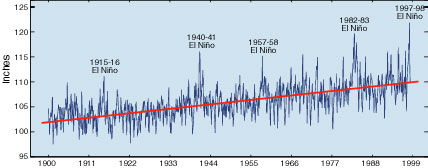
You could hardly get a better example of a straight-line trend, could you? From 1900 on, the sea level rise has been slow but steady. No sudden lasting upturns and no steep trend of any kind. So the data are consistent with some sort of slowly changing natural process -- such as slowly rising solar output, steadily-rising rice production (which produces heaps of methane) or -- wait for it: the inexorable creep of plate tectonics. Any schoolboy used to know that coastal California is geologically unstable. Don't they have earthquakes there or something? And San Francisco had a "great fire" in 1906 did it not? And the graph does show a big blip in sea level about then. So it could be sinking land as much as rising seas that have produced the effect.
So nobody really knows what this record tells us except that it is not some sudden sin of Western man that has brought it on.
More here
***************************************
Many people would like to be kind to others so Leftists exploit that with their nonsense about equality. Most people want a clean, green environment so Greenies exploit that by inventing all sorts of far-fetched threats to the environment. But for both, the real motive is to promote themselves as wiser and better than everyone else, truth regardless.
Global warming has taken the place of Communism as an absurdity that "liberals" will defend to the death regardless of the evidence showing its folly. Evidence never has mattered to real Leftists
Comments? Email me here. My Home Page is here or here. For times when blogger.com is playing up, there are mirrors of this site here and here.
*****************************************
Wednesday, August 17, 2005
"Americans are the world's greatest polluters" (??)
It seems that for many in the environmental movement, the actual defense of Gaia has taken a back seat to a more important objective; specifically, to attack the capitalist economic system in general, and, in particular, its American exemplar. Interestingly, Greenpeace co-founder Patrick Moore agrees, saying: "The environmental movement has been hijacked by political activists who are using green rhetoric to cloak agendas that have more to do with anti-corporatism and class warfare than with ecology or the environment."
Of course, given the ostensible raison d'ˆtre of organizations like Greenpeace and the WWF, attacks upon America can't be couched in blatantly political terms, but must be presented in environmental ones - hence the oft-cited contention that "America is the world's largest polluter". It's common to see the above statement subtly modified into something like "Americans are the world's greatest polluters," a construction that conveniently facilitates the desired demonization of unconcerned, greedy, SUV-driving Americans happily despoiling the air, land and water. In light of the image thus created, it's instructive to examine some actual data.
As far as water pollution is concerned, according to World Bank data on freshwater pollution based on a standard water-treatment test for the presence of organic pollutants, water in the US is significantly less polluted than the worldwide average. In fact, levels of these pollutants in UK rivers and lakes are approximately three times those in the US, which also boasts cleaner water than countries like Denmark, Switzerland, Japan, France and the Netherlands, to name just a few. Odd, given the pernicious presence of "the world's greatest polluters".
With regard to air pollution, the US ranks 114th in the world (first being the worst) with respect to urban sulphur dioxide concentration (the UK figure is about 33% higher), 63rd in ozone-depleting CFC consumption, 45th in urban NO2 concentration, and 13th in NOx emissions per unit of populated land area (the UK value is more than twice as high).
Of course, the greatest concern at present has to do with emissions of so called greenhouse gases. Interestingly, according to recent figures from the United Nations Framework Convention on Climate Change (UNFCCC), the US is not the largest per capita offender here, either. Nor is it second. Among the industrialised nations considered, those positions go to Australia and Canada, respectively. In fact, the average Australian emits some 30% more than his American counterpart (the Canadian figure is only slightly higher than that of the US). Another report (PDF) - which places Canadian per capita emissions at a level just under those of the US, those of Australia again far and away the highest - points out that, when measured per unit of GDP, Australia, Canada, New Zealand, the Czech Republic and Poland are all greater emitters.
I can only attribute the fact that one rarely encounters vituperative attacks on the Australian emissions champions, or on the Canadian runners up, to the political agenda described above.
Finally, in light of the frequently repeated accusation, it's interesting to note that, according to the OECD Working Group on Environmental Information and Outlooks, only two countries (the Netherlands and Austria) spend more than the US on pollution control and abatement (measured as a percentage of GDP). But don't expect facts like these to be reported by the likes of Greenpeace - they're too busy pursuing anti-capitalist, anti-American agendas of the kind that so disturb their own founder.
Source
BLUE-STATE RICH FOLKS BLOW OUT WIND POWER
With Ted Kennedy in the lead: It shows how much they really care about "fossil fuels" allegedly running out
Even with oil prices marching toward $70 a barrel, most alternative energy sources require heavy federal subsidies to allow producers to turn a profit. Wind power, though it still enjoys subsidies, is one of the few that is becoming economically competitive in its own right -- thanks to rising electric power costs in many parts of the world and technological advances in the design and manufacture of wind turbines.... But developers of wind power have begun to confront other barriers to the production this relatively cheap, clean renewable energy source.
Take the case of Jim Gordon, a private developer whose company, Cape Wind, has proposed building one of the largest and most ambitious wind projects in the U.S. -- the first offshore wind farm in the country. After four years of design and planning, Cape Wind is well on its way to building an $800 million, 420-megawatt, 130-turbine wind farm in Nantucket Sound offshore Cape Cod, Mass. The company says the project will supply about three-fourths of the power needed for Cape Code, eliminating about 4,000 tons of sulfur dioxide, about 1,000 tons of nitrous oxides, and about a million tons of greenhouse gases. The company has completed detailed engineering studies for the project. A 3,800-page Environmental Impact Statement, involving three years of study and 17 federal and state agencies, is awaiting final approval from the U.S. Army Corp of Engineers.
If approved by the Army, the project still faces one major hurdle. The neighbors don't like the way it looks. "People come to Cape Cod for natural beauty and the unspoiled horizon, and they're not going to go there to see a power plant off the beaches," said Audra Parker, assistant director of the Alliance to Save Our Sound, which has mounted a campaign to stop the project. "Our argument is that a lot of people do have an objection to the hard cost impact on property values."
The Alliance is a well-organized, well-funded group of local residents who have been working to stop the Cape Wind project since it was first proposed. It has organized opposition through public meetings, newsletters, press releases and challenges to rulings by various state and federal agencies in favor of the project.
Gordon has defended the project with his own Web site and press releases as he continues to grind through the lengthy permitting process with state and federal agencies. He's also working hard to counter the objections raised by the Alliance. "These are unfounded fears from very wealthy waterfront homeowners who believe that Cape Wind will impact their quality of life," he said.
The four years of civic war over the project has left the locals divided. A poll conducted in May found that, of those aware of the project, 39 percent opposed it while 37 percent supported it - a dead heat when accounting for the poll's margin of error. Some 24 percent haven't made up their minds.
If built, Cape Wind would be the largest offshore wind farm in the U.S. -- and could well provide a roadmap for other large-scale projects of its kind. Officials in New Jersey are reviewing several proposals for offshore wind farms along the Jersey shore. The Long Island Power Authority wants to install 40 turbines more than 3 miles offshore Jones Beach on Long Island.
More here
***************************************
Many people would like to be kind to others so Leftists exploit that with their nonsense about equality. Most people want a clean, green environment so Greenies exploit that by inventing all sorts of far-fetched threats to the environment. But for both, the real motive is to promote themselves as wiser and better than everyone else, truth regardless.
Global warming has taken the place of Communism as an absurdity that "liberals" will defend to the death regardless of the evidence showing its folly. Evidence never has mattered to real Leftists
Comments? Email me here. My Home Page is here or here. For times when blogger.com is playing up, there are mirrors of this site here and here.
*****************************************
It seems that for many in the environmental movement, the actual defense of Gaia has taken a back seat to a more important objective; specifically, to attack the capitalist economic system in general, and, in particular, its American exemplar. Interestingly, Greenpeace co-founder Patrick Moore agrees, saying: "The environmental movement has been hijacked by political activists who are using green rhetoric to cloak agendas that have more to do with anti-corporatism and class warfare than with ecology or the environment."
Of course, given the ostensible raison d'ˆtre of organizations like Greenpeace and the WWF, attacks upon America can't be couched in blatantly political terms, but must be presented in environmental ones - hence the oft-cited contention that "America is the world's largest polluter". It's common to see the above statement subtly modified into something like "Americans are the world's greatest polluters," a construction that conveniently facilitates the desired demonization of unconcerned, greedy, SUV-driving Americans happily despoiling the air, land and water. In light of the image thus created, it's instructive to examine some actual data.
As far as water pollution is concerned, according to World Bank data on freshwater pollution based on a standard water-treatment test for the presence of organic pollutants, water in the US is significantly less polluted than the worldwide average. In fact, levels of these pollutants in UK rivers and lakes are approximately three times those in the US, which also boasts cleaner water than countries like Denmark, Switzerland, Japan, France and the Netherlands, to name just a few. Odd, given the pernicious presence of "the world's greatest polluters".
With regard to air pollution, the US ranks 114th in the world (first being the worst) with respect to urban sulphur dioxide concentration (the UK figure is about 33% higher), 63rd in ozone-depleting CFC consumption, 45th in urban NO2 concentration, and 13th in NOx emissions per unit of populated land area (the UK value is more than twice as high).
Of course, the greatest concern at present has to do with emissions of so called greenhouse gases. Interestingly, according to recent figures from the United Nations Framework Convention on Climate Change (UNFCCC), the US is not the largest per capita offender here, either. Nor is it second. Among the industrialised nations considered, those positions go to Australia and Canada, respectively. In fact, the average Australian emits some 30% more than his American counterpart (the Canadian figure is only slightly higher than that of the US). Another report (PDF) - which places Canadian per capita emissions at a level just under those of the US, those of Australia again far and away the highest - points out that, when measured per unit of GDP, Australia, Canada, New Zealand, the Czech Republic and Poland are all greater emitters.
I can only attribute the fact that one rarely encounters vituperative attacks on the Australian emissions champions, or on the Canadian runners up, to the political agenda described above.
Finally, in light of the frequently repeated accusation, it's interesting to note that, according to the OECD Working Group on Environmental Information and Outlooks, only two countries (the Netherlands and Austria) spend more than the US on pollution control and abatement (measured as a percentage of GDP). But don't expect facts like these to be reported by the likes of Greenpeace - they're too busy pursuing anti-capitalist, anti-American agendas of the kind that so disturb their own founder.
Source
BLUE-STATE RICH FOLKS BLOW OUT WIND POWER
With Ted Kennedy in the lead: It shows how much they really care about "fossil fuels" allegedly running out
Even with oil prices marching toward $70 a barrel, most alternative energy sources require heavy federal subsidies to allow producers to turn a profit. Wind power, though it still enjoys subsidies, is one of the few that is becoming economically competitive in its own right -- thanks to rising electric power costs in many parts of the world and technological advances in the design and manufacture of wind turbines.... But developers of wind power have begun to confront other barriers to the production this relatively cheap, clean renewable energy source.
Take the case of Jim Gordon, a private developer whose company, Cape Wind, has proposed building one of the largest and most ambitious wind projects in the U.S. -- the first offshore wind farm in the country. After four years of design and planning, Cape Wind is well on its way to building an $800 million, 420-megawatt, 130-turbine wind farm in Nantucket Sound offshore Cape Cod, Mass. The company says the project will supply about three-fourths of the power needed for Cape Code, eliminating about 4,000 tons of sulfur dioxide, about 1,000 tons of nitrous oxides, and about a million tons of greenhouse gases. The company has completed detailed engineering studies for the project. A 3,800-page Environmental Impact Statement, involving three years of study and 17 federal and state agencies, is awaiting final approval from the U.S. Army Corp of Engineers.
If approved by the Army, the project still faces one major hurdle. The neighbors don't like the way it looks. "People come to Cape Cod for natural beauty and the unspoiled horizon, and they're not going to go there to see a power plant off the beaches," said Audra Parker, assistant director of the Alliance to Save Our Sound, which has mounted a campaign to stop the project. "Our argument is that a lot of people do have an objection to the hard cost impact on property values."
The Alliance is a well-organized, well-funded group of local residents who have been working to stop the Cape Wind project since it was first proposed. It has organized opposition through public meetings, newsletters, press releases and challenges to rulings by various state and federal agencies in favor of the project.
Gordon has defended the project with his own Web site and press releases as he continues to grind through the lengthy permitting process with state and federal agencies. He's also working hard to counter the objections raised by the Alliance. "These are unfounded fears from very wealthy waterfront homeowners who believe that Cape Wind will impact their quality of life," he said.
The four years of civic war over the project has left the locals divided. A poll conducted in May found that, of those aware of the project, 39 percent opposed it while 37 percent supported it - a dead heat when accounting for the poll's margin of error. Some 24 percent haven't made up their minds.
If built, Cape Wind would be the largest offshore wind farm in the U.S. -- and could well provide a roadmap for other large-scale projects of its kind. Officials in New Jersey are reviewing several proposals for offshore wind farms along the Jersey shore. The Long Island Power Authority wants to install 40 turbines more than 3 miles offshore Jones Beach on Long Island.
More here
***************************************
Many people would like to be kind to others so Leftists exploit that with their nonsense about equality. Most people want a clean, green environment so Greenies exploit that by inventing all sorts of far-fetched threats to the environment. But for both, the real motive is to promote themselves as wiser and better than everyone else, truth regardless.
Global warming has taken the place of Communism as an absurdity that "liberals" will defend to the death regardless of the evidence showing its folly. Evidence never has mattered to real Leftists
Comments? Email me here. My Home Page is here or here. For times when blogger.com is playing up, there are mirrors of this site here and here.
*****************************************
Tuesday, August 16, 2005
Military exercises 'good for endangered species'
Firing ranges can have more wildlife than national parks
Military exercises are boosting biodiversity, according to a study of land used for US training manoeuvres in Germany. Such land has more endangered species than nearby national parks. The land is uncultivated, but also churned up by tank tracks and explosions. This creates habitat both for species that prefer pristine lands and those that require disturbed ground, explains ecologist Steven Warren of Colorado State University in Fort Collins. Military land can host more species than agricultural land, Warren told a meeting of the Ecological Society of America in Montreal. What's more, its biodiversity can also exceed that of natural parks, where species that need disturbance cannot get a foothold.
Warren and his colleague Reiner Buettner of the Institute of Botany and Landscape Ecology in Hemhofen, Germany, surveyed two US military bases at Grafenwoehr and Hohenfels in the southern state of Bavaria. Although the bases represent less than 1% of the state's area, they contain 22% of its endangered species, Warren told the meeting. The national parks cover a similar area but host fewer endangered plants and animals, Warren says. "Some people are very anti-military," Warren says. "They assume that there's nothing the military can do that will be beneficial, particularly with relation to ecology." Warren, who doesn't work for the army, used to assume the same himself. "Twenty years ago I looked at military activities as an ecologist and thought 'they need me'. But I guess that's not really so."
Warren and Buettner studied several species to try and understand the benefits of military ground. One, the natterjack toad, breeds in water-filled ruts created by tank tracks, they found. The tendency when setting aside a nature reserve is to prevent disturbances such as periodic flooding, says Warren. But this can inadvertently remove some habitats. "[Tanks] replace to some degree the processes that have been stopped," Warren says. The same goes for fires caused by bombing. "We've trained generations of people that fire is bad," he says, "but in fact it's crucial for ecosystems."
The number of species on former Soviet training camps around Berlin has dropped since the fall of the Iron Curtain, Warren says, supporting the idea that military activity is good for biodiversity. "But some military chiefs worry that endangered species may begin to obstruct their exercises." The US Marine Corps has previously complained that the US Endangered Species Act threatens to turn its Camp Pendleton beach in San Diego County, California - home to 18 threatened species - into a nature reserve rather than a training facility.
Warren hopes that conservationists could learn from the military, and provide disturbances to help endangered species. One trial project at Tennenlohe, near Nuremberg in Germany, involves cutting up land using an agricultural tool called a ripper in a bid to mimic tank tracks.
Source
Australia's Minister for hot air
By Andrew Bolt
The savage green critics of the Howard Government are wrong. Guys, calm down. You've actually won. Just look: The Government's slick new Environment Minister Ian Campbell is now peddling your global warming myths.
Am I unfair? Well, compare two reports on global warming released last month -- an alarmist one here, and a far more sober one by a committee of Britain's House of Lords that warns the warming hype is being whipped up by political trickery. The alarmist report was, alas, released by Campbell himself, and produced the usual oh-my-God horror stories in the media. Commissioned by the Government's Australian Greenhouse Office, it followed the scary script: Australia is hotting up fast, thanks to our belching. Our reefs may turn white, our dams dusty, our weather wild. Malaria could creep back in the heat and kill us. We had to spend big on slashing our emissions. Campbell, who should know better, only fed the hysteria. "I don't think there is much doubt, frankly, about the science of global warming," he gloomed.
Really? In fact, the British report -- all but ignored here -- concludes the opposite: "The science of climate change remains debatable." So which of these reports to believe? Should we panic about global warming -- or politicians like Campbell? Let's compare.
The Australian Greenhouse Office's report was written by private consultants who talked exclusively to our environment ministries and agencies. Not one sceptical scientist outside our paid-to-be-green bureaucracy got to have a say. And its warnings of doom were based not on any new science, but on the 2001 report of the United Nation's body which has pushed the global warming scare hardest -- the Intergovernmental Panel on Climate Change. So if the IPCC is wrong, then so is much of Campbell's report.
Of course, the media has often told you not to doubt the IPCC -- a horde of experts brought together every few years by the UN to write reports on global warming. Just believe it: The globe will heat up by as much as 5.8 degrees by 2100, and we're largely to blame.
Not so fast, the British House of Lords' committee on economic affairs now says with alarm. This committee -- which included two former chancellors of the Exchequer, three top economists and a former Bank of England governor -- grilled more than 40 experts from around the world, including sceptics, to check the science of the global warming scare, and to price the solutions. It tested the greenhouse claims in a way the authors of Campbell's report didn't even try. And, ouch -- what it found shames the IPCC. As the committee summed up with British restraint: "We have some concerns about the objectivity of the IPCC process, with some of its emissions scenarios and summary documentation apparently influenced by political considerations." What's more: "There are significant doubts about some aspects of the IPCC's emissions scenario exercise . . . (and) the high emissions scenarios contained some questionable assumptions and outcomes . . . "There are some positive aspects to global warming and these appear to have been played down . . ."
That's putting it mildly. The examples the committee then gave to back up its claims of exaggeration, distortion and political interference should make even Ian Campbell wonder how settled this IPCC "science" he relies on really is. Here are just the top dozen of those examples:
1. The IPCC seemed to shut out some scientists who questioned its global warming theories.
2. A top IPCC malaria expert who disproved its claim that warming would spread the disease was dropped and replaced by people with little expertise.
3. IPCC scientists were outraged when the panel's political appointees falsified their 2001 report to make them seem to predict big losses from warming.
4. The IPCC "seemed to have made a conscious effort to downplay" research on the economic harm, or lack of it, that warming might cause -- perhaps because research actually showed "monetised damage is relatively low, even for a warming of 2.5 degrees".
5. Some of the IPCC's scariest warnings of a hotter world assumed the world's population would more than double -- "a projection not borne out by any of the population forecasts made elsewhere".
6. The IPCC "appears to be playing down" research showing it wasn't actually worth slashing greenhouse gases, when the Kyoto Accord, for instance, would cut temperatures by just 0.1 degrees by 2100 for a cost of up to $US17 trillion.
7. There was "uncertainty and controversy about the underlying data" behind the IPCC's claim that warming would make cyclones and hurricanes worse -- a claim that seemed unproven.
8. The IPCC had to take "a more balanced approach" and give "fuller consideration . . . on the positive effects of warming" -- such as better crops and more pleasant climates.
9. IPCC predictions that poorer countries would catch up fast to richer countries, so pumping out more greenhouse gases, were in fact widely disputed and seemed kind assumptions based on "political factors".
10. A mistake in the way the IPCC calculated the relative wealth of countries also exaggerated how much the poor ones would develop and the extra gases they would then emit.
11. The IPCC claimed average carbon dioxide emissions for each person were rising, when they were actually falling.
12. The IPCC seemed to underestimate how much sulphur emissions cooled the atmosphere.
Suspicious, how every one of these mistakes and distortions by the IPCC, and more, exaggerated the dangers of global warming. True, the House of Lords committee agreed there had been warming in the past century and most scientists thought our emissions were partly to blame. But it attacked the IPCC for "opening the way for climate science and economics to be determined, at least in part, by political requirements rather than by the evidence". What? Politics has trumped evidence? Someone tell our Environment Minister! Actually, don't bother. Just look how sweetly green he now looks, swearing the science of global warming really is beyond doubt. Trust him. Vote for him.
***************************************
Many people would like to be kind to others so Leftists exploit that with their nonsense about equality. Most people want a clean, green environment so Greenies exploit that by inventing all sorts of far-fetched threats to the environment. But for both, the real motive is to promote themselves as wiser and better than everyone else, truth regardless.
Global warming has taken the place of Communism as an absurdity that "liberals" will defend to the death regardless of the evidence showing its folly. Evidence never has mattered to real Leftists
Comments? Email me here. My Home Page is here or here. For times when blogger.com is playing up, there are mirrors of this site here and here.
*****************************************
Firing ranges can have more wildlife than national parks
Military exercises are boosting biodiversity, according to a study of land used for US training manoeuvres in Germany. Such land has more endangered species than nearby national parks. The land is uncultivated, but also churned up by tank tracks and explosions. This creates habitat both for species that prefer pristine lands and those that require disturbed ground, explains ecologist Steven Warren of Colorado State University in Fort Collins. Military land can host more species than agricultural land, Warren told a meeting of the Ecological Society of America in Montreal. What's more, its biodiversity can also exceed that of natural parks, where species that need disturbance cannot get a foothold.
Warren and his colleague Reiner Buettner of the Institute of Botany and Landscape Ecology in Hemhofen, Germany, surveyed two US military bases at Grafenwoehr and Hohenfels in the southern state of Bavaria. Although the bases represent less than 1% of the state's area, they contain 22% of its endangered species, Warren told the meeting. The national parks cover a similar area but host fewer endangered plants and animals, Warren says. "Some people are very anti-military," Warren says. "They assume that there's nothing the military can do that will be beneficial, particularly with relation to ecology." Warren, who doesn't work for the army, used to assume the same himself. "Twenty years ago I looked at military activities as an ecologist and thought 'they need me'. But I guess that's not really so."
Warren and Buettner studied several species to try and understand the benefits of military ground. One, the natterjack toad, breeds in water-filled ruts created by tank tracks, they found. The tendency when setting aside a nature reserve is to prevent disturbances such as periodic flooding, says Warren. But this can inadvertently remove some habitats. "[Tanks] replace to some degree the processes that have been stopped," Warren says. The same goes for fires caused by bombing. "We've trained generations of people that fire is bad," he says, "but in fact it's crucial for ecosystems."
The number of species on former Soviet training camps around Berlin has dropped since the fall of the Iron Curtain, Warren says, supporting the idea that military activity is good for biodiversity. "But some military chiefs worry that endangered species may begin to obstruct their exercises." The US Marine Corps has previously complained that the US Endangered Species Act threatens to turn its Camp Pendleton beach in San Diego County, California - home to 18 threatened species - into a nature reserve rather than a training facility.
Warren hopes that conservationists could learn from the military, and provide disturbances to help endangered species. One trial project at Tennenlohe, near Nuremberg in Germany, involves cutting up land using an agricultural tool called a ripper in a bid to mimic tank tracks.
Source
Australia's Minister for hot air
By Andrew Bolt
The savage green critics of the Howard Government are wrong. Guys, calm down. You've actually won. Just look: The Government's slick new Environment Minister Ian Campbell is now peddling your global warming myths.
Am I unfair? Well, compare two reports on global warming released last month -- an alarmist one here, and a far more sober one by a committee of Britain's House of Lords that warns the warming hype is being whipped up by political trickery. The alarmist report was, alas, released by Campbell himself, and produced the usual oh-my-God horror stories in the media. Commissioned by the Government's Australian Greenhouse Office, it followed the scary script: Australia is hotting up fast, thanks to our belching. Our reefs may turn white, our dams dusty, our weather wild. Malaria could creep back in the heat and kill us. We had to spend big on slashing our emissions. Campbell, who should know better, only fed the hysteria. "I don't think there is much doubt, frankly, about the science of global warming," he gloomed.
Really? In fact, the British report -- all but ignored here -- concludes the opposite: "The science of climate change remains debatable." So which of these reports to believe? Should we panic about global warming -- or politicians like Campbell? Let's compare.
The Australian Greenhouse Office's report was written by private consultants who talked exclusively to our environment ministries and agencies. Not one sceptical scientist outside our paid-to-be-green bureaucracy got to have a say. And its warnings of doom were based not on any new science, but on the 2001 report of the United Nation's body which has pushed the global warming scare hardest -- the Intergovernmental Panel on Climate Change. So if the IPCC is wrong, then so is much of Campbell's report.
Of course, the media has often told you not to doubt the IPCC -- a horde of experts brought together every few years by the UN to write reports on global warming. Just believe it: The globe will heat up by as much as 5.8 degrees by 2100, and we're largely to blame.
Not so fast, the British House of Lords' committee on economic affairs now says with alarm. This committee -- which included two former chancellors of the Exchequer, three top economists and a former Bank of England governor -- grilled more than 40 experts from around the world, including sceptics, to check the science of the global warming scare, and to price the solutions. It tested the greenhouse claims in a way the authors of Campbell's report didn't even try. And, ouch -- what it found shames the IPCC. As the committee summed up with British restraint: "We have some concerns about the objectivity of the IPCC process, with some of its emissions scenarios and summary documentation apparently influenced by political considerations." What's more: "There are significant doubts about some aspects of the IPCC's emissions scenario exercise . . . (and) the high emissions scenarios contained some questionable assumptions and outcomes . . . "There are some positive aspects to global warming and these appear to have been played down . . ."
That's putting it mildly. The examples the committee then gave to back up its claims of exaggeration, distortion and political interference should make even Ian Campbell wonder how settled this IPCC "science" he relies on really is. Here are just the top dozen of those examples:
1. The IPCC seemed to shut out some scientists who questioned its global warming theories.
2. A top IPCC malaria expert who disproved its claim that warming would spread the disease was dropped and replaced by people with little expertise.
3. IPCC scientists were outraged when the panel's political appointees falsified their 2001 report to make them seem to predict big losses from warming.
4. The IPCC "seemed to have made a conscious effort to downplay" research on the economic harm, or lack of it, that warming might cause -- perhaps because research actually showed "monetised damage is relatively low, even for a warming of 2.5 degrees".
5. Some of the IPCC's scariest warnings of a hotter world assumed the world's population would more than double -- "a projection not borne out by any of the population forecasts made elsewhere".
6. The IPCC "appears to be playing down" research showing it wasn't actually worth slashing greenhouse gases, when the Kyoto Accord, for instance, would cut temperatures by just 0.1 degrees by 2100 for a cost of up to $US17 trillion.
7. There was "uncertainty and controversy about the underlying data" behind the IPCC's claim that warming would make cyclones and hurricanes worse -- a claim that seemed unproven.
8. The IPCC had to take "a more balanced approach" and give "fuller consideration . . . on the positive effects of warming" -- such as better crops and more pleasant climates.
9. IPCC predictions that poorer countries would catch up fast to richer countries, so pumping out more greenhouse gases, were in fact widely disputed and seemed kind assumptions based on "political factors".
10. A mistake in the way the IPCC calculated the relative wealth of countries also exaggerated how much the poor ones would develop and the extra gases they would then emit.
11. The IPCC claimed average carbon dioxide emissions for each person were rising, when they were actually falling.
12. The IPCC seemed to underestimate how much sulphur emissions cooled the atmosphere.
Suspicious, how every one of these mistakes and distortions by the IPCC, and more, exaggerated the dangers of global warming. True, the House of Lords committee agreed there had been warming in the past century and most scientists thought our emissions were partly to blame. But it attacked the IPCC for "opening the way for climate science and economics to be determined, at least in part, by political requirements rather than by the evidence". What? Politics has trumped evidence? Someone tell our Environment Minister! Actually, don't bother. Just look how sweetly green he now looks, swearing the science of global warming really is beyond doubt. Trust him. Vote for him.
***************************************
Many people would like to be kind to others so Leftists exploit that with their nonsense about equality. Most people want a clean, green environment so Greenies exploit that by inventing all sorts of far-fetched threats to the environment. But for both, the real motive is to promote themselves as wiser and better than everyone else, truth regardless.
Global warming has taken the place of Communism as an absurdity that "liberals" will defend to the death regardless of the evidence showing its folly. Evidence never has mattered to real Leftists
Comments? Email me here. My Home Page is here or here. For times when blogger.com is playing up, there are mirrors of this site here and here.
*****************************************
Monday, August 15, 2005
GM CORN: ANOTHER GREENIE FRAUD
Post lifted from the Adam Smith blog
The Telegraph's science editor, Roger Highfield, reports on the strange disappearance of what was hailed as the world's worst leakage of genetically modified crops into regular strains.
This contamination was loudly trumpeted by anti-GM campaigners, even though the GM variety had no adverse effects on people. What happened then was strange. The magazine Nature disowned the original paper by researchers at the University of California in Berkeley.
The story becomes stranger. A two-year study by Ohio State University researchers, published in the Proceedings of the National Academy of Sciences, finds there has been no spread of GM strains into native crops.
It all makes the findings of the original Berkeley study seem extraordinary. What was claimed as the worst incident of GM contamination has disappeared into thin air. The refutation might not get quite the coverage the original scare generated, however.
SKEPTICISM ABOUT THE BRITISH "GREENBELT"
Which was an elitist idea long before the Greenies were thought of. Many British cities have areas around them on which housing is not allowed to be built. The reason why is very poorly thought-out
Apparently, 84 per cent of people want to save the green belt and keep if safe from urban sprawl. Can it be true? Can 16 per cent of the country really believe that it's right to pave over our pleasant land? I thought it was just me who reckoned the green belt was a colossally misguided scheme to inflate house prices, cripple the economy and do absolutely nil for the environment.
Try telling people that you think the green belt should be scrapped - worse still, that you think the entire system of Government planning should be done away with - and you won't win many friends. To argue against the belt, which surrounds London, Birmingham and other big cities and which celebrates its 50th anniversary this month, is to most people like calling for clean drinking water to be abolished, or campaigning to bring back witch-ducking.
Never mind that nobody seems to know what it looks like, or whether any of it is very nice. I've lived in London all my life and I've never hear anyone saying that they're off to spend a weekend in the green belt, what with it being so close by and everything. Maybe the BBC's new hit series Coast only narrowly beat a rival show called Disused Gravel Pits in Tilbury, but I doubt it. The point is, for every Chiltern hill or slope of the North Downs that the scheme protects, massive chunks of land that are downright foul are kept at bay from the potentially cheering extension of the suburbs.
Green belts do not create parkland within easy reach. Their real point is to prevent sprawl - although why London or Newcastle should be equally stopped from sprawling is hard to explain: they can't both be the ideal size, surely. Green belts increase pollution by encouraging development farther from the city, so adding to the number of miles commuters have to drive. Mark Pennington, an economics lecturer at Queen Mary College, points out that the new towns will often end up being built on much more environmentally valuable land than the belt itself. All that green belts do is to halt city growth, regardless of the economic benefits of new construction.
Ah. That word - economic - gets you in trouble. The complaint comes that letting the market run loose would cause havoc, because "land is a finite resource": once we've paved over Britain, we can never get it back. But economics is all about managing scarce resources - oil, labour or anything else. And economists will tell you that to manage resources effectively, you need information about their relative values. There is a word for such information: prices. Some of the green belt is lovely, some of it is awful - but greenbelt policy sucks because by shutting down the system of prices it fails to distinguish one from the other. If green belt land were traded freely, and could be developed without constraint, the magic of the price mechanism would get to work. Beautiful land would come at a higher price than ugly land, and developers would be guided to build in cheaper areas.
But alarm has been the sole response to Government plans, unveiled last month, to make planning more responsive to housing demand. Frankly, it would be hard to dream up a system less responsive to housing demand than the current planning laws. Anyone who has tried to get a building project approved will know how slow, expensive and often corrupt the set-up is. Planning is the legacy of the postwar Town and Country Planning Act, which tried to do to home building what the Attlee Government was also trying with coal, steel and other industries: control them from above. But, unlike those dinosaurs, planning has never been reformed, and it remains more like a vast, sclerotic, nationalised industry than anything else. Even John Prescott has been unable to break the logjam. Despite his threatening year after year to swamp the Thames Gateway and Bedfordshire with Barratt homes, the big build remains stubbornly unbuilt.
People think that if you got rid of government planning you would have anarchy. But that's not how things work in other parts of the economy. Prices allow a much more sophisticated level of co-ordination, in which demand for houses, offices and open spaces are all stirred into the mix. Do you live in an area with lots of attractive Victorian homes, where buildings that are out of character would damage the appeal? So club together with your neighbours, sign a restrictive covenant that bans everyone in the group from making changes, and watch the market response. Everyone in the group should see their house price rise, because each house becomes more valuable in an area guaranteed to stay attractive.
Having said all of that, I'm not against planning. Planning a town, working out how to mix homes, infrastructure and open spaces, is difficult, but not impossible. The problem is that there is only ever one planner - the Government. To scrap state planning would bring about a renaissance in a forgotten world from a century ago, when private corporations bought land speculatively and created garden cities and suburbs, many with restrictive covenants to keep them from decline. Competition between planners - something the current system lacks - drove up standards of design.
Thanks to the efforts of private planners, we now have picturesque suburbs and towns such as Highgate, Summertown and Letchworth. It could happen again. Tesco towns? They'd certainly beat a weekend for two in a gravel pit.
Source
In Situ Stable Isotope Probing of Methanogenic Archaea in the Rice Rhizosphere
Comment on the paper abstracted below: Rice agriculture is possibly the biggest source of anthropogenic methane and methane is one of those wicked greenhouse gases. Though carbon dioxide is also a greenhouse gas, methane is dozens of times more so. Rice paddies cover about 130 million hectares of the earth's surface, of which almost 90% are in Asia, and emit 50 to 100 million metric tons of methane a year. So stop those gooks growing all that rice! Let them eat cake!
(By: Yahai Lu1,2 and Ralf Conrad2. 1 College of Resources and Environmental Sciences, China Agricultural University, Beijing 100094, China. 2 Max-Planck-Institute for Terrestrial Microbiology, Karl-von-Frisch-Strasse, 35043 Marburg, Germany.)
Microorganisms living in anoxic rice soils contribute 10 to 25% of global methane emissions. The most important carbon source for CH4 production is plant-derived carbon that enters soil as root exudates and debris. Pulse labeling of rice plants with 13CO2 resulted in incorporation of 13C into the ribosomal RNA of Rice Cluster I Archaea in the soil, indicating that this archaeal group plays a key role in CH4 production from plant-derived carbon. This group of microorganisms has not yet been isolated but appears to be of global environmental importance.
Science, Vol 309, Issue 5737, 1088-1090 , 12 August 2005
The Doi (permanent) address for the above article is here
***************************************
Many people would like to be kind to others so Leftists exploit that with their nonsense about equality. Most people want a clean, green environment so Greenies exploit that by inventing all sorts of far-fetched threats to the environment. But for both, the real motive is to promote themselves as wiser and better than everyone else, truth regardless.
Global warming has taken the place of Communism as an absurdity that "liberals" will defend to the death regardless of the evidence showing its folly. Evidence never has mattered to real Leftists
Comments? Email me here. My Home Page is here or here. For times when blogger.com is playing up, there are mirrors of this site here and here.
*****************************************
Post lifted from the Adam Smith blog
The Telegraph's science editor, Roger Highfield, reports on the strange disappearance of what was hailed as the world's worst leakage of genetically modified crops into regular strains.
Four years ago, researchers reported finding cobs of genetically modified maize in Oaxaca, Mexico, suggesting that GM maize (corn) from the US had invaded a traditional maize variety.
This contamination was loudly trumpeted by anti-GM campaigners, even though the GM variety had no adverse effects on people. What happened then was strange. The magazine Nature disowned the original paper by researchers at the University of California in Berkeley.
The paper had sparked a protest to Nature by 100 biologists and was disowned by the Mexican government after its scientists could not repeat the experiment. The anti-GM lobby portrayed the row as an attempt to discredit the research and as part of a biotech industry vendetta.
The story becomes stranger. A two-year study by Ohio State University researchers, published in the Proceedings of the National Academy of Sciences, finds there has been no spread of GM strains into native crops.
The researchers gathered more than 153,000 seeds from 870 maize plants in 125 fields in Oaxaca, for the first survey of foreign "transgenes" in native varieties, and found no evidence of contamination. The finding surprised the researchers, said Prof Snow, because millions of tons of GM grain were imported from the US each year for processed food and animal feed.
It all makes the findings of the original Berkeley study seem extraordinary. What was claimed as the worst incident of GM contamination has disappeared into thin air. The refutation might not get quite the coverage the original scare generated, however.
SKEPTICISM ABOUT THE BRITISH "GREENBELT"
Which was an elitist idea long before the Greenies were thought of. Many British cities have areas around them on which housing is not allowed to be built. The reason why is very poorly thought-out
Apparently, 84 per cent of people want to save the green belt and keep if safe from urban sprawl. Can it be true? Can 16 per cent of the country really believe that it's right to pave over our pleasant land? I thought it was just me who reckoned the green belt was a colossally misguided scheme to inflate house prices, cripple the economy and do absolutely nil for the environment.
Try telling people that you think the green belt should be scrapped - worse still, that you think the entire system of Government planning should be done away with - and you won't win many friends. To argue against the belt, which surrounds London, Birmingham and other big cities and which celebrates its 50th anniversary this month, is to most people like calling for clean drinking water to be abolished, or campaigning to bring back witch-ducking.
Never mind that nobody seems to know what it looks like, or whether any of it is very nice. I've lived in London all my life and I've never hear anyone saying that they're off to spend a weekend in the green belt, what with it being so close by and everything. Maybe the BBC's new hit series Coast only narrowly beat a rival show called Disused Gravel Pits in Tilbury, but I doubt it. The point is, for every Chiltern hill or slope of the North Downs that the scheme protects, massive chunks of land that are downright foul are kept at bay from the potentially cheering extension of the suburbs.
Green belts do not create parkland within easy reach. Their real point is to prevent sprawl - although why London or Newcastle should be equally stopped from sprawling is hard to explain: they can't both be the ideal size, surely. Green belts increase pollution by encouraging development farther from the city, so adding to the number of miles commuters have to drive. Mark Pennington, an economics lecturer at Queen Mary College, points out that the new towns will often end up being built on much more environmentally valuable land than the belt itself. All that green belts do is to halt city growth, regardless of the economic benefits of new construction.
Ah. That word - economic - gets you in trouble. The complaint comes that letting the market run loose would cause havoc, because "land is a finite resource": once we've paved over Britain, we can never get it back. But economics is all about managing scarce resources - oil, labour or anything else. And economists will tell you that to manage resources effectively, you need information about their relative values. There is a word for such information: prices. Some of the green belt is lovely, some of it is awful - but greenbelt policy sucks because by shutting down the system of prices it fails to distinguish one from the other. If green belt land were traded freely, and could be developed without constraint, the magic of the price mechanism would get to work. Beautiful land would come at a higher price than ugly land, and developers would be guided to build in cheaper areas.
But alarm has been the sole response to Government plans, unveiled last month, to make planning more responsive to housing demand. Frankly, it would be hard to dream up a system less responsive to housing demand than the current planning laws. Anyone who has tried to get a building project approved will know how slow, expensive and often corrupt the set-up is. Planning is the legacy of the postwar Town and Country Planning Act, which tried to do to home building what the Attlee Government was also trying with coal, steel and other industries: control them from above. But, unlike those dinosaurs, planning has never been reformed, and it remains more like a vast, sclerotic, nationalised industry than anything else. Even John Prescott has been unable to break the logjam. Despite his threatening year after year to swamp the Thames Gateway and Bedfordshire with Barratt homes, the big build remains stubbornly unbuilt.
People think that if you got rid of government planning you would have anarchy. But that's not how things work in other parts of the economy. Prices allow a much more sophisticated level of co-ordination, in which demand for houses, offices and open spaces are all stirred into the mix. Do you live in an area with lots of attractive Victorian homes, where buildings that are out of character would damage the appeal? So club together with your neighbours, sign a restrictive covenant that bans everyone in the group from making changes, and watch the market response. Everyone in the group should see their house price rise, because each house becomes more valuable in an area guaranteed to stay attractive.
Having said all of that, I'm not against planning. Planning a town, working out how to mix homes, infrastructure and open spaces, is difficult, but not impossible. The problem is that there is only ever one planner - the Government. To scrap state planning would bring about a renaissance in a forgotten world from a century ago, when private corporations bought land speculatively and created garden cities and suburbs, many with restrictive covenants to keep them from decline. Competition between planners - something the current system lacks - drove up standards of design.
Thanks to the efforts of private planners, we now have picturesque suburbs and towns such as Highgate, Summertown and Letchworth. It could happen again. Tesco towns? They'd certainly beat a weekend for two in a gravel pit.
Source
In Situ Stable Isotope Probing of Methanogenic Archaea in the Rice Rhizosphere
Comment on the paper abstracted below: Rice agriculture is possibly the biggest source of anthropogenic methane and methane is one of those wicked greenhouse gases. Though carbon dioxide is also a greenhouse gas, methane is dozens of times more so. Rice paddies cover about 130 million hectares of the earth's surface, of which almost 90% are in Asia, and emit 50 to 100 million metric tons of methane a year. So stop those gooks growing all that rice! Let them eat cake!
(By: Yahai Lu1,2 and Ralf Conrad2. 1 College of Resources and Environmental Sciences, China Agricultural University, Beijing 100094, China. 2 Max-Planck-Institute for Terrestrial Microbiology, Karl-von-Frisch-Strasse, 35043 Marburg, Germany.)
Microorganisms living in anoxic rice soils contribute 10 to 25% of global methane emissions. The most important carbon source for CH4 production is plant-derived carbon that enters soil as root exudates and debris. Pulse labeling of rice plants with 13CO2 resulted in incorporation of 13C into the ribosomal RNA of Rice Cluster I Archaea in the soil, indicating that this archaeal group plays a key role in CH4 production from plant-derived carbon. This group of microorganisms has not yet been isolated but appears to be of global environmental importance.
Science, Vol 309, Issue 5737, 1088-1090 , 12 August 2005
The Doi (permanent) address for the above article is here
***************************************
Many people would like to be kind to others so Leftists exploit that with their nonsense about equality. Most people want a clean, green environment so Greenies exploit that by inventing all sorts of far-fetched threats to the environment. But for both, the real motive is to promote themselves as wiser and better than everyone else, truth regardless.
Global warming has taken the place of Communism as an absurdity that "liberals" will defend to the death regardless of the evidence showing its folly. Evidence never has mattered to real Leftists
Comments? Email me here. My Home Page is here or here. For times when blogger.com is playing up, there are mirrors of this site here and here.
*****************************************
Sunday, August 14, 2005
THE ATMOSPHERIC TEMPERATURE CONTROVERSY
Even mockers of the global warming scare have generally conceded that there has been some overall warming in recent years, though certainly no consistent warming from year to year. The only important dispute has been over whether or not the warming has anything to do with human activity -- in particular whether increased human output of CO2 has any net effect on global temperature. Both history (showing lots of past ups and downs in global temperature) and physics (gases other than CO2 such as water vapour and methane are by far the dominant influence on global temperature) suggest that the human influence is minuscule and that attempts to change it are therefore irrelevant.
There are some scientists, however, who have doubted that there has been any global warming at all going on. They point out that temperature rises recorded by ground-based stations could be simply "heat island" effects -- the effect of the heat that human activities generate rather than anything to do with atmospheric gases -- effects which would be greatest close to the ground. The most striking evidence for this has been the fact that both weather-balloon and satellite measurements of atmospheric temperature show no rise over the years.
Measuring atmospheric temperature is however a lot more complex than hopping into a balloon and waving a thermomenter about. And the temperature differences we are talking about are in any case minuscule. So lots of very precise scientific calculations have to be made from the raw data before a final assessment of temperature can be arrived at. As has been much bruited about in the news lately, however, some of those calculations have now been questioned and new calculations made which DO show some warming of the atmosphere.
The existing experts in the field of atmospheric temperature measurement have responded fairly positively to the new approach and conceded much truth in it. On re-doing their calculations to take the new considerations into account, however, the amount of warming they find is still minuscule -- which is what global warming critics have generally said all along.
The debate concerned is a highly technical one, which is why I have offered this summary rather than following my usual practice of just putting up relevant excerpts from existing articles. For those who wish to read further, however, I reproduce below one of the shorter newspaper summaries of the matter followed by some excerpts from the response by one of the main "no-warming" scientists involved:
From the Sydney Morning Herold
Some excerpts from an article in Tech Central Station by Roy Spencer of the UAH group. The "RSS" are the critics of the older measurements
Note also this comment about the new calculations (where the "Christy et al" group are the UAH team):
HURRICANE SIGNIFICANCE: UNKNOWN
"Five named storms before July 15! Obviously we're headed for some kind of record year. Or are we? And what does all of this have to do with planetary warming. The answers aren't clear. Hurricane (and tropical storm) data are notoriously noisy from year-to-year, and the way that we gather these statistics hasn't been constant. Prior to 1945, most hurricane information came from merchant shipping in the Atlantic. It's likely that many storms were missed, especially those that didn't cross major shipping lanes.
After World War II, we began to send out aircraft (called Hurricane Hunters), but these missions weren't launched unless there was some evidence of a storm, i.e. weather reports from an island or a ship. Only since the mid-1960s has weather satellite technology been sufficient to detect all storms. Since World War II the Hurricane Hunters have detected an apparent long-term decline in the average maximum winds measured in a given year. Apparently hurricanes are getting weaker. Important word, that: "apparently." It's possible that the decline in average maximum winds is real. Some scientists (not this one) think global warming increases the frequency or intensity of El Nino, the big Pacific Ocean weathermaker. El Nino activity and hurricane intensity in the Atlantic are highly anticorrelated.
The same result -- an apparent decline in maximum winds -- would obtain if we were now naming more tropical storms than we used to. In that case, the apparent lack of any trend in long-term frequency would be wrong; the true picture would be a slight decline. It's complicated, okay? Equally convoluted is the relationship between the number of early-season storms and overall annual activity. One would think that it would be very straightforward. The peak of hurricane season is around September 12. If numbers tend to fall off smoothly on both sides of that peak, then a large number of early-season storms would signal a banner year.
But hurricanes aren't evenly distributed at all throughout their season. Rather, they tend to "bloom," with multiple storms occurring simultaneously (or nearly so). When that occurs, the storms in each pod tend to be on pretty similar tracks -- which is why Florida got whacked four times last year in six weeks. A worse shellacking actually took place in northwestern Mexico in 1933, as six storms hit in fairly close proximity. The relationship between early and entire-season hurricanes is non-existent. Only 3 percent of the year-to-year variation in total number of tropical cyclones per year (since 1945) is explained by the number observed before August 1. Statistically speaking, that number is indistinguishable from zero.
Further, there is no relationship between the number of severe hurricanes ("category 3" or higher) and early-season activity. There is a pretty good reason for all of this, and it can be found in a study of recent Hurricane Dennis. Dennis was an extremely threatening Category 4 hurricane on Sunday morning, July 10, a mere six hours prior to landfall. But, as it approached the Florida coast, it encountered the water disturbed by tropical storm Cindy just six days before (behold the "clumpiness" of hurricanes!). The rough seas mixed colder water with the hotter surface layer, reducing the heat energy available to maintain Dennis, who shriveled faster than a (provide inappropriate metaphor here).
Hurricanes require hot water. But in years where there's a lot of early activity, there's going to be less of that around, which means, in general, that later storms will tend to be a bit less frequent or weaker. At least that's the theory. Reality is more complicated, as the relationship between water temperature and hurricane intensity is far rougher than indicated by simplistic computer models with warmer oceans. Here's the bottom line: Since World War II, there is no significant relationship between what happens in the entire hurricane season and what happened early in that season.
But then there's 1933, the same year that Mexico got pounded. Five storms were detected before August 1, which ties the record (observed three times) in the postwar era. The entire season saw 21 tropical storms and hurricanes, a record that still stands today".
Source
***************************************
Many people would like to be kind to others so Leftists exploit that with their nonsense about equality. Most people want a clean, green environment so Greenies exploit that by inventing all sorts of far-fetched threats to the environment. But for both, the real motive is to promote themselves as wiser and better than everyone else, truth regardless.
Global warming has taken the place of Communism as an absurdity that "liberals" will defend to the death regardless of the evidence showing its folly. Evidence never has mattered to real Leftists
Comments? Email me here. My Home Page is here or here. For times when blogger.com is playing up, there are mirrors of this site here and here.
*****************************************
Even mockers of the global warming scare have generally conceded that there has been some overall warming in recent years, though certainly no consistent warming from year to year. The only important dispute has been over whether or not the warming has anything to do with human activity -- in particular whether increased human output of CO2 has any net effect on global temperature. Both history (showing lots of past ups and downs in global temperature) and physics (gases other than CO2 such as water vapour and methane are by far the dominant influence on global temperature) suggest that the human influence is minuscule and that attempts to change it are therefore irrelevant.
There are some scientists, however, who have doubted that there has been any global warming at all going on. They point out that temperature rises recorded by ground-based stations could be simply "heat island" effects -- the effect of the heat that human activities generate rather than anything to do with atmospheric gases -- effects which would be greatest close to the ground. The most striking evidence for this has been the fact that both weather-balloon and satellite measurements of atmospheric temperature show no rise over the years.
Measuring atmospheric temperature is however a lot more complex than hopping into a balloon and waving a thermomenter about. And the temperature differences we are talking about are in any case minuscule. So lots of very precise scientific calculations have to be made from the raw data before a final assessment of temperature can be arrived at. As has been much bruited about in the news lately, however, some of those calculations have now been questioned and new calculations made which DO show some warming of the atmosphere.
The existing experts in the field of atmospheric temperature measurement have responded fairly positively to the new approach and conceded much truth in it. On re-doing their calculations to take the new considerations into account, however, the amount of warming they find is still minuscule -- which is what global warming critics have generally said all along.
The debate concerned is a highly technical one, which is why I have offered this summary rather than following my usual practice of just putting up relevant excerpts from existing articles. For those who wish to read further, however, I reproduce below one of the shorter newspaper summaries of the matter followed by some excerpts from the response by one of the main "no-warming" scientists involved:
From the Sydney Morning Herold
"Some scientists who question whether human-caused global warming poses a threat have long pointed to records showing the atmosphere's lowest layer, the troposphere, has not warmed over the past two decades, and has cooled in the tropics. Now two independent studies have found errors in the complicated calculations used to generate the old temperature records, which involved stitching together data from thousands of weather balloons lofted around the world as well as a series of short-lived weather satellites. A third study shows that when the errors are taken into account the troposphere has warmed. The three papers have been published in the online edition of the journal Science.
The scientists who developed the original troposphere temperature records, John Christy and Roy Spencer of the University of Alabama, Huntsville, conceded they had made a mistake but said their revised calculations still produced a warming rate too small to be a concern.
However, other climate experts said the new studies were significant, in effect resolving a puzzle that had been used by opponents of curbs on greenhouse gas emissions. Starting in about 2001, the data and methods of Dr Christy and Dr Spencer were re-examined by Carl Mears and Frank Wentz, scientists at Remote Sensing Systems, a company that analyses satellite data for NASA. They and others have since found more significant warming trends. Their new paper identifies a fresh error in the original calculations that, more firmly than ever, shows warming in the troposphere, particularly in the tropics.
Some excerpts from an article in Tech Central Station by Roy Spencer of the UAH group. The "RSS" are the critics of the older measurements
"While their criticism of the UAH diurnal cycle adjustment method is somewhat speculative, Mears & Wentz were additionally able to demonstrate to us, privately, that there is an error that arises from our implementation of the UAH technique. This very convincing demonstration, which is based upon simple algebra and was discovered too late to make it into their published report, made it obvious to us that the UAH diurnal correction method had a bias that needed to be corrected.
Since we (UAH) had already been working on a new diurnal adjustment technique, based upon the newer and more powerful AMSUs that have been flying since 1998, we rushed our new method to completion recently, and implemented new corrections. As a result, the UAH global temperature trends for the period 1979 to the present have increased from +0.09 to +0.12 deg. C/decade -- still below the RSS estimate of +0.19 deg. C/decade.
Our new AMSU-based (observed) diurnal cycle adjustments end up being very similar to RSS's climate model (theoretical) adjustments. So why the remaining difference between the trends produced by the two groups? While this needs to be studied further, it looks like the reason is the same as that determined for the discrepancy in deep-tropospheric satellite estimates between the two groups: the way in which successive satellites in the long satellite time series are intercalibrated. There has been a continuing, honest difference of opinion between UAH and RSS about how this should best be done.
In a paper accompanying the Mears and Wentz paper, a new analysis of radiosonde (weather balloon) data by Sherwood et al. also obtains larger levels of warming than have been previously reported. No other radiosonde dataset that has attempted to adjust for the calibration artifacts discussed therein has produced warming estimates as high as those obtained in this new study. As is always the case, it will take a while for the research community to form opinions about whether the new radiosonde adjustments advocated in this work are justified. At a minimum, the new work shows that at least one method for analysis of the weather balloon data (which have traditionally supported the much smaller satellite trends from UAH) results in trends much closer to the warmer surface thermometer trends....
What will all of this mean for the global warming debate? Probably less than the media spin will make of it. At a minimum, the new reports show that it is indeed possible to analyze different temperature datasets in such a way that they agree with current global warming theory. Nevertheless, all measurements systems have errors (especially for climate trends), and researchers differ in their views of what kinds of errors exist, and how they should be corrected. As pointed out by Santer et al., it is with great difficulty that our present weather measurement systems (thermometers, weather balloons, and satellites) are forced to measure miniscule climate trends."
Note also this comment about the new calculations (where the "Christy et al" group are the UAH team):
"The UAH temperature data set differs from a set of six different recent analyses of weather balloon radiosonde data by range from a low of 0.002 degrees centigrade to a high of 0.023 degrees centigrade. All are well within the +/-0.5 degree margin of error for the adjusted UAH data and lower than the adjusted RSS temperature trend. In other words, the balloon data suggest the global temperature trends are closer to the UAH number than they are to the RSS number. In its article, the RSS team agrees, "Trends from temporally homogenized radiosonde data sets show less warming than our results and are in better agreement with the Christy et al. results."
HURRICANE SIGNIFICANCE: UNKNOWN
"Five named storms before July 15! Obviously we're headed for some kind of record year. Or are we? And what does all of this have to do with planetary warming. The answers aren't clear. Hurricane (and tropical storm) data are notoriously noisy from year-to-year, and the way that we gather these statistics hasn't been constant. Prior to 1945, most hurricane information came from merchant shipping in the Atlantic. It's likely that many storms were missed, especially those that didn't cross major shipping lanes.
After World War II, we began to send out aircraft (called Hurricane Hunters), but these missions weren't launched unless there was some evidence of a storm, i.e. weather reports from an island or a ship. Only since the mid-1960s has weather satellite technology been sufficient to detect all storms. Since World War II the Hurricane Hunters have detected an apparent long-term decline in the average maximum winds measured in a given year. Apparently hurricanes are getting weaker. Important word, that: "apparently." It's possible that the decline in average maximum winds is real. Some scientists (not this one) think global warming increases the frequency or intensity of El Nino, the big Pacific Ocean weathermaker. El Nino activity and hurricane intensity in the Atlantic are highly anticorrelated.
The same result -- an apparent decline in maximum winds -- would obtain if we were now naming more tropical storms than we used to. In that case, the apparent lack of any trend in long-term frequency would be wrong; the true picture would be a slight decline. It's complicated, okay? Equally convoluted is the relationship between the number of early-season storms and overall annual activity. One would think that it would be very straightforward. The peak of hurricane season is around September 12. If numbers tend to fall off smoothly on both sides of that peak, then a large number of early-season storms would signal a banner year.
But hurricanes aren't evenly distributed at all throughout their season. Rather, they tend to "bloom," with multiple storms occurring simultaneously (or nearly so). When that occurs, the storms in each pod tend to be on pretty similar tracks -- which is why Florida got whacked four times last year in six weeks. A worse shellacking actually took place in northwestern Mexico in 1933, as six storms hit in fairly close proximity. The relationship between early and entire-season hurricanes is non-existent. Only 3 percent of the year-to-year variation in total number of tropical cyclones per year (since 1945) is explained by the number observed before August 1. Statistically speaking, that number is indistinguishable from zero.
Further, there is no relationship between the number of severe hurricanes ("category 3" or higher) and early-season activity. There is a pretty good reason for all of this, and it can be found in a study of recent Hurricane Dennis. Dennis was an extremely threatening Category 4 hurricane on Sunday morning, July 10, a mere six hours prior to landfall. But, as it approached the Florida coast, it encountered the water disturbed by tropical storm Cindy just six days before (behold the "clumpiness" of hurricanes!). The rough seas mixed colder water with the hotter surface layer, reducing the heat energy available to maintain Dennis, who shriveled faster than a (provide inappropriate metaphor here).
Hurricanes require hot water. But in years where there's a lot of early activity, there's going to be less of that around, which means, in general, that later storms will tend to be a bit less frequent or weaker. At least that's the theory. Reality is more complicated, as the relationship between water temperature and hurricane intensity is far rougher than indicated by simplistic computer models with warmer oceans. Here's the bottom line: Since World War II, there is no significant relationship between what happens in the entire hurricane season and what happened early in that season.
But then there's 1933, the same year that Mexico got pounded. Five storms were detected before August 1, which ties the record (observed three times) in the postwar era. The entire season saw 21 tropical storms and hurricanes, a record that still stands today".
Source
***************************************
Many people would like to be kind to others so Leftists exploit that with their nonsense about equality. Most people want a clean, green environment so Greenies exploit that by inventing all sorts of far-fetched threats to the environment. But for both, the real motive is to promote themselves as wiser and better than everyone else, truth regardless.
Global warming has taken the place of Communism as an absurdity that "liberals" will defend to the death regardless of the evidence showing its folly. Evidence never has mattered to real Leftists
Comments? Email me here. My Home Page is here or here. For times when blogger.com is playing up, there are mirrors of this site here and here.
*****************************************
Saturday, August 13, 2005
Lots of news in the "Green" world today. I will look at the latest claims about balloon and satellite measurements of earth's temperature tomorrow
SPECIAL HIGHWAY PRIVILEGES FOR THE RICH IN CALIFORNIA
Another example of whom the Greenies are really looking after. Now if you can afford a "hybrid" car to do your commuting in, traffic jams are going to be a thing of the past
"After months of uncertainty, California will open its carpool lanes to solo drivers in high-mileage hybrid vehicles. The decision, announced Wednesday by the Schwarzenegger administration, puts into effect a California law passed nearly a year ago to encourage the state's drivers to buy fuel-efficient vehicles. State officials had been waiting since then for federal officials to give their blessing to the law. The federal transportation act signed Wednesday by President Bush gives states the authority to allow cleaner, high-mileage cars in carpool lanes. Its wording does not, however, match the wording of the more stringent California law.
Schwarzenegger administration officials say they decided to implement the law anyway, after state Air Resources Board attorneys consulted privately with federal transportation officials. ARB spokeswoman Gennet Paauwe declined to offer details of those talks. "We determined the (president's) signing today gave California the approval it needed," Paauwe said....
The law goes into effect immediately, Department of Motor Vehicles officials said. DMV officials said they have a window sticker program ready to go. Hybrid owners must fill out an application, available on the DMV Web site, and mail it to the DMV with an $8 check, officials said. Those officials said they should be able to mail windshield stickers to qualifying drivers within two weeks. Only hybrid vehicles that get more than 45 miles to the gallon, however, will be allowed with a single occupant in carpool lanes, DMV officials said Wednesday. The three gas-electric models that the Air Resources Board says currently qualify are the Toyota Prius and Honda's Insight and Civic Hybrid....
More here
THE LATEST NEWS: SIBERIA IS HEATING UP!
We are asked to believe that a local effect in Western Siberia is due to global warming. No mention that the Antarctic is by contrast getting colder either. It does get a mention that there is a cyclical change in atmospheric circulation known as the Arctic oscillation but that couldn't be all there is to it could it? An article from issue 2512 of "New Scientist" magazine, 11 August 2005, page 12 below:
"The world's largest frozen peat bog is melting. An area stretching for a million square kilometres across the permafrost of western Siberia is turning into a mass of shallow lakes as the ground melts, according to Russian researchers just back from the region. The sudden melting of a bog the size of France and Germany combined could unleash billions of tonnes of methane, a potent greenhouse gas, into the atmosphere. The news of the dramatic transformation of one of the world's least visited landscapes comes from Sergei Kirpotin, a botanist at Tomsk State University, Russia, and Judith Marquand at the University of Oxford. Kirpotin describes an "ecological landslide that is probably irreversible and is undoubtedly connected to climatic warming". He says that the entire western Siberian sub-Arctic region has begun to melt, and this "has all happened in the last three or four years".
What was until recently a featureless expanse of frozen peat is turning into a watery landscape of lakes, some more than a kilometre across. Kirpotin suspects that some unknown critical threshold has been crossed, triggering the melting. Western Siberia has warmed faster than almost anywhere else on the planet, with an increase in average temperatures of some 3 °C in the last 40 years. The warming is believed to be a combination of man-made climate change, a cyclical change in atmospheric circulation known as the Arctic oscillation, plus feedbacks caused by melting ice, which exposes bare ground and ocean. These absorb more solar heat than white ice and snow. Similar warming has also been taking place in Alaska: earlier this summer Jon Pelletier of the University of Arizona in Tucson reported a major expansion of lakes on the North Slope fringing the Arctic Ocean.
The findings from western Siberia follow a report two months ago that thousands of lakes in eastern Siberia have disappeared in the last 30 years, also because of climate change (New Scientist, 11 June, p 16). This apparent contradiction arises because the two events represent opposite end of the same process, known as thermokarsk. In this process, rising air temperatures first create "frost-heave", which turns the flat permafrost into a series of hollows and hummocks known as salsas. Then as the permafrost begins to melt, water collects on the surface, forming ponds that are prevented from draining away by the frozen bog beneath. The ponds coalesce into ever larger lakes until, finally, the last permafrost melts and the lakes drain away underground. [So why is it now "a watery landscape of lakes"? The actual sequence of events seems to be the reverse of the theory. Once we discount the drama motivation, I think Occam's razor tells us that what we are actually looking at is in fact just one phase of a normal oscillation. The lakes have been disappearing and now they are appearing again]
Siberia's peat bogs formed around 11,000 years ago at the end of the last ice age. Since then they have been generating methane, most of which has been trapped within the permafrost, and sometimes deeper in ice-like structures known as clathrates. Larry Smith of the University of California, Los Angeles, estimates that the west Siberian bog alone contains some 70 billion tonnes of methane, a quarter of all the methane stored on the land surface worldwide.
His colleague Karen Frey says if the bogs dry out as they warm, the methane will oxidise and escape into the air as carbon dioxide. But if the bogs remain wet, as is the case in western Siberia today, then the methane will be released straight into the atmosphere. Methane is 20 times as potent a greenhouse gas as carbon dioxide. In May this year, Katey Walter of the University of Alaska Fairbanks told a meeting in Washington of the Arctic Research Consortium of the US that she had found methane hotspots in eastern Siberia, where the gas was bubbling from thawing permafrost so fast it was preventing the surface from freezing, even in the midst of winter.
An international research partnership known as the Global Carbon Project earlier this year identified melting permafrost as a major source of feedbacks that could accelerate climate change by releasing greenhouse gases into the atmosphere. "Several hundred billion tonnes of carbon could be released," said the project's chief scientist, Pep Canadell of the CSIRO Division of Marine and Atmospheric Research in Canberra, Australia".
How Global Warming Can Chill the Planet
So what exacty are we supposed to be worrying about? Sounds like climate disaster has become an unfalsifiable prediction -- which in science is normally the death-knell of a theory
Scientists hope new evidence of an ancient rise in sea level from a fresh water flood will tell them how global warming can lead to global cooling. A global cooling event was caused by global warming? Sounds strange. But that is exactly what scientists say happened.
The Earth was emerging from an ice age 8,200 years ago. Seas were warming and life was heating up. Then quite abruptly and for a relatively short period of time -- about 100 years -- the entire globe chilled down again, by almost 10.8 degrees Fahrenheit (6 Centigrade). One widely held theory for the chill was the sudden release of a substantial amount of fresh water into the northern Atlantic.
A lake twice the size of the Caspian Sea broke through an ice sheet that contained it over current day Minnesota and Canada, the evidence shows. It poured its fresh water into the salty Atlantic and changed the density of the ocean water. The oceans work on a sort of conveyor belt method to circulate cold and warm waters, thereby helping control cold, moderate, and warm areas of the globe. (Earth's climate is only partly affected by land temperatures and sunlight. Oceans, which store vast amounts of energy and are slow to warm up and cool down, contribute greatly to climate.)
But what happens if that conveyor belt stops or slows down? Cold, fresh water sinks, and warm salty water rises. The influx of fresh water into the Hudson Bay from Lake Agassiz provided a barrier against the warm, salty water struggling to move north on the conveyor belt. This effectively shut down the circulation of warm water in the Northern Atlantic.
With warm waters unable to move as far north the world became cooler. The amount of water Lake Agassiz dumped into the ocean is equivalent to how much the seas rose. Knowing these amounts will tell scientists how much fresh water could create this type of climate change nowadays, were a bunch of it to suddenly find its way into the ocean. The oceans were able to find their balance relatively quickly in that ancient event, and the effects wore off in about a century, but a century of that kind of change today would create widespread havoc.
"There is nothing like Lake Agassiz today, but there are things that could have a comparable effect," said Torbjorn E. Tornqvist, an geologist at the University of Illinois at Chicago. "Places like the Greenland ice sheet are very sensitive to warming and a lot of fresh water could enter the northern oceans and mess up circulation." Scenarios such as this are exactly why Tornqvist says investigations into past climate are vital to understanding current and future climate. "What if patterns of precipitation change from global warming? Having more precipitation in one place than in another could freshen ocean waters and play a role in climate cooling," Tornqvist told LiveScience.
The research of Tornqvist and his students centered on peat deposits in the Gulf of Mexico, where they found samples that were 8,200 years old. Tornqvist explained that peat is formed between sea level and high tide, and since there is very little influence from tides in the Gulf of Mexico, it is the perfect place to study changes in sea level accurately. The results of the research, which are detailed in the Dec. 11 online version of Geophysical Research Letters, showed a rise in sea level of less than about 4 feet (1.2 meters).
The rise might be even less, according to Tornqvist, and determining exactly how much less will provide a better picture of how fresh water influx affects the ocean conveyor belt and global climate. With this new data, and previous evidence from ice cores in Greenland that also showed a rise in sea level at the same time, scientists hope they can narrow down how much the seas rose. Then they can calculate how much water flowed into the ocean. Understanding these past climate changes will give scientists a better sense of what could happen today if similar events occurred. "Climatologists urgently need this type of information to run their climate models in order to understand the conditions that can produce such an abrupt climate change," Tornqvist said.
Source
***************************************
Many people would like to be kind to others so Leftists exploit that with their nonsense about equality. Most people want a clean, green environment so Greenies exploit that by inventing all sorts of far-fetched threats to the environment. But for both, the real motive is to promote themselves as wiser and better than everyone else, truth regardless.
Global warming has taken the place of Communism as an absurdity that "liberals" will defend to the death regardless of the evidence showing its folly. Evidence never has mattered to real Leftists
Comments? Email me here. My Home Page is here or here. For times when blogger.com is playing up, there are mirrors of this site here and here.
*****************************************
SPECIAL HIGHWAY PRIVILEGES FOR THE RICH IN CALIFORNIA
Another example of whom the Greenies are really looking after. Now if you can afford a "hybrid" car to do your commuting in, traffic jams are going to be a thing of the past
"After months of uncertainty, California will open its carpool lanes to solo drivers in high-mileage hybrid vehicles. The decision, announced Wednesday by the Schwarzenegger administration, puts into effect a California law passed nearly a year ago to encourage the state's drivers to buy fuel-efficient vehicles. State officials had been waiting since then for federal officials to give their blessing to the law. The federal transportation act signed Wednesday by President Bush gives states the authority to allow cleaner, high-mileage cars in carpool lanes. Its wording does not, however, match the wording of the more stringent California law.
Schwarzenegger administration officials say they decided to implement the law anyway, after state Air Resources Board attorneys consulted privately with federal transportation officials. ARB spokeswoman Gennet Paauwe declined to offer details of those talks. "We determined the (president's) signing today gave California the approval it needed," Paauwe said....
The law goes into effect immediately, Department of Motor Vehicles officials said. DMV officials said they have a window sticker program ready to go. Hybrid owners must fill out an application, available on the DMV Web site, and mail it to the DMV with an $8 check, officials said. Those officials said they should be able to mail windshield stickers to qualifying drivers within two weeks. Only hybrid vehicles that get more than 45 miles to the gallon, however, will be allowed with a single occupant in carpool lanes, DMV officials said Wednesday. The three gas-electric models that the Air Resources Board says currently qualify are the Toyota Prius and Honda's Insight and Civic Hybrid....
More here
THE LATEST NEWS: SIBERIA IS HEATING UP!
We are asked to believe that a local effect in Western Siberia is due to global warming. No mention that the Antarctic is by contrast getting colder either. It does get a mention that there is a cyclical change in atmospheric circulation known as the Arctic oscillation but that couldn't be all there is to it could it? An article from issue 2512 of "New Scientist" magazine, 11 August 2005, page 12 below:
"The world's largest frozen peat bog is melting. An area stretching for a million square kilometres across the permafrost of western Siberia is turning into a mass of shallow lakes as the ground melts, according to Russian researchers just back from the region. The sudden melting of a bog the size of France and Germany combined could unleash billions of tonnes of methane, a potent greenhouse gas, into the atmosphere. The news of the dramatic transformation of one of the world's least visited landscapes comes from Sergei Kirpotin, a botanist at Tomsk State University, Russia, and Judith Marquand at the University of Oxford. Kirpotin describes an "ecological landslide that is probably irreversible and is undoubtedly connected to climatic warming". He says that the entire western Siberian sub-Arctic region has begun to melt, and this "has all happened in the last three or four years".
What was until recently a featureless expanse of frozen peat is turning into a watery landscape of lakes, some more than a kilometre across. Kirpotin suspects that some unknown critical threshold has been crossed, triggering the melting. Western Siberia has warmed faster than almost anywhere else on the planet, with an increase in average temperatures of some 3 °C in the last 40 years. The warming is believed to be a combination of man-made climate change, a cyclical change in atmospheric circulation known as the Arctic oscillation, plus feedbacks caused by melting ice, which exposes bare ground and ocean. These absorb more solar heat than white ice and snow. Similar warming has also been taking place in Alaska: earlier this summer Jon Pelletier of the University of Arizona in Tucson reported a major expansion of lakes on the North Slope fringing the Arctic Ocean.
The findings from western Siberia follow a report two months ago that thousands of lakes in eastern Siberia have disappeared in the last 30 years, also because of climate change (New Scientist, 11 June, p 16). This apparent contradiction arises because the two events represent opposite end of the same process, known as thermokarsk. In this process, rising air temperatures first create "frost-heave", which turns the flat permafrost into a series of hollows and hummocks known as salsas. Then as the permafrost begins to melt, water collects on the surface, forming ponds that are prevented from draining away by the frozen bog beneath. The ponds coalesce into ever larger lakes until, finally, the last permafrost melts and the lakes drain away underground. [So why is it now "a watery landscape of lakes"? The actual sequence of events seems to be the reverse of the theory. Once we discount the drama motivation, I think Occam's razor tells us that what we are actually looking at is in fact just one phase of a normal oscillation. The lakes have been disappearing and now they are appearing again]
Siberia's peat bogs formed around 11,000 years ago at the end of the last ice age. Since then they have been generating methane, most of which has been trapped within the permafrost, and sometimes deeper in ice-like structures known as clathrates. Larry Smith of the University of California, Los Angeles, estimates that the west Siberian bog alone contains some 70 billion tonnes of methane, a quarter of all the methane stored on the land surface worldwide.
His colleague Karen Frey says if the bogs dry out as they warm, the methane will oxidise and escape into the air as carbon dioxide. But if the bogs remain wet, as is the case in western Siberia today, then the methane will be released straight into the atmosphere. Methane is 20 times as potent a greenhouse gas as carbon dioxide. In May this year, Katey Walter of the University of Alaska Fairbanks told a meeting in Washington of the Arctic Research Consortium of the US that she had found methane hotspots in eastern Siberia, where the gas was bubbling from thawing permafrost so fast it was preventing the surface from freezing, even in the midst of winter.
An international research partnership known as the Global Carbon Project earlier this year identified melting permafrost as a major source of feedbacks that could accelerate climate change by releasing greenhouse gases into the atmosphere. "Several hundred billion tonnes of carbon could be released," said the project's chief scientist, Pep Canadell of the CSIRO Division of Marine and Atmospheric Research in Canberra, Australia".
How Global Warming Can Chill the Planet
So what exacty are we supposed to be worrying about? Sounds like climate disaster has become an unfalsifiable prediction -- which in science is normally the death-knell of a theory
Scientists hope new evidence of an ancient rise in sea level from a fresh water flood will tell them how global warming can lead to global cooling. A global cooling event was caused by global warming? Sounds strange. But that is exactly what scientists say happened.
The Earth was emerging from an ice age 8,200 years ago. Seas were warming and life was heating up. Then quite abruptly and for a relatively short period of time -- about 100 years -- the entire globe chilled down again, by almost 10.8 degrees Fahrenheit (6 Centigrade). One widely held theory for the chill was the sudden release of a substantial amount of fresh water into the northern Atlantic.
A lake twice the size of the Caspian Sea broke through an ice sheet that contained it over current day Minnesota and Canada, the evidence shows. It poured its fresh water into the salty Atlantic and changed the density of the ocean water. The oceans work on a sort of conveyor belt method to circulate cold and warm waters, thereby helping control cold, moderate, and warm areas of the globe. (Earth's climate is only partly affected by land temperatures and sunlight. Oceans, which store vast amounts of energy and are slow to warm up and cool down, contribute greatly to climate.)
But what happens if that conveyor belt stops or slows down? Cold, fresh water sinks, and warm salty water rises. The influx of fresh water into the Hudson Bay from Lake Agassiz provided a barrier against the warm, salty water struggling to move north on the conveyor belt. This effectively shut down the circulation of warm water in the Northern Atlantic.
With warm waters unable to move as far north the world became cooler. The amount of water Lake Agassiz dumped into the ocean is equivalent to how much the seas rose. Knowing these amounts will tell scientists how much fresh water could create this type of climate change nowadays, were a bunch of it to suddenly find its way into the ocean. The oceans were able to find their balance relatively quickly in that ancient event, and the effects wore off in about a century, but a century of that kind of change today would create widespread havoc.
"There is nothing like Lake Agassiz today, but there are things that could have a comparable effect," said Torbjorn E. Tornqvist, an geologist at the University of Illinois at Chicago. "Places like the Greenland ice sheet are very sensitive to warming and a lot of fresh water could enter the northern oceans and mess up circulation." Scenarios such as this are exactly why Tornqvist says investigations into past climate are vital to understanding current and future climate. "What if patterns of precipitation change from global warming? Having more precipitation in one place than in another could freshen ocean waters and play a role in climate cooling," Tornqvist told LiveScience.
The research of Tornqvist and his students centered on peat deposits in the Gulf of Mexico, where they found samples that were 8,200 years old. Tornqvist explained that peat is formed between sea level and high tide, and since there is very little influence from tides in the Gulf of Mexico, it is the perfect place to study changes in sea level accurately. The results of the research, which are detailed in the Dec. 11 online version of Geophysical Research Letters, showed a rise in sea level of less than about 4 feet (1.2 meters).
The rise might be even less, according to Tornqvist, and determining exactly how much less will provide a better picture of how fresh water influx affects the ocean conveyor belt and global climate. With this new data, and previous evidence from ice cores in Greenland that also showed a rise in sea level at the same time, scientists hope they can narrow down how much the seas rose. Then they can calculate how much water flowed into the ocean. Understanding these past climate changes will give scientists a better sense of what could happen today if similar events occurred. "Climatologists urgently need this type of information to run their climate models in order to understand the conditions that can produce such an abrupt climate change," Tornqvist said.
Source
***************************************
Many people would like to be kind to others so Leftists exploit that with their nonsense about equality. Most people want a clean, green environment so Greenies exploit that by inventing all sorts of far-fetched threats to the environment. But for both, the real motive is to promote themselves as wiser and better than everyone else, truth regardless.
Global warming has taken the place of Communism as an absurdity that "liberals" will defend to the death regardless of the evidence showing its folly. Evidence never has mattered to real Leftists
Comments? Email me here. My Home Page is here or here. For times when blogger.com is playing up, there are mirrors of this site here and here.
*****************************************
Subscribe to:
Posts (Atom)


 Jim Hansen and his twin


