
Monday, August 06, 2018
Deadly heatwaves that can kill people in SIX HOURS could leave a large area of China uninhabitable by 2070
You wonder if some scientists ever set foot outside their own front door. The "MIT scientists" below are forecasting disaster if temperatures reach 31°C in humid areas of China.
Do they know nothing of the tropics? I was born there, and lived in the coastal city of Cairns until I was 19. And it sure was humid there. And it was not unusual to have summer daytime temperatures of 100°F (38°C).
And strange to say, we flourished. We were actually rather advantaged. We had zero problems in winter time. No snowplows, no shovelling snow, no chains on our tires, no burst pipes, no need for any heating. So we had year-round convenience for work or anything else we wanted to do. I wish it on China
Vast swathes of China could be left uninhabitable to humans towards the end of the century due to blistering climate change-driven heatwaves, scientists warn.
China's north plain is the most densely populated region of the country, and serves as a key agricultural region to provide food for the country's 1.4 billion residents.
According to new research, the 1,500 square mile region (4,000 square kilometres) will become a wasteland if greenhouse gas emissions continue at their current rate.
Climate change will result in a fatal combination of both heat and humidity, which can cause healthy individuals to drop dead in a matter of hours.
The scientists behind the study warned that unless China – the largest emitter of greenhouse gas emissions in the world – curbs its pollution levels, it could trigger serious consequences for its population.
Massachusetts Institute of Technology scientists predicted the devastating effect climate change will have on the densely-populated region of China, which stretches the length of the Yellow River.
For the study, which was published in Nature Communications, the researchers looked into the 'business-as-usual' situation and modelled the effects of current greenhouse gas emission levels over the next several decades.
According to the models, fatally humid heatwaves — known as 'wet bulb temperatures' (WBT) — are set to become more common in the north plain region.
Humidity dramatically exacerbates the effects of heatwaves for humans, as it stops them being able to shed excess heat from their bodies by sweating.
Without the use of this natural cooling mechanism, even fit and healthy humans sat in the shade can be overwhelmed and die in less than six hours.
A WBT above 31°C (87.8°F) is classed by the US National Weather Service as an 'extreme danger', warning people that 'if you don’t take precautions immediately, you may become seriously ill or even die.'
Low rainfall across the region in China makes irrigation networks necessary to effectively plant in the highly fertile soil.
However, as temperatures increase these systems will cause high levels of water evaporation, making the air in the north plain incredibly humid.
The researchers found fatal WBTs of 35°C (95°F) would strike the north China plain repeatedly between 2070 and 2100, unless carbon emissions are cut.
MIT scientists found that Shanghai, for example, would exceed the fatal threshold five times and the 'extreme danger' WBTs would occur hundreds of times.
Even if China makes significant carbon cuts, the models still showed the 'extreme danger' WBT would be exceeded many times between 2070 and 2100.
'This spot is going to be the hottest spot for deadly heatwaves in the future,' said Professor Elfatih Eltahir, the Massachusetts Institute of Technology (MIT) scientist who led the study.
'The projections are particularly worrying because many of the region's 400 million people are farmers and have little alternative to working outside.
'China is currently the largest contributor to the emissions of greenhouse gases, with potentially serious implications to its own population.
'Continuation of current global emissions may limit the habitability of the most populous region of the most populous country on Earth.'
SOURCE
Comment from a reader: My summers were spent hauling hay, picking cotton and harvesting corn in the Texas southeast ......hot, humid and 120 deg F in the hay barn, 98 deg F in the shade. In the summer I dreamed of winter, in the winter I dreamed of summer. No air conditioning only a window fan. The human body has evolved to deal with heat.
The Truth About Wildfires
The media's emotional narrative is about climate change instead of a more accurate picture.
Places like California and Greece are suffering from severe wildfires (again), which have caused numerous deaths and terrible destruction. Of course, our alarmist and narrative-driven media can’t cover these catastrophes without conveying some nebulous link to global warming climate change. For example, the Associated Press matter-of-factly declared, “Extreme heat and wildfires made worse by climate change, say scientists.” Wildfires are “part of summer,” the article admits, “but it’s all being made worse by human-caused climate change.”
California Democrat Gov. Jerry Brown likewise blamed global warming for the severity of this summer’s wildfires, committing to efforts that “will help prepare the state to deal with the increasingly extreme weather and natural disasters caused by climate change.”
In truth, this oft-repeated claim lacks congruence. “Scenes of Californians fleeing their homes and Greeks swimming out to sea have fueled alarm about climate change fueling deadly wildfires,” The Washington Times says, “but recent studies show that such destructive blazes are on the decline worldwide. A September 2017 report in the journal Science found that global burned area dropped by about 25 percent over the previous 18 years, a finding consistent with a May 2016 paper published by the Royal Society B: Biological Sciences. … Even in California, which for years has wrestled with fire devastation, a study in the International Journal of Wildland Fire found that the number of wildfires burning more than 300 acres per year has been tailing off since a peak in 1980.”
Speaking of California, meteorologist Joe Bastardi, in a May column for The Patriot Post titled “Before the Fact: Why Another Big Wildfire Season May Be on the Way,” explained that a soggy March and April in California set the stage for a bad wildfire season. Similar past patterns that preceded the development of El Niño indicated that drier conditions would follow — which they have — thereby aiding the wildfire season in the West. The opposite is true of Florida and the Northeast.
Regarding the seemingly worsening wildfire conditions, Bastardi offered this insight: “Quite frankly, the buildup in California means residents simply put themselves in positions where nature causes them problems. … As an environmentalist, I think the abuse of nature is not from excess CO2 but from man thumbing his nose at nature and building and paving ill-suited areas and then turning around and blaming something other than the actual cause. When you build houses on beaches that have been shifting forever, what do you think should happen? When you build houses in places that for years were forested, what do you think has to happen?” He added, “Look, it’s your choice if you wish to do that. But don’t go blaming nature when she simply does what she does.”
There may very well be a man-made component here — just not the one we keep hearing about through the media. But what is perhaps most remarkable is the fact that, despite this particular year’s wildfire season being especially severe and despite the increased risk that comes with city buildup, destructive wildfires are actually waning overall. Whether that trend continues remains to be seen, but it should at least make anyone question the prevailing narrative, which focuses solely on the immediate emotional impact of 24/7 televised destruction and human suffering instead of a reasonable view of the bigger picture.
SOURCE
Young people are about to utterly transform climate politics
Another stupid prophecy. No numbers. Just hand-waving generalization
Inter-generational justice demands bold, rapid climate action; real climate action demands a giant building boom.
We speak, for the sake of brevity, of “the climate movement.” But there is not one climate movement, but several different movements of people who want climate action, and the tensions between them are rising as younger people get more engaged.
We can see this best, right now, in the U.S. where there is, first, the old mainline environmental movement, which has done the bulk of climate advocacy work for decades.
Largely, this advocacy work has focused on cap-n-trade/CO2 tax policies and support for clean energy.
Mainline enviro groups have tended to treat climate as an environmental issue, indeed, often as one that must be weighed against others (we see this for instance in opposition to windfarms out of concerns for potential bird kills).
And their approach has tended to be technocratic, removed from contact with other social issues and at least overtly bipartisan.
In contrast to these big green groups, we have the older grassroots environmental groups, some of which treat climate seriously. These groups tend to be focused on greenery and lifestyles — local habitat preservation/restoration, recycling programs, etc
Much of the work of older local groups, though, has been to block bad things, like polluting factories, landfills, new freeways and what they see as greedy developers. Local enviros are a core of NIMBY opposition to change.
More recently, we’ve had the rise of what many progressives mean when they say “the climate movement”: a network of NGOs that primarily focus on fighting fossil fuel infrastructure (like pipelines) and pushing for divestment from coal and oil. This is the movement lead by 350.org.
The blockade-and-divest climate movement has been greatly magnified by the rise of a group of investors and regulators who see the dangers of the Carbon Bubble and have been nudging huge funds to divest for practical reasons (e.g. @CarbonBubble, @cdp)
At least as effective in actually driving down emissions, though, has been the urbanist climate movement. These are the newer local movements pushing for green building, transit and walkability, and dense, affordable housing. The YIMBYs.
(Here let me put my own cards on the table: I think there’s absolutely no way that the US can meet real carbon goals without fundamentally reforming urban planning and rebuilding urban/metro infrastructure.
Cities are the key to climate action, as I’ve said for 20 years.)
More recently, we’ve seen the rise of conflicting ideas about justice and the climate movement, which tend to get lumped under “climate justice” — from building local resilience to redistribution — but often have very different goals and aims. That’s worth unpacking another time.
Right now, as well, we’re seeing the rapid rise of business interests who see climate action not as a burden (much less a danger) but as a once-in-a-generation economic opportunity to participate in a huge boom. An iconic example is Tesla.
The business of building a carbon zero economy is about to become by far the most powerful part of the entire climate movement. That alone is going to kick up a lot of conflict, especially among those who consider anti-capitalist aims part of their climate advocacy.
Economic policy and development interests at state and regional levels are also huge players here, and work by yet another set of rules. CA’s climate policies are without a doubt the most important climate policies in America, for instance, but they work with their own dynamics.
On top of this, you have those who are advocating not (just) for reducing emissions but for readiness for disaster: People who want to ruggedize cities and infrastructure; restore ecosystems into the future; even attempt geoengineering and/or “geotherapy.”
On top of all that, you have those who are seeking to support the social stabilization work the planetary crisis will soon demand at massive scales: Folks concerned with forced migration and failed states; food supply and epidemic disease; conflict and recovery.
Take all this (and a few other major interest groups) and now add youth.
Climate change and the planetary crisis it drives are, above all else, generational in their politics. We olds may individually be doing amazing kick-ass work; the interests of the old and the young on the whole are still in obvious and direct conflict on a number of issues.
First, and foremost, there’s the issue of speed. Every day we delay, climate risks worsen & the costs of inevitable change rise.
If we care about intergenerational justice, moving at the most disruptive speed we can on cutting emissions is a clear ethical imperative.
That’s because while those risks and costs will fall almost entirely on the younger two-thirds of the population (and future generations) the money from climate destruction is being mostly accumulated by the older third.
Delay is, in this sense, predatory. On top of speed, though, there’s access.
The reality of American life is not only that younger people are being preyed upon by climate delay, but also that they’re largely shut out from building the lives they want.
We see this in myriad ways, from the housing shortage caused by anti-housing planning policies, to the death grip of car commuting on transportation planning, to the massive costs of education for the young (and its out-dated lack of focus on the tools they really need on a changing planet).
Almost everywhere in America, it’s hard to build the low-carbon new, even though younger people have shown that the low-carbon new is exactly what they want, from car-free neighborhoods to clean energy, bike infrastructure to green multifamily buildings…
So, if you’re a younger person, what you want is a) fast action, b) the chance to build a new low-carbon life and c) a good and meaningful job.
It’s the jobs part that’s going to really jack up the tension in the climate movement. Because for all our enthusiasm for “green jobs,” young people installing solar panels is just the tip of the iceberg, and most of the submerged ice is going to be far more controversial as it rises.
See, many older people have this idea that climate action will be a “transition.” That it’ll be slow, incremental, based on personal choices, largely about small behavioral changes and retrofitting today’s lifestyles with cleantech gadgets — composting food waster and driving a hybrid.
It’s not. Real climate action is disruptive af.
To get the speed of the emissions cuts we need, we’re going to need to build the new on an unprecedented scale, in ways that intentionally alter the fundamental workings of older systems, foreclose high emissions choices and tilt the economics of pollution everywhere.
That build of the new is not a trend that will influence the economy of the future, it IS the economy of the future.
A giant building boom is what successful climate action looks like. That means jobs. Jobs younger people want and will be better prepared to take up.
Young people have a massive self-interest in pushing that boom to happen as fast as possible — a self-interest every bit as strong (and far more ethical) as the self-interest that older people pursue through gradualism and delay.
As young people become more and more powerful in the climate movement, fault lines are going to open. Those cracks are visible now. Older leaders are just in the habit of ignoring them.
The climate movement of the 2020s will be fierce and focused on building the new world we need.
The conflict between old movement interest groups and that new call for action at scale and speed is going to be a — maybe the — major climate story in the coming decade.
SOURCE
No, Vertical Farms Won’t Feed the World
While they are well-intentioned, new indoor “farms” won’t help feed the world or reduce the environmental impacts of agriculture. We would be better to focus our efforts elsewhere
We’re beginning to see a new fad in agriculture — so-called “vertical farms” that grow food indoors with energy-intensive, artificial life support systems.
In the last few years, a number of tech companies have designed “farms” that utilize artificial lights, heaters, water pumps, and computer controls to grow crops inside. These systems glow with a fantastic magenta light — from LEDs that are specially tuned to provide optimal light for photosynthesis — often with stacked trays of plants, one on top of the other. Some of this technology is new, especially the LEDs, although pot growers have used tools like this for years.
Some of the more notable efforts to build indoor “farms” include Freight Farms in Boston. And there is a group at MIT that is trying to create new high-tech platforms for growing food inside, including “food computers”. These folks are very smart, and have done a lot to perfect the technology.
At first blush, these “farms” sound great. Why not completely eliminate food miles, and grow food right next to restaurants, cafeterias, or supermarkets? And why not grow crops inside closed systems, where water can be recycled, and pests can (in theory) be managed without chemicals.
It sounds great, doesn’t it? But there are many challenges.
First, these systems are really expensive to build. The shipping container systems developed by Freight Farms, for example, cost between $82,000 and $85,000 per container — an astonishing sum for a box that just grows greens and herbs. Just one container costs as much as 10 entire acres of prime American farmland — which is a far better investment, both in terms of food production and future economic value. Just remember: farmland has the benefit of generally appreciating in value over time, whereas a big metal box is likely to only decrease in value.
Second, food produced this way is very expensive. For example, the Wall Street Journal reports that mini-lettuces grown by Green Line Growers costs more than twice as much as organic lettuce available in most stores. And this is typical for other indoor growers around the country: it’s very, very expensive, even compared to organic food. Instead of making food moreavailable, especially to poorer families on limited budgets, these indoor crops are only available to the affluent. It might be fine for gourmet lettuce, or fancy greens for expensive restaurants, but regular folks may find it out of reach.
Finally, indoor farms use a lot of energy and materials to operate. The container farms from Freight Farms, for example, use about 80 kilowatt-hours of electricity a day to power the lights and pumps. That’s nearly 2–3 times as much electricity as a typical (and still very inefficient) American home, or about 8 times the electricity used by an average San Francisco apartment. And on the average American electrical grid, this translates to emitting 44,000 pounds of CO2 per container per year, from electricity alone, not counting any additional heating costs. This is vastly more than the emissions it would take to ship the food from someplace else.
And none of it is necessary.
But, Wait, Can’t Indoor Farms Use Renewable Energy?
Proponents of indoor techno-farms often say that they can offset the enormous sums of electricity they use, by powering them with renewable energy — especially solar panels — to make the whole thing carbon neutral.
But just stop and think about this for a second.
These indoor “farms” would use solar panels to harvest naturally occurring sunlight, and convert it into electricity, so that they can power…artificial sunlight? In other words, they’re trying to use the sun to replace the sun.
But we don’t need to replace the sun. Of all of the things we should worry about in agriculture, the availability of free sunlight is not one of them. Any system that seeks to replace the sun to grow food is probably a bad idea.
Besides, “Food Miles” Aren’t a Big Climate Problem
Sometimes we hear that vertical farms help the environment by reducing “food miles” — the distance food items travel from farm to table — and thereby reduce fuel consumption and greenhouse gas emissions.
This sounds logical, but it turns out to be a red herring.
Strange as it might seem, local food typically uses about the same amount of energy — per pound — to transport as food grown far away. Why? Short answer: volume and method of transport. A larger food operator can ship food more efficiently — even if it travels longer distances — because of the gigantic volumes they work in. Plus, ships, trains, and even large trucks driving on Interstate highways use less fuel, per pound per mile, than small trucks driving around town.
Plus it turns out that “food miles” aren’t a very big source of CO2 emissions anyway, whether they’re local or not. In fact, they pale in comparison to emissions from deforestation, methane from cattle and rice fields, and nitrous oxide from over-fertilized fields. And local food systems — especially organic farms that use fewer fertilizers, and grass fed beef that sequesters carbon in the soil — can reduce these more critical emissions. At the end of the day, local food systems are generally better for the environment, including greenhouse gas emissions. Just don’t worry about emissions from food miles too much.
And These Vertical “Farms” Can’t Grow Much
A further problem with indoor farms is that a lot of crops could never develop properly in these artificial conditions. While LED lights provide the light needed for photosynthesis to occur, they don’t provide the proper mix of light and heat to trigger plant development stages — like those that tell plants when to put on fruit or seed. Moreover, a lot of crops need a bit of wind to develop tall, strong stalks, needed later when they are carrying heavy loads before harvest. As a result, indoor farms are severely limited, and have a hard time growing things besides simple greens.
Indoor farms might be able to provide some garnish and salads to the world, but forget about them as a means of growing much other food.
A Better Way?
I’m not the only critic of indoor, high-tech, energy-intensive agriculture. Other authors are starting to point out the problems with these systems too (read very good critiques here, here, here, and here).
While I appreciate the enthusiasm and innovation put into developing indoor farms, I think these efforts are, at the end of the day, counterproductive.
Instead, I think we should use the same investment of dollars, incredible technology, and amazing brains to solve other agricultural problems — like developing new methods for drip irrigation, better grazing systems that lock up soil carbon, and ways of recycling on-farm nutrients. Organic farming and high-precision agriculture are doing promising things, and need more help. We also need innovation and capital to help other parts of the food system, especially in tackling food waste, and getting people to shift their diets towards more sustainable directions.
An interconnected network of good farms —real farms that provide nutritious food, with social and environmental benefits to their communities — is the kind of innovation we really need.
SOURCE
The Renewable Fuel Standard is the Obamacare of the energy industry
By Printus LeBlanc
After Scott Pruitt resigned as EPA Administrator, the cheers from K street could be heard around the country. The lobbyist camp led the fight against Pruitt because since coming into the position, Pruitt set his sights on one of the biggest sacred cows in D.C., the Renewable Fuel Standard (RFS). Just because he is gone, that doesn’t mean the fight over the RFS should end.
The RFS was created in 2005 as a result of the Energy Policy Act of 2005. The RFS mandates a certain amount of renewable fuel is blended with gasoline. The renewable fuel is mostly corn ethanol.
The regulation was further updated in 2007 with the Energy Independence and Security Act of 2007 (EISA). This bill was another gift to the renewable fuel industry as it increased the amount of renewable fuel to be blended. EISA had the goal of increasing the amount of renewable fuel by well over 300 percent from 11.1 billion gallons in 2009 to 36 billion gallons in 2022. A windfall for King Corn.
However, when Scott Pruitt came to the swamp, he sought to change the RFS. Pruitt knew the RFS did not do what it promised and was nothing more than the Obamacare mandate for the energy industry.
The RFS was intended to reduce U.S. dependence on foreign oil and reduce the number of pollutants released into the environment. When looking at the data the U.S. is less dependent on foreign oil and pollutants have been reduced, but it has nothing to do with the RFS. In fact, a study released in 2014 showed corn ethanol actually did more damage to the quality of the air than regular gasoline.
Proceedings of the National Academy of Sciences of the United States of America released a report titled, “Life cycle air quality impacts of conventional and alternative light-duty transportation in the United States.” The scientific report came to some startling conclusions. The report stated, “Scenarios with substantially decreased air quality-related health impacts compared with gasoline include gasoline hybrid vehicles (30% decrease) and EVs powered by natural gas or by WWS (50% and 70% decrease, respectively); scenarios with substantially higher damages than gasoline include corn ethanol (80% increase).”
Wasn’t the purpose of the RFS to reduce the pollutants in the air? How is that possible if it is almost twice as bad as gasoline?
Ask anyone in the energy industry, and it will become clear quickly the RFS also had nothing to do with the reduction of foreign oil imports either. That miracle was thanks to fracking. Data from the U.S. Energy Information Agency (EIA) clearly shows the introduction of fracking had more to do with the reduction in imported oil than anything else.
It gets worse for the RFS. Not only does it not reduce foreign dependence on oil, but it also reduces fuel economy, causing more consumption of petroleum. A quick search of the EIA website and any researcher can find the agency admitting the RFS does not do what it is advertised to do. The EIA states, “The energy content of ethanol is about 33 percent less than pure gasoline. The impact of fuel ethanol on vehicle fuel economy varies depending on the amount of denaturant that is added to the ethanol. The energy content of denaturant is about equal to the energy content of pure gasoline. In general, vehicle fuel economy may decrease by about 3 percent when using E10 relative to gasoline that does not contain fuel ethanol.”
Ok, so the RFS is not as advertised. At least the taxpayers are saving money, right?
No, not even close. Aside from the billions in subsidies from the farm bill, the RFS adds additional costs to fuel prices. A 2014 study by the Congressional Budget Office found the RFS adds between $0.13 and $0.26 per gallon of regular gasoline and $0.30 to $0.51 for diesel.
Considering in 2017 the U.S. consumed about 142.85 billion gallons of gasoline, according to the EIA, the RFS forced Americans to spend at least an extra $18.57 billion.
The utter failure that is the RFS is in place for two reasons and only two reasons. The first is money. King Corn spends millions on lobbying in D.C., and the second and probably most important is the Iowa primary. Almost no politician that wants to be President has the desire to tackle King Corn in its backyard with momentum in the Presidential nomination at stake. However, the evidence is overwhelming that the RFS does not help the environment, does not increase fuel efficiency, and does not reduce foreign dependence on oil. It does one thing and one thing only, transfer wealth. It is time to end the Obamacare of the energy industry.
SOURCE
***************************************
For more postings from me, see DISSECTING LEFTISM, TONGUE-TIED, EDUCATION WATCH INTERNATIONAL, POLITICAL CORRECTNESS WATCH, FOOD & HEALTH SKEPTIC and AUSTRALIAN POLITICS. Home Pages are here or here. Email me (John Ray) here.
Preserving the graphics: Most graphics on this site are hotlinked from elsewhere. But hotlinked graphics sometimes have only a short life -- as little as a week in some cases. After that they no longer come up. From January 2011 on, therefore, I have posted a monthly copy of everything on this blog to a separate site where I can host text and graphics together -- which should make the graphics available even if they are no longer coming up on this site. See here or here
*****************************************
Sunday, August 05, 2018
Hysteria reminiscent of Hitler from Jerry Brown. Says: "Since civilization emerged 10,000 years ago, we haven’t had this kind of heat condition"
The facts as advised by Meterorologist Joe Bastardi:
Statewide most recently 2006, 2005, 2003 were all warmer. Here are my previous links on this:
This May 17 on wildfires
https://patriotpost.us/opinion/56002-before-the-fact-why-another-big-wildfire-season-may-be-on-the-way
Then May 19 on heat
https://patriotpost.us/opinion/56059-more-reason-for-a-climate-ambulance-chaser-watch-summer
And again June 1! showing the changes are natural
https://patriotpost.us/opinion/56287-the-past-is-once-again-giving-valuable-hints-to-the-future-this-summers-texas-heat
Climate historian Tony Heller notes that California has always had massive forest fires. One in 1868 burned up much of the Santa Cruz mountains. (https://www.newspapers.com/image/50915615/?terms=forest%2Bfires )

With more than 20 active fires small and very large tearing across the state, California Gov. Jerry Brown warned today that “nature is powerful, and we’re not on the side of nature,” and that devastating blazes are "the new normal."
The Carr Fire in Shasta and Trinity counties, which was sparked July 23 by a non-criminal vehicle fire at Highway 299 and Carr Powerhouse Road west of Redding, Calif., has burned more than 115,000 acres and was 35 percent contained as of this morning. It's now ranked as the sixth most destructive wildfire in the state's history after killing six and destroying more than a thousand homes.
Cal Fire said that "steep terrain, erratic winds, and previously unburned fuels are contributing to spot fire potential." More than 4,100 firefighters are battling the blaze.
Along with a bulldozer contract employee and a Redding firefighter killed in the Carr Fire, the captain of a wildland hotshots team and a Cal Fire heavy equipment operator have been killed in the Ferguson fire burning near Yosemite in Mariposa County. The more than 62,000-acre blaze was 39 percent contained this afternoon.
Dreaming of Three Californias
At a state Office of Emergency Services press conference today, Brown said firefighters would have to adapt to increasingly severe wildfires in the years to come because of climate change.
“We’re fighting nature with the amount of material we’re putting in the environment, and that material traps heat, and the heat fosters fires, and the fires keep burning," he said.
The governor added that "since civilization emerged 10,000 years ago, we haven’t had this kind of heat condition, and it’s going to continue getting worse and that’s the way it is."
“Some people don’t want to accept that, some just outright deny it," Brown continued. "I don’t say it with any great joy here – we’re in for a very rough ride. It’s going to get expensive. It’s going to get dangerous, and we have to apply all our creativity to make the best of what is going to be an increasingly bad situation, not just for California, but for people all over America and all over the world.”
Brown said the state's budget would also have to figure in the cost of increased fire fury in the upcoming years. “So far, this fire activity is a small part of our very large budget, but it is growing and it will continue to grow as we adapt to the changing weather,” he said.
The governor said that steps to combat global warming can still, eventually, “shift the weather back to where it historically was.”
SOURCE
Anti-Fracking Groups Pull Fast One On Media By Repackaging Debunked ‘Health’ Report
frackingMoms Clean Air Force released a new “report” this week that alleges widespread health harms from oil and natural gas development based entirely on an array of debunked talking points and anecdotal accounts, rather than actual air measurements.
If this sounds familiar, it’s probably because two other anti-fracking groups, Earthworks and Clean Air Task Force (CATF), released essentially the exact same “report” just two weeks ago, utilizing an all-too-common “Keep It In the Ground” repackaging strategy designed to generate headlines rather than contribute to the honest scientific debate on the issue of fracking and public health.
And you don’t have to take our word for it.
The “new” Moms Clean Air Force report even notes, “This report builds on data and analysis from the Clean Air Task Force (CATF) and Earthworks quantifying the health impacts of oil and gas operations across the U.S.”
Rather than saying the report “builds” on CATF and Earthworks “data,” a more accurate description would have been that the report recycles that report’s long-debunked anti-fracking scare tactics.
As the following side-by-side comparisons show, the reports are nearly identical.
Both reports’ introductions prominently feature Earthworks’ infamous “Threat Map,” which merely identifies the fact that many Americans live near oil and gas development.
The bodies of each report are comprised of anecdotal accounts from Pennsylvania, Ohio, Texas, New Mexico, and Colorado, along with nearly identical Forward Looking Infrared (FLIR) images that Earthworks has admitted provide no scientific evidence of harmful emissions.
The reports’ conclusions are also strikingly similar, calling for increased oil and gas setbacks and — shocker — more federal regulations.
The fact remains that neither of these reports includes any original air quality data to verify their conclusions. And unfortunately for these groups, the timing of the anecdotal Washington County, Pa., profiles in both reports couldn’t be worse, as new Pennsylvania Department of Environmental Protection (DEP) and Pa. Department of Health (DOH) air monitoring reports were released last week that found that Washington County oil and gas emissions are protective of public health.
This latest Moms Clean Air Force report – in true KIITG fashion – is anything but new. And since the group chose to release a report with nothing new to add to the conversation, here’s the original debunk of this CATF/Earthworks “report” that EID published two weeks ago:
SOURCE
‘It Would Save 12,000 Lives’: Andrew Wheeler Stumps Dem Senator Chastising Trump Admin For Backing Off Obama-Era Fuel Standards
Environmental Protection Agency (EPA) acting administrator Andrew Wheeler pushed back against assertions that a draft Trump administration proposal reducing fuel efficiency standards would help industry while harming Americans.
Wheeler testified in front of the Senate Committee on Environment and Public Works Wednesday less than a month after he took control of the EPA. Wheeler’s appearance marks the first time he has sat before Congress since taking over the agency.
Democrat Sen. Ed Markey of Massachusetts tried to corner Wheeler, accusing the acting administrator and the Trump administration of acting in the best interests of oil companies to the detriment of consumers and the environment.
“Over the lifetime of the current fuel-economy standards, consumers will save $1 trillion on gasoline and will keep $12 billion barrels of oil in the ground,” Markey said at the beginning of his questioning. “That’s the simple formula for fuel-economy. You save consumers money and you save the planet at the same time.”
The Obama administration placed increasingly strict fuel-economy standards on car manufacturers’ vehicle fleets in 2012. Under the Obama-era rule, a carmaker’s fleet of vehicle models must average 39 miles per gallon in 2020 and 50 miles per gallon in 2025. The Trump administration is considering freezing the fuel efficiency standards at 2020 levels, according to Bloomberg.
No official proposal on the matter has been made.
The oil industry is “scared to death that $1 trillion will stay stranded in the pockets of consumers, and that is why the Trump administration is moving to roll back these standards,” Markey said before asking Wheeler if leaving the standards in place would result in more demand and consumption of oil.
“I believe the analysis shows that more oil would be consumed,” Wheeler answered. “But it would also save 12,000 lives and $500 billion.”
Markey recognized that Wheeler was correct about an increase in oil consumption but ignored the second part of Wheeler’s answer. The senator then asked if the Trump proposal would increase the price of gas relative to the current standards, citing the nonprofit environmental group Union of Concerned Scientists that claimed the Trump proposal would cost drivers $20 billion in extra fuel costs in 2025.
“That I do not know. I know that we have $500 billion in savings to the American consumers under the proposal,” Wheeler answered.
SOURCE
#Fake News: We Could Have Stopped Global Warming In 1980s
New York Times Magazine dedicated an entire issue to an article called “Losing Earth” that alleges humanity was on the cusp of stopping man-made global warming in the 1980s, but then didn’t.
Writer Nathaniel Rich narrative focuses around the failed efforts of “a handful of people, among them a hyperkinetic lobbyist and a guileless atmospheric physicist who, at great personal cost, tried to warn humanity of what was coming.”
“Their efforts were shrewd, passionate, robust. And they failed,” Rich wrote in his 30,000-word article published Wednesday after much hype.
The problem is — many policy experts and journalists aren’t buying Rich’s narrative.
University of Colorado professor Roger Pielke, Jr., who’s been involved in climate policy for decades, said the magazine article “brings together alternative history with a disaster movie plot.”
NYT reporter Brad Plumer was also skeptical the world was really ready to “stop” global warming in 1989, asking the obvious question, “how would we convince China to forego coal?”
Rich’s article follows a cast of characters, including former Friends of the Earth lobbyist Rafe Pomerance and former NASA climate scientist James Hansen, who worked to sound the alarm on catastrophic global warming and convince world leaders to cut greenhouse gas emissions — and, yes, former Vice President Al Gore is in there too.
Hansen is remembered for his 1988 congressional testimony where he told lawmakers “greenhouse effect has been detected, and it is changing our climate now.”
His testimony made waves in the media, despite being contradicted by the Intergovernmental Panel on Climate Change two years later.
The narrative crescendos in 1989 when Rich claims the world was poised to sign a global agreement to stop global warming — but didn’t. Rich suggested human nature was to blame for failing to stop global warming.
Former New York Times reporter Andrew Revkin noted a major presumption of the article is “exploded” in the first few paragraphs.
The presumption is in this line: “It is true that *much of the damage that might have been avoided* is now inevitable.” Nowhere does the piece demonstrate that what is cast as a pivotal moment in 1989 was in fact pivotal
Many environmental activists and journalists were quick to attack Rich’s article for not laying blame at the feet of the fossil fuel industry for waging a misinformation campaign against climate science.
Rich mentions the theory but says fossil fuel companies didn’t start campaigning against climate policies in earnest until after 1989. Environmentalists disagreed.
Other activists took to social media to caution supporters not to lose hope in mitigating global warming, arguing that action can still be taken today to avert catastrophe.
Of course, none of them mentioned that many of the dire predictions about global warming made during this time have not come true, including Hansen’s own projections of temperature increases.
Two recent analyses found that observed temperature increases most closely followed Hansen’s lowest and “least likely” scenario for warming.
This scenario also assumed carbon dioxide emissions flatlined after the year 2000, which didn’t actually happen.
SOURCE
Time to Drain Australia's Energy Swamp
By Viv Forbes
The Australian electricity market has become a stinking swamp covered with a tangled net of treaties, laws, rules, obligations, prohibitions, targets, taxes and subsidies. The swamp conceals the rubble of demolished coal generators; another plant destined for destruction (Liddell) is gradually sinking in the green ooze.
The way out of the energy swamp is to retrace the way we got in.
First, get to the root of the problem – UN Climate Alarmism. Disown the Paris and Kyoto Treaties and dump all the obligations, costs, hobbles and distortions they have created. Stop their pointless war on carbon energy. Carbon dioxide does not control climate but it does support all life on earth.
Abolish green energy targets and renewable energy certificates – they belong in museums beside the WW2 ration cards.
Then de-fund and boycott the rotten core of climate alarmism - the UNIPCC. Shun their never-ending climate conferences and cease funding all of their green tentacles. Cancel the tax exempt status of political activists posing as honest scientists.
Then unravel the electricity regulations mess. Stop politicians from banning or promoting their energy favourites – speculators should be free to build wind, solar, geothermal, wave, coal, gas, nuclear or pig-poo power generators free of all special taxes, subsidies and market mandates. But no electricity distributer, retailer or consumer should be forced to accept unreliable or expensive electricity.
Then abolish all guaranteed returns on inflated capital for those who gold-plate power lines and poles, or expect big returns on under-used connections to remote wind farms or other green energy toys. Consumers should not be saddled with these hidden green taxes.
All electricity producers and retailers should face competitive market prices, get no special subsidies and obey the same tax laws. But they should be encouraged to enter into long term contracts to supply base-load or peak power at agreed prices. Such contracts could underpin construction of new reliable generation capacity.
De-centralise decision making. Politicians should stop backing losers. Test energy theories properly by letting green states go deep green on intermittent energy, while others place their bets on long-term contracts from new HELE (High Energy Low Emissions) running on solid reliable black “fossil sunshine”. Allow isolated communities to try sealed transportable nuclear power packs.
The choice for our crippled electricity industry is stark – swift surgical reform and practical innovation; or let the lights go out as our once-cheap-and-reliable grid drowns in the smelly regulatory swamp.
SOURCE
***************************************
For more postings from me, see DISSECTING LEFTISM, TONGUE-TIED, EDUCATION WATCH INTERNATIONAL, POLITICAL CORRECTNESS WATCH, FOOD & HEALTH SKEPTIC and AUSTRALIAN POLITICS. Home Pages are here or here. Email me (John Ray) here.
Preserving the graphics: Most graphics on this site are hotlinked from elsewhere. But hotlinked graphics sometimes have only a short life -- as little as a week in some cases. After that they no longer come up. From January 2011 on, therefore, I have posted a monthly copy of everything on this blog to a separate site where I can host text and graphics together -- which should make the graphics available even if they are no longer coming up on this site. See here or here
*****************************************
Friday, August 03, 2018
Hot summer on the way in Australia: map shows just how bad Australia's drought really is
These predictions are just speculation based on models that frequently get it wrong. It's just one of the routine scares that the BoM put out regularly to promote their global warming beliefs.
And note again the North/South split in rainfall, a regular oscillation. Most of NSW and half of Victoria (the South) is in drought but rain is fine in nearly all Queensland (the North). We have had quite a few rainy nights in Brisbane (Qld.) during July, even though our winters tend to be dry. The rain will swing South in due course and Brisbane will be dry
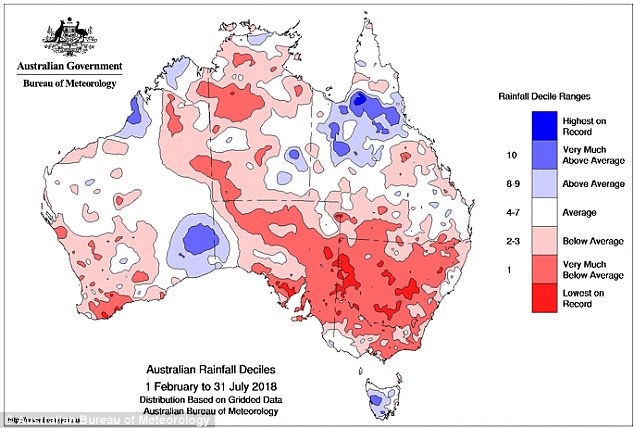
This is the map that shows just how desperate some areas of Australia are for drought-breaking rain - and there's no relief in sight with a hot, dry summer a certainty.
Looking at the past six months, large areas of NSW have experienced their lowest rainfall on record, and most of the rest of the state isn't far behind.
Almost all of NSW has received less than 20 per cent of its usual rainfall since January, and Australia as a whole just experienced its warmest and driest July in 20 years.
Weatherzone reports that Forbes, in NSW's central west, only received 0.8mm of rain at the beginning of the month and did not record any rainfall for the rest of July.
Meanwhile, extreme temperatures already recorded in NSW and south-east Queensland this winter look set to continue amid concerns a 'hot and deadly' summer is on the way.
ARC Centre of Excellence for Climate Extremes heatwave expert Sarah Perkins-Kirkpatrick told Weatherzone that Australians should be expecting extreme weather considering the dryness and warmth of the past few months.
'We are heading towards an El Nino summer, so we are more likely to have hotter and more extreme weather,' Dr Perkins-Kirkpatrick said. 'We should certainly be worried.'
Temperatures so far this winter have been unusually high, with Sydney and large regions of eastern Australia encountering an average high of 19.8 degrees last month - 3.4 degrees more than what was expected, according to Weatherzone.
Sydney recorded 13 days where temperatures reached 20 degrees. The last time Sydney experienced such warm temperatures in July was back in 2013 with a record high of 19.5 degrees.
With such a dry and warm July and above-average temperatures expected, the chances of El Ni¤o forming in spring is at 50 per cent - which is double the normal chance, according to Weatherzone.
Five of eight models indicate El Ni¤o levels will be reached in the southern hemisphere's springtime, while a sixth model says El Ni¤o will be reached in December.
This means Australia could be expecting even drier months and hotter temperatures as it heads towards spring and summer.
SOURCE
Bombshell: New York Times Debunks #ExxonKnew Climate Campaign
The New York Times Magazine has published an entire issue devoted to a single investigative piece on climate change, which observes that by the late 1970s and early 1980s, “everybody knew” it was happening.
The conclusion is a major blow to climate activists, who have spent years engaging in a political campaign targeting energy companies for supposedly covering up the risks of climate change, and thus preventing global action.
The author, Nathaniel Rich, writes that from 1979 to 1989 humanity had the best opportunity it has ever had to solve global warming and that “nothing stood in our way – nothing except ourselves.”
Rich even goes as far as to say that “[a] common boogeyman today is the fossil-fuel industry,” but during the time when “everybody knew,” oil companies “including Exxon and Shell, made good-faith efforts to understand the scope of the crisis and grapple with possible solutions.”
This lengthy report shreds the narrative put out by anti-oil and gas activists in recent years. As Rich told PBS NewsHour:
“By 1979, there was a strong consensus within the scientific community about the nature of the problem. The fundamental science hasn’t really evolved since then. It’s only been refined really. There was no politicization of the issue throughout the decade. A number of prominent Republicans were leading the charge to insist on a major climate policy, and industry, which we now blame for much of our paralysis, had not turned against science or truth and if anything, especially in the early part of the decade, was engaged in trying to understand the problem and determine solutions…
“By the mid-50s, you had top government scientists speaking about the issue. You had major articles in Life Magazine and Time. So it wasn’t just industry that was following it. It was at the highest levels of government. Lyndon Johnson sent a special message to Congress in 1965 that discussed the problem.” (emphasis added)
If all of humanity was informed of the dangers of climate change in the 1970s and agreed that something needed to be done, how can activists lay the blame for global inaction at the feet of the industry and political partisanship? As Rich writes,
“The rallying cry of this multipronged legal effort is ‘Exxon Knew.’ It is incontrovertibly true that senior employees at the company that would later become Exxon, like those at most other major oil-and-gas corporations, knew about the dangers of climate change as early as the 1950s. But the automobile industry knew, too, and began conducting its own research by the early 1980s, as did the major trade groups representing the electrical grid. They all own responsibility for our current paralysis and have made it more painful than necessary. But they haven’t done it alone.
“The United States government knew. Roger Revelle began serving as a Kennedy administration adviser in 1961, five years after establishing the Mauna Loa carbon-dioxide program, and every president since has debated the merits of acting on climate policy. Carter had the Charney report, Reagan had ‘Changing Climate’ and Bush had the censored testimony of James Hansen and his own public vow to solve the problem. Congress has been holding hearings for 40 years; the intelligence community has been tracking the crisis even longer.
“Everybody knew. In 1958, on prime-time television, ‘The Bell Science Hour’ — one of the most popular educational film series in American history — aired ‘The Unchained Goddess,’ a film about meteorological wonders, produced by Frank Capra, a dozen years removed from ‘It’s a Wonderful Life,’ warning that ‘man may be unwittingly changing the world’s climate’ through the release of carbon dioxide. ‘A few degrees’ rise in the Earth’s temperature would melt the polar ice caps,’ says the film’s kindly host, the bespectacled Dr. Research. ‘An inland sea would fill a good portion of the Mississippi Valley. Tourists in glass-bottomed boats would be viewing the drowned towers of Miami through 150 feet of tropical water.’ Capra’s film was shown in science classes for decades.
“Everyone knew — and we all still know.”
This conclusion – that #EveryoneKnew – is even supported by activists, though they haven’t yet followed their arguments to their logical conclusion.
Groups like the Union of Concerned Scientists and Greenpeace were quick to follow #ExxonKnew with #ShellKnew and #UtilitiesKnew, blaming every company they don’t like while failing to acknowledge their own amnesia on climate change.
The idea that energy companies “knew everything there was to know about climate change,” as Bill McKibben likes to say, and that the rest of us didn’t know about it until James Hansen testified before Congress in 1988, “is one of the worst examples we have of the cultural amnesia of this country and especially around this issue,” Rich told NewsHour.
Confirming that Rich’s narrative is a direct threat to the multi-million-dollar campaign they have waged in recent years, anti-energy activists intensely criticized the report before it was even released.
The loudest rebuttal came from Hunter Cutting, a director of strategic communications for Climate Nexus, a project of the Rockefeller Philanthropy Advisors.
The Rockefellers have funded every aspect of the #ExxonKnew campaign, and are no doubt alarmed by the New York Times contradicting the very basis for their campaign.
The activist group 350.org also condemned the story shortly after it was published.
For several hours after the report was released, the umbrella group for the #ExxonKnew campaign dedicated its Twitter page to criticizing Rich’s narrative and retweeting others who were scrambling to control the damage.
Rich’s story ultimately concludes that it’s too simplistic to point your finger at one company, industry, or political party for inaction on climate change, which is a complex global problem.
The issue was receiving mainstream media attention and was the subject of multiple Congressional hearings in the 1970s and 1980s, long before the supposed “disinformation campaign” that environmental activists cite ever began.
It may not have been the intent of New York Times Magazine to throw cold water on a fringe environmental activists campaign, but the damage has clearly been done. The attempt at damage control from the #ExxonKnew campaign is only beginning.
SOURCE
Mismanagement Turned California Forests Into A ‘Terrible Fire Threat,’ Expert Says
Years of mismanagement built up in California forests are feeding massive wildfires scorching the state, which is on track to experience its most destructive fire season ever.
Nearly 3,000 acres of state and local lands in California have been burned this year, about triple the size of the five-year average for this time of year. The amount outpaces 2017’s historic fire season in the state by about 70,000 acres, The San Francisco Chronicle reports. (RELATED: ‘We Are Not Climate Scientists’: Firefighters Dismiss Concerns Related To Global Warming)
The Little Hoover Commission (LHC), an independent California oversight agency, has been documenting forest mismanagement in the Golden State for decades. LHC described California’s Timber Harvest Plan in 1994 as an “inadequate tool” for balancing environmental and economic needs.
“Litigation rather than resolution is often the focus of the participants, leading to a strained decision-making process and lack of consensus,” LHC’s report said, pointing out one of the main issues with logging and forestry management in California.
Other issues in the Timber Harvest Plan included a limited view of the site impacts without accounting for the health of the overall ecosystem and focusing on process rather than outcome, according to LHC.
Recent droughts and bark beetle infestations have killed millions of trees in California that lie throughout the forests and are extremely susceptible to fire. About 129 million dead trees have littered California from 2010 to 2016, according to the U.S. Department of Agriculture.
“Our forests are dramatically overcrowded,” LHC project manager Krystal Beckham told The Washington Examiner.
“There are some places where there may be four times as many trees as there should be,” Beckham said. “When you have trees that close together, they can’t get the water they need, so they are more susceptible to drought, insects, and disease. And when they start dying, they become a terrible fire threat.”
SOURCE
WACKY NEW CLAIM: Global Warming Will Knock Out The Internet In 15 Years
A government-funded study predicts rising sea levels will likely submerge over 4,000 miles of internet cables and more than 1,000 data centers in the next 15 years.
But even the study’s authors admit their results are based on the “most extreme” sea level rise scenario of 6 feet by the end of the century.
The study’s dire predictions are based on future sea level rise that’s worse than even the most “extreme” scenario in the latest National Climate Assessment Special report released by the Trump administration in 2017.
The study, by University of Wisconsin-Madison and the University of Oregon researchers, uses the “most extreme” scenario considered by the National Oceanic and Atmospheric Administration (NOAA).
“We find that 4,067 miles of fiber conduit will be under water and 1,101 nodes (e.g., points of presence and colocation centers) will be surrounded by water in the next 15 years” with 1 foot of sea level rise, the study’s authors wrote.
“That was a little bit unexpected,” co-author Paul Barford told NBC News. “We sort of expected that it might be parceled out over a longer period of time, but that’s not the case.”
Of course, news headlines blared warnings the internet was in danger from man-made warming. (RELATED: Trump’s Tax Cuts, Tariffs Force Trudeau To Retreat On Carbon Taxes)
“Rising seas could knock out the internet — and sooner than scientists thought,” NBC News reported. “Climate change could literally break the internet,” reads The Huffington Post’s subheadline.
National Geographic went with the not-so-subtle headline: “The Internet Is Drowning.”
But how realistic is this dire prediction? The new study relies on an extreme scenario that projects more sea level rise than the latest NCA report’s most extreme scenario.
The NCA presents a range of sea level rise estimates of between 0.3 and 0.8 feet by 2030, but Barford and his colleagues went beyond that by modeling internet infrastructure inundation from sea level rise of one foot by 2030.
The NCA’s “intermediate” sea level rise scenario only predicts half a foot of sea level rise by 2030 and 3.3 feet by 2100. Barford’s study relies on a scenario of 6 feet by the end of the century.
“Specifically, in the next 15 years, as much as 2,429 miles of metro fiber conduit will be submerged after a 1 ft of sea level rise, whereas as 2,637 miles of metro fiber conduit will be affected in the next century,” the study found.
Researchers overlapped NOAA sea level rise data with internet cable and data center information mapped out by the website InternetAtlas.org. The study was funded by the federal government, including the National Science Foundation and Department of Homeland Security.
SOURCE
Gene editing in agriculture affectively banned in the European Union
Matt Ridley
A court decision condemns farmers to using pesticides instead. The European Court of Justice's bizarre decision to treat genome edited crops as if they were transgenic
The European Court of Justice has just delivered a scientifically absurd ruling, in defiance of advice from its advocate general, but egged on by Jean-Claude Juncker’s allies. It will ensure that more pesticides are used in Britain, our farmers will be less competitive and researchers will leave for North America. Thanks a bunch, your honours.
By saying that genome-edited crops must be treated to expensive and uncertain regulation, it has pandered to the views of a handful of misguided extremists, who no longer have popular support in this country.
Let’s compare two plant varieties: golden promise barley and a wheat resistant to a fungal pest called powdery mildew. The barley was derived from seeds bombarded with gamma rays at a nuclear facility in the 1950s, scrambling some of their genes, which had the happy if accidental result of making better malting barley. It became (and remains) a popular variety for brewing beer among (wait for it!) organic farmers.
The wheat was produced by Calyxt, a US company, last year using a genome-editing technique to tweak one part of one gene, introducing no foreign DNA. It will need less fungicide sprayed on it than normal wheat. The US government says it needs no special regulation. The EU has effectively said it will take Calyxt many years and vast sums of money to find out whether it might or might not approve the wheat for growing.
Calyxt and others like it won’t bother applying, so we will be deprived of the chance to use less fungicide. We will miss out on a new genome-edited potato variety that needs 80 per cent less spray. We are already missing out on GM varieties of maize and other crops that use much less insecticide and are proven safe by 25 years of consumption.
The ruling condemns Britain to the innovation slow lane, denying us greener crops. It will deter investment and drive our world-class scientists to move abroad. As one Canadian professor said: “Great news for Canadian and American farmers today. EU based environmental NGOs have politically manipulated their legal system to drive every last cent of ag R&D out of the EU, guaranteeing their farmers will no longer be competitive. Hope all Europeans enjoy their future higher food prices.”
Welcome to our continuing regulatory alignment with the EU.
SOURCE
***************************************
For more postings from me, see DISSECTING LEFTISM, TONGUE-TIED, EDUCATION WATCH INTERNATIONAL, POLITICAL CORRECTNESS WATCH, FOOD & HEALTH SKEPTIC and AUSTRALIAN POLITICS. Home Pages are here or here. Email me (John Ray) here.
Preserving the graphics: Most graphics on this site are hotlinked from elsewhere. But hotlinked graphics sometimes have only a short life -- as little as a week in some cases. After that they no longer come up. From January 2011 on, therefore, I have posted a monthly copy of everything on this blog to a separate site where I can host text and graphics together -- which should make the graphics available even if they are no longer coming up on this site. See here or here
*****************************************
Thursday, August 02, 2018
Green/Left lies and stupidity about the fires in CA
CA unusually hot? I reproduce below some conversation between two skeptics:
Tony Heller, climate historian: "Hotter than 134 degrees during July, 1913?"
Tony Heller again: "1988 was hotter than this year, and 2006 was just as hot. Redding got up to 118 degrees in 1988, five degrees warmer than this year's top temperature. I drove through Sacramento on the hottest day in 2006, and remember it was right around 115 degrees.
Joe Bastardi, meteorologist: Spot on right. 2006 was hotter and 2005,2003 just as hot
Tony Heller: "2006 was an amazing weather year. It was so warm in January in Fort Collins that I was wearing a T-shirt most days. Then I was working in Cupertino, CA from February-July, and our pool in Cupertino got hot all the way to the bottom. Most years that pool stays cold all year around.
We moved back to Colorado in the middle of the heatwave, and it was so hot my son's soccer camp didn't go outside some days.
But in the middle of September, the weather changed dramatically. It got cold and wet and stayed that way for six months - I was coaching soccer and it was miserable most weekends. Then Fort Collins had the largest snowstorm on record Christmas week.
Amazing how many different temperatures the same level of CO2 can produce."
The northern Sacramento Valley was well on its way to recording the hottest July on record when the Carr fire swept into town last Thursday.
*It was 113 degrees*, and months of above-average temperatures had left the land bone-dry and ready to explode. Within a few hours, hundreds of structures were lost and six people killed.
The destruction adds to California’s worst wildfire year on record — dozens dead since October, with more than 10,000 structures lost from San Diego to Redding.
There are many reasons for the grim totals, but experts say one common denominator connects the disastrous fires: California is facing extreme heat, the likes of which it has never seen in the modern historical record.
“The temperatures have just been almost inexorably warmer all the time,” said University of California, Los Angeles climate scientist Daniel Swain, and fires “burn more intensely if the fuels are extremely dry.”
In the past, there has been some reluctance among scientists to cite climate change as a major factor in California’s worsening wildfires. Human-caused ignitions and homes being built ever closer to forests have played a large role. But the connection between rising temperatures in California and tinder-dry vegetation is becoming impossible to ignore, according to experts who study climate and wildfires.
“The regional temperatures in the western U.S. have increased by 2 degrees since the 1970s,” said Jennifer Balch, director of Earth Lab at the University of Colorado, Boulder. “You’re seeing the effect of climate change.”
Neil Lareau, assistant professor of atmospheric sciences at the University of Nevada, Reno, said unusual warmth is now routine, and that heat “leads to drying things out quicker.”
Vegetation can have various degrees of dryness — a wet log in the woods could smolder before puttering out, while tinder-dry chaparral on a 110-degree day could explode when ignited, Swain said. Extremely flammable vegetation can create a particularly intense fire with the potential to grow much faster — leaving less time for firefighters to get a handle on a blaze and for people to escape.
“What that means is the fire has to do less work to ignite the vegetation right next to it. And it can spread faster, and it releases energy more quickly,” Lareau said.
SOURCE
All Of These Climate Change Lawsuits Will Be Thrown Out
All of these climate suits are likely to be thrown out. As Judge Alsup noted in his opinion, “No plaintiff has ever succeeded in bringing a nuisance claim based on global warming.” All district or appellate courts are likely to eventually rule that climate change issues are to be decided by the federal government, not state and local governments.
Last week, a federal judge dismissed New York City’s climate change lawsuit against five major oil companies. Last month, another federal judge dismissed similar global warming claims against oil firms brought by San Francisco and Oakland. More than a dozen climate lawsuits filed during the last year by cities and counties seek billions of dollars in damages from oil and gas companies. But it appears that all of these lawsuits will eventually be thrown out.
New York City sought monetary damages from BP, Chevron, Conoco-Phillips, ExxonMobil and Royal Dutch Shell as compensation for damage caused by dangerous global warming allegedly caused by the companies. But John F. Keenan, District Court judge for the Southern District of New York, disagreed and dismissed the complaint.
Judge Keenan ruled that, “…it would thus be illogical to allow the City to bring state law claims when courts have found that these matters are areas of federal concern that have been delegated to the Executive Branch as they require a uniform, national solution…Global warming and solutions thereto must be addressed by the other two branches of government.”
On June 25 on the west coast, US District Judge William Alsup threw out similar suits brought by the California cities of Oakland and San Francisco. Judge Alsup stated, “…it is true that carbon dioxide released from fossil fuels has caused (and will continue to cause) global warming. But against that negative, we must weigh this positive: Our industrial revolution and the development of our modern world have literally been fueled by oil and coal. Without those fuels, virtually all of our monumental progress would have been impossible.” Judge Alsup concluded that the courts should “defer to the legislative and executive branches.”
Note that Judge Alsup is not a conservative judge. Alsup was nominated by President Bill Clinton in 1999. In January, he blocked Trump Administration efforts to end the Deferred Action for Childhood Arrivals (DACA) program.
Several other climate lawsuits are pending in California. In July of last year, San Mateo County, Marin County, and Imperial Beach filed separate suits against 37 oil and gas companies in California Superior Court. Last December, Santa Cruz and Santa Cruz County also brought suits in California Superior Court against 29 companies. In January, the City of Richmond, California and the County of Contra Costa also filed claims against 29 companies.
Other state entities also initiated legal action this year. In April, the city of Boulder, Boulder County and San Miguel County filed a suit in Colorado against Exxon and Suncor. In May, King County Washington, the home of Seattle, filed suit against five companies. Just this month, the state of Rhode Island and the City of Baltimore filed separate climate change suits against oil and gas companies.
But all of these suits are likely to be thrown out. The New York City and the Oakland/San Francisco suits, the lawsuits with the highest profile, have now been dismissed. As Judge Alsup noted in his opinion, “No plaintiff has ever succeeded in bringing a nuisance claim based on global warming.” All district or appellate courts are likely to eventually rule that climate change issues are to be decided by the federal government, not state and local governments.
It’s clear that climate lawsuits do not reflect the will of congressional representatives elected by the American people. In December of 1998, President Bill Clinton signed the Kyoto Protocol, a 1997 international treaty signed by 192 nations committing to reduce greenhouse gas emissions. But the US Senate passed a resolution of disapproval with a vote of 95-0, so the treaty was never submitted to the Senate for ratification. Cap and trade legislation was rejected by Congress in 2003, 2005, 2007, and 2009. Last week the US House of Representatives passed a resolution opposing a carbon tax.
While advocates of climate common sense are pleased with the recent court decisions, the acceptance that humans are causing dangerous climate change by the oil and gas defendants is very disappointing. Evidence shows that natural factors, not emissions from industry, dominate global temperatures.
Nor are the feared climate disasters happening. Evidence shows that storms, droughts, or floods are neither more frequent nor more severe than in past decades. Oceans are rising 7-8 inches per century, not the 20 feet per century predicted by former Vice President Al Gore and others. And the polar bears are doing just fine.
SOURCE
Global warming is not people’s most pressing concern
Most people don’t really care, don’t think it affects them much, and don’t believe the hype
Tom Harris
In a recent interview with the Vatican News service, former U.S. Vice President Al Gore again claimed “the climate crisis is now the biggest existential challenge humanity has ever faced.”
Gore boasted, “I have been fortunate to be able to pour every ounce of energy I have into efforts to contribute to the solution to his crisis.” Ironically, Mr. Gore personally uses vast amounts of energy, often traveling in private jets, SUVs and limousines, and lives in mansions, one of which uses 21 times more electricity than the average American home.
We often hear claims that man-made climate change is our greatest threat. But according to a recent Gallup poll, very few people in the United States actually believe it is. Indeed, even the United Nations own polling reveals that respondents across the world rate climate change last among issues they would like the UN and governments to focus on. No matter how long the list, climate change is always last.
In telephone interviews conducted July 1-11, 2018 with a random sample of 1,033 adults, over the age of 18 and living in all 50 U.S. states and the District of Columbia, Gallup News Service asked: “What do you think is the most important problem facing this country today?” The question was “open ended,” in that any answer was accepted.
According to the respondents, the top problems facing America were “Immigration/Illegal aliens” (22%) and “Dissatisfaction with government/Poor leadership” (19%). Only 2% of respondents cited “Environment/Pollution.”
This 2% figure included those who mentioned climate change, as well as those who listed other environmental concerns such as ocean pollution, endangered species and toxic wastes. The fraction of Americans who labeled climate change as the nation’s most serious problem must have been very small indeed.
This sort of result is also reflected in July 5 poll reported by the New York Times. Among the main reasons young adults gave for not wanting (or not being sure they wanted) children, worries about climate change ranked #13 out of 19 reasons given. The first three reasons cited were “Want leisure time,” “Haven't found partner,” and “Can't afford child care.”
While other polls show varying levels of public concern about climate change, when people are asked to prioritize issues, climate change often does not rate highly. Even in 2014, just before then-President Barack Obama addressed the heavily publicized UN Climate Summit 2014 in New York City, Pew Research polling indicated that Americans did not consider climate change to be among the top six threats facing the country.
The UN’s own survey confirms that this trend is even more prominent internationally. After polling 9.7 million people from 194 countries, the UN’s My World global survey finds that “action taken on climate change” rates last out of the 16 suggested priorities for the agency. This despite the fact that on the survey website, the UN lists climate change action as the first choice given respondents. Access to reliable energy, better healthcare, government honesty, a good education, etc., are apparently far greater concerns to people across the world.
This should not be a surprise. In contrast to vitally important issues people must deal with on a daily basis, concerns about man-made climate change are based merely on a theoretical hypothesis, not what is happening now or even in the recent past. After all, even NASA’s Goddard Institute for Space Studies asserts that the Global Annual Mean Surface Air Temperature Change from 1880 to 2017 is only just over one degree Celsius despite a reputed 40% rise in atmospheric carbon dioxide (CO2) content. And the impact of further CO2 rise diminishes as the concentration increases.
It is not known whether the rate of sea level rise has increased or not. However, according to the National Oceanic and Atmospheric Administration’s U.S. state-wide extreme weather records database, probably the best of its kind in the world, there has been no increase in extreme weather. So, the primary rationale for “action taken on climate change” through expensive restrictions to CO2 emissions is merely the possibility of dangerous climate change in the future. And this is based on computer models of future climate states, models that have failed to forecast what has actually happened.
Dr. John Christy is Distinguished Professor of Atmospheric Science, Alabama State Climatologist and Director of the Earth System Science Center at The University of Alabama in Huntsville. During his February 2, 2016 testimony before the U.S. House of Representatives Committee on Science, Space & Technology, he presented a graph that dramatically demonstrates how far apart computer model temperature forecasts differ from what has actually been measured by satellites and weather balloons.
In fact, as of 2016, there was already a 0.5 degree Celsius (0.9 degree Fahrenheit) difference between real-world temperatures and the “runaway” temperature predicted by averaging 102 climate model estimates. And yet those faulty models have become the basis for countless claims of imminent climate doom – and the foundation for policies that would replace abundant, reliable, affordable fossil fuel energy with sporadic, unpredictable, weather-dependant, expensive wind, solar and biofuel energy.

Five-year averaged values of annual mean global mid-tropospheric temperature as depicted by the average of 102 IPCC CMIP5 climate models (red), compared to the average of 3 satellite datasets (green - UAH, RSS, NOAA) and 4 balloon datasets (blue, NOAA, UKMet, RICH, RAOBCORE)
Christy told Congress, “[T]hese models failed at the simple test of telling us ‘what’ has already happened, and thus would not be in a position to give us a confident answer to ‘what’ may happen in the future and ‘why.’ As such, they would be of highly questionable value in determining policy that should depend on a very confident understanding of how the climate system works.”
To create the models requires vast amounts of weather and climate data. We also need to input accurate data as the starting conditions for model-generated forecasts to be performed.
However, the collection and interpretation of the necessary data has only just begun, says former University of Winnipeg professor and historical climatologist Dr. Tim Ball. But there are relatively few weather stations that have temperatures records of adequate length or reliability on which to base model forecasts of future climate, Ball explains.
Referring to former-President Barack Obama’s worries about dangerous future climate change, Ball concludes, “Obama’s worries therefore have absolutely no credibility in the real world.”
Ball is not alone in holding this view. Extensive analyses and reports by the Nongovernmental International Panel on Climate Change (NIPCC) summarize thousands of studies from peer-reviewed scientific journals that debunk or cast serious doubt on the hypothesis that emissions of CO2 from human activities will cause catastrophic climate change.
Yet there is nothing hypothetical about the issues that Americans, and people all over the world, list as their top priorities. Problems with immigration and government are happening right now in America.
The issues rated highest in developing countries like Nigeria (2,735,062 Nigerians voted in the UN poll) are similarly pressing: access to a good education, better healthcare, better job opportunities, better transportation and roads, political freedom, affordable and nutritious food.
All are immediate concerns – today, to real people who understand that the world has real problems to solve: problems that affect our lives and well-being right now.
They realize we don’t have the time, money or manpower to obsess over problems that exist only in computer models, questionable news stories, or the fertile imaginations of multi-millionaires like Al Gore.
Via email
Largest US Wind Project ever, denied on the basis of economics
The Texas Public Utility Commission on Thursday unanimously rejected the project as proposed, saying it didn’t offer enough benefits for Texas ratepayers as structured.
“We are disappointed with the decision in Texas that resulted in the cancellation of the project,” PSO official Steven Pate said in a news release.
The $4.5 billion project centered on construction of a 300,000-acre wind farm — the largest in the United States — in Cimarron and Texas counties by international energy giant Invenergy. AEP and its subsidiaries would acquire the 2,000-megawatt wind farm and a 360-mile dedicated generation tie line to the Tulsa area, where it was to connect to the electrical grid for delivery to PSO customers in Oklahoma and Southwest Electric Power Co. customers in Louisiana, Arkansas and Texas.
Tulsa World attempts to reach Invenergy for comment on the future of the wind farm Friday afternoon were unsuccessful.
Preapproval for cost recovery from all four states involved in the project in a timely manner to qualify the project for energy tax credits was necessary for it to move forward, according to Nicholas K. Akins, AEP chairman, president and chief executive officer.
Arkansas was the first to approve it, and Louisiana followed. After repeated hearings, the Oklahoma Corporation Commission had yet to rule, but the project clearly faced hurdles.
“We are disappointed that we will not be able to move forward with Wind Catcher, which was a great opportunity to provide more clean energy, lower electricity costs and a more diverse energy resource mix for our customers in Arkansas, Louisiana, Oklahoma and Texas,” Akins said in the press release.
The announcement came just a few hours after dozens of local landowners attended a hearing in Creek County District Court, where the landowners were mounting a challenge against PSO in refusing the company access to survey their properties for the transmission line.
“So it’s over? It’s done? That is so wonderful. That’s excellent,” resident Marta Koenig said upon hearing the news. She learned that the line might cross her property and had attended the court hearing to learn what she could, even though she had learned that the line might not cross her property after all.
“People have organized in social media and all over. There was a man in the parking lot that at his own expense had made ‘No Wind Catcher’ signs, and he was just passing them out. I brought a couple home,” she said. “It was affecting so many people that I know.”
At the morning hearing the cases of unrepresented landowners were continued and would have been rolled in for hearing with those of several families who had hired attorneys. That hearing had been set for Monday afternoon.
Alan Weeks, one of the represented landowners, said he learned from his attorney Friday afternoon that the court case was withdrawn.
Weeks and his family have a 400-acre Creek County property that they have acquired and improved upon for 18 years. He said they were crushed to learn that the line might cut diagonally across their property.
“We’ve been waiting to exhale for a long time,” Weeks said. “It feels good to breathe again knowing that a place so special to us will remain undisturbed. It’s an awesome answer to many prayers.”
Greg Ganzkow of Bixby saw the result as one of awareness and community efforts.
As a small-business owner and director of land sales for Coldwell Banker, he had many existing and potential clients who were concerned and said he saw land deals fall through as a result of uncertainty about the line. His was one of several families who hired attorneys, started a No Wind Catcher Facebook page that had 1,200 members, and encouraged the Bixby City Council to oppose the giant generation tie line, which would have been the largest power line west of the Mississippi.
“I think Bixby really made a difference. It was one of the first big dominoes that went,” he said. “Bixby showed other communities, other people, that we could fight this. It surged the movement forward.”
He praised neighbors to the south. “Texas has tremendous backbone and immediately sniffed this out,” Ganzkow said. “In Louisiana and Arkansas they weren’t going to have the wind turbines and the big transmission line. They didn’t have much to lose, and it didn’t touch as many customers. In Oklahoma the whole thing was just so polluted with the campaign about how great it would be for everyone.
“This is just a really big win for the landowners and the people,” he said. “It was a David versus Goliath thing, and we really have the media to thank for listening to the David part of that David and Goliath battle, too.”
Americans for Prosperity-Oklahoma, the state’s largest free-market advocacy group, was an early opponent of the project and welcomed the news Friday.
“The project was a boondoggle from the beginning,” it said in a statement. “Thousands of activists and landowners from across Oklahoma spoke out against this project. Whether because of the cost, the impact to their property or the future impact to ratepayers, they were vocal in opposition to the project and their efforts were invaluable to help kill the project.”
Oklahoma Attorney General Mike Hunter also expressed concerns about the project from its first airing.
“I commend the Texas Public Utility Commission for its sound and sensible ruling,” he said in his own statement. “We have said from the beginning PSO failed on several fronts to qualify for pre-approval and cost recovery of this project, including its failure to comply with the (Oklahoma Corporation Commission’s) rules for competitive bidding, the inability to show a need for the generation capacity and unrealistic assumptions of ratepayer savings.”
Hunter said his office was not critical of the companies or wind power but the plan.
“PSO has proven itself as one of our state’s most valuable corporate citizens. We look forward to them continuing to provide quality service to thousands of Oklahomans for many years to come. We also look forward to working with them on future rate cases to keep customers’ rates reasonable, and PSO’s parent company, American Electric Power, attractive to investors,” he said.
Akins, of AEP, emphasized that the plan had always relied upon pre-approval and said the company will continue to grow in spite of this outcome.
“To realize the full benefits of Wind Catcher for customers, timely approvals were required from all jurisdictions so we could complete the project by the end of 2020 and be eligible for 100 percent of the federal production tax credit,” he said. “The strategic investments we are making in our regulated businesses will continue to support our 5 percent to 7 percent earnings growth rate. We are investing in a cleaner, smarter energy system for our customers and will continue to pursue opportunities to provide the new energy resources and technology solutions that bring value to our customers.”
SOURCE
Not everything is a feminist issue
Even climate change is now looked at through a gendered lens.
Feminism is no longer a specific political outlook, with specific issues attached. No, today it seems that everything is a feminist issue, from adverts on the Tube to the level of air-conditioning in an office. Thinking about buying a razor? There’s a feminist issue to be considered there, too.
But this week’s announcement that former Irish president and UN high commissioner Mary Robinson is launching a ‘feminist fight against climate change’ really takes the biscuit. Along with comedian Maeve Higgins, Robinson is hosting a new podcast called Mothers of Invention, which insists that ‘climate change is a manmade problem that requires a feminist solution’. Climate change, Robinson argues, is an issue which ‘affects women far more’, because ‘women are more likely to die in a climate disaster, and day to day they are the ones cooking on solid-fuel stoves that can ultimately poison them’.
Climate change is only the latest in a long line of political issues which have been rebranded feminist issues. At the height of the European migrant crisis in 2015, many news outlets focused on the plight of women despite the fact that the vast majority of migrants were young men. Earlier this year, the United Nations Population Fund published ‘Five reasons migration is a feminist issue’. The first reason is that ‘almost half of migrants are women and girls’. No3 is that women ‘face double discrimination – as women and as migrants’.
Poverty is also now a feminist issue, because of ‘period poverty’: the idea that some young women are so poverty-stricken they can’t access sanitary products. This is a favoured cause among many feminist commentators and MPs. Scottish Labour Party politician Danielle Rowley made a speech in parliament in June describing the plight of women who can’t afford the ‘£500 annual cost’ of sanitary products. Leaving aside the fact that Rowley’s ridiculous sum indicates she must be buying her tampons in Harrods, the idea that poor families don’t provide for their daughters’ basic hygiene needs is pretty insulting.
This desire constantly to gender political issues reveals modern feminism’s inability to extend solidarity. spiked has often been critical of the politics around climate change, but any discussion of how to make the planet a more habitable, functional place should surely include everyone. No moral person hears about the tragic deaths of migrants in the Mediterranean and feels more sorry for the female victims. And no one only expresses solidarity with struggling working people on the basis of their alleged inability to buy sanitary products.
Feminists today suggest that women’s experience of life and politics is inherently different to that of men. But what they don’t seem to understand is that a female migrant will have more in common with her fellow travellers than she would with a UN official in spike heels, and a girl from Tottenham will have more in common with the boy living next door to her than with a retweet-hungry Scottish MP waxing lyrical about sanitary pads.
We need to stop making everything a feminist issue. If we want to get serious about changing the world, let’s stop feeding the gender war.
SOURCE
***************************************
For more postings from me, see DISSECTING LEFTISM, TONGUE-TIED, EDUCATION WATCH INTERNATIONAL, POLITICAL CORRECTNESS WATCH, FOOD & HEALTH SKEPTIC and AUSTRALIAN POLITICS. Home Pages are here or here. Email me (John Ray) here.
Preserving the graphics: Most graphics on this site are hotlinked from elsewhere. But hotlinked graphics sometimes have only a short life -- as little as a week in some cases. After that they no longer come up. From January 2011 on, therefore, I have posted a monthly copy of everything on this blog to a separate site where I can host text and graphics together -- which should make the graphics available even if they are no longer coming up on this site. See here or here
*****************************************
Wednesday, August 01, 2018
Greenhouse Gas Climate Science Is Broken Beyond Repair
Written by Hans Schreuder
In earlier centuries, science had a positive influence on society in developing social awareness around objectivity and rationality.
It replaced the witchcraft and hocus pocus of charlatans with evaluation of objective evidence as the means of determining truth. But now, science is leading the pack for charlatanism and witchcraft, as junk science is acquiring a greater legitimacy than the charlatans ever had.
Wherever there is corruption in science the most important, underlying facts are contrived, while science is applied to more superficial elements of the subject. Omitting the science where it is most relevant isn’t an error, it is fraud. That’s why the word fraud must be used in describing the major corruptions of science.
Nowadays, science bureaucrats require that every detail of research be described in grant proposals; and in the laboratory, the researchers can do nothing but fill in the blanks with numbers. The claim is that doing otherwise would be defrauding the public. So the research has to be done at a desk instead of the laboratory.
Science bureaucrats are not politicians. They are scientists who put themselves in competition with the scientists in the laboratories. The editors and reviewers of science journals do the same. The result is that the laboratory scientists are dominated by office scientists who dictate how their work will be designed and reported.
Madness has taken over the western world, an insanity that demands we destroy ourselves over the ludicrous claim that a tiny increase of a trace gas has endangered the world due to an even more ludicrous “atmospheric greenhouse effect”.
Let me therefore conclude my “I Love My Carbon Dioxide” mission by stating the following, which is in the tradition of proper science, not radiative forcing’s greenhouse effect pseudo-science:
1.
The settled science that a greenhouse warms up due to re-radiated light (energy), as set out by Fourier (1824), Tyndall (1861), Arrhenius (1896), NASA (2008), et al., is false.
2.
Considering, therefore, that even inside an actual greenhouse with a barrier of solid glass no such phenomenon as a greenhouse effect occurs, most certainly there can be no greenhouse effect in our turbulent atmosphere.
Energy can not be created from nothing, not even by means of re-radiated infra red. Widely accepted theory has it that more energy is re-radiated to earth than comes from the sun in the first place, amounting to almost an extra two suns. All materials above zero Kelvin radiate energy, yes, but energy does not flow from a cold body to a warm one and cause its temperature to rise.
A block of ice in a room does not cause the room to warm up, despite the block of ice radiating its energy into the room.
Yet carbon dioxide’s re-radiation of infrared energy warming up planet earth is the preposterous theory hailed by not only the alarmists, but accepted and elaborated by most skeptics as well, with mathematical theorems that do little more than calculate the number of fairies that can dance on a pinhead.
The accepted carbon dioxide greenhouse theory is thus declared a complete and total scam, as more fully detailed in these papers, amongst many (and I salute all scientists who agree with these papers and will gladly publicise all papers on this subject) :
“Falsification Of The Atmospheric CO2 Greenhouse Effects Within The Frame Of Physics”
www.tech-know.eu/uploads/Falsification_of_the_Atmospheric_CO2_Greenhouse_Effects.pdf and
“Greenhouse Gas Hypothesis Violates Fundamentals of Physics”
http://freenet-homepage.de/klima/indexe.htm
SOURCE
San Francisco Bans Plastic Straws, Cocktail Swords

San Francisco's Board of Supervisors has voted unanimously to ban single-use plastic straws, making it the second major American city to do so.
The ordinance outlaws not just plastic straws, but also plastic splash sticks, toothpicks, and cocktail sticks, which would have to include those little swords and umbrellas. Other straw bans typically target food service businesses, but this one will prohibit anyone, including grocery stores and other retailers, from selling plastic straws.
"The negative environmental impacts of single-use plastics are astronomical," bill sponsor Katy Tang said in a statement. "San Francisco has been a pioneer of environmental change, and it's time for us to find alternatives to the plastic that is choking our marine ecosystems and littering our streets."
Like all good straw bans, the text of Tang's bill mentions the questionable statistic that Americans use 500 million straws a day. This statistic comes from a unconfirmed 2011 phone survey of straw manufacturers conducted by a 9-year-old. Market analysts think the actual number is far lower.
Violators of San Francisco's plastic straw/sword ban will face between $100 and $500 in fines, depending on the number of violations. While an explicit exemption for disabled people—many of whom lack the motor skills to drink or eat without a straw—is not included, the bill does say that "strict compliance" with the law is not required when it would "interfere with accommodating for any person's medical needs."
This makes it less punitive than the straw ban in nearby Santa Barbara, which has no disability exemption and even allows for the possibility of criminal sanctions. In other ways, though, San Francisco's straw ban is quite restrictive. Unlike Seattle's straw ban, for example, San Francisco's does not allow straws made from most compostable bioplastics.
The bill also includes a ton of other non-straw-related regulations aimed at cutting down on single-use food containers. Starting in 2020, event planners will now have to make reusable cups available for 10 percent of attendees. That same year, businesses will be required to meet yet-to-be-determined targets for using recycled content in containers, cups, and other "food service ware."
Tang's bill also restricts city departments' ability to issue waivers or exemptions for those claiming financial hardship.
A final vote enacting this ordinance into law is not expected until next week. But given the board's unanimous sign-off, this is a mere formality. The straw ban will take effect in July 2020.
As I've written many times in the past, straw bans are a useless environmental measure. San Francisco's is no exception. The United States is responsible for less than one percent of the world's plastic marine waste, and straws make up a tinier portion of this still. The best way to cut back on plastic pollution in the oceans is to improve waste management systems in China and other parts of the developing world, not to tinker with individuals' consumption habits in the States.
Despite the medical exemption, many disabled people will no doubt find it harder to have a drink out on the town. Able-bodied consumers will be inconvenienced too, although to a lesser degree. Meanwhile, straw-dependent bars, restaurants, and tea shops will see their costs rise even higher in the notoriously expensive city. These might not be life-altering hardships, but the government nevertheless shouldn't be imposing them on people.
SOURCE
Climate change alarmists burned by studies showing destructive wildfires in decline
Global burned area dropped by about 25 percent over the previous 18 years, study shows
Scenes of Californians fleeing their homes and Greeks swimming out to sea have fueled alarm about climate change fueling deadly wildfires, but recent studies show that such destructive blazes are on the decline worldwide.
A September 2017 report in the journal Science found that global burned area dropped by about 25 percent over the previous 18 years, a finding consistent with a May 2016 paper published by the Royal Society B: Biological Sciences.
“[G]lobal area burned appears to have overall declined over past decades, and there is increasing evidence that there is less fire in the global landscape today than centuries ago,” said the study by British researchers at Swansea University.
Even in California, which for years has wrestled with fire devastation, a study in the International Journal of Wildland Fire found that the number of wildfires burning more than 300 acres per year has been tailing off since a peak in 1980.
“The claim commonly made in research papers and the media that fire activity is increasing throughout the western USA is certainly an over-statement,” the authors, Jon E. Keeley and Alexandra D. Syphard, said in The Orange County Register.
Mr. Keeley is a scientist with the U.S. Geological Survey, and Ms. Syphard is with the Conservation Biology Institute.
Such findings appear to fly in the face of widespread reports that human-caused global warming is increasing the severity and frequency of wildfires by fueling drought and higher temperatures.
“Extreme heat and wildfires made worse by climate change, say scientists,” an Associated Press article proclaimed this week on NBC News.
“We now have very strong evidence that global warming has already put a thumb on the scales, upping the odds of extremes like severe heat and heavy rainfall,” Stanford University climate scientist Noah Diffenbaugh told the AP.
Yale Environment 360 declared in an Oct. 2 article, “Stark Evidence: A Warmer World Is Sparking More and Bigger Wildfires,” and concluded that “the fires being seen today … are man-made, or at least man-worsened.”
This year’s U.S. wildfire season was forecast to be worse than average, and so far it has kept with predictions, with 98 wildfires blackening 4.6 million acres as of Monday, more than the 10-year average of 3.7 million acres, according to the National Interagency Fire Center.
California has been hit hardest, but firefighters made progress Monday. They lifted some evacuation orders on the Carr fire in Shasta County about 150 miles north of Sacramento, the deadliest and most destructive of the blazes, and reached 30 percent containment on the Ferguson fire near Yosemite National Park.
Six people have been killed so far in the California wildfires, including two firefighters, a great-grandmother and two of her great-grandchildren. About 410,000 acres have burned across the state amid unpredictable winds and high temperatures.
The death toll in Greece rose to 91 on Sunday as wildfires swept through seaside communities, at one point sending dozens of people out to sea to escape the flames engulfing the resort town of Mati, as shown on a dramatic video.
California Gov. Jerry Brown, a Democrat, cited global warming last week as a factor in his proposal to reduce the legal liability of Pacific Gas & Electric Co., the utility company whose equipment was found to have sparked 15 of the state’s 2017 wildfires.
Mr. Brown and legislative leaders announced amended legislation July 2 to heighten California’s wildfire response, saying the effort “will help prepare the state to deal with the increasingly extreme weather and natural disasters caused by climate change.”
In a May report, “Indicators of Climate Change in California,” state Environmental Protection Agency Secretary Matthew Rodriguez said extreme weather events like wildfires are “not isolated incidents.”
“They are suggestive of the significant and increasingly discernible impacts of climate change in California,” Mr. Rodriguez said. “The most dramatic impacts include wildfires that are larger and more frequent, and the most severe drought since recordkeeping began.”
Others have argued that news coverage of fire disasters has contributed to the perception that wildfires driven by increased carbon dioxide levels in the atmosphere are raging out of control, despite evidence to the contrary.
“[M]any consider wildfire an accelerating problem, with widely held perceptions both in the media and scientific papers of increasing fire occurrence, severity and resulting losses,” said the Royal Society paper. “However, important exceptions aside, the quantitative evidence available does not support these perceived trends.”
In the Western United States, the study found that the limited data on fire severity “indicate little change overall, and also that area burned at high severity has overall declined compared to pre-European settlement.”
What’s responsible for the drop-off? The Science article pointed to an expansion of agriculture production in savannas and grasslands, resulting in a roughly 25 percent decrease in global burned area “despite the influence of climate.”
The discrepancy was not lost on climate skeptics such as Australia’s JoNova, who concluded Monday, “Global warming means a global fall in wildfires.”
Anthony Watts, who runs the Watts Up With That website, added: “Remember when we were told that wildfires would increase due to global warming? Never mind.”
University of Washington atmospheric sciences professor Clifford Mass said a host of factors may have contributed to this year’s California wildfires, including a modest temperature increase over the past several decades.
Add to that the drought, an increase of non-native invasive species, a huge influx of homeowners in fire-prone areas and aggressive fire suppression in the first half of the 20th century that left some forests overgrown and ripe for ignition.
“So there is a lot of talk of climate change ‘supercharging’ fires, but really no proof of it,” Mr. Mass said in an email. “And some fires are clearly NOT associated with climate change, like the wine country fires of last October.”
His conclusion? “I suspect climate change is a minor element in the CA wildfires, while fire suppression and human population growth into the wildlands are the dominant elements.”
SOURCE
Wet & Cold: The Shape Of British Summers To Come?
Global cooling?
It’s been a dull, damp few months and some scientists think we need to get used to it. Melting ice in Greenland could be bringing permanent changes to our climate
[…] A series of unusually wet and cold summers has afflicted the UK for several years. Remember the devastating floods of 2007, when some areas received double their normal rainfall for June? Or the predictions of a “barbecue summer” in 2009 that backfired badly on the Met Office as the (correctly anticipated) high temperatures were accompanied by heavy clouds and rainstorms? The impression that many Britons have had that summer weather has been getting worse in recent years is borne out by the data – five out of the last six years (2007-2012), have shown below-average sunshine from June to August, and in some cases well below average. All have had above-average rainfall – in some cases more than 50% above the long-term average. “It is not just a perception – we have had a run of relatively poor summers,” says Stott.
This year has been the worst so far. April was the wettest on record, and so was the period from April to June. The sun was missing too – June was the second dullest recorded. Hopes that August might bring more settled weather were dashed when the first few days brought floods as far apart as Scotland and Somerset, forcing scores of people from their homes. The unseasonally wet and miserable summer may have failed to dampen the Olympic spirit but it has brought misery to thousands.
Nor has the UK been alone in suffering extreme weather. In the US, the eastern seaboard has been hit by heatwaves and storms but even worse has been the “dustbowl effect” in Texas and across much of the nation’s agricultural heartland. India’s monsoon failed to appear on schedule, leaving millions of farmers in the subcontinent facing destitution. Floods in Beijing, after the heaviest rainfall in 60 years, caused devastation to millions.
The consequences across the world have been and will be dire. A food crisis is now all but inevitable, according to the US agriculture secretary. Emergency plans are being discussed in India, while in China the clear-up is accompanied by concerns that environmental degradation may be making the country’s problems worse.
Attributing any single weather event, or short pattern of events, however extreme, to climate change is always tricky. Extreme weather events occur, in the scientists’ term, stochastically – they happen by themselves, unpredictably, owing to the natural variations of the weather.
But the science of climate change has progressed rapidly in recent years. Last month, the Met Office and NOAA, the US National Oceanic and Atmospheric Administration, published a groundbreaking report that showed recent events could be attributed to human causes. Last year’s unseasonally warm November in the UK – the second hottest since records began in 1659 – was shown to be at least 60 times more likely to have happened because of climate change than because of natural variations in the earth’s weather systems.
Stott says: “We are much more confident about attributing [weather effects] to climate change. This is all adding up to a stronger picture of human influence on the climate.”
For the British Isles, the melting Arctic could hold the key to whether the weather is changing under human impacts. Recent poor summers have been strongly linked by scientists to a change in the usual position of the jet stream, a weather system that normally lies in high latitudes during the northern hemisphere summer.
Earlier this year, two US scientists published a paper in the journal Geophysical Research Letters, suggesting that the meandering of the jet stream could be linked to the reduction in sea ice. Edward Hanna, reader in climate science at the University of Sheffield, who is taking part in similar research, explains: “The last six summers since 2007, while often rather cool and wet over the UK, have brought Greenland unusually high air pressure, mild southerly winds, record-breaking temperatures and melting of the land ice.” The link, he believes, is that Arctic sea-ice losses and the release of heat over the Arctic Ocean have tended to weaken the jet stream and make it more meandering. This has brought more low pressures over Britain, less stable conditions, more cloud cover and rain-bearing weather systems from the Atlantic.
This year, the jet stream moved much more than usual, passing south of the UK. It also persisted in this position for an unusually long time. If this pushing of the jet stream southward is indeed linked to less sea ice over the Arctic circle, as Hanna suspects, then the signs are that we will see many more of these wet summers in future.
SOURCE
Elevated CO2 Overpowers the Effects of Drought in Wheat
Paper Reviewed: Uddin, S., Löw, M., Parvin, S., Fitzgerald, G.J., Tausz-Posch, S., Armstrong, R., O'Leary, G. and Tausz, M. 2018. Elevated [CO2] mitigates the effect of surface drought by stimulating root growth to access sub-soil water. PLoS ONE 13: e0198928.
In a study conducted in a glasshouse at the University of Melbourne, Creswick, Victoria, Australia, Uddin et al. (2018) set out to investigate the interactive effects of drought and elevated CO2 on wheat (Triticum aestivum, cv. Yitpi). The plants were maintained at either ambient (400 ppm) or elevated (700 ppm during daylight hours only) CO2 levels and one of four water treatments during the course of the growing season. In the first water treatment (WW), plants were well-watered to maintain a soil water content close to field capacity across the depth of the soil column for the entire length of the experiment. In the second (WD), third (DW) and fourth (DD) water treatments, drought was imposed at stem-elongation (62 days after sowing) on the lower, upper and full layer of the soil column, respectively, by withholding 33% of the irrigation, which droughted conditions were maintained through maturity and harvest (175 days after sowing).
Not surprisingly, the results of the experiment revealed that drought negatively impacted plant photosynthesis and biomass production, while elevated CO2 enhanced it. In describing some of the CO2-induced benefits Uddin et al. say that "plants under elevated CO2 were taller, had more tillers, a larger leaf area, more heads and greater numbers of grains, which resulted in greater aboveground biomass under elevated CO2 than ambient CO2" Plant water use efficiency, below ground biomass and grain yield were also stimulated by elevated CO2, with the latter parameter rising by an average 63% across the four water treatments. What is more, the grain yields under elevated CO2 in the WD and DW water treatments were both higher than the well-watered treatment at ambient CO2, indicating that elevated CO2 fully compensated for the negative impacts of these two drought treatments. And although the magnitude of grain yield in the DD treatment under elevated CO2 is slightly lower than the grain yield at ambient CO2 under well-watered conditions, the researchers note that the yield values of these two treatments "were not significantly different" from one another.
Clearly, based on the results described above, rising concentrations of atmospheric carbon dioxide will increase the yield of wheat, even during times of moderate to severe drought (relative to well-watered and ambient CO2 conditions of today). And on those rare instances of extreme drought, wheat yields of tomorrow should still be similar to those observed under well-watered conditions of today, thanks to the incredible molecule -- CO2 -- that we like to call the elixir of life!
SOURCE
***************************************
For more postings from me, see DISSECTING LEFTISM, TONGUE-TIED, EDUCATION WATCH INTERNATIONAL, POLITICAL CORRECTNESS WATCH, FOOD & HEALTH SKEPTIC and AUSTRALIAN POLITICS. Home Pages are here or here. Email me (John Ray) here.
Preserving the graphics: Most graphics on this site are hotlinked from elsewhere. But hotlinked graphics sometimes have only a short life -- as little as a week in some cases. After that they no longer come up. From January 2011 on, therefore, I have posted a monthly copy of everything on this blog to a separate site where I can host text and graphics together -- which should make the graphics available even if they are no longer coming up on this site. See here or here
*****************************************
Subscribe to:
Posts (Atom)


 Jim Hansen and his twin


