Sunday, June 10, 2018


Turncoat NASA chief says he changed mind about climate change because he 'read a lot’


This is a good example of regulatory capture -- when the people being regulated win over their supervisor to their viewpoint.  It happens all the time.  He looks a bit of a Shlemiel anyway so was probably not hard to capture

Another reason why he was quickly captured probably is that he knows nothing about science.  In justifying himself, Bridenstine referred to "The Science" as having convinced him. Whenever anybody  talks vaguely about "The Science" as his justification for believing in global warming that is a sure sign that he in fact knows nothing about the issues involved.  He is just appealing to authority, which is almost always a dumb thing to do.

So it is no surprise that his only postgrad degree is an MBA, a singularly useless piece of paper.  There is no MBA science.  An MBA is just a grab bag of ideas from other disciplines and 40 Years Of Data Show The MBA Effectively Does Nothing -- It Has No Impact.  Success in business is all about handling people and you have either got that or you haven't

I have read a number of comments from skeptics about Bridenstine's poorly articulated views and their consensus is that Bridenstine wanted to be captured. He is a relatively young 42 and he wants to be accepted by the Green/Left establishment with a view to his future career when Trump has left the scene.  We have a term for that in Australia:  He is a "crawler".  To Australians, a crawler is the lowest of the low
 

NASA chief says he changed mind about climate change because he 'read a lot’

NASA Administrator Jim Bridenstine says he changed his mind on the existence of man-made climate change because he “read a lot.”

“I heard a lot of experts, and I read a lot,” Bridenstine told The Washington Post on Tuesday. “I came to the conclusion myself that carbon dioxide is a greenhouse gas that we've put a lot of it into the atmosphere and therefore we have contributed to the global warming that we've seen. And we've done it in really significant ways.”

The former congressman from Oklahoma had long denied the scientific consensus on climate change and said in a 2013 speech on the House floor that "global temperatures stopped rising 10 years ago."

In May, Bridenstine first announced publicly that he now believes human activity is the main cause of climate change.

“The National Climate Assessment that includes NASA, and it includes the Department of Energy and it includes NOAA, has clearly stated it is extremely likely — is the language they use — that human activity is the dominant cause of global warming,” he said at a Senate Appropriations Committee subpanel's hearing last month.

President Trump and Environmental Protection Agency Administrator Scott Pruitt have not made similar pronouncements, however.

SOURCE


The Neurobiology of Climate Change Denial

This is a fun article so has already been widely noted.  So I don't think I will be letting the cat out of the bag if I report that as soon as I saw the reference to the work of Lewandowsky in the first paragraph I smelt a rat.  Lewandoski would be in the running to get first prize for the worst bit of survey research ever done.  I don't have enough information to diagnose what his problem is but it is clearly a big one.

But do read the whole of the article linked below  It is VERY reminiscent of a lot of brain-function studies coming from Leftist psychologists (e.g. Hibbing)


Much work has already been undertaken to establish the cognitive foundation for the irrationality of climate change denial. Of particular note are the studies undertaken by Lewandowsky, Kahneman, Shapiro and O’Conner, identifying the many cognitive biases that invalidate arguments put forward by those who profess scepticism in the face of the scientific evidence. However, it is not until recently that neuroscientists have turned their attention to the subject of climate change science denial in order to determine whether there are any fundamental neurological indicators that may be used as predictors of such pathological thinking strategies.......

More HERE


Vegans spreading the word about their lifestyle damage endangered PLANTS with their graffiti

Environmentalists have accused vegans of killing endangered cress in a row over an anti-meat graffiti stunt.

Meat-free campaigners daubed the words 'Go Vegan' in huge letters on a rock face in the Avon Gorge near Bristol this week.

But the move has been slammed by conservation experts at the National Trust, who say the rock is home to rare plants, including rock cress, which may have been killed or damaged by the thick masonry paint.

The 'Go Vegan' message is clearly visible from across the gorge on Bridge Valley Road and appears to be either signed or a message to a 'Ned', 'Ryan' and 'Ash'.

The National Trust's local countryside manager Lisa Topham hit out at the irresponsible move.

She said: 'The cracks in that rock are home to the exceptionally rare Bristol Rock Cress which grows in crevices of exposed rock faces.

'The people who climbed the rock face are bound to have trampled the plants and even painted them. What they have done there isn't green in any way.'

Ms Topham added: 'We can't risk causing damage ourselves, so we can't use chemicals to remove the paint.

'Using a blaster to remove it still risks the paint filling the crevices where these rare plants live.

'The only other option is painting over it - but that creates a blank canvas and we'd still rather not have anybody up on the rock face for any reason.'

The area is a National Nature Reserve, Site of Special Scientific Interest and Special Area of Conservation.

Ms Topham said: 'The woods and the edge of the gorge are terribly important. They are home to several species which are not found anywhere else in the world - including the rock cress.

'It is probably the richest site for Whitebeams in the world with some very rare trees only found in Leigh Woods.

'We want people to feel it is their woods and come and enjoy it - but we also need people to understand it is fragile and to help us look after the place.'

SOURCE


Cost-Benefit Reform at the EPA

Barack Obama’s Environmental Protection Agency jammed through an average of 565 new rules each year during the Obama Presidency, imposing the highest regulatory costs of any agency. It pulled off this regulatory spree in part by gaming cost-benefit analysis to downplay the consequences of its major environmental rules. The Trump Administration has already rolled back some of this overregulation, and now Administrator Scott Pruitt wants to stop the EPA’s numerical shenanigans, too.

On Thursday the EPA will take the first step toward a comprehensive cost-benefit reform by issuing an advance notice of proposed rule-making. After weighing public input, EPA will propose a rule establishing an agency-wide standard for how regulations are assessed. The reform would make it easier for Americans and their elected representatives to see whether more regulation is truly justifiable.

The EPA has a statutory obligation to look at the costs and benefits of many proposed rules. That responsibility has been reinforced by executive orders and court rulings. But while all three branches of government have supported such assessments, they leave the EPA broad discretion. Enter the Obama Administration, which saw the chance to add additional considerations to the cost-benefit equation.

By introducing “social costs” and “social benefits,” the EPA began factoring in speculation about how regulatory inaction would affect everything from rising sea levels to pediatric asthma. EPA optimists even included their guesses about how domestic regulations could have a global impact. Meanwhile, the agency ignored best practices from the Office of Management and Budget, juking the numbers to raise the cost of carbon emissions.

This proved as politically useful as it was scientifically imprecise. Months before introducing the Clean Power Plan, the EPA suddenly raised the social cost of a ton of carbon emissions to an average of $36 from $21. Before it embarked on new oil and gas regulations, the EPA put the social cost of methane at an average of $1,100 per ton.

At White House direction, the Trump EPA recalculated those figures last year to include only demonstrable domestic benefits. The social cost estimates dropped to an average of $5 per ton of carbon and $150 per ton of methane. That made a big difference in the cost-benefit analysis. While the Obama Administration claimed the Clean Power Plan would yield up to $43 billion in net benefits by 2030, the Trump EPA concluded it would carry a $13 billion net cost.

Another statistical sleight of hand involves the Mercury and Air Toxics Standards. The regulation’s stated purpose was to reduce mercury pollution, but the EPA added the rule’s potential to decrease dust. That was irrelevant to the central question of whether it was worthwhile to regulate mercury as proposed. But without the erroneous co-benefits, EPA would find such regulations tougher to justify.

On his first day in office, Mr. Pruitt said his goal was to protect the environment and the economy, and that “we don’t have to choose between the two.” His many ethics controversies have distracted from that mission, but this cost-benefit reform is a welcome return.

The regulatory specifics will be hashed out in the coming months, but there’s real potential here to curb the distortions that mask bad policy. If Mr. Pruitt succeeds, future cost-benefit analyses will be more consistent and transparent. The reform would help to ensure regulation is based on sound scientific analysis instead of wishful bureaucratic thinking.

SOURCE


Energy policy as shameful as the Soviet’s

“I told myself it was beneath my dignity to arrest a man for pilfering firewood. But nothing ordered by the party is beneath the dignity of any man, and the party was right: One man desperate for a bit of fuel is pathetic. Five million people desperate for fuel will destroy a city.’’

Communist General Yevgraf Zhivago, Dr Zhivago, (film), 1965

One of my favourite movies of all time is the classic Dr Zhivago set against the backdrop of the turmoil of the Bolshevik revolution in Russia.

And I’ve always been haunted by the scene where Yuri – played by Omar Sharif – returns home from work early and admonishes his wife for not keeping the heating on. His wife then breaks down in tears telling Yuri they have no fuel to keep it alight.

Later that evening Yuri sneaks out into the night scavenging for wood to take home and burn to heat his home and keep his family warm. In the darkness of night, Yuri rips off a few wooden planks from a fence which he hides under his heavy overcoat, while his half-brother, Communist General Yevgraf Zhivago watches from the shadows.

However, not being able to heat one’s home in winter, and scavenging the streets looking for a few pieces of wood to burn for a little warmth is not something restricted to chaos and confusion of the Bolshevik revolution in Russia.

Here in modern-day Australia, one of most energy-rich nations in the world, last financial year a total of 109,000 households had their electricity disconnected, unable to afford their electricity bills inflated by over $3 billion in subsidies for Chinese made solar panels and wind turbines.

And add to those 109,000 homes where the electricity was cut-off, a further 100,000 plus more homes are on electricity hardship programs, plus the millions of Australians that this winter won’t turn their heaters on for fear of being unable to afford what is now almost the most expensive electricity in the world — and we to have many people scavenging the streets looking for pieces of wood to burn to try and keep their homes warm.

Recently, I’ve heard stories of people stealing wooden pallets from industrial areas to take home to burn for a little warmth. I also constantly hear stories people going in bushland to fill the boot of their car with firewood because they can’t afford electricity. And we’ve even had examples of people resorting to burning barbecue heat beads indoors to try and heat their homes – only to be poisoned by noxious gasses emitted.

But to the climate change zealots, having hundreds of thousands of their fellow Australians unable to heat their homes in winter is simply a necessary sacrifice in their virtue-signalling against “global warming’’.

As Yuri Zhivago says to Bolshevik commander upon finding an old Russian peasant suffering from starvation and lack of warmth; “It would give me satisfaction for to hear them admit it”.

SOURCE

***************************************

For more postings from me, see  DISSECTING LEFTISM, TONGUE-TIED, EDUCATION WATCH INTERNATIONAL, POLITICAL CORRECTNESS WATCH, FOOD & HEALTH SKEPTIC and AUSTRALIAN POLITICS. Home Pages are   here or   here.  Email me (John Ray) here.  

Preserving the graphics:  Most graphics on this site are hotlinked from elsewhere.  But hotlinked graphics sometimes have only a short life -- as little as a week in some cases.  After that they no longer come up.  From January 2011 on, therefore, I have posted a monthly copy of everything on this blog to a separate site where I can host text and graphics together -- which should make the graphics available even if they are no longer coming up on this site.  See  here or here

*****************************************


Friday, June 08, 2018


NOAA Scientist To Media: Don’t Link Hurricanes To Global Warming

The news media should be cautious about linking hurricane activity to global warming, according to National Hurricane Center Science and Operations Officer Chris Landsea.

In an interview with NBC News reporters, Landsea said he is concerned when hurricanes are used “as a poster child” for global warming.

“There are periods where it’s busy and quiet and busy and quiet, but no trend,” said Landsea, “There’s no statistical change over a 130-year period. Since 1970, the number of hurricanes globally is flat. I haven’t seen anything that suggests that the hurricane intensity is going to change dramatically.

“It looks like a pretty tiny change to how strong hurricanes will be. It’s not zero, but it’s in the noise level. It’s very small.”

Responding to assertions that hurricanes are stronger now or retain their strength longer than was the case several decades ago, Landsea questioned whether that perception is due to modern technology.

Today’s technology is able to immediately detect the full strength of a hurricane even when it is far out at sea.

Global tropical cyclone data, presented by meteorologist Ryan Maue at http://wx.graphics/tropical/, show fluctuations from year to year but little if any long-term trend.

2017 was an active hurricane season in the North Atlantic, prompting the media to link hurricane activity to global warming.

However, the 12 years before 2017 marked the longest period in recorded history without a major hurricane (category 3 or higher) striking the United States.

SOURCE 


Wind Disappears in Britain Leaving Turbines at a Standstill

Britain’s gone seven days with almost no wind generation and forecasts show the calm conditions persisting until the middle of the month.

The wind drought has pushed up day-ahead power prices to the highest levels for the time of year for at least a decade.

U.K. turbines can produce about as much power as 12 nuclear reactors when conditions are right. During the “Beast from the East” storm that hit Britain in March, they generated record levels of power and at times provided the biggest share of the nation’s electricity.

Low wind power isn’t a threat to supplies in June when demand is low, but on a dull, dark day in winter, this could be a different story.

The government has to make sure that there is enough back up generation for times when the wind isn’t blowing. Greg Clark, secretary of state for business energy and industrial strategy announced Monday that the U.K. will take the next step toward agreeing to help Hitachi Ltd. finance a new nuclear reactor.

SOURCE 


Ehrlich’s Guide To Being An Intrusive Arsehole

SPOTLIGHT: The venomous, judgmental tone of public discourse can’t be blamed on Twitter. It was already in full swing 50 years ago.

BIG PICTURE: Convinced that overpopulation threatened civilization, scientist Paul Ehrlich urged readers of his monster 1968 bestseller The Population Bomb, to harangue their friends and acquaintances.

The question of how many children to bring into the world wasn’t a supremely private matter. Ehrlich insisted it was everybody’s business.

His book says someone who already has eight kids should have it pointed out to them that they “surely would not behave that way today.”

Childless individuals, he said, should be praised for their “selfless devotion to mankind” even, he said, in instances in which “you suspect [they are] sterile.”

People with two children should be told that “two is plenty,” and advised that any additional offspring would make it clear they were “doing it for personal satisfaction, not out of love of children.”

Conservatives should be reminded that “overpopulation breeds conditions in which communism and ‘big government’ thrive.”

Liberals should be told that “as long as population continues to grow” the rich will get richer and the poor poorer. (Global poverty has actually fallen sharply in recent decades, despite ongoing population increases.)

Those encountering a university professor must convince the professor that he should immediately use his influence in every way possible within and outside of the university…The population crisis must be an integral part of his teaching – it is pertinent to everysubject…

In this context, Ehrlich the censor is once again on full display. Someone in the physical sciences, he says, should “write to the Scientific American and similar journals to ask the editors to stop accepting advertisements that imply that a technology for mining or farming the sea can save humanity.”

Such a scientist should also “write strong letters to his narrow-minded colleagues who are proposing idiotic panaceas to solve the food problem.”

A man who dismissed others as narrow-minded had the chutzpah to insist it was his way or the highway. Multiple analyses weren’t permitted.

Other people had no legitimate contributions to make. Magazine readers shouldn’t even be exposed to ads that implied a different perspective.

TOP TAKEAWAY:  Supercilious arrogance. Scorn, contempt, and disrespect for other people. This has been the Paul Ehrlich playbook for half a century.

SOURCE 


Cooling Ocean Air Temps

Presently sea surface temperatures (SST) are the best available indicator of heat content gained or lost from earth’s climate system.  Enthalpy is the thermodynamic term for total heat content in a system, and humidity differences in air parcels affect enthalpy.  Measuring water temperature directly avoids distorted impressions from air measurements.  In addition, ocean covers 71% of the planet surface and thus dominates surface temperature estimates.  Eventually we will likely have reliable means of recording water temperatures at depth.

Recently, Dr. Ole Humlum reported from his research that air temperatures lag 2-3 months behind changes in SST.  He also observed that changes in CO2 atmospheric concentrations lag behind SST by 11-12 months.  This latter point is addressed in a previous post Who to Blame for Rising CO2?

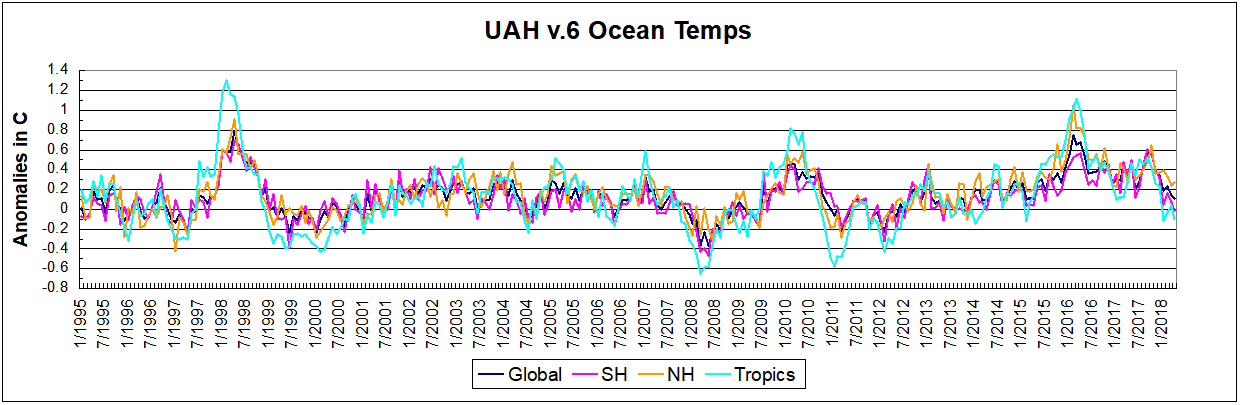
The May update to HadSST3 will appear later this month, but in the meantime we can look at lower troposphere temperatures (TLT) from UAHv6 which are already posted for May. The temperature record is derived from microwave sounding units (MSU) on board satellites like the one pictured above.

The UAH dataset includes temperature results for air above the oceans, and thus should be most comparable to the SSTs. The graph below shows monthly anomalies for ocean temps since January 2015.

The anomalies have reached the same levels as 2015.  Taking a longer view, we can look at the record since 1995, that year being an ENSO neutral year and thus a reasonable starting point for considering the past two decades.  On that basis we can see the plateau in ocean temps is persisting. Since last October all oceans have cooled, with upward bumps in Feb. 2018, now erased.

As of May 2018, global ocean temps are slightly lower than April and below the average since 1995.  NH remains higher, but not enough to offset much lower temps in SH and Tropics (between 20N and 20S latitudes).  Global ocean air temps are now the lowest since April 2015, and SH the lowest since May 2013.

The details of UAH ocean temps are provided below.  The monthly data make for a noisy picture, but seasonal fluxes between January and July are important.


Big fall from 2016 ElNino peak evident

The greater volatility of the Tropics is evident, leading the oceans through three major El Nino events during this period.  Note also the flat period between 7/1999 and 7/2009.  The 2010 El Nino was erased by La Nina in 2011 and 2012.  Then the record shows a fairly steady rise peaking in 2016, with strong support from warmer NH anomalies, before returning to the 22-year average.

Summary

TLTs include mixing above the oceans and probably some influence from nearby more volatile land temps.  They started the recent cooling later than SSTs from HadSST3, but are now showing the same pattern.  It seems obvious that despite the three El Ninos, their warming has not persisted, and without them it would probably have cooled since 1995.  Of course, the future has not yet been written.

SOURCE 


NEW Rebel Book Makes ‘The Case Against David Suzuki’

The smiling avuncular deceiver

Tomorrow the University of Alberta will give David Suzukian honorary degree. That’s a disgrace. David Suzuki despises Alberta — he boycotts it, insults it, encourages lawbreaking against it.

Imagine inviting in such a man, to bestow upon him the university’s highest honour. And not just at any time.

Right when the debate over the Kinder Morgan Trans Mountain pipeline expansion is at its apex; when the lack of a pipeline is causing a bottleneck that costs tens of millions of dollars a day, not just to workers, but to government coffers too.

For the unemployed men and women in the oil patch, the U of A has no time. But for their tormentor, David Suzuki, they’ve got an honorary degree.

There was a backlash — protests, petitions, donors cancelling their money. But the U of A dug in.

The thing about Suzuki is, opposition to him is dissident. It’s underground. Because who would dare contradict him? No-one at the CBC, the largest media company in Canada, for forty years.

They’ve been Suzuki’s PR machine, pumping him out not only over the airwaves, but also into classrooms and the popular culture. He’s ubiquitous. But he’s never been properly vetted.

At his events, at his speeches, for which he charges $30,000 a pop, he rarely takes questions, and if he does, they’re almost always pre-screened.

David Suzuki lives a double life:

Someone who condemns capitalism — but has literally five homes. Someone who condemns fossil fuels — but travels globally, non-stop, and even has a business deal with an oil company. Someone who claims to be progressive, but treats young women as sexual objects.

Now our own Sheila Gunn Reid has published the authoritative guide to Suzuki — it’s called The Case Against David Suzuki: The Unauthorized Biography.

It’s a quick read — less than 100 pages. But meticulously footnoted. So you can check all the facts for yourself.

And we’re giving it away, absolutely FREE, as an ebook at SuzukiBook.com

The idea being: have as many people as possible get the truth about Suzuki. Do the kind of research that the U of A didn’t do — and then refused to do, when they were called on it.

SOURCE 

***************************************

For more postings from me, see  DISSECTING LEFTISM, TONGUE-TIED, EDUCATION WATCH INTERNATIONAL, POLITICAL CORRECTNESS WATCH, FOOD & HEALTH SKEPTIC and AUSTRALIAN POLITICS. Home Pages are   here or   here.  Email me (John Ray) here.  

Preserving the graphics:  Most graphics on this site are hotlinked from elsewhere.  But hotlinked graphics sometimes have only a short life -- as little as a week in some cases.  After that they no longer come up.  From January 2011 on, therefore, I have posted a monthly copy of everything on this blog to a separate site where I can host text and graphics together -- which should make the graphics available even if they are no longer coming up on this site.  See  here or here

*****************************************


Thursday, June 07, 2018


Berkeley Scholar: Climate Change Is Officially Dead. But Blame Activists, Not Trump

In an op-ed for The Wall Street Journal Monday, Steven F. Hayward, senior resident scholar at the Institute of Governmental Studies at the University of California, Berkeley, declared that climate change as a pre-eminent policy issue has officially "run its course." And if you're looking for someone to blame, he suggests, don't look at President Trump, look instead at left-wing activists who've let their social justice and "green utopian vision" sabotage viable solutions.

"All that remains" of the climate change political movement, writes Hayward, "is boilerplate rhetoric from the political class, frivolous nuisance lawsuits, and bureaucratic mandates on behalf of special-interest renewable-energy rent seekers." Most national governments, he explains, have been steadily "backing away from forced-marched decarbonization." The arc of climate change as a policy priority, he declares, can officially be dated from 1988 to 2018.

But while the issue has run its course in the early years of Trump's presidency, he notes, Trump’s decision to pull out of the Paris Agreement "merely ratified a trend long becoming evident." No, Trump isn't to blame for the demise of the issue; in the end, the self-defeating ideological agenda of social justice and climate activists have finally buried it.

"The descent of climate change into the abyss of social-justice identity politics represents the last gasp of a cause that has lost its vitality. Climate alarm is like a car alarm—a blaring noise people are tuning out," writes Hayward. And this collapse of the movement, he explains, was utterly "predictable."

Citing political scientist Anthony Downs' 1972 article for the Public Interest, “Up and Down With Ecology: The ‘Issue-Attention Cycle,’" Hayward lays out the five stages of a political movement, with which climate change has tracked perfectly. It's now suffering the inglorious fifth stage:

Stage 1: Experts and activists call attention to a public problem.

Stage 2: The "alarmed media and political class discover the issue" and often stir up "euphoric enthusiasm ... as activists conceive the issue in terms of global peril and salvation."

Stage 3: The "hinge," characterized by "a gradually spreading realization that the cost of ‘solving’ the problem is very high indeed."

Stage 4: The "gradual decline in the intensity of public interest in the problem."

Stage 5: A "prolonged limbo—a twilight realm of lesser attention or spasmodic recurrences of interest," which often involves "painful trade-offs" that activists simply aren't willing to make.

Climate change is clearly in this fifth and final stage, he explains, where activists are blocking viable solutions as a result of their ideology, including social justice activism and their "utopian" environmental vision:

A case in point is climate campaigners’ push for clean energy, whereas they write off nuclear power because it doesn’t fit their green utopian vision. A new study of climate-related philanthropy by Matthew Nisbet found that of the $556.7 million green-leaning foundations spent from 2011-15, “not a single grant supported work on promoting or reducing the cost of nuclear energy.” The major emphasis of green giving was “devoted to mobilizing public opinion and to opposing the fossil fuel industry.”

If scientists want to be angry with anyone, he writes, they should direct that anger at the Left for politicizing the issue and the international policy community for narrowing what it deems to be acceptable responses.

"Treating climate change as a planet-scale problem that could be solved only by an international regulatory scheme transformed the issue into a political creed for committed believers," he concludes. "Causes that live by politics, die by politics."

SOURCE 


Recycling nonsense hits a rock in New England

Once labor costs are included, it is doubtful if any municipal recycling scheme has been profitable.  Sending everything straight to the landfill would save a lot of money

Buried in the mountains of refuse at Casella’s recycling plant in Charlestown are tons of material that should have gone straight to the landfill — from tires and pots to lobster buoys and garden hoses — items that can gum up the machines and taint the byproducts ultimately sold as commodities.

The increasing amount of such non-recyclable waste entering processing plants has sparked a backlash in the countries that convert the material into useful products, most notably China, which used to process the vast majority of US recyclables before it cracked down on what materials it would accept this year.

The result is a backup at some recycling plants in Massachusetts and across the United States, driving up costs and disrupting the industry and local municipalities’ refuse efforts. Towns that used to earn money from recycled waste are now forced to pay as much as $70 a ton to have it hauled to landfills or incinerators.

“These new policies have made it much harder for every recycler,” said Austin Mc-knight, general manager of the Charlestown plant, which processes about 230,000 tons of paper, plastic, glass, and other material every year, more than any similar facility in New England. “Everyone’s struggling now.”

The problems began last summer, when Chinese officials announced as part of a major antipollution campaign that they would no longer import 24 materials, including mixed paper and a range of plastics.

The Chinese also vowed to accept far less cardboard and scrap metal, limiting the items to those with impurities of just 0.5 percent. They previously took material that was far more tainted by food scraps and other non-recyclables.

Since the new policy went into effect on Jan. 1, US exports of recyclable material to China have plunged. Facilities such as the one in Charlestown have slowed their sorting process to reduce the amount of impurities in the bales of material they ship abroad, but plant owners say their equipment can’t reach such levels of purity.

At E.L. Harvey & Sons, a recycling company in Westborough, the plant’s parking lot has been overtaken by about 5,000 tons of paper and cardboard that it hasn’t been able to discard. Usually, the company would have a few hundred tons stockpiled until it received a decent price for the material.

Now, with 400 tons of new material coming in every day — only about half of which they can recycle — the company has been paying to send as much of the refuse away as possible, taking a significant loss.

“This really impacts the bottom line,” said Ben Harvey, the company’s president, adding that revenue has plummeted by about a quarter since January. “We’re feeling it right now, but the municipalities we collect from are going to feel the impact well into the future.”

Many of them are already feeling it. In Rockland, for example, residents were paying $3 a ton to have their recyclables collected and hauled away; now they’re paying $70. Abington is now paying $62 a ton, up from zero.

In Plymouth, the costs spiked so much that town officials last week eliminated its curbside recycling program.

“It’s a very bad situation, all around,” said Claire Galkowski, executive director of the South Shore Recycling Cooperative, which oversees programs in 15 communities. “All of them have experienced cost increases to a various extent.”

The problem, she and others said, is that US sorting facilities have been sending too many bales of tainted material abroad, particularly to China, India, and Vietnam.

With the rise of single-stream recycling, many residents have become less conscientious about what they deposit in recycling bins, with everything from bowling balls to Christmas lights fouling up the machines at sorting plants, she said.

In Braintree, where the cost of recycling has risen from about $4 a ton last year to $47, local officials are worried about what will happen in the coming months.

“It’s already having a big impact, but it keeps going up,” said Rosemary Nolan, the town’s solid waste and recycling coordinator. “We’ve been told it could go up to $200 a ton.”

If the costs continue to rise, she worries the town may have to cut other services, such as education or transportation projects.  “The runaway escalation isn’t sustainable,” she said.

Boston officials didn’t respond to questions about the impact of China’s new policies on the city.

Some local officials and recycling companies have been urging the state to take action to help defray the costs. State officials declined to answer questions, but in a statement said they are seeking to mitigate local costs with a variety of programs and efforts.

For example, they said, they are working with municipalities to create a common list of acceptable recyclables for residents and have been encouraging new glass recycling businesses to move to Massachusetts, since glass constitutes about 20 percent of the state’s recycling stream.

The state Department of Environmental Protection “will continue to work with neighboring states and companies to ensure responsible recycling continues,” said Ed Coletta, a spokesman for the agency.

The crisis has also sparked tensions between municipalities and the companies that collect their recycling.

Last month, New Bedford filed a lawsuit against ABC Disposal Service, after the New Bedford-based company threatened to stop collecting recyclables there, as well as in Fairhaven, Mattapoisett, Rochester, and Plymouth. The company had increased rates in response to the rising costs.

In a letter to the company, local officials acknowledged that ABC Disposal’s costs had risen as a result of China’s new policies but asked to review the company’s financial records before agreeing to modify their contacts to allow higher rates.

“ABC’s mere assertions that it needs contract increases in order to survive are an insufficient basis on which to impose an additional burden on taxpayers,” they wrote.

After the company refused, New Bedford filed the lawsuit, claiming the company was breaching its contracts.

“The company’s repeated refusals to share its financial information with the city, as well as its recent conflicting statements about whether it will comply with its contract, have left the city no choice but to seek a court order that will protect taxpayers,” New Bedford Mayor Jon Mitchell said in a statement.

Michael Camara, the company’s chief executive, said his costs have surged and he has no choice but to pass them on to customers.

ABC Disposal used to earn as much as $45 a ton for the recyclables his employees collected; now the company is paying $100 a ton, he said. Moreover, his company now has to deliver the material to plants as far away as Stamford, Conn., costing it far more in gas and time.

He also lamented the environmental consequences, noting that the recyclables are taking up precious space in landfills in Massachusetts.

“It’s insane what has happened,” he said. “This is an international crisis. We just can’t absorb these costs.”

SOURCE 


Doomsday Climate Models Wrong Again! Hurricanes Declining …European Floods Not More Frequent

Meteorologist Dr. Ryan Maue pointed out here at Twitter that hurricane activity has not lived up to the climate model projections and that major hurricanes in the 1970s and 80s were “likely underestimated.” The hurricane expert tweeted:

Over the past 4-decades, number of global HURRICANE strength tropical cyclones (about 48/year) have actually DECREASED, while MAJOR hurricane strength tropical cyclones (about 25/year) have slightly (insignificant) trended upward.”

And:

Over the past 10-years (120-months) there have been 232 major hurricane strength tropical cyclones globally. In the 10-years prior, there were 252 majors. And the 10-years before that 258 majors. We likely underestimated majors in 1970s & early 1980s prior to Hi-Res satellites.”

No trend in flooding in Europe

And at the Die kalte Sonne site here, geologist Dr. Sebastian Lüning and Prof. Fritz Vahrenholt report in Europe that floods and storms In Europe have not been more frequent, despite all the unending claims by the media.

Over the past week, the German media hyped up some local, severe thunderstorms that had hit in parts of the country, causing heavy downpours and local flooding.

The media injected their usual Biblical tones in their reports.

Lüning and Vahrenholt first cite a recent study, which was even featured in detail by German DLF public radio, which tells us that the frequency and severity of heavy rain events and flooding have not increased in Europe over the past 150 years:

Severe weather in Europe: Flooding not more than in the past
When it comes to torrential rainfall and flooding, many people agree: Such things never happened in the past. But that is not true Dominik Paprotny of the University of Technology in Delft analyzed. Historical sources show that large floods are not more frequent today.”

And DLF Nova reported:

Danger of flooding is the same as it was 150 years ago
High water and flooding in Europe has not become more frequent at all, a team of scientists in the Netherlands show. The scientists have put together a databank that looks at storms and floods back to 1870. Most international databanks go back to only to 1970.”

Read more at DLF Nova.

The study by Paprotny et al. 2018 appeared in Nature Communications and it can be downloaded free of charge as a pdf file. In the abstract:

Trends in flood losses in Europe over the past 150 years

[…] Here we utilize a gridded reconstruction of flood exposure in 37 European countries and a new database of damaging floods since 1870. Our results indicate that, after correcting for changes in flood exposure, there has been an increase in annually inundated area and number of persons affected since 1870, contrasted by a substantial decrease in flood fatalities. For more recent decades we also found a considerable decline in financial losses per year.”

The recent flare-up in honesty in media “remarkable”!

Lüning and Vahrenholt then go on to express their surprise that the DLF would present the scientific results so “honestly and without climate alarmist undertones.” and that “it is remarkable for today’s mainstream journalism”, which over the years tended to link every summer thunderstorm to Co2 emitted by man.

Flooding was worse during Little Ice Age

Next Lüning and Vahrenholt present studies showing that flooding in Central Europe and in the Alps region was even worse during the Little Ice Age than it is today, see here, here, here, and here.

Potsdam Institute contradicted:

Lüning and Vahrenholt next dismiss earlier claims by the climate alarmist Potsdam Institute, which earlier claimed “robust trends” concerning “summertime dry periods and greater occurrence of flooding” in the German state of Saxony Anhalt (pdf here).

The two German skeptic scientists examined the official data from the German DWD national weather service for Saxony Anhalt, and found the following:


Summer precipitation in Sachsen Anhalt since 1880. Data source: DWD.

Lüning and Vahrenholt summarize with four main points:

The linear trend for precipitation since 1881 is zero.
Summer weather in Central Europe is controlled by the Atlantic Multidecadal Oscillation (AMO), i.e. natural ocean cycles.
The weather is not getting more extreme. The year-to-year differences in summertime precipitation are, in fact, showing a slight downward trend.
In Saxony Anhalt, despite all the alarmist claims, there is no anthropogenic signal.

More HERE  (See the original for links, graphics etc.)


Q&A: The Politically Incorrect Book That Debunks Climate Change Myths

Marc Morano, founding editor of the award-winning website ClimateDepot.com, recently authored “The Politically Incorrect Guide to Climate Change.” He spoke to Daily Signal Editor-in-Chief Rob Bluey about climate change myths and other facts you probably haven’t heard reported by the media. An edited transcript of their interview is below. You can also listen to it on The Daily Signal podcast.

Rob Bluey: What prompted your interest in the issue of climate change? There’s a great photo of you in the book next to a wanted poster. How did you become such a villain to the left?

Marc Morano: I always said I was a Republican, except when it came to environmental issues. I remember not liking James Watt, the former interior secretary. I remember not liking President Ronald Reagan’s environmental policies. I always wanted to be a forest ranger as a kid growing up. I got heavily involved emotionally in watching all the documentaries about the Amazon rainforest back in the 1980s and 1990s.

It wasn’t until I started reading Dixy Lee Ray and actually hearing her talk, it was actually on Rush Limbaugh’s show, the coverage of the Rio Earth Summit, that I started to look deeper into environmental issues. What I remember her specifically saying, as a nuclear physicist, Dixy Lee Ray, that the Amazon was one of the most intact forests and this idea that it’s about to disappear was complete exaggeration and hype. I started investigating that. It actually culminated in a documentary on the Amazon rainforest.

Global warming, when I started focusing on it, I actually started with a skeptical view and I was only able to get more and more skeptical, because I saw the same tactics being used.

The way I ended up in the wanted poster in Paris—that was the movie premier of my film “Climate Hustle” from 2015 at a Paris cinema. The environmental groups put out wanted posters of me the day of the premier. All over the city, this was literally on the main streets of Paris. So I posed with one of them in the book and you can see the picture. They called me a “climate criminal wanted for climate crimes.” This is the kind of intimidation they like to do.

Marc Morano, author of “The Politically Incorrect Guide to Climate Change,” in Paris. (Photo Courtesy of Marc Morano)
Bluey: Despite that intimidation, you’ve still gone on to write this book. So what prompted you to do that and what’s your goal when a reader picks it up? What do you want them to walk away with?

Morano: My goal here was to help conservatives and Republicans articulate the issue. During my time on Capitol Hill, I worked for the Senate Environment of Public Works Committee. I can’t tell you the horror stories, Rob, of being in high-level meetings, during the height of the cap-and-trade debate 2007, 2008, 2009; back when President Barack Obama was pushing this through all the way to 2010.

The staffers of very conservative Republican senators would be like, “Well, we don’t want to touch the science on this because we don’t want to be seen as against the Earth or against the environment. Let’s just solely focus on the economics.”

I remember arguing passionately. If people think we face the climate catastrophe, we’re Americans! They’re going to say we will bear any cost and overcome it. They never wanted to challenge it. So I’m trying to, and working for Sen. James Inhofe, we tried to challenge the science.

What I tried to do with this book is say it’s OK to espouse climate skepticism. The book is done for anyone from, I would say, sixth grade through highest levels of education to educate them with the top voices in science, the basic concepts, and to make it fun, informative in a talking point form.

This is a needed book because in order to fulfill President Trump’s policies, you need the scientific justification, and this book fills that gap in, as well as talks about the policy.

Bluey: The other thing the book has is a lot of great facts that I think counter what you so often hear in the media and from liberal politicians. Could you share some of them? I know you have examples right on the cover. For instance, let’s take hurricanes because we’re in the midst right now of another hurricane story. You hear this all the time—that these hurricanes are more intense, they’re happening more often because of climate change. You say, “No.”

Morano: Not only do I say “no,” but the peer-reviewed scientific literature clearly and overwhelmingly says “no.”

There is nothing unusual, particularly on extreme weather. It’s not just hurricanes. Hurricanes, floods, droughts, tornadoes, on the entire spectrum of extreme weather, we are either at stable or declining trends. And that includes droughts.

California droughts in previous centuries blew away anything we’re talking about now. Floods, no trends on 100-year, 85-year time scales. Hurricanes were much worse, many more powerful hurricanes in the 1940s and ’50s. In fact, we were in the longest period of no major hurricane category three or larger before last year’s big hurricanes hit. And even though there is this alleged record rains, in the 1960s hurricanes that hit Cuba had many more times rain and flooding events than that.

“They make it seem like extreme weather is everywhere. But taken as a whole, and in the peer-reviewed literature, it’s actually on a declining trend.”

I go into that in the book about these so-called 1,000-year floods and I explain that all these extreme weather events they claim, it’s kind of like a lottery promotion scam. Where they say, “Oh, this is a 1,000-year storm hit this city, and a 1,000-year storm hit that, this is unusual.” No, there are going to be very few lottery winners. But the lottery winners there are, they highlight them. “Look, there’s a lottery winner and there’s a lottery, look the lottery winners are everywhere.” They make it seem like extreme weather is everywhere. But taken as a whole, and in the peer-reviewed literature, it’s actually on a declining trend.

Interestingly enough, cold weather is actually more extreme than warm weather. In the 1970s, they blamed tornadoes, floods, even the threat of war and increased violence on global cooling at the time. So there’s just not the science there at all, when it comes to that. And also I go through all the other myths you’ve heard about from the hottest year on record, the hottest decade.

Bluey: Let’s tackle that one because we hear this one it seems month after month—another record-breaking month. At the same time, I love the chart that The Daily Signal published of the temperature throughout history. You see the lines going up and down. Tell us what we need to know.

Morano: First of all, in the book, I interviewed geologists, I have Nobel Prize-winning scientists endorse the book. They explain that in the geologic history of the Earth, we are in the coldest 10 percent of the geologic history of the Earth. In other words, 90 percent of our Earth’s history was too warm to have ice at either pole. So we are in the 10 percent coldest. That’s No. 1.

No. 2, if you go back to the Roman warming periods during the time that Jesus Christ walked the Earth—and I show this in the peer-reviewed studies in the book, in a very reader-friendly way—we are actually now cooler than we were. So we’ve cooled since the time Jesus Christ walked the Earth. We’re actually about the same temperature or cooler since the medieval warm period, since about 900 to 1300.

First of all, you say hottest year, what time scale? Then, you jump ahead to about 1850, the end of the Little Ice Age, where the New York river, New York Harbor froze over, the Thames river was frozen, it was a brutal period, coinciding with low sun spot activity and bunch of other factors.

Suddenly, we get thermometer data. So the thermometer data comes online right at the end of the Little Ice Age. It’s very cold. All these things you hear about the glaciers retreating, most of that glacier retreat happened by 1900. Now, 80 percent of the carbon dioxide came after 1940, or after World War II in 1945. We had a huge warm spell from the 1920s into the ’30s and then, we had a cooling period from the ’50s all the way up to about the late 1970s. I go into the whole global cooling scare.

“The so-called claims of the hottest year fall easily within the margin of error. That’s why it’s a political statement. It is utter nonsense from beginning to end.”

They now claim, “Oh, that never happened.” They have studies out, they claim that that was overblown, there’s only a couple scientists. I show in the book it was National Academy of Sciences, CIA, some of the same scientists warning of global cooling in the ’70s who then flipped and became global warming.

I actually feature in the book an article from the 1977 and ’78 in The New York Times, two articles. During this time, the scientists were battling it out when global cooling was morphing into a climate change, global warming.

To answer the question on the hottest year, we warm from the late ’70s to the late ’90s. Then essentially we flatlined. Essentially, there’s no statistically significant global warming. We had a thing called “the pause.” They didn’t like that, so they actually went back in the records and erased the pause. They changed the data.

Besides, even doing all that, the hottest year claims are within hundredths of a degree and that margin of error is tenths of a degree and they adjust the temperatures to within tenths of a degree without explanations. The so-called claims of the hottest year fall easily within the margin of error. That’s why it’s a political statement. It is utter nonsense from beginning to end.

It’s a fancy way of saying the temperature hasn’t changed since the ’90s. That’s where they get hottest decade on record. On record just means since the Little Ice Age ended, when we put thermometer data out and that’s what that means. If you go back further, we’ve cooled, Middle Ages, Roman warming period, and even further.

Bluey: Thank you for setting the record straight on that. One of the other things that you argue is that the left has abandoned this fact-based science and instead resorted to just dramatic fear-mongering. What do you mean?

Morano: Go back to the 19th century, Rob, to explain this. Every storm is allegedly unprecedented, we’ve never seen it, this is the new normal, so to speak. This hurricane has a name, it’s Hurricane Katrina. This hurricane has a name, it’s Hurricane Harvey. The same lines over and over. Everything is done as a tactic of fear in order to get action. This started in the 1960s with the modern environmental movement.

Particularly, I go into a little bit about Paul Ehrlich, author of “The Population Bomb.” I actually show, Rob, that they use this hysteria for the different environmental scares in the 1970s, whether it’s resource scarcity, over-population, rainforest clearing, et cetera.

They will say, “We need a global solution; we need global governance; we need wealth redistribution; we need sovereignty threatening treaty, or some kind of economic activity limiting.” No matter what environmental scare in the past that they tried to scare people with, it was the same solutions they’re proposing now.

In the book, I go back and show over and over that global warming is merely the latest scare they’re using to get their agenda. I show Naomi Klein, who’s an adviser to Pope Francis, who wrote “Capitalism vs. the Climate.” I interviewed her for the book. She actually says that they would be seeking the same solutions even if there was no global warming and that essentially, capitalism is incompatible with a livable climate. She actually urges people, “We need to jump on this because solving global warming will solve what we’ve been trying to achieve all along.”

They’re open about it. They use the climate scare tactics to achieve their ends. And in order to get those ends achieved, they have to hype and scare. It’s been a very effective strategy because they’ve bullied Republican politicians, who should know better, into at least submissiveness and silence and/or activism, when you come to the case with John McCain and even Mitt Romney.

Climate change activists want to have it both ways to advance their agenda, argues author Marc Morano. (Photo: Erik Mcgregor/ZUMA Press/Newscom)
Bluey: What are some of the strangest things that you’ve seen the left blame climate change on?

Morano: There’s a whole series of things. One of the things they do is they make opposite predictions. Global warming will cause more snow, less snow. More hurricanes, less hurricanes. More fog, less fog. More malaria, less malaria. I go through it all.

It’s as if you bet on the Super Bowl, and you bet both teams to win. You can go to the office the next day and say, “I did it! I won! I bet on the winning team.” First of all, they’re never wrong because they literally have opposite predictions.

The second thing is they come up with everything. Global warming will cause an increase in prostitution, bar room brawls, vehicle thefts. These are by United Nations scientists who did these studies, funded by major universities. These aren’t just some wacky claim, or some professor talking off the top of his head. They actually get funded studies to do this.

“They actually blame the rise of Hitler on global warming. … There are so many wacky things that they’ll blame on global warming.”

One of my favorites was in 1941, a University of Cincinnati professor said that the warmer weather we were having in the 1930s and ’40s created more docile people, which led to them being more susceptible to Hitler, Mussolini, and dictators. They actually blame the rise of Hitler on global warming at that time. Oddly enough, Hitler was saved in the bunker when Von Stauffenberg tried to kill him. Because it was a very hot day, they had to move the location of that meeting when the assassination attempt happened. They moved it to a room with a heavy table that saved Hitler. Global warming created Hitler, global warming saved Hitler.

There are so many wacky things that they’ll blame on global warming. My favorite quote is probably Michael Oppenheimer, U.N. lead scientist, former Environmental Defense Fund activist, “Anybody who eats is under threat from climate change.” That’s his summation. So there you go. It’s that combination of just about everything. If you eat, then you’re under threat of climate change, you should be worried. If you don’t eat, then you’re fine.

Even when you’re dead, you won’t escape the clutches of global warming. In the book, I show multiple examples. In one case, Peruvian mummies are decaying faster because of the humidity caused by climate change. Also, they’re worried that dead bodies in the permafrost in Siberia are melting and are going to release new pathogens. The dead walk among us because of global warming. So, even the dead are now to blame for exacerbating the problem of global warming.

Bluey: We’ve used these terms interchangeably: climate change and global warming. Can the left make up its mind on what to call it?

Morano: No, in fact, in the book, I have a lot of fun. “Global climate disruption” was John Holdren, Obama’s former science czar. He wanted to call it that. “Global weirding” is what Tom Friedman, New York Times columnist, wants to call it. They’ve come up with all these different names. “Global heating.”

Former Sen. Barbara Boxer, when I was in the Senate Environment Public Works Committee, she actually called the hearing “global warming” one time. This was when they were really trying to push climate change. Temperatures hit their peak in the late 1990s from the cooling of the 1970s. They’ve tried to push climate change because they didn’t think without that constant increase in temperature, they weren’t getting anywhere. It was getting harder to sell.

“[C]limate change had to be the new moniker because global warming was too focused on temperature.”

Climate change includes the extreme weather. I remember very vividly, I was in Bali, Indonesia—a $15,000 roundtrip business class flight for the U.S. Senate at a global warming hearing for the United Nations—arguing with a John McCain climate staffer about how the new argument in global warming was all going to be about extreme weather.

Therefore, climate change had to be the new moniker because global warming was too focused on temperature. They wanted to go out on every limb and this way they could blame everything from cows and transportation, airlines.

They’re trying to get every aspect of our society under global warming regulation and not just focus on temperature. Because now if you have a bad crop, if you have vehicle crash—the Department of Transportation got us funding to study how global warming could increase fatal car accidents—that’s why it has to be “climate change,” because they’re trying to go in every direction.

Bluey: How have the left’s policies, as you argue in the book, hurt the world’s poor?

Morano: That is one of the most insidious things. In the book, I feature Al Gore at a Bill Gates function, saying that Africa’s projected to have more people than China and India combined in the next century and that we need “ubiquitous fertility management.”

This is a white, wealthy Western politician saying essentially there are too many black Africans. Let’s be blunt about it. I actually quote a former Harvard professor just excoriating Al Gore for essentially racist comments. Basically singling out Africa and saying, “They’ve got to have better fertility management because we have too many Africans and we’ve got to control their population.” Now Al Gore would just say, “No, I’m thinking of only the Earth.” But what conservative politician could get away with that?

“Fossil fuels are the most abundant, cheaply available, and fastest way out of energy poverty, which means they’re the lifeline for lowering infant mortality, longer life expectancy, modern dentistry.”

When you look at third-world development—and by the way, “third world” is a politically incorrect term; we’re supposed to say the “developing world”—they have about 1.1 billion people without running water and electricity. Essentially, what they’re trying to do with climate policy is prevent them from developing through fossil fuels.

Fossil fuels are the most abundant, cheaply available, and fastest way out of energy poverty, which means they’re the lifeline for lowering infant mortality, longer life expectancy, modern dentistry.

If you’re living in a poor nation, you’re burning dung, you’re living in a hut made of dung, you’re breathing in horrible air, the rivers are polluted from sewage. The second you get modern sewage, the second you get coal plants even or oil or even nuclear, if you’re lucky enough, everything gets radically cleaner. They’re trying to prevent it. Even the World Bank won’t allow coal plant development in countries that are in dire poverty.

These environmentalists I interviewed, one in South Africa, they travel the world from Minnesota and other places—wealthy, white Western college kids—go to Africa and essentially say, “You’re doing it right by living this primitive existence. You’re living it right. You’re Earth-friendly.”

I interviewed Jerry Brown, the California governor, at an Earth Summit in South Africa. He actually says the Earth can’t allow the rest of the world to develop like the United States and Europe because we’d need 20 more Earths to do it. In other words, they have to be managed. It’s a new form of colonialism. It’s the most insidious things. That’s a very intense chapter in the book because it’s an eye-opener for people who haven’t been following this. They are trying to limit their development.

The environmental activists—climate activists—they even have something called the U.N. Climate Fund. I interviewed a South African development activist, Leon Lowe, who’s very articulate. He just says, “The developing world needs to tell the first world to essentially go to hell if they’re going to tell them how to develop, what resources they can use of their own.”

He says, “Until London, Rotterdam, Paris, and Washington level their cities, return them to swamps and wetlands and jungles, they have no business telling the developing world how they can use the natural resources, how they can develop, what energy they can use.”

That’s the dilemma we’re facing now. They’re trying to control and manage people and keep them at a subsistence level of life. It’s the most anti-human movement of today. It’s why former Czech President Václav Klaus has said, the greatest threat we face today for human freedom is, what he says, “ambitions environmentalism from the climate movement.”

Bluey: In addition to writing the book, you run a website called ClimateDepot.com. What’s your mission? What do you strive to do there?

What I’m trying to do there is have a daily one-stop shop of all the latest climate, energy, and environmental news. In other words, I link to all the mainstream sources, but I’ll try to pick out some of the best tidbits and actually try to do reality checks all the time. I do special reports.

It’s a way for you to get your energy, climate, environment news without just having to hear the mantra of nonsense, of 97 percent of all scientists agree the Earth is doomed, we’re facing a catastrophe, we need the Paris Agreement.

I have user guides. I have special reports and I have a lot of humor to try to bring people in—to say this is not an intimidating topic. Don’t be afraid to stand up because the whole movement is designed—the environmental left has designed this to intimidate everyone into silence on this issue. If you’re against climate change, belief in climate change, catastrophic climate change, you are a dumb person. You are an idiot. You’re a rube. You’re not welcome in polite society. Even the impolite don’t want you.

Bluey: Marc, thanks so much. Again, the book is called “The Politically Incorrect Guide to Climate Change.” Thanks for writing it.

Morano: Thank you, Rob. Appreciate it, enjoyed it.

SOURCE 


Germany’s Wind Energy Mess: As Subsidies Expire, Thousands Of Turbines To Shut Down … Environmental Nightmare!

The Swiss national daily Baseler Zeitung here recently reported how Germany’s wind industry is facing a potential “abandonment”.

Over the years Germany has made approvals for new wind parks more difficult as the country reels from an unstable power grid and growing protests against the blighted landscapes and health hazards.

Now that the wind energy boom has ended, the Baseler Zeitung reports that “the shutdown of numerous wind turbines could soon lead to a drop in production” after having seen years of ruddy growth.

Today a large number of Germany’s 29,000 total turbines nationwide are approaching 20 years old and for the most part they are outdated.

Worse: the generous subsidies granted at the time of their installation are slated to expire soon and thus make them unprofitable. After 2020, thousands of these turbines will lose their subsidies with each passing year, which means they will be taken offline and mothballed.

The Baseler Zeitung writes: “In many cases the earnings will not be able to cover the continued operation costs of the turbines. After 20 years of operation, the turbines require more maintenance and some expensive repairs.”

The Baseler Zeitung adds that some 5700 turbines with an installed capacity of 45 MW will see their subsidies run out by 2020. The Swiss daily reports further:

“The German Windenergie federal association estimates that approximately 14,000 megawatts of installed capacity will lose their subsidies by 2023, which is more than a quarter of the German wind energy capacity.”

So with new turbines coming online only slowly, it’s entirely possible that wind energy output in Germany will recede in the coming years, thus making the country appear even less serious about climate protection.

Wind turbine dump in Africa?

So what happens to the old turbines that will get taken offline?

Windpark owners hope to send their scrapped wind turbine clunkers to third world buyers, Africa for example. But if these buyers instead opt for new energy systems, then German wind park operators will be forced to dismantle and recycle them – a costly endeavor, the Baseler Zeitung reports.

Impossible to recycle composite materials

The problem here are the large blades, which are made of fiberglass composite materials and whose components cannot be separated from each other. Burning the blades is extremely difficult, toxic and energy-intensive. So naturally there’s a huge incentive for German wind park operators to dump the old contraptions onto third world countries, and to let them deal later with the garbage.

Sweeping garbage under the rug

Next the Baseler Zeitung brings up the disposal of the massive 3000-tonne reinforced concrete turbine base, which according to German law must be removed.

Some of these concrete bases reach depths of 20 meters and penetrate multiple ground layers, the Baseler Zeitung reports, adding:

“The complete removal of the concrete base can quickly run up to several hundreds of thousands of euros. Many wind park operators have not made the corresponding provisions for this expense.”

Already wind park operators are circumventing this huge expense by only removing the top two meters of the concrete and steel base, and then hiding the rest with a layer of soil, the Baseler writes.

In the end most of the concrete base will remain as garbage buried in the ground, and the above-ground turbine litter will likely get shipped to third world countries.

That’s Germany’s Energiewende and contribution to protecting the environment and climate!

SOURCE 

***************************************

For more postings from me, see  DISSECTING LEFTISM, TONGUE-TIED, EDUCATION WATCH INTERNATIONAL, POLITICAL CORRECTNESS WATCH, FOOD & HEALTH SKEPTIC and AUSTRALIAN POLITICS. Home Pages are   here or   here.  Email me (John Ray) here.  

Preserving the graphics:  Most graphics on this site are hotlinked from elsewhere.  But hotlinked graphics sometimes have only a short life -- as little as a week in some cases.  After that they no longer come up.  From January 2011 on, therefore, I have posted a monthly copy of everything on this blog to a separate site where I can host text and graphics together -- which should make the graphics available even if they are no longer coming up on this site.  See  here or here

*****************************************

Wednesday, June 06, 2018


Trump calls for 'immediate action' to prevent coal, nuclear power plants from closing

In a rare move, the Trump administration confirmed Friday that it will take "immediate steps" to prevent coal and nuclear power facilities in the U.S. from closing.

A statement from White House press secretary Sarah Sanders did not say specifically what steps the administration would take but said that "keeping America’s energy grid and infrastructure strong and secure protects our national security, public safety, and economy from intentional attacks and natural disasters."

"Unfortunately, impending retirements of fuel-secure power facilities are leading to a rapid depletion of a critical part of our Nation’s energy mix, and impacting the resilience of our power grid," Sanders said in a statement.

So what could that look like?

The National Security Council reportedly discussed a draft memo on Friday, reported by Bloomberg News, that would direct electrical grid operators to purchase electricity from coal, nuclear, or oil-fueled facilities at risk of closing.

The draft memo laying out the directive doesn't give a specific amount operators would have to spend but says it will be enough to keep the facilities open for the next two years, saying that U.S. national security "relies on a robust U.S. domestic industrial base, of which the coal, nuclear, and oil and natural gas industries are critical strategic components."

The administration says the move will prevent coal and nuclear power plants critical to the electrical grid from closing, but opponents say the requirement is essentially a bailout for a dying industry that the president promised to save and will cause Americans' electricity bills to get more expensive.

According to data from the Energy Information Administration, coal consumption has fallen about 20 percent compared to last year, from about 149,200,000 short tons in the first two months of 2017 to just under 119,600,000 short tons in the first two months of 2018.

The EIA also reports that nearly all power plants that retired between 2008 and 2017 were fossil fuel plants and that most plants that plan to close before 2020 use coal or natural gas. But the agency said that most of the coal powered plants that closed were "relatively old and small."

Several industry groups call federal intervention 'misguided'

Groups like the American Coalition for Clean Coal Electricity have told the Energy Department that retiring coal facilities could threaten the electrical grid. The National Coal Council said in a statement Friday that existing coal facilities provide "direct economic benefits, energy and price stability, job-creating opportunities and environmental benefits."

Perry previously said the department was considering this approach in a hearing with the House Science Committee earlier this month.

"It's about the national security of our country. Of keeping our plants, all of them, online, being able to deliver energy, no matter whether it's a natural disaster that we might see from a polar vortex, or it's something more nefarious, as a cyber attack from a terrorist state or some entity with bad intent for the United States," Perry said in the hearing on May 9.

But some groups that study the U.S. electric grid say that it isn't at risk of breaking down in the way the directive describes. One independent group that manages the electricity grid that serves more than 65 million people said that it could be bad for consumers if the federal government intervenes in the market.

"Any federal intervention in the market to order customers to buy electricity from specific power plants would be damaging to the markets and therefore costly to consumers," that group PJM Interconnection said in a statement. "There is no need for any such drastic action."

Another coalition of energy industry groups representing the oil, natural gas, solar, and wind industries issued joint statements saying the administration's plan is "misguided," "unwarranted," and "an exercise in crony capitalism."

The American Council on Renewable Energy, a nonprofit that represents various groups that want to emphasize renewable energy sources, said in a statement that the administration is intervening to bail out coal and nuclear power plants "that are no longer competitive on their own."

"Arbitrary market interventions of this sort have no place in the electricity structure that has kept American electric power reliable and affordable," the group's President and CEO Gregory Wetstone said in a statement.

Environmental groups like the Sierra Club have been pushing campaigns to phase out coal as part of the U.S. energy grid and they say that even a "bailout" will not keep coal and nuclear plants open as the global market focuses more on natural gas and renewable energy sources.

“This is an outrageous ploy to force American taxpayers to bail out coal and nuclear executives who have made bad decisions by investing in dirty and dangerous energy resources, and it will be soundly defeated both in the courts and in the court of public opinion. Trump will clearly," Mary Anne Hitt, the director of the Sierra Club's campaign to close coal facilities, said in a statement.

SOURCE 


Wind power INCREASES dependence on fossil fuel power plants

The advocates of alternative energy often cite wind turbines as a means of reducing dependency on fossil fuels and nuclear energy. However, a new study has shown that wind power has not delivered the level of fossil fuel independence predicted in the European Union. Appearing in the academic journal Energy Policy, the study looked at data from 1990 to 2014. It found that installing more wind turbines has merely preserved dependence on fossil fuels because intermittent renewable sources (as opposed to hydro, which is far more dependable) means the energy infrastructure must maintain, and sometimes increase, the number of fossil-fuel power plants generating power when there is insufficient or too much wind.

The study found that increasing the number of power plants (whether wind or fossil-fuel) has also increased the idled power plant capacity, thus making the entire energy system less efficient and costly. This comes when wind turbines are idle because of insufficient wind speed or when fossil fuel plants are idle because the wind is blowing.

Some power companies in the U.S. appear undeterred by scientific data about the efficacy of wind turbines.  In Michigan's lower peninsula, in the area directly north of Detroit known as the "Thumb," Consumers Energy recently built another 19 wind turbines in Tuscola County. More are to come and add to the more than 100 wind turbines already in the area. The Cross Winds Energy Park, slated for completion in 2019 with a $345 million CMS Energy Corp. investment, will establish a total of 81 turbines providing electric power for 60,000 residents. Approximately 150 jobs were created by the project, which is garnering increasing opposition from local voters who object to the noise generated by the wind turbines.

The conclusion of the study states:

“In short, the results indicate that the European Union’s domestic electricity production systems have preserved fossil fuel generation, and include several economic inefficiencies and inefficiencies in resource allocation. On the one hand, as renewable energy sources (RES) deployment increases, the idle capacity of RES increases by the same amount. This generates idle capacity and electricity production systems have to maintain or increase the installed capacity of fossil fuels in order to back up the RES, thus generating installed overcapacity in fossil fuels too. On the other hand, both the electrification of the residential, industrial and services sectors and consumption peaks also require fossil fuels, because RES are unable to satisfy them without resorting to fossil fuels.”

“In fact, RES cannot satisfy electricity consumption without resorting to fossil fuel electricity generation. This has hindered the shift from fossil fuels to RES, and has cancelled out the advantage of the shift to electrification, because of the need to burn fossil fuels”

The paper is titled: “Have fossil fuels been substituted by renewables? An empirical assessment for 10 European countries.” António Cardoso Marques, José Alberto Fuinhas, Diogo André Pereira of the University of Beira Interior and NECE-UBI Management and Economics Department in Portugal are the authors.

The abstract of the study states:

“The electricity mix worldwide has become diversified mainly by exploiting endogenous and green resources. This trend has been spurred on so as to reduce both carbon dioxide emissions and external energy dependency. One would expect the larger penetration of renewable energies to provoke a substitution effect of fossil fuels by renewable sources, in the electricity generation mix. However, this effect is far from evident in the literature.

"This paper thus contributes to clarifying whether the effect exists and, if so, the characteristics of the effect by source. Three approaches, generation, capacity and demand, were analysed jointly to accomplish the main aim of this study. An autoregressive distributed lag model was estimated using the Driscoll and Kraay estimator with fixed effects, to analyse ten European countries in a time-span from 1990 until 2014. The paper provides evidence for the substitution effect in solar PV and hydropower, but not in wind power sources. Indeed, the generation approach highlights the necessity for flexible and controllable electricity production from natural gas and hydropower to back up renewable sources. Moreover, the results prove that peaks of electricity have been an obstacle to the accommodation of intermittent renewable sources."

SOURCE 


Paul Ehrlich, a false prophet and people-hater but still an ecofascist hero

SPOTLIGHT: Whether the predictions in Paul Ehrlich’s 50-year-old bestseller, The Population Bomb, were right or wrong matters. Because scientists and environmentalists continue to follow in his footsteps.

BIG PICTURE: Ehrlich is an important case study. His conviction that humanity is a blight on the planet is shared by many ordinary people, as well as by many influential ones.

In Future Babble: Why Expert Predictions Fail – and Why We Believe Them Anyway, journalist Dan Gardiner describes how Ehrlich became a “rock star” after his book appeared in 1968.

By 1970, thousands were being turned away from his speaking events. He “was invited to talk with [late-night television host] Johnny Carson and his millions of viewers more than twenty times.”

Let us be clear about one thing. If it had been within Ehrlich’s power to take the steps he insisted were necessary, the human rights abuses would have been horrendous.

I’ve explained that he advocated the deployment of US helicopters to forcibly sterilize Indian peasants. I’ve highlighted his declaration that “we can no longer tolerate” television shows that present large families in a positive light.

Coercion and censorship are the tools of fascism. They lead to mass murder. Ehrlich displayed enthusiasm for these tools.

His book urged political leaders to be “relentless,” to “take whatever steps are necessary.” He urged them to support “any program” and “any policies” that would reduce global population (pp. 138, 166, 210, 211).

A world in which Ehrlich was in charge would be neither democratic nor free. Instead, bureaucrats would decide how many children were allowed to be born.

Toward the end, he posed the question: “What if I’m wrong?” But this was mere lip-service, a cavalier dismissal:

If I’m right, we will save the world. If I’m wrong, people will still be better fed, better housed, and happier, thanks to our efforts. (p. 198)

How could this be remotely true when, 33 pages earlier, he admitted that stemming overpopulation in developing countries would require “many apparently brutal and heartless decisions” that would cause intense pain?

Gardiner labels Ehrlich’s above rationalization “glib nonsense.” Had the authorities taken his advice and denied food aid to nations that declined to pursue barbarous anti-population measures, famines would have been caused rather than averted. Many human beings would have died. Large numbers of them would have been children (see the front cover of Ehrlich’s book).

There’s a huge problem when scientists who advocate coercive, anti-democratic behavior are celebrated rather than shunned. Here’s Gardiner again:

It was clear by the 1990s that the dire forecasts Ehrlich had made in the 1970s had come to nothing but that didn’t slow the shower of awards Ehrlich enjoyed that decade.

There was the Gold Medal Award of the World Wildlife Fund International; the John Muir Award of the Sierra Club; the Volvo Environmental Prize; the Blue Planet Prize of the Asahi Glass Foundation; the Tyler Prize from the University of Southern California; the Heinz Award…the Sasakawa Prize from the United Nations; and the MacArthur Fellowship, nicknamed the “Genius Award.”

Ehrlich also won the Crafoord Prize of the Royal Swedish Academy of Sciences, which is widely considered the Nobel of environmentalism.”

More recently, Ehrlich was honored with membership in the UK’s Royal Society, the world’s most prestigious science academy.

TOP TAKEAWAY: It’s OK to make wildly erroneous predictions about the future. It’s OK to embrace fascism by another name. The Paul Ehrlich case demonstrates that scientific bodies and environmental organizations will sing your praises anyway.

SOURCE 


If all plastic were banned from supermarket offerings, food waste would skyrocket

IT SOUNDS great in theory, but getting rid of plastic bags comes with a “trade-off” — and Australian Woolworths’ boss says he didn’t realise “what a headache” it would be

SHOPPERS must be willing to sacrifice convenience for the environment in giving up harmful single-use plastic items such as plastic bags, but they should also be careful not to “demonise” plastic.

That was the message delivered by industry leaders and experts during sustainability event at the Woolworths Bella Vista headquarters on Monday, which came as the supermarket giant announced it would phase out the sale of plastic straws by the end of the year.

Woolworths group chief executive Brad Banducci said the four main issues customers cared about were food waste, reducing plastic, a sustainable supply chain and energy efficiency.

“Very important for us is the journey of taking plastic out of fruit and veg,” he said. “We know our customers don’t like it; we do however know that there’s a complex trade-off between keeping the product fresh and [reducing] plastic.

“If we end up throwing things away because we’ve taken plastic out, that is a very false economy given only 10 per cent of the energy to grow a fruit and veg product on average is plastic.

“It’s quite a complex balance but we are working on it, and we have taken plastic out of a number of products already. We’re working through it product by product.”

With supermarkets around the country preparing to phase out single-use plastic bags later this month, Mr Banducci said he didn’t know if he “would have been quite as brave” in making the decision last July had he known “what a headache” it was to take 3.4 billion plastic bags out of the business.

“One of the things that actually upset me a little bit at the time was there was sort of an innuendo that we will profiteer, because we will be charging for a 15c or 99c bag,” he said.

“Actually [with] the incremental amount of time in store to actually service the customer, certainly it is not a profit driver and we never did it as a profit driver. We did it to do the right thing.”

Harris Farm Markets CEO Angus Harris said now that most states and major retailers had banned plastic bags, it was time for the federal government to follow up with legislation.

“We went to paper bags, our consumers all really got behind it — sorry, most of our consumers got behind it,” he said.

“A lot of people now take boxes rather than bags. We’ve gone from using two-and-a-half plastic bags per customer to half a paper bag per customer.

“I still think paper bags is a bad idea. It’s one of those things you just don’t need. You can bring your own recycled bags. Consumers, they’re funny — they like convenience and we’re trying to tell them you’ve got to do something that’s less convenient.”

Peter Skelton from not-for-profit sustainability organisation Wrap UK said there was a complex dynamic between food waste and packaging.

In the UK, 50 per cent more food waste is thrown away than packaging, but 67 per cent of packaging is recycled or recovered, compared with less than 20 per cent of food waste.

“The environmental impact of food waste is far, far higher than the average carbon impact of a tonne of packaging,” Mr Skelton said.

“We need to get the balance right. We need less plastic. We need to make sure the plastic doesn’t go into the oceans, but actually what we mustn’t do is cause more food waste by the unintended consequences of maybe a knee-jerk reaction on plastic.”

Mr Skelton said the UK Plastics Pact, a pledge last month by businesses to ban single-use plastics, was “about saying, we need to tackle plastic but in a way that we don’t demonise it”.

“We need to prevent those unnecessary single-use items such as straws,” he said. “What are those items we actually don’t need? Let’s get rid of them, let’s find those alternatives.

“We want a world where plastic is valued, but doesn’t pollute the environment. Valued from a consumer’s point of view so they see why we use plastics, valued from an economic point of view so they’re seen as a resource, not just as a waste.”

Mr Skelton said for every two tonnes of food consumed, another tonne of food was wasted. In the UK, 53 per cent of all food waste occurs in households, compared with 19 per cent in the supply chain and 17 per cent in-store.

“This is actually more complex than the packaging challenge because the packaging issue is less about the consumer,” he said. “It’s down to millions and millions of small actions — planning your shopping trip, knowing how to store food properly.”

To that end, Woolworths has done a bit of in-house recycling of its own, repurposing Jamie Oliver — whose Created with Jamie range has shown signs of struggling — to be its food waste ambassador, offering tips on cooking up leftovers.

“We’re working a lot with our marketing team on food savers, teaching customers how to use leftovers,” Mr Banducci said. “In fact, you’ll see the repositioning we’ve done with Jamie Oliver on the topic of leftovers and it really does resonate with our customers.”

Meanwhile, billionaire Anthony Pratt, executive chairman of cardboard box giant Visy, said China’s so-called “Green Sword” ban on foreign waste could actually benefit Australia in the long run.

“We recently made a $2 billion pledge to invest in recycling infrastructure in Australia,” he said. “The China situation, whilst it’s very surprising and sudden, the short-term pain is probably a blessing in disguise. It will force people to use more of the recycled materials here. It’s not really recycling until you turn it back into something.”

Mr Pratt also called for landfill fees to increase. “The NSW government receives $700 million a year from landfill fees and they only spend about $200 million of it back into recycling infrastructure,” he said.

SOURCE 


Australian gasoline servo condemned after banning reusable coffee cups over food safety concerns

ADELAIDE petrol station chain On the Run has come under fire on World Environment Day for banning environmentally friendly reusable coffee cups due to the “food safety risk”.

In an internal memo, On the Run told staff that if a customer brought a reusable cup they should “politely explain that we are required to use our disposable cups and disposable packaging for food safety reasons”.

“We cannot control contaminants (bacteria, mould, viruses, foreign objects, etc.) which might be present,” the memo said. “Foreign containers present a high risk of cross-contamination when they come into contact with food preparation areas and equipment.”

Environmental campaigner Jon Dee from the DoSomething Foundation said the Adelaide service station, which has more than 100 locations, was the first chain in the country to ban environmentally friendly coffee cups.

“Australians use an estimated 1.2 billion disposable coffee cups every year,” he said. “Most of those end up as litter or landfill. Reducing that problem is the key reason why On the Run should reverse their ban on refillable cups.”

He said the move was “surprising” as many service stations and cafes were moving away from disposable coffee cups. “They’re going strongly against the tide of what the rest of the industry is doing,” he said.

Many cafes now offer discounts of up to 50 cents to customers who bring their own cup, and Mr Dee said one coffee chain had reduced its use of disposable cups by 46 per cent as a result.

“SA Health has confirmed that it has no policy or regulation that impacts on reusable cups,” he said. “Plus there are no health authorities anywhere in Australia that have a policy or regulation that tells companies not to use reusable cups. OTR’s claim that they are doing this for food safety reasons does not stack up.”

Mr Dee said what made the decision “even more bizarre” was that OTR had been selling reusable cups until recently. “The question has to be asked whether the people who bought those refillable cups will be getting a refund from OTR,” he said.

“South Australia is the state that’s known for doing the right thing by the environment. With this ban, OTR are not just doing the wrong thing by the environment. They’re doing the wrong thing by South Australia as well.”

A spokesman for OTR said the company had been researched reusable cups “for many years”. “We’ve had entire projects searching for the best reusable coffee flasks, and have sold them in store,” he said. “As we — along with many of our customers — have become aware of the problem of disposable coffee cups on the environment.

“We care about this problem, so it was not easy to decide that our food-grade (but disposable) coffee cups were the only ones we feel sure about serving our coffee and tea in.

“We have had many incidents of customers bringing in dirty, unhygienic, contaminated cups, more recently we had an incident where a customer brought a cup in that was contaminated with a heavy metal.

“We realised that there are other more common potential health risks in us serving coffee into cups that we can’t guarantee are clean and ready to use.

“Some people are particularly sensitive to this kind of risk, and they are our customers too. It is difficult for us to accommodate washing cups. There are bound to be solutions to this, but for now we have decided to serve coffee in our cups only.

“It’s heartening that so many people feel strongly about this. We will continue investigating better solutions to a sustainable, high-quality offer.”

SOURCE 

***************************************

For more postings from me, see  DISSECTING LEFTISM, TONGUE-TIED, EDUCATION WATCH INTERNATIONAL, POLITICAL CORRECTNESS WATCH, FOOD & HEALTH SKEPTIC and AUSTRALIAN POLITICS. Home Pages are   here or   here.  Email me (John Ray) here.  

Preserving the graphics:  Most graphics on this site are hotlinked from elsewhere.  But hotlinked graphics sometimes have only a short life -- as little as a week in some cases.  After that they no longer come up.  From January 2011 on, therefore, I have posted a monthly copy of everything on this blog to a separate site where I can host text and graphics together -- which should make the graphics available even if they are no longer coming up on this site.  See  here or here

*****************************************