
Tuesday, February 06, 2018
Greens are sexual harassers too
News from Australia's Green Party
A young Greens volunteer was sexually assaulted in Canberra. That’s scandalous enough, but the party’s response to the assault has added to the injury. Former Greens candidate Christina Hobbs weighs into the debate, in response to a staggering OpEd by party founder Bob Brown.
This week I’ve realised that in the aftermath of #MeToo, disappointment packs a particular punch when it is your hero who lands the blow.
Bob Brown has been an inspiration for much of my life. It is our common shared values of social justice and environmental sustainability that led me into a career with the United Nations. It is his legacy that inspired my first non-violent civil disobedience to protect the Liverpool Plains. I joined the party he founded, and in 2016 I represented the Greens as the ACT Senate Candidate.
It is with huge sadness therefore to see how Bob has chosen to publicly respond to a story written by the survivor of a sexual assault, seeking to use his clout to discredit and diminish her voice, and failing to recognise the immense courage it took her to speak out.
In an article printed last month in The Saturday Paper, a woman described how she was sexually assaulted by a senior Greens volunteer after leaving an election night party in 2016.
She believes the Greens failed her, and so do I. It should be a moment for radical introspection. Yet Bob began his response to the paper by referring to her as an “anonymous correspondent”, and described her criticism of the Greens as “anonymous pillorying”.
Bob may not know her identity, but I do. She was one of a number of young women who became the glue of the campaign. She is a hard working, smart, talented and effective campaigner for our movement, passionate about progressive values.
The author is not an anonymous agitator hiding in the shadows; she is a brave survivor using an alias so that this incident is not the first story that future employers, future partners or even future children read about when her name is searched online.
Bob’s letter descends into classic victim blaming, stating that she should have “immediately reported” this assault to the police, but “inexplicably” did not do so for many months. I am shocked that Bob does not recognise how difficult it is for survivors to report what has happened to them. Instead of saluting her courage and bravery in seeking justice, he has chosen to blame and criticise her.
This woman did go to the authorities, and it appears the police have decided not to press charges. Bob appears shocked by this, even though you would imagine that the former leader of Australia’s most progressive political party would know how hard it is to prosecute this type of case.
In his response, he says the police “should re-open their investigation of what reads as an open-and-shut case of rape”.
This kind of comment appears to be an attempt to shift the focus to the police as opposed to scrutinising the failures of the party itself to prevent and respond to such an incident. He says the Greens “could not and should not have been expected to substitute for the criminal justice system handling such a heinous crime”.
The young woman in question is not asking the ACT Greens to “substitute” the justice system, and it is absurd to suggest this. She does however believe that the response of the party to her earlier reports of harassment, prior to the assault, fell on deaf ears. She considers that the assault was not properly followed up when she did report it, and that the Greens haven’t fully acknowledged failings or offered her a genuine apology.
In part, this is because she disputes ACT Greens Minister Shane Rattenbury’s current public account of how the matter was handled.
Volunteers are generally entitled to the same protections as employees under workplace health and safety, and anti-discrimination laws. There are also laws that mean that, in certain situations, organisations can be held legally responsible for the actions of volunteers.
If the ACT Greens had stronger processes and guidelines in place before the election began; if senior officials and staff had been trained on strategies for creating safe workspaces; and if those in oversight positions had been empowered to properly monitor the campaign, this assault may never have happened.
Looking back, I also should have done more to raise issues relating to culture in the early months of the campaign.
If nothing is clearer it is that progressive political ideology is not enough to protect women. Rape is the consequence of unbalanced power. If checks and balances to power are not in place to support all employees or volunteers to thrive, then the #MeToo movement has shown us that sexual assault and harassment will prevail no matter what sector of our society.
As a young woman, our volunteer has never held the power in this story, and following Bob’s letter in The Saturday Paper, even less so.
Publicly detailing a sexual assault is incredibly brave. As a powerful man in the progressive movement, Bob could have used his influence to listen, to understand, and to help mediate. This could be a powerful moment for the Greens to say, “Yes #UsToo”.
Instead, Bob has used his clout to back the words of another powerful man – a Greens Minister who can hold his own.
There is no shame in admitting that we can and must do better. Our membership demands it. The ACT Greens, including Minister Rattenbury, have stated that they are already working on it.
Will our party go far enough in order for this young woman to gain closure? I don’t know. But if progressive organisations cannot be leaders in protecting and promoting women in the workplace, then we will lose authority to advocate on fundamental issues of workers rights, gender equality and justice.
The elected leaders of the Australian Greens should immediately distance themselves from Bob’s remarks. The nation’s most progressive political party must ensure such an incident never occurs again.
SOURCE
39 Years of Data
The “Global Temperature Report” for December 2017 by the Earth System Science Center at the University of Alabama in Huntsville (UAH) contained an illuminating global map. The map showed the global temperature change in the lower troposphere as calculated from satellite measurements from December 1979 to December 2017 – 39 years.
These calculations are independently verified by direct measurements of temperatures from weather balloons. These are the most comprehensive temperature data compiled, far more inclusive than surface-air data, taken about shoulder height off the ground, largely in westernized regions of the global land mass.
Further, it is in the atmosphere where the greenhouse gas effect occurs, not at shoulder level. [Satellite data do not include the region directly over the poles.]
These atmospheric data reveal a pronounced warming over the Arctic, as one would expect from greenhouse gas theory. However, except for the region known as Queen Maud Land, roughly south of Africa, which shows a pronounced warming, the bulk of Antarctica shows a cooling, or no change.
This is contrary to what one would expect from the greenhouse gas theory, as expressed in the 1979 Charney Report produced by the US National Academy of Sciences.
Further, the bulk of the atmosphere over the tropics does not show a strong pronounced warming, contrary to what the UN Intergovernmental Panel on Climate Change (IPCC) asserted in its Second Assessment report, claiming it had detected a distinct human influence (human fingerprint) on climate from greenhouse gases (SAR, 1995).
The atmosphere continues to contradict the findings of the IPCC, and it is past time to re-evaluate the assumptions made by it, its supporters, and its models.
Also, when will the IPCC advocates in NOAA and NASA admit that greenhouse gas warming occurs in the atmosphere, not on or near the surface of the earth? NOAA and NASA continue to undermine their own credibility by their continued use of surface (surface-air) temperatures and by their manipulation of historic data, producing a false warming trend.
SOURCE
World Leading Authority: Sea Level “Absolutely Stable”… Poor Quality Data From “Office Perps"
German-speaking readers will surely want to save the text of an interview conducted by the online Baseler Zeitung (BAZ) of Switzerland with world leading sea level expert Prof. Nils-Axel Mörner.
Few scientists have scientifically published as much on sea level as Mörner has.
Yet because he rejects the alarmist scenarios touted by the media and alarmist IPCC scientists, the Swedish professor has long been the target of vicious attack campaigns aimed at discrediting him – yet to little effect.
Mörner, who headed of the Paleogeophysics & Geodynamics (P&G) Department at Stockholm University from 1991 to 2005, has studied sea level his entire career, visiting 59 countries in the process.
Sea level hijacked by an activist agenda
In the interview Mörner tells science journalist Alex Reichmuth that climate and sea level science has been completely politicized and hijacked by an activist agenda and has become a “quasi religion”.
According to the BAZ, recently Mörner has been at the Fiji Islands on multiple occasions in order “to study coastal changes and sea level rise”, and to take a first hand look at the “damage” that allegedly has occurred due to climate change over the past years.
IPCC is false
The Swedish professor tells the BAZ that he became a skeptic of alarmist climate science early on because “the IPCC always depicted the facts on the subject falsely” and “grossly exaggerated the risks of sea level rise” and that the IPCC “excessively relied on shaky computer models instead of field research.”
He tells the BAZ: “I always want to know what the facts are. That’s why I went to the Fiji Islands.”
“Very poor quality data” from “office perps”
Mörner also dismisses claims by the Swiss ProClim climate science platform who recently announced that the Fiji Islands are seeing a rapid sea level rise. According to Mörner the data were taken from poor locations. “We looked over the data, and concluded that they are of very poor quality” and that the researchers who handled the data were “office perps” who were “not specialized in coastal dynamic processes and sea level changes”.
Many of them have no clue about the real conditions.”
Sea level “absolutely stable”
Mörner tells the BAZ that sea level at the Fiji islands was in fact higher than it is today between 1550 and 1700. Coral reefs tell the story and “they don’t lie,” the Swedish professor said. He added he was not surprised by the data because “it is not the first time the IPCC has been wrong”.
Over the past 200 years: “The sea level has not changed very much. Over the past 50 to 70 years it has been absolutely stable”.
“Because they have a political agenda”
Not only is sea level rise due to climate change at the Fiji Islands exaggerated, but the same is true worldwide as a rule. When asked why are we seeing all the warnings from scientists, Mörner tells the BAZ: “Because they have a political agenda.”
Mörner warns readers that the IPCC was set up from the get-go with the foregone conclusion man was warming the globe and changing the climate: Mörner says: “And it is sticking to that like a dogma – no matter what the facts are.”
When asked if sea level rise poses a problem for the islands, Mörner answers with one simple word: “No.”
Strong evidence solar activity impacts sea level
The Swedish professor also tells the BAZ that the rates of water rushing into the ocean due to glacier melt are exaggerated and that thermal expansion of the ocean is minimal. Mörner adds:
Sea level appears to depend foremost on solar cycle and little from melting ice.”
Junk surveys produce “nonsense”
When asked by the BAZ why he became skeptical, Mörner recalls the “great anger” from an IPCC representative when he spoke at a 1991 sea level conference in the USA. He was surprised by the reaction, alluding to the fact that it is normal to have different views in science. And as the years followed, he became increasingly aware of the falsehoods made by the IPCC and the organization’s refusal to admit to them.
On the subject of publishing research results:
Publishers of scientific journals no longer accept papers that challenge the claims made by the IPCC, no matter the paper’s quality.”
In his decades long career, Mörner has authored some 650 publications, and he tells the BAZ that he has no plans to stop fighting. “No one can stop me.”
Near the end of the interview Mörner calls the claim that 97% of all climate scientists believe global warming is man-made “nonsense” and that the number comes from “unserious surveys”.
In truth the majority of scientists reject the IPCC claims. Depending on the field, it’s between 50 and 80 percent.”
Cooling over the next decades
Mörner also sees little reason to reduce CO2 emissions, and calls the belief in man-made climate change a religious movement driven by public funding.
In conclusion Mörner tells the BAZ that he thinks solar activity will likely decrease and that cooling will ensue over the coming decades.
Then it will become clear just how wrong the global warming warnings are.”
SOURCE
Things Your Professor Didn’t Tell You About Climate Change
Davos 2018 is gone, but not forgotten. This year’s World Economic Forum provided yet another opportunity for those who believe in apocalyptic climate change to harangue us about the evils of greenhouse gases amid warnings the world will end in 2050 or 2100 or one of these days when it gets warm enough. Most striking is the annual spectacle of the world’s wealthy and privileged disembarking from their fuel-gulping private jets and limousines or emerging from luxury hotel suites, to proclaim the world must cut back on the use of fossil fuels, or to question why the world’s common people do not feel as deeply or passionately about climate change as they do.
Other than a propensity for believing everything they are told, why are these people so agitated?
If you look at climate change predictions, almost all of them are bad. Critics refer to these views collectively as climate alarmism. Alarmists believe the Earth’s climate is warming because greenhouse gases are being added to the atmosphere through human activities, primarily the burning of fossil fuels. They claim unless the buildup of greenhouse gases is stopped, global temperatures will begin to rise exponentially, which will have terrible consequences, such as major flora and fauna extinctions, coastal inundation caused by melting ice caps, heatwaves, drought, famine, economic collapse, war, and the potential for human extinction.
The basis for many of these predictions are the reports issued by the United Nations Intergovernmental Panel on Climate Change (IPCC). One of the functions of the IPCC is to model the Earth’s climate to predict changes in global temperature. Although the Earth is warming a bit, their models always seem to be more enthusiastic about warming than the Earth appears to be. In fact, a recent study from the UK suggests climate models factor in too much warming.
In science, if a hypothesis is proposed and predictions based on that hypothesis happen as predicted, the hypothesis becomes a theory. If not, the hypothesis is rejected. Not so with global warming. When global temperatures fail to meet the IPCC’s model predictions, they simply move the prediction date out into the future, all the while making it clear the global warming apocalypse is still coming.
Speaking of ominous, in 2006 former vice-president and climate change activist Al Gore claimed:
Unless drastic measures are taken to reduce greenhouse gases in the next ten years, the world will reach a point of no return.
I doubt that point was reached a few weeks ago when I shoveled a surprise blanket of frozen climate change off my driveway. Fortunately, this and many of Gore’s other ominous climate predictions, have not come true.
So, what do we really know?
First, we know the percentage of carbon dioxide and other greenhouse gases in the atmosphere is increasing. Carbon dioxide levels are approximately 45% higher now than they were 150 years ago, likely caused by the burning of fossil fuels during the twentieth century and recent industrialization in Asia.
Even though the present warming trend may be linked to rising amounts of CO2, this is an unproven hypothesis, not settled science. Scientists are still arguing over surface temperature data, including the way it is collected, adjusted, and interpreted; whether CO2 is affecting global temperatures as much as believed; and if water vapor, which humans have no control over, really dominates the greenhouse effect in the Earth’s atmosphere.
Incidentally, the news about carbon dioxide is not all bad. An international study found plant life thriving worldwide thanks to higher CO2 levels.
We know the Sun has a larger effect on the Earth’s climate than anything else. Small changes in solar insolation due to variations in the Sun’s energy output or cyclical variations in the Earth’s orbit, known as the Milankovitch Cycles, can make a big difference in the surface temperature. Yes, greenhouse gasses, ocean currents, volcanic eruptions, and many other things can affect the climate, but the Sun is still the 800 lb. gorilla in the room.
We live in an ice age. Over the last 450,000 years the ‘normal’ average global temperature has been approximately 5 degrees Centigrade cooler than it is today. During that time our climate cycled between long cool periods, known as glacials, which can last 50,000-100,000 years, and shorter warm periods called interglacials, which usually last between 10,000-20,000 years. During glacial periods glaciers and continental ice sheets develop and grow. During interglacial periods, like the one we are experiencing now, the Earth warms and sea level rises as most of the ice melts.
We know, due to the above-mentioned factors and other natural climate oscillations, such as the El Niño Southern Oscillation (ENSO), the 11-year Sunspot Cycle, the Pacific Decadal Oscillation (PDO), the Atlantic Multidecadal Oscillation (AMO), and perhaps the De Vries Solar Cycle, the world’s climate continually changes. This means the present warming trend could be a natural climate oscillation unrelated to CO2 or possibly a combination of both.
One of those oscillations occurred between 1940 and 1977 as the Earth went through a minor cooling trend, possibly linked to the PDO. This prompted a global cooling scare as scientists feared we were sliding into another glacial period.
We are fairly certain the Earth has been warmer in the past than it is today, perhaps as recently as 950 -1250 AD during the Medieval Warm Period, or 5000-8000 years ago during the Holocene Climatic Optimum, or during the Eemian Interglacial Period around 130,000-125,000 years ago.
We are also certain sea level was higher in the past than it is today. In their 2014 Climate Report the IPCC claims:
Maximum global mean sea level during the last interglacial period (129,000 to 116,000 years ago) was, for several thousand years, at least 5 m higher than present.
So, if the Earth was naturally warmer in the past and sea level was higher, both without extra carbon dioxide in the atmosphere, doesn’t this cast doubt on the CO2 apocalypse?
One item of concern is sea level, which has risen a bit over eight inches since 1880. Alarmists point out roughly ten percent of the world’s population live near the ocean at elevations of ten meters or less, and they present this information as if sea level rise is an imminent threat.
The present accepted rate of sea-level rise is about the thickness of two pennies stacked one on top of the other, around 3 millimeters per year. At this rate, sea level would rise barely 9 inches by 2100, meaning New York City, average elevation 10 meters, would be flooded in a little over 3,000 years. The point is this is a slow-motion process and something we can deal with.
To sum up, there are plenty of reasons to doubt human activities are the sole cause of climate change. If you are feeling anxious or guilty because of alarmist predictions, relax. The climate will continue to warm and cool and it is a good bet Mother Nature will be the one in the driver’s seat. If you still want to be an eco-warrior, recycle, plant a tree, and try to be energy efficient. It is good for the planet.
SOURCE
Great Barrier Reef in 'deep trouble' as climate, other threats mount: official
More lying Greenie propaganda. Their claims about bleaching in 2015/2016 were not and could not be verified. When Prof. Ridd pointed that out, what did they do? Present evidence of verification? No way. They sued Peter Ridd for letting the cat out of the bag. What frauds! What jerks! They just love the funding they get for their lies. They've just got $60 million from the Feds
The Great Barrier Reef is in "deep trouble" as climate change and other threats mount, hindering the ability of corals to rebound from natural events, a senior scientist with the reef's Marine Park Authority said.
Unprecedented back-to-back mass coral bleachings resulted in 29 per cent of the shallow water corals dying in the summer of 2015-16 and a further 20 per cent last summer, David Wachenfeld, director of recovery at the authority, said.
Fortunately, "there's no prediction of substantial mass bleachings at this point" for this summer. Still, February - typically the worst month for heat stress on corals - "is going to be a slightly nervous month" for scientists, Dr Wachenfeld said.
The roughly 50-per cent death rate for the corals excludes damage done last March by Cyclone Debbie, which tore into the northern end of the southern section of the Great Barrier Reef - an area largely spared from the bleaching events.
While corals have a natural ability to bounce back, the increasing frequency and severity of extreme weather made recovery harder.
"[E]very time we get impacts on the reef, they are slightly or a lot worse than previous impacts," Dr Wachenfeld told Fairfax Media. "And the question is, as we keep seeing bigger impacts, will the reef continue to be as resilient as it has been in the past?"
How climate change will affect the Great Barrier Reef and other parts of Australia will feature at a week-long gathering of senior scientists in Sydney for the first Australian/New Zealand Climate Forum held in seven years.
Terry Hughes, Director of the ARC Centre of Excellence for Coral Reef Studies and one of the speakers at the event, said scientists were in "uncharted territory" when it came to predicting how fast the reef can recover.
"Normally, after a cyclone, it takes 10-15 years for the fastest-growing species to bounce back," Professor Hughes said.
"Optimistically, 50 per cent mortality after the two recent heatwaves means the glass is still half full," he said. "The survivors ... are tougher than the corals that died - there is about a billion of them, and they are reproducing."
Dr Wachenfeld said tackling other stressors on corals, including from nutrient run-off from farms and the latest big outbreak of crown-of-thorns starfish, were important local efforts to help corals rebound.
"That's the way to give the reef the best chance to survive the global threat of climate change," he said.
"The reef is still a dynamic, vibrant, awesome place," Dr Wachenfeld said. "But it's in deep trouble, and at the moment, it's not heading in the right direction."
SOURCE
***************************************
For more postings from me, see DISSECTING LEFTISM, TONGUE-TIED, EDUCATION WATCH INTERNATIONAL, POLITICAL CORRECTNESS WATCH, FOOD & HEALTH SKEPTIC and AUSTRALIAN POLITICS. Home Pages are here or here. Email me (John Ray) here.
Preserving the graphics: Most graphics on this site are hotlinked from elsewhere. But hotlinked graphics sometimes have only a short life -- as little as a week in some cases. After that they no longer come up. From January 2011 on, therefore, I have posted a monthly copy of everything on this blog to a separate site where I can host text and graphics together -- which should make the graphics available even if they are no longer coming up on this site. See here or here
*****************************************
Monday, February 05, 2018
Global Temperatures Drop Back To Pre-El Nino Levels
According to the satellite data

The onset of La Niña in the tropical Pacific Ocean has caused temperatures drop to levels not seen in six years, according to satellite temperature data.
“Note that La Niña cooling in the tropics has finally penetrated the troposphere, with a -0.12 deg. C departure from average,” wrote atmospheric scientists John Christy and Roy Spencer, who compile satellite data at the University of Alabama, Huntsville.
Satellite data, which measures Earth’s bulk atmosphere, show temperature anomalies dropped from 0.41 degrees Celsius in December to 0.26 degrees in January. The temperature drop was brought about by a La Niña cooling event in the tropics.
La Niña is in full swing in 2018, plunging temperatures in the tropics to -0.12 degrees Celsius in January, down from 0.26 degrees the previous month. It’s the third-largest tropical temperature drop on record.
“The last time the tropics were cooler than this was June, 2012 (-0.15 deg. C),” the scientists wrote.
“Out of the 470 month satellite record, the 0.38 deg. C one-month drop in January tropical temperatures was tied for the 3rd largest, beaten only by October 1991 (0.51 deg. C drop) and August, 2014 (0.41 deg. C drop),” they wrote.
La Niña settled in late 2017, with cooler waters reaching from South America, across to eastern Pacific islands. It’s the opposite of El Niño warming events.
“The last time the Southern Hemisphere was this cool (+0.06 deg. C) was July, 2015 (+0.04 deg. C),” Christy and Spencer wrote.
“The linear temperature trend of the global average lower tropospheric temperature anomalies from January 1979 through January 2018 remains at +0.13 C/decade,” they wrote.
SOURCE
Great Lakes ice cover isn't cooperating with the "runaway global warming" narrative:
2/2/2016: 5.8%
2/2/2017: 8.3%
2/2/2018: 29.1%
SOURCE
The solar influence
When comparing current Solar Activity (SC24) to 100 years ago its very obvious the future trend is for COOLING... as to why the MetOffice, NASA and NOAA predict Warming is a complete mystery. The next Cycle (SC25) is expected to be even lower.
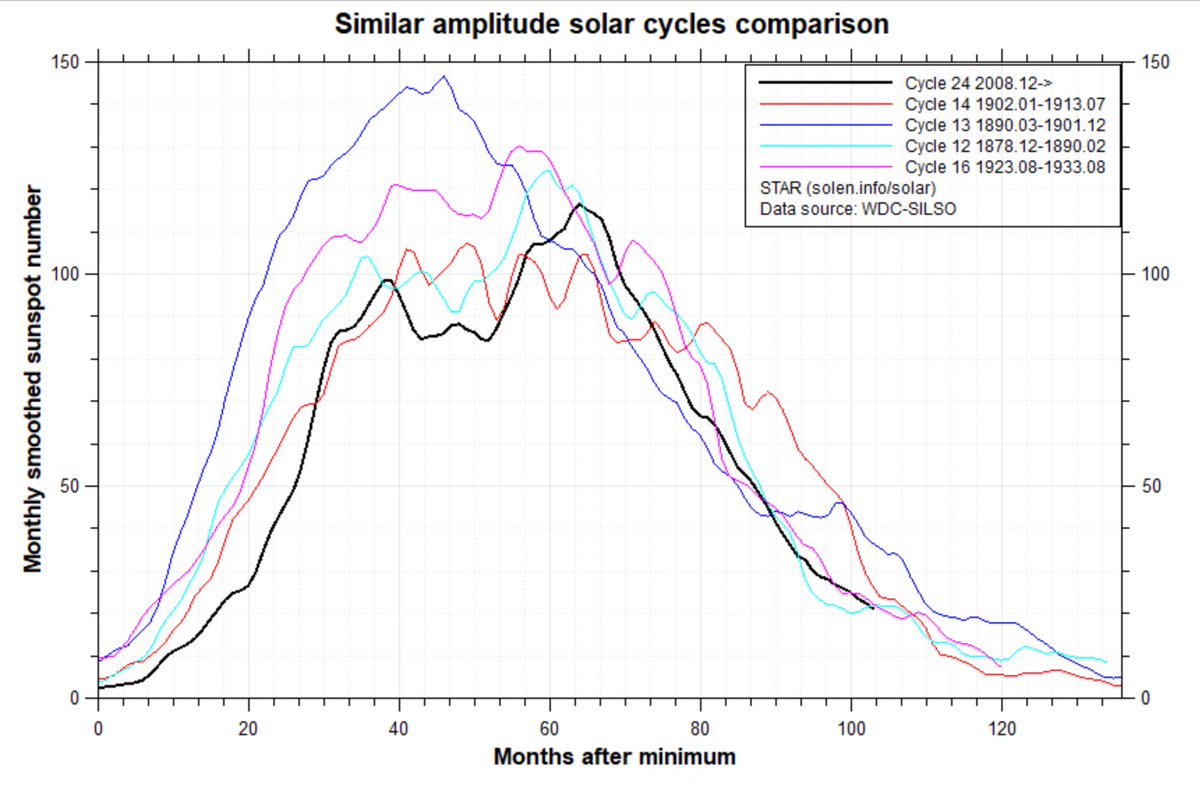
The area enclosed by the black line represents the latest solar activity and that area is well down on previous periods, meaning that the sun has been unusually inactive recently. And solar cycles DO correlate with weather.
A Washington State Carbon Tax: All Pain, No Gain,/b>
Even with unrealistically positive assumptions, the benefits would be minuscule. With respect to Washington governor Jay Inslee’s renewed proposal for a “carbon” tax on that state’s greenhouse-gas (GHG) emissions, a number to keep closely in mind is: 2/1000 of a degree. That would be the global temperature effect in the year 2100 if Washington were to reduce its GHG emissions to zero immediately.
That figure comes from the Environmental Protection Agency’s climate model, under a set of assumptions that exaggerate the effects of emissions reductions. Obviously, the effect of the governor’s proposed tax would be vastly smaller. And by the way, the governor’s proposal would not apply to jet fuel, as Boeing is the state’s largest private employer.
Even with that glaring concession to political reality, Inslee apparently still believes that the state should make itself a moral example and “mark the way.” Sorry, but the federal bureaucracy until Donald Trump assumed the presidency was way ahead of him. Implementation of the Obama administration’s entire package of climate policies would have reduced temperatures by 25/1000 of a degree, while the Paris agreement, if implemented fully, would yield a reduction of 17/100 of a degree.
Those effects, by the way, would be too small to be measured reliably. And so Inslee’s claim that his proposed tax would “save our children” from droughts, flooding, fires, and other “existential threats” is preposterous.
Inslee seems implicitly to recognize this, and so he reverted to a justification based upon the employment that will be created by an expansion of “clean energy” production. That, too, is deeply dubious. His tax on energy would shift employment away from energy-intensive sectors toward others, and in the aggregate would reduce employment by making the economy smaller. (U.S. data show that energy consumption and employment move together closely. The same is true for energy consumption and GDP growth, household income, and reductions in the poverty rate.)
And about that “clean energy”: There is nothing “clean” about it. There is heavy-metal pollution created by the production process for wind turbines. There are noise and flicker effects of wind turbines. There is the large problem of solar-panel waste. There is wildlife destruction caused by the production of renewable power. There is massive and unsightly land use made necessary by the unconcentrated nature of renewable energy.
And above all, there is the increase in emissions of conventional effluents caused by the up-and-down cycling of the backup conventional-generation units, which are needed to avoid blackouts caused by the unreliability of wind and solar power — a reality curiously underreported in the popular discussion.
With respect to the “existential threats” asserted by Inslee: There is no question that increasing GHG concentrations are having measurable effects. But they are far smaller than the climate models would lead one to believe. The degree to which recent warming has been anthropogenic is unsettled in the scientific literature, and the Intergovernmental Panel on Climate Change (IPCC) in its fifth assessment report (AR5) has reduced its estimated range of the effect in 2100 of a doubling of GHG concentrations from 2.0–4.5 to 1.5–4.5 degrees C.
Moreover, there is little evidence of strong climate effects attendant upon increasing GHG concentrations, in terms of sea levels; Arctic and Antarctic sea ice; tornado activity; tropical cyclones; U.S. wildfires; drought; and flooding. IPCC in the AR5 is deeply dubious (Table 12.4) about the various severe effects often hypothesized (or asserted) as future impacts of increasing GHG concentrations.
Climate change caused by GHG emissions might prove to be a serious problem. It might prove to be a minor problem, and it might prove to be beneficial on net. We simply do not know, and the argument that very large costs ought to be imposed by climate policies upon the economy — that is, upon actual people — with trivial or unmeasurable benefits is deeply problematic. More research, more technological advance, and adaptation over time are likely to prove far wiser.
In his State of the State address, Inslee used the phrase “carbon pollution” no fewer than five times. That term is political propaganda, the obvious purpose of which is to cut off debate before it begins by assuming the answer to the underlying policy question. Carbon dioxide is not “carbon,” and it is not a “pollutant,” as a certain minimum atmospheric concentration of it is necessary for life itself.
By far the most important GHG in terms of the radiative properties of the troposphere is water vapor; no one calls it a “pollutant.” Why not? Is it because ocean evaporation is a natural process? So are volcanic eruptions, but the toxins, particulates, and other effluents emitted by volcanoes are pollutants by any definition. All of us would do well to use the phrase “greenhouse gases,” which has the virtue of being scientifically accurate without assuming the answer to the underlying policy question. Willie Sutton, who robbed banks because “that’s where the money is,” would be proud.
Whatever Inslee’s spending preferences for the revenues, interest-group competition within the legislature guarantees that good intentions would yield quickly to ordinary pork-barrel politics. With no prospect of environmental improvement and little of real beneficial spending, what is the rationale for a tax on “carbon?” Why not on zucchini?
SOURCE
UN does not like Australia's climate policies
Oh, Goodie!
Australia's climate policies are "a decade behind" other rich nations, according to a United Nations investment official, leaving the country exposed to risks of a so-called "green paradox" when carbon emissions will have to make a precipitous retreat.
A phasing out of coal and other fossil fuels is the centrepiece of four recommended investor goals to be unveiled by the UN's Principles for Responsible Investment unit in New York on Thursday morning, eastern Australian time.
Fiona Reynolds, UNPRI's managing director, said investors needed to take the lead in forcing companies to reveal their exposure to fossil fuels and to step up pressure on governments to meet their Paris climate commitments.
"Investors have a huge, huge role to play on climate change," Ms Reynolds told Fairfax Media, citing their ability to influence the companies they own, including steering them away from fossil fuels to renewable energy. "This a really urgent issue."
While countries in Europe of all political persuasions were tackling the need to switch to a low-carbon future, the debate in Australia 10 years behind, she said.
"Australia keeps battling about the downsides and not the opportunities that could be available to the country in this transition," Ms Reynolds said.
The Abbott government's scrapping of a carbon price in 2014 - and the kryptonite reaction to another policy since - went against the global trend.
Some 40 nations had introduced some form of carbon pricing and major international investors were generally supportive, Ms Reynolds said. "They say, 'As investors, we work in market-based systems. We need carbon pricing,'" she said. "It's a high priority."
Josh Frydenberg, the environment and energy minister, said the Turnbull government won't support a carbon price: "The last time Australia had a price on carbon it was Labor's $15.4 billion carbon tax which was a disaster that sent electricity prices up and made us less competitive."
Pricing carbon, though, received support this week from European researchers who say putting a price on emissions would be a key method to avoid a "green paradox" that had implications for nations such as Australia.
'Nightmare scenario'
In a paper published in Nature Climate Change, the researchers looked at the possibility that fossil-fuel owners, in anticipation of future carbon curbs, would accelerate extraction rates to maximise profits - contrary to the object of those restrictions.
"Strong and timely signals" from climate policy-makers are necessary to counter the incentive to expand output of fossil fuels in the short term, they said.
Nico Bauer, a modeller from Germany's Potsdam Institute for Climate Impact Research and the paper's lead author, said Australia faced the "grass paradox" because of its fossil fuel wealth, including about 13 per cent of the world's coal reserves.
A "serious carbon price" would affect use of coal in Australia and promote faster take-up of renewable energy, Dr Bauer said.
Australia faced being "a victim of a blame game" if the Paris goal of a 2-degree warming limit is exceeded, a prospect that should serve to motivate climate action, he said, adding "the carbon price would be economically the most efficient instrument".
A delay also increased the likelihood of a "carbon bubble" emerging that would end up being popped rather than deflated if governments resorted to a "climate policy shock" to get emissions down to the required rate of reduction.
"This, however, is a kind of a nightmare scenario for financial regulators, because they figure out a financial crisis scenario and they fear something like a fossil-fuelled Lehman Brothers event," Dr Bauer said.
SOURCE
***************************************
For more postings from me, see DISSECTING LEFTISM, TONGUE-TIED, EDUCATION WATCH INTERNATIONAL, POLITICAL CORRECTNESS WATCH, FOOD & HEALTH SKEPTIC and AUSTRALIAN POLITICS. Home Pages are here or here. Email me (John Ray) here.
Preserving the graphics: Most graphics on this site are hotlinked from elsewhere. But hotlinked graphics sometimes have only a short life -- as little as a week in some cases. After that they no longer come up. From January 2011 on, therefore, I have posted a monthly copy of everything on this blog to a separate site where I can host text and graphics together -- which should make the graphics available even if they are no longer coming up on this site. See here or here
*****************************************
Sunday, February 04, 2018
Extreme cold, frostbite and hypothermia force halt to Yukon Arctic Ultra race
According to the Greenies, the earth started to warm immediately after WWII -- as industrialization picked up and produced more and more CO2 emissions.
They got one part right. CO2 has risen steadily since then. But where is the warming? After 70 years of warming there should be none of these repeated incidents of extreme cold. Extreme cold should have greatly moderated. But it has not. Worldwide there have been constant severe winters.
Greenies say these freezing periods are just weather but when does weather become climate? Frequent cold weather is part of climate so the Greenie prophecies have just not been fulfilled. The global warming prophecy was wrong
It's billed as "the world's coldest and toughest ultra" race — and few would argue, after this year.
The long-distance, backcountry Yukon Arctic Ultra race, which began Thursday in Whitehorse, was put on hold on Friday after a slew of competitors fell victim to hypothermia and frostbite, calling for help, and dropping out of the race.
"We are in what we refer to as 'high alert status,'" says a notice on the race website.
The temperature in Whitehorse as racers set off on Thursday morning was hovering around –30 C. Overnight, it was closer to –45 C, race officials say.
"We were hoping most of them will get through the night without major problems. Unfortunately, this was not the case," the race website says.
As of Friday afternoon, several competitors had already been retrieved from the trail, and some have gone to hospital to be treated for frostbite.
Mark Kelly, a Whitehorse photographer, found himself unexpectedly busy on Friday morning, picking up racers in distress on his snowmobile and delivering them to safety.
He had arranged to meet one of the racers on the trail, freelance journalist Eva Holland, to take some photographs for her. He didn't get far out of town before he was sidetracked.
"I was maybe five or eight kilometres on the trail, and a fellow hopped out of the bush and waved me down and just said, 'rescue me!'. Poor guy, I really felt for him. He was definitely hypothermic," Kelly said.
Kelly gave the cold man some hot tea, loaded him on his sled, and took him back to his truck to warm up and wait to be picked up. Kelly then set off again to meet Holland.
Again, he was stopped before he reached her. Another man was in trouble, and calling for help.
"After the second fellow with the blackening fingers, I thought, this is serious," Kelly said.
"One of the fellows, he'd stopped [to camp] because he was freezing cold, but his hands were so frostbitten that he couldn't even open his Thermarest. So he was laying, literally, right on the frozen ground — no wonder he was hypothermic."
Kelly eventually made it to Holland, who in the meantime had also called for help. Her fingers were frostbitten, but she was in good spirits, Kelly said.
SOURCE
Where the floating plastic comes from. It is not "us"
A picture is worth a thousand words

The wetland reserve at the mouth of the Yangtze is supposed to be the last unspoilt tract of seaside by Shanghai.
Yet here in the delta of the world’s third longest river, which is the leading source of plastics polluting the oceans, it is more like a disaster zone of flotsam and debris.
The tides sweep a myriad of garbage — bits of old appliances, plastic jugs, packaging fragments, torn fishing lines and polystyrene foam — on to the shoreline at Jiuduansha.
“Plastic waste far outnumbers any other kind of waste I have found on beaches,” Tang Heqing said, who is trying to clean the area and gauge the level of pollution.
SOURCE
Climate change is making some women reluctant to have children
Good, good, Good! I am all in favor of lamebrains voluntarily removing themselves from the gene pool
Climate change is creating yet another debate -- this time largely among women who are wondering what it means for their reproductive future.
They are not saying they fear their ovaries are affected by climate change; instead, they are saying they are so worried about climate change, it has made them wonder if bringing a child into the world right now is a bad idea.
The state of worry has created groups such as Conceivable Future. The group is made up of men and women. Though largely made of women, everyone comes to discuss the next generation and climate change. Members of the organization aren't optimistic for what is ahead, so they are unsure about bringing a child into an uncertain future.
Gone are the days of getting married and nine months later, happy couples welcome their first child into the world.
Now, future parents are calculated, often double earners faced with skyrocketing college costs, the consequences of living in a digital age, ever increasing health risks, and the declining state of our planet. At Conceivable Future, the environment discussion is all about how climate change affects family.
“It’s one way to talk about climate that really cuts both across everybody’s life and cuts to the core of what it really means to be a human," Josephine Ferorelli, co-founder of Conceivable Future, said.
The organization’s founder holds house parties across the U.S., including areas such as Chicago. The mission of these house parties is to get attention with help from testimonials from members.
Hannah Harpole, 34, from New York, is among those that are worried about the future.
“At this point, I feel it is very unlikely that I will have children,” Harpole said. “It’s a biological feeling that It’s a very bad idea to have children because of what’s going on with the climate.”
Harpole is not alone in feeling this way. Andree Zaleska, 48, from Boston, is right behind Harpole.
“I have had to raise my kids with the knowledge that their future is completely uncertain to me," she said.
According to the organization, it is a chance for everyone to have and hold a conversation. Everyone is welcome, men and women, adults and children, those with kids and those without. It’s a forum, a safe place, they say, to share and to ask questions.
Ferorelli initiates this conversation with a question that allows for the discussion to begin.
“How is climate change impacting our reproductive lives? That’s the conversation, as open-ended as that,” she said.
The questionable climate change has prompted others to consider having more children or even a child at all.
Eleanor Ray is one of the many women that see the climate as a reason why she has settled on not having kids.
“Every other thing is eventually going to depend on what the weather does,” Ray said. “ I think it will be the shaping force of the next 100 years, and we’re not planning for it.”
SOURCE
Conservation, Not Environmentalism
Much of the disagreement over the use of America's natural resources stems from confusion over the difference between conservation and environmentalism. Conservation, a rational, conservative approach to protecting and preserving the environment, is an ethic of resource utilization. Conservationists view man as a natural, invested partner in the endeavor to preserve the environment to ensure its continued, sustainable use by humans.
Environmentalism began as a sincere conservationist movement but subscribes to a view of man as nature's enemy. Nature itself is revered and intrinsically embodied with value. Environmentalists seek to limit human access to, rather than allow use of, nature to advance human life, health, and happiness. Environmentalists perceive man as an immoral, destructive interloper who can interact only negatively with his natural surroundings.
In his book, Smoking Them Out: The Theft of the Environment and How to Take It Back (American Tradition Institute, 2013), Greg Walcher focuses on these ideological differences as he examines the environmental movement.
Walcher begins with the history of the environmental movement. He demonstrates how the stewardship of our resources – water, forests, energy sources, other natural resources – has become less about real science and conservation and more about politics and achieving centralized control. This change in focus has created unintended consequences, far removed from the ideals of caring for the environment and, today, bordering on malfeasance.
The author describes an environmental industry that has grown by leaps and bounds since the 1980s. Although their stated goals have remained the same, the nature of the groups has changed radically as they borrowed techniques from non-profit organizations in other fields and raised huge sums of money, much from major foundations such as the Ford Foundation, the Heinz Endowments, the Rockefeller Brothers Fund, and other entities known for supporting anti-capitalist goals.
Many of the organizations boast membership statistics that dishonestly include visitors to their websites and attendees to their meetings to claim extensive and widespread support for their activities, while having few actual, dues-paying members. Large organizations often spawn new groups that are portrayed as concerned citizens promoting an alleged grassroots issue of regional concern, such as "Friends of the Canyon," to give an image of neighborhood conservation groups valiantly fighting large, evil corporations.
The emphasis has been on stopping development rather than compromising to balance community needs with legitimate environmental concerns. As a result, hundreds of new local groups have sprung up to influence nearly all major natural resource agencies at every level of government. They pursue lawsuits in staggering numbers, greatly impeding progress on the development of environmental policies. The Sierra Club alone filed 129 federal lawsuits between 2001 and 2007.
During his tenure as head of the Department of Natural Resources in Colorado, Walcher dealt firsthand with the full smorgasbord of environmental concerns. He describes his interactions with factions of the powerful, politically connected international environmental industry and takes issue with their negative characterizations of coal-miners; oil, gas, and mining companies; loggers; and farmers as irresponsible abusers of the environment.
Walcher considers the Endangered Species Act of 1973 – the most powerful environmental law ever passed – a failure. Half of the species on the endangered list have been on the list for more than 20 years, and only one third have an actual recovery plan in place. The legislation has accomplished little to recover endangered species, and, in the vast majority of cases, the situation has worsened. Rather than recovering and reintroducing self-sustaining populations of species, the focus has been on habitat conservation, resulting in legislation and regulations to control property, land access, and resources with a negligible effect on actual species recovery.
Walcher's approach to species endangerment was to build state-of-the-art recovery facilities: first an aquatic species hatchery and, later, similar facilities for birds and mammals. The goal was to recover sufficient numbers of the species to place them into a suitable habitat for their growth.
While the program became overwhelmingly successful, little interest arose from the government and environmental groups. Walcher became aware that listings of endangered species were made with inadequate proof that they were, in fact, endangered, and statistics on historic populations or recovery goals were not part of the equation. Further, the law offered no appeals process or comment period for the public to contest a potential listing. Since the inception of the Act, 1,435 species had been placed on the list, and only eight had been removed. From this dismal record, Walcher concluded that the real agenda was to control land and human activity.
In his well researched book, Walcher describes similar scenarios of environmentalists' intrusions in the management (or mismanagement) of other resources: forests, land, water, and energy. He shows how well endowed environmental organizations are adept at imposing their agendas at any cost and with any subterfuge necessary.
In land management, he explains how America's forests had traditionally been kept in check by nature, with periodic fires sparked by lightning. But forest management was created and engaged in fire suppression, with logging taking the place of fire to thin forests. In the late 1990s, logging became unpopular and a hot-button issue for environmentalists. The result: a massive overgrowth of trees, brush, grasses, and weeds that deteriorated the health of forests and produced a literal tinderbox. Our forests are so overcrowded that they currently burn at a rate unmatched in recorded history, threatening the wildlife they sustain.
An interesting split on land management and development issues between the West and East is also explored in Smoking Them Out. Whereas in the Western states, much of the land is state- and federally owned, government land ownership constitutes a mere 1% to 2% in the East. For example, Nevada consists of nearly all public land, while less than 1% of New York State land is government-owned. This means that Nevada has a much lower tax base available for local schools, fire departments, water and sewer services, and other needs. The amount of publicly owned lands presents a difficult challenge for Western states hampered by government regulation of much of the land surrounding their communities.
In the end, Walcher promotes a policy of hands-on environmentalism – recovering endangered species, restoring forests through effective clearing, responsible mining with an emphasis on mitigation and reclamation, and other such sensible interventions. With millions of acres of land currently restricted for human activity, our forests and water supply have suffered, and we have strayed from the original intent of resource protection to a hidden agenda of control.
Flush with cash and an armamentarium of legal guns, the environmental groups have embarked on a multi-decade destructive crusade that has plundered resources and ensured that the next generation will not enjoy the same standard of living; will travel less; will live in smaller homes; will relinquish cars; and will consume, manufacture, and produce less. In Smoke Them Out, Greg Walcher demonstrates that the answer is not to continue to promulgate a massive regulatory morass, but to engage in sensible conservation and recovery policies.
Moving forward, environmental policy should be about responsibly providing the necessary natural resources to sustain a prosperous country. As is clear from the many examples set by impoverished countries, when people have inadequate resources to sustain their communities and livelihoods, they focus on survival and don't expend time and energy for conservation.
SOURCE
Australia: Greenies trying to gag honest scientidst
Marine scientist commented on their "unvalidated" public pronouncements about catastrophic damage to the Great Barrier Reef. The reef is now back to normal so he was proved right.
Marine scientist Peter Ridd has refused to accept a formal censure and gag order from James Cook University and expanded his Federal Court action to defend academic freedoms and free speech.
A revised statement of claim alleges JCU trawled through private email conversations in a bid to bolster its misconduct case against him.
JCU had found Professor Ridd guilty of “serious misconduct”, including denigrating a co-worker, denigrating the university, breaching confidentiality, publishing information outside of the university and disregarding his obligations as an employee. [i.e. He told the truth]
Professor Ridd has asked the Federal Court to overturn the university ruling and confirm his right not to be silenced.
In the revised statement of claim, Professor Ridd has dropped an earlier claim of conflict of interest against JCU vice-chancellor Sandra Harding, but has alleged other senior staff had been biased and had not acted fairly or in good faith.
Professor Ridd’s Federal Court action is seen as a test of academic freedom and free speech, and has been supported by the Institute of Public Affairs.
Professor Ridd said he would seek public donations to continue the fight against JCU. He first took court action in November in a bid to stop a JCU disciplinary process against him for comments he made to Sky News presenter Alan Jones.
The university said by expressing concerns about the quality of some reef science, Professor Ridd had not acted in a “collegiate” manner.
Professor Ridd told Sky News: “The basic problem is that we can no longer trust the scientific organisations like the Australian Institute of Marine Science, even things like the ARC Centre of Excellence for Coral Reef Studies.”
He said a lot of the science was not properly checked, tested or replicated and “this is a great shame because we really need to be able to trust our scientific institutions and the fact is I do not think we can any more”.
A JCU spokesman said the university’s lawyers had invited Professor Ridd to discontinue his proceedings. “(He) has amended his proceedings. His decision to do so is a matter for him,” he said.
“The university intends to vigorously defend those proceedings (but) as these matters are before the courts, JCU will not comment further.”
Lawyers for JCU wrote to Professor Ridd on November 28 confirming the university had determined he had engaged in “serious misconduct” and issued him with a “final censure”.
“The disciplinary process and all information gathered and recorded in relation to the disciplinary process (including the allegations, letters, your client’s responses and the outcome of the disciplinary process) is confidential pursuant to clause 54.1.5 of the university enterprise agreement,” the JCU lawyers said.
Professor Ridd has subsequently published his concerns about the quality of reef science in a peer-reviewed journal. He said he was determined to speak freely about his treatment “even though it will go against explicit directions by JCU not to”.
“This is as much a case about free speech as it is about quality of science,” he said.
SOURCE
***************************************
For more postings from me, see DISSECTING LEFTISM, TONGUE-TIED, EDUCATION WATCH INTERNATIONAL, POLITICAL CORRECTNESS WATCH, FOOD & HEALTH SKEPTIC and AUSTRALIAN POLITICS. Home Pages are here or here. Email me (John Ray) here.
Preserving the graphics: Most graphics on this site are hotlinked from elsewhere. But hotlinked graphics sometimes have only a short life -- as little as a week in some cases. After that they no longer come up. From January 2011 on, therefore, I have posted a monthly copy of everything on this blog to a separate site where I can host text and graphics together -- which should make the graphics available even if they are no longer coming up on this site. See here or here
*****************************************
Friday, February 02, 2018
Global warming is shrinking insects: Study reveals the four largest beetle species in Canada have shrunk 20% in the last 45 years in an attempt to survive hotter temperatures
This claim is a hardy perennial. It flies in the face of the fact that the age of the dinosaurs was warmer than today. And they were LARGER than present day terrestrial creatures. The entomologsts below have ignored a basic law of statistics -- that correlation is not causation. There were probably plenty of other things in the environment affecting the bugs as the climate (slightly) warmed
Researchers in Canada found that some native beetle species are getting 20 per cent smaller as their habitats get warmer.
They say their study provides evidence that climate change is affecting the size of organisms.
Assistant professor of botany and zoology Dr Michelle Tseng at the University of British Columbia (UBC) who oversaw the research, said: 'In nature, there is so much going on that can affect body size so we weren't sure we were going to see anything.
'This research provides evidence that climate change is affecting even the smallest organisms out there.'
Scientists expect living organisms to respond to climate change in three ways - by moving to new regions, changing the timing of their life stages or shrinking.
Up until now, most of the evidence for organisms shrinking has come from laboratory work where the environment and living conditions can be tightly controlled.
Dr Tseng asked students in her fourth-year class to look into whether that is happening by examining beetle specimens in UBC's Beaty Biodiversity Museum collection, as well as historical weather data.
They selected eight species of beetles from the Lower Mainland and Okanagan for their data set.
They photographed more than 6,500 beetles and inputted information about each insect, when it was collected and where it was found into a database.
Sina Soleimani, one of the students who co-authored the paper, said: 'We got data from 100 years of caught specimens.
Researchers wanted to know if animal species' were shrinking
'It's cool that people have been collecting these insects since 1910 and noting all of their collection information. That's probably what makes our paper stand out.'
The students measured whether the beetles had changed in size in the last 40 or 100 years.
They then used a climate database from the faculty of forestry to gather data about changes in the environment for the two regions where the beetles lived.
Shrinking in body size is seen from several global warming events.
With the global temperatures set to continue to rise, it is expected the average size of most animals will decrease.
At first, the figures didn't indicate a clear trend - some beetles were shrinking, some were not.
But by taking a closer look, they found that it was the larger beetles that were shrinking, while the smaller ones were not.
SOURCE
Greenland’s recent temperature drop
They say it is just weather, not climate. 14 years of bad weather? It sounds like the 70 years of bad weather that Russian farmers had in the old Soviet union. The amusing thing is that Greenland is part of the Arctic and Warmists regularly have orgasms about the slightest warming in the Arctic. "Last year, winter sea ice fell to the smallest extent on record" is the excited sort of utterance we hear. A change of just ONE year is paraded as significant. If the Arctic warms it is climate. If it cools it is just weather
Using satellite data, a group of scientists has studied the development of temperature over the past 15 years in a large part of Greenland.
More precisely, they looked at surface temperatures (the temperature close to the Earth’s surface) in a part of the country that is not covered by ice—around one fifth of the surface area of Greenland.
Intuitively, you may think that temperature throughout all of Greenland has been increasing, but that is not the case. When you look at the yearly average, the ice-free parts of Greenland show a slight drop in temperature between 2001 and 2015. With swings in temperature from year to year.
However, these results should not be interpreted as “proof” that the Earth is not warming, say the scientists behind the research, which is published in the journal Scientific Reports.
This is weather, not climate
You need to have thirty years’ worth of data before you can “talk about climate,” says Professor Bo Elberling, an environmental geochemist and senior scientist on the study.
So we should be wary of discussing these results in the context of climate change, says Elberling, who is head of the Center for Permafrost (CENPERM) at the Department of Geosciences and Natural Resource Management at the University of Copenhagen, Denmark.
“What’s interesting here is that with these new data we have a unique description of the spatial distribution of surface temperatures across the entire ice-free part of Greenland, which we couldn’t pull out of the approximately 45 weather stations that cover Greenland today,” he says.
SOURCE
Trump Slashes Budget of Global Warming Madrassa
Slowly but surely the Trump administration is draining the climate swamp.
Here’s the latest good news, courtesy of American Geophysical Union’s Eos, in a piece headlined “Prestigious Climate-Related Fellowships Rescinded.”
It reports on the reduction (by half) of National Oceanic and Atmospheric Administration’s (NOAA) “prestigious” Climate and Global Change Postdoctoral Fellowship Program — or what I would call a madrasa for climate change alarmists.
Since 1992, at a cost of around $2 million per annum, the program has sponsored eight fellows a year in order “to help create the next generation of researchers needed for climate studies.”
The graduates’ list is a veritable Who’s Who of prominent climate alarmists.
Among the program’s alumni is Myles Allen, a man-made climate change specialist at Oxford University; Gavin Schmidt, now head of the notoriously climate alarmist NASA Goddard Institute of Space Studies; and Heidi Cullen, who writes alarmist propaganda for the website Climate Central.
Not all alumni, it’s true, go on to shill for the great global warming scam.
For example, one alumnus — Chris Landsea, a meteorologist specializing in hurricanes — took the brave and principled decision of resigning in 2005 from the Intergovernmental Panel on Climate Change’s (IPCC) Fourth Assessment Report. Landsea objected to the way his views were being misrepresented by one of the report’s lead authors, Kevin Trenberth.
Trenberth wanted to promote the idea that “global warming” (as it was then known) would lead to an increase in intense hurricane activity.
Landsea was outraged because this contradicted all available scientific studies, including his own. So he resigned in protest, no doubt costing himself a well-paid career on the climate change gravy train.
But Landsea is almost certainly the exception rather than the rule.
The majority of the Climate and Global Change Program’s 218 alumni will have gone on to positions in the science departments of some of the finest universities in the U.S. There, they will, of course, have helped entrench and promote the view that “anthropogenic global warming” is both a significant threat and an eminently worthwhile subject for scientific study.
Unfortunately for them, the U.S. is now run by an administration which doesn’t believe any of this.
Here is what President Donald Trump had to say recently on the subject in a TV interview with Piers Morgan:
"There is a cooling and there’s a heating. I mean, look, it used to not be climate change, it used to be global warming. That wasn’t working too well because it was getting too cold all over the place.
The icecaps were going to melt, there were going to be gone by now, but now they’re setting records, OK? They’re at a record level."
This is Trump-speak for: “I’m not buying that nonsense.”
His administration is acting accordingly. With the support of administrators like Scott Pruitt at the Environmental Protection Agency, the draining of the climate swamp has begun.
One measure of the new approach is the dramatic reduction in the number of U.S. university grant applications mentioning the words “climate change.” According to the National Science Foundation, there was a 40 percent drop in 2017.
Another sign that time is up for the alarmists is the reduction of NOAA’s Climate and Global Change Postdoctoral Fellowship Program.
Where in previous years, it funded as many as eight candidates, the 2017 intake had just four. Another four had their initial offers withdrawn, which the article in Eos appears to think is a matter of great sadness.
It quotes Katie Travis, who was finishing a PhD in atmospheric chemistry at Harvard University, landed a place on the program, but then subsequently had the offer rescinded because of budget cuts.
“This was the first grant I wrote myself,” she said. “It was really validating for me to be selected, which is why it’s so crushing that the program ended up the way it did.”
But the story gets sadder still. Another victim of this savage funding cut back, it seems, was the cause of “diversity.”
"Especially troubling to Abigail Swann, an ecologist at the University of Washington in Seattle, is that three of the rescinded offers were to women, whereas the four who were funded are all men. That makes the 2017 class the only one in the program’s 27-year history other than the first to be all male. Swann and two program alumni wrote a letter—since signed by more than 100 program alumni, hosts, selection committee members, and others—expressing concern that the lack of diversity makes it even harder for female geoscientists to bridge the “PhD-to-Professor gap,” a precarious career stage when many women scientists leave the field. They also noted that NOAA itself has committed to increasing diversity."
Putting aside the sarcasm for a moment, let me gently suggest that while these may feel like issues of burning importance to Abigail Swann, Katie Travis, and the author of the article, a lot of readers here will be thinking: “This is why we voted for Donald Trump.”
Indeed, the very existence of this grant program is a measure of just how out of touch liberal academia is with reality.
In what way is it or was it ever good value for taxpayers to fork out $2 million a year so that needy science PhDs like Katie Travis could feel “validated”? Or that other female PhDs could feel their diversity was being celebrated? Or that science post-graduates generally should be diverted from doing something actually beneficial to mankind and instead encouraged onto a program designed to parachute them into the almost entirely pointless $1.5 trillion-plus global warming industry?
To be absolutely clear, the National Oceanic and Atmospheric Administration’s (NOAA) “prestigious” Climate and Global Change Postdoctoral Fellowship Program is a waste of money. It always was a waste of money.
The four places on the program which have been scrapped so far are a very good start.
Let’s hope the other four places on the program are nixed soon.
SOURCE
Al Gore’s global warming vision proves more mirage than material
Al Gore’s vision of a dangerous climate “tipping point”, foreshadowed in his 2007 book Assault on Reason, has failed to materialise, according to a top American business professor who a decade ago challenged the former US vice- president to bet on how global average temperature would change.
Mr Gore’s staff said he did not take bets, but a decade on Scott Armstrong, a business professor at the Wharton Business School, has concluded that global temperature deviations since 2007 had easily fallen within the natural level of variation, and “no change” was the most accurate way to describe global weather patterns over the past decade.
“When you lack scientific evidence, the primary way to keep ‘global warming’ alive is to avoid having a testable hypothesis,” Professor Armstrong said, mocking how some observers had “touted the extremely cold weather that occurred in January (in the northern hemisphere) as another piece of evidence of global warming”.
The UN’s 2001 Intergovernmental Panel on Climate Change projected warming of 3C every century, which prompted governments to introduce taxes and regulations to curb CO2 emissions.
Professor Armstrong said he had seen “no dangerous long-term trends” in temperature data and, in any case, “like most people”, he would prefer temperatures “a little warmer”. “A few years ago, people in the US were asked how much tax they would be willing to pay on gasoline to completely eliminate dangerous global warming — the amount was about a dollar.”
Professor Armstrong and his academic colleague Kesten Green at the University of South Australia took Mr Gore’s “tipping point” scenario, charitably, to be the “business as usual” forecast from the UN’s 2001 panel on climate change, which had anticipated a 0.3C increase in average global temperature every decade.
The “bet” was monitored on theclimatebet.com site using global temperature data from University of Alabama researchers.
“Global temperatures have always varied on all timescales and Professor Armstrong was not highly confident that he would win a 10-year bet when temperatures had commonly drifted up or down by 0.3C over 10-year periods in the past,” Dr Green said.
The monthly data showed the years from 2008 to 2014 were largely cooler than the 2007 average deviation, while 2016 and last year were warmer. Between AD16 and 1935, a “no change” forecast over periods of one to 100 years was “much more accurate” than a hypothesis of global cooling or warming, the academics said.
The 2001 IPCC report said “...the long-term prediction of future climate states is not possible”.
“The fact the last two years … favoured the warming forecast is meaningless in the context of the swings in temperature that occurred during the bet, and that will continue to occur in the future,” Dr Green said.
“Basing public policy on failed alarmist scenarios is irrational, and is causing enormous harm.”
SOURCE
Australia: The end of recycling
Recycling in Victoria is on the brink of collapse, with councils facing having to stockpile millions of tonnes of waste - or dump it in landfill - as a China export ban begins to bite.
Several councils have already had recycling contracts cut off, with the Municipal Association of Victoria warning the problem could soon spread to the entire state.
The Chinese town of Giuyu used to be a dumping ground for the world's trash. Now China has banned imports of foreign waste to crack down on its own chronic pollution problem.
Experts said any solution would be expensive, with ratepayers likely to be slugged if the crisis takes hold.
The recycling industry has been warning for some time that a decision by China – our largest export destination for recycling – to ban waste imports would have a catastrophic impact on the sector, possibly making it unviable.
Those warnings came home to roost this week. Recycling giant Visy told Wheelie Waste, a bin collector that services 11 councils in Victoria’s west including Greater Shepparton, Macedon Ranges, Horsham and Ararat, that it would stop accepting council recycling on February 9.
The company cited China’s ban as the reason for the move. Wheelie Waste declined to comment, and Visy did not respond to requests for comment.
The Age understands several other councils have also been told they will lose service. "We think ultimately there’s a potential for them all to be affected," Municipal Association of Victoria CEO Rob Spence said. "This is just the beginning of the potential impacts."
SOURCE
***************************************
For more postings from me, see DISSECTING LEFTISM, TONGUE-TIED, EDUCATION WATCH INTERNATIONAL, POLITICAL CORRECTNESS WATCH, FOOD & HEALTH SKEPTIC and AUSTRALIAN POLITICS. Home Pages are here or here. Email me (John Ray) here.
Preserving the graphics: Most graphics on this site are hotlinked from elsewhere. But hotlinked graphics sometimes have only a short life -- as little as a week in some cases. After that they no longer come up. From January 2011 on, therefore, I have posted a monthly copy of everything on this blog to a separate site where I can host text and graphics together -- which should make the graphics available even if they are no longer coming up on this site. See here or here
*****************************************
Thursday, February 01, 2018
USA Today claims it doesn't publish climate-denying op-eds. That's not true
The Leftist article below shows an absolute horror over anti-Warmist views getting any publicity at all. Their attitudes to opposing views are thoroughly North Korean. And their objections to climate skepticism are entirely "ad hominem". There is no reference to any scientific facts against which we could evaluate Warmism.
And in their final paragraph below they say that global warming is not getting nearly enough attention in the media. But if you google "global warming" you get something like 50 pro-Warmist articles to about one skeptical article. So how come they have not long ago made their case to everyone with all that support for it? That the theory is heavily at variance with the evidence they cannot consider
Each editorial USA Today publishes is accompanied by an "opposing view" op-ed that presents a counter-argument. This is a particular problem when it comes to the topic of climate change. As Media Matters has documented on multiple occasions, the newspaper's “opposing view” format regularly leads it to publish climate denial and misinformation from authors who have undisclosed fossil-fuel industry connections.
USA Today has heard from critics who have called on it to stop running climate-denying op-eds, but instead of changing its practices, the paper's editorial board is trying to defend them. Its defense does not hold up to scrutiny.
Bill Sternberg, the paper's editorial page editor, put forward that defense in a January 26 piece titled, "Why does USA TODAY pair editorials with opposing views?" From the piece:
In recent years, perhaps no debate topic has been more controversial than global warming. A number of readers and outside groups have demanded that we stop running opposing views from climate change skeptics.
We’ve tried to adhere to the rule of thumb put forth by the late Sen. Daniel Patrick Moynihan of New York: Everyone’s entitled to their own opinion, but they are not entitled to their own facts.
In other words, we won’t run pieces that deny the reality of human-induced climate change. The scientific consensus on that point is overwhelming, and increasingly so.
But we will run opposing views that disagree about proposed remedies, discuss the urgency of the climate change problem compared to other problems, or raise questions about costs versus benefits.
And whenever possible, we try to disclose potential conflicts of interest, such as whether the writers, or their organizations, have received money from fossil-fuel interests.
But in fact USA Today has regularly run "opposing view" op-eds that "deny the reality of human-induced climate change." And many of them have been written by people who have "received money from fossil-fuel interests," which the paper typically fails to disclose.
A 2016 Media Matters study found that USA Today published five “opposing view” opinion pieces featuring climate denial or misinformation from January 1, 2015, through August 31, 2016. All five were written by individuals with fossil-fuel ties, which USA Today did not disclose to readers.
For example, Sen. James Inhofe (R-OK), the Senate's leading climate denier, argued in a March 2015 "opposing view" piece that "the debate on man-driven climate change is not over," though in fact it is over. There is overwhelming scientific consensus that human activity is causing climate change, as Sternberg admits in his own piece.
And, in October 2015, then-Sen. Jeff Sessions (R-AL) wrote an "opposing view" op-ed claiming that “temperatures have been essentially flat for 18 years," pushing a favorite climate-denier myth that has been thoroughly discredited. USA Today did not disclose that Inhofe and Sessions had both received substantial campaign contributions from fossil fuel industry interests -- millions of dollars in Inhofe's case and hundreds of thousands in Sessions'.
More recently, in August 2017, USA Today published an op-ed casting doubt on a federal climate report; the piece was written by Chris Horner, who the paper identified only as "a senior fellow at the Competitive Enterprise Institute." As Media Matters pointed out at the time, Horner's work has been funded by big fossil-fuel corporations for years. Horner has received payments from Alpha Natural Resources, one of the largest coal companies in the U.S., and has numerous other ties to the coal industry. Horner’s employer, the Competitive Enterprise Institute, has received more than $2 million from ExxonMobil over the past two decades, as well as funding from Marathon Petroleum, Texaco, the American Petroleum Institute, the American Coalition for Clean Coal Electricity, American Fuel and Petrochemical Manufacturers, Koch Industries, and the Koch brothers' charitable foundations, among others.
But USA Today might be making modest progress on disclosure, at least. In September 2017, an "opposing view" piece by longtime climate denier Myron Ebell did acknowledge some of his conflicts of interest. The bio that ran under his piece read, "Myron Ebell is director of the Center for Energy and Environment at the Competitive Enterprise Institute, which has received donations from fossil fuel interests."
If USA Today recently adopted a policy of disclosing authors' fossil-fuel industry ties, that would be a modest step in the right direction. But it still needs to do more to fix its problem. Instead of giving a platform to an increasingly small group of climate deniers, whose views are far outside the mainstream, the paper should be inviting more commentary from diverse voices in the business, military, scientific, and other communities who are arguing for different kinds of climate solutions.
The country desperately needs intelligent debate about the best ways to combat and cope with climate change, not about whether climate change is a serious problem. If, as Sternberg claims, USA Today wants to make its readers "better informed," it should publish more op-eds by people who take climate change seriously and create a vibrant forum for honest and constructive back-and-forth about climate action.
SOURCE
We Will Make You Green
BOOK REVIEW: "Green Tyranny: Exposing the Totalitarian Roots of the Climate Industrial Complex" by Rupert Darwall
Anyone remember the “acid rain and forest death” scare of the 1970s and 1980s? Rupert Darwall, in Green Tyranny, provides a reminder of this and much more while “exposing the totalitarian roots of the climate industrial complex”.
Acid rain caused by sulphur emissions from coal-fuelled power stations was supposedly poisoning Scandinavian and northern American soil, lakes, fishes and forests. Scandalously, the national science academies of the US, Canada, UK, Sweden and Norway said so loudly. But it was bunk, and put to rest by a 1990 report by the US government’s National Acid Precipitation Assessment Program, a decade-long US$500 million study.
Darwall is not a scientist or an academic but an investment banking and public policy wonk, with an after-hours specialty in the history of ideas. His previous book was The Age of Global Warming: A History (2013). In this new volume, his forensic rigour again puts muscle into every page.
The book gains novelty and heft by focusing on how Sweden and Germany generated the global—or rather, the West’s—renewables transformation. The Swedes (population 8 million) have been extraordinarily influential, due largely to their supposed integrity and independence from power blocs. Above all, the Swedes were father to the IPCC.
Darwall busts the stereotype with detail, such as Sweden’s refusal to accept Jews fleeing from the Nazis, and its alliance with NATO in the Cold War that was kept secret from the Swedish and world public (Sweden was not neutral at all). In a hall-of-mirrors exercise, Sweden was also used by the Soviets as a drop-box and credible source for their misinformation campaigns. These included the “nuclear winter” phoney scare, designed to undermine the US nuclear armament drive that, ultimately, led to communism’s defeat. In the twenty-first century Swedish bureaucrats continue to enforce conformity to the state line, including suppression of wayward journalism.
The “climate industrial complex” is necessarily led by the state, with its power to engorge the renewables industry rent-seekers through tax, regulations, laws and administration. “Dense networks connect state bureaucracies and regulatory bodies to universities, think-tanks, NGOs, the media, special interest groups, financiers and their lobbyists, and religious institutions,” Darwall says.
Their aim is to overwhelm business opposition, control advice to government and suppress the sensible objections to draconian renewables targets. Thus is occurring “the largest misallocation of resources in history”. As one example, Angela Merkel coerced the EU in 2007 into a legally-binding 20 per cent renewables target by 2020. This was in the absence of any technical knowhow about the grid integration, let alone the cost (which in Germany’s case alone is heading towards 1.1 trillion euros, about the same as its renovation costs for East Germany). As Darwall puts it, “Government support for wind and solar was less about assuring the survival of the unfittest than guaranteeing the triumph of the unfittest.”
That the climate-saving rationale is a sham is proven by the same environmentalists’ successful attacks on nuclear power and strivings against the dazzlingly emissions-effective fracked gas.
The climate cabal’s own-goals would be hilarious if the issues were not so world-changing. Before 2010, the environmental NGOs attacked Volkswagen as a polluter, but greased by Volkswagen million-euro donations, changed tune and lauded the company in 2012 as the world’s ecologically-nicest car-maker. Then in 2015 the sensational Volkswagen emissions cheating scandal came to light.
A far bigger scandal is the West’s subsidising or enforcing a switch from petrol cars to allegedly low-carbon-dioxide-emission diesel, such that by 2011 more than half of all Europe’s new cars were diesel. But the authorities knew from the start that diesel-based air pollution in big cities is an immediate cancer and health risk. As a London Department of Transport official who had helped draft the UK’s pro-diesel switch put it:
We did not sleepwalk into this. You are talking about killing people today rather than saving lives tomorrow. Occasionally we had to say we were living in a different world and everyone had to swallow hard.
The same authorities are now enforcing anti-diesel policies. As Darwall says, it’s a “world created by environmentalism and carbon policy monomania”.
The Potsdam Institute for Climate Impact Research is on the front line for the climate industrial complex. Its head, Hans Joachim Schellnhuber, believes the carrying capacity of the planet is under 1 billion (currently 7.6 billion) because of global warming. He has also warned of a possible “ocean heat belch” that would shock-heat the first ten kilometres of the atmosphere by thirty-six degrees. Schellnhuber was Angela Merkel’s top climate adviser for many years and was also appointed by Pope Francis to help write his climate encyclical Laudato Si. The Potsdam Institute, by the way, now partners with Melbourne University. Schellnhuber said at the partnership launch that global warming “has to be tackled with the best scientific evidence”.
Because the renewable targets are so destructive, a vital task of the climate industrial complex is to maintain all-pervasive faith in the supposed warming crisis (notwithstanding the now scientifically accepted finding that the climate models have exaggerated heat forecasts). Darwall believes the complex has created what he calls the “spiral of silence”, a psychological phenomenon known for half a century in which people shrink from expressing dissenting views if they believe their views would be widely unpopular.
As a local example, Robyn Williams of the ABC’s Science Show lavishes time on climate nutter Naomi Oreskes while excluding and mocking sceptics. When finally giving leading sceptics airtime last June, Williams also brought in anti-sceptic professors Andy Pitman and Steve Sherwood with their “gold star” science (Williams’s description) to dominate the conversation lest any listener be contaminated by the likes of US sceptic climatologist Judith Curry. Incidentally, Pitman’s remarks included a prediction of Sydney temperatures of up to fifty-five degrees.
But Australia’s “spiral of silence” is, thankfully, collapsing. The importance of Tony Abbott’s London sceptic speech in October was not just in telling some climate truths but also in legitimising others to defy the “consensus”. It also forced the sceptic case into the left-wing media, where a panicked Fairfax refers even in straight news to “Abbott’s ‘loopy’ speech”.
Darwall’s book abounds in surprising factoids.
• The carbon-dioxide emissions research pioneer Svente Arrhenius inspired the creation in 1922 of the State Institute for Racial Biology. The goal was selective breeding to improve racial characteristics, and one lecturer was the future Nazi “Race Pope” Hans Guenther. In 1933 the Swedes legislated for sterilisation without consent in some cases. The cause was taken up by Gunnar Myrdal (Nobel Prize for economics 1974) advocating sterilisation of “low-quality” people.
• Hitler domestically was an ardent environmentalist, at the height of the war intervening to protect German wetlands. He backed giant wind tower plans to cut coal consumption, and was still funding wind power research in 1944.
• From 2006 the revered bird-loving group the Audubon Society endorsed “clean energy” wind farms, knowing, as its US president John Flicker said, that “wind turbines sometimes kill a lot of birds”—in fact, nearly 600,000 birds a year in the US, including 80,000 raptors, as well as over 900,000 bats. “We very much appreciate Audubon’s leadership on this issue,” responded the American Wind Energy Association.
• An unintended consequence of California’s legalisation of pot smoking and production is that private indoor pot growers are now consuming 9 per cent of the state’s electricity, jeopardising the state’s emission targets. Some large growers are paying a million dollars a month in electricity bills.
Darwall is writing largely for a US audience, and the book’s timing is obviously caught short by Trump’s counter-attack in favour of fossil fuels. But Darwall’s long-term warning holds:
Global warming poses a question about the nature and purpose of the state: whether its role is to effect a radical transformation of society or whether its principal task is to protect freedom …
Delivering pre-ordained emission cuts requires a powerful administrative state. Uniquely, America’s Constitution and its separation of powers provide checks against it. This, ultimately is what is at stake in the battle of Paris and the climate war. It is a fight for America’s soul.
SOURCE
NY’s latest power play
Renewable energy companies aren’t building the windmills and solar panels Governor Andrew Cuomo hoped for when he pledged in 2015 to have 50 percent of the state’s electricity come from renewables by 2030. Cuomo’s latest solution? The state will build them itself.
Part GG of Cuomo’s proposed Transportation and Economic Development (TED) Article VII budget bill would let the state Power Authority, which owns and operates the massive hydroelectric dams at Niagara Falls and Massena, “finance, plan, design, engineer, acquire, construct, operate or manage” renewable energy projects, defined as “solar power, wind power, hydroelectric, and any other generation resource authorized by any renewable energy standard adopted by the state for the purpose of implementing any state clean energy standard.”
It’s difficult to overstate what type of change this represents in state energy policy, which since Cuomo was elected has been to cajole private interests into investing in utility-scale renewable energy projects without the state building them itself.
The state since 2013 has been financing green energy projects through the Cuomo-created Green Bank, which last year reported having lent $259 million for the purpose and committed another $85 million. More importantly, the state Public Service Commission’s 2016 Clean Energy Standard ordered utilities and anyone getting power directly from the grid to begin buying renewable energy credits (RECs), a mechanism by which renewable generators could remain profitable while selling electricity into the grid at a loss.
That heavy-handed approach, by which the state puts up the capital and then makes people buy the product, still isn’t delivering the desired results. The state has twice had to slash the amount of RECs it’s requiring utilities and others to buy simply because not enough eligible renewable energy is produced here (and since power generated by rooftop solar panels didn’t count toward the total).
NYPA, by the way, is authorized already to use its profits from the large hydroelectric plants to buy energy on the market, a mechanism by which it was hoping to prop up offshore wind developers as recently at 2011. This brute-force legislation would go the last mile and let NYPA build and operate them itself.
That, however, opens up a new array of problems. For one thing, NYPA would have to pay artificially inflated construction costs, since it’s subject to the state’s archaic prevailing wage law. NYPA’s expenses would also be elevated by mandatory contributions to the state pension system, the state’s arbitrary requirement to contract with minority- and woman-owned business enterprises (MWBEs) and the work rules set out in the authority’s union contracts. And all of this would be happening while NYPA’s finances are being drained by the money-losing canal system, which state legislators transferred to the Authority last year.
It is, in short, the Cuomo administration’s last resort.
The move is likely necessary to maintain even the appearance New York is making progress toward the governor’s ballyhooed “50-by-30” goal of having half the state’s electricity come from renewables by 2030. That target, the Empire Center explained in 2016, raises significant cost, land-use and transmission issues, all while New York simply isn’t the most practical place to deploy solar panels or wind turbines.
The difficulty in reaching 50 percent is compounded by the artificial constraints placed on the state’s own initiatives. All Canadian hydroelectric power—and any existing renewable generators—are disqualified from competing for the newest set of renewable energy subsidies. And, as noted in this space previously, the renewable push itself has been something of a green smokescreen for the Clean Energy Standard’s real purpose: a multi-billion dollar bailout of upstate nuclear plants toward which 99.3 of related funds will flow by the end of 2018.
The governor’s criticism of New York’s renewable energy spending in his written 2013 State of the State message still holds true: “despite all of this spending, NYS is not on track to achieve its clean energy goals.”
SOURCE
A 'Climate Skeptic' Just Took Charge Of EU Environment Policy
Neno Dimov, the man who took over as the president of the EU's Environment Council on Jan. 1, got an earful yesterday when he appeared before members of the European Parliament. Some of his past words were coming back to haunt him.
Lawmakers were aghast that a man who once called climate change a fraud and described himself as an opponent of climate science was going to be coordinating the EU's environment policy for the next six months.
“You personally have been questioning climate change and whether human activity is the cause; you even challenged the theory of sea-level rise,” Dutch Liberal MEP Gerben-Jan Gerbrandy said to him. Other MEPs demanded he clarify his personal stance.
Dimov demurred. He would not say anything about his personal opinion on climate change, noting only that there is a "political consensus" within the EU on climate change and that he will "keep this consensus alive." However, he said, there is always room for "challenges and doubts." A vocal admirer of U.S. President Donald Trump, Dimov has in the past said global warming is being used as a tool of intimidation.
Musical Chairs
So how did the EU end up with a climate-skeptic environment chief?
The European Union, always keen to avoid the impression of being centralized around Brussels, has a variety of traditions meant to diffuse power throughout the bloc.
One of these is the "rotating presidency." Every six months, one of the EU's 28 member countries takes charge of the Council of the EU – the bloc's upper chamber, made up of ministers from each of the national governments. Each of the Council's policy configurations – for instance, the Agriculture Council, made up of the 28 different agriculture ministers – is chaired by the presidency country.
As Bulgaria's environment minister, Dimov will chair the Environment Council until the end of July. This means he will set the agenda and conduct negotiations with the European Parliament on behalf of all the member states. The Council does not propose legislation – that task falls to the Commission, the EU's executive branch, and its environment commissioner, Karmenu Vella. But Dimov will still have the power to steer important pieces of legislation over the coming months.
Dimov became Bulgaria's environment minister in May of last year, and shortly afterward he gave a TV interview saying that "climate change is a scientific debatе; there is no consensus, and every part has arguments." He said that he is one of the opponents.
In 2015 he said in an online video that global warming is a "fraud … used to scare the people." "The melting of the ice will not raise the sea level even with a millimeter," he said. "The main factor for climate change is solar activity."
But it is Dimov's stance on sustainability and preservation issues that have riled environmentalists in his home country. He is currently embroiled in controversy over his decision to open up protected nature areas in the country to development, including for a large new ski resort. Earlier this week, Bulgarian environmentalists gathered in front of the Council of the EU to give a jar of fresh air from one of the nature reserves to Dimov as he arrived in Brussels for his meetings.
"There are big protests in a lot of cities in Bulgaria and abroad because of the National Park Pirin, and we want Neno Dimov's resignation as a main wish of the protests," says Danita Zarichinova of Friends of the Earth Bulgaria. "He's made total chaos in the ministry on the politics of air pollution, plastics, Natura 2000 zones and so on."
Dimov is no stranger to environmental issues. He has built his career portraying himself as a fair-handed and reasonable arbiter, striking a balance between environmental protection and economic development. "We must have some symbiosis between these two trends, if we want to improve the standard of our living as they both determine the quality of life," he told Bulgaria's Focus Radio this month. "This is actually what I was trying to achieve from the very beginning."
Dimov served as Bulgaria's deputy minister of the environment from 1997 to 2002, during which time he was also a member of the management board for the EU's European Environment Agency – somewhat analogous to the Environmental Protection Agency in the United States.
Afterward, he conducted Bulgaria's EU accession negotiations in the field of environment. He has written a book critical of environmental red tape, called "From Environmentalism to Freedom.”
Dimov will not be the traditional president of the Environment Council, where previous minister-presidents have tended to come from either purely political or environmentalist backgrounds.
In this way, he may find common cause with a counterpart across the Atlantic. Scott Pruitt, the new head of the U.S. EPA, has a similar background of crusading against environmental red tape and casting doubt on climate change.
SOURCE
Australia: Classrooms powered by renewable energy to be trialled in NSW schools
This sounds like fun. What happens when it is an overcast day? Do the kids alternately freeze and boil?
School children across Australia could soon be taught in classrooms powered entirely by renewable energy as a result of the innovative ‘Hivve’ modular classroom, now being trialled in two New South Wales schools.
On behalf of the Australian Government, the Australian Renewable Energy Agency (ARENA) is providing Hivve Technology Pty Ltd with $368,115 in funding to pilot their modular classrooms in a school environment.
Known as the ‘Hivve’, the portable classroom incorporates solar PV generation, real time energy metering, CO2 metering, data capture and communications to actively manage energy demands and control indoor environment quality.
Each Hivve classroom has the potential to generate enough electricity to power itself and two other classrooms in the school.
A regular classroom can consume on average 3,800 KWh per year, but when a HIVVE classroom is in use, there is an estimated net energy generation of 7,600 KWh per year.
Ready for the start of 2018 school year this week, the two pilot classrooms are being trialled at St Christopher’s Catholic Primary School in Holsworthy in Sydney’s south western suburbs and at Dapto High School in Dapto where the performance of the Hivve classrooms will be monitored and evaluated over a 12 month period.
A prototype building built by Hivve Technology Pty Ltd has successfully demonstrated the functionality in a controlled environment and this will be the first time the Hivve classroom and technology has been trialled in a real school.
ARENA CEO Ivor Frischknecht said there was enormous potential for Australia’s public schools to not only educate on renewables, but also reduce their reliance on the grid.
“This is a great way to get the next generation involved in renewables at an early age and educate them as to what the positive benefits will be as Australia continues its shift towards a renewable energy future,”
“The success of the Hivve project could lead to a nation-wide adoption of the modular classrooms, reducing reliance on the grid and even providing a significant amount of electricity back to the NEM.” Mr Frischknecht said.
Hivve Director David Wrench said the Hivve Technology was conceived and designed to deliver sustainable solutions – both environmental and economic – to help meet Australia’s growing school infrastructure needs.
“We are very pleased to be partnering with ARENA on this exciting project. We have carefully designed every element of the Hivve classroom to create the best possible learning environment for students”, Mr Wrench said.
Media release from hivve.com.au
***************************************
For more postings from me, see DISSECTING LEFTISM, TONGUE-TIED, EDUCATION WATCH INTERNATIONAL, POLITICAL CORRECTNESS WATCH, FOOD & HEALTH SKEPTIC and AUSTRALIAN POLITICS. Home Pages are here or here. Email me (John Ray) here.
Preserving the graphics: Most graphics on this site are hotlinked from elsewhere. But hotlinked graphics sometimes have only a short life -- as little as a week in some cases. After that they no longer come up. From January 2011 on, therefore, I have posted a monthly copy of everything on this blog to a separate site where I can host text and graphics together -- which should make the graphics available even if they are no longer coming up on this site. See here or here
*****************************************
Subscribe to:
Posts (Atom)


 Jim Hansen and his twin


