
Friday, January 05, 2018
New study identifies thermometer for global ocean
It should be noted that this is an estimate of ocean heat, not a direct measure of it and that no attempt seems to have been made to validate the estimates -- by repeating the study with (say) Arctic cores.
For what it is worth however the study should be disappointing to Warmists. An estimated temperature rise of only one tenth of one degree over the last 50 years is way below what Warmists normally talk about. Note that 50 years ago is roughly when Warmists claim anthropogenic global warming started
There's a new way to measure the average temperature of the ocean thanks to researchers at Scripps Institution of Oceanography at the University of California San Diego. In an article published in the Jan. 4, 2018, issue of the journal Nature, geoscientist Jeff Severinghaus and colleagues at Scripps Oceanography and institutions in Switzerland and Japan detailed their ground-breaking approach.
Determining changes in the average temperature of the entire world's ocean has proven to be a nearly impossible task due to the distribution of different water masses. Each layer of water can have drastically different temperatures, so determining the average over the entirety of the ocean's surface and depths presents a challenge.
Severinghaus and colleagues were able to bypass these obstacles by determining the value indirectly. Instead of measuring water temperature, they determined the ratio of noble gases in the atmosphere, which are in direct relation to the ocean's temperature.
"This method is a radically new way to measure change in total ocean heat," said Severinghaus. "It takes advantage of the fact that the atmosphere is well-mixed, so a single measurement anywhere in the world can give you the answer."
In the study, the scientists measured values of the noble gases argon, krypton, and xenon in air bubbles captured inside ice in Antarctica. As the oceans warm, krypton and xenon are released into the atmosphere in known quantities. The ratio of these gases in the atmosphere therefore allows for the calculation of average global ocean temperature.
Measurements were taken from ice samples collected during the West Antarctic Ice Sheet (WAIS) Divide coring project, of which Severinghaus is a leader. Over the course of six field seasons in Antarctica, a drill removed ice in cylindrical samples 3.7 meters (just under 9 feet) in length. The final sample was taken at a depth of 3,405 meters (over 11,000 feet) in 2011. This record spans nearly 100,000 years and the age of the layers can be determined to within 50 years. Earth's atmosphere mixes on a scale of weeks to months, so a measurement of these air bubbles gives what is essentially a global average. For this study, scientists focused on samples 8,000 to 22,000 years old, and collected data in increments averaging 250 years in resolution.
New insights into the glaciation cycles that occurred on Earth long before humans began affecting the temperature of the atmosphere and oceans are now possible using the technique of measuring noble gas quantities. The study determined that the average global ocean temperature at the peak of the most recent ice age was 0.9 ºC (33.6 ºF). The modern ocean's average temperature is 3.5 ºC (38.3 ºF). The incremental measurements between these data points provide an understanding of the global climate never before possible.
"The reason this study is so exciting is that previous methods of reconstructing ocean heat content have very large age uncertainties, [which] smooths out the more subtle features of the record," said co-author Sarah Shackleton, a graduate student in the Severinghaus lab at Scripps. "Because WAIS Divide is so well dated, this is the first time that we've been able to see these subtle features in the record of the deglaciation. This helps us better understand the processes that control changes in ocean heat content."
"Our precision is about 0.2 ºC (0.4 ºF) now, and the warming of the past 50 years is only about 0.1 ºC," he said, adding that advanced equipment can provide more precise measurements, allowing scientists to use this technique to track the current warming trend in the world's oceans.
SOURCE
The End of the Ocean Acidification Scare for Corals
Paper Reviewed: McCulloch, M.T., D'Olivo, J.P., Falter, J., Holcomb, M. and Trotter, J.A. 2017. Coral calcification in a changing world and the interactive dynamics of pH and DIC upregulation. Nature Communications 8: 15686, DOI:10.1038/ncomms15686.
The global increase in the atmosphere's CO2 content has been hypothesized to possess the potential to harm coral reefs directly. By inducing changes in ocean water chemistry that can lead to reductions in the calcium carbonate saturation state of seawater (Ω), it has been predicted that elevated levels of atmospheric CO2 may reduce rates of coral calcification, possibly leading to slower-growing -- and, therefore, weaker -- coral skeletons, and in some cases even death. Such projections, however, often fail to account for the fact that coral calcification is a biologically mediated process, and that out in the real world, living organisms tend to find a way to meet and overcome the many challenges they face, and coral calcification in response to ocean acidification is no exception, as evidenced by findings published in the recent analysis of McCulloch et al. (2017).
Writing in the journal Nature Communications, this team of five researchers developed geochemical proxies (δ11B and B/Ca) from Porites corals located on (1) Davis Reef, a mid-shelf reef located east-northeast of Townsville, Queensland, Australia in the central Great Barrier Reef, and (2) Coral Bay, which is part of the Ningaloo Reef coastal fringing system of Western Australia, in order to obtain seasonal records of dissolved inorganic carbon (DIC) and pH of the corals' calcifying fluid (cf) at these locations for the period 2007-2012. And what did those records reveal?
As shown in the figure below, coral colonies from both reef locations "exhibit strong seasonal changes in pHcf, from ~8.3 during summer to ~8.5 during winter," which "represents an elevation in pHcf relative to ambient seawater of ~0.4 pH units together with a relatively large seasonal range in pHcf of ~0.2 units." These observations, in the words of McCulloch et al., "are in stark contrast to the far more muted changes based on laboratory-controlled experiments" (as shown in the dashed black line on the figure), which laboratory-based values are "an order of magnitude smaller than those actually observed in reef environments."
With respect to DICcf (also depicted in Figure 1), McCulloch et al. report that the "highest DICcf (~ x 3.2 seawater) is found during summer, consistent with thermal/light enhancement of metabolically (zooxanthellae) derived carbon, while the highest pHcf (~8.5) occurs in winter during periods of low DICcf (~ x 2 seawater)."
The proxy records also revealed that coral DICcf was inversely related (r2 ~ 0.9) to pHcf. Commenting on this relationship, the marine scientists say it "indicate[s] that the coral is actively maintaining both high (~x 4 to x 6 seawater) and relatively stable (within ± 10% of mean) levels of elevated Ωcf year-round." Or, as they explain it another way, "we have now identified the key functional characteristics of chemically controlled calcification in reef-building coral. The seasonally varying supply of summer-enhanced metabolic DICcf is accompanied by dynamic out-of-phase upregulation of coral pHcf. These parameters acting together maintain elevated but near-constant levels of carbonate saturation state (Ωcf) of the coral's calcifying fluid, the key driver of calcification."
The implications of the above findings are enormous, for they reveal that "pHcf upregulation occurs largely independent of changes in seawater carbonate chemistry, and hence ocean acidification," demonstrating "the ability of the coral to 'control' what is arguably one of its most fundamental physiological processes, the growth of its skeleton within which it lives." Furthermore, McCulloch et al. say their work presents "major ramifications for the interpretation of the large number of experiments that have reported a strong sensitivity of coral calcification to increasing ocean acidification," explaining that "an inherent limitation of many of these experiments is that they were generally conducted under conditions of fixed seawater pHsw and/or temperature, light, nutrients, and little water motion, hence conditions that are not conducive to reproducing the natural interactive effects between pHcf and DICcf that we have documented here." Given as much, they conclude that "since the interactive dynamics of pHcf and DICcf upregulation do not appear to be properly simulated under the short-term conditions generally imposed by such artificial experiments, the relevance of their commonly reported finding of reduced coral calcification with reduced seawater pH must now be questioned."
And so it appears that alarmist claims of near-future coral reef dissolution, courtesy of the ever-hyped ocean acidification hypothesis, have themselves dissolved away thanks to the seminal work of McCulloch et al. Clearly, the world's corals are much more resilient to changes in their environment than acidification alarmists have claimed them to be.
SOURCE
Environmentalists freak out over Trump’s repeal of rule which never went into effect
The green energy, “keep it in the ground” folks are off to a bad start in 2018. It turns out that another one of Barack Obama’s signature “achievements” in energy regulation, the one which would heavily regulate fracking on federal lands, is going away. Given what a dirty word “fracking” has become in liberal circles, this is causing all manner of outrage on the left. There’s only one catch here… the rule in question never even went into effect for even a single day. (Washington Times)
The Obama administration’s 2015 fracking rule was never actually implemented, thanks to an ongoing court battle, and it apparently never will be.
The Interior Department published a final rule Friday in the Federal Register repealing immediately the hydraulic-fracturing regulation on federal lands, saying that “we believe it imposes administrative burdens and compliance costs that are not justified.”
The previous fracking rule was already moribund after a federal judge in Wyoming struck it down in June 2016 in response to a four-state lawsuit, holding that the Bureau of Land Management had overstepped its authority by acting without congressional approval.
Under Obama, the Bureau of Land Management (BLM) had been fighting the lower court ruling every step of the way. The 10th Circuit had given them until January 12th to file their next appeal and keep the case going. But now that the new rules have come out and the regulation under discussion has disappeared, the point is moot and the case has collapsed in upon itself.
That’s a sensible approach since each state already sets their own rules regarding fracking. If the residents of certain states (such as New York, sadly) wish to elect leaders who ban fracking and miss out on that sort of economic opportunity, that’s up to them. As the Trump administration is pointing out, that’s why it’s best left up to the states. Meanwhile, other states such as Pennsylvania are seeing an employment boom and rising personal wealth for people who lease out their land for energy development. And after many years of this, the Keystone State doesn’t seem to have fallen into a black hole.
Meanwhile, on a somewhat related note, do you recall how we finally got the Dakota Access Pipeline approved and finished? You might be wondering how that’s working out for the people of North Dakota. The Wall Street Journal looked into the question (subscription required) and found that things are coming up roses.
In just six months of service, the $3.8 billion Dakota Access Pipeline has boosted North Dakota’s economy and energy sector, helping lower transportation costs for energy companies and increase oil production by 78,000 barrels per day in October from September — the biggest-ever monthly rise. As a result, the state had an unemployment rate of 2.3% in November, while revenue climbed by about $43.5 million in the first five months since the pipeline came online.
That’s the result for a pipeline which only occupies space inside the United States. We’re still seeing too many delays on international pipeline work thanks to ongoing court challenges. And do you know what that means for shipping volumes? Environmentalists will probably cheer and tell you that less oil is being moved, but that’s not the case. It just means that more and more of it is moving by train. According to Reuters, Canadian crude-by-rail exports to the United States hit a six-month high of 137,000 barrels per day in October and it’s not slowing down. They’d better hope those trains are smarter than some of our recent passenger rail service lines or they’ll be wishing they had more pipelines in operation.
SOURCE
Little Ireland being bullied over climate by EU
Ireland is facing a fine of €75 million each year if 16% of its energy doesn’t come from renewable-energy sources by 2020, such as solar panels and wind turbines.
EU member states have committed to reduce their greenhouse gas emissions by at least 40% by 2030.
Currently, Ireland is one of four member states that are predicted to miss their emissions target.
Varadkar said there will be a “big focus” on climate change by his government this year, and over the next ten years “to enable us to meet our commitments which we are not meeting at the moment”.
He said:
In fact from 2020 onwards we’re heading into some pretty major fines for not meeting our obligations. I would rather spend money now on meeting our commitments than on fines from 2020 onwards.
In an interview with TheJournal.ie, Environment Minister Denis Naughten admitted that the Ireland’s progress on the 2020 emissions targets has been disappointing.
Attending a climate summit in Paris last year, Naughten reaffirmed Ireland’s commitment to the global objectives set down by the Paris Agreement to significantly cut greenhouse gas emissions.
“I am going to get us as close as possible to the target,” he told TheJournal.ie, stating that despite missing the 20% reduction for 2020, he hopes to hit the 30% reduction mark in 2030.
The bigger issue for the minister is the renewable energy targets, said Naughten.
The current trajectory puts Ireland at 13% so far, but if we fail to hit these targets, the country face annualised fines from the European Union, explained the minister.
SOURCE
Failed Polar Bear Predictions Have Climate Change Community In A Panic
Polar bear experts who falsely predicted that roughly 17,300 polar bears would be dead by now (given sea ice conditions since 2007) have realized their failure has not only kicked their own credibility to the curb, it has taken with it the reputations of their climate change colleagues.
This has left many folks unhappy about the toppling of this important global warming icon but ironically, consensus polar bear experts and climate scientists (and their supporters) were the ones who set up the polar bear as a proxy for AGW in the first place.
I published my professional criticisms on the failed predictions of the polar bear conservation community in a professional online scientific preprint journal, which has now been downloaded almost 2,000 times (Crockford 2017; Crockford and Geist 2017).
My paper demonstrates that the polar bear/seaice decline hypothesis, particularly the one developed by Steven Amstrup, is a failure. I’m not the only one who thinks so, as emails obtained from the US Fish and Wildlife Service show. The argument the paper lays out and the facts it presents have not been challenged by any one of the consensus polar bear experts who object to it so strenuously. Instead, they have chosen to misrepresent my work, and publicly belittle my credentials and scientific integrity in the published literature (Harvey et al. 2017) and online.
Harvey and colleagues suggest in their paper that I and others use polar bears as a proxy for AGW as part of a deliberate plan to undermine the public’s confidence in global warming. Harvey et al. state:
“…the main strategy of denier blogs is therefore to focus on topics that are showy and in which it is therefore easy to generate public interest. These topics are used as “proxies” for AGW in general; in other words, they represent keystone dominoes that are strategically placed in front of many hundreds of others, each representing a separate line of evidence for AGW. By appearing to knock over the keystone domino, audiences targeted by the communication may assume all other dominoes are toppled in a form of “dismissal by association.”
I do not recall ever stating or implying that if polar bear predictions of doom were wrong, then general climate change models must also be wrong. But if any other bloggers have done so, they can hardly be blamed.
A bit of reflection shows it was the climate science community itself — in collaboration with Arctic researchers and the media — who by the year 2000 set the polar bear up as an icon for catastrophic global warming. They made the polar bear a proxy for AGW.
Al Gore used the polar bears on an ice flow image to seal global warming icon status for the polar bear in his 2007 movie, An Inconvenient Truth.
SOURCE
***************************************
For more postings from me, see DISSECTING LEFTISM, TONGUE-TIED, EDUCATION WATCH INTERNATIONAL, POLITICAL CORRECTNESS WATCH, FOOD & HEALTH SKEPTIC and AUSTRALIAN POLITICS. Home Pages are here or here. Email me (John Ray) here.
Preserving the graphics: Most graphics on this site are hotlinked from elsewhere. But hotlinked graphics sometimes have only a short life -- as little as a week in some cases. After that they no longer come up. From January 2011 on, therefore, I have posted a monthly copy of everything on this blog to a separate site where I can host text and graphics together -- which should make the graphics available even if they are no longer coming up on this site. See here or here
*****************************************
Thursday, January 04, 2018
China halts production of 500 car models
The climate bigots are interpreting this as an obeisance to their pathetic little cult. It is no such thing. China has REAL pollution problems -- with particulate pollution from coal-burning furnaces etc. THAT is what the leadership is desperate to get down
China is suspending the production of more than 500 car models that do not meet its fuel economy standards, several automakers confirmed Tuesday, the latest move by Beijing to reduce emissions in the world's largest auto market and take the lead in battling climate change.
The official Chinese news agency Xinhua said in a report Sunday that the suspension, effective Monday, would affect both domestic carmakers and foreign joint ventures like FAW-Volkswagen and Beijing Benz. No end date was given.
The move was expected to affect a small share of car manufacturing in China, where 28 million vehicles were produced in 2016. China has dozens of small-scale automakers some producing just a few hundred cars a year and the central government has tried to consolidate its auto industry, a factor that most likely also played a role in the suspension.
Still, the measure pointed to a mounting willingness by China to test forceful antipollution policies and assume a leading role in the fight against climate change, experts said. The country, which for years prioritised economic growth over environmental protection and now produces more than a quarter of the world's human-caused greenhouse gases, has emerged as an unlikely bastion of climate action after President Donald Trump's rejection of the Paris climate agreement.
Chinese leaders are under intense pressure to rein in dangerous air pollution, a hot-button issue in China, where thick smog has at times forced schools and businesses to temporarily shut down. Late last month, China said it was going ahead with plans to create the world's largest carbon market, giving Chinese power companies a financial incentive to operate more cleanly.
"They're sending a signal to everybody that this is for real," said Michael Dunne, president of Dunne Automotive, a Hong Kong-based consultancy on China's clean car market. "This shows their emissions standards have teeth."
The Chinese government has already become the world's biggest supporter of electric cars, offering automakers numerous incentives for producing so-called new energy vehicles. Those incentives are set to decrease by 2020, to be replaced by quotas for the number of clean cars automakers must sell. That has spurred global automakers to pick up the pace in their shift toward battery-powered cars.
The fact that Chinese automakers like the state-run giant Dongfeng Motor Corp. did not appear to be spared "shows that the government is not playing favourites in trying to meet their goals," said Bruce M. Belzowski, managing director of the Automotive Futures group at the University of Michigan Transportation Research Institute.
The Chinese government had long held back from aggressive emissions standards to allow its own automakers to catch up with the latest clean car technology. But that is changing, with the government setting increasingly stringent tailpipe rules.
The latest development "is a testimony to how quickly their own automakers have evolved," Dunne said. "They're saying: We're ready to play this game."
Foreign automakers were still tallying the effect of the suspension on Tuesday. Volkswagen, General Motors, Honda and other foreign automakers in China referred queries on specific numbers to their Asia offices. Rebecca Kiehne of BMW, which runs the BMW Brilliance joint venture in China, said the company was not yet prepared to comment.
Han Tjan, a spokesman for Daimler, said production would not be affected at its Beijing Benz joint venture with the Chinese car manufacturer BAIC Motor Corp. The only car covered by the suspension was a high-end E-Class model the venture has not manufactured since 2016, he said.
Whatever the consequences, global automakers will have no choice but to meet the increasingly stringent government policies in China, said Michelle Krebs, an analyst at the AutoTrader Group.
"The simple fact that China is the biggest market means automakers will be accommodating," she said.
SOURCE
Alarmists Trumpet ‘Global Warming’ amid Record Cold Temperatures
If the climate worked the way global warming theory says it does, we should have been getting ever milder winters. Nothing like that has happened. Atmospheric CO2 has been steadily increasing and is now well above what was one said to be a critical level -- but the climate has not followed suit
Climate change alarmists continue to preach the dogma of global warming in a textbook case of cognitive dissonance, despite record low temperatures in different points around the globe.
This past week, Buffalo and Watertown, New York, registered their coldest week in recorded weather history. Boston, too, is set to tie its record of seven straight days with temperatures remaining below 20 degrees, reports Weather.com, which has not been seen in Beantown for exactly 100 years—since the week ending January 4, 1918. Flint, Michigan, set its all-time record-low temperature for December of 18 degrees below zero last Thursday morning.
North American cities too numerous to mention have been setting records for daily low temperatures, as the gelid weather wave shows its impressive staying power. For instance, the National Weather Service reported a temperature of minus 15 F in Omaha on Sunday, breaking a record low dating back to 1884.
So what is going on?
During the summer period, mainstream media offer an ongoing stream of reports of how climate change is causing higher temperatures and severe weather, yet when temperatures drop to record lows in wintertime, they write them off as normal cyclical weather phenomena.
“Deadly heat waves are going to be a much bigger problem in the coming decades,” warned CNN in a report last June, “becoming more frequent and occurring over a much greater portion of the planet.”
“Extreme heat waves,” CNN continued, “are frequently cited as one of the most direct effects of man-made climate change.”
As Australian science writer Joanne Nova quipped, for the radical climate crowd, “extreme cold is just weather but all heat waves are climate change.” While heat waves and extreme weather events are routinely pointed to as indicators of global warming trends, the coldest weather in over a century is simply brushed off as “natural variability.”
Or as J. Marshall Shepherd, director of the atmospheric sciences program at the University of Georgia, sarcastically described the record-low temperatures, “What we are seeing right now in the United States is just, … well… wait for it… ‘winter.’”
Shepherd’s inconsistent use of cold and warm imply that cold is not just a lack of heat; it’s something fundamentally different, Nova wrote. “Heat, after all, can prove human attribution, but cold cannot prove the opposite.”
USA Today ran a defensive piece titled “It’s cold outside, but that doesn’t mean climate change isn’t real.” The article cited authorities pointing to other points of the globe that are experiencing warmer than average temperatures, in a bid to relativize the cold spell.
The ironic thing is, of course, that when the media speak of unusually hot weather as a sign of global warming, they never seem to look for places where it is unusually cold to show nature’s balance.
Meanwhile, USA Today also cited Shepherd, who stated that daily or weekly weather patterns “say nothing about longer term climate change,” something one never hears during the summer months when news outlets are falling over themselves to point to “yet another” indication that burning fossil fuels is making the earth a hotter place.
Jonathan Overpeck, a climate scientist at the University of Michigan, claimed that the recent record-cold weather is not only happening despite global warming, but, indeed, “at least in part” because of it.
Overpeck’s theory is that a loss of Arctic ice has allowed more heat to transfer from the ocean to the atmosphere, causing a weakening of the polar vortex winds over the Arctic. As a result, more freezing Arctic air is swooping further south, he proposes.
“That is due to the warming of the Arctic, which in turn is due to human emissions of greenhouse gases and primarily burning of fossil fuels,” Overpeck declared.
In other words, all weather behavior—whether colder or warmer—becomes a confirmation that manmade global warming is real.
Or, as Dinesh D’Souza tweeted, “Since heat & cold are both taken as confirmation of global warming, what, if anything, can disprove this supposedly scientific hypothesis?”
SOURCE
Global Warming Predictions, Especially About the Future, is Really Hard
In an article entitled, Al Gore’s Prediction For December 2017 Was Way, WAY Off The Mark, Andrew West outlines some of the scare mongering spouted by The High Priest of the Chruch of the Warming Globe, Al Gore. Scare mongering did I say? Yes, but I think that's putting it mildly what Gore has done. I would add lying, profiteering, scamming and fraud to that list. West goes on to say:
"Just how bad were some of Gore’s predictions? Well, for starters, he believed that the North Pole would be completely devoid of ice by today." “NINE YEARS AGO THIS MONTH— Al Gore predicted the North Polar Ice Cap would be completely ice free in five years.”
“Gore made the prediction to a German audience in 2008. He told them that ‘the entire North ‘polarized’ cap will disappear in 5 years.’
“In January 2006, Al Gore posited ‘within the next 10 years, the world will reach a point of no return’ and ‘a true planetary emergency’ due to global warming.”
And in the process he's managed to enrich himself immensly. Apparently he didn't think the emergency was so great he should stop trying to get more money, or not live in massive energy sucking "$9 million beach front home in Montecito, [California]. Guess Al is not really afraid of sinking into the sea."
And we're shocked his prediction have been wrong?
Here's Anant Goel's discription of this massively expensive, disgustingly fraudlent scam by the world's biggest con artist of all time:
"Al Gore has a meltdown and despairs as his climate change alarmism fails with the general public. His worst fears are now being realized as he fails to become the planet's first climate Billionaire. This is my dream - that maybe one day we will get to see Al Gore grilled like this on the hundreds of millions of dollars he has made out of Global Warming
Dr. Don Easterbrook is a climate scientist who stated - seven years before Al Gore and the UNIPCC shared the 1997 Nobel Peace Prize on their Global Warming predictions - stating the world would be cooling, not warming, and he was right. As for these predictions he stated:
“When we check their projections against what actually happened in that time interval, they’re not even close. They’re off by a full degree in one decade, which is huge. That’s more than the entire amount of warming we’ve had in the past century. So their models have failed just miserably, nowhere near close. And maybe it’s luck, who knows, but mine have been right on the button,”
Then there's loony Prince Charlie. It's no wonder the Queen of England keeps holding on to the throne. In July of 2009 he predicted we only have 96 months to save world from burning up. Well, there's only six months left to his prediction. I wonder what the odds on a bet would be in Las Vegas that his prediction is going to fail?
In an effort to justify his loony ideas this guy - whose lived a life of luxury and privilege while never making any of the changes in his life he's been demanding of others - claims "the price of capitalism and consumerism is just too high"........ Blaming capitalism should be the first warning sign to anyone who pays attention to these loony leftist greenies there's something wrong with what they're saying.
But these two loons - albeit the most famous of the Sky is Falling crowd - are not alone. The number of loons and loony predictions of a global warming catostrophe are Legion.
A massive list of failed predictors and their predictions appeared on Anthony Watts' website Watts ip With That, in the article, Some Failed Climate Predictions, which are far too numerous to list here, so please take the time to peruse this amazing list.
We have to get this once and for all. Anyone promoting Anthropogenic Climate Change is either deliberately being fradulent, a semi-pagan secular green fanatic, or is as dumb as tree moss.
I think that sums it up nicely. Have a good day!
SOURCE
Climate Expert James Hansen: New York Will Have Vanished Underwater by Midnight!
Say goodbye to Lower Manhattan, everybody! By midnight tonight, it will be gone forever—drowned by the melting icecaps of the disappearing Arctic.
Obviously this will be quite sad for people who live in New York. But it will be a tremendous vindication for the expertise of James Hansen, the former director of NASA’s Goddard Institute for Space Studies (GISS) who saw this disaster coming as far back as 2008.
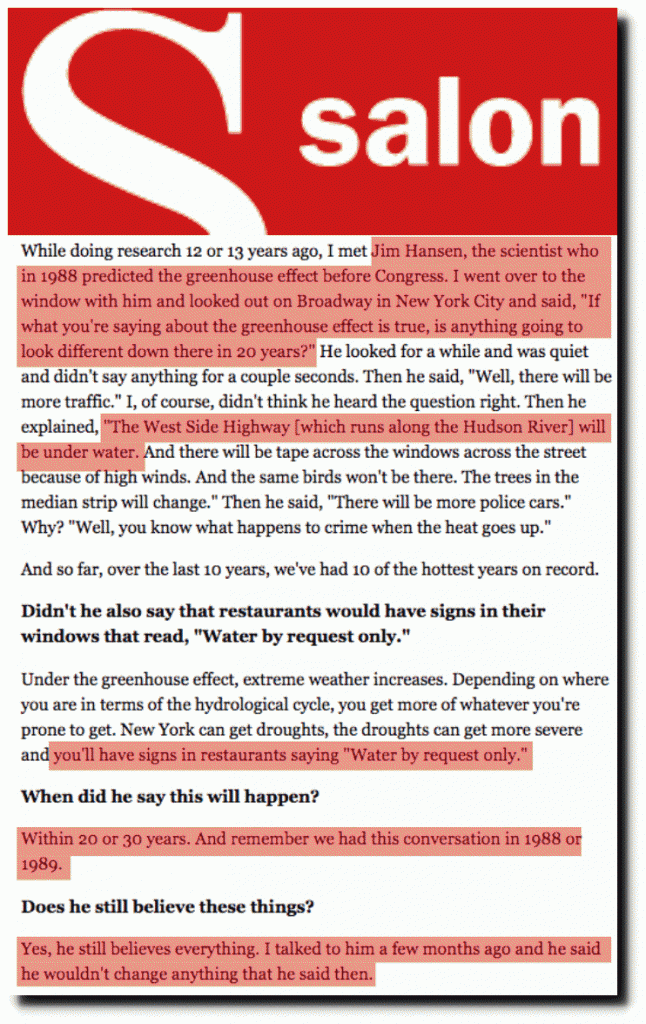
In the highly unlikely event that James Hansen is proved wrong and New Yorkers wake up tomorrow morning to find their city unsubmerged it could prove somewhat embarrassing. Not so much for Hansen, perhaps, who appears to have no sense of embarrassment or shame. But definitely—or so you’d hope—for all the politicians, environmental activists, teachers and so on who have spent the last few decades giving so much credence to his experty expertise.
It was Hansen, remember, who basically launched the whole global warming scare. Hansen was the guy who in 1988 declared at a packed congressional hearing, as sweat visibly poured from his brow, that “the earth is warmer in 1988 than at any time in the history of instrumental measurements.”
Though this claim was disowned by his former supervisor Dr. John Theon who felt that Hansen had “embarrassed NASA”, it was swallowed lock stock and barrel by most of the world’s media, and a good many of its politicians, with consequences we are ruing to this day.
The great physicist and mathematician Dr. Freeman Dyson once said, “The person who is really responsible for this overestimate of global warming is Jim Hansen. He consistently exaggerates all the dangers. … Hansen has turned his science into ideology.”
So let’s hope, for the sake of Hansen’s credibility—and for the sake of all those who pinned their faith and their policymaking decisions on his expertise—that New York is underwater tomorrow.
Otherwise, Hansen and his people will have an awful lot of explaining and apologizing to do. Or so you’d hope…
SOURCE
Australia: Former PM resisting carbon trading
Malcolm Turnbull is facing a backlash over his energy policy as conservative MPs including Tony Abbott condemn a proposal to allow power companies to meet emissions targets by buying permits from overseas as a “carbon tax” by stealth.
Mr Abbott has slammed the government’s in-principle support for including international carbon credits in Australia’s energy policy, arguing that the move will see Australian businesses and consumers shovelling money to foreign carbon traders, with huge potential for rorts.
Energy and Environment Minister Josh Frydenberg announced the new stance on carbon credits when releasing the final report of his 2017 review of climate change policies on December 19.
“As flagged in 2015, the review considered the role of international units and as a result the government has now given in-principle support for their use,” he said. “The final decision on the timing and appropriate quantity and quality limits will be taken by 2020 following further consultation and detailed analysis.”
Carbon credit schemes reward carbon abatement projects, such as tree planting in developing countries, potentially allowing Australian energy companies to buy the credits from the tree-planters to offset their own emissions. Business groups have strongly backed the move, arguing that there is no reason to waste efforts on higher-cost domestic abatement options when credible, less expensive alternatives are available abroad.
Liberal backbencher Craig Kelly has joined Mr Abbott in voicing strong opposition to the government’s move, while the Nationals’ George Christensen has previously expressed concerns about the international trading of carbon credits.
Mr Abbott said his position on international carbon credits remained the same as it had been when he was prime minister and party leader.
“I don’t support carbon trading, which is a carbon tax under a different name, and I certainly don’t support overseas carbon credits being available to Australian businesses,” he told The Australian. “That just means that Aussie consumers end up shovelling our money to foreign carbon traders, and we all know the potential for rorts there.”
Mr Frydenberg hit back last night, saying the role of international carbon credits had been on the table since Mr Abbott’s government announced in 2015 Australia’s Paris commitment.
‘’Since then we have conducted a major climate review in which industry groups representing energy intensive businesses across the economy including the BCA, AiG and the Minerals Council have made it very clear they strongly support the use of international permits," he said. “It is worth noting that Mr Abbott’s position on international permits is closer to the Greens than that of Australia’s big employers.”
In recent days, the Prime Minister has hailed his government’s national energy guarantee as a “real breakthrough” and key achievement in 2017.
Although the government won support for the guarantee in the Coalition partyroom, the latest development in the policy has inflamed the internal divisions that in 2009 saw Mr Abbott overthrow Mr Turnbull as opposition leader.
Mr Kelly said international carbon credits would put an extra cost burden on Australian businesses that would not be borne by competitors in countries such as China, the US and India.
“We’d be doing this at a time when every Australian business that uses energy is under enormous international competitive pressure through the higher cost of energy and with the company tax cuts in the US,” Mr Kelly said.
“Businesses in Australia are going to be struggling to compete internationally without us effectively putting on a further new green tax, forcing them to buy pieces of paper from overseas.”
Mr Kelly said the Abbott opposition’s criticisms of the Gillard government’s policy in 2011 remained relevant. “All those arguments are just as relevant today as they were back then,” he said, likening international carbon offset schemes to someone saying they were going to go on a diet over Christmas, but continuing to eat and paying a “diet offset”.
“You keep eating and someone from the Third World gets paid to starve,” he said.
Sky News commentator and former Abbott chief of staff Peta Credlin dubbed the timing of the announcement last month as a “getting out the trash” move, given it was released the day after the mid-year economic and fiscal update and the day of Mr Turnbull’s cabinet reshuffle.
In December 2010, Europol revealed it had arrested more than 100 people connected with carbon offset fraud, with links to organised crime networks in Europe and the Middle East. Consequently, trading volumes on Europe’s carbon market fell by 90 per cent, with a loss to European taxpayers of $6.6 billion.
In 2011, now Foreign Minister Julie Bishop wrote an opinion article attacking the then Gillard government’s policy of support for international carbon credits.
“It is naive at best for the prime minister to assume that such a scheme will emerge, given the clear signals internationally that major emitting nations are moving away from trading in carbon credits,” Ms Bishop wrote.
“Of more concern is that Julia Gillard appears blithely or wilfully unconcerned about the fraud and criminal activity that has beset trading in carbon credits.”
Asked whether her views had changed, and whether she supported the Turnbull government’s policy of in-principle support, Ms Bishop said in 2011 there had been widespread allegations of fraud in relation to international carbon credits.
“Since then, an international framework has been established through the Paris Agreement which provides unprecedented transparency, accountability and global co-operation on governance issues,” she said.
“The government is working to reduce emissions and meet our international obligations under the Paris Agreement through a broad range of emissions reduction policies and initiatives.
“We support, in principle, the use of international permits as part of our comprehensive suite of policies.”
SOURCE
***************************************
For more postings from me, see DISSECTING LEFTISM, TONGUE-TIED, EDUCATION WATCH INTERNATIONAL, POLITICAL CORRECTNESS WATCH, FOOD & HEALTH SKEPTIC and AUSTRALIAN POLITICS. Home Pages are here or here. Email me (John Ray) here.
Preserving the graphics: Most graphics on this site are hotlinked from elsewhere. But hotlinked graphics sometimes have only a short life -- as little as a week in some cases. After that they no longer come up. From January 2011 on, therefore, I have posted a monthly copy of everything on this blog to a separate site where I can host text and graphics together -- which should make the graphics available even if they are no longer coming up on this site. See here or here
*****************************************
Wednesday, January 03, 2018
Australia: High tide at Fort Denison in Sydney Harbour
You can see that if the sea is rising, it's not rising very much. More evidence that the alarmist figures put out by the climate bigots are a crock. Al Gore prophecies rises of several metres

There has in fact been some rise over the 128-year-long tide gauge record. Since 1886 it indicates a long-term rate of sea-level rise of two and a half inches (6.5cm) a century. That's hardly enough to knock anybody off their horse.
But wait! There's more! Here is a plot of the rise:
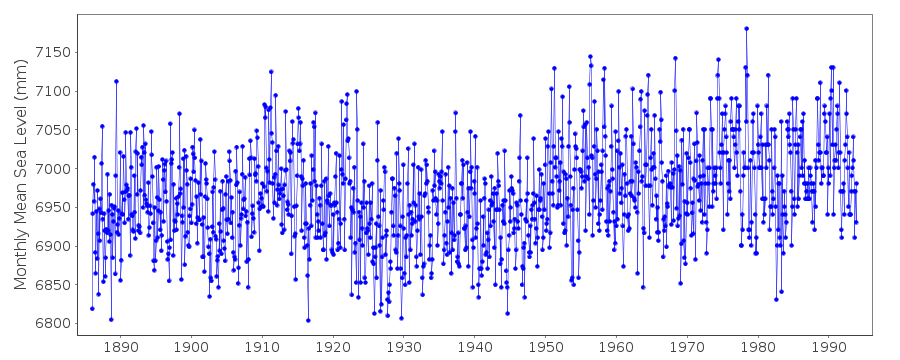
You can see that the sea level has been plateaued since 1950 -- exactly the time that the climate bigots say global warming began. So NONE of the rise was due to global warming. The small amount of global warming we appear to have had in recent decades did not shift the sea level one iota. Fun!
Laugh of the day: A quarter of the world could become a DESERT if global warming increases by just 2ºC
Who do these assholes think they are kidding? A warmer world would be a WETTER world. Surely I don't have to spell out how rain works? The guff below is just more modelling stupidity. One wonders what planet their models are supposed to be matching
An increase of just 2°C (3.6°F) in global temperatures could make the world considerably drier and more desert-like, new research has warned.
More than a quarter of the world's land surface, home to more than 1.5 billion people, would become more arid and droughts and wildfires could be widespread.
Limiting global warming to 1.5°C (2.7°F) would dramatically reduce the percentage of the Earth's surface affected, scientists found.
'Aridification would emerge over 20 to 30 per cent of the world's land surface by the time the global temperature change reaches 2ºC (3.6ºF)', said Dr Manoj Joshi from the University of East Anglia's School of Environmental Sciences and one of the study's co-authors.
The research team studied projections from 27 global climate models and identified areas of the world where aridity will substantially change.
The areas most affected areas are parts of South East Asia, Southern Europe, Southern Africa, Central America and Southern Australia.
These areas are home to more than 20 per cent of the world's population - that's over 1.5 billion people.
The study looked at the current rate of global temperature increase and compared it to data from before the industrial revolution.
The world has already warmed by 1°C (1.8°F) since then.
Dr Chang-Eui Park, a co-author of the study from the Southern University of Science and Technology in China said another way to look at the potential changes is as a 'continuous moderate drought'.
SOURCE
Will we run out of CHOCOLATE? Experts predict treat will disappear in 30 years because cacao plants are perishing in the warm climate
Ya gotta laugh. The climate bigots trot this scare out once a year, roughly. And they always leave out half the story, such as the fertilizing effect of more CO2 and more rain in a warmer world
Cacao beans are grown in many parts of the world -- Peru, Equador, Bolivia, Brazil, Bali, Fiji etc. So it is obviously not hard to plant more of it elsewhere if one particular country falls short. There has in fact been a recent big success in growing cacao in my home State of Queensland
And the guff below is just another Warmist prophecy anyway. The supply of cacao beans at present is in glut -- so much so that prices have dropped by a third
Experts predict the world could run out of chocolate within 40 years because cacao plants are struggling to survive in warmer climates.
The trees can only grow within approximately 20 degrees north and south of the Equator - and they thrive under specific conditions such as high humidity and abundant rain.
But a temperature rise of just 2.1C over the next 30 years caused by global warming is set to wreak havoc for the plants - and in turn the worldwide chocolate industry, according to the US National Oceanic and Atmospheric Administration.
As the mercury rises and squeezes more water out of soil and plants, scientists believe it is unlikely that rainfall will increase enough to offset the moisture loss.
That means cacao production areas are set to be pushed thousands of feet uphill into mountainous terrain which is carefully preserved for wildlife by 2050.
Officials in countries such as Côte d’Ivoire and Ghana - which produce more than half of the world's chocolate - will face an agonising dilemma over whether to maintain the world's supply of chocolate or to save their dying ecosystems.
Last year experts predicted that the world was heading for a 'chocolate deficit' as shoppers in developing countries snapped up more of the sweet treat.
The typical Western consumer eats an average of 286 chocolate bars a year - more if they are from Belgium, the research titled Destruction by Chocolate found.
For 286 bars, producers need to plant 10 cacao trees to make the cocoa and the butter - the key ingredients in the production of chocolate.
Since the 1990s, more than a billion people from China, Indonesia, India, Brazil and the former Soviet Union have entered the market for cocoa.
Despite the increased demand, supply has not kept up and stockpiles of cocoa are said to be falling.
Doug Hawkins, from London-based research firm Hardman Agribusiness, said production of cocoa is under strain as farming methods have not changed for hundreds of years.
He said: 'Unlike other tree crops that have benefited from the development of modern, high yielding cultivars and crop management techniques to realise their genetic potential, more than 90 per cent of the global cocoa crop is produced by smallholders on subsistence farms with unimproved planting material.'
Some reports suggest cocoa growers in the world's top producer country, Ivory Coast, have resorted to illegally farming protected forests to meet demand - what Mr Hawkins calls 'destruction by chocolate'.
He said: 'All the indicators are that we could be looking at a chocolate deficit of 100,000 tonnes a year in the next few years.'
SOURCE
Humans are good, after all
Greenies hate people but they have just come up with the thought that they need humans to control global warming:
Curbing climate change
Study finds strong rationale for the human factor
Humans may be the dominant cause of global temperature rise, but they may also be a crucial factor in helping to reduce it, according to a new study that for the first time builds a novel model to measure the effects of behavior on climate.
Drawing from both social psychology and climate science, the new model investigates how human behavioral changes evolve in response to extreme climate events and affect global temperature change.
The model accounts for the dynamic feedbacks that occur naturally in the Earth's climate system -- temperature projections determine the likelihood of extreme weather events, which in turn influence human behavior. Human behavioral changes, such as installing solar panels or investing in public transportation, alter greenhouse gas emissions, which change the global temperature and thus the frequency of extreme events, leading to new behaviors, and the cycle continues.
Combining climate projections and social processes, the model predicts global temperature change ranging from 3.4 to 6.2°C by 2100, compared to 4.9°C from the climate model alone.
Due to the complexity of physical processes, climate models have uncertainties in global temperature prediction. The new model found that temperature uncertainty associated with the social component was of a similar magnitude to that of the physical processes, which implies that a better understanding of the human social component is important but often overlooked.
The model found that long-term, less easily reversed behavioral changes, such as insulating homes or purchasing hybrid cars, had by far the most impact in mitigating greenhouse gas emissions and thus reducing climate change, versus more short-term adjustments, such as adjusting thermostats or driving fewer miles.
The results, published today in the journal Nature Climate Change, demonstrate the importance of factoring human behavior into models of climate change.
"A better understanding of the human perception of risk from climate change and the behavioral responses are key to curbing future climate change," said lead author Brian Beckage, a professor of plant biology and computer science at the University of Vermont.
The paper was a result of combined efforts of the joint Working Group on Human Risk Perception and Climate Change at the National Institute for Mathematical and Biological Synthesis (NIMBioS) at the University of Tennessee, Knoxville, and the National Socio-Environmental Synthesis Center (SESYNC) at the University of Maryland. Both institutes are supported by the National Science Foundation. The Working Group of about a dozen scientists from a variety of disciplines, including biology, psychology, geography, and mathematics, has been researching the questions surrounding human risk perception and climate change since 2013.
"It is easy to lose confidence in the capacity for societies to make sufficient changes to reduce future temperatures. When we started this project, we simply wanted to address the question as to whether there was any rational basis for 'hope' -- that is a rational basis to expect that human behavioral changes can sufficiently impact climate to significantly reduce future global temperatures," said NIMBioS Director Louis J. Gross, who co-authored the paper and co-organized the Working Group.
"Climate models can easily make assumptions about reductions in future greenhouse gas emissions and project the implications, but they do this with no rational basis for human responses," Gross said. "The key result from this paper is that there is indeed some rational basis for hope."
That basis for hope can be the foundation which communities can build on in adopting policies to reduce emissions, said co-author Katherine Lacasse, an assistant professor of psychology at Rhode Island College.
"We may notice more hurricanes and heat waves than usual and become concerned about climate change, but we don't always know the best ways to reduce our emissions," Lacasse said. "Programs or policies that help reduce the cost and difficulty of making long-term changes or that bring in whole communities to make long-term changes together can help support people to take big steps that have a meaningful impact on the climate."
SOURCE
Al Gore’s climate change predictions IMPLODE as everybody realizes the North Pole didn’t completely melt
For some people, it doesn’t matter how often former Vice President Al Gore has been wrong in his dire predictions of planetary demise, thanks to human-caused “global warming” and “climate change.” They’ll believe him no matter what, until the day they die (from natural causes, of course, not from planetary demise due to “global warming” and “climate change”).
But for those of you who like and appreciate honesty from politicians and public figures, you have long given up any hope that Gore is anything other than a hapless, feckless Alt-Left partisan when it comes to his environmental activism.
That said, our job is to set the record straight, which is why we found it prudent to remind our readers that roughly nine years ago today, Gore predicted that many of you were going to be swallowed up by rising sea waters caused from tons of melting ice.
Needless to say, that didn’t happen.
In January 2006, Al Gore claimed that “within the next 10 years, the world will reach a point of no return” and “a true planetary emergency” due to human-caused global warming.
Again in 2009, Gore told an audience in Copenhagen, Denmark, that there was a “75 percent chance” that during “some summer months” the “polar ice cap” would disappear completely within “five years.”
The claims were tied to his widely-debunked 2006 “documentary” An Inconvenient Truth, in which he won a very politically motivated Nobel Peace Prize. (Remember when Obama won a Nobel after just a few months in office based not on any accomplishments but on what the committee ‘hoped’ he would accomplish?)
As for Gore, nothing this man has said would happen as regards to the earth warming and slipping closer to self-destruction has come true. Nothing.
But that didn’t stop him from releasing a follow-up film to his original ‘documentary’ earlier this year called, An Inconvenient Sequel. “Sooner or later, climate deniers in the GOP will have to confront their willful blindness to the climate crisis,” Gore tweeted.
Right. Perhaps “sooner or later” climate-change and environmental hoaxers will have to confront the fact that most of us are onto them and no longer believe the lies. (Related: U.N. official actually ADMITS that ‘global warming’ is a scam designed to ‘change world’s economic model.’)
And with good reason. Not only has Gore’s wild claims of doomsday been debunked, so have other so-called environmental experts who have similarly predicted doom and gloom.
They include Stanford University biologist Paul Ehrlich, a longtime environmental icon and author of the 1968 book “The Population Bomb.”
“Population will inevitably and completely outstrip whatever small increases in food supplies we make,” Ehrlich confidently predicted in a 1970 issue of Mademoiselle, as reported by Investors Business Daily. “The death rate will increase until at least 100-200 million people per year will be starving to death during the next 10 years.”
He further claimed to readers of The Progressive that same year that between 1980 and 1989, 4 billion people including 65 million Americans would be vanquished in the “Great Die-Off.”
In a 1969 essay called “Eco-Catastrophe!” he wrote that “most of the people who are going to die in the greatest cataclysm in the history of man have already been born.”
The fact is, scare-mongers like Ehrlich have cried “Wolf!” so many times that few people believe them anymore. Gore is on that list.
So, too, is S. Dillon Ripley, longtime head of the Smithsonian Institute, who was once cited by Sen. Gaylord Nelson in Look magazine decades ago that, within 25 years, “between 75 and 80 percent of all the species of living animals will be extinct.”
And so on.
To underscore Gore’s bogus predictions, there is now a cycle of global cooling, not warming, and sea ice and polar ice caps are growing, not receding.
Here are some constants: The climate is always changing, the weather is not the same as climate, and everything Al Gore says about both is wrong.
SOURCE
***************************************
For more postings from me, see DISSECTING LEFTISM, TONGUE-TIED, EDUCATION WATCH INTERNATIONAL, POLITICAL CORRECTNESS WATCH, FOOD & HEALTH SKEPTIC and AUSTRALIAN POLITICS. Home Pages are here or here. Email me (John Ray) here.
Preserving the graphics: Most graphics on this site are hotlinked from elsewhere. But hotlinked graphics sometimes have only a short life -- as little as a week in some cases. After that they no longer come up. From January 2011 on, therefore, I have posted a monthly copy of everything on this blog to a separate site where I can host text and graphics together -- which should make the graphics available even if they are no longer coming up on this site. See here or here
*****************************************
Tuesday, January 02, 2018
Australia's greenhouse gas emissions increase for third consecutive year
These figures are very dodgy. There is no way such a figure could be directly measured. They are estimated by adding together the amount of cement produced, the amount of coal mined and the number of sheep farting etc. There are many ways that could be inaccurate. Such figures could be fairly good at enabling year to year comparison but fluctuating commodity prices are a big influence on Australia's economic activity so are probably much less accurate than world figures, where losses and gains are more likely to average out
And what does it matter anyway? Belief in global warming is just climate bigotry -- impervious to any evidence about its truth or falsity
New Environment Department figures shows gas emissions grew by 0.7 per cent last financial year, which has been blamed on an increase in gas production and exports.
That comes after a 0.8 per cent increase during the 2015/16 financial year, which was accompanied with a warning Australia was not on track to meet its 2030 emissions reduction target.
But Energy Minister Josh Frydenberg said the latest data showed the Federal Government was expected to achieve its 2020 climate change target reduction of 294 million tonnes compared to 2000 levels.
In a statement, Mr Frydenberg said Australia was, "[continuing] to close the gap on the 2030 target" despite the annual increase in gas emissions.
"Australia beat its first Kyoto Protocol target by 128 million tonnes of emissions, and updated data released today by the Department of Environment and Energy shows Australia's emissions are now at their lowest level in 28 years on a per capita and GDP basis," Mr Frydenberg said.
Opposition energy spokesman Mark Butler said the Government's revised emissions targets for 2030 would only be 5 per cent below 2005 levels.
"Ignoring land sector emissions, 2030 emissions are projected to be almost 10 per cent higher than 2005 levels," Mr Butler said.
The Environment Department's long-awaited review of climate change policy found Australia accounted for 1.3 per cent of global carbon emissions.
Mr Frydenberg said the report proved the Federal Government had the right mix of policies to meet climate change goals, while also securing reliable and affordable power supply.
He said the emissions reduction fund was now, "one of the world's largest domestic carbon offset markets" with more than 191 million tonnes of abatement secured with an average of price of $11.90 per tonne.
The department report also considered the role of international emissions trading, with the Federal Government now giving "in-principle support".
This would allow businesses that have low emissions to sell excess usage to other organisations that have higher pollution rates, which may help reduce compliance costs.
"The final decision on the timing and appropriate quantity and quality limits will be taken by 2020 following further consultation and detailed analysis," Mr Frydenberg said.
Climate Council chief executive Amanda Mackenzie said the latest figures showed Australia risked becoming, "the global climate laggard".
SOURCE
Some evidence that the official global warming figures are fake
Great Lakes total ice cover, 12/30/15: 0.6%
Great Lakes total ice cover, 12/29/16: 2.9%
Great Lakes total ice cover, 12/30/17: 14.8%
SOURCE
Insane unreliables: to cost 10,000 Euros per household
First we need to recognise that capacity is nowhere near the same as average delivered power. I think the figure for what is currently delivered is closer to 20-30% of capacity, so the actual capacity will be lower. But it gets worse, because it gets even lower the higher the % of unreliables. Because whereas it is now cheap conventional that gets turned off when there is excess power, if you were insane enough to get rid of conventionals then much of the time it is expensive unreliables would be turned off because unreliables were producing too much … and much of the time industry and consumers would be turned off as they produce too little. So the available capacity from unreliables would be much smaller.
However if we assume a 25% delivery for convenience, the above graph suggests the cost per W per person of unreliables is 0.018*1000/0.25 = 74cent/kwh per person. On average a household of 2.5people consumes about 400w. So that yearly cost of unreliables for a household if anyone were mad enough to go for 100% unreliables appears to be around
74 * 0.4 * 24 * 365 = ~2600 Euros per Household
This is however the direct cost. But as raw materials and manufacturing costs are all directly related then the cost will be higher. A while back I wrote about The Enerconic multiplier (expanded later in the The Enerconic or society energy multiplier). This provides the useful figure that energy is reused in society about 4x. As such, if everyone we sourced goods and services were to adopt the same crazy policy of 100% unreliables, I can work out the cost per household as
2600 x 4 = ~10,000 Euros.
With an average EU salary of 17640, an average wage single earner household will be spending 56% of their salary solely on extra costs incurred by this crazy policy. Of course, not every country is mad enough to go along with this insanity. So, the effect at the moment is that it is cheaper to produce things in countries who have not been infected with the madness. Thus in addition to seeing large cost increases, there is also a steady drain of jobs abroad. That will depress EU economies & hence wages until it has much the same effect as if we were all being taxed an additional ~ 56%. But there is one small issue here. The average tax rate in the EU is 40%. So between the increase costs for unreliables and massive government taxes (also added to the cost of unreliables) there is frankly very little left.
There is however one ray of hope … as the UK isn’t in the Euro, and with the Italian financial crisis looming, the cost of unrelieables in Euros will be much smaller (… I’m just joking, the green parasites suck us dry whatever the currency).
But can you now see why I call this policy insane? The direct cost is massive, but the indirect cost is totally bonkers and would leave all of us with almost no personal salary – or more likely, we’d end up being able to afford to purchase a fraction of what we do now. We will all be a lot lot poorer. It is total bonkers and if politicians were mad enough to push it through would cause those countries adopting it to descend into an economic decline heading toward third world status. And with that I would like to wish you all …
SOURCE
Why China's Freezing: A well-meaning anti-pollution push turned into a debacle
China is suffering from a frigid winter, but it can't blame Mother Nature alone. Late last week, following a widespread uproar, officials reversed a policy banning some provinces from using coal for heat -- which had the inadvertent but predictable effect of leaving large swathes of the country freezing cold.
China's government has been keen to reduce air-pollution levels, which are quite literally off the charts. State media rejoiced last month when data showed that China was only the second-most polluted developing country, behind India. With health concerns rising, and middle-class anger swelling, the coal ban was a well-meaning attempt to address the problem.
Unfortunately, it made no sense. China generates almost 70 percent of its electricity from coal. Households buy it from vendors pushing carts, while metal refiners use it on a huge scale to power their plants. Any attempt to reduce this consumption would require serious investment in alternatives and a gradual phase-in. Instead, officials simply mandated the cuts, with little in the way of preparation.
This led to a scramble for natural gas, one obvious alternative. But a lack of inventory, distribution and ready output caused a supply crunch. Production has risen by only 9.7 percent this year, with total consumption up 14.6 percent -- not nearly enough to make up for the cuts in coal. Officials are expecting a shortage of up to 20 percent this winter. Prices in some areas have doubled. In Tianjin, near Beijing, they're up 74 percent.
Making matters worse, the ban has brought major industries to a near-standstill. Mills in the key steel regions of Tangshan and Hebei were operating at 80 percent of capacity in September; now rates are as low as 43 percent. Aluminum and other heavy industries are facing severe production limits through March 15, a mandated slowdown that could weigh heavily on gross domestic product.
The public backlash has been swift. With millions of homes left with insufficient energy for cooking and heating, anger on social media grew so fierce that the government soon reversed course. Last week, the Ministry of Environmental Protection told local officials in 28 cities to ease coal restrictions and take measures to stabilize prices and supplies.
All this was a perfectly foreseeable outcome to imposing steep cuts on the country's primary source of heating and electricity without any alternative in place. So what happened?
On one level, it's another example of how China's bureaucracy can sometimes subordinate common sense to centrally mandated goals. In an analogous episode a few years back, a hurriedly constructed school track meant to impress a government official came out as a rectangle, leading to instant social-media infamy.
But the coal debacle also reflects a deeper problem. A country of 1.4 billion simply can't change its energy mix overnight. China has made great strides in encouraging alternative fuels, but continued progress will require good planning, not just investment. Natural gas, which the government hopes will meet its residential energy needs, is widely available globally, yet China's pipelines aren't ready to transport it. Many of the country's solar farms are sitting idle for similar reasons.
Solving such problems is easier said than done. But rather than making heavy-handed decrees, China should be thinking about market-based reforms such as carbon taxes, while working to improve infrastructure for alternative energies. A more transparent policy-making process would also help. There's a reason that major public investments and policy changes usually require things like comment periods or impact reports. Such formalities lead to better regulation and reduce the risk of technocrats making well-meaning mistakes.
A common refrain from China bulls is that democracy is too slow in solving problems. As anyone who has visited an American airport or subway system in recent years can attest, there's some merit to this argument. But while central planning may seem more efficient at times, far more often it leads to predictable foul-ups -- with all-too-costly results.
SOURCE
Hollywood tries to save the Earth, but moviegoers aren’t buying eco-messages anymore
Climate change got its close-up in 2017. A gaggle of films either name-checked Al Gore’s biggest fear or built their narratives around it.
The timing, in theory, couldn’t be better for Hollywood bean counters: Three major hurricanes. Massive fires in the West. Record-setting chills. Media reports routinely connected the disasters with a warming planet.
Yet audiences stayed away from films influenced by eco-concerns. Far, far away.
Think “Blade Runner 2049,” “Geostorm,” “Downsizing,” “An Inconvenient Sequel: Truth to Power” and “mother!” They all flopped, some in spectacular fashion.
Mr. Gore’s sequel to his documentary smash “An Inconvenient Truth” paid the most attention to climate change, of course. The 2006 original scored with audiences and Oscar voters, earning best documentary honors. The sequel snared a fraction of the first film’s tally: $3 million versus $24 million. That’s despite massive media attention, mostly fawning reviews and promotion from eco-conscious stars such as Paul McCartney, Bono and Pharrell Williams.
Documentaries rarely make serious coin at the box office, but the drop was massive.
“Geostorm” promised B-movie thrills with a tale of the Earth’s weather run amok. Audiences typically adore disaster films — the cheesier, the better. So what happened? The movie raked in $33 million from a reported $120 million budget.
“Downsizing,” a rare flop from director Alexander Payne (“About Schmidt”), envisioned a future in which people can shrink themselves to the height of a grapefruit. That fueled some cheeky social commentary and a recurring message about the world’s dwindling resources.
“Mother!” and “Blade Runner 2049” touched on climate change in more subtle ways.
Is there a connection among the flops, or is Hollywood circa 2017 more unpredictable than ever?
Justin Haskins, executive editor at the right-leaning, free-market Heartland Institute, said Hollywood insiders remain fixated on saving the planet.
“They believe climate change will bring people to the movies,” Mr. Haskins said. “That’s wildly out of touch with how moviegoers feel about the issue.”
A Pew Research survey this year found that “the environment” does not rank among the top 10 public policy concerns of most Americans, trailing behind “terrorism,” “the economy,” “education” and “jobs,” among others.
Mr. Haskins said it wasn’t always this way. Hits such as “An Inconvenient Truth” and “The Day After Tomorrow,” the 2004 film that dove directly into climate change fears, touched a nerve. The box office receipts proved it. “Tomorrow” hauled in $186 million despite tepid reviews.
At the time, audiences were genuinely scared about what climate change could mean to the planet, he said. Time passed, though, and many of the frightening predictions made by Mr. Gore and like-minded activists didn’t come to fruition.
“They stopped believing the problem was as serious as what Al Gore was saying,” Mr. Haskins said.
Is it any wonder climate change alarmism isn’t an easy sell at the cineplex?
Doug Stone, president of Box Office Analyst, doesn’t see a connection between the failing films and their climate change elements.
“You need to look at each individual film,” Mr. Stone said. “‘Mother!’ was really well-liked by critics but hated by anyone who went to see it.”
“Blade Runner 2049” underperformed because of its length (164 minutes) and the confusion it caused for those who didn’t know the original by heart, he said.
The marketing team behind “Downsizing” may have hurt the film as much as the content, Mr. Stone said. Paramount Pictures pitched the Matt Damon feature as a comedy despite its somber presentation. That kind of bait-and-switch tactic often backfires, especially with social media providing near-instant word-of-mouth results.
The movie’s marketing team also kept the climate change elements out of its initial trailers.
“They knew they had a picture that was difficult to sell,” Mr. Stone said.
Could it be that the aforementioned filmmakers let their artistry wane while sending a message? Mr. Payne, the Oscar winner behind celebrated movies such as “Sideways” and “The Descendants,” co-wrote “Downsizing.” The new film lacks the zip and humor of his previous efforts, which focused on entertainment first and foremost.
Director David Zucker of “Airplane!” fame suggested as much after the failure of his conservative comedy “An American Carol” in 2008.
But Mr. Stone suggests that’s not always the case and points to two 2017 films as proof: “Get Out” and “The Big Sick” both had something to say about racism in America. Each overperformed at the box office and may even nab an Oscar nomination or two next month.
Marc Morano, publisher of Climate Depot and a fiery critic of global warming alarmism, sees the films’ collective failures differently. Mr. Morano calls the box office failures a disconnect between show business and its consumers.
“Hollywood is finding out that the climate scare continues to be nothing more than a big yawn for the public,” Mr. Morano said. “Lecturing the public on climate change is boring, and ticket receipts prove this.”
SOURCE
***************************************
For more postings from me, see DISSECTING LEFTISM, TONGUE-TIED, EDUCATION WATCH INTERNATIONAL, POLITICAL CORRECTNESS WATCH, FOOD & HEALTH SKEPTIC and AUSTRALIAN POLITICS. Home Pages are here or here. Email me (John Ray) here.
Preserving the graphics: Most graphics on this site are hotlinked from elsewhere. But hotlinked graphics sometimes have only a short life -- as little as a week in some cases. After that they no longer come up. From January 2011 on, therefore, I have posted a monthly copy of everything on this blog to a separate site where I can host text and graphics together -- which should make the graphics available even if they are no longer coming up on this site. See here or here
*****************************************
Monday, January 01, 2018
Judith Curry gets it right
She might also be describing bigots but she is certainly describing most Greenies
There are five attributes of ideologues:
1. Absence of doubt
2. Intolerance of debate
3. Appeal to authority
4. A desire to convince others of the ideological “truth”
5. A willingness to punish those that don’t concur
In the climate communication world, it has become very trendy to wear your political ideology on your sleeve. How many ‘climate science communicators’ can you name that have at least 4 of the above attributes of ideologues with regards to climate change?
SOURCE
Bill Nye is having a wet dream
He says Blue States Will ‘Impose Economic Sanctions’ Against Climate Change-Denying States. I think he has finally lost his marbles
Friday on MSNBC, climate activist Bill Nye warned conservatives to “watch out,” saying progressive blue states will “address climate change” on their own.
Nye said, “Only 40 percent of people in the U.S. think that Congress should be addressing this and that’s because certain conservative groups, especially from the fossil fuel industry, have been very successful in introducing the idea that scientific uncertainty, plus or minus two percent, is the same as plus or minus 100 percent.”
He continued, “There’s a lot of emphasis from conservatives on what are writ-large states rights. Just watch out, conservatives, if states rights include California, Illinois, New York — these places that, where people voted in a progressive fashion — watch out if all those places start to address climate change and then impose economic sanctions, either overtly or by default, on places that have not embraced the work that needs to be done. Then you’ll end up with this states rights working the other way.”
He added, “We’ve got to remind people that we’re all in this together. The people I think about all the time are what are eloquently stated as the hillbillies. We want to engage everybody. Not working to address climate change is in no one’s best interest. It is not in the best interest, especially of your children and grandchildren. A couple of times you mentioned that I am against the president and so on. I’m not especially against the president. I just think he’s gotten himself surrounded by people who are willing to mortgage the future, to let the people who are coming into the workforce now pay for the future.
SOURCE
What needs to happen before electric cars take over the world
A lot
The electric-car future is still missing some pieces. Some crucial raw materials are scarce. There are not enough places to recharge. Battery-powered cars still cost thousands of dollars more than many petrol vehicles.
Here's a look at what needs to happen before electric cars take over the world.
The cost of building motors and components will have to continue to decrease
Electric cars will go mainstream when the cost of the motor and other components that make the car go forward - the powertrain - is the same or below as owning a car that burns petrol or diesel. How soon that day arrives is almost solely a function of the price of batteries.
The average price of a conventional powertrain is $US6000 ($7700), compared with $16,000 for an electric car powertrain.
Battery prices, measured by the power they produce, have fallen by more than half since 2011, according to analysts at Bank of America Merrill Lynch. The unexpectedly rapid drop in prices has sped up the timetable.
Merrill Lynch analysts now expect electric vehicles will be cheaper to own in the United States by 2024. Just a year ago, they estimated it would take until 2030.
One reason battery costs are falling is that manufacturers are ramping up production. The greater the supply, the lower the price.
There must be a steady, affordable supply of the resources required to make batteries
Carmakers are racing to secure the essential ingredients in batteries like cobalt, lithium and graphite. They need to avoid shortages that would drive prices too high, making electric vehicles unaffordable.
But manufacturers are also dealing with a geopolitical dimension. The world's reserves of lithium, a crucial ingredient in the most common kind of electric car battery, are in China, Bolivia and Chile. As demand surges, China could deploy its natural resources as a diplomatic cudgel the same way that Saudi Arabia uses oil.
More charging stations will need to be built, and they'll need to charge faster
Even when people can buy an electric car for the same price or less than a petrol model, they face another problem: where to plug it in. And they will not want to wait all day for the car to recharge.
Electric cars will become commonplace once there is a dense network of high-voltage charging stations where drivers can refill their batteries in the time it takes to use the restroom and drink a cup of coffee. At the moment, a cross-country drive in an electric car is an adventure. The average range of an electric vehicle on full charge is about 305 kilometres, compares with more than 600 for petrol.
But an array of startups and established companies like ABB are busy installing charging stations around the world, and they are on their way to becoming commonplace. There are already about 16,000 public charging stations in the United States alone, up from a few hundred in 2010. That compares with about 112,000 petrol stations.
Surprisingly, Volkswagen's emissions scandal has accelerated the rollout. As part of its settlement with diesel owners in the United States who bought cars with illegal software, Volkswagen agreed to spend $US2 billion to promote electric cars and build infrastructure. Electrify America, a company established to invest the settlement money, plans to install more than 2000 fast chargers in the US by mid-2019 in a first phase, with thousands more to follow.
Drivers will have to shed their attachment to the sound, smell and feel of petrol-powered engines
One of the biggest barriers for electric vehicles is psychological. People are used to internal combustion engines and the sensations that go with them - the odour of the fuel, the shifting of the transmission, the sound of the engine as the car accelerates.
Electric cars have a different personality that people need to get their heads around before they will buy one.
They may be pleasantly surprised. The physics of electric motors give them exceptional acceleration. A $US135,000 Tesla S clocked by Motor Trend magazine went from 0 to 97 kph faster than Ferraris, Lamborghinis or Porsches which cost hundreds of thousands of dollars more.
Electric cars are quiet, nearly vibration free and they do not smell like petrol or exhaust. They do not need oil changes. They cost less to operate. Electric cars hug the road because heavy battery packs, typically arrayed underneath the passenger compartment, provide low centres of gravity and high stability.
"There is no question that an electric car gives you significantly better performance," Stafford said. "I don't think the mainstream driver is going to understand that unless they experience it."
SOURCE
Global Cooling! But This Isn't a Schadenfreude Moment
By Rich Kozlovich
Andrew West published an article entitled, Deadly Temperatures Are Set To Invade America…Are You Safe? on December 28, 2017 saying:
"All good hoaxes must come to an end, and this week’s frigid and dangerous arctic blast may be another nail in the coffin for the “global warming” charlatans. The idea that the entire globe is somehow filling with greenhouse gasses, thusly heating the planet up to the point of no return, is patently absurd. Even the liberal science community believed 30 years ago that this process would likely cause a mini ice age, before dramatically shifting to their current hangup regarding an increase in temperature. The reason for this abrupt change was not some scientific breakthrough, rather, the idea that the earth could become uninhabitable via heat is a much more profound problem."
Unfortunately, this isn't a schadenfreude moment. You love to smugly say "I told you so", when arrogant, smarmy leftists look down their noses at everyone and declare any who disagree with them as enemies of humanity, flat Earthers, deniers, and more in their efforts to impose a totally destructive economic plan on the world based on the Kyoto Accords. A scientifically fraudulent plan with the real goal of creating a scheme of worldwide governance under the United Nations. Even a past president of France, Jacques Chirac acknowledged the Kyoto Accord was the first step in global governance.
However, this cooling trend is what many of us who've been on the right side of this issue from the beginning has been expecting for some time: The potential for another solar minimum, and they're deadly!
The last minimum was during what's called the Dalton Minimum, which was another low sun spot period starting "about 1790 to 1830 or 1796 to 1820, corresponding to the period solar cycle 4 to solar cycle 7." "Like the Maunder Minimum, 1645 - 1715, and Sporer Minimum 1460 -1550, the Dalton Minimum coincided with a period of lower-than-average global temperatures. During that period, there was a variation of temperature of about 1 °C in Germany."
Some are claiming the cause for that cooling was a result of volcanism - and while that may have been a contributing factor - the fact of the matter is the cooling temperatures and solar minimum patterns are solid evidence, and that pattern is playing out right now.
But here's something to think about. There's no consistent pattern as to how long these minimums go on. The Maunder Minimum started in "about 1645 and continuing to about 1715", about 70 years, and if the Dalton minimum started in 1790 and lasted until 1830, that was 40 years, if it lasted, as some claim, from 1796 until 1820, that was a mere 24 years. But no matter - there was only about a 75 to 85 year period where temperatures rose to level better suited to human and animal survival during that either 175 or 185 year period.
Let's understand this - over the last 1000 years it's been the cold that's been deadly, not the warming. The warm periods were periods where agriculture, humans and animals flourished, including the Roman Warming Period from approximately 250 BC to AD 400.
A thousand years ago that age, now known as the Medieval Warming Period from 800 to 1400 AD, it was substantially warmer than it is today. Although there are those who claim - through the use of Climate Proxy records this warming period wasn't universal. Proxy records like tree ring counting, but is that reliable?
As a result of Biffa's offerings - tree ring counting that supplied evidence in support of what's now being called the "fraudulent" Hockey Stick Graph - we now know it isn't.
We now know that not only can it be unreliable, it can be manipulated to get the results the researcher wants, all of which Anthony Watts covers quite well in his December 4, 2009 article, Jo Nova finds the Medieval Warm Period. It's also interesting no one questioned the universality of that warming period until it interfered with the Warmist’s claims, especially since in Mann's Hockey Stick Graph the Medieval Warming Period and the Little Ice Age completely disappear.
The Medieval Warming period ended with what's called the Little Ice Age - 1300 to about 1850 - which forced the Vikings who lived there for about 300 years to abandon Greenland and return to Iceland. Greenland really was green over a large section of the Southern region. It's also known from the historical records they're agricultural practises were the same as those practiced in Norway and Iceland. They had to leave because they could no longer maintain those practises. Because cold kills! And every warming period humanity has experience has been beneficial.
In the paper, The `Hockey Stick': A New Low in Climate Science by John L. Daly he outlines the time lines in this way:
Medieval Warm Period (AD 700 - 1300)
Sporer Minimum' cool period (AD 1300 - 1500)
Brief climatic warming (AD 1500 - 1560)
Little Ice Age (`Maunder Minimum') (AD 1560 - 1830)
(Editor's note: I think he must be melding the Maunder and Dalton Minimums in this time frame. One thing we all have to acknowledge is the exact time frames for all of this is malleable, which can be a source for controversy, but the fact these eras existed isn't disputable. RK)
Brief warmer period (AD 1830 - 1870)
Brief cool period (AD 1870 - 1910)
20th century warm period (AD 1910 - 2000)
He goes on to say:
"As to what caused these two major climatic events, the most probable candidate is the variable sun, particularly with respect to the Little Ice Age. This is because we have direct observations of sunspot counts going back to 1600 AD, which allows us to compare variations in the sun with variations to global climate. Fig.2 shows how the sun has changed over time, the radiation being greatest during a sunspot maximum and least during a sunspot minimum, both recurring on an 11-year cycle."
All the claims about Anthropogenic Climate Change are based on two foundations. The Hockey Stick Graph, which is now being challenged by more and more scientists, including those who previously adhered to this tenet of green religion, and computer models, all of which are failing or have failed, which is why I call that Game Boy science.
There are three things Warminsts leave out of these models that actually have something to do with climate: The decadal cycles of the oceans currents, the sun's cycles and the number one component of our atmosphere which actually does hold warmth - water vapor! Why are they left out? Because these are natural components of climate and mankind can't be blamed.
Computer models are an important part of science as it allows scientists to test new ideas quickly, then change the parameters to see what comes out, allowing for more speculation. But speculation isn't science! It’s a component of science which can allows for shortcuts in deciding what areas they need to pay attention to in order to do real science. Science based on actual observation, not speculation.
We're hearing all these claims of Anthropogenic Climate Change and disaster, but we should be asking this: Why did these hystarians opt out of the phrase, Anthropogenic Global Warming and choose Anthropogenic Climate Change instead? They knew their claims were unraveling! It was also clear the "climate deniers" weren't walking away from the evidence of their fraud so they had to find a way to make whatever temperatures changes which might occur the fault of mankind, and most importantly - capitalism - and especially the capitalists of the United States.
But their efforts are failing so rapidly even Al Gore won't be able to further enrich himself with the scam. The biggest reason is the Internet! Finally, those who've opposed all the fraudulent claims put out by that neo-pagan secular religion known as Environmentalism, had a platform - an international platform - to challenge these people. A platform the media would have never given them. That's why the Kyoto Protocol never passed, and that piece of junk science known as the Montreal Protocol would have never been passed if the Internet existed then.
What I would like to know is when are these fraudsters going to be charged with a crime? The Global Warming scam is a fraud paid for by the American taxpayer. And the last time I looked: Fraud is a crime!
There are a five questions everyone has to ask.
1. Was it substantially warming during the Midieval Warming period than it is now? The answer is yes!
2. If the answer is yes, and it is, then we have to ask: What caused that warming period and what caused the Roman Warming Period? Answer: Those periods of warming must have been naturally occurring.
3. If those warming periods were naturally occurring why shouldn't we believe any warming occurring now (which stopped over 20 years ago) isn't naturally occurring? Answer: We shouldn't
4. If it was substantially warmer during both the Roman and Medeival Warming periods did any of the disasters they're predicting for today occur then? Answer: There's absolutely nothing in the historical record to show any of these disasters occurred then.
5. If these disasters didn't occur then, when it was substantially warmer, why should we believe any of these disasters will occur today. The answer is - we shouldn't!
We're going through another period of little or no sun spot activity. Does that mean another solar minimum? No one knows for sure, but it seems historically and scientifically probable. It's hard to feel schadenfreude when that happens - because cold kills!
SOURCE
Repairing the Damage to Children Caused by Climate Alarmists: a letter from Ken Haapala
Anyone on the look-out for materials, ideas, approaches that could help repair the emotional and intellectual damage caused to children (and vulnerable adults) by climate alarmists? This letter from Ken Haapala of SEPP seems to me to be a good contribution in the right direction:
'Letter to Dr Singer from students in Denmark asking important questions:
We are starting a project next week and the topic is "change". We have chosen the subtopic "global warming"
Do you have the time to answer a few questions in writing?
1. What is behind global warming?
2. What can we do to prevent global warming?
3. If we don't do anything about it, how does it affect us and our descendants?
4. What will happen in the future, and what are the alternatives for us, if the Earth becomes unlivable?
5. How can we save Earth if it isn't too late?
RESPONSE
Dear Students:
Dr. Singer was not available to answer your questions. I have worked with him for the past seven years, and he approved this response to you.
You ask some very good questions, which require answers with some detail. Science advances by asking good questions, providing answers that may or may not be correct (guesses), then testing the guesses against all hard evidence, that may or may not support it. If the strongest evidence does not support the guess (the hypothesis), then the guess must be discarded or changed.
The climate has been warming and cooling for hundreds of millions of years. For over two million years, the globe has usually been cold, with long ice ages interrupted by short warm periods of 10 to 15 thousand years. We live in one such warm period of about 10,000 years. The longer periods of cooling (and shorter periods of warming) have been explained as resulting from a changing of the orbit and tilt of the globe in relation to the sun, known as the Milankovitch cycles.
Within the generally-warm past 10,000 years, there has been shorter periods of modest warming and cooling. During a warming period, agriculture began and with it, civilization. The most recent cooling period is known as the Little Ice Age. It occurred between about 1300 to 1850 and was very hard for those living in Northern Europe and China, where we have written records. In Europe, many died from starvation and associated diseases because crops did not ripen. The Nordic settlements in Greenland were wiped out. Great storms occurred in the North Sea, killing thousands of people living in the low countries. It is thought this cooling period was caused by a weaker intensity of the sun, which resulted in increasing cloudiness and corresponding cooling.
Understanding what is behind the current warming of the last century or so, requires a complete understanding of what created periods of warming and cooling over the past 10,000 years, which we do not have. The earth’s climate is extremely complex. It can be described as the result of two fluids in motion interacting with the land. The fluids move in response to the heat generated daily by the sun.
One of the fluids is the ocean, which transports heat on the surface from the tropics to the poles, where it escapes into the atmosphere and to space. A famous surface ocean flow is the Gulf Stream, which keeps Northern Europe much warmer than the corresponding latitudes of Canada. The other fluid is the atmosphere, which transports heat from the surface to the upper troposphere by convection, from which heat can escape to space by radiation. We simply do not understand the movements of fluids sufficiently well to explain exactly how these systems work.
Adding to the complexity is the rotation of the earth, which changes the intensity of solar energy hitting any specific location on the globe. That varies both daily and seasonally, which adds to the ever-changing motions of the atmosphere and the oceans. It may take hundreds of years before these complex motions are fully understood.
In answer to your question: What is behind global warming? We simply do not know in detail, but can guess, then look at the evidence.
Over 100 years ago, scientists wondered why the surface of the earth does not cool as rapidly at night, as many thought it should. An explanation, since then well tested, is that some gases in the atmosphere delay the transport of heat from the surface to space, keeping the earth warmer at night. These gases are called greenhouse gases, the most important of which is water vapor. Deserts, with low atmospheric water vapor, cool more rapidly at night than humid areas at comparable latitude.
A lesser greenhouse gas is carbon dioxide which humans emit by burning fossil fuels. But research by different laboratories have shown that adding carbon dioxide to today’s atmosphere will cause only a small warming, nothing to fear.
Prior to the time when satellite measurements began (1979), the surface thermometers that indicated warming were largely on land, mostly located in the US, Western Europe, and other Westernized areas. The coverage was not global. Surface temperatures may indicate what is occurring in the atmosphere, but are influenced by many other human activities such as building cities, land clearing, and farming. For over 38 years, we have had the benefit of accurate temperature measurements from satellites that cover nearly all the earth, including oceans.
Meanwhile, computer models, known as General Circulation Models, have been used with relatively little success. Built into them is the assumption that the slight warming caused by CO2 will be amplified into a much greater warming due to water vapor. The principles of the scientific method demand that real data from observations be used, and for a computer model to be valid, it must reproduce the observed data. Any warming caused by increased greenhouse gases will be stronger in the atmosphere than on the surface.
Satellite measurements of temperature trends in the atmosphere have been studied intensely, including even tiny corrections for drifting orbits. Furthermore, the temperature trends are double-checked by using four different sets of atmospheric temperature measurements, taken with different instruments, carried by weather balloons; and all closely agree. Now stretching over 38 years, these show a modest warming trend.
From this evidence, we can conclude that: unless compelling evidence indicates otherwise, the warming influence of greenhouse gases, especially carbon dioxide, has been greatly overestimated; efforts to reduce greenhouse gases will not prevent global warming; carbon dioxide-caused warming will be modest; and the Earth will not become unlivable from carbon dioxide warming. Life began on this planet when the atmosphere was far richer in carbon dioxide, and far poorer in oxygen, than it is today.
Starting in 1972, Landsat satellites have been taking images of the earth. They show that the earth is greening with increasing carbon dioxide, becoming richer for life. Thousands of experiments show food crops grow better in atmospheres richer in carbon dioxide than the atmosphere today. Indoor plant nurseries routinely increase the carbon dioxide concentration of their air to three to four times that of today’s atmosphere.
Through the wonder of photosynthesis, using energy from the sun, green plants convert carbon dioxide and water into oxygen and carbohydrates (food). All plants and complex animals depend on this food. We should praise carbon dioxide, not fear it.
To directly answer your questions:
What is behind global warming? We don’t know exactly, but based on evidence, greenhouse gases are not the main cause.
What can we do to prevent global warming? Nothing. The main cause is natural variation, which we cannot prevent.
If we don't do anything about it, how does it affect us and our descendants? You and your descendants will live in a world richer in carbon dioxide, which is a benefit to plants, the environment, and humanity.
What will happen in the future, and what are the alternatives for us, if the Earth becomes unlivable? Life began on earth with the atmosphere many times richer in carbon dioxide than today. The earth will not become unlivable from carbon dioxide-caused warming.
How can we save Earth if it isn't too late? The earth does not need saving, but it needs good stewards. You can help by not polluting with trash, not wasting energy, and living healthy lives.
SOURCE
***************************************
For more postings from me, see DISSECTING LEFTISM, TONGUE-TIED, EDUCATION WATCH INTERNATIONAL, POLITICAL CORRECTNESS WATCH, FOOD & HEALTH SKEPTIC and AUSTRALIAN POLITICS. Home Pages are here or here. Email me (John Ray) here.
Preserving the graphics: Most graphics on this site are hotlinked from elsewhere. But hotlinked graphics sometimes have only a short life -- as little as a week in some cases. After that they no longer come up. From January 2011 on, therefore, I have posted a monthly copy of everything on this blog to a separate site where I can host text and graphics together -- which should make the graphics available even if they are no longer coming up on this site. See here or here
*****************************************
Subscribe to:
Posts (Atom)


 Jim Hansen and his twin


