
Thursday, May 04, 2017
Greenie hatred of garbage costs Britain heaps
Everything must be recyled according to Greenies. And in their typically authoritarian way, they have tried to FORCE people to comply -- by limiting the amount of household garbage that the local authority will collect. So what are people supposed to do with the uncollected garbage? Their only legal option is to pay extra to have some private operator to collect it. And what he does with it nobody asks. And what do the poor do? They take it to some rural spot and dump it by the side of the road -- "fly tipping". So instead of orderly waste disposal you have garbage littered around the landscape -- that has to be picked up eventually anyway, at considerable cost
Fly-tipping and other waste crimes have risen to record levels, costing the country £600 million a year, because of a loophole that allows criminals to set up as licensed rubbish collectors.
The number of people and organisations registered to carry waste has more than doubled in the past decade to 185,000 and few checks are carried out on those involved, research shows. The loophole was exposed when the study’s authors registered a dead dog as a waste carrier and the Environment Agency issued a licence immediately without any identity checks.
Anyone can obtain a licence to transport waste and then advertise a collection service by spending a few minutes filling in an online form and paying £234 to the Environment Agency.
SOURCE
Ecofascist March Is Really About Bullying & Rebellion
Once again, Washington, DC, was filled with a bunch of yahoos on Saturday — a day that corresponded with Donald Trump’s media-sensationalized 100th day in office. And no, we’re not talking about the lawmakers on Capitol Hill. Though it supposedly wasn’t a direct encore to last weekend’s March for Science Fiction, Saturday’s confab — called the Peoples Climate March — attracted thousands of likeminded activists who view the Trump administration and its vast EPA downsizing as environmental hazards. Temperatures soared into the 90s, which of course many pundits interpreted as an omen. Of course, it could simply have been all that hot air ecofascists spew.
Hillary Clinton called the march an achievement toward “economic justice.” Which is ironic when accounting for the fact thousands and thousands of jobs have been lost because of onerous EPA regulations. According to The Washington Post, some of the march participants' chants included: “Shame, shame, shame!”; “Hey hey, ho ho, Scott Pruitt has got to go!”; “Resistance is here to stay, welcome to your 100th day”; and “The oceans are rising and so are we!” Cute. But as Frank Fleming wryly tweeted, “If there was a march to stop useless marches, I wouldn’t march at it because it wouldn’t accomplish anything.”
Saturday’s gathering of disgruntled individuals is not purely about righteous indignation, either, despite what they claim. It’s about rebelling against limited government and Republican doctrine. Case in point: “Hundreds of thousands of demonstrators are expected to take to the streets Monday in massive May Day events across the USA mostly protesting the policies of President Trump,” USA Today reports. As if they needed yet another march. All these events have another thing in common as well: Most have George Soros' fingerprints all over them. The Peoples Climate March was no exception. All leftist marches are really about centralized government control.
Another irony of these marches: Extreme weather — and we’re talking about a wide range of issues here (droughts, tornadoes hurricanes, etc.) — is basically doing the opposite of what alarmists forewarned. True believers of science and the environment would recognize and celebrate this.
SOURCE
Government help for wind energy in TX?
The very famous Ronald Reagan line is: “The nine most terrifying words in the English language are, ‘I’m from the government and I’m here to help.’” He wasn’t even a little incorrect.
The lather-rinse-repeat cycle is always the same. Government champions itself as the answer to a private sector “problem.” But wait, before we go any further: Nigh always the “problem” government “identifies” – isn’t actually a problem. Government identifies problems – the way Bernie Madoff’s victims identified good investment guidance.
Now that government has made the determination that it is going to “help” – it bull-in-a-china-shop’s its way into the middle of the private sector. Creating massive disruption – and crowding out private participants. The entire market warps and distorts – as it is forced to accommodate this massive interloper.
The results are as awful – as they are predictable. The examples are limitless. See: Obamacare. Or Dodd-Frank. Or Sarbanes-Oxley. Or….
Then government – the entity that just demonstrably worsened the situation – declares itself the “solution” to the problems it itself just caused. And further involves itself in the private sector. Which further warps the private sector. Which leads the government to declare itself the “solution”…. Lather, rinse, repeat…ad nauseam.
A prime example of this government inanity – is the energy sector. Private energy providers have done a magnificent job over the last century-plus maximizing fabulous, low-cost…you know, actual energy – oil, natural gas, coal, nuclear, etc.
Then the government decided to “help.” They started regulating the daylight out of these actual energy sources. And taxing the daylight out of them (and the rest of us) to fund fake energy sources – the non-energy-producing, uber-expensive likes of wind, solar, ethanol, etc.
This isn’t government picking winners and losers – it’s government picking losers at the expense of winners. And again reminds us of one of life’s empirical truths: If it’s a good idea – no government money is necessary. No one needs to subsidize ice cream.
And this is federal government inanity – so it screws up things all across the country. And individual states have to deal with the fallout from the federal foolishness. Texas is currently in the midst of this expensive, utterly unnecessary nonsense.
The Lower Colorado River Authority (LCRA) provides power in the Lone Star State. In 2009, it in San Patricio County cut a 20-year deal with Papalote Creek II (a subsidiary of E.ON and Sumitomo Matsui Banking Corporation) – to purchase 200 megawatts of wind-generated power.
Enter the original sin: Again, the federal government subsidizes wind “energy” out the wazoo. Which gets people who would otherwise never try to provide wind power – because it makes zero free market economic sense – trying to provide wind power. The sector – has begun its government-induced warping.
LCRA understood all this – and built into the contract an out should wind energy prices drop below a certain level. So they could renegotiate at the new, lower rate. (Conversely, Papalote Creek II had a similar out should the price rise – and they could renegotiate at the higher rate.)
Thanks to fracking and other private sector innovations in the actual energy sector, all energy prices fell – wind included. So low, it reached the magic number in the contract – and LCRA exercised their option.
Papalote Creek II refused to enter into resolution arbitration – as the contract they signed required. A federal judge mandated arbitration – which LCRA won.
Then comes further ridiculousness. When you’re a hammer – everything looks like a nail. When you count on government for your very survival – you always run to government when things go awry. Government-funded Papalone Creek II – looks at the entire world and everything in it through a government-only prism.
Having failed in the Real World private energy sector, government-centric Papalone Creek II went running to government – the courts – to bail them out. And in an example of the belt-and-suspenders approach – they also went to the Texas legislature looking for another bailout.
Another empirical truth: The answer to too much government – isn’t even more government.
But sadly, bizarrely, a Texas REPUBLICAN state representative is ignoring this empirical truth – and attempting to throw Papalone Creek II that government lifeline. Behold J.M. Lozano – and his House Concurrent Resolution (HCR) 117.
Actually, it isn’t totally bizarre (though it remains inordinately sad) – Papalone Creek II is in Lozano’s district. That said, nothing justifies what his bill is attempting to do.
First, it is a terrible idea for any legislature to parachute into the middle of courts – in the middle of cases – and disrupt and distort them. We have separate government branches for a reason. Let the judicial branch do – what the judicial branch does. Unfettered by legislative branch manipulation.
Second, this is legislation attempting an after-the-fact rewrite of the LCRA-Papalone Creek II contract – all to the one-sided benefit of Lozano-district-residing Papalone Creek II. Which just isn’t cricket – in fact, it’s dirty pool.
HCR 117 isn’t a bill – so much as it is a really bad joke. Representative Lozano isn’t at all amusing here. Lozano’s legislative colleagues should give his bill no thought, no time – and no quarter.
SOURCE
Bret Stephens Gives Climate-Change Alarmists Advice, and the Left Erupts
Ordinarily when war breaks out between the activist Left and the New York Times, the conservative impulse is not to delve too deeply into the substance of the dispute but rather to inquire about the availability of refreshments: When the Ayatollah and Saddam go to war, what is there to do but rather to inquire about the availability of refreshments: When the Ayatollah and Saddam go to war, what is there to do but put one’s feet up and enjoy the carnage?
I invoke Islamism advisedly. After Bret Stephens, the Times’ new conservative op-ed columnist, made the mild-mannered and more or less inarguable point that there are details unsettled within the topic of climate change, his many ideological opponents reacted with a mindless fury characteristic of religious zealotry. Someone tweeted at Stephens that he should share the fate of Daniel Pearl, like Stephens a longtime Wall Street Journal writer, who was denounced for being Jewish and beheaded by men acting in Allah’s name. The web of ties between ordinary global-minded progressives and jihadists grows ever more dense: For both groups, American conservatives pose the principal threat to their goals.
Let’s give credit, though, to the Times’ op-ed editor James Bennet, both for hiring Stephens in the first place — the Times now boasts three right-of-center op-ed columnists, which is more than tokenism — and for standing by his new hire while abuse rained down and some progressives claimed to have canceled their subscriptions. Non-partisan institutions (are you listening, university presidents?) and even the Right should learn this lesson from Bennet’s bracing example: Ignore hecklers. They enjoy veto power only if a cowardly decision-maker grants them that power. After a few days, Stephens’s attackers will move on and find something else to be outraged about.
Stephens’s column arrives at a moment when, culturally speaking, the fulminating Left is feeling pretty upbeat. Its core stratagem of demanding that conservatives either shut up or be shut down is working frighteningly well. Universities from coast to coast are either allowing leftist groups to cancel conservative speech before it occurs or providing such weak and ambivalent protections for speakers that right-wing ideas are effectively squelched. Using Bill O’Reilly’s alleged sexual misconduct as a pretext, Media Matters managed to get him booted off the air. If Bill Clinton had a political talk show, I think we all know the answer to whether leftist pressure groups would publicly denounce any advertisers that sponsored it.
Stephens’s perfectly reasonable column amounted to friendly strategic advice for the climate alarmists: “Censoriously asserting one’s moral superiority and treating skeptics as imbeciles and deplorables wins few converts,” he noted, and he was immediately treated as a deplorable imbecile. Think Progress compared him to a Holocaust denier and a KKK official. Nate Silver, whose reputation for being a dispassionate data nerd increasingly seems endangered, denounced the column with a barnyard epithet and posted a tweet in which a Times billboard advertising “Truth” was (sarcastically) juxtaposed with a quotation of Stephens’s unassailable point that “claiming total certainty about the science traduces the spirit of science.” “Classic climate change denialism,” thundered Slate. “Climate denial wouldn’t get past my desk,” a New Yorker fact-checker tweeted, as if Stephens denied there is a climate. (Stephens also said human influence on global warming was “indisputable.”) The Guardian, as ever the most grievously wounded of them all, called Stephens a “hippie puncher.”
The near-lunatic disapproval of Stephens’s first Times column indicates more than just fierce disagreement with the tenor of his remarks, or surprise that an institution that barely bothers to disguise its political inclinations would allow someone like Stephens to make his case. The degree of shrieking, world-coming-to-an-end hysteria Stephens unleashed (from the moment he was hired, even before he had published a word with the Times, social-media users were trying to shame Bennet into reversing the decision) reveals a deep-seated worry within the Left. What if “Shut up” isn’t such a persuasive argument to everyone? If it doesn’t work on fellow liberals today, there is significant danger that it might not work, in future, on university presidents or Fox News Channel. If someone with as much clout as Bennet thinks conservative viewpoints are within “the bounds of reasonable discussion,” the idea could catch on. When two parties are welcome at the debate, winning becomes more challenging.
To the Left (as to the Islamists), there is little substantive difference between a moral failing and a simple difference of opinion on matters of regnant orthodoxy. Disgusting actions indicating gross moral turpitude on the part of a news anchor are indistinguishable from impure thoughts from a Pulitzer Prize–winning columnist. Liberals don’t see the distinction because they genuinely think holding conservative views makes you a bad person. They think Bennet has invited a blasphemer into their ranks.
As the media columnist Jack Shafer points out, progressives have a history of going berserk when the Times brings aboard a conservative. Longtime Timesman David Halberstam, apoplectic about the 1973 hiring of former Nixon speechwriter William Safire as a columnist, insisted that Safire’s arguments were out of bounds because he was “a paid manipulator . . . not a man of ideas or politics but rather a man of tricks.” The word “tricks” tells us much; for Halberstam, as with today’s liberals, conservative arguments are so self-evidently lacking in merit that some kind of dark magic must explain their persistence. In Bret Stephens they see a bogeyman. They can’t hear what he’s saying over the sound of their own shrieks.
Leftist State government approves new iron mine in South Australia
No uproar from the Greenies so far. Maybe they are unaware that magnetite (Fe3O4) is a common iron ore
A $4.5 billion mining project that will create nearly 2,000 jobs during construction has been approved in South Australia.
Iron Road has received a mining lease and development approval for the project on the Eyre Peninsula, which will result in 700 jobs over the 25-year life of the mine.
The South Australian Government said if the company meets the conditions of the approval, the Central Eyre Iron Project would be Australia's largest magnetite mine, estimated to produce 21.5 million tonnes each year.
The project will include the construction of a new 145-kilometre rail link and deep-water port at Cape Hardy, near Tumby Bay.
The port will also be able to be used to export other goods from the region, such as grain.
Premier Jay Weatherill said the rigorous development assessment process considered a wide range of environmental, social and economic impacts on local residents and businesses.
The assessment resulted in 127 conditions that Iron Road will have to meet to proceed with the project.
Conditions include the resolution of land access issues, continuous monitoring and public reporting of dust emissions and noise, and taking measures to prevent any loss of agricultural productivity from surrounding properties.
"If Iron Road meet the conditions of their approval this project will create thousands of jobs and have a significant, lasting impact on our economy," Mr Weatherill said.
"Connecting the Eyre Peninsula to the world's markets through a modern rail link and deep-water port that can be used by other businesses will also enable this important region of our state to grow."
Mineral Resources and Energy Minister Tom Koutsantonis said the project was one of several magnetite projects under development in South Australia.
"There are 14 billion tonnes of magnetite underground in South Australia and the State Government is committed to developing this resource in order to boost exports, create jobs and drive economic activity in regional areas," he said.
"This is an extremely important milestone in the Centre Eyre Iron Project, which is the latest in a pipeline of magnetite projects under development in South Australia.
"If this project proceeds to production, it won't be a sugar hit to our economy, it will deliver 700 jobs over a 25-year mine life."
SOURCE
********************************
For more postings from me, see DISSECTING LEFTISM, TONGUE-TIED, EDUCATION WATCH INTERNATIONAL, POLITICAL CORRECTNESS WATCH, FOOD & HEALTH SKEPTIC and AUSTRALIAN POLITICS. Home Pages are here or main.html or here. Email me (John Ray) here.
********************************
Wednesday, May 03, 2017
Ignorance, intolerance, violence
Using junk science marches, ignorant professors, resistance and violence to drive public policy
Paul Driessen
Recent science and climate marches demonstrated how misinformed, indoctrinated, politicized and anti-Trump these activists are – and how indifferent about condemning millions in industrialized nations and billions in developing countries to green energy poverty. Amid it all, University of Michigan history professor Juan Cole helped illustrate how the marchers became so ignorant, insensitive and intolerant.
It’s always amazed me how frequently academics, journalists, politicians and students confuse poisonous carbon monoxide (CO) with plant-fertilizing carbon dioxide (CO2). But Professor Cole’s April 17 article in The Nation presents unfathomable ignorance from the intellectual class that is “educating” our young people, while displaying and teaching intolerance toward countervailing facts and viewpoints.
Bashar al Assad’s sarin gas attack “consumed the world’s attention,” Prof. Cole intones, but President Trump is committed to releasing hundreds of thousands of tons a day “of a far more deadly gas – carbon dioxide.” Even CO2 that is washed out of the atmosphere “typically goes straight into the oceans,” he continues, “where it turns them acidic,” threatening a “mass die-off of marine life.”
Cole’s polemical nonsense is too extensive to address in full. But these two claims require rebuttal.
A deadly gas? Carbon dioxide is the Miracle Molecule that enables plants to grow and makes all life on Earth possible. Plants absorb CO2 exhaled by humans and animals, and emitted by burning wood, dung, fossil fuels and biofuels – and then release oxygen that people and wildlife need to survive.
Hundreds of studies demonstrate how slightly higher atmospheric CO2 levels (rising from 0.03% a century ago to 0.04% today) are making crop, forest and grassland plants more drought resistant, helping them grow faster and better, and “greening” vast areas that had been brown and barren. Claims that CO2 has replaced the solar and other powerful natural forces that have always controlled Earth’s climate, and is now causing “dangerous manmade climate change,” are not supported by actual planetary evidence.
Marine life thrived when CO2 levels were many times higher during past geologic eras. Far from being or becoming acidic, the oceans are mildly alkaline, and their vast volumes of water will not become acidic from human fossil fuel use: that is, to drop from their current pH of 8.1 into the acidic realm below 7.0 on this logarithmic scale. Oceans may become slightly less alkaline with another century or two of human carbon dioxide emissions, but most marine organisms will be unaffected; others will adapt or evolve.
The science marchers forget that President Trump’s actions are in response to eight Obama years of “highly politicized so-called research on climate,” under grants that “anticipated particular scientific outcomes before funding was provided,” Princeton University physicist Dr. Will Happer told me. Real science “is not based on political agendas, belief systems or computer models. It’s based on evidence – and actual observations have found normal icecap fluctuations, seas rising a foot or less per century, drought cycles little different from the twentieth century, and a decline in major landfalling hurricanes.”
These inconvenient truths contradict the dominant narratives in college classrooms and political circles. Climate alarmists thus demand that they be vilified, banned and silenced, through vile, even violent confrontations if need be – along with other conservative speech on and beyond too many campuses.
It’s as if reality, truth, discussion and debate have become irrelevant where feelings, leftist dogma, climate science or public policies are involved. Even more troubling, it’s as if our culture, education and public forums have been taken over by jack-booted fascists, Mao’s Red Guards, Maduro thugs, and “heroes” like Pavlik Morozov, memorialized by Stalin for betraying his father to the secret police.
Some intolerant protesters may be delicate snowflakes, too easily intimidated, offended or made to feel “unsafe” by conservative or other contrarian thought. However, the near-constant intimidation and threats of expulsion or violence have become a deliberate tactic, used repeatedly to impose speech codes and political agendas – and too often ignored, acquiesced in or supported by professors, administrators and politicians who welcome the silencing of opposition voices or lack the courage to confront it. During Science March weekend in Huntsville, Alabama, shots were fired into the offices where reality-based climatologist John Christy works. “Mainstream media” and academia coverage was minimal.
They demand diversity of race, language, handicaps, sex, sexual orientation, transgender status and sexual self-identification. They cannot tolerate diversity of thought, speech or faculty and student ideology.
George Mason University economics professor Walter Williams calls it “a spreading cancer,” a re-emerging mentality that gave us loyalty oaths, which today come in the form of demands that faculty members sign “diversity statements, especially as part of hiring and promotion procedures…. The last thing diversity hustlers want is diversity of ideas.” The goal is “political conformity among the faculty indoctrinating our impressionable, intellectually immature young people,” Williams says.
As far-left protest marches, window smashing, limousine burning and physical assaults in Berkeley, Portland, Washington, DC and other cities attest, the cancer is metastasizing – particularly when movements and political groups believe their money, power, influence and control are threatened.
On the climate front, at stake are $100 billion a year in reparation funds for poor countries, $7 trillion a year for companies that want to build “sustainable low-carbon” energy systems, and boundless power for politicians and bureaucrats who want to control economic growth, livelihoods and living standards. They cannot tolerate “climate deniers,” even those who merely question the extent of human influences, the degree and impact of temperature and climate changes, whether changes will all be bad, or the supposed inability of wildlife and wealthy, technologically advanced societies to adapt to future changes.
Members of this activist, governing and corporate elite also excel at inflating trivial risks and dismissing easy solutions, to advance their agendas and self-interests. For example, as President Trump revises many Obama era environmental rules, activist groups are using other tactics to continue their war on coal.
Dry ash from coal-fired power plants can be used in wallboard and to partially replace sand in high-strength concrete for bridges, roads and buildings. However, regulations, engineering considerations and other factors limited that option and resulted in most wet and dry ash being sent to impoundments that can leak barely detectable pollutants into surface and ground water. Studies have shown that these levels of chromium and other metals pose little risk to humans, but scare campaigns are creating pressure to force utility companies to spend billions of dollars relocating the ash and closing more power plants.
The best solution is likely to leave the ash in place, shore up the coffer dams, put solid clay seals over the deposits, and let them dry out, locking the metals in place. Radical groups demand relocation and seek to bankrupt the utilities – after which they intend to intensify their attacks on natural gas-fired power plants, drilling, fracking, and the factories, petrochemical plants and other industries that use fossil fuels.
In essence, they have brilliantly established a mantra that can ensure victory in every campaign. Whatever they support is safe, sustainable, climate-friendly environmental justice; whatever they oppose is dangerous, unsustainable, ecologically destructive and unjust. End of discussion.
In the process, they are unwilling or unable to recognize two facts. One, cheap, reliable energy improves living standards, saves lives, and supports new technologies and opportunities, with poor families benefitting most. Policies that make energy less accessible and affordable harm the poorest most of all.
Two, fossil fuels have undeniable environmental impacts, but allow us to produce vast amounts of cheap energy from relatively few acres. Replacing those fuels with wind, solar and biofuel energy would require hundreds of millions of acres worldwide that are now cropland or wildlife habitats. Those “eco-friendly” alternatives are actually our least sustainable, most ecologically destructive energy options.
The stakes are too high to let intolerant ideologues continue to control energy policy decisions.
Via email
Soros a major backer of weekend’s Climate March
Liberal billionaire donated to labor groups who came to march
The People’s Climate March on Saturday in the nation’s capital had a powerful billionaire behind it: Democratic Party donor George Soros.
Mr. Soros, who heads the Open Society Foundations, contributed over $36 million between 2000 and 2014 to 18 of the 55 organizations on the march’s steering committee, according to an analysis released Friday by the conservative Media Research Center.
Six of the groups received during that time more than $1 million each: the Center for Community Change, the NAACP, the Natural Resources Defense Council, People’s Action, Public Citizen and the Union of Concerned Scientists.
The People’s Climate March, which came a week after another climate-themed anti-Trump event, the March for Science, ran along Pennsylvania Ave. and ended by surrounding the White House in order to “drown out all of the climate-denying nonsense that has been coming out of this administration.”
While some of its partners are climate change organizations like NextGen Climate, founded by top Democratic donor Tom Steyer, the march also was heavily backed by labor unions and social justice groups such as Color of Change, which also is backed by Mr. Soros.
Only three of the six organizations on the steering committee — NRDC, Public Citizen and UCS — “actually have anything climate-related in their individual missions,” the Media Research Center reported.
“The presence of many nonclimate-related organizations leading the march indicated that this climate march (just like the March for Science and the Women’s March) is not about a single issue, but about attacking the new administration,” MRC’s Aly Nielsen said.
She pointed to the march’s “usual checklist of liberal policy priorities,” such as labor union rights, a minimum wage increase and a halt to “attacks on immigrants.”
People’s Climate March organizers made no secret of their antipathy for President Trump, calling for “climate, jobs and justice” as an alternative to “Trump’s disastrous agenda.”
“Trump’s game plan has been to relentlessly attack our communities and shock us into despair,” march organizers said in a post. “It hasn’t worked because our people-powered movement is stronger than he is — together, the resistance stopped his attempts to overturn the Affordable Care Act and stymied his despicable Muslim ban.”
Mr. Soros, a longtime top donor to Democrats and left-wing causes, contributed nearly $10 million to Priorities USA Action, the primary super PAC supporting Mr. Trump’s opponent, Democratic nominee Hillary Clinton, in the 2016 election cycle, according to Open Secrets.
The march was held on the 100th day of the Trump administration.
SOURCE
Trump Counters Federal Land Grab by Invoking Federalism
On Wednesday, Donald Trump announced that he was “signing an executive order to end another egregious abuse of federal power and to give that power back to the states and to the people, where it belongs.” The egregious abuse of power he’s referring to revolves around the 1906 Antiquities Act, under which presidents are authorized — with virtually unbridled leeway and zero oversight — to designate huge chunks of land as national monuments.
Not only does this strip power from the states, but it’s also a recipe for abuse because there is nothing to prevent land grabs whose purposes are purely political. Barack Obama was especially guilty of this.
Therefore, Trump has commissioned his “Secretary of the Interior … [to] conduct a review of all Presidential designations or expansions of designations under the Antiquities Act made since January 1, 1996, where the designation covers more than 100,000 acres, where the designation after expansion covers more than 100,000 acres, or where the Secretary determines that the designation or expansion was made without adequate public outreach and coordination with relevant stakeholders.”
As The Daily Signal’s Nicolas Loris notes, what started out as a “law … to prevent the looting of archaeological and Native American structures and objects” has instead “evolved into a federal power tool for making land grabs that cater to special interests.” In fact, The Hill adds, “Under the Antiquities Act, presidents have nearly unlimited power to create national monuments on land the federal government already owns.”
So no wonder, The New York Times reported in December, that “Mr. Obama … designated about 553 million acres as national monuments, more than any of his predecessors.”
Much of the land Obama designated was done so with highly questionable motives. Protecting land is not a bad thing. But that doesn’t make it the federal government’s responsibility to override a state issue. As the executive order states, “Monument designations that result from a lack of public outreach and proper coordination with State, tribal, and local officials and other relevant stakeholders may … create barriers to achieving energy independence, restrict public access to and use of Federal lands, burden State, tribal, and local governments, and otherwise curtail economic growth.” Trump is simply correcting the abuse that took place under Obama’s watch.
SOURCE
Poison for the Mind: The Nation on CO2 and Global Warming
Another debunking of the uninformed Prof. Juan Cole
What’s “a far more deadly gas” than the Sarin that Syrian President Bashar al Assad used to kill his own citizens—prompting President Trump to respond with a missile attack?
Carbon dioxide.
Or so says The Nation. According to “The Other Poison Gas Killing Syrians: Carbon Dioxide Emissions,” by University of Michigan Professor of History Juan Cole, “If Trump and his cronies really cared about children killed by noxious gases, they wouldn’t be trying to spew ever more CO2 into the atmosphere.”
We could laugh at the ignorance of the author, the fact checkers (if any), and the editors. Or we could rage at their dishonesty. Or we could cry at the ignorance of trusting but deceived readers. Maybe we should do all three.
Time for an elementary lesson in toxicology.
A lethal dose of Sarin is about one-half milligram. The average person exhales over one million times as much CO2 per day — about 1.04 kilograms.
If CO2 is “far more deadly” than Sarin, the human race should have perished when the first human took the first breath.
Just a little more about CO2’s toxicity — or, rather, lack thereof.
Occupational exposure standards for CO2 are 0.5% (5,000 ppm) average through a 40-hour work week and 3% (30,000 ppm) for short-term exposure.
But those standards are overcautious. The National Research Council reports, “Data collected on nine nuclear-powered ballistic missile submarines indicate an average CO2 concentration of 3,500 ppm [0.35%] with a range of 0–10,600 ppm [0–0.16%], and data collected on 10 nuclear-powered attack submarines indicate an average CO2 concentration of 4,100 ppm [0.41%] with a range of 300–11,300 ppm [0.03–1.1%].” And we trust those submariners with control of nuclear ICBMs.
The breath we exhale contains about 40,000–53,000 ppm (4–5.3%) CO2.
Exposure to CO2 only becomes dangerous to life if prolonged more than a few minutes at (40,000 ppm).
Global average open-air CO2 concentration is about 407 parts per million (ppm) (0.04%).
So open-air CO2 concentration would have to be twelve-and-a-half times what it is today to reach the 40-hour work week standard; 74 times to reach the short-term exposure standard; and 98 times to reach the life-threatening level.
Rising at about 3 ppm per year, it will take 1,531 years to reach the work-week standard; 9,864 to reach the short-term standard; and 13,198 to reach the life-threatening level.
That’s sufficient to expose Professor Cole and The Nation’s gross errors. It should warn us not to trust Cole’s central claims: Human-induced climate change caused the “severest drought in recorded modern Syrian history in 2007–10,” which “made its contribution” to the Syrian civil war, which killed 400,000 people, left 23 million homeless, and made 4 million refugees.
The problem is that the Syrian drought was caused primarily by non-climatic factors.
The Fertile Crescent, which includes Syria, experienced about a 7% decline in winter rainfall since 1930, most before 1980. That leaves only about 3% of the decline during allegedly man-made warming, post-1980. Average annual surface temperature rose by about 0.5 C˚ since 1930, again about half before 1980. Those are not enough to explain the drought or the conflict over water.
So what did cause them?
From 1930 to 2010, Syria’s population multiplied 11 times, and its industrial and agricultural water use multiplied even more. That meant greatly multiplied water consumption, and hence shortages, regardless of temperature or rainfall.
“Drought” designates not low rainfall but water shortage — which can be caused by decreased rainfall, increased consumption, or accelerated runoff.
Did higher temperature and lower rainfall contribute? Perhaps. But the UN Intergovernmental Panel on Climate Change (IPCC) concluded in its 2012 report on extreme weather that it was impossible to demonstrate a connection between global warming and increasing frequency or severity of extreme weather events, including droughts.
Even if global warming contributed somewhat to the rise in temperature and decline in rainfall, that doesn’t mean human activity drove it. IPCC’s computer models simulate warming from rising atmospheric CO2 at double the observed rate, and recent research has found that most, maybe all, of the warming was driven by the El Niño-Southern Oscillation coupled with changes in solar output and the 1977 “Pacific Shift,” not by CO2.
So, at most, human activity contributed only a small fraction of the global warming, therefore only a fraction of the rise in temperature and decline in rainfall in the Fertile Crescent, therefore only a fraction of a fraction of the drought, and therefore only a fraction of a fraction of a fraction of the conflict over water.
Even the conflict over water pales into insignificance compared with religious and political conflicts as causes of Syria’s civil war, the rise of ISIS, and the consequent refugee crisis.
This isn’t even to mention the benefits of increased CO2, but they are many.
Plants must have it for photosynthesis. Every doubling of it causes an average 35% increase in plant growth efficiency. With more CO2, plants grow better in warmer and cooler weather and in wetter and drier soil, make better use of soil nutrients, and resist diseases and pests better. Consequently, they expand their range and the range of all insects and animals, which depend on them, greening the earth and reducing risks of species extinction.
They also yield more fruit. The result is more food for everything that, directly or indirectly, eats plants. And the poor benefit the most because rising CO2 makes food more affordable.
Professor Cole’s claim that CO2, because it contributes to global warming, is “far more deadly” than Sarin gas is precisely opposite the truth. It is both ludicrous and vicious.
SOURCE
Leading Australian conservative says Australia has 'moral obligation' to supply coal to poorer nations
Nationals leader Barnaby Joyce has defended the proposed Adani coal mine in Queensland, saying Australia has a "moral obligation" to help poorer nations keep their lights on.
The controversial Carmichael mine would be Australia's largest, with Indian company Adani expecting to export 60 million tonnes of coal per year, much of it to India.
Sparring between Deputy Prime Minister Barnaby Joyce and Q&A host Tony Jones were relieved by the presence of British satirist Armando Iannucci.
Environmental fears, including concerns from graziers that the mine has been granted an unlimited licence to use water, have swirled around the proposal, leading major banks including Westpac and the Commonwealth to distance themselves from it.
Speaking on the ABC's panel program Q&A on Monday night, Mr Joyce would not rule out the government stepping in to provide direct finance to Adani to ensure the mine goes ahead.
"I'm not going to start answering that question, but I suspect not," Mr Joyce said. "The issue is the infrastructure that surrounds it. We're happy to look at that, and we are doing that.
"We've said we're prepared to support the rail link, and we look forward to [it]."
The government has proposed loaning the mining conglomerate $1 billion from the Northern Australia Infrastructure Fund to build a rail line that would transport the coal to ports.
However, the company may have ruled itself ineligible for the criteria of the loan, after declaring such an investment would not be "make or break" for the project.
Mr Joyce said he did not want to create two classes of people - those who can afford power, and those who can't - by refusing the mine.
"I'm going to be a complete economic pragmatist. We have to make sure this economy works. We have to export dollars. One of our largest exports is coal," he said.
"We have to realise we have a moral responsibility to other people in other nations to keep their lights on. They have their right to exist in the 21st century like we do. We can't sort of lord it over people and say 'we prescribe a way of life for you that you can't afford'."
Mr Joyce said the mine would ultimately lead to lower emissions than if people in India used local coal.
"If we decide that we don't want to use Adani - the coal from the Galilee coalfields - to help poor people in India be able to turn on their lights like we do, they're still going to get coal. They're just going to get coal that's 60 percent less efficient, from India," he said.
"So you're actually going to increase your carbon emissions."
Mr Joyce was also quizzed on climate change. He acknowledged human activity had an impact on the phenomenon, but said it was not responsible for "every climatic catastrophe".
"Of course, if human activity is putting greenhouse gases - and it does - into the atmosphere, then of course that has an effect on the climate," he said.
"They [activists] always take the next step and say 'that cyclone was climate change, that bushfire was climate change', everything. And it's not. It's part of the natural path of what happens in the climate all the time, for which part of the effect are greenhouse gases."
Fellow panellist Brian Schmidt, the vice chancellor of Australian National University, said we must take steps over the next 30 years to lessen the impact of climate change.
"You are correct that often any little thing is ascribed to climate change," said Mr Schmidt, who won the Nobel Prize for physics in 2011. "But as climate change becomes bigger and bigger, more and more things really are going to relate to that.
"People have, I think, this false belief that it's only going to be two degrees [of warming]. It's only going to be two degrees if we actually really start changing quickly. It could be five, six, seven - we don't know, it's hard to calculate when it becomes really big."
SOURCE
***************************************
For more postings from me, see DISSECTING LEFTISM, TONGUE-TIED, EDUCATION WATCH INTERNATIONAL, POLITICAL CORRECTNESS WATCH, FOOD & HEALTH SKEPTIC and AUSTRALIAN POLITICS. Home Pages are here or main.html or here. Email me (John Ray) here.
Preserving the graphics: Most graphics on this site are hotlinked from elsewhere. But hotlinked graphics sometimes have only a short life -- as little as a week in some cases. After that they no longer come up. From January 2011 on, therefore, I have posted a monthly copy of everything on this blog to a separate site where I can host text and graphics together -- which should make the graphics available even if they are no longer coming up on this site. See here or here
*****************************************
Tuesday, May 02, 2017
Britain's diesel disaster
During the Blair regime in Britain, diesels were "discovered" by Greenies. They were said to put out less CO2 than other cars. So under Greenie influence the Blair government put in place various incentives to cause people to buy diesel-powered cars. So there are now around 10 million diesel-powered cars on British roads.
That was from the beginning bizarre. Who has not driven behind a diesel vehicle and observed it pumping black clouds of particulate matter into the environment from its tailpipe? Even under the high temperatures of a diesel engine, diesel fuel just does not combust as thoroughly as conventional fuel. Clever engineering can reduce the problem but not eliminate it. But such was the CO2 paranoia of the Greenies that they were prepared to tolerate particulate pollution as long as CO2 emissions were reduced.
But gradually air pollution in London began to increase. And it is quite bad by now. And there is no doubt that diesel engines made a substantial contribution to that. So official policy has done a 180 degree turn. Diesel cars are now anathema. But what to do about those 10 million diesels that Britons had been induced to buy by previous governments? They could not be banned outright as it would enrage 10 million drivers -- who vote.
So the main policy initiative so far is to ban diesel cars from London unless the driver pays a hefty fee for access to its hallowed streets. That too provokes outrage but Brits are used to being slugged for all sorts of taxes and charges by the powers that be so we are seeing only the first rumbles of discontent so far. The charges are however set to increase gradually, with people who take government advice being badly hit.
It's all just another example of how destructive Greenie policies generally are.
There is a big article on the subject here which relates the horror in all its details.
Outright lies from the BBC
By Paul Homewood
The Royal Horticultural Society has just published a 45 page report “Gardening in a Changing Climate”. I strongly suspect that most gardeners will get most value out of it by putting it in the compost bin!
It has been written by Dr Eleanor Webster, who is employed by the RHS as a climate scientist. Quite why they feel they should be wasting members fees on a climate scientist is beyond me.
The BBC report gives a feel for the rubbish it contains:
Artificial lawns, plants from arid countries and flower beds designed to cope with floods are among future features of UK gardens outlined in a major new report.
As the world warms and weather patterns shift, the study by the Royal Horticultural Society (RHS) concludes that British gardens will need to adapt.
Traditional designs with “immaculate, well-watered lawns” and “Edwardian” borders may be too hard to maintain if the weather becomes more volatile.
The report warns that climate change looks set to bring more extremes and more erratic weather with stronger storms, heavier downpours and more intense heatwaves potentially damaging plants and eroding soil.
But the authors also welcome the prospect of longer growing seasons and say there are new opportunities to use more varied plants in wider areas of the country.
They identify a sharp divide across the UK with climate change bringing contrasting prospects to different regions.
Dr Eleanor Webster, who coordinated the RHS report, told the BBC: “The key thing is that the south of England is going to be hotter and drier throughout the year with some heavy rain showers and then the north of England is going to be certainly milder but it is also going to be wetter in the summer and in the winter.
“The south of England is going to mainly be about water conservation and the north of England is going to be about managing a wet and warm environment.”
The report points to the most recent decade being 0.9C warmer than the period 1961-1990 and to an increase in rainfall over Scotland and the north of England over the past century.
Before we look at the detail, there are two fundamental reasons why this study belongs in the bin:
1) British climate is notoriously volatile, and this volatility on a year to year, month to month, and even day to day basis drowns out any tiny climatic signal that there may be.
Indeed, there is no such thing as a “normal” or “average” climate in Britain.
Gardens have survived decades of this “weather”, and certainly won’t be inconvenienced any climate change.
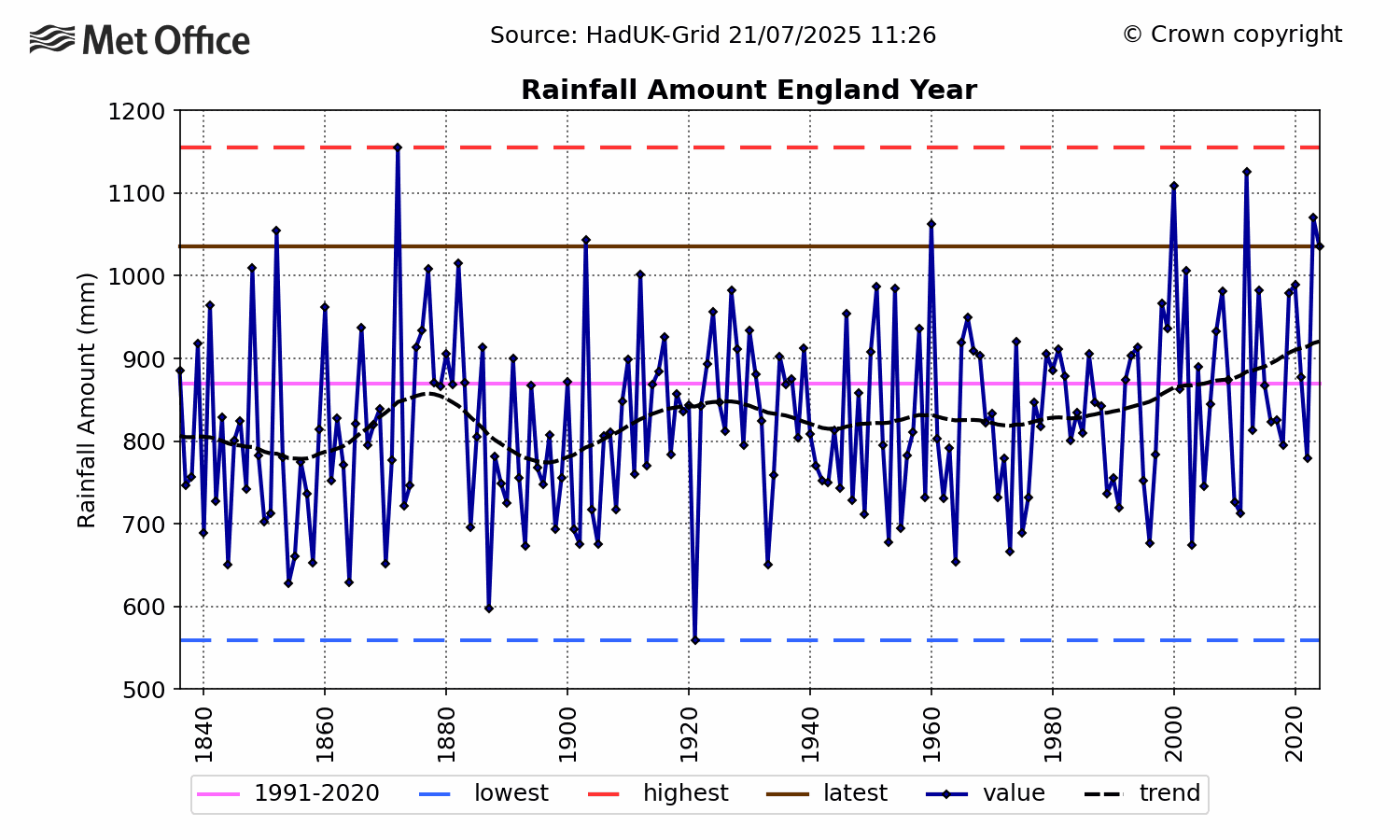
This can easily be seen in the annual temperature and rainfall records for England:

http://www.metoffice.gov.uk/climate/uk/summaries/actualmonthly
2) Gardeners won’t be in the least bit interested in what their descendants might be growing in 50 or 100 years time. So why waste money on this report now?
Let’s now look at some of the claims made in the study. It is worth pointing out that, although it talks of future projections, the report is clear that these things are already occurring.
1) The report warns that climate change looks set to bring more extremes and more erratic weather with stronger storms, heavier downpours
We are back to the “extreme rainfall” myth, so it is time to demolish it once and for all.
Below is an analysis of the wettest months in England since 1910. Contrary to Met Office spin, these were much more common in the past, though we again see the comparative dearth in the 1970s and 80s.
The wettest month of all was December 1914.

http://www.metoffice.gov.uk/pub/data/weather/uk/climate/datasets/Rainfall/ranked/England.txt
2) The report warns that climate change looks set to bring more intense heatwaves.
To which the answer is Cobblers.

http://www.metoffice.gov.uk/climate/uk/summaries/actualmonthly
3) The south of England is going to be hotter and drier throughout the year
The Met Office divides England into two regions.

According to their data, there has been no significant change in day time temperatures in the south, since 1990. There is no evidence whatsoever that temperatures will rise in coming decades.

http://www.metoffice.gov.uk/climate/uk/summaries/datasets
Since 1910, annual rainfall has been notable for its volatility.
The wettest year was 1960, and the driest in 1921.
Again, there is absolutely no evidence that the south will become drier.

http://www.metoffice.gov.uk/climate/uk/summaries/datasets
4) The north of England is going to be certainly milder but it is also going to be wetter in the summer and in the winter.
As with the south, temperatures show no signs of rising.

http://www.metoffice.gov.uk/climate/uk/summaries/datasets
As for rainfall, apart from 2012, which was clearly an outlier, annual rainfall in recent years has not been unusual, and is within the bounds of normal variability.

http://www.metoffice.gov.uk/climate/uk/summaries/datasets
5) The scenario for East Anglia envisages an average temperature 5C warmer than now. Lawns will be replaced by synthetic grass.
Downpipes will channel the limited summer rain to underground tanks. Garden centres will precondition plants to become used to drought. And shade will come from almond, peach and olive trees.
East Anglia tends to be the driest corner of the country, and climate alarmists often paint a picture of it turning into a drought ridden dustbowl.
In reality, rainfall patterns there have not changed since 1910.


http://www.metoffice.gov.uk/pub/data/weather/uk/climate/datasets/Rainfall/date/East_Anglia.txt
Unsurprisingly the BBC give the report top billing, with David Shukman calling it a major new report.
He uncritically lists its findings, apparently under the misapprehension that it is a serious study, and concludes that what we think of as a classic British garden will look very different in the decades ahead.
I only wish I could say the same about the BBC!
RHS-Gardening-in-a-Changing-Climate-Report
Trump to order review of offshore drilling
President Trump will sign an executive order on Friday to reconsider several major Obama-era actions cracking down on offshore drilling.
The aim of the order, Interior Secretary Ryan Zinke told reporters Thursday, is to consider how to best expand offshore drilling in U.S. waters.
The Trump administration is reversing former President Obama’s December decision to remove most of the Arctic Ocean from the federal drilling program.That move would have blocked drilling in the Arctic for years to come, angering the drilling industry, which has long desired to tap massive stores of oil underneath Arctic waters.
Zinke said his department will also reopen the Obama administration’s five-year drilling plan, finalized in November, that restricts lease sales for new drilling to only the Gulf of Mexico and waters off south-central Alaska.
Regulators will also reconsider government regulations on activities like seismic testing and will review decisions within the last 10 years to create offshore marine monuments and sanctuaries.
None of these actions mean new drilling in the Arctic or Atlantic is imminent. For one, reviewing the five-year plan is a lengthy process that Zinke predicted could take about two years.
Trump’s order is likely to draw lawsuits as well. The Obama administration insisted the decision to withdraw the Arctic from the drilling program could not be reversed under the law, and that contention has yet to be tested in court.
The order, once signed, will be the second action Trump has taken this week to try to expand oil and gas drilling in the United States. On Wednesday, he signed an order to reconsider 20 years of national monument designations on public lands, a proposal that could eventually open up more federal acreage to energy production.
On top of Trump’s other energy-related executive orders, this measure “puts us on track for American energy independence,” Zinke said.
Environmentalists have long fought to prevent drilling in environmentally sensitive areas off the coast of the United States, warning that the threat of a devastating oil spill outweighs the benefits of obtaining energy supplies.
The Obama administration stripped potential lease sales for the Atlantic and Arctic from its final five-year plan, a regular government drilling blueprint that takes years to put together.
His decision to remove most of the Arctic from the drilling program was aimed at blocking oil production there indefinitely. It was a step greens urged him to take throughout his presidency and one he issued one month before he left office.
The drilling industry was incensed by the decision. Even though there is no drilling there now — it is too expensive to extract oil in the Arctic, and on-shore oil supplies are so plentiful that suppliers haven’t looked to expand their offshore portfolio — drillers still wanted the opportunity to tap it in the future.
"We are pleased to see this administration prioritizing responsible U.S. energy development and recognizing the benefits it will bring to American consumers and businesses,” American Petroleum Institute President Jack Gerard said in a statement.
“Developing our abundant offshore energy resources is a critical part of a robust, forward-looking energy policy that will secure our nation’s energy future and strengthen the U.S. energy renaissance," he added.
Environmentalists and Democrats in Congress have begun lambasting Trump’s order before it even comes out.
Twenty-seven senators sent a letter to Zinke on Thursday asking him not to revise the five-year drilling plan, saying Obama’s plan would “protect key industries for our states, such as fishing and tourism, our environment and our climate.”
Green groups pledged vigorous opposition as well.
“This latest executive order is yet another indication that the Trump administration is committed to doubling down on dirty and dangerous oil and gas development, instead of moving America towards clean energy alternatives like offshore wind,” Nancy Pyne, the climate and energy campaign director at Oceana, said in a statement, noting local opposition to drilling.
Zinke said he will listen to local opinions on drilling before making any decisions on a new plan.
“As a secretary of Interior, I want to know what our inventory is,” he said.
“It also involves public hearings and the opportunity for the public to vocalize their support or dissent. Not everywhere likes offshore drilling. … That’s part of the process, is to look at that.”
SOURCE
Outdoor Clothing maker loves wilderness
A self-interested campaign? More wilderness sells more gear?
Outdoor-clothing maker Patagonia hit back at President Trump on Wednesday, threatening to sue over an executive order calling for the Department of the Interior to review national monuments designated during Bill Clinton's, George W. Bush's and Barack Obama's presidencies.
“A president does not have the authority to rescind a National Monument. An attempt to change the boundaries ignores the review process of cultural and historical characteristics and the public input,” Patagonia CEO Rose Marcario said in a statement. “We’re watching the Trump administration’s actions very closely and preparing to take every step necessary, including legal action, to defend our most treasured public landscapes from coast to coast.”
Trump ordered federal officials to review two decades of national monument designations earlier in the day Wednesday, calling them “another egregious abuse of federal power.”
The president framed the order as a way to return power to states and individuals, after former President Obama and his predecessors blocked development on hundreds of millions of acres of federal land and water by creating monuments.
Patagonia said it would "fight with everyone" it has to in order to preserve the Obama administration's designation of tribal lands to form Bears Ears National Monument in Utah.
"We take this as a sign that Trump and his team prefer to cater to fossil fuel interests and state land grabs for unsustainable development, rather than preserve a vital part of our nation's heritage for future generations by protecting federal lands owned by every citizen," the Patagonia statement read.
“As stewards of America’s federal public lands, the Trump administration has an obligation to protect these most special wild places,” Marcario said. “Unfortunately, it seems clear they intend to do the opposite.”
SOURCE
Thoughts on the Public Discourse over Climate Change
by Richard Lindzen
Introduction:
For over 30 years, I have been giving talks on the science of climate change. When, however, I speak to a non-expert audience, and attempt to explain such matters as climate sensitivity, the relation of global mean temperature anomaly to extreme weather, that warming has decreased profoundly for the past 18 years, etc., it is obvious that the audience’s eyes are glazing over. Although I have presented evidence as to why the issue is not a catastrophe and may likely be beneficial, the response is puzzlement. I am typically asked how this is possible. After all, 97% of scientists agree, several of the hottest years on record have occurred during the past 18 years, all sorts of extremes have become more common, polar bears are disappearing, as is arctic ice, etc. In brief, there is overwhelming evidence of warming, etc. I tended to be surprised that anyone could get away with such sophistry or even downright dishonesty, but it is, unfortunately, the case that this was not evident to many of my listeners. I will try in this brief article to explain why such claims are, in fact, evidence of the dishonesty of the alarmist position.
The 97% meme:
This claim is actually a come-down from the 1988 claim on the cover of Newsweek that all scientists agree. In either case, the claim is meant to satisfy the non-expert that he or she has no need to understand the science. Mere agreement with the 97% will indicate that one is a supporter of science and superior to anyone denying disaster. This actually satisfies a psychological need for many people. The claim is made by a number of individuals and there are a number of ways in which the claim is presented. A thorough debunking has been given in the Wall Street Journal by Bast and Spencer. One of the dodges is to poll scientists as to whether they agree that CO2 levels in the atmosphere have increased, that the Earth has been warming (albeit only a little) and that man has played some part. This is, indeed, something almost all of us can agree on, but which has no obvious implication of danger. Nonetheless this is portrayed as support for catastrophism. Other dodges involve looking at a large number of abstracts where only a few actually deal with danger. If among these few, 97% support catastrophism, the 97% is presented as pertaining to the much larger totality of abstracts. One of my favorites is the recent claim in the Christian Science Monitor (a once respected and influential newspaper): “For the record, of the nearly 70,000 peer-reviewed articles on global warming published in 2013 and 2014, four authors rejected the idea that humans are the main drivers of climate change.” I don’t think that it takes an expert to recognize that this claim is a bizarre fantasy for many obvious reasons. Even the United Nations Intergovernmental Panel on Climate Change (this body, generally referred to as the IPCC is the body created by the UN to provide ‘authoritative’ assessments of manmade climate change) doesn’t agree with the claim.
Despite the above, I am somewhat surprised that it was necessary to use the various shenanigans described above. Since this issue fully emerged in public almost 30 years ago (and was instantly incorporated into the catechism of political correctness), there has been a huge increase in government funding of the area, and the funding has been predicated on the premise of climate catastrophism. By now, most of the people working in this area have entered in response to this funding. Note that governments have essentially a monopoly over the funding in this area. I would expect that the recipients of this funding would feel obligated to support the seriousness of the problem. Certainly, opposition to this would be a suicidal career move for a young academic. Perhaps the studies simply needed to properly phrase their questions so as to achieve levels of agreement for alarm that would be large though perhaps not as large as was required for the 97% meme especially if the respondents are allowed anonymity.
The ‘warmest years on record’ meme:
This simple claim covers a myriad of misconceptions. Under these circumstances, it is sometimes difficult to know where to begin. As in any demonization project, it begins with the ridiculous presumption that any warming whatsoever (and, for that matter, any increase in CO2) is bad, and proof of worse to come. We know that neither of these presumptions is true. People retire to the Sun Belt rather than to the arctic. CO2 is pumped into greenhouses to enhance plant growth. The emphasis on ‘warmest years on record’ appears to have been a response to the observation that the warming episode from about 1978 to 1998 appeared to have ceased and temperatures have remained almost constant since 1998. Of course, if 1998 was the hottest year on record, all the subsequent years will also be among the hottest years on record. None of this contradicts the fact that the warming (ie, the increase of temperature) has ceased. Yet, somehow, many people have been led to believe that both statements cannot be simultaneously true. At best, this assumes a very substantial level of public gullibility. The potential importance of the so-called pause (for all we know, this might not be a pause, and the temperature might even cool), is never mentioned and rarely understood. Its existence means that there is something that is at least comparable to anthropogenic forcing. However, the IPCC attribution of most of the recent (and only the recent) warming episode to man depends on the assumption in models that there is no such competitive process.
The focus on the temperature record, itself, is worth delving into a bit. What exactly is this temperature that is being looked at? It certainly can’t be the average surface temperature. Averaging temperatures from places as disparate as Death Valley and Mount Everest is hardly more meaningful than averaging phone numbers in a telephone book (for those of you who still remember phone books). What is done, instead, is to average what are called temperature anomalies. Here, one takes thirty year averages at each station and records the deviations from this average. These are referred to as anomalies and it is the anomalies that are averaged over the globe. The only attempt I know of to illustrate the steps in this process was by the late Stan Grotch at the Lawrence Livermore Laboratory. Figure 1a shows the scatter plot of the station anomalies. Figure 1b then shows the result of averaging these anomalies. Most scientists would conclude that there was a remarkable degree of cancellation and that the result was almost complete cancellation. However, instead, one stretches the temperature scale by almost a factor of 10 so as to make the minuscule changes in Figure 1b look more significant. The result is shown in Figure 1c. There is quite a lot of random noise in Figure 1c, and this noise is a pretty good indication of the uncertainty of the analysis (roughly +/- 0.2C). The usual presentations show something considerably smoother. Sometimes this is the result of smoothing the record with something called running means. It is also the case that Grotch used data from the UK Meteorological Office which was from land based stations. Including data from the ocean leads to smoother looking series but the absolute accuracy of the data is worse given that the ocean data mixes very different measurement techniques (buckets in old ship data, ship intakes after WW1, satellite measurements of skin temperature (which is quite different from surface temperature), and buoy data).
These issues are summarized in Figure 2 which presents an idealized schematic of the temperature record and its uncertainty. We see very clearly that because the rise ceases in 1998, that this implies that 18 of the 18 warmest years on record (for the schematic presentation) have occurred during the last 18 years. We also see that the uncertainty together with the smallness of the changes offers ample scope for adjustments that dramatically alter the appearance of the record (note that uncertainty is rarely indicated on such graphs).
At this point, one is likely to run into arguments over the minutia of the temperature record, but this would simply amount to muddying the waters so to speak. Nothing can alter the fact that the changes one is speaking about are small.
When all of them are included, the UN IPCC finds that we are just about at the greenhouse forcing of climate that one expects from a doubling of CO2, and the temperature increase has been about 0.8C. If man’s emissions are responsible for all of the temperature change over that past 60 years, this still points to a lower sensitivity (sensitivity, by convention, generally refers to the temperature increase produced by a doubling of CO2 when the system reaches equilibrium) than produced by the least sensitive models (which claim to have sensitivities of from 1.5-4.5C for a doubling of CO2). And, the lower sensitivities are understood to be unproblematic.
However, the IPCC only claims man is responsible for most of the warming. The sensitivity might then be much lower. Of course, the situation is not quite so simple, but calculations do show that for higher sensitivities one has to cancel some (and often quite a lot) of the greenhouse forcing with what was assumed to be unknown aerosol cooling in order for the models to remain consistent with past observations (a recent article in the Bulletin of the American Meteorological Society points out that there are, in fact, quite a number of arbitrary adjustments made to models in order to get some agreement with the past record).
As the aerosol forcing becomes less uncertain, we see that high sensitivities have become untenable. This is entirely consistent with the fact that virtually all models used to predict ‘dangerous’ warming over-predict observed warming after the ‘calibration’ periods. That is to say, observed warming is small compared to what the models upon which concerns are based are predicting. This is illustrated in Figure 4. As I have mentioned, uncertainties allow for substantial adjustments in the temperature record. One rather infamous case involved NOAA’s adjustments in a paper by Karl et al that replace the pause with continued warming. But it was easy to show that even with this adjustment, models continued to show more warming than even the ‘adjusted’ time series showed. Moreover, most papers since have rejected the Karl et al adjustment (which just coincidentally came out with much publicity just before the Paris climate conference).
The third approach is somewhat different. Instead of arguing that the change is not small, it argues that the change is ‘unprecedented.’ This is Michael Mann’s infamous ‘hockey stick.’ Here, Mann used tree rings from bristle cone pines to estimate Northern Hemisphere temperatures back hundreds of years. This was done by calibrating the tree ring data with surface observations for a thirty year period, and using this calibration to estimate temperatures in the distant past in order to eliminate the medieval warm period. Indeed, this reconstruction showed flat temperatures for the past thousand years.
The usual test for such a procedure would be to see how the calibration worked for observations after the calibration period. Unfortunately, the results failed to show the warming found in the surface data. The solution was starkly simple and stupid. The tree ring record was cut off at the end of the calibration period and replaced by the actual surface record. In the Climategate emails (Climategate refers to a huge release of emails from various scientists supporting alarm where the suppression of opposing views, the intimidation of editors, the manipulation of data, etc. were all discussed), this was referred to as Mann’s trick.
The whole point of the above was to make clear that we are not concerned with warming per se, but with how much warming. It is essential to avoid the environmental tendency to regard anything that may be bad in large quantities to be avoided at any level however small. In point of fact small warming is likely to be beneficial on many counts. If you have assimilated the above, you should be able to analyze media presentations like this one to see that amidst all the rhetoric, the author is pretty much saying nothing while even misrepresenting what the IPCC says.
The extreme weather meme:
Every line weather forecaster knows that extreme events occur someplace virtually every day. The present temptation to attribute these normally occurring events to climate change is patently dishonest. Roger Pielke, Jr. actually wrote a book detailing the fact that there is no trend in virtually any extreme event (including tornados, hurricanes, droughts, floods, etc.) with some actually decreasing. Even the UN’s IPCC acknowledges that there is no basis for attributing such events to anthropogenic climate change.
Figure 5. Temperature map for North America.
The situation with respect to extreme temperatures actually contradicts not just observations but basic meteorological theory. Figure 5 shows a map of temperatures for North America on February 27, 2008. Extreme temperatures at any location occur when air motions carry air from the coldest or warmest points on the map. Now, in a warmer climate, it is expected that the temperature difference between the tropics and the high latitudes will decrease. Thus the range of possible extremes will be reduced. More important is the fact that the motions that carry these temperatures arise from a process called baroclinic instability, and this instability derives from the magnitude of the aforementioned temperature difference. Thus, in a warmer world, these winds will be weaker and less capable of carrying extreme temperatures to remote locations. Claims of greater extremes in temperature simply ignore the basic physics, and rely, for their acceptance, on the ignorance of the audience.
The claims of extreme weather transcend the usual use of misleading claims. They often amount to claims for the exact opposite of what is actually occurring. The object of the claims is simply to be as scary as possible, and if that requires claiming the opposite of the true situation, so be it.
Sea level rise:
Globally averaged sea level appears to have been rising at the rate of about 6 inches a century for thousands of years. Until the advent of satellites, sea level was essentially measured with tide gauges which measure the sea level relative to the land level. Unfortunately, the land level is also changing, and as Emery and Aubrey note, tectonics are the major source of change at many locations. Beginning in 1979 we began to use satellites to measure actual sea level. The results were surprisingly close to the previous tide gauge estimates, but slightly higher, but one sees from Wunsch et al (DOI: 10.1175/2007JCLI1840.1) that one is in no position to argue that small differences from changing methodologies represents acceleration. Regardless, the changes are small compared to the claims that suggest disastrous changes. However, even in the early 1980’s advocates of warming alarm like S. Schneider argued that sea level would be an easily appreciated scare tactic. The fact that people like Al Gore and Susan Solomon (former head of the IPCC’s Scientific Assessment) have invested heavily in ocean front property supports the notion that the issue is propagandistic rather than scientific.
Arctic sea ice:
Satellites have been observing arctic (and Antarctic) sea ice since 1979. Every year there is a pronounced annual cycle where the almost complete winter coverage is much reduced each summer. During this period there has been a noticeable downtrend is summer ice in the arctic (with the opposite behavior in the Antarctic), though in recent years, the coverage appears to have stabilized. In terms of climate change, 40 years is, of course, a rather short interval. Still, there have been the inevitable attempts to extrapolate short period trends leading to claims that the arctic should have already reached ice free conditions. Extrapolating short term trends is obviously inappropriate. Extrapolating surface temperature changes from dawn to dusk would lead to a boiling climate in days. This would be silly. The extrapolation of arctic summer ice coverage looks like it might be comparably silly.
Moreover, although the satellite coverage is immensely better than what was previously available, the data is far from perfect. The satellites can confuse ice topped with melt water with ice free regions. In addition, temperature might not be the main cause of reduced sea ice coverage. Summer ice tends to be fragile, and changing winds play an important role in blowing ice out of the arctic sea. Associating changing summer sea ice coverage with climate change is, itself, dubious. Existing climate models hardly unambiguously predict the observed behavior. Predictions for 2100 range from no change to complete disappearance. Thus, it cannot be said that the sea ice behavior confirms any plausible prediction.
It is sometimes noted that concerns for disappearing arctic sea ice were issued in 1922, suggesting that such behavior is not unique to the present. The data used, at that time, came from the neighborhood of Spitzbergen. A marine biologist and climate campaigner has argued that what was described was a local phenomenon, but, despite the claim, the evidence presented by the author is far from conclusive. Among other things, the author was selective in his choice of ‘evidence.’
All one can say, at this point, is that the behavior of arctic sea ice represents one of the numerous interesting phenomena that the earth presents us with, and for which neither the understanding nor the needed records exist. It probably pays to note that melting sea ice does not contribute to sea level rise. Moreover, man has long dreamt of the opening of this Northwest Passage. It is curious that it is now viewed with alarm. Of course, as Mencken noted, “The whole aim of practical politics is to keep the populace alarmed (and hence clamorous to be led to safety) by an endless series of hobgoblins, most of them imaginary.” The environmental movement has elevated this aim well beyond what Mencken noted.
Polar bear meme:
I suspect that Al Gore undertook considerable focus-group research to determine the remarkable effectiveness of the notion that climate change would endanger polar bears. His use of an obviously photo shopped picture of a pathetic polar bear on an ice float suggests this. As Susan Crockford, a specialist in polar bear evolution, points out, there had indeed been a significant decrease in polar bear population in the past due to hunting and earlier due to commercial exploitation of polar bear fur. This has led to successful protective measures and sufficient recovery of polar bear population, that hunting has again been permitted. There is no evidence that changes in summer sea ice have had any adverse impact on polar bear population, and, given that polar bears can swim for over a hundred miles, there seems to be little reason to suppose that it would. Nonetheless, for the small community of polar bear experts, the climate related concerns have presented an obvious attraction.
Ocean acidification:
This is again one of those obscure claims that sounds scary but doesn’t stand up to scrutiny. Ever since the acid rain scare, it has been realized that the public responds with alarm to anything with the word ‘acid’ in it. In point of fact, the ocean is basic rather than acidic (ie, its ph is always appreciably higher than 7, and there is no possibility of increasing levels of atmospheric CO2 bringing it down to 7; note that ph is a measure of acidity or basicness: values greater than 7 are basic and less than 7 acid.), and the purported changes simply refer to making the ocean a bit less basic. However, such a more correct description would lack the scare component. As usual, there is so much wrong with this claim that it takes a fairly long article to go over it all. I recommend the following source.
Death of coral reefs:
The alleged death of coral reefs is partly linked to the acidification issue above, and as we see, the linkage is almost opposite to what is claimed. There is also the matter of warming per se leading to coral bleaching. A typical alarmist presentation can be found here.
The article is behind a pay wall, but most universities provide access to Nature. The reasoned response to this paper is provided here.
As Steele, the author of the above, points out, bleaching has common causes other than warming and is far from a death sentence for corals whose capacity to recover is substantial. This article is a bit polemical, but essentially correct.
Global warming as the cause of everything:
As we see from the above, there is a tendency to blame everything unpleasant on global warming. The absurd extent of this tendency is illustrated on the following here. That hasn’t stopped the EPA from using such stuff to claim large health benefits for its climate change policies. Moreover, I fear that with so many claims, there is always the question ‘what about ….?’ Hardly anyone has the time and energy to deal with the huge number of claims. Fortunately, most are self-evidently absurd. Nation magazine recently came up with what is a bit of a champion is this regard.
CO2, it should be noted, is hardly poisonous. On the contrary, it is essential for life on our planet and levels as high as 5000 ppm are considered safe on our submarines and on the space station (current atmospheric levels are around 400 ppm, while, due to our breathing, indoor levels can be much higher). The Nation article is typical in that it makes many bizarre claims in a brief space. It argues that a runaway greenhouse effect on Venus led to temperatures hot enough to melt lead. Of course, no one can claim that the earth is subject to such a runaway, but even on Venus, the hot surface depends primarily on the closeness of Venus to the sun and the existence of a dense sulfuric acid cloud covering the planet. Relatedly, Mars, which also has much more CO2 than the earth, is much further from the sun and very cold. As we have seen many times already, such matters are mere details when one is in the business of scaring the public.
Concluding remarks:
The accumulation of false and/or misleading claims is often referred to as the ‘overwhelming evidence’ for forthcoming catastrophe. Without these claims, one might legitimately ask whether there is any evidence at all.
Despite this, climate change has been the alleged motivation for numerous policies, which, for the most part, seem to have done more harm than the purported climate change, and have the obvious capacity to do much more. Perhaps the best that can be said for these efforts is that they are acknowledged to have little impact on either CO2 levels or temperatures despite their immense cost. This is relatively good news since there is ample evidence that both changes are likely to be beneficial although the immense waste of money is not.
I haven’t spent much time on the details of the science, but there is one thing that should spark skepticism in any intelligent reader. The system we are looking at consists in two turbulent fluids interacting with each other. They are on a rotating planet that is differentially heated by the sun. A vital constituent of the atmospheric component is water in the liquid, solid and vapor phases, and the changes in phase have vast energetic ramifications. The energy budget of this system involves the absorption and reemission of about 200 watts per square meter. Doubling CO2 involves a 2% perturbation to this budget. So do minor changes in clouds and other features, and such changes are common. In this complex multifactor system, what is the likelihood of the climate (which, itself, consists in many variables and not just globally averaged temperature anomaly) is controlled by this 2% perturbation in a single variable? Believing this is pretty close to believing in magic. Instead, you are told that it is believing in ‘science.’ Such a claim should be a tip-off that something is amiss. After all, science is a mode of inquiry rather than a belief structure.
SOURCE
***************************************
For more postings from me, see DISSECTING LEFTISM, TONGUE-TIED, EDUCATION WATCH INTERNATIONAL, POLITICAL CORRECTNESS WATCH, FOOD & HEALTH SKEPTIC and AUSTRALIAN POLITICS. Home Pages are here or main.html or here. Email me (John Ray) here.
Preserving the graphics: Most graphics on this site are hotlinked from elsewhere. But hotlinked graphics sometimes have only a short life -- as little as a week in some cases. After that they no longer come up. From January 2011 on, therefore, I have posted a monthly copy of everything on this blog to a separate site where I can host text and graphics together -- which should make the graphics available even if they are no longer coming up on this site. See here or here
*****************************************
Monday, May 01, 2017
An old Greenie scare now looks even more ridiculous
Mainly in the '70s Greenies were wailing that the world's known reserves of potassium compounds -- such as potash -- were not enough to last us much longer. And potassium is needed for bone health. So we were all in danger of crumbling bones. Potash is in fact found worldwide. The "known reserves" were simply what was most cheaply mined. But then a big discovery of potash in North Africa was announced, which put the "known rserves" up way beyond scare levels. So the story below is amusing. It turns out that even Britain has huge amounts of the stuff under the ground that can economically be mined. Another Greenie scare has turned out to be a total false prophecy. Your bones are safe
The Queen is among a clutch of landowners set to share a £3.8bn windfall from the largest mine dug in Britain. Dozens of small farmers in North Yorkshire could become multimillionaires thanks to a gigantic deposit of fertiliser a mile below the moors.
Sirius Minerals lifted the lid last week on the riches that will be unlocked for local people and estate owners by its mine. It broke ground on the project in North York Moors national park this year.
The company aims to tap a 70-metre deep seam of polyhalite, a mineral-rich form of potash. The £2.3bn mine is expected to reach peak production in the mid-2020s.
SOURCE
The economic prospects of advanced coal technologies have never seemed so promising
Despite all of the attention given to wind and solar power, the development and deployment of advanced coal technologies may be far more important in shaping our energy future. Consider where world energy use and research is headed. Coal, and other fossil fuels, remain the backbone of the global energy system and will remain so for the foreseeable future.
If the politics of coal have never seemed so anguished, the economic prospects of advanced coal technologies with higher generating efficiencies have never seemed so promising. Not so far into the future, several new coal technologies are expected to come into greater commercial use in the United States. The best known are new pulverized coal combustion systems, operating at increasingly higher temperatures and pressures, and plants with an integrated gasification combined cycle. Increasing the average efficiency rate of the U.S. coal fleet from 33 to 40 percent using these available technologies would reduce coal-plant emissions by between 14 and 21 percent.
And there may yet be cost-cutting breakthroughs in the development of techniques to capture carbon emissions from power plants – both coal and natural gas units -- and use the carbon to produce petrochemicals, plastics and other useful products. Researchers at the Massachusetts Institute of Technology and other leading universities are trying to come up with the answers.
Global warming will continue unless all countries reduce carbon emissions. That's because most countries burn coal, which is responsible for about 45 percent of the world's carbon emissions. The U.S. Energy Information Administration projects that even as coal's share of U.S. electricity generating capacity declines, its world use will rise from about 30 percent today to 50 percent by 2035.
Its environmental impact notwithstanding, coal is a practical energy option for fast-growing economies like China and India, which don't have large natural gas resources. These countries are determined to grow their economies and lift millions of people out of poverty, and do it at the least cost possible.
Given the certainty that coal will continue to play a large and indispensable role in electricity production, the way forward requires the deployment of innovative coal technologies to mitigate carbon emissions.
The World Coal Association says that lifting the average global efficiency rate of coal plants to 40 percent compared to 33 percent today would reduce carbon output by an amount equal to India's annual carbon emissions, which are among the highest in the world. Some coal plants operating with ultra-supercritical technology in Europe and Japan are already achieving efficiencies in the 42 to 46 percent range.
Importantly, higher efficiencies are a critical step toward the use of carbon capture, use and storage technology, without which, it is highly improbable that global carbon emissions can be brought down to acceptable levels.
Despite the challenges, several projects have been launched to develop and test processes for capturing and sequestering carbon. Most of this activity is under way in the United States, and its cost is being shared by government and private industry. For example, NRG Energy is pumping carbon dioxide 80 miles by pipeline from its coal-burning Parish power plant in Texas and using it to extract more oil and natural gas from old wells.
Exxon Mobil is a major partner in a carbon mitigation project that uses fuel cells – devices that generate electricity through chemical reactions. The idea is to connect fuel cells to fossil-fuel plants, so that the fuel cells can generate additional power to make up for the cost of sequestering the carbon.
In Alberta, Canada, a company is injecting carbon captured from a natural gas plant and injecting it into concrete. The process reduces the need for composite material when making concrete and makes it stronger. So far it's been put into use at about 50 concrete plants over the past two years.
And in Mississippi, a Southern Company power plant that burns lignite coal strips out about 65 percent of the carbon from gas emissions, then pumps it to other companies for use in enhanced oil recovery.
The basic attraction of coal remains its low cost and abundance. In the next 10 to 20 years, coal's value is likely to grow, as advanced coal plants, including some retrofitted with carbon capture, meet the world's growing need for energy while helping reduce greenhouse emissions.
SOURCE
Liberals have epic meltdown after NYT columnist suggests science behind climate change isn’t certain
Bret Stephens, one of the New York Times’ newest conservative columnists, endured a wrath of anger from liberals on Friday who proceeded to meltdown after his first column for the Times stated that “climate change” isn’t certain.
The general idea of Stephens’ column was that the science behind “climate change” is not certain — despite claims from climate change alarmists that it is — and that when uncertain science is deemed certain it undermines science as a whole.
“Claiming total certainty about the science traduces the spirit of science and creates openings for doubt whenever a climate claim proves wrong,” Stephens wrote.
“None of this is to deny climate change or the possible severity of its consequences. But ordinary citizens also have a right to be skeptical of an overweening scientism. They know — as all environmentalists should — that history is littered with the human wreckage of scientific errors married to political power,” he explained.
To put it lightly, liberals and climate change alarmists lost their minds. They proceeded to lambaste Stephens on Twitter:
“literally go f*ck yourself, new york times. go eat dog d*cks,” wrote another user.
All of the outrage over his column, or his assertion that it’s OK to be skeptical of climate change despite those who claim it to be “settled science,” didn’t get past Stephens.
“After 20 months of being harangued by bullying Trump supporters, I’m reminded that the nasty left is no different. Perhaps worse,” he responded.
However, the hate continued to pour in.
“bret if you think that tweet was “nasty” i have some news for you: you’re a sh*thead. a crybaby lil f*ckin weenie. a massive tw*t too,” wrote one journalist.
“Oh no, someone said you should get fired, how dare they insult you for being a huge piece of sh*t, on record, over and over again,” added another Twitter user.
“f*ck you, crybaby,” said yet another.
In response to the outrage, the New York Times tweeted its coverage of climate change to its followers on Friday.
But for many liberals who are afraid to read anything they disagree with, publishing Stephens’ column was the final straw. Many called the Times’ subscription office to cancel their subscription of the paper.
SOURCE
Appeals panel agrees to delay case on coal plant pollution
The Trump administration has successfully delayed a legal fight over enforcing Obama-era restrictions on pollution from coal-fired power plants.
The U.S. Court of Appeals for the District of Columbia Circuit on Thursday granted a request from the Environmental Protection Agency to postpone a planned hearing on 2012 rules requiring energy companies to cut emissions of toxic chemicals. Though the regulations are finalized and already in effect, the new administration told the court it intends to rewrite them.
It is the latest in a string of moves by President Donald Trump's appointees to help companies that profit from burning fossil fuels. Trump has pledged to reverse decades of decline in a U.S. coal industry under threat from such cleaner sources of energy as natural gas, wind turbines and solar farms.
SOURCE
Another stupid Greenie prophecy from Australia: "The Reef will never be the same again"
This is just straight Greenie propaganda, with no regard to all the facts. The GBR has had some bleaching events lately but it is nothing compared to Bikini Atoll, which had a thermonuclear device exploded above it. And Bikini coral is thriving again. If coral on Bikini can survive that, why should not the GBR survive infinitely lesser stressors?
And attributing the isolated bleaching to global warming is just assertion. They offer no evidence for it. The best evidence is that it is due to sea-level changes, not ocean warming.
It does seem that the 2015/2016 summer bleaching was repeated in summer this year (2016/2017). Since water levels change only slowly, that is to be expected.
And note that, while they are busily attributing the bleaching to global warming, they give not a single number for either the global water temperature or the North Queensland water temperature.
So let me supply some numbers: NASA/GISS Tell us that the global December 2016 temperature (mid-summer) was .77, which was DOWN on December 2015 (1.10)and even slightly down on 2014 (.79). So in the period at issue, there was NO global warming. So the guys below are lying through their teeth. They say that the bleaching was caused by global warming but there WAS no global warming in the period concerned.
And they also don't give numbers for sea levels in the area. They are zealously hiding the real cause of the bleaching
THE biggest jewel in Australia’s tourism crown will never look the same again — and to fix it, Australia needs a worldwide hand.
Made up of 3000 individual reef systems, the Great Barrier Reef is the world’s largest living organism. It is home to 300 species of coral and a vast array of fish, molluscs, starfish and other marine life.
The Reef also supports a $6 billion tourism industry that provides employment for 69,000 people — all of which is in strife if environmental degradation causes significant, widespread harm.
Already back-to-back coral bleaching episodes have taken their toll, wiping out nearly 600km of coral mostly in the far north.
Caused by rising ocean temperatures that kill food-generating algal organisms inside the coral, no one can say with any confidence that bleaching will not become an annual event.
Even more worrying, scientific data suggests a further two-degree increase in ocean temperatures would wipe-out most of the hard corals.
The man in charge of the Reef Recovery program at the Great Barrier Reef Marine Park Authority, Dr Mark Read, concedes it will never look the same again.
Although some corals will build up a resilience to warmer temperatures, a number of species are facing extinction.
“I think it’s going to end being a real mosaic,” said Dr Read.
“Some parts of the Reef are going to look more classic — hard coral-dominated — that we’re familiar with while other parts will be less dominated by hard coral and more dominated by soft coral and algae.”
While natural habitats are destined to change over time, Dr Read says in the Reef’s case, mankind has contributed to the “current accelerated period of heating” causing coral bleaching.
“We are talking about a global phenomenon,” Dr Read said.
“(Coral bleaching) is happening all around the world where you have hard coral. The Great Barrier Reef has been hit particularly hard, so it’s front of mind.”
Among the strategies being used by his team to aid in the Reef’s recovery, are ensuring activities in the area do not adversely impact the delicate marine environment; tackling the insidious Crown of Thorns starfish; improving water quality and reducing the volume of debris that finds its way into the massive water park.
Together those initiatives will make a difference but Dr Read admits they won’t prevent more episodes of coral bleaching.
“In terms of dealing with the warming per se, that is something that needs to be tackled at that global level,” he said.
“What we do, and what we can do is reduce as many of the direct pressures on the Reef to enhance its capacity to bounce back.”
Those who make a living from the Reef are watching the situation with some trepidation.
Despite chalking up their best tourism season since 1997 in 2016, long-term operators know the back-to-back coral bleaching events that have received global coverage will eventually take their toll.
SOURCE
***************************************
For more postings from me, see DISSECTING LEFTISM, TONGUE-TIED, EDUCATION WATCH INTERNATIONAL, POLITICAL CORRECTNESS WATCH, FOOD & HEALTH SKEPTIC and AUSTRALIAN POLITICS. Home Pages are here or main.html or here. Email me (John Ray) here.
Preserving the graphics: Most graphics on this site are hotlinked from elsewhere. But hotlinked graphics sometimes have only a short life -- as little as a week in some cases. After that they no longer come up. From January 2011 on, therefore, I have posted a monthly copy of everything on this blog to a separate site where I can host text and graphics together -- which should make the graphics available even if they are no longer coming up on this site. See here or here
*****************************************
Subscribe to:
Posts (Atom)


 Jim Hansen and his twin


