Tuesday, July 12, 2016


2016 NASA DATA SHOWS THAT GLOBAL WARMING/CLIMATE CHANGE NOT CAUSING RETREAT OF POLAR ICE


Bigger graph here

Note that this is about global ice not Arctic ice.  A global theory should be supported by global data.  It isn't

Updated NASA data on the polar ice cap is showing results that are contrary to all who claim global warming is shrinking it. Reportedly, global warming (better known presently as climate change) has not caused any recession of polar ice.

According to a report by Forbes, a NASA satellite instrument revealed that the Earth’s polar ice caps have not receded at all since it began its measurements back in 1979. From what was shown in its data, total polar ice has generally remained above the post-1979 average, a finding that contradicts the most-frequently spoken claims by those who push global warming as the primary reason why the polar ice caps are receding.

Polar Ice Cap

To be fair though, the aforementioned information on the polar ice caps not receding is taken as a whole. What scientists who pushed the the global warming agenda kept concentrating on was the sea ice loss, often associated with huge chunks of the polar ice cap itself falling into the ocean. Beginning in 2005, said sea ice receded at a modest pace for several years and by 2012, it was approximately 10 percent from the 1979 measurement. This fact has many of the same scientists, who push the global warming or climate change agenda, screaming it is the reason why 10 percent of sea ice has receded. In the full scope of things, 10 percent is considered a poor number to utilize as “proof.”
Actually, an article written by Daily Mail back in 2013 reports the opposite of what all the global warming and climate change enthusiasts are pushing. According to their report, the polar ice caps were growing by 29 percent in a year, a result that has caused them to coin the term “global cooling.” As visual proof, the report provided NASA photographs of the Arctic Ocean’s polar ice cap in August of 2012 and August of 2013. By comparing the photographs, there is clearly an expansion of said ice cap from the previous year.

Sea Ice, Arctic Ocean, Polar Ice Cap

The Daily Mail provided a graphic of two NASA photographs of the Arctic Ocean’s polar ice cap in August of 2012 and August of 2013. Comparing the two pictures, it is shown said ice cap has increased.

Despite the aforementioned sources showing that the polar ice caps have generally not receded, many global warming and climate change enthusiasts are still crying wolf, pushing the agenda the polar ice caps are melting away. All anyone has to do is do a simple internet news search (Google, Bing, Yahoo!, etc.) for “polar ice caps” and they will find numerous articles on the doom and gloom caused by global warming and climate change. What’s funny is that some of those articles even have fixed countdowns that have already passed, yet have not come true.

With that in mind, one person who should be shoving his foot in his mouth is former Vice President Al Gore. Back in 2007, while receiving the Nobel Peace Prize for campaigning global warming especially through An Inconvenient Truth, he predicted there would be no more polar ice caps by 2014. Seven years later, we had a polar ice cap that is thicker and covers 1.7 million square kilometers.

SOURCE


The Link between Extreme Environmentalism and Hard-Core Racism

In my reading and writing on the history of eugenics (here, here, and here), I’ve begun to discern a common trait between the people called environmentalists and racists from a century ago.

They share a common outlook that is illiberal to its core. They imagine that a wise and powerful state can better plan a future for both nature and man. Both groups were panicked about unplanned progress, assuming it could only resort in degeneration, mongrelization, and destruction. They dreamed of a future in which they and not the unwashed masses would be in charge of how resources are used and how the human race propagates itself.

Madison Grant Saves the Trees and the White Race

Thanks to Mother Jones, my suspicions have been confirmed. An essay that pleads with the progressive movement to deal forthrightly with its own grim history of racism discusses the life and work of Madison Grant (1865-1937). This bushy-lipped aristocrat was the hero of the environmentalists in the Progressive Era. He saved the redwoods of California from logging. He was the guru behind the creation of national parks. He undertook the most aggressive efforts ever to preserve species from extinction. He was handsome, urbane, ridiculously well educated and well connected, and “the greatest conservationist who ever lived.”

Also, Grant wrote the book that Adolf Hitler described as “my Bible.” The book is the 1916 The Passing of the Great Race. A bestseller for many years, on the coffee tables in all the fashionable houses, it is quite possibly the crudest, crankiest, and most bloodthirsty racialist tract ever written; and there’s a lot of competition for that title. He championed segregation, exclusion, sterilization, immigration restrictions, a welfare state (to keep women from working), a high bar for professional employment (minimum wages), and aggressive central planning.

The Passing is a hard read actually. You will discover more than you ever want to about the inferiority of everyone but people like Grant himself. He sounded alarm bells about the coming “mongrelization” of the race, given the influx of Jews, Italians, Slavs, Africans, and every group other than the one that supposedly built civilization and made it great. Uncontrolled procreation is destined to ruin all things. Along the way, you find wicked ethnic caricatures covered by the gloss of science (the “Polish Jew, whose dwarf stature, peculiar mentality, and ruthless concentration on self interest are being engrafted upon the stock of the nation…”).

Racism Is an Ideology

Once you read this literature – it was almost impossible to avoid in the period between 1880 and 1935 or so – you begin to get the hang of it. The word racism – thrown around far too recklessly – exists as an accurate description of a special version of anti-liberal ideology. This isn’t about off-color jokes, prejudice, or even a preference for one’s own people. It’s a settled worldview that postulates race, far above any other concern, as the driving-force of history. It has a nightmare scenario of random race-mixing as a consequence of free-wheeling sexual association. And it has a utopia in mind: a great nation inhabited only by the purest stock. It is anti-capitalist, anti-individualist, and anti-liberal to the core, and it views government as savior.

From a scientific point of view, the racists are deeply confused. They find differences between people and posit irreconcilable conflict. If they grappled with what Carlyle called the “dismal science,” they would discover a more beautiful picture: the division of labor, the exchange economy, and free association lead people to find value and dignity in other human beings regardless of race, and to discover it is in everyone’s self interest to respect the equal freedom of others. For this reason, the historical trajectory of commercial society has always been toward integration, inclusion, equality, and liberalization. This is also why racism as an ideology ultimately turns against liberalism.

Grant’s theory of government sums it all up:

Mankind emerged from savagery and barbarism under the leadership of selected individuals whose personal prowess, capacity, or wisdom gave them the right to lead and the power to compel obedience. Such leaders have always been a minute fraction of the whole, but as long as the tradition of their predominance persisted they were able to use the brute strength of the unthinking herd as part of their own force, and were able to direct at all the blind dynamic impulse of the slaves, peasants, or lower classes. Such a despot had an enormous power at his disposal which, if he were benevolent or even intelligent, could be used, and most frequently was used, for the general uplift of the race. Even those rulers who most abused this power put down with merciless rigor the antisocial elements, such as pirates, brigands, or anarchists, which impair the progress of a community, as disease or wounds cripple an individual.

This is a restatement of the views of Thomas Carlyle, the founding father of fascism, united with pseudoscience of racial uplift, resulting in a worldview that serves as a perfect foil to the liberal tradition of Thomas Jefferson through F.A. Hayek. Is the fabric of history woven by brilliant planners with power, or by the cooperative and decentralized choices of millions of individual actors? There’s no question where people like Carlyle, Grant, and the fascist tradition stand on this question. To their minds, a unplanned social order is chaos and decline in the making, and is saved only by strong men.

Redwoods and Nordics

Thanks to the profile in Mother Jones, I had the chance to read some of Grant’s work on the environment as well, which predates his race books and continued even after. What one finds here is the same spirit at work. There is a theory of environmental history during which the fittest of the fit survive (think of the majestic trees of the Redwood Parks) while the unfit are culled. What is going wrong? The demands of commercial society are prompting stupid people to destroy this evolution. There is an apocalyptic scenario of a coming doom if government doesn’t act. But there is also a solution: total government ownership and control under the firm hand of intelligent people like himself.

It’s truly bizarre. Replace the mighty redwoods with the white race and you have an identical paradigm unfolding here. The enemy is the same (too many inferior people doing random things in their own commercial interest). The fear-mongering is the same: we are doomed if this keeps up. The solution is the same: government needs to act with ferocity.

Mother Jones is to be commended for its conclusion: “it's worth remembering because the movement has always struggled with elitist and exclusionary elements in its ranks.”

But, listen, this isn’t about the grim intellectual personalities of some of these Progressive-Era monsters. This isn’t even a personal attack or exposé. This is a problem of a worldview that is anti-liberal at its core. Whether we are talking about environmental purity or racial hygiene, the loathing of freedom itself is the issue and the factor that unites greens, browns, and reds of all stripes.

Enemies of freedom come in many flavors. The deeper you look into this history, the more the flavors blend together. We tend to think of these varieties of authoritarianism as being opposed to each other. It is more correct to think of them as the inevitable splits within the same movement.

SOURCE


Analysis: Green Energy Is Growing 5 Times Slower Than Dems Demand

America isn’t even close to getting enough energy from wind and solar power to the levels Democrats say are required despite extremely lucrative subsidies, according to an analysis of 2014 data from the U.S. Energy Information Administration (EIA) conducted by The Daily Caller News Foundation.

A draft of the Democratic Party’s proposed platform for this year’s election would require every state get 50 percent of its electricity from “clean sources” by 2020 and 100 percent by 2050. Though the platform never defines what constitutes a “clean” source, wind and solar energy are the only “clean” sources that can significantly expand.

Wind and solar power provided 4.4 and 0.4 of all electricity produced in America in 2014 respectively, according to the EIA. Last year, wind and solar power only accounted for 4.7 and 0.6 percent of all electricity generated in America respectively, according to data from the EIA. Hydropower and biofuels account for six and 1.6 percent of all electricity generated last year, but both are increasingly targeted by the green movement, difficult to rapidly expand and dependent upon regional conditions.

This means that the percent of wind power provided substantially more electricity, but grew at a slow rate of less than 6.4 percent, while solar produced far less electricity, but grew at a much faster rate of 50 percent. If both wind and solar power continue growing at their present rates, they will only provide 6.41 and 4.56 percent of America’s electricity by the 2020 deadline.

That’s only one-fifth of the electricity called for by the proposed Democratic platform, even if the extremely high growth rates of wind and solar continue. Even if hydropower, biofuels and geothermal,which are either growing at much slower rates or cannot be expanded, are added in, that would still only account for less than 20 percent of American electricity by 2020. Claiming that America will get 50 percent of its electricity from “clean” power by 2020 is therefore exceedingly unrealistic, even with generous subsidies.

Green energy generation is concentrated in only a handful of states, making the situation much worse. The EIA doesn’t break down wind power use by the state level, but its does for solar in 2014, and the results show that there may be no good way of encouraging solar power to grow more rapidly.

Out of the 50 US states, only Hawaii, California, Arizona and Florida got more than 1 percent of energy from solar power. Each one of these states has noticeably favorable weather environments for solar power. Only California had a notably high number of pro-solar power state policies and a majority of US states got less than 0.1 percent of their energy from solar power in 2014.

Statistical regressions run by The DCNF found no statistically significant correlation between the number of policies and the percentage of solar power obtained by the state. The DCNF mapped and displayed the data to demonstrate this clear lack of correlation.

Objectively, Hawaii gets a higher portion of its electricity from solar than any other state, getting 3.66 percent of its energy from solar. However, Hawaii only has 29 policies supporting green energy, which is far fewer than the national average of 51 policies.

Minnesota gets a mere 0.031 percent of its energy from solar, even though it has 141 pro-green energy policies, making it the second most pro-solar regulatory environment in the nation. Other states like Colorado, Oregon, Texas, New York and Washington all had at least 90 pro-green energy policies, but all get less of their electricity from solar than the national average. Alaska, Mississippi, North Dakota, South Dakota and Wyoming got so little energy from solar power that the EIA found that the amount was legally indistinguishable from zero.

A 2014 study by the left-leaning Brookings Institution found wind power is twice as expensive as the conventional power it replaces and that solar is three times as expensive.

Solar power gets 326 times more in subsidies than coal, oil, and natural gas per amount of energy generated, according to 2013 Department of Energy data collected by Forbes.

Solar power by itself receives more federal subsidies than all fossil fuel sources combined, according to the EIA. Green energy in the U.S. got $13 billion in subsidies during 2013, compared to $3.4 billion in subsidies for conventional sources and $1.7 billion for nuclear, according to EIA data. Solar companies simply cannot maintain their current high levels of growth without government support, but even more support likely won’t speed up that growth enough to meet the Democrat’s goals. .

Most solar subsidies go to residential installations and include a 30 percent federal tax credit, while wind is usually industrial scale and is thus somewhat more efficient per dollar spent. Solar-leasing companies install rooftop systems, which cost a minimum of $10,000, at no upfront cost to the consumer. Companies do this because the state and federal subsidies are so massive that such behavior is actually profitable.

The DCNF previously used statistical analysis to show that the more pro-green energy policies a state has, the less likely it was to reduce carbon dioxide emissions.

SOURCE


The Green/Left obsession with the oil industry

Looking back on the 20th century and the first sixteen years of the 21st, future historians may find an extraordinary thread running through left-wing politics in the developed world – the systematic and never-ending assault on oil companies.

The assault has been relentless. It began with the 1911 antitrust laws in the US that were used to break up the Standard Oil Company into Esso, Sohio, Mobil, Amoco and Chevron.

It was seriously believed by some that that both world wars (and all subsequent ones), were driven by the oil companies, and not by the politicians alone.

Then in the last 30-odd years, communists and socialists of every stripe agreed that the oil industry, virtually on its own, was responsible for destroying the planet by emitting carbon dioxide.

Carbon dioxide

It is now rare to find commentators in the major media prepared to challenge a theory that defies history and common sense, especially as the basis is the assumption that carbon dioxide, and recently it seems carbon of any kind – even trees if you follow the weird logic of some extremists – is a poison.

Whole industries, entire governments with their associated bureaucracies, the UN, the EU, churches and universities have all embraced the idea of carbon emissions poisoning the climate and causing an impending world disaster of Armageddon proportions.

Those few who dare to challenge this orthodoxy are subject to ad hominem attacks of extraordinary viciousness.

They are pilloried, chased out of employment; their motives questioned, scorned, ridiculed, ostracised and treated as Protestants once were in 16th century Europe.

Is all this rational? Are oil companies and their products uniformly bad for human health and the world itself? Are the oil companies engaged in some vast conspiracy that works behind the scenes to suppress truth?

Such thoughts used to be the stuff that mad people spouted on street corners. Now it is in the mainstream of political life, taking on a momentum of its own.

In the US, public prosecutors (who are politicians first and professionals second it seems) have now chosen to use legal means to silence critics of global warming theory, on the grounds that it is not a theory but a fact, and to say otherwise is fraud.

The prime target of this assault on free speech is the Exxon oil company, of course. It is the largest company in the oil industry. Destroying it will be a major triumph for the climate alarmists and their socialist hangers-on.

It will be a victory for those who believe in a central all-powerful sate that controls every aspect of the life of its citizens. That this assault on essential democratic freedoms that were wrenched from the superstition and intolerance that gripped Europe before the industrial revolution, is a major shift from reason to emotion and fear.

Now no less than 16 US public prosecutors have banded together to demand that Exxon-Mobil hand over e-mails, paper memos, documents of any kind that so much as use words like “climate change”, “global warming” or “carbon dioxide emissions”, as well as all communications with those who oppose climate alarmism.

These guardians of US law and the US constitution and Bill of Rights want to hunt through decades of company documents in a massive fishing expedition to find Exxon guilty of something.

Those who follow the climate change phenomenon and its political offshoots have long been suspicious, and even alarmed, by some of its manifestations, and the steady march towards greater intolerance of dissent from its orthodoxy.

Climate change

The latest to join the Exxon hunt is the Massachusetts attorney-general Maura Healey who has broadened the chase to include 40 years of Exxon communications with a handful of conservative organisations known colloquially as “think tanks”.

Allegedly involved in the antiglobal warming doctrine is the Heritage Foundation, Americans for Prosperity, the Beacon Hill Institute and the Acton Institute.

Curiously, neither the Beacon Hill nor the Acton Institute has ever received funds from Exxon. Never mind, they are conservative organisations, so bring them in for a grilling; they are bound to be guilty of something.

Healey isn’t the first attorney-general to target conservative groups that disagree with most Democratic politicians on global warming policy. The Virgin Islands attorney-general in March gunned for Exxon, issuing a subpoena to Exxon for its communications with dozens of conservative think tanks, policy experts and scientists.

New York’s attorney-general launched an investigation into Exxon’s global warming stance in November, based on reporting by liberal journalists at Inside Climate News and Columbia University, that Exxon had been covering up climate science for decades while funding right-wing activist groups.

He led a conference in March, which announced that more prosecutors would probe Exxon and fight against Republican attacks on federal environmental regulations.

Former vice-president Al Gore attended the event, as did a group of environmental activists. He even suggested that global warming sceptics should be jailed, claiming that freedom of speech did not mean the right to commit fraud. It was a veiled attack on scientific inquiry.

Exxon has responded by filing a complaint against the New York attorney-general, supported by two Republican attorneys-general. It has also filed against the Massachusetts attorney-general, claiming she has attacked Exxon as a calculated political stunt, alleging that she announced the results of her investigation before she served her subpoena to the company.

It will be a great legal fight that Exxon has the resources to bear. It is ironic that a private company should now bear the banner of individual liberty to prove that it is not the enemy of democracy but by force majeure, its defender.

SOURCE


Global Warming Insurance Requires Reasonable Premiums

Global warming advocates are increasingly claiming carbon dioxide restrictions are a prudent and conservative insurance policy against severe global warming. Insurance policies, however, are only prudent and conservative when the price of the premiums is reasonable considering the likelihood and severity of the risk. Global warming insurance policies based on affordable natural gas, nuclear, and hydro power might make reasonable investments, but insurance policies based on unreliable and prohibitively expensive wind and solar power do not. If global warming advocates hope to forge a broad consensus for American policymakers to purchase insurance, they need to stop jacking up the premiums through expensive wind and solar power.

A mountain of scientific evidence, with some noteworthy examples found here, here, here, and here, strongly indicates (1) we are unlikely to experience rapid warming in the foreseeable future and (2) the consequences of any future warming are likely to be only modestly harmful, at worst. Many scientists, including highly credentialed scientists and policy experts at the CO2 Coalition, make a strong argument that the net impacts of our moderately warming planet are beneficial rather than harmful. Even so, the unlikely but plausible possibility that very harmful future warming will occur might justify reasonably priced global warming insurance.

Energy is the lifeblood of our economy. The price of energy directly impacts how much money people have left over for food, clothing, housing, health care, education, and consumer goods after paying electricity and fuel bills. The price of energy also factors into every good and service that is purchased and traded in our economy. When energy prices go up, it is like a tax increase – with the exception that people theoretically get something of value in return when they pay higher taxes to government. When energy prices go down, it is like a tax cut giving people more money to spread throughout the economy and improve the quality of their lives.

Carbon dioxide reductions can come in many forms. Some of the most prominent environmental activists insist on wind and solar power to achieve those reductions. However, nuclear and hydro power are also zero-emissions power sources. Nuclear and hydro power are much more dependable than variable wind and solar power, making them even more effective and reliable at reducing carbon dioxide emissions. Also, natural gas cuts carbon dioxide emissions in half versus coal power.

These multiple options to reduce carbon dioxide emissions give us multiple means of purchasing global warming insurance. When purchasing life, home, health, or auto insurance, a prudent investor engages in comparison shopping to avoid overpaying. Policymakers considering purchasing global warming insurance must do the same thing.

Wind and solar power clearly impose expensive insurance premiums. A study by the left-of-center Brookings Institution found replacing conventional power with wind power increases electricity prices by 50 percent. The same study found replacing conventional power with solar power triples electricity prices. Even these price premiums don’t tell the full story, as the variable nature of wind and solar power poses additional costs and strains on electrical generation and distribution.

Fortunately for people seeking carbon dioxide reductions, natural gas, nuclear, and hydro power offer more affordable alternatives. Natural gas and hydro power are cost-competitive with coal. Nuclear power is somewhat more expensive, but still more affordable and reliable than wind and solar. Conservatives are wary of taking too much money out of consumers’ household budgets as “insurance” against unlikely global warming harms, but conservatives may well sign on to global warming insurance that entails adding more affordable energy sources to our power mix.

This leaves global warming advocates with a choice: continue insisting on expensive wind and solar power that lack public support and will slowly get implemented if at all, or immediately assure substantial reductions in carbon dioxide emissions by supporting natural gas, nuclear, and hydro power.

SOURCE


Greenie versus Greenie in Australia

Sadly, the realistic ones were defeated by the sentimentalists.  With few dingoes and no Aborigines to hunt them, kangaroo numbers have grown into pest proportions, which  endangers other, smaller animals.  But that is too cerebral for the sentimentalists

Bush Heritage Australia has forfeited the inheritance of a 350-acre property near Bega and lost numerous donors as they face backlash from a planned kangaroo cull at Scottsdale​ Reserve, south of Canberra.

Regular supporters of the non-profit organisation have pulled donations following reports of a cull, with one referring to the organisation as "hopeless frauds".

Bush Heritage aims to "conserve biodiversity" at properties either purchased or donated across Australia.

However, the Australian Society for Kangaroos unveiled a practice of culling which has left supporters feeling lied to.

"I've cancelled my donation forever," one email read, in correspondence with ASK.

"If so-called saviours of the bush can't do it without this slaughter they shouldn't be doing it. Hopeless frauds."

Another person emailed ASK to say they would no longer be leaving their "precious" property to Bush Heritage in their Will.

"Following what seems to be a constant stream of horror stories [including] secretive native animal culling, we have now changed our Wills by omitting any reference to Bush Heritage," the email reads.

Bill Taylor, of Bywong, said he was a contributor to the non-profit for a number of years, before "pulling the plug" when the organisation didn't respond to questions about kangaroo culling he raised in reference to their annual report.

In response to the protests, Bush Heritage Australia has cancelled the kangaroo cull, which was approved by the NSW Office of Environment and Heritage.

Science and research manager at Bush Heritage Australia, Jim Radford, said kangaroo culls had been undertaken at the Scottsdale Reserve in the past, however the planned cull was called off due to, in part, concerns for public safety.

He said one the main concerns was "unauthorised access onto the site". "We didn't have any direct evidence of that and we weren't approached directly but we considered there was a risk," he said.

He said Bush Heritage had a range of ways to manage the kangaroo population, but as a last resort they turned to culling the macropods. "Under certain circumstances we do need to reduce the pressure applied by an excessive number of kangaroos," he said.

The Scottsdale Reserve is home to a variety of flora and fauna classed as vulnerable or critically endangered, including the Rosenberg's monitor and Yellow-box grassy woodland.

Mr Radford said the kangaroo population in the grasslands at Scottsdale Reserve was at more than twice the recommended level for maintaining ecologically sustainable populations.

"I think there is a great misunderstanding out there," Dr Radford said. "In some landscapes there are hugely elevated and unsustainable numbers of roos.

"We aim to maintain a healthy, resilient kangaroo population but there comes a point where their a risk to their own welfare from starvation stress. But to be honest our primary concern is the other species that are potentially impacted."

He said there would not be a kangaroo cull undertaken in the "foreseeable future" at Scottsdale Reserve

SOURCE

***************************************

For more postings from me, see  DISSECTING LEFTISM, TONGUE-TIED, EDUCATION WATCH INTERNATIONAL, POLITICAL CORRECTNESS WATCH, FOOD & HEALTH SKEPTIC and AUSTRALIAN POLITICS. Home Pages are   here or   here or   here.  Email me (John Ray) here.  

Preserving the graphics:  Most graphics on this site are hotlinked from elsewhere.  But hotlinked graphics sometimes have only a short life -- as little as a week in some cases.  After that they no longer come up.  From January 2011 on, therefore, I have posted a monthly copy of everything on this blog to a separate site where I can host text and graphics together -- which should make the graphics available even if they are no longer coming up on this site.  See  here or here

*****************************************


Monday, July 11, 2016


Now it's mangroves (persongroves?)

All bad things are caused by global warming.  That seems to be the orthodoxy. Evidence be damned. Warmists are like the people who see UFO's ..... every light in the sky is a UFO.  So coral bleaching in 2015 was due to global warming; kelp dieback was due to global warming and now dieback among some mangroves in Northern Australia is due to global warming.  And, as we all surely know, global warming is caused by increasing levels of CO2 in the atmosphere.  As CO2 increases, so we get hotter.  So if all these diebacks were caused by a warming globe, CO2 levels should have been shooting up, right?

Fortunately the guy below can pinpoint the time when the mangroves died off.  He says it happened "in September-October 2015".  So CO2 levels should have shot up around that time, right?  In fact, 2015 was the one year in which CO2 levels stagnated. 2015 CO2 levels at Mauna Loa just fluctuated up and down from month to month around the 400ppm mark.  See the record below, a screen grab from Mauna Loa.


The 4th column is the actual average CO2 level in ppm. So, far from shooting up, CO2 was in stasis.  So any warming CANNOT be attributed to a CO2 rise. Dr Norm Duke is talking through his anus.  There WAS warming in 2015 but that was due to El Nino. It cannot have been due to a CO2 rise, because there wasn't any


Close to 10,000 hectares of mangroves have died across a stretch of coastline reaching from Queensland to the Northern Territory.

International mangroves expert Dr Norm Duke said he had no doubt the "dieback" was related to climate change.

"It's a world-first in terms of the scale of mangrove that have died," he told the ABC.

Dr Duke flew 200 kilometres between the mouths of the Roper and McArthur Rivers in the Northern Territory last month to survey the extent of the dieback.

He described the scene as the most "dramatic, pronounced extreme level of dieback that I've ever observed".

Dr Duke is a world expert in mangrove classification and ecosystems, based at James Cook University, and in May received photographs showing vast areas of dead mangroves in the Northern Territory section of the Gulf of Carpentaria.

Until that time he and other scientists had been focused on mangrove dieback around Karmuba, Queensland, at the opposite end of the Gulf.

"The images were compelling. They were really dramatic, showing severe dieback of mangrove shoreline fringing — areas just extending off into infinity," Dr Duke said.

"Certainly nothing in my experience had prepared me to see images like that."

Dr Duke said he wanted to discover if the dieback in the two states was related. "We're talking about 700 kilometres of distance between incidences at that early time," he said.

The area the Northern Territory photos were taken in was so remote the only way to confirm the extent and timing of the mangrove dieback was with specialist satellite imagery.

With careful analysis the imagery confirmed the mangrove dieback in both states had happened in the space of a month late last year, coincident with coral bleaching on the Great Barrier Reef.

"We're talking about 10,000 hectares of mangroves were lost across this whole 700 kilometre span," Dr Duke said.     "It's not only unprecedented, it's extensive, it's severe and it's noticeable.

"I have not seen such imagery anywhere before, from all over the world. I work in many places around the world and I look at damaged mangroves as part of my work all the time. These are the most shocking images of dieback I've ever seen."

Dr Duke flew to the Northern Territory in June to judge the physical extent of the mangroves' damage. With the support of the NT Parks and Wildlife Commission he flew in a helicopter between the mouths of the Roper and McArthur Rivers.
What is causing the 'dieback'?

Dr Duke said the cause of such extensive damage was not immediately evident.

"Like a large oil spill, like a cyclone or severe storm — none of those things had occurred in the region in recent times," he said.

"But in that mix of things that were going on at the same time we're starting to hear about coral bleaching ... [and] hot water on the east coast."

The coincident timing of coral bleaching on the Great Barrier Reef and the dieback of mangroves in the north led Dr Duke to look at climatic factors.

"I started hearing that the wet season was missing from the Northern Territory over that time period," he said. "The wet season was only one-month-long in the year before. Usually the wet season in the Northern Territory in that area is three or four months long," Dr Duke said.

He said he was convinced unusually low rainfall in the 2014 wet season and elevated temperatures led to the massive mangrove dieback. He said a deadly lack of fresh water and increased water and atmospheric temperatures stressed the plants beyond their tolerance.

Satellite imagery pinpoints the damage to a period of around four weeks in September-October 2015.

SOURCE


Highland bog reveals global warming threat to peatlands

The article below is just another Greenie fraud.  As you will see from the appended journal abstract, the research neither used nor had any data on global warming.  All they showed is that sea-level rise exposes peat to more salt, which is bad for it.  Sea levels have of course been rising ever since the end of the little ice-age

Rising sea levels and increased pollution linked to global warming are posing a huge threat to the future of the world’s peatland areas, new research has concluded.

Geologists based their findings on a major study of Kentra Moss, in Lochaber, a blanket bog deemed a special conservation area. They found climate change is increasing salt levels in peatlands which makes it less able to store carbon.

Peat bogs cover 3 per cent of the Earth’s surface and play a crucial role in absorbing and storing carbon from the atmosphere.

Experts say that natural ecosystems are now under “considerable threat” around the world – and significantly in Scotland, where 20 per cent of the land is covered in peat, storing 1.6 billion tonnes of carbon.

Peatlands are also vital for providing natural filters for clean water, sustaining plants and wildlife, and providing some rural areas with fuel as well as the water used to give whisky its distinctive taste and colour.

Study leader Dr Angela Gallego-Salas, senior lecturer in physical geography at Exeter University, said: “The results were startling. Peatland areas are vital for our ecosystems. We need to act now to protect our peatlands. The effects of global warming are already being observed, but the longer we wait to act, the quicker changes to our environment, which would have a devastating impact on many regions around the world, will take place.”

Her team examined the impact salt found in seawater has on how successfully peatland ecosystems accumulate carbon from the atmosphere. They discovered that the rate at which peatland areas accumulated carbon was significantly impacted as the concentration of salt rose.

The results – which appeared in the scientific journal Scientific Reports – highlighted how sea levels linked to predicted climate change pose a serious threat to the future security of peatlands.

SOURCE

Vulnerability of the peatland carbon sink to sea-level rise

Alex Whittle & Angela V. Gallego-Sala

Abstract

Freshwater peatlands are carbon accumulating ecosystems where primary production exceeds organic matter decomposition rates in the soil, and therefore perform an important sink function in global carbon cycling. Typical peatland plant and microbial communities are adapted to the waterlogged, often acidic and low nutrient conditions that characterise them.

Peatlands in coastal locations receive inputs of oceanic base cations that shift conditions from the environmental optimum of these communities altering the carbon balance. Blanket bogs are one such type of peatlands occurring in hyperoceanic regions.

Using a blanket bog to coastal marsh transect in Northwest Scotland we assess the impacts of salt intrusion on carbon accumulation rates. A threshold concentration of salt input, caused by inundation, exists corresponding to rapid acidophilic to halophilic plant community change and a carbon accumulation decline.

For the first time, we map areas of blanket bog vulnerable to sea-level rise, estimating that this equates to ~7.4% of the total extent and a 0.22 Tg yr−1 carbon sink. Globally, tropical peatlands face the proportionally greatest risk with ~61,000 km2 (~16.6% of total) lying ≤5 m elevation. In total an estimated 20.2 ± 2.5 GtC is stored in peatlands ≤5 m above sea level, which are potentially vulnerable to inundation.

Scientific Reports 6, Article number: 28758 (2016) doi:10.1038/srep28758


Fuel me or fool me

America has centuries of fossil fuels, but hydrocarbon deniers want to strangle our future

Paul Driessen

Fool me once, the adage says, shame on you. Fool me twice, shame on me.

The reality-based fossil fuel version states: Fuel me for 150 years, fuel me forever – or at least until creative, entrepreneurial spirits can devise reliable, affordable alternatives. The 2016 Democratic Party would change this adage to read: Fuel me for 150 years, fuel me never again.

Bernie Sanders and Hillary Clinton want to regulate drilling and fracking into oblivion, or ban them outright. Clinton also says she is “going to put a lot of coal miners and coal companies out of business.”

The draft Democratic Party platform supports a “phase down” of fossil fuel production on public lands, turning those lands into “engines of the clean energy economy,” getting 50% of US electricity from “clean sources” by 2027, and reducing greenhouse gas emissions by 80% below 2005 levels by 2050.

This Big Green, Bigger Government, Democratic ideology represents destructive madness.

1) Oil, natural gas and coal replaced human and animal muscle, wood, waterwheels and whale oil. They provided the energy that lifted billions from abject poverty, disease, malnutrition and early death, to the amazing living standards and longevity we enjoy today. They still provide over 80% of America’s and the world’s energy, and the vast majority of nations are burning them in ever-increasing amounts to power their own health and economic transformations. Even wealthy developed countries are reexamining punitive climate and “renewable” energy policies, to embrace fossil fuels anew.

2) Fears that we will run out of oil and gas are unfounded. In 1945, the Institute for Energy Research (IER) reports, the USA had 20 billion barrels of oil reserves. Between 1945 and 2014 we consumed 177 billion barrels – and still had 40 billion barrels of proven reserves left in the ground. It’s the same story with iron, copper, aluminum, titanium and other vital raw materials. The more we use, the more we have – thanks to constantly improving exploration, production and other technologies, driven by rising demand and prices, conceived and built by mankind’s increasingly creative genius, our Ultimate Resource.

3) In fact, we are still blessed with centuries of fossil fuels. Oslo-based Rystad Energy consulting calculates that the United States has 264 billion barrels of technologically and economically recoverable oil: 8 billion more than Russia and 52 billion more than Saudi Arabia.

Based on current consumption rates, IER and EIA (Energy Information Administration) data show that US “proven reserves” (recoverable at today’s prices) total 5 years of oil, 13 years of natural gas and 319 years of coal. As prices rise and technologies improve, “technically recoverable” figures soar to 206 years for oil, 83 years for gas and 597 years for coal. “In-place total resource” estimates send these calculations to an astronomical 536, 510 and 12,849 years respectively!

4) According to the IER and economist Steve Moore, this amazing abundance could translate into 6 million new jobs and $1 trillion a year in energy exports. America’s non-environmentally sensitive western public lands could hold $50 trillion in energy resources – which new pipelines, refineries and liquefied natural gas terminals could bring to the world, unleashing incredible job and economic growth. However, Mrs. Clinton and Democrats oppose these facilities and want the resources locked up.

Those policies would be disastrous, especially for western states that would be turned into playgrounds for rich and famous elites, and for our manufacturing heartland. A University of Colorado Leeds School of Business study projects that eliminating 75-80% of hydraulic fracturing for oil and gas in the Centennial State would cost it $11 billion per year and 62,000 jobs by 2030.

5) In the absence of government diktats, we will gradually and voluntarily make a transition to new energy sources that we cannot even imagine today, long before we run out of these fossil fuel bounties. We would do it without destroying jobs and economies – just as we did over these past 150 years. Who among us, just 100 years ago, could have predicted the coal, gas, hydroelectric and nuclear power plants that generate 93% of today’s electricity … or the cell phone, internet, medical, entertainment, manufacturing and other incredible technologies that are made possible by electricity?

Any coerced transition will destroy millions of jobs and send families, communities, states and nations into social and economic chaos – for no environmental or climate benefit.

6) Widespread wind and solar facilities would have monumental impacts. Industry data reveal that getting 50% of US electricity from wind would require some 465,000 turbines and 48,000 miles of new transmission lines, across croplands and wildlife habitats equal to North Dakota (45,000,000 acres) – and 675,000,000 tons of concrete, steel, copper, fiberglass and rare earth metals. They would impair human health and kill millions of birds and bats annually. This is unconscionable and unsustainable.

And to top it off, we would still need backup coal or gas generators – unless we are willing to have to only minimal, expensive, constantly interrupted electricity, when it is available, rather than sufficient, affordable, dependable power, when we need it for modern lives, livelihoods and living standards.

Ruling elites may be happy to impose that on “commoners.” They will never tolerate it for themselves.

7) Every one of these “clean,” “green,” “sustainable,” “renewable” energy edicts and fantasies is based on assertions that fossil fuels emit greenhouse gases that are causing “dangerous manmade climate change.”

However, as my Climate Hype Exposed book, my numerous articles, and studies and books by hundreds of climate scientists reveal, there is no convincing evidence that carbon dioxide and other GHG emissions have replaced the powerful, interconnected natural forces that have always driven climate change. Climate alarmists cannot show that recent or ongoing climate and weather fluctuations, cycles and events are significantly different from those of the last 50, 150 or 1,500 years.

Climate alarmists cannot separate human influences from natural causes for any recent changes. They do not know how much Earth will warm by 2100. They cannot say at what point further warming will be “dangerous” – or for which plant, wildlife or human populations. They admit that slashing America’s fossil fuel use will reduce global warming by only a few hundredths of one degree (assuming CO2 drives climate change), especially if most countries continue burning coal, oil and natural gas.

8) If we truly want to Make America great again, Help working class Americans, and Care about the poor – we will not “Keep it in the ground.” We will not squander our bounteous fossil fuel inheritance on the pagan altar of climate chaos. We will not sacrifice our children’s future for illusory ecological benefits.

The draft Democratic Party platform essentially says we must safeguard the assumed needs of future generations, even if it means ignoring or compromising the real needs of current generations – including the needs, aspirations and welfare of America’s and the world’s poorest people.

It says we must protect poor and working classes from alleged, exaggerated and imagined climate disasters decades from now – by imposing very real energy policy disasters that will adversely affect their jobs, living standards, health, wellbeing and life spans today.

That’s why the Obama EPA alone has issued more than 3,900 new tiny-print rules and regulations, totaling nearly 76,000 pages in the Federal Register, and costing us tens of billions of dollars a year.

Big Green Democrats think they can fool Americans again and again, and continue asserting their moral superiority, condescension and contempt for anyone who does not accept their ideologies and agendas. They believe it’s good policy to send America deeper into energy and economic decline.

Are they right? Or are voters finally waking up? The coming months will tell.

Via email


Lake Poopo again

The NYT has a podcast on this unpleasant-sounding lake.  Below is the promotional screed for the podcast.  I first commented on the lake last February. I might as well repeat what I said then:

What a lot of Poopo! Since there was no statistically significant terrestrial warming for over 18 years the lake was not affected by it. There may have been some local warming due to last year's El Nino but but diversion of water flowing into it will be the big culprit. And it is shallow so does dry out periodically anyway


There used to be a lake in Bolivia. Lake Poopó. Then it disappeared — along with most of the villagers who depended on the lake, for generations.

The Andes bureau chief, Nicholas Casey, went with the Times photographer Josh Haner to Llapallapani, Bolivia, and wrote what is a cautionary tale about climate change and its consequences.

In this podcast, Mr. Casey and Mr. Haner talk about a world of pink flamingos and fish-rich seas that is no more. Mr. Casey describes the difficulty involved in explaining “flying cameras” — drone cameras — to village leaders. And Mr. Haner talks about the special challenges presented when he is tasked with documenting something — like Lake Poopó — that is no longer there.

SOURCE


MIT Study: No Scientific Consensus On Global Warming Crop Impact

Scientists disagree on the effects of global warming on American agriculture, according to a Massachusetts Institute of Technology study published Friday.

The research used climate and agricultural computer models to conclude that global warming would have numerous positive impacts on US farming, including fewer frosts, a longer growing season and an earlier start of field operations by the end of the century. However, the study also found that plants could potentially suffer from more heat stress and more dry days.

The study’s one firm conclusion was that farmers would likely be able to adapt to the potential challenges caused by global warming.

“The new study, and its approach to trying to better identify the type and character of future climate changes that may be best related to future agricultural productivity is useful, primarily, as the authors point out, in helping to drive adaptive strategies,” Chip Knappenberger, climate scientist at the libertarian Cato Institute, told The Daily Caller News Foundation. “It is silly to think that U.S. farmers will not adapt to climate change—after all adaptive measures are at the heart of agriculture, as different crop varieties, different farming techniques, different technologies, etc., are what drives crop yields ever higher, even in the face climate change. This has happened in the past and will continue to happen in the future.”

The study rebukes previous claims that global warming could cause the total collapse of American and global agriculture.

“Projections of agricultural collapse (in the U.S. or abroad) as a result of human-caused global warming are naive at best, intentionally misleading at worst,” Knappenberger continued. “The new paper largely avoids such pitfalls as it recognizes that a) all climate change is not bad for U.S. agriculture, and b) more importantly, that the future of agricultural productivity depends on continuing adaptation—something that the authors of the new paper hope that their results aid in.”

The study was authored by a research team from MIT and the University of California at Davis and was published in the peer-reviewed scientific journal Environmental Research Letters. The new research is an enormous boost for scientists skeptical of global warming, as it indicates they were correct about a long running positive effect of rising CO2 emissions.

Previous studies have estimated that global warming is causing roughly half of Earth’s land-mass to demonstrate “significant greening” and that only 4 percent of the world saw a decrease in plant life. The increased vegetation growth caused by warmer temperatures is likely slowing global warming as well, since more trees and plants equates to more sequestered CO2.

Other research suggests that increasing global temperatures means the air has more capacity to hold moisture from the oceans, leading to more rains in arid regions of the world. This is even true in the Earth’s driest regions, such as the Sahara desert. The research concludes that arid areas and deserts in Australia, California, Central Asia, Sinai and Southwestern Africa can all expect more rain.

This is the latest scientific study to show that nature is considerably more resilient to global warming than scientists suspected and even United Nations Intergovernmental Panel on Climate Change now believes that the evidence linking global warming to extinctions is sparse.

Global warming will likely have many positive environmental impacts such as helping Canadian trees recover from a devastating insect infestation, creating more food for fish in the ocean, making life easier for Canadian moose, improving the environment better for bees and literally causing deserts to bloom with foliage.

Despite this growing consensus, environmental groups still believe that plants and animals aren’t capable of adapting to changing temperatures, leading to mass extinctions and agricultural disruptions caused by global warming.

“One-fourth of the Earth’s species could be headed for extinction by 2050 due to climate change,” The Nature Conservancy claims. “Rising temperatures are changing weather and vegetation patterns across the globe, forcing animal species to migrate to new, cooler areas in order to survive.”

SOURCE


The Climate Police Crack-Up

Those Exxon Mobil subpoenas? Never mind

Free-speech advocates have reason to cheer as two state attorneys general have walked back their subpoenas against Exxon Mobil Corp., tacitly admitting that their climate-change harassment lacks a legal basis.

Virgin Islands AG Claude Walker recently withdrew his subpoena of Exxon Mobil. He was a leader among the 17 AGs charging that the oil giant defrauded shareholders by hiding the truth about global warming. That’s hard to prove when the company’s climate-change research was published in peer-reviewed journals.

Mr. Walker also targeted some 90 think tanks and other groups in an attempt to punish climate dissent. These groups and others, including these columns, pushed back on First Amendment grounds, and the Competitive Enterprise Institute counter-sued Mr. Walker and demanded sanctions. He pulled his subpoena against CEI last month.

Mr. Walker claimed he is dropping his Exxon subpoena so the U.S. Justice Department can more easily pursue its racketeering charges against the company. But that’s glitter on a surrender document. The reason the state AGs chose to pursue Exxon for shareholder fraud is because anyone with legal knowledge knows how difficult it would be for the feds to bring a successful RICO case. To our knowledge, Justice doesn’t even have such an investigation underway.

Meantime, Massachusetts AG Maura Healey filed court documents declaring she won’t enforce her subpoena against Exxon until the oil giant’s countersuits against the AGs are settled. Exxon has sued Ms. Healey in Texas federal court to quash her subpoena as a violation of its First and Fourth Amendment rights. Mrs. Healey clearly sensed the political dangers of dragging her office on a long, anti-free-speech march and is putting the investigation to the side.

That leaves California’s Kamala Harris and New York’s Eric Schneiderman as the two remaining AGs with outstanding Exxon subpoenas. Mrs. Harris joined this escapade to burnish her progressive bone fides as she runs to replace retiring Senator Barbara Boxer, and her office has done little investigating. Mr. Schneiderman has the most prosecutorial leeway under his state’s egregious Martin Act, which doesn’t require proof of intent in civil cases. But he has also been on the political defensive for trying to punish policy disagreements.

The climate police would do more for their cause if they spent more time persuading the public on the merits of climate risks and policy. Their resort to abusive government power suggests that they think they have a weak case.

SOURCE

***************************************

For more postings from me, see  DISSECTING LEFTISM, TONGUE-TIED, EDUCATION WATCH INTERNATIONAL, POLITICAL CORRECTNESS WATCH, FOOD & HEALTH SKEPTIC and AUSTRALIAN POLITICS. Home Pages are   here or   here or   here.  Email me (John Ray) here.  

Preserving the graphics:  Most graphics on this site are hotlinked from elsewhere.  But hotlinked graphics sometimes have only a short life -- as little as a week in some cases.  After that they no longer come up.  From January 2011 on, therefore, I have posted a monthly copy of everything on this blog to a separate site where I can host text and graphics together -- which should make the graphics available even if they are no longer coming up on this site.  See  here or here

*****************************************
Sunday, July 10, 2016


Spectacular 'forests of the sea' kelp fields which span thousands of kilometres and fund a $10 BILLION tourism and seafood industry wiped out by a marine heatwave

Greenies can't help themselves.  They can't resist tying any natural disaster to global warming.  The dieoff  described below happened in 2011, in the middle of a global temperature stasis that had lasted 12 years at that point.  Over that period, global temperatures had risen and fallen to the tune of only hundredths of one degree per annum.  It was as clear an era of NON-warming as one would ever be likely to find.  So global warming CANNOT be responsible for what happened to the kelp: There wasn't any such warming at that time

Hundreds of kilometres of a remarkable kelp forest off the western coast of Australia have been wiped out by marine heatwaves, a study has found.

These 'forests of the sea' make up 90 per cent of the north-western tip of the Great Southern Reef and underpin tourism and fishery industries that pump $10 billion into the Australian economy each year.

About 2,000 kilometres of the Western Australian coastline from Cape Leeuwin in the south to Ningaloo in the north of Western Australia was analysed in a study that spanned 14 years from 2001.

A heatwave in 2011 has been named the primary cause of loss, with 100 kilometres of kelp destroyed, which made up 43 per cent of the kelp in Western Australia.  Above-average ocean temperatures in 2012 and 2013 were said to 'compound' these effects.

The demise of the kelp forests is likely permanent researchers have said in a study published in the journal of Science on Thursday.

The forests that covered 70 per cent of shallow rocky reefs in mid-Western Australia have now become 'barren', researcher Dr Scott Bennett told ABC.

Dr Bennett who helped in the survey said he thought his team had initially made an error when they dived into the reefs off Kalbarri.

'We jumped into these waters at sites we've been going to for the past 10 years expecting to see large kelp forests and it was just a desert,' he said.

'We thought we'd made a mistake and got the location wrong. It is just heartbreaking to see such a complex, beautiful, vibrant ecosystem decimated.'

Turf algae had multiplied and tropical fish communities had increased which were preventing the regrowth of the kelp because they were being eaten before they managed to re-establish.

The extensive loss of kelp forests in Western Australia provides a strong warning of what the future might be like for Australia's temperate marine environments.

Climate change was creating more frequent heatwaves helping the southward movement of warmer waters and tropical species to increase in the region.

The survey also revealed that 2.5 degrees Celsius is the 'tipping point' for kelp forests.

Associate Professor Thomas Wernberg, from the University of Western Australia worked alongside Dr Bennett and described the kelp forests as the 'biological engine' of the reef system.

'They are as critical to the Great Southern Reef as corals are to the Great Barrier Reef,' he said.

'They are up to 16 times more productive than our most productive wheat fields and provide the foundations for the ecosystem.'

Species such as abalone and rock lobster thrive in these environments which are some of the most valuable species of marine life for fisheries in Australia.

'The impact has been particularly prominent at northern reefs, where kelp forests have disappeared completely,' Professor Wernberg said.

'Recovery is unlikely because of the large grazing pressure, continued warming and the likelihood of more heatwaves in the future.'

SOURCE


Climate change is already killing people (?)

Amusing that the only evidence put forward for the claim in the headline above is something that happened in just two cities way back in 2003. Would the solution to this be to cut off their cheap power so that they cannot afford air conditioning? Or perhaps impoverish them so much that they can't afford to install air-conditioning in the first place?

As we constantly strive to reduce our fossil fuel emission and our impact on the world, climate change can sometimes seem like a problem that is still a few years away from impacting our daily lives.

But a new study has revealed the dangers of climate change are already affecting us in a and man-made climate change led to the death of hundreds of people across Europe sixteen years ago.

A heatwave in 2003 killed 506 people in Paris and 315 in London, experts have said in a new study.

The study led by University of Oxford scientists said there were 315 heat-related deaths as Europe experienced its hottest summer on record.

But a fifth of those can be blamed on man-made pollution.

It found human-induced climate change increased the risk of heat-related deaths in central Paris by around 70 per cent and by 20 per cent in London.

No heatwave on record has ever had such a widespread effect on human health, as experienced during those months of 2003.

A fifth of those deaths can be blamed on man-made pollution.

The study led by University of Oxford scientists said there were 315 heat-related deaths in London as Europe experienced its hottest summer on record, out of which 64 were caused by climate change.

The study was the first to calculate the number of premature deaths and it's link to air pollution and warned heatwaves will become more common and more severe in the future.

From June, apart from a brief respite, the UK languished under sustained above average temperatures until the end of August.

Several weather records were broken including the UK's highest recorded temperature 38.5 °C (101.3 °F) at Faversham in Kent on 10 August and Scotland's highest temperature record with 32.9 °C (91.2 °F) recorded a day earlier in Greycrook in the Scottish borders.

France was hardest hit and in Paris, the hottest city in Europe, 506 out of 735 summer deaths were due to a heatwave made worse by man-made climate change.

The results were based on climate modelling and should help officials prepare for future heatwaves and protect the elderly who are most at risk.

It found human-induced climate change increased the risk of heat-related deaths in central Paris by around 70 per cent and by 20 per cent in London.

Researchers stressed the findings apply to just the two cities and the numbers affected by climate change across Europe will be higher.

'It is often difficult to understand the implications of a planet that is one degree warmer than preindustrial levels in the global average, but we are now at the stage where we can identify the cost to our health of man-made global warming,' Dr Daniel Mitchell, from Oxford's Environmental Change Institute said.

'This research reveals that in two cities alone hundreds of deaths can be attributed to much higher temperatures resulting from human-induced climate change.'

The study published in the journal Environmental Research Letters looked at the three months June to August.

It warned no heatwave on record has ever had such a widespread effect on human health, as experienced during those months of 2003.

Previous studies have attributed changes in heatwave frequency and severity to human-caused climate change, or demonstrated the effect of extreme heat on human mortality.

But the study was the first to attribute the number of premature deaths to climate change during extreme heat waves.

Co-author Dr Chris Huntingford, of Oxford's Centre for Ecology and Hydrology, added: 'Traditionally, climate research has linked increasing levels of greenhouses gases simply to trends in weather, such as generally higher day-to-day temperatures.

'However, linking the impact of burning of fossil fuels right through to health implications enables much better planning to prepare for any further climatic changes.'

'By starkly showing we can measure the toll in human lives that climate change is already taking through worsening extreme heat, this study shines a spotlight on our responsibilities as a society for limiting further damage,' said co-author Dr Peter Frumhoff of the Union of Concerned Scientists in Cambridge, US.

SOURCE


CLIMATE PLAN ENDANGERS GERMANY, RULING PARTY LEADERS WARN

The “Climate Protection Plan 2050″ is supposed to make Germany’s economy more environmentally friendly. But it is stirring resistance among Christian Democratic leaders who fear the plan endangers Germany’s prosperity and social peace.

There is great discontent among the parliamentary Christian Democratic Party (CDU) about the “Climate Protection Plan 2050″ presented by Federal Environment Minister Barbara Hendricks (SPD). With her draft, which is currently under review at the Federal Chancellery and which should be decided in the autumn by the Cabinet, Hendricks is essentially “proscribing a command economy.” According to a report by Frankfurter Allgemeine Zeitung, the accusation is being made by four deputy parliamentary leaders of the CDU and CSU in a letter to Chancellery minister Peter Altmaier (CDU).

In their letter, the leaders call for early discussions about the basic thrust of the climate plan before the government takes any decisions. The CDU politicians Georg Nüßlein (CSU), Gitta Connemann (CDU), Michael Fuchs (CDU) and Arnold Vaatz (CDU) claim that the plan is “basically wrong”, that it would have “a massive impact on the future competitiveness of the business location Germany” and was likely to “jeopardise the economy, prosperity and social peace in our country.”

The Chancellery is currently examining Hendricks’ plan before it goes to further consultation in other ministries. The Cabinet is expected to decide the “plan” in the autumn. It is supposed to be a kind of road map for German climate policy in the coming decades and will be updated regularly.

According to the plan, Germany will essentially be completely decarbonised. It includes the progressive withdrew from coal, the full conversion of the transport system to electrical cars by 2030, the ban of central gas and oil heating systems for new buildings, the promotion of cycling and organic farming, the reducing of meat consumption by at least half by 2050 and a rise in taxes that take into consideration environmental issues.

SOURCE


Japan’s solar boom is beginning to falter

Until recently, the resource-poor nation has been one of the leading markets for photovoltaics, helping to prop up an industry hurt by falling prices for the technology and policy changes. But four years after the introduction of generous incentives to promote clean energy in the wake of the Fukushima atomic meltdown, data show the boom is losing steam.

The slowdown -- after several years of rapid growth -- threatens to undermine the government’s push to find a clean alternative to nuclear power and dims what has been a bright spot for the global photovoltaic industry.

“As the declining volume of PV module shipments shows, the market is shrinking,” said Takehiro Kawahara, an analyst for Bloomberg New Energy Finance.

Repeated tariff cuts and difficulty securing land and grid connections are among some of the reasons that have led to a drop in new applications to develop solar, Kawahara said.

For Japanese panel makers such as Sharp Corp. and Kyocera Corp., “the shrinking domestic market forces them to lower costs to remain in competition with international players or consider exiting the segment,” he said.

More Bankruptcies

Solar power-related bankruptcies are increasing, according to Teikoku Databank Ltd. The number of companies that went bust rose to 36 in 2015, from 17 in 2013 and 21 in 2014. Bankruptcies continue to accelerate, with 17 seen in just the first five months of 2016, Teikoku said.

Some question what has Japan got for all the money spent on promoting clean energy. While more solar energy is being produced, it still comprises a fraction of the nation’s power generation mix.

Solar has grabbed the lion’s share of what’s known as feed-in tariffs -- above market rates awarded to producers of clean energy. With available land for solar in short supply and some utilities saying they can’t accept more intermittent solar power, that’s a worry for some. Moreover, only about a third of the solar projects awarded the preferred rates have actually begun producing power.

“Feed-in tariffs have proved there’s potential for 80 gigawatts of solar in Japan,” said Masaaki Kameda, secretary-general at the Japan Photovoltaic Energy Association, the country’s solar lobby. “But to bring online this potential, various policies need to be applied continuously,” he said.

The government has tightened rules for projects that have been delayed and plans to introduce an auction system for large-scale solar next year.

“Now that we know that solar power generation systems can certainly supply energy, it is important to find out how we can make the most of the generated power,” Kameda said.

Japanese Prime Minister Shinzo Abe has tried to play it both ways -- saying he’s a supporter of clean energy, while also backing a continued role for nuclear and a big role for coal.

Despite clouds over the nuclear industry and repeated failed attempts to get reactors back online, Japan’s latest policy pronouncements see nuclear accounting for as much as 22 percent of Japan’s power mix by 2030. Similarly, the government sees a bright future for coal at 26 percent.

SOURCE


‘Carbon markets in US, Europe & Asia are collapsing, with prices so low they’ve become virtually valueless’

Carbon markets, the free-enterprise solution to saving the world from global warming, are now in danger themselves.

The idea was simple enough: Set a cap on carbon emissions, issue enough permits to allow power plants, refineries and the like to stay within those limits and then shrink the cap over time to achieve reductions. The companies whose emissions fall fastest can sell their permits for a profit to slower responders — call it a reward for good behaviour.

The reality, though, is more complex. Undercut by a lack of political will on the size of caps and overtaken by costly new environmental mandates, carbon markets in the US, Europe and Asia are collapsing, with prices so low they’ve become virtually valueless. The credits auctioned in the US Northeast in June, for instance, sold for just US$4.53 (RM18.27) a short tonne, a 40 per cent drop from December.

“Climate policy has been muddled and messy,” said Michael Grubb, a professor at University College London’s Institute for Sustainable Resources who has advised the UK energy regulator. “Governments have set inadequate targets due to lobbying pressures and because they didn’t think carefully enough about overlapping efforts. That has destroyed investor confidence that carbon prices will rise.”

The idea of a carbon market originated 20 years ago with Richard Sandor, an economist who also pioneered interest-rate futures and derivatives at the Chicago Board of Trade. Today, there are 38 countries, cities, states and provinces using pricing systems in an attempt to put a lid on greenhouse gases, according to the World Bank.

The problem is that the permits are selling at a slower and slower rate. The surplus of allowances is becoming so large in systems run by Europe, California and Quebec — which together account for more than 90 per cent of global trading — that by 2022 it could cover the emissions spewing from every car on Earth for a full year, according to estimates by the London environmental group Sandbag Climate Campaign CIC and Bloomberg New Energy Finance.

In California’s market, all 23 million allowances sold in an auction in 2014. In May, 7.3 million permits found buyers, only 11 per cent of what was put up for sale.

‘Extreme paranoia’

The markets are crumbling just as the UK’s vote to leave the European Union throws into question the future of the world’s largest market by threatening to shrink demand. Nor does the collapse bode well for China, as the world’s top greenhouse-gas emitter prepares to start its own next year.

Alex Rau, a principal at the carbon-trading advisory group Climate Wedge Ltd, chalks up the downfall largely to “an extreme paranoia” that the price of carbon will rise too high. So instead of strengthening caps unpopular among some oil companies, polluting factories and consumers who ultimately shoulder costs, politicians around the world have stitched together a patchwork of overlapping measures that are less vulnerable to lobbyists.

Take the US, where states including California run carbon markets but have also imposed other regulations that require gasoline suppliers to cut the carbon intensity of their fuel and utilities to buy increasing volumes of solar and wind power.

“When you put in place all these other mandates, there is little work left for carbon markets,” said Meredith Fowlie, an economist and research associate at the University of California at Berkeley department of agriculture and resource economics.

In California, the state Air Resources Board still has the authority to pull excess permits from circulation to avoid a glut, said Dave Clegern, a spokesman for the agency. “One auction tells us very little,” he said. “We’re in the long game here.”

Anna-Kaisa Itkonen, a spokeswoman for the European Commission in Brussels, noted that its emissions targets under a climate agreement hammered out by leaders in Paris last year were among the most ambitious in the world. EU carbon allowances fell as much as 3.1 per cent to €4.44 euros (RM19.81) a metric tonne on ICE Futures Europe in London today, the lowest since July 1. They’ve dropped 46 per cent in the year to date.

Germany, meanwhile, acknowledged that the system run by the EU is in need of an overhaul, especially in light of the Paris climate pact. “We will need to look at our ambition,” Michael Schroeren, a spokesman for Germany’s environment ministry, said in a statement. “After more than 10 years of emissions trading in Europe, we can look back on the lessons learned.”

China risks falling into the same trap as others. While regulators looking to establish a national market there appear to be trying to avoid an oversupply, prices are already plummeting in pilots they’re running, said Sophie Lu, an analyst in Beijing at Bloomberg New Energy Finance.

Just as carbon market history has repeated itself around the world, Lu said, China “may not be willing to pay the political and economic costs.” — Bloomberg

SOURCE

***************************************

For more postings from me, see  DISSECTING LEFTISM, TONGUE-TIED, EDUCATION WATCH INTERNATIONAL, POLITICAL CORRECTNESS WATCH, FOOD & HEALTH SKEPTIC and AUSTRALIAN POLITICS. Home Pages are   here or   here or   here.  Email me (John Ray) here.  

Preserving the graphics:  Most graphics on this site are hotlinked from elsewhere.  But hotlinked graphics sometimes have only a short life -- as little as a week in some cases.  After that they no longer come up.  From January 2011 on, therefore, I have posted a monthly copy of everything on this blog to a separate site where I can host text and graphics together -- which should make the graphics available even if they are no longer coming up on this site.  See  here or here

*****************************************

Friday, July 08, 2016


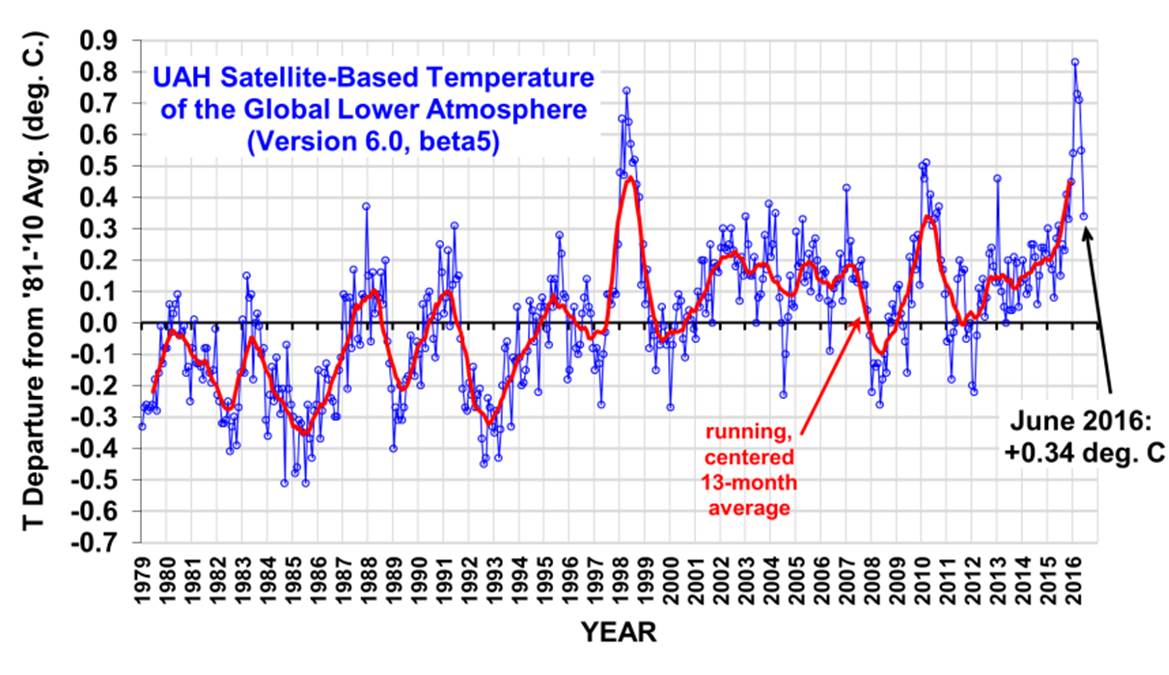
Global temperature back into the normal range

GISS have not yet updated for June but Roy Spencer has -- using the satellite data:

Second largest 2-month drop in global average satellite temperatures.

Largest 2-month drop in tropical average satellite temperatures.

NOTE: This is the fifteenth monthly update with our new Version 6.0 dataset. Differences versus the old Version 5.6 dataset are discussed here. Note we are now at “beta5” for Version 6, and the paper describing the methodology is still in peer review.

The Version 6.0 global average lower tropospheric temperature (LT) anomaly for June, 2016 is +0.34 deg. C, down 0.21 deg. C from the May value of +0.55 deg. C


This gives a 2-month temperature fall of -0.37 deg. C, which is the second largest in the 37+ year satellite record…the largest was -0.43 deg. C in Feb. 1988.

In the tropics, there was a record fast 2-month cooling of -0.56 deg. C, just edging out -0.55 deg. C in June 1998 (also an El Nino weakening year).

SOURCE


Cosmo Blames Shark Attacks On Global Warming, Doesn’t Read Own Sources

The women’s magazine Cosmopolitan claimed Friday that global warming will cause a surge in shark attacks this year — but the article’s own sources contradict the claim.

Cosmo’s assertion is based on a National Geographic article from February that states more shark attacks occurred last year than in any other, as well as a study that says sharks are migrating farther north than before.

National Geographic’s explanation for the unusually high number of attacks is that warm El Nino weather encouraged people to go swimming more often. The magazine even quoted shark biologist Frank Schwartz of the University of North Carolina in Chapel Hill who “says there’s too much natural variability in weather cycles to blame the recent shark attacks on global warming.”

Shark experts support this position, saying “the number of shark-human interactions occurring in a given year is directly correlated with the amount of time humans spend in the sea,” according to the International Shark Attack File at the Florida Museum of Natural History.

 Cosmo’s claim that sharks will soon start migrating into the waters of New York and New Jersey is countered by the fact that of the 98 total shark attacks worldwide last year, precisely 30 of them occurred in the state of Florida, while the biggest surge of attacks occurred in North Carolina.

Cosmo’s article also says that humans shouldn’t be afraid of sharks because scientists have captured “the first ever sonogram of a pregnant tiger shark, which is pretty cute.”

Other media outlets such as The Daily Mail, Investors Business Daily and CBS News also claimed that global warming should be blamed for any shark attacks this summer. They cited a single expert who told Reuters that rising temperatures might make swimming more popular, which could lead to more attacks.

Environmentalist media, such as EcoWatch, has a long history of linking shark attacks to global warming, but the existence of such a link is doubted by scientists.

There is less than one shark-attack death every two years in America, according to a 2005 study by National Geographic. Statistically speaking, cows are much more dangerous than sharks as they cause 20 deaths annually in the U.S.

SOURCE


Study: US Has More Oil Reserves Than Saudis And Russians

America has more oil reserves than both Saudi Arabia and Russia, according to a study published Monday by the Norwegian oil and gas consulting firm Rystad Energy.

The study estimates that America has 264 billion barrels of economically recoverable oil in existing fields, proven reserves and even in fields that haven’t been discovered yet. America’s reserves are larger than Saudi Arabia’s 212 billion and Russia’s 256 billion in oil reserves. The state of Texas alone has roughly 60 billion barrels of shale oil according to the study.

Rystad Energy estimates that there are 2,092 billion barrels in total global oil reserves, or 70 times the current production rate. For comparison, all the oil ever produced up until 2015 only amounts to 1,300 billion barrels.

“There is little potential for future surprises in many other countries, but in the US there is,” Per Magnus Nysveen, an analyst at Rystad Energy, told The Financial Times Monday. “Three years ago the US was behind Russia, Canada and Saudi Arabia.”

American oil and natural gas reserves are at their highest levels since 1972. American reserves of crude oil and natural gas have risen for six consecutive years despite the U.S. producing more oil and natural gas than any other country. Oil production last year was 80 percent higher than it was in 2008.

The massive expansion of America’s oil reserves is due to new drilling techniques like hydraulic fracturing, fracking, and horizontal drilling. The American frakcing boom was the driving factor behind the recent oil price collapse from a mid-2014 high of $115 a barrel to below $30 earlier this year.

These innovations have allowed America to increase its oil production faster than at any time in history. The process helped America surpass Russia as the world’s largest and fastest-growing producer of oil last year. American oil production in 2015 was 80 percent higher than it was in 2008. The U.S. produced an average of about 9.3 million barrels of crude oil per day in June.

The U.S. Energy Information Administration reported that in 2000 America got roughly 2 percent of its oil, about 102,000 barrels per day, from fracking. America got 51 percent of its oil, about 4.3 million barrels per day, from fracking in 2015.

The study does not include oil shale, which excludes the fact that America controls the world’s largest untapped oil reserve, the Green River Formation in Colorado. This formation alone contains up to 3 trillion barrels of untapped oil shale, half of which may be recoverable. That’s five and a half times the proven reserves of Saudi Arabia. This single geologic formation could contain more oil than the rest of the world’s proven reserves combined.

SOURCE


Eco-Terrorists May Have Spiked Logs To Cripple Lumber Mills

A lumber mill in Oregon is on the look out after learning environmentalists and conservationists may have jammed metal spikes in its logs in an effort to slow down or stop logging in the state.

A green group calling itself SAP claimed on environmental website “Earth First! Newswire” that it used the eco-terrorist tactic — which was popular in the 1990s as a way to seriously injure loggers — at the Swanson Brothers mill June 11 near Eugene, Ore.

Larry Konnie, the president of the mill, said his crew was operating as usual for two days prior to learning about SAP’s claim. “It makes me think they wanted to hurt somebody,” Konnie added.

No spikes have been found yet, according to Konnie.

SOURCE


African farming sacrificed to European green politics, blocking GMO innovation

The call, in a report made by the Members of European Parliament (MEPs) to the New Alliance for Food Security and Nutrition, not to support genetically modified (GM) crops in Africa is unfortunate and an attempt to institutionalize poverty on the continent.

The G7 group of nations’ joint initiative with the New Alliance—aimed at lifting 500 million people out of poverty by 2022 using 10 African countries as pilot studies—to start using genetically modified tools in agricultural production is being thrown out of the window.

The report recommended that intensive agriculture that made Europe, the Americas, and many parts of Asia food secure should not be applied in Africa, but that the continent remain with small-scale farming practices that have not been able to meet our food and nutrition needs. Despite the huge tonnage of GM cereals and legumes imported into Europe used as feedstuff, their cultivation is prohibited—to ‘protect’ the environment, to maintain the organic market and, more importantly, for ideological reasons.

This was nicely described as ‘cultivation forbidden, importation indispensable‘ by Giovanni Tagliabue in a 2016 paper (The EU Legislation on “GMOs”: Between Nonsense and Protectionism, a paper for the 20th ICABR Conference) in which the author gave the example of the genetically modified Amflora potato which, due to long delays, was not commercialized only to be produced through mutagenesis and commercialized with no fuss as it was politically a “non-GMO”.

This saga between Europe and America makes Africa suffer. It has been established that agricultural biotechnology is needs-based in Africa. Reports from other developing countries that adopted the technology speaks volume on benefits; the risk aspects being properly managed by their regulators. The African end users, farmers and consumers need to be given the opportunity to access and assess the technology themselves.

The African political leadership is aware of the responsibilities of adopting the technologies properly. This is the reason most African countries and the EU Member States are parties to the Convention on Biological Diversity (CBD) which states in Article 16 that the transfer of technology, including biotechnologies, is essential to the attainment of the goals of the Convention. The CBD further urges Parties in Article 19 to promote priority access to the benefits arising from biotechnologies, especially for developing countries. Furthermore, 44 out of the 54 African Union Member States have signed and ratified the Cartagena Protocol on Biosafety.

This call for Africa not to grow GMOs will be in contravention of the Convention on Biological Diversity. In addition to this, the African Union Commission together with its technical arm, the New Partnership for Africa’s Development Planning and Coordinating Agency, developed a Biotechnology Strategy for Africa in 2007 and in 2008 established a unit to see to the safe and responsible application of the technologies called the African Biosafety Network of Expertise (ABNE). The mandate is to build functional regulatory systems in Member States that would like to adopt the technologies. It is also to build capacity for African regulators in all aspects of agricultural biotechnology regulatory work and thereby build confidence in decision making.

Moreover, other biosafety service providers in Africa include the USAID Program for Biosafety System, the Biosafety Unit of the International Centre for Genetic Engineering and Biotechnology (ICGEB) and a number of biosafety civil society groups. This is intended to point out that regulatory systems are optimal especially in those Member States that have adopted or are in the process of adopting GM technologies in Africa. What we are striving to achieve in Africa is to embrace a science-based approach in the GMO policy decisions, with European Food Safety Authority as our excellent reference point although the MEPs have difficulties with some of its findings.

On trade, once Africa Member States are able to harmonize the regulatory frameworks properly within the regional economic communities (REC), intra-Africa trade is big enough to mop up GM products. Aside from this, the application of GM technologies focuses on African commodities that are of little or no significance in Europe except for Africans in diaspora and Europeans who have developed a taste for such commodities—as such, the level of trade for these purposes is minimal.

It is on these aforementioned opinions that the European Parliament should uphold its tenets of respect for human dignity, liberty, democracy, equality, the rule of law and respect for human rights by not opposing African Union’s efforts to make use of all available beneficial technologies.

It is surprising to note that this call is only for Africa but not to other developing countries in Latin America and Asia. The African farmer must have the right to decide whether to plant improved seeds and must have access to safe new products that will benefit the family farm, local communities and also contribute to improved livelihoods and socio-economic development.

SOURCE


Report: New Documents Confirm: ‘Climate RICO’ AGs Attempting to Write Themselves Out of Transparency Laws to Hide Abusive Campaign

New responses from state Attorneys General offices (OAGs) obtained by the Energy & Environment Legal Institute (E&E Legal) and the Free Market Environmental Law Clinic (FME Law) confirm that the coalition of Democratic Attorneys General using racketeering laws to investigate universities, climate scientists, free market think tanks and energy companies are hiding behind a contract with each other — also apparently with outside activists helping the campaign — to avoid releasing public records relating to their pursuit of political opponents.

This confirms suggestions in prior emails, obtained under state open records laws, that the AGs had entered what they are calling a Common Interest Agreement (CIA), with green activists and other AGs, and are using this contract of nondisclosure among themselves to keep public records regarding their RICO push from the public.

CIAs are common instruments, but what the AGs and green groups have attempted is not; nor is keeping the pact itself from the public normal.  To be legitimate, parties to a common interest agreement must have imminent litigation, a clear scope and clearly shared interests.  Instead, documents obtained to date show that these AGs and their green-group colleagues with inherently disparate interests have entered not a legitimate CIA, but a pact of secrecy, covering broad topics, not specific matters, simply to avoid scrutiny of otherwise public records relating to their extraordinarily controversial abuse of political opponents’ First Amendment rights.

“We have confirmed that the Democratic AGs are citing a Common Interest Agreement to avoid releasing crucial information to the public, as they continue their abuse of power”, said David W. Schnare, E&E Legal General Counsel. “The earlier draft we obtained showed the desire to exempt AGs’ correspondence, which are deemed public records by their legislatures, from open records laws if they related not just to defense of the Obama administration’s EPA rules, but to investigations and nearly anything else they might not want released involving “fossil fuels”, “renewable energy”, or “climate”.”  It appears these terms survived in a new agreement.

This pact of secrecy, written by New York’s Eric Schneiderman, promises to alert each party about, and force requesting parties to sue for satisfaction of, public (or media) records requests seeking information about this abuse of office in going after opponents of the “climate” agenda.

This revelation, and that these AGs think they can hide from the public even the names of outside activists with whom they have contracted a promise to stonewall FOIA requests, as well as the vow of secrecy itself, raises more questions about the scope and intentions behind the investigations.

“In short, these activist AGs are trying to write themselves out from freedom of information laws their legislatures have written them into,” said E&E Legal senior fellow Chris Horner.  Horner continued, “they are hiding behavior that seems to be precisely the sort of abuse lawmakers sought to expose to sunlight when deciding to cover their states’ chief law enforcement officers under FOIA laws, particularly their use of nearly limitless powers to chill opposition and damage political opponents.”

In March, E&E Legal obtained documents showing that NY Attorney General Schneiderman’s office circulated a CIA to a coalition of AGs participating in a press conference with Al Gore to announce their cooperation on a wide array of possible steps to protect the Obama administration’s “climate” agenda, from defending EPA rules to investigating “fossil fuel” companies. Staff from Vermont’s OAG raised concerns in an email, specifically their discomfort about contracting a default promise to make requesters of public records sue to obtain the information.

Vermont OAG clearly became more comfortable with this position after revelations of the first open records act release blew up in all their faces, now forcing E&E Legal to sue in an ongoing case to obtain further public records.

That first release also revealed a March 30, 2016 email from NY OAG indicating it would circulate a new agreement prior to their April 12 organizing call. Clearly it did so, and activist AGs signed on, possibly also with activist groups but regardless promising to keep their work with these “outside consultants” from the public and the media.

Late last week, in response to an E&E Legal appeal of withholding records relating to the Illinois Attorney General’s Office involvement in the RICO push,that office told E&E Legal that it was withholding the disclosure of certain records because “a common interest agreement (Agreement) was entered into by the Office of the Illinois Attorney General and the other affected stakeholders related to a number of the withheld records. Under the terms of that Agreement, particular categories of documents are to remain confidential.”

In an earlier email, Rhode Island OAG Special Assistant Attorney General Gregory Schultz emailed his agreement to sign an April 12, 2016 CIA, though by that time no office had yet acknowledged the existence of such a pact.  Indeed, the New York, Vermont and California OAGs denied public records requests by the Competitive Enterprise Institute (CEI) for any such contracts to secrecy.

Thus, the states have decided that they can not only write a contract making public records invisible to the citizenry, but prevent citizens from even taking a look at the contract itself.

Yesterday, Rhode Island offered further, facially absurd reasons for not providing the agreement itself, a wholly separate issue and even more facially abusive than claiming records are exempt from FOIA laws because one OAG promised another, and some green-group activists, that it wouldn’t release them.

What are these crusading AGs afraid of the public learning about their investigations?  Why are they invoking absurd claims to try and withhold documents — and writing themselves a blank check to self-exempt from the FOIA laws their legislators apparently thought those with the authority to exercise police powers had better be subject to?  Why are they making parties sue to obtain these public records, which even Vermont’s OAG acknowledged was improper?

The obvious answer to all of this is that they are afraid of the embarrassment they will suffer once people see what they hastily agreed to, which also subjects these offices to potential civil rights lawsuits and other countersuits by those they’ve targeted.

“E&E Legal expects to do whatever is necessary to get these public records before the public, to educate on this unprecedented abuse of power”, said E&E Legal’s Executive Director Craig Richardson. “All that we have found indicates that these AGs and their outside activist partners will make litigation necessary at every turn.”

SOURCE

***************************************

For more postings from me, see  DISSECTING LEFTISM, TONGUE-TIED, EDUCATION WATCH INTERNATIONAL, POLITICAL CORRECTNESS WATCH, FOOD & HEALTH SKEPTIC and AUSTRALIAN POLITICS. Home Pages are   here or   here or   here.  Email me (John Ray) here.  

Preserving the graphics:  Most graphics on this site are hotlinked from elsewhere.  But hotlinked graphics sometimes have only a short life -- as little as a week in some cases.  After that they no longer come up.  From January 2011 on, therefore, I have posted a monthly copy of everything on this blog to a separate site where I can host text and graphics together -- which should make the graphics available even if they are no longer coming up on this site.  See  here or here

*****************************************


Thursday, July 07, 2016


Are Federal Bans on Mining for the Birds?

With little time left on its clock, the Obama administration is rushing to place millions of acres of federal land off limits to commercial resource extraction. Although Lighthouse subscribers have read about regulatory obstacles to oil and gas development, a recent op-ed by Independent Institute Senior Fellow William F. Shughart II and Strata Research Director Megan E. Hansen emphasizes the harm that federal restrictions impose on the development of minerals and metals that could otherwise be used for making things like smart phones, electric car batteries, and computer memory chips.

“Mineral resources are plentiful within our borders, but the United States imported $41 billion worth of processed mineral materials in 2014 from foreign countries,” Shughart and Hansen write. “The production of rare earth metals, for example, is now dominated by China, even though the United States once was a leading rare earth elements producer. In fact, we have now become 100 percent dependent on imports of 19 key minerals.”

The Department of Interior is trying to create more obstacles. Last fall it proposed withdrawing 10 million acres of land from resource development—an amount equivalent of the size of Yellowstone National Park—ostensibly in order to protect the habitat of the greater sage grouse—a bird species that the U.S. Fish and Wildlife Services says is not at risk of extinction.

“Banning mining on federal lands will weaken Western state economies to protect a species that doesn’t seem to need protecting,” Shughart and Hansen continue. “Claiming that the ban will save the greater sage grouse is an absurdly deceptive justification for regulatory overreach.”

SOURCE  


Environmentalists Blast TransCanada for Suing Obama Administration Over Rejection of Keystone XL Permit

TransCanada is suing the U.S. government for $15 billion over President Obama’s rejection of its permit application for the Keystone XL pipeline, a move environmental activists called “absurd” and “a bullying tactic” in a telephone press conference earlier this week

TransCanada filed the lawsuit under the North American Free Trade Agreement (NAFTA), claiming that the Obama administration “discriminated against and significantly damaged” TransCanada and that the administration’s actions were "politically drivern,"and "breached U.S. obligations” under NAFTA.

The corporation’s complaint argues that Congress, rather than the president, has the power to “govern the development of oil pipelines and other infrastructure projects with significant domestic effects,” citing the Clean Water Act, the National Historic Preservation Act, and the Endangered Species Act as precedents.

“[T]he prohibition on construction of the Keystone XL Pipeline directly interferes with foreign and domestic commerce, the regulation of which is textually committed to the Congress by the U.S. Constitution,” the complaint maintains

“Absent express statutory authority, the President simply does not have the power to regulate such domestic facilities based on asserted harms arising from greenhouse gas emissions,” TransCanada's lawsuit continued.

“Stated simply, the delay and the ultimate decision to deny the permit were politically-driven, directly contrary to the findings of the Administration’s own studies, and not based on the merits of Keystone’s application,” according to the corporaton's Notice of Intent to seek arbitration under NAFTA.

But environmentalist groups were quick to criticize the lawsuit.

“This lawsuit from TransCanada is both absurd and a perfect illustration of why people around the world feel that their elites are getting out of touch,” said Bill McKibben, founder of 350.org.

“The rejection of the Keystone pipeline came out of one of the biggest exercises in democracy in recent American history. ... It was a vast, nationwide, continent-wide campaign. And everyone who was involved with it took the science extraordinarily seriously,” continued McKibben.

“This was a remarkable, remarkable battle. And the idea that after all those many, many, many millions of Americans and Canadians participated in this fight, it could somehow be negated by three guys sitting in a room that nobody’s ever heard of and nobody ever voted for, is all the proof that anyone would ever need as to why these kinds of arrangements like NAFTA are something we should be wary of to a huge degree,” he told reporters during the press call.

“TransCanada filed this lawsuit as a bullying tactic,” agreed Jill Kleeb, president of Bold Alliance. “Now TransCanada is trying to bully the American taxpayers and President Obama and any future president that they should not dare to mess with big oil.”

“President Obama did not make a political decision. President Obama made the right climate, water, and property decision on rejecting the Keystone XL pipeline,” continued Kleeb.

Anthony Swift, director of the Canadian division of the Natural Resources Defense Project, told reporters that the argument that the pipeline would not have had significant environmental impact "could not be farther from the truth."

However, in January 2014, the State Department’s Final Supplemental Environmental Impact Statement on Keystone XL concluded that not building the 875-mile pipeline could result in the release of “from 28 to 42 percent” more greenhouse gases into the environment due to the need to use alternate transportation modes -- such as railcars and diesel-fueled trucks -- to get the oil to market.

TransCanada applied to the State Department for a presidential permit to build Keystone XL in 2008. The pipeline would have brought crude oil from the tar sands of western Canada into the U.S., performing the same function as three already-existing pipelines, according to TransCanada.

President Obama denied the permit in November after seven years of delay. “The State Department has decided that the Keystone XL pipeline would not serve the national interests of the United States. I agree with that decision,” he said when he announced the rejection.

“For years, the Keystone pipeline has occupied what I frankly consider an overinflated role in our political discourse. It became a symbol too often used as a campaign cudgel by both parties rather than a serious policy matter,” Obama said.

SOURCE  


Happy American Energy Independence Day

Every president since Richard Nixon has promised to make America energy independent, but  we still import nine million barrels of oil a day, with much of it coming from the Middle East and OPEC.  Now for the first time in a half century -- thanks to the shale oil and gas revolution -- the dream of American energy independence is not just a pipedream but easily achievable if the next president takes the right steps to make it happen.

This Made in America energy strategy means we could stop draining our economy of about $200 billion a year that could be used to rebuild our own country.  This isn't just about the economy.  We know from intelligence reports that as much as $500 million a year of petro-dollars find their way into the coffers of terrorist networks like ISIS.

To achieve American energy self-sufficiency I'm not talking about the left's strange infatuation with building more windmills (sorry Hillary). We only get about 5% of our energy from windmills and solar panels.

What I am talking about is about taking the strategic steps necessary to making the United States the energy dominant force on the planet within five to 10 years by using our super-abundance of fossil fuel resources.  Thanks to the amazing made-in-America technological breakthroughs of the last decade -- including horizontal drilling and hydraulic fracturing to get at shale oil and gas reserves -- the U.S. now has at least 150 years of oil and natural gas resources on top of 500 years of coal.

Consider what has happened in less than a decade with oil production.  ‎In 2008 the U.S. produced about 5 million barrels a day. We hit 8.7 million ‎in 2014 and could double that by 2025.

Get instant access to exclusive stock lists and powerful tools on Investors.com. Try us free for 4 weeks.
As we tap into the full potential of our tens of billions of shale oil and gas we can become the number one export nation on the planet. This could easily mean more than $1 trillion a year in oil, gas and also coal exports each year -- perhaps exceeding 5% of GDP.

Let's not forget about coal.  America was built on coal, and our nation has far more of it than any other nation. And we burn it cleanly and efficiently, unlike the Chinese and India who build hundreds of coal plants every year, but spew out dirty emissions.

I estimate that with five simple steps taken by the next president, America will gain its energy independence:

1. Allow drilling and mining permits on federal lands.  So far at least 90% of the shale gas and shale oil revolution has happened on private land.  But around half of all the land west of the Mississippi is government owned.  We estimate there are $50 trillion of energy resources stored underneath non-environmentally sensitive federal lands.  This is the biggest treasure chest in the world.

2. Build a national network of pipelines across the country by allowing the permitting for projects like Keystone XL and many others.  Right now the federal government is holding up as many as a dozen necessary pipelines to get the oil and gas across the country and then shipped across the world.

3. Build refineries and liquefied natural gas (LNG) terminals in the United States. The Energy Information Agency says the latest refiner "began operating in 1977" – or almost 40 years ago even though the U.S. population has nearly doubled since the mid 1970s and our energy production has doubled as well.

4. Stop the Obama war on coal.  The environmentalists have tried to shutdown coal production, the next president should revive it.  This means putting a muzzle on the EPA to allow our energy resources to be harnessed and used in an environmentally responsible way.  Environmental rules have to be shown to be cost-effective, meaning that the cost to the economy of complying with the rules is justified on the basis of the environmental benefits -- and measured honestly.

5. End all subsidies for all forms of energy. The left complains about taxpayer subsidies for oil and gas. The best way to promote efficient energy is to let the free market work and remove government handouts – particularly to the green energy sector.

If we get this right, America can declare its independence from OPEC and Middle Eastern oil.  We can become the Saudi Arabia of the 21st century.

SOURCE  


Pennsylvania Slashes Rooftop Solar Subsidies

The Pennsylvania Public Utility Commission (PUC) just ended the solar subsidy called net metering, and the state legislature isn’t likely to overturn the decision.

The state commission found twice that net metering solar subsidies are not in the public interest, as they raise the price of electricity and transfer money from poor people without solar panels to rich people with them. The PUC is made up of both Republican and Democratic appointees and voted unanimously both times.

The only way to stop massive subsidy cuts is if the state legislature blocks the PUC’s plans within two weeks. But the legislature isn’t interested in doing so and will soon leave for a summer break.

“Basically, the moon and the stars have to align in a perfect order for this to be stopped,” Todd Stewart, a partner at a regulatory law firm in Pennsylvania, told the Pittsburgh Post-Gazette. “Otherwise, if the commission intends to promulgate the regulations anyway over the double objection by IRRC, they can still do so.”

Net metering policies force utilities to buy electricity produced by rooftop solar panels at retail rates, which means companies can’t cover the fixed costs of operating the electrical grid. Rooftop solar companies such as SolarCity, have pushed these policies as a way to encourage solar power across the country.

The PUC found that forcing up the price of electricity via net metering hurts the poor and ethnic minorities the most, because poor people tend to spend a higher proportion of their incomes on basic needs like groceries, power bills, gasoline, etc. than wealthier people. As essential goods like electricity become more expensive, the cost of producing goods and services that use electricity increases, effectively raising the price of almost everything.

Policies like net metering hurt the poor 1.4 to four times more than they hurt the rich, according to a study by the National Bureau of Economic Research.

A 2015 study by the Massachusetts Institute of Technology (MIT) concluded rooftop solar subsides are inefficient and costly, and that rooftop solar companies simply cannot compete without government support.

Even proponents of solar power and net metering recognize their reliance on subsidies. Without high net metering payments, rooftop solar “makes no financial sense for a consumer,” Lyndon Rive, CEO of SolarCity, admitted to The New York Times in February.

Solar power receives 326 times more subsidies than conventional energy sources relative to the amount of energy produced, according to Department of Energy data. Green energy sources got $13 billion in subsidies during 2013, compared to $3.4 billion in subsidies for conventional sources and $1.7 billion for nuclear, according to data from the U.S. Energy Information Administration (EIA).

Despite the enormous subsidies, solar power only accounted for only 0.6 percent of electricity generated in the U.S. for 2015, according to the EIA.

SOURCE  


Mississippi Clean Coal Plant Touted By Obama Admin Plagued With Inefficiency, Secrets

A ‘clean coal’ plant in Mississippi the Obama administration touted as an answer to global warming is now two years behind schedule, billions of dollars over its initial budget, and under a Securities and Exchange Commission investigation for allegations of fraud.

The Kemper coal plant in Mississippi was touted as the first commercial scale ‘clean coal‘ power plant in the United States, meaning it was capable of capturing and storing its own carbon dioxide emissions. A Tuesday article from The New York Times shows just how bad things have gotten at Kemper.

“It has nothing to do with the design, it has nothing to do with the technology, it just has to do with poor project management,” Landon Lunsford, a plant engineer said in a conversation with whistleblower, Brett Wingo last year. “As long as they can talk away the results as attributable to something else other than just poor performance, the other public service commissions can’t hold them over the fire as much.”

The problem has gotten so bad that the Securities and Exchange Commission has initiated an investigation into why a project that was slated to cost $2.9 billion now costs $6.7 billion and is still not operational. The company that runs the coal plant, Southern Company, is also being sued by Mississippi businesses who are concerned that the fact the project is so far over-budget may mean higher prices for its customers.

“The people of south Mississippi are struggling,” Michael Avenatti, the lawyer representing the customers told the Wall Street Journal in a recent interview. “They can least afford to be saddled with this boondoggle.” The piece goes on to say how due to the cost overruns, Southern Company also recently saw its credit rating downgraded by Fitch Ratings and Moody’s Investors Service.

The plant has some backers still standing up for it though, federal energy officials claim that for a project of this size it is ‘inevitable’ that it run over-budget and past deadline, further claiming bad weather, labor shortages and design uncertainties are responsible for the delays.

Brett Wingo, an engineer for the Kemper plant, is a whistleblower who first exposed the issues. “I’ve reached a personal tipping point and feel a duty to act,” Wingo said in a email from 2014. Wingo was able to find other engineers from the Kemper plant who think the delays and cost overruns are directly related to ‘mismanagement or fraud’.

Wingo also sent a letter to Southern’s CEO telling the company that the publicized open date was ‘not realistic’, but nothing came of it. Wingo was eventually ordered to stay silent on the matter.

SOURCE  


Australia's ABC suspends junk science reporter

The woman should have known better. There must have been some personal reason for the BS.  The effect of electromagnetic radiation on health has been a big boogeyman for many years but the contrary evidence is huge. A scare that a few alarmists are trying to keep alive is that the radiation from your mobile phone will give you brain cancer.  Yet from the early days of mobile phones until now there has been no upsurge in brain cancer.  Now that mobiles are very widely used, we should be swimming in brain cancer cases by now.  But we are not. High or low levels of mobile phone use and the resultant radiation makes no difference. It's all just attention-seekers big-noting themselves


Isn't she gorgeous?  I suspect that it is her looks rather than her scientific ability that has got her prestigious jobs.  It happens


A CONTROVERSIAL ABC program about the health effects of Wi-Fi has led to a presenter being suspended, after it breached impartiality standards.

ABC presenter Dr Maryanne Demasi from the popular science program Catalyst has been suspended until September this year, after a review of the episode titled “Wi-Fried” was conducted by the ABC’s independent Audience and Consumer Affairs (A&CA) Unit.

Adelaide-born Dr Demasi completed a doctorate in medical research at the University of Adelaide and worked for a decade as research scientist at the Royal Adelaide Hospital.

She has also worked as an adviser to the South Australian Government’s Minister for Science and Information Economy.

The “Wi-Fried” episode was broadcast in February this year and contained information about the safety of wireless devices such as mobile phones.

In a statement released by the ABC, the investigation was initiated after the ABC received complaints from viewers about the episode. The ABC informed readers of its findings after the show aired on Tuesday night.

The A&CA found the episode breached the ABC’s editorial policies standards on accuracy and impartiality. “The A&CA Report found several inaccuracies within the program that had favoured the unorthodox view that mobile phones and Wi-Fi caused health impacts including brain tumours,” the ABC’s statement said.

“ABC TV is reviewing the strategy and direction for Catalyst with a view to strengthening this very important and popular program.

“Further, ABC TV is addressing these issues directly with the program makers and has advised the reporter, Dr Maryanne Demasi, that her on-air editorial assignments will be on hold until the review is completed in September 2016.”

ABC Director of Television, Richard Finlayson said the investigation had been thorough.  “Catalyst is a highly successful and respected science program that explores issues of enormous interest to many Australians. There is no doubt the investigation of risks posed by widespread wireless devices is an important story but we believe greater care should have been taken in presenting complex and multiple points of view,” he said.

The finding comes just two years after a separate investigation was launched into a Catalyst program about the use of cholesterol-reducing medications.

“ABC TV takes responsibility for the broader decision-making process that resulted in the program going to air and acknowledges this is the second significant breach for the program in two years,” the ABC stated.

“The ABC accepts the findings and acknowledges that errors were made in the preparation and ultimate approval of the program.”

The “Wi-Fried” program will now be removed from the Catalyst website.

Information about A&CA’s findings will be added to the Catalyst website, and the A&CA’s investigation and findings are on the ABC Corrections page.

SOURCE

***************************************

For more postings from me, see  DISSECTING LEFTISM, TONGUE-TIED, EDUCATION WATCH INTERNATIONAL, POLITICAL CORRECTNESS WATCH, FOOD & HEALTH SKEPTIC and AUSTRALIAN POLITICS. Home Pages are   here or   here or   here.  Email me (John Ray) here.  

Preserving the graphics:  Most graphics on this site are hotlinked from elsewhere.  But hotlinked graphics sometimes have only a short life -- as little as a week in some cases.  After that they no longer come up.  From January 2011 on, therefore, I have posted a monthly copy of everything on this blog to a separate site where I can host text and graphics together -- which should make the graphics available even if they are no longer coming up on this site.  See  here or here

*****************************************