Wednesday, July 06, 2016


African agriculture and CO2

Below is a bit of total brainlessness.  Newsweek channelling Mother Jones in fact! Both warming and increased CO2 levels are GOOD for plants.  And warming also brings rain, which is best of all.  No doubt Africa is hungry in many places but climate is not the cause of that.  Climate change is one of the few things that could help Africa

Agriculture in Africa is one of the most important yet underreported stories about climate change today. It's a fascinating intersection of science, politics, technology, culture, and all the other things that make climate such a rich vein of reporting. At that intersection, the scale of the challenge posed by global warming is matched only by the scale of opportunity to innovate and adapt. There are countless stories waiting to be told, featuring a brilliant and diverse cast of scientists, entrepreneurs, politicians, farmers, families, and more.

East Africa is already the hungriest place on Earth: One in every three people live without sufficient access to nutritious food, according to the United Nations. Crop yields in the region are the lowest on the planet. African farms have one-tenth the productivity of Western farms on average, and sub-Saharan Africa is the only placeon the planet where per capita food production is actually falling.

Now, climate change threatens to compound those problems by raising temperatures and disrupting the seasonal rains on which many farmers depend. An index produced by the University of Notre Dame ranks 180 of the world's countries based on their vulnerability to climate change impacts (No. 1, New Zealand, is the least vulnerable; the United State is ranked No. 11). The best-ranked mainland African country is South Africa, down at No. 84; Nigeria, Kenya, and Uganda rank at No. 147, No. 154, and No. 160, respectively. In other words, these are among the places that will be hit hardest by climate change. More often than not, the agricultural sector will experience some of the worst impacts. Emerging research indicates that climate change could drive down yields of staples such as rice, wheat, and maize 20 percent by 2050. Worsening and widespread drought could shorten the growing season in some places by up to 40 percent.

This isn't just a matter of putting food on the table. Agricultural productivity also lies at the root of broader economic development, since farming is Africa's No. 1 form of employment. So, even when hunger isn't an issue, per se, lost agricultural productivity can stymie rural communities' efforts to get the money they need for roads, schools, clinics, and other necessities. "We only produce enough to eat," lamented Amelia Tonito, a farmer I met recently in Mozambique. "We'd like to produce enough to eat and to sell." More food means more money in more pockets; the process of alleviating poverty starts on farms.

"We only produce enough to eat," lamented Amelia Tonito, a farmer I met recently in Mozambique. "We'd like to produce enough to eat and to sell."

More HERE


New paper finds extreme storms "seem to coincide with the COLDEST periods in Europe"

Extreme storms during the last 6500 years from lagoonal sedimentary archives in the Mar Menor (SE Spain)

Laurent Dezileau et al.

Abstract.

Storms and tsunamis, which may seriously endanger human society, are amongst the most devastating marine catastrophes that can occur in coastal areas. Many such events are known and have been reported for the Mediterranean, a region where high-frequency occurrences of these extreme events coincides with some of the most densely populated coastal areas in the world. In a sediment core from the Mar Menor (SE Spain), we discovered eight coarse-grained layers which document marine incursions during periods of intense storm activity or tsunami events. Based on radiocarbon dating, these extreme events occurred around 5250, 4000, 3600, 3010, 2300, 1350, 650, and 80 years cal BP. No comparable events have been observed during the 20th and 21st centuries.

The results indicate little likelihood of a tsunami origin for these coarse-grained layers, although historical tsunami events are recorded in this region. These periods of surge events seem to coincide with the coldest periods in Europe during the late Holocene, suggesting a control by a climatic mechanism for periods of increased storm activity. Spectral analyses performed on the sand percentage revealed four major periodicities of 1228 ± 327, 732 ± 80, 562 ± 58, and 319 ± 16 years. Amongst the well-known proxies that have revealed a millennial-scale climate variability during the Holocene, the ice-rafted debris (IRD) indices in the North Atlantic developed by Bond et al. (1997, 2001) present a cyclicity of 1470 ± 500 years, which matches the 1228 ± 327-year periodicity evidenced in the Mar Menor, considering the respective uncertainties in the periodicities.

Thus, an in-phase storm activity in the western Mediterranean is found with the coldest periods in Europe and with the North Atlantic thermohaline circulation. However, further investigations, such as additional coring and high-resolution coastal imagery, are needed to better constrain the main cause of these multiple events.

Clim. Past, 12, 1389-1400, 2016. doi:10.5194/cp-12-1389-2016


Arctic Update

Two months ago, climate "experts" told us that the Arctic would be ice-free this summer

Arctic sea ice volume is exactly normal, and close to 15 feet thick near the North Pole.
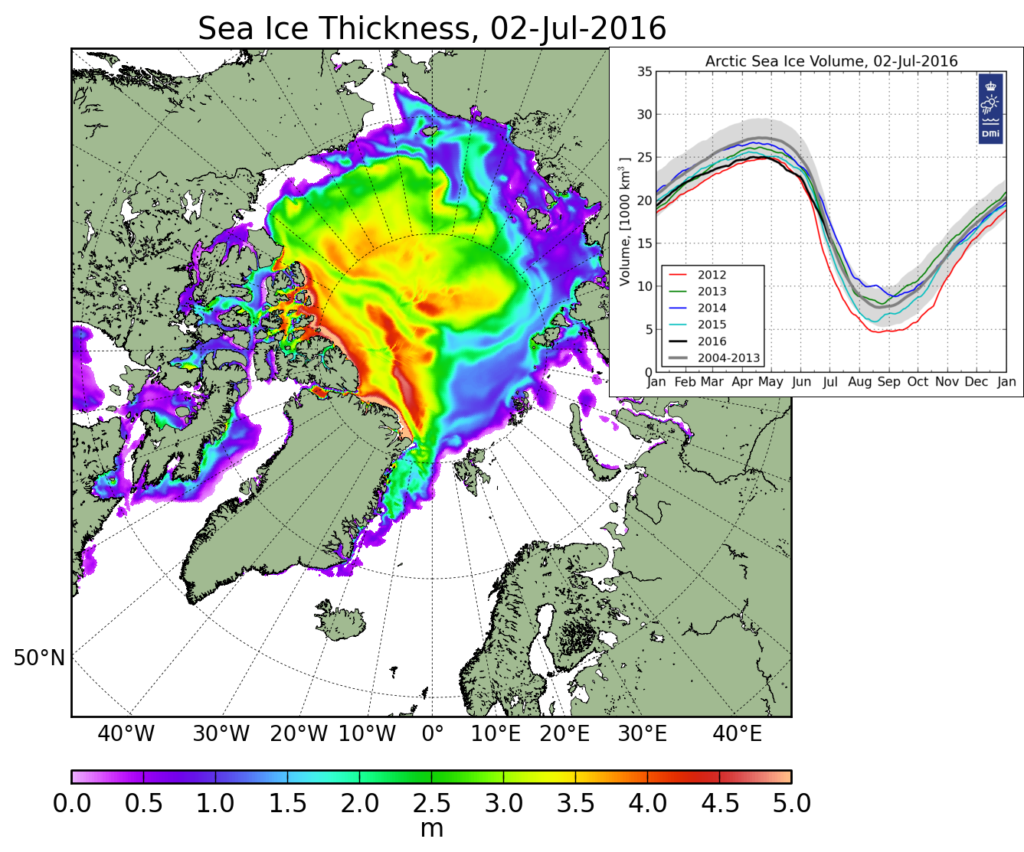


Temperatures near the pole have been persistently below normal for the entire melt season, which almost half over.

Robert Scribbler is the same fraudster who started the “jet stream crossing the equator” scam last week.

Democrats say that it is illegal to lie about the climate, which is their own standard operating procedure.

SOURCE


Foolish Climate power play by the AAAS et al.

Judith Curry

The AAAS and affiliated professional societies just shot themselves in the foot with the letter to U.S. policy makers.

Last week, the American Association for the Advancement of Science (AAAS) issued a press release entitled Thirty-One Top Scientific Societies Speak With One Voice on Global Climate Change.  Punchline:

In a consensus letter to U.S. policymakers, a partnership of 31 leading nonpartisan scientific societies today reaffirmed the reality of human-caused climate change, noting that greenhouse gas emissions “must be substantially reduced” to minimize negative impacts on the global economy, natural resources, and human health.

This statement is a blatant misuse of scientific authority to advocate for specific socioeconomic policies.  National security and economics (specifically called out in the letter) is well outside the wheelhouse of all of these organizations.   Note the American Economics Association is not among the signatories; according to an email from Ross McKitrick, the constitution of the AEA forbids issuing such statements. In fact, climate science is well outside the wheelhouse of most of these organizations (what the heck is with the statisticians and mathematicians in signing this?)

The link between adverse impacts such as more wildfires, ecosystem changes, extreme weather events etc. and their mitigation by reducing greenhouse gas emissions hinges on detecting unusual events for at least the past century and then actually attributing them to human caused warming.  This is highly uncertain territory – even within the overconfident world of the IPCC.  And the majority of the signatories to this letter have no expertise in the detection and attribution of human caused climate change.

‘Scientists speaking with one voice’ on an issue as complex and poorly understood as climate change, its impacts and solutions is something that I find rather frightening.  Well, I am somewhat reassured that this is not the population of scientists speaking, but rather the leadership of the professional societies speaking.  How many members of the American Society of Ichthyologists and Herpetologists have an educated opinion, or even care very much, about climate change?  And many of these society leaders (who were responsible for signing on behalf of their organization) are not scientists themselves, e.g. Chris McEntee, Executive Director of the AGU, whose background is in nursing (Masters in Health Administration).  She is quoted in the AAAS press release:

“Climate change is one of the most profound challenges facing our society. Consensus on this matter is evident in the diversity of organizations that have signed this letter. Science can be a powerful tool in our efforts to mitigate and adapt to the impacts of climate change, and we stand ready to work with policymakers as they deliberate various options for action.”

Impact?

So, is this letter going to change the minds of ~50% of Congressional members who do not support President Obama’s climate change plan, either because they don’t like the proposed solutions, or don’t think climate change is dangerous, or don’t think humans are the dominant cause of recent climate change?

Those in Congress that disagree with Obama’s plan have clearly shown themselves not to be susceptible to pressures from scientist/advocates and their consensus enforcement.  Further, by broadening the list of signatories to include societies that have little or no expertise in the physics of climate, this whole exercise reinforces the public distrust of these scientific organizations.

It seems that the primary motivation of this is for the leaders of these professional societies to be called to the big table to engage in the Congressional policy deliberations about climate change.  So, if you are Lamar Smith or Ted Cruz, would you be calling any of these people to participate in Congressional hearings?

The AAAS and the affiliated professional societies blew it with that letter.  They claim the science is settled; in that case, they are no longer needed at the table. If they had written a letter instead that emphasized the complexities and uncertainties of both the problem and the solutions, they might have made a case for their participation in the deliberations.

Instead, by their dogmatic statements about climate change and their policy advocacy, they have become just another group of lobbyists, having ceded the privilege traditionally afforded to dispassionate scientific reasoning to political activists in the scientific professional societies.  With a major side effect of damaging the process and institutions of science, along with the public trust in science.

The AAAS et al. have shot themselves in the foot with this one.

More HERE


The idea that we are edging up to a mass extinction is not just wrong – it’s a recipe for panic and paralysis

by Stewart Brand

The way the public hears about conservation issues is nearly always in the mode of ‘[Beloved Animal] Threatened With Extinction’. That makes for electrifying headlines, but it misdirects concern. The loss of whole species is not the leading problem in conservation. The leading problem is the decline in wild animal populations, sometimes to a radical degree, often diminishing the health of whole ecosystems.

Viewing every conservation issue through the lens of extinction threat is simplistic and usually irrelevant. Worse, it introduces an emotional charge that makes the problem seem cosmic and overwhelming rather than local and solvable. It’s as if the entire field of human medicine were treated solely as a matter of death prevention. Every session with a doctor would begin: ‘Well, you’re dying. Let’s see if we can do anything to slow that down a little.’

Medicine is about health. So is conservation. And as with medicine, the trends for conservation in this century are looking bright. We are re-enriching some ecosystems we once depleted and slowing the depletion of others. Before I explain how we are doing that, let me spell out how exaggerated the focus on extinction has become and how it distorts the public perception of conservation.

Many now assume that we are in the midst of a human-caused ‘Sixth Mass Extinction’ to rival the one that killed off the dinosaurs 66 million years ago. But we’re not. The five historic mass extinctions eliminated 70 per cent or more of all species in a relatively short time. That is not going on now. ‘If all currently threatened species were to go extinct in a few centuries and that rate continued,’ began a recent Nature magazine introduction to a survey of wildlife losses, ‘the sixth mass extinction could come in a couple of centuries or a few millennia.’

The range of dates in that statement reflects profound uncertainty about the current rate of extinction. Estimates vary a hundred-fold – from 0.01 per cent to 1 per cent of species being lost per decade. The phrase ‘all currently threatened species’ comes from the indispensable IUCN (International Union for Conservation of Nature), which maintains the Red List of endangered species. Its most recent report shows that of the 1.5 million identified species, and 76,199 studied by IUCN scientists, some 23,214 are deemed threatened with extinction. So, if all of those went extinct in the next few centuries, and the rate of extinction that killed them kept right on for hundreds or thousands of years more, then we might be at the beginning of a human-caused Sixth Mass Extinction.

An all-too-standard case of extinction mislabeling occurred this January on the front page of The New York Times Magazine. ‘Ocean Life Faces Mass Extinction, Broad Study Shows,’ read the headline. But the article by Carl Zimmer described no such thing. Instead it was a relatively good-news piece pointing out that while much of sea life is in trouble, it is far less so than continental wildlife, and there is time to avoid the mistakes made on land. The article noted that, in the centuries since 1500, some 514 species have gone extinct on land but only 15 in the oceans, and none at all in the past 50 years. The Science paper on which Zimmer was reporting was titled ‘Marine Defaunation: Animal Loss in the Global Ocean’ by Douglas McCauley, an ecologist at the University of California, Santa Barbara, and colleagues. It stated: ‘Though humans have caused few global marine extinctions, we have profoundly affected marine wildlife, altering the functioning and provisioning of services in every ocean,’ and it went on to chronicle the causes of ‘the proliferation of ‘empty reefs’, ‘empty estuaries’, and ‘empty bays’, with an overall decline of marine fishes by 38 per cent.

Extinction is not a helpful way to think about threats to ocean animals because few go extinct there. The animals are highly mobile in a totally connected vast environment where there is almost always somewhere to hide, even from industrial-scale hunting. Atlantic cod used to be one of the world’s great fisheries before it collapsed in 1992 from decades of overfishing. According to Jesse Ausubel, one of the organisers of the recent international Census of Marine Life: ‘The total estimated kilos of cod off Cape Cod today probably weigh only about 3 per cent of all the cod in 1815.’ (Across the Atlantic in the North Sea, however, cod fishery is recovering, thanks to effective regulation.) No one really expects cod to go extinct, and yet the Red List describes them as threatened with extinction.

The best summation I have seen of the current situation comes from John C Briggs, biogeographer at the University of South Florida, in a letter to Science magazine last November:

"Most extinctions have occurred on oceanic islands or in restricted freshwater locations, with very few occurring on Earth’s continents or in the oceans. The world’s greatest conservation problem is not species extinction, but rather the precarious state of thousands of populations that are the remnants of once widespread and productive species"

Briggs’s point about oceanic islands is worth examining in detail. Compared with continents, the ecosystems of remote islands are so simple and restricted, a great deal of what we understand about ecology and evolution has come from studying them. (Australia is considered such an island despite its size, thanks to its long isolation.) Darwin’s revelation about the origins of speciation was inspired by his travels to Pacific islands such as the Galapagos. One of the core texts of ecology and conservation biology is The Theory of Island Biogeography (1967) by Edward O Wilson and Robert MacArthur.

Many new species readily emerge on ocean islands because of the isolation, but there are few other species to co-evolve with and thus they have no defence against invasive competitors and predators. The threat can be total. An endemic species under attack has nowhere to escape to. The island conservationist Josh Donlan estimates that islands, which are just 3 per cent of the Earth’s surface, have been the site of 95 per cent of all bird extinctions since 1600, 90 per cent of reptile extinctions, and 60 per cent of mammal extinctions. Those are horrifying numbers, but the losses are extremely local. They have no effect on the biodiversity and ecological health of the continents and oceans that make up 97 per cent of the Earth.

The frightening extinction statistics that we hear are largely an island story, and largely a story of the past, because most island species that were especially vulnerable to extinction are already gone.

The island ecosystems have not collapsed in their absence. Life becomes different, and it carries on. Since the majority of invasive species are relatively benign, they add to an island’s overall biodiversity. The ecologist Dov Sax at Brown University in Rhode Island points out that non-native plants have doubled the botanical biodiversity of New Zealand – there are 2,104 native plants in the wild, and 2,065 non-native plants. Ascension Island in the south Atlantic, once a barren rock deplored by Charles Darwin for its ‘naked hideousness’, now has a fully functioning cloud forest made entirely of plants and animals brought by humans in the past 200 years. (The Ascension Island story opens a new book by environmental journalist Fred Pearce, titled The New Wild: Why Invasive Species Will Be Nature’s Salvation.)

But the main news from ocean islands is that new methods have been found to protect the vulnerable endemic species from their worst threat, the invasive predators, thus dramatically lowering the extinction rate for the future. New Zealanders are the heroes of this story, beautifully told in Rat Island: Predators in Paradise and the World’s Greatest Wildlife Rescue (2011) by William Stolzenburg. Every ocean island in the world has been afflicted with intensely destructive alien predators brought by us – rats, mice, goats, pigs, burros, tree snakes (Guam), foxes (Aleutians), and many more. In the 1980s, New Zealand conservationists were driven to desperation by the vulnerability of beloved unique creatures such as a ground-dwelling parrot called the kakapo. They decided to do whatever it took to eliminate every single rat on the kakapo’s island refuge. It took many seasons of relentless poisoning and trapping, but when it was done, it was really done. The kakapos could finally reproduce in safety, and did. The technique was tried on other islands with other endangered species and other problem predators, and it worked there too.

More than 800 islands worldwide have now been cleansed of their worst extinction threat, with more coming. Some are pretty spectacular. Donlan, quoted above, was in the thick of the battle to get rid of all the goats that were destroying Santiago, Pinta and Isabela islands in the Galapagos archipelago. It took years of work with high-powered rifles, hunting dogs, helicopters and ‘Judas goats’ to kill every single one of the 160,000 goats on the islands, but when it was done, the cure was permanent. And now, according to Elizabeth Kolbert in The New Yorker this December, New Zealanders are stepping up to a much larger scale. An organisation called Predator Free New Zealand is co‑ordinating a massive nationwide effort to eradicate every single invasive rat, stoat, weasel and cat, and thus make the whole country a refuge for its native kiwis, wetas (giant insect), kakapos, saddlebacks (bird), tuataras (bizarre lizard), and more.

More HERE


Australia: The Green/Left panicked by new independent senator

Chronically angry Liz Conor is anyway.  And her elitism pops out quickly too.  She says below of Pauline Hanson:  "And why does Hanson even have an opinion on climate science?".  The obvious riposte:  "And why does Liz Conor have an opinion on climate science?"

The rest of her rant is just one wild accusation after another.  I have noted some in the body of her text.  I actually wonder if she is serious.  I think she just enjoys being a dramatist.  But is she right in thinking that Pauline is bad for the Greenies?

Her offsider in Queensland, Malcolm Roberts, is a ferociously well-informed climate skeptic so she will have real intellectual firepower behind her.  Nobody will be able to bluff her with phony statistics etc.  So it is highly probable that Greenie policies will come under heavy challenge from her.  And she is not alone in climate skepticism.  About half the Liberal party are closet climate skeptics so if she demands anti-Warmist measures as her price for supporting the conservatives in crucial votes, there will be a real willingness to give that to her


Fellow Austraiyans. If you are reading me now it means that I have become murderous. Murderously, apoplectically incensed.

Pauline Hanson appears to have picked up a spot in our Senate at the time of writing, possibly even two or more. She will represent Queensland in our House of Review, where our nation’s proposed laws are rejected or amended. And it’s not a three-year term. Unless Turnbull (potentially newly rolled into Prime Minister Morrison out of revenge for the LNP’s slashed majority) finds some other spurious reason to call a double dissolution, Hanson’s term is Six. Six. Six.

Hanson will make extravagant use of the Senate’s committee system, already proposing royal commissions into Islam and climate science. How in chrissname do you conduct an inquiry into one of the three major world religions? Imagine the terms of reference. Are there too many believers? Should they perform the pilgrimage to Mecca? Are Humans superior to Angels? Will the Australian Royal commission into erm, Islam require the seventh-century originals of its foundational documents be tendered – the Qur’an, hadith and tafsir?

And why does Hanson even have an opinion on climate science? Why are racists climate deniers? Does Hanson have doubts about enlightenment empiricism? Logical positivism? The verification of Authentic Knowledge? Or has she, like most climate deniers and obstructers, featherbedded her campaign with undeclared funds from fossil fuel conglomerates?

And this from the state where a few short weeks ago 69,000 jobs were unceremoniously scuppered from tourism on our ghostly white Great Barrier Reef. 5.2 billion in revenue sank without trace with the ‘jobs and growth’ shipwreck of LNP sloganeering. [That job loss was a Greenie prediction -- amid actual thriving of reef tourism]

The reef grief and reef rage many of us felt was bad enough. I mean it’s nice to banner hope for the unbleached 7 per cent and ‘recovering’ 65 per cent with a donate button but let’s be honest, the waters aren’t going to get cooler in the long-term, there will be more frequent El Niño events, worsening storms and Crown of Thorn starfish outbreaks. ["frequent El Niño events"?  They are reasonably predictable but they are not frequent]

The reef is terminal. [The head of the GBRMPA doesn't think so and it's his job to know] We have five years to save what little remains but instead the two parties that oversaw this catastrophe now hang in the balance, continuing to accept party donations of $3.7 million from the corporations responsible. While still in unfettered power the Libs demanded UNESCO whitewash any mention of the reef from its report into risks to world heritage sites and tourism.

So. Once you’ve taken out the largest living organism on the planet how precisely do you top that? It seems their ecocidal mania knows no bounds. Both parties can lay claim to the dubious distinction of perpetrating the only environmental catastrophe visible from space.

These people are not in jail where they belong. Instead they spent the last eight weeks fronting up to Australians asking to be entrusted again. We are not in safe hands.

As the 350.org Nemo who intercepted Turnbull might reasonably protest to humans, ‘I’m fed up with being told, this is our reef. Well, where the hell do I go? I draw the line when told I must pay and continue paying for something that happened over 20 years ago,’ namely early and credible warnings of global warming.

What kind of electoral dissonance are One Nation Voters suffering? As we of the Greens voting variety have been instructed, the workers of Australia have been so cowed by threats to Medicare they simply cannot spare a thought for refugees. Apparently the capacity for workers to run more than one thought process in their heads at any time is somewhat limited. Only the left commentariat can multitask, it seems.

But how can we fathom the thinking of One Nation voters, many of them jumping ship from the Palmer United Party.

I believe we are in danger of being swamped by Caucasians, tax evasions and Australasians. They have their own culture and religion, form ghettos, and do not assimilate.

We are bringing in people from Oxley at the moment. There was a huge amount coming to our polling booths, and they’ve got diseases, they’ve got BIAS.

Either Blind Freddy or Rip Van Winkel would have to vote for a candidate who did time for electoral fraud. Even if her conviction was overturned it shows a hair-raising lack of judgement in whom she entrusts the basics of organisational governance.

Where will Hanson-voters’ intolerance for Halal snackpacks take us? What other food allergies are they intending to force on the rest of us? Battered Islamophobia? Deep-fried homophobia? Queue-jumping dimsims?

Hanson will find a way to jumble racism with climate obstruction. As Naomi Klein presciently argues they already go hand in glove. She writes, “there is no way to confront the climate crisis as a technocratic problem, in isolation. It must be seen in the context of austerity and privatisation, of colonialism and militarism, and of the various systems of othering needed to sustain them all.”

But let’s give Pauline the last word on facing imminent destruction: “Do not let my passing distract you for even a moment … For the sake of our children and our children’s children, you must fight on.”

Thanks for the tip Pauline. You can bet we will.

SOURCE

***************************************

For more postings from me, see  DISSECTING LEFTISM, TONGUE-TIED, EDUCATION WATCH INTERNATIONAL, POLITICAL CORRECTNESS WATCH, FOOD & HEALTH SKEPTIC and AUSTRALIAN POLITICS. Home Pages are   here or   here or   here.  Email me (John Ray) here.  

Preserving the graphics:  Most graphics on this site are hotlinked from elsewhere.  But hotlinked graphics sometimes have only a short life -- as little as a week in some cases.  After that they no longer come up.  From January 2011 on, therefore, I have posted a monthly copy of everything on this blog to a separate site where I can host text and graphics together -- which should make the graphics available even if they are no longer coming up on this site.  See  here or here

*****************************************


Tuesday, July 05, 2016


Is the Tesla bubble about to burst?

How long can they keep running in the red?  They're nice cars but if you want one maybe you should buy one now -- while they last

Add yet another problem to the list at Tesla Motors: lackluster growth.

Tesla announced on Sunday that it delivered 14,370 vehicles in the second quarter. That is well below its own forecast of about 17,000, which it gave in May. Although sales of its Model X grew significantly from the first quarter, its signature Model S sedan actually saw sales fall sequentially by more than 22%. That is surprising since Tesla said in May that Model S orders were strong. The company has now missed its own deliveries guidance for two consecutive quarters.

The electric auto maker has delivered fewer than 30,000 cars in the first half of the year, putting its full year forecast of 80,000 to 100,000 in serious jeopardy. Tesla says it expects to deliver “about 50,000” cars in the next six months. That isn’t impossible, but Sunday’s news is disconcerting. Since Tesla can’t successfully forecast deliveries more than two months out, it stretches CEO Elon Musk’s bold forecast of 500,000 deliveries by 2018 from improbable to farcical.

For its part, Tesla cited an unusually high number of vehicles in transit for the shortfall. The company says more than five thousand cars are to be delivered soon, which would have helped them clear the bar. But Tesla, which carries a market value in excess of $30 billion and has designs on disrupting the entire automobile industry, should be far enough in its development to be able to accurately forecast delivery times to customers.

For shareholders, this is merely the latest in a series of worries. For starters, the company continues to burn cash at an alarming rate, to the tune of $2.1 billion in the last four quarters through March 31. This means Tesla requires ongoing access to capital markets to function. Tesla has issued shares or convertible debt in every year since 2010.

That isn’t the end of it. A proposed merger with SolarCity, the other public company in which Mr. Musk is the largest shareholder, would exacerbate that cash burn, cause further stock dilution and raises questions about the firm’s corporate governance. Tesla’s reported earnings are heavily inflated by adjustments that don’t conform with generally accepted accounting principles. New competition looms on the horizon. And now, federal regulators are looking into two potential safety issues in Tesla vehicles.

Despite the litany of worries piling up, the stock remains priced for explosive growth in the near future. It fetches over 130 times consensus forward earnings, according to FactSet. Tesla’s shares, clinging to such a lofty valuation even as doubts have piled up, have been more dazzling than its vehicles.

Now, though, the bull case is running on fumes

SOURCE


Bees not so "threatened" after all

To listen to the Warmists you would think that there is only one species of bee and would think that it is at risk of being burnt to death by global warming.  There are in fact around 20,000 species of bee and all have their ecological niche.  Populations of European honeybees have had some difficulties in recent years but other species are thriving.  Below is a report on an Australian bee species


Flinders Biological Sciences PhD student Rebecca Dew and Associate Professor Michael Schwarz, together with Professor Sandra Rehan of the University of New Hampshire in the US, have found a rapid increase in the population size of the small carpenter bee (Ceratina australensis) from 18,000 years ago, when the climate began warming up after the last Ice Age.


Their findings, published in the latest Journal of Hymenoptera Research, show future global warming could be a good sign for at least some bees, which are major pollinators and are critical for many plants, ecosystems and agricultural crops.

“Our findings also match those from two previous studies on bees from North America and Fiji,” Ms Dew says.

“It is really interesting that you see very similar patterns in bees around the world. Different climate, different environment, but the bees have responded in the same way at around the same time.”

The small carpenter bee is found in sub-tropical, coastal and desert areas of Australia. The researchers spent almost two years conducting field analysis near Warwick in south-east Queensland, Cowra in central New South Wales, Mildura in north-west Victoria and West Beach in Adelaide.

Global warming has other potential effects on environment and ecosystems.

In another recent collaborative study between the Flinders School of Biological Sciences team,  previous Flinders research students Dr Scott Groom and Ms Carmen da Silva, Dr Daniel Silva from Brazil and Associate Professor Mark Stevens, from the South Australian Museum, showed that a bee species accidentally introduced to Fiji has become widespread and will flourish with continued global warming, perhaps even spreading to Australia and New Zealand.

“This bee, Braunsapis puangensis, is resistant to honeybee diseases and could well become an important ‘fall-back’ crop pollinator if honeybee populations continue to decline, which has become a major worry in many parts of the world, including Australia,” Associated Professor Schwarz says.

The findings, however, may not all be positive for bees globally, with other studies showing that some rare and ancient tropical bees require a cool climate to survive and, as a result, are already restricted to the highest mountain peaks of Fiji. For these species, climate warming could spell their eventual extinction.

“We now know that climate change impacts bees in major ways, but the challenge will be to predict how those impacts play out. They are likely to be both positive and negative, and we need to know how this mix will unfold,” Ms Dew says.

Ms Dew, who was previously awarded the prestigious J.H. Comstock award from the Entomological Society of America, is now investigating the populations of another species of native bee (Exoneurella tridentata) in arid areas of Australia.

SOURCE


Democrats Adopt a Fascist Party Plank

The Democrat Party’s totalitarian impulses have been formalized. In the final draft of this year’s party platform, the Democratic Platform Drafting Committee unanimously adopted a provision "calling on the Department of Justice to investigate alleged corporate fraud on the part of fossil fuel companies who have reportedly misled shareholders and the public on the scientific reality of climate change." In short, the attempt to criminalize dissent is now an official party plank.

The committee was led by DNC Chairwoman Debbie Wasserman Schultz and Rep. Elijah Cummings (D-MD). "As Democrats, we believe that our country’s greatest strength is its people, and we’re committed to the values of inclusion and opportunity for all," Wasserman Schultz said in a statement.

Apparently Wasserman Schultz is oblivious to her own hypocrisy. There is nothing remotely inclusive about such a "my way or the prosecutorial highway" take on science that is far from settled, despite all the orchestrated hysteria by Democrats and their media enablers. Yet if Democrats wish to prosecute fraud, perhaps they should start at the top of the so-called food chain, as in government entities, not corporate ones, who have pushed an agenda in lieu of scientific fact.

Take the National Aeronautics and Space Administration’s Goddard Institute of Space Studies, for example. German Professor Dr. Friedrich Karl Ewert, a retired geologist and data computation expert, undertook a detailed study of NASA-GISS’s temperature data series, going all the way back to 1881 and involving 1,153 stations. He discovered NASA-GISS had tampered with raw temperature data to literally invent global warming. Between 2010 and 2012 NASA-GISS altered its own data sets to show a post-WWII warming that never existed. Moreover, apart from the continent of Australia, the planet has been on a cooling trend.

The agency is not an outlier. The National Oceanic Atmospheric Administration (NOAA) has also cooked the books on more than one occasion, including on ocean temperatures to make the nearly two decade warming "hiatus" disappear.

Earlier this year, at a "hottest year ever" press briefing, NOAA presented a graph ostensibly showing a 58-year long temperature record compiled by "radiosondes," which are mini weather stations with radio transmitters attached to helium or hydrogen-filled balloons that lift them to altitudes exceeding 115,000 feet. Yet NOAA’s graph showed only the last 37 of those 58 years. The omitted data? It revealed as much pre-1979 global cooling as post-1979 warming.

It also revealed NOAA’s willingness to defraud the public in pursuit of the leftist agenda.

And that’s when leftists bother pursuing data at all. Speaking to the Democratic Platform Drafting Committee, climatologist Michael Mann de-emphasized the need for climate science because global warming has become too obvious to ignore. "What is disconcerting to me and so many of my colleagues," he lamented, "is that these tools that we’ve spent years developing increasingly are unnecessary because we can see climate change, the impacts of climate change, now, playing out in real time, on our television screens, in the 24-hour news cycle."

That Mann would de-emphasize science is not surprising. That’s because his own contribution to environmental radicalism includes the now infamous temperature graph known as the "hockey stick." First published in 1999, Mann’s effort was to reconstruct the average northern hemisphere temperature over the past 1,000 years. His graph showed relatively steady temperature until the last part of the 20th century, when they allegedly began to rise dramatically — creating what looked like a hockey stick. Unfortunately for Mann, Canadian scientists Stephen McIntyre and Ross McKitrick found a fundamental mathematical flaw in the computer program used to produce the hockey stick. In short, data that accrued to the hockey stick was emphasized and data that didn’t was suppressed.

Just like the Democrat Party would suppress — and now officially attempt to prosecute — those who disagree with them.

Unfortunately for Democrats, the sun itself is not cooperating. On June 23, for the second time in just this month, the sun went completely spotless. The blank sun is a sign the next solar minimum is on its way, leading to an increasing number of spotless days, then weeks, then months reaching a solar minimum phase around 2019 or 2020. The last time the sun entered a long phase with no sun spots was between 1645 and 1715. The so-called "Maunder Minimum" coincided with the Little Ice Age that produced a series of extraordinarily cold winters in Earth’s northern hemisphere. Some scientists believe we will experience a similar scenario in the next few years.

Are they correct? More to the point, what gives them any less credibility than fascist-minded Democrats and their government collaborators at NASA and the NOAA, or the odious coalition of 16 Democrat attorneys general who are threatening legal action and huge fines against those who refuse to abide their version of so-called Settled Science™?

In a rare show of backbone, Republicans are fighting back. "If it is possible to minimize the risks of climate change, then the same goes for exaggeration," Republican AGs wrote in a letter to their Democrat counterparts. "If minimization is fraud, exaggeration is fraud."

Yet such fraud pales in comparison to a Democrat Party willing to formally embrace the prosecution of Americans' First Amendment protections. A Democrat Party that is clearly green on the outside, but red on the inside. "The draft platform we have produced in an open and transparent manner reflects our priorities as Democrats and demonstrates our vision for this nation," states Platform Drafting Committee Chair Rep. Elijah Cummings (D-MD). Those would be the priorities of suppression and/or prosecution, and the vision of an authoritarian state. Democrats? Fascists is more like it.

SOURCE  


Federal Government Says a Farmer Broke the Law by Plowing His Land

Earlier this month a federal court in California ruled that a farmer plowing his land without a permit from the federal government is breaking the law. In 2013, the Army Corps of Engineers, without any notice or due process, ordered the owners of Duarte Nursery to cease use of their land for allegedly violating the Clean Water Act (CWA). The violation: plowing. The California court agreed with the federal government’s action, despite the fact the CWA specifically exempts normal agricultural activities like plowing from regulation.

This overreaching assertion of federal power is not an isolated incident. For decades, the EPA and the Army Corps have aggressively sought to stretch the bounds of the CWA. When Congress passed the CWA, the federal government was given regulatory authority over “navigable waters,” which the statute additionally defines as “waters of the United States.” While the word navigable may seem to have an obvious meaning to most Americans as bodies of water that can be navigated by watercraft, federal bureaucrats have identified these terms as a license for a massive regulatory land grab.

Asserting ambiguity, the EPA has tried to use the CWA language to claim control over essentially any water which eventually might find its way into a navigable waterway. They have asserted jurisdiction not just over logical sources like large tributaries of navigable waters or wetlands immediately adjacent to rivers but have tried to reach their regulatory arms to isolated puddles or dry stream beds which only see running water during large rainstorms. This overreach has been repeatedly struck down by the Supreme Court, most recently in 2001 and 2006. But these repeated rebukes have not stopped the regulators.

In June of 2015, EPA finalized yet another rule seeking to broadly define “waters of the US” under the CWA. Like its previous attempts, this rule goes well beyond any reasonable definition of “navigable waters.” The rule would require federal permits even for ditches and puddles, almost any water within the boundaries of the United States. This sort of excessive permitting requirement would impose new costs on virtually every American: not just farmers, but anyone who owns land.

Thankfully, this new rule has been put on hold nationwide for the moment by federal courts while its legality and constitutionality is challenged, but the danger remains. The bureaucrats have made clear with their repeated attempts at overreach using the CWA that they will not be dissuaded by the courts, even if this newest attempt is also struck down by the Supreme Court.

This saga shows the folly of broad grants of power to regulatory agencies. The bureaucracy cannot be trusted to use its powers with restraint. When the power of the regulatory state grows, the liberty of the American people diminishes. Reining in the power of the regulatory state should be a priority of all American citizens.

SOURCE


DiCaprio flies his LA friends 6,000 miles around the world so they can listen to his speech on GLOBAL WARMING

When Hollywood actor Leonardo DiCaprio hosts a reception for a string of A-list stars, supermodels and wealthy philanthropists later this month, he will make an impassioned plea for more action to be taken on global warming.

But instead of holding the event in Los Angeles, where most of his guests are based, they will fly halfway around the world to the glitzy French resort of St Tropez – at enormous cost to the environment.

Last night, green campaigners were quick to criticise 41-year-old DiCaprio, who in February used his Best Actor acceptance speech at the Oscars to warn about the dangers posed by climate change.

The reception – the grand-sounding Leonardo DiCaprio Foundation Annual Gala To Fund Climate and Biodiversity Projects – will be held on July 20 at the Bertaud Belieu Vineyards on the French Riviera.

Celebrities including Kate Hudson, Charlize Theron, Cate Blanchett, Marion Cotillard, Penelope Cruz, Robert De Niro, Scarlett Johansson, Arnold Schwarzenegger and Kevin Spacey are all expected to attend, along with a host of international rock and pop stars, supermodels and tycoons.

And while a table seating 12 people at the gala costs up to £125,000, the real price will be paid by the environment.

If just one guest among the 500 invitees chooses to fly the 12,000-mile round trip from LA to St Tropez by private jet – a notoriously environmentally unfriendly way to travel – they will produce 86 tons of carbon dioxide greenhouse gas.

Even those who use a scheduled flight will be responsible for releasing seven tons of CO2 – leading green campaigners to ask why the event could not have been held in Hollywood or in St Tropez during May’s Cannes Film Festival, when many of the guests would have been there anyway.

Robert Rapier, an environmental analyst, said: ‘DiCaprio demonstrates why our consumption of fossil fuels continues to grow. It’s because everyone loves the combination of cost and convenience they offer.

'He believes that no sacrifice is necessary; just Government policies that can provide him with a solar-powered yacht or jet, or that give individuals low-cost renewable energy on a broad scale.’

One guest who attended last year’s gala said: ‘It’s basically a big party for Leo and his showbusiness friends and models. The models, of course, do not pay for tickets, and neither do the VIP guests – they get to have a nice big free party.’

The Mail on Sunday has learned that guests opting for the Grand Earth Protector Package – ‘prime dinner seating for 12 guests’ at a table near to DiCaprio – costs £125,000. The more frugal Earth Protector Package – seating 12 at a slightly more distant table – costs £82,000, while those content with social Siberia can choose the Ocean Steward Package, at a mere £58,000 for 12 diners.

The Titanic star – whose love of private jets is well known – has long been dogged by accusations that he fails to practise the carbon footprint-aware lifestyle he preaches.

In May, he flew by private jet to New York from France, where he had been attending the Cannes Film Festival, to receive a ‘green’ award – before flying back the following day.

The 8,000-mile round-trip churned 55 tons of CO2 into the atmosphere. In the previous five months, he travelled more than 91,000 miles by plane during 18 separate trips.

Where private jets are used, the carbon dioxide emitted goes up hugely – between seven and 20 times, depending on the plane.

It is estimated DiCaprio has potentially emitted up to 418 tons of CO2 this year alone because of his globe-trotting. In contrast, the average American produces just 19 tons on flights each year.

In 2014, emails hacked from film studio Sony revealed the actor took six private flights in just six weeks, costing £138,000, though a friend insists most of his journeys were commercial.

DiCaprio – who sits on the boards of two eco-pressure groups – has previously made much of his support for environmental causes, with his foundation recently pledging more than £10 million to green projects at this year’s World Economic Forum.

In 2008 he made his own environmental documentary, The 11th Hour, which inconveniently tanked at the box office.

A source close to DiCaprio said last night that he would be flying to St Tropez on a commercial airline and not a private jet.

SOURCE


UK: It might seem bad now, but wait until the lights go out!

In view of the shambles engulfing our politics in all directions, it might seem appropriate that last Thursday MPs should blithely have accepted that, within a few years, our lights will go out and our economy will grind to a halt. What they allowed to be nodded through was something called the "Fifth Carbon Budget", committing us to an energy policy so insanely unworkable that it can only result in Britain committing economic suicide.

As I predicted and explained in more detail on May 14, what the MPs tacitly agreed to was that, between 2028 and 2033, we should cut our emissions of CO2 by a far greater amount than any other country in the world. We will put an end to any use of gas for cooking and heating. Sixty per cent of all our transport will be powered not by fossil fuels but by electricity. And to achieve this, we will double the amount of electricity we need (two thirds of which still comes from those same hated "carbon emitting" fossil fuels).

Parliament has now set us firmly on course for a disaster beyond all imagining

Much of this electricity, the Government fondly imagines (on advice from the fantasists on Lord Deben’s Climate Change Committee), will come from tens of thousands more lavishly subsidised wind turbines, solar farms, new nuclear power stations unlikely ever to be built and woodchips imported at vast expense from forests in North America.

Not one of the MPs who accepted this could plausibly explain what is to happen to all those electric cookers, heating systems, cars, cashpoints etc, when the wind isn’t blowing and the sun isn’t shining. Furthermore, none seemed to notice that key ingredients in that make-believe scenario dreamt up months ago by the Climate Change Committee are based on assuming that by 2030 we shall still be in the EU, whose own energy policy is now falling apart in all directions, as Germany, Poland and other countries rush to build new coal-fired power stations.

Apart from the Global Warming Policy Foundation and 15 Tory MPs, including three former Cabinet ministers, almost no one seems to have pointed out that, whatever happens to Brexit, Parliament has now set us firmly on course for a disaster beyond all imagining.

SOURCE

***************************************

For more postings from me, see  DISSECTING LEFTISM, TONGUE-TIED, EDUCATION WATCH INTERNATIONAL, POLITICAL CORRECTNESS WATCH, FOOD & HEALTH SKEPTIC and AUSTRALIAN POLITICS. Home Pages are   here or   here or   here.  Email me (John Ray) here.  

Preserving the graphics:  Most graphics on this site are hotlinked from elsewhere.  But hotlinked graphics sometimes have only a short life -- as little as a week in some cases.  After that they no longer come up.  From January 2011 on, therefore, I have posted a monthly copy of everything on this blog to a separate site where I can host text and graphics together -- which should make the graphics available even if they are no longer coming up on this site.  See  here or here

*****************************************


Monday, July 04, 2016


Upper atmosphere cooling, CO2 and bluish sunsets

Global warming causes everything and everything is caused by warming.  That seems to be the dogma of the Warmists.  So we must not be surprised that global warming has been drafted in to explain noctilucent clouds, or more precisely, their greater incidence in recent decades.  Their story is excerpted below.

The problem below lies with this statement: "While increasing carbon dioxide warms the surface of the Earth, those same molecules refrigerate the upper atmosphere".  It is a conventional explanation of the well known fact that atmospheric layers above the tropopause are indeed getting colder.

So how so?  What is the theory linking CO2 to upper atmosphere cooling?  It relies on an assumption, that heat rising off the earth is blocked by tropospheric CO2 and hence is not available to warm the mesosphere and the stratosphere generally. The mesosphere is the lower part of the stratosphere.

So the big underlying assumption is to conceive CO2 as forming some sort of blanket around the earth.  A blanket would indeed keep the heat in and deny it to the stratosphere.  But CO2 is NOT a blanket.  It is just lots of separate molecules jiggling away doing their own thing.  And ANY heated atmospheric molecule will emanate its radiation in ALL directions -- not just downward towards earth.  CO2 molecules  don't have little compasses in them telling them in which direction to focus their radiations.

So CO2 is not a blanket at all.  It will be just as likely to radiate upwards as downwards.  It will be just as likely to warm the stratosphere as the troposphere. So once again Warmism is fundamentally flawed.  CO2 does NOT explain stratospheric or mesospheric cooling.

One could argue that upward radiation is blocked by that peculiar layer called the tropopause but if we argue that way, what do we need CO2 for?  Why do we need it to explain tropospheric warming? The tropopause already does the blocking job that CO2 is supposed to do.  CO2 blocking becomes a surplus explanation that is put to death by Occam's razor. I don't think Warmists would want to go there.

So what, then, does explain the cooling of the stratosphere?  I don't really think I need to go there. I don't have to have all the explanations.  I will leave that pathology to the Warmists.  I do however have some ideas centred around the fact that column ozone levels do differ in different parts of the world:

The stratosphere is where most of the earth's ozone is located.  And incoming solar radiation breaks it up, producing warming. Where ozone levels are falling, there would be less warming and hence a cooling trend.  And ozone levels DO appear to be falling, at least in Antarctica.  The ozone hole there was at its largest late last year -- for all that the ozone hole warriors would have us think otherwise. I have dealt with their recent fantasy about that yesterday -- including their bizarre claim about how volcanoes work

So I can firmly say is that one part of the explanation for noctilucent clouds is faulty.  The mesosphere is indeed getting cooler but global warming has nothing to do with it.

The second part of the explanation -- that methane promotes PMCs by adding moisture to the mesosphere, because rising methane oxidizes into water -- I have no quarrel with


In the summer of 1885, sky watchers around northern Europe noticed something strange. Sunsets weren’t the same any more.  The red and orange colors they were used to seeing were still there—but those familiar colors were increasingly joined by rippling waves of luminous blue.

At first they chalked it up to Krakatoa, which had erupted just two years earlier. The explosion of the Indonesian super volcano hurled massive plumes of ash and dust into the atmosphere more than 50 miles high, coloring sunsets for years after the blast.

Eventually Krakatoa’s ash settled, yet the rippling waves of luminous blue didn’t go away.  Indeed, more than 100 years later, they are shining brighter than ever.

Today we call them, "noctilucent clouds" (NLCs). They appear with regularity in summer months, shining against the starry sky at the edge of twilight. Back in the 19th century you had to go to Arctic latitudes to see them. In recent years, however, they have been sighted from backyards as far south as Colorado and Kansas.

Noctilucent clouds are such a mystery that in 2007 NASA launched a spacecraft to study them. The Aeronomy of Ice in the Mesosphere satellite (AIM) is equipped with sensors specifically designed to study the swarms of ice crystals that make up NLCs.  Researchers call these swarms "polar mesospheric clouds" (PMCs).

A new study published in the Journal of Geophysical Research (doi:10.1002/2015JD024439) confirms what some researchers have long suspected:  PMCs in the northern hemisphere have become more frequent and brighter in recent decades—a development that may be related to climate change.

At altitudes where PMCs form, temperatures decreased by 0.5 ±0.2K per decade. At the same time, water vapor increased by 0.07±0.03 ppmv (~1%) per decade.

"These results settle the decades old question of whether or not the observed long-term change in PMCs is an indicator of changing temperature or humidity," says James Russell, AIM Principal Investigator. "It’s both."

These results are consistent with a simple model linking PMCs to two greenhouse gases. First, carbon dioxide promotes PMCs by making the mesosphere colder. (While increasing carbon dioxide warms the surface of the Earth, those same molecules refrigerate the upper atmosphere – a yin-yang relationship long known to climate scientists.) Second, methane promotes PMCs by adding moisture to the mesosphere, because rising methane oxidizes into water.

SOURCE  


Leaders ignore climate change controversy at summit …..Political correctness trumps scientific realities (1)

The North America Leaders' Summit — or what the Investor’s Business Daily editorial board aptly calls the "‘Three Amigos’ summit" — began Wednesday in Ottawa, Canada, and it involves that Canadian Prime Minister Justin Trudeau along with Barack Obama and Mexico’s Pena Nieto. According to the White House website, the trio is unveiling "[a] historic goal to achieve 50% clean power across North America by 2025."

"The administration calls it ‘ambitious,’" says Investor’s. "We call it ‘ludicrous.’" Here’s why:

"Since the U.S. accounts for three-quarters of the total energy produced by these three countries, the responsibility of living up to any such agreement would fall most heavily on the U.S. … According to the Department of Energy’s Energy Information Administration, ‘clean energy’ — nuclear, hydroelectric, solar, wind, biomass, etc. — makes up less than one-fifth of U.S. energy production. … So the only way to get there would be to dramatically increase one or all of these sources in nine years."

And even then, IBD elucidates, the problem becomes fourfold: 1. Ecofascists are opposed to an energy infrastructure that relies heavily on hydroelectric and nuclear power. 2. Even if America did decide to broaden its reliance on nuclear energy — and there are no plans to do so — the process for developing the infrastructure would take far longer than the White House’s timeframe. 3. On the remaining options — wind, solar and biomass — "production levels from these sources would have to increase something like 470% in nine years for clean energy to account for half of the nation’s energy production." Even the optimists would agree that’s an unrealistic expectation. 4. A pledge may look great on paper, but will Canada and Mexico follow through? That’s the trillion-dollar question.

"For a guy who is desperately fishing around for something to claim as a legacy," IBD concludes, "President Obama’s running around making promises that he knows will never be kept is an odd way to go about things." In other words, when it comes to Obama fulfilling his pledges, don’t hold your breath. On second thought, maybe you should. You might just save the world — and his legacy.

SOURCE  


Leaders ignore climate change controversy at summit …..Political correctness trumps scientific realities (2)

In Wednesday’s Leaders’ Statement on a North American Climate, Clean Energy, and Environment Partnership, President Obama, Canadian Prime Minister Trudeau and Mexican President Pena Nieto agreed, "to work together to implement the historic Paris Agreement, supporting our goal to limit temperature rise this century to well below 2 degrees C."

Obama told Canada’s Parliament, "This is the only planet we’ve got, and this may be the last shot we’ve got to save it!"

Underlying such assertions is the unjustified belief that climate science is well understood. According to Obama, Trudeau, and Pena Nieto, a global warming catastrophe awaits if we do not reduce our carbon dioxide emissions by quickly moving away from fossil fuels.

Yet thousands of highly qualified, independent scientists do not share this opinion. Besides their scientific publications, they have made their views known through countless newspaper editorials and open letters. Perhaps the most straight-forward was the Climate Scientists Register of the International Climate Science Coalition (ICSC). In the space of only three days in 2010, 142 climate experts from 22 countries endorsed the following statement:

"We, the undersigned, having assessed the relevant scientific evidence, do not find convincing support for the hypothesis that human emissions of carbon dioxide are causing, or will in the foreseeable future cause, dangerous global warming."

Among the 64 signatories from the United States were Syun-Ichi Akasofu, Professor of Physics, Founding Director, International Arctic Research Center, University of Alaska; Robert W. Durrenberger, former Arizona State Climatologist and President of the American Association of State Climatologists, Professor Emeritus of Geography, Arizona State University; William Happer, Professor of Physics, Princeton University; and Richard S. Lindzen, Alfred P. Sloan Professor of Meteorology, Massachusetts Institute of Technology.

Many scientists told ICSC that they agreed with the Register but feared reprisals from their employers or activists if they publicly endorsed the statement.

Such concerns are not unjustified. Two of ICSC’s scientists have had death threats and there have been cases of academic dismissal for espousing politically incorrect views on climate change. In recent months, we have seen attempts by state legislators in California and 16 state attorneys general to criminalize some forms of ‘climate change denial.’ On June 25, the Democratic Platform Drafting Committee unanimously agreed to call for the Department of Justice to investigate corporations who disagree with political correctness on climate science.

Despite such intimidation, debate rages in the scientific community about the causes and consequences of climate change. This is well revealed by the reports of the Nongovernmental International Panel on Climate Change (NIPCC). Citing thousands of peer-reviewed references published in the world’s leading science journals, NIPCC reports demonstrate that today’s climate is not unusual, and the evidence for future climate calamity is weak. The NIPCC explains how the United Nations Intergovernmental Panel on Climate Change (IPCC) has ignored much of the available scientific literature that does not conform to their position on climate change and so often comes to conclusions that do not match the facts.

Statements in support of dangerous anthropogenic global warming (DAGW) by national science academies are also tainted. Not a single one that officially supports the DAGW hypothesis has demonstrated that a majority of its scientist members agree with their academy’s position. Their statements are merely the opinions of the groups’ executives, or small committees appointed by the executives.

Yet last year, the White House tweeted: "97% of scientists agree: #climate change is real, man-made and dangerous." A few days later, Secretary of State John Kerry proclaimed, "97% of the world’s scientists tell us this is urgent."

This is unsubstantiated. There has never been a reputable, worldwide poll of scientists who study the causes of climate change that demonstrates that a majority of them support the DAGW hypothesis.

Even if someday a survey does show a scientific consensus in support of the position held dear by Obama, Trudeau, and Pena Nieto, it would still prove nothing about nature. Scientific ideas are not proven right by a show of hands, political correctness or intimidation. Were it otherwise, we would still believe that witches cause bad weather, Earth is the centre of the universe, and hand-washing is unimportant in public health.

It is not surprising that all three leaders erred in this way. They are relying on the IPCC which often labels its climate science conclusions unequivocal, or statements that cannot be wrong. In support of their position, the UN body presents empirical data. But data is always subject to interpretation, so cannot be used to prove truth.

We are best served when our leaders encourage scientists to be fearless intellectual explorers, going wherever their research leads, independent of contemporary fashion. Wednesday’s leaders’ summit did the opposite, merely reinforcing a point of view many scientists consider foolish. Citizens of all three countries deserve better.

SOURCE  


Virgin Islands AG Drops Exxon Subpoena

The attorney general of the U.S. Virgin Islands withdrew his subpoena of oil giant Exxon Mobil on Wednesday afternoon, dealing the first setback to a group of Democratic officials seeking racketeering charges against the company.

Exxon told a federal court that AG Claude Walker had agreed to walk away if the company would drop a related lawsuit alleging that the subpoena violated its constitutional rights and the laws of its home state of Texas.

Walker was the third state attorney general, after New York and Massachusetts, to subpoena Exxon Mobil over allegations that it committed fraud and racketeering by misleading customers and shareholders about the risks of climate change.

Walker is the first to walk back the effort against Exxon, but he is also in litigation in Washington, D.C., over a separate subpoena sent to a libertarian nonprofit that received donations from Exxon more than a decade ago.

Both subpoenas have triggered legal action. In a federal lawsuit filed three weeks after it was subpoenaed, Exxon alleged that Walker’s subpoena violated its "rights under the First, Fourth, Fifth, and Fourteenth Amendments to the United States Constitution, the Texas Constitution, and Texas common law."

District Judge Ed Kinkeane ordered Exxon and Walker to meet no later than July 11 to discuss "the possibilities for a prompt resolution of the case." Exxon’s filing notified the court that they’d reached an agreement to withdraw both the subpoena and the resulting lawsuit.

Walker had asked for a massive number of internal Exxon documents, including documents pertaining to its internal deliberations and projections about climate change, but also requested communications with nearly a hundred nonprofit groups.

They included conservative and libertarian advocacy groups, but also more mundane organizations such as the Smithsonian Astrophysical Observatory, the Arizona State University office of climatology, and Africa Fighting Malaria.

New York attorney general Eric Schneiderman and Massachusetts attorney general Maura Healey asked for communications with many of the same research and advocacy groups, including the Heritage Foundation, the Competitive Enterprise Institute, and the Cato Institute.

Schneiderman is the leader of a group of 20 state attorneys general that have seized on reports from news organizations funded by environmentalist groups that allege that Exxon misled the public about the risks its product poses.

Exxon and other critics say it is an unconstitutional effort to use state governments’ legal authority to shut down political speech and advocacy with which the attorneys general disagree.

The attorneys general, all Democrats, have been planning the legal campaign for more than a year. When a Schneiderman aide emailed a questionnaire to other attorneys general involved in the effort, Walker said he was "eager to hear what other attorneys general are doing and find concrete ways to work together on litigation to increase our leverage."

Though Walker has withdrawn his Exxon subpoena, he also subpoenaed the Competitive Enterprise Institute, a libertarian group that used to receive Exxon funding, seeking evidence in its investigation into the company.

Walker has dropped his effort to enforce that subpoena in D.C., where CEI is based, but has not actually withdrawn it. The group is now alleging that the effort violated a DC law against lawsuits designed to censor, harass, or intimidate a public critic. A federal judge heard arguments on that motion on Tuesday.

The larger campaign was orchestrated behind the scenes with leaders of prominent environmental groups and deep-pocketed foundations that fund them and the news organizations whose reporting ostensibly spurred the investigation.

According to internal documents detailing the effort, its goals are to "delegitimize [ExxonMobil] as a political actor," "force officials to disassociate themselves from Exxon," "drive divestment from Exxon," and "to drive Exxon & climate into center of 2016 election."

Democratic lawmakers have also pressed the Justice Department to bring civil racketeering charges against Exxon over the same allegations. Attorney General Loretta Lynch has said that she referred the case to the FBI, which is deciding whether to prosecute.

SOURCE  


Brexit’s energy lesson for California, et al.

"California’s largest utility and environmental groups announced a deal Tuesday [June 21] to shutter the last nuclear power plant in the state." This statement from the Associated Press reporting about the announced closure of the Diablo Canyon nuclear power plant should startle you. The news about shutting down California’s last operating nuclear power plant, especially after Pacific Gas & Electric Co. (PG&E) had sought a 20-year extension of the operating licenses for the two reactors, is disappointing — not startling. What should pique your ire is that the "negotiated proposal," as the Wall Street Journal (WSJ) called it, is between the utility company and environmental groups—with no mention of the regulators elected to insure that consumers have efficient, effective and economical electricity.

Who put the environmental groups in charge? Not the California voters. But unelected environmental groups — and their bureaucratic friends in various government agencies — have been dictating energy policy for the most of the past decade. Regarding the "negotiated proposal," WSJ points out: "The agreement wades deeply into intricate energy procurement, environmental and rate-setting matters that are normally the exclusive jurisdiction of state agencies."

California has a goal of generating half of its electricity from renewable sources by 2030 and environmental groups are calling for the state officials to replace Diablo’s generating capacity with "renewable power sources." Realize that this one nuclear power plant provides twice as much electricity as all of California’s solar panels combined.

Bloomberg Intelligence analysts’ research concluded that PG&E "would need 10,500 megawatts of new solar installations to replace all of Diablo Canyon’s output" and that, without including potential costs of new transmission lines or back-up resources for solar, will cost $15 billion — with totals, including decommissioning, estimated at $20 billion.

The Bloomberg report states: "PG&E will ask that customers make up any shortfall."

Actual costs, Bloomberg says: "could be lower because the company expects to compensate for lower demand and replace only part of the production." Why will there be lower demand? The WSJ explains: "the plan calls for new power sources to furnish only a portion of the electricity that Diablo Canyon generates, assuming that greater energy efficiency in the future will also curb some power demand."

All of this is announced while California is experiencing, and expecting more, blackouts due to "a record demand for energy" and because "there just aren’t enough gas pipelines for what’s needed," according to CNN Money. "Southern California," reports WSJ, "is vulnerable to energy disruptions because it relies on a complex web of electric transmission lines, gas pipelines and gas storage facilities — all running like clockwork — to get enough electricity. If any piece is disabled, it can mean electricity shortages. Gas is the state’s chief fuel for power generation, not coal. But the pipelines can only bring in about 3 billion cubic feet of working gas a day into Southern California, below the daily demand, which gets as high as 5.7 billion cubic feet."

California’s Independent System Operator, which runs the state’s power grid, therefore, has warned of "significant risk" that there may not be enough natural gas which could result in "outages for as many as 14 summer days." CNN Money reports: "Natural gas has played a bigger role for California as the state has tried to phase out coal and nuclear power" — environmental groups oppose the use of all of these three power sources.

It is expected that Diablo Canyon’s generating capacity will, in part, be replaced with more natural gas —  which is good news for fracking. Eric Schmitt, vice president of operations for the California Independent System Operator, said: "California needs more flexibility in how it generates power so it can balance fluctuating output from wind and solar projects. Gas plants can be turned off and on quickly."

As coal-fueled electricity has been outlawed in California, and environmental groups have pushed to close nuclear power plants, and routinely block any new proposed natural gas pipelines, black outs will become frequent. California’s energy demand doesn’t match solar power’s production.

This dilemma makes "energy efficiency" a key component of the environmental groups’ decrees — which parallels the European Union’s (EU) policies that were a part of Britain’s "exit" decision (known as "Brexit").

When the EU’s energy efficiency standards for small appliances were first proposed, then German EU energy commissioner, Gunther Oettinger, according to the Telegraph, said: "All EU countries agree energy efficiency is the most effective method to reduce energy consumption and dependence on imports and to improve the climate. Therefore there needs to be mandatory consumption limits for small electrical appliances." In 2014, the EU, in the name of energy efficiency, sparked public outcry in Britain when it banned powerful vacuum cleaners with motors above 1600 watts. It then proposed to "ban high powered kettles and toasters" as part of the "Eco-design Directive" aimed at reducing the energy consumption of products.

The EU’s Eco-design Directive’s specific requirements are to be published as "Implementing Measures" — which, according to Conformance.co.uk, are made "as European Law Commission Regulations." It explains that this process allows the directives to "enter into force in all the member states without requiring a transcription process in their National Law. Thus they can be issued much more quickly than the usual Directive Process."

When the EU’s high-powered toaster/tea-kettle ban was announced, it became "a lightning rod for public anger at perceived meddling by Brussels" — which was seen as "intruding too much into citizens’ daily lives." When the ban was announced, retailers reported a spike, as high as 95 percent, in toaster and electric tea-kettle sales. The European overreach became such ammunition in Britain’s Brexit referendum, that Brussels stalled the ban until after the election and engaged in a now-failed public relations exercise with "green campaigners" to speak out in favor of the toaster and tea-kettle regulations that were believed to have "considerable energy saving potential."

The Brits didn’t buy it. It is reported that top of the list for "leave" voters were "EU Rules and Regulations." Matthew Elliot, chief executive of the Vote Leave campaign said: "If we vote remain we will be powerless to prevent an avalanche of EU regulations that Brussels is delaying until after the referendum."

Brussels’ toaster and tea-kettle ban, which were perceived as an assault on the British staples, has been called "bonkers" and "too barmy to be true." Specifically addressing the ban, Elliot said: "The EU now interferes with so many aspects of our lives, from our breakfast to our borders." David Coburn, a UK Independence party MEP from Scotland, who recently bought a new toaster and tea kettle grumbled: "I think I must have bought a euro-toaster, I have to put bread in it five times and it’s still pale and pasty. Perhaps it’s powered by windmills. And the kettle? Watching a kettle boil has never been so boring."

While energy efficiency directives banning Keurig coffee makers would be more likely to draw similar ridicule from Californians, there is a lesson to be learned from the Brexit decision: too much regulation results in referendums to overturn them. It is widely believed that, with Brexit and new leadership, many of the EU’s environmental regulations, including the Paris Climate Agreement, will be adjusted or abandoned.

More and more Americans are reaching the same conclusion as our British cousins about the overreach of rules and regulations. As Coburn concluded: "What we want is to let the free market reign, not this diktat by bureaucrat."

SOURCE  


Greenie scare fails in Australia

Australia’s Great Barrier Reef named the best place in the world to visit.  Throughout the bleaching scare, tourism operators have never had any difficulty taking people to unspoiled areas of the reef

IN a much-needed boost for the Great Barrier Reef, the world’s largest living organism has been voted the best place in the world to visit by an influential US travel site.

US News and World Report’s World’s Best Places to Visit for 2016-17 ranked the Reef No.1 ahead of Paris and Bora Bora in French Polynesia.  Sydney also made the list — at 13th.

The site described the Reef as "holding a spot on every travellers’ bucket list".

"The Great Barrier Reef is a treasure trove of once-in-a-lifetime experiences," said the description.  "Whether you’re gazing at marine life through a scuba mask, letting the tropical breeze unfurl your sail, or in a plane gliding high above it all, the possibilities for exploration are nearly limitless."

It comes after a series of sinister reports about the Reef’s future following a major coral bleaching event found to have affected extensive areas.

Tourism and Events Queensland CEO Leanne Coddington said the Reef’s first placing on the list, was a vote of confidence in its worldwide tourism appeal.

"The Great Barrier Reef is a living treasure and a major tourism drawcard for visitors to Queensland," Ms Coddington said. "It is an unrivalled experience that tens of thousands of people are enjoying every day."

Other destinations to make the top ten included Florence in Italy; Tokyo, Japan; the archealogocial capital of the Americas — Cusco in Peru; London, Rome, New York and Maui.

Cape Town in South Africa and Barcelona in Spain finished ahead of Sydney, the only other Australian location on the list.

"Expert opinions, user votes and current trends" were used to compile this list.

Last year London was No.1, Bora Bora No.2 and Barcelona third — while Sydney was placed fifth.

Ms Coddington said this year’s result reaffirmed just how important the Reef was to Australia’s tourism economy.  "It’s ours to protect and share," she said.  "Experiences like the Great Barrier Reef help inspire visitors to experience Queensland, the best address on earth."

SOURCE

***************************************

For more postings from me, see  DISSECTING LEFTISM, TONGUE-TIED, EDUCATION WATCH INTERNATIONAL, POLITICAL CORRECTNESS WATCH, FOOD & HEALTH SKEPTIC and AUSTRALIAN POLITICS. Home Pages are   here or   here or   here.  Email me (John Ray) here.  

Preserving the graphics:  Most graphics on this site are hotlinked from elsewhere.  But hotlinked graphics sometimes have only a short life -- as little as a week in some cases.  After that they no longer come up.  From January 2011 on, therefore, I have posted a monthly copy of everything on this blog to a separate site where I can host text and graphics together -- which should make the graphics available even if they are no longer coming up on this site.  See  here or here

*****************************************


Sunday, July 03, 2016


Is the ozone "hole" shrinking at last?

As I pointed out recently, the ozone levels at Mauna Loa seem to be just oscillating across an an unchanging range, indicating no trend.  And ozone is well mixed so at least that non-trend (if not absolute levels) should also apply over the Antarctic.  And that does seem to be so.  The "hole" too just oscillates, expanding and contracting in a random way. And in October 2015 the Antarctic ozone hole reached a record size.  No shrinking there!  Which is very frustrating to Greenies.

But they were determined to find something to support their thinking so pulled together all the data they could find on the hole and tortured it with statistics.  They did something that is totally illegitimate in statistics:  Data dredging.   If you look hard enough at any set if statistics you can generally find SOME trend or correlation somewhere.  The problem is that  extending the data base in some way usually wipes out the trend or correlation.  There is a classic example of that here in a study of lynching in the American South.

So what did the authors dredge out?  It would be funny if it were not so pathetic.  They found a trend line going through the data for September only.  In Septembers since 2000, the ozone has been behaving itself, too bad about the other months of the year. How you can draw any inferences from that -- let alone the sweeping inferences they do draw -- I do not know.

And why 2000?  There's no theoretical reason.  It's just more data dredging.  It's also one of the classic tricks of chartmanship. If you are allowed to pick your starting and end points in a trend line, you can "prove" almost anything.

At the risk of beating a dead horse I will have one more laugh at these galoots.  What do they say about the VERY embarrassing October 2015 ozone hole?  They say the reading then was influenced by a volcano:  "the Calbuco eruption" in Southern Chile.  Being a suspicious soul, I looked up exactly when Calbuco erupted:  April 2015!  Something that happened in April had no effect until 6 months later!  Pull the other one! One would expect a big effect immediately after the eruption, tapering off in subsequent months.  Instead these Warmists ask us to believe the opposite happened. It's not even clever lying.

And, anyway, volcanoes are fairly common on a global scale and it is global ozone that is supposedly affected by wicked man-made chemicals -- so how come this eruption was so unusually significant?  Was it vast?  No.  It was just a level 4 event (out of 10). Clearly blaming Calbuco is a work of desperation.  The October 2015 ozone level was just another episode in the random walk that is the ozone "hole".  The Greenies bullied us out of our best refrigerant gases for nothing.

And their crookedness and deceptions never stop


Emergence of healing in the Antarctic ozone layer

Susan Solomon et al.

Abstract

Industrial chlorofluorocarbons that cause ozone depletion have been phased out under the Montreal Protocol. A chemically-driven increase in polar ozone (or “healing”) is expected in response to this historic agreement. Observations and model calculations taken together indicate that the onset of healing of Antarctic ozone loss has now emerged in September. Fingerprints of September healing since 2000 are identified through (i) increases in ozone column amounts, (ii) changes in the vertical profile of ozone concentration, and (iii) decreases in the areal extent of the ozone hole. Along with chemistry, dynamical and temperature changes contribute to the healing, but could represent feedbacks to chemistry. Volcanic eruptions episodically interfere with healing, particularly during 2015 (when a record October ozone hole occurred following the Calbuco eruption).

Science  30 Jun 2016: DOI: 10.1126/science.aae0061.  See here for another summary of their findings


Greenland ice cover now tracking above average


Top: The total daily contribution to the surface mass balance from the entire ice sheet (blue line, Gt/day).
Bottom: The accumulated surface mass balance from September 1st to now (blue line, Gt) and the season 2011-12 (red) which had very high summer melt in Greenland. For comparison, the mean curve from the period 1990-2013 is shown (dark grey). The same calendar day in each of the 24 years (in the period 1990-2013) will have its own value. These differences from year to year are illustrated by the light grey band. For each calendar day, however, the lowest and highest values of the 24 years have been left out.

SOURCE  


“Climate System Scientist” Claims Jet Stream Crossing the Equator is Unprecedented

by Roy W. Spencer, Ph. D.

Paul Beckwith has a masters degree in laser optics, which he has somehow parlayed into being a “Climate System Scientist” to spread alarmism about the climate system.

But his post “Unprecedented, Jet Stream Crosses Equator” suggests he knows little of meteorology, let alone climate.

A “jet stream” in the usual sense of the word is caused by the thermal wind, which cannot exist at the equator because there is no Coriolis force. To the extent that there is cross-equator flow at jet stream levels, it is usually from air flowing out of deep convective rain systems. That outflow often enters the subtropical jet stream, which is part of the average Hadley Cell circulation.

There is frequently cross-equatorial flow at jet stream altitudes, and that flow can connect up with a subtropical jet stream. But it has always happened, and always will happen, with or without the help of humans. Sometimes the flows connect up with each other and make it look like a larger flow structure is causing the jet stream to flow from one hemisphere to the other, but it’s in no way unprecedented.

We’ve really only known about jet streams since around WWII…one of my professors, Reid Bryson, was one of the first to advise the U.S. military that bombers flying to Japan might encounter strong head winds. The idea that something we have been observing for only several decades on a routine basis (upper tropospheric winds in the tropics) would exhibit “unprecedented” behavior is rather silly.

I especially like this portion of Paul’s post: “We must declare a global climate emergency. Please consider a donation to support my work..”

Nice touch, Mr. Beckwith.

SOURCE  


Mulch could slow global warming: UBCO study

Something else not in the climate models

Researchers at the local campus of the University of British Columbia have discovered mulch is much more than a landscape accessory.

Craig Nichol, senior instructor of Earth and Environmental Sciences at UBC Okanagan, found using mulch in agriculture can cut nitrous oxide emissions by up to 28 per cent.

In the two-year study, emissions-recording chambers were put on bare soil and on soil covered by mulch. This was part of a larger study with Melanie Jones and Louise Nelson, also UBC researchers.

Mulched areas had a 74 per cent reduction in soil nitrates and reduced levels of nitrous oxide emissions. Nitrates are the source material for nitrous oxide emissions and can seep into groundwater, according to a UBC media release.

Agriculture and Agri-Food Canada says nitrous oxide from soil makes up one half of agriculture emissions that contribute to global warming. Emission levels are often higher in agricultural soil because of fertilizer and manure use.

“In addition to saving water, improving soil, combatting pests and stopping weeds, wood mulch actually reduces the release of a greenhouse gas 300 times more potent than carbon dioxide,” Nichol says. “Provided you are not driving great distances to obtain the mulch, it would appear that mulch could be a powerful tool in helping to reduce greenhouse gas emissions, particularly if used in these agricultural systems.”

SOURCE  


NOAA 1974 - Global Cooling Will Starve the World

"The poorest nations, already beset by man-made disasters, have been threatened by a natural one: the possibility of climatic changes ...perhaps throughout the world. The implications for global food and population policies are ominous..." - NOAA, 1974

In October 1974, the National Oceanic and Atmospheric Administration (NOAA) published an alarming article in their quarterly magazine stating that climatologists believed a recent global cooling trend would starve the world and send the planet into another ice age.

Most forecasts of worldwide food production have been based on the assumption that global weather will stay about the same as it has been in the recent past. But it has already begun to change.

In the Sahelian zone of Africa south of the Sahara, the countries of Chad, The Gambia, Mali, Mauritania, Niger, Senegal, and Upper Volta are enduring a drought that in some areas has been going on for more than six years now, following some 40 previous years of abundant monsoon rainfall. And the drought is spreading—eastward into Ehtiopia and southward into Dahomey, Egypt, Guinea, Kenya, Nigeria, Somalia, Tanzania, and Zaire.

Many climatologists have associated this drought and other recent weather anomalies with a global cooling trend and changes in atmospheric circulation which, if prolonged, pose serious threats to major food-producing regions of the world.

Annual average temperatures over the Northern Hemisphere increased rather dramatically from about 1890 through 1940, but have been falling ever since. The total change has averaged about one-half degree Centigrade, with the greatest cooling in higher latitudes. A drop of only one or two degrees Centigrade in the annual average temperature at higher latitudes can shorten the growing season so that some crops have to be abandoned. [...]

...the average growing season in England is already two weeks shorter than it was before 1950. Since the late 1950's, Iceland's hay crop yield has dropped about 25 percent, while pack ice in waters around Iceland and Greenland ports is becoming the hazard to navigation it was during the 17th and 18th centuries. [...]

Some climatologists think that if the current cooling trend continues, drought will occur more frequently in India—indeed, through much of Asia, the world's hungriest continent. [...]

Some climatologists think that the present cooling trend may be the start of a slide into another period of major glaciation, popularly called an "ice age."

This is consistent with the documented media hysteria of the 1970s about global cooling and demonstrates, contrary to alarmist arguments - that many climatologists did agree with the media's representation of a coming ice age apocalypse.

SOURCE (See the original for links)


Coal company warns of mass layoffs

Murray Energy Corp. says it might lay off up to 82 percent of its workforce in September, due in part to President Obama.

Murray Energy, owned by outspoken executive and Donald Trump supporter Bob Murray, said the potential layoffs would affect 4,400 employees in six states. Murray said this week that his company has 5,356 workers, according to SNL Financial.

“These workforce reductions are due to the ongoing destruction of the United States coal industry by President Barack Obama, and his supporters, and the increased utilization of natural gas to generate electricity,” the company said in a Friday statement.
“Murray Energy hopes and expects to continue operating its mines, and will retain as many employees as practicable to ensure continued operation and to fulfill its obligations to its customers.”

The warnings came three days after miners in the United Mine Workers of America rejected the latest proposal for a new contract from Murray Energy and other unionized coal companies.

The coal industry employs fewer than 60,000 people, compared with the more than 80,000 jobs in 2008.

Murray has been an outspoken critic of Obama and his policies that hurt coal, calling him “the greatest destroyer America has ever had.” The company frequently files lawsuits against the Obama administration for its environmental regulations.

He predicted that Trump “will be the best president of our lifetimes.”

SOURCE  

***************************************

For more postings from me, see  DISSECTING LEFTISM, TONGUE-TIED, EDUCATION WATCH INTERNATIONAL, POLITICAL CORRECTNESS WATCH, FOOD & HEALTH SKEPTIC and AUSTRALIAN POLITICS. Home Pages are   here or   here or   here.  Email me (John Ray) here.  

Preserving the graphics:  Most graphics on this site are hotlinked from elsewhere.  But hotlinked graphics sometimes have only a short life -- as little as a week in some cases.  After that they no longer come up.  From January 2011 on, therefore, I have posted a monthly copy of everything on this blog to a separate site where I can host text and graphics together -- which should make the graphics available even if they are no longer coming up on this site.  See  here or here

*****************************************


Friday, July 01, 2016


Is the march of the penguins over? Researchers warn climate change could kill off 60% of global Adélie populations by the end of the century

This is all reliant on the usual global warming models, that have never got anything right yet

Adélie penguins have roamed across Antarctica for millions of years. However, climate change has finally reached a 'tipping point' that could decimate their numbers, researchers have warned.

They says 30 per cent of current colonies may be in decline by 2060, and approximately 60 per cent may be in decline by 2099.

In a paper published today (June 29) in Scientific Reports, the researchers project that approximately 30 percent of current Adélie colonies may be in decline by 2060 and approximately 60 percent may be in decline by 2099.

'It is only in recent decades that we know Adélie penguins population declines are associated with warming, which suggests that many regions of Antarctica have warmed too much and that further warming is no longer positive for the species,' said the paper's lead author Megan Cimino.

The current work used satellite data and global climate model projections to understand current and future population trends on a continental scale.

'Our study used massive amounts of data to run habitat suitability models. 'From other studies that used actual ground counts--people going and physically counting penguins-- and from high resolution satellite imagery, we have global estimates of Adélie penguin breeding locations, meaning where they are present and where they are absent, throughout the entire Southern Ocean.

'We also have estimates of population size and how their populations have changed over last few decades,' explained Cimino, now a postdoctoral scholar at Scripps Institute of Oceanography.

'When we combined this data with satellite information and future climate projections on sea surface temperature and sea ice, we can look at past and future changes in Adélie penguin habitat suitability,' Cimino said.

Funded through the NASA Biodiversity program, the study is based on satellite observations from 1981-2010 of sea surface temperature, sea ice and bare rock locations, and true presence-absence data of penguin population estimates from satellite imagery.

In particular, the researchers examined the number of years from 1981-2010 with novel or unusual climate during the Adélie penguin chick-rearing period from past satellite observations and used an ensemble of global climate models to make predictions about Adélie penguin habitat suitability from 2011-2099. The team validated the models with documented population trends.

The study results suggest that climate novelty, particularly warm sea surface temperature (SST), is detrimental to Adélie penguins.

While the specific mechanisms for this relationship remain unknown, the study focuses attention on areas where climate change is likely to create a high frequency of unsuitable conditions during the 21st century.

Lynch noted that 'One of the key advances over the last decade is our ability to find penguin colonies from space and, nearly as important, to determine which areas of Antarctica do not support penguin colonies.

'Having both true presence and absence across a species' global range is unique to this system, and opens up new avenues for modeling habitat suitability.'

According to Cimino, the southern WAP, associated islands and northern WAP regions, which are already experiencing population declines, are projected to experience the greatest frequency of novel climate this century due to warm SST.

This suggests that warm sea surface temperatures may cause a decrease in the suitability of chick-rearing habitats at northerly latitudes.

'Matt and I have worked extensively at Palmer Station and we know that penguin colonies near there have declined by at least 80 percent since the 1970s.'

By contrast, the study also suggests several refugia -- areas of relatively unaltered climate -- may exist in continental Antarctica beyond 2099, which would buffer a species-wide decline.

Understanding how these refugia operate is critical to understanding the future of this species.

SOURCE  


Leaving EU will make it harder for UK to tackle climate change, says minister

Like how?  She doesn't say. This is just propaganda.  The British stockmarket is already back to where it was before the Brexit vote and most other things should soon be back to normal too.  Britain didn't need the EU to waste a fortune on windmills

Brexit will make it harder for Britain to play its role in tackling climate change, the UK energy and climate secretary has said.

But Amber Rudd said that the UK remained committed to action on global warming and Whitehall sources have told the Guardian that on Thursday she will approve a world-leading carbon target for 2032.

“While I think the UK’s role in dealing with a warming planet may have been made harder by the decision last Thursday, our commitment to dealing with it has not gone away,” Rudd told an audience in London.

“Securing our energy supply, keeping bills low and building a low carbon energy infrastructure: the challenges remain the same. Our commitment also remains the same. As I said, I think the decision last week risks making it a harder road.”

She said she agreed with chancellor, George Osborne, that the UK now faced a period of uncertainty. “The decision on Thursday raises a host of questions for the energy sector, of course it does. There have been significant advantages to us trading energy both within Europe and being an entry point into Europe from the rest of the world.”

She added that the UK remained committed to new nuclear, including the planned £23bn expansion of Hinkley Point in Somerset, which some observers have said is likely to become a casualty of last week’s leave vote.

Rudd’s comments on Brexit having significant ramifcations for the energy sector were at odds with her energy minister, Andrea Leadsom, a prominent Leave campaigner during the referendum.

“In my view, for energy policy I don’t believe anything will change,” she said on Wednesday when asked by MPs on the committee on energy and climate change what impact Brexit would have.

“The UK’s Climate Change Act is absolutely key to our climate change objectives, we continue to be absolutely committed to those.

“In terms of interconnectors, those are businesses, those are run on commercial terms and nothing will change. In terms of cooperation on climate change and decarbonisation our own commitment remains as strong, but we never only working with EU, we were working globally.”

Industry, experts and green groups broadly welcomed Rudd’s speech today.

Nick Molho, executive director of the Aldersgate Group, which represents BT, Ikea, M&S and a group of businesses supporting sustainability, said: “Coming a few days after the outcome of the EU referendum, it is positive to hear Amber Rudd highlight the importance of continuing to tackle climate change.”

The leading economist Lord Stern said: “The secretary of state’s speech has provided reassurance that the long-term direction of UK climate change policy under the current government has not changed.”

Sam Barker, director of the Conservative Environment Network, said: “This is a welcome intervention from the energy and climate change secretary. Ministers across this Conservative government have delivered significant environmental improvements, from planning an ambitious coal phase-out to creating the world’s largest marine reserve.”

Greenpeace said that Rudd and Leadsom’s commitment to the Climate Change Act was good but action was needed. “Soothing words are not good enough. Green investor confidence in the UK was shaky before Brexit because of the government’s ever changing and incoherent policies, which neither minister seem willing to get to grips with even now,” said John Sauven, the group’s executive director.

On Wednesday, the wind power industry said that the uncertainty created by Brexit meant it was time the government reconsidered its stance on onshore wind power, for which Rudd cut subsidies last year.

RenewableUK’s chief executive, Hugh McNeal, said: “It is precisely now, at this moment which is so unpredictable and uncertain, that I believe we should reflect on what we can offer; cheap, homegrown electricity able to deliver hundreds of millions of pounds of capital investment for our economy over the next few years, helping companies all over Britain just at a time when we need it most.”

Separately, politicians expressed shock that Mark Reckless, a Ukip Welsh assembly member had been appointed chair of the Welsh assembly’s Climate Change, Environment and Rural Affairs Committee. Ukip has repeatedly cast doubt on climate change science and in the 2015 general election campaigned on a manifesto promise to repeal the Climate Change Act.

SOURCE  


German climate alarmists are wavering

The solar slowdown has freaked them -- Schellnhuber, Rahmstorf et al.

The daily Berliner Kurier here writes today that solar physicists at the ultra-warmist Potsdam Institute for Climate Impact Research (PIK) are warning that Europe may be facing “a mini ice age” due to a possible protracted solar minimum.

The Berliner Kurier writes:

That’s the conclusion that solar physicists of the Potsdam Institute for Climate Impact Research reached when looking at solar activity.”

For an institute that over the past 20 years has steadfastly insisted that man has been almost the sole factor in climate change over the past century and that the sun no longer plays a role, this is quite remarkable.

The Berliner Kurier reports that the PIK scientists foresee a weakening of the sun’s activity over the coming years. “That means that conversely it is going to get colder. The scientists are speaking of a little ice age.”

According to the PIK scientists, the reduced solar activity will, however, not be able to stop the global warming and only brake the warming up to 2100 by 0.3°C.

Given the extreme warnings of warming and sea level rise put out by the Potsdam Institute in the past, this still represents an extraordinary admission, one that has us suspecting a major climate turnaround may be ahead – despite all the efforts by the Potsdam Institute to play it all down. Here we see them possibly setting up a global warming postponement of a couple of decades. The sun plays a role after all.

The source of the Berliner Kurier report is the Austrian weather site wetter.at here. The wetter.at site writes that some solar physicists suspect the current solar inactivity may be “the start of a new grand minimum” like the one the planet saw in the 17th century and left Europe in an ice box.

Though most scientists agree that the Little Ice Age took place, many dispute its extent. Some insist it was localized over the North Atlantic region. But now there are dozens of studies that show it was in fact a global event. That should make us worry.

SOURCE  


The $108 Million Science Swindle

The House Subcommittee on Oversight and Investigations shed light on more government-sanctioned junk science. Among the things covered in Thursday’s oversight hearing is a startling revelation concerning the Department of the Interior that gets to the crux of climate skeptics' dissent over the supposed effects of anthropogenic warming. According to the hearing memorandum:

    “[Office of Inspector General] found that the operator of a mass spectrometer device at the U.S. Geological Survey (USGS) Energy Resources Programs Energy Geochemistry Laboratory in Lakewood, Colorado manipulated scientific results and data between 2008 and 2014. Committee staff later learned from the OIG that the individual was the second employee to do so, and that data manipulation in the lab began in the late 1990’s. Test results from the lab are used in the Energy Resource Program’s coal and water quality assessments. The OIG noted in its report transmittal letter that the full extent of the impacts of this manipulated data are not yet known, but that they will be serious and far ranging. According to the OIG audit, projects potentially affected by the falsified data between FY08 and FY16 had received $108 million in funding. USGS permanently closed the lab in February 2016 and the scientist in question resigned in the course of the investigation.”

On Thursday, Rep. Bruce Westerman said, “It’s astounding that we spend $108 million on manipulated research and then the far-reaching effects that that would have. We know how research multiplies and affects different parts of our society and our economy and … if you’re working off of flawed data it definitely could be in a bad way.”

What is it ecofascists are constantly crowing? Something about how the science of “climate change” is settled? It’s especially easy to make that argument — which is scientifically flawed in any case — when the evidence is rigged. And climate alarmists have been caught again doing just that. Last week’s hearing only affirms an inconvenient truth: In government, science is far likelier to be manipulated than it is truthful.

SOURCE  


Ecofascists Target Differences of Opinion

Here in America, Land of the Free, it ought to take actual wrongdoing for government to act against individuals and organizations. And when those in positions of authority are properly serving the people, that’s the way it works.

Alas, that is not always so. It is growing more frequent to see malfeasance by public servants who, rather than seeking out criminal or civil misbehavior, use their offices for purposes outside their scope of responsibility. Apparently, the punishment for abdicating one’s sworn duty to honorably do his/her job is insufficient — or nonexistent — to discourage bad behavior.

Perhaps the best-known recent episode of such public dis-service was the IRS harassment of conservative organizations that filed for non-profit status, a function under the control of one Lois Lerner.

During a congressional hearing investigating the affair, Lerner refused to answer questions, hiding behind the Fifth Amendment’s protection from self-incrimination, later resigning her federal position and, having avoided criminal charges, lives peacefully on her government pension.

While Lerner used her IRS position against political adversaries, public servant misbehavior also creeps into the area of harassing ideological opponents. The environmental Left’s position that burning fossil fuels significantly harms the environment is based upon evidence so weak and heavily disputed that a substantial number of Americans — perhaps a majority — reject the idea. Unable to convince people through the strength of scientific evidence, leftists resort to using the power of government to force people into line.

This time the target is ExxonMobil and a dozen independent groups that are in the crosshairs of a state prosecutor because they do not accept the idea that fossil fuels significantly damage the environment, and have had the unmitigated gall to express their opinion publicly.

Earlier this month, ExxonMobil released a copy of an April 19 subpoena filed by Massachusetts Attorney General Maura Healey demanding 40 years of communications regarding climate change from the company and the organizations. Exxon has filed a motion for injunction in U.S. District Court for the Northern District of Texas, accusing Healey of waging a politically motivated fishing expedition aimed at silencing oppositional opinion on climate change.

Did Exxon engage in legally actionable fraud as Healy claims? “Fossil fuel companies that deceived investors and consumers about the dangers of climate change should be, must be held accountable,” she said. She also referred to what she called the “troubling disconnect between what Exxon knew, what industry folks knew and what the company and industry chose to share with investors and with the American public.”

Healy’s statement suggests that someone can be held criminally liable for knowing the Left’s argument about climate change, and then failing to discard their own opinion in favor of that argument. Merely knowing that ecofascists think fossil fuel use is harming the environment makes you legally obligated to adopt that position, even if you do not agree and, more importantly, even if there is no actual proof that assumption is correct.

Healy and her fellow travelers seem to believe that their opinion becomes truth merely because they believe it — even if it has never been proven true or valid. And if you disagree you can face legal action. Free speech and the First Amendment apparently no longer apply where climate change is concerned.

Of this poorly thought through legal fiasco, Alex Epstein, whose Center for Industrial Progress is one of the dozen organizations targeted by Healy along with Exxon, had this to say: “What ExxonMobil is being prosecuted for is expressing an opinion about the evidence that the government disagrees with. … There is a fundamental distinction in civilized society between fraud and opinion.”

In his excellent book, “The Moral Case for Fossil Fuels,” Epstein advances the position that fossil fuel use has provided millions and millions of people wonderful advantages in terms of higher living standards, increased life expectancy and decreased infant and child mortality. He also references the manic climate change narrative that produced repeated predictions of doom that did not materialize.

A fundamental truth in the United States is that one may hold and espouse any opinion he or she chooses, without regard to whether that opinion is true or false; it is not a crime to disagree, even if the subject is climate change.

This effort to force acceptance of the weak theory of fossil fuels damaging the environment is an initiative of “AGs United for Clean Power.” This perhaps signals a coming expanded effort to silence disagreement. But it has aroused the attention of 13 attorneys general, who signed a letter to their counterparts across the country that said: “We think this effort by our colleagues to police the global warming debate through the power of the subpoena is a grave mistake.”

Whether that letter will help redirect AGs tempted to the dark side or not is unknown. But it is a step in the right direction.

SOURCE  


Greenie scare fails

Australia’s Great Barrier Reef named the best place in the world to visit.  Throughout the bleaching scare, tourism operators have never had any difficulty taking people to unspoiled areas of the reef

IN a much-needed boost for the Great Barrier Reef, the world’s largest living organism has been voted the best place in the world to visit by an influential US travel site.

US News and World Report’s World’s Best Places to Visit for 2016-17 ranked the Reef No.1 ahead of Paris and Bora Bora in French Polynesia.  Sydney also made the list — at 13th.

The site described the Reef as “holding a spot on every travellers’ bucket list”.

“The Great Barrier Reef is a treasure trove of once-in-a-lifetime experiences,” said the description.  “Whether you’re gazing at marine life through a scuba mask, letting the tropical breeze unfurl your sail, or in a plane gliding high above it all, the possibilities for exploration are nearly limitless.”

It comes after a series of sinister reports about the Reef’s future following a major coral bleaching event found to have affected extensive areas.

Tourism and Events Queensland CEO Leanne Coddington said the Reef’s first placing on the list, was a vote of confidence in its worldwide tourism appeal.

“The Great Barrier Reef is a living treasure and a major tourism drawcard for visitors to Queensland,” Ms Coddington said. “It is an unrivalled experience that tens of thousands of people are enjoying every day.”

Other destinations to make the top ten included Florence in Italy; Tokyo, Japan; the archealogocial capital of the Americas — Cusco in Peru; London, Rome, New York and Maui.

Cape Town in South Africa and Barcelona in Spain finished ahead of Sydney, the only other Australian location on the list.

“Expert opinions, user votes and current trends” were used to compile this list.

Last year London was No.1, Bora Bora No.2 and Barcelona third — while Sydney was placed fifth.

Ms Coddington said this year’s result reaffirmed just how important the Reef was to Australia’s tourism economy.  “It’s ours to protect and share,” she said.  “Experiences like the Great Barrier Reef help inspire visitors to experience Queensland, the best address on earth.”

SOURCE

***************************************

For more postings from me, see  DISSECTING LEFTISM, TONGUE-TIED, EDUCATION WATCH INTERNATIONAL, POLITICAL CORRECTNESS WATCH, FOOD & HEALTH SKEPTIC and AUSTRALIAN POLITICS. Home Pages are   here or   here or   here.  Email me (John Ray) here.  

Preserving the graphics:  Most graphics on this site are hotlinked from elsewhere.  But hotlinked graphics sometimes have only a short life -- as little as a week in some cases.  After that they no longer come up.  From January 2011 on, therefore, I have posted a monthly copy of everything on this blog to a separate site where I can host text and graphics together -- which should make the graphics available even if they are no longer coming up on this site.  See  here or here

*****************************************