
Wednesday, February 04, 2015
Another attempt to deny the significance of the warming "pause"
What a crock! They found that the models gave reasonable predictions of weather in the past and say that the models are therefore right despite the "pause". But all or almost all of the models have been adjusted at some stage to give accurate hindcasts. So all that the study below shows is that the modellers have done a good job of getting their models to give good hindcasts. Forecasts defeat them, however
The temperature of Earth's surface has increased by only 0.06°C in the past 15 years - a fact that contradicts global warming climate models. This so-called 'pause' has been used by some groups as evidence by that climate change is not taking place.
Now a new study suggests that the discrepancy between the models and reality is all down to random fluctuations in the Earth's climate – and that the long-term trend still points to severe warming.
Researchers at Max Planck Institute for Meteorology in Hamburg and Leeds University in the UK say the models do not overestimate man-made climate change.
They claim global warming is 'highly likely' to reach critical proportions by the end of the century - if the global community does not finally get to grips with the problem.
The global average temperature has risen only slightly since 1998 – which is surprising, considering scientific climate models predicted considerable warming due to rising greenhouse gas emissions.
To explain the discrepancy between model simulations and observations, Professor Marotzke and Piers Forster compared simulated and observed temperature trends over all 15-year periods since the start of the 20th century.
For each year between 1900 and 2012 they looked at the temperature trend that each of the 114 available models predicted for the subsequent 15 years.
They then compared the results with measurements of how the temperature actually rose or fell.
By simulating the average global temperature and other climatic variables of the past and comparing the results with observations, they were able to check the reliability of their models.
The 114 model calculations withstood the comparison. 'On the whole, the simulated trends agree with the observations,' said Professor Marotzke.
'The most pessimistic and most optimistic predictions of warming in the 15 subsequent years for each given year usually differed by around 0.3 degrees Celsius.
'However, the majority of the models predicted a temperature rise roughly midway between the two extremes.
'The observed trends are sometimes at the upper limit, sometimes at the lower limit, and often in the middle, so that, taken together, the simulations appear plausible.
'In particular, the observed trends are not skewed in any discernible way compared to the simulations,' Professor Marotzke explains.
If that were the case, he said, it would suggest a systematic error in the models.
The scientists are now also analysing why the simulations arrived at disparate results by looking at how the models react to increases in atmospheric carbon dioxide.
Since 1998, the warmest year on record, the steep increase in global temperatures seen during the 1990s has levelled off, failing to match computer model predictions for climate change.
This pause, or hiatus, has been blamed on weak solar activity and increased uptake of heat by the world's oceans.
The UN's Intergovernmental Panel on Climate Change last year concluded that the deep oceans had been responsible for absorbing an increasing amount of heat, but warned that this could not continue indefinitely.
SOURCE
Hooray! Warmists are now having to talk about THOUSANDTHS of one degree in temperature change!
Completely ignoring issues of accuracy of measurement
The world's oceans are heating at the rate of two trillion 100-watt light bulbs burning continuously, providing a clear signal of global warming, according to new study assessing data from a global fleet of drifting floats.
The research, published on Tuesday in the journal Nature Climate Change, used data collected from the array of about 3500 Argo buoys from 2006-13 to show temperatures were warming at about 0.005 [FIVE THOUSANDTHS] degrees a year down to a depth of 500 metres and 0.002 degrees between 500-2000 metres.
Oceans south of the 20-degree latitude accounted for two-thirds to 98 per cent of the heat gain during the period studied, with three giant gyres in the southern Pacific, Indian and Atlantic oceans largely responsible for drawing down the extra warmth.
"The global ocean heat content right now is the most reliable metric of that radiation imbalance" between the energy received from the sun and what is radiated back to space, said Susan Wijffels, an oceans expert at the CSIRO and one of the report's authors.
Until the Argo fleet launched about a decade ago, coverage of ocean temperatures was closely linked to rocords provided by ships – giving readings a strong bias to the northern hemisphere, near continental coasts and during summer, the paper said. Most readings were down to 700 metres or less.
The Argo floats – about 10 per cent of which are operated by Australia – have "hugely revolutionised our ability to track what's happening to the earth," Dr Wijffels said.
The paper noted there has been "no significant trend" in mean sea-surface temperatures since 1998, confirming a "hiatus" that deniers of climate science often point to when claiming global warming isn't happening. However, since the oceans are responsible for absorbing about 93 per cent of the Earth's net energy gain, trends beneath the waves are a much better guide, the researchers said.
"The ocean is just vertically transferring the heat away from the surface to the depth," Dr Wijffels said. "The 'hiatus' is not meaningful."
SOURCE
Obama’s Drilling Ban in Alaska Isn’t About Saving Polar Bears. It’s About His Radical Agenda
It was just recently that President Obama took credit for falling gas prices in his State of the Union address, and already he is sticking another knife in the back of America’s domestic oil and gas producers — to say nothing of the residents of Alaska.
Obama’s latest anti-fossil-fuels directive is to move off-limits to exploration and drilling some 12 million acres in Alaska’s Arctic National Wildlife Refuge. This is one of the most oil-rich regions in the world. The area to be removed from drilling is larger than the combined land area of Connecticut and Massachusetts. Alaska’s economy is already softening because of low oil prices; now he tosses the state’s drowning economy an anchor.
Obama says his motivation is to keep this land environmentally undisturbed and to protect wildlife — as if he were a modern-day Theodore Roosevelt–style preservationist. “Alaska’s National Wildlife Refuge is an incredible place — pristine, undisturbed,” Obama says. “It supports caribou and polar bears, all manner of marine life, countless species of birds and fish, and for centuries it supported many Alaska Native communities. But it’s very fragile.”
Well, no, not really. Think of a football field, and then think of placing a postcard on that field. This is roughly the size of the development footprint required to drill in these wilderness lands, compared with the entire Alaskan landmass. Thanks to horizontal drilling, the footprint from oil and gas production is getting smaller all the time. Drilling will hardly alter the majesty of the mountains or the forest lands.
Would oil and gas drillers kill off the eagles, caribou, and polar bears, as the White House warns? These were the arguments made more than 40 years ago against building the Trans-Alaska Pipeline System — which carries oil from Alaska’s North Slope to the port of Valdez for shipment to the lower 48 states. Over the last 35 years it has carried more than 17 billion barrels of oil, a quantity worth nearly $1 trillion in today’s dollars. At the time, the Sierra Club moaned that the pipeline would mean “the wilderness is forever broken,” while the Wilderness Society said the project would lead to “imminent, grave and irreparable damage to the ecology, wilderness values, natural resources, recreational potential, and total environment of Alaska.” No bird or caribou would be safe from the carnage. Sound familiar?
Instead, the impact on Alaska’s wildlife and natural beauty has been almost nonexistent. A study delivered in 2002 to the American Society of Civil Engineers found that “the ecosystems affected by the operation of TAPS and associated activity for almost 25 years are healthy.” Today the size of the caribou herd in Alaska is estimated at about 325,000 — four times the number before the pipeline was built.
It turns out that the radical greens in and out of the White House are dead wrong. Nature is not fragile; it is resilient, durable, and adaptable.
So what’s really going on here? This latest White House move isn’t about saving polar bears. It’s about a radical climate-change agenda to stop all domestic oil and gas drilling and coal mining, wherever and whenever possible. The middle-class Americans who will lose jobs or pay more for gas at the pump are collateral damage.
Alaska senator Lisa Murkowski calls this White House maneuver “a stunning attack on our sovereignty and our ability to develop a strong economy . . . for our children and our grandchildren.” She’s right, of course, and it’s not only Alaska’s children and grandchildren who will suffer, but all future generations of Americans. Meanwhile, Vladimir Putin and the leaders of ISIS and OPEC are smiling — and not because they care about elk and polar bears.
SOURCE
Pope is a Greenie
He's a nice man but no intellectual -- despite allegedly being a Jesuit
Anyone with doubts the Vatican would abandon a neutral position on the science of climate change can now lay them to rest. Under Pope Francis the Vatican has been sending unmistakable signals that it is joining the junk-science based global warming movement, perhaps with the hopes of resurrecting the notorious system of indulgences (or a form of it) which for centuries swindled common people of their wealth and sent it to the coffers of the Roman Catholic Church.
The Church preaches that as stewards of the planet man must make responsible use of God-given resources, to use them sparingly, and that we share the fruits of our labors with the poor. Yet the Vatican never will do the same with its tens of billions in assets it has stashed away over the centuries.
In the interview Chairman Sorondo tells Bojanowski that “the Church believes in science – especially Galileo“. And on the upcoming encyclical on climate change, to be released in either June or July, Sorondo refuses to tell Spiegel what is going to be in it. “We will see.”
As to why there is even an encyclical on the climate to begin with, Sorondo tells Spiegel that it is to “provide an impulse” for the upcoming Paris Conference. The Lima Conference “disappointed the Pope”, Sorondo tells Spiegel.
On why a climate treaty is important, Chairman Sorondo spills the beans, telling Spiegel that “climate change has adverse impacts on the poorest two thirds of the world’s population who have no access to fossil energies but who have to bear the consequences of their consumption. Bartholomeos I, the Patriarch of Constantinople, compared climate change to modern slavery at the Conference of Religious Leaders in December.”
Clearly the Catholic Church is sympathetic to this extreme and preposterous position. Why would Chairman Sorondo cite it if it wasn’t. Unfortunately the Vatican fails to see that over the past 50 years fossil fuels have helped the poor far more than any Church’s redistributive plundering ever has over the last 1000 years. More often than not Church obstinate dogmatism often put the brakes on progress and as a result caused far more misery. It’s appalling that the Church fails to recognize that no God-given resource has been such a blessing to the poor as has affordable fossil fuels and that life as we know it today would be unimaginable without it.
Vatican sees Galileo as a “leading figure”
On why the Church is suddenly interested in environmental protection, Sorondo says it is so because “The Church believes in science.” A somewhat taken aback Bojanowski reacts skeptically and brings up the incident surrounding Galileo. Sorondo responds, claiming the Church never condemned Galileo: “He was only put to the test because his scientific evidence had not been convincing. Our Academy today views him as a leading figure.”
Isn’t that the way things usually turn out whenever blind consensus gets asserted and dogmatism prevail in science? For the Vatican unfortunately it took almost 400 years and man going to the moon before they became “convinced”.
Bojanowski responds forcefully, seemingly scoffing at the Chairman’s claim:
"Galileo’s writings were banned by the Church, or were allowed to appear only in censored versions. He was no longer allowed to freely express himself on his theories. In court he was forced to accept what the Catholic Church regarded as true and was then subsequently punished with arrest. And his colleague Giordano Bruno had to endure much worse: Because he refused to recant his astronomical theories that opposed those of the Church, he was executed.”
Chairman Sorondo admits: “That was in any case a great injustice, and the Church acknowledged that.”
That alone ought to drive home the dangers of religion deciding science. Can we really trust this Catholic Church and current pope on climate science?
Bojanowski also makes another important point: If the consensus of science supports a climate treaty, then why is the Vatican not playing along with the consensus on other scientific issues, like birth control? Here the Chairman is clearly in over his head.
So why is the Catholic Church taking the step of endorsing what is likely the most dubious, tampered and politicized science that civilization has seen in has seen in at least 100 years? Why is it teaming up with groups and political parties that are notorious proponents of abortion, population control, waging war, anti-Christianity and self-centered hedonism? One can only speculate.
To me it all reeks of Chicago-style politics. Perhaps there is a lot more rot in the Vatican than we may think – in addition to the scandals involving child molestation and shady finances. Someone seems to have gotten the goods on the Vatican, and now it’s: play along and everything will be okay, or else there’s going to be lots of trouble. Has the Vatican sold its soul?
As if it ever had one.
SOURCE
I come to bury Renewable Fuel Standards
Not to praise ethanol mandates that kill jobs, raise food costs, and hurt poor families and wildlife
Paul Driessen
They say politics makes strange bedfellows. In a perfect example, U.S. Senators Dianne Feinstein (D-CA) and Pat Toomey (R-PA) are cosponsoring the “Corn Ethanol Mandate Elimination Act,” to abolish the corn ethanol Renewable Fuel Standard (RFS), which requires that increasing volumes of this biofuel be blended into gasoline. Let’s hope it passes, as an amendment or stand-alone bill.
The RFS was a mistake when enacted ten years ago. Since then, despite attempts to curtail it, the program has expanded and had more lives than Freddy Krueger. Perhaps the senators are now paraphrasing William Shakespeare and Marc Antony, saying “I come to bury the ethanol RFS, not to praise it.”
Renewable fuels advocates are predictably fighting back. They say ethanol is vital to agricultural sector jobs and revenues, “homegrown fuels” diversify our energy mix and reduce foreign imports, and biofuels help prevent “dangerous manmade climate change.” The claims do not withstand scrutiny.
Ethanol has already “hit the blend wall,” the senators point out. Even current ethanol production mandates result in more ethanol than can be used safely in gasoline. That and fewer miles driven of late means refinery “blend targets” have already been met for E10 (10% ethanol) gasoline. More ethanol would impair automotive engine systems and void warranties. All this results in surplus ethanol, increasing corn grower demands for E15 mandates or permits (15% ethanol), and worse market and ecological effects.
And still federal law requires that the ethanol mandate must keep rising: from 9 billion gallons of ethanol in 2008 to 14 billion now and 36 billion gallons by 2022. That would exacerbate all these problems.
America is already plowing an area larger than Iowa to grow corn for ethanol, and turning nearly 40% of all its corn into ethanol. The guaranteed income incentivizes farmers to take land out of wheat and rye, conservation easements, pasture land and wildlife habitat – and grow corn instead. Converting these vast fields of corn into ethanol requires enormous amounts of irrigation water, fertilizers, pesticides, and gasoline or diesel fuel to grow, harvest and ship the corn … and more gasoline, diesel and natural gas to produce and transport the ethanol.
Corn growers make money, since they are protected by annual ethanol blend mandates that guarantee a demand, market and high price for their output. But there is no comparable “renewable protein standard” to guarantee a market for statutorily mandated quantities of poultry, pork, beef, eggs and fish.
Thus U.S. corn prices skyrocketed from $1.96 per average bushel in 2005 to as much as $7.50 in autumn 2012 and $6.68 in June 2013, before dropping in 2014 due to record yields and lower demand for corn and ethanol. Since the RFS was implemented, feed costs for chicken, turkey, egg and hog farmers have been nearly $100 billion higher than they would have been in the absence of the RFS, National Chicken Council president Mike Brown estimates.
These protein farmers have been compelled to subsidize corn farmers by almost $1.35 per gallon of ethanol; beef and dairy farmers have been forced to pay similar subsidies. All these costs have been passed on to American families. Since 2007, high and volatile feed costs forced many meat and poultry producers to cut back or cease production, file for bankruptcy or sell their operations to other companies. Biofuel mandates also mean international aid agencies must pay more for corn and wheat, so more starving people remain malnourished longer
Energy per acre of corn is minuscule compared to what we get from oil and gas drilling, conventional and hydraulic fracturing (fracking) alike. Moreover, corn-based ethanol requires 2,500 to 29,000 gallons of fresh water per million Btu of energy, the US Department of Energy calculates; biodiesel from soybeans consumes an unsustainable 14,000 to 75,000 gallons of water per million Btu. By comparison, fracking requires just 0.6 to 6.0 gallons of fresh or brackish water per million Btu of energy produced.
New seismic, deepwater drilling, hydraulic fracturing and other technologies have led to discoveries of enormous new reserves of oil and natural gas – and enabled companies to extract far more petroleum from reservoirs once thought to have been depleted. All these newly abundant oil and gas supplies could easily replace ethanol and other biofuels, and slash U.S. oil imports even further.
This resurgence of hydrocarbons has obliterated the Club of Rome “peak oil” notion that we are rapidly exhausting the world’s petroleum, made Big Green environmentalists apoplectic, and caused resource depletion alarmists to make a 180-degree policy turn on natural gas. Just four years ago the Sierra Club used $75 million from Aubrey McClendon and Michael Bloomberg to finance an anti-coal campaign which insisted that coal-fired power plants could be replaced with natural gas facilities.
Now the Sierrans despise natural gas and want to totally ban the technology that created our newfound abundance of gas: hydraulic fracturing. They disregard the benefits of lower gas prices for families and factories, ignore the need for coal and natural gas-based electricity as backup power generation for wind and solar facilities, and concoct all kinds of fanciful “dangers” from fracking operations.
Meanwhile, the prominent environmental think tank World Resources Institute just issued a new report that concluded: turning plant matter into liquid fuel or electricity is so inefficient that it is unlikely to supply a substantial fraction of the world’s energy demand – ever. Perhaps worse, spending countless more billions on this misguided strategy will result in more millions of valuable, fertile acres being devoted to “growing energy” instead of helping to feed malnourished and starving people.
Adding to the reasons the RFS deserves an F on its report card, ethanol gets 30% less mileage than gasoline, so motorists pay the same or more per tank but can drive fewer miles. It collects water, gunks up fuel lines, corrodes engine parts, and wreaks havoc on lawn mowers and other small engines.
Ethanol production also kills marine life. Much of the nitrogen fertilizers needed to grow all that corn gets washed off the land into waterways that drain into the Gulf of Mexico, where they cause enormous summertime algae blooms. When the algae die, their decomposition consumes oxygen in the water – creating enormous low-oxygen and zero-oxygen regions that suffocate marine life that cannot swim away.
Regarding jobs, the Bureau of Labor Statistics defines “green jobs” as any that make a company “more environmentally friendly.” The BLS even includes people who drive pilot natural gas, biofuel or hybrid buses. The Solar Energy Society includes accountants, lawyers and landscapers involved even part time with making or installing solar panels. One suspects that even burger flippers could qualify as having green jobs, anytime they sell a meal to a truck driver who happens to be hauling corn to an ethanol plant.
That brings us to “climate chaos” as a last-resort rationale for costly Renewable Fuel Standards. However, Climategate and other IPCC scandals clearly demonstrate that the “science” behind climate disaster claims is conjectural, manipulated and even fraudulent. And actual observations of temperatures, storms, droughts, sea levels and Arctic ice have refused to cooperate with computer models and Hansen-Gore-EPA-IPCC disaster hype and scenarios. The catechism of climate cataclysm – what blogger Jim Guirard calls the Branch Carbonian Cult – can no longer be allowed to justify misguided standards and subsidies.
About the only thing “green” about the ethanol RFS is the billions of dollars it takes from taxpayers and consumers – and funnels to politicians, who dole the cash out to crony corporatists, who then return some of it as campaign contributions, to get the politicians reelected, to perpetuate the gravy train.
It’s time to bury the RFS – and stop forcing motorists to buy gasoline that refiners are compelled to blend into motor fuels. Crony capitalist arrangements benefit too few at the expense of too many.
Paul Driessen is senior policy analyst for the Committee For A Constructive Tomorrow (www.CFACT.org), author of Eco-Imperialism: Green power - Black death and coauthor of Cracking Big Green: To save the world from the Save-the-Earth money machine.
Via email
Must not genetically engineer trees
Why? What harm would it do? What is wrong with improving Loblolly pines?
Groups from around the world [1] today joined together to denounce the US government for allowing the first genetically engineered tree, a loblolly pine, to be legalized with no government or public oversight, with no assessment of their risks to the public or the environment, and without regard to overwhelming public opposition to GE trees.
A secret letter from the USDA to GE tree company ArborGen [2], dated last August, was recently exposed by scientist Doug Gurian-Sherman of the Center for Food Safety [3]. In this letter, the USDA made the unprecedented decision to allow ArborGen to pursue unregulated commercial cultivation of a loblolly pine genetically engineered for altered wood composition. These trees could be planted anywhere in the US, without public knowledge or access to information about them.
Gurian-Sherman argues the USDA “is deliberately thumbing its nose at the public” with this decision, pointing out that this is probably the biggest environmental regulatory change in the US since the early 1990s [4].
Loblolly pines are native across 14 states throughout the US Southeast, and are grown in plantations around the world. Their pollen is known to travel for hundreds of miles.
“If these GE loblolly pines are released on a large scale in the US, there will be no way to stop them from cross contaminating native loblolly pines,” said biologist Dr. Rachel Smolker of Biofuelwatch. “This is deliberate, irreversible and completely irresponsible contamination of the environment with unknown and possibly devastating consequences. Forest ecosystems are barely understood, and the introduction of trees with genes for modified wood characteristics could have all manner of negative impacts on soils, fungi, insects, wildlife, songbirds, and public health. And all this for short term commercial profit.”
Many are also worried about the international implications of this USDA decision. Winnie Overbeek, International Coordinator of the Uruguay-based World Rainforest Movement states, “We are greatly concerned that these unregulated GE pines could be shipped to Brazil or other countries without public, or maybe even government, knowledge, further promoting the expansion of industrial tree plantations in the Global South. This contributes to deforestation and affects indigenous and peasant communities worldwide who depend on forests for survival.”
Global Justice Ecology Project’s Ruddy Turnstone from Florida remarks, “ArborGen and the government may think they have won this round, but there is already a huge anti-GMO movement. There are also forest protection groups, Indigenous Peoples, birders, foresters, scientists, parents, hikers, and many others who do not want the forests contaminated by GE trees. A great many of them will take action to ensure these trees are never planted.”
In 2013, when the USDA called for public comments on another ArborGen request to commercialize a GE Eucalyptus tree (a decision still pending), they received comments at the rate of 10,000 to one opposing the industry request. By simply refusing to regulate this new GE pine, the USDA has cut the public out of the process completely. In 2013, a conference on Tree Biotechnology in Asheville, NC was disrupted for its entire 5 days by anti-GE tree activists, and there were multiple arrests.
SOURCE
***************************************
For more postings from me, see DISSECTING LEFTISM, TONGUE-TIED, EDUCATION WATCH INTERNATIONAL, POLITICAL CORRECTNESS WATCH, FOOD & HEALTH SKEPTIC and AUSTRALIAN POLITICS. Home Pages are here or here or here. Email me (John Ray) here.
Preserving the graphics: Most graphics on this site are hotlinked from elsewhere. But hotlinked graphics sometimes have only a short life -- as little as a week in some cases. After that they no longer come up. From January 2011 on, therefore, I have posted a monthly copy of everything on this blog to a separate site where I can host text and graphics together -- which should make the graphics available even if they are no longer coming up on this site. See here or here
*****************************************
Tuesday, February 03, 2015
More Warmist crookedness
Joe Romm recently tried to show that the recent heavy snowfall in the N.E. of the U.S.coast area proved global warming. I pointed out the major logical fault in that claim a few days ago and left the matter at that. Another strange thing about the claim however is to associate heavy snow with warming. Snow is cold stuff. Doesn't unusually heavy snow therefore indicate unusual cold, not unusual warmth?
But illogic is not the only fault in the article. Steve Goddard has recently put up the graph below which shows the claim to be utterly dishonest from the start. The Warmists involved are quite psychopathic in their lack of any ethics or morality.
Goddard went back to the original data and found that the whole claim is founded on a careful cherrypick from the data. They have used one of the oldest tricks of chartmanship: Choosing the range you display. And in this case extending the range displayed gives a totally opposite conclusion to the one drawn by the Warmists
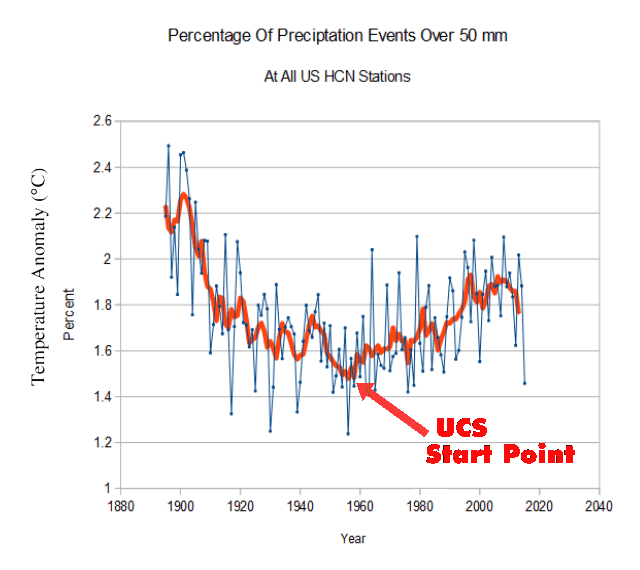
If image does not come up click here
Is the Pentagon hyping climate change?
"Facts" turn out to be fiction. Warmism can't survive the truth
Let’s face it: Climate change can be a murky thing, hard to see and touch in the here and now. Except for some melting icecaps and vanishing species, it’s more future threat than current crisis.
So when the folks at the Pentagon went looking for photos to illustrate how global warming is “already beginning” to affect their 7,000 facilities, they must have been thrilled to discover an alarming image of a four-story building that collapsed when the permafrost melted right out from under it on a military base in Alaska.
There’s just one problem with that photo, which appears on the cover of the “adaptation roadmap” the Pentagon issued last fall: The building is not on a military base. It’s not even in Alaska. It’s in Russia.
Moreover, the collapse of the building, a block of flats above the Arctic Circle in Russia’s eastern reaches, had nothing to do with climate change, according to the photographer, Vladimir E. Romanovsky, a geophysicist at the Permafrost Laboratory at the University of Alaska-Fairbanks. “It’s not global warming; it’s bad maintenance,” Romanovsky said in a telephone interview. “For the whole winter, there was hot water leaking in the basement.”
Pentagon officials were mortified when we here at the Energy and Environment blog alerted them to the photo’s provenance. They quickly swapped it out for an admittedly less dramatic shot of an Alaska roadway buckled by degraded permafrost
“I’m embarrassed about it,” said John Conger, the acting assistant secretary of defense for energy, installations and environment. “The fact of the matter is we shouldn’t have used it. We asked the Army Corps of Engineers for a picture of permafrost damage in Alaska, and this is what they sent us.”
Problem solved! Except that the photo isn’t the only instance of Pentagon climate hype. The agency has been praised for taking a relatively proactive approach, compared with other federal agencies, to a problem that presents undeniable risks to property and national security. But at the Department of Defense, the immediacy of the threat has, at times, been a little overstated.
For example: Conger, who regularly discusses climate change with the press and in other public forums, often mentions that sea-level rise has forced Cape Canaveral Air Force Base to move its launch pads a quarter-mile inland so “they wouldn’t flood anymore.”
But that’s not true, said officials with both the Air Force, which manages one set of launch pads, and NASA, which manages another.
While Cape Canaveral has been battling beach erosion due to stronger storms, its launch pads have never flooded. And while there is a revised development plan for the cape that involves building future launch pads farther back from the sea – an “adaptation strategy for assured national access to space,” as one presentation put it – those launch pads have yet to be built.
In an interview, Conger acknowledged the error. “We’ve done some fact-checking today, because you raised the issue, and what was changed was the master plan,” not the actual location of the launch pads. “I’ve used that example in the past, and I won’t anymore.”
Finally, we come to the example that set this whole line of inquiry in motion: Conger’s assertion that two military bases are running out of water.
“There are a couple bases that run out of water in the West in twenty years,” Conger said last June at a conference on sea-level rise hosted by Sen. Tim Kaine (D-Va.) at Old Dominion University. “What do you do when a base runs out of water? Truck it in like you do in Afghanistan?”
That’s an intriguing question, but one that turns out to be largely theoretical. Because the bases – Fort Irwin National Training Center in California’s Mojave Desert and Mountain Home Air Force Base in the high desert of southern Idaho – are decades away from running out of water.
At Fort Irwin, the Army has implemented a host of conservation measures – landscaping with desert plants rather than grass, for example – that have slashed annual water consumption from 1 billion gallons to around 700 million gallons, sharply extending the life of the existing water supply.
“The current survey from the [U.S. Geological Survey] tells us we have 40 to 50 years of water left,” said Muhammad Bari, director of public works at Fort Irwin.
The three basins that have supplied the fort for decades will eventually run dry, Bari said. But the Army has already identified an alternative water source a few miles away. “So we’ll be able to extend our life for the foreseeable future,” he said.
The situation is similar in Mountain Home, where the latest survey shows the regional groundwater aquifer has a “useful life” of 25 to 30 years, spokesman Shane Mitchell said via email. Because the base is one of Idaho’s largest employers, this news greatly troubled state leaders, who worried that the dwindling water supply might cause bureaucrats in Washington – i.e., Conger — to seek to close Mountain Home.
So last year, Gov. C.L. “Butch” Otter (R) sought and won legislative approval to purchase water rights for the base from the Snake River. And in August, J.R. Simplot Co., the potato company, agreed to sell its rights for $2.5 million.
Now those rights are held by the Idaho Water Resource Board, which will keep them in reserve “until we figure out how to get a project in place to get the water to Mountain Home,” said Brian Patton, the board’s executive director. That project, expected to cost as much as $35 million, involves pumping the water “600 vertical feet out of the canyon and across 11 miles of desert.”
“We’re hoping the Pentagon ponies up a major portion of it,” Patton said. To prod Washington to action, the agreement with Simplot says the company can repurchase the rights if the Pentagon fails to exercise them within seven years.
Presented with these facts, Conger argued that the “water thing” was not an exaggeration on his part. “This is actually a real issue,” he said. “Whether this is climate change or just climate, it’s fair to say we’re newly sensitized to some of these problems because of the focus on climate change” in Washington.
Conger is also in the midst of assessing the vulnerability of the nation’s military bases to other effects of climate change, including sea-level rise, excessive heat and wildfires. A full report is due out later this year.
“There’s been a series of things that we’ve been doing to try and be reasonable,” he said. “The water one is a future issue, identifying what’s coming down the road.”
David Titley, director of the Center for Solutions to Weather and Climate Risk at Penn State University and a former rear admiral in the Navy, said the Pentagon does deserve credit for taking “tangible, discrete actions … to address some of the impacts of climate change,” though few of them are “as exciting as buildings collapsing in the permafrost.” In particular, he said, planning is well underway for one of the most immediate threats: rising tides at Naval Station Norfolk.
Still, “overhyping is just as bad as ignoring or denying,” Titley said. “This is a challenge, not necessarily a crisis.”
SOURCE
Is there such a thing as an earthwide average temperature?
Or is it just a statistical fiction?
by Jeff Jacoby
UNLESS YOU'VE spent the last few weeks in solitary meditation on a remote island, you couldn't miss the wave of media stories breathlessly proclaiming that 2014 was the hottest year in recorded history. As usual, the coverage was laced with alarm about the menace posed by climate change, and with disapproval of skeptics who decline to join in the general panic.
Well, I'm also not a scientist. But I do know that what NASA's Goddard Institute for Space Studies and NOAA's National Climatic Data Center actually reported was rather less categorical than what the news accounts — or the White House — might lead you to believe. As both government agencies made clear in their briefing materials, the likelihood that 2014 was the planet's warmest year is far from a slam-dunk. Indeed, the probability that 2014 set a record is not 99 percent or 95 percent, but less than 50 percent. NOAA's number-crunchers put the probability at 48 percent; NASA's analysis came in at 38 percent.
You don't have to be a scientist to realize that climate is complicated and hard to get right. Climate models have so far been unable to accurately predict changes in global temperature. Experts didn't foresee the global cooling that began in the 1940s and didn't anticipate the warming cycle that started in the late 1970s. Climate science is still in its infancy, and it would be folly to treat any single explanation for changes in global temperatures as impervious to challenge or skepticism.
In fact, the very idea of a "global temperature" is hard to make sense of. How can an entire planet, with its multifarious systems, be said to have a temperature, or even an average temperature?
Averaging is a familiar and useful concept that we use in a myriad of contexts. Average household income, average life expectancy, average weight of airline passengers, average number of earned runs given up by a pitcher, average daily temperature in Waikiki in April — each is a comprehensible and meaningful statistic. But as the authors of a provocative 2007 paper in the Journal of Non-Equilibrium Thermodynamics explain, there are certain kinds of variables that lose all meaning if they are averaged. For example, exchange rates are extremely useful when comparing two currencies. The notion of a "global exchange rate," however, would be absurd.
Temperatures on the earth are in constant flux. They change with latitude, with time of day, with season, with weather; they vary from ocean depths to atmospheric heights, from the equator to the poles. Even assuming that the necessary raw data could be properly gathered, mathematicians must choose among multiple averaging techniques, which can yield flatly contradictory results.
Physically, there is no such thing as the "global temperature trend," the authors conclude. Hence, "ranking this or that year as the 'warmest of the millennium' is not possible, since other averages will give other results with no grounds for choosing among them."
As headline fodder, "warmest year ever" may be irresistible. As an unassailable reality on which critical public policy questions should turn? Be skeptical.
SOURCE
Shell Eyes Arctic Drilling this Summer
Oil major Shell wants to revive its Arctic oil drilling programme this year after a near two-year suspension, angering environmentalists who say the risk of an oil spill is too high.
Remote and costly to develop, the Arctic is estimated to contain 20 percent of the world's undiscovered hydrocarbon resources and despite fierce opposition, plans for drilling north of the Arctic Circle are under way in the United States, Russia and Norway.
Shell, Europe's largest energy firm, is intent on restarting its Arctic drilling campaign in Alaska's Chukchi Sea this summer. It was suspended in early 2013 following the grounding of a drilling rig.
"Will we go ahead? Yes if we can. I'd be so disappointed if we wouldn't," Shell Chief Executive Ben van Beurden told journalists at the company's fourth quarter results conference in London.
The resumption depends on having the logistics in place, receiving necessary permits and fending off a number of legal challenges, he said.
Opposition to the Arctic drilling has been fierce.
"Shell is taking a massive risk doggedly chasing oil in the Arctic, not just with shareholder value, but with the pristine Arctic environment," said Greenpeace environmental campaigner Charlie Kronick in a statement.
"No company is able to operate safely in this remote, fragile ocean where the nearest rescue fleets are hundreds of miles away."
The Anglo-Dutch company has already spent $1 billion on preparing its Arctic drilling work and it is costing Shell several hundred millions of dollars a year even without progressing with drilling, Chief Financial Officer Simon Henry said.
Shell said time was pressing for oil production to start in Alaska as capacity use of a pipeline connecting the remote region to the main North American oil system was falling close to levels at which it cannot operate.
"That means not only new projects wouldn't go ahead but the existing (ones) won't be able to operate either," Henry said.
SOURCE
Markets vs. Mandate: the American energy dilemma
New York State’s fracking ban has evoked strong polarising sentiment. Local anti-fracking supporters welcomed the ban as a necessary intervention against corporations pursuing profits at the expense of local safety. The fracking industry on the other hand, saw it as a political move; an example of political interference in the markets at the expense of jobs, energy security and the principles of enterprise and free markets that America stands for.
This dynamic is symptomatic of a bigger tension between markets and mandate within the US energy industry; one that that lies at the heart of hotly contested issues like the Keystone pipeline and the proposed TTIP EU-US free trade agreement.
And against the backdrop of a President carving out climate action as a top priority, historic US commitments to reducing emissions, a Republican House majority that views Obama’s Environmental Protection Agency as big-government interventionism, and America’s emergence as a global energy producer, how this tension is resolved affects not just the future of American energy, but has wider global ramifications.
Six years ago I wrote in the Financial Times about the need for less interference in European energy markets to enhance competitiveness; a perspective I still find myself inclined towards today, and for good reason.
Take energy security for example. Shifting responsibility for energy security from suppliers to government would reduce, not increase, security. A liberalised market provides strong incentives for producers to diversify supply and respond to consumer demand. OPEC’s current oil price war might even eventually strengthen a fracking industry forced to become more technically innovative and cost efficient to survive, despite the shorter-term challenges.
Then there is the danger of vested interests influencing a wide government mandate and effectively using government as a proxy for their own interests as illustrated by recent alleged links between energy company Devon Energy and Oklahoma Attorney General Scott Pruitt.
And of course there is the notion that climate change justifies state intervention to make cleaner renewables more competitive against oil and gas. But while this is a logical argument, its worth noting that government intervention is at least partly to blame for renewables having less market share in the first place. Federal research for US oil and gas as well as tax credits and subsidies totalling $10 billion between 1980 and 2002 dwarfed state support for renewables, ensuring there was never a level playing field to begin with. And modern-day fracking could not have developed without federal research and demonstration efforts in the 1960s and ’70s.
But as valid as all this is, it fails to tell the whole story.
What makes the energy industry unfortunately unique is the speed with which it could environmentally impact our planet; a factor so exceptional it justifies exceptional action in addressing it, including, if need be, some level of market intervention.
The real problem with the US energy debate is its deep ideological polarisation. Energy discourse is too often pulled towards dogmatic extremes; between those who believe strong government intervention is necessary to further centralise and regulate energy markets, sometimes to the point of protectionism, or conversely those who, as economist Paul Krugman put it when describing the GOP, “believe climate change is a hoax concocted by liberal scientists to justify Big Government, who refuse to acknowledge that government intervention to correct market failures can ever be justified”.
Yet with the looming 2016 Presidential elections, the potential for politicised narratives and populist slogans to take priority over any meaningful measured balance in the US energy discourse is all too real and present.
Somewhere between climate deniers, including prominent GOP members, refusing to acknowledge the need for any climate action, and those attempting to address the problem in a vacuum without considering how sweeping interventionist solutions undermine economic competitiveness (an approach that creates an inevitable political, business and electoral backlash), lie more sustainable, effective solutions. It is vital moderates across the political aisle work together to reach them.
SOURCE
Global Urban Renewal
Al Gore and Felipe Calderon want to stuff you into a box in order to “save the planet.”
An unholy alliance between former president Al Gore, former Mexican president Felipe Calderon, and Britain's Prince Charles, and the entire membership of the World Economic Forum, affectionately nicknamed by its lower echelon members, "The Chicken Little Society," but sourly discouraged by senor members, has formed, and it has a plan for you.
An article by Daniel Greenfield on FrontPage on January 28th put me onto the trail of another horrendous idea from the whirligig mind of Al Gore, "Al Gore Wants to Spend $90 Trillion to Create a World Without Cars."
If you ever wanted to live in a giant slum with no way to get anywhere except by waiting on the poorly operated local public transit system in hock to municipal systems, you can have it for just $90 trillion. Come on. That's pocket change. And just think, you'll be able to live in a horrible futuristic nightmare. (See either "Soylent Green," "Logan's Run," "Metropolis," "THX 1138," or sunless, always-raining Los Angeles in "Blade Runner" for a foretaste of your future - if Gore's fantasy gels into reality.)
"Former Vice President Al Gore and Mexican President Felipe Calderon proposed a $90 trillion plan to redesign every city on earth so that motor vehicles would become obsolete due to more dense populations."
It is a scheme to relieve you of the time, expense, and bother of owning a car. And also of owning your own home, of having nice neighbors, of your privacy, of your career, and of living your own life. Gore and Calderon have better uses for your time on earth as a reckless and irresponsible occupant. Western Journalism reported:
"We cannot have these cities with low density, designed for the use of cars," Calderon said. "We recommend those cities should have more density and more mass transportation."
The better for you to be stamped, hole-punched, assigned a number, and bar-coded so you can be better managed, controlled, redirected, watched, and reduced to serfdom and dependency.
Remember that Calderon was president of a country that keeps sending hordes of illegal immigrants across our border to idle American workers or become welfare state "clients." It's all for your own good. Don't complain. Don't you want a clean, safe, and healthy planet?
No, we can't have "low density" cities. They've got to be evacuated, emptied out, declared forbidden zones, and ploughed under for Mother Earth to reclaim in her own good time. Everyone now living in them should be forcibly moved to the giant, high-density slum where everyone and his mother is underfoot and in the way. In the 1930's and 1940's this was called compulsory "resettlement."
When all cities are scoured of cars, and you have been dispossessed, you will be a displaced person until a walk-in closet has been assigned to you by your friendly government real estate agent or licensed and certified relocater. When your time to "move" comes, remember that you will be allowed to take only what will fit into a carry-on bag, or a back-pack.
You won't be able to escape Gore Town or Calderon Ciudad except with a special travel pass and permit, but they'll be hard to come by because you'll need to have a legitimate purpose for exiting the city. Your sick mother on the other side of the country just won't qualify. She'll need to take her cough medicine by herself. Bereavement leave will never be denied; just don't have so many relatives who may die at any moment.
Gore and Calderon will have taken a leaf from Maryland which taxes rainfall runoff from your property, and imposed a "breathing tax" for every cubic square foot of oxygen you inhale, and also tax your CO2 exhalents, to help control greenhouse gases. After all, plants have got to breathe, too.
It's all for the good of Mother Earth, you see. If you don't buy the Global Warming mantra, then you must be a racist, or a bigot, or are certifiably "disturbed."
Of course, Al Gore, Prince Charles, and Felipe Calderon and others of the elite won't be your next-door neighbors. They'll be living across town in triple-gated enclaves and sanctuaries with guards armed with .50 caliber machine guns fixed with night scopes to deter intrusive burglaries, or resting from their labors in their similarly secured mansions in the countryside. They'll be far away from the noise and ordure of the general population, planning more population engineering controls.
They're saviors of mankind, even though they'll have sentenced it to grinding and perilous poverty. But, after all, isn't life nasty, brutish, and short, for every one of us, except for occasional episodes of numbness? Why would you want to prolong it?
Our and the planet's saviors, of course, will experience the joy of remaking the world in their own minds. You and countless other minions will be but tiny, insignificant elements of a megalopolis tree house world. Still, our saviors will expect to be swamped with expressions of gratitude.
More HERE
***************************************
For more postings from me, see DISSECTING LEFTISM, TONGUE-TIED, EDUCATION WATCH INTERNATIONAL, POLITICAL CORRECTNESS WATCH, FOOD & HEALTH SKEPTIC and AUSTRALIAN POLITICS. Home Pages are here or here or here. Email me (John Ray) here.
Preserving the graphics: Most graphics on this site are hotlinked from elsewhere. But hotlinked graphics sometimes have only a short life -- as little as a week in some cases. After that they no longer come up. From January 2011 on, therefore, I have posted a monthly copy of everything on this blog to a separate site where I can host text and graphics together -- which should make the graphics available even if they are no longer coming up on this site. See here or here
*****************************************
Monday, February 02, 2015
Leftist fantasies don't change much
Psychohistorian Richard Koenigsberg says:
"The question is: what did anti-Semitism mean to people like Hitler, Himmler and Goebbels? Why did the idea of “the Jew” arouse such a passionate, hysterical response? Why did Nazi leaders—and many other Germans—feel it was necessary to destroy or eliminate the Jews, conceiving of the Final Solution as a moral imperative?
Hitler said, “We may be inhumane, but if we rescue Germany, we have performed the greatest deed in the world.” Hitler’s ideology grew out of a rescue fantasy. He wanted to “save the nation.” This is not an unusual motive. Much of politics grows out of this idea that one must act to “save” one’s nation—from external and internal enemies.
Indeed, this motive—the desire to “save one’s nation”—is so ordinary that we barely reflect upon it. What is it that individuals wish to save? What is the nature and meaning of these threats to one’s nation—that often evoke such radical, violent forms of action?"
This is yet another similarity between Greenies and Nazis. Hitler wanted to save Germany and Greenies want to save the planet. Both had/have a central fantasy of themselves as saviours.
Hitler was very socialist. Greenies are very socialist. Hitler fantasized a return to a romanticized rural past. The Greenies fantasize a return to a romanticized rural past. Hitler predicted food shortages as a future policy problem. Greenies predict food shortages as a future policy problem.
The resemblances go on. There is clearly something in human nature (Freud's "Thanatos"?) that emerges in malign form from time to time. It goes at least as far back as ancient Sparta. It may also underlie Islam. Muslims don't seem to care about the environment but they are very collectivist and regard the "Ummah" (Muslim world) in a very mystical way: As a sort of living body that must not lose any of its parts: Very much the way Hitler viewed Germany.
We skeptics are up against some very deep-lying, destructive and irrational instincts.
Another example of Greens using Nazi tactics
Disturbing article reveals what happens if you dare to doubt the Green prophets of doom
David Rose

I've never supported the British National Party or the Ku Klux Klan. I've never belonged to the Paedophile Information Exchange, or denied the Holocaust, or made a penny from the banking crash.
But if you read The Guardian newspaper's website, you might think otherwise. A commentator on it urged my own children to murder me.
He did so because of one of the many stories I've written for this newspaper about climate change. I first reported on the subject nearly six years ago: my article was about the 'climategate' scandal, where leaked emails showed university scientists were trying to cover up data that suggested their claim the world is hotter than at any time in the past 1,300 years may be wrong.
Ever since then, I have been labelled a 'climate change denier' – a phrase which, since I happen to be Jewish, has particularly unfortunate connotations for me.
And this is despite the fact I believe the world IS warming, and that carbon dioxide produced by mankind IS a greenhouse gas, and IS partly responsible for higher temperatures – and have repeatedly said so.
On the other hand, I also think that the imminence of the threat posed by global warming has been exaggerated – chiefly because the grimmer computer projections haven't been reflected by what's been happening recently to temperatures in the real world.
I do believe we should invest in new ways of generating energy, and I hate belching smoke stacks and vast open-cast coal mines as much as anyone who cares about the environment.
But I also think current 'renewable' sources such as wind and 'biomass' are ruinously expensive and totally futile. They will never be able to achieve their stated goal of slowing the rate of warming and are not worth the billions being paid by UK consumers to subsidise them.
Some would say this makes me a 'lukewarmer' – the jargon for someone who is neither a 'warmist' or a 'denier'. But true believers don't recognise such distinctions: to them, anyone who disagrees with their version of the truth is a denier, pure and simple. The result: vitriol directed my way, the like of which I have never experienced in 34 years as a journalist. Lately, it's become worse.
The remark about my children killing me was made some months ago, after The Guardian published one of several critiques of my work by its climate activist blogger, Dana Nuccitelli. One of the online commenters posted: 'In a few years, self-defence is going to be made a valid defence for parricide [killing one's own father], so Rose's children will have this article to present in their defence at the trial.'
Another commenter compared me to Adolf Hitler. Frankly, I didn't take either of them too seriously. But last week on Twitter, someone else wrote that he knew where I lived, and posted my personal phone numbers.
Meanwhile, Nuccitelli had written another vehement attack, this time against Matt Ridley, The Times columnist, Tory peer and fellow 'lukewarmer'. This fresh assault was illustrated by the paper's editors with a grotesque image of a severed head. One who commented, called 'Bluecloud', said: 'Should that not be Ridley's severed head in the photo... Why are you deniers so touchy? Mere calls for a beheading evolve [sic] such a strong response in you people. Ask yourself a simple question: Would the world be a better place without Matt Ridley? Need I answer that question?'
In fact, Bluecloud is a Guardian contributor called Gary Evans, who is also a 'sustainability consultant' funded by Greenpeace.
Ridley complained, but the statements stayed on the website for at least four days. Comments in support of Ridley were removed by the site's moderators, because they did not 'abide by our community standards'. In an email to The Guardian's editor, Alan Rusbridger, Ridley pointed out that a Japanese hostage had just been beheaded by Islamic State.
Language only barely less extreme is now common. In the US, the Nobel Prize-winning economist and New York Times columnist Paul Krugman has written that anyone who denies global warming must be 'punished in the afterlife… this kind of denial is an almost inconceivable sin'.
Observer columnist Nick Cohen says he is sick of hearing climate sceptics whinge that being called 'deniers' equates them with those who deny the Holocaust: 'The evidence for man-made global warming is as final as the evidence of Auschwitz. No other word will do.'
A good clue as to what's making the 'warmists' so much hotter under the collar came last Monday when a Met Office press release stated: '2014 one of the warmest years on record globally.' Normally, one might have expected this to be given widespread coverage by broadcasters and newspapers. In fact, BBC news bulletins ignored it altogether. Only one national newspaper mentioned it.
The reasons? First, because, with admirable precision, the Met Office pointed out that as its measurements of global temperatures come with a sizeable margin of error, 'it's not possible to definitively say which of several recent years was the warmest'. All one could state with confidence was that 2014 was somewhere in the top ten.
Secondly, because the previous week, almost every broadcaster and newspaper in the world had screamed that 2014 was emphatically The Hottest Year Ever. They did so because NASA told them so. Its Goddard Institute for Space Studies (GISS), the custodian of one of the main American temperature datasets, had announced: 'The year 2014 ranks as Earth's warmest since 1880.' If you'd bothered to click on the sixth of a series of internet links listed at the end of the press release, you could have found deep within it the startling fact that GISS was only '38 per confident' that 2014 really did set a record. In other words, it was 62 per cent confident that it wasn't.
Another detail was that the 'record' was set by just two hundredths of a degree. The margin of error was five times bigger. These boring details were ignored. The '2014 was a record' claim went to the very top. President Obama cited it in his State of the Union address. Like the news outlets, it's unlikely he will issue a correction or clarification any time soon.
The larger truth that lies behind The Hottest Year That Probably Wasn't, as it should probably be correctly termed, is the reason why I'm a lukewarmer. The figures show that global warming is proceeding much more slowly than it did in the 1980s and early 1990s, and much slower than computer models project. In 2013, the UN Intergovernmental Panel on Climate Change (IPCC) said that between 1998-2012 the rate was 0.05C per decade. Six years earlier, the same body predicted it would be four times higher – 0.2C per decade.
The global warming 'pause' – the absence of any statistically significant warming trend in surface temperature records – goes back to 1997; 18 years. Satellite measurements say it is even longer than that.
Now, predicting the future is hard. The atmosphere is a complex and chaotic system. Changes in the output of the sun, in levels of soot, the effects of warming on CO2-absorbing plants, clouds and ocean temperature cycles all have potentially big impacts. They don't affect that basic proposition – that human activity causes warming, but do substantially affect its rate – how fast the world is warming.
There is still argument among scientists over just how flawed the models are, but it's clear that if the pause goes on much longer, they will be seen as not fit for purpose.
You might think that some of the high-profile failed predictions of recent years might have induced caution. Al Gore repeatedly suggested that the Arctic would likely be ice-free in summer by 2014. In fact Arctic ice has recovered in the past two years, and while the long term trend is down, it looks likely to last several more decades.
In 2000, East Anglia University's David Viner said within a few years winter snowfall would be 'a very rare and exciting event', and children 'just aren't going to know what snow is'. If you live in Derbyshire, a look at the snowscape outside your window would tell you this is not so.
Tropical storms are often said to be increasing. They may do in future. But they certainly haven't done yet: the trend is flat.
Last winter's UK storms may have dumped slightly more rain than they would have done 50 years ago, because a warmer atmosphere can hold more moisture. But there is simply no evidence that the jet-stream storm track, the phenomenon that barrelled depression after depression towards us, has anything to do with global warming.
In America, the tendency to blame what was once called 'weather' on climate change is especially marked: the bitter 'polar vortex' experienced there in the 2014 winter, last week's no-show 'snowmageddon' in New York and California's (now terminated) drought have all been widely ascribed to it. The same went for Sandy, the storm and tidal surge that drenched New York and New Jersey in 2011. No one wanted to remember that two worse such surges took place in the 1930s, while the continental US is still in the longest hurricane drought (since Wilma in 2005) in recorded history.
But nuance and caution are not what politicians and green activists want, and they insist there is a fixed, known relationship between exact levels of carbon dioxide and future temperatures. Often they add we are perilously close to 'tipping points', when the present, modest warming – an average of 0.12C per decade since 1951 – will suddenly accelerate and become rampant, although the 2013 IPCC report offers little support to such claims.
But ultimately, where are they taking us? Citing climate change is certainly an effective way of making schoolchildren feel fearful and guilty, much as preachers once used to. Yet the 'solutions' orthodoxy advocates – an international, binding emissions treaty and further vast investment in renewables such as wind – haven't worked yet, and it won't work now.
We're in a hole, but we keep digging, enacting unilateral measures in Britain and the rest of the EU which merely make our energy more expensive, and so export jobs to countries which produce higher emissions. The billions being poured by UK consumers into subsidising renewables have succeeded only in creating powerful vested interests, who cloak their greed with green verbiage.
If just a fraction of this money was spent on research into new forms of nuclear reactors, including fusion, where huge progress has been made in the past 20 years, the prospects of developing low carbon energy sources that might actually work would be much greater. In recent cold, still days this winter, windmills were producing just half a per cent of the UK's electricity.
You may not have known such a thing as the Commons Environmental Audit Committee exists. But it does, and last week it recommended a ban on fracking for shale gas in the UK. Natural gas is by far the cleanest fossil fuel. By switching from coal to fracked gas, America has seen huge falls in its emissions. According to the committee, however, fracking 'is incompatible with our climate change targets'.
Which is a shame, because the UK is sitting on vast reserves of a fuel that can end energy insecurity, and provide clean jobs and growth for decades. In the Commons last week, Bristol MP Charlotte Leslie voted in favour of fracking. Afterwards, in indelible red paint, her Bristol office was painted with the words 'fracking whore'.
There is one way the world really is getting hotter, very fast: in the temperature of the climate debate. The reason is simple: in November, there will be yet another vast UN conference, which will try, and fail, to get another legally binding treaty. The search will be futile, because however fierce the green pressure, India, China, Russia and, thanks to the Republican Congress, America, will not sign up to it.
Maybe after that, when the hatred has dissipated a little, the debate we should have started years ago can begin. Because, ultimately, it doesn't matter how hot we think the world might be in 2100: right now, the things greens and politicians are trying to do, cannot and will not work.
Although my children are told in school that views such as mine jeopardise their future, I'm reasonably confident that what I've written here won't induce them to kill me. Whether my online critics encourage them to do so once again, we will have to see.
SOURCE
Deep depression among Warmists
Everybody is ignoring them and the planet isn't helping
I have been researching and writing about anthropogenic climate disruption (ACD) for Truthout for the past year, because I have long been deeply troubled by how fast the planet has been emitting its obvious distress signals.
On a nearly daily basis, I've sought out the most recent scientific studies, interviewed the top researchers and scientists penning those studies, and connected the dots to give readers as clear a picture as possible about the magnitude of the emergency we are in.
This work has emotional consequences: I've struggled with depression, anger and fear. I've watched myself shift through some of the five stages of grief proposed by Elisabeth Kübler-Ross: denial, anger, bargaining, depression, acceptance. I've grieved for the planet and all the species who live here, and continue to do so as I work today.
I have been vacillating between depression and acceptance of where we are, both as victims - fragile human beings – and as perpetrators: We are the species responsible for altering the climate system of the planet we inhabit to the point of possibly driving ourselves extinct, in addition to the 150 to 200 species we are already driving extinct daily.
Can you relate to this grieving process?
If so, you might find solace in the fact that you are not alone: Climate science researchers, scientists, journalists and activists have all been struggling with grief around what we are witnessing.
To see more stories like this, visit "Planet or Profit?"
Take Professor Camille Parmesan, a climate researcher who says that ACD is the driving cause of her depression.
"I don't know of a single scientist that's not having an emotional reaction to what is being lost," Parmesan said in the National Wildlife Federation's 2012 report. "It's gotten to be so depressing that I'm not sure I'm going to go back to this particular site again," she said in reference to an ocean reef she had studied since 2002, "because I just know I'm going to see more and more of the coral dead, and bleached, and covered with brown algae."
Last year I wrote about the work of Joanna Macy, a scholar of Buddhism, eco-philosophy, general systems theory and deep ecology, and author of more than a dozen books. Her initiative, The Work That Reconnects, helps people essentially do nothing more mysterious than telling the truth about what we see, know and feel is happening to our world.
In order to remain able to continue in our work, we first must feel the full pain of what is being done to the world, according to Macy." Refusing to feel pain, and becoming incapable of feeling the pain, which is actually the root meaning of apathy, refusal to suffer - that makes us stupid, and half alive," she told me. "It causes us to become blind to see what is really out there."
I recently came across a blog titled, Is This How You Feel? It is an extraordinary compilation of handwritten letters from highly credentialed climate scientists and researchers sharing their myriad feelings about what they are seeing.
The blog is run and operated by Joe Duggan, a science communicator, who described his project like this: "All the scientists that have penned letters for this site have a sound understanding of climate change. Some have spent years designing models to predict changing climate, others, years investigating the implications for animal life. More still have been exploring a range of other topics concerning the causes and implications of a changing climate.
SOURCE
The Grand Slam of Climate
By Joe Bastardi (Chief forecaster at WeatherBELL Analytics, who make their living by good forecasting)
I introduced something on the O'Reilly Factor several years ago called the “Triple Crown of Cooling.” I called it that because back in 2007 I thought a 20-30 year period of cooling would start, resulting in global temperatures returning to 1978 levels by 2030. I also introduced the concept that this cooling may cause a “time of climatic hardship” — in other words, the natural process of cooling after a process of natural warming could produce an uptick in extreme events. The increase in this is not clear, though one can argue it is occurring off the East Coast. The Atlantic still is in its warm cycle and will be for several more years, so the coastal water is warm. It is the reason I am very worried about the East Coast with hurricanes similar in magnitude to storms of the 1950s, though it has not yet occurred. That’s right – Irene, Sandy and Arthur can’t hold a candle to eight major hurricane hits in seven years. None of the aforementioned storms was major.
The fact is, winters have been getting colder in the U.S., as data compiled by NOAA’s National Climatic Data Center shows. And it’s this onslaught of colder temperatures that is likely the cause for any uptick in snowfall near the East Coast. Once the Western Atlantic cools again, the snows will go back toward normal.

So one would look for clashes naturally near the East Coast – the key word here being naturally – as one can also see that the NCEP CFSR data against satellite era temperatures have started a downturn over the past 10 years.

The point is that all this was introduced years ago during a time where the missive was: Winters won’t be cold and snowy, and the ice cap is melting away. Now I will make another forecast in a five-year increment: At least three of the next five winters will be warmer than average across the eastern U.S. The Great Plains will be back and forth, and the core of the coldest winters will be in the West. Let’s see how I do.
Even though severe cold and enhanced storminess will rule the roost over the next couple of weeks – and we think spring is going to be very late this year for much of the country – spring training for baseball is around the corner, so I decided to rename my climate for “dummies” idea The Grand Slam of Climate.
Let’s ask these questions:
1.) Does the sun have a far greater effect on the climate than CO2?
2.) Do the cycles in the ocean, with the vast amount of the earth’s heat stored in them, have a far greater effect on the climate than CO2?
3.) Do stochastic events (ex-volcanoes, etc.) have a far greater effect on the climate than CO2?
And now I have added the fourth leg, the grand slam:
4.) Does the very design of the system have far greater effect on the climate than CO2?
Quantifying CO2’s effect, with its increase of only one molecule out of every 10,000 molecules of air over a 100-year period, against the grand slam of climate, especially in light of the earth having had ice ages at 7,000 PPM and warmer times at 250 PPM, is grasping at straws at best. Then again, desperate people zealous about another issue would do that if they felt this would help them get their way.
Just ask yourselves these questions above and see what you come up with. It’s not that you’re dumb, it’s just that alarmists think you are. So let’s humor them a bit.
By the way, here’s a fun thing to think about: Mars has an atmosphere with the same percentage of CO2 as Venus, but is much less dense. So why is Mars so much colder than Venus? And just why do those Martian icecaps shrink for years, then expand again? These questions are out of this world; the ones in the Grand Slam of Climate are not.
SOURCE
Is the wind production tax credit dead?
It may be time for the wind energy industry to finally stand on its own two feet.
On January 28, the U.S. Senate defeated an amendment by Sen. Heidi Heitkamp (D-N.D.) in favor of the now-expired wind production tax credit. It failed by a vote of 47 to 51.
And that was merely a “sense of Congress” non-binding resolution in favor of the policy, which funds an inflation-adjusted 2.3 cents per-kilowatt-hour (kWh) tax credit for electricity generated that were constructed before January 1, 2015.
In 2014, it cost taxpayers $6.4 billion paid out to owners and operators of wind turbines.
That credit lasts for 10 years, and so taxpayers are still on the hook until at least January 1, 2025, but as most projects were constructed before 2014, the amount of the credit should gradually be winding down on an annual basis.
Any new wind projects will not be eligible to receive the tax credit, leading American Wind Energy Association head Tom Kiernan to complain, “We worry about the industry going off the cliff again if we don’t get the Production Tax Credit extended as soon as possible.”
Industry experts warn that the tax credit expiration will halt production of new turbines, since current market participants would have a built-in cost advantage versus new entrants into the industry unable to take advantage of the tax incentive.
Such are the perverse incentives Congress creates when it doles out tax subsidies to any industry.
In this case, in 2012 wind only generated $5 billion of revenue, according to the U.S. Census Bureau. Compare that to the $6 billion tax subsidy from that year, estimated by the Joint Committee on Taxation.
By that count, new entrants into the marketplace will be seeing as much as a 55 percent markdown, on average, compared to subsidized competitors.
Which is why the subsidy should be eliminated altogether. It’s the only way to have a truly level playing field with real competition.
Proponents will argue that, actually, this is why the tax credit should be made permanent, a position we’re certain the American Wind Energy Association would support.
But what industry wouldn’t want a permanent, annual subsidy totaling billions of dollars?
Ultimately, it is for Congress to decide whether the cost is worth it to subsidize an industry that only produces 4.5 percent of U.S electricity, according to the Energy Information Agency.
As it is now, the remaining subsidies appear to create a barrier for new wind turbines to be built and thus will impact the growth of the industry by its own admission. And Congress has shown no interest in renewing the tax credit.
Therefore, the only fair way to proceed is to eliminate the remaining subsidies, too. Right?
SOURCE
Can Lisa Murkowski save the Alaska pipeline?
President Obama and his regulators have made the people of the state of Alaska their personal punching bags over the past year with the announcement that an area that is the equivalent of 80 percent of the entire state of West Virginia will be locked away from energy development in the state.
The designation of 12 million acres including the Arctic National Wildlife Reserve as a Wilderness Area has to be agreed to by Congress, but the law puts the land in limbo until Congress either agrees or rescinds the designation.
When coupled with the blocking of off-shore oil development in the Arctic Sea and an attempt to roll back allowed oil development in the National Petroleum Reserve in Alaska.
These actions come on the heels of Obama’s Environmental Protection Agency acting last year to prevent a copper mine from being developed in the southwestern portion of the state on land specifically designated for mining. The EPA action was particularly egregious because it usurped the normal and strenuous federal mine permitting process denying the company developing the area from being able to submit a plan after spending almost half a billion dollars in environmental analysis and engineering.
The reaction from the Alaska Congressional delegation was swift and loud as the President’s actions have the potential of eviscerating the resource development dependent state’s capacity to exist and thrive in the future. The goal of environmentalists is to cut off the supply of oil that flows through the Alaska pipeline and force its closure and dismantling. While the pipeline has proven to have easily coexisted with the various animal species that congregate under it during the bitter cold of an Arctic winter, environmentalists fought it with as much fervor as they are currently devoting to killing the Keystone XL with many of the same arguments.
The development of the Alaska pipeline opened up year round oil development out of the state’s Prudhoe Bay as the black liquid flowed north to south more than 800 miles. Now, due to declining production and the blocking of the development of new oil fields, the pipeline is being choked and with it Alaska’s economy.
It is estimated that almost one-third of all the jobs in the state are petroleum related. If the pipeline dies, those jobs go away, more than 100,000 men and women thrown out of work due to Obama’s efforts.
Ironically, Alaska’s Senior Senator Lisa Murkowski was seen as one of the Republican Senators who President Obama might be able to reach out to in order to build compromise toward his policies. Now, with an existential threat to her state’s economic survival, Murkowski faces the political battle of her life, and has promised to use every tool at her disposal to win it.
If Murkowski, a potential swing vote in the Senate is serious, Obama could face paybacks on his nominees and his entire “all in one” energy strategy could come under withering scrutiny from the Senate Energy Committee that the Alaska Senator chairs. Not to mention finding a closed door as he attempts to push the now Republican U.S. Senate to the left.
The stakes are high. The battle lines are set. And the future of energy and mineral development are on the table. Hardly the kind of conciliatory hand shake Republicans expected from Obama after they chose to work with him on the Cromnibus federal government funding bill in the lame duck session of Congress.
SOURCE
***************************************
For more postings from me, see DISSECTING LEFTISM, TONGUE-TIED, EDUCATION WATCH INTERNATIONAL, POLITICAL CORRECTNESS WATCH, FOOD & HEALTH SKEPTIC and AUSTRALIAN POLITICS. Home Pages are here or here or here. Email me (John Ray) here.
Preserving the graphics: Most graphics on this site are hotlinked from elsewhere. But hotlinked graphics sometimes have only a short life -- as little as a week in some cases. After that they no longer come up. From January 2011 on, therefore, I have posted a monthly copy of everything on this blog to a separate site where I can host text and graphics together -- which should make the graphics available even if they are no longer coming up on this site. See here or here
*****************************************
Sunday, February 01, 2015
The Earth's crust under Iceland is rising -- but why?
We read below: "Compton found the onset of rising temperatures and the loss of ice corresponded tightly with her estimates of when uplift began". But there has been no global warming for 18 years. So has the uplift stopped? Rather to the contrary, it seems. So it must be local warming at work -- probably due to vulcanism.
Note also below: "He added there is geological evidence that during the past deglaciation roughly 12,000 years ago, volcanic activity in some regions of Iceland increased thirtyfold". So if uplift can be related to volcanic activity 12,000 years ago, why not now? QED
A new study has found that as global warming melts the island's great ice caps, the crust is 'rebounding' and rising.
Geologists have long known that as glaciers melt and become lighter, the Earth rebounds as the weight of the ice decreases.
Whether the current rebound geologists detect is related to past deglaciation or modern ice loss has been an open question until now.
Some sites in south-central Iceland are moving upward as much as 1.4 inches per year — a speed that surprised the researchers.
The University of Arizona-led team reports in an upcoming issue of Geophysical Research Letters.
The paper is the first to show the current fast uplift of the Icelandic crust is a result of accelerated melting of the island's glaciers and coincides with the onset of warming that began about 30 years ago, the scientists said.
'Our research makes the connection between recent accelerated uplift and the accelerated melting of the Icelandic ice caps,' said first author Kathleen Compton.
'Iceland is the first place we can say accelerated uplift means accelerated ice mass loss,' Bennett said.
To figure out how fast the crust was moving upward, the team used a network of 62 global positioning satellite receivers fastened to rocks throughout Iceland. By tracking the position of the GPS receivers year after year, the scientists 'watch' the rocks move and can calculate how far they have traveled — a technique called geodesy.
The new work shows that, at least for Iceland, the land's current accelerating uplift is directly related to the thinning of glaciers and to global warming. 'What we're observing is a climatically induced change in the Earth's surface,' Bennett said.
He added there is geological evidence that during the past deglaciation roughly 12,000 years ago, volcanic activity in some regions of Iceland increased thirtyfold.
Others have estimated the Icelandic crust's rebound from warming-induced ice loss could increase the frequency of volcanic eruptions such as the 2010 eruption of Eyjafjallajökull, which had negative economic consequences worldwide.
The article 'Climate driven vertical acceleration of Icelandic crust measured by CGPS geodesy' by Compton, Bennett and their co-author Sigrun Hreinsdóttir of GNS Science in Avalon, New Zealand, was accepted for publication Jan. 14, 2015, and is soon to be published online. The National Science Foundation and the Icelandic Center for Research funded the research.
The team primarily used the geodesy network to track geological activity such as earthquakes and volcanic eruptions.
In 2013, Bennett noticed one of long-running stations in the centre of the country was showing that site was rebounding at an accelerated rate.
He wondered about it, so he and his colleagues checked the nearby stations to see if they had recorded the same changes.
'The striking answer was, yes, they all do,' he said. 'We wondered what in the world could be causing this?'
The team began systematically analyzing years of signals from the entire network and found the fastest uplift was the region between several large ice caps. The rate of uplift slowed the farther the receiver was from the ice cap region.
Other researchers had been measuring ice loss and observed a notable uptick in the rate of melting since 1995.
Temperature records for Iceland, some of which go back to the 1800s, show temperatures increasing since 1980.
To determine whether the same rate of ice loss year after year could cause such an acceleration in uplift, Compton tested that idea using mathematical models. The answer was no: The glaciers had to be melting faster and faster every year to be causing more and more uplift.
Compton found the onset of rising temperatures and the loss of ice corresponded tightly with her estimates of when uplift began. 'I was surprised how well everything lined up,' she said. Bennett said, 'There's no way to explain that accelerated uplift unless the glacier is disappearing at an accelerated rate.'
Estimating ice loss is laborious and difficult, he said. 'Our hope is we can use current GPS measurements of uplift to more easily quantify ice loss.'
The team's next step is to analyze the uplift data to reveal the seasonal variation as the ice caps grow during the winter snow season and melt during the summer.
SOURCE
Senate approves Keystone, Obama veto looms
The Senate voted Thursday to approve the Keystone XL pipeline on a 62-36 vote, setting up a clash with President Barack Obama, who has vowed to kill the bill with just his third veto in six years.
The Keystone bill’s three-week gallop included votes on more than 40 amendments, but the bill still lacks the support in both the Senate and the House to override a presidential veto.
Story Continued Below
Yet the debate drew praise from Democrats and Republicans alike as a sign the Senate had left behind the gridlock that has stymied legislation for years, and it could now pick up its pace while giving the minority a chance to influence policymaking.
But the debate failed to win over any lawmakers from the solid bloc of Democrats who were unwilling to undercut Obama and approve a pipeline that’s long been a top priority for the oil and gas industry.
“Time and time again Republicans pledge their allegiance to foreign special interests above the American middle class,” New York Sen. Chuck Schumer, Democrats’ third-ranked leader, told reporters.
Despite the intensity of the debate in Congress, Keystone is still largely where it began: a symbol to Republicans of the White House’s hostility to fossil fuels, and to Democrats as another effort by GOP to do the bidding of Big Oil.
Senior Republicans have not yet agreed on whether the pipeline bill will head to the House for a second vote, thanks to changes the Senate made this month, or go to bicameral conference talks.
House Speaker John Boehner praised Senate Majority Leader Mitch McConnell “for passing this bill in an open, inclusive, and bipartisan way,” and urged Obama to walk back a threat to veto “this common-sense bill that would strengthen our energy security.”
The White House did not back down, reiterating on Thursday its intention to veto the Keystone bill. Overriding Obama would require four more Democratic votes in the Senate and dozens more in the House, where 28 Democrats joined the GOP in approving the pipeline bill earlier this month.
Obama has not said whether he would approve the permit that would allow TransCanada to build the pipeline that would link Canada’s oil sands to refineries on the U.S. Gulf Coast. The White House has said it opposed the legislation in the Congress because it would remove the decision from the executive branch.
Republicans already are discussing plans to attach the pipeline to upcoming measures that could prove difficult for Obama to reject, such as annual government spending bills.
But the Keystone clock may already be working against them. The State Department has told other federal agencies to weigh in by Monday on its year-old finding that the $8 billion project is unlikely to have a significant environmental impact, an indication that the administration is in the final stages of its six-year Keystone review.
A final recommendation from State on whether Keystone is in the national interest could come as soon as this month. Although there is no binding deadline for Obama to make the final decision on a border-crossing permit for the pipeline, he has repeatedly expressed a dim view of its economic benefits in recent months.
TransCanada CEO Russ Girling praised today’s vote, which he noted was the 10th time the Senate had passed a measure to support the pipeline’s construction.
“Every barrel of Canadian and American oil transported by Keystone XL replaces imports from overseas — and improves U.S. and North American energy independence,” he said in a statement.
American Petroleum Institute CEO Jack Gerard warned that leaving the pipeline in limbo could have a significant impact on oil and gas transportation plans throughout the country.
“The fact is that if all other infrastructure projects are delayed like Keystone XL, we are years away from approving anything that could create jobs and enhance our energy security,” Gerard said in a statement.
Despite the Keystone bill’s poor prospects at becoming law, Senate Republicans welcomed the vote that gave their new majority its first legislative accomplishment and drew three new Democratic supporters — Sens. Michael Bennet (Colo.), Bob Casey (Pa.) and Tom Carper (Del.) — more fully behind their Keystone effort.
In addition to that trio, six Democrats who have previously supported Keystone joined with every Republican to pass the Keystone bill.
Democrats and environmentalists also saw bright spots in the vote: They prevented the GOP from peeling off new Keystone supporters in Obama’s party and opened up some cracks in the Republican’s rhetoric on climate change.
“The only positive aspect of this debate has been that some amendments did put senators on the record on issues that truly matter — starting with climate change,” the Natural Resources Defense Council’s Canada project director, Danielle Droitsch, said in a statement on the Keystone vote.
Tom Steyer, the billionaire environmentalist who poured more than $50 million into Democratic candidates’ campaigns during last year’s midterms, urged Obama to follow up EPA’s carbon regulations and his emissions pact with China by rejecting Keystone to “truly solidify America’s legacy as a global leader on climate.”
SOURCE
New Virginia law protects farmers from meddling local officials
The "Boneta Bill" marks a major victory for grassroots activists over powerful special interests
In a hard-fought and stunning victory for family farmers and property rights throughout the Commonwealth, Gov. Terry McAuliffe (D) March 5 signed into law legislation solidifying Virginia’s status as a right-to-farm state by limiting local officials’ ability to interfere with normal agricultural operations.
The governor’s signature marks the latest chapter in a swirling controversy that attracted nationwide attention in 2012 when the Fauquier County Board of Supervisors forced family farmer Martha Boneta to cease selling produce from her own 64-acre farm. No longer allowed to sell the vegetables she had harvested, Boneta donated the food to local charities lest it go to waste.
Fauquier County officials threatened Boneta with $5,000-per-day fines for hosting a birthday party for eight 10-year-old girls without a permit, and advertising pumpkin carvings. Seeing in the county’s action against Boneta as a brazen effort to drive her off her land, Virginians from all walks of life rallied to her defense. Supporters gathered in Warrenton, the county seat, for a peaceful “pitchfork protest” to vent their anger over what an out-of-control local government had done to a law-abiding citizen.
In the 2013 session of the General Assembly, Rep. Scott Lingamfelter, R-Prince William, spearheaded an effort to undo the injustice inflicted on Boneta, and to protect other small farmers from similar abuse, by strengthening Virginia’s Right to Farm Act. What became known as the “Boneta Bill” passed the House by an overwhelming margin but was killed in a Senate committee.
Undeterred, Boneta and her supporters came back to the General Assembly in 2014 and won wide bipartisan approval for legislation protecting the rights of family farmers. The bill signed by Gov. McAuliffe grew out of legislation developed by Rep. Bobby Orrick, R-Thornburg, and Richard Stuart, R-Montross, and supported by, among others, Sen. Chap Petersen, D-Fairfax.
Backed by the Virginia Farm Bureau, the new law protects customary activities at agricultural operations from local bans in the absence of substantial impacts on public welfare. It also prohibits localities from requiring a special-use permit for a host of farm-related activities that are specified in the bill. The law takes effect on July 1.
“I want to thank Gov. McAuliffe, the members of the General Assembly, and all those who have rallied to the defense of family farmers,” Boneta said. “After all my family and I have been through, it is gratifying to know that an injustice can be undone, and the rights of farmers as entrepreneurs can be upheld thanks to the work of so many dedicated people.”
Successful grassroots effort citizens
Passage of the Boneta Bill was all the more remarkable, because it was entirely a grassroots effort. Supporters of the legislation, none of whom received any compensation for the time and effort they devoted to the cause, flooded the state capitol in Richmond with emails, phone calls, and personal visits with lawmakers to ensure enactment of the legislation.
In contrast, opponents of the bill, including well-funded environmental organizations and power-hungry county governments – both determined to preserve strict land-use controls – reportedly employed lobbyists to kill the bill. In the end, highly-motivated citizens triumphed over highly paid lobbyists.
SOURCE
India unwilling to be treated at par with China on CO2 emissions
India’s resistance to accept a peak year for emissions was a prime reason why US President Barack Obama and Prime Minister Narendra Modi failed to strike a climate deal along the lines of a US-China agreement on emission cuts.
The US wanted India to make specific commitments including a peak year for a new climate treaty to be signed at Paris later this year. But India refused as it feared it would have resulted in the world putting India in the same bracket as China on carbon emissions.
China is the world’s biggest carbon emitter while India is fourth with per capita emissions one-third those of China’s.
“Having a peaking year was not acceptable to us,” said an environment ministry official.
The officials also said the US was not willing to enhance its commitment to climate finance and reiterated that it had already offered to give $1 billion to the Indian Renewable Energy Development Agency (IREDA) for climate finance. India has also been seeking a US commitment to provide adequate funds for adapting to climate change for developing and least developed countries.
Sources said India was also not willing to make any bilateral commitment until India submitted its intended domestically determined contribution (INDCs) to fight climate change to the United Nations by June this year.
India is likely to make its plan of generating 1,00,000 MW of solar power and 55,000 MW of wind power as part of its INDCs, apart from saving upto 20,000 MW of power from introducing energy efficient systems. “We also want to see what other countries will commit in their INDCs,” an official explained.
US Secretary for State John Kerry earlier this month had emphasised that a climate deal with India would be a top priority during Obama’s visit. But the two countries failed to hammer out a deal except for a US commitment to invest in India’s plan to generate 1,00,000 MW of solar power by 2019.
But it is not the end of the road for a Indo-US deal on climate change. The two countries will hold further negotiations on climate change in a working group in the next few months. A source said many issues are on the table and will be discussed in coming months.
SOURCE
Deflating Climate Change
New England Patriots quarterback Tom Brady is dominating the headlines amid allegations of cheating in his team’s 45-7 playoff win over the Indianapolis Colts last week. At least he was – Boston still is the subject of most newswires, but for the past two days that was thanks to an ironically well-timed blizzard, not Brady.
The real DeflateGate, however, is Barack Obama’s negligence concerning foreign affairs while obsessing over things beyond his control. Last week, Yemen fell hostage to Islamic extremists, the latest in a string of countries whose leadership crumbled to radical uprisings. Nevertheless, terrorism’s expanding influence is not what the president chose to emphasize is civilization’s greatest threat during his State of the Union address. No, that would be a perpetual straw man – global warming.
Shortly after delivering self-congratulatory remarks on his counterterrorism policies, Obama proceeded in his SOTU address to declare, “No challenge – no challenge – poses a greater threat to future generations than climate change.” Really, how crazy must one be to worry about getting blown to smithereens or having your throat slit by maniacal fundamentalists when the oceans might rise a bit within the next century? And here we thought the president already had that situation under control. In 2008, the story was that Obama’s inauguration would mark “the moment when the rise of the oceans began to slow and our planet began to heal.” Six years later, the world is going up in flames, and it’s not because of a man-made fever.
“2014 was the planet’s warmest year on record,” said the lecturer in chief, a statistic that was the conclusion of a new report by NOAA’s National Climatic Data Center. According to NOAA, earth’s average temperature last year was 1.24°F above average – sea surface temperatures were the highest on record (1.03°F above average), while land temperatures came in fourth place (1.80°F above average).
Even if we take the government at its word and assume last year was indeed the warmest – since records began in the late 1800s, it’s important to note – the report lacked two particularly big disclaimers.
For starters, last week the Daily Mail revealed, “The margin of error is said by scientists to be approximately 0.1C. … As a result, GISS’s [Goddard Institute for Space Studies] director Gavin Schmidt has now admitted [government officials believe] the likelihood that 2014 was the warmest year since 1880 is just 38 per cent.” Incredibly, the trumpeted “consensus” appears suddenly irrelevant.
Second, Obama’s ensuing remark is simply unfounded: “Now, one year doesn’t make a trend, but this does: 14 of the 15 warmest years on record have all fallen in the first 15 years of this century.” According to Remote Sensing Systems (RSS) satellite data, the staple of modern temperature recordings, the globe has experienced no observable warming now for more than 18 years. NOAA omitted that inconvenient truth, however, because the nearly two-decade long hiatus doesn’t fit the narrative.
It seems Mother Nature presents a twist every time envirofascists open their petulant mouths – and indeed, drivers on Monday’s snarled I-95 corridor would have enjoyed some global warming. Tom Brady may be tossing under-inflated footballs, but the narcissist in chief has been prematurely spiking the ball ever since he entered the Oval Office, all while destroying our Liberty, one policy at a time. Unless America begins taking seriously the real DeflateGate, the only thing we’ll be left with is a Hail Mary.
SOURCE
Russian sponsorship of Green groups?
A shadowy Bermudan company that has funneled tens of millions of dollars to anti-fracking environmentalist groups in the United States is run by executives with deep ties to Russian oil interests and offshore money laundering schemes involving members of President Vladimir Putin’s inner circle.
One of those executives, Nicholas Hoskins, is a director at a hedge fund management firm that has invested heavily in Russian oil and gas. He is also senior counsel at the Bermudan law firm Wakefield Quin and the vice president of a London-based investment firm whose president until recently chaired the board of the state-owned Russian oil company Rosneft.
In addition to those roles, Hoskins is a director at a company called Klein Ltd. No one knows where that firm’s money comes from. Its only publicly documented activities have been transfers of $23 million to U.S. environmentalist groups that push policies that would hamstring surging American oil and gas production, which has hurt Russia’s energy-reliant economy.
With oil prices plunging as a result of a fracking-induced oil glut in the United States, experts say the links between Russian oil interests, secretive foreign political donors, and high-profile American environmentalists suggest Russia may be backing anti-fracking efforts in the United States.
The interest of Russian oil companies and American environmentalist financiers intersect at a Bermuda-based law firm called Wakefield Quin. The firm acts as a corporate registered agent, providing office space for clients, and, for some, “managing the day to day affairs,” according to its website.
As many as 20 companies and investment funds with ties to the Russian government are Wakefield Quin clients. Many list the firm’s address on official documentation.
Klein Ltd. also shares that address. Documents filed with Bermuda’s registrar of companies list just two individuals associated with the company: Hoskins, Wakefield Quin senior counsel and managing director, and Marlies Smith, a corporate administrator at the firm.
According to documents filed with Bermuda’s registrar of companies, Klein Ltd. was incorporated in March 2011 “exclusively for philanthropic purposes,” meaning “no part of the net earnings … inures to the benefit of any private shareholder or individual.”
“The company does not propose to carry on business in Bermuda,” the documents stated.
The only publicly available documentation of any business conducted by Klein Ltd. were two Internal Revenue Service filings by the California-based Sea Change Foundation, which showed that Klein had contributed $23 million to the group in 2010 and 2011. Klein Ltd. was responsible for more than 40 percent of contributions to Sea Change during those years.
The foundation passed those millions along to some of the nation’s most prominent and politically active environmentalist groups. The Sierra Club, the Natural Resource Defense Council, Food and Water Watch, the League of Conservation Voters, and the Center for American Progress were among the recipients of Sea Change’s $100 million in grants in 2010 and 2011.
Neither Wakefield Quin nor Sea Change responded to multiple requests for more information about their relationships with Klein Ltd.
“None of this foreign corporation’s funding is disclosed in any way,” the Senate Environment and Public Works Committee wrote of the company in a report last year. “This is clearly a deceitful way to hide the source of millions of dollars that are active in our system, attempting to effect political change.”
The Sierra Club, which received nearly $8.5 million from Sea Change in 2010 and 2011, launched its “Beyond Natural Gas” campaign the following year. The effort has become one of the largest and best-funded environmentalist campaigns combating fracking and the extraction of natural gas in general.
Sea Change’s “skeletal staff quietly shovels tens of millions of dollars out the door annually to combat climate change. And that’s pretty much all it does,” noted Inside Philanthropy, which awarded the foundation its “sharpest laser focus in grantmaking” award last year.
Nathaniel Simons and his wife run the foundation and are, except for Klein Ltd., its only donors. Simons, a hedge fund millionaire who commutes to work across San Francisco Bay aboard a 50-foot yacht, also runs a venture capital firm that invests in companies that benefit from environmental and energy policies that Sea Change grantees promote.
Simons himself has ties to Klein Ltd. Several Wakefield Quin attorneys are listed as directors of hedge funds that his firm manages, and in which Sea Change has assets.
Senior counsel Rod Forrest was listed on documents filed with the Securities and Exchange Commission as a director of two investment funds, Medallion International Ltd. and Meritage Holdings Ltd., in which Sea Change had tens of millions invested while it received money from Klein Ltd.
Simons’ company runs the Meritage Fund. The Medallion Fund is run by Renaissance Technologies, the hedge fund management firm run by his father, billionaire and Democratic mega-donor Jim Simons. Both funds listed Wakefield Quin’s Hamilton, Bermuda, address on SEC filings.
Wakefield Quin’s Hoskins and Smith, as well as a number of other employees of Wakefield Quin, have worked in some capacity for companies or investment funds owned by or tied to Russian state-owned corporations and high-level officials in the country.
Hoskins, Forrest, and another Wakefield employee named Penny Cornell were all listed as executives of Spectrum Partners Ltd., a fund with offices in Moscow, Cypress, and Bermuda, Cornell at the address of Wakefield Quin’s offices.
According to a performance report for one of Spectrum Partners’ funds, its portfolio consisted of “Russian and CIS [former Soviet state] securities and securities outside of Russia or CIS but having significant economic or business involvement with Russia and/or CIS.”
As of 2008, more than half of the fund’s holdings were in the oil and gas sectors.
Numerous executives at Wakefield Quin have ties to Russian oil and gas companies, including Rosneft, which is majority-owned by the Russian government and in 2013 became the largest oil company in the world.
Hoskins is the vice president of a London-based company called Marcuard Services Limited, and a member of the firm’s board, according to its website.
The company’s president, and the chairman of its parent company, Bermuda-based Marcuard Holding Limited, is Hans-Joerg Rudloff. Rudloff is also a former vice-chairman of the Rosneft’s board.
Hoskins is also a director at a Bermuda-based subsidiary of Russian investment bank Troika Dialog. That firm organized an initial public offering for Timan Oil & Gas, which is run by Russian oligarch Alexander Lebedev.
The Environmental Policy Alliance, which provided the Washington Free Beacon with a copy of an upcoming report on Klein Ltd.’s Kremlin ties, said Wakefield Quin’s ties to environmental financiers and Russian oil barons merit closer scrutiny.
“The American public deserves to know whether environmentalists are attacking US energy companies at the behest of a Russian government that would like nothing more than to see their international competition weakened,” Will Coggin, a senior research analyst at the EPA, said in an emailed statement.
“In the face of mounting evidence, environmental groups are going to have to start answering hard questions about their international funding sources,” Coggin said.
The overlap between executives at firms with ties to Russian oil interests and a multi-million-dollar donor to U.S. environmentalist groups has some experts worried that Russians may be replicating anti-fracking tactics used in Europe to attack the practice in the United States.
“I have met allies who can report that Russia, as part of their sophisticated information and disinformation operations, engaged actively with so-called non-governmental organizations—environmental organizations working against shale gas—to maintain European dependence on imported Russian gas,” Anders Fogh Rasmussen, formerly NATO’s secretary general, said last year.
It is unlikely that the Kremlin is directly involved in doing so in the United States, according to Ron Arnold of the Center for the Defense of Free Enterprise.
“If anybody in Russia is behind all the secretive Bermuda investment house and law firm action, it’s most likely some oligarch bidding against U.S. competition,” he said in an email.
Arnold, the author of Undue Influence: Wealthy Foundations, Grant Driven Environmental Groups, and Zealous Bureaucrats That Control Your Future, said that the opacity of Klein Ltd.’s involvement with the Sea Change Foundation exemplifies attempts to shield the source of donations to such groups.
“In my experience of trying to penetrate offshore money funnels for U.S. leftist foundations and green groups, I have found that Liechtenstein, Panama and Bermuda are the Big Three green equivalents of the Cayman Islands for hedge fund managers—totally opaque and impervious to my specially designed research tools,” Arnold said.
SOURCE
***************************************
For more postings from me, see DISSECTING LEFTISM, TONGUE-TIED, EDUCATION WATCH INTERNATIONAL, POLITICAL CORRECTNESS WATCH, FOOD & HEALTH SKEPTIC and AUSTRALIAN POLITICS. Home Pages are here or here or here. Email me (John Ray) here.
Preserving the graphics: Most graphics on this site are hotlinked from elsewhere. But hotlinked graphics sometimes have only a short life -- as little as a week in some cases. After that they no longer come up. From January 2011 on, therefore, I have posted a monthly copy of everything on this blog to a separate site where I can host text and graphics together -- which should make the graphics available even if they are no longer coming up on this site. See here or here
*****************************************
Subscribe to:
Posts (Atom)


 Jim Hansen and his twin


