Tuesday, June 19, 2012

Wind farms to lose subsidies by 2020, says British government minister

Taxpayers could stop subsidising onshore wind farms and solar power providers by the end of the decade, ministers claim. Cabinet Office Minister Oliver Letwin has confirmed that financial support – currently worth around £400million – will have ‘disappeared’ by 2020.

George Osborne is believed to be arguing for a 25 per cent cut in renewable energy subsidies. But Mr Letwin revealed in an email to a campaigner that the cut could go much further.

‘I anticipate subsidies… will come down to zero over the next few years and should have disappeared by 2020, since these forms of energy are gradually becoming economic without the need for subsidies,’ he told Terry Stewart, president of the Dorset branch of the Campaign for the Protection of Rural England.

Mr Stewart, who had written to Mr Letwin – his MP – to complain about plans for 160 wind turbines in Dorset, said: ‘The subsidy for wind turbines is iniquitous – it is a stealth tax.

‘It is being paid out to rich land owners and foreign energy companies and developers.’ Electricity companies have to pay twice the market price for energy from onshore wind farms. This is then passed on through higher bills.

While the Lib Dems are in favour of subsidising ‘green’ energy, more than 100 Tory MPs wrote to David Cameron in January to urge him not to blight the landscape with turbines. There are currently more than 3,000 onshore wind turbines in Britain, with another 4,500 expected to be erected.

Tory MP Chris Heaton-Harris said: ‘This policy is not green, progressive or sensible. The Chancellor should take an axe to these subsidies.’

The revelation is embarrassing for Deputy Prime Minister Nick Clegg, due to attend the United Nations Rio+20 Earth Summit in Brazil tomorrow. The Lib Dem leader has argued national wealth should also be measured by how clean a country’s environment is, rather than just how much money it earns.

Ed Davey, the Liberal Democrat Energy Secretary, will announce details of subsidies for renewable energy from 2013 to 2017 in the next few weeks. It will follow a consultation on whether subsidies should be cut by more than 10 per cent.

John Constable, director of the UK charity Renewable Energy Foundation, said: ‘Extremely high subsidies have harmed the reputation and integrity of the renewables sector, which has been corrupted by easy money and undeserved fortunes.

‘Reductions in subsidies are welcome, but may not be enough to protect the consumer in very hard times, and retrospective cuts, supported by windfall taxes, cannot be ruled out.’

A Department of Energy and Climate Change spokesman said the 2020 date referred to by Mr Letwin was an ‘aspiration’. She added: ‘It is always our aspiration to end subsidies for any energies.’

SOURCE


USA: Wind Farms Canceled, Layoffs Starting

Government dependence is risky business

The major federal tax and grant subsidies for windpower and other qualifying renewables are scheduled to expire at year-end. And claims of robust economics, competitiveness, and growth have given way to fear of a freer, less preferential market in 2013 and beyond. Wind’s artificial boom/upcoming bust is the risky business of political capitalism.

Last Friday’s edition of Environment & Energy Daily ran this story (sub. req.):

The American Wind Energy Association estimates that 10,000 jobs will be lost by September — primarily among manufacturers of wind turbines and components facing a dearth of orders for next year. By the end of the first quarter of 2013, the industry will have shed about 37,000 jobs without quick action on a PTC renewal, according to a widely cited study AWEA commissioned from Navigant Consulting. The industry estimates it employed about 78,000 people at the beginning of this year.

So in the next six-to-nine months, nearly one-half of the industry’s jobs will be gone just because a special tax break has lapsed? How lousy is this industry? What have we gotten for decades and tens of billions of dollars expended to date?

And what is the plan for the inevitable task of dismantling the industrial wind turbines that no longer spin but look like some industrial death scene from Planet of the Apes?

Competitive–or Almost So?

What about the repeated claims that windpower is almost competitive? Back in 1986, a representative of the American Wind Energy Association told Congress:

The U.S. wind industry has … demonstrated reliability and performance levels that make them very competitive. It has come to the point that the California Energy Commission has predicted windpower will be that State’s lowest cost source of energy in the 1990s, beating out even large-scale hydro. [1]

He added: “We are not quite there. We have hopes.”

Just last week (26 years later!) a new report from the United Nations Environment Program (UNEP) and the Renewable Energy Policy Network for the 21st Century stated that wind will be “fully competitive” with gas-fired power generation by 2016.

As reported by North American Windpower:

Based on current trends, it is predicted that the average onshore wind project worldwide will be fully competitive with combined-cycle gas turbine generation by 2016 – even in the U.S., where gas prices are expected to rebound to a point where they cover the cost of extraction, UNEP says. At present, this is true only of a minority of wind projects – those that use the most efficient turbines in locations with superior wind resources.

Such is just the latest in a long list of false hopes, exaggeration, and falsified promises from the industrial wind lobby. They present half-truths, white lies, and falsehoods to get taxpayer/ratepayer subsidies, and then warn against losing jobs to try to keep the government largesse going.

The same will be true in the future, as it has been in the past. Such is the inherent fate of dilute energy that is higher cost and intermittent, requiring blending with dense, reliable energy.

Doom-and-Gloom

Back to the E&E News piece, here is more angst from the proponents of extending the PTC:

Wind farm developers generally say they have placed few, if any, turbine orders for next year because of uncertainty over the PTC’s fate, and several companies have already announced plans to cancel or suspend projects that already have been in development.

Just this week, developer Gamesa canceled a 30-turbine project in Pennsylvania, the third project cancellation in that state in less than a month, following Iberdrola Renewables’ decision in May to abandon two planned wind farms, according to press reports. Also last month, Invenergy delayed until at least 2015 plans for a 15- to 18-turbine wind farm in Roanoke, Va., citing uncertainty around the production tax credit.

NRG Systems, which manufactures turbine components, announced last month it would lay off 18 employees to reduce its work force to 100, with the company’s CEO saying at the time that the decision was required in the face of a “deeply unstable” industry.

“The constant threat of expiration of the PTC is an example of how government can negatively impact the private sector. … And the slowdown in the wind sector because of the games that Congress is playing with the PTC should serve as a canary in the coal mine for the broader economy,” said Joshua Freed, who directs the clean energy program at the centrist think tank Third Way.

Time is of the essence because of the 12- to 18-month lead time wind farms require before they can become operational and begin generating the tax benefits, industry sources say. Even if the credit is extended in November or December, industry representatives predict a significant downturn in 2013 compared to what is expected to be a banner year for turbine deployment this year.

The good news? Resources wasted in the wind sector can be redeployed in the resource-needy oil and gas sector! To wit: Dear Wind Industry: We Need Your Workers and Materials (and taxpayers need your cessation).


SOURCE


The environmental importance of a market economy

Vuk picks up on an important point about the Soviet economy of old. Growth in that economy was almost entirely a matter of greater inputs into the economy. This is a strategy that clearly runs out of steam when you've no more inputs to add: and run out of steam that sort of economy did. But we can take this argument further, as Paul Krugman did when examining the Japanese economy of the 80s and 90s. Here.
How, then, have today's advanced nations been able to achieve sustained growth in per capita income over the past 150 years? The answer is that technological advances have led to a continual increase in total factor productivity--a continual rise in national income for each unit of input. In a famous estimate, MIT Professor Robert Solow concluded that technological progress has accounted for 80 percent of the long-term rise in U.S. per capita income, with increased investment in capital explaining only the remaining 20 percent....()......But what they actually found was that Soviet growth was based on rapid--growth in inputs--end of story. The rate of efficiency growth was not only unspectacular, it was well below the rates achieved in Western economies. Indeed, by some estimates, it was virtually nonexistent.

What it boils down to uis that it is the strictures of the market that lead to that greater efficiency and technological progress. William Baumol has noted the reason why: either system can create the inventions, make the new technology. But only a market based system gives the freedom to experiment with it to increase that efficiency and then, as others become more efficient, that impetus for others to adopt in order not to go bankrupt.

The most important lesson of which in modern terms is for the various greens and environmentalists. If you really do want an economy in which resource use is reduced then you really do need to have a market economy. For planned ones just aren't any good at increasing efficiency: efficiency meaning here a reduction in resource use for any given level of output.

And when I meet, if I ever do, another environmentalist like me who argues for the free market precisely because it is environmentally sound to do so I shall rejoice. Until then, looking at the greens that we do have I can only consider them with horror. Why is it that they continually argue for policies like planning so inimical to their actual desire, reduced resource use?

SOURCE


Mr. Smoot vs. the Smart Meter: “Underground movement” goes mainstream

On Thursday the battle against mandatory Smart Meter deployment was taken up by the Ft. Worth Star-Telegram's popular Watchdog columnist Dave Lieber.

Lieber covered background on what he called an "underground movement" against Smart Meters, reported on the current state of affairs and gave precise information on how and where to send comments to the PUC in his article, "Give Texas Public Utility Commission your opinion on smart electric meters."

Nationwide attention like this coupled with attacks on their profits are making public utilities pay attention. Yes, attacks on their profits.

Like computer geeks who hack into their high school's computer and change their failing grade to an A, people are hacking their own Smart Meters, and other people's meters for profit, changing the settings so the meters report lower usage than is actually being consumed.

According to KrebsOnSecurity.com, this can be done "using software that can be downloaded from the Internet and it "may have cost a single US electric utility hundreds of millions of dollars annually."

While libertarians would never condone theft of services this may be the one issue that will finally get the attention of America's corporatist-statist monopolist electric utility companies and make them pause in their headlong rush to deploy their not-so-smart meters on the nation's not-so-smart electric grid.

Certainly customer complaints about inaccurate readings, health and safety concerns, radiofrequency interference and privacy issues haven't deterred them a bit here in North Texas.

On June 4 Cindy Carriger of RefuseSmartMeters told the Dallas Libertarian Examiner, "I was called back by Oncor and they assured me there is no opt-out list or waiting list."

Neither the Ft. Worth resident code-named Mr. Smoot (his name is an acronym for Smart Meter Opt Out Texan) nor the Dallas Libertarian Examiner received any reply to their inquiries.

(And sure enough, Installer Number 5 knocked on Smoot's door even as this article was being written.)

Carriger continued the pressure. On June 5 she organized a meeting in Bedford which was attended by several dozen concerned citizens and one Dallas Morning News reporter/photographer who posted his article that evening.

That story quotes what is apparently the first Texas politician, Sen. Dennis Bonnen, R-Angleton, to demand legislation "requiring utilities to allow customers to decline a Smart Meter" if the PUC doesn't set up an opt-out program "pronto."

No longer can detractors call Smart Meter resisters conspiracy nuts. It's mainstream now.

SOURCE


“Sustainable justice” = redistribution of SCARCITY

The UN Rio+20 agenda means less freedom, happiness, true justice and human rights progress

Presidential candidate Barack Obama promised that his Administration would “fundamentally transform the United States of America.” He gave a clue to exactly what he had in mind when he told now-congressional candidate Joe “The Plumber” Wurzelbacher: “When you spread the wealth around, it’s good for everybody.”

Not necessarily – especially when activists, regulators, politicians and ruling elites do all they can to ensure there is less and less wealth to spread around.

Just this week, the Civil Society Reflection Group on Global Development Perspectives released a new report to the United Nations Rio+20 Earth Summit on Sustainable Development. The executive summary of No Future Without Justice begins with the heading, “The World Is in Need of Fundamental Change.” The document then offers “solutions,” which include “universal fiscal equalization” and a “massive and absolute decoupling of well-being from resource extraction and consumption.”

The 18-member Group includes no Americans – but condemns the US and other governments for their dedication to economic growth, rather than wealth redistribution, and demands that governments play a key role in promoting “sustainability” and welfare. They insist that all governments provide universal access to public health care, guaranteed state allowances for every child, guaranteed state support for the unemployed and underemployed, and basic universal pensions and universal social security.

It is, in short, the total nanny state – but with little or no resource extraction or economic growth to support it. In other words, it guarantees sustained injustice and redistribution of increasing scarcity.

The Group admits that human civilization “will still need some form of growth in large parts of the world, to expand the frontiers of maximum available resources for poor countries.” However, the massive investments needed to shift to a totally renewable energy and resource-based economy will require “massive de-growth (shrinkage) of products, sectors and activities that do not pass the sustainability test” – as devised by them, affiliated organizations and the United Nations Environment Programme (UNEP).

Key financial support for the push toward “sustainability” includes a “greener” and “more progressive” tax system featuring a financial transaction tax, abolition of subsidies for all but renewable energy, cutting military spending while dramatically increasing “stimulus” spending, a compensation scheme to pay off “climate debts” to poor countries supposedly impacted by hydrocarbon-driven climate change, a new regulatory framework for financial markets, a financial product safety commission, and still more regulations for hedge funds and private equity funds. The Group also demands public control of financial rating agencies and a government takeover of international accounting standards.

To ensure that “sustainable development” permeates every aspect of society, the Group proposes a new “Sherpa” for Sustainability (with cabinet rank), a parliamentary committee on policy coherence for sustainability, a UN Sustainability Council, a Universal Periodic Review on Sustainability, and an Ombudsman for Intergenerational Justice and Future Generations. It also proposes an International Panel on Sustainability that builds on the “success” of the Intergovernmental Panel on Climate Change.

Of course, guiding all this would be the world’s premiere political body and bastion of freedom, fairness, democracy and human rights – the UN General Assembly.

To guide this “fundamental” shift toward the sustainability paradigm, the Group laid down eight principles – the key being the “precautionary principle,” which forbids any activity that might involve risk or “do harm.” Its own sustainability prescriptions are, of course, exempted from any reviews under the precautionary principle.

The objective, they state, is to build economies that drastically limit carbon emissions, energy consumption, primary resource extraction, waste generation, and air and water pollution. Society must also stop the asserted and computer-modeled loss of species and ruination of ecosystems.

All this naturally will require mandatory changes in consumption patterns and lifestyles (at least for the common folk), and the recognition that work (unlike capital) is not a production factor. Indeed, says the Group, work is not even a commodity. Moreover, only “decent” work qualifies under the sustainability paradigm. (While “decent work” is never defined, it presumably includes backbreaking sunup-to-sundown labor at subsistence farming, which under the Group’s agenda would be called “traditional” or “organic” farming and would not be replaced by modern mechanized agriculture.)

What is the source of all of this gobbledygook? Agenda 21, the centerpiece of the original Rio Earth Summit – which is being perpetuated, refined and redefined at parallel proceedings in Belo Horizonte, Brazil, while the main sustainability discussions are ongoing in Rio de Janeiro.

Agenda 21 states, for example, that “achieving the goals of environmental quality and sustainable development will require ... changes in consumption patterns.” This too would be achieved under UN auspices because, as Earth Summit creator Maurice Strong has explained, the days of national sovereignty are over, and the world needs to embrace a system of wealth transfer to ensure environmental security.

In short, “sustainable development” is a system that requires a redefinition of business activity, away from the pursuit of personal profit – and of government activity, away from the pursuit of individual happiness and justice – and toward the pursuit of societal good, as defined by activists and the UN.

Simply put, as Brian Sussman points out in his new book, Eco-Tyranny, the ultimate goal of those who endorse the sustainability paradigm is to expunge “the most precious” rights expressed in the American Declaration of Independence: “that all Men are created equal, that they are endowed by their Creator with certain unalienable Rights, that among them are Life, Liberty and the Pursuit of Happiness – that to secure these Rights, Governments are instituted among Men, deriving their just Powers from the Consent of the Governed.”

The Agenda 21 and sustainability paradigm also rejects and undermines Adam Smith’s belief that mankind’s natural tendency toward self-interest, profit and self-improvement results in greater prosperity, opportunity, health, welfare and justice for all.

Most of all, the UN/Maurice Strong/ Civil Society Reflection Group vision is merely the latest embodiment of Plato’s Republic. Under Plato’s thesis, an educated, elite, but benevolent and mythical, ruling class acts on the belief that its self-appointed philosopher kings have all the right answers, and do not require the Consent of the Governed. The rest of humanity must fall into lockstep or face the consequences; however the results will be exemplary.

Unfortunately, as Alexander Hamilton observed, men are not angels. Moreover, it defies experience and common sense to suppose that the elitist UN, UNEP and environmental activist community will ever display wisdom detached from ardent ideology – or benevolence toward the humans they seek to govern.

SOURCE


Are fatties starving the poor?

The familiar zero-sum game fallacy

Overweight people are a threat to future food security and increasing population fatness could have the same implications for world food demands as an extra billion people, researchers have found.

Scientists from the London School of Hygiene and Tropical Medicine examined the average weight of adults across the globe and said tackling population weight was crucial for food security and ecological sustainability.

The United Nations predicts that by 2050 there could be a further 2.3 billion people on the planet and that the ecological implications of the rising population numbers will be exacerbated by increases in average body mass.

The world's adult population weighs 287 million tonnes, 15 million tonnes of which is due to being overweight and 3.5 million tonnes to obesity, according to the study, which is to be published in BMC Public Health.

The data, collected from the UN and the World Health Organisation, shows that while the average global weight per person is 62 kilograms in 2005, Britons weighed 75 kilograms. In the US, the average adult weighed 81 kilograms. Across Europe, the average was 70.8 kilograms compared with just 57.7 kilograms in Asia.

More than half of people living in Europe are overweight compared with only 24.2 per cent of Asian people. Almost three-quarters of people living in North America are overweight.

Researchers predict that if all people had the same average body mass index as Americans, the total human biomass would increase by 58 million tonnes.

The authors of the study say the energy requirement of humans depends not only on numbers but average mass.

"Increasing biomass will have important implications for global resource requirements, including food demand and the overall ecological footprint of our species," they wrote.

"Although the concept of biomass is rarely applied to the human species, the ecological implications of increasing body mass are significant and ought to be taken into account when evaluating future trends and planning for future resource challenges. Tackling population fatness may be critical to world food security and ecological sustainability."

Professor Ian Roberts, who led the research at LSHTM, said: "Everyone accepts that population growth threatens global environmental sustainability - our study shows that population fatness is also a major threat."

SOURCE

***************************************

For more postings from me, see DISSECTING LEFTISM, TONGUE-TIED, EDUCATION WATCH INTERNATIONAL, POLITICAL CORRECTNESS WATCH, FOOD & HEALTH SKEPTIC, GUN WATCH, AUSTRALIAN POLITICS, IMMIGRATION WATCH INTERNATIONAL and EYE ON BRITAIN. My Home Pages are here or here or here. Email me (John Ray) here. For readers in China or for times when blogger.com is playing up, there are mirrors of this site here and here

*****************************************

Monday, June 18, 2012

A suppressed truth

Greenies mainline on ice-core records -- but are those records on their side? Some findings have just leaked out in New Zealand which say not

Al Gore’s movie and book, “An Inconvenient Truth” convinced John Key and many other New Zealand politicians that catastrophic climate change was real and happening in their time, thanks largely to a now discredited temperature graph known as “the hockey stick”.

But now a real temperature graph using ice core data from Antarctica shows just how much the public and politicians were conned. The Law Dome ice core study has been languishing unpublished for more than a decade, and the picture below, featuring global temperatures on the vertical axis and the years in AD on the horizontal, shows modern temperatures are cooler than they were a thousand years ago.


How, you may ask, does an ice-core at -70 below in Antarctica measure global temperatures? Certain Oxygen isotopes are more prevalent in warmer climates, and less prevalent in the cold, and after adjusting for the known location scientists can establish – from when the oxygen was captured in the ice – how warm the circulating global atmosphere was at the time.

In comparison, the discredited “Hockey Stick” tries to suggest modern temperatures are hotter than ever.

SOURCE


It's no wonder the world's cooling on climate change

By James Delingpole, writing from England

They used to call it ‘Flaming June’. Nearer the mark today would be ‘Flaming ruddy awful June’. We are on the cusp of the Summer Solstice (starting on Wednesday evening), in the wake of the wettest April on record and in the midst of what promises to be a June that is both record-breakingly damp and 1.4C cooler than average. Out of our rain-streaked windows we spy leaden skies, louring clouds and oily puddles.

Of course, you are not supposed to ask yourselves: ‘Whatever happened to global warming?’

Not even if you say it particularly quietly, or as a joke. If you do, chances are you will be sharply reminded that ‘weather is not the same as climate’.

This is true. But it’s also a bit of a cop-out. After all, as most of us are now aware, there has been no ‘global warming’ since 1998, which is when the curve on the graph goes flat.

In the eternally moving battlefield of claim and counter-claim in the great climate change debate, even the fervently warmist Professor Phil Jones – of the University of East Anglia’s Climatic Research Unit – concedes that there has been no ‘statistically significant warming’ since 1995.

In the simplest, human terms, therefore, no one younger than 14 years old has experienced global warming.

So why does our Government go on acting as if it’s a major problem? Why all these hugely expensive commitments to ‘decarbonisation’ and ‘renewable energy’? Why all the eco-taxes on our holiday flights and wind-farms – if the supposed threat they were designed to avert now turns out to be unsupported by real-world evidence?

It is not just ‘deniers’ who are asking these questions. Last week, in London, the Global Warming Policy Foundation hosted a lecture by a leading German green – former activist and Hamburg state environment senator Prof Fritz Vahrenholt.

The evidence for man-made global warming is looking shakier by the day, Germany’s answer to Jonathon Porritt or George Monbiot admitted. Far more likely a culprit is the sun.

Vahrenholt isn’t the only green guru to recant. Earlier this year, Prof James Lovelock graciously conceded his doomsday claims about climate change – for example his prediction that 80 per cent of all humans would be wiped out by 2100 – had been somewhat overdone.

‘The world has not warmed up very much since the Millennium,’ he said. ‘The problem is that we don’t know what climate is doing. We thought we did 20 years ago.’ Indeed we did.

But as a reminder of just how very much things have changed between then and now, we have the Rio +20 Summit opening in Brazil this week. Staged by the United Nations to mark the 20th anniversary of the world’s first Earth Summit (also held in Rio), it is turning out to be a pale imitation of the original.

The 1992 Rio Earth Summit was the greatest political gathering the world had ever seen – attended by politicians from 172 countries, including no fewer than 108 presidents and prime ministers.

At the end of it, 154 nations signed the United Nations Framework Convention on Climate Change (UNFCCC) committing themselves to reducing their greenhouse gas emissions in order to prevent ‘dangerous anthropogenic interference with Earth’s climate system’. In fact, symbolically, it was rather humbling – an example of how humanity coalesced in the face of a common enemy.

Alas, two decades on, about the best Rio +20 can manage is Nick Clegg. President Obama is not going, nor is Angela Merkel, nor David Cameron. Global warming no longer seems to be quite the urgent threat it was after a succession of bitingly cold winters and miserable summers.

Like the disastrous Copenhagen, Cancun and Durban summits before it, the Rio event looks set to be another damp squib, beset by bickering, achieving nothing other than a few vague, non-binding commitments to do something serious some time in the future.

How much simpler things were in the early Nineties. The Intergovernmental Panel on Climate Change (IPCC) had just produced its first Assessment Report in which the world’s most expert scientists all apparently agreed that the world was doomed to burn in hellfire unless man amended his wicked ways.

The three IPCC reports since then have confirmed this prognosis with increasingly shrill certainty. But, unfortunately, no one outside the Government and the green movement takes them very seriously any more, because the real world has stubbornly refused to act in accordance with all the climate scientists’ scary predictions.

Sea levels have not risen dramatically. ‘Threatened’ regions such as Tuvalu, the Maldives and Bangladesh have not drowned. Polar bear populations continue to thrive. Arctic sea ice is recovering while the Antarctic ice is expanding. But, most damningly of all, global warming stopped at the end of the last century.

And if we’re to believe Fritz Vahrenholt in his bestselling book Die Kalte Sonne (The Cold Sun) it’s in no danger of starting any time soon.

Vahrenholt’s thesis – based on the observations of increasingly respected scientists such as the Danish physicist Henrik Svensmark – is that the main agent of climate change is not CO2 but solar radiation.

Much of the mild global warming we’ve experienced in the past 150 years (a rise of about 0.8C) was, it would appear, the result of solar activity (detectable in the number of sun spots) which is now slowing down.

We are entering a period of ‘weak’ solar cycles, and this decline in activity is expected to continue until about 2040, by which time – according to some pessimistic predictions – global mean temperatures will have fallen by 2C.

For many of us, in other words, ‘global warming’ is something we will never experience again in our lifetime. From now on we can expect drabber, wetter summers and colder winters.

And as if that weren’t depressing enough, here are our political leaders regulating and carbon taxing our economies as if the non-existent global warming problem was still something to fear.

This is madness – and one day future historians will see it as such. They will gasp in astonishment that in 2011 the global carbon trading market climbed to a record $176 billion (£113 billion) – about the same as global wheat production.

They will ask how CO2 could be valued as highly as the essential foodstuff that supplies 20 per cent of the calories consumed by the seven billion people on the planet.

A good place for them to start would be the hysteria and optimism of that original Earth summit, in which a mix of panic and good intentions were allowed to override common sense. In short, blame it on Rio.

SOURCE


Influence Peddling with a Shade of Green

Do I need to say how this will end up?

Everybody has heard about Solyndra and the many other failures of the DOE green energy grant and loan program replete with scandalous political paybacks to Obama supporters. Now there's another one. It involves the largest single loan guarantee of the entire $16 billion program, a current Cabinet Secretary and a former Chief-of-Staff to Vice-President Joe Biden.

BrightSource Energy spent two years and half a million dollars lobbying the Obama Administration to approve a $1.6 billion loan guarantee for the gigantic Ivanpah solar-power plant in California's Mojave Desert. Facing what the company called a "do-or-die deadline" in early 2011, BrightSource pulled out all the stops and further leveraged their considerable political connections to the max.

Bernie Toon, former Chief-of-Staff to Joe Biden in the Senate, was hired to ramp-up lobbying efforts with top Administration officials. On March 9, 2011, just days after being hired, Toon escorted three BrightSource executives to the White House for a meeting with Alan Hoffman, according to a Wall Street Journal investigation. Hoffman was Deputy Assistant to the President and Deputy Chief of Staff to the Vice-President according to White House personnel reports.

On March 15, there was a meeting with officials at the White House's Office of Management and Budget.

BrightSource also leveraged the influence of company Chairman John Bryson by sending a "proposed letter" to the DOE green-energy loan program director, Jonathan Silver, threatening to call on Bryson's close personal friend White House Chief-of-Staff William Daley for intervention. Silver apparently got the message, and within hours Silver sent an email saying there was no need for Bryson to contact Daley. "Mr. Silver assured BrightSource that its deal was 'on track'" according to the WSJ.

The $1.6 billion loan guarantee was approved on April 5, and Toon's lobbying contract ended. He clipped a cool $40,000 for barely a month of his service. The next month, May 2011, Obama nominated John Bryson to be Secretary of Commerce. Bryson recently took a medical leave of absence after being involved in two hit-and-run accidents in southern California.

Regardless of all the meetings and influence peddling at the highest levels, the White House maintains that the DOE made the BrightSource loan guarantee decision "based on the project's merits" completely independent of White House pressure or political considerations.

But, they also made sure that the DOE's John Silver "didn't respond to messages seeking comment" by the Wall Street Journal about this latest messy disclosure of how business really gets done in the Obama White House.

SOURCE


Paper, Plastic or Cloth: Which Bag is Best for the Environment?

Which is the most earth-friendly: paper bags, plastic bags or cloth bags?

The answer to the question depends upon whether or not you really believe in science, because as they say in certain environmental activist circles, the "science is settled"! Here's the summary description of the bag found to be the best for the environment, which is defined as being the bag with the least negative impact upon the environment, as found in a very recent and thorough study on the topic:
The conventional HDPE bag had the lowest environmental impacts of the lightweight bags in eight of the nine impact categories. The bag performed well because it was the lightest bag considered. The lifecycle impact of the bag was dictated by raw material extraction and bag production, with the use of Chinese grid electricity significantly affecting the acidification and ecotoxicity of the bag.

Yes, the convential High-Density Polyethylene (HDPE) (aka "plastic") bag had the least impact upon the environment of all the bags considered in the study, which considered a number of bags made from different plastics, as well as both paper and cotton-based materials!

But that's only considering using each type of bag just once. For many eco-oriented people, the whole point is to reuse other kinds of bags to counteract the perceived environmental hazards posed by the conventional plastic bag.

Fortunately, the study revealed how many times the alternatives to the conventional plastic bag would have to be reused to overcome their own negative impacts to the environment:


Here, we find that if a consumer only uses a conventional HDPE plastic bag just once (say to carry their groceries home before throwing the bag away), a paper bag would have to be reused 3 times, a heavy-duty plastic bag made from Low-Density Polyethylene (LDPE) would have to be used 4 times, a plastic "bag-for-life" made of non-woven Polypropylene (PP) would have to be used 11 times, and a cotton (or canvas) bag would need to be re-used 131 times!

The study reports that a canvas bag is expected to last for 52 trips (Table A.3.1). With that as a reference, a cotton/cloth canvas bag user does over twice the damage to the environment that a plastic bag using grocery shopper who throws away every plastic bag they get immediately after each shopping trip, as they will likely have to replace their more environmentally-destructive bag at least once long before they reach 131 uses!

However, if a consumer reuses 100% of their conventional HDPE plastic bags (say as trash bags), the number of uses needed for the other bags to have a lesser environmental impact than the conventional HDPE plastic bag rises by a factor of anywhere from 2.2 to 2.5, which we see in the table above. For example, that re-usable canvas bag would need to be used at least 327 times to be less damaging to the environment!

Which makes the eco-friendly canvas bag user over six times as destructive to the environment as the conventional consumer who simply re-uses all the plastic bags they get from the grocery store just once.

If only those anti-plastic bag advocates cared more about the environment....

SOURCE


New hope for shale oil in Utah

People in Parachute, Colorado remember all too well the Black Sunday on May 2nd 1982 when Exxon suddenly closed its oil shale development there. Over 2,000 people found themselves out of work.

People still don’t trust oil shale, and given the story of Parachute, Colorado, one can understand why. Heretofore, oil shale has been too difficult to extract and required too much energy and water to make it viable energy source.

In recent years, a company called Enefit American Oil, based out of Estonia has moved into Utah and plans on setting up shop to extract oil from the shale. Enefit and its supporters point to Estonia as a country where oil shale has been in use for a hundred years, and also claim that the company has developed a method by which the oil can be extracted from the shale with almost no water. The company also points to its track record on reclamation in Estonia and to the fact that its emissions exceed the stringent requirements of the European Union.

The company appears to have found the Rosetta Stone that will allow it to crack the shale code in the United States. Its arrival will mean energy jobs in the State of Utah and will also add another alternative to the energy options box. By all indications, the company is a bright spot in the difficult history of oil shale development in the America.

SOURCE


Republicans who think that Greenies can be appeased

When will they learn that there's no such thing as a happy Greenie and that no Greenie will ever vote GOP anyway?

Support for available, abundant, and affordable energy generally falls along party lines—with Republicans supporting “responsible” energy (the stuff that really works) and Democrats pushing “renewable" energy (the stuff they hope will work someday). But when an elected official, or spokesperson, makes foolish choices, he or she needs to be called to task.

I’ve encouraged people to tweet about Karl Rove’s contrarian position backing the extension of the wind energy subsidy, known as the PTC, which is set to naturally expire at the end of this year. Rove’s PTC extension support puts him at odds with most of the Republican Party. We can’t vote Rove out, but we can shame him for supporting a subsidy at a time when we have to borrow from China to do it. He should know better.

I’ve asked people to call or email Tennessee’s Republican Senator Lamar Alexander to pressure him to join his party—and coal state and vulnerable Democrats—in supporting Senator Inhofe’s resolution (SJ 37) that would neuter President Obama’s regulatory war on coal. Despite the known increase in electricity prices and the hardships the regulations will put on working families, Alexander is resolutely siding with the President.

Now, it is time to call out Republican Governor Bob McDonnell—whose actions on energy more closely resemble those of the Obama administration than his Republican colleagues.

While campaigning, McDonnell vowed to make his state of Virginia the “Energy Capital of the East Coast.” His campaign website states: “Bob McDonnell’s plan for ‘More energy, More Jobs’ takes an ‘all of the above’ approach to solving our energy crisis. His administration will continue to support the traditional sources of energy that provide thousands of jobs to Virginians and help keep our electricity costs fairly low. He will also expand investments in renewable energy sources and incentivize green job creation so that the future of Virginia remains bright.”

Governor McDonnell has made some strides—that parallel President Obama’s—toward investments in renewable energy. Though his heralded pilot offshore wind turbine project has been put on hold, in a recent Wall Street Journal op-ed, McDonnell touts his record: “During my term as governor, we have focused on making Virginia the energy capital of the East Coast. In just two years our state has taken aggressive actions to harness the power of offshore wind and promote greater utilization of solar energy. Had the president not stopped Virginia's offshore oil and gas efforts, a portion of the revenue from those efforts would have gone—under a law passed during my term of office—to renewable energy research.”

Notably missing is any mention of nuclear power and the important fuel that makes it possible: uranium—both of which are abundant in Virginia. The state has four nuclear reactors and one of the world’s largest uranium ore deposits. Discovered in the late 1970s, the Coles Hill deposit has yet to be tapped—despite the fact that Virginia gets 40% of its power from nuclear and 92% of the uranium comes from outside our country.

In 1982, legislators imposed a temporary moratorium on uranium mining until the state could conduct an independent environmental study and state agencies could develop an appropriate regulatory program. After all, Virginia knows how to mine coal, but they have no experience with uranium. The study was completed in 1984 and determined that “uranium development in [in Pittsylania County] can be undertaken with minimal risks.” Based on the study, the legislature's Uranium Task Force concluded that “uranium development activity can be undertaken with an acceptable level of risk and with economic benefits to the state,” and recommended, by a 15-2 vote, that the General Assembly lift the moratorium and task state agencies with developing a regulatory and permitting program. Before the moratorium was lifted, the bottom fell out of the uranium market and the company that had leased the mining rights moved on. Interest in developing the regulatory framework dissipated.

But that was then and this is now. The global uranium market is surging. With 430 nuclear power plants worldwide and 65 new reactors under construction—with more planned, more uranium is being consumed than is being mined. The difference is being made up by depleting inventories of Cold War weaponry.

The timing couldn’t be better! The economy is in shambles. People need jobs—good paying jobs. The American trade deficit is higher than ever. And, right there in one of Virginia’s most economically depressed counties—a region formerly known for tobacco farming—is a natural resource, owned by a consortium of local folks, that would create 1000 jobs—325 of which will be directly hired by the company with wages in excess of $65,000 per year for 30+ years.

Yet Governor “Energy Capital” is, according to an April 6, 2012 Richmond Times-Dispatch newspaper headline, “mum on mining”—the subtitle reads: “McDonnell will pass along uranium study but won’t weigh in.” Similarly, the Danville Register headline reads: “On uranium, Gov. to stay silent.”

No one is asking McDonnell to “weigh in” based on 30-year-old data. The Virginia Coal & Energy Commission engaged the National Academy of Sciences (NAS) to conduct an 18-month study of the public health and environmental impacts of uranium mining. They also hired Chmura Economics to do a socioeconomic study.

Both studies were completed in December 2011, just weeks before the 2012 General Assembly. Most people expected a bill to lift the moratorium would be introduced. Instead of touting the positive economic impacts the socioeconomic study predicted—1,000 jobs, $5 billion in new revenue for Virginia companies, $110 million in local and state tax revenue or praising the major advances in best practices and regulations made in uranium mining over the past 30 years that drastically improve the industry’s environmental performance and mitigate the environmental problems experienced during the early Cold War days of the industry, as demonstrated by the NAS study—Governor “Energy Capital” followed President Obama’s Keystone Pipeline model.

Refusing to take a decisive stand on one side or the other, McDonnell kicked the can down the road and “issues a directive to state agencies to analyze scientific and legal issues and report back prior to 2013.” This Uranium Working Group (UWG) is expected to produce another report: a “draft statutory proposal and regulatory framework” by December 1.

It is important to understand that, in addition to the 30-year-old studies and the two recent ones, members of the administration have personally been to the Coles Hill deposit site, and they have visited successful Canadian uranium mining operations. Lifting the temporary, 30-year-old moratorium would not allow one shovel of dirt to be extracted. Lifting the moratorium would allow the process of creating the rules and regulations necessary for uranium mining to begin. Actually extracting the resource would still be years down the road once the “regulatory framework” is in place.

Governor “Energy Capital” could come out with encouragement, “I eagerly await the release of the UWG’s report. I believe we can learn from successful mining operations in Canada and replicate their positive socioeconomic impact for Virginia. Assuming the report green lights the project, I look forward to issuing a recommendation that the moratorium be lifted so the state can begin layering in a regulatory regime, gathering public comments, and refining the oversight mechanism needed for future uranium mining.” Instead, he is “mum.”

Even worse, McDonnell has dodged any position. He recently expressed his lack of commitment by saying he’d reserve the right to either recommend lifting the moratorium, recommend not lifting the moratorium, or to recommend nothing at all and let the General Assembly handle it. (Perhaps his all-purpose position is to avoid having a stand for which he can be held accountable should he get the VP nod.)

A May 29 radio interview offers a clue to his motives. Like President Obama on the Keystone pipeline, he’s been pressured by environmentalists who don’t want to see any mining (or any energy development for that matter). I’ve encountered the same type of obstructionists while fighting for uranium mining in New Mexico.

All is not lost.

McDonnell seems to be waking up to the fact that no matter how many studies they do, no matter how safe uranium mining is proven to be, no matter how many jobs will be created, and no matter how much producing a product in demand on the global market will help the American economy, the environmentalists will never approve.

During the May 29 radio interview, he expressed his exasperation with them: “These people don't want us to even study it. They've made their decision. They've made up their mind that they don't want us to look at it. They don't want us to study it. They don't want us to have any mining going on. That's just ridiculous. What I want to do is just get the facts. I don't have a decision made. They do. Our job—at the direction of the General Assembly—is to get the facts and to determine ‘can we mine it safely?’”

The UWG is holding a series of four public meetings during the next six months as they draft a statutory and conceptual regulatory framework. The UWG will hear public comments following their presentation. The environmentalists have historically been activated—filling hearings with “anti” rhetoric. People, who support the prosperity a project like Coles Hill can create, sit them out.

Often the only public comment received is from the obstructionists—leaving commission or board members to conclude that the vocal minority is the majority. The first of the four meetings is being held Monday, June 18, beginning at 6:00 PM at the Chatham High School, 100 Cavalier Circle, Chatham, VA. Anyone within range is encouraged to show up, stand up, and speak up on behalf the safe extraction of uranium. Additionally, comments can be made through the UWG website.

Will McDonnell keep his campaign promise and move Virginia toward being the “Energy Capital” or will he be kowtowed by the environmentalists who don’t want “any mining going on”—making Virginia an “energy prison” with the natural resources locked up? We know he’s been pressured from the left. Perhaps he just needs pressure from the right.

SOURCE

***************************************

For more postings from me, see DISSECTING LEFTISM, TONGUE-TIED, EDUCATION WATCH INTERNATIONAL, POLITICAL CORRECTNESS WATCH, FOOD & HEALTH SKEPTIC, GUN WATCH, AUSTRALIAN POLITICS, IMMIGRATION WATCH INTERNATIONAL and EYE ON BRITAIN. My Home Pages are here or here or here. Email me (John Ray) here. For readers in China or for times when blogger.com is playing up, there are mirrors of this site here and here

*****************************************

Sunday, June 17, 2012

Agroforestry?

The writer below is undoubtedly an expert at agronomy, botany, rural sociology and various related disciplines but, like so many "Experts" has not got a blind clue about the big picture. What he proposes below is well-intentioned and probably beneficial and I think we should all wish him luck with it but his underlying premise is plain wrong, Malthusian wrong.

He thinks that it is the capacity of the land which dictates how much food can be grown and sees an urgent need to devise new methods which will squeeze out more food per acre. What he fails to take on board is that existing, even primitive, methods can and will produce all the food we need. The constraints on food availability are political and economic, not agronomic.

Proof? China. Under Communism, China was a big food importer. Australian wheatgrowers were very grateful for their large orders from China. And given the large Chinese population that seemed merely sensible and quite inevitable. It was not. Under capitalism, China is now a huge food exporter. It feeds most of the word with some food product or other -- from garlic to truffles. And even Chinese wine is beginning to look good.

And China still is in some ways a primitive country. Human feces are still their major fertilizer. Just think what those clever Chinese farmers could do under Western conditions!

And the nearly unmanageable agricultural surpluses produced by Europe's Common Agricultural Policy are of course well known. It's only political stupidity and corruption that keeps people poor and hungry, nothing else.


The world stands at a critical juncture in the second decade of the 21st century. International policymakers have begun to face the unspeakable possibility that we might be running out of food and the land to grow it. Staggeringly, we need to grow as much food in the next 40 years as we have done in the past 8,000 years.

The recently published United Nations Africa Human Development Report estimates that one third of all Africans do not get enough food to eat. Two thirds of agricultural lands in Africa face degradation or collapse by 2030. Meanwhile, the global population continues to grow, and people in expanding economies are demanding more food.

A new way of doing business is essential if we are going to meet the demands for food tomorrow, let alone in 2030, when urban populations become the majority in developing countries or by 2050, when we expect nine billion mouths to feed.

About 140 million hectares of forest and woodland have been lost worldwide since 1990 to plant huge swathes of food crops. But trees play a fundamental role in almost all the Earth's ecosystems and provide a range of benefits to rural and urban people. Landscapes without trees can quickly erode.

As natural vegetation is cleared for agriculture and other types of development, however, trees need to be integrated into agriculturally productive landscapes - a practice known as agroforestry. These trees yield more than environmental benefits. Adding trees to cropland can be highly profitable, producing valuable fruit, rubber, coffee, oil, cocoa, medicinal and energy products.

Agroforestry is an integrated land use that subsistence farmers throughout most of the world have developed. Almost half of the world's farmland already has more than 10 percent tree cover. But that is not enough to supply the goods and ecological services needed today.

With growing recognition that agriculture needs to drastically shift to incorporate more sustainable farming systems, agroforestry is gaining more and more prominence. It is increasingly promoted by land use managers and international development organizations for its ability to bring both livelihood and environmental benefits, especially in some of the poorest and most degraded areas of the world.

Natural forests are increasingly threatened as populations grow. This pressure can be lifted by growing trees outside forests that provide the same goods and services. For example, thousands of smallholder farmers in Africa, Latin America, and Asia are benefitting from growing superior varieties of indigenous fruit trees to earn extra income. In addition they are increasing on-farm biodiversity.

Trees outside forests also have a role in climate change mitigation and adaptation. Trees store carbon both above and below ground. According to the Intergovernmental Panel on Climate Change, "transformation of degraded agricultural lands to agroforestry has far greater potential to sequester carbon than any other managed land use change." Trees help to buffer against the impacts of climate change by reducing erosion and runoff, improving water retention, and providing shade.

The United Nations Convention to Combat Desertification sees agroforestry as a key to rehabilitating land while generating production and income for land users. And the success of African countries has started to build momentum. Following reforms to the forest code in Niger, for example, farmers have again been cultivating trees and the country has seen a tremendous increase in tree cover on over five million hectares in the past 20 years.

In Senegal, planting strips of Casuarina spp. in the Niayes coastal stretch north of Dakar has stopped the movement of sand dunes and allowed market gardening to thrive. Fertilizer trees that capture nitrogen from the atmosphere and transfer it to the soil provide a low cost way for farmers to improve soil fertility and boost crop yields. In Malawi, Zambia, Kenya, Tanzania, Niger, Burkina Faso, and other countries in sub-Saharan Africa, fertilizer trees are doubling and tripling average maize yields. Yet the need to overcome policy constraints in other countries is still holding farmers back from taking full advantage of growing trees on their farms.

Clearly, a new and entirely different agricultural revolution is needed, where farm production is intensified and sustained by maintaining and enhancing the productive capacity of land rather than destroying it in search of short-term gain. In this light, trees have to be part of the future landscape. All branches of governments, development agencies and businesses need to work together in this endeavor, otherwise we cannot remodel our existing, defective agricultural system to meet the pressing needs of the future.

SOURCE


Money corrupts the peer-review process

And it's not only money. I personally place considerable value on peer review as a quality filter -- but only where politics or iconoclastic theories are not involved.

I personally had problems on both fronts, since my work usually led to conclusions uncongenial to the Leftist consensus in the social sciences and was hence both iconoclastic and objectionable. By dint of observing high quality standards I did however get some papers published in peer-reviewed journals.

Most of my papers were however published in journals where the editor was secure enough in his own breadth of relevant knowledge to need little assistance from reviewers -- principally Leonard Doob, Hans Eysenck and Stanley Renshon. Since they all edited widely circulated journals, it is clear that they did not underestimate their editorial expertise. Nonetheless such editors are rare and peer review deserves little respect as an evaluation of politically relevant or iconoclastic papers -- JR


The head of the Intergovernmental Panel on Climate Change (IPCC) has referred to its work as the gold standard, based on its oft-made claim that it only surveys work published in peer-reviewed professional research papers.

Interestingly, Albert Einstein's famous 1905 paper on relativity was not peer-reviewed. It is therefore quite clear that peer-review is not a precondition for excellent, indeed epoch-making, scientific research.

So what is a peer-reviewed (also termed refereed) research paper?

Peer-review is a technique of quality control for scientific papers that emerged slowly through the 20th century, only achieving a dominant influence in science after the Second World War. The process works like this. A potential scientific author conducts research, writes a paper on his or her results and submits the paper to a professional journal that represents the specialist field of science in question.

The editor of the journal then scan-reads the paper. Based upon his knowledge of the contents of the paper, and of the activities of other scientists in the same research field, the editor selects (usually) two persons, termed referees, to whom he sends the draft manuscript of the paper for review.

Referees, who are unpaid, differ in the amount of time and effort that they devote to their task of review. At one extreme a referee will criticize and correct the writing of a paper in detail, including making comments on the scientific content; at the other extreme, a referee may merely skim-read a paper, ignoring obvious mistakes in writing style or grammar, and make some general comments to the editor about the scientific accuracy, or otherwise, of the draft paper.

Neither type of referee, nor those who lie between, pretend to check either the original data or the detailed statistical calculations (or, today, complex computer modelling) that often form the kernel of a piece of modern scientific research.

Each referee makes a recommendation to the editor as to whether the paper should be published (usually with corrections) or rejected, the editor making the final decision regarding publication based on this advice.

In essence, then, peer-review is a technique of editorial quality control. That a scientific paper has been peer-reviewed is absolutely no guarantee that the science it portrays is correct. Indeed, it is the very nature of scientific research that nearly all scientific papers require later emendation, or reinterpretation, in the light of new discoveries or understanding.

Scientific knowledge, then, is always in a state of flux. Much though bureaucrats and politicians may dislike the thought, there is simply no such thing as "settled science," peer-reviewed or otherwise.

During the latter part of the 20th century, Western governments started channelling large amounts of research money into favoured scientific fields, prime among them global-warming research. This money has a corrupting influence, not least on the peer-review process.

Many scientific journals, including prestigious internationally acclaimed ones, have now become captured by insider groups of leading researchers in particular fields. Researchers who act as editors of journals then select referees from within a closed circle of scientists who work in the same field and share similar views.

The Climategate email leak in 2009 revealed for all to see that this cancerous process is at an advanced stage of development in climate science. A worldwide network of leading climate researchers were revealed to be actively influencing editors and referees to approve for publication only research that supported the IPCC's alarmist view of global warming, and to prevent the publication of alternative or opposing views.

Backed by this malfeasant system, leading researchers who support the IPCC's red-hot view of climate change endlessly promulgate their alarmist recommendations as "based only upon peer-reviewed research papers," as if this were some guarantee of quality or accuracy.

Peer-review, of course, guarantees neither. What matters is not whether a scientific idea or article has been peer-reviewed but whether the science described is right, i.e. accords with empirical evidence.

So what about the much-trumpeted, claimed "gold standard" of strict use of peer review papers by the IPCC? Well, this has been completely exposed by Canadian investigative journalist Donna Laframboise, who showed that an amazing 30% of the articles cited in the definitive [external] Fourth Assessment Report of the IPCC were from non-peer-reviewed sources, including such writings as student theses and environmental lobbyist reports.

Therefore, the repetition of the "we-only-use-peer-reviewed-information" mantra that is so favoured by lobbying and government-captive scientific organizations signals not just scientific immaturity but also a lack of confidence, or ability, to assess the scientific arguments about global warming on their own merits and against the empirical evidence.

SOURCE


Former Hot Era fails to confirm conclusions of current climate models

They're being wise after the event but anybody can do that

The Eemian interglacial period that began some 125,000 years ago is often used as a model for contemporary climate change. In the international journal "Geophysical Research Letters" scientists from Mainz, Kiel and Potsdam (Germany) now present evidence that the Eemian differed in essential details from modern climatic conditions.

To address the question about how climate may develop in the future, earth scientists direct their attention to the past. They look for epochs with similar conditions to today. The major identified climatic processes are then simulated with numerical models to further test possible reactions of the Earths' system.

An epoch which is often regarded suitable for such an undertaking is the Eemian warm period, which began around 125,000 years ago following the Saalian ice age. For about 10,000 years, average temperatures on Earth in the Eemian were rather enhanced -- probably several degrees above today's level. This seems to be well documented in both ice cores as well as terrestrial records from land vegetation. Substantial parts of the Greenland ice had melted, and global sea level was higher than today. "Therefore, the Eemian time is suited apparently so well as a basis for the topical issue of climate change," says Dr Henning Bauch, who works for the Academy of the Sciences and the Literature Mainz (AdW Mainz) at GEOMAR | Helmholtz Centre for Ocean Research Kiel.

However, in a study which appears in the recent issue of the international journal "Geophysical Research Letters" Dr Bauch, Dr Evgeniya Kandiano of GEOMAR as well as Dr Jan Helmke of the Institute for Advanced Sustainability Studies in Potsdam now show that the Eemian warm period differed from the present day situation in one critical aspect -- the development in the Arctic Ocean.

In our current warm period, also called Holocene, oceanic and atmospheric circulation delivers large amounts of heat northward into the high latitudes. The most well known heat conveyer is the Gulf Stream and its northern prolongation called the North Atlantic Drift. The currents provide not only the pleasant temperatures in Northern Europe, they also reach as far as the Arctic. Studies in the last years have shown that the oceanic heat transport to the Arctic has even increased, while the summer sea ice cover in the Arctic Ocean seems to be decreasing continuously. It has long been assumed that such conditions also prevailed 125,000 years ago. Accordingly, the Arctic should have been by and large ice-free in the Eemian summers.

Dr Bauch's group examined sediment cores from the seabed in which information about the climate history of the past 500,000 years is stored. These come from the Atlantic to the west of Ireland and from the central Nordic Seas to the east of the island of Jan Mayen. The sediments contain minute calcite tests of dead microorganisms (foraminifers). "The type of species assemblage in the respective layers as well as the isotopic composition of the calcitic tests give us information about temperature and other properties of the water in which they lived at that time," explains Dr Bauch.

The samples from the Atlantic delivered the higher-than-Holocene temperature signals so typical for the Eemian. The tests from the Nordic Seas, however, tell quite another story. "The found foraminifers of Eemian time indicate comparatively cold conditions." The isotope investigations of the tests, in combination with previous studies of the group, "indicate major contrasts between the ocean surfaces of these two regions ," according to Dr Bauch. "Obviously, the warm Atlantic surface current was weaker in the high latitude during the Eemian than today." His explanation: "The Saalian glaciation which preceded the Eemian was of much bigger extent in Northern Europe than during the Weichselian, the ice age period before our present warm interval. Therefore, more fresh water from the melting Saalian ice sheets poured into the Nordic Seas, and for a longer period of time. This situation had three consequences: The oceanic circulation in the north was reduced, and winter sea ice was more likely to form because of lower salinity. At the same time, this situation led to a kind of 'overheating' in the North Atlantic due to a continuing transfer of ocean heat from the south."

On the one hand, the study introduces new views on the Eemian climate. On the other hand, the new results have consequences for climatology in general: "Obviously, some decisive processes in the Eemian ran off differently, like the transfer of ocean warmth towards the Arctic. Models should take this into consideration if they want to forecast the future climate development on the basis of past analogues like the Eemian ," says Dr Bauch.

SOURCE


Hickman on Lovelock

A little while ago I was rather reproving towards Ben Pile over his "intellectual" style of writing -- a style which to an extent obscured an excellent skeptical mind. In a brief resultant correspondence with him he mentioned that his own father had once asked him: "Why use 8 words when 80 would do?". He assured me however that he can write in an easily understandable way when he tries and I think his article below is proof of that

Leo Hickman has an interesting interview with James Lovelock here, and a fuller transcript of their discussion here.

Given that Lovelock predicted in 2006 that by this century’s end “billions of us will die and the few breeding pairs of people that survive will be in the Arctic where the climate remains tolerable”, this new laissez-faire attitude to our environmental fate smells and sounds like of a screeching handbrake turn.

Indeed, earlier this year he admitted to MSNBC in an interview reported around the world with somewhat mocking headlines along the lines of “Doom-monger recants”, that he had been “extrapolating too far” in reaching such a conclusion and had made a “mistake” in claiming to know with such certainty what will happen to the climate.

But Lovelock is relaxed about how this reversal might be perceived. He says being allowed to change your mind and follow the evidence is one of the liberating marvels of being an independent scientist, something he has revelled in since leaving Nasa, his last full-time employer, in the late 1960s.

This raises some points of discussion that Hickman has in the past shrunk away from, and no doubt, given his green leanings, is made uncomfortable by. Kudos to him for that. But as I pointed out in my review of Mark Lynas’ attempt to reformulate environmentalism, these uncomfortable issues might well have been confronted years ago.

Environmentalism, ignorant to criticism, has thus developed inside an insular, self-regarding bubble. Perhaps only someone from within it could prick that bubble, revealing to its members what those outside it have been telling them for decades.

Lovelock observes, for instance, that environmentalism has developed into something resembling a religion, which is mirrored by a religiosity amongst some sceptics. On the first point, Lovelock is hardly the first to point it out. And though as a description it seems to explain the excesses of environmentalism, it isn’t enough to explain how green thinking developed in this way. And the second point seems to present environmentalists as equal and opposite forces, which is inaccurate, as we know, because ‘scepticism’ simply isn’t a political force — it has very little institutional muscle through which it can assert itself . Similarly, the substance of many arguments on Hickman’s own articles seems to have been that a handful of tiny and barely-funded organisations have been able to thwart the progress of huge NGOs and governments seeking to establish global political institutions to ‘tackle climate change’.

The interview concludes, after Lovelock’s entirely correct pointing out that ‘sustainability’ is a meaningless concept:

Lovelock says he’s doubtful that internationalist efforts of this sort achieve much: “Whenever the UN puts its finger in, it seems to become a mess. The burden of my thoughts are very much that the climate situation is more complex than we at present are capable of handling, or possibly even in the future. You can’t treat it as a scientific problem alone. You have to involve the whole world, and then there’s the time constant of human activity. Look at how long ago the Kyoto treaty was - 15 years ago - and damn all has been done. The human time constant is very slow. You don’t get major changes in under 50-100 years, and climate doesn’t wait for that.”

But the UN’s efforts were never ‘science alone’ and were from the outset a political project, which recruited scientific authority precisely as the political authority of domestic governments waned. This ought to gives us clues, both as to environmentalism’s ascendency, and its religious character. It’s no use pretending now that environmentalism was, from its beginning, a response to science which merely lost its way. The clues are there: Lovelock’s freedom to admit his mistakes are, as he explains, made possible by his freedom from institutional science. The transformation of science — its increasing specialisation, and its shift of focus, away from the material world, onto the organisation of society and formulating the basis of policy — is something which Lovelock seems to recognise as a problem, but is unable to distance himself from:

Lovelock is influenced at present by US biologist EO Wilson and his study of social insects. “He’s come up with an extraordinary theory that the nest is the unit of selection, not the individual insects. That has enormous consequences. Now consider that applied to humans. If we all move into cities, they become the equivalent of a nest. Then another thought comes immediately from that: if that’s the way the flow is going, don’t stop it, let’s encourage it. Instead of trying to save the planet by geo-engineering or whatever, you merely have to air-condition the cities.”

This Logan’s Run vision of the future - where we all live in megacities to better manage dwindling resources - might not appeal to all, he admits. “But you don’t even have to do the experiment. You only have to go to Singapore. You could not have chosen a worse climate in which to build a city. It’s a swamp with temperatures in the 90s every day, and very humid. But it is one of the most successful cities in the world. It seems to me that they are treading the path that we are all going to go. It’s so much cheaper to air-condition the cities and let Gaia take care of the world. It’s a much better route to go than so-called ‘sustainable development’, which is meaningless drivel.”

The idea of cities as ‘nests’, which better enable us to survive nature’s (now mediated, or at lest, deferred) revenge is not a real escape from the ‘Spaceship Earth’ idea of social organisation. Cities were attractive once because they offered many things than amount to a preferable way of life (for most), not simply an escape from nature — whatever her plans. The idea of limited resources still seems to forces us into megacities, whereas a proper break with environmentalism’s precepts would conceive of a future in which we are <i>less</i> bound by material constraints — natural resources and hostile environments — than more so. Cities should develop according to our wishes, not organised around the (myth of the) necessity of survival.There is little reflection, also, in Lovelock’s distancing from his alarmist past. It’s one thing to recognise the excesses of environmental orthodoxy, and its weakening foundation in science. But surely the most interesting thing is how one moves from a perspective in which ‘Humans are too stupid to prevent climate change from radically impacting on our lives over the coming decades‘ and ‘became the Earth’s infection a long and uncertain time ago‘ into one in which environmentalism is seen in as an irrational, inflexible and religious ideology. After all, Lovelock’s comments were related by Hickman just two years ago. Maybe… Just maybe… it was this view of humans — their capacities and moral value — which helps to explain environmentalism. It follows that if you think humans are stupid, and simply a virus, you might not have too much time for nuclear power.

SOURCE


Japan moves closer to restarting nuclear reactors

Germany is now going to look foolish if it persists with its nuclear shutdown. The only tsunami in Germany was a tsunami of hysteria

Japan moved closer to restarting nuclear reactors for the first time since last year's earthquake and tsunami led to a nationwide shutdown after a mayor gave his support Thursday to bringing two of them back online.

All 50 of Japan's workable reactors are offline because of safety concerns or for maintenance since the March 11, 2011, disaster caused radiation leaks at the Fukushima Dai-ichi plant. Public opposition to nuclear power remains high, even though the government has been pressing for the restart of reactors because it says nuclear energy is crucial to Japan's economy.

Power companies have warned of looming shortages, as demand reaches its summer peak.

Work to restart two reactors in the western town of Ohi, which are the first ready to resume generating power, could begin as soon as this weekend now that the mayor signed off on the plan. Once the work begins, it takes about three weeks to get a reactor operating at full capacity.

The governor of Fukui, the prefecture (state) in which Ohi is located, now has to meet with Prime Minister Yoshihiko Noda to inform him that the local governments are willing to accept the restart plan. The prime minister has to give final approval, which Japanese media reports said will likely happen Saturday.

With the high-demand summer months looming, Noda announced last week that he wants to restart Ohi's reactors as soon as possible. He also said he wants to move forward with the restart of other plants as soon as their safety is confirmed.

Before last year's crisis, Japan depended on nuclear for about one-third of its electricity and was planning to expand that further. The government is now carrying out a sweeping review of that plan.

Noda said the government has taken ample measures to ensure the two reactors in Fukui prefecture would not leak radiation if an earthquake or tsunami as severe as last year's should strike them.

More HERE


Horrors! Grass grows in some parts of Antarctica

The Greenies sure have a lot to worry about

ANTARCTIC scientists are making plans to defend the continent against green alien pests. Believe it or not, green grass does grow on the Antarctic continent and scientists are calling it an alien invasion.

Paddock grasses such as poa annua, or bluegrass, are encroaching on areas that do not have permanent ice and snow cover. And alien flies have been spotted buzzing around.

Australian Antarctic Division Terrestrial biologist Aleks Terauds said such infestations had only been there a few years. Dr Terauds, speaking yesterday at a Scientific Committee on Antarctic Research forum in Hobart, said they along with unwanted micro organisms had been ferried in on the boots and equipment of scientists and tourists.

A team led by Dr Terauds yesterday announced that they had divided the vulnerable areas those with no permanent snow cover, adding up to about two thirds of the size of Tasmania into 15 distinct regions based on location, climate, flora and fauna and geology.

"While quarantine procedures are already in place for intercontinental travel, such as cleaning clothing and equipment before arriving in Antarctica, there are less biosecurity measures for intra-continental movement," Dr Terauds said.

He added that scientists had not ruled out bids to eradicate existing alien populations that could run rampant with global warming.

SOURCE


Australian radio commentator Alan Jones officially censured over perfectly reasonable global warming comments

Since the % of CO2 in the air is in any case tiny and there have always been large natural causes of it, what Jones said was a perfectly reasonable ballpark estimate. ALL estimates involve a large element of guesswork and assumption anyway

In a separate investigation, ACMA also looked into remarks made by Jones on March 15 last year when he told listeners on his breakfast show that "Human beings produce .001 per cent of carbon dioxide in the air."

ACMA found Jones had breached the code of practice when he made no effort to check his claims and 2GB needed to improve its processes for fact-checking or face a licence condition.

SOURCE

***************************************

For more postings from me, see DISSECTING LEFTISM, TONGUE-TIED, EDUCATION WATCH INTERNATIONAL, POLITICAL CORRECTNESS WATCH, FOOD & HEALTH SKEPTIC, GUN WATCH, AUSTRALIAN POLITICS, IMMIGRATION WATCH INTERNATIONAL and EYE ON BRITAIN. My Home Pages are here or here or here. Email me (John Ray) here. For readers in China or for times when blogger.com is playing up, there are mirrors of this site here and here

*****************************************
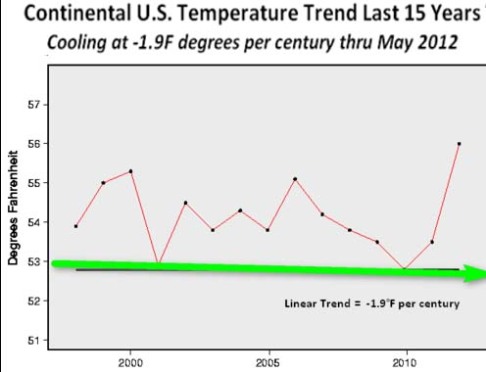
Friday, June 15, 2012

Global Warming: Lucky to be Alive – Harder Scrutiny May Kill it Outright

Propagandists behind the idea of man-caused global warming continually frame it as a problem to be solved, not questioned. For the briefest time earlier this spring, they must have been proud to see it portrayed as settled science during a major league baseball game, when announcer Tim McCarver said he believed climactic changes result in thinner air, thus “balls are carrying much better now than I remember.”

McCarver’s outlandish claim quickly blew up because baseball stats can be checked so easily. Home run totals have declined since 2000.

The mainstream media gets away with many other tougher-to-see faults because most people don’t know much about climate science. Smart-sounding scientists and reporters are saying our CO2 emissions are worsening the climate, who are we to question them?

That is precisely what the propagandists fear the most: the public must never see crippling faults in narratives about any facet of the issue. If doubt gets out of control, it’s no less deadly than the loss of confidence that implodes any ponzi scheme. Here, the issue is kept afloat not by infusions of cash, but with ceaseless unquestioned media reports supporting the issue and about allegedly corrupt skeptic scientists.

Ocean acidification caused by CO2 absorption? A melting Arctic, drowning polar bears? Unprecedented extreme weather? The Intergovernmental Panel on Climate Change (IPCC) is beyond reproach?

Skeptic scientists and their supporters point to meticulous analysis of faulty IPCC methodology, and to screaming newspaper weather headlines from from long ago, and to the Arctic Ice Cap returning to its 1979-2000 average extent, and the oceans’ current alkalinity, just to name a few contradictions.

But we have a monstrous public disconnect when the mainstream media is a gatekeeper to that information. Why report it when skeptic scientists are corrupt, and nothing they say is worthy of consideration?

With remarks at the White House in March 1995, Al Gore has long insinuated that skeptics operate no differently than ‘expert shills’ paid by the tobacco industry to ‘manufacture doubt’ about cigarette smoking risks. In his 2006 movie, he directly equated a supposedly leaked coal industry memo to the infamous Brown & Williamson Tobacco “Doubt is our Product” memo, yet neither he nor his followers show how scientific doubt about global warming has not existed from the start, or more specifically, that skeptics fabricated demonstratively false climate assessments after receiving industry money.

Despite those two massive faults, Gore’s loyal followers, including many in the mainstream media, rely on this to imply there’s no legitimate scientific criticism worthy of discussion.

Problem is, when anyone digs into the accusation, all they find are bigger problems.

Al Gore says investigative reporter / Pulitzer winner Ross Gelbspan discovered leaked evidence from 1991 coal industry memos ‘proving’ skeptics are corrupt. But Gelbspan never won a Pulitzer and other authors and reporters quoted fragment sentences from those memos prior to Gelbspan’s 1997 book exposé, including Gore’s own 1992 book. Worst of all, no accuser shows the memos in full context, so how are we to know this is no less problematic than the Peter Gleick / Heartland Institute memo controversy four months ago?

Gore equates these coal industry memos to the infamous Brown & Williamson Tobacco “Doubt is our Product” memo, but an actual comparison falls flat. The full context B&W memo is found within seconds on the internet. It took me seven months to find the coal industry memos, but only my articles link to their location at Greenpeace archive scans. Anyone reading them soon sees they are merely a small pilot project PR campaign and not any kind of sinister industry directive.

Skeptic scientists have exposed the IPCC’s faulty science for two decades. Any ordinary citizen can easily spot massive faults in the efforts to smear skeptics.

We don’t need to solve a climate crisis. We instead have a politically-driven agenda begging for a top-to-bottom investigation.

SOURCE (See the original for links)


Britain has wettest June since records began

Temperatures up to 10C below normal and sunshine is down 60 per cent

Britain is set to be lashed by 80mph hurricane force winds bringing three months worth of rain over the next three days with forecasters predicting it will be the wettest June since records began.

Emergency services issued a 'major flood event' alert in the South-West and Wales last night with eight inches of rain expected as a massive front of terrible weather sweeps in from the Atlantic.

Forecasters said England and Wales’ appalling June weather is officially the worst since records began more than 100 years ago. The countries are on course for the wettest ever June, temperatures are up to 10C below normal and sunshine is down 60 per cent.

MeteoGroup forecaster Julian Mayes said: 'We cannot find a period of June weather worse than this month since records began. For a 12-day period, it’s as bad as it can be.

'There’s no parallel with this month’s combination of very high rainfall, very low sunshine and very low daytime temperatures.

'The outlook is unsettled and although we don’t yet know for sure if it will be the wettest June, it’s well on the way.'

Cornwall Fire and Rescue Service said its 650 firefighters and 100 support staff were ready to take flood action. A spokesperson said: 'Ourselves, the police and county council are monitoring the weather forecast and will take appropriate action when needed. We have vast experience dealing with flooding, in particular floods which devastated Cornwall in November 2010.'

When 80mm of rain fell in 24 hours in west Wales last Friday, 150 people were rescued and 850 relocated as 5ft floods swept through caravan parks and villages.

Government forecasters predicted 15-20mm of rain today, plus 70-100mm over higher ground in 48 hours from midnight, with 30-50mm on lower ground.

The Weather Channel forecast more than 100mm on higher ground and warned of a 'major flooding event.' Rivers running off higher ground will fill rapidly.

The fresh deluges will fall on top of 42mm of rain in Culdrose, Cornwall, in 24 hours to 10am yesterday, plus yesterday afternoon’s expected 50-60mm from localised 'torrential downpours.'

SOURCE


Obama’s war on resource industries

As much as President Barack Obama claims to be concerned about jobs for Americans, he has a strange way of showing it.

Three recent actions in Alaska, West Virginia, and Arizona reveal the astonishing ways in which the Obama administration is twisting our nation's environmental laws in order to block natural resource production, and destroy jobs in the process.

On May 11, the U.S. Environmental Protection Agency released an assessment of the Bristol Bay watershed, an area of approximately 20,000 square miles (roughly twice the size of Maryland) in southwest Alaska.

The assessment is a superficial cut-and-paste job designed to give the EPA a basis for denying a Clean Water Act permit for a major mining project known as the Pebble Mine.

The EPA's watershed assessment concludes that a big mine could lead to the loss of 54 to 88 miles of small streams and 3.9 to 6.7 square miles of wetlands.

The Region 10 administrator claimed that a mine such as Pebble could have an adverse impact, mostly through loss of habitat, on Bristol Bay's salmon fishery, which produces half the world's wild sockeye salmon.

This claim is preposterous. The Bristol Bay watershed has thousands of miles of rivers and streams. A loss of 6.7 square miles of wetlands in a State that has 175,000 square miles of wetlands is not even a drop in the bucket.

The proposed Pebble Mine would be one of the world's largest copper, gold, and molybdenum mines. It would directly employ approximately 1,000 people for at least 30 years in high-paying jobs and indirectly create thousands more manufacturing and service jobs.

The EPA spent less than a year throwing its assessment together.

By contrast, the company developing the Pebble Mine has spent $120 million over the past eight years in commissioning an exhaustive array of environmental studies from top scientists and experts.

In February, they released an environmental baseline document of 27,000 pages.

Yet, the Obama EPA plans to use its sketchy 338-page assessment as the basis for denying a wetlands permit for the Pebble Mine — before the company even applies for it and submits the voluminous documentation required.

Even more mendaciously, EPA Administrator Lisa Jackson doesn't pretend to be objective. She was the featured speaker at an anti-Pebble event last year.

The EPA is using similarly outrageous methods to shut down a coal mine in West Virginia. In early May, the Obama administration appealed a federal court decision that blocked the EPA's attempt to revoke a Clean Water Act permit for the mine.

After the Army Corps of Engineers issued the permit in 2007, the Arch Coal Co. began the $250 million investment in the Spruce No. 1 Mine that will eventually employ 250 people.

The mine has been operating for several years, but the EPA wants to shut it down even though it is not claiming that the mine has violated any of the stringent environmental protections required by the permit.

And in Arizona, it's the National Park Service that is out of control. In January, the Park Service announced a 20-year ban on any uranium mining on 1 million acres of federal lands in northern Arizona near Grand Canyon National Park.

An ongoing investigation by the House Natural Resources Committee under Chairman Doc Hastings, R-Wash., recently revealed that the Park Service's estimates of the possible impacts of uranium mining on the Grand Canyon were strongly criticized by one of its own scientists.

In an internal 2011 email, NPS hydro-geologist Larry Martin wrote: "My personal and professional opinion is that the potential impacts stated in the DEIS (Draft Environmental Impact Statement) as grossly overestimated and even then they are very minor and even negligible."

In another email uncovered by the House committee's investigation, Dr. Bill Jackson, chief of the Park Services' Water Resources Division, wrote about Martin's findings: "There exists no information we could find that would contradict his conclusion, nor any hypothesis suggested as to how contamination of park waters might physically occur."

But the Obama administration was determined to ban uranium mining, and Jackson, being a loyal bureaucrat, went on to discuss "the best way to 'finesse' " these inconvenient scientific facts.

As destructive as these three actions are, they are unfortunately not isolated incidents. They are part of a broad campaign to restrict access to oil and natural gas as well as coal and hardrock minerals.

New mining projects could provide a major boost to the economy, but will not do so as long as Congress and the American people allow President Obama to persist in his regulatory onslaught.

SOURCE


Smoke and mirrors in Obama's energy policy

Petroleum is always in the news, especially in an election year, when politicians fear that voters angered by high gas prices will do them in. In addition, much attention has focused on upcoming economic sanctions on imports of Iranian oil (which will soon be imposed by the Europeans) and on financial institutions in other countries that undertake transactions with the Iranian central bank to buy Iranian oil (which will be imposed by the United States) — in the quixotic attempt to get Iran to give up its nuclear program. This nuclear program would provide security and prestige to the radical but unpopular Iranian government. But blocking Iran’s oil from the world market would theoretically tend to reduce the world’s oil supply, thus causing the higher fuel prices that politicians fear most.

To get around this electoral problem and have his cake and eat it too, Obama has gotten a wink and a nod from Saudi Arabia, a major foe of Iran, that the desert kingdom will pump more oil onto the world market to offset the reduction in Iranian oil exports. In the end, however, a worldwide glut of oil may ensue, because trade embargoes, especially those on relatively fungible items like oil, are usually sieves, rife with opportunities for evasion. Iran will discount its oil, making the product difficult to resist for oil-thirsty economies in the industrializing world. Oil tankers will mysteriously change their destinations while at sea. Even prohibitions on financial transactions can be evaded — for example, China, the world’s largest customer for Iranian oil, can use channels to buy such oil that circumvent the Iranian central bank, thus providing a loophole for Chinese financial institutions to avoid being shut out of the U.S. banking system. The probable petroleum glut may become significant when lower demand from a slowing world economy is added to augmented Saudi production and surreptitious Iranian supplies

Severely leaky sanctions that fail to bite economically, however, may be a boon to the Obama administration. Because of the likely oil glut, the oil price will stay low for the election, while Obama retains the symbolism of “doing something” about Iran’s nuclear program.

In another example of the administration’s “smoke and mirrors” in energy policy, it has touted lessening U.S. dependence on foreign oil because of lowered demand from increasing auto fuel efficiency and because of the rapid rise of U.S. oil production (production has risen by a quarter in the last four years). And that is true as far as it goes, which is not far. Net imports of U.S. petroleum have been reduced from about 60% of total consumption in 2005 to just over 40% today. Yet protectionism (euphemistically called “energy security” or “energy independence”) is as economically inefficient in energy as it is in any other product. In a worldwide petroleum market, U.S. companies should buy from the cheapest source, no matter where the oil is produced. In fact, some new U.S. production may be sold overseas.

Even with American demand declining and domestic production increasing, however, it is unlikely that the United States will become energy independent anytime soon. Although this goal is one of the few things that both political parties can agree on, it is a canard and is not even desirable. No one ever tells American voters and consumers that energy independence, even if possible, would cost them dearly in inefficiency-induced price increases. Technology has increased U.S. production, but many overseas sources of oil are still cheaper than such domestic drilling.

Even for those politicians unable to shake the erroneous notion that oil is a “strategic” commodity coming to the United States from dangerous or unfriendly Middle Eastern countries, increased production in Brazil and from Canadian tar sands will render this notion obsolete. Contrary to popular belief, the United States doesn’t currently import that much of its oil from the Persian Gulf and will likely import less in the future as production in the United States and Western Hemisphere rises.

SOURCE


UN Climate Scientists Plead for Immunity from Criminal Prosecution

Who are the real flat-earthers?

Climate researchers working for the United Nations have issued an astonishing plea for immunity from prosecution. Government-funded personnel sought the ruling on the eve of the latest round of climate talks scheduled for Rio de Janeiro, Brazil (June 20, 2012).

The United Nations Framework Convention on Climate Change (UNFCCC) issued it’s formal request for immunity from prosecution that includes researchers providing “evidence” supportive of the man-made global warming scare story. The perplexing plea will likely reverberate throughout the general scientific community as further affirmation that many climate scientists were not conducting honest research after all. John Bolton, a former U.S. Ambassador to the UN, questioned the motives, “The creeping expansion of claims for privileges and immunities protection for UN activities is symptomatic of a larger problem.”

High Price of Get Out of Jail Free Card

Especially worrisome is that in conjunction with the application for a sweeping “get out of jail free card” for all it’s scientists the UNFCCC is promoting a mammoth Green Climate Fund, intended to help mobilize as much as $100 billion a year for projects to lower global greenhouse gases. At the Rio conference the UN plans to trumpet a new draft planning and agenda document, “The Future We Want,” that will compel American families to pay $1,325 per year to “stop” climate change.

Bolton, alongside many savvy taxpayers, is right to worry when such an organization seeking to manage a $100 billion a year fund based on dodgy science is at the same time demanding immunity from prosecution. Can you think of a better recipe for corruption?

Worse yet, climatologists have never provided any credible evidence to back their doomsaying claims that Earth’s climate is ‘catastrophically’ warming due to human emissions of carbon dioxide. Indeed, if anything the most telling graph of U.S. temperatures, as per the latest NOAA/NCDC temperature dataset, shows cooling for the last 15 years (H/T: C3Headlines). Regardless of all such facts the Obama Administration strongly supports the Green Climate Fund and its tax-hiking objective.


Climate Fraud Akin to Banking Fraud?

But critics argue the worst crime has been inflicted upon the poorest among us. The least well off in our communities have been hit hardest by increased food and energy prices – all at a time when well-funded climatologists continue to oppose any and all independent auditing of their computer climate models. It is little wonder such ‘scientists’ are increasingly cast in the same shadow as Wall Street banksters. Worse still, latest evidence from independent researchers here, here and here suggests the greenhouse gas effect (GHE), the very cornerstone of global warming science, is also discredited.

We are seeing an increasing number of scientists insisting that it is not possible for CO2 - or any so-called “greenhouse” gas - to “trap” energy in Earth’s atmosphere – one of the most often cited claims of global warming alarmists. Critics of the GHE say the latest findings comport with satellite data and indicate that Earth emits as much infrared heat as it receives from the sun and thereby proves there is no magical atmospheric effect in play making our planet warmer than it would otherwise be. Despite these new findings dozens of government agencies aren’t interested in addressing the scientific flaws. Instead they remain firmly clamped to the teat of the climate cash cow while issuing crass statements that our atmosphere actually does act “like a greenhouse.”

Shamelessly, the sham is sustained wholesale in those well funded institutions that despite billions in funding are still using computer programs that model Earth as a flat disk lit by constant and frigid twilight. This government “flat earth modeling technique” has persisted since the early 1980′s when computers had far less processing power than today. But by sticking to their now antiquated calculating method a small and diminishing clique of climatologists think they can still get away with a fudge factor in their calculations that accounts for the additional heat they say is the “trapped” energy of the GHE.

For too long the tight-knit climate science community has been conducting a phony debate that never questions the so-called “settled science” of the GHE and only disputes the amount of warming from CO2 – a monumental intellectual travesty. But 21st Century satellite and computing power is leaving the charlatans with no room to hide their bad accounting practices.

Adept critics say that by sticking to their outmoded flat earth physics formula climatologists thus avoid the otherwise inconvenient fact that the sun actually shines on only half the planet. Is this important? Yes, because by continuing to treat Earth as if it were a flat disk is a needless statistical anomaly (or perhaps a deliberate trick?) in our age of super computers that merely serves to hide the fact that all gases in our atmosphere help to distribute solar energy around the globe and thus cool our planet. Without such gases the sun-facing side of our earth would become unbearably hot and the dark-side of our earth would be unbearably cold; an undeniable moderating effect by those gases (including carbon dioxide) that counters the pseudo scientific claims of the UN that more CO2 in the atmosphere results in more warming.

As eminent South African professor, Will Alexander recently stated (14 May 2012):

“The real tragedy is that the global warming community have showed no signs of changing their ways and entering into multidisciplinary discussions in a field where they have neither knowledge nor experience. Do they not realise that they have antagonised those of us in the engineering and applied sciences to the extent that we no longer trust their motives based on their attempts to silence all those who have contrarian views, and their deliberate departures from the truth?“

Freethinkers Oppose Flat Earth Climate Physics

Independent scientists such as those at Principia Scientific International (PSI) echo Professor Alexander’s words. It is concerned specialists from outside scientific disciplines and better skilled in math and thermodynamics who are the most outspoken. They say there is no excuse for the continued use of any computer model that treats Earth as a flat disk. They argue it is this ‘flat Earth physics,’ left uncorrected for so long, that has grown like a cancer infecting all corners of the infant science of ‘climatology.’

Now the penny drops with the UNFCCC. They understand that climate scientists have failed to prove their man-made global hypothesis and are facing increased legal scrutiny. Lawyers are sharpening their legal minds to dissect from the UN’s bloated climate science body the malignant tumor of man-made global warming. If the UNFCCC legal immunity gambit can be resisted we may yet see criminal prosecutions for the worst offenders in the climate fraud.

Regardless of any such remedy Third World starvation - a byproduct of asinine international climate policy over biofuels – will further increase as basic food staples continue to disappear. Such “progress” inflicted on us by the climate strategists to needlessly cut carbon emissions, has already accounted for the irrecoverable loss of six percent of all arable land. Thanks to the greed and hubris of a rich elite eager to profit from trade in carbon credits, global hunger skyrockets unabated and the masses remain otherwise duped by a dilettante mainstream media that still wants to believe it was for the noble cause of “sustainability” and “saving the planet.”

SOURCE (See the original for links)


Huge Australian marine reserve under fire

THE Coalition has promised to review the world's largest single marine reserve off the Queensland coast and warned it would cost Labor seats at the next election.

The Federal Government's 3.1 million sq km national marine reserve, stretching from the tip of Cape York to near Bundaberg, was yesterday welcomed by the tourism industry and environmentalists but slammed by fishing groups.

Nationals Senator Ron Boswell said the reserves would cost Labor marginal seats and the Coalition would review the network, which including about one million sq km of the Coral Sea off Queensland.

But federal Environment Minister Tony Burke said Labor was confident the issue would not prove political poison.

He said virtually all concerns of amateur fishers had been met by providing a large area outside the Great Barrier Reef Marine Park for fishing.

Conceding long-line fishers would be the worst affected, Mr Burke said boundaries had been drawn to follow the shape of reefs - a bonus for charter boats and divers, although it would affect spear fishers. About $100 million would be needed to pay out fishermen nationally.

The proposal has angered commercial fishermen, who have warned the decision will shut down business and cost Australians more to buy their favourite seafood imported from China or Vietnam.

The Australian Marine Alliance released a cost-benefit analysis saying it would devastate the country's coastal communities at a $4.35 billion cost and hit 36,000 jobs for "little if any environmental benefit".

In Cairns alone, charter boat operators, game boats, aquarium collectors, spearfishing tours and commercial fisherman estimate it will cost them up to $60 million.

Skipper Graham Johnstone, who headlined the infamous Marlin Wars of the late 1970s, declared the industry would be "back on the warpath". "They think we are a soft touch," said Mr Johnston, one of the pioneers of the north's promotion as an international mecca for black marlin fishing. "We are looking into an abyss and we will not accept them meddling in our affairs."

Daniel McCarthy, president of the Cairns Professional Gamefishing Association, said members felt hijacked by the green lobby in Canberra. "What are we protecting it from?" Mr McCarthy said. "It is not about protection but about exclusion. "It'll end up a huge fattening paddock for poachers."

Queensland Tourism Industry Council chief executive Daniel Gschwind said most concerns on better protection of reefs, dive sites and game boat access had been met and this was welcome.

SOURCE

***************************************

For more postings from me, see DISSECTING LEFTISM, TONGUE-TIED, EDUCATION WATCH INTERNATIONAL, POLITICAL CORRECTNESS WATCH, FOOD & HEALTH SKEPTIC, GUN WATCH, AUSTRALIAN POLITICS, IMMIGRATION WATCH INTERNATIONAL and EYE ON BRITAIN. My Home Pages are here or here or here. Email me (John Ray) here. For readers in China or for times when blogger.com is playing up, there are mirrors of this site here and here

*****************************************