Tuesday, June 05, 2012

Is this the end of British wind farms? Finance Minister demands Government subsidies are slashed by a quarter

George Osborne is demanding huge cuts in government aid for wind farms – a step which could kill plans for the construction of hundreds of turbines across the country. The Chancellor has told the Treasury to draw up plans for a reduction of 25 per cent in subsidies for onshore wind farms.

The intervention will provoke widespread anger among his Lib Dem coalition partners, who strongly support plans to put up hundreds of turbines in the countryside.

Environmental groups say the cut in subsidy would put an end to the development of further wind power sites – an outcome that would be welcomed by thousands of campaigners who are opposing plans for turbines near their homes.

Only last week the campaigners scored a major victory when a High Court judge ruled that the right of villagers in Norfolk to preserve their landscape was more important than the Government’s energy targets.

Last night Tory backbenchers supported Mr Osborne’s determination to slash the amount spent on renewable energy by the Government at a time of austerity.

Douglas Carswell said: ‘Why has it taken so long? A centre-right government should be bringing an end to this. One of the reasons that the economy is not growing is because energy costs are so ridiculously high because of this wind farm scam which is adding hidden surcharges to our bills.’

In February more than 100 Conservative MPs wrote to the Prime Minister to demand cuts to the £400million a year public support for wind farms, which they say is evidence of too much Lib Dem influence over policy.

Mr Osborne’s position puts him at odds with Lib Dem energy secretary Ed Davey – a key supporter of renewable energy.

It could also cause friction with his boss David Cameron, who promised to lead the ‘greenest government ever’ after the election.

But his intervention could restore his popularity among Tory MPs such as Chris Heaton-Harris, who has led the charge against the subsidies. Many are angry at a series of U-turns on Budget measures in recent weeks.

Juliet Davenport, of renewable electricity supplier Good Energy, said the Chancellor was giving in to Tory backbenchers who do not want turbines built in their constituencies.

SOURCE


Obama's Interior Department stalls clean energy query

President Obama, confronted yet again by House and Senate investigators probing the cronyism in his green energy programs, did what he often does. He simply ignored Congress.

“Last November, a request was made of the Department of the Interior for information and answers about its role in the Department of Energy’s green energy loan guarantee program, as well as favorable loans and federal land-use deals provided to certain corporations,” wrote Sen. Jeff Sessions, R-Ala., and Rep. Darrell Issa, R-Calif., in a letter to Obama’s Interior Secretary Ken Salazar last week. “It is suggestive and troubling that more than half a year has passed without DOI providing the requested documents and information.”

The lawmakers fear that several politically connected green energy companies received special treatment from the Interior and Energy departments due to their relationship with Obama. They focused their inquiry on six companies in particular: Abengoa Solar, BrightSource Energy, First Solar, Nevada Geothermal Power, NextEra Energy Resources and SolarReserve.

Issa and Sessions suspect that Salazar initiated a “fast-tracking” process that allowed some companies to receive regulatory and environmental approval and permission to use government lands for clean energy projects without adequate vetting. Whereas the review process for establishing an oil or gas lease on federal land can take more than a decade, some of these favored projects were pushed through in less than a year.

The lawmakers asked Salazar months ago about SolarReserve – which received a $737 million loan guarantee from the Department of Energy last year. SolarReserve is connected to the same Obama campaign bundler, George Kaiser, who invested heavily in Solyndra.

First Solar -– a company that is also using government subsidies to buy products from itself over international borders, as the Washington Examiner’s Tim Carney reported -– might soon follow Solyndra into bankruptcy. So might Nevada Geothermal, despite a $98.5 million federal loan guarantee.

Congressional investigators have uncovered some direct White House involvement in the loan process, particularly with respect to BrightSource. John Bryson, who now serves as Obama’s Commerce Secretary, once served on the board of BrightSource. He also co-founded the Natural Resources Defense Council (NRDC). which Republican committee staffers assert has secretly helped negotiate funding agreements between green energy companies and the federal government.

But that wasn’t the only contact between BrightSource and the Obama team. In 2010, BrightSource CEO John Woolard even asked a DOE official to review a drafted letter that Bryson intended to send to then-White House Chief of Staff Bill Daley, asking for help securing a loan. “We need a commitment from the WH to quarterback loan closure between OMB [Office of Management and Budget] and DOE,” the drafted message said.

BrightSource received a $1.6 billion loan guarantee, but still had to cancel its initial public offering in April. “The continued market and economic volatility are not optimal conditions for an I.P.O.,” Woolard said in a statement.

Salazar, for the last six months, has followed the same playbook that Energy Secretary Steven Chu has followed with Solyndra investigators: Stall, and give Congress as little information and documentation as possible. Attorney General Eric Holder, who leads the Justice Department, has adopted the same tactic with investigators probing the gun-walking scheme, Operation Fast and Furious, to the point that contempt charges are being considered against him.

The persistent refusal of multiple cabinet appointees to submit to congressional oversight regarding their decision-making processes raises grave concerns about what the Obama administration is hiding with regard to these projects.

SOURCE


Green/Leftist prophesies destruction of Israel

(Disguised as concern for Israel, of course) -- in the form of a novel written by an aptly-named Mr Laughter

I cannot see the future and I’m no prophet, but I have seen the future – so to speak — and it’s dank, dark and dystopian.
In 500 years, if we do not tame climate change and global warming worldwide, Israel will be no more and the entire Middle East will be unoccupied by human beings.

Yes, by 2500, Israel will be no more if we do not stop global warming in its tracks now. It’s written on the wind, and scientists, many of them Jewish, know it. Did you know that the Hebrew name for Al Gore’s climate change documentary An Inconvenient Truth is Emet Matridah? Yes, and it means “The Truth That Terrifies.”

Okay, not everyone wants to sit at Mr. Gore’s table, and not all Jews believe in global warming. Some are vociferous critics of the climate ideas of James Hansen and James Lovelock. But there are also many Jewish scientists and climate activists who “get it” and understand that the very fate of humanity is in question.

Will humans exist a thousand years from now? Will there be any Jews alive? Will the human species be extinct by then? These are deeply Jewish questions, and I pose them here as a deeply Jewish climate activist and journalist.

Okay, you don’t have to agree with me. You may even want to criticize me and ridicule me. That’s fine. I am all ears and all points of view are welcome at my home. But let me tell you this, as a modern-day Jeremiah: God’s creation, the Earth and His people, are at risk because of what we are doing to the His creation with excessive CO2 emissions and other man-made global warming impacts.

So what am I doing about all this? Well, to make a long story short, last year, as a newbie book producer, I commissioned novelist Jim Laughter in Oklahoma to write a book about mankind’s shaky future on this third rock from the sun, and he said yes.

The novel, titled Polar City Red, is out now, in paperback and on Kindle, and the entire story, from page one to the final paragraph, belongs to Mr. Laughter. His name is on the book cover, not mine, and all profits, if any, go to him. It’s his book. But it’s my vision.

Having read the book as it was being written chapter by chapter, and again as a completed paperback, I can tell you this: climate denialists are going to say it’s not science, and die-hard climate activists are going to say it’s just fiction.

Jews are going to be of two minds, too: Some will champion the novel and see it as a book of prophecy that we need pay attention to, and others, equally eloquent, will give the book a bad grade and send the author to the back of the room. Me? I support and champion Mr. Laughter’s vision completely, and I feel this small novel could be one of the most important novels ever written by a human being.

Laughter’s “polar Western” is set in Alaska just 60 years from now, and it poses a very important and headline-mirroring question: Will mankind survive the “climapocalypse” coming our way as the Earth heats up over the next few centuries? The end is not coming in 100 years, but it might happen by 2500 A.D.

What do the rabbis have to say about all this? They are listening to the climate debate and boning up on the science, and some are already giving sermons on the issue and writing their own blog posts about it.

More HERE


Historical Imagery of Greenland Glaciers Lessens Sea Level Rise Alarm

A new study using historical images of glaciers in southeast Greenland to investigate glacier response to climate changes suggests that the recently observed acceleration of ice loss from Greenland may not be a long-term phenomenon. Instead, as marine terminating glaciers reach their grounding line and as the termini of land-terminating glaciers migrate upwards in elevation, ice loss rates from glacial discharge may slacken. According to Anders Bjork and co-researchers:

[T]he recent high rate of retreat may come to a slowdown when retreating marine-terminating glaciers reach their grounding line and become less sensitive to the influence of ocean temperature, or through positive or negative feedback mechanisms relating to the cold East Greenland Coastal Current.

and,

Our results have implications for future estimations of sea-level rise as retreat rates for marine-terminating glaciers are likely to increase as temperature rises until glacier fronts reach the grounding line, or when cold ocean currents re-establish, whereas retreat rates for land-terminating glaciers are not likely to rise in the same order of magnitude.


Such results throw a bit of cold water on alarmist ideas that rising temperatures will lead to ever-accelerating ice loss from Greenland and accelerating sea level rise.

For example, Eric Rignot and colleagues (2011) last year documented an acceleration in the rate of ice loss from Greenland (and Antarctica) over the past two decades. They extrapolated this acceleration into the future, to arrive at potential future sea level contributions from the loss of ice sheets:


At the current rate of acceleration in ice sheet loss, starting at 500 Gt/yr in 2008 and increasing at 36.5 Gt/yr2, the contribution of ice sheets alone scales up to 56 cm [22 in.] by 2100.

Rignot et al. (2011) were quick to note that this rather na‹ve extrapolation was probably less than reliable:

While this value may not be used as a projection given the considerable uncertainty in future acceleration of ice sheet mass loss, it provides one indication of the potential contribution of ice sheets to sea level in the coming century if the present trends continue.

The new Bjork et al. (2012) study (as well as a slew of other recent studies which we have discussed: see here, here, here, here, here , and here for example) strongly suggests that "present trends" will not continue-and thus the Rignot et al. extrapolation is grossly inaccurate (i.e., far too large).

Bjork and colleagues came to their conclusion by studying some recently unearthed historical photographs of the coast of southeastern Greenland that had been taken by early 20th century Danish expeditions to the region. The earliest photos were from the early 1930s. Combining those photos with a set of U.S. WWII military photos and modern satellite imagery, Bjork and fellow researchers were able to build a photographic database of the behavior of the glaciers in the region for much of the 20th and early 21st centuries, and related that behavior to climate changes observed across southeast Greenland.

They found that the glaciers respond rather quickly to climate changes. The well-known warmth of the region during the early 20th century was accompanied by relatively rapid retreat of both marine-terminating and land-terminating glaciers. As temperatures cooled from the 1950s through the 1980s, many glaciers advanced, and the warming of the past two decades has again been marked by rapid glacier retreat (Figure 1).


Figure 1. Behavior of glaciers along Greenland's southeastern coast during different periods during the past 80 years. Glaciers generally retreated during the relative warmth of the 1930s-1940s and again in the early 21st century. Some glacier advancement was observed during the relatively cool conditions of the 1960s-1970s. (source: Bjork et al., 2012)

This pattern of behavior of glacial dynamics is exactly like that of surface ice melt in Greenland that we documented in our paper (Fraunfeld et al., 2011) from last year and discussed here. In that paper, we concluded the following:

The forces acting in concert with ice melt across Greenland to produce higher global sea levels currently, should also have been acting during the extended high?melt conditions from the mid?1920s to the early 1960s. There is some qualitative indication of an observable influence of the variations in input from Greenland in the decadal rates of sea level change over the course of the past century… However, there is no indication that the increased contribution from the Greenland melt in the early to mid 20th century, a roughly 40 year interval when average annual melt was more or less equivalent to the average of the most recent 10 years (2000-2009), resulted in a rate of total global sea level rise that exceeded ?3 mm/yr. This suggests that Greenland's contribution to global sea level rise, even during multidecadal conditions as warm as during the past several years, is relatively modest.

The implications of the new results reported by Bjork at al. are in accordance.

Bjork at al. note that in the early 20th century warmth, both marine- and land-terminating glaciers increased their rates of retreat, but during the relative warmth of the early 21st century, the marine-terminating glaciers retreated at a greater rate than the land-terminating glaciers. They speculated that the reason the land-terminating glaciers did not respond as much to the recent warmth was that they had retreated to higher elevations during the warmth of the early 20th century and thus were less sensitive to further warming. Bjork et al. further speculated that even though the marine-terminating glaciers may continue their increasing rate of retreat with further ocean temperature increases, that this increase will not continue indefinitely, but will begin to slow as the marine-terminating glaciers reach their grounding line. Together, their results indicate the potential for only modest increases in the annual amount of ice loss as condition warm (similar to our findings reported above).

Currently, ice loss from Greenland contributes about one-to-two hundredths of an inch per year to the global average sea level-that's a total of 1-2 inches by the year 2100. So, even if the rate of ice loss doubles or triples, the resulting sea level rise falls far short of being catastrophic. And the more evidence that comes in, the more confidence we have that as temperatures rise, Greenland will shed ice only gradually and through somewhat self-limiting processes-rather than catastrophically through rapid acceleration and "slipping into the sea" as Al Gore so indelicately described his (incorrect) vision of the future.


SOURCE


Poverty Pollutes: Lomborg on the Rio+20 Conference

The current United Nations response to environmental concerns is doing more harm than good

A great article by Bjorn Lomborg appeared last week in Newsweek magazine. The author has a different analysis than I do with respect to whether significant global warming is currently being caused by humans – and whether that warming is likely to be a problem decades hence (backup link).

But despite his contrary analysis, Lomborg argues persuasively that the UN-led response to poverty and environmental issues is still fundamentally flawed. His piece examines the Rio+20 conference scheduled for later this month. Between June 20 and 22, a self-selected group of people will discuss – on behalf of all of us and prior to any meaningful consultation with most of the world’s citizenry – “The Future We Want.”

It is a terrible irony that some of the people who express the most concern about the world’s poorest communities are advocating costly, unworkable solutions that will impoverish even more of us. Wealth saves lives. It pays for hospitals, doctors, and medicine. Desperate people with sick children need all of those. The last thing they have time for is well-fed bureaucrats who tell them their poverty equals sustainable living.

Until well-intentioned green activists address these sorts of inconvenient truths, gushers of money will continue to be totally wasted. Here are a few sobering quotes from Lomborg’s piece:
As long as wind turbines and solar panels remain more expensive than fossil fuels while working only intermittently, they will never contribute much to our energy supply. Germany, the world’s largest per capita consumer of solar energy, produces just 0.3 percent of its energy this way. And to achieve this No. 1 status, the country has paid $130 billion for $12 billion worth of energy.

…The truth is that while we mull green initiatives, approximately 900 million people remain malnourished, 1 billion lack clean drinking water, 2.6 billion lack adequate sanitation, and 1.6 billion are living without electricity. Every year roughly 15 million deaths – a quarter of the world’s total – are caused by diseases that are easily and cheaply curable.

…for most of the 1.6 billion people who live without electricity, we should opt for the tested, simple, and cheap solution: hook them up to generators or power plants, which, just like ours, run mostly on fossil fuels. When the sun goes down, it’s literally lights out for those people. What makes us think they should have technologies that are more expensive, less reliable, and much feebler than the ones we rely on?

…If your family is freezing, you will cut down the last tree for fuel; if they are starving, you will strip the land bare to feed them. And if you have no certainty about the future, you will provide for it in the only way possible: by having more children to care for you in your old age…Recent history suggests that when living standards go up, people and societies reduce their pollution…helping people to emerge from poverty is one of the best things we can do for the environment.

Lomborg raises an absolutely critical idea. Is it not bizarre that UN bureaucrats want to toss the world’s current economic system into the dustbin? There’s no question it has flaws and shortcomings. But in recent decades it has nevertheless lifted hundreds of millions out of poverty. No other economic approach has ever achieved these kinds of real-world results. Writes Lomborg:
the U.N. [has] itself declared the world’s current economic model a failure…Let’s pause for a minute and consider the latest figures on global absolute poverty, which came out this year. Contrary to the U.N.’s dire assessment, humanity has never seen a clearer reduction in poverty worldwide. The proportion of people living in absolute poverty has dropped massively, from 52 percent in 1981 to 22 percent today.

With the current economic model, the U.N.’s own climate panel is forecasting an extreme reduction of poverty worldwide over the coming century: per capita income in what we now call the developing world is projected to soar to more than 23 times the 2000 level by the year 2100. So how can the U.N. argue that such economic growth needs to be overturned and replaced…?

The fact that the UN isn’t trumpeting this stunning progress, but is instead advocating that we experiment with totally unproven economic approaches tells us a great deal.

It says this organization is now run by political activists rather than pragmatic problem solvers.

While Rome burns these people are impeding the firefighters. Why? Because UN documents call for them to be organized in ten squadrons rather than five.

SOURCE


Australia: Women are not so green behind the wheel

Are they the modern-day equivalent of witches?

WOMEN aged between 25 and 49 have been rated the worst on the road when it comes to eco-friendly driving. A new study has found they scored poorly on everything from car-pooling, braking, airconditioning use and driving in the right gear.

At the other end of the scale, a panel of experts studying the green credentials of Australian drivers scored women over 50 as the nation's most environmentally sensitive.

The national survey of 3000 drivers was conducted for car insurer AAMI. The impact of driving behaviour on the environment was ranked to produce a "green score" out of 10. Factors taken into account included whether a driver removed unnecessary weight from the car boot, how often they serviced their vehicle and their willingness to use public transport. Key findings include:

DRIVERS of both sexes over 50 have a lower environmental impact than those aged 18-24.

OLDER motorists are most likely to service their car.

VICTORIAN drivers have the highest impact on the environment.

AAMI spokesman Reuben Aitchison said the fact that women over 25 were worse for the environment than equivalent male drivers came as a surprise.

"In particular, they were less likely to avoid high speeds or drive in a higher or lower gear than needed, and were far less likely to car-pool," Mr Aitchison said.

"The much maligned older driver sets the best example, with smoother, slower driving and attention to servicing," he said.

Greenfleet chief Sara Gipton said car manufacturers had reduced the environmental impact, but technology went only so far. "Drivers must take advantage of these improvements to get the greatest benefit," Ms Gipton said.

The release of the findings coincides with World Environment Day today.

SOURCE

***************************************

For more postings from me, see DISSECTING LEFTISM, TONGUE-TIED, EDUCATION WATCH INTERNATIONAL, POLITICAL CORRECTNESS WATCH, FOOD & HEALTH SKEPTIC, GUN WATCH, AUSTRALIAN POLITICS, IMMIGRATION WATCH INTERNATIONAL and EYE ON BRITAIN. My Home Pages are here or here or here. Email me (John Ray) here. For readers in China or for times when blogger.com is playing up, there are mirrors of this site here and here

*****************************************
Monday, June 04, 2012

A "Green" fossil fuel?

Wonders will never cease. How the mighty are fallen!

Energy from gas power stations has been rebranded as a green, low-carbon source of power by a €80bn European Union programme, in a triumph of the deep-pocketed fossil fuel industry lobby over renewable forms of power.

In a secret document seen by the Guardian, a large slice of billions of euros of funds that are supposed to be devoted to research and development into renewables such as solar and wave power are likely to be diverted instead to subsidising the development of the well-established fossil fuel.

The news comes as a report from the respected International Energy Agency predicted a "golden age for gas" with global production of "unconventional" sources of gas (notably shale gas extracted by hydraulic fracturing or 'fracking') tripling by 2035.

The insertion of gas energy as a low-carbon energy into an EU programme follows more 18 months of intensive lobbying by the European gas industry, which is attempting to rebrand itself as a green alternative to nuclear and coal, and as lower cost than renewable forms of power such as wind and sun.

But green groups warned that relying on gas would raise energy prices and fail to tackle climate change, and could fatally stunt the growth of the renewables industry. Gas is a fossil fuel – but because it generates less carbon dioxide when burned than coal, gas industry lobbyists have been touting the fuel as a lower-carbon alternative to coal.

The gains of switching from coal to gas are shortlived – any gas-fired power stations constructed today would be expected to continue in operation for at least 25 years. That would mean decades of carbon poured into the atmosphere – while scientists and industry experts warn that global emissions must peak by 2020 in order to avoid the worst manifestations of climate change. "A golden age for gas is not necessarily a golden age for the climate," warned Birol.

The document seen by the Guardian has been agreed by member states and sets out the framework for Horizon 2020, billed as a €80bn programme for research and innovation for the years 2014 to 2020. Of the funds available, more than €30bn are supposed to flow to "address major concerns shared by all Europeans such as climate change, developing sustainable transport and mobility, making renewable energy more affordable, ensuring food safety and security, or coping with the challenge of an ageing population", according to the European Commission.

As part of this mission, Horizon2020 will dispense billions of euros in funds to research and development projects, and is intended to "support research and innovation activities, strengthen the European scientific and technological base and foster benefits for society". Clean energy is a key part of this, according to the document: "The specific objective is to make the transition to a reliable, sustainable and competitive energy system, in the face of increasingly scarce resources, increasing energy needs and climate change."

But the original document has been altered by officials to include explicit references to funding for gas – despite gas being a fossil fuel and a mature technology.

This reference shows that gas is now being considered in an official EU programme as a "low-carbon" form of energy, equivalent to renewables or nuclear power – despite its status as a fossil fuel.

Finally, the last paragraph of the document shows that the R&D funding programme originally intended only to support renewables has been altered to explicitly include fossil fuels. It reads: "Activities [of the research and development programme] shall focus on research, development and full scale demonstration - of innovative renewables, efficient and flexible fossil power plants (including those using natural gas) and carbon capture and storage technologies." The reference to fossil fuels has been inserted.

Renewables compete with fossil fuels such as gas for investment, and if investors see that gas - which is a mature technology with low risks and high returns on investment - is favoured, they are likely to prioritise gas investment over renewables.

SOURCE


Greenies who want to reduce the population are shooting themselves in the foot with their carbon scare

There have been many suggestions here on this blog, and elsewhere, that the aim of the CAGW hoax is population control.

It is obvious that the poor people of the world produce more babies; witness Africa with a birth rate much higher than the rest of the world but a very low GDP. The Africans would seem to be the model for what the Greens want the world to be: a low carbon footprint. But with their high birth rate and low production, most of Africa teeters on the brink of famine. Unable to afford energy and sanitation, many burn forests and dump their waste untreated into the environment. This would suggest that the “low carbon footprint” model is only a recipe for disaster.

On the other hand, countries with well developed economies have low birth rates but high carbon footprints. If we are to reach a stable population, one that can be sustained far into the future, a world-wide well developed economy will be required.

A well developed economy requires energy. Producing food, goods, keeping people warm or cool, assuring hygiene, and providing transportation for people, food, and products, require energy.

What are the relationships between population growth, energy consumption, and production? First, here’s a chart of electricity consumed versus GDP (Gross Domestic Product) per person for 202 countries.

It is clear from Figure 1 that to have a well developed economy with a high GDP, energy consumption must also be high. A rough trend can be seen: each KW hour produces about $10 GDP per person. The average GDP per kilowatt-hour for all countries is $8.31. The ten highest electrical power users per person are: Iceland, Norway, Kuwait, Canada, Finland, Sweden, United Arab Emirates, Luxembourg, United States, and Australia. Oil production in Africa and the Middle East distort some of the GDP numbers.

What does a high GDP do to birth rate?

In Figure 2, a fertility rate of 2 is the replacement level. Fertility rates below 2 indicate a declining population. Above 2 there is an increasing population. As you can see, most of Africa is poor and pregnant. African countries that are not poor are oil producers like Libya and Nigeria. Most European populations are in decline. The exceptions are Andorra and Gibraltar. Asian countries with thriving economies are below the replacement value. Singapore is the bottom point on fertility with a rate of 0.78 children per woman. South Korea, Taiwan, Hong Kong, and Macau are just above that number.

There is a third leg to our stool: the relationship between fertility rate and electrical power.

Again, most of Africa, and some of Asia, is pregnant and powerless. It should be clear by now that there is an optimum electrical power and GDP necessary to result in a sustainable, stable population. Those numbers would appear to be about 3,000 KW hours and a GDP of about $30,000 annually per person. The total population is about seven billion. Therefore: 7 billion X 3,000 KWh = 21 trillion KWh.

21 trillion kilowatt-hours would seem to be a reasonable target. The world currently produces 19 trillion kilowatt-hours of electricity. It appears that about 10% more electrical energy, with the accompanying improvement in GDP, primarily in Africa and some parts of Asia, would go a long way toward improving the quality of life and stabilizing population in those areas.

Energy drives civilization. This fundamental should be obvious to all, but apparently has not penetrated the consciousness of Greens, Progressives, and warmist zealots. Man builds cities to concentrate people, jobs, markets, and energy use into more efficient areas. Energy allows more efficient production, including food, technology, housing, and transportation. Cities and energy encourage creativity and innovation. More energy means a higher Gross Domestic Product.

Figure 4 shows a clear relationship between GDP and electrical power consumption. If less electricity is generated, the cost of electricity will go up (due to the economic law of supply and demand), less will be used, and GDP will go down. The converse is, of course, more desirable: more power and reducing the cost, will result in a higher GDP. High priced wind and solar is not the answer. Let the market decide how to generate more power efficiently.

For those that are screaming “what about carbon footprint!”, the market will very soon take care of that non-problem. We are currently passing the “peak oil” point. Fossil fuels, in the long term, will be a declining portion of our power production. Barring governmental stupidity, nuclear power will be an increasing percentage of energy production.

Due to the fact that carbon dioxide is a vital plant food, as well as a minor greenhouse gas, sometime in the not too distant future we will be developing schemes to keep the atmospheric CO2 level above 400 ppm or higher.

SOURCE (See the original for links and graphics)


Another EPA power grab

The Environmental Protection Agency has just taken its first abrupt step in the most dangerous power grab of our time. And it did so in direct defiance of instructions from the Congressional Committee on Oversight and Government Reform.

The menace is hidden in a study called “An Assessment of Potential Mining Impacts on Salmon Ecosystems of Bristol Bay, Alaska.” While the draft study seems ordinary, it was released in haste on May 18 – despite the prohibition of Congress – and is widely assumed to be the first step toward an unprecedented preemptive veto of the proposed Pebble Mine, a project which has not yet requested a single permit, but promises $7 billion of new infrastructure in a place without a diverse economy if EPA doesn’t kill it.

The Oversight Committee has asked the EPA to answer a long list of questions about its first-time assertion of such preemptive veto power, which the agency claims is authorized by the Clean Water Act, Section 404(c), but the committee says is illegal.

The EPA claims its study’s “narrow scope” does not indicate that the agency has already decided to preemptively veto the mine. However, the evidence says that’s a flat-out lie.

The Agency’s quick release of its hideously negative watershed assessment – against congressional instructions – can only be seen as a deliberate and malicious end-run to rapidly poison public opinion against Pebble Mine before anyone could come out for it.

The comment period, open now and ending July 23, has been irretrievably biased by EPA’s defiant early release of its study. With overwhelming public disapproval – rigged by the EPA and its Big Green allies – EPA will be fully justified in vetoing the Pebble Mine before its first permit is requested.

Very clever. Very ruthless. Very vicious. Very illegal.

The EPA used a similar tactic by yanking a West Virginia mining permit after the mine had been running for years, instead of before as in the Pebble Mine. The West Virginia mine owner took EPA to court and won. The U.S. District Court for the District of Columbia ruled:

“EPA’s position is that section 404(c) grants it plenary authority to unilaterally modify or revoke a permit that has been duly issued by the Corps [the Army Corps of Engineers] – the only permitting agency identified in the statute – and to do so at any time.

“This is a stunning power for an agency to arrogate to itself when there is absolutely no mention of it in the statute. It is not conferred by section 404(c), and is contrary to the language, structure, and legislative history of section 404 as a whole.”

The case is Mingo Logan v. EPA, decided March 23, 2012.

The Oversight Committee told EPA in a May 10 letter that, just as EPA has no authority to yank a permit retroactively, Section 404(c) gives EPA no authority to deny one preemptively.

Now we can see the Pebble tactic: Kill it before it starts. (It’s like arresting speeders before they get in the car!)

If the EPA gets away with the Pebble tactic in Alaska, the Agency will have a precedent to kill any project anywhere in America. The Obama Administration will then possess the perfect political poison pill.

This is not about the mine. This is about the Pebble tactic. Once again, this fight is not about the Pebble Mine — it is much, much bigger than that — it is about power; specifically, power over permits. Something the EPA does not and should not have.

SOURCE


There are no winners in the war on coal

Recently the Seattle City Council unanimously passed Resolution 31379, opposing the development of coal-export terminals in Washington State. These terminals would use local railroads for transporting coal to the shore to be shipped overseas, mainly to Asian markets.

However, according to the Associated Press, “mining and burning more coal isn’t consistent with the city’s goal to fight climate change,” said Councilmember Mike O’Brien, sponsor of the Seattle resolution. So the council voted the resolution down. After all, we wouldn’t want any coal dust or pollution to hit the air of Seattle would we?

The coal mined in Wyoming and Montana, specifically in the Powder River Basin, which is the coal that would be transported to Asia, is considered low-sulfur and low-ash coal. Meaning, often times this coal doesn’t have to go through a rigorous process to comply with the Clean Air Act. It doesn’t emit near as much carbon or sulfur as other types of coal mined elsewhere in the U.S. and world.

Funny how sometimes those of the radical environmentalist mindset forget the world includes more than just the U.S. The coal burned in Asia is going into the air Americans breathe as well. Wouldn’t a true environmentalist want all nations to have healthy, clean air?

The World Coal Association highlights that about 80 percent of electricity generated in China comes from coal. If the U.S. decides, as the Seattle City Council did, that coal will not be exported through its state to another nation, it will not have an impact on China’s coal use. The country will simply import it from somewhere else.

Again, from an environmental standpoint, wouldn’t it be better for China, a country more dependent on coal than the U.S., to burn a cleaner variety of American-based coal than one that emits much more carbon and sulfur? Either way, China will burn the coal, and Wyoming and Montana will find customers.

This battle has nothing to do with the environment but everything to do with a gutting a vital domestic industry, despite what Seattle City Council Member O’Brien says.

Should the U.S. become adamant about not exporting coal from Wyoming and Montana to other nations, and if the government continues its war on coal here in the U.S., then no one wins.

“The City Council is full of hot air. To fight what it calls the ‘serious impacts’ of the discredited man-made climate change hoax, the City Council has seen fit to pass a resolution condemning the Rocky Mountain coal industry and the railroads that deliver the coal to the Pacific for overseas export,” says Bill Wilson, president of Americans for Limited Government (ALG). “They are declaring war in effect on these coal-producing states, as well as the workers who would be employed at the port to ship the coal. All this in a misguided attempt stop the burning of coal that will take place anyway.”

If the U.S. government follows in the footsteps of the Seattle City Council soon we will lose what was once a vibrant, productive industry. Meanwhile, the rest of the world will continue to burn coal. This is a lose-lose situation for everyone — the environmentalist, American workers and the world.

SOURCE


All (Green) Thumbs

It was interesting while it lasted. But it looks like the "green revolution" has entered the long slide into "What was all that about?"

In January, the Spanish government removed absurdly lavish subsidies for its renewable energy industry, and the renewable energy industry all but imploded. You could say it was never a renewable energy industry at all. It was a government subsidy industry where in exchange for creating conscience-soothing but otherwise inefficient windmills and solar panels, the government gave the makers piles of cash consumers never would.

"They destroyed the Spanish market overnight with the moratorium (on subsidies)," European Wind Energy Association CEO Christian Kjaer told Bloomberg News.

The reason the Spanish example is so important is that it demonstrates how the whole green energy "revolution" was really an ideologically driven green boondoggle from the start.

At the beginning of his administration, President Obama insisted that if we didn't follow their lead, we would surrender the hugely profitable renewable energy sector to those sagacious Spaniards. In 2009, researchers at King Juan Carlos University found that Spain had destroyed 2.2 jobs in other industries for every green job it created. It also calculated that the Spanish government has spent more than half a million euros for each green job created since 2000, while wind industry jobs cost more than 1 million euros apiece.

When asked about the study, then-White House Press Secretary Robert Gibbs responded that he hadn't read it, but, "It seems weird that we're importing wind turbine parts from Spain in order to build -- to meet renewable energy demand here if that were even remotely the case."

Let's cut Gibbs & Co. some slack. These were the days before the White House learned there were no shovel-ready jobs, before they discovered that their "investments" in companies like Solyndra were little better than shoveling taxpayer dollars into an industrial mulcher. So it shouldn't surprise anyone that Gibbs would find it "weird" that our own domestic phylum of subsidy-seeking sucker fish might want to buy Spain's artificially cheap products in a scheme to feed off domestic subsidies here at home.

The evidence that this administration put cronyism and ideology ahead of reality is all around us. "Since 2009," reports the Wall Street Journal, "the Obama administration has awarded more than $1 billion to American companies to make advanced batteries for electric vehicles. Halfway to a six-year goal of producing one million electric and plug-in hybrid vehicles, auto makers are barely at 50,000 cars." Well, that leaves just 950,000 cars to go.

Obama believed he was smart enough to start whole new industries simply by sluicing taxpayer dollars into the right maws. Any suggestion that the transition to inefficient energy sources might come at a cost to taxpayers or economic growth was derided as a "false choice."

It seems like Obama at least understands the tough choices he faces. In 2009, the president's Earth Day message was stridently dedicated to climate change. In 2012, it didn't even mention the word "climate." The administration wants everyone to believe it supports "fracking" and natural gas development. When Energy Secretary Steven Chu said he prefers high gasoline prices, the administration all but defenestrated the guy. Much to the chagrin of the green lobby, Obama will not be attending this year's Earth Summit. Heck, the current picture on the White House's energy and environment page even shows Obama happily walking past a stack of oil pipes. Subtle.

Yes, Obama threw a bone to the greens on the Keystone pipeline, but he more quietly opened up the Alaskan Arctic to new oil development, granting Shell permits to drill offshore.

"We never would have expected a Democratic president -- let alone one seeking to be 'transformative' -- to open up the Arctic Ocean for drilling," Michael Brune, executive director of the Sierra Club, told The New York Times.

Now, I have no doubt that Obama's course correction is entirely political. For instance, if he hadn't approved the Arctic drilling, Shell almost surely would have sued the administration for the billions it's spent developing its Arctic leases. That's not the kind of lawsuit Obama would want in an election year.

But saying Obama has caved to political reality doesn't change the fact that political reality is largely a function of economic reality. In Europe and America alike, voters increasingly recognize that the benefits of the green revolution aren't worth the costs, particularly when the revolutionaries don't have a clue what they're doing. The only question for voters is whether Obama has really learned his lesson, or whether he plans on reverting to type if re-elected.

SOURCE


Australia: Death threats just par for the course for climate skeptics

The wimps of the Green/Left claim that various criticisms of their mental ossification are "death threats" (See here). It's just projection. The skeptics are the ones that get the threats -- from Green/Left thugs

DEATH threats and vile abuse are real. They infect the daily lives of key players in the debate over climate change. But it's not what you think: the main recipients of this torrent of abuse are not climate scientists.

They are the journalists and broadcasters whose job requires them to test the received wisdom on this and many other subjects.

They are the inheritors of that great tradition in which Western civilisation has encouraged criticism of the orthodoxy in order to expose its flaws.

That tradition, which thrives on dissent, is very much alive in parts of the media. But it is under threat.

The intolerance of those who support the orthodox view on climate change has reached the point where the physical safety of those who express a contrary view is regularly threatened.

So where is the outraged media coverage? The ABC and like-minded outlets have devoted considerable resources to allegations of death threats against scientists who defend the orthodox view on climate change. Later events have undermined the veracity of those allegations, but you would never know unless you were prepared to wade through the corrections on the ABC's website.

But at the same time, real abuse and real death threats against those on the other side of this debate have been largely ignored.

At the moment, climate change is one of the "hot button" issues that brings out the crazies. But it's not just climate change.

Melbourne columnist Andrew Bolt has also had threats of physical violence for criticising Islamism and Anita Heiss's book Am I Black Enough for You?.

He has even been threatened for opposing a national day of mourning for the Black Saturday bushfires.

Bolt puts it down to the morally superior manner of those who play a leading role in setting the tone of public policy debate.

The most startling incident occurred a decade ago when an activist organisation published his home address on its website "along with an exhortation to burn the house down".

Two weeks ago a filmmaker, whom he named, used Twitter to urge his followers: "Let's assassinate Andrew Bolt." It was later removed.

A Greens candidate at the last federal election used Twitter to publish this: "Andrew Bolt is a vile c ... of a man. I openly condone hunting him down and beating him to within an inch of his life."

Sydney Daily Telegraph columnist Tim Blair says he has received "death wishes" rather than death threats. The last one contained the cheery sign-off: "Die painfully, yours sincerely ... ".

Blair says this happens relatively frequently, whenever a "hot button" issue is in the news. And the most popular trigger is "anything to do with climate change".

Most of this material arrives by email and while they are abusive, Blair says they are not real death threats. "They want you to die, rather than saying they are going to kill you," he says.

But he was worried after he published on a private website Danish cartoons of the prophet Mohammed that had triggered death threats against the cartoonist.

The Sydney Morning Herald accompanied its report on this incident with a photograph of Blair, which led to police calling him and suggesting he might wish to move to a more secure location.

Broadcaster Ray Hadley says he usually receives about 600 emails a day on a range of subjects, and 10 per cent are abusive.

In the 11 years he has been with Sydney radio station 2GB he has received about 20 death threats, only one of which seemed serious enough to refer to police. It contained details of his movements but turned out to be the work of an eccentric pensioner with an alcohol problem.

"The rest are in the form of 'I wish you were dead and if I could make you dead I would do it' ", Hadley says. "But some of the people I know in the security industry say that if someone is going to knock you off they are not going to tell you about it."

At The Australian, editor-in-chief Chris Mitchell says he has received hundreds of death threats during his 20 years as an editor and editor-in-chief and has ignored them all.

He says the recent debate about alleged death threats against climate change scientists gave rise to an implication that death threats only came from climate change deniers. But in his experience, that is not the case.

He has received threats from both sides of the climate change debate - from those accusing him of destroying the planet for their grandchildren and from those demanding that the newspaper withdraw its support for a carbon tax. In the past two years, most of the threats from the Right have largely come from Queensland and Western Australia.

He believes there would always have been threats made against those in the media and email has simply made it more convenient.

Climate scientists, like other new players in public policy debates, were clearly shocked by the vile nature of some of the abuse they have received.

But after 20 years of abuse and threats, Mitchell has some advice: "These climate scientists need to harden up."

The abuse directed at climate scientists, bad as it was, needs to be kept in perspective.

Ten years ago, the Brisbane home of The Australian's Hedley Thomas was peppered with bullets late at night, narrowly missing his wife and children.

Thomas, who has five Walkley awards, has received threats but does not take them seriously, "because if someone wants to do you in, they are not going to give you a warning".

He says he has never been scared away from a story because of threats.

More than a decade ago, reporter Tom Dusevic was beaten by two young men with baseball bats who were waiting for him when he returned home at night. This came shortly after Dusevic had written a contentious article. But he believes it was probably just a case of mistaken identity.

SOURCE

***************************************

For more postings from me, see DISSECTING LEFTISM, TONGUE-TIED, EDUCATION WATCH INTERNATIONAL, POLITICAL CORRECTNESS WATCH, FOOD & HEALTH SKEPTIC, GUN WATCH, AUSTRALIAN POLITICS, IMMIGRATION WATCH INTERNATIONAL and EYE ON BRITAIN. My Home Pages are here or here or here. Email me (John Ray) here. For readers in China or for times when blogger.com is playing up, there are mirrors of this site here and here

*****************************************
Sunday, June 03, 2012

On seeing what you want to see: Warmists definitely have the eye of faith


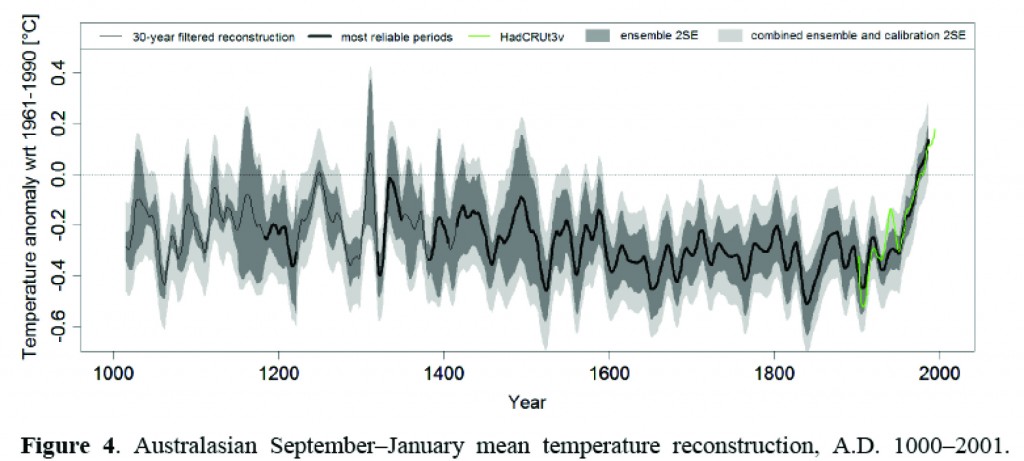
Warmist Eric Steig claims that the graph above demonstrates that the the late 20th century was unusually warm. Can you see it? I can't. I think it shows that the Medieval warm period was warmer. I had a previous laugh at the Gergis study on May 20. Below is what Steig says, for what it is worth -- JR:

In the Northern Hemisphere, the late 20th / early 21st century has been the hottest time period in the last 400 years at very high confidence, and likely in the last 1000 – 2000 years (or more). It has been unclear whether this is also true in the Southern Hemisphere. Three studies out this week shed considerable new light on this question. This post provides just brief summaries; we’ll have more to say about these studies in the coming weeks.

First, a study by Gergis et al., in the Journal of Climate uses a proxy network from the Australasian region to reconstruct temperature over the last millennium, and finds what can only be described as an Australian hockey stick. They use an ensemble of 3000 different reconstructions, using different methods and different subsets of the proxy network. Worth noting is that while some tree rings are used (which can’t be avoided, as there simply aren’t any other data for some time periods), the reconstruction relies equally on coral records, which are not subject to the same potential (though often-overstated) issues at low frequencies. The conclusion reached is that summer temperatures in the post-1950 period were warmer than anything else in the last 1000 years at high confidence, and in the last ~400 years at very high confidence.

SOURCE


History ignored once again

It's hard to believe that the title on the article below is: "Climate change will create a toxic brew for herbivores". That the much warmer age of the dinosaurs supported some HUGE herbivores is completely ignored. Theory trumps fact every time among the Green/Left

A WARMER world might be a poisoned one. A compilation of studies suggests that as temperatures rise, herbivorous mammals will suffer greater effects from the toxins they eat, with animals living in dry regions at particular risk.

Mammals can maintain a constant body temperature and so are thought to be less vulnerable to temperature changes than cold-blooded animals like reptiles. But Denise Dearing at the University of Utah in Salt Lake City has found evidence that mammals feel the heat in subtle ways.

Plants produce toxins to defend themselves against animals that eat them. In response, herbivores limit the amount of toxins they eat, often by eating a wide range of plants.

That strategy may need some adjusting as climate change pushes temperatures up. Dearing found a number of lab studies scattered through the scientific literature showing that animals kept at higher temperatures become less able to process toxins (Journal of Comparative Physiology B, DOI: 10.1007/s00360-012-0670-y).

In one study in mice, raising the temperature from 26 °C to 36 °C made them more vulnerable to caffeine: they died after receiving just one-fifth of the normal lethal dose. Meanwhile, in the wild, white-throated woodrats often eat juniper, which is toxic, but they eat less of it in summer even though the juniper is readily available.

SOURCE


Another severe pratfall for the Warmist religion

If it’s not the global warming schemers deserting the cause, and global warming profiteers going belly up, and real life contradicting the premise, it’s another bulletin of bad news. Where will it all end for the global warming worshippers?

Here’s the latest, which just happens to devastate another assumption of the warming theorists (emphasis ours):

“A paper published today in Atmospheric Chemistry and Physics finds that clouds located in the stratosphere over the poles act to cool the stratosphere by adiabatic cooling, which is the cooling of air parcels as they rise and expand, rather than by ‘trapping heat’ below the clouds resulting in ‘radiative cooling’ of the stratosphere above. This finding contradicts a tenet of AGW theory, which predicts that infrared radiation from greenhouse gases will ‘trap heat’ to create a ‘hot spot’ in the troposphere and cooling of the stratosphere. This study finds that cooling of the stratosphere is instead due to rising air parcels rather than a decrease in radiation due to heat ‘trapped by greenhouse gases’.”

As if it weren’t bad enough that European schemers are jumping off the bandwagon, and Spanish profiteers are failing at profiteering, and real life disproves the theory that CO2 brings devastating heat…

…now we find that the stratosphere could be cooling, not heating, things up.

Gee, who knew all this would lead nowhere, bankrupt the players and be based on fraud and wrong-headed science? Oh wait. Yeah. That’s what we’ve been saying for about a decade now.

Of course, more and more folks are coming around, recognizing this obsession is counterproductive and a more productive path would be to help poor people become better off, not deny them cheap electricity.

And more and more folks are understanding that the “science-is-settled” crowd that shouts down dissenters isn’t better informed. Just louder.

And of course, more and more folks are accepting the fact: there is no global warming crisis. Period.

SOURCE


Let us rend our garments! We have been condemned by a "spiritual author"

No wonder he quotes not one scientific fact

The Truthout website has published an article written by Richard Schiffman, who is described as " the author of two biographies as well as a journalist whose work has appeared in The New York Times, Salon, The Washington Post, The Christian Science Monitor, The Huffington Post, and on NPR and Monitor Radio."

In the article Schiffman, who maintains that "climate change is now virtually undisputed", joins the people who have condemned the Heartland Institute´s "offensive billboard campaign":
The science only gets better with time, and climate change is now virtually undisputed - by the people who are doing the science, at any rate. That it remains a "controversial issue" long after the results are in is thanks to a well-funded cabal of free-market think tanks, corporations and business groups that hope to win in the political arena a fight that they have long since lost in the halls of science. They are abetted by a media whose relish for conflict and a scientifically nonsensical sense of supposed "balance" has led them to give the deniers equal airtime.

In May, the Heartland Institute put up a billboard on the Eisenhower Expressway outside of Chicago comparing believers in climate change to the Unabomber, Ted Kaczynski. A firestorm in the press quickly convinced the Institute to pull the plug on the offensive billboard campaign.

However, Schiffman himself thinks that it is quite OK to compare "denialists" to Holocaust deniers:
But the question remains: why is the media paying any attention to the discredited ideas of the denialists? We don't give Holocaust deniers equal time to vent their noxious views, so why offer it to the climate change deniers?

The analogy might seem far-fetched, but the findings of climate scientists tell us that it is apt. We are facing a potential holocaust for life on earth, which could destroy entire ecosystems, turn productive regions into dust bowls, multiply catastrophic weather events, wipe out a large proportion of the planet's species and cost us more in dollars (not to mention lives) than all the wars in history combined.

In order to understand what kind of a man this self proclaimed scientific expert is, it is perhaps good to know how Schiffman himself chooses to introduce himself:
"My name is Richard Schiffman. I am a spiritual author and a former journalist who started writing poetry a few years back."

"Spiritual poetry is an effort to find words for the wordless. As such, it is bound, in one sense, to fail. But, paradoxically, the effort to express the inexpressible can serve as "a finger pointing toward the moon," in the language of zen. That is to say, at its best spiritual poetry brings us to the edge of the Great Mystery in which we live and move."

[Sounds like he has tumbled over the edge -- JR]

SOURCE


Nobel laureate Carlo Rubbia in Venice: "no relationship between CO2 emissions and climate change"

Below is the Google translation from an article in Italian. It is pretty rough but I don't have the time to tidy it up. I have however read it in the original Italian so will summarize it instead:

Carlo Rubbia shared the Nobel Prize in Physics in 1984 and he points out that CO2 emissions don't correlate with climate change. He is however diplomatic enough to say that this may be because "other" (vaguely specified) processes may be masking CO2 effects and says that we should therefore continue to work to reduce CO2 emissions. He shows his lack of enthusiasm, however, by saying that sustainable energy is a long way off and will will have to continue to use fossil fuels for a long time yet


"It's not found a relationship between climate change and CO2 emissions." He said today in Venice Prize laureate Carlo Rubbia. "The new situation - he explained - and 'that while emissions continue, by 2000, and' a decrease in temperature." The physical phenomenon and noted that 'due to an effect of' masking ', which plays a role such as the energy stored in the oceans. "You can not 'say that the CO2 does not count - he concluded - that we still have to decrease."

The Nobel Prize considers the decisions to be taken in the next 10-15 years on the sustainability of the 'energy' will have significant consequences in the field of energy security and climate change, as well as' on growth and jobs. Costs could be high - highlights - but the price of inaction 'it would be much more "'. The Nobel and 'spoke at the annual conference' The Creation of shared value: Sustainability and Finance ', organized by the BSI Gamma Foundation Auditorium Santa Margherita in Venice. "Go towards sustainability '- added the physical - implies a broadening of the definition of cost that goes far beyond' mere economic implications of short-term interests to include economic, environmental and social long-term. In order to reconcile economic growth and sustainable development, strategic choices must be made ​​consistent, they are based on real and innovative scientific and technological developments. "Rubbia, beginning his long speech he stated that" sustainable development means to respond to this without compromising future generations, "arguing that this" fossil energy sources will be needed for decades to come. "

SOURCE


Australia: UNESCO meddling aims to put the State of Queensland into a Greenie straitjacket

But neither State nor federal politicians are buying it

HALTING port and industry development along Queensland's coast to protect the Great Barrier Reef is not an option, Premier Campbell Newman says.

His comments come as the UN's environmental arm UNESCO released a report that says rapid coastal development is threatening the health of the reef.

The report warns the reef could be listed as a World Heritage site in danger unless substantial changes are made to its management, sparking calls from green groups for the government to put a moratorium on massive coal port developments.

Mr Newman told reporters on Saturday that his government was committed to protecting the reef and the environment. But he made it clear halting port and infrastructure development connected to the coal and liquified natural gas industry was not an option. "We will protect the environment but we are not going to see the economic future of Queensland shut down," Mr Newman said.

Later he added: "We are in the coal business. If you want decent hospitals, schools and police on the beat we all need to understand that."

Mr Newman said the previous governments over the past decade were to blame for the "haphazard" and "ad hoc" development of ports.

"The business and economic issues that we were concerned about are very similar to the environment issues UNESCO has identified," Mr Newman said. "Very clearly there needs to be a proper strategy, orderly progression of these developments. We shouldn't be building a multitude of new ports and we won't be." Cabinet will be discussing this on Monday, he said.

Australian Marine Conservation Society director Darren Kindleysides said the world expected Australia to look after the unique reef, which was worth $6 billion annually to the tourism industry. “The rush to ship coal and gas through the World Heritage Great Barrier Reef intensifies by the day," Mr Kindleysides said. "Australia must now put the brakes on the approval of any new port and infrastructure developments risking the Reef."

The UNESCO report recommends an independent review into the management of Gladstone Harbour, which is at the centre of a diseased fish outbreak.

Mr Newman said he was already in the process of developing a water management plan for Gladstone Harbour.

He said it would be similar to the "watersway partnership" in Moreton Bay, where universities, government agencies, local councils and natural resource management groups jointly monitor water quality in creeks and rivers.

Legal issues may stop reef report response

The federal government may not be able to meet a major recommendation of the UNESCO report on the Great Barrier Reef, Environment Minister Tony Burke says.

About 45 development applications are in the pipeline that could “potentially” affect the reef including LNG and other processing facilities, port expansions, dredging, tourism developments and aquaculture.

The busy coal terminals of Abbot Point and Hay Point in north Qld are also undergoing expansion while new port facilities are anticipated on Cape York and Balaclava Island in central Queensland.

Mr Burke said the state and federal governments were already undertaking the “most comprehensive and complex assessment” ever to have been done on the reef.

It’s due to be delivered to UNESCO by February next year.

“The Great Barrier Reef is one of the world’s greatest treasures, it is one of Australia’s most significant environmental places and has been recognised as one of the healthiest coral reef ecosystems, and best managed marine areas in the world,” Mr Burke said.

The Queensland Resources Council (QRC) has taken issue with key findings of the scathing UNESCO report about the management of the Great Barrier Reef.

The report, released on Saturday, noted the international body's "extreme concern" at the "unprecedented" rate of development along the Queensland coast, and warned the reef could be listed as a World Heritage site in danger.

But QRC chief executive Michael Roche said the industry was on a sustainable footing. "We believe that the scale of development is very much a steady-growth scenario, not unprecedented growth," he told AAP.

Mr Roche said he did not accept the figures about increases in shipping movements put forward by environmental group Greenpeace.

"We need to ensure that all of these comments and requests and recommendations from UNESCO are seen in the context of realistic estimates of development," he said.

Mr Roche said the industry was serious about the looking after the Great Barrier Reef. "Industry has long demonstrated its commitment to protection of the reef through direct funding of essential reef research," he said.

"(It has met) the exacting environmental protection standards of the state and federal governments in seeking project approvals."

SOURCE

***************************************

For more postings from me, see DISSECTING LEFTISM, TONGUE-TIED, EDUCATION WATCH INTERNATIONAL, POLITICAL CORRECTNESS WATCH, FOOD & HEALTH SKEPTIC, GUN WATCH, AUSTRALIAN POLITICS, IMMIGRATION WATCH INTERNATIONAL and EYE ON BRITAIN. My Home Pages are here or here or here. Email me (John Ray) here. For readers in China or for times when blogger.com is playing up, there are mirrors of this site here and here

*****************************************

Saturday, June 02, 2012

"Six days thou shalt work, but on the seventh day thou shalt rest" -- Exodus 34:21

My recent very unpleasant medical problems have made me ask what is the best way forward in my life. To answer that question I turned to the wisest book I know: The Bible. And I found the quotation above. Following Bible advice has always worked wonderfully for me so I now intend to follow that piece of advice too. I intend from now on the keep the Sabbath and will blog only six days of the week instead of seven.

But it will be the real Sabbath I will keep, not the pagan abomination of the Sun's day. It was precisely because the pagans had set aside the first say of the week as a day to worship the sun that the ancient Hebrews defiantly made the seventh day of the week their holy say and I will follow their example. I will no longer blog on Saturday but will do other things.

But I will not be surrounding what I do with rules. As Jesus said, the Sabbath is made for man, not man for the Sabbath. The Bible simply says to do no work and that does not exclude doing all sorts of other things.

One of the things I would like to do today is to learn the words of the Stabat Mater in full. It is the most famous Medieval Latin poem and has been set by many composers -- with the glorious rendition by Pergolesi being best known. I already sort of know the poem but would like to be able to recite the whole thing right through without interruption. To be able to do that will be pleasure, not work. Latin poetry is wonderful even in a work of Marian devotion.

Stabat mater dolorosa
Juxta crucem lacrimosa
Dum pendebat filius

Cuius animam gementem
contristatam et dolentem
Pertransivit gladius ... etc

The is a video from Italy here which offers a respectful version of the first part of the Pergolesi masterpiece. If it's a techno beat you like, you will hate it. This is a work of profound contemplation about the central event of the Christian faith. Even I as an atheist can feel the power of it.

Friday, June 01, 2012

Some pesky stats from Australia

Australia was founded as a branch of the most advanced civilization of its day (Britain) and was therefore very early in adoption of the latest science. One of my ancestors, for instance, was vaccinated against smallpox on his arrival in Sydney in 1828.

And meterorological records were kept from early on. Such records are rare in the Southern hemisphere so deserve some attention. If something is "global", there should be records of it in the Southern hemisphere too. We find here a careful record of Sydney temperature minima and maxima from 1859 to December 2005.

The very first line of the table is interesting. It is for January -- which is of course midsummer in the Southern hemisphere. We note that the highest maximum temperature for any month in any year was 45.3 (Celsius) on 14/01/1939. Yes: 1939.

We also note that the highest average temperature was 33.7 (Celsius) on 13/01/1896. Yes: 1896.

And I can assure you that my ancestors were not driving SUVs at that time -- though I do have a picture of one of their bullock teams proudly displayed on my wall. I am a descendant of teamsters!


Green Party nonsense: nuclear power and the problem of the precautionary principle

Since I've already ruined my chances of ever leading the warriors of the Green Party in glorious revolution, what with saying that the vandalism of publicly funded scientific research is pretty much not cool, I've decided to throw caution to the wind.

From the Greens' energy policy, I read this:

"The Green Party is fundamentally opposed to nuclear energy, which we consider to be expensive and dangerous. The technology is not carbon neutral, and being reliant on uranium it is not renewable. We consider its use, moreover, to be elitist and undemocratic. There is so far no safe way of disposing of nuclear waste. To a degree unequalled by even the worst of other dangerous industries, the costs and dangers of nuclear energy and its waste will be passed on to future generations long after any benefits have been exhausted."

This statement is problematic on a number of levels. I don't like the idea of being "fundamentally opposed" to one of the most obvious available options for keeping our lights on. If it is shown to be safe and economic, then we should use it. It's not a moral issue; it's just one more tool, which we can use well or badly, safely or unsafely. Also: how can an energy technology be "elitist"? I literally don't know what that means. Is it elitist because it's hi-tech and third-world countries can't easily make their own? Well, so are iPads, then, and Toyota Priuses. Or does the word "elitist" just mean "bad" in Green-land, in the same way that "natural" means "good"? [Edit: I can't believe I didn't pick up on "undemocratic" as well. Since when are power stations democratic institutions?]

As for it not being renewable: well, neither is sunlight or the wind, if you're taking a sufficiently long view. Eventually the Sun will consume the last of its hydrogen and expand into a red giant, probably blasting the Earth to its constituent atoms as it does so. But that's quite a long way off, so we don't worry about that. In the shorter but still decently long term, even if no more uranium deposits are found (although they will be) and no more efficient ways of using it developed (although they will be), "total identified resources are sufficient for over 100 years of supply", according to the IAEA. That ain't nothing.

"Carbon neutral" is a bit of a red herring as well in this case. It's true, nuclear power is not carbon neutral. But it's much less carbon positive, if that makes sense, than fossil fuels. The perfect is the enemy of the good, as the saying goes: just because something isn't the best possible, doesn't mean you should ignore it if it's an improvement over what is available. Furthermore, there is potential to improve the carbon emissions of nuclear; if it is made economically attractive to do so, companies will do it themselves. Targeted carbon taxes, or an auction of carbon credits, would work; certainly the latter did for industrial sulphur dioxide emissions.

But this is all a side issue, isn't it? It's about safety. Nuclear power is unsafe. Look at Chernobyl, look at Three Mile Island, look at Fukushima. It's dangerous, as the Greens say, and its cost, dangers and waste will be "passed on to future generations".

But as Prof Paddy Regan says in our paper today, that's false. Chernobyl killed about 50 people (28 people in the immediate weeks after; an estimated 19, according to the WHO, died of radiation-induced cancers in the following 20 years). Three Mile Island killed, and indeed harmed, precisely nobody. And Fukushima was the most ridiculous of all: as a vast earthquake and tsunami killed 15,000 people, the world's attention was focused on a meltdown in a 40-year-old reactor which, again, killed no one at all. As Prof Regan points out, it led to absurdities:

"The Italian foreign ministry, for example, recommended that its citizens flew out of Tokyo to avoid potential radiation exposure in the first couple of weeks following the Fukushima leak. While the radiation levels in the Japanese capital rose significantly above normal, they remained lower than the typical average background radiation levels in Rome, leading to the bizarre situation of individuals being relocated to places with higher radiation levels than those they were leaving."

He also points out that the waste from the "natural reactor" at Oklo in Gabon, which underwent a spontaneous nuclear reaction in its uranium-rich deposits two billion years ago, has moved less than 10 metres from where it was formed. "If this is what happens in nature’s random geological disposal site, a carefully chosen, geologically stable deep storage facility for vitrified nuclear fuel waste would seem safe to me," says Prof Regan.

Meanwhile, in the last 40 years, tens of thousands of people have been killed by failures at hydroelectric dams; hundreds more have died in coal mines, and of course thousands every year in the US alone from respiratory problems caused by fossil fuels. But the fear of "radiation", evident in the nonsense scares about "electrosmog", trump the very real dangers of other energy sources. (There's another interesting piece to write some day about our evolved fear of "contamination"; since the 1940s or so "radiation" has been mentally filed under "poisons", and therefore any at all is bad. But this piece is long enough already.)

The "precautionary principle", the idea that a new technology or policy should not be employed until we can be sure it is safe, sounds very reasonable. But as always, it's more complicated than that. Everything we do entails not doing something else; in this case, not using nuclear, in the short term at least, means more coal, more shale gas, more fracking, to maintain energy demands (and cutting energy use would cause its own problems, of course). Is that safer? Nuclear power has risks, of course it does. But so does everything, and nuclear power has clear potential benefits. The trick is to calmly and sensibly assess those risks and benefits, not pull up the drawbridge out of misguided fear.

SOURCE


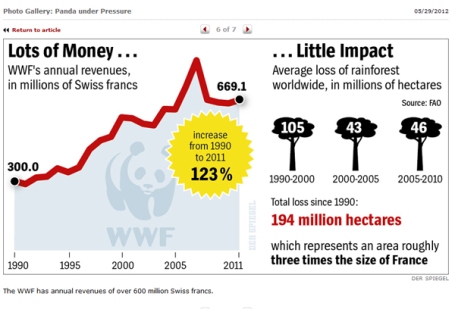
Der Spiegel Skewers the World Wildlife Fund

A splendid and disturbing investigative feature in Der Spiegel explains why the WWF doesn’t deserve your charitable donations.

Screen capture from the Der Spiegel article. Click to jump to the article

Yesterday the German news magazine Der Spiegel ran an investigative feature article on the World Wildlife Fund (WWF).

This is not the sort of thing one usually finds in the mainstream media, especially not in Germany. For the average member of the public, making informed decisions about which organizations deserve one’s charitable donations is difficult. This article is chock-a-block with the sort of information we all deserve to know.

Here are some direct quotes to whet your appetite:

  • “Over the years, the WWF has received a total of $120 million from the United States Agency for International Development (USAID).”
  • “Companies pay seven-figure fees for the privilege of using the [WWF] logo [on their products].”
  • “In Sumatra, members of a tribal group reported how troops hired by WWF partner Wilmar had destroyed their houses…”
  • “The Dutch section of WWF helped pay for Greenpeace’s flagship, the Rainbow Warrior.”
  • “Experts estimate that in Africa alone, conservation efforts have created 14 million ‘conservation refugees’…”
  • “Ruswantu takes affluent eco-tourists on tours of the park on the backs of tamed elephants. The area is off-limits for the locals…’The WWF is in charge here…’”
  • “‘Sustainable palm oil, as the WWF promises with its RSPO certificates, is really nonexistent,’ [a former WWF employee] says.”
  • “[leftist activist target] Monsanto…has donated $100,000 to the WWF over the years…”
  • “The [German branch of the WWF] even paid the travel expenses for representatives of the Argentine branch of the WWF, which was long run by a man with ties to the former military junta…”

During the 1980s the WWF reportedly funded helicopter death squads that exterminated liquidated summarily executed dozens of local poachers in a national park in Zimbabwe. The inescapable conclusion, therefore, is that while the WWF takes extreme measures to prevent poor, indigenous locals from hunting African wildlife, if you’re a wealthy foreigner different rules apply. Says the magazine:

Spanish King Juan Carlos, for example, was recently in the news after he broke his hip while hunting elephants in Botswana. Juan Carlos is the honorary president of WWF Spain, which many find outrageous. In Namibia alone, the WWF has permitted trophy hunting in 38 conservation areas.

Rich Europeans or Americans are allowed to behave as if the colonial period had never ended. They are allowed to shoot elephants, buffalo, leopards, lions, giraffes and zebras…A WWF spokesman defends this practice, saying that quotas have been established, and that the proceeds from this “regulated hunting” can contribute to conservation.

The following passage, however, is perhaps the most interesting of all. At WWF world headquarters near Geneva, the article tells us,

plaques there commemorate the people to whom the organization owes a great debt: the “Members of The 1001.” This elite group of undisclosed financiers was created in 1971 to provide financial backing for the organization.

To this day, the WWF does not like to disclose the names of the donors, probably because some of those appearing on the club’s list would not exactly help their image – people like arms dealer Adnan Khashoggi and former Zairian dictator Mobutu Sese Seko.

Then-WWF President Prince Bernhard of the Netherlands was able to recruit oil multinational Shell as his first major sponsor. In 1967, thousands of birds died after a tanker accident off the coast of France, and yet the WWF forbade all criticism. That could “jeopardize” future efforts to secure donations from certain industrial sectors, WWF officials said during a board meeting.

I urge you to read the whole thing here. It’s well worth your time.


SOURCE


America’s actual health and welfare crisis

It is EPA rules that most gravely threaten our energy, economy, health, welfare, justice, and civil rights progress

Paul Driessen

EPA Administrator Lisa Jackson says we face grave threats to human health, welfare and justice. She’s absolutely right. However, the dangers are not due to factory or power plant emissions, or supposed effects of “dangerous manmade global warming.”

They are the result of policies and regulations that her EPA is imposing in the name of preventing climate change and other hypothetical and exaggerated environmental problems. It is those government actions that are the gravest threat to Americans’ health, welfare, and pursuit of happiness and justice.

By hyper-regulating carbon dioxide, soot, mercury, “cross-state air pollution” from sources hundreds of miles away, and other air and water emissions, EPA intends to force numerous coal-fired power plants to shut down years before their productive life is over; sharply reduce emissions from cars, factories, refineries and other facilities, regardless of the costs; and block the construction of new coal-fired power plants, because none will be able to slash their carbon dioxide emissions to half of what average coal-fired plants now emit, without employing expensive (and nonexistent) CO2 capture and storage technologies.

EPA has also issued 588 pages of rules for hydraulic fracturing for critically needed oil and natural gas, while the Obama Administration has vetoed the Keystone XL pipeline and made 95% of all publicly owned (but government controlled) energy resources unavailable for leasing, exploration, drilling and mining.

These actions reflect President Obama’s campaign promises to “bankrupt any company that tries to build a new coal-fired power plant,” replace hydrocarbons with heavily subsidized solar, wind and biofuel energy, make energy prices “necessarily skyrocket,” advance rent-seeking crony-corporatism – and “fundamentally transform” America’s constitutional, legal, energy, economic and social structure.

Energy is the lifeblood of our nation’s economy, jobs, living standards and civil rights progress. Anything that affects energy availability, reliability and price affects every aspect of our lives. These federal diktats put bureaucrats and activists in charge of our entire economy – seriously impairing our health and welfare.

Moreover, the anti-hydrocarbon global warming “solutions” the Obama Administration is imposing will bring no real world benefits – even assuming carbon dioxide actually drives climate change. That’s largely because China, India and other developing countries are increasing their use of coal for electricity generation, and thus their CO2 emissions – far beyond our ability to reduce US emissions. These nations rightly refuse to sacrifice economic growth and poverty eradication on the altar of climate alarmism.

Even worse, the health, welfare and environmental justice benefits that EPA claims will result from its regulations are equally exaggerated and illusory. They exist only in the same dishonest computer-generated virtual reality that concocted its alleged climate change, health and environmental cataclysms, and in junk-science analyses that can best be described as borderline fraud.

Implementing EPA’s regulatory agenda will inflict severe economic dislocations and send shock waves through America’s factories, farmlands and families. Far from improving our health and welfare – they will make our economy, unemployment, living standards, health and welfare even worse.

EPA’s new automobile mileage standards alone will result in thousands of additional serious injuries and deaths every year, as cars are further downsized to meet its arbitrary 54.5 mpg requirements. Its anti-coal and anti-fracking rules will severely impact electricity generation, reliability and prices; factory, office and hospital operations and budgets; American industries’ competitiveness in global markets; employment, hiring and layoffs; and the well-being of families and entire communities. Especially for areas that depend on mining and manufacturing – and the 26 states where coal-based power generation keeps electricity rates at half of what they are in states with the least coal use and toughest renewable energy mandates (6-9 cents versus 13-17 cents per kilowatt hour) – it will be all pain, for no gain.

According to the Wall Street Journal, a White House letter to House Speaker John Boehner inadvertently acknowledged that EPA alone is still working on new regulations that the agency itself calculates will impose $105 billion in additional regulatory burdens and compliance costs. Win or lose in November, the Administration will likely impose these and other postponed rules after the elections. We, our children and grandchildren will pay for them in countless ways.

Utilities will have to spend $130 billion to retrofit or replace older coal-fired units, says energy analyst Roger Bezdek – and another $30 billion a year for operations, maintenance and extra fuel for energy-intensive scrubbers and other equipment, to generate increasingly expensive electricity.

Duke Energy’s new $3.3 billion coal gasification and “carbon dioxide capture” power plant will increase rates for its Indiana customers by some 15% the next two years. Hospitals, factories, shopping malls and school districts will have to pay an extra $150,000 a year in operating expenses for each million dollars in annual electricity bills. That’s four or five entry-level jobs that won’t be created or preserved.

Nationwide, 319 coal-fueled power plants totaling 42,895 megawatts (13% of the nation's coal fleet and enough for 40 million homes and small businesses) are already slated to close, the Sierra Club joyfully proclaimed. Illinois families and businesses could pay 20% more for electricity by 2014, the Chicago Tribune reports. Chicago public schools may have to find an extra $2.7 million a year to keep the lights and heat on and computers running.

Higher electricity prices will further strain refineries already struggling with soaring electricity costs and EPA’s sulfur and other regulations, restrictions on refinery upgrades and construction, constraints on moving crude oil to East Coast refineries, and other compliance costs – all for dubious environmental or health benefits. Three East Coast refineries have already closed, costing thousands of jobs and causing the Department of Energy to warn that pump prices are likely to soar even higher in Eastern states.

When we include discouraged workers who have given up looking for jobs, and people who have been forced to work fewer hours or at temporary jobs, our unemployment rate is a whopping 19 percent – and double that for black and Hispanic young people. America’s labor force participation rate is at a 30-year low. Our nation’s 2011 economic growth rate was a dismal 1.7 percent.

Well over a million US workers age 55 and older have now been out of work for 27 weeks or more. Not only do prospects plummet for re-employment of older workers. The longer they are unemployed, the more they are disconnected from society, the further their living standards fall, the more their physical and emotional well-being deteriorates, and the more likely they are to die prematurely.

The cumulative effect is that families have even less money to buy food, pay the rent or mortgage, repair the car or house, save for college and retirement, take a vacation – and keep people comfortable (and alive) on frigid winter nights and sweltering summer afternoons. Workers lose jobs. Health and welfare, family relationships, future prospects and psychological well-being plummet. Because they spend the highest proportion of their incomes on energy, poor and minority families suffer disproportionately.

And yet the EPA and White House regulatory agenda, regulatory onslaught and horse-blinder definition of health, welfare and justice ignore these realities – and ensure that this unconscionable situation will only get worse. In fact, the only welfare EPA’s rules will ensure is the expansion of our welfare rolls, unemployment lines and already record-setting food stamp programs.

EPA is also giving billions of taxpayer dollars to activist groups, to advance its agenda and dominate our media and hearings with false or misleading information about the costs and benefits of its programs.

Worst of all, our Congress and courts have completely abdicated their obligations to provide oversight and control of this dictatorial agency and Obama Administration. If this is the hope, change and future we can look “forward” to, our nation’s health, well-being and justice will be rolled backward.

SOURCE


Is Washington, D.C., Really the Environment's Savior?

Guest post by Jonathan H. Adler, a professor at the Case Western Reserve University School of Law and a regular contributor to the Volokh Conspiracy.

Note by JR: The market-based approaches briefly outlined below are useful contributors to real environmental problems but they cannot deal with mythical problems such as CO2 "pollution". You have to have a real problem before you can mitigate it


It can be a bit lonely working on environmental issues from the "right" side of the political spectrum. Environmental academics and activists rarely have much patience (let alone sympathy) for principles that would limit the scope of government power and few conservatives or libertarians take environmental issues seriously.

Some of my friends on the right seem to think that any environmental problem the market cannot magically solve must be a hoax. There's no doubt many environmental threats have been exaggerated, and the capacity of traditional regulatory institutions to address environmental concerns is often oversold, but serious environmental problems remain, and they should be addressed.

Yet in the political sphere, those on the right either oppose every environmental measure with a reactionary fervor or they insist that whatever we do, we just have to make it cost a bit less. Neither is a satisfactory response. Blind opposition to the Sierra Club's agenda does not an environmental policy make. Nor is there a compelling case for always doing environmental initiatives on the cheap. Across the aisle, unfortunately, concerns for regulatory costs and limitations are viewed with equal suspicion.

As illustrated in the past three posts, much of my work explores the possibility and potential of a "pro-environment" policy agenda that is consistent with principles of limited government. This sort of approach is often characterized as "free market environmentalism" or "FME." This moniker may be a bit of a misnomer in that it emphasizes the "market" rather than the underlying set of institutions upon which markets - and sound conservation - both depend, but it certainly communicates the idea of trying to reconcile free enterprise and environmental protection through the recognition and protection of property rights in environmental resources.

This approach cuts against the grain of conventional environmental policy. Suggestions for dramatic reform of environmental laws is regularly characterized as "anti-environmental." Part of the problem is the standard fable of federal environmental regulation which recounts an overly romanticized view of the federal government's role in environmental protection. Based on this fable, many believe any effort to curtail federal regulatory authority, expand protection of property rights, or create greater state flexibility is an attack on environmental protection. But it ain't necessarily so.

According to the standard fable, post-war environmental conditions got inexorably worse until the nation's environmental consciousness awoke in the 1960s and demanded action. State and local governments were environmental laggards, according to this story, and only the federal government was capable of safeguarding ecological concerns. Events such as the 1969 fire on the Cuyahoga River, memorialized in Time magazine with this picture, are pointed to as support for this traditional account. This fire, which helped spur passage of the 1972 Clean Water Act, is constantly cited as evidence of how bad things were before the federal government got involved.

Yet the standard fable is just that, a fable - a fictionalized account with some truth, but fiction nonetheless. Let's start with the 1969 fire. There was a fire on the Cuyahoga River in June 1969, Time magazine did run a photo of a fire on the Cuyahoga, and the story of the fire did help spur passage of the CWA. But that's about where the truth ends. The fire was actually a minor event in Cleveland, largely because river fires on the Cuyahoga had once been common, as they had been on industrialized rivers throughout the United States, throughout the late 19th and early 20th centuries. But river fires were costly and posed serious risks to people and property, prompting local governments and private industry to act. The fire was not evidence of how bad things could get, but a reminder of how bad things had been.

Further, the June 1969 fire was far smaller and less significant than the fires of years past. Where there had been some major infernos on the Cuyahoga in years past, the 1969 fire was not among them. The fire burned for less than thirty minutes, and was out before the cameras arrived. (Here's the closest thing to a picture of that fire.) And that picture in Time magazine? It was not of the 1969 fire but of a fire from 1952. Apparently the editors of Time felt the need to dramatize their story of environmental ruin with a picture of a real fire, so they used the best picture they could find, even if it was not of the fire featured in their story. [For those interested, here is an extensive treatment of this history.]

The problems with the standard fable extend beyond the story of one river. While there were plenty of serious environmental problems in the 1960s, it's wrong to suggest everything was getting inexorably worse until the federal government got involved. Just as the problem of river fires had gotten better, not worse, prior to the 1969 Cuyahoga river, many environmental indicators were improving before the enactment of the major federal environmental laws. According the Environmental Protection Agency's first national water quality inventory in 1972, levels of some key pollutants had been declining significantly in the decade prior to enactment of the CWA. Ambient concentrations of some air pollutants, such as sulfur dioxide, had declined substantially before enactment of the federal Clean Air Act. Wetland loss rates plummeted before the extension of federal regulatory protection. And so on.

Not every trend was positive, to be sure, but many were. In particular, those environmental concerns that were most obvious, understandable, and costly were improving -- largely due to a combination of state, local and private efforts - whereas emerging or less-well understood problems were not. In some cases federal regulation augmented and enhanced these preexisting efforts, but in other areas it imposed redundant or excessive controls that crowded out more locally tailored efforts. (For more on these points, see here and here.)

None of this means that all federal environmental regulation was unnecessary or unwise. There are some environmental problems that state and local governments are unwilling or unable to address on their own. But, contrary to the standard fable, federal environmental regulation was not always necessary or an improvement over the available alternatives. Among other things it had the effect of dampening innovation and experimentation in environmental protection, encouraging a "one-size-fits-all" approach to some environmental problems that too often becomes "one-size-fits-nobody." And if there is to be renewed experimentation and innovation in environmental policy, there needs to be a recognition that not all environmental policy decisions are best made in Washington, D.C. My own proposal for how to encourage greater environmental innovation can be found here.

In my view, greater state flexibility is a necessary, but not sufficient, for meaningful environmental reform. Environmental problems are hard, and the best solutions are not always apparent. Even where there is a broad consensus on the desirability of a particular policy approach, questions of implementation and design remain. Experimentation and innovation are necessary to discover how best to get these details right. I believe that greater reliance on property rights and market institutions will lead to more effective and equitable environmental protection, but until such approaches are tried, the claim is speculative. Only by trying new approaches can we learn which measures best succeed, or fail. I believe property-based approaches will emerge as the best (or least bad) approach to many environmental problems, but we will not know for sure until we try. And unless one is truly satisfied with current approaches to environmental protection (and few are), there is no reason not to let the experiments begin.

SOURCE


Australia: Jobs bonanza in new brown coal rush

If Greenies hate coal, they REALLY hate brown coal (lignite) -- but it is very close to the surface in Australia so just has to be dredged up -- making it very cheap. It has been powering Victoria for decades. It is also now the major source of power for Germany (and -- Ahem! -- Greece)

A PLAN to export Victoria's brown coal will deliver 3300 jobs and more than $11 billion in new revenue as the state plots its own mining boom.

Internal government documents seen by the Herald Sun reveal the enormous scale of the proposed project and how advanced negotiations are.

The Baillieu Government has been in secret talks with a consortium from India, Japan and Australia for more than a year about granting access to the state's huge deposits of brown coal, papers show.

That project alone would generate $11 billion in state revenue and create 3000 jobs on its construction and another 300 on-going jobs through its operation.

And the Herald Sun understands that windfall could be the tip of the iceberg, as other overseas groups are interested in similar-scale schemes.

Documents detail how a consortium led by Australian company Exergen, backed by India's biggest business group, Tata, and Japan's third-largest trader, Itochu, is in talks with the Government over one plan.

Tata Power executives met state Energy Minister Michael O'Brien and federal Resources Minister Martin Ferguson in October, claiming the coal project could deliver $11 billion in royalties to Victoria's economy in the next 40 years.

Exergen has told the Government it has spent $20 million developing technology that can reduce the moisture content of brown coal from 65 per cent to 25 per cent, making it suitable for export.

Under the first stage of its Victorian project the consortium plans to spend $50 million building a full-scale commercial demonstration plant, to be operational within three years of it receiving an allocation.

Exergen is also collaborating with the CSIRO to develop the use of its treated brown coal, and claims three direct injection coal engines would be able to replace a third of the electricity generated at Hazelwood, but with vastly lower emissions.

Exergen chief executive officer Trevor Bourne told the Herald Sun his group wanted access to a billion tonnes of Victoria's brown coal, with full confidence it could make the project commercially and environmentally sound.

"We are going to invest $100 million in proving this - we are confident enough to spend that money," he said.

"We are a committed company that think we can have an impact reducing carbon dioxide and unlocking the value in the Latrobe Valley."

SOURCE

***************************************

For more postings from me, see DISSECTING LEFTISM, TONGUE-TIED, EDUCATION WATCH INTERNATIONAL, POLITICAL CORRECTNESS WATCH, FOOD & HEALTH SKEPTIC, GUN WATCH, AUSTRALIAN POLITICS, IMMIGRATION WATCH INTERNATIONAL and EYE ON BRITAIN. My Home Pages are here or here or here. Email me (John Ray) here. For readers in China or for times when blogger.com is playing up, there are mirrors of this site here and here

*****************************************