Thursday, May 05, 2011

I predicted it! Even jokes come true where Warmists are concerned

Prominent Donk says Osama's death should encourage Warmists. I said on 2nd that the death of bin Laden would "prove" global warming somehow

Former New Mexico Gov. Bill Richardson hopes that Osama bin Laden's death will spur President Barack Obama to promote climate change legislation.

“My hope is that from this success in the foreign policy arena two days ago, that he will be emboldened to take once again to the Congress legislation — not just to increase a renewable energy standard — but climate change legislation that this country and the world need,” Richardson said Tuesday at a Climate Leadership Gala hosted by the Earth Day Network in Washington.

Climate change legislation, particularly anything labeled as toxic as “cap and trade,” is seen as non-starter while Republicans hold the House and many Senate Democrats are wary of the issue. But Richardson warned climate bill backers against standing on the sidelines.

“We can sit back and say, ‘Well we’ll wait until the next election, wait until the political climate is better.’ You know if we do that, we’re doomed — if we don’t take action right away,” he said.

The former energy secretary and U.S. ambassador to the United Nations in the Clinton administration called for a comprehensive nationwide greenhouse gas reduction program in addition to a national renewable energy standard.

Richardson suggested Obama offer Congress two options: an economy-wide cap-and-trade program with stringent timetables over several decades and a carbon tax. And if Congress fails to do either of those, EPA must plow ahead with climate change regulations, he said. “I’m still one of those who supports cap and trade, but it’s good I believe to offer choices,” he said.

SOURCE


Why tell the truth when lies suit so much better?

The blah below has been reported umpteen times in papers around the world lately. It is of course nothing more than another model-based projection. See the facts in the following post

Arctic Assessment bombshell: “Global sea level is projected to rise by 0.9–1.6 meter by 2100″

A major new multi-country scientific assessment of the Arctic has concluded that on our current greenhouse gas emissions path, we face 3 to 5 feet of sea level rise — far greater than the 2007 IPCC warned of. This is fully consistent with several recent studies (see “Sea levels may rise 3 times faster than IPCC estimated, could hit 6 feet by 2100“).

The Arctic Monitoring and Assessment Programme — formed in 1991 to advise the eight Arctic countries on threats to the Arctic from pollution — has released the Executive Summary of their Snow, Water, Ice and Permaforst in the Arctic (SWIPA) assessment on their website [big PDF here]. SWIPA “brings together the latest scientific knowledge about the changing state of each component of the Arctic cryosphere.”

The report notes that, “The observed changes in sea ice on the Arctic Ocean and in the mass of the Greenland Ice Sheet and Arctic ice caps and glaciers over the past ten years are dramatic and represent an obvious departure from the long-term patterns.” I’ll have more to say shortly on the effort by the anti-science crowd to mislead on this key point.

More HERE


The sea-level reality
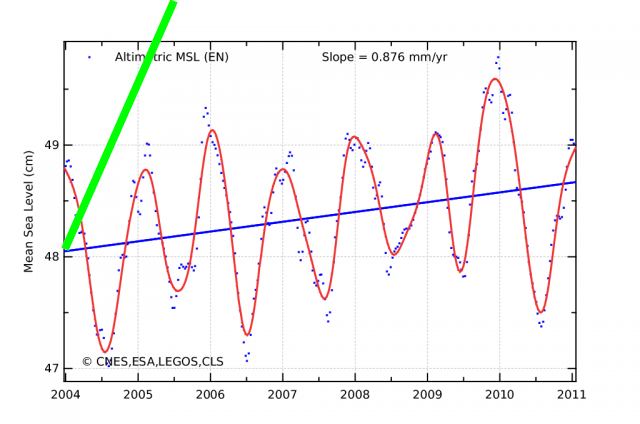

The image above shows actual sea level rise in blue measured by Envisat, versus the claimed rate of the "experts" (shown in green, appropriately enough)

SOURCE

Note: The actual rise translates to about a sixteenth of an inch per year. Panic!


New Report: Shale Gas Shock Challenges Climate and Energy Policies

The Global Warming Policy Foundation today publishes a detailed report about the shale gas revolution and its likely implications for UK and international climate policy.

The report The Shale Gas Shock, written by Matt Ridley and with a foreword by Professor Freeman Dyson, finds that shale gas:

* is not only abundant but relatively cheap and therefore promises to take market share from nuclear, coal and renewable energy and to replace oil in some transport and industrial uses, over coming decades.

* will help to keep the price of nitrogen fertiliser low and hence keep food prices down, other things being equal.

* is unlikely to be a major source of pollution or methane emissions, but in contrast promises to reduce pollution and accelerate the decarbonisation of the world economy.

Matt Ridley, the author of the GWPF report, said:

"Abundant and relatively cheap shale gas promises to lower the cost of gas relative to oil, coal and renewables. It indefinitely postpones the exhaustion of fossil fuels and makes reducing emissions of carbon dioxide possible without raising energy prices."

Freeman Dyson, in his foreword to the GWPF report, said:

"Shale gas is not a perfect solution to our economic and environmental problems, but it is here when it is needed, and it makes an enormous difference to the human condition.”

“Matt Ridley gives us a fair and even-handed account of the environmental costs and benefits of shale gas. The lessons to be learned are clear. The environmental costs of shale gas are much smaller than the environmental costs of coal.”

The full report is available here


George is lost -- for reasonable answers to Green "problems"

George Monbiot seems to be throwing in the towel. His newly discovered liking for nukes is being undermined by huge new discoveries of fossil fuels (principally shale gas)


Toon from "Private Eye"

You think you're discussing technologies, and you quickly discover that you're discussing belief systems. The battle among environmentalists over how or whether our future energy is supplied is a cipher for something much bigger: who we are, who we want to be, how we want society to evolve. Beside these concerns, technical matters – parts per million, costs per megawatt hour, cancers per sievert – carry little weight. We choose our technology – or absence of technology – according to a set of deep beliefs: beliefs that in some cases remain unexamined.

The case against abandoning nuclear power, for example, is a simple one: it will be replaced either by fossil fuels or by renewables that would otherwise have replaced fossil fuels. In either circumstance, greenhouse gases, other forms of destruction and human deaths and injuries all rise.

The case against reducing electricity supplies is just as clear. For example, the Zero Carbon Britain report published by the Centre for Alternative Technology urges a 55% cut in overall energy demand by 2030 – a goal I strongly support. It also envisages a near-doubling of electricity production. The reason is that the most viable means of decarbonising both transport and heating is to replace the fuels they use with low-carbon electricity. Cut the electricity supply and we're stuck with oil and gas. If we close down nuclear plants, we must accept an even greater expansion of renewables than currently proposed. Given the tremendous public resistance to even a modest increase in windfarms and new power lines, that's going to be tough.

What the nuclear question does is to concentrate the mind about the electricity question. Decarbonising the economy involves an increase in infrastructure. Infrastructure is ugly, destructive and controlled by remote governments and corporations. These questions are so divisive because the same world-view tells us that we must reduce emissions, defend our landscapes and resist both the state and big business. The four objectives are at odds.

But even if we can accept an expansion of infrastructure, the technocentric, carbon-counting vision I've favoured runs into trouble. The problem is that it seeks to accommodate a system that cannot be accommodated: a system that demands perpetual economic growth. We could, as Zero Carbon Britain envisages, become carbon-free by 2030. Growth then ensures that we have to address the problem all over again by 2050, 2070 and thereon after.

Accommodation makes sense only if the economy is reaching a steady state. But the clearer the vision becomes, the further away it seems. A steady state economy will be politically possible only if we can be persuaded to stop grabbing. This in turn will be feasible only if we feel more secure. But the global race to the bottom and its destruction of pensions, welfare, public services and stable employment make people less secure, encouraging us to grasp as much for ourselves as we can.

If this vision looks implausible, consider the alternatives. In the latest edition of his excellent magazine The Land, Simon Fairlie responds furiously to my suggestion that we should take industry into account when choosing our energy sources. His article exposes a remarkable but seldom noticed problem: that most of those who advocate an off-grid, land-based economy have made no provision for manufactures. I'm not talking about the pointless rubbish in the FT's How To Spend It supplement. I'm talking about the energy required to make bricks, glass, metal tools and utensils, textiles (except the hand-loomed tweed Fairlie suggests we wear), ceramics and soap: commodities that almost everyone sees as the barest possible requirements.

Are people like Fairlie really proposing that we do without them altogether? If not, what energy sources do they suggest we use? Charcoal would once again throw industry into direct competition with agriculture, spreading starvation and ensuring that manufactured products became the preserve of the very rich. (Remember, as EA Wrigley points out, that half the land surface of Britain could produce enough charcoal to make 1.25m tonnes of bar iron – a fraction of current demand – and nothing else.) An honest environmentalism needs to explain which products should continue to be manufactured and which should not, and what the energy sources for these manufactures should be.

There's a still bigger problem here: even if we make provision for some manufacturing but, like Fairlie, envisage a massive downsizing and a return to a land-based economy, how do we take people with us? Where is the public appetite for this transition?

A third group tries to avoid such conflicts by predicting that the problem will be solved by collapse: doom is our salvation. Economic collapse, these people argue, is imminent and expiatory. I believe this is wrong on both counts.

Last week something astonishing happened: Fatih Birol, the chief economist of the International Energy Agency, revealed that peak oil has already happened. "We think that the crude oil production has already peaked, in 2006." If this is true, we should be extremely angry with the IEA. In 2005 its executive director mocked those who predicted peak oil as "doomsayers". Until 2008 (two years after the IEA now says it happened) the agency continued to dismiss the possibility that peak oil would occur.

But this also raises an awkward question for us greens: why hasn't the global economy collapsed as we predicted? Yes, it wobbled, though largely for other reasons. Now global growth is back with a vengeance: it reached 4.6% last year, and the IMF predicts roughly the same for 2011 and 2012. The reason, as Birol went on to explain, is that natural gas liquids and tar sands are already filling the gap. Not only does the economy appear to be more resistant to resource shocks than we assumed, but the result of those shocks is an increase, not a decline, in environmental destruction.

The problem we face is not that we have too little fossil fuel, but too much. As oil declines, economies will switch to tar sands, shale gas and coal; as accessible coal declines, they'll switch to ultra-deep reserves (using underground gasification to exploit them) and methane clathrates. The same probably applies to almost all minerals: we will find them, but exploiting them will mean trashing an ever greater proportion of the world's surface. We have enough non-renewable resources of all kinds to complete our wreckage of renewable resources: forests, soil, fish, freshwater, benign weather. Collapse will come one day, but not before we have pulled everything down with us.

And even if there were an immediate economic cataclysm, it's not clear that the result would be a decline in our capacity for destruction. In east Africa, for example, I've seen how, when supplies of paraffin or kerosene are disrupted, people don't give up cooking; they cut down more trees. History shows us that wherever large-scale collapse has occurred, psychopaths take over. This is hardly conducive to the rational use of natural assets.

All of us in the environment movement, in other words – whether we propose accommodation, radical downsizing or collapse – are lost. None of us yet has a convincing account of how humanity can get out of this mess. None of our chosen solutions break the atomising, planet-wrecking project. I hope that by laying out the problem I can encourage us to address it more logically, to abandon magical thinking and to recognise the contradictions we confront. But even that could be a tall order.

SOURCE


Australia: Solar panel silliness slowly fading away

THE Federal Government is set to cut $1000 off the solar panel subsidy to cool an overheating market which has started to push up electricity prices.

Climate Change Minister Greg Combet said the subsidy would be reduced to around $3700. "We will be announcing today a reduction in the level of Federal Government support for the installation of solar panels on people's roofs," he told ABC Radio. "However, the cut we are making still means that a subsidy of around $3700 will be available."

Mr Combet said there had been such strong demand for the solar panels that it had resulted in higher electricity prices. "The Government is very keen to take pressure off prices," he said.

The problem stems from feed-in tariffs, particularly in NSW where the former Labor government introduced a very high rate to encourage solar panel take-up, the minister said. Under feed-in tariffs people who install solar panels are paid for electricity they feed back into the electricity grid.

Mr Combet said the tariffs paid by states and territories supplemented the Federal Government subsidy to install panels and the NSW tariff had been a key driver of demand. "There just needs to be some heat taken out of that market while we still provide encouragement for people to use renewable energy in this way," he said.

SOURCE

***************************************

For more postings from me, see DISSECTING LEFTISM, TONGUE-TIED, EDUCATION WATCH INTERNATIONAL, POLITICAL CORRECTNESS WATCH, FOOD & HEALTH SKEPTIC, GUN WATCH, AUSTRALIAN POLITICS, IMMIGRATION WATCH INTERNATIONAL and EYE ON BRITAIN. My Home Pages are here or here or here. Email me (John Ray) here. For readers in China or for times when blogger.com is playing up, there are mirrors of this site here and here

*****************************************
Wednesday, May 04, 2011

Nutty assumptions produce nutty conclusions

Alarmists of all kinds almost always use straight-line projections from some current trend. But most natural phenomena are not ordered in that way. Below is an example of how a straight-line projection of mortality from radioactivity gives absurd conclusions -- yet it precisely that sort of projection that is generally used by regulators.

The truth is that low to medium doses of ionizing radiation are harmless or even beneficial. It is only high doses that lead to adverse health effects. Google "radiation hormesis" for the relevant facts

Once again reality is not as simple as the theorists imagine


The Union of Concerned Scientists (UCS) All Things Nuclear blog has an analysis of how many deaths occurred at Chernobyl based on linear no threshold view of radiation. So 0.01 milliSieverts (1 milliRem) for each of 6 billion people in the world is calculated to add 4000 deaths from cancer. 0.3 milliSieverts (30 milliRem) for 500 million people in europe is calculated to add 9000 more deaths from cancer.

Using the same analysis (NEI Nuclear Notes) found that, 79,000 and 40,000 would be reasonable estimates of the number of excess cancers and cancer deaths attributable to the flying in the past decade. The numbers increase even more over the 25 years since Chernobyl and would be 200,000 excess cancers and 100,000 excess deaths from commercial aviation over the last 25 years.

As the US EPA (Environmental Protection Agency) explains, exposure to cosmic radiation depends on altitude, latitude, and solar activity, but the EPA estimates that "a typical cross-country flight in a commercial airplane" results in "2 to 5 millirem (mrem)" of dose from radiation.

The statistics from the US Bureau of Transportation Statistics indicate that over 7 billion airline passengers (international and domestic) flew in the US between January 2001 and January 2011. Thus, if we assume a fairly low average value of 3 millirem per passenger, then aviation has resulted in a collective dose of 210,000 passenger-Sv over the past decade.

This is quite a large number already, but Dr. Gronlund did not consider the radiation exposure within just one country. She provided an estimate for the entire world. So we should follow suit.

The US aviation market comprises somewhere between 25 to 30 percent of the entire world's airline passengers (e.g., in 2009, passengers in the US comprised roughly 28% of the airline passengers worldwide, according to IATA statistics). Thus, if we conservatively assume that US passengers comprised 30% of the passengers worldwide during the past decade, then worldwide, the collective dose due to commercial aviation is 700,000 passenger-Sv.

Using Dr. Gronlund's methodology (which was taken from the BEIR VII report), we should assume that "the expected incidence and mortality of solid cancers and leukemia are 0.1135 cancer cases and 0.057 cancer deaths per Sv." Thus, because of radiation exposure due to the airline industry, the expected number of cancer cases is 79,000, of which some 40,000 should result in death.

Note however that, because exposure only increases the probability of developing cancer, we should keep in mind that no given cancer can be attributed to flying. Moreover, because these additional cancers will be distributed among hundreds of millions of people, it is practically impossible to discern them among all the other cancer cases. (About 42% of the general population have cancer at some point in their lives, and about 20% of the population die because of cancer or complications that result from cancer.)

It is somewhat illustrative to compare these numbers to the numbers presented by Dr. Gronlund for the Chernobyl accident: 68,000 cancer cases with 34,000 deaths. Given these numbers, one can scientifically conclude that the airline industry is far more dangerous -- in terms of deaths due to low-dose exposure to radiation -- than old, Soviet-era nuclear reactors.

In light of these numbers, I expect that the UCS will be setting itself up as an "aviation watchdog" any day now.

SOURCE


Time magazine's Bryan Walsh: Fossil fuels cause global terrorism

I prophesied on 2nd. that Osama bin Laden's death would be seen by some as proof of global warming. We're not quite there yet but the report below comes close

We know that `global warming' causes everything. We know that `fossil fuel funding' causes skepticism. Did you know that fossil fuel funding 'causes' Osama bin Laden? Journalist Bryan Walsh thinks so:
Born and raised in the petroleum cradle of Saudi Arabia, bin Laden was able to finance a global terrorist network thanks to the wealth crude oil had brought his homeland-and to America's addiction to the stuff.

From `fossil-fuel funded disinformation campaign' to `fossil-fuel funded terrorism', everything is caused by fossil fuels. The implication is clear enough:

Why this tortured, circuitous logic from a Time magazine journalist, we might wonder. Mr Walsh answers that question himself:
It can happen to any journalist-major news happens, but not on your beat. What do you do? You look for any entry point you can. But we don't have to stretch too far to examine the implications that al-Qaeda leader Osama bin Laden's death might have on global energy markets-and especially oil

Indeed, Mr Walsh, indeed - no stretching is required. `Global warming' and climate change is indeed connected to everything - from tornadoes to Osama bin Laden.

SOURCE


Warmists ignore variations in the amount of sunlight that is reflected rather than absorbed as heat

Moonlight is not light generated by the moon, but reflected sunlight. First astronauts on the moon were amazed by the brightness of Earth when it appeared over the lunar horizon. What they saw was Earthlight, which is also reflected sunlight. It's sunlight that does little to heat the Earth because it goes directly back out to space. The amount reflected varies with changes to the surface and atmosphere. These changes are significant, yet poorly measured or understood and pushed aside by the fanatic focus on CO2. Global warming due to humans is based on the hypothesis that our addition of CO2 has changed the balance of energy entering and leaving the Earth's atmosphere. There are a multitude of factors that can change this balance, many ignored or underplayed by climate science. They get away with this because the public is unaware.....

IPCC are projecting climate change for the next 50 years or more. So we have problems with the amount of incoming energy, but there are more problems with what happens to the energy once it enters the atmosphere.

One of these is change in albedo. Some believe it's more important than CO2 in affecting balance. The most interesting thing here is that the albedo forcings, in watts/sq meter seem to be fairly large. Larger than that of all manmade greenhouse gases combined.

Albedo is the amount of sunlight reflected from a surface. The lighter surface reflects more than the dark surface. When sunlight strikes a surface the color, texture and angle of the light (known as the angle of incidence) determines how much is reflected or absorbed. The difference between them, as a percentage, is called the albedo (from the root Latin word albus for white). With a pure white shiny surface, 100 percent of the light is reflected, so the albedo is 100. On a matte black surface, 100 percent is absorbed, and the albedo is zero (Figure 2). A solar collector needs to absorb as much solar energy as possible so is matte black and set at right angles to the solar rays.

The moon's albedo is 7, which means 93 units of 100 are absorbed and 7 units reflected. On average, Earth's albedo is 30 for the entire globe. The amount varies from a high of 75-95 percent for fresh snow down to 8-9 percent for coniferous forest. Seasonal variation in snow and ice cover is important as it affects global energy and therefore the weather from year to year.

However, the major factor is variability in the type and amount of cloud cover. Thick cloud varies from 60-90 and thin cloud from 30-50. This variability explains most of the change in albedo shown in Figure 3. The right side scale shows changes in energy with a range of about 9 watts per square meter. Compare this with the 2.5 watts per square meter change estimated to be due to human activities.

Earth's average albedo is not constant from one year to the next; it also changes over decadal timescales. The computer models currently used to study the climate system do not show such large decadal-scale variability of the albedo.

Sadly, there are many factors affecting climate change that the IPCC ignore or underplay to achieve the political result that human CO2 is the sole cause. They only acknowledge "cloud albedo effect", but correctly admit their level of scientific understanding (LOSU) is low.

So they ignore many variables and admit they know little about the ones they study. It is a total abrogation of scientific and social responsibility to let these results form the basis for draconian and destructive energy and environmental policies. They shouldn't have won a Nobel Peace Prize. They couldn't have won a Science Prize.

More HERE (See the original for links, graphics etc.)


Greenie propaganda site for children tells blatant lies

They claim that a CO2 level of 500ppm would make the planet uninhabitable for most species -- ignoring that life flourished in the past when levels were higher than that -- and also ignoring that rising CO2 levels do NOT lead to warming, as we have seen in the last 12 years

It's not much of a secret that our planet is messed up. We're facing a long list of problems, and most of them are caused by by one simple thing: the burning of fossil fuels.

The most urgent problem is climate change, caused by our out of control addiction to fossil fuels. When we burn fossil fuels like oil, coal and gas, we emit all this extra carbon dioxide, CO2, into the atmosphere, which messes up the balance of the atmosphere.

Scientists that dedicate their entire lives to studying this, have made it clear: to avert the worst effects of climate change, the levels of CO2 in the atmosphere need to be at 350 parts per million (ppm). Right now we are at 391ppm. If we keep burning at the rate we are now, we will be at 500ppm by 2050. This would make earth a completely different planet, uninhabitable for most species. We can't let that happen.

SOURCE


An Alarming Shade of Green at Dartmouth College

"Fire and brimstone," "real collapse" and "biblical concern" are the kinds of phrases many of us have come to associate with global warming. Economist Eban Goodstein did not disappoint in his lecture at Dartmouth this April, using these terms and many others as he called on his audience to save the planet by redesigning "every city on Earth" and becoming superheroes like characters from "The Lord of the Rings." Before trying to build a new world order, however, it's worth taking all the hysteria about climate change with a grain of salt.

There's certainly been a lot of unfounded alarmism in recent decades. In 1970, ecologist Kenneth Watt said, "If present trends continue, the world will be . 11 degrees colder by the year 2000. This is about twice what it would take to put us in an ice age." In 2000, University of East Anglia senior research scientist David Viner predicted that within a few years, "Children just aren't going to know what snow is." It's time to stop taking people with academic credentials so seriously when they engage in such nonsensical speculation.

Goodstein predicted in his lecture that "Impacts from the arctic ice melting could cost . somewhere between $2.4 trillion and $24 trillion in cumulative damages by 2050." The absurdly unhelpful breadth of this range reflects how hopeless it is to try to predict temperature changes over four decades and then reduce to dollars and cents an infinite number of effects on issues such as animal welfare, forestry, human health, agriculture and energy use. These impacts aren't even necessarily negative ones - indeed, a model by the U.S. Department of Agriculture found that a slight rise in temperature would cause modest growth in total world agricultural output.

It's far from clear that the past century's mild warming of about 0.6 degrees Celsius is really the result of increased human emissions. Carleton University paleoclimatologist Professor Tim Patterson points out, "When CO2 levels were over 10 times higher than they are now, about 450 million years ago, the planet was in the depths of the absolute coldest period in the last half billion years." Given the National Center for Policy Analysis estimate that humans are responsible for just 0.28 percent of the greenhouse effect, we shouldn't be too ready to assume responsibility for climate change. Indeed, temperatures actually fell from 1940 to 1970 at the same time that carbon dioxide emissions increased.

Considering the guesswork and subjective judgment involved in predicting the effects of climate change, it's no wonder that damage estimates for a metric ton of carbon dioxide emissions range from the $2 suggested by Dutch economist Richard Tol to the $85 proposed by British economist Nicholas Stern. It is disturbing that environmental groups believe the government should mandate massive and extraordinarily expensive infrastructure changes based on an almost arbitrary figure that could easily be off by a factor of 10.

Any government response to climate change will inevitably be more about politics than science. By exaggerating global warming threats, government officials can justify higher taxes and push a variety of preexisting agendas as they regulate the various human activities that contribute to emissions. Former Canadian Environment Minister Christine Stewart put it best when she said in 1998, "No matter if the science is all phony, there are collateral environmental benefits ... climate change [provides] the greatest chance to bring about justice and equality in the world." This sentiment is perhaps shared by many members of the Intergovernmental Panel on Climate Change, which Vincent Gray, an expert reviewer on every IPCC report since 1990, insists "is not a scientific body. It is a political organization that puts out propaganda as naturally as Green Peace."

While environmental awareness is generally a good thing, we must be on guard against "experts" spouting sensational, politically-motivated scaremongering to make headlines and attract funding. Unfortunately, the College's decision to invite someone like Goodstein without bringing in opposing perspectives reflects the extent to which many members of the Dartmouth community have bought into the overblown hype surrounding climate change.

SOURCE


An even deeper shade of Green coming at CBS

By now, I'm sure you all know that Katie Couric, who must by law be described with the adjective "perky", has stepped down as anchor of the CBS Evening News after several years of doing to her ratings what hiring an elderly mule as a CEO would do to the stock of Apple. Her replacement is likely to be veteran 60 Minutes reporter Scott Pelley. Pelley, as CBS was proud to note, is an actual journalist who is responsible for half the awards won by his former show over the past several years.

Of course, you know that if someone is getting accolades by the MSM, they can't be good for anyone with a conservative view of the world, and Pelley certainly isn't. He made a bit of a name for himself in 2006 when he equated those who don't worship at the altar of Global Warming with Holocaust deniers:
Pelley's most recent report, like his first, did not pause to acknowledge global warming skeptics, instead treating the existence of global warming as an established fact. I again asked him why. "If I do an interview with Elie Wiesel," he asks, "am I required as a journalist to find a Holocaust denier?" He says his team tried hard to find a respected scientist who contradicted the prevailing opinion in the scientific community, but there was no one out there who fit that description. "This isn't about politics or pseudo-science or conspiracy theory blogs," he says. "This is about sound science."

But doesn't the fact that there are a lot of Americans who are skeptical of global warming - not well respected scientists, perhaps, but ordinary people watching the segment - warrant at least some recognition of the other side? "There becomes a point in journalism where striving for balance becomes irresponsible," says Pelley.

So, not only is he an insulting journalist but one who has taken it solely upon himself to decide what is and isn't responsible journalism. This includes, you'll notice, deciding who is "respectable" based on criteria to which only he holds the magic key.

Pelley's global warming reporting since than has been both alarmist and oddly conspiratorial. In fact, in one report in 2008 he accused the Bush White House of tampering with the science in order to downplay what he considered the certain threat of global warming. In 2009, Pelley filed a report so full of distortions about The Eeeeevil Oil Companies (the global warming cult's favorite villain not named George Bush or Dick Cheney) that even the Columbia Journalism Review felt the need to write a detailed criticism. He's also swung his bias stick hard at coal companies and, in a non-global warming turn, gave the would-be builder of the Ground Zero Mosque a completely free field to hawk his project.

I could go on - believe me, there are plenty of examples of Pelley's unchecked bias to fill a small book - but you get the point. CBS executives could have replaced the perky Katie Couric with a serious journalist who would be honest about his biases and work hard to overcome them. Instead, they opted for just another narrative-pusher, a carbon-copy talking head with an inflated sense of self-worth whose only real effect on the network's news coverage will be to drive it even further into irrelevance.

SOURCE

***************************************

For more postings from me, see DISSECTING LEFTISM, TONGUE-TIED, EDUCATION WATCH INTERNATIONAL, POLITICAL CORRECTNESS WATCH, FOOD & HEALTH SKEPTIC, GUN WATCH, AUSTRALIAN POLITICS, IMMIGRATION WATCH INTERNATIONAL and EYE ON BRITAIN. My Home Pages are here or here or here. Email me (John Ray) here. For readers in China or for times when blogger.com is playing up, there are mirrors of this site here and here

*****************************************
Tuesday, May 03, 2011

Some "old" ice could be quite new

Another reason for skepticism about ice-core proxies for CO2 levels etc. The lower part of an Antarctic drill core may NOT be older than the upper parts -- completely overturning all existing ice-core assumptions. As of now, caution indicates that the lower part of any existing drill core must be taken as uninformative about the past
Science 25 March 2011: Vol. 331 no. 6024 pp. 1592-1595

Widespread Persistent Thickening of the East Antarctic Ice Sheet by Freezing from the Base

Robin E. Bell et al.

ABSTRACT

An International Polar Year aerogeophysical investigation of the high interior of East Antarctica reveals widespread freeze-on that drives substantial mass redistribution at the bottom of the ice sheet. Although the surface accumulation of snow remains the primary mechanism for ice sheet growth, beneath Dome A, 24% of the base by area is frozen-on ice. In some places, up to half of the ice thickness has been added from below. These ice packages result from the conductive cooling of water ponded near the Gamburtsev Subglacial Mountain ridges and the supercooling of water forced up steep valley walls. Persistent freeze-on thickens the ice column, alters basal ice rheology and fabric, and upwarps the overlying ice sheet, including the oldest atmospheric climate archive, and drives flow behavior not captured in present models.

SOURCE


Prominent Warmist "scientist" ignores the facts about tornadoes

Romm is blaming the high tornado count the last two weeks on global warming. There are so many things wrong with his analysis, it is difficult to tell where to start.

* Global temperatures have been below the 30 year mean this year

* Most of the increase in tornadoes is due to better detection of small tornadoes. It is well know that severe tornadoes (F3 and above) have declined, and that “significant” tornadoes (F2 and above) have also declined.


* It is also well understood that the tornadoes this year are the result of very cold water and air to the northwest, colliding with warm humid air in the southeast. Last spring was much warmer and had below normal tornadoes.

Similarly, Romm blames the flooding on the Mississippi on global warming, despite the fact that there is no trend in precipitation.


Is the problem that Romm is not very bright, or is he just wildly dishonest?

SOURCE (See the original for links)


Now that we’ve killed Osama bin Laden, oil should be the next target

Drill, baby, drill? The article below makes a good case for unleashing oil exploration in the USA but that is not the intention. The article comes from the deep Green "Grist". What they are promoting is nostrums like Priuses and bicycles

The U.S. military's killing of Osama bin Laden is a huge victory in the war against terror and on behalf of a safer, freer world.

But if this is to be the beginning of the end for al Qaeda and repressive governments everywhere, we have to make it our national mission not just to hunt down terrorist leaders, but also to wipe out the single greatest source of their money and power: oil.

From the beginning, Osama bin Laden's rise was made possible by oil money. He acquired the millions of dollars that allowed him to start and finance al Qaeda from his huge family construction business, which literally paved the way for Saudi Arabia's massive oil boom. Al Qaeda continues to receive tens of millions of dollars from oil-rich sympathizers in the Gulf. But they're hardly alone in feeding their brutality with oil.

Libya's Muammar Gadaffi is able to hang on against an intense NATO campaign largely because of the billions of dollars in oil money he's stockpiled to pay African mercenaries and buy off potential opponents. Iran's Mahmoud Ahmadinejad has financed Hezbollah and Hamas and poured billions into a nuclear weapons program with profits from Iran's huge oil deposits. Further down on the repression scale, Bahrain's royal family has imported Saudi troops to crush the country's democratic reform movement, while Vladimir Putin is able to resist calls for openness and economic innovation because of the flood of oil dollars entering his country.

In contrast, Tunisia and Egypt's relative lack of oil meant that their governments didn't have the same level of resources to maintain the support of loyalists or try to temporarily buy off their people.

Indeed, not only does oil finance terror and repression, it enables it. According to an extraordinary statistical analysis by UCLA political scientist Michael Ross, a country's "reliance on either oil or mineral exports tends to make it less democratic," and "this effect is not caused by other types of primary exports; ... it is not limited to the Arabian Peninsula, to the Middle East, or sub-Saharan Africa; and ... it is not limited to small states."

When demand surges and the price of oil rises, terrorist groups are better financed and repressive governments have more resources with which to repress their people and more ability to resist pressure to respect human rights and democratize

More HERE


The Green gravy train rolls on

A satisfied comment from CA below

Tackling climate change just got a little bit easier, with some help from federal funding.

The Environmental Protection Agency recently awarded grants to five local and tribal governments in California for projects that include reducing waste, improving energy efficiency and planting drought-resistant gardens. Nationwide, 50 communities will receive funds for localized efforts to reduce greenhouse gas emissions, totaling $20 million in two years.

While there isn't a national target for reducing greenhouse gas emissions, the state's Global Warming Solutions Act (known as AB 32) mandates a reduction to 1990 levels by 2020, about 15 percent less than current emissions.*

In the Bay Area, Alameda County's Stop Waste program received $498,720 to reduce industrial packaging waste, swapping cardboard boxes and wooden pallets with more durable and reusable totes. The project began as a pilot program in 2007 and is expanding thanks to the federal dollars. But working with local businesses that use national suppliers can be a challenge, said Justin Lehrer, the project manager.

"It involves making a change to transport packaging, so it's more than just putting recycling bins in place," he said. "It creates ripples throughout the (supply chain) system."

One example is Oakland-based Peerless Coffee & Tea. The company had to retrofit its truck fleet to accommodate the reusable totes that replaced boxes and pallets. And though there is often an up-front cost for reusables, Lehrer said their program works with companies to identify long-term savings. The program is estimated to reduce greenhouse gas emissions by the equivalent of 16,000 metric tons of carbon dioxide annually.

For Humboldt County's Waste Management Authority, the program's goal is to turn commercial food waste into fuel through the use of an anaerobic food digester. Collecting organic waste from Humboldt State University, St. Joseph's Hospital, Costco and a number of breweries and cheese makers, the digester will break down the food waste, collect the by-product – methane gas – and use it to generate electricity.

Beginning this year, the pilot project will help identify benefits for its customers, reduce overall waste and identify the most efficient route for the collection trucks using GIS mapping technology. Juliette Bohn, the project manager, said the program creates local jobs, produces renewable electricity and helps meet a number of statewide goals for climate change and renewable energy.

"If we are going to reach our AB 32 goals, then we should get reductions in every way we can," Bohn said.

Sacramento County is using its $486,668 grant to expand a river-friendly landscaping program, part of a sustainable landscaping initiative. Encouraging homeowners and businesses to plant "rain gardens," the county provides a handy guide to selecting native and drought-resistant vegetation.

The native plants not only reduce storm water runoff, they attract bees and butterflies, and reduce the "heat island" effect that occurs in urban areas in the summer. Individuals can receive up to a $500 rebate to offset the costs of supplies and labor, said media representative Diane Margetts. The county estimates the project will reduce emissions by the equivalent of 10,350 metric tons of carbon dioxide annually.

Other winners in California include the Santa Ynez Band of Chumash Indians in Santa Barbara County, and the Small Cities Climate Action Partnership, which includes Albany, El Cerrito, Piedmont and San Pablo. The tribal program aims to educate the community about energy efficiency, which includes retrofitting and weatherizing homes. It will also include job training to teach solar panel installation. The Small Cities partnership also promotes energy efficiency, the EPA's website states.

According to the agency, nearly 20 percent of the applications for the Climate Showcase Communities program in the two-year grant cycle came from California. All 50 programs are estimated to reduce emissions by the equivalent of 350,000 metric tons of carbon dioxide annually, by 2014.

An EPA representative emphasized that those are estimates, and each program is required to monitor and report actual reductions. The "showcase" programs are intended to serve as replicable models for other communities.

"We're pleased to see the federal government supporting efforts at the local level and among tribal lands to promote climate change programs," Stanley Young, a representative for the state's Air Resources Board, said in an e-mail message. "This helps ensure that the effort to reach a clean energy future is a commitment at every level of government, and it's an example of the kind of cooperation that supports plans and projects that touch people's everyday lives and supports the specific, on-the-ground solutions."

SOURCE


Why the public won’t buy greenhouse limits

In the April 21st issue of the far-left New Republic, associate editor Bradford Plumer asked his readers whether the Greens’ climate strategy had been a “total flop.” He said the Greens had helped elect Barack Obama and a filibuster-proof majority in both Houses of Congress, and approved Obama’s Cabinet and “czars.” The President was expected to roll over the climate deniers.

“Instead,” says Plumer, “the climate push was . . . a total flop. By late 2010, the main cap-and-trade bill had fizzled out in the Senate; not a single Republican would agree to vote for it. Greens ended up winning zilch from Congress, not even minor legislation to boost renewable electricity or energy efficiency. Worse, after the 2010 midterms, the House GOP became overrun with climate deniers, while voters turned apathetic about global warming.”

Plumer wants to know who or what to blame. Was it strategy? Money? A failure of Presidential will? None of the above. The Greens and Obama are failing on emission controls for the simplest of reasons. The earth stopped warming.

James Hansen told the Senate in 1988 that the earth would thenceforth do nothing but get rapidly warmer, dictated by rising concentrations of CO2 in the atmosphere. For a time, Hansen’s predictions seemed to be accurate—but then after 1998 the warming trend stopped. CO2 concentrations continued to rise, but the temperatures didn’t. The public began to wonder if the previous warming-with-CO2 had been a coincidence.

Then came 2007, and a sharp drop in global temperatures! The computer models’ predictions had failed. The mainstream media kept mostly silent about this unnerving development, but the blogs and talk radio didn’t. This was itself a key change in the public persuasion machinery, which had previously been unanimous in its promotion of man-made warming.

The lack of public panic on temperatures has been supported by the satellites, arguably the best source of global temperature information ever devised. The alarmists kept shouting “record high averages” but the satellites have revealed only a modest increase since 1979, and no recent upward temperature trend.

The skeptics also note that the thermometer record has recently trended both upward and downward—in 30-year spurts. Those spurts now appear linked to a 60-year cycle in the Pacific. In 2008, NASA said its satellites confirmed the Pacific moving into a cool phase, which is likely to last 25 years. The sunspot index has just been through an ultra-long minimum, which also suggests colder temperatures. Is this another climate step-change?

Climate legislation now hinges on the temperatures over the next three years or so. A cooling trend will endorse the solar cause of warming. A resumption of warming will re-endorse the greenhouse theory.

But the public isn’t waiting. They’ve already “gone apathetic,” to quote Plumer. Concern about global warming has dropped 12 percent in America since 2001, according to a March Gallup poll. We’ve had a series of obviously colder, snow-filled winters. Several of the IPCC scare stories have been proven wrong. The fear of man-made warming has dropped below critical levels.

Prediction: Global warming is a dead issue unless the planet can be persuaded to start warming again, quickly. Don’t blame the President or the eco-ad campaign. Blame the thermometers.

SOURCE


Australia's official climate experts: Clueless

Climate commissioner Will Steffen said the following at a meeting of the commission chaired by the ABC's Tony Eastley at Port Macquarie April 28. (Video available HERE)

At 16:09 WILL STEFFEN: "Great Barrier Reef: about 15 years ago there were no bleaching events. The sea surface temperatures is risen, we've had 7 or 8 severe bleaching events in the last 15 years in the Great Barrier Reef"

The Facts

15 years from 2011 that would be 1996. Let's see what the record says:

According to the IPCC AR4 WGII (p.512) "Eight mass bleaching events on the Great Barrier Reef since 1979"

According to wikipedia "The Great Barrier Reef along the coast of Australia experienced bleaching events in 1980, 1982, 1992, 1994, 1998, 2002, and 2006.[24

A question from the audience about 0:27:05:

At the time of the dinosaurs what would you imagine the temperature would have been?

WILL STEFFEN: Good question. That would have been about 65 million years ago. Much Much warmer than today, probably on the order of 5 or 6 degrees warmer. CO2 was much much higher than today as well, probably 900 to 1000ppm.

The Facts

1. Dinosaurs actually extinct 65 million years ago. They dominated life on earth for 160 million years between the Triassic and Cretaceous, living through a wide range of climates. FAIL

2. For the Cretaceous temperatures about 4 degrees warmer, CO2 about 1700ppm. For the Jurassic temperatures about 3 degrees warmer, CO2 about 1950ppm. For the Triassic temperatures about 3 degrees warmer, CO2 about 1750ppm. FAIL

Clearly Will Steffen is getting his facts mixed up and is misinforming and misleading the audience. Will ABC's embedded reporter cover the lies, or let it slip? (or are they just mistakes-what from an expert, surely not).

We expect experts paid good money out of our taxes to get things right. It is news when they get things wrong.

(Note that the the main reason for an absence in bleaching being noted prior to 1980 has more to do with a lack of observers than events-but more on that later)

SOURCE

***************************************

For more postings from me, see DISSECTING LEFTISM, TONGUE-TIED, EDUCATION WATCH INTERNATIONAL, POLITICAL CORRECTNESS WATCH, FOOD & HEALTH SKEPTIC, GUN WATCH, AUSTRALIAN POLITICS, IMMIGRATION WATCH INTERNATIONAL and EYE ON BRITAIN. My Home Pages are here or here or here. Email me (John Ray) here. For readers in China or for times when blogger.com is playing up, there are mirrors of this site here and here

*****************************************

Monday, May 02, 2011

Osama bin Laden dead -- proof of global warming

How come? Beats me. But EVERYTHING is caused by global warming. Just you wait and see!


New Zealand: Conservative government reverses Leftist ban on incandescent light bulbs

Old news now but welcome

Energy and Resources Minister, Gerry Brownlee, has told Parliament today the ban on traditional light bulbs is being lifted.

"This government has real concerns about telling people they have to move to energy efficient light bulbs by decree," he said.

"It has been well signaled and will come as no surprise that the government is lifting the ban on traditional or incandescent light bulbs," said Mr Brownlee.

"We are committed to energy efficiency in the home and efficient lighting has an important role to play in helping us reduce the amount of energy we use, but this Government believes it is a matter of consumer choice.

"People need good, credible information about the different lighting options that are available to them, and then they can decide what is right for them in their homes."

"Lifting the previous government's ban on incandescent light bulbs simply means we are allowing their continued sale, and I am confident the consumer trend to energy efficient bulbs will continue," said Mr Brownlee.

SOURCE


The Great Hypotheses Scam

As painful at it is, it must be recognized that The Great Hypotheses Scam has infected every aspect of our society and nowhere is this more painful and evident than in our government institutions. Here is a press release about a report issued by the Interior Department's Bureau of Reclamation

"Interior Releases Report Highlighting Impacts of Climate Change to Western Water Resources"

The report is not about any current impact from climate change but are projections of future impacts as this excerpt points out:
The report, which responds to requirements under the SECURE Water Act of 2009, shows several increased risks to western United States water resources during the 21st century. Specific projections include:

a temperature increase of 5-7 degrees Fahrenheit;

a precipitation increase over the northwestern and north-central portions of the western United States and a decrease over the southwestern and south-central areas;

a decrease for almost all of the April 1st snowpack, a standard benchmark measurement used to project river basin runoff; and

an 8 to 20 percent decrease in average annual stream flow in several river basins, including the Colorado, the Rio Grande, and the San Joaquin.

The report notes that projected changes in temperature and precipitation are likely to impact the timing and quantity of stream flows in all western basins, which could impact water available to farms and cities, hydropower generation, fish and wildlife, and other uses such as recreation.

Policy makers are making decisions based on this report which as the report itself clearly states is primarily the result of modelling hypotheses not actual measurable science:
To develop the report, Reclamation used original research and a literature synthesis of existing peer-reviewed studies. Projections of future temperature and precipitation are based on multiple climate models and various projections of future greenhouse gas emissions, technological advancements, and global population estimates. Reclamation will develop future reports to Congress under the authorities of the SECURE Water Act that will build upon the level of information currently available and the rapidly developing science to address how changes in supply and demands will impact water management.

From the actual report we have even greater detail of the modelling they used to determine their projections:
The analysis involves developing hydrologic projections associated with World Climate Research Programme Coupled Model Intercomparison Project3 (WCRP CMIP3) climate projections that have been bias-corrected and spatially downscaled and served here.

In total, 112 hydrologic projections were developed, relying on watershed applications of the Variable Infiltration Capacity (VIC) macroscale hydrology model (described below). From these time-series climate and hydrologic projections (or hydroclimate projections), changes in hydroclimate variables were computed for three future decades: 2020s (water years 2020–2029), 2050s (water years 2050–2059) and 2070 (water years 2070–2079) from the reference 1990s’ decade (water years 1990–1999). The reference 1990s are from the ensemble of simulated historical hydroclimates, not from the observed 1990s.

So as pointed out the report issued and submitted to congress is based on climate modelling, a hypotheses, not evidence, but note the last sentence of this paragraph "The reference 1990s are from the ensemble of simulated historical hydroclimates, not from the observed 1990s."

So pervasive is the reliance on modelling in the climate science arena that even when there exists actual, verifiable, measured data to work with, they choose "simulated historical hydroclimates"

Consider that little tidbit of information when you read in the report:
In the context of assessing future hydrologic impacts using these BCSD hydrologic projections, the findings from the assessment are:

Precipitation is expected to increase from the 1990s’ level during the 2020s and 2050s but to decline nominally during the 2070s (though the early to middle 21st century, increases could be artifacts of the BCSD climate projections development leading to slightly wetter projections).

Temperature shows a persistent increasing trend from the 1990s’ level.

April 1st snow water equivalent (SWE) shows a persistent decreasing trend from the 1990s’ level

Annual runoff shows some increase for the 2020s’ decade from the 1990s’ level but shows decline moving forward to the 2050s’ and 2070s’ decade from the 1990s’ reference, suggesting that, although precipitation changes are projected to remain positive through the 2050s, temperature changes begin to offset these precipitation increases leading to net loss in the water balance through increased evapotranspiration losses.

Winter season (December–March) runoff shows an increasing trend.
Spring–summer season (April–July) runoff shows a decreasing trend.

Now all of this upon which important decisions are to be made are nothing more than computer generated projections but in addition, the past which they are comparing it to "the 1990's" is not the actual historical 1990's but rather a simulated historical hydroclimate.

Not only is the future being divined by computer modelling but so too is the past.

More HERE


Green schemes are 'wide open to major corruption'

Millions of pounds in grants and aid are being siphoned off by fraudsters, warns report

Corruption is threatening global steps to combat climate change, a new report from Transparency International (TI) warned yesterday. Billions of pounds will be plundered and wasted, it says, unless stronger measures are introduced against embezzlement and misappropriation.

The organisation warns that 20 nations most vulnerable to climate change – where millions in grants and aid will be targeted – are judged to be among the most corrupt in the world – and stronger oversight is needed to ensure the funds are properly spent. None of the countries, which include Bangladesh, Zimbabwe, Egypt and Vietnam, scores higher than 3.6 on TI's influential Corruption Perception Index, where 0 is wholly corrupt and 10 "very clean".

Any siphoning off of green grants would undermine efforts to reduce the impact of climate change by developing projects such as wind farms or solar power plants, improving sea wall defences, irrigation systems and housing capable of withstanding natural disasters, says TI.

"Corruption holds nothing sacred, not even our planet's future," said Huguette Labelle, chair of TI. "Failure to properly govern climate change measures now will not only lead to misallocated resources and fraudulent projects today, but also hurts future generations," The report, Global Corruption Report: Climate Change, estimates the total investment into combating global climate change will reach almost $700bn (£420bn) by 2020. "Where huge amounts of money flow through new and untested financial markets and mechanisms, there is a risk of corruption," it says.

Carbon markets, the main financial tool for combating climate change, have already been hit by fraud, the report points out. In January, the European Union's carbon market was shut down after it was attacked by cyber-hackers. More than three million carbon credits were stolen from government and private company accounts.

The system has also been hit by repeated tax frauds. One scheme to meet all of Europe's power needs from concentrated solar power plants covering 1 per cent of the Sahara desert was undermined after experts said bureaucratic complexity and corruption in north Africa raised the risks and costs of investment there. After an investigation by Spanish officials, it was discovered that more than one in 10 of its solar parks was falsely registered as operational, despite making no contribution to the energy grid.

The dash for low-carbon solutions is proving a curse for some communities, TI warns; governments who sell off land for bio-fuel cultivation must respect local land rights. Half the world's known reserves of the lithium vital for electric vehicles are believed to lie in Bolivia's Uyuni salt lake, but companies exploiting the reserves have failed to consult with local groups and have damaged eco-systems, threatened water supplies, and blighted tourism.

Illegal logging, an industry estimated to be worth more than $10bn a year, is fuelled by corrupted customs and other officials, the report says. Some countries have already claimed carbon credits for fictitious forest plantation projects. In Kenya, deforestation is exacerbated by corruption among under-resourced forest guards. TI estimates that in 1963 Kenya had about 10 per cent forest cover; by 2006, it was less than 2 per cent.

All countries are vulnerable: Britain is criticised for its failure to deal with so-called "greenwashing" marketing techniques used by companies to misrepresent how environmentally friendly their products are.

SOURCE


Energy Independence is a Myth

Answering a question on America’s foreign dependence on oil from a Northern Virginia Community College student at a town hall event on April 19, Barack Obama boldly alleged, “we have actually continually increased U.S. production, so U.S. production is as high as it’s ever been.” It was a claim so false as to be laughable.

In fact, in 1970, the U.S. produced 9.6 million barrels of oil a day, the most we ever produced. But today, we only produce 5.5 million a day. And while domestic production slightly increased in the past two years, according to the Energy Information Agency (EIA), it now projects declines of 30,000 barrels a day in 2011 and 120,000 barrels a day in 2012, when production will only be 5.36 million.

So much for that. But then again, energy independence has always been a myth.

Or, in the least, the promise of energy independence by politicians dating back to Richard Nixon has been a fairy tale. In 1974, in response to the oil embargo, then-President Nixon promised, “Let this be our national goal: At the end of this decade, in the year 1980, the United States will not be dependent on any other country for the energy we need to provide our jobs, to heat our homes, and to keep our transportation moving.”

The only problem is that by 1980, we were only producing 8.5 million barrels a day — some 1.1 million less than we were in 1970. It declined every single year after Nixon set the goal while he was in office.

The challenge facing the country, with oil prices spiking once again, is that the U.S. consumes about 18.7 million barrels of petroleum a day, a net 9.6 million of which is imported. At $110 a barrel, we’re spending about $2.057 billion daily. If the price stays that high for a year, it will cost $750.8 billion, of which $385.4 billion would be shipped overseas!

So, besides the high prices of staples like gasoline and home heating oil, there are perfectly legitimate reasons to ramp up crude oil production, namely to stop shipping hundreds of billions of dollars overseas every day unnecessarily. That’s money that could be reinvested here.

Overall, the historic decline of the U.S. oil industry has played a key role in debilitating the domestic economy, driving overall investment overseas too, and killing American jobs.

Currently, the oil and gas industry employs 9.2 million. If the current 5.5 million barrels a day production were doubled, millions more jobs would be created. Instead oil production, like manufacturing, has been outsourced. With unemployment so high, shouldn’t we be creating jobs here in America?

The reasons to increase oil production go on. If the U.S. became energy independent, it would not be subject to foreign supply shocks, such as occurred in 1973 with the oil embargo.

Finally, because of its abundant supply, natural gas is one energy commodity that has not been spiking exponentially in price. Similarly, if the U.S. could dramatically expand its domestic supplies of oil, it would necessarily have an impact upon the price.

Although current oil prices are undoubtedly presently spiking because of the weak dollar, that does not mean that we do not need to be drilling. The reasons are plentiful.

So, with all of the benefits of being energy independent, why is it that politicians like Obama and Nixon only have paid lip service to the idea?

SOURCE


Environmentalism as a Surrogate Religion

As we reflect on Earth Day 2011 (April 22) and on passionate appeals that we support environmental initiatives almost too numerous to count, we should also reflect on a fundamental new reality.

Environmentalism has replaced religion for many of its adherents.

The ending “-ism” denotes a way of thinking, perceiving and structuring one's life. Every “ism” is based on underlying assumptions, principles and beliefs that tell its adherents what they ought to believe and do. Providing ethical guidance for its members is a major part of what an “-ism” does.

Followers of Judaism who observe Passover as their ancestors’ liberation from slavery in Egypt – and Christians who commemorate the death and resurrection of Jesus Christ at Easter – have no problem acknowledging that these are matters of belief.

They would never claim that science provides absolute proof of authenticity – although many find in science valuable support for the validity of their beliefs. Those who can see an underlying compatibility between science and religious faith are comfortable in both realms.

Environmentalism likewise provides ethical guidance. But its followers generally recoil from the suggestion that it’s a religion. The traditional buildings and rituals are absent; moreover, many adherents come from a background of explicitly rejecting “institutional” religions. Nevertheless, a careful examination of the basic assumptions shows that environmentalism indeed meets the criteria of a secular religion.

In environmentalism, “Mother Earth” (Gaia the Earth Goddess) replaces God as the object of special devotion, causing some of environmentalism’s subsequent assertions to be in direct opposition to fundamental teachings of Christianity and Judaism. Another cornerstone beliefis that mankind is just one species among many; this view opposes the Judeo-Christian belief that God considers mankind to be very special.

Science appears to play a major role in environmentalism, but actually its role is distinctly secondary: Science is used subjectively, not objectively. After a set of beliefshas been established, various fields of science (and scholarly studies within those fields), are carefully sifted to select facts that support those beliefs. Facts and scientific fields that contravene or fail to support core beliefs are rejected or ignored.

That’s not the way science is supposed to work. However, it happens every day in environmentalism, as reflected in movies, magazines, blogs, television programs, newspapers – and legislative and regulatory initiatives.

In his excellent book, “The New Holy Wars: Economic Religion vs. Environmental Religion in Contemporary America,” Professor Robert H. Nelson likens the contemporary struggle between those two secular religions to John Calvin's struggle against the establishment of Catholicism 500 years ago.

Nelson’s book concludes: “It is time to take secular religion seriously. It is real religion. In the twentieth century, it showed greater energy, won more converts, and had more impact on the western world than the traditional, institutional forms of Christianity.”

For the believing environmentalist, there is a certain “Garden of Eden” narrative: the beginning of evil came with the development of agriculture, when mankind rose above hunter-gatherer status and began to control and improve on nature to meet his needs. Thereafter came civilization and all its negative environmental effects and associations. The whole story hangs together within a religious framework.

In America today, the religion of environmentalism has the distinct advantage of being taught in the public schools, and receiving plentiful government funding. Some of its beliefs are fairly benign, such as sympathy for polar bear cubs. But other beliefs have had horrible consequences.

The chemical spray DDT is a powerful weapon against malaria. It wiped the disease out in the developed world. Sprayed on walls, DDT acts for six months or more with a single application, keeping mosquitoes out of homes, preventing them from biting, and killing any that land.

However, environmental activism and incorrect scientific interpretations led politicians to believe DDT harmed birds and fish, and the insecticide was banned in the United States in 1972. Since then, it has been largely purged from the disease control arsenal worldwide, even though malaria still infects a billion people in poor countries every year, killing up to one million.

Today, many environmentalists view the alleged dangers of using DDT as being worse than the misery and death caused by the disease. Since 1972, at least 20 million African children have died from malaria.

Throwing trash out of your car window is considered a sin by environmentalism. In other religions, allowing the preventable death of millions of children is a far greater sin.

This year Easter, Passover and Earth Day all came close together. Now may be a good time to ask whether environmentalism can be reconciled with traditional religions.

Most religious people who believe in God as Christians or Jews also want to protect the environment. They see ecological stewardship as part of their responsibility to God.

Indeed, that is the message of another excellent book, “Environmental Stewardship in the Judeo-Christian Tradition.” Published by the Acton Institute a decade ago, it is a brief collection of essays by Protestant, Jewish and Catholic scholars who have pondered how and why their own faith embraces care for God's creation.

In all cases, these authors root their arguments in Scripture, abetted by an understanding of modern science. They stress that the word “dominion” used in the Bible does not mean people have a right to wreck the planet. Rather, it means mankind is a partner chosen by God to be a responsible steward of creation.

Emphatically, these Christian and Jewish authors do not regard mankind as just “one species among many.” And they don't confuse “mother earth” with God.

SOURCE


Australia: Poll shows Queenslanders against planned carbon tax

And Queensland is the swing State that makes or breaks Federal governments

QUEENSLAND will be at the centre of the Government's battle to win support for its carbon tax, with a new poll finding the state has the strongest opposition to the plan.

A Galaxy poll commissioned by the Australian Coal Association found the highest opposition to the tax was in Queensland mining towns, where 73 per cent of voters were against it.

The findings come as the Federal Government talked down the likely level of the carbon tax in an attempt to argue the climate change measures would not cost jobs in high-polluting industries.

New Treasury modelling shows the carbon tax would have a minor impact on production costs of coal, steel and aluminium compared with the hit from the high Australian dollar and commodity price movements.

But Australian Coal Association chairman John Pegler warned the tax could be the end for Queensland coal mines.

"As the cost of this rolls along over time, it's going to cost jobs. It will certainly cost investment," Mr Pegler told The Courier-Mail.

Coal miners would support a different carbon pricing scheme if they had greater protection, Mr Pegler said.

The poll, which surveyed 1400 voters on April 12 and 14, found 63 per cent of Queenslanders opposed the tax compared with 55 per cent nationally.

Even more worrying for the Government, 77 per cent of voters across the country thought the carbon tax would leave them worse off. Only 6 per cent believed they would be better off.

A breakdown of the poll results in Queensland mining towns - in electorates including Capricornia, Dawson and Flynn - showed only 1 per cent thought they would be better off.

Almost half the respondents in coal towns in Queensland and NSW said they were unlikely to vote for a candidate who strongly backed the carbon tax. In metropolitan areas, the figure was 41 per cent.

SOURCE

***************************************

For more postings from me, see DISSECTING LEFTISM, TONGUE-TIED, EDUCATION WATCH INTERNATIONAL, POLITICAL CORRECTNESS WATCH, FOOD & HEALTH SKEPTIC, GUN WATCH, AUSTRALIAN POLITICS, IMMIGRATION WATCH INTERNATIONAL and EYE ON BRITAIN. My Home Pages are here or here or here. Email me (John Ray) here. For readers in China or for times when blogger.com is playing up, there are mirrors of this site here and here

*****************************************

Sunday, May 01, 2011

Contemptible Green/Leftists

How low can liberals sink? This low: Think Progress blames the tornadoes that killed close to 300 across the South on those states' Congressional delegations: "Catastrophic Climate: Storms Kill 292 In States Represented By Climate Pollution Deniers."
The Congressional delegations of these states overwhelmingly voted (HR 910 and McConnell Amendment 183) to reject the science that polluting the climate is dangerous:

That is typical Think Progress: the votes were not, of course, on whether "polluting the climate"--whatever that means--"is dangerous." The votes were to overturn the EPA's carbon dioxide endangerment finding.
"Given that global warming is unequivocal," climate scientist Kevin Trenberth cautioned the American Meteorological Society in January of this year, "the null hypothesis should be that all weather events are affected by global warming rather than the inane statements along the lines of 'of course we cannot attribute any particular weather event to global warming.'"

The implication is that this week's tornadoes were caused by anthropogenic global warming. As regular readers know, my view is that the scientific evidence overwhelmingly refutes the politically-motivated claim that the earth's climate is warming significantly, and the primary cause is human activity. But put the broader issue aside for the moment. The southern states have always been prone to tornadoes in the spring. Tornadoes existed long before the Industrial Revolution. There is zero evidence--none--that this week's weather had anything to do with human activity of any sort.

It is ironic that Think Progress quotes Kevin Trenberth for the proposition that all weather events--heat, cold, rain, drought, wind, no wind, you name it--should be presumed to be "affected by global warming." Trenberth is the very pseudo-scientist who admitted that he and his fellow alarmists have no idea what actually causes the weather, which usually fails to conform to the alarmists' predictions. Trenberth wrote, in one of the most famous Climategate emails:
Well I have my own article on where the heck is global warming? We are asking that here in Boulder where we have broken records the past two days for the coldest days on record. We had 4 inches of snow. The high the last 2 days was below 30F and the normal is 69F, and it smashed the previous records for these days by 10F. The low was about 18F and also a record low, well below the previous record low. This is January weather (see the Rockies baseball playoff game was canceled on saturday and then played last night in below freezing weather). ...

The fact is that we can't account for the lack of warming at the moment and it is a travesty that we can't. The CERES data published in the August BAMS 09 supplement on 2008 shows there should be even more warming: but the data are surely wrong. Our observing system is inadequate.

Got that? The climate isn't behaving as Trenberth and his fellow alarmists predicted; they have no idea why; the alarmists' inability to explain observed weather patterns is a "travesty;" and the data the alarmists rely on is "surely wrong" because their "observing system is inadequate." What's the solution? No problem--just ignore the data and presume that "all weather events are affected by global warming." Sure, that works--if you are a political activist, rather than a scientist.

The AFP offered a saner assessment of this week's tragic storms: "Tornadoes whipped up by wind, not climate."
US meteorologists warned Thursday it would be a mistake to blame climate change for a seeming increase in tornadoes in the wake of deadly storms that have ripped through the US south.

"If you look at the past 60 years of data, the number of tornadoes is increasing significantly, but it's agreed upon by the tornado community that it's not a real increase," said Grady Dixon, assistant professor of meteorology and climatology at Mississippi State University.

"It's having to do with better (weather tracking) technology, more population, the fact that the population is better educated and more aware. So we're seeing them more often," Dixon said.

But he said it would be "a terrible mistake" to relate the up-tick to climate change. ...

Craig Fugate, administrator of the Federal Emergency Management Agency (FEMA), also dismissed Thursday climate change as a factor in the deadly tornadoes: "Actually what we're seeing is springtime," he said. ...

[T]he stronger-than-usual tornadoes affecting the southern states were actually predicted from examining the planet's climatological patterns, specifically those related to the La Nina phenomenon. "We knew it was going to be a big tornado year," he said. But the key to that tip-off was unrelated to climate change: "It is related to the natural fluctuations of the planet."


Everyone is mistaken sometimes, but Think Progress and similar far-left web sites are unique in that they engage in a systematic effort to mislead their readers in order to advance a political agenda. Reading them makes you stupid.

SOURCE


Tornadoes influenced by the sun

A geologist says mini-tornadoes under very different conditions in Australia throw light on the cause of all tornadoes

National Geographic:
The tornado that devastated Tuscaloosa, Alabama, on Wednesday was the result of an unusual confluence of meteorological conditions. Current estimates put the twister’s wind speed at about 260 mph, and it may have remained in contact with the ground for more than 200 miles. An unusually strong jet stream over the region, with wind speeds of 150 mph, caused intense upward motion in the atmosphere. The colder, drier air within combined with the warm, moist air already in place to create rotating thunderstorms known as supercells—one of the few types of storms that spawn tornadoes. A 50 mph wind closer to the ground only increased the storms’ rotation. Wednesday’s tornado outbreak included more than 100 twisters across 6 states and killed at least 283 people, making it the worst outbreak since 3 April 1974, when 330 people were killed in an area that stretched from Alabama to Indiana

The appearance of a strong jet stream can be linked into the solar plasma surges that Piers Corbyn has identified as drivers of the earth’s weather. The plasma surge causes the polar auroras to appear, and apparently affect the polar jet stream. What makes it interesting is the picture that Marc Morano posted up on Climate Depot and which is reproduced below:


These intense, swirling vortices are associated with electric fields up to 10,000 volts, and as the image above shows, also with lightning. It is believed that this lightning is produced by charge separation inside clouds. Dust devils are also small scale vortices in air, and a normal occurrence in outback Australian summers. I frequently observe them during my field work and have wondered why these small dust devils dart about the surface in hot humid motionless air. These dust devils are also associated with electric fields up to 10,000 volts and it’s obvious that an electric field implies the existence of charge separation. The major problem is that often these small, darting dust devils occur in windless, hot humid air masses, so the belief that bumping molecules of air is the mechanism for charge separation, has some problems. Exactly how does moist still air cause charge separation? And how on earth can an isotropic, motionless, hot and humid mass of air develop an intense, small, vortex that develops into a dust devil?

We have it back to front. It’s the atmospheric electricity that is forming the dust devils, hurricanes, tornadoes and other rotational weather phenomena, not the phenomena the electricity. If this is the case then its pretty clear why Piers Corbyn gets his forecasts so accurate – its the electric current surges into the earth from solar fluctuations that causes the earth’s weather. Carbon dioxide has nothing to do with it.

SOURCE


Being in the prophecy business is a mug's game

But seeing that the facts are against them, prophecy is all the Warmists have got
(Aug. 31, 2007) — NASA scientists have developed a new climate model that indicates that the most violent severe storms and tornadoes may become more common as Earth’s climate warms.

Previous climate model studies have shown that heavy rainstorms will be more common in a warmer climate, but few global models have attempted to simulate the strength of updrafts in these storms. The model developed at NASA’s Goddard Institute for Space Studies by researchers Tony Del Genio, Mao-Sung Yao, and Jeff Jonas is the first to successfully simulate the observed difference in strength between land and ocean storms and is the first to estimate how the strength will change in a warming climate, including “severe thunderstorms” that also occur with significant wind shear and produce damaging winds at the ground.

This information can be derived from the temperatures and humidities predicted by a climate computer model, according to the new study published on August 17 in the American Geophysical Union’s Geophysical Research Letters. It predicts that in a warmer climate, stronger and more severe storms can be expected, but with fewer storms overall.


Their model makes no sense theoretically or empirically. Severe tornadoes declined as the world warmed from 1975-2000, just as theory predicts they should. Severe tornadoes increased from 1950-1975, as the world cooled. 1975 was the peak of the global cooling panic


SOURCE (See the original for links)


Junk science book links global warming and ill health

Since life expectancies keep lengthening, we must be experiencing global cooling by that reasoning.

And the fact that hospitals and funeral services are busiest in winter also seems to be overlooked


Climate change isn’t just bad for the polar bears, argue Dan Ferber and Paul Epstein. In “Changing Planet, Changing Health,” the authors link global warming to declining human health.

The book explores places where the effects of climate change can already be observed — not only through the now-familiar indicators such as extreme weather events, drought, flooding and species decline, but also by the resulting impacts on human health.

Ferber, a science journalist, and Epstein, a medical doctor and health and disease expert, reveal the complex links between global warming and cholera, malaria, Lyme disease, asthma and other health threats.

The authors offer sustainable solutions that encourage humanity’s own capactiy for change and the options already within our grasp.

SOURCE


Carbon and Carbon Dioxide: Clearing Up the Confusion

We are constantly bombarded with information – much of it inaccurate, misleading, even deliberately so.

We are frequently told we must reduce carbon emissions, support “carbon disclosure” and invest in “carbon trusts” – to prevent catastrophic global warming, global climate change or global climate “disruption.” News stories, advocacy and lobbying activities, and corporate “ethics” promotions frequently use “carbon” and “carbon dioxide” almost interchangeably; some occasionally talk about “dangerous carbon monoxide emissions.”

Torn by misplaced hydrocarbon guilt, wanting to do right ecologically, and often scientifically challenged, people are naturally confused. Because so much is at stake – for our energy supplies and prices, jobs, economies, living standards, budget deficits and environment – clearing up that confusion is a high priority.

“Carbon” (chemical symbol C) is what we burn to get energy to power modern society. Carbon is the molecular building block for wood, charcoal and coal, and hydrocarbons (HC) like oil and natural gas. Cars and power plants do not emit carbon, except in the form of soot. Thus, talk of “carbon disclosure” or “reducing our carbon emissions” is misleading, unless one is confessing how much charcoal was used at a picnic, or apologizing for not having pollution controls on a wood-burning stove.

“Carbon monoxide” (CO) is an odorless, deadly gas. A natural product of combustion, it increases when ventilation is poor, oxygen levels are low and burning is inefficient. It’s why we shouldn’t use charcoal grills indoors or operate cars in garages, unless we’re suicidal.

“Carbon dioxide” (CO2) is another natural byproduct of combustion, from power plants, factories, vehicles, homes, hospitals and other users of wood, coal, petroleum and biofuels. This is what many environmental activists, politicians and scientists blame for recent and future climate change.

(The other major byproduct is water vapor or steam – plus pollutants that reflect impurities in the fuel and are removed via scrubbers and other technologies, or reduced by controlling the temperature, airflow and efficiency of combustion processes: sulfur and nitrogen oxides, particulates, mercury and so on.)

Literally thousands of scientists vigorously disagree with the hypothesis that CO2 is responsible for (dangerous) climate change. It plays only a minor role, they argue, in a complex, chaotic climate system that is driven by numerous natural forces, cycles, and positive and negative feedback loops. They also note that CO2 increases have followed, not preceded, temperature rises, throughout Earth’s history.

CO2 constitutes a mere 0.0380% of our atmosphere. That’s 380 parts per million (380 ppm), which sounds much more threatening, especially when used in juxtaposition with the pre-Industrial Revolution figure of 280 ppm. But even that 100 ppm increase represents only 0.0100% of Earth’s atmosphere – equivalent to one penny out of $100.

380 is far below historical CO2 levels. During the Jurassic and Early Carboniferous periods, geologists calculate, our atmosphere contained 1,500-2,500 ppm carbon dioxide. However, even at today’s comparatively CO2-impoverished levels, this trace gas is vital to the health of our planet.

As every grade schooler learns, CO2 enables photosynthesis and plant growth: carbon dioxide in, oxygen out, through complex chemical reactions. Without CO2, there would be no plants and no oxygen; life as we know it would cease. Carbon dioxide is truly the “gas of life” – and no attempt by Al Gore, James Hansen or EPA to brand it as a dangerous pollutant can change that.

The 100 ppm rise in CO2 levels came courtesy of two things. As oceans warmed after the Little Ice Age ended 160 years ago, they released some of their carbon dioxide storehouses. (As with beer and soda water, seawater is able to retain less CO2 as it warms.) The rest came from hydrocarbon fuels burned during the Industrial Revolution and modern era, and from billions more impoverished people still burning wood and animal dung in open fires.

Though vilified by radical greens and climate alarmists, hydrocarbon energy and the Industrial Revolution have hugely benefitted mankind. They doubled average life expectances in industrialized nations and increased prosperity, overall health and living standards, in proportion to the ability of poor communities to acquire electricity and modern technologies. Thus, telling poor countries to limit hydrocarbon use, and focus instead on wind and solar power, sharply limits their ability to modernize, create jobs, and improve health, living conditions and life spans.

And all that extra CO2 from electrical generation and other economic activities? As Drs. Craig and Sherwood Idso explain on their CO2science.org website and in their fascinating book, The Many Benefits of Atmospheric CO2 Enrichment, the extra carbon dioxide has blessed people and planet in at least 55 ways.

For example, increased atmospheric carbon dioxide increases the photosynthesis rates for plants. It enables plants to extract more moisture from the air and soil, thereby expanding root systems that stabilize soil, reduce erosion and help plants survive better during droughts.

Higher CO2 levels also reduce the need for plants to keep their stomata (pores in leaves) open to absorb carbon dioxide – and in the process release moisture from the plant – further increasing drought resistance. Because stomata don’t need to be open as much, plants also reduce their absorption of harmful pollutants that can damage their tissue. As with the air in greenhouses, rising atmospheric CO2 concentrations improves nitrogen fixation by soil bacteria, increasing the availability of this important chemical.

CO2-enriched air also increases plants’ ability to manufacture Vitamin C, antioxidants, and health-promoting substances in medicinal plants – while likewise improving plants’ immune systems and ability to withstand a wide variety of common plant diseases.

Many climatologists and astrophysicists believe recent sun spot, Pacific Ocean and global temperature trends suggest that our planet may have entered a cool phase that could last for 25 years. If that is the case, the additional carbon dioxide being emitted by China, India and other developing countries could bring a major additional benefit: helping to protect wildlife habitats, enhance oceanic biota and preserve crop yields under sub-optimal climatic conditions.

Attempts to coerce expanded wind and solar installations will require that we devote still more land, raw materials and taxpayer subsidies to these expensive, unreliable energy supplies. And trying to capture and store carbon dioxide from power plants and factories will require trillions of dollars and vast supplies of energy, to take this plant-fertilizing gas out of the atmosphere and inject it under high pressure deep into the earth – and keep it from escaping, to kill animals and people.

To get 1000 megawatts of net electricity from a power plant designed for CO2-capture-and-storage would require building (at minimum) a 1300-MW plant, burning at least one-third more fuel than a conventional plant does, using over one-third of the 1300 MW to power the CCS equipment – and paying much higher electricity prices. The impact on factories, shops, jobs, household budgets and fuel supplies would be significant.

Legislators and regulators need to focus on controlling unhealthy amounts of real pollutants (based on valid medical and environmental science) – and keep their pesky hands off our CO2!

SOURCE


Australia: Struggling families delay paying electricity bills inflated by Greenie charges

MORE than 1.1 million Australians were late paying their utility bills in the past three months as soaring electricity prices put pressure on household budgets. The figures come from a survey by credit information agency Veda Advantage and show the number of customers who missed a payment in any given quarter has risen by 40 per cent in the past 12 months.

Average arrears on utility bills have hit a record $500, said credit and collections agency Dun & Bradstreet.

The figures have been described as bordering on a national crisis, and are likely to get worse. Pricing regulator IPART has already said that NSW customers will be slugged with an 18 per cent price rise from July 1.

"It's a really worrying situation because there is clearly a growing group of people having difficulty with utility bills as the costs continue to rise and it doesn't look as though things are going to get any easier," said Chris Gration of Veda.

Ausgrid chairman John Conde offered no comfort to customers hoping his company would take action to ease bills, saying the company had introduced payment plans for struggling householders.

Clare Petre, the Energy and Water Ombudsman, said there was an ever-increasing number of complaints. "The 'usage' element of the bill is the smallest, with the bulk taken up by the fixed network charges, so it doesn't matter what the customer does to limit their usage, their bills are still unaffordable -- this is my biggest concern," she said.

Katherine Lane of the Consumer Credit Legal Centre said the State Government must legislate so households that cannot afford their bills are not unjustly cut off.

SOURCE

***************************************

For more postings from me, see DISSECTING LEFTISM, TONGUE-TIED, EDUCATION WATCH INTERNATIONAL, POLITICAL CORRECTNESS WATCH, FOOD & HEALTH SKEPTIC, GUN WATCH, AUSTRALIAN POLITICS, IMMIGRATION WATCH INTERNATIONAL and EYE ON BRITAIN. My Home Pages are here or here or here. Email me (John Ray) here. For readers in China or for times when blogger.com is playing up, there are mirrors of this site here and here

*****************************************