Sunday, August 06, 2006

A little eco-nomics never hurt

Technological advancements have elevated mankind to its healthiest and wealthiest level in history. Our lives are longer, our health is greater, our food is more plentiful, and modern conveniences are now so affordable that even the poor among us own what only the rich could afford 50 years ago. It is against this backdrop that we now find ourselves debating the merits of many of these conveniences and advancements. From the chemical scares of the 1960's and 1970's (e.g., DDT, dioxin, food preservatives), to the fear of runaway population growth and rapidly dwindling petroleum supplies, the very people that have been blessed with the prosperity that unbridled human ingenuity brings are increasingly anxious about the world we have created for ourselves.

Fear of the ultimate environmental threat, global warming, is now striking at the very heart of modern life, casting doubt upon the future availability of inexpensive energy that is necessary to keep society running. Al Gore's movie 'An Inconvenient Truth', Discovery's recent special 'Global Warming: What You Need to Know with Tom Brokaw', and a deluge of media stories and editorials are all dedicated to convincing you that we need to be saved from ourselves.

And while it is true that there are potential negative side effects of our use of fossil fuels (as well as most other natural resources), little attention is ever paid to the practical question: what should be done about it? It is much easier to point out a problem than it is to actually fix it....and 'fixing problems' too often leads to unintended negative consequences.

A century ago people would be too busy working -- trying to stay fed, clothed, and sheltered -- to worry about any ill effects from the industrial revolution. Today, though, we have enough wealth to not only support ourselves and clean up most of our messes in the process, but to donate to causes that claim to be 'making things better' by lobbying for ever-increasing levels of cleanliness and safety in our environment.

What reasonable person could be against 'clean water', 'clean air', and 'clean renewable sources of energy'? Who dares argue with politicians, scientists, and other pundits who lead the fight against global warming? The dangerous illusion underpinning many environmental efforts is that it is both possible and preferable to keep pushing toward a 100 percent clean and safe existence. Those of us who try to point out that there are practical limits to cleanliness and safety are immediately branded as shills for big business. Meanwhile, environmentalists and politicians get to hold the high ground of altruism and concern for the public's interest.

P.J. O'Rourke once said, "Some people will do anything to save the Earth...except take a science course." To that I would add, "...or a basic economics course". If for a reasonable cost we can remove 98 percent of the contaminants in our drinking water and make it quite safe, is it then a good idea to spend ten times as much to push that purity from 98 percent to 99 percent?

In the real world, there are only limited resources to accomplish everything we want to do, and resources diverted to wasteful ends are no longer available to tackle more pressing problems. Only in the imaginary world of the environmental lobbyist, pandering politician, or concerned journalist is it a public service to keep pushing toward 100 percent purity. Occasionally, the light bulb will go on, and someone realizes the practical limits that (thankfully) keep "Earth saving" goals from rarely being achieved. This happened to '20/20' consumer advocate John Stossel in 1994, with his special "Are We Scaring Ourselves to Death?". For me, it was about 1985, when I started reading about -- and understanding -- basic economics.

While most people are out making the system work, others are devising ever more alarmist ways to make it look like the latest drought, flood, or hurricane is mankind's fault. The implication is that, if only enough of us can agree that something bad is happening, we will then be motivated into action. And we indeed should do those things that make the most economic and scientific sense -- for instance national investments in energy research.

But when the pundits push for solutions that will not work (the Kyoto Protocol, or the rapidly failing EU carbon trading scheme), one begins to wonder about either their intelligence or their motives. In the end, these efforts do little more than redistribute wealth and let their proponents feel good about themselves. Could redistributing wealth be the true motive? Disdain for 'wealth' and 'big business' arises when people neglect the fact that these conditions only occur when someone figures out a better way to provide more desirable goods and services, at a lower cost, that people want. Economic transactions benefit the seller and the buyer, otherwise they would not occur.

But instead, our language belies persistent beliefs in economic myths: 'workers' versus 'management' (as if managers have no economic value), or 'price gouging' (when gasoline supply is disrupted, or has a threatened disruption, and prices rise, we somehow expect the laws of supply and demand to be repealed). We may be envious of those that have more than us, but it is misguided to believe that if they had less, that we would have more.

Everyone benefits from the promise of profits that motivates investors to risk their money on better ways to provide what people want. You say you don't like the disparities in wealth that a free market generates? I would be glad to have my wealth increase by only 40 percent as the rich see a 200 percent increase in their wealth. The alternative is for all of us to be equally poor and miserable. If you must, think of profits as a necessary evil...but for the good of all of us, profits (as well as the risk of losses) are a necessary part of our high standard of living.

As long as the media continues to portray the global warming issue (as well as other environmental threats) as an ideological battle between politicians and scientists who are trying to save humanity on the one hand, and evil petroleum-pushers bent on maintaining our 'addiction to oil' on the other, we will be no closer to solutions to our energy problems. Journalists have the power to frame the debate, and so far that power has been, at best, misused. At worst, it has been abused.

Source


Clinton unveils global warming initiative


On a stage of political all-stars Tuesday afternoon at UCLA, former President Clinton announced a new initiative to help cities combat global warming. Joined by British Prime Minister Tony Blair, Los Angeles Mayor Antonio Villaraigosa, San Francisco Mayor Gavin Newsom and London Mayor Ken Livingstone, Clinton laid out the challenges ahead. "We have to reduce about 80% of our greenhouse gases over the next 10 years," said Clinton What a moron! Does he realize that doing so would take us back to the caves?] , whose foundation sponsored the initiative. "It sounds like a daunting task. I don't believe it is." The burning of fossil fuels is blamed for creating most greenhouse gases, which in turn are blamed for trapping heat in the atmosphere and warming the Earth, leading to an array of problems.

Clinton offered a three-prong plan: Use a consortium of large cities to leverage their purchasing power for energy-saving products; offer expert technical assistance to cities trying to reduce their greenhouse gas emissions; and create better measurement tools to ensure that progress is being made.

As of last month, 164 nations had signed the Kyoto Protocol, which calls for reducing greenhouse gas emissions to below 1990 levels. The United States has not signed the treaty, leading a number of cities and states - including Los Angeles and led by Seattle Mayor Greg Nickels - to declare they were forging ahead on their own. At the same time, a group of cities from around the globe, led by Livingstone, is also tackling the problem. He detailed some of the drastic and politically unpopular steps that he took to pry motorists from their cars in London - most prominently a huge increase in downtown parking fees.

Villaraigosa promised the invited crowd at UCLA's Anderson School of Management that Los Angeles would not shy from making reductions. "We can't think about global warming as some faraway problem of melting polar ice caps, rising sea levels and distant hurricanes," he said. "It's our problem here in the city of Los Angeles." Villaraigosa noted programs already in place, including getting ships to use electric power while docked at the Port of Los Angeles, planting 1 million trees to absorb carbon dioxide and pushing the Department of Water and Power to secure 20% of its electricity from renewable sources by 2010. About 5% of Los Angeles' power now comes from renewable sources. The DWP relies heavily on coal-burning power plants, considered to be a significant source of greenhouse gases.

Source


New York Times Op-Ed Heat Wave Hype Melts Under Scrutiny

The August 3 New York Times op-ed by Bob Herbert titled "Hot Enough Yet," makes several dubious global warming claims. See: http://select.nytimes.com/2006/08/03/opinion/03herbert.html?hp Herbert promotes the idea that the recent heat wave that has swept across the United States is another example of human caused catastrophic global warming. But the facts do not support this latest example of climate hysteria.

Claim: Herbert implies that the recent heat wave hitting the eastern United States is somehow evidence of global warming.
Fact: The recent heat wave hitting Mid-Atlantic States is nowhere close to breaking record temperatures set in 1930 - 50 years before fears of human cased catastrophic global warming began. "That summer has never been approached, and it's not going to be approached this year," said the state of Virginia's climatologist Patrick Michaels. See: http://www.cnsnews.com/ViewNation.asp?Page=/Nation/archive/200608/NAT20060804c.html

In addition, even climate alarmist, NASA scientist James Hansen, rebuffs any attempts to tie any single weather event to global warming. "I am a little concerned about this, in the sense that we are still at a point where the natural fluctuations of climate are still large -- at least, the natural fluctuations of weather compared to long-term climate change," Hansen, director of the agency's Goddard Institute for Space Studies, told reporters in April 2006.

Claim: Herbert wrote: "We should keep in mind, as Al Gore has pointed out, that of the 21 hottest years ever measured, 20 have occurred within the last 25 years. And the hottest year of this recent hottest wave was last year."
Fact: According to official temperature records of the Climate Research Unit at the University of East Anglia in the UK, the global average temperature did not increase between 1998-2005. ".this eight-year period of temperature stasis did coincide with society's continued power station and SUV-inspired pumping of yet more carbon dioxide into the atmosphere," noted paleoclimate researcher and geologist Bob Carter of James Cook University in Australia in an April 2006 article titled, "There is a problem with global warming... it stopped in 1998." See: http://www.telegraph.co.uk/opinion/main.jhtml?xml=/opinion/2006/04/09/do0907.xml&sSheet=/news/2006/04/09/ixworld.html

Claim: Herbert wrote: "But with polar bears drowning because they can't swim far enough to make it from one ice floe to another."
Fact: Polar Bears are not going extinct because of the supposedly melting ice, according to a biologist Dr. Mitchell Taylor from the arctic government of Nunavut. "Of the 13 populations of polar bears in Canada, 11 are stable or increasing in number. They are not going extinct, or even appear to be affected at present," Taylor wrote on May 1, 2006. See here: http://www.thestar.com/NASApp/cs/ContentServer?pagename=thestar/Layout/Article_Type1&c=Article&cid=1146433819696&call_pageid=970599119419

Claim: Herbert wrote: ".with the once-glorious snows of Kilimanjaro about to bring down the final curtain on their long, long run."
Fact: A New York Times recent article debunked Herbert's claims, noting that there is `dubious evidence' that Kilimanjaro is melting due to global warming. "The ice on Kilimanjaro has been in retreat since at least the 1880's, with the greatest decline occurring at the beginning of that period, when greenhouse gas concentrations were much lower," says the New York Times article of July4, 2006 by Philip M. Boffey. "The National Academies panel judged that Kilimanjaro's glaciers "may be shrinking primarily as a continuing response to precipitation changes earlier in the century," Boffey noted.

Claim: Herbert wrote: ".with the virtual disappearance of Lake Chad in Africa, which was once the size of Lake Erie, it may be time to get serious about trying to slow this catastrophic trend."
Fact: The disappearance of Lake Chad primarily has been caused by human overuse of water, not global warming. "The lake's decline probably has nothing to do with global warming, report the two scientists, who based their findings on computer models and satellite imagery made available by NASA. They attribute the situation instead to human actions related to climate variation, compounded by the ever increasing demands of an expanding population," according to the April 26, 2001 National Geographic titled "Shrinking African Lake Offers Lesson on Finite Resources." See: http://news.nationalgeographic.com/news/2001/04/0426_lakechadshrinks.html ).

Claim: Herbert wrote: "I think the single most effective thing most ordinary Americans could do to become more informed about global warming - and the steps we need to take to fight it - is to go see Al Gore's movie, "An Inconvenient Truth," and read his book of the same title."
Fact: Gore has been criticized by many scientists for his incorrect and misleading presentation of science in his movie. "A general characteristic of Mr. Gore's approach is to assiduously ignore the fact that the earth and its climate are dynamic; they are always changing even without any external forcing. To treat all change as something to fear is bad enough; to do so in order to exploit that fear is much worse." - wrote Richard S. Lindzen, the Alfred P. Sloan Professor of Atmospheric Science at MIT, in an op-ed in the June 26, 2006 Wall Street Journal. For more scientific critique of Gore see here: http://epw.senate.gov/pressitem.cfm?party=rep&id=257909

In April, 60 scientists wrote a letter to the Canadian Prime Minister questioning the basis for climate alarmism. The letter noted, "'Climate change is real' is a meaningless phrase used repeatedly by activists to convince the public that a climate catastrophe is looming and humanity is the cause. Neither of these fears is justified. Global climate changes all the time due to natural causes and the human impact still remains impossible to distinguish from this natural "noise." See web link:
http://www.canada.com/nationalpost/financialpost/story.html?id=3711460e-bd5a-475d-a6be-4db87559d605

Source


Windmills versus birds -- the right decision for the wrong reason

The Australian government banned a windfarm because it might kill a rare parrot. But Greenies want their windmills back and who cares about the parrot? The parrot was probably not endangered but so are many of the things that Greenies want to protect. Maximum disruption is all that the Greenies really want

So, the Orange-bellied Parrot might yet be forced to fly the gauntlet of the deadly wind turbines of Bald Hills. Federal Environment Minister Ian Campbell yesterday set a course for abandoning the quixotic avian rescue mission he launched in April by blocking the $220 million Bald Hills wind farm. But, with his legal defence looking ever more wobbly, the minister yesterday invited the Bald Hills developers to resubmit their application to build 52 wind turbines in South Gippsland.

Campbell's dilemma illuminates both the dangers of belief politics and the end of certainty within the environmental lobby.
The minister's problem is that he really seems to believe at least one or two of the rare parrots will be sliced and diced by the twirling blades of Bald Hills.

Had Campbell merely been wedging species-green against climate-change-green against renewable-committed state government, then John Howard might well be preparing to strike a medal in his honour. Instead the PM could soon be looking for a replacement. Because, whatever the outcome of his ministerial review, Campbell looks as endangered as his pretty parrot.

If, in the name of the parrot, Campbell sticks to his ban, then he will cop it from state governments committed to ambitious renewable energy targets and the developers riding on that policy. Less predictably, Campbell will also get it in the neck from elements of the environmental lobby who now reckon solutions to climate change take precedence over limited species protection.

For example, Greenpeace has called for the parrot-saving minister to be sacked. And not because he has opened the way for the extinction of the parrot. No, Greenpeace says Campbell must go for the flimsy evidence supporting his stand against wind power taking its proper place on the national energy horizon. The irony of Greenpeace's position will be naked to all those who, over the past 25 years, have spent millions defending projects from environmental challenges based on similarly gossamer evidence.

But a Campbell backflip, for all its intellectual necessity, will make him look even sillier than he did in April. Not only will he look weak but the Howard Government will become politically liable for every chopped-up parrot found at the foot of a Bald Hills turbine.

The sad twist in the debate is that the minister made the right decision but for all the wrong reasons. The Government should stop Bald Hills but only because it, like any other wind farm, fails any test of economic viability. Australia's commitment to wind power is little more than an expensive expression of feel-good politics. And power consumers will directly pay the price of the renewables policy.

There is no particular government subsidy available to the wind power industry. Rather, there are federal and state government targets that force power distributors to take whatever wind power is produced. This means the wind generators sell their power into the grid at the going price paid to all other generators. The renewables producers then receive a credit for each megawatt hour they produce. That credit is then sold for about $43 a megawatt hour to the distributors. That is then added to our power bills.

That is the untold story of wind power. In June, Access Economics estimated Victoria's then policy of producing 10 per cent of the state's power from renewables by 2010 would add about 10 per cent to the wholesale price of power. And yet, even in those states with the most ambitious renewables targets, South Australia and Victoria, the net effect of wind power on carbon dioxide emissions will be negligible, if not illusory. According to another recent study, if Victoria reaches its target of 1000 megawatts of renewable generation capacity by 2016 (the state currently boasts about 120MW of wind capacity), its share of national greenhouse gas emissions will fall from 32 per cent to 28 per cent by 2020. But in raw numbers, Victoria's power plants will be pumping out 24 per cent more carbon dioxide by 2020 than they do in 2006 because, quite simply, Victorians will be using much more power.

Interestingly, that same report, prepared for Sustainability Victoria, found flaws in the Government's greenhouse gas abatement model because the Government was assuming wind power would replace, predominantly, brown coal fuelled electricity. But the flukey nature of wind power, combined with the low-cost base of brown coal, means wind is far more likely to replace gas and black coal fired power. Both, but gas in particular, produce lower emissions than Victoria's brown coal. "Thus, a more sophisticated approach is required to estimate the level of abatement from wind generation," the report suggests. I would argue that a greater level of sophistication is needed at all levels of this debate.

Because the answers to our national greenhouse challenge do not lie in the wind. There is no way either wind or solar power can produce the levels of base load electricity capacity we need. The big solutions lie elsewhere and can only emerge from a broad and cohesive national energy policy directed at finding cleaner ways of producing base load power from known technologies. That means embracing the work being done on clean coal and low-emission power plants. And probably investigating nuclear options.

Source

***************************************

Many people would like to be kind to others so Leftists exploit that with their nonsense about equality. Most people want a clean, green environment so Greenies exploit that by inventing all sorts of far-fetched threats to the environment. But for both, the real motive is to promote themselves as wiser and better than everyone else, truth regardless.

Global warming has taken the place of Communism as an absurdity that "liberals" will defend to the death regardless of the evidence showing its folly. Evidence never has mattered to real Leftists


Comments? Email me here. My Home Page is here or here. For times when blogger.com is playing up, there are mirrors of this site here and here.

*****************************************

Saturday, August 05, 2006

Foolish fight against natural selection in Britain

Japanese knotweed was named yesterday as the most invasive and unwanted of all the imported species in Britain. Fallopia japonica headed a list of the ten most unwanted invasive species compiled by the Environment Agency, which spends thousands of pounds each year trying to eradicate it. So tenacious is the variety, originally imported from Japan as an ornamental garden plant, that it can cause damage to buildings and roads and chokes native species as it spreads. It is particularly common along riverbanks and roadsides but is also found in suburban gardens. It is causing such problems that it is illegal to plant it and there are strict rules on its removal. This summer the agency will issue guidelines for land developers on how to get rid of the plant. The new approach is expected to halve the cost of clearing the weed, which can cost 50,000 pounds per acre. It is estimated that attempting to clear it from Britain would cost 1.56 billion.

American signal crayfish came second in the list of unwanted invaders. They were introduced in the 1970s for farming, but are deadly to native white-clawed crayfish because they carry the fungus Aphanomyces astaci, known as crayfish plague. A family of the American variety can spread more than half a mile along a canal or river in a year. It can causedamage to riverbanks as it digs a complex of burrows that cause them to collapse. At present they are common in freshwater lakes and rivers across England and Wales and if caught by anglers must be killed. But they have the advantage, a spokesman for the agency said, of being "tasty in a bisque". They were introduced in the 1970s for commercial farming.

Mink, Mustela vison, is another species that was brought to Britain to be farmed - in this case for fur - but which now thrives in the wild and has become a pest. It has devastated the numbers of some native creatures, most notably the water vole and moorhen, which are easy prey.

Among the lesser-known invasive species highlighted yesterday is parrot's feather, Myriophyllum aquaticum, a plant that chokes waterways by forming dense mats of vegetation and has adapted to become more frost resistant than in its native central South America. It is known to be in 150 sites in the wild, mostly in southern England, but conservationists fear that it will move north. A spokesman for the agency said: "These invasive species have been identified by the Environment Agency as the biggest threat to safeguarding native species and biodiversity. Japanese knotweed at No 1 is not surprising, given its impact on the natural and built environment. "This is why a new control programme has been developed that will help developers identify the knotweed and choose the most cost-effective way of destroying it. "Parrot's feather is increasingly regarded as a problem. This species is largely confined to the South, but is likely to move northwards due to milder winter temperatures."

Source


BRITISH "CLIMATE PORN"

Apocalyptic visions of climate change used by newspapers, environmental groups and the UK government amount to "climate porn", a think-tank says. The report from the Labour-leaning Institute for Public Policy Research (IPPR) says over-use of alarming images is a "counsel of despair". It says they make people feel helpless and says the use of cataclysmic imagery is partly commercially motivated. However, newspapers have defended their coverage of a "crucial issue".

The IPPR report also criticises the reporting of individual climate-friendly acts as "mundane, domestic and uncompelling". "The climate change discourse in the UK today looks confusing, contradictory and chaotic," says the report, entitled Warm Words. "It seems likely that the overarching message for the lay public is that in fact, nobody really knows."

IPPR's head of climate change Simon Retallack, who commissioned the report from communication specialists Gill Ereaut and Nat Segnit, said: "We were conscious of the fact that the amount of climate change coverage has increased significantly over the last few years, but there had been no analysis of what the coverage amounted to and what impact it might be having."

They analysed 600 newspaper and magazine articles, as well as broadcast news and adverts. Coverage breaks down, they concluded, into several distinct areas, including:

* Alarmism, characterised by images and words of catastrophe

* Settlerdom, in which "common sense" is used to argue against the scientific consensus

* Rhetorical scepticism, which argues the science is bad and the dangers hyped

* Techno-optimism, the argument that technology can solve the problem

Publications said often to take a "sceptical" line included the Daily Mail and Sunday Telegraph. Into the "alarmist" camp the authors put articles published in newspapers such as the Independent, Financial Times and Sunday Times, as well as statements from environmental groups, academics including James Lovelock and Lord May, and some government programmes. "It is appropriate to call [what some of these groups publish] 'climate porn', because on some level it is like a disaster movie," Mr Retallack told the BBC News website. "The public become disempowered because it's too big for them; and when it sounds like science fiction, there is an element of the unreal there."


No British newspaper has taken climate change to its core agenda quite like the Independent, which regularly publishes graphic-laden front pages threatening global meltdown, with articles inside continuing the theme. A recent leader, commenting on the heatwave then affecting Britain, said: "Climate change is an 18-rated horror film. This is its PG-rated trailer. "The awesome truth is that we are the last generation to enjoy the kind of climate that allowed civilisation to germinate, grow and flourish since the start of settled agriculture 11,000 years ago."

Ian Birrell, the newspaper's deputy editor, said climate change was serious enough to merit this kind of linguistic treatment. "The Independent led the way on campaigning on climate change and global warming because clearly it's a crucial issue facing the world," he said. "You can see the success of our campaign in the way that the issue has risen up the political agenda."

Mr Retallack, however, believes some newspapers take an alarmist line on climate change through commercial motives rather than ideology. "Every newspaper is a commercial organisation," he said, "and when you have a terrifying image on the front of the paper, you are likely to sell more copies than when you write about solutions."

Mr Birrell denied the charge. "You put on your front page what you deem important and what you think is important to your readers," he said. "If our readers thought we put climate change on our front pages for the same reason that porn mags put naked women on their front pages, they would stop reading us. "And I disagree that there's an implicit 'counsel of despair', because while we're campaigning on big issues such as ice caps, we also do a large amount on how people can change their own lives, through cycling, installing energy-efficient lighting, recycling, food miles; we've been equally committed on these issues."

The IPPR report acknowledges that the media, government and NGOs do discuss individual actions which can impact greenhouse gas emissions, such as installing low-energy lightbulbs. But, it says, there is a mismatch of scale; a conclusion with which Solitaire Townsend, MD of the sustainable development communications consultancy Futerra, agrees. "The style of climate change discourse is that we maximise the problem and minimise the solution," she said. "So we use a loud rumbling voice to talk about the challenge, about melting ice and drought; yet we have a mouse-like voice when we talk about 'easy, cheap and simple' solutions, making them sound as tiny as possible because we think that's what makes them acceptable to the public. "In fact it makes them seem trivial in relation to the problem."

Mr Retallack believes his report contains important lessons for the government as it attempts to engage the British public with climate change. "The government has just put 12m pounds into climate change communication initiatives," he said, "including teams which will work at the local level. "It's vital that this motivates and engages the public."

Source


A NEW DISASTER FOR THE LIST: GLOBAL WARMING CAUSED THE WAR IN SUDAN!

Or so the article below tries to claim. They are right that desertification in areas near or around the Sahara is an underlying problem but blaming it on global warming rather than on the well-known cause -- overgrazing by goats and other domestic animals -- is just another Greenie absurdity

Though a sudden agreement gave hope for peace in Darfur, the lack of support from small anti-government groups, the spillover of refugees into Chad and the opposition of the central government to UN peacekeepers mean that the conflict drags on. Lost in discussions about ending the Sudanese government's attacks on its people, however, is the acknowledgment of how the dispute began: Darfur may well be the first war influenced by climate change.

In recent years, increasing drought cycles and the Sahara's southward expansion have created conflicts between nomadic and sedentary groups over shortages of water and land. This scarcity highlighted the central government's gross neglect of the Darfur region-a trend stretching back to colonial rule. Forsaken, desperate and hungry, groups of Darfurians attacked government outposts in protest. The response was the Janjaweed and supporting air strikes.

Though a sudden agreement gave hope for peace in Darfur, the lack of support from small anti-government groups, the spillover of refugees into Chad and the opposition of the central government to UN peacekeepers mean that the conflict drags on. Lost in discussions about ending the Sudanese government's attacks on its people, however, is the acknowledgment of how the dispute began: Darfur may well be the first war influenced by climate change.

In recent years, increasing drought cycles and the Sahara's southward expansion have created conflicts between nomadic and sedentary groups over shortages of water and land. This scarcity highlighted the central government's gross neglect of the Darfur region-a trend stretching back to colonial rule. Forsaken, desperate and hungry, groups of Darfurians attacked government outposts in protest. The response was the Janjaweed and supporting air strikes.

"The blunt truth is that the lack of water and agricultural land is a significant contributory factor. We should see this as a warning sign."

The theory that current climate change will result in resource scarcity that could spark warfare has gained traction in the past decade, with research on the topic commissioned by organizations ranging from the United Nations to the Pentagon. In March, British Home Secretary John Reid publicly fingered global warming as a driving force behind the genocide in Darfur. "[Environmental] changes make the emergence of vio-lent conflict more rather than less likely," he said. "The blunt truth is that the lack of water and agricultural land is a significant contributory factor to the tragic conflict we see unfolding in Darfur. We should see this as a warning sign."

Desertification and increasingly regular drought cycles in Darfur have diminished the availability of water, livestock and arable land. "The effect of climate change on these resources has been a latent problem," said Leslie Lefkow, an expert on Darfur with Human Rights Watch. "And instead of addressing the cause of that tension and putting money into development of water resources...the government has done nothing. So the tensions have grown. And these tensions are one of the reasons why the rebellion started."

Chalking the Darfur conflict up to climate change alone would be an oversimplification, argues Eric Reeves, a leading advocate and a professor of English literature at Smith College. "The greater cause, by far, lies in the policies of the current National Islamic Front regime," he said. Marc Lavergne, a researcher with the French National Center for Scientific Research and former head of the Centre D'Etudes et de Documentation Universitaire Scientifique et Technique at the University of Khartoum, agrees. "The problem is not water shortage as such, and water shortages don't necessarily lead to war. The real problem is the lack of agricultural and other development policies to make the best use of available water resources since colonial times."

Source


Windy idea blows itself out in Australia

The company behind the South Gippsland wind farm that fell victim to the orange-bellied parrot has scrapped plans for one near Ballarat. Wind Power has axed plans for a 14-turbine farm at Haddon, 15km west of Ballarat, known as the Bo Peep wind farm. The company yesterday cited lack of financial viability and local opposition as among the reasons for the about-face. Wind Power is fighting federal Environment Minister Ian Campbell in the Federal Court over his controversial decision to blackball the Bald Hills project.

Wind Power director Andrew Newbold said a pre-feasibility study found that Bo Peep would not make money. "The studies show it could only sustain three or four (turbines), which is not commercially viable," he said. "This is just part of what we do, (it is) a decision we take quite often." The wind farm would have had turbines almost 100m tall with blades up to 55m long.

Mr Newbold said the company was conducting pre-feasibility studies for two sites in the Lexton area, about 47km northwest of Ballarat. He said Wind Power had considered local opposition against the Bo Peep farm. "It was not a determining factor, but certainly a factor we took into account," he said. A study found the area could only take three or four turbines, a big reason for ending the project. The State Government would not comment on the axing of the Bo Peep farm yesterday. Bo Peep would have generated less than 30 megawatts of electricity, which means that Ballarat Council, not the State Government, considers the planning permit.

Wind Power's fight against Senator Campbell will return to the Federal Court this month. It is seeking to overturn a decision that banned construction of the Bald Hills wind farm, about 20km southeast of Inverloch, because of the danger it posed to the orange-bellied parrot. But a report showed the wind farm would possibly threaten one parrot every 1000 years.

Source

***************************************

Many people would like to be kind to others so Leftists exploit that with their nonsense about equality. Most people want a clean, green environment so Greenies exploit that by inventing all sorts of far-fetched threats to the environment. But for both, the real motive is to promote themselves as wiser and better than everyone else, truth regardless.

Global warming has taken the place of Communism as an absurdity that "liberals" will defend to the death regardless of the evidence showing its folly. Evidence never has mattered to real Leftists


Comments? Email me here. My Home Page is here or here. For times when blogger.com is playing up, there are mirrors of this site here and here.

*****************************************

Friday, August 04, 2006

California AG Puts Climate Skeptics on Trial

Post lifted from Steven Milloy

California Attorney General Bill Lockyer is apparently trying to position California as a leader in the movement to silence scientific debate. The State of California has filed a request in federal court to force auto makers to disclose all documents and communications between the companies and the so-called "climate skeptics." California accuses the climate skeptics of playing a "major role in spreading disinformation about global warming."


The underlying litigation is a lawsuit by General Motors, DaimlerChrysler Corp., and the Association of Automobile Manufacturers against the state of California challenging the state's greenhouse gas emissions limits for new cars, light-duty trucks and sports utility vehicles (Central Valley Chrysler-Jeep Inc. v. Catherine Witherspoon, No. 04-6663).


California has been joined in the lawsuit by environmental activist groups including, the Sierra Club, Natural Resources Defense Council and Environmental Defense.


In a pre-trial discovery motion, California and the environmental groups asked for:


All DOCUMENTS relating to both GLOBAL WARMING and to any of the following individuals: S. Fred Singer, James Glassman, David Legates, Richard Lindzen, Patrick J. Michaels, Thomas Gale Moore, Robert C. Balling, Jr., Sherwood B. Idso, Craig D. Idso, Keith E. Idso, Sallie Baliunas, Paul Reiter, Chris Homer [sic], Ross McKitrick, Julian Morris, Frederick Seitz, Willie Soon, and Steven Milloy, including but not limited to:


  1. All DOCUMENTS relating to any communications between YOU and these individuals, and

  2. All DOCUMENTS relating to YOUR relationship (or the relationship of any automobile manufacturer or association of automobile manufacturers) with any of them, including but not limited to payments directly or indirectly from YOU or any other automobile manufacturer or association of automobile manufacturer to any of them.


The state then goes on to quote from Ross Gelbspan's book entitled, "The Heat Is On":


Ever since climate change took center stage at the 1992 UN Conference on Environment and Development (UNCED) in Rio de Janeiro, Pat Michaels and Robert Balling, together with Sherwood Idso, S. Fred Singer, Richard S. Lindzen, and a few other high-profile greenhouse skeptics have proven extraordinarily adept at draining the issue of all sense of crisis. They have made frequent pronouncements on radio and television programs, including a number of appearances by some of them on the Rush Limbaugh show; their interviews, columns, and letters have appeared in newspapers ranging from local weeklies to The Washington Post and The Wall Street Journal. In the process they have helped create a broad public belief that the question of climate change is hopelessly mired in unknowns..


The tiny group of dissenting scientists have been given prominent public visibility and congressional influence out of all proportion to their standing in the scientific community on the issue of global warming. They have used this platform to pound widely amplified drumbeats of doubt about climate change. These doubts are repeated by virtually every climate-related story in every news-papers and every TV and radio news outlet in the country.


By keeping the discussion focused on whether there really is a problem, these dozen or so dissidents-contradicting the consensus view held by 2,500 of the world's top climate scientists-have until now prevented discussion about how to address the problem.


California then asserts that:


As set forth above, Defendants are entitled to review the documents most likely to contain internal dissent at the manufacturers and the most likely such documents are those dealing with the tactics of entities like the GCC and individuals like the "climate skeptics."


The automakers responded by stating that:


The so-called "climate skeptics" are not on trial in this case, and the court should resist defendants' attempt to put them on trial. Nor does this case require the court definitively to resolve questions regarding "GLOBAL WARMING" writ large. At most, as Plaintiffs have stated before and will state again at the risk of redundancy, the only relevant issue in this case with respect to global warming is the much narrower issue of what impact, if any, the A.B. 1493 Regulations will have on global warming. To adjudicate this issue, the court will need to assess the greenhouse gas reductions that the A.B. 1493 Regulations will cause and then compare these reductions to the proffered experts' view about how much this level of reduction will affect the global climate. In the context of this battle-of-experts, Defendants' attempt to plumb the plaintiffs' files for documents regarding Defendants' hit-list of "climate skeptics" is beside the point.


There are at least three points to make here.


First, California and the global warming lobby doesn't like what the skeptics have to say and, by virtue of this sort of intimidation, is apparently out not only to silence the skeptics but to make sure that no one dare support the skeptics lest supporters be implicated as aiding and abetting thought-crimes against California-approved, politically-correct global warming science.


Next, I wonder whether Attorney General Lockyer disclosed to the judge that Gelbspan is a rather dubious character - for example, he misrepresented himself as a Pulitizer Prize winner on the jacket of his book, entitled "The Heat Is On." Gelbspan never won a Pulitzer, nor was he ever even nominated. Click for more on Gelbspan


Finally, AG Lockyer has a track record of trying to silence scientific debate. In 2001, for example, the pro-gun control Lockyer gagged California state experts who opposed Lockyer's dubious plans for pre-sale ballistics fingerprinting.


The so-called "climate skeptics" are all that stand between junk science-based global warming alarmism and higher energy prices, reduced economic growth and increased Green political power.


Global warming, 1948 style

Post lifted from The Corner

A scientist friend discovered an article from 1948 entitled "The Present Climatic Fluctuation." Written by Professor Hans Ahlmann of the University of Stockholm, it begins:

The present climatic fluctuation has been discussed since the 1920's almost exclusively in scientific circles, although it has recently become a subject of more than academic interest...Ordinary people are beginning to realize that something has happened and is happening which is of great interest to themselves. The last dry summer, which transformed large parts of Western Europe into a virtual steppe, increased this interest and also caused anxiety, though this drought cannot be said with any certainty to belong to the present climatic fluctuation.

Sound familiar? All that is missing is adocumentary by Thomas E Dewey on the subject. Anyway, Ahlmann documents rapidly rising temperatures, glaciers melting like crazy, atmospheric circulation changes, species shifting, sea level rise, and so on from all around the world. But he concludes:

If we find in the Antarctic similar evidence of the present climatic fluctuation as has been found in other parts of the world, we shall be justified in concluding that the present fluctuation is a world-wode phenomenon and probably the result of variations in solar activity which, slow as they may be to take effect, are actually resulting in an improvement in the climate of our world.

How times change!


More Comes From Knowing More

Ideas have consequences, which Malthus never quite understood and which Greenies still don't understand

For a long time, economists believed that much of their job was to analyze a world of scarcity, the grim business of harvesting limited resources and distributing too few goods to too many people. And then there was the matter of decreasing returns to additional investment. Such returns were once "a familiar topic in economics," David Warsh tells us in "Knowledge and the Wealth of Nations." After all, "even the richest coal vein plays out."

Decreasing returns and scarcity animated the doomster wing of economics, of which Thomas Malthus was the principal architect. It was he who lamented overpopulation so famously, even ahead of Paul Ehrlich, and predicted bouts of "periodical misery" to adjust human numbers downward, putting them, at least now and then, in equilibrium with the world's limited riches.

Mr. Warsh, a former economics reporter for the Boston Globe, does not intend to mock earlier theories of political economy but to tell the story of their gradual refinement over time--especially as "one system of thought replaces another." He notes, for instance, that anti-Malthusian concepts central to the understanding of modern economic growth--abundance and the notion of "increasing returns"--came to compete with the scarcity school of thought. It is axiomatic to us, not least because of technology's marvelous effects, that "the same amount of work or sacrifice produces an increasing quantity of goods." But it was an idea that required special attention when it was first considered plausible.

The worry at first was that, in theory, increasing returns--where they proved possible--would create monopoly power. In Adam Smith's famous pin factory, division of labor and specialization yielded increasing returns. But why wouldn't the pin factory, or any other enterprise generating increasing returns, increase itself (so to speak) at the expense of every other enterprise of lesser aptitude and slower growth? Monopoly power would then undermine the competition that, in Smith's view, put markets on their virtuous path.

It remained a worry--and a conceptual conundrum--for a long time to come. Fifty years ago, the economist George Stigler framed the problem this way: "Either the division of labor is limited by the extent of the market, and, characteristically, industries are monopolized; or, industries are characteristically competitive." If they are indeed characteristically competitive, then the monopoly-threatening aspect of Adam Smith's view is, as Mr. Stigler noted, either "false or of little significance." Like many modern economists, he sided with the reliably competitive nature of industrial growth, and the fate of modern economies has borne him out.

But what about growth itself--especially the sustained economic growth that we now take for granted (however sluggish it may be at times)? At an informal academic conference in Buffalo, N.Y., in 1988--assembled by Jack Kemp, then a member of the House--the Stanford economist Paul Romer presented a paper that ultimately turned the economic thinking on its ear. In Mr. Romer's work, as Mr. Warsh puts it, "the concept of intellectual property was, if not exactly 'discovered,' then formally characterized for the first time in the context of growth." Mr. Romer saw that knowledge was "both an input and output of production."

Thus instead of land, labor and capital--the traditional inputs of economic theory--it was "people, ideas and things" that mattered, driving technological change and entrepreneurial creativity. "No longer were the advantages of technical superiority to be understood as a case of 'market failure,'" Mr. Warsh writes. "They were part of the rules of the game." Such superiority was by its nature temporary--i.e., nonmonopolistic. New knowledge constantly trumped old, and the law (rightly) gave ideas only limited property-protection.

More and more, economists came to see that it was knowledge that made the difference in modern societies--e.g., in software, drugs, industrial processes, biotechnology and other parts of the economy where the upfront costs were large, the payoffs enormous and the benefits widespread. Economists inevitably turned their attention to the institutions or invisible structures--constitutions, customs, property rights, cultural sentiments (like trust)--that help to generate knowledge and sustain its effects.

In his admirably compelling account of economic thinking over time--from Adam Smith to the present day--Mr. Warsh shows a certain partiality to abstract mathematical theory. He might have given more credit to the thinkers such as Friedrich Hayek, the great philosopher of freedom and opponent of central planning; or to historians such as Joel Mokyr, who has chronicled the effects (as the subtitle of one of his books has it) of "technological creativity and economic progress"; or to popularizers such as George Gilder, who has documented (and celebrated) the role of knowledge in economic growth, especially in our computer age.

Mr. Warsh does, though, quote the great British economist Alfred Marshall, who observed as early as 1890 that "knowledge is our most powerful engine of production; it enables us to subdue nature and force her to satisfy our wants." More than a century later, knowledge is still the true wealth of nations.

Source

***************************************

Many people would like to be kind to others so Leftists exploit that with their nonsense about equality. Most people want a clean, green environment so Greenies exploit that by inventing all sorts of far-fetched threats to the environment. But for both, the real motive is to promote themselves as wiser and better than everyone else, truth regardless.

Global warming has taken the place of Communism as an absurdity that "liberals" will defend to the death regardless of the evidence showing its folly. Evidence never has mattered to real Leftists


Comments? Email me here. My Home Page is here or here. For times when blogger.com is playing up, there are mirrors of this site here and here.

*****************************************
Thursday, August 03, 2006

AMUSING

Even "The Guardian" is realizing that if global warming did happen, it would have pluses and minuses.

Climate change could "dramatically" change the face of British tourism in the next 20 years, with European tourists flocking to the UK to escape unbearably hot continental summers, experts say. Research shows that European tourists may choose to holiday in Britain as resorts nearer to home become too hot.


Weather changes may provide revival opportunities for northern seaside towns such as Blackpool and put new strains on roads and development in southern coastal resorts, a study in the Journal of Sustainable Tourism said.

Academic David Viner, a researcher at the University of East Anglia's Climatic Research Unit in Norwich, produced the report after analysing the work of experts around the globe. "The likelihood [is] that Mediterranean summers may be too hot for tourists after 2020, as a result of too much heat and water shortages," the study said.

There were "opportunities for the revival of northern European resorts, including Blackpool, in the next 20 years, as climate change and rising transport costs offer new holiday opportunities," it said. The study added: "Climate change will impact on many holiday destinations. For many this will be problematic, for others it will produce benefits."

Source


EMPTY PROPAGANDA EXERCISE IN CALIFORNIA

Declaring California and the United Kingdom partners in an international fight against climate change, British Prime Minister Tony Blair and Gov. Arnold Schwarzenegger signed a unique accord Monday to develop plans to curb pollution and avert global warming. The unusual summit, between the British leader and the governor of a state accounting for the world's sixth-largest economy, was hailed in a joint mission statement as a commitment to "urgent action to reduce greenhouse gases" and promote cleaner technologies. "I think the evidence of climate change and its danger is overwhelming," Blair said, appearing with Schwarzenegger at the Port of Long Beach. "I think it is now very hard for anyone to dispute it."

Officially, California has no authority to enter into treaties with foreign governments, and the agreement announced by Blair and Schwarzenegger includes no binding requirements to reduce pollution. Instead, it is a joint pledge by Britain and California to share expertise, ideas and business strategies to respond to climate change.

But the announcement of a shared United Kingdom-California effort to combat the problem appeared to bypass -- and upstage -- the Bush administration in planning ways to cut carbon dioxide and other pollutants scientists blame for global warming. "We're collaborating on a long-term challenge . on the single most important issue we face as a global community," Schwarzenegger said. "California is like a nation-state and when we act, the world takes notice." Schwarzenegger added: "There is not great leadership from the federal government in protecting the environment and that's why we as a state are moving forward."

More here


GREENIES LOSE ONE IN CALIFORNIA

Mosquito control officials have scheduled aerial pesticide spraying in urban Yolo County this week, saying they want to prevent an epidemic of West Nile virus. The treatment is planned for Thursday and Friday from 8 p.m. to midnight over 15,000 acres in Davis and 13,000 acres in Woodland. All 28,000 acres are set to be sprayed the first night, with a repeat application the second night. David Brown, manager of the Sacramento-Yolo Mosquito and Vector Control District, said the agency also may spray Galt and Elverta in far southern and northern Sacramento County, respectively, but no definitive plans are in place.

This is the second year in a row that the mosquito district has opted to deliver chemical insecticides by aircraft over urban residential areas to combat West Nile virus, which has an unpredictable ability to cripple and kill. Some people can be infected and never know it, while others develop symptoms ranging from body aches and fever to paralysis. Last year's aerial spraying over 110,000 acres in Sacramento County triggered vociferous protest.

On Monday, Jack Milton, an organizer of a group called Stop West Nile Spraying Now, presented more than 400 letters to the Davis City Council from residents opposed to spraying. He and others propose a resolution asking that Davis be allowed to opt out of the spraying. They also want a moratorium on spraying while that resolution is considered. Milton said he realizes the resolution wouldn't be binding -- the Mosquito and Vector Control District, not the City Council, decides when spraying is necessary -- but that it would send a strong message. "We're astonished at what is happening," said Milton, a math professor at the University of California, Davis. "They don't have any evidence to do what they are doing."

Mosquito district and state health department officials have said last year's spraying was effective. Following the treatments, which occurred on seven nights in August, the mosquito population shrank and no new human cases of West Nile virus were reported in the county. Sacramento was the nation's epicenter for the virus in 2005, with 177 cases and one death. California as a whole logged 935 cases, with 19 deaths. So far this year, Sacramento has reported no cases; Yolo has two. Both involve men, one 18, the other 36, according to Yolo County Health Officer Bette Hinton. She said Monday that both patients are recovering.

District officials said they don't want to see a repeat of last year's epidemic. "Are we spraying too early?" Brown, the district manager, asked rhetorically. "We could say we sprayed too late last year." Brown said he is particularly concerned that during the current cool spell, people are more likely to spend time outside, increasing their exposure to mosquitoes. West Nile virus is spread by the bite of infected mosquitoes.

Normally, the district controls mosquitoes by treating standing water with larvicides or mosquito-eating fish, with the aim of preventing juvenile mosquitoes from becoming flying adults. Spraying pesticides to kill adult mosquitoes, or "adulticiding," is considered a less-effective last resort. Brown said the number of infected mosquitoes in urban Yolo County, along with rising numbers of dead infected birds and the onset of human cases, calls for emergency measures.

Hinton appeared at a mosquito district news conference Monday to show her support for the spraying. "The risk of the disease is hugely larger than any risk of the (pesticide) product," she said.

The district is using the same pesticide as last year, EverGreen Crop Protection EC 60-6. It contains two active ingredients: pyrethrins, which are extracted from chrysanthemums and attack some insects' nervous systems, and piperonyl butoxide, or PBO, a "synergist" that impedes the ability of an insect's body to break down pyrethrins. Pyrethrins break down quickly in sunlight and moisture, and are considered a relatively benign choice among pesticides. PBO is more insidious. A UC Berkeley study published online last week in the peer-reviewed journal Environmental Science & Technology found that PBO from last August's treatments doubled the toxicity of pesticides that had already accumulated in local creeks.

More here


GREENIE FANATIC PAYS THE PRICE OF HIS UNREALISM

Famed global warming activist James Schneider and a journalist friend were both found frozen to death on Saturday, about 90 miles from South Pole Station, by the pilot of a ski plane practicing emergency evacuation procedures. "I couldn't believe what I was seeing", recounted the pilot, Jimmy Dolittle. "There were two snowmobiles with cargo sleds, a tent, and a bright orange rope that had been laid out on the ice, forming the words, 'HELP-COLD'".

One friend of Prof. Schneider told ecoEnquirer that he had been planning a trip to an ice sheet to film the devastation brought on by global warming. His wife, Linda, said that she had heard him discussing the trip with his environmental activist friends, but she assumed that he was talking about the Greenland ice sheet, a much smaller ice sheet than Antarctica. "He kept talking about when they 'get down to chili', and I thought they were talking about the order in which they would consume their food supplies", Mrs. Schneider recounted. "I had no idea they were talking about Chile, the country from which you usually fly or sail in order to reach Antarctica".

Apparently, while all of Prof. Schneider's friends were assuming that the July trek would be to Greenland, during Northern Hemisphere summer, his plans were actually to snowmobile to the South Pole - which, in July, is in the dead of winter.

Mr. Dolittle related how some people do not realize that, even if there has been warming in Antarctica, the average temperature at the South Pole in July still runs about 70 degrees F below zero. "Some people think that July is warm everywhere on Earth." "And I was surprised to see how close they got to South Pole Station. They ran through all of their gas supplies for the snowmobiles", explained Doolittle. "They had cold weather gear and clothes, but during this time of year you just don't go outside unless it is an emergency." "At least James died for something he believed in", said Mrs. Schneider. "He died while trying to raise awareness of the enormous toll that global warming is taking on the Earth."

Source

Update:

I only glanced at the above story when I first put it up but, on reflection, it is probably a spoof. Interesting that it is hard to satirize Greenies without it seeming totally believable!

***************************************

Many people would like to be kind to others so Leftists exploit that with their nonsense about equality. Most people want a clean, green environment so Greenies exploit that by inventing all sorts of far-fetched threats to the environment. But for both, the real motive is to promote themselves as wiser and better than everyone else, truth regardless.

Global warming has taken the place of Communism as an absurdity that "liberals" will defend to the death regardless of the evidence showing its folly. Evidence never has mattered to real Leftists


Comments? Email me here. My Home Page is here or here. For times when blogger.com is playing up, there are mirrors of this site here and here.

*****************************************

Wednesday, August 02, 2006

The EPA's Polluted Science

The Environmental Protection Agency is preparing to tighten air pollution standards again. What we really need, however, is an effective program to control the EPA. The EPA is facing a legal deadline of September for deciding whether to make the federal standards for fine particulate matter (soot) and ground-level ozone (smog) more stringent. While this may sound like a laudable goal on the surface, the absurdity of the process becomes readily apparent once you learn that the EPA's air quality standards for soot and smog issued in 1997 have yet to be fully implemented and their results assessed. Worse, the congressional opposition to this new EPA crackdown has opted for the usually futile tactic of arguing costs rather than science with the agency.

Under the Clean Air Act, the EPA must consider health risks but not costs in determining the so-called "national ambient air quality standards." Despite the law's express prohibition on the consideration of costs, Sen. George Voinovich, D-Ohio, is arguing that hundreds of counties would violate the EPA's new standards, according to an article in the Clean Air Report (July 27). Voinovich asserted at a July 19 hearing on the EPA's proposed rules that while he was governor of Ohio, the state had difficulty in attracting businesses because of the EPA rules.

While I appreciate the importance of Voinovich's concerns, his assumption that fellow politicians, the public and the media -- all largely ignorant of the realities of air quality science -- will prioritize jobs over the public health will not carry the day in this debate.

Voinovich apparently doesn't remember the circus surrounding the EPA's issuance of air quality rules for soot and smog in 1997. The costs of those rules -- still not fully implemented, mind you -- were estimated to be $100 billion per year for soot and were not estimated at all for smog because they were extraordinarily high (remember that, under the law, the EPA is not supposed to consider costs at all, so their calculation is technically not even necessary).

The EPA did, however, claim that its rules would prevent thousands of premature deaths per year, thus satisfying the legal and political hurdles to issuing the rules -- at least on a superficial level. And this aspect of the EPA's rulemaking is where Sen. Voinovich - if he really wanted to spotlight problems with the agency and its rulemaking -- should focus his attention.

The stark fact is that there is not a single believable study demonstrating that soot and smog at current levels cause any significant health problems -- let alone any deaths. Yes, the EPA has perhaps dozens if not hundreds of studies that purport to link soot, in particular, with premature death, but every single one of these studies is easily debunked as an exercise in statistical wishful thinking. All of the studies that supposedly link soot with premature deaths rely on extraordinarily poor health and soot exposure data, and weak statistical correlations.

They're even more laughable given that the precedent cited by the agency for relying on such weak statistical correlations is the EPA's own 1993 report claiming to link secondhand smoke with lung cancer -- a study that was eviscerated and vacated by a federal court in 1998 because the EPA's science was so poor and contrived in nature.

The health data the EPA's studies relied upon was so dubious in quality that when Congress requested that the agency turn over the data for independent review, the EPA's only realistic choice was to stonewall - and it did, refusing to turn over the data to a Congress that blinked in the face of bureaucratic refusal. It was a daring tactic that served the agency well as it entirely prevented any meaningful review of the agency's health claims, which subsequently helped the agency beat back legal efforts to block the rules.

What Sen. Voinovich also apparently doesn't understand is the EPA modus operandi when it comes to science and regulation. You might think that the EPA first looks at the science and then decides whether regulation is necessary - you'd be wrong. The EPA typically decides first whether to regulate, and then it molds and manipulates the science to fit its regulatory decisions. This has long been standard practice at the agency - a 1992 report entitled "Safeguarding the Future: Credible Science, Credible Decisions" by a blue ribbon panel of scientists reviewing the EPA's use of science concluded that the EPA "adjusts science to fit policy" - and was one of the reasons given by the federal court for vacating the EPA's secondhand smoke risk assessment.

If Sen. Voinovich is truly concerned about the economic impacts of the EPA's proposed air quality standards, he would start at the proposal's Achilles heel -the EPA's junk science.

Source


The Quixotic Quest for Carbon Neutrality

Post lifted from Cheat-seeking Missiles

Carbon neutrality, as its name implies, is the quest to offset your "carbon footprint" -- the amount of carbon your business or lifestyle puts into the atmosphere -- with credits deemed to reduce carbon output by an equal amount. Basically, it's "burn a watt, plant a tree," but it gets more complex quickly.

Al Gore bragged recently that he and Tipper are going carbon-neutral, and said he proofed his pudding with his flick, An Inconvenient Truth. Variety details how Gore's Opus Climatus became carbon neutral:
Paramount Classics and Participant [Productions] have teamed with NativeEnergy on an eco-savvy way to tout the film: They're offsetting 100% of the carbon dioxide emissions generated by pic-related globetrotting activities such as air travel, car services and hotels.

NativeEnergy calculates a "carbon footprint" based on the promo activities, with Par Classics and Participant splitting the costs associated with the footprint. NativeEnergy will use the proceeds to help build new Native American, Alaskan Native Village and farmer-owned renewable energy projects.

It's nice that the Native Americans got some renewable energy. I wonder how much carbon will be burned delivering the equipment and the trainers, and how that carbon will be offset.

Note that Gore did not attempt to offset the energy involved in making the film; only in marketing it. Production crew travels, lighting sets, manufacturing cameras, editing and duping the film ... indeed, showing the film in air conditioned theaters that folks drive to ... these are carbon-spewing activities that Gore chose not to be neutral on. Why? Presumably because it would be far too costly.

But what's really obvious is that carbon neutrality in this application is nothing more than another Leftist wealth redistribution scheme: Rich politico-enviros and Hollywood producers give some of their money to poor Native Americans, then recover it by writing it off as marketing expense, so the American taxpayers foot the bill.

In concept, carbon neutrality is blissful. It allows us to purge our materialism guilt by giving to the church of Mother Earth. After all, there's nothing wrong with planting trees, or encouraging the development of alternative energy sources through Renewable Energy Credits, another carbon neutrality strategy. Really. I'm not being sarcastic. There's nothing wrong with that. Go for it.

But there's nothing wrong with not doing it, either. Corporations and individuals give in many ways, and the carbon neutrality movement is a very clever way to encourage their giving to go into eco-causes. But that can mean that other worthy causes -- orphaned children, inner city poverty, coversion of lost souls -- will get less money, and human suffering will increase because the enviros are getting more money to chase the windmill of turning back their demon de jour, global warming.

Because this is a Leftist concept, the next logical step will be to mandate carbon neutrality by forcing businesses to pursue it. In so doing, they are fostering Socialism, forcing their thinking into the free market. Their thinking always is detrimental to the free market. When the free market suffers, people suffer by getting laid off ... which is more impactful on their quality of life than global warming.

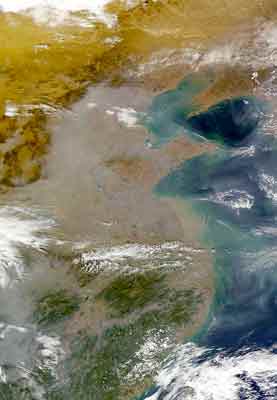
Finally, as shown in this satellite photo of air pollution in China -- carbon pollutants that are now wafting over our shores from the smelters, factories and diesel trucks of the eco-bruttality that is Communist China -- we see the final fallacy of carbon neutrality. It focuses on the nations that are working hard to increase efficiency and decrease pollutants, and does nothing globally to fix problems in China and India.

Oh, they may have a handy project you can help fund to put windmills in some farm village in rural China, but what's needed is eco-diplomacy, cutting Favored Nation trade status and tough policy, not chanting Om and prancing after carbon neutrality.

Now that the enviros have introduced the concept of carbon neutrality, they should keep their little promotion machine going and let the free market do its stuff. If they do, carbon neutrality is a fine thing.

But it's more likely they will do what they always do. They will guilt-trip us, indoctrinate our children, and not practice what they preach. (How does a big, fundraising-needy enviro group go carbon-neutral on a direct mail campaign to a couple million recipients?) When that fails to turn public opinion enough for them (and they have a very hard time realizing when they've been victorious) they will use legislation and the courts to force their will on us.


ISRAELI RAINMAKERS

If this ever gets off the ground, the Greenies will of course oppose it as "unnatural"

While scientists have made great strides in recent years in understanding and predicting the weather, the idea of taking control of the weather and making it rain has remained within the realm of mysticism and religion. Now Israeli researchers are part of an international team along with American and Belgian colleagues gearing up to perform one of the greatest and most elusive tricks of all by causing the heavens to bring rain. With the potential to alleviate the hunger problem in the world, the Geshem Project (named for the Hebrew word for rain) hopes to turn myth into science.

Scientists plan to produce rain in sub-tropical areas during the cloudless summer months by altering air currents using a unique thermal material developed in Israel. Led by Professor Leon Brenig of the University of Brussels Department of Physics, Project Geshem partners desert researchers from Israel's Ben Gurion University of the Negev with computer analysts at UCLA in California, and space imagery from NASA. The technique involves spreading a large black solar-absorbing surface over several square kilometers of land to generate intense and asymmetrical thermal emissions. Energy from sunlight is absorbed by the material and then radiated back into the air to heat the lower atmosphere with minimal loss into the ground. The heated air rises taking water condensation high enough to form clouds and produce out-of-season rain.

"It will make a huge difference." Brenig told ISRAEL21c. "In a region where there is 150 mm. a year it would go up to 600-700 mm. a year." Eli Zaady, a researcher on the project and ecologist from the BGU Open Space Agriculture Research organization, explains the technique could increase crops for a given area by 40 percent. "It all depends on the amount moisture in the air," said Zaady.

Sub-tropical climates are vulnerable to drought during the summer due to an atmospheric phenomenon know as the Hadley Cells. First described by their namesake George Hadley in the 18th century to explain the Trade Winds, Hadley cells are convection cycles of air that affect the weather in tropical and sub-tropical climates. The hot equatorial sun heats air in the low atmosphere causing it to rise and flow away from the equator towards the North and South. The air thermals carry water condensation up until it forms clouds that produce rain and the humid equatorial climates. However, as the air-currents reach sub-tropical regions they cool and descend preventing local water condensation from rising high enough to form clouds. The effect deprives sub-tropical areas of rain during the warm months of spring and summer.

"The object is to locally fight against that descent," Brenig says and estimates that air above the black surface could be raised by 40-50 degrees centigrade above the surrounding temperature creating a 'chimney' of rising air currents. The artificial thermal will boost water vapor to around 3000 meters where it can condense into water droplets that create clouds.

Materials with the required asymmetric thermal properties are hard to find. Mirrors, for example, although highly reflective would concentrate the heat in a small area whereas the Geshem project requires heating a wide expanse of air. The search for the 'ideal' black surface brought researchers to Acktar, an Israeli company that specializes in making custom materials with unique surface properties. Founded in 1994, Acktar, is a world technology leader in the development, and production of black, light absorbing coatings that deliver unique performance due to their high specific surface area. The coatings are based on vacuum deposition technologies that use a flow of atoms or ions directed towards a surface to build specific layers or crystalline phases on an atomic level.

Whereas there are other materials that absorb and reflect heat - such as road tarmac for example - the Acktar panels are unique in their highly asymmetrical properties and easy deployment. "You aren't going to put down tarmac over large areas," jokes Acktar CEO Zvi Finkelstein from the company's manufacturing site in Kiryat Gat.

The Ackerman material is so light that the company will be able to wrap several kilometers of material onto rolls for easy deployment and relocation. The material will be laid out on panels in long modules allowing maintenance crews to service the panels from vehicles driving between the rows. By covering an area of between five to nine square kilometers with the black material researchers estimate rainfall on an area of 40-100 square kilometers downwind. Clouds will form along a strip as wide as the black surface and up to 30 kilometers long during the hours from midday till five in the afternoon.

The cost of setting up a full-size black surface would run at over 80 million Euros, about comparable to establishing a desalinization plant. However, the operational costs are minimal and the technology simple to operate. Whereas desalinization requires a safe method of disposing with the saline by-products and energy to drive the process the Geshem method is environment-friendly and powered by the sun. "Solar energy is free," Brenig notes.

The method can be applied to any dry region located in subtropical or tropical latitudes within 150 km from an ocean, sea, or large lake. In coastal regions with high solar radiation intensity, the dominant wind during the day is a steady sea breeze that flows from the coast inland. The predictable wind will cause rains on accurately determined culture zones on the continent almost each day during sunny seasons. Adapted agricultural and water-collecting techniques could then make best use of the predictable rain.

The idea of using a large solar-heated surface to make clouds has been around since the 1960s. However, at that time the only suitable black-surface material was asphalt and the computing power required to test the theory was still decades away. Brenig first toyed with the idea of playing with the weather in the 1980s but was also hampered by limited computer power. "It is hard to simulate because meteorological predications are often not very good," Brenig explains. "We need very accurate predications such as how much rain will be produced to evaluate the efficiency of the system. The problem is that the mathematical models for cloud formations are still in their infancy."

The project was put on hold until 2003 when Brenig contacted the Jacob Blaustein Institute for Desert Research at BGU. Brenig chose Israel because of its arid regions and BGU's worldwide reputation for desert research. Armed with space images from NASA Brenig turned to the number-crunching super-computers at UCLA to run simulation on models in order to determine the optimal size and shape for the black surface. "Meteorological simulations are the most complex in the world and require the fastest computers," he notes.

Initial simulations confirmed the theory was reasonable and the search began to find an efficient and environment-friendly material to create the black surface. Now researchers are putting the finishing touches to the computer-simulations and hope to garner the financial support for a trial within in a year on an area of 3000 square meters in Israel's Negev desert that will use water vapor and breezes from the nearby Mediterranean Sea. Finklestein estimates the trial will cost around two million euros and Brenig is seeking support from the European Commission, NATO's Science for Peace, and various water authorities to fund the trial. Israeli authorities are keen to back the project and have already indicated that they will approve the required land area.

Zaady says that if the experiment is a success a larger trial will follow and Brenig is confident that if the technique works according to the simulation the idea will be adopted in various sub-tropical regions around the world that are suffering from desertification. Northeastern Brazil, North Africa, the Kalahari and Sahara deserts could all benefit from the method. In southeast Spain where desertification is claiming large swathes of agricultural land authorities have already shown great interest in the project and have indicated they would finance a large trial in that country. "It can bring water to a place where there is no water," Finklestein says. "Where there is water there is life, and then there is no limit to the imagination."

Source

***************************************

Many people would like to be kind to others so Leftists exploit that with their nonsense about equality. Most people want a clean, green environment so Greenies exploit that by inventing all sorts of far-fetched threats to the environment. But for both, the real motive is to promote themselves as wiser and better than everyone else, truth regardless.

Global warming has taken the place of Communism as an absurdity that "liberals" will defend to the death regardless of the evidence showing its folly. Evidence never has mattered to real Leftists


Comments? Email me here. My Home Page is here or here. For times when blogger.com is playing up, there are mirrors of this site here and here.

*****************************************

Tuesday, August 01, 2006

Polluted Thinking

It's a rather striking irony that, as our air grows cleaner, environmentalists' complaints grow louder. Since 2001, they've been screaming that President Bush is "rolling back the Clean Air Act," and that the resulting increase in air pollution will kill people by the thousands. Instead, every category of air pollution has fallen during the Bush years, with 2003, 2004, and 2005 showing the lowest levels of harmful ozone and particulates in the air since the monitoring of air pollution began in the 1960s. What exactly is going on?

A little background in is order. In the late 1990s, the Clinton administration sued dozens of electric utilities under a new and aggressive interpretation of the Clean Air Act's arcane New Source Review (NSR) regulations. NSR was the epitome of the complicated, costly, and counterproductive regulatory regime. It required existing sources of pollution, such as power plants, to meet stringent new regulations if they made any substantial operating changes. This had the consequence of freezing old technology in place: Many plants avoided small upgrades that would have lowered their emissions and increased their electricity output, for fear that doing so would drag them into the NSR morass. Even the Progressive Policy Institute saw that NSR was a mess, calling in 2000 for it to be scrapped entirely and replaced with a market-oriented "cap and trade" system, in which firms able to reduce their emissions to lower-than-required levels could sell their "leftover" emissions allotments to other companies. Cap-and-trade systems have the virtue of concentrating emissions reductions among the firms able to undertake them most efficiently. And because firms can sell any emissions "credits" they don't use, they have a strong market incentive to pollute less. A similar emissions-trading program has worked successfully to reduce acid rain in the northeast since 1990.

When the incoming Bush administration proposed to simplify NSR and adopt cap-and-trade, the environmental lobby went nuts, successfully blocking the administration's "Clear Skies" legislation in Congress. So the White House decided to implement its new approach administratively through the EPA's "Clean Air Interstate Rule," which applied a cap-and-trade program to the midwestern and northeastern states where most of the nation's coal-fired pollution originates.

That program has been in effect long enough for us to see the results, and they should fill any environmentalist with joy. A new report from the National Academy of Science concludes that the Bush system will likely prove just as effective in lowering air pollution as the regulation- and lawsuit-happy Clinton approach - and it will do so at a much lower cost. That should of course put an end to claims that the Bush administration is filling our air with deadly pollutants.

But don't hold your breath. The environmental movement has proved time and again that it can't take yes for an answer. Reducing air pollution has been the single greatest environmental-policy success of our time. Emissions are falling fast, and are going to keep falling. Despite more cars on the road and more drivers per capita, automobile emissions are falling 8 percent a year, and EPA models predict a further 80-percent reduction in car and truck emissions over the next 20 years. Power-plant emissions are going to follow a similar trajectory - and they'll fall even faster if greens relax their reflexive opposition to nuclear power.

Yet the environmental lobby continues to act as though catastrophe were about to befall us, and has been especially shrill in condemning Bush's record. Their intellectual bankruptcy is perhaps most strikingly illustrated by the fact that their current favorite idea for cutting greenhouse-gas emissions is nothing other than . . . cap and trade. But when Bush applies the same policy to air pollutants, he is a despoiler of Mother Earth. It's hard not to conclude that their real problem with the president is that he is a Republican.

Source


THE HUGE COSTS OF RESTRICTIVE GREENIE LAND USE POLICIES

The radio interview below is with Wendell Cox -- the world's best known critic of urban consolidation. He's looked at housing prices relative to income in six countries, and says Australia has some of the highest there are. In fact there's a strong link between high house prices and land rationing, which forms the basis of urban consolidation. And if that isn't radical enough, Cox also says public transport almost never lives up to the claims made for it, and we should be building more freeways.

Michael Duffy: One of the policies we've been pursuing in Counterpoint is that of urban consolidation which is affecting the way so many of us live, and this interests us strangely for a number of reasons; it's the last bastion of attitudes that were once associated with socialism, such as a distain for private property (in this case, cars) and also what I think is an unwarranted faith in central planning. Perhaps its best-known international critic is Wendell Cox who runs a US consultancy called Demographia and they've got a very interesting website that I'll give you later on. Wendell has done work for many public and private organisations, including in Australia, he's been here before and he'll be here again next month on a speaking tour, but I thought we'd catch up with him first. Wendell, welcome to the program. You have done something very interesting called a Demographia International Housing Affordability Survey. Tell us about that.

Wendell Cox: That's right. We looked at housing affordability in 100 markets in six nations. My great interest in that has to do with the recognition that home ownership is the principal driver of economic growth. What we found is that in Australia things are pretty bad. As I think most Australians know, housing affordability has been greatly lost. The great Australian dream, I would argue, is in the process of being destroyed for hundreds of thousands, if not millions, of future households. As you think, for example, in the Sydney area, housing prices relative to incomes are three times what they should be, three times what they are in Atlanta or Houston. In places like Brisbane, Adelaide, Melbourne and Perth, housing prices relative to incomes are about double what they should be, and this is being caused principally by the kind of regulations you've mentioned and that's the extreme regulation of land going under the name urban consolidation, anti-sprawl, et cetera, and it is doing to have, I believe, very serious impacts on the Australian economy in the long run.

Michael Duffy: Wendell, let's break that down, because you've just given us quite a good summary but let's take it step by step. First of all, which countries did you actually look at?

Wendell Cox: We looked at Australia, New Zealand, the United States, Canada, the UK and Ireland.

Michael Duffy: What was the measure? You said you compared house prices with income.

Wendell Cox: That's right. What we did is we looked at median house price and compared it to median household income in each of the countries. Essentially, historically, whether we talk about Australia or the United States or the UK, that measure is normally about three where the market is allowed to operate. What has happened in Australia and in some US west coast urban areas such as Los Angeles and Portland and Vancouver and Canada is these kinds of restrictive land rationing policies have been implemented and have driven the price of land through the ceiling.

Michael Duffy: But talking about the measure for the moment so our listeners understand what's going on here; you're looking at the average house price as a multiple of average individual income, household income?

Wendell Cox: Of median household income, middle household income.

Michael Duffy: So that is a pretty good measure, isn't it, because it gives you some sense of the pressure that an individual family or an individual might be under in any of those different markets.

Wendell Cox: Precisely.

Michael Duffy: Has this sort of thing been done before?

Wendell Cox: Not really at this scale. Most of these kinds of affordability measures have been done only inside countries and this is one of the things that sort of surprised the Australian and the New Zealand media a couple of years ago when we did our first study where there was an assumption that the same things that had gone wrong with the housing markets in Australia had occurred elsewhere...yet if you look in the US, for example, where Atlanta, Dallas, Fort Worth and Houston are the three fastest-growing large urban areas in the first world, housing affordability...with the huge demand those guys have got, housing affordability is down in the three range instead of the eight-and-a-half range or the six range for the median multiple that you find in the other capital cities.

Michael Duffy: So where did...you obviously must have ranked a lot of cities, a lot of housing markets...where did places like Sydney and Melbourne end up on your latest list?

Wendell Cox: Sydney ends up as one of...I think there are about eight worst, I forgot to check, but the worst are actually in California at the moment. Melbourne and the other three large capital cities are in the top 20 or the top 22 or something like that, they all tend to have multiples of about six. What we find is the only place where you find multiples of greater than four is where the kind of unwise policies that have been implemented, especially in Sydney and Melbourne, have been implemented.

Michael Duffy: I'd like to talk about those policies in a moment, but just before we do that, do you know if there is a trend over time? Do you know if things used to be better, in terms of that multiple, in places like Sydney and Melbourne?

Wendell Cox: Far better. If you just look at what has happened in housing prices relative to income in the last five years in Sydney, the average household that is going to buy a house today is going to pay an extra $200,000 at least including interest because of what's happened to those prices, and that is $200,000 that isn't going to go into buying other products and creating jobs.

Michael Duffy: Obviously you've got a lot of data because you looked at a lot of housing markets, something like 100...

Wendell Cox: Right, 100.

Michael Duffy: Is there a common pattern here? Is there a common cause you've been able to come up with to explain why some of these cities are worse than others?

Wendell Cox: Well, it all comes down to land regulation. In the urban areas, especially in the US and Canada where there's a fairly liberal regime that allows the market to deliver as many houses as people want to buy...places, again, like Atlanta, Dallas, Fort Worth, Houston, Calgary, Edmonton and Winnipeg et cetera, we find really no problem whatsoever with housing affordability, a little increase but not much. But of course where we find the real problems are in places like Australia and New Zealand especially, where they have all fallen for this really false doctrine of urban consolidation without ever even having looked at the economic impacts.

Michael Duffy: What is it about urban consolidation that pushes up house prices?

Wendell Cox: What it is, it basically rations land. If tomorrow...if OPEC were to decide it would produce as much oil as it can, we would find gasoline prices, petrol prices, probably dropping by half, but because they've created a shortage of oil, the price is driven up. The cost of production has not gone up. If you look at Australia, over the last 20 years the actual cost of building a house has declined relative to inflation. What has happened is that the land prices have exploded due to the rationing of land, the scarcity of land that has been created by policies, which is really crazy when you think about the fact that something like one-quarter of 1% of Australia is in urban development.

Michael Duffy: Wendell, you said that some American cities (not that many but some) are very expensive, in fact more expensive than Sydney, so have they also adopted these same policies?

Wendell Cox: Precisely. There are differences...for example, the big problem in Sydney is a combination of taking land off the development rolls and creating unbelievable excessive infrastructure charges that one of your former guests, Patrick Troy, has roundly and rightly criticised. In California, principally it is very large infrastructure charges on new housing that bear no resemblance to reality. In Portland and Vancouver and Toronto you have urban growth boundaries, which you also have in Melbourne with their soon to be failing Melbourne 2030 plan, and that kind of thing.

Michael Duffy: Wendell, given the outcomes that you've just been talking about, why do you think urban consolidation was and still is so popular?

Wendell Cox: It is principally popular among a group of planners for whom what the city looks like aesthetically is the most important thing. They have done all sorts of research that's largely wrong, you hear them complaining about land being taken out of agricultural production because of urbanisation when in fact, for example, in Australia all of the land taken out of agricultural production for the last quarter century exceeds the size of the state of Victoria because you've gotten better at producing agricultural products. So a lot of it is based upon a sort of theory that we are ruining the land and that mankind is a scourge on the land.

Michael Duffy: So this is something of an outgrowth of the tremendous boom in the environmental movement, is it, over the last couple of decades?

Wendell Cox: Exactly, and it is based upon the most unsound environmental research you can imagine. The fact is we need to improve and protect the environment, we're doing an awful lot of good things, but we do not need to force people to live in downtown Sydney high-rises to accomplish that.

Michael Duffy: It's curious, there does seem to be a lot of data coming out just in the last year or so that I've noticed acknowledging that the promise of urban consolidation isn't always fulfilled. For example, in Sydney recently they discovered...I think it was water use in high-rises was as great or greater than in free-standing houses, which would appear to be counter intuitive, but that's been found by reputable experts.

Wendell Cox: And there's also the claim always made, especially by your academics in Australia, that suburbanisation creates traffic congestion when in fact it doesn't. Suburbanisation dilutes traffic congestion and makes traffic flow more freely. So that, for example, in our less dense urban areas of the US, we get to work on average 20 minutes faster every day, round trip, than Canadians do. So the point is, a lot of the claims...almost any claim you see made by the proponents of urban consolidation fails to stand the test of scrutiny.

Michael Duffy: Let's talk a bit more about transport because I know Demographia has done a lot of interesting work here, and one of the things you've looked at is the amount of freeways that cities have in relation to their population size. How do Australian cities come out of that?

Wendell Cox: Pretty much dreadfully. Melbourne and Brisbane are not bad, Perth is not bad, but the real losers are Sydney and Adelaide. Adelaide has fewer freeways per capita in terms of lane kilometres than any place, except perhaps Winnipeg. But if you look at Sydney, it comes out near the bottom of the list.

Michael Duffy: In a sense I suppose that lack of freeways creates some of the problems, and then the urban consolidators put forward their theories as if they're going to solve them. I know that they're very keen on things like light rail and public transport. Looking around the world at all the cities you've studied, is there any evidence you can actually shift people out of cars and onto things like light rail?

Wendell Cox: Not a shred. For example, when they built the Portland Oregon light rail line they found a reduction of traffic congestion along the adjacent freeway for a matter of about 30 days. The fact is that the basic problem with public transport, while we all love it, is that it only gets you to one place. If you go to any city, I don't care if it's Sydney or Portland or Perth or Paris, what you will find is public transport gets you to the core but is absolutely useless and uncompetitive in terms of getting you around the urban area otherwise. You think about Sydney, for example, only 13% of employment is downtown. That means 87% of the employment can't reasonably be reached by public transport. And, for example, you can see the light loads on that bus-way that you've built as indicative of this. The fact is that no urban area in the world has any plans for any public transport system that will draw very many people out of cars, and there's good reason for that; no urban area could afford it.

Michael Duffy: There's a certain religious element to this anti-car feeling I've found in people I talk to. One of the things I'm often told here is that if you build more freeways it will just encourage more people to use cars. There's a sort of anti-choice philosophy at the background of all this, isn't there?

Wendell Cox: There is, and in fact what happens when you build more freeways is people do drive a little bit longer in terms of distance but they drive shorter in terms of time because we're not all sitting around waiting so that we can drive 36 hours a day or something. The fact is that a situation like Sydney where there are insufficient freeways and there's no way you're ever going to have sufficient freeways because you'd have to tear up too much of the city, you've got more intense air pollution emissions because the cars are going slower and because they're in more stop-and-go traffic. This whole idea that building freeways creates traffic is sort of like the assumption that building maternity wards would raise the birth rate.

Michael Duffy: I once gave a lecture, not that long ago, at a university on urban planning and at the end one of the horrified students in the class said to me, 'But you can't just let people do what they want!'

Wendell Cox: Yes, but the interesting thing is all sorts of economic studies around the world show that economic growth and affluence happen where people are allowed to do what they want, and that's what is really at risk here. I don't know what the impact is going to be but it is not a good impact when you significantly increase the price of housing for no good reason.

Source


CALIFORNIA: GLOBAL WARMING A POLITICAL PROBLEM

Thirty-one years ago, Newsweek magazine published an extensive account of what it described as a growing scientific consensus of global climate change. "There are ominous signs that the Earth's weather patterns have begun to change dramatically and that these changes may portend a drastic decline in food production," Newsweek said, adding, "The evidence in support of these predictions has now begun to accumulate so massively that meteorologists are hard-pressed to keep up with it" and "to scientists these seemingly disparate incidents represent the advance signs of fundamental changes in the world's weather."

Global warming? Not quite. The Newsweek article about the emerging scientific consensus was about global cooling and the potential onset of a mini-ice age, akin to the one that chilled the Northern Hemisphere between 1600 and 1900. Now we are told, of course, that there's a growing scientific consensus about global warming, with hydrocarbon emissions from humankind's economic activities the chief culprit, although there's a significant body of contrary opinion.

Whether global warming is a scientific fact or, alternatively, a theory being propagandized for ideological reasons is still an open question. But it clearly is a political fact and in politics, perceptions are always more powerful than reality, whatever it may be. The potency of global warming as a political issue is underscored in a new poll by the Public Policy Institute of California, which found that most Californians are alarmed and want the state to take steps to deal with it regardless of what happens at the national or international levels. "Californians now rank global warming as more important than at any time since we first started asking about it in June of 2000," said PPIC's polling director, Mark Baldassare. The poll was taken even before California was slammed by a record-breaking and deadly heat wave in mid-July, so it would be a safe assumption that the attitudes found in the PPIC poll have hardened since then.

Not to be punny, but it's a hot potato for Gov. Arnold Schwarzenegger as he tries to balance the evident voter interest in doing something about global warming against his very close, mutually beneficial political alliance with business executives. The latter are leery about strict regulations on hydrocarbon emissions, as proposed in legislation, Assembly Bill 32, being advanced by Assembly Speaker Fabian Nunez.

The California Chamber of Commerce and other business groups have labeled AB 32 a "job killer" that "increases costs for California businesses, makes them less competitive and discourages economic growth with little or no proven environmental benefit by adopting an arbitrary cap on carbon emissions." Schwarzenegger needs business support in his re-election campaign but has said he wants to push global warming actions, has already undertaken some steps by decree, and is at least a semi-sponsor of the Nunez bill.

As currently written, AB 32 labels global warming a "serious threat" and directs the state Air Resources Board, over a period of years, to monitor greenhouse gas emissions and set standards for reducing them. Having the ARB become the greenhouse gas czar is a key element of the legislation, one that environmentalists like because of its history of aggressive action on smog, and one that business leaders dislike for the same reason. They envision every business project becoming a battleground, much as occurs now under the California Environmental Quality Act, forcing corporations to buy up emission credits to operate.

Schwarzenegger is now suggesting that the ARB be taken out of the picture and that the power to set and enforce greenhouse gas emissions be given to a new agency directly under the control of a governor and his appointees -- including the power to nix any regulations deemed to be economically harmful. And that's raising the hackles of environmentalists, who see having a governor directly control enforcement as an invitation for business to wield influence through the Governor's Office.

Source


BEFORE THE WHITE MAN CAME? WAR

We've deluded ourselves into believing in the myth of the noble and peaceful primitive

By MARK STEYN

Nicholas Wade's 'Before The Dawn' is one of those books full of eye-catching details. For example, did you know the Inuit have the largest brains of any modern humans? Something to do with the cold climate. Presumably, if this global warming hooey ever takes off, their brains will be shrinking with the ice caps.

But the passage that really stopped me short was this:

"Both Keeley and LeBlanc believe that for a variety of reasons anthropologists and their fellow archaeologists have seriously underreported the prevalence of warfare among primitive societies.... 'I realized that archaeologists of the postwar period had artificially "pacified the past" and shared a pervasive bias against the possibility of prehistoric warfare,' says Keeley."

That's Lawrence Keeley, a professor at the University of Illinois. And the phrase that stuck was that bit about artificially pacifying the past. We've grown used to the biases of popular culture. If a British officer meets a native -- African, Indian, whatever -- in any movie, play or novel of the last 30 years, the Englishman will be a sneering supercilious sadist and the native will be a dignified man of peace in perfect harmony with his environment in whose tribal language there is not even a word for "war" or "killing" or "weapons of mass destruction." A few years ago, I asked Tim Rice, who'd just written the lyrics for Disney's Aladdin and The Lion King, why he wasn't doing Pocahontas. "Well, the minute they mentioned it," he said, "I knew the Brits would be the bad guys. I felt it was my patriotic duty to decline." Sure enough, when the film came out, John Smith and his men were the bringers of environmental devastation to the New World. "They prowl the earth like ravenous wolves," warns the medicine man, whereas Chief Powhatan wants everyone to be "guided to a place of peace." Fortunately, Captain Smith comes to learn from Pocahontas how to "paint with all the colours of the wind."

In reality, Pocahontas's fellow Algonquin Indians were preyed on by the Iroquois, "who took captives home to torture them before death," observes Nicholas Wade en passant. The Iroquois? Surely not. Only a year or two back, the ethnic grievance lobby managed to persuade Congress to pass a resolution that the United States Constitution was modelled on the principles of the Iroquois Confederation -- which would have been news to the dead white males who wrote it. With Disney movies, one assumes it's just the modishness of showbiz ignoramuses and whatever multiculti theorists they've put on the payroll as consultants. But professor Keeley and Steven LeBlanc of Harvard disclose almost as an aside that, in fact, their scientific colleagues were equally invested in the notion of the noble primitive living in peace with nature and his fellow man, even though no such creature appears to have existed. "Most archaeologists," says LeBlanc, "ignored the fortifications around Mayan cities and viewed the Mayan elite as peaceful priests. But over the last 20 years Mayan records have been deciphered. Contrary to archaeologists' wishful thinking, they show the allegedly peaceful elite was heavily into war, conquest and the sanguinary sacrifice of beaten opponents.... The large number of copper and bronze axes found in Late Neolithic and Bronze Age burials were held to be not battle axes but a form of money."

And on, and on. Do you remember that fabulously preserved 5,000-year-old man they found in a glacier in 1991? He had one of those copper axes the experts assured us were an early unit of currency. Unfortunately for this theory, he had it hafted in a manner that suggested he wasn't asking, "Can you break a twenty?" "He also had with him," notes professor Keeley, "a dagger, a bow, and some arrows; presumably these were his small change." Nonetheless, anthropologists concluded that he was a shepherd who had fallen asleep and frozen peacefully to death in a snowstorm. Then the X-ray results came back and showed he had an arrowhead in him.

Not for the first time, the experts turn out to be playing what children call "Opposite Land." There's more truth in Cole Porter's couplet from Find Me A Primitive Man:

I don't mean the kind that belongs to a club But the kind that has a club that belongs to him.

Although Porter was the kind that belongs to a club, the second line accurately conveys his own taste in men. He'd have been very annoyed if Mister Primitive had turned out to be some mellow colours-of-your-windiness hippy-dippy granola-cruncher.

Lawrence Keeley calculates that 87 per cent of primitive societies were at war more than once per year, and some 65 per cent of them were fighting continuously. "Had the same casualty rate been suffered by the population of the twentieth century," writes Wade, "its war deaths would have totaled two billion people." Two billion! In other words, we're the aberration: after 50,000 years of continuous human slaughter, you, me, Bush, Cheney, Blair, Harper, Rummy, Condi, we're the nancy-boy peacenik crowd. "The common impression that primitive peoples, by comparison, were peaceful and their occasional fighting of no serious consequence is incorrect. Warfare between pre-state societies was incessant, merciless, and conducted with the general purpose, often achieved, of annihilating the opponent."

Why then, against all the evidence, do we venerate the primitive? And to the point of pretending a bunch of torturing marauders devised the separation of powers in the U.S. Constitution. We do it for the same reason we indulge behaviour like that at Caledonia, Ont. We want to believe that the yard, the cul-de-sac, the morning commute, the mall are merely the bland veneer of our lives, and that underneath we are still that noble primitive living in harmony with the great spirits of the forest and the mountain. The reality is that "civilization" -- Greco-Roman-Judeo-Christian -- worked very hard to stamp out the primitive within us, and for good reason.

I was interested to read Wade's book after a month in which men raised in suburban Ontario were charged with a terrorist plot that included plans to behead the Prime Minister, and the actual heads of three decapitated police officers were found in the Tijuana River. The Mexican drug gangs weren't Muslim last time I checked, but evidently decapitation isn't just for jihadists anymore: if you want to get ahead, get a head. A couple of years back, I came across a column in The East African by Charles Onyango-Obbo musing on the return of cannibalism to the Dark Continent. Ugandan-backed rebels in the Congo (four million dead but, as they haven't found a way to pin it on Bush, nobody cares) had been making victims' relatives eat the body parts of their loved ones. You'll recall that, when Samuel Doe was toppled as Liberia's leader, he was served a last meal of his own ears. His killers kept his genitals for themselves, under the belief that if you eat a man's penis you acquire his powers. One swallow doesn't make a summer, of course, but I wonder sometimes if we're not heading toward a long night of re-primitivization. In his shrewd book Civilization And Its Enemies, Lee Harris writes:

"Forgetfulness occurs when those who have been long inured to civilized order can no longer remember a time in which they had to wonder whether their crops would grow to maturity without being stolen or their children sold into slavery by a victorious foe. . . . That, before 9/11, was what had happened to us. The very concept of the enemy had been banished from our moral and political vocabulary."

It's worse than Harris thinks. We're not merely "forgetful." We've constructed a fantasy past in which primitive societies lived in peace and security with nary a fear that their crops would be stolen or their children enslaved. War has been the natural condition of mankind for thousands of years, and our civilization is a very fragile exception to that. What does it say about us that so many of our elites believe exactly the opposite -- that we are a monstrous violent rupture with our primitive pacifist ancestors? It's never a good idea to put reality up for grabs. You can bet your highest-denomination axe on that.

Source

***************************************

Many people would like to be kind to others so Leftists exploit that with their nonsense about equality. Most people want a clean, green environment so Greenies exploit that by inventing all sorts of far-fetched threats to the environment. But for both, the real motive is to promote themselves as wiser and better than everyone else, truth regardless.

Global warming has taken the place of Communism as an absurdity that "liberals" will defend to the death regardless of the evidence showing its folly. Evidence never has mattered to real Leftists


Comments? Email me here. My Home Page is here or here. For times when blogger.com is playing up, there are mirrors of this site here and here.

*****************************************