Sunday, September 26, 2010


Correlating Temperature With CO2 before and after the matter became politicized

Amazing difference between pre-"adjustment" and post-"adjustment" graphs in the comparator below. This is outright fraud -- JR


NCAR graph from the 1970s

Now that at least one member of the Hockey team has acknowledged that the cooling in the 1970s was both real and natural, we can analyze older data which was not perturbed by people with an agenda to prove global warming. The graph below compares NCAR’s 1970s temperatures vs. atmospheric CO2.


As you can see, there isn’t much of a correlation – the graph is almost flat.

Since then, the official temperature data has been massaged many times to make the past colder and the present warmer. So it is useful to do a correlation using data from the pre-agenda climate era.

Blink comparator showing GISS US temperature changes from 1998 to present.


Here is what people wanted to do to solve the climate problem of 1975
Climatologists are pessimistic that political leaders will take any positive action to compensate for the climatic change, or even to allay its effects. They concede that some of the more spectacular solutions proposed, such as melting the Arctic ice cap by covering it with black soot or diverting arctic rivers, might create problems far greater than those they solve. But the scientists see few signs that government leaders anywhere are even prepared to take the simple measures of stockpiling food or of introducing the variables of climatic uncertainty into economic projections of future food supplies. The longer the planners delay, the more difficult will they find it to cope with climatic change once the results become grim reality.


SOURCE


Northern Hemisphere Temperature Reconstruction Clearly Shows the Medieval Warm Period and Little Ice Age (Plus a Whole Lot More)

Discussing: Ljungqvist, F.C. 2010. "A new reconstruction of temperature variability in the extra-tropical northern hemisphere during the last two millennia". Geografiska Annaler 92A: 339-351.

The pattern of temperature change over the past 2000 years is important for several reasons. First, if there has been no long-term pattern to it, then any warming in recent decades can more easily be attributed to human activity. On the other hand, if there have been natural cycles or centennial-scale excursions of temperature, then it is more difficult to claim that recent warming is unnatural or unprecedented. Second, impacts of climate change are often based on the assumption that "unusual" warmth is harmful to life and human society; but if it was equally warm, or warmer than today, a thousand years ago, then there is much less basis for predicting harm.

The study of Ljungqvist (2010) expands the data available for reconstructing past climate by utilizing 30 datasets. However, the author felt that data from arid zone tree species should be disqualified, due to the confounding of the effects of warm temperatures with those of drought stress. Thus, bristlecone pine, foxtail pine, and Mongolia data that show a pronounced (and likely spurious) hockey-stick shape were not used.

The CPS (Composite Plus Scale) method of analysis was employed; and the data were linearly interpolated. For each dataset, the data were normalized to zero mean and unit variance. The 30 data sets were combined by computing their mean. The composite score was shown to have a correlation of 0.95 with the Hadley instrumental temperature record for the zone 90-30°N and was scaled to match the variance of the Hadley data.

While the CPS method has the disadvantage that certain proxies which might not relate to local temperature are combined with others and correlated with the hemispheric temperature (vs. doing strictly local calibration), it has the advantage that individual proxies are given equal weights, so that one is not selectively picking out those with the "right" shape by chance and giving them too much influence.

The resulting reconstruction has values at each decade. It shows a clear repeating warm/cool pattern of Roman Warm Period, Dark Ages Cold Period, Medieval Warm Period, Little Ice Age and recent warming. This long-term pattern was stated to relate to the 1500-year Bond cycles. Looking at the reconstruction itself, the RWP and MWP were both warmer than the decades from 1961-1990; and the composite proxies do not show rapid warming after 1990. Thus, the study clearly shows that large temperature excursions on centennial scales are real features of the past 2000 years, and that recent warmth is not unprecedented.

SOURCE

Journal Abstract:

A new temperature reconstruction with decadal resolution, covering the last two millennia, is presented for the extratropical Northern Hemisphere (90–30°N), utilizing many palaeo-temperature proxy records never previously included in any large-scale temperature reconstruction. The amplitude of the reconstructed temperature variability on centennial time-scales exceeds 0.6°C. This reconstruction is the first to show a distinct Roman Warm Period c. ad 1–300, reaching up to the 1961–1990 mean temperature level, followed by the Dark Age Cold Period c. ad 300–800. The Medieval Warm Period is seen c. ad 800–1300 and the Little Ice Age is clearly visible c. ad 1300–1900, followed by a rapid temperature increase in the twentieth century. The highest average temperatures in the reconstruction are encountered in the mid to late tenth century and the lowest in the late seventeenth century. Decadal mean temperatures seem to have reached or exceeded the 1961–1990 mean temperature level during substantial parts of the Roman Warm Period and the Medieval Warm Period. The temperature of the last two decades, however, is possibly higher than during any previous time in the past two millennia, although this is only seen in the instrumental temperature data and not in the multi-proxy reconstruction itself. Our temperature reconstruction agrees well with the reconstructions by Moberg et al. (2005) and Mann et al. (2008) with regard to the amplitude of the variability as well as the timing of warm and cold periods, except for the period c. ad 300–800, despite significant differences in both data coverage and methodology.

This combination of many proxies would seem to give results quite close to what I specified as a valid proxy on 20th. -- JR


New Scientist permits the sun to join the climate club

It does seem as if the AGW establishment are preparing the ground for admitting that the sun is perhaps critical for climate. The New Scientist runs an editorial today grudgingly admitting that “The sun’s activity has a place in climate science”.
FOR many years, any mention of the sun’s influence on climate has been greeted with suspicion.

People who believe human activity has no effect on the climate staked a claim on the sun’s role, declaring it responsible for the long-term warming trend in global temperatures. Climate scientists were often uneasy about discussing it, fearful that any concession would be misunderstood by the public and seen as an admission that climate sceptics are right.

No one has ever denied that the sun has an effect on climate. But the consensus view has always been that variations in the sun’s activity, such as the 11-year sunspot cycle, have insignificant effects. While this remains true, the latest findings show that the sun might be significant on a more regional scale. It seems changes in solar activity can have consequences ranging from higher rainfall in the tropics to extreme weather events in the north.

But then they go out of their way in this article (see “The sun joins the climate club”) to denigrate the sun.
THE idea that changes in the sun’s activity can influence the climate is making a comeback, after years of scientific vilification, thanks to major advances in our understanding of the atmosphere.

The findings do not suggest – as climate sceptics frequently do – that we can blame the rise of global temperatures since the early 20th century on the sun. “There are extravagant claims for the effects of the sun on global climate,” says Giles Harrison, an atmospheric physicist at the University of Reading, UK. “They are not supported.”

Where solar effects may play a role is in influencing regional weather patterns over the coming decades. Predictions on these scales of time and space are crucial for nations seeking to prepare for the future.

Over the famous 11-year solar cycle, the sun’s brightness varies by just 0.1 per cent. This was seen as too small a change to impinge on the global climate system, so solar effects have generally been left out of climate models. However, the latest research has changed this view, and the next report by the Intergovernmental Panel on Climate Change (IPCC), due in 2013, will include solar effects in its models.

But the sun does not much care (Beware the Icarus Syndrome) I think for the scientific establishment and will continue to do its own thing.

SOURCE


The oceans are getting an acknowledgement now too

"Der Spiegel" says: The Ocean’s Influence Greater Than Thought

Alex Bojanowski at Germany’s online Der Spiegel reports here on a new paper appearing in Nature that shows climate change in the 1970s was caused by ocean cooling. Climate simulation models once indicated that the cooling in the 1970s was due to sun-reflecting sulfur particles, emitted by industry. But now evidence points to the oceans.

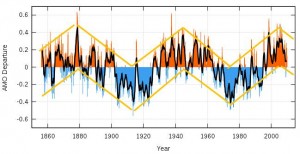
I don’t know why this is news for the authors of the paper. Ocean cycles are well-known to all other scientists. The following graphic shows the AMO 60-year cycle, which is now about to head south.


Computer models simulating future climate once predicted that it would soon get warm because of increasing GHG emissions, but, writes Der Spiegel, citing Nature:
Now it turns out that the theory is incomplete. A sudden cooling of the oceans in the northern hemisphere played the decisive role in the drop of air temperatures.

The paper was authored by David W. J. Thompson, John M. Wallace, John J. Kennedy, and Phil D. Jones. The scientists discovered that ocean temperatures in the northern hemisphere dropped an enormous 0.3°C between 1968 and 1972. Der Spiegel writes:
A huge amount of energy was taken out of the oceans. The scientists said that it was surprising that the cooling was so fast.

This shows, again, that the climate simulation models used for predicting the future are inadequate. It’s not sure what caused the oceans to cool. But scientists are sure that aerosols were not the cause. Der Spiegel describes a possible scenario how the oceans may have cooled:
Huge amounts of melt water from Greenland’s glaciers poured into the Atlantic at the end of the 1960s, and formed a cover over the ocean. The melt water cooled the ocean for one thing, and acted to brake the Gulf Stream, which transports warm water from the tropics and delivers it to the north. The result: the air also cools down.

But, as Spiegel reports, that hardly explains why there was also cooling in the north Pacific. Der Spiegel:
The scientists will have to refine their climate simulations. The new study shows one thing: The influence of the oceans is greater than previously thought.

I’d say that’s a very polite way of saying: Your models have been crap, and it’s back to the drawing board. This time don’t forget to properly take the oceans and every thing else into account. Yes, there’s a quite a bit more to climate than a single trace gas in the atmosphere. Hooray – the warmists are finally beginning to realize it! (Maybe)

SOURCE


Unsustainable Cow Manure

Sustainable, affordable, eco-friendly renewable energy, my eye

"Seek a sustainable future! Wind, solar and biofuels will ensure an eco-friendly, climate-protecting, planet-saving, sustainable inheritance for our children". Or so we are told by activists and politicians intent on enacting new renewable energy standards, mandates and subsidies during a lame duck session. It may be useful to address some basic issues, before going further down the road to Renewable Utopia.

First, when exactly is something not sustainable? When known deposits (proven reserves) may be depleted in ten years? 50? 100? What if looming depletion results from government policies that forbid access to lands that might contain new deposits – as with US onshore and offshore prospects for oil, gas, coal, uranium, rare earth minerals and other vital resources?

Rising prices, new theories about mineral formation, and improved discovery and extraction technologies and techniques typically expand energy and mineral reserves – postponing depletion by years or decades, as in the case of oil and natural gas. But legislation, regulation, taxation and litigation prevent these processes from working properly, hasten depletion, and make “sustainability” an even more politicized, manipulated and meaningless concept.

Second, should the quest for mandated “sustainable” technologies be based on real, immediate threats – or will imaginary or exaggerated crises suffice? Dangerous manmade global cooling morphed into dangerous manmade global warming, then into “global climate disruption” – driven by computer models and disaster scenarios, doctored temperature data, manipulated peer reviews, and bogus claims about melting glaciers and rising sea levels. Shouldn’t policies that replace reliable, affordable energy with expensive, intermittent, land-intensive, subsidized sources be based on solid, replicable science?

Third, shouldn’t inconvenient sustainability issues be resolved before we proceed any further, by applying the same guidelines to renewable energy as courts, regulators and eco-activists apply to petroleum?

Most oil, gas, coal and uranium operations impact limited acreage for limited times – and affected areas must be restored to natural conditions when production ends. Effects on air and water quality, habitats and protected species are addressed through regulations, lease restrictions and fines. The operations generate vast amounts of affordable, reliable energy from relatively small tracts of land, and substantial revenues.

Wind turbines generate small amounts of expensive, unreliable electricity from gargantuan installations on thousands of acres. Turbines and their associated transmission lines dominate scenic vistas, disrupt habitats and migratory routes, affect water drainage patterns, impede crop dusting and other activities, and kill bats, raptors and other birds, including endangered species that would bring major fines if the corporate killers were oil or mining companies. And yet, wind operators receive exemptions from environmental review, biodiversity and endangered species laws that traditional energy companies must follow – on the ground that such rules would raise costs and delay construction of “eco-friendly” projects.

Kentucky’s Cardinal coal mine alone produces 75% of the Btu energy generated by all the wind turbines and solar panels in the USA, Power Hungry author Robert Bryce calculates. Unspoiled vistas, rural and maritime tranquility, and bald eagles will all be endangered if 20% wind power mandates are enacted.

The Palo Verde Nuclear Power Station near Phoenix generates nearly 900 times more electricity than Nevada’s Nellis Air Force Base photovoltaic panels, on less land, for 1/15 the cost per kWh – and does it 90% of the time, versus 30% of the time for the Nellis array. Generating Palo Verde’s electrical output via Nellis technology would require solar arrays across an area ten times larger than Washington, DC.

Building enough photovoltaic arrays to power Los Angeles would mean blanketing thousands of square miles of desert habitat. Once built, solar and wind systems will be there just this side of forever, since there will be no energy production if we let them decay, after shutting down whatever hydrocarbon operations aren’t needed to fuel backup generators that keep wind and solar facilities operational.

Wind and solar power also mean there is a sudden demand for tons of rare earth elements that weren’t terribly important a decade ago. They exist in very low concentrations, require mining and milling massive amounts of rock and ore to get the needed minerals, and thus impose huge ecological impacts.

If mountaintop removal to extract high quality coal at reduced risk to miners is unacceptable and unsustainable – how is it eco-friendly and sustainable to clear-cut mountain vistas for wind turbines? Blanket thousands of square miles with habitat-suffocating solar panels? Or remove mountains of rock to mine low-grade rare earth mineral deposits for solar panel films, hybrid batteries and turbine magnets?

Since any undiscovered US rare earth deposits are likely locked up in wilderness and other restricted land use areas, virtually no exploration or development will take place here. We will thus be dependent on foreign suppliers, like China, which are using them in their own manufacturing operations – and selling us finished wind turbines, solar panels and hybrid car batteries. The United States will thus be dependent on foreign suppliers for renewable energy, just as we rely on foreign countries for oil and uranium.

To claim any of this is ecologically or economically sustainable strains credulity.

Green jobs will mostly be overseas, subsidized by US tax and energy dollars – other people’s money (OPM). Indeed, Americans have already spent over $20 billion in stimulus money on “green” energy projects. However, 80% of the funding for some of them went to China, India, South Korea and Spain, and three-fourth of the turbines for eleven US wind projects were made overseas. This is intolerable, indefensible and unsustainable. But it gets worse.

Denver’s Nature and Science Museum used $720,000 in stimulus money to install photovoltaic panels and reduce its electricity bills by 20 percent. The panels may last 25 years, whereas it will take 110 years to save enough on those bills to pay for the panels – and by then four more sets of panels will be needed.

As to biofuels, the US Navy recently waxed ecstatic over its success with camellia-based eco-fuel in fighter jets. But the PC biofuel costs $67.50 per gallon, versus $5.00 per gallon for commercial jet fuel.

To meet the 36-billion-gallons-a-year-by-2022 federal ethanol diktat, we would have to grow corn on cropland and wildlife habitat the size of Georgia, to get 15 billion gallons of corn-based ethanol – plus switchgrass on farmlands and habitats the size of South Carolina, to produce 21 billion gallons of “advanced biofuel.” By contrast, we could produce 670 billion gallons of oil from frozen tundra equal to 1/20 of Washington, DC, if the Arctic National Wildlife Refuge weren’t off limits.
OPM-subsidized ethanol also means a few corn growers and ethanol refiners make hefty profits. But chicken and beef producers, manufacturers that need corn syrup, and families of all stripes get pounded by soaring costs, to generate a fuel that gets one-third less mileage per tank than gasoline.

Hydrocarbons fueled the most amazing and sustained progress in human history. Rejecting further progress – in the name of sustainability or climate protection – requires solid evidence that we face catastrophes if we don’t switch to “sustainable” alternatives. Computer-generated disaster scenarios and bald assertions by Al Gore, Harry Reid, John Holdren and President Obama just don’t make the grade.

We need to improve energy efficiency and conserve resources. Science and technology will continue the great strides we have made in that regard. Politically motivated mandates will impose huge costs for few benefits. Sustainability claims will simply redistribute smaller shares of a shrinking economic pie.

“Renewable” energy subsidies may sustain the jobs of lobbyists, activists, politicians, bureaucrats and politically connected companies. But they will kill millions of other people’s jobs.

Let’s be sure to remind our elected officials of this along their campaign trails.

SOURCE


Another disastrous "Green" scheme in Australia

Home water tanks were subsidized by the government in lieu of building new dams

Three years ago, owning a water tank business was a licence to print money. Then the rebates were cut and the rains came. Now what was the busiest industry on the block is practically non-existent, as 400 water tank operators have been whittled to 12.

Millions of dollars have been lost, businesses have disappeared and customers wanting tanks for their homes have evaporated.

Leisa Donlan, from independent body the Association of Rotational Moulders, said it was the "industry that has been forgotten".

"Lives have been absolutely shattered by this. What the state government did by introducing the rebate and then cutting it all of a sudden was just awful," she said. "Family businesses have been ruined. Our staff have been suicidal some days after counselling the people involved. "Losing a business is a very human thing."

Department of Environment and Resource Management figures showed that across the state more than 250,000 Queenslanders claimed the rebate for a water tank.

"At the peak of the drought and the WaterWise Rebate Scheme, there were four-month waits. Manufacturers were working 24 hours a day, seven days a week," Ms Donlan said.

"State government ministers themselves came out and said that the industry needed to invest in better equipment to keep up with the demand, to step it up.

"Then, all of a sudden in June 2007, as quickly as it started, the rebate for the tanks stopped. Manufacturers had spent tens of millions of dollars buying new equipment to cope with the excessive demand and all of a sudden the demand was gone. Overnight. It was devastating."

Toby Peacock, owner of Brisbane water tank business QTank, said the abolition of the rebate, coupled with the breaking of the drought, had all but "killed" the industry.

"During the height of the drought, water was all everyone was talking about. People were desperate for water tanks, desperate to conserve water and everyone was wanting to safeguard themselves," he said.

"But once the rebate ended and the drought started to break, people moved on to talking about something else. They forgot how important it is to conserve water. Tanks were no longer fashionable."

Under Brisbane City Council planning regulations, all new dwellings must include a 5000-litre water tank to gain approval.

This regulation is the only thing keeping a handful of operators in business, Mr Peacock said. "Every night I go to bed nervous, praying that when I wake up in the morning, the government won’t have cancelled this regulation," he said.

Ms Donlan said the lack of support for the industry was disappointing because it was highly likely water consumption would be an issue again in the future.

SOURCE

***************************************

For more postings from me, see DISSECTING LEFTISM, TONGUE-TIED, EDUCATION WATCH INTERNATIONAL, POLITICAL CORRECTNESS WATCH, FOOD & HEALTH SKEPTIC, GUN WATCH, SOCIALIZED MEDICINE, AUSTRALIAN POLITICS, IMMIGRATION WATCH INTERNATIONAL and EYE ON BRITAIN. My Home Pages are here or here or here. Email me (John Ray) here. For readers in China or for times when blogger.com is playing up, there are mirrors of this site here and here

*****************************************

Saturday, September 25, 2010


Republicans Promise Climategate Investigation If They Win U.S. Elections

The House's top Republican watchdog is planning to launch an investigation into international climate data if he takes the helm of the chamber's oversight panel next year.

Rep. Darrell Issa (R-Calif.), the ranking member of the Oversight and Government Reform Committee, said a probe of the "Climategate" scandal will top his environmental agenda if the Republicans take over the House next year and he gets the chairmanship.

"I do have a backburner investigation that I'm going to want to have completed, and that is, we paid a lot of money to have international evaluation, most of it done in Britain, that turns out to have been less than truthful in some of the figures," he said. "We're going to want to not investigate to get our money back, but we're going to want to have a do-over of good numbers so that everyone can have confidence."

The disputed climate data became the subject of heated controversy last year when hackers released e-mails from the Climatic Research Unit of the University of East Anglia in England. Climate skeptics pointed to the e-mails as evidence that prominent scientists tried to inappropriately manipulate and suppress raw climate data and silence their critics.

Investigative panels in Britain and the United States have since cleared researchers of any wrongdoing, but some Republican lawmakers remain unconvinced.

"For me, settled science starts out with settled raw data, then people negotiate and discuss and hypothecate from that data," Issa said. "If the raw data's in doubt, then the idea that we have settled science doesn't exist. I want settled science."

Should Republicans win control of the House next year -- which many political analysts see as likely -- Issa and other top Republicans are expected to ramp up their oversight of federal agencies, including U.S. EPA.

Asked whether this Congress has been lax in its EPA oversight, Issa quipped, "You think?"

"We've seen no oversight, or virtually no oversight," he said.

"The amount of letters sent out to the administration by chairmen and so on speaks legions about it," Issa said. Former Oversight Chairman Henry Waxman (D-Calif.), who now leads the Energy and Commerce Committee, "is sending out less than a quarter of what he was sending out when there was a different president and he was still chairman. And that's a shame, because he said that Republicans had not held President Bush to a high enough oversight standard."

SOURCE


A dodgy "melting icecap" paper in more ways than one

The methodology used is still experimental and gives some clearly wrong results; Its authors have tried (would you believe it?) to keep details of their work secret; and (not mentioned below): the time period covered is ludicrously short for any kind of generalization to be extracted.

There has recently been some discussion, already mentioned in ‘The Observatory,’ about a finding that the Greenland Ice Cap and part of the Antarctic Ice Cap are not melting as fast as once suggested. The conclusion was based on a new method of analysing data from the pair of GRACE gravity measuring satellites. However, it is a good example of how a simple conclusion can enter the climate change debate and be accepted as a fact when a closer look at the data shows much uncertainty. It illustrates that standing back and looking at the bigger picture, often reveals something quite different.

According to the new paper by Wu et al (2010) published in Nature Geoscience the Greenland and West Antarctic ice caps are melting at half the rate previously measured.

The melting of the Greenland and Antarctic ice caps has been monitored since 2002 by the two GRACE satellites that detect small changes in the Earth's gravitational field that are related to the distribution of mass on Earth, including ice and water. When ice melts, or moves it has a small but measurable effect on the gravitational field that shows itself as minor perturbations in the orbits of the two GRACE satellites. The problem with the GRACE data is that it is extraordinarily difficult to calibrate requiring very sophisticated mathematics and tiny measurements in a sea of noise and undoubtedly many unknown effects.

Data has been extracted from GRACE and most scientists understand that they are feeling their way towards a better understanding of the satellites and their data. One study of the polar ice caps published in 2009 that has received much comment calculated that for Greenland the ice was melting at an accelerating rate. In 2002 – 2003 it was 137 Gigatons per year, whereas by 2007-2009 it had increased to 286 Gigatons a year.

For West Antarctica, the estimate was 104 Gigatons per year in 2002 – 2006 and in 2006 -2009 it had increased to 246 Gigatons per year.

But the new results by Wu at al (2010) change those figures drastically. According to Wu et al it appears that the previous results were not properly corrected for glacial isostatic adjustment, which is the rebound of the Earth’s crust as a result of the melting of the massive ice caps from the last major Ice Age about 20,000 years ago. These crustal movements have to be included in the calculations, since they alter the Earth’s mass distribution and affect the gravitational field. Wu’s figures are Greenland (2002 – 2008) 104 +/- 23 Gigatons a year and 64 +/- 32 Gigatons a year for West Antarctica. Wu’s figures are approximately half of those previously published. How can they be reconciled with the other observations?

Compare Wu’s figures to another recent study published in Nature Geoscience by researchers at the University of Texas at Austin in Austin, Texas. They conclude that the mass loss for Antarctica - 190 +/- 77 Gigatons a year averaged over 2002 - 2009. This shows the spread of ice loss measurements for Greenland and Antarctica and is much larger than previous estimates (although consistent with the most recent Synthetic Aperture Radar estimates of 196 +/- 92 Gigatons a year.)

Researchers have told me that the new analysis technique being developed by Wu et al is promising, and will no doubt be very useful in the future, but at present it is throwing up contradictions.

It produces a figure for Greenland’s Glacial Isostatic Adjustment (GIA) that is 12 times larger than that predicted by the models that have observational support from geological changes in sea levels.

The large present day GIA required by Wu et al would have to have a large ice mass loss occurring in the Holocene period. There is no evidence for this in geological ice-core data.

Wu et al predicts vigorous thickening of the central region of the Greenland Ice Cap, major ice losses in the southwest and thinning in the north. None of these things are seen.

Clearly, the GRACE approach to evaluating ocean mass and sea level trends still has a long way to go, and must develop a longer period of data acquisition, before it can ever be considered a reliable means of providing assessments of ocean mass and sea level change that are accurate enough to detect an anthropogenic signal that could be confidently distinguished from natural variability.

Consequently, is would be unwise to make too much of the new figures. Such caveats are not present in the associated NASA press release detailing this research.

Finally, the ice mass loss rates must be put into context. Clearly their rate of change is all-important, as is region from which the loss is occurring and its contribution to sea level change. However, a loss of 200 Gigatons per year from Antarctica seems a great deal. In absolute terms however it is tiny. The mass of the Antarctic ice sheet is estimated at 33 million Gigatons.

I am grateful to several glaciologists and climatologists for discussions about this work. It was however initially not possible to obtain a copy of the Wu et al (2010) Nature Geoscience paper for detailed scrutiny as the lead author refused to send a copy to me, and was only willing to share it with “colleagues.”

SOURCE


It's The End Of Britain's Green World As We Know It

More than 30 ‘green’ quangos are facing the axe and the budget for communities will be slashed by a third after George Osborne signed off massive cuts to two departments.

Environment Secretary Caroline Spelman and Communities and Local Government Secretary Eric Pickles yesterday agreed with the Treasury on how to slash spending in their departments.

The two ministers, dubbed the ‘King and Queen of quango cuts’ in Whitehall, impressed the Chancellor with their willingness to axe expensive bodies.

Local Government Secretary Eric Pickles and Environment Secretary Caroline Spelman have been dubbed the ‘King and Queen of quango cuts'

David Cameron has now agreed that they can join Mr Osborne’s ‘Star Chamber’, where senior ministers can pass judgment on the cuts plans of their colleagues...

Mrs Spelman has identified 30 quangos for the axe, including the Sustainable Development Commission and the Royal Commission on Environmental Pollution.

More HERE


French Academy of Science Allows Science Debate

Jean-Michel Bélouve

Two days ago, the French Académie des sciences organised a closed-door meeting on climate change: only scientists were invited. Le Monde had announced the secretive event two days earlier. The list of participants was published only after the meeting. The secrecy of the meeting has been criticized by media outlets given that the Academy’s main goal is to convey accurate knowledge and scientific understanding among the public. It seems that this choice was due to conditions of privacy requested bysome attendees to allow a genuine debate between proponents and critics of the conventional global warming theory.

On September 21, the Academie des sciences has published a short one page press release, the programme, and the list of participants. It seems that the panel was more or less balanced between advocates of the conventional view and climate sceptics. Among the critical speakers, among others, were Professor Richard Lindzen and Professor Vincent Courtillot. They were able to exchange their views with fellow climate researchers such as Jean Jouzel, Hervé Le Treut, Sandrine Bony (IPSL modeling specialist), Edouard Bard and others.

In its statement, the Académie points out that there are differences of opinions regarding the extend of solar influences. It also states that while there is general agreement about the fact that greenhouse gases have an impact on the climate, their indirect effects is controversial. In addition, the impact of clouds on the climate remains poorly understood and further research is required to improveunderstanding. A full report about the meeting will be published before the end of October.

Since no journalists were allowed to attend, the media could just report comments and assertions by some of the participants who generally chose to remain anonymous (which shows the climate of fear and suspicion among French climate researchers). This allowed the media to select statements which emphasised the conventional views and messages.

Le Monde, which is one of the most biased newspapers on global warming, writes that it was a serious and fair debate. However, it also choses to quote some participants who claim that the meeting was a “trap” against climate scientists, a “malicious venture… aimed at a part of the French scientific research”.

Many French papers just published the AFP wire story or the article in Le Monde. Some interesting comments were posted on websites. An anonymous scientist is quoted as saying that he regrets that the issue of oceans was not discussed at the meeting. This seems to be a relevant criticism since oceans play such an important role in a climate system that remains insufficiently understood.

Overall, I think that approach by the Academie des sciences is a positive development, even if it appears to be somewhat timid and lacks transparency. For a start, this is a serious attempt to foster a genuine scientific debate between opposing scientists - and that is really new in France. What is more, the Academy is trying to stand clear of supporting the claims and accusations that numerous climate scientists have made against climate sceptics. We have to wait for the full report to be issued in October to know whether or not it will commission a review of the state of science for the French public who have become less certain and more doubtful over the last couple of years. I am not convinced it will go that far. Nevertheless, I hope that it won't shut down what looks to me like the beginnings of a real scientific debate.

SOURCE (See the original for links)


Koch Brothers, Private Industry Vilified by NYT for Advancing Calif. Initiative Aimed Against Global Warming Act

They cover a lot of bases here but omit any discussion of the environmental movement’s international dimensions. Polls shows that the public is evenly divided over a ballot initiative that would suspend California’s global warming law until after unemployment falls. Here, the NYT seeks to swing public sentiment by questioning the motives of private donors who are linked in with the Tea Party

A California ballot initiative that could potentially unravel the anti energy policies Gov. Arnold Schwarzenegger signed into law four years ago is the subject of a report aimed against free market groups. Charles and David Koch described here as the “billionaires from Kansas who have played a prominent role in financing the Tea Party movement” are the primary targets. But out of state business interests also come in for criticism.

Both sides acknowledge that initiative could have national ramifications for the environmental movement and its pursuit of “cap and trade” policies. State-level regulatory efforts that mimic the Kyoto Protocol rippled out of California’s Global Warming Solutions Act and could recede if pro-energy activists prevail in November. The initiative, known formally as Proposition 23, calls for a suspension of anti-emissions restrictions until after unemployment falls to 5.5 percent or lower for at least four consecutive quarters.

Over the past year, the environmental movement has been beset with setbacks that undermine long-standing scientific and economic arguments activists and government officials have invoked to advance regulatory directives. It is evident from this report that the NYT and other left leaning media outlets are panicked by recent developments. The idea here is to discredit the opposition and explain away public opposition as an understandable, albeit misguided byproduct of the recession.

“Traditionally, public support for environmental measures suffers during tough economic times,” the report says. “Here in California, backers of the initiative have seized on that anxiety — which is particularly acute in this state, with its 12.3 percent unemployment rate — in search of a victory.”

The stipulations included in Proposition 23 “could have the practical effect of killing the law,” the NYT correctly notes. Over the past several decades, the unemployment rate as rarely fallen to such relatively low rate for an extended period of time. AB 32, the Global Warming statute, calls for carbon dioxide and other greenhouse emissions to be reduced back to 1990 levels by 2020. Private industry officials say they that the high cost of compliance would result in job losses and rising gas prices.

There are a number of detailed, scholarly studies that bolster and substantiate the concerns of private industry. The Institute for Energy Research (IER), for instance, has published a report that goes into great detail about the higher costs attached to renewable standards and emissions restrictions. But these hard facts have no place in an agenda laced report that works over time to sully the reputation of business groups, Tea Party activists and individual donors who are committed to private enterprise.

“The campaign against California’s greenhouse gas law comes as business groups have invested heavily across the country in trying to defeat members of Congress who voted for a cap-and-trade bill that also mandated emission reductions; the bill passed the House but failed in the Senate in the face of strong opposition from lawmakers in industrial states,” the report says.

Looking ahead to November, current polls show that the competing sides are evenly matched.

“Yet supporters said they were concerned that the proposition could slip through at a time when Democratic spirits are low,” the NYT points out. “More significant is the question of how much more supporters of Prop 23 can raise to finance their campaign. Of the $8.2 million raised so far, $1 million came from the Koch firm, $4 million from the Valero Energy Corporation and $1.5 million from the Tesoro Corporation; both corporations are based in San Antonio.”

The article concludes with a spokesman from the NRDC quoted at length expressing concern over the influence and financial backing of anti-regulatory organizations. That’s the pot calling the kettle black.

“We have every reason to believe that they are going to put the money in to run a big television campaign in the most expensive media market in the country,” said Annie Notthoff, the California advocacy director for the Natural Resources Defense Council, an environmental group. “We certainly are expecting to have a fight on our hands.”

As of 2006, the NRDC has net assets in excess of $125 million and enjoys consistent, steady substantial support from well-endowed left-leaning foundations, according to The Capital Research Center.

NRDC is part of large, expansive network of left-wing organizations operating under the guise of environmentalism that have worked on national and international level to restrict and restrain America’s economic development.

These outside groups that operate in concert with the European Union and the United Nations at the expense of U.S. taxpayers and consumers deserve greater exposure and attention.

Former Secretary of State George Schultz, who supports Calif.’s global warming law, should be asked about the international backing of environmental groups like the NRDC receive since he’s so concerned about the activities of American citizens who favor affordable energy.

SOURCE


Incredible Greenie nonsense in Australia

Homeowners who sandbag coastal areas to protect their properties during storms could face fines up to $247,000 under tough new coastal protection laws. Councils will also be given the power to impose levies on coastal property owners to build sea walls.

Environment Minister Frank Sartor is in negotiations with the Greens to get his Coastal Protection Bill through Parliament, with the Opposition opposing it and organisations such as the Property Council lobbying to have it defeated.

The Bill includes provisions for $495,000 fines for corporations and $247,000 fines for residents who install illegal measures to protect their homes from sea level rises. Residents who do not gain approval for sandbagging would also pay up to $22,000 a day in fines if they continue.

Mr Sartor's laws - which he introduced into Parliament this week - have raised the ire of NSW coastal residents. The laws apply to properties within 1km of coastal rivers and estuaries as well as seafront properties.

Pat Aiken of Saratoga on the Central Coast has set up a community organisation to oppose the Bill. "Gosford Council has identified 9000 properties as potentially affected by sea level rise," he said. He said it was not just rich residents of Byron Bay who were affected but "people with the arse hanging out of their pants" in suburbs such as Woy Woy and Booker Bay.

"The estuary, river, bay and lagoon people probably have no idea what is about to come down on them - another big government tax on the back of climate change," he said.

Collaroy property owner Robert Wiggins said the Bill was about removing liability from government for not building sea walls.

Property Council of Australia acting executive director Edward Palmisano was "concerned that property owners who purchased or developed land in good faith will lose the capacity to take reasonable measures to protect their property from sea level rise".

"The Bill creates potential limitations on the opportunities available to homeowners to protect their property. Such restrictions do not apply to properties under threat from bushfires or floods, so why should sea level rise be treated any differently?" he asked.

Mr Palmisano said the Bill had the potential to impose "huge burdens on property owners" including "onerous new levies".

SOURCE

***************************************

For more postings from me, see DISSECTING LEFTISM, TONGUE-TIED, EDUCATION WATCH INTERNATIONAL, POLITICAL CORRECTNESS WATCH, FOOD & HEALTH SKEPTIC, GUN WATCH, SOCIALIZED MEDICINE, AUSTRALIAN POLITICS, IMMIGRATION WATCH INTERNATIONAL and EYE ON BRITAIN. My Home Pages are here or here or here. Email me (John Ray) here. For readers in China or for times when blogger.com is playing up, there are mirrors of this site here and here

*****************************************

Friday, September 24, 2010


What The Guardian wouldn't print

In his usual abusive and ad hominem style, Georgie Moonbat has an article in the Guardian under the heading: "Are the climate change deniers with no evidence just naturally gullible?". Piers Corbyn put up a reply in their comments section which the paper deleted. The comment is below:

George, YOUR "poser" must be applied to yourself!
You ask: "Are people who entertain a range of strong beliefs for which there is no evidence naturally gullible?".

Well you are a person with a strong belief in man-made(CO2) Global Warming / Climate Change, and there is no evidence for it. So are you naturally gullible?

If you have observational data evidence for the theory - using available data for the last hundreds, thousands and millions of years - let's have it. We don't want your usual opinion-polls, bluster, innuendo and opinion of peoples' attitudes, vibes and mental states we want EVIDENCE-BASED SCIENCE.

There are three key points which must be be understood:

1. The theory of Man-made Global Warming & Climate Change is failed science based on fraudulent data. IT JUST DOESN'T ADD UP!

All the dire predictions of the UN (IPCC) since 2000 have failed. CO2 does not cause extreme weather. The world is cooling not warming. There is no evidence in 600, 600,000 or 600million years of data that changes in CO2 levels in the real atmosphere drive world temperatures or change climate; indeed it is temperatures which generally drive CO2 levels. - See http://bit.ly/9UKlBD . Extra CO2 has ZERO effect, and any concession to the notion there is somehow some 'weak' effect waiting to happen falls into the trap the Climate hype industry machine has set for the ill-informed and the usual Appeasement brigades who surface in all political conflicts.

2. The driver of all important weather extremes is solar activity.

In the end it is extreme weather that matters rather than averages and this is controlled by Jet stream shifts and extra activity of weather fronts, and These are driven by changes in solar activity and largely predictable – See ongoing discussion in Comments as link above, http://bit.ly/bpZDlp - espec comment Aug 8th concerning predicted changes in the jet stream + records of the solar activity that caused them.

3. MORE CO2 is GOOD not bad.

CO2 is plant food and more CO2 increases the productivity of agriculture. Carbon fixing policies are madness which if carried out in the name of ‘Clean coal’
[NB Smoke from coal is easily removed and should be, but that is another issue]
would double the cost of electricity and double the amount of coal used to produce power because carbon fixing (‘sequestration’) is very energy intensive.

Received via email


Canadian university persecutes skeptical scientist

The University of Ottawa has a notorious record regarding access to information and protection of personal information: LINK-1, LINK-2, LINK-3, LINK-4, LINK-5, LINK-6, LINK-7, LINK-8.

In a recent access to information (ATI) case in which a graduate student sought access to his personal information, the University made sustained but failed attempts over a period of two years to subvert the ATI law of Ontario.

In the end, on August 27, 2010, the Information and Privacy Commissioner (IPC) Adjudicator Diane Smith ordered the University to immediately release the last contested document (IPC Order PO-2909-I).

The student, scholarship physics graduate student and elected University Senate member Joseph Hickey, has made the entire ordeal public on the web: HERE.

The released document shows that the University had no reasonable standing to argue that the document could not be released to the claimant. The University’s efforts in this direction appear to constitute either obstruction of justice or incompetence. Two lawyers were directly involved in this apparent cover up by making formal submissions to the IPC: Former VP-Governance Pamela Harrod and present University Legal Counsel Kathryn Prud’homme.

Indeed, to block the release of the document was to hide a gross (and illegal under labour law) violation of academic freedom, a foundational principle of universities in free and democratic societies.

Under academic freedom a university administration can in no way interfere with university research. Yet the document shows the dean of the Faculty of Science Andre E. Lalonde sending an email to the dean of the Faculty of Graduate and Postdoctoral Studies Gary Slater, to two University-hired corporate lawyers Andre Champagne and Lynn Harnden, and to the then VP-Governance Pamela Harrod stating (LINK):
“Gary, Andre, Lynn, Pamela,

The Chair of Physics [Bela Joos] has evidence that is not reproduced below that indicates the student wishes to research global climate change with Professor Rancourt. The professor has no scientific expertise in this scientific field whatsoever. I am strongly opposed to letting this student initiate such a study with Professor Rancourt.

Andre”

The email also has VP-Academic Robert Major, the human resources boss Louise Page-Valin, and others in cc.

Note that Harrod was involved in BOTH the violation of academic freedom (and the student’s right to fair process without discrimination) AND the apparent attempted cover up with the IPC.

Such an intervention was unprecedented in physics professor Rancourt’s twenty-two-year academic career since:

(1) Rancourt was known for successfully changing scientific fields several times in his research career and was certified to supervise graduate students and postdoctoral researchers in both the Department of Physics and the Department of Earth Sciences.

(2) Rancourt had published (and been an invited conference speaker) in areas as diverse as nuclear spectroscopy, materials science, organic chemistry, soil science, metallurgy, magnetism, marine science, aquatic geochemistry, environmental nanoparticles, X-ray diffraction, and measurement theory, as both a theorist and a measurement scientist.

(3) Thanks to his scientific record, in 2000 Rancourt was awarded the largest Natural Sciences and Engineering Research Council (NSERC) Strategic Project Grant ever awarded at the University of Ottawa to lead a five-year project in lake environmental geochemistry and to supervise dozens of research students in the project, whereas he had never previously published in this area.

(4) Similarly, Rancourt had supervised a physics graduate research student in the area of “physics education”, having never at the time published in a peer-reviewed education journal. The physics student took courses out of faculty.

Rancourt had in February 2007 self-published (posted to the web) a damning scientific and societal/political critique of global warming science. The essay received some attention and criticism in the left media soon after its posting. His article has since catalyzed other studies and has been used in university courses.

Following this, Rancourt continued to research global warming science on his own and it was known that he had started conceiving graduate student research projects that would examine at the root the fundamental physical mechanisms behind such phenomena as an atmospheric greenhouse effect, radiative sublimation or melting of snow and ice, particulate effects on snow and ice radiation absorption, and the statistical and physical meaning of mean global temperature. (Recent articles HERE, HERE, HERE; and video interview HERE.)

In 2008 Rancourt discussed potential graduate student research projects with then undergraduate student Joseph Hickey. They agreed to work together and Mr. Hickey submitted his application accordingly, following established application procedures.

It appears that the dean’s October 2008 vehement intervention was aimed at squashing Rancourt’s research plans in the area of global climate science by barring supervisions in this area. NSERC research funds are tied to supervisions of students.

Rancourt was then in December 2008 suspended from all his supervisory duties, trespassed from campus and handcuffed and arrested while still a Full tenured professor, and ultimately fired in April 2009 under the false pretext of having arbitrarily attributed high grades in one advanced physics course in the winter semester of 2008. (LINK-1, LINK-2)

Yesterday (September 21, 2010) Rancourt sued by filing a labour law grievance against the University of Ottawa and those involved: HERE.

SOURCE (See the original for links)


Polar bear mania: British TV station thinks a cow is a polar bear!

Remember the MSM boast about all that "fact checking" they do?


When reports came in that a polar bear had washed up on a Cornish beach, television presenter Naomi Lloyd was first with the news. The presenter of ITV's West Country breakfast bulletin informed astonished viewers that an animal more commonly spotted near the North Pole had turned up in the seaside town of Bude. Video footage showed a large, white beast lying on the shore.

"A walker in Cornwall has caught an extraordinary sight on camera. A polar bear has washed up on a beach near Bude," an excited Miss Lloyd said. "The bear comes from the Arctic Circle and an investigation is under way as to how it could have ended up there."

Alas for Miss Lloyd, the tale of the Cornish polar bear turned out to be several thousand miles wide of the mark. Closer inspection revealed that the polar bear was, in fact, a cow. The farm animal had been bleached white by sea water.

Red-faced bosses at ITV dropped the item from later bulletins, but insisted that it was an easy mistake. "The animal caused quite a stir in Bude. Several people has seen the animal from a cliff top and thought it was a polar bear," a spokesman said. "Its size and colour and its lying position on the beach did make it look like a polar bear and we had several calls. "But on closer inspection we discovered it was a cow. The tide was very strong and it did bring several dead animals in along that stretch of coast."

The spokesman conceded that the mistake was "a bit embarrassing".

ITV West Country has an available audience of up to two million viewers and the bulletin was broadcast at 7.55am.

Students of geography would have realised the unlikeliness of a polar bear appearing in the warm seas off Cornwall. The animals live on the Arctic sea ice and Greenland is the closest they get to Britain.

SOURCE


All is Not What It Appears to Be in "nature" documentaries

Hey! Did you know that what is depicted in those nature documentaries is not always genuinely "in the wild?" It's often set up in controlled circumstances, according to Chris Palmer, author of a new book that uncovers the tricks used by wildlife videographers. From the Washington Post:
...At 63, he has written a confessional for an entire industry. "Shooting in the Wild," published this year by Sierra Club Books, exposes the unpleasant secrets of environmental filmmaking: manufactured sounds, staged fights, wild animals that aren't quite wild filmed in nature that isn't entirely natural.

Nature documentaries "carry the promise of authenticity," Palmer said, speaking on a morning stroll through the manufactured wilderness of the National Zoo. Nature filmmakers profess to present animal life as it is lived, untouched by mankind. Yet human fingerprints are everywhere.

Palmer's book underscores the fundamental challenge of wildlife filmmaking: Nature is frequently boring. Wild animals prefer not to be seen....

Palmer asserts that manipulation pervades his field. Game farms, he writes, have built a cottage industry around supplying nature programs with exotic animals. Much of the sound in wildlife films is manufactured in the studio. Interactions between predator and prey are routinely staged.

What a surprise, that environmentalism devotees would distort reality to paint the picture they want in the minds of their viewing public. Even more so for those lying to push their agenda, like those who produced the anti-oil propaganda pic "Crude." Or "Gasland."

SOURCE


Another Global Warming Fable Bites The Dust


NCAR graph from 1975 showing rapid cooling after WWII.

Our friends didn’t like the fact that temperatures cooled dramatically when they were supposed to be rising (due to the carbon sins of mankind.) So they found a way to blame that on people too. They said the cooling was due to sulphur aerosols from fossil fuels -- For a while ….

But The Guardian now reports : Pollution not to blame for rapid ocean cooling, says Phil Jones paper. Research from UEA finds drop in temperature is too quick to be caused by the build-up of sulphur aerosols from fossil fuels

Quite a revelation that the climate has natural cycles, which are not controlled by man. The good news for the hockey team groupies is that they don’t have to keep denying that the ice age scare occurred – because Phil Jones has now confirmed the basis of it.

And John Holdren wrote a book about it at the time, in which he of course came to the wrong conclusion.


The next big step for the hockey team will be to admit that the rapid warming from 1880 to 1945 could not have been caused by CO2.

SOURCE


Clinton Initiative Looks To Stop Global Climate Disruption With New Stoves

On the surface, this seems like a good idea
At the Clinton Global Initiative today, Secretary of State Hillary Rodham Clinton and various partners described details of a plan to curb the clouds of toxic cooking smoke killing nearly 2 million people a year in the world’s poorest places. More than 2 billion people rely on firewood or dried dung for cooking and often burn these fuels in unvented stoves or fireplaces. (The photo above was shot for The Times in Kohlua, India, by Adam Ferguson.)

The lead organization, the United Nations Foundation, pledges to get cleaner, more efficient stoves into 100 million homes by 2020. Read John Broder’s news story for the basics, which include a commitment of $50.8 million over five years from the United States as seed money. Also visit the alliance Web site cleanercookstoves.org.

Despite the fact that Mankind has been cooking with wood and dung since Prometheus stole fire from god, oh, OK, since man first noticed fire, the way many in poorer countries cook is not healthy. The smoke often stays in the domicile and causes health problems. Buuuuuuuut, is this really about helping the poor out?
The black smoke from such stoves also could be contributing to the melting of Himalayan snow and, by absorbing sunlight, can add local warming to whatever comes in a particular region from climate change.

And there you have it. It's about anthropogenic global warming. The article writer, Andrew Revkin, manages to cite the Himalayas, without mentioning that the evidence for the glacier melt was fabricated and a load of camel fritters. The Global Alliance For Cleaner Cookstoves also mentions globull warming as one of the reasons on their Overview pages. A lot. Anyone think that isn't the primary reason for this initiative? They also link in carbon credits, so, this could be a good way to attempt to make some cash off the plight of these poor people. Who often avoid using the "clean stoves", because they do not provide the heat necessary to cook their foods, such as breads.

I have a better idea: why not create power plants? Studies have shown again and again that the best way to pull people out of poverty is with modern energy. Instead of giving them climate change friendly stoves, how about bringing them electricity? Oh, wait, sorry, I forgot that our modern life is killing Gaia, so, we can't allow these folks living in real poverty to harm it more. Even though modern energy would decrease all the health problems this initiative mentions.

SOURCE

***************************************

For more postings from me, see DISSECTING LEFTISM, TONGUE-TIED, EDUCATION WATCH INTERNATIONAL, POLITICAL CORRECTNESS WATCH, FOOD & HEALTH SKEPTIC, GUN WATCH, SOCIALIZED MEDICINE, AUSTRALIAN POLITICS, IMMIGRATION WATCH INTERNATIONAL and EYE ON BRITAIN. My Home Pages are here or here or here. Email me (John Ray) here. For readers in China or for times when blogger.com is playing up, there are mirrors of this site here and here

*****************************************

Thursday, September 23, 2010


Joe Romm Forecasts 4C Warming From 2000-2080

"The rate of human-driven warming in the last century has exceeded the rate of the underlying natural trend by more than a factor of 10, possibly much more. And warming this century on our current path of unrestricted greenhouse gas emissions is projected to cause a rate of warming that is another factor of 5 or more greater than that of the last century. We are punching the climate beast — and she ain’t happy about it!"

SOURCE


That works out to 0.5ºC warming per decade, starting in the year 2000. So how is he doing so far? I overlaid HadCrut (pink) on his graph at the same scale. The thin red line shows where we are “supposed to be” in 2010. Way off the mark.


Instead of warming 0.5ºC this past decade, temperatures barely warmed at all. Even more damning, half of the 20th century warming occurred with CO2 levels less than 320 ppm – barely above pre-industrial values.

The warming from 1910 to 1940 was just as great as the warming from 1970 to 2000, yet it can hardly be blamed on CO2. And the graph since 2000 is not even remotely following his forecast.

SOURCE


"Green" Spain in big trouble

"Renewable" electricity has virtually bankrupted the country

On one side, angry coal miners are striking to force the government to save their jobs from a torrent of inexpensive imports. On another, the solar power industry, which was once booming, complains that it is being crippled by the mere prospect of an end to generous state subsidies.

The natural gas and nuclear industries are having their own problems. Meanwhile, the shortfall accumulated since 2000 between the cost of power generation in Spain and what regulated rates bring in is expected to reach 20 billion euros, or $26.7 billion, by the end of the year — a bill the government, with its ailing public finances, can no longer afford.

A new energy strategy to raise self-sufficiency at an affordable cost was to be delivered before the summer break. But the government, which is aiming to erase the tariff deficit by 2013, has not yet presented any sort of plan. Critics say that in trying to please everyone, Prime Minister José Luis Rodríguez Zapatero is pursuing conflicting goals.

“The Spanish government’s energy strategy has been erratic and incoherent,” said Gonzalo Diaz-Rato, a partner at Gala Fund Management, which has invested across the Spanish energy sector. “The government wants to increase its green credentials by paying unsustainable subsidies to renewable producers and talking tough to the nuclear lobby, be price-friendly to end customers who are also the voters, while also supporting coal producers, even if that is economically unfeasible and not environmentally friendly.”

Coal producers, meanwhile, are also blaming other energy producers for their distress, particularly those of natural gas.

Years ago, when foreign coal was more expensive and renewables not yet widely developed, the government emphasized the increased use of natural gas. Today, there is something of a supply glut, which was exacerbated by Spain’s recession. Electricity demand in the country fell 4.4 percent last year.

The share of coal in Spain’s electricity production was 13.5 percent last year, about half its level from a decade earlier, according to data from the national grid operator. Gas and renewable energies each accounted for almost a third of overall production, while nuclear energy represented about 20 percent.

Until recently, solar energy was an undisputed source of national pride. “For the first time in our history, we can say that we have a real leadership position in such a sector,” Pedro Luis Marín, the Spanish secretary of state for energy, said in July.

The concern, however, is that this leadership position has come too quickly and too expensively. About 50,000 solar power installations in Spain operate with the support of guaranteed rates, representing an annual cost of about 2 billion euros ($2.6 billion) to the government. In 2008 alone, Spain added 2,600 megawatts of photovoltaic capacity — more than five times what the government sought.

As a starting point for getting costs under control, the government has begun a review of the preferential rates it has set for green electricity, in particular for photovoltaic, which remains the most costly even though its costs have fallen about 50 percent in two years.

“Spain, which was a leader in renewable energies, has suddenly put the brake on the whole sector and created an environment of complete legal uncertainty that has made investors flee,” said Javier García Breva, a director of the Spanish Association of Renewable Energy Producers.

Reflecting falling margins in the Spanish market, some of the country’s largest power companies have shifted their growth ambitions overseas. Iberdrola, for instance, announced in February that the United States would account for almost 40 percent of its 18 billion euros ($23.6 billion) in planned capital spending until 2012.

The nuclear power industry has grown concerned about whether Spain might follow Germany’s lead in raising taxes on the sector, which is one of the most profitable.

Another way to sanitize the finances of Spain’s energy sector would be to allow utilities to significantly raise electricity prices, which, when adjusted for inflation, fell 38.8 percent from 1990 to 2008, Mr. García Breva said.

But amid a financial crisis and before pivotal regional elections, that option appears politically unpalatable. “There is a historic error that continues to be made in Spain, which is the belief that our energy policy must be aimed at not raising the electricity bill and allow people to believe that energy is an abundant and cheap asset,” Mr. García Breva said.

As to the forthcoming national energy strategy, few see the delay as a sign that politicians are working on a profound overhaul.

“The government must restructure the energy sector completely as the current situation is unsustainable,” said Mr. Diaz-Rato, the fund manager. “But this is politically very hard, as all stakeholders will need to suffer, and the government has little political capital to spend.”

SOURCE


Greenies fed up with Obama

Promising everything to everyone does catch up with you eventually. Excerpt from "Grist" below:

I confess that when I initially heard of it, I thought Bill McKibben's drive to return solar panels to the White House was essentially a waste of time: of all the things to ask the president, it seemed like the smallest, most insignificant, and easiest. It certainly wouldn’t solve the climate crisis. And it would allow President Obama to cloak himself in a symbolic green action that let him cover a rapidly worsening environmental record.

I realize now that its very simplicity made the solar panels a masterstroke that clearly exposed, more than any big policy ask ever would, President Obama's unwillingness or inability to confront our great planetary crisis. Because even in this smallest of disappointments, Obama responded in a way that was a caricature of his failure-by-committee administration: sending mid-level officials to tell the greatest American environmental activist of our time that the president was rejecting their request out of hand in favor of a continued "deliberative process." Huh? It's a solar panel, not the Afghanistan war strategy. Politico, in the course of its daily "mind-meld" with top White House officials, probably captured the truth behind the White House's craven response when they wrote that "the White House won’t like the symbolism" of anything associated with Jimmy Carter.

Of course, rejecting the solar panels, taken alone, is no reason to pass judgment on the entire administration. But this cowardly act came on the same day that the administration rolled out the latest plank in a growing legal assault on independent actions to fight climate change. On the ninth, the administration filed papers with the United Nations to try and prevent Europe from instituting pollution control measures on U.S. airlines' flights that take off or land in Europe. And just two weeks earlier, the Obama administration "appalled" environmentalists by intervening -- on the side of polluters -- in a lawsuit in which eight states and New York City are suing major Midwestern utilities to force them to clean up their carbon pollution (and doing so in a particularly egregious way, as outlined by Jonathan Zasloff of Legal Planet).

These aren’t the first times the Obama administration has weighed in for polluters -- they’ve also worked to stop environmentalists from using the Endangered Species Act to force polluters to clean up -- even though climate pollution is melting the sea ice that species like polar bears depend on for survival and imperiling more than a third of all species on Earth. Perhaps most tragically, they issued BP special permits exempting the Macondo well from several environmental laws -- and then assented to a sweetheart deal with BP that made BP’s compensation of people affected by the oil spill dependent on continued unsafe drilling in the Gulf.

To put the administration’s actions in context, it’s important to consider the seven major ways that progress has been made around the world against climate change: 1) Pollution caps instituted by Europe, Japan, and other Kyoto Protocol signatories 2) State-level action such as pollution caps in California and northeastern states, as well as state-level Renewable Energy Standards 3) Entrepreneurism and private investment 4) Voluntary actions by businesses to reduce pollution 5) Activism to pressure corporations, educational institutions, local governments, and other institutions to adopt climate-friendly measures 6) Lawsuits 7) Personal lifestyle changes.

Now the administration is actively working to undermine at least three of these seven pillars by fighting state efforts, publicly rejecting activist efforts such as the solar panel drive, and even going so far as meddling in efforts of other countries to tackle climate change.

Like many environmentalists, I’ve long criticized President Obama for not doing enough to protect the planet -- but now I fear that he is not only not doing enough, he is actively going out of his way to fight climate action on many fronts. It’s sad to say it, but he seems to prize the possibility of an unholy and illusory accommodation with polluters over a solution to the great environmental crisis that confronts us....

So what to do? As enthralled as environmentalists and progressives once were about Obama’s promise, we cannot ignore that for all his fine rhetoric, his accomodationism and reserve are allowing the planetary crisis to deteriorate and leaving America behind in the race for a clean energy economy. It pains me to say it, but success will require a new president -- and that means that after the midterm elections, we need to start looking for a primary challenger who has the heart and soul required to save the planet from catastrophe and rescue American from its economic morass -- even as we throw ourselves into grassroots action to do what we can to save the planet despite the president’s interference.

SOURCE


The waste of recycling

by Jeff Jacoby

I GENERALLY see her after dark: an old woman in a conical Vietnamese hat, making the rounds in my neighborhood the night before our weekly trash pickup. She is out in all kinds of weather, checking the bins that residents have set out on the curb, helping herself to the aluminum cans. I've smiled and nodded hello once or twice, but she looks right past me and moves on. I figure she's too busy working to lose any time on pleasantries.

That elderly woman engages in one of mankind's oldest means of employment: picking through rubbish, looking for things of value in other people's discards. Winslow Homer portrayed such scavengers — recyclers, we'd call them today — in Scene on the Back Bay Lands, Boston, an 1859 engraving of trash-pickers sorting through the landfill that eventually became one of Boston's most elegant neighborhoods.


Such "private sector recycling is as old as trash itself," notes Clemson University economist Daniel K. Benjamin, who reproduces the Homer image in Recycling Myths Revisited, a new monograph for PERC, the Montana-based Property & Environment Research Center. Like the "scow-trimmers" who once competed for the right to rummage through New York City's garbage barges, or like Cairo's modern-day "Zabbaleen," who collect much of that city's waste and support themselves by recycling what they find, Homer's Back Bay foragers were poor people who sifted through rubbish not because it was politically correct or required by law, but because it was a productive use of their time. It left them better off.

Similarly, the woman I see in my neighborhood pulls beverage cans out of trash bins not because she believes recycling is virtuous, but because there is a natural market demand for aluminum cans (bolstered by a 5-cent deposit) and she increases her wealth by supplying them.

By contrast, she doesn't take the old toothpaste tubes or Styrofoam cups that people have thrown out, because there is no natural market for them. That doesn't mean those items couldn't be recycled. It means that they're not worth recycling. To put it in environmental terms, recycling such rubbish would be a waste of resources.

Most of the stuff we throw out — aluminum cans are an exception — is cheaper to replace from scratch than to recycle. "Cheaper" is another way of saying "requires fewer resources." Green evangelists believe that recycling our trash is "good for the planet" — that it conserves resources and is more environmentally friendly. But recycling household waste consumes resources, too.

Extra trucks are required to pick up recyclables, and extra gas to fuel those trucks, and extra drivers to operate them. Collected recyclables have to be sorted, cleaned, and stored in facilities that consume still more fuel and manpower; then they have to be transported somewhere for post-consumer processing and manufacturing. Add up all the energy, time, emissions, supplies, water, space, and mental and physical labor involved, and mandatory recycling turns out to be largely unsustainable — an environmental burden, not a boon.

"Far from saving resources," Benjamin writes, "curbside recycling typically wastes resources — resources that could be used productively elsewhere in society."

Popular impressions to the contrary notwithstanding, we are not running out of places to dispose of garbage. Not only is US landfill capacity at an all-time high, but all of the country's rubbish for the next 100 years could comfortably fit into a landfill measuring 10 miles square. Benjamin puts that in perspective: "Ted Turner's Flying D ranch outside Bozeman, Mont., could handle all of America's trash for the next century — with 50,000 acres left over for his bison."

Nor do modern landfills — which are regulated by the Environmental Protection Agency — pose a threat to human health or the environment. They must be sited far from wetlands and groundwater, thickly lined with clay and plastic, covered daily with fresh layers of soil, and equipped for drawing off the methane gas created by decomposition (the gas, in turn, is collected and purified for sale). Eventually they are capped, landscaped, and turned into public parks or other open space.

Recycling makes many people feel good, but feelings are not the best test of environmental soundness. When it makes more sense to recycle than to throw something away; government compulsion isn't needed. And when recycling is a profligate use of natural and human resources, government mandates can't change the fact. Big Brother can force you to recycle your garbage, but that doesn't make garbage-recycling green.

SOURCE


The bioethanol binge

Fuel made from corn is expensive, inefficient—and undrinkable

Aberdeen, South Dakota—“I’ve always wanted to know, can you drink what you guys make?,” I asked, sitting in Jim Lane’s office at the Advanced Bioenergy ethanol plant in Aberdeen, South Dakota. After all, ethanol plants ferment corn just like bourbon distilleries do. Lane smiled, pointed to a small jar of water-clear fluid on the table at which we were sitting, and said, “Open it up. Give it a smell.” I did. It felt like several layers of the cells lining my nostrils were being burned off. Lane smiled some more. The obvious answer was no. He explained that toxic stench in fuel ethanol emanates from fusel oil, a mixture of alcohols and fatty acids, which is used industrially to remove lacquer and enamel—that explains the eau de paint thinner—and is retained in fuel ethanol because it provides some extra energy. It also limits any temptation that a plant worker might have to take sip while on the job. In addition, to avoid paying beverage alcohol taxes the plant denatures its ethanol by adding two percent gasoline before shipping it.

Lane, a chemical engineer who is in charge of regulatory affairs at Advanced Bioenergy, generously agreed to give me a tour of the Aberdeen facility so that I could learn more about the process of producing fuel ethanol or bioethanol from corn. Last year, the country produced just over 11 billion gallons of bioethanol. In contrast, only about 1.2 billion gallons of ethanol were produced to drink in the form of wine, beer, and distilled spirits. The Energy Independence and Security Act of 2007 [PDF] mandates that the country will use 36 billion gallons of ethanol for fuel by 2022, which is equal to about a quarter of the 138 billion gallons of gasoline consumed domestically last year.

Upon arriving at the Advanced Bioenergy facility, a pleasant, familiar smell pervaded the environs of the Aberdeen plant. As I later learned, what I was smelling was distillers grains, a close cousin to the sweet cattle feed we used to get from the Southern States mill when I was a farm kid. Distillers grains is the term for what is left over after alcohol has been extracted. As Lane explained, roughly about one-third of the corn is starch (converted to sugar) that is fermented into ethanol; another third, mostly proteins, becomes feed; and the last third is carbon dioxide produced by fermentation and which is vented into the atmosphere. Lane hastened to explain that the facility’s carbon dioxide emissions were recycled carbon dioxide captured by corn plants and did not add to the greenhouse gas content of the atmosphere. The livestock feed is an additional revenue stream for the plant (currently $147 per ton for wet and $120 per ton for dry distillers grains), but ethanol production always provides the larger share of the revenues.

The Aberdeen plant began as a small facility in 1992 producing just 3.5 million gallons annually. In 2008, the plant was expanded at a cost of about $100 million, and now produces about 50 million gallons of bioethanol per year. This is achieved by grinding up 51,000 bushels of corn (2.8 million pounds) per day 355 days per year for a total of more than 18 million bushels annually. Each bushel yields about 3 gallons of ethanol. The plant employs 45 full-time employees.

ethanol vatLane gave me a thorough tour of the plant, showing me where the corn was ground up, softened using enzymes into a mash, and dosed with brewers yeast. We climbed up to peer into one of the fermentation tanks in which the yellowish mash appeared to be boiling furiously, but was actually bubbling away carbon dioxide. It generally takes about 50 hours for one of the giant tanks to finish fermentation. Lane showed me how alcohol was distilled and stored.

After the alcohol has been extracted, the distillers grains are processed through centrifuges which remove water containing some solubles. An evaporator reduces them to a syrup that can be added later to enhance the nutritional value of the distillers grains. The solids leave the centrifuge and are dried to produce, yes, dry distillers grains. Lane also showed me the labs in which samples from the fermentation tanks are constantly tested to make sure that they have not become infected with bacteria. If an infection occurs, the tanks are treated with penicillin.

Lane is an earnest believer in the benefits of ethanol and was eager to persuade me that ethanol was good for the country and the economy. Like many others whom I’ve met in the renewable fuels sector, he forcefully argued that ethanol helped free us from foreign oil, provided good jobs, boosted the economies of rural communities, and helped reduce our greenhouse gas emissions. When I asked Lane about the $6 billion in tax credits given to the ethanol industry by the federal government last year, he retorted that oil companies get subsidies too. In fact, The New York Times reported in July that the oil industry got $4 billion in tax breaks last year. Many of the tax breaks, however, are standard ones like deducting interest expenses that nearly every industry enjoys.

Currently, corn-based ethanol producers receive a tax credit of 45 cents per gallon. The tax credit offsets some of the production costs of bioethanol making it more competitive to gasoline. In July, boosters of corn ethanol were dismayed by a Congressional Budget Office (CBO) report [PDF] that found after adjusting for the difference in energy content between ethanol and gasoline plus adding in the amount of petroleum fuels burned to produce ethanol that actually the “the producers of ethanol made from corn receive 73 cents to provide an amount of biofuel with the energy equivalent to that in one gallon of gasoline.” The CBO further estimated that without the tax break bioethanol production would be about one-third lower than it is, which means that the “costs to taxpayers of using a biofuel to reduce gasoline consumption by one gallon are $1.78 for ethanol made from corn.” Historically, ethanol prices have generally been higher than gasoline prices [PDF], so ethanol has only been competitive with gasoline because of the tax subsidy.

And what about greenhouse gas reductions? The CBO cited life cycle calculations by the Argonne National Laboratory that found that a gallon of gasoline produces 12 kilograms of greenhouse gases whereas an energy equivalent amount of bioethanol produces 10 kilograms, about 20 percent less. So corn bioethanol would need to displace 424 gallons of gasoline in order to reduce greenhouse gas emissions by 1 metric ton. Multiplying this figure by the $1.78 cost to taxpayers of displacing one gallon of gasoline by bioethanol yields a cost of $754 to cut one metric ton of carbon dioxide. At the moment, carbon emission permits in the European market are going for just under $20 per metric ton.

In fact, whether or not producing corn ethanol actually reduces carbon emissions is still a hotly contested scientific question. Some researchers argue that land clearing to grow additional corn releases more carbon dioxide than bioethanol displaces by reducing the consumption of gasoline. Let's not forget the issue of how turning one-third of America’s corn crop into fuel impacts food prices, especially the prices of corn-fed beef and pork.

It’s past time for the ethanol industry (and all other energy supply industries) to stand on their own. Although this is probably a pipe dream, all energy subsidies should be ended and the market allowed to determine which fuels win. The ethanol tax credit expires at the end of this year. Congress should let it die.

Note: I am traveling back to the East Coast over the next couple of weeks from a summer in Montana spent working on a new book. Along the way I am visiting various energy production facilities. The goal of this circuitous trip is for me to get a better understanding of energy production and to geek out on technological marvels.

SOURCE


Malthus not a good guide for population policy

Jessica Brown talks about a Greenie idol in the context of a debate in Australia about cutting back immigration

Thomas Malthus, the eighteenth century British thinker who predicted that over-population would lead to global famine, has lately had something of a resurgence. With everyone from Bob Brown to Bob Carr in wild agreement that Australia’s population growth must be cut, Malthusian prophecies of doom are back in fashion.

But a new book by Fred Pearce, Peoplequake: Mass Migration, Ageing Nations and the Coming Population Crash, highlights just what a nasty character Malthus actually was.

Malthus’ issue wasn’t really with the growth in England’s population but the growth in the number of poor people. His solution was to stop them from marrying and, therefore, procreating. He was virulent in his opposition to charity on the grounds that giving food to the poor would just prolong their inevitable deaths.

Malthus was immortalised as the detestable ‘Scrooge’ in Charles Dickens’ A Christmas Carol.

But his legacy did not only live on in literature. His teachings informed officials in charge of coming up with a solution to the Irish potato famine of 1845 to 1849. Spurred on in part by hatred of the Irish and in part by Malthusian logic, one English Treasury official argued that the famine was a good ‘mechanism for reducing surplus population’ and ‘a direct strike of an all-wise and all-merciful Providence.’ In what became a self-fulfilling prophecy, an estimated one million people died.

While this example is perhaps extreme in the context of Australia’s current population debate, it nevertheless highlights why liberals should be wary of the new Malthusianism.

At its heart, the theory is profoundly illiberal. Malthusian thinking has spawned countless policies across the globe – forced sterilisations in India are the best known example – that have tossed aside the rights of the individual in order to achieve some perceived greater good.

It’s also fundamentally pessimistic. It assumes that catastrophic consequences of population growth are inevitable, so we shouldn’t bother looking for solutions.

Malthus was an eighteenth century country pastor who didn’t get out much. In a sense, it’s not surprising that he took such a dim view of the world.

But this is 2010, and we live in an open, successful and entrepreneurial country. Surely, in our population debate, we can do better.

The above is a press release from the Centre for Independent Studies, dated 17 September. Enquiries to cis@cis.org.au. Snail mail: PO Box 92, St Leonards, NSW, Australia 1590.


***************************************

For more postings from me, see DISSECTING LEFTISM, TONGUE-TIED, EDUCATION WATCH INTERNATIONAL, POLITICAL CORRECTNESS WATCH, FOOD & HEALTH SKEPTIC, GUN WATCH, SOCIALIZED MEDICINE, AUSTRALIAN POLITICS, IMMIGRATION WATCH INTERNATIONAL and EYE ON BRITAIN. My Home Pages are here or here or here. Email me (John Ray) here. For readers in China or for times when blogger.com is playing up, there are mirrors of this site here and here

*****************************************