Saturday, March 27, 2010


Choose reality over superstition


Instead of celebrating Earth Hour (last year they called it Earth Day) by switching off all your lights (8.30pm on Saturday 27th March) we should celebrate Human Achievement Hour by keeping them on. My suspicion is that most people will do the latter & only the most useless & pretentious parts of government will do the former which seems appropriate. eg Zimbabwean children will hold a candlelit picnic & the WWF fakecharity are pushing it.

This orbital picture shows, in a way 1,000 words couldn't do, what is wrong with pure socialism & indeed Luddite "environmentalism". One may argue correctly that less pure socialism/Luddism we have in Britain is less destructive but that is an argument only that it is less horrible not that it is in any way good.

There is a close relationship between electricity use & GNP with the developed world averaging just under $4 of GNP per kWh, China doing $2.45, Britain $6.3 & those significantly above being undeveloped, artificially increasing wealth by having oil, or so failing that electricity & the rule of law doesn't go beyond the capital city, or all 3.

There are a noisy minority who would do this in Britain if they could, though they have less organising ability than Kim. This extremely silly letter published in the Morning Star inviting us all to prove our socialist purity by supporting North Korea in the World cup. To be fair it was followed by a reply saying otherwise but to continue being fair that was followed by a further reply saying that "many reactionaries would take comfort" from the 1st reply.

My previous poll on the desired size of government showed that while there is a normal curve centering around about 17% of GNP being government spending there was a another small bump at +90% who clearly can never be even close to placated by anything acceptable to the overwhelming bulk of us (& of whom I am ungenerous enough to suspect none live out of anything but the public purse). Placating the Luddite parasites need not be done & by doing so we have just been paying Danegeld, since, as my post yesterday showed, the parasites will tell any lie to build a poorer nation if it will pay them.

SOURCE


UN climate change chief Rajendra Pachauri says sorry — and switches to neutral

The outspoken chairman of the UN’s climate change body is to adopt a neutral advisory role and has agreed to stop making statements demanding new taxes and other radical policies on cutting emissions.

In an interview with The Times, Rajendra Pachauri, chairman of the Intergovernmental Panel on Climate Change, apologised for his organisation’s handling of complaints about errors in its report.

He also apologised for describing as “voodoo science” an Indian Government report which challenged the IPCC’s claims about the rapid melting of Himalayan glaciers.

But Dr Pachauri, 70, rejected calls for his resignation and insisted he would remain as chairman until after publication of the IPCC’s next report in 2014.

He claimed he had the support of all the world’s governments and denied that, by remaining in post, he was undermining the IPCC’s chances of regaining credibility with the public.

“It is not correct to say there are people who don’t trust me,” he said.

He admitted it had been a mistake to give the impression, in many interviews, that he was advocating specific actions to cut emissions. Last year, he called for higher taxes on aviation and motoring, said people should eat less meat, and proposed that hotel rooms should have electricity meters to charge people extra for using air conditioning.

Speaking in London yesterday, he said he would focus in future on presenting the science on climate change rather than advocating policies.

“I will try to clarify that I’m not prescribing anything as a solution. Maybe I should be more careful [in media interviews] in laying down certain riders. One learns from that and I’m learning.”

On the IPCC’s tardiness in responding to complaints and correcting errors — such as its claim that all Himalayan glaciers would disappear by 2035 — he said: “Our response has been much too late and much too inadequate.”

Of his “voodoo science” comment, he said: “It was an intemperate statement. I shouldn’t have used those words. I have to show respect to people who have worked on a particular subject.”

However, he said that the review of the IPCC announced this month would not consider his role or his actions. The review, by a panel drawn from the world’s leading science academies, will only consider the IPCC’s procedures.

Dr Pachauri said he wanted more power over the IPCC secretariat and an extra $1million (£671,000) a year to fund its work, on top of the $5million it already receives. The IPCC is planning to recruit more spin-doctors to help it promote its work and defend itself against attacks by climate sceptics. Dr Pachauri said that at present the organisation is “terribly ill-equipped” to communicate with the world’s media.

He dismissed suggestions that he was too old for the job and said he would be playing cricket for his institute’s team immediately after landing back in Dehli.

“I open the bowling and I swing the ball in both directions. I used to be fast, I’m gentle medium pace now. I work 16-17 hours a day, seven days a week. If you can find someone 40 years younger to do it, I would salute that person,” he said.

He rejected claims that he had personally profited from the many contracts he has to advise companies on climate change. All the money went to the charitable research institute which he heads, he said. He gave The Times a copy of his 2008-09 income tax return which showed earnings of £44,600.

A KPMG report into his financial relationship with The Energy and Resources Institute concluded: “No evidence was found that indicated personal fiduciary benefits accruing to Dr Pachauri from his various advisory roles that would have led to a conflict of interest.”

SOURCE


SCOTTISH GOVERNMENT'S CHIEF SCIENCE ADVISOR SPEAKS ON WARMING

Last night I attended the Royal Philosophical Society of Glasgow lecture in which Professor Anne Glover, the Chief Science Advisor & also on the committee of NERC told us all about how dreadfully catastrophic global warming was. I am afraid I was not impressed.

The lecture started by saying how important it is that we stick to the evidence. The sceptics have even done some good by making people focus on the evidence & that was what she intended.

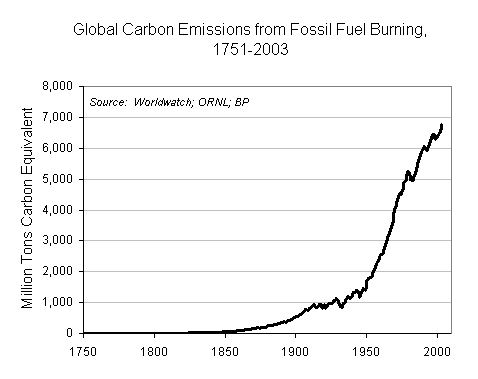
Her evidence for warming turns out not to be that catastrophic warming is actually taking place but that human caused CO2 emissions are rising dramatically & that this means warming must happen. She used this graph foreshortened for the period 1850-2000 & with the perpendicular graph in units of 1 - 25 but without saying in what units.


This caused me to dump the question I intended to ask, which was about the fact that virtually the entire "scientific consensus" is among the government paid.

Other evidence, from the Antarctic, being that the CO2 in air is higher than it has been in millenia (this being from ice cores & is questioned since it is possible the CO2 leaks more than Oxygen). No mention of the fact that ice at both poles is increasing & that in the Antarctic it never stopped doing so.

She acknowledged that sea level in Scotland is actually falling ie that the land is bouncing back from the last ice age faster than any sea level rise but that in Bangladesh the rise would matter. During a previous lecture to a junior school one of the pupils had said they didn't care about Bangladesh but that she had pointed out to him that in that case the people of Bangladesh would want to come here - mass population movement being another of those things global warming is responsible for.

This was followed by an acknowledgement of the value of having sceptics around because "there is no such thing as truth or certainty" in science.

Then the familiar graph showing how temperature, or at least measured temperature, has risen & also that it has fallen over recent years, though that was ignored & described as "we're experiencing climate change now."

Then there was a graph showing the probabilities of various levels of temperature increase - apparently we have an 85% chance of 2 degree warming. However apart from saying the graph proved the chances she didn't say how this relative certainty had been achieved.

This was followed by another showing what catastrophic effects such increases will have, particularly on food production - though no mention of the increased growth caused by more CO2 & the only mention of all the Canadian & Russia tundra that would become fertile was to say it would be worse at the equator. To be fair to Scotland she did say that warmer weather here might not be bad particularly with the "increase in day length in Scotland" - I kid you not. Presumably some heretofore unknown effect of global warming is that it will tilt the Earth's axis to lengthen our day.

Another effect of warming is an increase in extreme weather such as parasites moving. An example is the midge causing Bluetonge disease in cattle. This previously could only survive in Africa but has now settled in Scotland entirely because of global warming.

She then lectured us on all the non-carbon energy systems we will have to adopt - except without mentioning nuclear.

This must be achieved by the spontaneous enthusiasm of the populace. The role of government is "legislation", "information", "eduction" & "leadership".

Then I learned something I had not appreciated. I have previously written on how the government's decision to reduce CO2 by 42% by 2020, means a reduction in electricity production & thus national wealth of 50%. One of her slides showed that Holyrood has also decided that we must get rid of 100% of CO2 production in making electricity by 2030. That would leave us with about 10% from existing hydro & probably about another 5% from windmills etc. The former requires a 7% annual recession for 10 year - the latter 9% annual decline for 20 years. Perhaps I underestimated when I said the former decision, made unanimously by all parties & MSPs meant they are all clinically insane.

Having slid by that bombshell she assured us that doing all this will only cost us 1% of GNP, because Stern said so, compared to paying 8% of GNP to bail out the banks. Apart from anything else that piece of sleight of hand omits that 1% a year is not the same as 1% in total.

She finished by saying how she had visited the carbon storage project & how "my jaw dropped in amazement" at the technology. The gentleman next to me quietly said "this is Scotland's chief science advisor!".

Audience Questions. The first was about Professor Lovelock quoted as saying that it was all to late anyway. She disagreed.

Then I got mine. First I said I had to point out that Professor Lovelock, having seen the fraud going on, had evidently changed his mind & said that only the sceptics had kept the debate sane. My question was about the CO2 graph - firstly that the period of sharpest rise, roughly 1940 - 75 was, on the other graph she had shown, a period of reduced temperature. Secondly that she ought to be aware that manmade emissions accounted for only 3% of the total & that had total CO2 production been shown the graph would have been of a 3% rise rather than a 2,500% rise.

She replied saying how much she valued the contribution of sceptics it is just that they "don't provide evidence" for their doubts. Really she did. Then that what mattered is that the entire system is so well balanced & there is no countervailing way of reducing CO2 so even a tiny increase is disastrous.

Since plant growth increases with more CO2 that most certainly is a method of taking more out but I contented myself by saying that with CO2 being 300 ppm of the atmosphere & mankind producing only 3% of it that is 9 parts in a million which is not much to cause catastrophe.

She replied by saying that it was so finely balanced that just a 2 - 3C rise would be enough to melt Greenland. I wished to reply that since we have had a 4C rise during the climate optimum of 9,000 - 5,000 BC but Greenland has been unmelted for at least 650,000 years that could not be correct but was told, quite properly since it is a lecture not a debate, that my time was up.

She was also asked a couple of questions about nuclear power. Particularly had she, in her role of chief science advisor, advised the government that it was impossible to keep the lights on without nuclear? The questioner, correctly in my opinion, implied that it was her absolute duty to give good such good advice on the issue. She ducked a direct answer saying that some less chiefly advisers knew more about nuclear but agreed that "nobody ever said wind can provide baseload - baseload is coal, gas & oil" (though presumably not in 2030).

She also rather praised recession as a way of cutting CO2 saying of the graph shown "if I had extended the graph it would have shown another dip".

While this lecture may do for frightening younger schoolchildren the Royal Phil is a society with a lot of very qualified members, moreso than me & I think are entitled to expect something more serious.

SOURCE


The Next "Enemy of the State" is Energy

By Alan Caruba

Waiting in the Senate is a Cap-and-Trade bill that would impose the largest tax on the use of energy the nation has ever seen. It lacks any scientific justification, based as it is on the fraud known as “global warming.”

The nation will not survive Cap-and-Trade and James M. Taylor, a Senior Fellow specializing in environmental policy at The Heartland Institute, a Chicago-based, non-profit, free market think tank has authored “The Cap & Trade Handbook” that explains why. It is a slim six pages. (On May 16-18, the Institute will sponsor the Fourth International Conference on Climate change.)

Cap-and-Trade seeks to impose restrictions on greenhouse gases in general and carbon dioxide (CO2) in particular. Taylor notes that “The portion of the Earth’s greenhouse gas envelope contributed by mankind is negligible, barely one-tenth of one percent of the total. Carbon dioxide is no more than four percent of the total greenhouse gas envelope. (Water is more than 90 percent, followed by methane and nitrous and sulfur oxides.) Of that four percent, mankind contributes a little more than three percent. Three percent of four percent is 0.12 percent.”

There is no proof whatever that CO2 or human activity plays any role in “global warming” and there is no proof whatever that “global warming” exists except a natural cycle based on the actions of the sun, the oceans, cloud cover, and other factors over which humans have no control, nor influence.

Moreover, the Earth has entered a new, natural cycle of cooling and its average temperatures have been declining since around 1995. Weather satellites all confirm this and it began to cause consternation among a small group of scientists who, under the aegis of the United Nations Intergovernmental Panel on Climate Change, deliberately perverted climate data in order to foist the “global warming” fraud on the world.

Since “global warming” is a fraud, Cap-and-Trade is a fraud.

The Obama administration, however, took power vowing to make war on the sources of energy on which the nation depends for its electrical power and transportation needs. Coal, which provides just over fifty percent of all electrical power, is high on their list. Huge national reserves of oil which provide gasoline and diesel for our transportation needs continue to be restricted despite talk of “energy independence.” Even natural gas is being subjected to efforts by the Environmental Protection Agency efforts to thwart extraction.

The Obama administration is five votes or less away from destroying the nation. As President Obama has said, “Electricity rates would necessarily skyrocket.”

This is tantamount to treason.

As Taylor points out, “a 70% cut in carbon dioxide emissions would cause gasoline prices to rise 145%, electricity prices would rise 129%, and more than four million jobs would disappear. Average household income would fall by nearly $7,000 each and every year” if Cap-and-Trade is enacted. The bill calls for an 83% cut in emissions!

These projections are based on data from the U.S. Energy Information Administration and from the Congressional Budget office.

SOURCE


Gore loses the first 2 years of the climate bet to Armstrong’s scientific forecast

What if Mr. Gore had accepted Professor Armstrong’s proposed ten-year bet on climate change in 2007? Gore said that the temperature would go up while Armstrong predicted it would not change from the 2007 average. We assumed a relatively conservative prediction from Mr. Gore of a 0.03 degrees Centigrade increase per year: the central projection of the U.N.’s Intergovernmental Panel on Climate Change.

Over the years 2008 and 2009, Mr Gore’s forecast was closer than Professor Armstrong’s to the actual monthly temperature in only four of the 24 months. Put another way Mr Gore’s forecast was 0.26 degrees too warm in 2008 and 0.08 degrees in 2009, whereas Professor Armstrong’s was 0.23 degrees too warm in 2008 and 0.02 degrees to warm in 2009.

We use the University of Alabama at Huntsville’s satellite measure of the global lower atmosphere temperature anomaly as our actual temperature in order to avoid the problems identified by researchers and, more recently, the release of the “Climategate” emails, with the Hadley Centre series used by the IPCC.

Professor Armstrong said that one must be cautious about small samples. The amount of variability in annual temperature is high relative to the predicted change, so Armstrong said that he expects to lose in some years. As shown by a 150-year simulation of the bet, he said that he had only a bit better than 50% chance of winning a given year, but this jumps to nearly 70% for ten years. Armstrong said, “it is about as certain as one can be in forecasting that I would win if the bet were for 100 years, but I wanted to see what would happen, so I proposed only ten years.”

You can follow the bet on a monthly basis here at theclimatebet.com. In addition you can see what one betting market expects to happen.

SOURCE

***************************************

For more postings from me, see DISSECTING LEFTISM, TONGUE-TIED, EDUCATION WATCH INTERNATIONAL, POLITICAL CORRECTNESS WATCH, FOOD & HEALTH SKEPTIC, GUN WATCH, SOCIALIZED MEDICINE, AUSTRALIAN POLITICS, IMMIGRATION WATCH INTERNATIONAL and EYE ON BRITAIN. My Home Pages are here or here or here. Email me (John Ray) here. For readers in China or for times when blogger.com is playing up, there are mirrors of this site here and here

*****************************************
Friday, March 26, 2010


Public scepticism prompts British Science Museum to rename climate exhibition

The Science Museum is revising the contents of its new climate science gallery to reflect the wave of scepticism that has engulfed the issue in recent months. The decision by the 100-year-old London museum reveals how deeply scientific institutions have been shaken by the public’s reaction to revelations of malpractice by climate scientists.

The museum is abandoning its previous practice of trying to persuade visitors of the dangers of global warming. It is instead adopting a neutral position, acknowledging that there are legitimate doubts about the impact of man-made emissions on the climate.

Even the title of the £4 million gallery has been changed to reflect the museum’s more circumspect approach. The museum had intended to call it the Climate Change Gallery, but has decided to change this to Climate Science Gallery to avoid being accused of presuming that emissions would change the temperature.

Last October the museum launched a temporary exhibition called “Prove It! All the evidence you need to believe in climate change”. The museum said at the time that the exhibition had been designed to demonstrate “through scientific evidence that climate change is real and requires an urgent solution”.

Chris Rapley, the museum’s director, told The Times that it was taking a different approach after observing how the climate debate had been affected by leaked e-mails and overstatements of the dangers of global warming. He said: “We have come to realise, given the way this subject has become so polarised over the past three to four months, that we need to be respectful and welcoming of all views on it.”

Professor Rapley, a climate scientist and former director of the British Antarctic Survey research centre, said that the museum needed to remain neutral in order to be trusted: “The Science Museum will not state a position on whether or not climate change is real, driven by humans or threatening.”

“The climate science community, by and large, has concluded that humans have intervened in the system in a way that will lead to climate change. But that is their story. It’s not our story, so that can’t be our conclusion. If we take sides we will alienate some of the people who want to be part of the discussion. “Although there is an extreme faction who very much disagree, there is a much bigger contingent who are not convinced. We want to welcome them into the debate by being as neutral and fairhanded as we can be.”

Professor Rapley said that the gallery, which is to open in November before the climate summit in Cancun, Mexico, would refrain from scaring visitors with apocalyptic predictions of rising sea levels and would be honest about the conflicting views on the scale of possible changes to the climate.

“You can argue about how much effect the carbon in the atmosphere will have on the system and what we should do about it,” he said. “The role of the museum should be to lay out honestly and fairly what the climate science community has found out about the science.

“There are areas of uncertainty which are perfectly reasonable to raise and we will present those. For example, the extent to which the climate is as sensitive to the CO2-loading that humans have put in or not.”

Professor Rapley declined to give his own views on climate change, saying that they were not relevant. However, in 2007 he said: “The more greenhouse gases we add, the warmer we’ll be. It’s not rocket science.”

SOURCE


Endangered findings

Now that health care is done (for the time being), expect global warming to be high on the Obama administration's "to do" list. But cap-and-trade legislation and its alternative, a direct tax on carbon-based fuels, can't be passed via "reconciliation" and are far short of the needed 60 Senate votes.

As a result, the Environmental Protection Agency (EPA) is itching to step in and dictate how and how much we can drive, fly, consume, or make. This the agency made clear in its "endangerment finding," a necessary precursor to regulation, released last December.

Expect the administration to use 2010 global-temperature data as backup for the EPA's regulatory power grab. Global temperatures shot upward around the beginning of this year thanks to El Niño, a warming of the tropical Pacific that takes place every few years. The average global temperature has a reasonable chance of beating the last high, set back in 1998 (also an El Niño year).

Meanwhile, a number of studies point to sources other than greenhouse gases as explanations for the modest warming trend of the late 20th century. This could doom the EPA's finding. But do not expect it to go quietly.

The EPA did no scientific research of its own to buttress its endangerment finding, relying on the 2007 report of the United Nations' Intergovernmental Panel on Climate Change (IPCC) and a similar "Synthesis Report" from the U.S. Climate Change Science Program as the basis for its conclusions. According to these reports:

Most of the observed increase in global average temperatures since the mid–20th century is very likely due to the observed increase in anthropogenic [greenhouse gas] concentrations. "Most" means "more than one-half," and the IPCC says "very likely" means a probability of between 90 and 99 percent. This claim may have constituted the "settled" science of climate change in 2007, but things have become greatly unsettled since then.

The rise in global surface temperatures as measured by the Climate Research Unit at the University of East Anglia (yes, the "Climategate" folks) is 0.70 degrees Celsius since 1950, or a little over a tenth of a degree per decade. But the most recent refereed science literature argues otherwise.

Soon after the IPCC report, David Thompson and several others (including Climategate's Phil Jones) published a paper in Nature showing a cold bias in measurement of sea-surface temperatures from the early 1940s through the mid 1960s. Accounting for this drops the rise in temperature to 0.55 degrees Celsius.

At the time of the IPCC report, Canada's Ross McKitrick and I published a paper in the Journal of Geophysics showing that there was a clear and systematic "non-climatic" warming — from changes in land use and problems with station maintenance — in temperatures measured at weather stations. The bias isn't all that much when measured globally, but it subtracts another .08 degrees Celsius, leaving 0.47 degrees Celsius.

Earlier this year, Susan Solomon of the National Oceanic and Atmospheric Administration published a bombshell in Science in which she argued that the lack of recent warming was likely due to fluctuations in water vapor way up in the stratosphere — changes that bear no obvious relationship to greenhouse-gas emissions. Given the limited stratospheric data that we have going back to 1980, her finding reduces the remaining trend to 0.41 degrees Celsius.

In 2008, V. Ramanathan of the Scripps Institute of Oceanography summarized the scientific literature on the emissions of black carbon (aka "soot") and concluded this was responsible for about 25 percent of global warming. Carbon particles are not greenhouse gases. This drops the supposedly greenhouse-gas-caused warming to .31 degrees Celsius — 44 percent of the original 0.70.

Note that it's not even necessary to bring in variations in the sun in order to ascribe more than half of the warming to non-greenhouse changes.

So, where are the studies refuting these findings? They don't exist. The EPA is wrong. The IPCC was wrong, too, that it is "very likely" that "most" of the warming since 1950 is from greenhouse-gas changes. The EPA has lost the scientific linchpin of its proposal to regulate our lives.

While the president will surely brandish the El Niño–driven warmth of 2010 as the reason for the EPA to regulate where the Senate can no longer act, the EPA needs to accept that the "settled" science of global warming has shifted tectonically since the last IPCC report.

SOURCE


Suing our way to a carbon-free world

Having bullied unwilling House members into supporting his health care package, President Obama can move to his next big legislative goal -- making Americans pay more for energy in an attempt to reduce carbon emissions.

Just days from now, Obama's Environmental Protection Agency is expected to propose new regulations on carbon emissions. If the agency makes them as draconian as the letter of the law requires, your McMansion could become a federally regulated stationary source of pollution.

But don't worry: These regulations are not designed to take effect, but rather to scare the hell out of Congress so that it enacts milder restrictions. It is a regulatory and legislative game of chicken.

This probably sounds like a bad method for making laws, and it is. But there's an even worse method: to have a jury of angry Mississippians decide the issue of global warming once and for all.

Trial lawyers on the Gulf Coast, representing Mississippi property owners, have sued dozens of energy and chemical companies in a case called Comer v. Murphy Oil. They allege that dozens of energy firms, by causing carbon emissions, caused the climate to change and made Hurricane Katrina more intense than it would have been otherwise. As a result, they claim, the storm did greater damage to their property than it would have otherwise.

The federal district court threw the case out of court in 2007 on the grounds that such claims cannot be decided in court. This was not a simple public nuisance case, in which a company produced toxic sludge and caused a town's residents to become ill.

This was a question over global warming and its potential causes and effects, about which very little is known with scientific certainty. If presented in court, it would call upon a jury to adjudicate yet-unproven and probably unknowable questions about how greenhouse gases affect particular weather patterns -- in this case, how they affected one particular 2005 weather pattern.

Even worse, this case could potentially implicate everyone in the United States. Think about it for a moment, assuming not only that global warming is man-made but also that it fueled Hurricane Katrina.

Do you drive a car, ride the bus or cause carbon emissions of any kind? If so, you could be named as a defendant in the next lawsuit over Katrina -- or even in this one. You may not bear as much of the responsibility as Murphy Oil or Massey Energy, or any of the other defendants in the case, but you are liable all the same.

So is your neighbor. So is your employer. If you need someone to blame, just throw a rock in the air.

In October, a 2-to-1 panel on the Fifth Circuit Court of Appeals reinstated the case. (The two were Clinton appointees, in case you were wondering.) Despite a raging political battle over global warming in Washington, Judge James Dennis ruled that the suit does not present a political question that is more properly handled by Congress. For a few months, it appeared that a Mississippi jury would get to decide whether the oceans stop rising or not.

Earlier this month, the full Fifth Circuit changed its mind and agreed to give the case another hearing. It could determine just who bullies you into paying more for your energy -- President Obama, the Congress or the trial lawyers.

SOURCE


Governor Shreds New Jersey Climate Change Programs

Kills Emission Reporting, Diverts Green Energy Fund & Defunds Climate Office. Greenie wail below

New Jersey Governor Chris Christie has taken a wrecking ball to the state's touted Global Warming Response Act, according to Public Employees for Environmental Responsibility (PEER). In recent weeks, the Christie administration has blocked required reporting from greenhouse gas sources, diverted $300 million in Clean Energy Funds dedicated to energy efficiency and proposed to zero out the state's Office of Climate Change and Energy.

"New Jersey's Global Warming Response Act is now a dead letter," stated New Jersey PEER Director Bill Wolfe, referring to 2007 legislation regarded as the crowning environmental achievement of the Corzine administration. "Whatever progress on climate change we can expect will have to come from Washington, because Trenton has gone AWOL."

Apparently by mutual agreement of the ongoing Corzine and incoming Christie administration, a proposed rule to require monitoring and reporting of emissions of greenhouse gases was allowed to quietly die on January 20, 2010 - one year after it was first proposed. This emission monitoring regime is a key mandate of the state's Global Warming Response Act. Without monitoring and reporting, New Jersey cannot track emissions or develop a regulatory program to meet the reduction milestones set forth in the Act.

On October 30, 2009, the U.S. Environmental Protection Agency adopted its first federal greenhouse gas monitoring requirements. Compared to EPA rules, however, the New Jersey law (and its now abandoned monitoring plan) is broader, covering more gases, more emissions sources and with lower thresholds. Ironically, in its public comments this fall, the state Department of Environmental Protection (DEP) urged the EPA to integrate more stringent state rules into its proposal.

Sweeping executive orders imposing a regulatory moratorium, cost-benefit analysis requirements, and a policy of rolling back to minimum federal standards in the first weeks of the Christie administration make it unlikely that any new plan for greenhouse gas monitoring will ever emerge again from DEP. Several other major environmental and public health policies, such as the recently shelved drinking water standard for perchlorate, a chemical used in rocket fuel, are apparently also destined for the scrap heap.

This Christie anti-regulatory stance is compounded by diversions of $300 million in Clean Energy Funds dedicated to energy efficiency and renewable energy programs. In addition, Governor Christie's proposed budget for FY 2011, beginning this July, will eliminate funding for the Office of Climate Change and Energy--the office responsible for implementing the Global Warming Response Act--even diverting revenue from the Regional Greenhouse Gas Initiative (RGGI) emission credit auctions to the General Fund.

"The current governor has decided that investment in a clean energy future for New Jersey is a luxury that we can no longer afford," added Wolfe. "In terms of public health and welfare, New Jersey will soon start to resemble states like Mississippi that can only provide minimal state services."

SOURCE


Now it's CowGate: expert report says claims of livestock causing global warming are false

It is becoming difficult to keep pace with the speed at which the global warming scam is now unravelling. The latest reversal of scientific “consensus” is on livestock and the meat trade as a major cause of global warming – one-fifth of all greenhouse gas emissions, according to eco-vegetarian cranks. Now a scientific report delivered to the American Chemical Society says it is nonsense. The Washington Times has called it “Cowgate”.

The cow-burp hysteria reached a crescendo in 2006 when a United Nations report ominously entitled “Livestock’s Long Shadow” claimed: “The livestock sector is a major player, responsible for 18 per cent of greenhouse gas emissions measured in CO2e (carbon dioxide equivalents). This is a higher share than transport.” This led to demands in America for a “cow tax” and a campaign in Europe at the time of the Copenhagen car crash last December called Less Meat=Less Heat.

Now a report to the American Chemical Society by Frank Mitloehner, an air quality expert at the University of California at Davis, has denounced such scare-mongering as “scientifically inaccurate”. He reveals that the UN report lumped together digestive emissions from livestock, gases produced by growing animal feed and meat and milk processing, to get the highest possible result, whereas the traffic comparison only covered fossil fuel emissions from cars. The true ratio, he concludes, is just 3 per cent of greenhouse gas emissions in America are attributable to rearing of cattle and pigs, compared with 26 per cent from transport.

Mitloehner also makes the deadly serious point: “Producing less meat and milk will only mean more hunger in poor countries.” Precisely. The demonising of cows and pigs is just another example of global warmists’ callous indifference to starvation in the developing world, as in the case of the unbelievably immoral and reckless drive for biofuels – pouring Third World resources for subsistence into Western liberals’ fuel tanks – and, notoriously, carbon trading.

Week by week the AGW collapse intensifies. Himalayan glaciers, polar bears, Arctic ice, Amazon rainforests, all discredited. Now it turns out the great cow-burp scare is bovine excrement too. The global warming scam is, to the majority of people, an object of derision. The scientific community has also at last wakened up. They are smelling the coffee in more and more institutions these days.

This week the Science Museum in London announced it is revising its stance so that its Climate Change Gallery will now be renamed the Climate Science Gallery, to reflect its new position of neutrality in the climate debate. Chris Rapley, the director, said the museum was taking a different approach after observing how the debate had been affected by leaked e-mails and overstatements of the dangers of global warming. He said: “We have come to realise, given the way this subject has become so polarised over the past three to four months, that we need to be respectful and welcoming of all views on it.”

When did you ever hear that sort of thing before? But that is fair enough: neutrality, a level playing field and an equal voice is all global warming sceptics have ever asked for. Given those reasonable conditions, the truth will out and we will win. The signs are that a lot of scientists have been moved to assert their integrity, encouraged by the increasingly huge breaches sceptics have made in the defences of the AGW camp. Others may simply have calculated they may have backed a loser and it is time to take out some insurance.

Whatever the case, it is a different world now in the war against the AGW scam. Zac Goldsmith, warmist fanatic and Tory candidate, is telling environmentalists that green issues are vote losers. He should tell Dave that and stop him making an even bigger fool of himself. We are experiencing a tipping point in the climate war and the advantage is slowly but irresistibly moving towards the sceptics.

SOURCE


A New Revelation: Wind Energy Needs Wind to Work

One of the common arguments made against wind power is that without government subsidies, mandates or tax credits, wind turbines would not be built. But even when companies do receive preferential treatment to build windmills, just because they’re built doesn’t mean they’re going to work. For that, there needs to be (drum roll, please)…wind! A report from Britain says:

“The analysis of power output found that more than 20 wind farms are operating at less than one-fifth of their full capacity. Experts say many turbines are going up on sites that are simply not breezy enough. They also accuse developers of ‘grossly exaggerating’ the amount of energy they will generate in order to get their hands on subsidies designed to boost the production of green power.

While it is possible some of the results were skewed by breakdowns, the revelation that so many are under-performing will be of great interest to those who argue that wind farms are little more than expensive eyesores. The analysis was carried out by Michael Jefferson, an environmental consultant and a professor of international business and sustainability. He believes that financial incentives designed to help Britain meet is green energy targets are encouraging firms to site their wind farms badly.”

In other wind farm news, although the event was called “exceptionally rare and highly unusual”, Europe’s largest wind farm had to be shut down because a 14-ton turbine snapped. It’s not the first time a windmill broke and fortunately no one was hurt. A turbine snapping is no reason to stop building windmills just as coal mining accidents are not reason to completely cut off our coal supply. Accidents happen in any industry and it’s a company’s job to learn from them and improve both quality and safety.

If businesses find it profitable to build supply energy in a variety of ways without government handouts, increased competition will only benefit the consumer. Yet, we’re being told we need to transition to a clean energy economy and that the United States needs to be the leader in building these technologies because, “the nation that leads the clean energy economy will be the nation that leads the global economy. And America must be that nation,” said President Obama in his State of the Union address. If renewable energy eventually competes in the marketplace, economist Don Boudreaux says, “So what if the Chinese are world-leading producers of such equipment? Specializing in the production of other goods and services – things that we produce more efficiently than the Chinese – we Americans can then buy solar panels and wind turbines from the Chinese for use in our homes and offices. The latitudinal and longitudinal coordinates of the factories where the final assembly of such equipment occurs are irrelevant.” That’s not to say U.S. can’t be a leader in wind mill production, but market-based policies are the best way to ensure that America’s renewable energy production is as competitive as possible.

In addition, the cleanliness in the President’s mission to green our economy may be a bit over hyped. We not only use fossil fuels to make turbines but also provide back up power when the windmills don’t spin. Since it’s too costly to stop and start a power plant, wind simply creates more emissions. Or, as Todd Wynn of the Cascade Policy Institute points out, in some instances wind replaces CO2-free sources of energy, like hydroelectricity: “So when the wind blows, the dams stop generating electricity, and when the wind stops, the dams continue to generate electricity. So, in fact, wind power is just offsetting another renewable energy source. It’s not necessarily offsetting any fossil fuel generation.”

Wind may be economically viable in some parts of the United States, but we should let businesses and electricity consumers, not the government, decide that.

SOURCE

***************************************

For more postings from me, see DISSECTING LEFTISM, TONGUE-TIED, EDUCATION WATCH INTERNATIONAL, POLITICAL CORRECTNESS WATCH, FOOD & HEALTH SKEPTIC, GUN WATCH, SOCIALIZED MEDICINE, AUSTRALIAN POLITICS, IMMIGRATION WATCH INTERNATIONAL and EYE ON BRITAIN. My Home Pages are here or here or here. Email me (John Ray) here. For readers in China or for times when blogger.com is playing up, there are mirrors of this site here and here

*****************************************

Thursday, March 25, 2010


France ditches carbon tax as protests mount

France is facing its own 'spring of discontent' as strikes shut schools, courts, railways and metro services, and trade unions vowed mass protests across the country.

President Nicolas Sarkozy on Tuesday scrapped the country's proposed carbon tax and reshuffled his cabinet in populist tilt after suffering a crushing electoral defeat over the weekend, when his Gaulliste UMP party lost every region other than in its bastion of Alsace and the Indian Ocean island of Reunion.

The vote saw a resurrection of both the Socialist Party and the far-Right National Front, showing how the delayed effects of rising unemployment can change the political landscape long after recession has passed. The jobless rate has risen to 10.1pc, up from 8.7pc a year ago. A quarter of those aged under 25 are out of work.

The government said its energy tax was being postponed indefinitely in order not to "damage the competitiveness of French companies", fearing that it would be too risky for France to go it alone without the rest of the EU. Brussels has announced plans for an EU-wide tax, but the initiative already looks doomed.

Chantal Jouanno, the environment secretary, said she was "devastated that eco-scepticism had prevailed". France's leading green groups wrote a joint letter to Mr Sarkozy saying they were "scandalised" by his decision, accusing him of tearing up a pledge to put climate change at the centre of his presidency.

Medef, France's business lobby, said the demise of the carbon levy was a "relief". The tax would have been €17 a tonne compared to around €100 in Sweden, but business feared that this would creep up over time.

The trade unions said half of all primary school teachers followed the call to strike on Tuesday, though officials said the figure was 30pc. Half the commuter trains were stopped. The CGT union federation said it planned 180 marches across France to protest pension reform. The retirement age in France is still 60, far short of North European levels around 67. The pension deficit will reach €50bn a year by 2020 without radical changes.

France has hardly begun to pair back the fiscal stimulus of the last year, though the car scrappage scheme is being phased out in steps. The budget deficit is expected to rise to 8.2pc of GDP this year, with no real austerity until 2011. The country faces the same risks as the UK in delaying retrenchment as public debt surges above 80pc of GDP this year. Fitch Ratings and Standard & Poor's have begun to mutter that France may endanger its AAA status if it fails to act soon, though the Paris clearly has more leeway than London for now.

France's rigid labour markets tend to delay full recovery from downturns and cause debt to keep rising for longer than in Anglo-Saxon states. Gilles Moec, from Deutsche Bank, said France came through the recession in better shape than most European nations in part because it has a low exposure to exports outside the eurozone. The flip-side is that it risks being left behind by Germany as the rebound in global trade gathers pace.

Le Figaro said Mr Sarkozy's travails reflect the schizophrenia of the public psyche. "The problem is that voters thought they had elected a French Churchill when in fact they were only ready for a MacMillan," it said.

SOURCE


Even soil feels the heat: Soils release more carbon dioxide as globe warms

The evidence below is weak but if it is correct it is yet more evidence that a climbing CO2 rate is the RESULT of warming, not the cause. There are two other apparent ramifications: 1). Results like this mean that the anthropogenic fraction must be readjusted. Is man's annual contribution 4%? 3%? Less? 2). This latest natural emission estimate shows that previous source/sink models have been inadequate, as usual

Twenty years of field studies reveal that as the Earth has gotten warmer, plants and microbes in the soil have given off more carbon dioxide. So-called soil respiration has increased about one-tenth of 1 percent per year since 1989, according to an analysis of past studies in today's issue of Nature.

The scientists also calculated the total amount of carbon dioxide flowing from soils, which is about 10-15 percent higher than previous measurements. That number -- about 98 petagrams of carbon a year (or 98 billion metric tons) -- will help scientists build a better overall model of how carbon in its many forms cycles throughout the Earth. Understanding soil respiration is central to understanding how the global carbon cycle affects climate.

"There's a big pulse of carbon dioxide coming off of the surface of the soil everywhere in the world," said ecologist Ben Bond-Lamberty of the Department of Energy's Pacific Northwest National Laboratory. "We weren't sure if we'd be able to measure it going into this analysis, but we did find a response to temperature."

The increase in carbon dioxide given off by soils -- about 0.1 petagram (100 million metric tons) per year since 1989 -- won't contribute to the greenhouse effect unless it comes from carbon that had been locked away out of the system for a long time, such as in Arctic tundra. This analysis could not distinguish whether the carbon was coming from old stores or from vegetation growing faster due to a warmer climate. But other lines of evidence suggest warming is unlocking old carbon, said Bond-Lamberty, so it will be important to determine the sources of extra carbon.

The Opposite of Photosynthesis

Plants are famous for photosynthesis, the process that stores energy in sugars built from carbon dioxide and water. Photosynthesis produces the oxygen we breathe as a byproduct. But plants also use oxygen and release carbon dioxide in the same manner that people and animals do. Soil respiration includes carbon dioxide from both plants and soil microbes, and is a major component of the global carbon cycle.

Theoretically, the biochemical reactions that plants and soil microbes engage in to produce carbon dioxide suggest that higher temperatures should result in more carbon dioxide being released. But unlike the amount of sunlight reaching Earth, soil respiration can't be measured from space and can't yet be simulated effectively with computer models.

So, the researchers turned to previous studies to see if they could quantify changes in global soil respiration. PNNL's Bond-Lamberty and his colleague Allison Thomson, working at the Joint Global Change Research Institute in College Park, Md., examined 439 soil respiration studies published between 1989 and 2008.

They compiled data about how much carbon dioxide has leaked from plants and microbes in soil in an openly available database. To maintain consistency, they selected only data that scientists collected via the now-standard methods of gas chromatography and infrared gas analysis. The duo compared 1,434 soil carbon data points from the studies with temperature and precipitation data in the geographic regions from other climate research databases.

After subjecting their comparisons to statistical analysis, the researchers found that the total amount of carbon dioxide being emitted from soil in 2008 was more than in 1989. In addition, the rise in global temperatures correlated with the rise in global carbon flux. However, they did not find a similar relation between precipitation and carbon.

Zooming In

Previous climate change research shows that Arctic zones have a lot more carbon locked away than other regions. Using the complete set of data collected from the studies, the team estimated that the carbon released in northern -- also called boreal -- and Arctic regions rose by about 7 percent; in temperate regions by about 2 percent; and in tropical regions by about 3 percent, showing a trend consistent with other work.

The researchers wanted to know if their data could provide more detailed information about each region. So they broke down the complete data set by regional climates and re-examined the smaller groups of data using different statistical methods. The regional data from the temperate and tropical climates produced results consistent with other results, such as more carbon being released at higher temperatures, but the boreal-Arctic climate data did not. In addition, removing only 10 percent of the boreal-Arctic data points was enough to invalidate the statistical significance of the boreal-Arctic result. Together, the results support the idea that more boreal data on regional climates is needed to reach statistical relevance.

"We identified an area where we need to do more work," said Thomson.

More information: Bond-Lamberty and Thomson, 2010. Temperature-associated increases in the global soil respiration record, Nature March 25, 2009, doi:10.1038/nature08930

SOURCE


Unbelievable irony‏


Incredibly, THIS is how Alarmists feel, that THEY are the ones being pressured and intimidated to change their views. Bullies feeling sorry for themselves, sorry that their well-funded tactics are failing... that's a new one on me.

SOURCE


Warmists are now "scared shitless"

The excerpt below is from a pastoral letter to Warmists from a Warmist publication but some of the admissions are interesting. The calls for more objectivity and openness are revealing in themselves. Note, as usual, that not one scientific fact in support of AGW is mentioned: No science in an allegedly scientific publication

The integrity of climate research has taken a very public battering in recent months. Scientists must now emphasize the science, while acknowledging that they are in a street fight.

Climate scientists are on the defensive, knocked off balance by a re-energized community of global-warming deniers who, by dominating the media agenda, are sowing doubts about the fundamental science. Most researchers find themselves completely out of their league in this kind of battle because it's only superficially about the science. The real goal is to stoke the angry fires of talk radio, cable news, the blogosphere and the like, all of which feed off of contrarian story lines and seldom make the time to assess facts and weigh evidence. Civility, honesty, fact and perspective are irrelevant.

Worse, the onslaught seems to be working: some polls in the United States and abroad suggest that it is eroding public confidence in climate science at a time when the fundamental understanding of the climate system, although far from complete, is stronger than ever. Ecologist Paul Ehrlich at Stanford University in California says that his climate colleagues are at a loss about how to counter the attacks. “Everyone is scared shitless, but they don't know what to do,” he says.

Scientists must not be so naive as to assume that the data speak for themselves.

Researchers should not despair. For all the public's confusion about climate science, polls consistently show that people trust scientists more than almost anybody else to give honest advice. Yes, scientists' reputations have taken a hit thanks to headlines about the leaked climate e-mails at the University of East Anglia (UEA), UK, and an acknowledged mistake about the retreat of Himalayan glaciers in a recent report from the Intergovernmental Panel on Climate Change (IPCC). But these wounds are not necessarily fatal.

To make sure they are not, scientists must acknowledge that they are in a street fight, and that their relationship with the media really matters. Anything strategic that can be done on that front would be useful, be it media training for scientists or building links with credible public-relations firms. In this light, there are lessons to be learned from the current spate of controversies. For example, the IPCC error was originally caught by scientists, not sceptics. Had it been promptly corrected and openly explained to the media, in full context with the underlying science, the story would have lasted days, not weeks. The IPCC must establish a formal process for rapidly investigating and, when necessary, correcting such errors.

The unguarded exchanges in the UEA e-mails speak for themselves. Although the scientific process seems to have worked as it should have in the end, the e-mails do raise concerns about scientific behaviour and must be fully investigated. Public trust in scientists is based not just on their competence, but also on their perceived objectivity and openness. Researchers would be wise to remember this at all times, even when casually e-mailing colleagues.

More HERE


More doubts about Warmist statistics

This is just too true to be good. An unassuming climate scientist from the Netherlands, Bart Verheggen, who specializes in studying the effects of aerosols on climate change, (and who has corresponded with me frequently in a very genteel fashion) has a well-mannered, even tempered weblog called My View on Climate Change. About half the posts are in Dutch. Bart is a polite member of the anthropogenic global warming consensus--he believes strongly that human emission of greenhouse gases have caused significant temperature rises and pose a threat to development going forward.

And what's going on on his website is one of the most signficant and unexpected happenings in all the debate on global warming. For three weeks now, a discussion on something as unlikely as statistics is coming close to rewriting climate change history. Because for just about the first time, scientists from all parts of the spectrum are engaging in almost real time on an issue of substance that can actually be resolved in front of the viewing audience. It has engaged the attention of physicists, statisticians, webloggers and an army of viewers. If you read through it you will never think of the term 'unit root' in the same way again.

What's at stake is the legitimacy of a large number of papers using one set of statistical procedures to correlate the rise of CO2 and temperatures that is not valid due to the properties of the data collected. Using the proper method, co-integration, does not appear to yield the same results. Your world and mine could change--policies, taxes, mileage standards and decisions on whether to support natural gas instead of wind power--based on this discussion about statistics. It's hugely important and I have joined countless others in trying to keep up with the discussion. It's like being on trial in an alien court with the proceedings conducted in a foreign language. And I understand quite a bit of the statistics--maybe even 10%.

Bart wrote a post on March 1 titled, 'Global average temperature increase, GISS HadCru and NCDC compared.' (That's not Dutch...). It now has over 735 comments on it.

The issue they are debating is whether the analysis performed by climate scientists on CO2 rises and temperature is seriously flawed. The conversation goes way past Dutch and into Greek, but the key point, as summarized by commenter whbabcock on March 17, is this:

"The issues being addressed in this thread relate to a single question, “Does available real world data support the hypothesis that increased concentrations of atmospheric greenhouse gases increase global temperature permanently?”

VS has clearly pointed out that, to properly test this hypothesis, one must use statistical techniques that are consistent with the underlying characteristics of the data. As noted in the B&R paper, “… the radiative forcings of greenhouse gases (C02, CH4 and N2O) are stationary in second differences (i.e. I(2)) while global temperature and solar irradiance are stationary in first differences (i.e. I(1)).” B&R refer to five papers that have the same findings – i.e., that radiative forcings and global temperature are non-stationary to the same order.

Ignoring the properties of the time series data used to test a theory (hypothesis) can easily suffer the “pitfall of spurious regression.” That is, you can’t look at the simple correlation between greenhouse gas concentrations and temperature (or simple transformations of these data) and accept the hypothesis that one is caused by the other. In the case before us (i.e., given the characteristics of the time series data being used), cointegration has been demonstrated as the appropriate statistical technique. This has nothing to do with the logic or correctness of the underlying theory being tested. Rather, it has to do with the statistical properties of the time series being used to test the theory – two separate issues.

The B&R paper finds that, when cointegration is applied to available data,” … greenhouse gas forcings do not polynominally cointegrate with global temperature and solar irradiance.” Hence, available data do not support the physics based hypothesis.

This type of statistical result simply demonstrates the relationship (or lack thereof) in available data. It is what is!! This result stands (unless there are problems in execution – e.g., the analysis was implemented incorrectly, or the data are faulty, etc.). No appeal to theory or to alternative analyses of different types of data that support the hypothesis changes this single analytical result. Again, it is what is! It is what the data are telling us. In this case the data are telling us that bumble bees can fly (i.e., real world data – observations — are inconsistent with the formulated, mathematically based hypothesis).

What does all this mean? It could mean that the theory is incorrect. Or, it could mean that the data are not “accurate” enough to exhibit the “theoretical relationship.” It certainly “raises a red flag” as VS has noted several times. And, it does mean that one can’t simply point to highly correlated time series data showing rising CO2 concentrations and rising temperatures and claim the data support the theory."

Just to be clear, this is not going to prove or disprove global warming. But a lot of the conjectural studies claiming to be able to project future scenarios based on the correlation between CO2 and temperatures may have to be completely rewritten with a much higher standard of investigation--or else they won't really be usable. And it will certainly bring up the point that this issue with the data should have been examined about 20 years ago, when all the hype started.

It would be like reading War and Peace to go over there now and start from the beginning. But if you really care about the debate on global warming, you should do so. If you can't, I'm really hoping that someone will summarize the entire debate in the very near future.

SOURCE


Bangladeshi Island Sinks "From Global Warming"

No mention that the land surface of Bangladesh has in fact been GROWING overall in recent years

New Moore Island has been sinking for 30 years. However, the island itself, known as New Moore, is no more. In fact, it's now completely submerged under water.

Scientists used satellite imagery to prove their point. Moreover, sea patrols have confirmed that New Moore Island has sunk. Now the Global Warming experts say it's because of Climate Change.

However, the fact is, the island has been sinking dramatically during the past decade. Global Warming experts claim that the sea level is rising in accordance with rising temperatures. The island is about two square miles.

The island itself could be the first of many islands to soon disappear. Reports say that around 10 other islands are at risk of being submerged by rising waters. It is either caused by rising sea levels or the island itself might be sinking in mud.

Bangladesh And India Fought Over The Land For Many Years

The land is actually named South Talpatti Island in Bangladesh. However, India called it "New Moore Island" because it was uninhabited. The land emerged in the Bay of Bengal in the aftermath of the Bhola cyclone in 1970.

Its sovereignty was disputed between Bangladesh and India for years until the island became submerged. There was never any permanent settlement on the land. The emergence of the island was first discovered by an American satellite in 1974.

The satellite image showed the island to have an area of 27,000 square-feet. Later, various remote sensing surveys showed that the island had expanded gradually to an area of about 110,000 square-feet at low tide. The highest elevation had never exceeded two meters above sea level.

The island was claimed by both Bangladesh and India. Neither country established any permanent settlement because of the island's geological instability. India had reportedly hoisted the Indian flag on the territory in 1981 and established a temporary base of Border Security Forces.

The location of the channel in 1947 may be more relevant than its later location. River channels often shift their locations from time to time.

SOURCE

***************************************

For more postings from me, see DISSECTING LEFTISM, TONGUE-TIED, EDUCATION WATCH INTERNATIONAL, POLITICAL CORRECTNESS WATCH, FOOD & HEALTH SKEPTIC, GUN WATCH, SOCIALIZED MEDICINE, AUSTRALIAN POLITICS, IMMIGRATION WATCH INTERNATIONAL and EYE ON BRITAIN. My Home Pages are here or here or here. Email me (John Ray) here. For readers in China or for times when blogger.com is playing up, there are mirrors of this site here and here

*****************************************

Wednesday, March 24, 2010


You can't predict the weather; or climate change: Our weather forecasts will always be as unreliable as our predictions of climate change

By Roger Highfield (Roger Highfield is the Editor of 'New Scientist’, a generally Warmist publication, so the stress below on the uncertain magnitudes involved is a big retreat)

Last year, the Met Office claimed the UK was “odds-on for a barbecue summer”. The reality was a washout. Then came its predictions of a mild winter, when it was the coldest for three decades. Now another company predicts this year’s summer will be sizzling. Can we believe them?

I asked Prof Tim Palmer, now at Oxford University, who pioneered medium-range climate forecasts. He sighs, and says of the Met’s forecasts that “we weren’t promised a barbecue summer — unfortunately, there was a certain amount of unnecessary spin placed on uncertain predictions”.

Today, at the Royal Society, London, Prof Palmer has gathered experts to discuss how we should handle uncertainties. Among them are Lord May, who put chaos theory into biology.

Chaos rules the weather. One can appreciate this with a mathematical structure called a Lorenz attractor, named after an American meteorologist. The lines depicting this structure never repeat their trajectory, just as the weather varies from day to day, but overall the lines form an owl-eye shape, just as our climate has regularities, notably warm summers and cold winters.

Although chaos theory limits the accuracy of weather predictions, we can still understand factors that influence the climate such as the greenhouse effect, predicted in 1827 by the French mathematician Joseph Fourier (1768-1830). The name arises because, like glass in a greenhouse, gases such as carbon dioxide and water vapour let solar energy in to warm the Earth but also trap some of the planet’s heat. Without greenhouse gases, the ground temperature would be 30C lower.

The uncertainty in predictions of global warming have not changed much since pioneering work by the American Jule Charney in the Seventies, when he worked out the possible impact of climate change. His lower limit estimates of 1.5 deg warming for a doubling of carbon dioxide levels are similar to those from the latest climate models.

There is little uncertainty when it comes to explaining why the Earth is warming, says Prof Palmer. The big issue is what happens next. Some scientists fear apocalyptic scenarios, others believe the change will be smooth. All agree that there are major holes in our understanding.

“What has been naggingly difficult has been working out the upper limit of possible warming,” says Prof Palmer. There is much debate among scientists, but among the public this comes over as “you are either a believer or non-believer in climate change, which is a false dichotomy”.

All the time, there is endless pressure to simplify. PR disasters such as the Met’s seasonal forecast can result when uncertainty is rendered down to a soundbite. The Met had said it was ''odds-on for a barbecue summer’’ in its press statement, which had a greater ring of certainty than the actual 50 per cent probability of above-average temperatures. Similarly, although the winter had a 50 per cent chance of being milder, there was a 20 per cent chance of being colder.

This month the Met Office abandoned these forecasts, where many variations on the same computer model of the climate are run to produce a fuzzy “ensemble” of forecasts, a method Prof Palmer popularised back in 1989. Palmer believes they are still valid. “The Met has been criticised too much.”

Uncertainty is a part of everyday life. “The big issue is this,’’ Prof Palmer explains. “When it comes to a catastrophic 4 deg average global warming, how big a probability would the public have to be faced with to back taking drastic action?”

The failure to make the uncertainties of climate change crystal clear may be another reason why public confidence in climate science has slumped.

SOURCE


Lord Oxburgh, the climate science peer, ‘has a conflict of interest’

A member of the House of Lords appointed to investigate the veracity of climate science has close links to businesses that stand to make billions of pounds from low-carbon technology.

Lord Oxburgh is to chair a scientific assessment panel that will examine the published science of the Climatic Research Unit at the University of East Anglia.

The CRU has been accused of manipulating and suppressing data to overstate the dangers from climate change. Professor Phil Jones, its director, has stood down from his post while a separate inquiry, chaired by Sir Muir Russell, takes place into the leaking of e-mails sent by him and his colleagues.

Climate sceptics questioned whether Lord Oxburgh, chairman of the Carbon Capture and Storage Association and the wind energy company Falck Renewables, was truly independent because he led organisations that depended on climate change being seen as an urgent problem.

Andrew Montford, a climate-change sceptic who writes the widely-read Bishop Hill blog, said that Lord Oxburgh had a “direct financial interest in the outcome” of his inquiry.

Lord Oxburgh has said that he believes the need to tackle climate change will make capturing carbon from power plants “a worldwide industry of the same scale as the international oil industry today”.

The CCS Association has stated that carbon capture could become a “trillion dollar industry” by 2050, but this would happen only if governments made reducing emissions a top political priority. In an interview in 2007, Lord Oxburgh said that the threat from global warming was so severe that “it may be that we shall need . . . regulations which impose very severe penalties on people who emit more than specified amounts of greenhouse gases into the atmosphere”.

The university appointed Lord Oxburgh, a geologist and former chairman of the Lords Select Committee on Science and Technology, after consulting the Royal Society, of which he is a fellow.

Professor Trevor Davies, the university’s pro-vice-chancellor for research, said that the university had been aware of Lord Oxburgh’s business interests but believed that he would lead the panel of six scientists “in an utterly objective way”. The panel will meet in Norwich next month.

He added: “We all have an interest in seeing alternatives to fossil fuel energy sources. This is going to be an issue for us all in future regardless of climate change.

“The choice of scientists is sure to be the subject of discussion, and experience would suggest that it is impossible to find a group of eminent scientists to look at this issue who are acceptable to every interest group which has expressed a view in the last few months. Similarly it is unlikely that a group of people who have the necessary experience to assess the science, but have formed no view of their own on global warming, could be found.”

He said the scientists has been selected because they had “the right mix of skills to understand the complex nature of climate research and the discipline-based expertise to scrutinise CRU’s research”.

Lord Oxburgh, a former chairman of Shell UK, said: “The shadow hanging over climate change and science more generally at present makes it a matter of urgency that we get on with this assessment. We will undertake this work and report as soon as possible.”

The university expects his report to be published before the summer.

The panel members are: Huw Davies, Professor of Physics at the Institute for Atmospheric & Climate Science at ETH Zürich; Kerry Emanuel, Professor of Meteorology at Massachusetts Institute of Technology; Professor Lisa Graumlich, Director of the School of Natural Resources and the Environment at the University of Arizona; David Hand, Professor of Statistics in the Department of Mathematics at Imperial College, London; Herbert Huppert, Professor of Theoretical Geophysics at the University of Cambridge; and Michael Kelly, Prince Philip Professor of Technology at the University of Cambridge. They will be given access to CRU’s original data and be able to interview its scientists.

Professor Bob Watson, Chief Scientific Adviser to the Department for Environment, Food and Rural Affairs, said: “I strongly support the choice of chair and panel members — all world class — and the terms of reference. This should lead to a critical evaluation of the quality of the CRU science.”

SOURCE


Great news for earth's ecosystems

Recent news has been all bad for the International Panel on Climate Change and the former gold standard for global temperatures at East Anglia University.

Leaders of the organizations have been less than forthright regarding these facts: "The climate science is not settled," that assumptions in models used to "predict" catastrophic future warming may have been wrong, that the rapidity of glacier loss was overstated by multiples of years (initially denied), that there has been a tendency to leave out inconvenient scientific data in IPCC's all-important summary for policymakers, that temperatures today are possibly not unprecedented, and that there has been no statistically significant global warming in the last 15 years.

These admissions, prompted by information generated from 3,000 internal e-mails at East Anglia's Climate Research Unit, have shaken the warming community to its roots (even the leader of Greenpeace of the United Kingdom is appalled).

There is, however, great news for planet Earth and the plant and animal kingdoms, including humanity. With these admissions that the data and conclusions may be suspect, scientists and policymakers should now realize that carbon dioxide may not be a significant cause of climate change and that the addition of CO2 to the atmosphere may be beneficial to Earth, as it already has been since the beginning of the industrial revolution around 1860.

Thousands of real field and laboratory experiments by the agricultural community indicate that Earth's plants have experienced an increased growth of about 12 percent and Earth's forest an increase of about 18 percent.

In fact, these peer-reviewed studies show that an addition of 300 parts per million of CO2 to Earth's existing 387 ppm would result in average plant growth of 35 percent and growth of trees by 50 percent.

Other benefits include the fact that plants require less water to grow as large in a CO2- enriched atmosphere. This makes plants drought-tolerant as evidenced by plants today encroaching onto the deserts. Plants also become more tolerant of many environmental stresses.

It quickly became obvious that people, scientists and politicians were not aware of the astonishing benefits of CO2. Because there is not a single instance of CO2 being a pollutant and my own research of the literature indicating that there is no convincing evidence of CO2-caused global climate change, I gave some public talks and found that objective people were very interested in having a summary of these benefits to weigh against what they were being fed by proponents of CO2-caused warming.

This led to my becoming chairman and spokesman for a 501 c(3) organization, PlantsNeedCO2.org, and a 501 c(4) advocacy foundation, CO2IsGreen.org.

People easily grasp the magnitude of the benefits of more CO2 but invariably ask, "But isn't CO2 causing global warming?"

While climate science is very complex, these observations deny that conclusion. First is the fact that detailed studies of ice cores prove that changes in CO2 levels follow changes in temperature by several hundreds of years.

Secondly, a law of physics shows that CO2's ability to absorb more heat declines very rapidly, logarithmically, as more CO2 is added to the atmosphere.

Thirdly, empirical (real) studies of current and historical climates do not support the hypothesis that CO2 is or has been a major cause of climate change.

Check it out on PlantsNeedCO2.org. You will soon realize the amazing benefits that additional CO2 can bring to Earth's ecosystems, habitats, food supplies and human health.

More CO2 will truly "green" the Earth, while the cries from extremists to actually reduce atmospheric CO2 would result in a "browning" of Earth and death or increased misery to hundreds of millions of people living on the edge of starvation.

H. Leighton Steward, a Texas geologist, is also the author of two best-selling books challenging conventional wisdom -- "Fire, Ice and Pa

SOURCE


Water Vapour as a greenhouse gas?

Clouds have a warming effect because in order for water vapour to condense back into water droplets, the water molecules must first re-emit the energy they absorbed to become vapour in the first place.

The latent heat which is released in this process is what makes the local environment feel warmer. But this does not increase the overall energy in the system. This effect is simply a localized effect, the result of large amounts of energy actually leaving the system.

Most of the energy in this process is energy that has been stored by the oceans. This energy is then moved into the clouds via evaporation. When this evaporated water condenses it releases that energy into the atmosphere and it feels warmer. But it is a fleeting short lived increase in local temperature.

This energy would have been absorbed into the oceans somewhere near the equator. Then it will have been transported North or South by oceanic convection currents. When this warmer water reaches colder latitudes the warmer water evaporates. The water vapour caries the energy up to cloud level. Enormous amounts of energy are then released as the water vapour condenses into cloud. This released energy quickly leaves the system as it is lifted high up into the atmosphere by powerful convection currents in the atmosphere and is re-emitted to space as infrared radiation.

As I said the warming provided by this process is fleeting. To call it a greenhouse effect is to misunderstand what is happening. We feel the effect of this process in the form of milder localized weather. But this process is not adding energy to the system, it is actually a process that removes energy from the system. It is equivalent to standing in a shop doorway on a cold day. The door is open and the heat from inside the shop is rushing by you and it feels warmer by the door than it does inside the shop itself. But standing there with the door open isn't going to make the shop warmer. It can only make it colder.

Clouds are simply a transport mechanism for energy leaving the Earth's system. The warming they provide on a temporary local basis is energy that was absorbed in warmer equatorial regions. We feel its benefit on its way out of the system.

This process is not a greenhouse effect. It is not a net increase, it is a net loss.

There is no greenhouse effect in the atmosphere, it is a fraud.

A greenhouse is warmed by energy as it comes into the system. Our atmosphere is warmed by energy as it leaves the system.

Don't believe AGW is a fraud, know it!

SOURCE


Grass is also Green

Comment from Australia

You may have heard of Peter Spencer, the desperate Australian farmer who went on a hunger strike to draw attention to the fact that government bans on clearing vegetation had stolen his assets and destroyed his business. Peter is just one of many Australian farm families reduced to desperation and even suicide by seizure or sterilisation of their land to satisfy the voracious green god.

The most massive injustice occurred a couple of years ago, when, as a sacrifice to the Kyoto god, the federal government conspired with state governments to ban vegetation clearing on all property, even freehold. This was done in an underhand way to allow the government to seize carbon credits from landowners without paying compensation.

Many well meaning people, while not happy with the tactics and the refusal to pay compensation for property seized or devalued, think that there will be some environmental or climate benefits to come from all this.

Generally there are none.

Even if extraction of carbon dioxide from the atmosphere was a good idea (and it isn't), no tree can keep extracting it on a long term basis. Every living thing (including trees, grass, cows and humans) borrows carbon from the environment as it grow, stops extracting it at maturity, and hands the valuable carbon back to the environment when it dies and the body rots. Net life time extraction equals ZERO. It is absolute scientific nonsense to believe that trees can have a long term effect on so called greenhouse gases. Like everything politicians touch, short term appearances and secret agendas are preferred to long term reality.

Banning the clearing of scrub regrowth in our grasslands is also a backward step environmentally. Everyone can see and understand tree forests, but no one appreciates the grass forests beneath their feet. Natural fires created our grasslands long before humans occupied Australia. They are valuable environmental landscapes far more important to humans than the stupid carbon credit forests and eucalypt weeds now invading them. With closer settlement and excessive areas locked up by governments, fires no longer protect our grasslands and landowners must use machinery to maintain their grass. Preventing this is like telling a market gardener he is not allowed to chip weeds invading his vegetable patch. Every landowner tries to guard the long term value of his land. No one has a monopoly on knowledge on how to do it. Some properties may need more trees, some less - if more trees are a benefit, landowners will grow them without coercion.

Does anyone seriously believe that a few green politicians and activists can devise one dictatorial land plan for every property from Longreach to Wagga and then use legal bludgeons, land confiscation and a desk bound bureaucracy to enforce the co-operation of landowners?

The Senate is currently carrying out an enquiry into some aspects of this massive land mismanagement. It is a bigger scandal than the home insulation scheme, and few politicians are free of blame. The Senate will be surprised at the injustices that will be revealed by this enquiry.

The Carbon Sense Coalition has (in some haste) made a Submission to this enquiry. We urge you to read it and print it out for friends. See it here

SOURCE


Corroboration of Natural Climate Change

By Dan Pangburn, P. E. (Licensed Mechanical Engineer), Life Member of ASME. Excerpt only below. Full article available from the author: danpangburn@roadrunner.com

I observed the many conflicting assertions regarding the existence and cause of Global Warming, particularly as to whether it was significantly contributed to by human activity.

This led to substantial curiosity as to the truth. As a result I have conducted research on the issue for thousands of hours for over three years and have determined that the belief that human activity has had a significant influence on global climate is a mistake.

Greenhouse Analogy

This may be how the mistake began. Incorrect conclusions may have been drawn from various observations and discoveries. Some of the discoveries and developments are:

1. Electromagnetic wave theory which includes that all objects above absolute zero emit electromagnetic radiation (EMR).

2. Radiation heat transfer.

3. Quantum mechanics.

4. Gases absorb (and emit) photons (quanta) of EMR at discrete wavelengths. (Although probably inconsequential in the present discussion, theory and extremely fine observations have revealed that the absorption and emission `lines' are actually narrow statistical distributions).

5. Absorption by various atmospheric gases, especially water vapor and carbon dioxide, of EMR radiated from this planet, make the planet warmer than it would be if this absorption did not occur.

6. Window glass is transparent to EMR at wave lengths of visible light but opaque to EMR from objects at room temperature which are radiating at infra-red (IR) wavelengths.

Since early greenhouses were glass (plastics had not been invented yet) and glass is predominately transparent to EMR at short wave lengths (visible) and opaque at long wavelengths (IR), some concluded that this characteristic is what made greenhouses work. Similarly the discovery that some gases are nearly transparent at short wavelengths and absorb certain long wavelengths led to these being called greenhouse gases (ghg).

Now, however, most greenhouses use plastic film which works very nearly as well as glass but is cheaper and doesn't break as easily. (The construction is often double wall with trapped air between the walls to greatly reduce conductive heat loss). The plastic film is essentially transparent to EMR at both visible and IR wavelengths which shows that greenhouses actually work primarily because convection with outside air is blocked.

Despite this realization the term ghg remains and refers to gases such as water vapor and carbon dioxide that are transparent to EMR at visible wavelengths and absorb (and emit) EMR at discreet (but slightly smeared) IR wavelengths. There are several other ghgs. Some are much higher EMR absorbers per molecule, but they are of less significance because they are present in only tiny amounts.

Thermalization

Absorption and emission spectral lines reveal that gases can absorb and emit EMR only at certain specific wavelengths. When a molecule of ghg (or any gas) absorbs a photon of EMR (EMR can be considered to be in packets called photons) and then bumps into another molecule before it has emitted a photon, its energy changes to a level where essentially it can not emit a photon. The mechanism of bumping in to another molecule is thermal conduction in the gas mixture. When a photon is absorbed but not emitted the absorbed photon has been thermalized.

After the photon has been absorbed by a carbon dioxide molecule but prior to it bumping in to another molecule the carbon dioxide molecule is at an energy level where it can emit a photon. The photon that it emits (if it emits one) is the same wavelength as the photon that it absorbed. An observed characteristic of gases is that they absorb and emit at the same discrete wavelengths.

It should be apparent that a time interval must pass between absorption and emission by any molecule. If that time interval were zero there would be no evidence that the photon had been absorbed. The amount of time that passes between absorption and emission is very short, less than a microsecond, but it must be more than zero. The amount of time that passes between contacts of molecules in a gas is also very short. If a photon is absorbed by a carbon dioxide molecule just before it contacts a nitrogen (or other) molecule, then emission will not have taken place and the photon is thermalized. Thus a fraction of the radiation that is absorbed by gas molecules is emitted as EMR (of the same wavelength that was absorbed) and the remainder is thermalized. The fraction that is thermalized is determined by the statistical probability of which occurs first, the variable time to emit after absorption by a molecule or the variable time to make contact with another molecule. [All EMR energy in a microwave oven appears as heat but the physical process involved is entirely different from that described above.]

Failure to identify thermalization is a major deficiency of the 1997 Kiehl & Trenberth chart which has been relied on heavily by the Climate Science community. This chart is shown for example at
http://hanson.geog.udel.edu/~hanson/hanson/Climate_Dynamics_files/Intro.pdf .

A color version of this chart is at http://junkscience.com/Greenhouse/stupid.html .

This chart is also shown in the fourth IPCC report at AR4WG1, Chapter 1, page 96.

A 2008 update to this chart can be seen at
http://chriscolose.wordpress.com/2008/12/10/an-update-to-kiehl-and-trenberth-1997/

It also fails to indicate thermalization.

The Kiehl and Trenberth charts imply that absorbed radiation penetrates substantially to high altitude and also that all r radiation from high altitude gets all the way to the ground.
Both of these implications are misleading. With thermalization, EMR flux declines with distance from the emitting surface.

A rough analysis using a corrected Kiehl and Trenberth type chart indicates that, at sea level atmospheric pressure, about 11.6% of the absorbed radiation (most of the IR that is absorbed is absorbed by water vapor) is thermalized. Thermalization of absorbed radiation is primarily what warms the atmosphere. The lower per cent of thermalization that takes place at higher altitude because the molecules are further apart is not accounted for in any of the assessments presented here

Received via email

***************************************

For more postings from me, see DISSECTING LEFTISM, TONGUE-TIED, EDUCATION WATCH INTERNATIONAL, POLITICAL CORRECTNESS WATCH, FOOD & HEALTH SKEPTIC, GUN WATCH, SOCIALIZED MEDICINE, AUSTRALIAN POLITICS, IMMIGRATION WATCH INTERNATIONAL and EYE ON BRITAIN. My Home Pages are here or here or here. Email me (John Ray) here. For readers in China or for times when blogger.com is playing up, there are mirrors of this site here and here

*****************************************

Tuesday, March 23, 2010


The latest nonsense: Flowers losing scent due to climate change

Since there has been no global warming for over 10 years, warming is not the cause of whatever has been observed below. And if there is an in principle claim that warming deodorises flowers, all those fragrant blossoms I encountered during my years in the tropics must have been a figment of my imagination

A rose may stop smelling like a rose. This is the concern of environmentalists as flowers are losing their scent due to climate change and air pollution. And their fragrance may be lost forever. Science and Technology Professor Emeritus at Universiti Kebangsaan Malaysia, Dr Abdul Latif Mohamad, said genetically modified flowers might be the way out.

Climate change is also the reason Kuala Lumpur City Hall is increasingly turning to shady trees, because flowers which previously formed the centrepiece of its beautification programme have been wilting fast.

Datuk Bandar Datuk Ahmad Fuad Ismail said City Hall used to spend RM1.5 million ($635,100) a month to plant and maintain flowers in the city, but the contractor's services were terminated in March last year. City Hall has taken over the planting, opting for bougainvillea and the tropical shrubs, Ixora, for their durability and cheaper cost. Under the previous arrangement, some of the small flowers cost RM3.50 per seedling.

"It was getting too costly to beautify the city. Flowers were dying fast," he said, adding that City Hall would continue to plant shady trees more suited for soaking up the increasing pollution and coping with global warming.

Latif said UKM might have offered plausible reasons as to why some pollinators were not spreading flower seeds, a pattern caused by the missing "scent trail" with scent tissues burning easily due to global warming. "The aroma producing chemical compounds in flowers dry up faster now compared with before."

The only way out, he said, was to genetically modify the flowers so that the effects would not be permanent and the future generation would not be robbed of nature's beauty. "The act is almost like producing essential oils. Scientists add on certain chemicals for stronger scent." He said scents in flowers last longer in colder climate as plants can hold on to their essential oils longer. "The flowers may still have strong scents in colder climate. But locally, we fear this might be lost forever."

With flowers emitting lesser scent, the insects and butterflies are travelling further and longer to get a share of nectar. Latif said birds and insects were heading towards hilly areas and deeper into the jungles where the weather is cooler.

More HERE


Cutting out meat won't fight climate change: expert

EATING less meat will not reduce global warming and reports that claim it will help are distracting society from finding real ways to beat climate change, a leading air quality expert has said. "We certainly can reduce our greenhouse gas production, but not by consuming less meat and milk," Frank Mitloehner has said as he presented a report on meat-eating and climate change at a conference of the American Chemical Society in California.

Associate Professor Mitloehner, an air quality expert at the University of California-Davis, has said blaming cows and pigs for climate change was scientifically inaccurate. He has also dismissed several reports, including one issued in 2006 by the United Nations, which he has said overstate the role that livestock play in global warming.

The UN report - Livestock's Long Shadow - which said livestock cause more anthropogenic greenhouse gases than all global transportation combined, merely distract from the real issues involved in climate change and was a distraction in the quest for true solutions to global warming, he has said.

The notion that eating less meat will help to combat climate change has spawned campaigns for "meatless Mondays" and a European campaign launched late last year, called "Less Meat, Less Heat". Former Beatle Paul McCartney, one of the world's best-known vegetarians, was a driving force behind "Less Meat, Less Heat".

"McCartney and others seem to be well-intentioned but not well-schooled in the complex relationships among human activities, animal digestion, food production and atmospheric chemistry," Prof Mitloehner said. "Smarter animal farming, not less farming, will equal less heat ... Producing less meat and milk will only mean more hunger in poor countries." Developing countries "should adopt more efficient, Western-style farming practices, to make more food with less greenhouse gas production" and developed countries "should focus on cutting our use of oil and coal for electricity, heating and vehicle fuels".

In the United States, transportation creates an estimated 26 per cent of all greenhouse gas emissions, whereas raising cattle and pigs for food accounts for about three per cent, he said.

The UN report, issued in 2006, said global livestock rearing was responsible for 18 per cent of greenhouse gas emissions measured in carbon dioxide equivalents. The UN report said that was more than the greenhouse gases produced by transport.

SOURCE


Solar insanity in Britain

Since when do Brits even SEE the sun?

Moonbat's spat over feed-in tariffs continues with a repost from his nemesis, Jeremy Leggett, defender of the solar industry. For once, though, we are completely on Moonbat's side. Only now is the enormity of the government's proposal beginning to sink in, with its intention to have a full two percent of UK electricity supplied from micro-generation by 2020. This will largely be delivered by solar panels, the most profitable option for small installations.

Actually, solar panels are one of the least cost-effective ways of producing electricity, costing £4,000-6,000 per kilowatt of installed capacity. Without massive government support, payback times (with interest) could be a hundred years or more to recoup the typical installation costs of between £3,000 and £20,000. Given that the devices have a maximum lifetime of 30 years, that would never have happened.

However, from 1 April, the government is offering 41.3p per kWh produced – a supposed "feed-in" tariff although it is paid even if the owner uses all the electricity produced. From this, it estimates that a typical 2.5kW well sited installation could earn £900 a year and save £140 a year on the electricity not used – the subsidies calculated to give a 5-8 percent return on investment.

The income from the electricity sales is not taxed so, for a higher bracket taxpayer – who would have to pay for the electricity out of earned income, the payback time can be reduced to as little as 15 years. By 2020, however, the government estimates that the subsidy – paid by electricity users – will be costing £8.6 billion annually. Since only the better off will be able to afford the installation costs, this amounts to a massive transfer of wealth from the poor to those fortunate enough to be able to buy the equipment.

To get to this state, the number of installations, currently approximately 100,000 and, up from an estimated 82,000 at the end of 2004, will need to increase to something like 7-10 million. And, as a rough estimate, the capital cost could be in the region of £100 billion – for two percent of our electricity production – with which we could buy 100 percent of our requirement in the form of brand new nuclear power stations.

It is this capital expenditure which will be defrayed by the feed-in tariff, replacing a composite scheme which included installation grants.

There was an inkling of how profitable solar was becoming last year when Guardian journalist Ashley Seager spent £8,500 on solar roof panels (having got a 50 percent grant for a system that cost £17,500) and claimed the experience to be financially rewarding.

That was before the government's feed-in tariff came into force and, when it does the owners will be able to sell all the electricity they produce at 41.3p per kWh, even if they use it all themselves.

Just how insane this really is can be seen from a similar scheme introduced in Germany in 2004 – with a 57.4 euro cent/kWh subsidy for domestic users. This pushed solar power capacity to about 9GW, delivering about 1.35 GW, or about one percent of total German production - including some massive industrial installations, which get a slightly lower subsidy rate.

But the cost has been massive. German electricity consumers last year paid more than £10 billion in subsidies, forcing chancellor Merkel to cut the tariff by 15 percent this month, with more cuts in the pipeline.

With the UK feed-in tariff – and other tax incentives – solar panels are now a good investment for anyone who can afford them, which means that there will almost certainly be a massive uptake. The government may well reach its 2020 target of two percent but the rest of us will be paying dearly for the privilege.

Even allowing for a low end installation cost of £4,000 per kW installed, the load capacity of domestic panels in the UK rarely exceeds 10 percent. This means that the 2GW needed by 2020 to make up 2 percent of our electrical production would still cost in the region of £80 billion. At this rate, no wonder Merkel finds the subsidies unaffordable. And yet, David Cameron wants not 2 but 15 percent, jacking up capital costs to a potential £600 billion.

If the current scheme is already insane, what the Tories are proposing is a multiple of insanity. And we can afford neither.

SOURCE (See the original for links)


Pesky Arctic ice won’t melt

The US National Snow and Ice Data Center in 2007 warns the Arctic ice could vanish: "The issue is that, for the first time that I am aware of, the North Pole is covered with extensive first-year ice—ice that formed last autumn and winter. I’d say it’s even-odds whether the North Pole melts out [this year]."

The US National Snow and Ice Data Center in 2010 concedes the Arctic ice has grown: "A report from the US National Snow and Ice Data Center in Colorado finds that Arctic summer sea ice has increased by 409,000 square miles, or 26 per cent, since 2007."

SOURCE (See the original for links)


Attention BBC: which of Australia's cities is almost dry?

By Andrew Bolt

A word to the BBC’s Sydney reporter Nick Bryant. Mate, Australians now have the Internet and can read and check the bizarre reports you file back home, like this one:
Australia is in the grip of “the Big Dry”, one of the worst droughts in a century.

Major cities confront the major possibility of running out of water daily, and some are building desalination plants that draw from the sea.

Here’s the rain anomalies for this summer, showing above average rainfall for most of the country:

image

And here are the current storage levels on these cities that “confront the major possibility of running out of water daily”:

Sydney: 59%

Melbourne: 34.3% with desalination plant to come online next year.

Brisbane: 97.7%

Perth: 39.6% with desalination plant online.

Adelaide: 62% plus water piped from the Murray.

Your correction should be a beauty. Claiming you simply consulted Alarmist of the Year Tim Flannery is no excuse.

SOURCE


New book

An email from Steve Goreham of climatism.net

My name is Steve Goreham. I'm an engineer, a former business executive, and a Yank. I've just published (ink not yet dry) the book: Climatism! Science, Common Sense, and the 21st Century's Hottest Topic to add weight against climate change alarmism and for sound science and energy policy.

Climatism! covers the science, politics, and energy policy impacts of global climate mania. It's written in a down-to-earth manner for world citizens to accelerate the demise of Climatism.

You can order from Steve's site

***************************************

For more postings from me, see DISSECTING LEFTISM, TONGUE-TIED, EDUCATION WATCH INTERNATIONAL, POLITICAL CORRECTNESS WATCH, FOOD & HEALTH SKEPTIC, GUN WATCH, SOCIALIZED MEDICINE, AUSTRALIAN POLITICS, IMMIGRATION WATCH INTERNATIONAL and EYE ON BRITAIN. My Home Pages are here or here or here. Email me (John Ray) here. For readers in China or for times when blogger.com is playing up, there are mirrors of this site here and here

*****************************************